Prevod
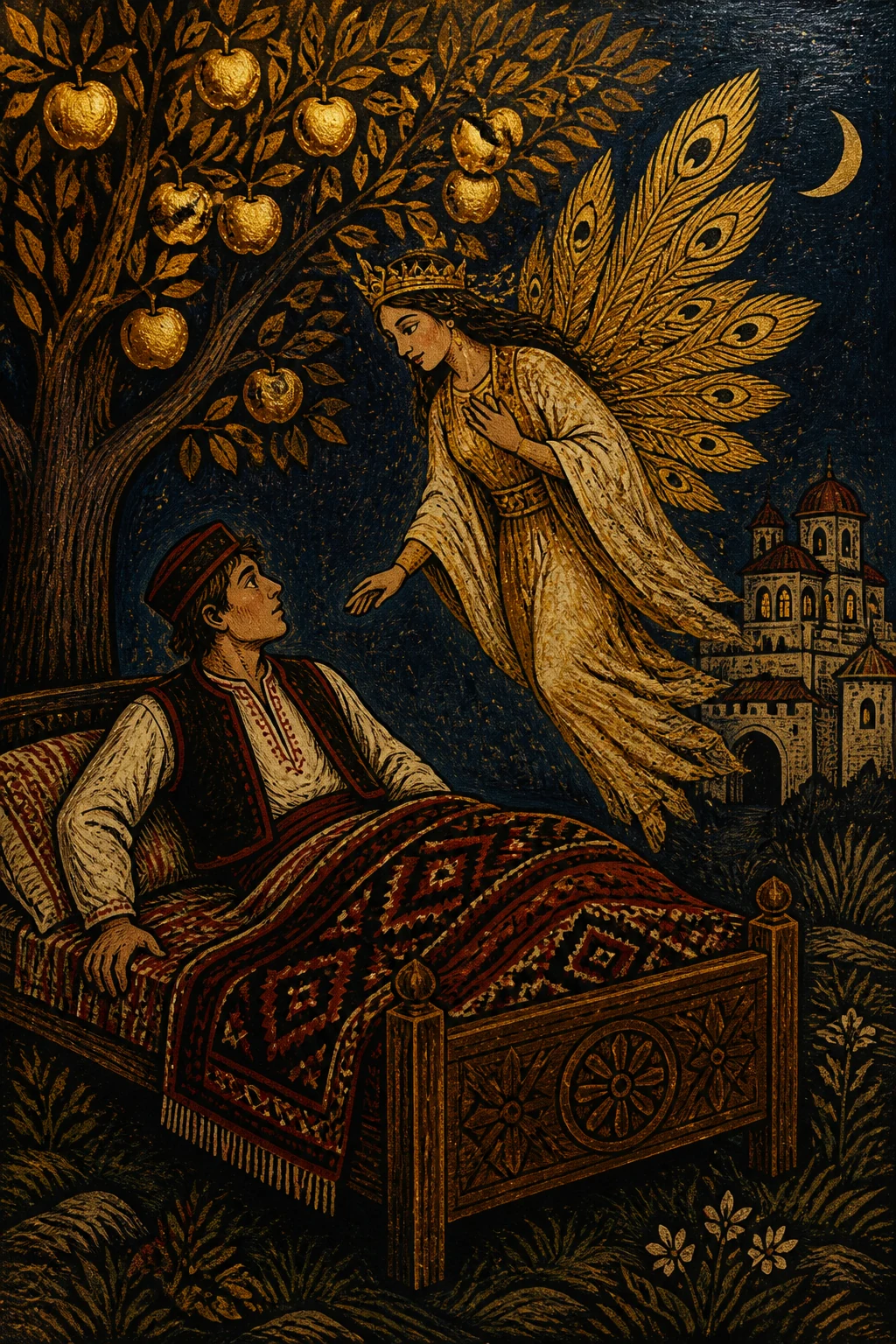
Once upon a time, as in no other time, there lived a great and mighty emperor. Beside his palace he had a beautiful garden, rich in flowers and laid out with extraordinary skill. No garden like it had ever been seen in those parts. At its far end stood an apple tree that bore golden apples, yet ever since he had owned it, the emperor had never tasted its ripe fruit. He would watch the blossoms open, the apples grow and begin to ripen, but just as they were ready, someone would come in the night and steal them. All the watchmen in the empire, and the finest soldiers the emperor had set to keep guard, had failed to catch the thief. At last the emperor’s eldest son came to him and said, “Father, I have grown up in your palace and walked through this garden so many times. I have seen the beautiful fruit on the tree at the far end, yet never once have I tasted it. Now that it is ripening, give me leave to keep watch these next few nights myself, and I promise to lay hands on the scoundrel who robs us.” “My dear boy,” his father said, “so many brave men have kept watch and accomplished nothing. Yet I long to see even one apple from this tree upon my table, after all the money it has cost me. So I shall give in and let you keep watch, though I can scarcely believe you will succeed.” And so the emperor’s son took up his watch for an entire week.
He watched by night and rested by day. But one morning he returned sorrowfully to his father and told him how he had stayed awake until midnight; how, after that, such a drowsiness had come over him that he could scarcely stand; how sleep had finally overcome him and he had fallen as though dead, unable to wake until the sun was two spear-lengths above the horizon; and how he had then seen that the apples were gone. His father’s sorrow on hearing this was beyond words. Willing or not, he had to wait another year to grant the wish of his middle son, who begged insistently to be allowed to keep watch in his turn, pledging that he would catch the thief who caused his father such grief. The time came, and the apples began to ripen. The middle son kept watch too, but fared just as his elder brother had. In despair, their father resolved to cut down the tree. But his youngest son, Praslea, came to plead with him and said, “Father, for so many years you have suffered so much trouble on account of this tree. Leave it standing this year too, I beg you, and let me try my luck.” “Away with you, foolish boy!” said the emperor. “Your elder brothers, and so many brave men accustomed to hardship, could do nothing, and now a mere stripling like you is going to succeed? Did you not hear the strange things your brothers told us? There must be some witchcraft at work here.” “I do not presume to say I shall catch the thief,” Praslea replied. “I only say that letting me try can do you no harm.” The emperor relented and left the tree standing for another year. Spring came, and the tree blossomed more beautifully and set more fruit than ever before. The emperor rejoiced at the beauty of its flowers and the abundance of its fruit, but when he thought that
this year too he would have no share of his golden apples, he regretted not having cut it down. Praslea often went into the garden, walking round the apple tree and turning over plans in his mind. At last the apples began to ripen. Then the emperor’s youngest son said, “Father, the day has come for me to keep watch too.” “Go,” said the emperor, “but you are sure to return in shame, just like your elder brothers.” “The shame will not be so great for me,” he replied, “for not only am I younger, but I have made no promise to catch the thief. I am only going to try.” When evening came, he took a book to read, two pointed stakes, his bow and his quiver of arrows, and went into the garden. He chose a place to keep watch in a corner near the tree, drove the stakes into the ground and settled between them, with one in front of him and the other behind, so that if he grew sleepy and nodded, his chin would strike the stake in front, and if his head fell backwards, the back of his neck would strike the one behind. In this way he kept watch until, one night, some time after midnight, he felt the dawn breeze brush softly against him, steeping him in its sweet scent, and a heavy drowsiness began to weigh upon his eyes. But the blows he received whenever he nodded woke him, and he remained watchful until, towards daybreak, a faint rustling sounded in the garden. Keeping his eyes fixed on the tree, he took up his bow and held himself ready. The rustling grew louder, and someone approached the tree and seized its branches. Praslea loosed one arrow, then another; and when he loosed the third, a groan came from beside the tree, followed by a deathly silence. As soon as there was a little light, he picked a few apples, laid them on a golden platter and carried them to his father. Never had the emperor felt greater joy than when he saw upon his table the golden apples he had never before tasted. “Now,” said Praslea, “let us look for the thief as well.” But the emperor was content to have held the golden apples in his hands.
he wanted nothing more to do with thieves. His son, however, was not so easily put off. Showing the emperor the trail of blood left on the ground by the wound he had given the thief, he said he would go in search of him and bring him before the emperor, even if he had to drag him out of a snake’s hole. The very next day he spoke to his brothers, asking them to go with him, follow the thief’s tracks, and catch him. His brothers had grown jealous of him because he had proved worthier than they, and were looking for a chance to do away with him; so they readily agreed to go. They made their preparations and set out. Following the trail of blood, they walked and walked until they reached a wilderness, where the trail vanished. They searched around a chasm and saw that the blood went no farther. Then they understood that the thief who stole the apples must live down in that abyss. But how were they to get down? They ordered windlasses and thick ropes to be brought at once, and everything was soon ready. They set the gear in place, and the eldest brother began to descend. “When I shake the rope,” he said, “pull me out.” And so they did. After the eldest brother, the middle brother went down and did just as the first had done, except that he let himself be lowered a little farther. “Now it is my turn to go down into the abyss,” said Prâslea, seeing how his elder brothers hung back. “When I shake the rope, lower me farther still; and when you see that the rope will go no farther down, set guards to watch it. When they see it moving and striking the sides of the pit, pull it up.” So the youngest brother too was lowered, and whenever he shook the rope, his brothers let him farther down. They lowered him and lowered him until they saw that the rope was no longer taut, as it is when something hangs from its end. Then the brothers took counsel together and said, “Let us wait and see whether he succeeds. Whatever happens, whether he does well or ill, we shall do away with him and be rid of a fellow who puts us to shame.” Prâslea reached the other realm and looked timidly about him. To his great wonder, he saw that everything was different there: the earth, the flowers, the trees were all of another kind. At first he was rather frightened, but he took courage, chose a road, and followed it until he came to a palace made entirely of copper. Not seeing a single soul whom he might ask about the place, he entered the palace to discover who lived there. At the threshold a beautiful maiden met him and said, “Thank God that I have lived to see another person from our own realm! How did you get here, brother?” she asked. “This is the domain of three zmeu brothers, who carried us away from our parents. We are three sisters, daughters of an emperor, from the realm you come from.” Then he briefly told her the whole story of the apples, how he had wounded the thief and followed the trail of blood to the pit through which he had descended to her, and he asked what sort of creatures these zmei were and whether they were mighty fighters. She told him that each of the zmei had chosen one of the sisters and was forever trying to force her to marry him. The sisters kept putting them off with all manner of excuses, demanding the moon and the sun, while the zmei went to any lengths to grant their every wish. “They are indeed mighty,” she added, “but, God willing, perhaps you will overcome them. Meanwhile, for pity’s sake, hide somewhere, so that the zmeu does not find you in his house. He has a terrible temper and will fly into a rage. It is nearly time for him to return to the palace. His custom is to throw his mace ahead of him from a stage’s journey away. It strikes the door, then the table, and hangs itself on its peg.” She had scarcely finished speaking when something whistled through the air, struck the door and the table, and there was the mace, settling itself on its peg. But Prâslea took it and hurled it back farther than the zmeu had thrown it; as it passed him, it struck him on the shoulders. Startled, the zmeu stopped in his tracks, looked after the mace, went to fetch it, and turned homeward. When he reached the gate, he began to shout, “Hum! Hum! I smell human flesh from the other realm!” Seeing the emperor’s son coming out to meet him, he said, “What wind has blown you here, man, to leave your bones in a foreign realm?” “I have come to catch the thieves who steal my father’s golden apples.” “We are the thieves,” said the zmeu. “How shall we fight? Shall we strike with maces, slash with swords, or wrestle?” “Let us wrestle, for that is the fairest fight,” Prâslea replied. So they grappled, and they struggled and struggled until the zmeu drove Prâslea ankle-deep into the earth. But Prâslea braced himself, swung the zmeu round, and dashed him down, driving him knee-deep into the ground; then he cut off his head. With tears in her eyes, the maiden thanked him for freeing her from the zmeu and begged him to take pity on her sisters too. After resting for a day or two, he followed her directions and set out for her middle sister, whose palace was of silver. There, as at the eldest sister’s, he was welcomed with joy. The maiden begged him to hide, but he refused. When the mace came to hang itself on its peg, thrown by her zmeu from two stages’ journey away, Prâslea hurled it much farther back and struck the zmeu on the head. The zmeu came home in a fury, wrestled with Prâslea as his elder brother had done, and met the same death. After thanking him, the maiden advised him how to free their youngest sister from captivity. “He is stronger than the brothers you have killed,” she said, “but with God’s help—and especially since he is still ailing from the arrow wound you gave him when he came to steal the apples—I hope you will get the better of him.” For a whole week they made merry together, Prâslea and the two maidens. Then, rested from his hardships, he set out for the third zmeu. At the sight of the golden palace where the youngest zmeu lived, he hesitated a little, but took heart and went inside. As soon as the maiden saw him, she begged him, as she would have begged God Himself, to save her from the zmeu, who, she said, was determined to force her to marry him as soon as he was fully recovered. She had scarcely finished speaking when the mace struck the door and the table and settled on its peg. Prâslea asked how strong the zmeu was, and she told him that he threw his mace from three stages’ journey away. Then Prâslea hurled it farther still, striking him in the chest. Burning with anger, the zmeu returned home at once. “Who has dared cross my borders and enter my house?” “I have,” said Prâslea. “If it is you,” the zmeu replied, “then I shall punish you bitterly for your recklessness. You came as you pleased, but you shall not leave as you please.” “With God’s help,” Prâslea answered, “I have a cure for you as well.” Then they agreed to settle the matter by wrestling, and they struggled and struggled, all through the long summer day until evening. Around noon they both turned into flames and fought in that form, while a raven circled above them, croaking. Seeing it, the zmeu said, “Raven, raven, bring some tallow in your claws and drop it on me, and I shall give you this carcass.” “Raven, raven,” Prâslea said in his turn, “if you drop tallow on me, I shall give you three carcasses.” “Would to God such good fortune might come my way! I could feed my whole household.” “My mouth speaks the truth,” Prâslea replied. Without further delay, the raven brought tallow in its claws and dropped it on brave Prâslea, who gained fresh strength. Toward evening, when they had become men again, the zmeu said to the emperor’s daughter, who stood watching them fight, “My beauty, give me a little water to cool myself, and I promise we shall be married tomorrow.” “My beauty,” Prâslea said too, “give me water, and I promise to take you back to our own realm, where we shall be married.” “May God hear your words, brave man, and grant your wish,” she answered. The emperor’s daughter gave Prâslea water to drink, and he grew stronger still. Then he caught the zmeu in his arms, lifted him high, and dashed him down, driving him knee-deep into the earth. The zmeu braced himself, lifted Prâslea in his turn, and threw him down, driving him into the ground up to his armpits. Gathering all his strength, Prâslea seized the zmeu once more, squeezing him until his bones cracked, swung him round, and hurled him down so fiercely that he sank into the earth up to his neck. Then he cut off his head. The maidens gathered joyfully around their deliverer, embraced and kissed him, and said, “From this day forward, you shall be our brother.” They then told him that each of the zmei’s palaces had a whip, and that if one struck the palace at its four corners with this whip, it would turn into an apple. They did so, and each maiden had an apple. Then they made ready to return to our own realm. When they reached the pit, Prâslea shook the rope so that it struck all the sides, and the guards above understood that they must pull it up. They took their places at the windlasses and drew up the eldest maiden with her copper apple. As soon as she reached the top, she showed them a letter Prâslea had given her, saying that she was to marry his eldest brother. Her joy was beyond words when she found herself once more in the world where she had been born. They lowered the rope again and drew up the middle sister, with her silver apple and another letter in which Prâslea gave her in marriage to his middle brother. Once more they lowered the rope and brought up the youngest maiden, who was Prâslea’s betrothed; but he did not give her the golden apple, keeping it himself. He had already sensed that his brothers wished him dead, and when the rope was lowered again to bring him up, he tied a stone to it and put his cap on top to test them. As soon as the brothers saw the cap, thinking it was their youngest brother, they loosened the windlasses and let the rope go. It plunged down so swiftly that they believed Prâslea had perished. They took the maidens back to the emperor and told him, with feigned sorrow, that their brother was dead. Then they married the two sisters, as Prâslea had arranged. But the youngest maiden would not marry on any account, nor would she accept any other man. Prâslea, who had stood to one side, saw the stone crash down and thanked God for saving his life. Then he began to wonder how he could get out. While he was brooding and lamenting his plight, he heard cries and wailing that filled his heart with pity. Looking about him, he saw a dragon coiled around a tree, climbing up to devour some griffin chicks. Prâslea drew his sword, rushed at the dragon, and in an instant cut it to pieces. When the chicks saw this, they thanked him and said, “Come here, brave man, and let us hide you. If our mother sees you, she will swallow you for joy.” They plucked a feather from one of the chicks and hid him inside it. When the mother griffin came and saw the great heap of dragon pieces, she asked the chicks who had done them this kindness. “Mother,” they said, “it was a man from the other realm, and he went that way, toward the east.” “I shall go and thank him,” she said. Off she flew like the wind in the direction the chicks had told her the man had taken. A few minutes later she returned. “Tell me truly,” she said, “which way did he go?” “Toward the west, Mother.” In as little time as it has taken me to tell you this, she searched the four corners of the lower realm and returned empty-handed. She demanded that they tell her at once. At last the chicks said, “If we show him to you, Mother, will you promise not to harm him?” “I promise, my darlings.” Then they took him out of the feather and showed him to her. In her joy she embraced him, and she would very nearly have swallowed him had the chicks not shielded him. “What kindness can I do you in return for saving my young from death?” “Take me up to the other realm,” Prâslea answered. “You have asked a difficult thing,” said the griffin. “But since I owe you my children’s lives, I agree. Prepare a hundred okas of meat, cut into pieces of one oka each, and a hundred loaves of bread.” Prâslea did as she asked, prepared the bread and meat, and brought them to the mouth of the pit. The griffin said, “Climb onto my back with all the provisions, and whenever I turn my head, give me a loaf of bread and a piece of meat.” He settled himself on her back, and off they went, with Prâslea giving her bread and meat whenever she asked. When they were very, very close to the upper world, the great bird turned her head once more to be fed, but the meat had run out. Without losing his presence of mind, Prâslea drew his sword, cut a piece of flesh from his thigh, and gave it to the griffin. After they reached the surface, she saw that Prâslea could not walk and said, “Were it not for the kindness you did me and my children’s pleading, I would almost have eaten you. I could tell that the last meat you gave me was sweeter than the rest, and I did not swallow it. You did wrong to give it to me.” Then she brought it up, put it back in its place, and smeared it with her spittle, and it joined to his body again. They embraced, thanked one another, and parted: she went back down into the abyss from which they had emerged, and Prâslea set out for his father’s empire. Dressed in coarse peasant clothes, he travelled toward the city where his parents and brothers lived. He met some wayfarers and learned from them that his brothers had married the maidens he had sent up, just as he had arranged, while his parents were deeply grieved by the loss of their youngest son. He also learned that the youngest maiden would not hear of marriage, though many emperors’ sons had sought her hand. Now, at last, his brothers had brought her a very handsome bridegroom, and everyone was pressing her to accept him; no one knew whether she would be able to escape the marriage. Hearing all this, Prâslea was deeply saddened, and he entered the city with a heavy heart. Making inquiries here and there, he learned that the maiden had told the emperor that, if he wished her to marry the young man they had brought, he must order a golden distaff, with tow and spindle all of gold, which would spin by itself, and have it brought to her among her treasures. The zmeu had made her such a thing, and she had loved it dearly. Prâslea also learned that the emperor had summoned the master of the silversmiths and commanded him, “Three weeks from today, you must have ready the distaff my youngest daughter asks for. If not, your head shall lie where your feet now stand.” The poor silversmith had returned home sorrowful and weeping. So Prâslea went to him and entered his service as an apprentice. Seeing his master forever lamenting because he could not make the distaff as commanded, Prâslea said, “Master, I see you are unhappy because you cannot make the distaff the emperor ordered. There are still three days before the time he allowed you runs out. Let me make it.” The silversmith scolded him. “So many great craftsmen have failed to make it, and a ragged fellow like you is going to do it?” “If I do not give you the distaff three days from now,” Prâslea answered, “you may do whatever you please with me.” Then they agreed that he should have a room where he could work alone, and that every night he should be given a little bag of hazelnuts and a glass of good wine. The silversmith worried about him, for when he listened at the door he heard nothing but the cracking of nuts on the anvil. But early on the third morning Prâslea came out of the room with the distaff on a tray. He had taken it from the zmeu’s apple, which he still had with him, and he gave it to the silversmith to carry to the emperor’s daughter. The silversmith was beside himself with joy and had a new suit of clothes made for Prâslea. Around noon, when the emperor’s servants came to summon him to the palace, he went and delivered the self-spinning distaff. After marvelling at its beauty, the emperor gave the silversmith two sacks of money. The moment the maiden saw the distaff, she felt as though a red-hot iron had pierced her heart. She recognized it and understood that brave Prâslea must have reached the upper world. Then she said to the emperor, “Father, whoever made this distaff can make one more thing that the zmeu brought me for my treasures.” The emperor immediately summoned the silversmith and commanded him to make a hen with chicks, all of solid gold, giving him three weeks and warning him that, if he failed, his head would lie where his feet now stood. As before, the silversmith went home sorrowful, and as before he scoffed at Prâslea when the young man questioned him. But once they had talked it over, they came to an agreement, and this task too was happily accomplished. When the silversmith saw the hen clucking and the chicks peeping, all of gold, and pecking at millet that was also gold, he understood that this must be enchanted workmanship. He took the hen to the emperor, who marvelled to his heart’s content at the beauty and delicacy of the creatures, then carried them to the maiden and said, “There, all your wishes have been granted. Now, my daughter, prepare for your wedding.” “Father,” she replied, “whoever made these two things must also have the zmeu’s golden apple. Please order the silversmith to bring the craftsman who made them.” On receiving this command, the silversmith appeared before the emperor and begged his pardon, saying, “How can I bring the craftsman before Your Majesty? He is a lowly, ragged man, unworthy to behold Your Majesty’s radiant face.” The emperor ordered him to bring the man, whatever he might be like. So the silversmith had Prâslea washed and cleaned, dressed him in new clothes, and brought him before the emperor, who presented him to the maiden. As soon as she saw him, she recognized him. Overcome with joy, she could not hold back her tears, and she said to the emperor, “Father, this is the brave man who saved us from the zmei.” Falling to her knees, she kissed his hands, both palms and backs. Looking closely at him, the emperor recognized him too, though he had changed greatly. He embraced him and kissed him a hundred times. But Prâslea denied who he was. At last, his heart softened by the entreaties of his father, his mother, and the maiden, who remained on her knees imploring him, he confessed that he was indeed their youngest son. Then Prâslea told them his whole story, explained how he had come back to the upper world, and showed them the zmeu’s golden apple. The emperor, filled with anger, summoned his two elder sons, but when they saw Prâslea, their courage failed them. The emperor asked Prâslea how they should be punished. Our brave young man said, “Father, I forgive them. Let their punishment come from God. We shall go out to the palace steps, and each of us shall shoot an arrow into the air. If any of us has done wrong, God will punish him.” And so they did. The three brothers went out into the courtyard before the palace and shot their arrows into the air. When the arrows fell, those of the elder brothers struck them squarely on the crown of the head and killed them, while the youngest brother’s fell harmlessly before him. After the elder brothers had been buried, a great wedding was held, and Prâslea married the youngest maiden. The whole empire rejoiced that God had brought the emperor’s youngest son home safe and sound, and everyone took pride in his valiant deeds. After his father’s death, he ascended the imperial throne and ruled in peace from that day to this, if they are still alive. I too passed that way and ate my fill and made merry at the wedding, where I had a piece of hard bread and a lame hare’s leg; then I mounted a saddle, and told you the tale just so.