Prevod
There was once a poor man and a poor woman who had nothing but a little hut and lived by fishing, from hand to mouth. One day, as the man sat by the water casting his net, he drew out a fish that was all of gold. As he gazed at it in wonder, the fish began to speak. “Listen, fisherman, if you throw me back into the water, I will turn your little hut into a splendid castle.” The fisherman answered, “What good is a castle to me if I have nothing to eat?” The golden fish went on, “That too shall be taken care of. There will be a cupboard in the castle, and whenever you unlock it, you will find dishes of the finest food inside, as much as you could wish for.” “If that is so,” said the man, “I can certainly do you this kindness.” “Yes,” said the fish, “but on one condition: you must never reveal to anyone in the world, whoever it may be, how your good fortune came about. If you speak a single word, it will all be gone.”
So the man threw the wondrous fish back into the water and went home. But where his hut had stood, there now stood a great castle. He could hardly believe his eyes. He went inside and found his wife dressed in fine clothes, sitting in a magnificent room. She was delighted and said, “Husband, how has all this come about so suddenly? It suits me very well.” “Yes,” said the man, “it suits me too, but I am terribly hungry as well. Give me something to eat first.” His wife said, “I have nothing, and I do not know where to find anything in this new house.” “Never mind that,” said the man. “I see a large cupboard over there. Just unlock it.” When she unlocked the cupboard, there stood cakes, meat, fruit, and wine, all looking wonderfully inviting. Then the woman cried joyfully, “What more could the heart desire?” They sat down and ate and drank together. When they had had their fill, the woman asked, “But, husband, where does all this wealth come from?” “Ah,” he answered, “do not ask me that. I must not tell you. If I reveal it to anyone, our good fortune will be gone again.” “Very well,” she said, “if I am not to know, then I have no wish to know.” But she did not mean it. The question gave her no peace by day or night, and she tormented and pestered her husband until at last, in his impatience, he blurted out that it all came from a wondrous golden fish he had caught and set free in return. No sooner were the words out than the beautiful castle and its cupboard vanished, and they were sitting once more in their old fisherman’s hut.
The man had to begin all over again and return to his trade of fishing. But as luck would have it, he caught the golden fish once more. “Listen,” said the fish, “if you throw me back into the water, I will give you the castle again, with its cupboard full of boiled and roasted meats. Only stand firm, and on no account betray who gave it to you, or it will all be lost again.” “I shall take care,” answered the fisherman, and threw the fish back into its waters. At home everything was restored to its former splendor, and his wife was overjoyed at their good fortune. Yet her curiosity still gave her no peace, and after a few days she began asking again how it had happened and how he had managed it. For a time the man said nothing, but at last she made him so angry that he burst out and revealed the secret. That very instant the castle vanished, and they were sitting in the old hut again. “Now look what you have done,” said the man. “We shall have to go hungry again.” “Ah,” said his wife, “I would rather do without the riches if I cannot know who they come from. Otherwise I can never be at peace.”
The man went fishing again, and after a time, sure enough, he drew out the golden fish for the third time. “Listen,” said the fish, “I see that I am always to fall into your hands. Take me home and cut me into six pieces. Give two to your wife to eat, two to your horse, and bury two in the earth, and you will be blessed for it.” The man took the fish home and did as it had told him. Now from the two pieces buried in the earth, two golden lilies grew; the horse gave birth to two golden foals; and the fisherman’s wife bore two children who were all of gold.
The children grew tall and handsome, and the lilies and horses grew along with them. Then the boys said, “Father, we mean to mount our golden steeds and set out into the world.” But he answered sorrowfully, “How shall I bear it if you go away and I do not know how you are faring?” They said, “The two golden lilies will stay here, and by them you can see how we fare. If they are fresh, we are well; if they wither, we are ill; if they fall, we are dead.” They rode away and came to an inn where there were many people, and when the people saw the two golden children, they began to laugh and mock them. When one of the brothers heard their jeers, he felt ashamed and no longer wished to venture into the world, so he turned back and went home to his father. The other rode on until he came to a great forest. As he was about to ride into it, the people said, “You cannot ride through there. The forest is full of robbers, and they will treat you badly. If they see that you and your horse are golden, they will surely kill you.” But he would not be frightened and said, “I must and shall go through.” So he took bearskins and covered himself and his horse with them, until none of the gold could be seen, and rode boldly into the forest. He had not gone far when he heard a rustling in the bushes and voices talking together. From one side came the cry, “Here comes someone!” But from the other came the answer, “Let him go. He is a bearskin fellow, as poor and bare as a church mouse. What use would he be to us?” So the golden child rode safely through the forest and came to no harm.
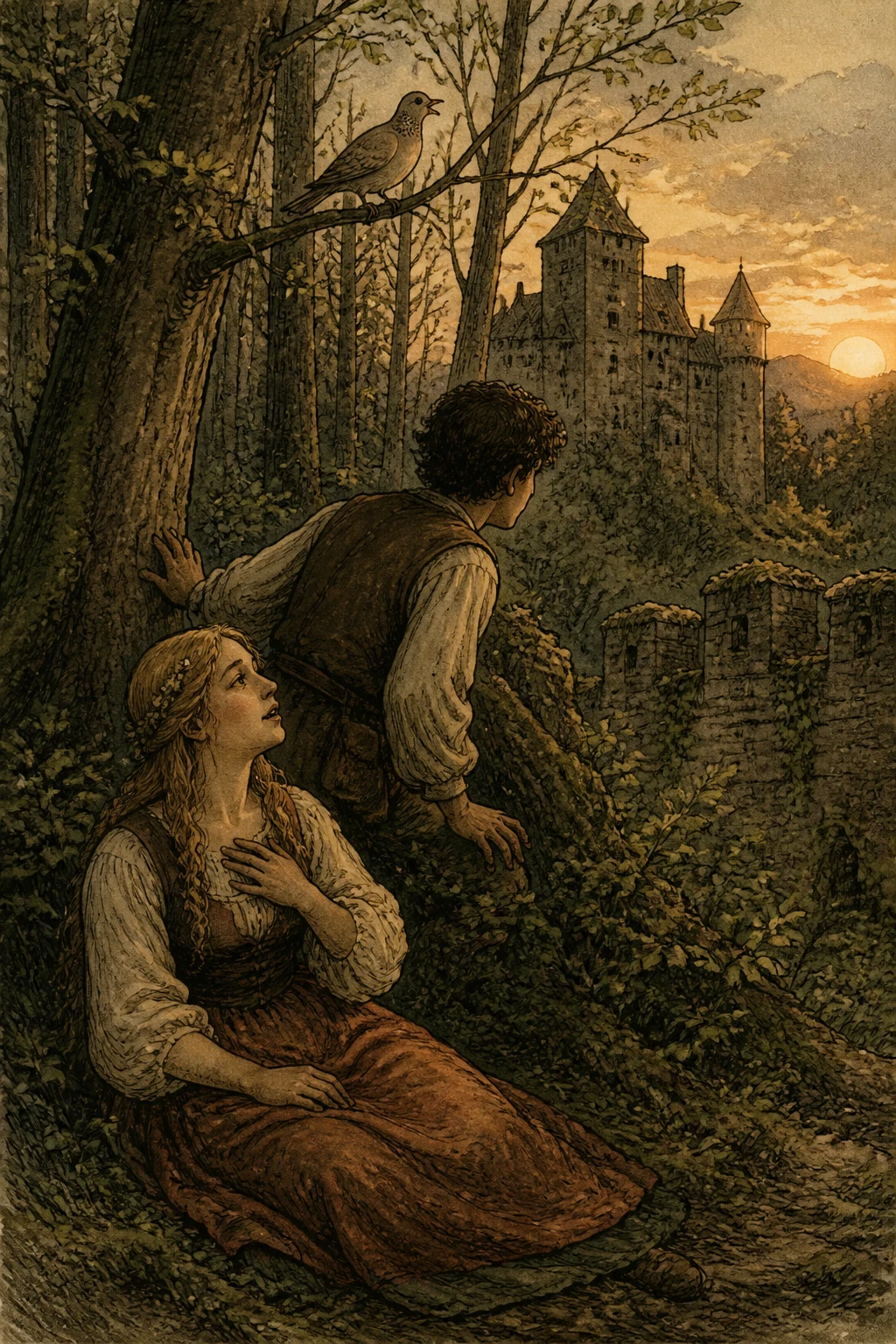
One day he came to a village, where he saw a maiden so beautiful that he could not believe there was a lovelier one in all the world. He felt such love for her that he went up to her and said, “I love you with all my heart. Will you be my wife?” The maiden liked him so well that she agreed, saying, “Yes, I will be your wife and remain true to you all my life.” So they celebrated their wedding, and just as their merriment was at its height, the bride’s father came home. When he saw that his daughter was holding her wedding, he was astonished and said, “Where is the bridegroom?” They pointed out the golden child, who was still wrapped in his bearskins. Then the father said angrily, “Never shall a bearskin fellow have my daughter!” and wanted to kill him. But the bride pleaded with him as earnestly as she could, saying, “He is my husband now, and I love him with all my heart,” until at last she soothed his anger. Yet he could not put the matter out of his mind, and early the next morning he rose to look at his daughter’s husband and see whether he was a common, ragged beggar. But when he looked, he saw a splendid golden man lying in the bed, with the discarded bearskins on the floor. Then he went away again, thinking, “How fortunate that I curbed my anger! I might have committed a dreadful crime.”
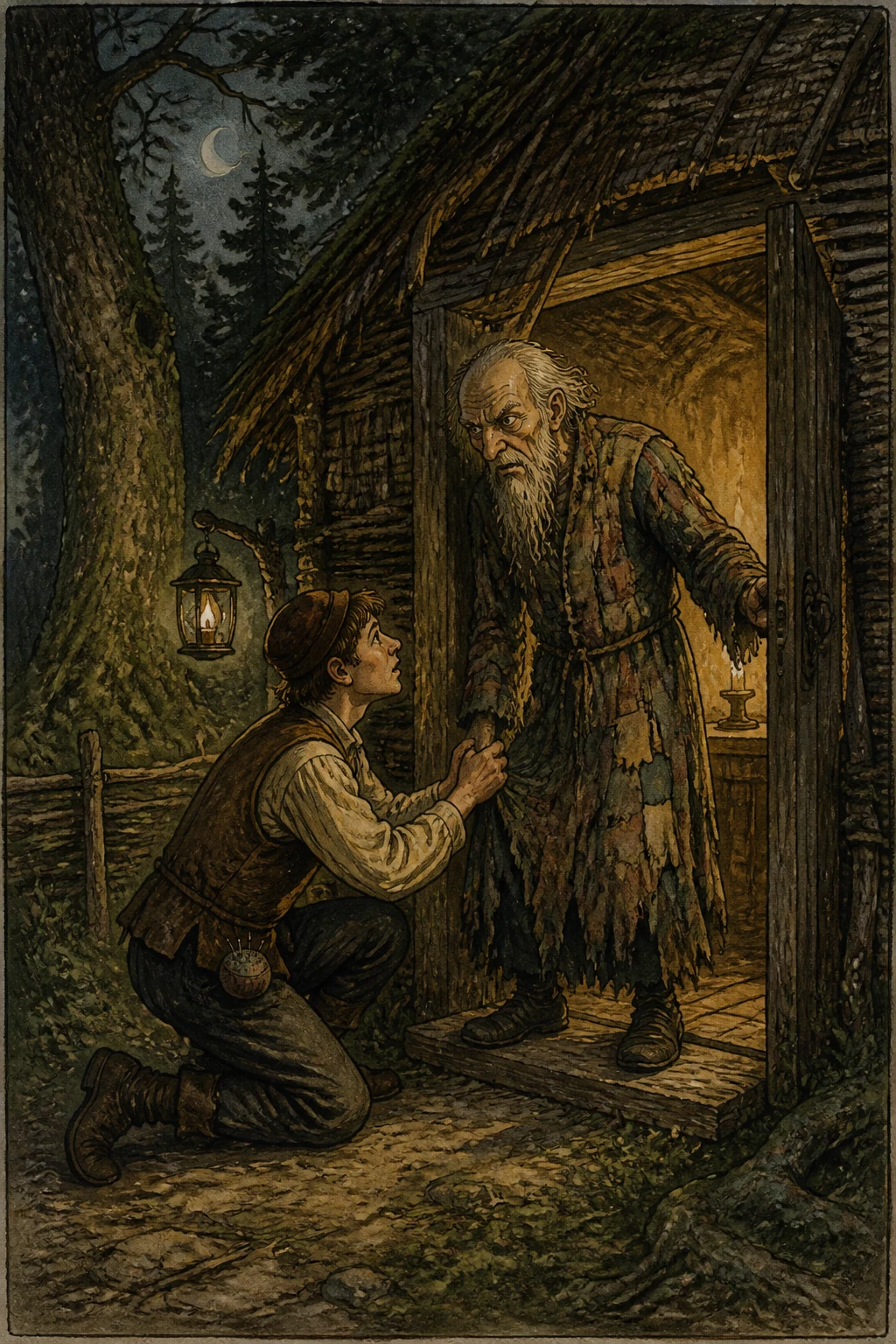
Now the golden child dreamed that he went out hunting a magnificent stag, and when he woke in the morning, he said to his bride, “I am going out hunting.” She was afraid and begged him to stay, saying, “Some terrible misfortune may easily befall you.” But he answered, “I must and shall go.” So he rose and went out into the forest, and before long a proud stag stood before him, just as in his dream. He took aim and was about to shoot, but the stag bounded away. He pursued it over ditches and through thickets, never tiring all day long, but in the evening the stag vanished before his eyes. When the golden child looked about him, he found himself in front of a little house where a witch lived. He knocked, and an old woman came out and asked, “What brings you into the depths of this great forest so late?” He said, “Have you seen a stag?” “Yes,” she answered, “I know the stag well.” Meanwhile, a little dog that had come out of the house with her barked fiercely at him. “Be quiet, you nasty toad,” he said, “or I shall shoot you dead.” Then the witch cried angrily, “What! You would kill my little dog?” And at once she transformed him, so that he lay there like a stone. His bride waited for him in vain and thought, “Surely the very thing I feared, that weighed so heavily on my heart, has come to pass.”
At home, the other brother was standing beside the golden lilies when suddenly one of them fell. “Oh, God,” he said, “some terrible misfortune has befallen my brother. I must go and see whether I can save him.” His father said, “Stay here. If I lose you too, what shall I do?” But he answered, “I must and shall go.” So he mounted his golden horse and rode away, and came to the great forest where his brother lay turned to stone. The old witch came out of her house and called to him, meaning to ensnare him too, but he would not go near her. Instead he said, “I shall shoot you down unless you bring my brother back to life.” Much against her will, she touched the stone with her finger, and at once he was restored to human life. The two golden children rejoiced to see one another again, kissed and embraced, and rode out of the forest together, one to his bride and the other home to his father. Then the father said, “I knew you had freed your brother, for the golden lily suddenly stood upright again and went on blooming.” And they lived happily and prospered to the end of their days.