Prevod
There was once a man who had three sons. The youngest was called Simpleton, and he was despised, mocked, and slighted at every turn. One day the eldest son decided to go into the forest to chop wood, and before he left, his mother gave him a fine pancake and a bottle of wine so that he would not go hungry or thirsty. When he reached the forest, he met a little old grey man, who wished him good day and said, "Give me a piece of the cake in your bag, and let me have a sip of your wine. I am so hungry and thirsty." But the clever son replied, "If I give you my cake and my wine, I shall have nothing left for myself. Be off with you!" He left the little man standing there and went on his way. When he began to chop down a tree, it was not long before he missed his stroke and the axe cut into his arm, so that he had to go home and have it bandaged. This, however, was the little grey man's doing.
Then the second son went into the forest, and his mother gave him a pancake and a bottle of wine, just as she had given the eldest. He too met the little old grey man, who asked for a piece of cake and a drink of wine. But the second son also answered quite sensibly, "Whatever I give you, I shall have to do without myself. Be off with you!" He left the little man standing there and went on his way. His punishment was not long in coming: after only a few strokes at the tree, he cut himself in the leg and had to be carried home.
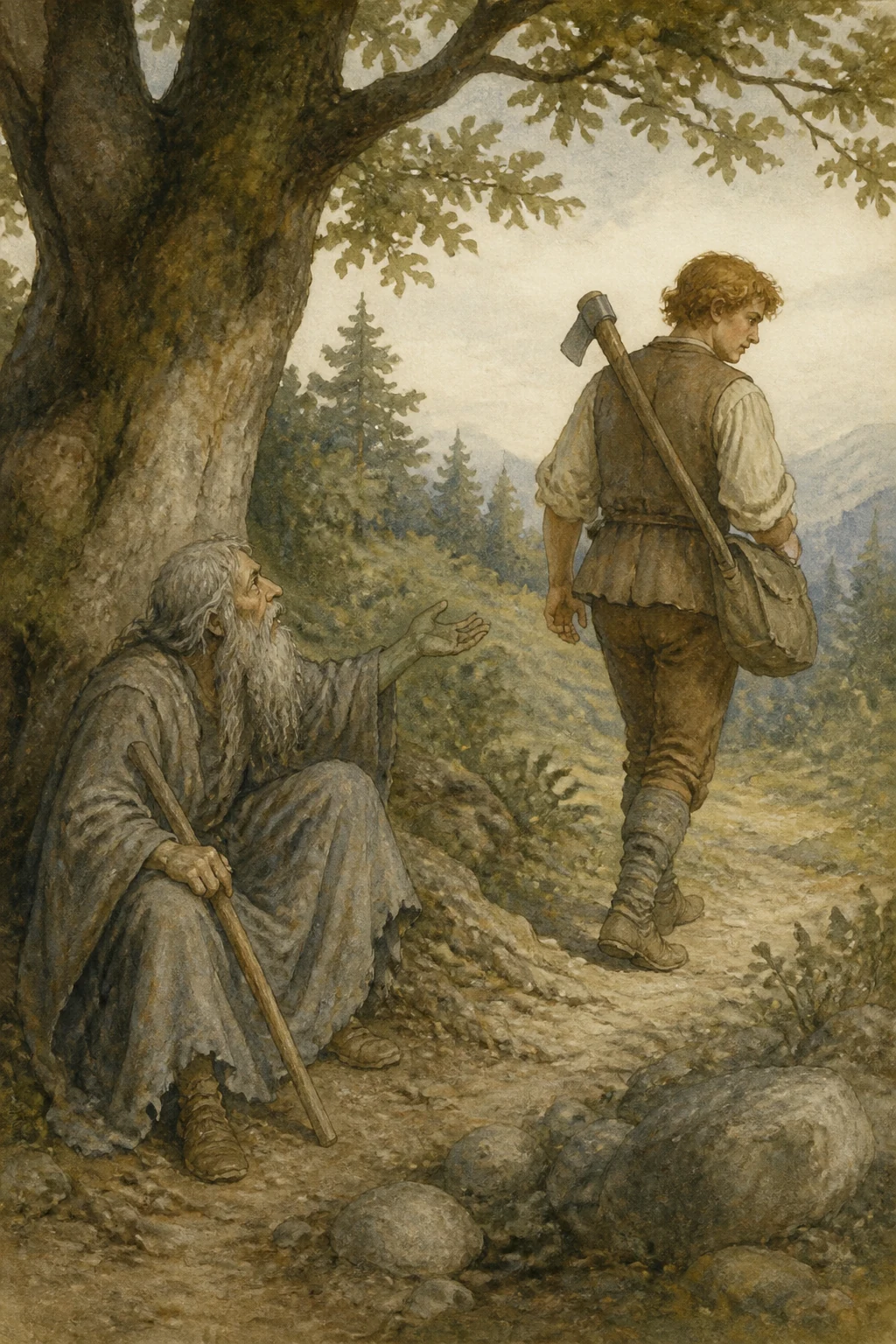
Then Simpleton said, "Father, let me go out and chop wood for once!" His father answered, "Your brothers have hurt themselves doing that. Leave it alone; you know nothing about it." But Simpleton kept begging until at last his father said, "Go, then. A little misfortune will teach you some sense." His mother gave him a cake made with water and baked in the ashes, and a bottle of sour beer to go with it. When he reached the forest, he too met the little old grey man, who greeted him and said, "Give me a piece of your cake and a drink from your bottle. I am so hungry and thirsty." Simpleton answered, "I have only ash-cake and sour beer, but if that will do, let us sit down and eat." So they sat down, and when Simpleton took out his ash-cake, it had become a fine pancake, and the sour beer had turned into good wine. They ate and drank, and afterwards the little man said, "Because you have a kind heart and gladly share what you have, I shall bring you good fortune. Over there stands an old tree. Cut it down, and you will find something among its roots." Then the little man took his leave.
Simpleton went and cut down the tree, and when it fell, there among its roots sat a goose with feathers of pure gold. He lifted it out, took it with him, and went to an inn, where he intended to spend the night. Now the innkeeper had three daughters, who saw the goose and were curious to know what sort of wonderful bird it was. They would dearly have liked one of its golden feathers. The eldest thought, "There is bound to be a chance for me to pluck out a feather." And when Simpleton had gone out for a while, she seized the goose by the wing, but her fingers and hand stuck fast to it. Soon afterwards the second daughter came in, thinking of nothing but getting a golden feather for herself; yet scarcely had she touched her sister than she too was stuck fast. At last the third came with the same intention. The others cried, "Keep away! For heaven's sake, keep away!" But she could not understand why she should stay away, and thought, "If they are there, I can join them." She hurried over, and as soon as she touched her sister, she stuck fast to her. And so they had to spend the night beside the goose.
The next morning Simpleton took the goose under his arm and went on his way, paying no heed to the three girls clinging to it. They had to keep running after him, to the left or the right, wherever his feet happened to lead him. In the middle of the fields they met the parson, and when he saw the procession, he said, "Shame on you, you wicked girls! What do you mean by running after that young fellow across the fields? Is that proper behaviour?" With that he took the youngest by the hand and tried to pull her back, but the moment he touched her, he too stuck fast and had to run along behind them. Before long the sexton came by and saw the parson following close on the heels of three girls. Astonished, he called out, "Why, Parson, where are you off to in such a hurry? Do not forget that we have a christening today." He ran up and caught him by the sleeve, but he too stuck fast. As the five of them trotted along in a line, two peasants came from the fields with their hoes. The parson called to them and begged them to free him and the sexton. But scarcely had they touched the sexton than they too were stuck fast, and now there were seven of them running after Simpleton and his goose.
At last he came to a town ruled by a king whose daughter was so solemn that no one could make her laugh. The king had therefore decreed that whoever could make her laugh should have her hand in marriage. When Simpleton heard this, he went before the princess with his goose and all its followers, and when she saw the seven people running along one behind the other, she burst out laughing and could not stop.
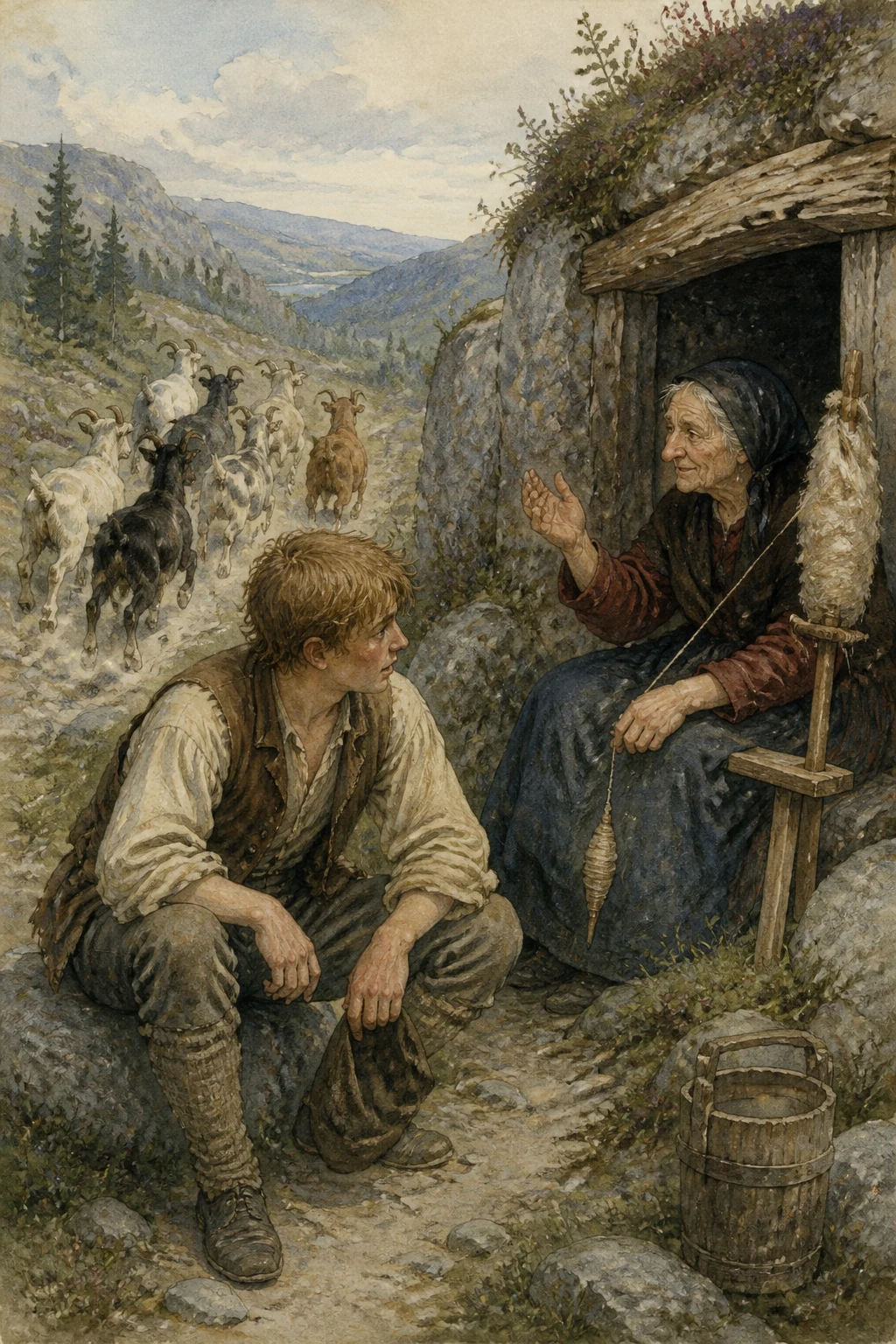
Then Simpleton asked for her as his bride, but the king did not like the prospect of such a son-in-law. He raised all manner of objections and said that Simpleton must first bring him a man who could drink a whole cellarful of wine. Simpleton thought of the little grey man, who might be able to help him, and went out into the forest. On the very spot where he had cut down the tree, he saw a man sitting with a most sorrowful face. Simpleton asked what was troubling him so deeply. The man answered, "I am so thirsty, and I cannot quench my thirst. I cannot bear cold water, and though I have emptied a whole barrel of wine, what is that but a drop on a hot stone?" "I can help you there," said Simpleton. "Just come with me, and you shall have all you want!" He led him to the king's cellar, and the man set to work on the great barrels, drinking and drinking until his sides ached. Before the day was out, he had drunk the whole cellar dry.
Simpleton asked once more for his bride, but the king was angry that a lowly fellow whom everyone called Simpleton should carry off his daughter, and he set a new condition: Simpleton must first find a man who could eat a mountain of bread. Simpleton did not hesitate, but went straight out into the forest. There, in the same place, sat a man tightening a strap around his waist. He wore a wretched expression and said, "I have eaten a whole ovenful of coarse bread, but what good is that when you are as hungry as I am? My stomach is still empty, and I must bind it tight if I am not to starve to death." Simpleton was delighted and said, "Get up and come with me. You shall have your fill!" He led him to the king's court, where the king had ordered all the flour in the kingdom to be brought together and made into an enormous mountain. The man from the forest stood before it and began to eat, and in a single day the whole mountain had vanished. For the third time, Simpleton demanded his bride. But the king sought yet another way out and demanded a ship that could travel both on land and on water. "As soon as you come sailing in it," he said, "you shall have my daughter for your wife." Simpleton went straight into the forest, and there sat the little old grey man with whom he had shared his cake. The little man said, "I have drunk and eaten for you, and I shall give you the ship as well. All this I do because you showed me kindness." Then he gave him the ship that could travel both on land and on water, and when the king saw it, he could no longer refuse him his daughter.
The wedding was celebrated, and after the king's death Simpleton inherited the kingdom and lived happily with his wife for many years.