Prevod
The first mendicant stepped forward and said to her, “My lady, know that the reason my beard is shaven and my eye is lost is this: my father was a king, and he had a brother who ruled over another city. As it happened, my mother gave birth to me on the very day my cousin was born. Years and months and days passed until we were grown. In some years I would visit my uncle and stay with him for several months. On one such visit, my cousin welcomed me with the greatest generosity: he slaughtered sheep in my honor, had clear wine prepared for me, and we sat down to drink. When the wine had gained mastery over us, my cousin said, ‘Cousin, I have an important favor to ask of you, and I want you not to oppose what I intend to do.’ I answered, ‘Gladly, and with all my heart.’
“He bound me by solemn oaths, then rose at once and went away for a little while. When he returned, a woman followed him, adorned and perfumed, wearing robes worth a great fortune. With the woman standing behind him, he turned to me and said, ‘Take this woman and go ahead of me to such-and-such a burial ground.’ He described it, and I knew the place. ‘Go into the tomb with her,’ he said, ‘and wait for me there.’ I could not disobey or refuse his request because of the oath I had sworn. So I took the woman and went with her into the tomb. We had scarcely settled ourselves when my cousin arrived, carrying a bowl of water, a sack of plaster, and a pickaxe. He took the pickaxe to a grave in the middle of the tomb, broke it open, and piled its stones to one side. Then he dug into the earth until he uncovered a trapdoor the size of a small door. Beneath it appeared a stone stairway. He turned to the woman, beckoned, and said, ‘There lies the way to what you desire.’ She went down the stairs. Then he turned to me and said, ‘Cousin, complete your kindness. When I have gone down into this place, replace the trapdoor and cover it with earth as it was before. That will crown your good deed. Here is plaster in this sack and water in this bowl: mix them together and plaster around the stones of the grave as they were before, so that no one will notice anything or say, “This has been freshly opened, though the inside is old.” I have spent a whole year working on it, and no one knows of it but God. This is the favor I ask of you.’ Then he said, ‘May God never deprive me of you, cousin,’ and went down the stairs.
“When he had vanished from sight, I rose, replaced the trapdoor, and did as he had instructed, until the grave looked just as it had before. Then I returned to my uncle’s palace. My uncle was away hunting. I slept there that night, but when morning came, I remembered the previous night and all that had passed between my cousin and me, and regretted what I had done, when regret could no longer help me. I went out to the burial ground and searched for the tomb, but could not recognize it. I kept searching until nightfall without finding it, then returned to the palace, neither eating nor drinking. My mind was troubled over my cousin, whose fate I did not know. I was overwhelmed with sorrow and spent the night grieving until morning. Then I went back to the burial ground, pondering what my cousin had done and regretting that I had obeyed him. I searched every tomb, but could not recognize the one I sought. For seven days I kept searching without finding any way to him, and my distress grew until I was almost mad. At last I could find no relief but to leave and return to my father. The moment I reached my father’s city, a band of men at the gate rushed at me and bound my arms behind my back. I was utterly astonished, for I was the son of the city’s ruler, and these men were my father’s servants and my own retainers. Great fear seized me, and I said to myself, ‘What can have happened to my father?’ I began asking those who had bound me why they had done so, but they gave me no answer. After a while, one of them, who had been my servant, said, ‘Fortune has turned against your father. His troops betrayed him, and the vizier killed him. We have been waiting for you to fall into our hands.’
“They took me away, scarcely aware of the world after the news I had heard of my father. I was brought before the vizier who had killed him. Now there was an old enmity between us, and this was its cause. I had been very fond of shooting clay pellets with a bow. One day, as I stood on the roof of my palace, a bird alighted on the roof of the vizier’s palace, where he too was standing. I aimed at the bird, but the pellet missed it and struck the vizier in the eye, destroying it, as fate and destiny had decreed. As the poet says:
“‘Let destiny do as it will, and be content with what fate has ordained. Neither rejoice nor grieve at anything, for nothing endures.’ And as another poet says:
“‘We have walked the steps appointed us; whoever has steps appointed him must walk them. And he whose death is destined in one land shall never die in any other.’” Then the mendicant continued, “When I destroyed the vizier’s eye, he could say nothing, for my father was king of the city. That was the cause of the enmity between us. When I stood before him with my arms bound, he ordered me beheaded. ‘Will you kill me when I have done no wrong?’ I asked. ‘What wrong could be greater than this?’ he answered, pointing to his ruined eye. ‘I did it by accident,’ I said. ‘If you did it by accident,’ he replied, ‘I shall do it to you on purpose.’ Then he said, ‘Bring him here before me.’ They brought me forward, and he thrust his finger into my left eye and destroyed it. From that day I have been one-eyed, as you see me now. Then he had me bound and put into a chest, and said to the executioner, ‘Take charge of this man. Draw your sword, carry him outside the city, kill him, and leave him for the wild beasts to devour.’ The executioner took me away and went on until we were outside the city. He drew me out of the chest, my hands bound and my feet fettered, and was about to blindfold me and kill me when I wept and recited these verses:
“‘I made you my stout armor, to ward off the arrows of my foes, but you became their arrowheads. In every calamity that struck my right hand, I hoped you would be its left. Leave the tale of my detractors aside, and let my enemies shoot their arrows at me. If my own soul cannot outwit its foes, then remain silent, neither against it nor for it.’ I also recited these verses:
“‘Brothers I took for shields—and shields they were, but for my enemies. I thought them arrows true of aim—and so they were, but in my heart. They said, “Our hearts are clear”—they spoke the truth, but clear of love for me. They said, “We have striven with all our might”—they spoke the truth, but for my ruin.’ When the executioner heard my verses—he had been my father’s executioner, and I had shown him kindness—he said, ‘My lord, what can I do? I am a servant under orders.’ Then he said, ‘Save your life, and never return to this land, or you will perish and bring me to ruin with you. As the poet says:
“‘Save your own life if you fear oppression, and leave the house to mourn the one who built it. For you may find another land in place of yours, but never another self to take your own place. I marvel at a man who lives in a land of humiliation when God’s earth stretches so far and wide. And he whose death is destined in one land shall never die in any other. Lions grew thick of neck only when they took their own affairs upon themselves.’ When he had said this, I kissed his hands and fled, scarcely believing I had escaped. The loss of my eye seemed a small thing now that I had been spared death. I traveled until I reached my uncle’s city, went in to him, and told him what had happened to my father and how I had lost my eye. He wept bitterly and said, ‘You have added sorrow to my sorrow and grief to my grief. Your cousin disappeared some days ago, and I do not know what has happened to him. No one has brought me any news of him.’ He wept until he fainted. When he came to himself, he said, ‘My son, I have grieved deeply for your cousin, and now what has happened to your father has added grief to my grief. Yet, my son, better your eye than your life.’
“I could no longer keep silent about my cousin, his son, and told him everything that had happened. My uncle was overjoyed to hear news of his son and said, ‘Show me the tomb.’ ‘By God, Uncle,’ I answered, ‘I do not know where it is. I went back many times afterward to search for it, but could not find it.’ Then my uncle and I went to the burial ground. I looked to the right and left, and recognized it. We were both filled with joy. We entered the tomb, cleared away the earth, lifted the trapdoor, and descended some fifty steps. When we reached the bottom of the stairs, smoke rose to meet us and clouded our sight. My uncle uttered the words whose speaker need have no fear: ‘There is no power and no strength save in God, the Most High, the Almighty.’ We went on and found ourselves in a hall filled with flour, grain, provisions, and other stores. In the middle of the hall we saw a curtain drawn over a bed. My uncle looked at the bed and found his son and the woman who had gone down with him, clasped in each other’s arms and burned to black charcoal, as though they had been cast into a pit of fire. At the sight, my uncle spat in his son’s face and said, ‘You deserve it, wicked wretch! This is your punishment in this world; the punishment of the next still awaits you, and it is harsher and more enduring.’” Dawn overtook Shahrazad, and she fell silent, leaving her tale untold.
Then, when it was the twelfth night,
She said, “It has reached me, O fortunate king, that the mendicant said to the young woman, while the company, the caliph, and Ja‘far listened: ‘Then my uncle struck his son with his slipper as he lay there, black as charcoal. I was astonished that he should strike him, and grieved for my cousin, who, with the young woman, had been reduced to charcoal. I said, “For God’s sake, Uncle, ease the sorrow in your heart. My mind and soul are troubled by what has happened to your son, and how he and the young woman came to be burned to charcoal. Is his present plight not enough for you, that you must strike him with your slipper?” He answered, “My brother’s son, from his earliest years this son of mine was infatuated with his sister. I used to forbid him to go near her, yet I would tell myself that they were only children. When they grew up, however, they committed an abomination together. I heard of it and would not believe it, but I rebuked him sternly and said, ‘Beware of these vile deeds, which no one before you has committed and no one after you will commit! Otherwise we shall live in shame and disgrace among kings until we die, and travelers will carry the tale of us far and wide. Take care never to do such things, or I shall turn against you in wrath and kill you.’ Then I kept him apart from her and her apart from him. But the wicked girl loved him passionately, and Satan had gained mastery over them both. When he saw that I had barred his way to her, he secretly made this underground place and brought in the provisions you see. He took advantage of my absence when I went out hunting and came here. But the True God—glorified and exalted be He—was jealous for His sacred bounds and burned them both. And the punishment of the next world is harsher and more enduring.” Then he wept, and I wept with him. “You are my son in his place,” he said to me.
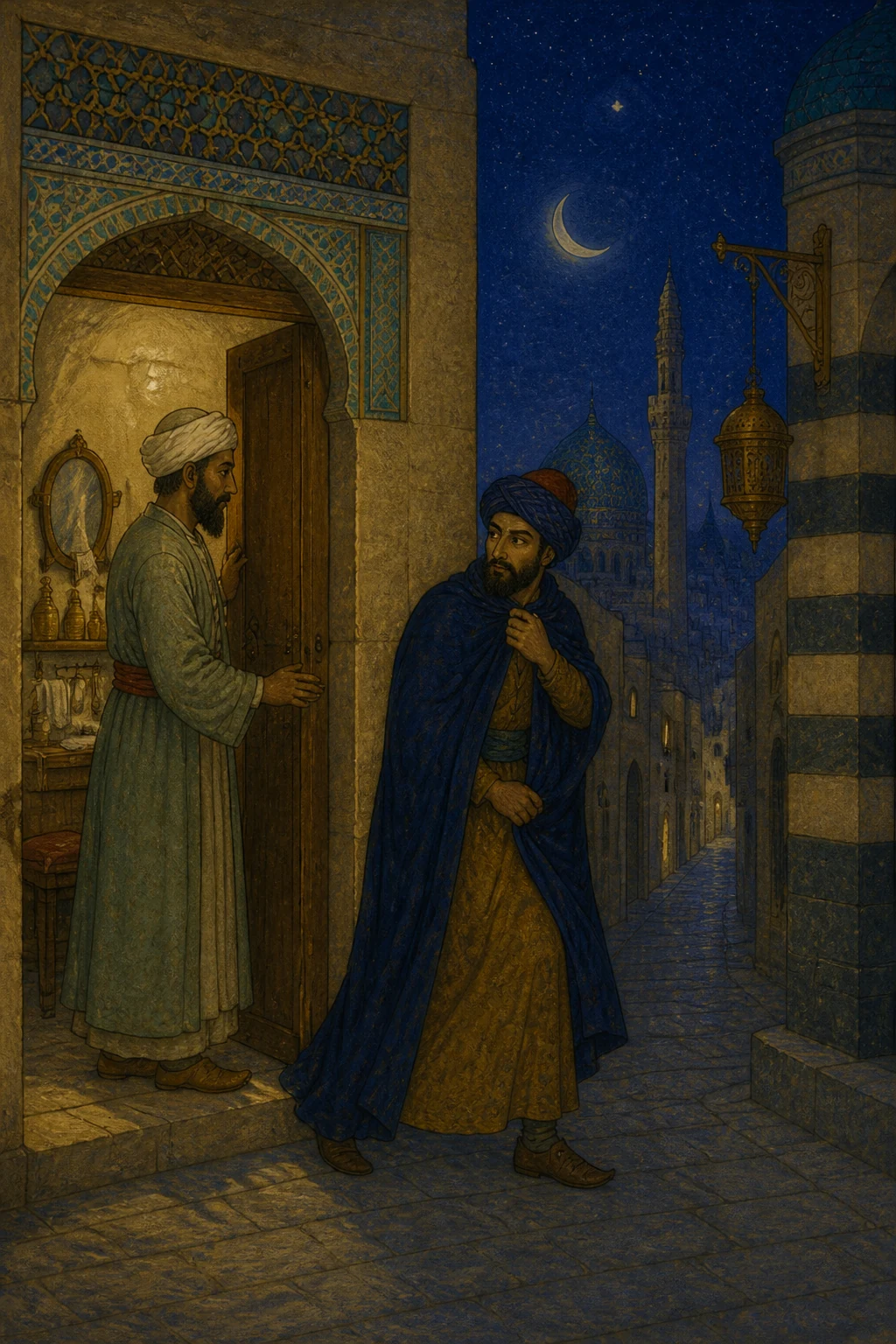
“‘For a while I reflected on the world and its calamities: the vizier’s murder of my father and seizure of his throne, the loss of my eye, and the strange fate that had overtaken my cousin. I wept. Then we went back up, replaced the trapdoor and the earth, and restored the grave to its former state. We returned to our palace, but had scarcely sat down when we heard the beating of drums and the blare of trumpets. Warriors charged, and the whole world filled with dust raised by the horses’ hooves. We were bewildered and did not know what had happened. The king asked for news, and was told, “Your brother’s vizier has killed him, mustered troops and soldiers, and come with his army to take the city by surprise.” The people of the city had no strength to resist him, and surrendered to him. I said to myself, “If I fall into his hands, he will kill me.” Sorrow upon sorrow overwhelmed me, and I remembered the calamities that had befallen my father and mother. I did not know what to do. If I showed myself, the people of the city and my father’s troops would recognize me and seek to kill and destroy me. I could see no means of escape except to shave my beard, so I shaved it, changed my clothes, and left the city. I made for this city, the Abode of Peace, hoping someone might bring me to the Commander of the Faithful, the caliph of the Lord of All Worlds, so that I could tell him my story and all that had happened to me. I reached this city tonight and stood bewildered, not knowing where to go, when I saw this mendicant standing nearby. I greeted him and said, “I am a stranger here.” “I too am a stranger,” he replied. While we were standing there, this third companion of ours came up, greeted us, and said, “I am a stranger here.” “We too are strangers,” we told him. We walked on, and darkness fell upon us. Fate led us to your door. That is the story of my shaven beard and my lost eye.’
“The young woman said, ‘Stroke your head and go your way.’ But he answered, ‘I shall not leave until I have heard the others’ stories.’ They marveled at his tale, and the caliph said to Ja‘far, ‘By God, I have never seen anything to equal what befell this mendicant.’”