Prevod
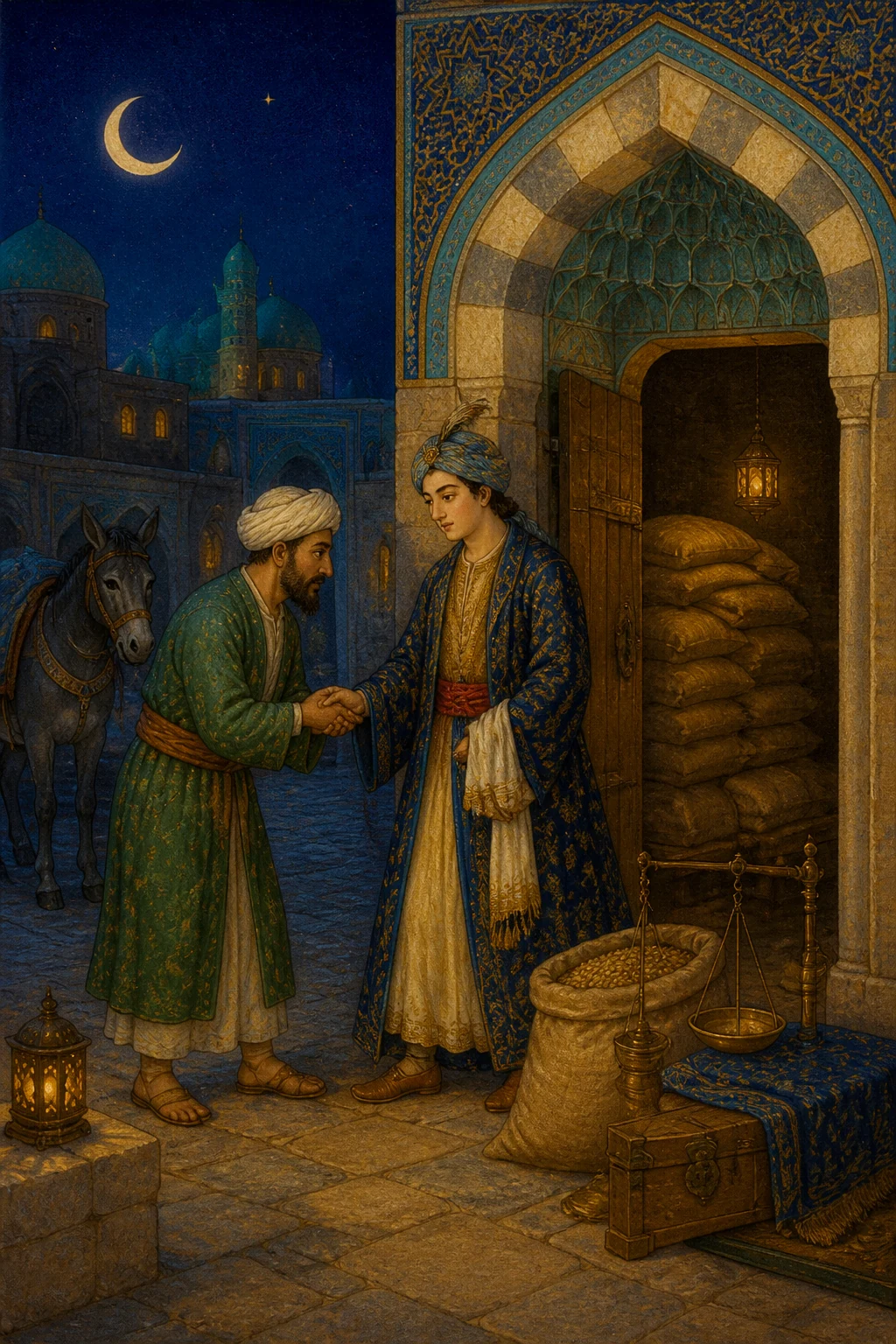
Yet this is no more wondrous than what befell the porter. He was a man of Baghdad, a bachelor who earned his living carrying loads. One day, as he stood in the market leaning against his basket, a woman stopped before him, wrapped in a mantle of Mosul silk embroidered with gold and edged on either side with gold brocade. She raised her veil, revealing dark eyes fringed with lovely lashes. Her limbs were delicate, her beauty flawless, and she said in a sweet voice, “Take up your basket and follow me.” The porter could scarcely believe his good fortune. He took his basket and followed her until she stopped at the door of a house and knocked. A Christian came down to her, and she gave him a dinar and took a quantity of olives, which she put in the basket. “Carry it and follow me,” she said. “By God,” said the porter, “this is a blessed day!” He shouldered the basket and followed her to a fruit seller’s stall, where she bought Syrian apples, Ottoman quinces, Omani peaches, Aleppine jasmine, Damascene water lilies, Nile cucumbers, Egyptian lemons, royal citrons, fragrant myrtle, henna blossoms, chamomile, anemones, violets, pomegranate blossoms, and wild roses. She put them all in the porter’s basket and said, “Carry it.” He lifted it and followed her until she stopped at a butcher’s and said, “Cut me ten pounds of meat.” He cut it for her, and she wrapped it in banana leaves, put it in the basket, and said, “Carry it, porter.” He lifted it and followed her. Next she stopped at a seller of nuts and dried fruits and took something of every kind, then told the porter, “Carry it and follow me.” He shouldered the basket and followed her to a confectioner’s shop, where she bought a platter and filled it with every sweet he had: latticed fritters, musk-scented stuffed pancakes, sabuniyya, lemon cakes, maymuniyya, comb-shaped pastries, finger pastries, and the little fried dumplings called “the judge’s morsels.” She piled all these varieties of sweets on the platter and put it in the basket. The porter said, “If you had told me, I would have brought a mule to carry all these things.” She smiled, then stopped at a perfumer’s shop, where she bought ten kinds of scented water, including rosewater, orange-blossom water, and willow water. She also took some sugar, a sprinkler of musk-scented rosewater, grains of frankincense, aloeswood, ambergris, musk, and Alexandrian candles. She put everything into the basket and said, “Take up your basket and follow me.”
He carried the basket after her until she reached a handsome house with a spacious courtyard before it, lofty walls, and firmly built foundations. Its double doors were of ebony plated with red gold. The young woman stopped and knocked gently, and both leaves of the door swung open. The porter looked at the woman who had opened it and saw a slender girl with firm, rounded breasts, lovely in face and form. Her forehead shone like the crescent moon, her eyes were a gazelle’s, her brows like the crescent of Ramadan, her cheeks like anemones, her mouth like Solomon’s seal, and her face as radiant as the full moon. Her breasts were a matching pair of pomegranates, and beneath her clothes her belly was folded as a scroll is folded over its writing. The sight of her robbed the porter of his senses, and the basket almost fell from his head. “Never in my life,” he said, “have I known a more blessed day.” From within the doorway, the young gatekeeper welcomed the shopper and the porter. They went on into a spacious and beautifully decorated hall, with alcoves, fountains, raised seats, curtained recesses, and cupboards screened by hanging draperies. In the middle stood a marble couch inlaid with pearls and jewels, over which hung a canopy of red satin. Within it sat a young woman with eyes that held the sorcery of Babylon, a figure straight as the letter alif, and a face that put the shining sun to shame. She seemed a radiant star or a noble Arabian lady, as the poet said of her:
“Whoever compares your figure to a tender bough makes that comparison a falsehood and a slander. A bough is fairest clothed in leaves, but you are fairest naked.” The third young woman rose from the couch and walked gracefully into the middle of the hall to join her sisters. “Why are you standing there?” she said. “Take the load from this poor porter’s head.” The shopper went before him and the gatekeeper behind, while the third helped them lower his burden. They emptied the basket, put everything in its proper place, gave the porter two dinars, and said, “Go your way, porter.” He looked at the girls, their beauty and their gracious ways, and thought he had never seen their equal. Yet there were no men with them. He looked at their wine, fruit, flowers, and all the rest, and was utterly astonished. He lingered instead of leaving. “Why don’t you go?” the young woman asked. “Do you think your wages too little?” She turned to her sister. “Give him another dinar.” “By God, my ladies,” said the porter, “my wage is only two half-dirhams. I am not dissatisfied with my pay. It is you who have captured my heart and my thoughts. How can you be here alone, without any men to keep you company? You know a minaret will stand only on four supports, and you have no fourth. Women’s pleasure is not complete without men, as the poet says:
“‘Look at the four things gathered here with me: a harp, a lute, a zither, and a flute.’ You are three, and you need a fourth: a man of wit and skill who knows how to keep a secret.” They replied, “We are young women, and we fear to entrust our secrets to someone who cannot keep them. We have read these verses in old accounts:
“‘Guard your secret from others; entrust it to no one. Whoever entrusts a secret has already lost it.’” When the porter heard this, he said, “By your lives, I am a sensible, trustworthy man. I have read books and studied histories. I reveal what is good and conceal what is shameful, and I follow the poet’s words:
“‘Only a trustworthy man can keep a secret; with the best of men a secret stays concealed. My secret is in a house secured with locks: its keys are lost, its door is sealed.’” When the girls heard his verses and his fine speech, they said, “You know we have spent a great deal of money on this gathering. Have you anything to contribute? We shall not let you sit with us unless you pay as much as we have, since you wish to join us, become our drinking companion, and gaze upon our fair and lovely faces.” The mistress of the house said, “Love without money is not worth a grain.” The gatekeeper said, “If you have nothing, go away with nothing.” But the shopper said, “Sisters, let us leave him be. By God, he has served us well today. Another man would never have been so patient with us. Whatever his share comes to, I shall pay it for him.” The porter was delighted. “By God,” he said, “the first money I earned today came from you.” “Sit down,” they told him. “You are most welcome.” The shopper rose, tucked up her clothes at the waist, arranged the bottles, strained the wine, and laid out the party beside the pool. She brought everything they needed, then served the wine and sat down with her sister. The porter sat among them, thinking himself in a dream. Then she brought forward the wine bowl, filled the first cup, and drank it, and did the same with the second and the third. She filled another and handed it to her other sister, then filled one for the porter. He took the cup from her and recited:
“Drink wine and win good health, for this drink is a cure for every ill.” He added this verse: “None drinks wine but one whose heart is glad, whom drunkenness raises to a higher joy.” After these verses he kissed their hands and drank with them. Then he moved beside the mistress of the house and said, “My lady, I am your slave, your servant, and your bondsman,” and recited:
“At your door stands one of your slaves, mindful of your generosity and kindness, and grateful.” She said, “Drink with pleasure, and may it flow through you in health.” He took the cup, kissed her hand, and sang the poet’s words:
“I offered her wine sparkling like her cheeks, red, with a glow like the light of a firebrand. I kissed her, and she said, laughing, ‘How can you give people’s cheeks to people to drink?’
“I said, ‘Drink, for it is made of my tears; its redness is my blood, and my breath is mingled with it in the cup.’” The young woman took the cup, drank, and moved beside her sister. They continued dancing and singing, enjoying the fragrant flowers, with the porter among them. He embraced and kissed them, while one spoke to him, another drew him towards her, and another playfully struck him with a bunch of flowers, until the wine began to work upon their senses. When drink had mastered them, the gatekeeper rose, stripped herself naked, and threw herself into the pool. She played in the water, filled her mouth, and squirted it at the porter. Then she washed her limbs and the place between her thighs, came out of the water, and flung herself into his lap. “My darling,” she said, pointing to her sex, “what is this called?” “Your womb—God have mercy on you,” said the porter. “Oh, oh! Have you no shame?” she cried. She caught him by the neck and began slapping him. “Your vulva,” he said. “Something else.” “Your cunt.” “Something else.” “Your hornet.” She went on slapping him until his neck and the back of his head were sore. At last he said, “Then what is it called?” “Basil of the bridges,” she told him. “Thank God we are safe at last, O basil of the bridges!” said the porter.
Then they passed the cups and bowls around, and the second woman rose, took off her clothes, and threw herself into the pool. She did as the first had done, then came out and flung herself into the porter’s lap. Pointing to her sex, she said, “Light of my eyes, what is this called?” “Your vulva,” he said. “Aren’t you ashamed to say such a thing?” she cried, and gave him a slap that rang through the hall. “Basil of the bridges,” he said. “No,” she answered, raining blows and slaps on the back of his neck. “Then what is it called?” he asked. “Hulled sesame,” she said.
Then the third rose, took off her clothes, and went into the pool. She did as the others had done, then dressed and threw herself into the porter’s lap. Pointing to her sex, she too asked, “What is this called?” He offered one name after another, until at last, as she struck him, he asked, “Then what is it called?” “Abu Mansur’s inn,” she replied. “Thank God we are safe at last, O Abu Mansur’s inn!” he said.
After a while the porter rose, stripped off his clothes, and went down into the pool, his cock floating in the water. He washed as they had washed, then came out and threw himself into the mistress’s lap, laying his arms in the gatekeeper’s lap and his legs in the shopper’s. He pointed to his prick and said, “My lady, what is this called?” They all laughed at his words until they fell onto their backs. “Your cock,” they said. “No.” And he took a bite from each of them. “Your prick,” they said. “No.” And he took an embrace from each. But dawn overtook Shahrazad, and she fell silent, leaving her permitted tale untold.
When it was the tenth night
Her sister Dunyazad said, “Sister, finish your story for us.” “With love and pleasure,” she replied. “It has reached me, O fortunate king, that they went on saying, ‘Your cock, your prick,’ while he kissed, bit, and embraced them, and they laughed together. At last they asked, ‘Then what is it called?’ He said, ‘It is called the bold mule, which grazes on basil of the bridges, feeds on hulled sesame, and spends the night at Abu Mansur’s inn.’ They laughed until they fell onto their backs, then returned to their drinking. They continued thus until night fell, when they said to the porter, ‘Off with you now, and let us see the breadth of your shoulders.’ ‘By God,’ he said, ‘it would be easier for my soul to leave my body than for me to leave you. Let us join night to day, and then each of us can go our own way.’ The shopper said, ‘By my life, let him sleep here with us, so we can laugh at him. He is a charming rogue.’ They told him, ‘You may stay the night on condition that you submit to our rule: whatever you see, you must not ask about it or its cause.’ ‘Agreed,’ he said. ‘Get up, then,’ they said, ‘and read what is written on the door.’ He went to the door and found written upon it in gold: ‘Do not speak of what does not concern you, lest you hear what does not please you.’ The porter said, ‘Bear witness that I shall not speak of what does not concern me.’
“Then the shopper rose and prepared food, and they ate. They lit candles and burned aloeswood, and sat eating and drinking. Presently they heard a knock at the door, but it did not disturb their merriment. One of the women went to the door, then returned and said, ‘Our pleasure tonight is now complete. At the door I found three foreigners with shaven beards, all three blind in the left eye—what an extraordinary coincidence! They are strangers newly arrived from the land of Rum, and each has a comical appearance. If they come in, we shall have some fun with them.’ She continued coaxing her two companions until they said, ‘Let them in, but make it a condition that they do not speak of what does not concern them, lest they hear what does not please them.’ Delighted, she went out and returned with the three one-eyed men. Their beards were shaven and their moustaches twisted into fine points; they were wandering dervishes. They greeted the company and stood back, but the girls rose to receive them and offered them seats. The three men looked at the porter and saw that he was drunk. Taking him for one of their own, they said, ‘He is a dervish like us; he will keep us company.’ When the porter heard this, he rose, rolled his eyes, and said, ‘Sit down and mind your own business. Haven’t you read what is on the door?’ The girls laughed and said to one another, ‘What fun we shall have between the dervishes and the porter!’
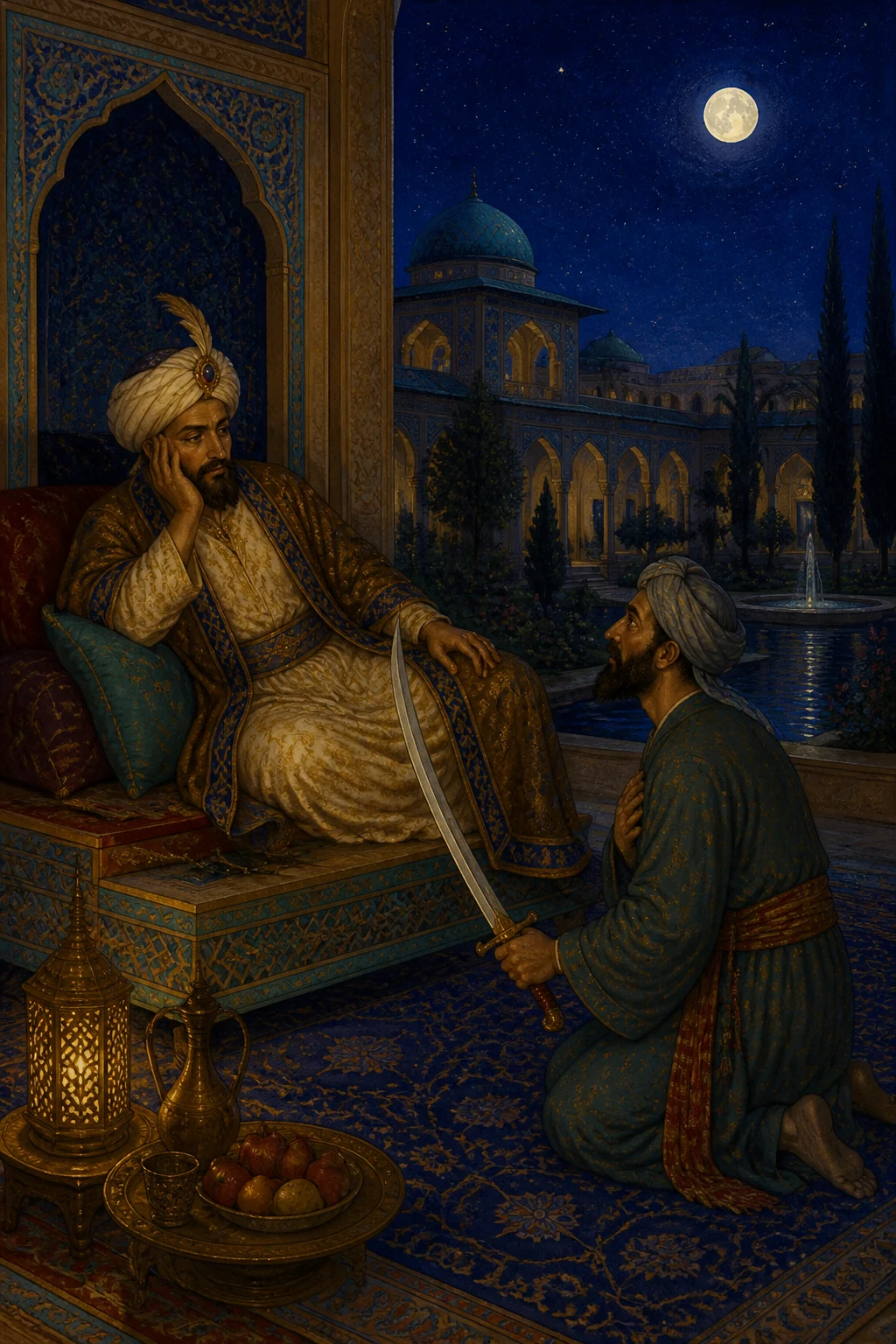
“They set food before the dervishes, who ate and then sat drinking with the others, while the gatekeeper served them. When the cup had gone round, the porter said, ‘Brothers, have you a story or an amusing tale to entertain us?’ As their spirits warmed, they asked for musical instruments. The gatekeeper brought them a Mosul tambourine, an Iraqi lute, and a Persian harp. The dervishes stood up, one taking the tambourine, another the lute, and the third the harp. They played while the girls sang, and the sound rose loud. As they were enjoying themselves, someone knocked at the door, and the gatekeeper rose to see who was there. The reason for this knocking was that the caliph Harun al-Rashid had gone out that night to see and hear what news there was, accompanied by his vizier Ja‘far and Masrur, the executioner who carried out his wrath. It was his custom to disguise himself as a merchant. As they walked through the city that night, their way brought them past the house, and they heard the music. The caliph said to Ja‘far, ‘I wish to enter this house and see who is making these sounds.’ Ja‘far replied, ‘These people are drunk, and I fear some harm may come to us from them.’ ‘We must go in,’ said the caliph. ‘I want you to devise some means of gaining us entrance.’ ‘I hear and obey,’ said Ja‘far. He went forward and knocked. When the gatekeeper opened the door, he said, ‘My lady, we are merchants from Tiberias. We have been in Baghdad for ten days with our merchandise and are lodging at the merchants’ inn. This evening a merchant invited us to his house. He served us food, and we ate, then spent an hour drinking with him before he gave us leave to depart. We went out into the night, but as we are strangers, we lost our way to the inn where we are staying. We beg your kindness to admit us for the night and let us sleep here. May you be rewarded for it.’
“The gatekeeper looked at them and saw that they had the appearance of merchants and bore themselves with dignity. She went in and consulted her companions, who said, ‘Let them in.’ She returned and opened the door. ‘May we enter with your permission?’ they asked. ‘Come in,’ she said. The caliph, Ja‘far, and Masrur entered, and the girls rose to receive and attend to them. ‘A warm welcome to our guests,’ they said. ‘We have one condition: you must not speak of what does not concern you, lest you hear what does not please you.’ They agreed, then sat down to drink and converse. The caliph looked at the three dervishes and saw that all were blind in the left eye, which astonished him. Then he looked at the girls and was bewildered by their loveliness and beauty. They continued drinking and talking, and wine was brought to the caliph, but he said, ‘I have made the pilgrimage,’ and sat apart from the others. The gatekeeper rose and set an ornamented table before him, placing on it a porcelain bowl. Into this she poured willow water, dropped a piece of ice, and mixed in sugar. The caliph thanked her, thinking, ‘Tomorrow I must reward her for this kindness.’
“They went on with their drinking, and when the wine had mastered them, the mistress of the house rose and attended to them. Then she took the shopper by the hand and said, ‘Sister, rise, and let us discharge our debt.’ ‘Yes,’ she replied. The gatekeeper rose, cleared the middle of the hall, and moved the dervishes back beyond the doorways facing them. Then the women called to the porter. ‘How little affection you show us! You are no stranger now, but one of the household.’ He rose, tucked up his clothes at the waist, and asked, ‘What do you want?’ ‘Stay where you are,’ she said. Then the shopper rose and said to him, ‘Help me.’ He saw two black bitches with chains around their necks. He took them and brought them into the middle of the hall. The mistress of the house rose, bared her forearms, took a whip, and told him, ‘Bring one of them forward.’ He drew her forward by the chain. The bitch wept and shook her head at the young woman, who began striking her on the head. The bitch howled, but she went on beating her until her arms grew weary. Then she threw down the whip, clasped the bitch to her breast, wiped away her tears, and kissed her head. ‘Take her back and bring the other,’ she told the porter. He brought the second, and she treated her as she had the first. At this the caliph’s heart was troubled and his breast tightened. He signalled to Ja‘far to question her, but Ja‘far motioned to him to remain silent.
“Then the mistress of the house turned to the gatekeeper and said, ‘Rise and discharge what you owe.’ ‘Yes,’ she replied. The mistress mounted a marble couch plated with gold and silver and said to the gatekeeper and the shopper, ‘Bring what you have.’ The gatekeeper seated herself on a couch beside her, while the shopper went into a chamber and brought out a satin bag with green fringes. Standing before the mistress of the house, she shook out the bag and took a lute from it. She tuned its strings and sang these verses:
“‘Restore to my eyelids the sleep that was stolen, and tell me where my reason has gone. When I chose love for my dwelling, I knew sleep had taken offence at my eyes. They said, “We knew you as a man of good sense. What led you astray?” I said, “Seek the cause in his glance.” I beg his pardon for my spilled blood, saying, “I have put him to the trouble of shedding it.” He cast the sun of his beauty into the mirror of my thoughts, and its reflection kindled fire within me. God fashioned him from the water of life, and let what remained run cool and sweet between his teeth. What do you think of a lover who, whenever you are named, complains or weeps, yearns or rejoices? When he would drink, he sees your image in the clear water and is refreshed before he has drunk.’ She also sang:
“‘I am drunk with his glance, not his wine; my eyes droop in sleep at his swaying grace. It is not the wine that consoles me, but his cheeks; not the vintage that steals my senses, but his charms. The curls twisted at his temples have twisted my resolve, and what his robes conceal has carried off my reason.’ When the young woman heard this, she said, ‘May God gladden you!’ Then she tore her clothes and fell to the floor unconscious. As her body was exposed, the caliph saw the marks of rods and whips upon it and was utterly astonished. The gatekeeper rose, sprinkled water on her face, brought her a fresh robe, and dressed her in it. The caliph said to Ja‘far, ‘Do you not see this woman and the marks of beating upon her? I cannot keep silent about this. I shall have no peace until I learn the truth of this girl’s story and the story of those two bitches.’ Ja‘far replied, ‘My lord, they imposed a condition upon us: we must not speak of what does not concern us, lest we hear what does not please us.’ Then the shopper rose, took the lute, rested it against her breast, touched the strings with her fingertips, and sang:
“‘If we complain of love, what will you say? If we perish of longing, what remedy is there? If we send messengers to speak for us, no messenger can convey a lover’s grief. If we endure, little life remains to us after the loss of those we love. There is nothing but regret, then sorrow, and tears flowing down our cheeks. You who are absent from my sight still dwell within my heart. Have you kept faith, in absence, with a lover who will never turn from you? Or, in your distance, have you forgotten one whom grief for you has wasted and made thin? When resurrection gathers us together, I shall ask our Lord to make the reckoning long.’ When the second woman heard the shopper’s song, she tore her clothes as the first had done, screamed, and threw herself to the floor unconscious. The shopper rose, sprinkled water on her face, and dressed her in another robe. Then the third woman rose, sat on a couch, and said to the shopper, ‘Sing to me, so that I too may discharge my debt. Only this song remains.’ The shopper tuned the lute and sang these verses:
“‘How long must this coldness and estrangement last? Enough tears have flowed from my eyes. How long you have deliberately kept me far from you! If you meant to please my envier, he is well satisfied. If treacherous time were ever fair to lovers, it would never favour those who blame them. To whom shall I reveal my longing, O you who slay me? How hopeless the complaint when faithfulness is gone! My passion for you only deepens into yearning; when have you ever made a promise that I have not seen you break? O Muslims, avenge a lover whose eyes have grown accustomed to wakefulness and never sleep! Is it lawful in the faith of love that I should be abased while another is honoured with union? I have delighted in the burden of loving you, while my reprover labours to condemn my love.’ When the third woman heard the poem, she screamed, tore her clothes, and fell to the floor unconscious. As her body was exposed, the same marks of beating with rods appeared upon it as on the woman before her. The dervishes said, ‘Would that we had never entered this house and had spent the night on the rubbish heaps instead! Our night here has been spoiled by something that breaks the back.’ The caliph turned to them. ‘Why is that?’ he asked. ‘Our minds are troubled by this affair,’ they said. ‘Are you not members of this household?’ asked the caliph. ‘No,’ they replied. ‘We thought this place belonged to the man beside you.’ The porter said, ‘By God, I never saw this place before tonight. Would that I had slept on the rubbish heaps rather than here!’ They all said, ‘We are seven men, and they are only three women, with no fourth to help them. Let us question them about their circumstances. If they will not answer willingly, they shall answer by force.’ They agreed on this, but Ja‘far said, ‘This is no wise plan. Leave them alone. We are their guests, and they imposed a condition which we should honour. Little of the night remains; then each of us can go his own way.’ He signalled to the caliph and said, ‘Only an hour remains. Tomorrow you can summon them before you and question them about their story.’ But the caliph refused. ‘I can wait no longer to learn their story,’ he said. Much talk and argument passed among them. Then they asked, ‘Who shall question them?’ Someone said, ‘The porter.’ The women asked, ‘What are you all talking about?’ The porter rose and said to the mistress of the house, ‘My lady, I ask you by God, and adjure you in His name, to tell us about the two bitches. Why do you punish them, then weep over them and kiss them? And tell us why your sister has been beaten with rods. That is our question, and no more.’
“The mistress of the house said to the company, ‘Is what he says truly your wish?’ They all answered yes, except Ja‘far, who remained silent. When the young woman heard their answer, she said, ‘By God, our guests, you have grievously wronged us. We warned you beforehand that whoever spoke of what did not concern him would hear what did not please him. Was it not enough that we admitted you to our house and fed you with our food? Yet the fault is not yours, but hers who brought you to us.’ Then she bared her forearms, struck the floor three times, and cried, ‘Quickly!’ A cupboard door opened, and seven slaves emerged with drawn swords in their hands. ‘Bind these chatterers’ arms behind their backs,’ she said, ‘and tie them to one another.’ They did so, then said, ‘Lady, give us leave to strike off their heads.’ ‘Grant them a little time,’ she replied, ‘so that I may ask about their circumstances before you strike off their heads.’ The porter said, ‘For God’s sake, my lady, do not kill me for another’s offence. All of them did wrong and shared in the sin except me. By God, ours would have been a pleasant night had we been spared these dervishes, who would lay a flourishing city waste if they entered it.’ Then he recited:
“‘How fair is pardon from one who has power, especially for one who has no defender! By the affection that lies between us, do not kill the first for the last.’” When the porter finished speaking, the young woman laughed. But dawn overtook Shahrazad, and she fell silent, leaving her permitted tale untold.
When it was the eleventh night
She said, “It has reached me, O fortunate king, that when the young woman laughed after her anger, she turned to the company and said, ‘Tell me your stories, for you have only an hour left to live. If you were not men of rank, leaders of your people, or rulers, I would have hastened your punishment.’ The caliph said, ‘Confound you, Ja‘far! Tell her who we are, or she will kill us.’ ‘It is only part of what we deserve,’ Ja‘far replied. ‘This is no time for jesting,’ said the caliph. ‘Jest and earnest each have their proper time.’ Then the young woman turned to the dervishes and asked, ‘Are you brothers?’ ‘No, by God,’ they said. ‘We are merely poor men who have fallen into the barber’s hands.’ She asked one of them, ‘Were you born blind in one eye?’ ‘No, by God,’ he replied. ‘An extraordinary thing befell me when I lost my eye. Its story, if written with needles upon the inner corners of the eyes, would be a lesson to all who take heed.’ She questioned the second and the third, and they gave the same answer as the first. Then they said, ‘Each of us comes from a different country, and our tales are wondrous and our adventures strange.’ The young woman turned to them and said, ‘Let each of you tell his story and explain what brought him to our house. Then he may stroke his head and go his way.’ The first to come forward was the porter. ‘My lady,’ he said, ‘I am a porter. This shopper hired me to carry her purchases and brought me here. What happened between us happened, and that is my story, no more.’ ‘Stroke your head and go,’ she told him. ‘By God,’ he said, ‘I shall not leave until I have heard my companions’ stories.’”