Prevod
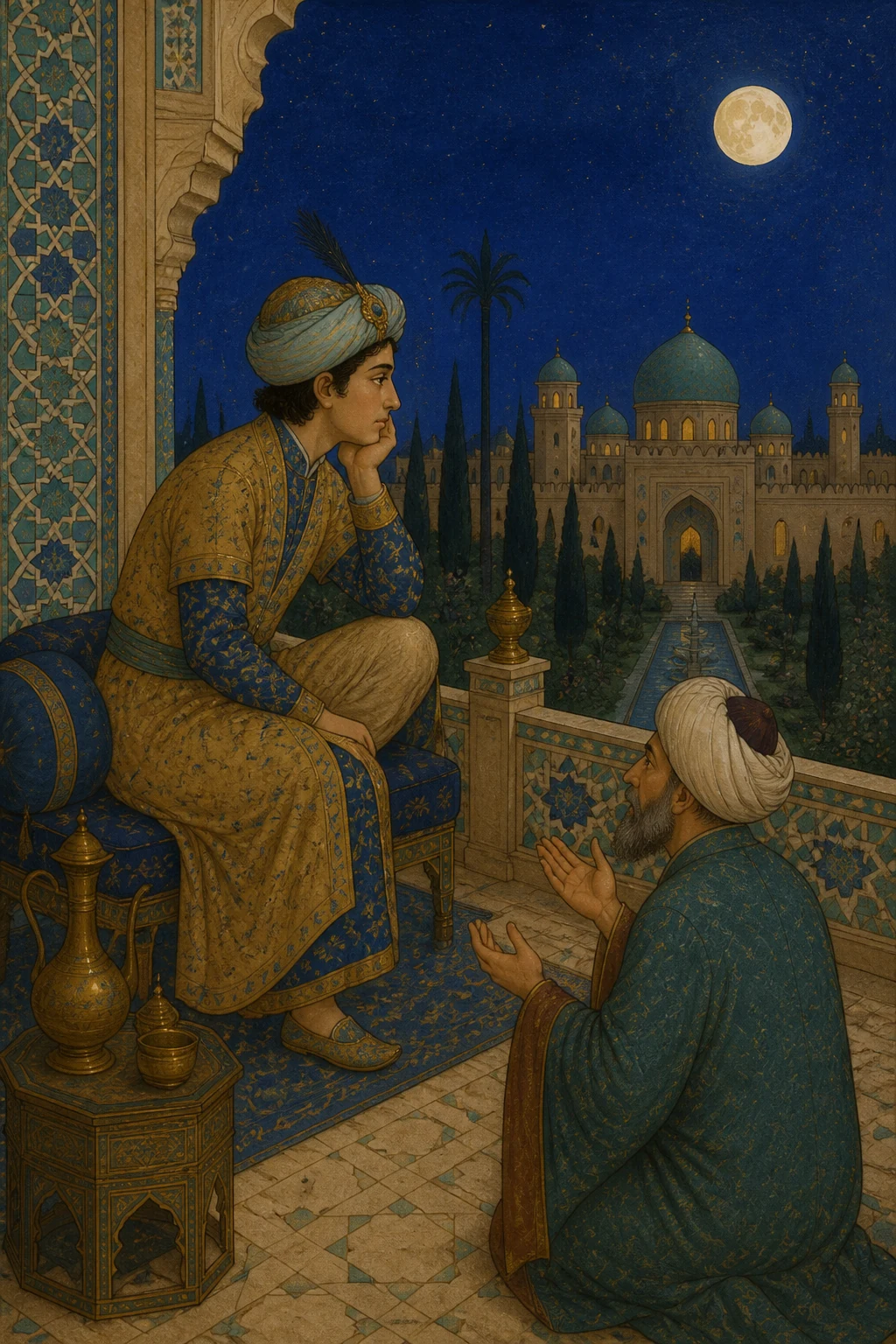
She said: It has reached me, O fortunate king, that the vizier Dandan said to Daw al-Makan: Taj al-Muluk’s father said to him, “My son, her father is a king, and his country lies far from ours. Put this matter out of your mind and enter your mother’s palace, where there are five hundred slave girls as lovely as moons. Take whichever of them pleases you; and if none pleases you, we shall ask for the hand of some king’s daughter who is fairer than Lady Dunya.” He replied, “Father, I want no one but her. She is the one who embroidered the gazelle you saw, and I must have her, or I shall wander into the wilderness and kill myself for her sake.” His father said, “My son, give me time to send to her father and ask for her hand. I shall bring you your heart’s desire, just as I did for myself with your mother. If he refuses, I shall shake his kingdom about him and send against him an army whose vanguard will be at his gates while its rear is still at mine.” Then he summoned the young Aziz and said, “My son, do you know the way?” “Yes,” he answered. “I wish you to travel with my vizier.” Aziz replied, “I hear and obey, O king of the age.” Then the king summoned his vizier and said, “Arrange my son’s affairs as best you know how. Go to the Islands of Camphor and ask for their king’s daughter in marriage.” The vizier answered, “I hear and obey.” Taj al-Muluk returned to his dwelling, his sickness and sorrow increased, and when night closed about him he recited these verses:
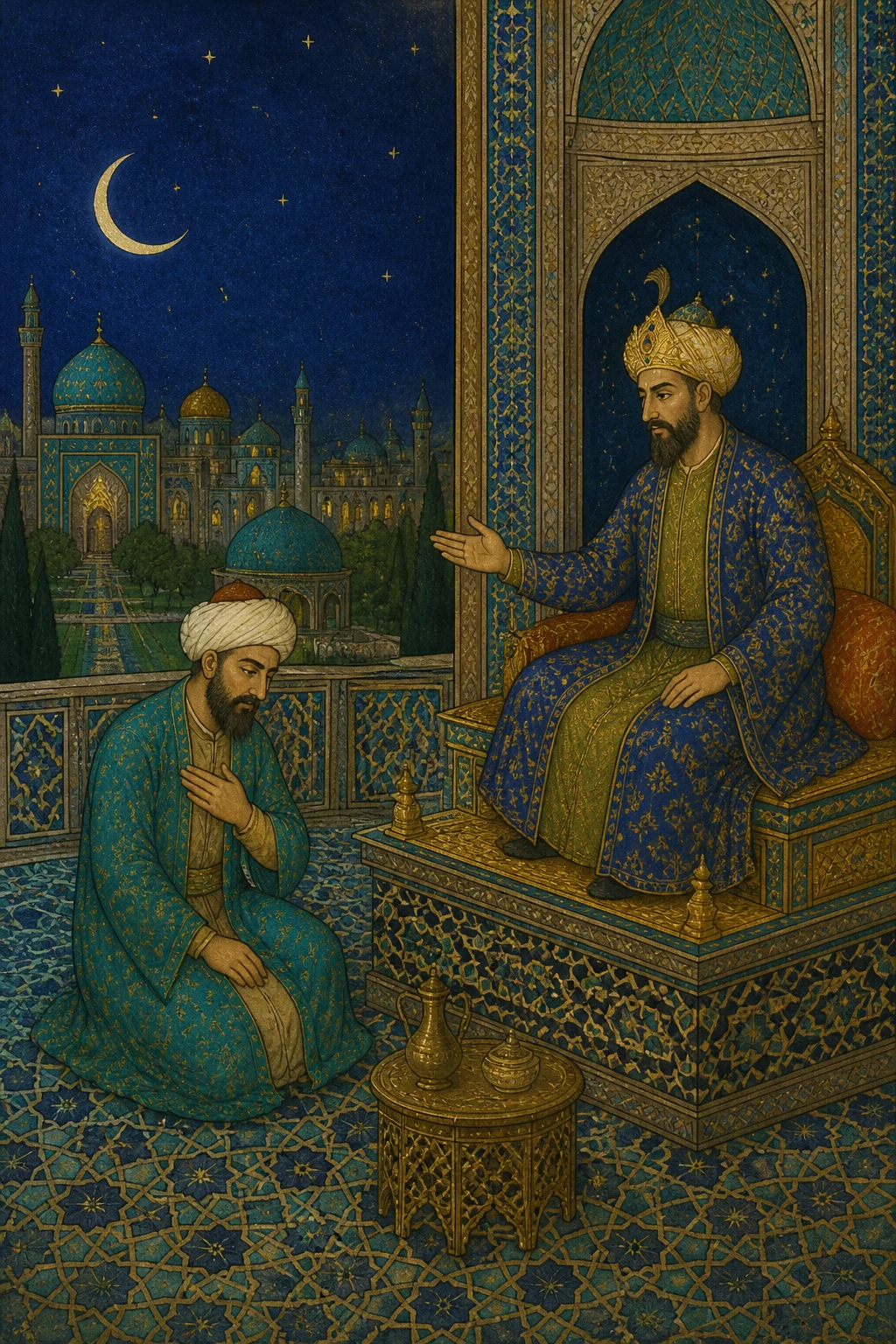
Darkness has fallen, and my tears flow ever more freely; longing feeds its fierce fires within my breast. Ask the nights about me, and they will tell you whether sorrow takes pity on my lovesick heart. Sleepless, I keep watch over the stars of night, while tears fall down my cheeks like hail. I am left alone, with no one beside me, like a lover bereft of family and child. When he had finished his verses, he fell unconscious and did not recover until morning. At daybreak his father came to him and saw how his color had changed and his pallor deepened. He promised to unite him with his beloved, then made ready Aziz and the vizier and gave them gifts to take. They traveled for days and nights until they came in sight of the Islands of Camphor. They halted beside a river, and the vizier sent a messenger to the king to announce their arrival. Half a day after the messenger’s departure, the king’s chamberlains and emirs suddenly appeared, having come a parasang to meet them. They welcomed them and escorted them into the king’s presence. They presented their gifts and remained his guests for four days. On the fifth day the vizier rose, went before the king, and told him his story and the purpose of his visit. The king was at a loss how to answer, for his daughter had no wish to marry. He bowed his head toward the ground for a while, then raised it and said to one of his servants, “Go to your mistress Dunya and tell her what you have heard and what this vizier has come to ask.” The servant went away and, after a while, returned and said, “O king of the age, when I went in to Lady Dunya and told her what I had heard, she flew into a terrible rage and came at me with a whip, meaning to break my head. I fled from her, and she said, ‘If my father forces me to marry, I shall kill the man I marry.’” Her father said to the vizier and Aziz, “Convey my greetings to your king and tell him this: my daughter has no desire to marry.” And dawn overtook Shahrazad, and she fell silent, leaving her tale untold.
When it was the one hundred and thirty-first night,
She said: It has reached me, O fortunate king, that King Shahriman said to the vizier and Aziz, “Convey my greetings to your king and tell him what you have heard: my daughter has no desire to marry.” So the vizier and his companions returned without accomplishing their purpose. They traveled until they came before the king and told him what had happened. He at once ordered the captains to alert the troops to prepare for war and holy battle. But the vizier said, “Do not do this, for the king is not to blame. It is his daughter who refuses. When she learned of the proposal, she sent word, ‘If my father forces me to marry, I shall kill the man I marry, then kill myself.’” When the king heard the vizier’s words, he feared for his son Taj al-Muluk and said, “If you make war on her father and win his daughter, she will kill herself.” Then the king told his son Taj al-Muluk the truth of the matter. On hearing it, he said, “Father, I cannot endure being parted from her. I shall go to her and find some means of reaching her, even if I die. Nothing else will I do.” “How will you go to her?” his father asked. “In the guise of a merchant,” he replied. The king said, “If you must, take the vizier and Aziz with you.” He brought out some of his treasures and furnished him with merchandise worth a hundred thousand dinars, and they agreed upon the plan. When night came, Taj al-Muluk and Aziz went to Aziz’s house and spent the night there. Taj al-Muluk was beside himself and could find pleasure in neither food nor sleep. Thoughts assailed him and drowned him in their seas; longing for his beloved shook him, and his tears flowed as he recited these two verses:
Will we ever meet again after this separation, that I may tell you of my love and plead my case? I remembered you when morning was still far from the night, and you kept me wakeful while all mankind slept. When he had finished his verses, he wept bitterly, and Aziz wept with him, remembering his cousin. They continued weeping until morning. Then Taj al-Muluk rose and went to his mother, dressed for travel. She asked him about his condition, and he told her the truth of the matter. She gave him fifty thousand dinars and bade him farewell, praying as he left for his safety and his reunion with those he loved. Then he went to his father and asked permission to depart. His father granted it, gave him fifty thousand dinars, and ordered a tent to be pitched for him outside the city. A magnificent tent was raised, and they stayed in it for two days before setting out. Taj al-Muluk found comfort in Aziz’s company and said, “Brother, I can no longer bear to be parted from you.” Aziz replied, “I feel the same, and I would gladly die at your feet. But, brother, my heart is troubled over my mother.” Taj al-Muluk said, “Once we have attained our desire, all will be well.” The vizier counseled Taj al-Muluk to be patient, while Aziz recited poetry to him and entertained him with histories and tales. They traveled by night and day for two months. The road seemed long to Taj al-Muluk; love pressed harder upon him, and his yearning and distraction increased. But when they drew near the city, he rejoiced exceedingly, and his grief and sorrow left him. They entered in the guise of merchants, the king’s son dressed as a trader, and came to a place known as the Merchants’ Lodging, a great khan. Taj al-Muluk asked Aziz, “Is this the merchants’ lodging?” Aziz answered, “Yes, though it is not the khan where I stayed with my caravan. This one is finer.” They made their beasts kneel there, unloaded their baggage, stored their goods in the storerooms, and rested for four days.
Then the vizier advised them to rent a large house. They agreed and rented a spacious dwelling fitted out for celebrations, where they took up residence. The vizier and Aziz set about devising a stratagem for Taj al-Muluk, while Taj al-Muluk himself was at a loss what to do. He could think of no expedient but to open a shop in the cloth market. The vizier turned to him and Aziz and said, “Know that if we remain as we are, we shall neither attain our desire nor accomplish our purpose. A thought has occurred to me which may serve us well, if God wills.” Taj al-Muluk and Aziz answered, “Do as you think best. There is a blessing in the counsel of elders, especially one as experienced in affairs as you. Tell us what you have in mind.” He said to Taj al-Muluk, “My advice is to rent a shop for you in the cloth market, where you can sit buying and selling. Everyone, high and low, has need of cloth. If you sit in such a shop, your affairs will prosper, God Most High willing, especially since you are so handsome. But make Aziz your assistant and have him sit inside the shop to hand you the fabrics.” When Taj al-Muluk heard this, he said, “That is sound advice.” He brought out a merchant’s suit and put it on, then set off with his servants following him. He gave one of them a thousand dinars to pay the expenses of the shop. They walked until they reached the cloth market. When the merchants saw Taj al-Muluk and beheld his beauty and grace, their wits were confounded. “Has Ridwan opened the gates of Paradise and neglected them,” they asked, “so that this marvelously handsome youth has escaped?” Others said, “Perhaps he is one of the angels.” On entering the market, they asked for the shop of its chief. The merchants directed them, and they made their way to him.
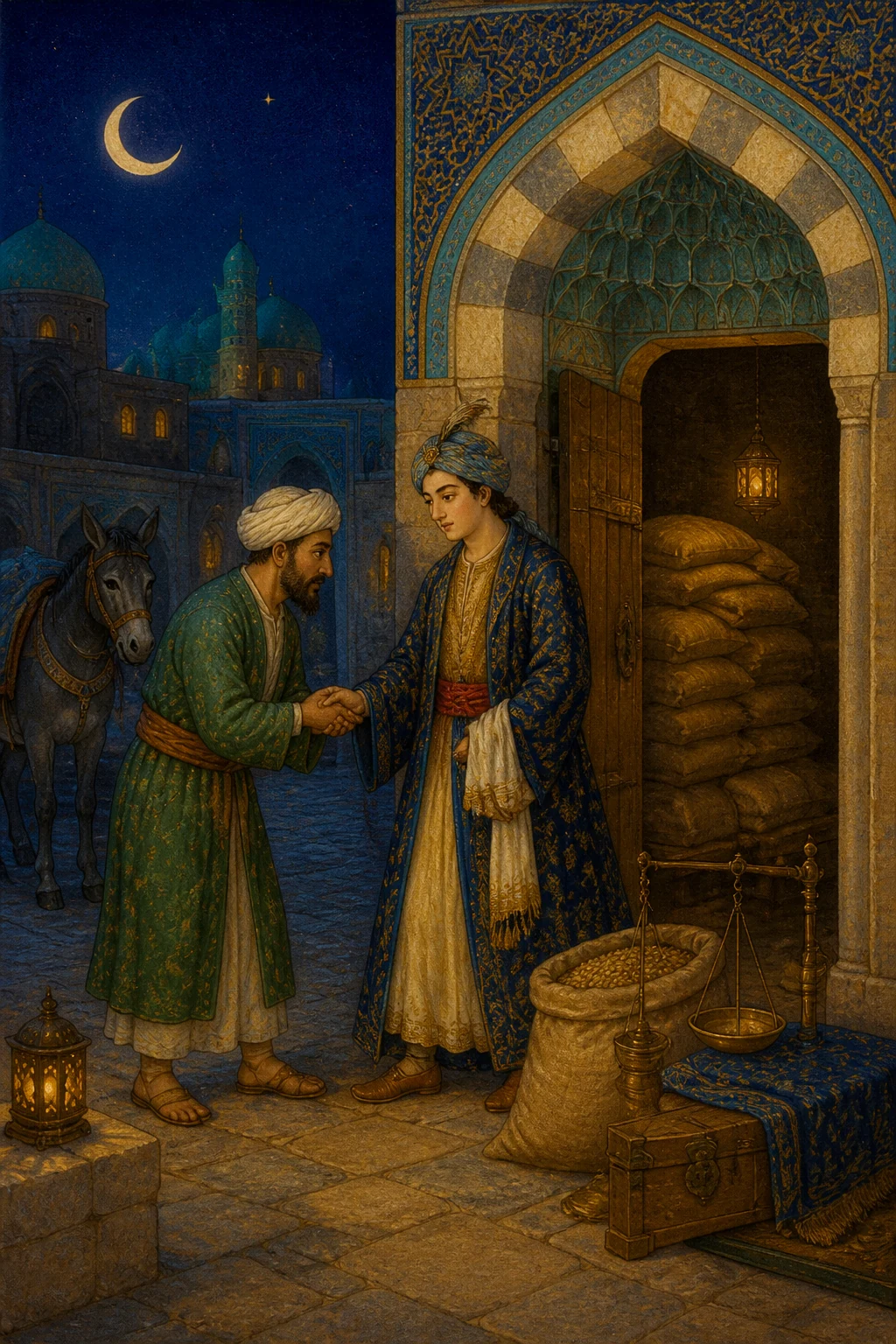
As they approached, he and the merchants with him rose to receive them with respect, especially the noble vizier, whom they saw to be an elderly man of imposing dignity, accompanied by Taj al-Muluk and Aziz. The merchants said to one another, “This old man must be the father of these two youths.” The vizier asked, “Which of you is the chief of the market?” “There he is,” they replied. The vizier looked him over and saw an elderly man of distinction and gravity, attended by servants and pages. The chief greeted them as dear friends, treated them with great honor, seated them beside him, and said, “Is there any service we may have the pleasure of doing you?” The vizier answered, “Yes. I am an old man, advanced in years, and these two youths are with me. I have traveled with them through every region and country, and whenever I enter a town I stay a full year, so that they may see its sights and come to know its people. Now I have reached your city and chosen to remain here. I would like you to find me a shop in one of the best locations, where I may establish them so that they can trade, see the city, acquire the manners of its people, and learn buying and selling, giving and taking.” The chief of the market replied, “That can easily be done.” He looked at the two youths, took great delight in them, and became exceedingly fond of them. For the chief of the market was enamored of slaying glances, preferred boys to girls, and had a taste for tart fruit. He said to himself, “Glory be to Him who created them and fashioned them from a lowly drop!” Then he rose to attend upon them like a page standing before his masters. He went and found them a shop in the middle of the market, the largest and most prominent of them all. It was spacious and richly decorated, with shelves of ivory and ebony. He handed its keys to the vizier, who was dressed as a merchant, and said, “May God make it a blessing to your two sons.” The vizier took the keys and went to the shop with the two youths. They placed their belongings inside and ordered their servants to bring over all their wares and fabrics. And dawn overtook Shahrazad, and she fell silent, leaving her tale untold.
When it was the one hundred and thirty-second night,
She said: It has reached me, O fortunate king, that when the vizier took the keys of the shop, he went there with the two youths. They placed their belongings inside and ordered their servants to bring over all their merchandise, fabrics, and precious objects, which were worth whole treasuries of money. Everything was carried to the shop, and they passed the night. In the morning the vizier took the two youths to the bathhouse. Once inside, they washed themselves and enjoyed it to the full. Each youth possessed a dazzling beauty, and in the bath it was as the poet said:
Good fortune to the bath attendant whose hand has touched a body born of water and light! He plied his craft with such tender skill that he gathered musk from a statue of camphor. Then the two came out of the bathhouse. The chief of the market, hearing that they had gone there, had seated himself to wait for them. Now they approached like two gazelles, their cheeks flushed, their eyes dark, their bodies gleaming, as though they were two laden boughs or two radiant moons. He said, “My sons, may your bath bring lasting bliss.” Taj al-Muluk answered in the sweetest tones, “Would that you had been with us!” They both kissed his hands and walked ahead of him as far as the shop, out of respect for him as chief of the market and for his kindness in giving them the shop. When he saw their swaying buttocks, his passion flared and grew. He snorted and grunted, unable to contain himself, fixed his eyes upon them, and recited these two verses:
My heart studies the chapter on exclusive possession of it, and will read no discussion of sharing. No wonder it quivers beneath its weight: how many motions has that revolving sphere! When they heard his verses, they insisted that he enter the bathhouse with them. They had left the vizier inside. When the chief of the market returned with them to the baths, the vizier heard of his arrival, came out of the private chamber, and met him in the central hall. He invited him to join him, but the chief declined. Then Taj al-Muluk took one of his hands and Aziz the other, and they led him into another private chamber. The wicked old fellow willingly yielded to them. Taj al-Muluk swore that no one but he should bathe him, and Aziz swore that no one else should pour the water over him. The vizier said, “They are your sons.” The chief replied, “May God preserve them for you! Blessings and good fortune have descended upon our city with your arrival and that of your followers.” Then he recited these two verses:
You came, and our hills grew green, radiant with flowers for all to behold. The earth and all upon it cried, “Welcome, most welcome, you who have come!” They thanked him, and Taj al-Muluk continued washing him while Aziz poured the water. He imagined his soul was in Paradise. When they had finished attending to him, he blessed them and sat beside the vizier, ostensibly to converse with him, though his chief purpose was to gaze at Taj al-Muluk and Aziz. Then the servants brought towels. They dried themselves, put on their clothes, and left the bathhouse. The vizier turned to the chief of the market and said, “Sir, the bath is the bliss of this world.” The chief replied, “May God make it health to you and your sons, and shield them from the evil eye. Do you remember anything the eloquent poets have said about the bath?” Taj al-Muluk said, “I shall recite two verses for you:
The life of the bath is the sweetest of lives, though the time one spends there is brief: a paradise where one dislikes lingering, a hell into which one gladly enters.” When Taj al-Muluk had finished, Aziz said, “I too remember some verses on the bath.” “Let me hear them,” said the chief. Aziz recited these two verses:
A house whose flowers are carved of solid stone, lovely when fires are kindled all around it. You think it hell, though in truth it is a paradise, filled above all with suns and moons. When Aziz finished, the chief marveled at their beauty and eloquence and said, “By God, you have united grace of speech with grace of form. Now listen to me.” He sweetened his voice and recited these verses:
How lovely a fire whose torment is bliss, restoring life to body and soul! Marvel at a house whose pleasures remain fresh while flames are burning beneath it. A life of delight awaits whoever enters, as pools pour their tears over him. Then he let his eyes roam through the gardens of their beauty and recited these two verses:
I came to his dwelling and found no doorkeeper who did not meet me with a smiling face. I entered his paradise and visited his hell, and thanked Ridwan and the mercy of Malik. They marveled at these verses. Then the chief invited them to his house, but they declined and went home to rest after the exertion of the bath. They ate and drank and passed the night at home in the greatest comfort and happiness. When morning came, they rose, performed their ablutions and obligatory prayers, and took their morning refreshment. Once daylight had spread and the shops and markets opened, they left the house and went to their shop. The servants had arranged it beautifully, spreading it with silken carpets and setting out two cushions, each worth a hundred dinars, with a royal leather cover edged in gold upon each. Taj al-Muluk sat on one cushion and Aziz on the other, while the vizier sat in the middle of the shop and the servants stood before them. People heard of them and crowded in, and they sold some of their fabrics. Taj al-Muluk’s fame spread through the city, and the report of his beauty and grace became known everywhere. They continued thus for several days, people flocking to them daily. Then the vizier counseled Taj al-Muluk to conceal his identity, entrusted him to Aziz’s care, and went home to devise some plan that might benefit them. Taj al-Muluk and Aziz sat talking, and Taj al-Muluk kept saying, “Perhaps someone will come from Lady Dunya.” So he passed days and nights without sleep. Love had mastered him, and his wasting sickness grew until he was deprived of sweet slumber and refused food and drink, though he was like the moon at its full. As Taj al-Muluk sat there, an old woman came toward him. And dawn overtook Shahrazad, and she fell silent, leaving her tale untold.
When it was the one hundred and thirty-third night,
She said: It has reached me, O fortunate king, that the vizier Dandan said to Daw al-Makan: As Taj al-Muluk sat there, an old woman approached him with two slave girls following her. She walked on until she stopped before his shop. When she saw his graceful figure and his beauty, she marveled at his loveliness and grew wet in her drawers. Then she said, “Glory be to Him who created you from a lowly drop! Glory be to Him who made you a temptation to all the world!” She continued gazing at him, saying, “This is no mortal; this is none other than a noble angel.” Then she drew near and greeted him. He returned her greeting, rose to his feet, and smiled at her, all at Aziz’s prompting. He seated her beside him and fanned her until she was rested. Then the old woman said, “My son, perfect in form and spirit, are you from this country?” Taj al-Muluk answered with sweet and graceful eloquence, “By God, madam, this is the first time I have ever entered this country. I am staying here only to see its sights.” She said, “Then honor and a warm welcome to our visitor! What fabrics have you brought with you? Show me something beautiful, for the beautiful bring only beautiful things.”
When Taj al-Muluk heard her words, his heart fluttered, though he did not grasp her meaning. Aziz gave him a knowing signal, and Taj al-Muluk said, “I have whatever you might desire, things fit only for kings and kings’ daughters. For whom do you wish to buy, so that I may show you what befits its wearer?” By this he meant to discover whom she represented. She answered, “I want cloth suitable for Lady Dunya, daughter of King Shahriman.” When Taj al-Muluk heard his beloved’s name, he rejoiced exceedingly and said to Aziz, “Bring me the finest goods you have.” Aziz brought a bundle and opened it before him. Taj al-Muluk said to her, “Choose what suits her. These are things to be found nowhere but here.” The old woman chose goods worth a thousand dinars and asked, “How much is this?” As she spoke to him, she rubbed between her thighs with the heel of her hand. He answered, “Would I bargain with someone like you over so trifling a thing? Praise be to God who has made us acquainted!” The old woman said, “I commend your lovely face to the protection of the Lord of Daybreak. Your face is beautiful, and so are your deeds. Happy the woman who sleeps in your arms, embraces your shapely body, and enjoys your handsome face, especially if she is as beautiful as you.” Taj al-Muluk laughed until he fell back, then said, “O You who fulfill our wishes through the hands of wicked old women!” She asked, “My son, what is your name?” “My name is Taj al-Muluk,” he answered. She said, “That is a king’s name, yet you are dressed as a merchant.” Aziz said, “His family gave him that name because they love and cherish him so dearly.” The old woman replied, “You speak truly. May God shield you from the evil of the envious, though your charms tear hearts to pieces.”
Then she took the cloth and left, bewildered by his beauty and his graceful figure. She walked on until she came before Lady Dunya and said, “My lady, I have brought you some beautiful cloth.” “Show it to me,” she said. “Here it is, my lady. Unfold it and examine it.” When Lady Dunya saw it, she said, “Nurse, this is beautiful cloth. I have never seen its like in our city.” The old woman replied, “My lady, the man who sells it is more beautiful still. It is as though Ridwan opened the gates of Paradise and left them unattended, and the merchant who sells this cloth escaped. I wish he were with you tonight, sleeping between your breasts, for he enchants all who see him. He has come to our city with these fabrics to see its sights.” Lady Dunya laughed at the old woman’s words and said, “God disgrace you, you ill-omened old woman! You have grown senile and lost your wits.” Then she said, “Give me the cloth so that I may look at it properly.” The old woman handed it to her, and she examined it again. It was small in quantity but great in value, and she marveled at its beauty, for she had never seen anything like it in her life. The old woman said, “My lady, if you saw its owner, you would know him to be the most beautiful man on the face of the earth.” Lady Dunya asked, “Did you ask whether there was anything he needed? He could tell us, and we would do it for him.” The old woman shook her head and said, “God preserve your discernment! By God, he does have a need. Who is without one?” Lady Dunya said, “Go to him, convey my greetings, and tell him, ‘Your arrival has honored our city. Whatever you may need, we shall gladly attend to it.’” The old woman returned at once to Taj al-Muluk. When he saw her, his heart leaped with joy. He rose to his feet, took her hand, and seated her beside him. Once she had sat down and rested, she told him what Lady Dunya had said. He was overjoyed; his heart opened and his spirits rose. “My wish is fulfilled,” he said to himself. Then he asked the old woman, “Will you carry a letter from me to her and bring me her answer?” “I hear and obey,” she replied. On hearing this, he said to Aziz, “Bring me ink and paper and a pen of brass.” When Aziz brought them, he wrote these verses:
I write to you, my heart’s desire, of all the pain of parting that I bear. First I set down the fire within my heart; second, my love and longing. Third, my life and patience are spent; fourth, all my yearning still remains. Fifth, when will my eyes behold you? Sixth, when will the day of meeting come? Then he signed it: “This letter is from the captive of desire, imprisoned in the dungeon of longing, who can find release only in union, even with a phantom in a dream, for he suffers bitter torment through separation from those he loves.” Then his tears flowed, and he wrote these two verses:
I write to you while tears are streaming, and the weeping of my eyes will never cease. Yet I do not despair of my Lord’s bounty: perhaps a day will come when we shall meet. Then he folded the letter, sealed it, and gave it to the old woman, saying, “Deliver this to Lady Dunya.” “I hear and obey,” she replied. He gave her a thousand dinars and said, “Accept this as a gift from me.” She took it and departed, praying for him, and walked on until she came before Lady Dunya. When Dunya saw her, she asked, “Nurse, what need did he mention, so that we may satisfy it?” She replied, “My lady, he has sent a letter with me, but I do not know what is in it.” She handed her the letter. Lady Dunya took it, read it, and understood its meaning. “What is this?” she said. “How has this merchant come to send me letters and write to me?” Then she struck her face and said, “Were it not for my fear of God Most High, I would have him crucified at his shop.” The old woman asked, “What is in this letter to trouble your heart so? Does he complain of some wrong, or ask for payment for the cloth?” “Woe to you!” she replied. “There is nothing of that in it, only love and passion. This is all your doing. Otherwise, how could this devil have found his way to such talk?” The old woman said, “My lady, you sit in your lofty palace, where no one can reach you, not even a bird in flight. You are safe from blame and reproach. What harm can the barking of dogs do you? Do not hold me to account for bringing you this letter when I did not know what was in it. My advice is to send him an answer threatening him with death and forbidding this madness. Then he will stop and never repeat it.” Lady Dunya said, “I fear that if I write to him, he will grow hopeful.” The old woman replied, “Once he hears threats and warnings, he will abandon his purpose.” “Bring me ink and paper and a pen of brass,” she said. When they brought them, she wrote these verses:
You who claim love, affliction, and sleeplessness, and all the longing and distraction you endure: do you seek union with a moon, deluded fool? Can any mortal gain his wishes from the moon? I warn you against the thing you seek. Desist, for you stand in danger. If you return to such words, I shall visit cruel torment upon you. By Him who created man from a clot, who kindled the light of sun and moon, if you return to what you speak of, I shall have you crucified upon a tree trunk. Then she folded the letter and gave it to the old woman, saying, “Give him this and tell him to cease such talk.” “I hear and obey,” she replied. She took the letter joyfully, went home, and spent the night in her house. In the morning she went to Taj al-Muluk’s shop and found him waiting for her. When he saw her, he nearly flew with joy. As she drew near, he rose and seated her beside him. She took out the paper, handed it to him, and said, “Read what it says.” Then she added, “When Lady Dunya read your letter, she was angry, but I coaxed and joked with her until I made her laugh. Her heart softened toward you, and she wrote this answer.” Taj al-Muluk thanked her and ordered Aziz to give her a thousand dinars. Then he read the letter, understood it, and wept bitterly. The old woman’s heart softened toward him, and his weeping and lamentation weighed heavily upon her. “My son,” she asked, “what is in this paper to make you weep?” He answered, “She threatens me with death and crucifixion and forbids me to write to her. Yet if I cannot write to her, death is better than life. Take my answer to her letter, and let her do as she wishes.” The old woman said, “By your youth, I shall risk my life with you and bring you your desire. I shall attain what is in your heart.” Taj al-Muluk replied, “Whatever you do, I shall reward you, and it will be set down to your credit. You are skilled in intrigue and know every avenue of mischief. Every difficulty is easy for you, and God has power over all things.” Then he took a sheet of paper and wrote these verses:
You threaten me with death—alas for me! Yet killing would bring me rest, and death is ordained. Death is better for a lover than a lengthened life of denial and oppression. For God’s sake, visit a lover with few to help him, for I am your slave, and a slave is captive. My masters, have mercy on me in my love for you: whoever loves the noble deserves to be excused. Then he sighed deeply and wept until the old woman wept as well. She took the paper from him and said, “Be of good heart and take comfort. I shall surely bring you your desire.” And dawn overtook Shahrazad, and she fell silent, leaving her tale untold.
When it was the one hundred and thirty-fourth night,
She said: It has reached me, O fortunate king, that when Taj al-Muluk wept, the old woman said, “Be of good heart and take comfort. I shall surely bring you your desire.” Then she rose and left him burning with longing, and went to Lady Dunya. She found her color changed by her anger over Taj al-Muluk’s letter. She handed her the new letter, and Dunya’s anger increased. “Did I not tell you he would grow hopeful?” she said. The old woman replied, “What is this dog, that he should aspire to you?” Lady Dunya said, “Go to him and tell him, ‘If you write to her again, she will have your head struck off.’” The old woman replied, “Put those words in a letter, and I shall take it with me, so that his fear will be all the greater.” Dunya took a sheet of paper and wrote these verses:
You who heedlessly ignore the blows of fate will never hasten to attain union. Do you imagine, deluded fool, that you can reach Suha, when you cannot attain the shining moon? How can you aspire to us and hope for our embrace, to clasp our slender forms? Abandon this purpose, fearing my wrath upon a grim day that will turn your hair white. Then she folded the letter and handed it to the old woman, who took it and set off to Taj al-Muluk. When he saw her, he rose to his feet and said, “May God never deprive me of the blessing of your coming.” The old woman said, “Take the answer to your letter.” He took the paper, read it, and wept bitterly. “I wish someone would kill me now,” he said, “for death would be easier to bear than what I am enduring.” Then he took ink, pen, and paper and wrote a letter, setting down these two verses:
O my heart’s desire, do not persist in coldness and estrangement; visit a lover drowning in his love. Do not think me alive while you shun me: my soul departs when those I love are far away. Then he folded the letter and gave it to the old woman, saying, “I have wearied you to no purpose.” He ordered Aziz to give her a thousand dinars and said, “Mother, this letter must be followed by perfect union or complete separation.” She replied, “My son, by God, I wish you nothing but good, and my desire is to see her beside you. You are the moon with its radiant light, and she is the rising sun. If I cannot bring you together, there is no use in my living. I have spent my life in trickery and deceit until I have reached ninety years. How then should I fail to bring two lovers together in sin?” Then she bade him farewell, comforted his heart, and departed.
She walked on until she came before Lady Dunya, having hidden the letter in her hair. When she sat beside her, she scratched her head and said, “My lady, would you pick the lice from my hair? It has been a long time since I went to the bath.” Lady Dunya bared her arms to the elbows, loosened the old woman’s hair, and began searching through it. The paper fell from her head. Lady Dunya saw it and asked, “What is this paper?” She replied, “I must have sat at the merchant’s shop and had this paper catch on me. Give it here, so that I can return it to him.” Lady Dunya opened it, read it, and understood its contents. She said to the old woman, “This is a trick of yours. If you had not brought me up, I would punish you this instant. God has afflicted me with this merchant, and everything I have suffered from him is your doing. I do not know what country he has come from. No one else has ever dared such insolence toward me. I fear that my affair will become known, especially when it concerns a man who is neither of my station nor my equal.” The old woman turned to her and said, “No one would dare speak of such a thing, for fear of your power and awe of your father. There is no harm in sending him an answer.” Dunya said, “Nurse, this man is a devil. How has he dared such words without fearing the sultan’s might? I am at a loss what to do with him. To order his death would not be right, yet if I leave him alone, he will grow more insolent.” The old woman replied, “Write him a letter. Perhaps it will restrain him.” So she called for paper, ink, and a pen, and wrote him these verses:
Long have I reproached you, yet your boundless folly tempts you on. How often have I written verses in my own hand to warn you! Yet every warning only feeds your hopes, and I shall be pleased with you only if you keep this secret. Conceal your love and never proclaim it; if you speak, I shall show you no mercy. If you return to what you have been saying, the raven of separation will come to announce your doom. Soon death will rush upon you, and a grave beneath the earth will be your dwelling. You will leave your family grieving, deluded man, for far beyond your reach lies any refuge from the swords of love. Then she folded the paper and handed it to the old woman, who took it to Taj al-Muluk and gave it to him. When he read it, he knew that she was hardhearted and that he could never reach her. He complained of his plight to the vizier and begged him to devise some wise course. The vizier said, “Know that nothing remains to be tried but to write her a letter and call down a curse upon her.” Taj al-Muluk said, “My brother Aziz, write on my behalf something of the kind you know.” So Aziz took a sheet of paper and wrote these verses:
O Lord, by the five holy elders, deliver me, and let the one who has afflicted me share my sorrow. You know that I burn in the flames of longing, forsaken by a beloved who has no pity for me. How tenderly I feel toward her amid all my suffering, and how cruelly she wrongs me in my weakness! I wander through depths of anguish without end, and see no helper, Lord, to come to my aid. How often I seek to forget my love for her! But how can I forget, when passion has consumed all my patience? You who deny me the sweetness of union, do you think yourself safe from the blows and trials of fate? Do you not live in happiness, while for your sake I am exiled from my family and my homeland? Then Aziz folded the letter and handed it to Taj al-Muluk. He read it and was pleased, so he sealed it and gave it to the old woman. She took it and went to Lady Dunya, into whose hands she delivered it. When Dunya read and understood it, she flew into a terrible rage and said, “Everything that has happened to me is the doing of this wretched old woman!” She called out to the maidservants and eunuchs, “Seize this scheming old woman and beat her with your slippers!” They fell upon her, striking her with their slippers until she fainted. When she came to, Dunya said, “By God, you wicked old woman, were it not for my fear of God Almighty, I would kill you!” Then she ordered them, “Beat her again!” They beat her until she fainted once more, and Dunya ordered them to drag her out and throw her beyond the door. They dragged her face down and flung her outside. When she recovered, she got up and made her way home, walking a little and then sitting down to rest. There she waited until morning, when she rose and went to Taj al-Muluk and told him all that had happened. He was deeply distressed and said, “Mother, it grieves us to hear what you have suffered, but all things are ordained by fate.” She replied, “Take heart and be at ease. I shall not cease my efforts until I bring you together and deliver you to this hussy who has left me burning from her blows.” Taj al-Muluk said, “Tell me why she hates men.” “Because of a dream she had,” answered the old woman. “What was the dream?” he asked. She said, “One night, as she slept, she dreamed of a hunter who set a snare on the ground, scattered wheat around it, and sat down nearby. Birds of every kind came to the snare, and among them she saw a pair of pigeons, a male and a female. As she watched, the male’s foot caught in the snare, and he began to struggle. All the other birds took fright and flew away. But his mate returned and circled over him, then approached the snare while the hunter was not looking. She began pecking at the loop that held the male’s foot and tugging at it with her beak until she freed him, and they flew off together. Afterward the hunter came, repaired his snare, and sat some distance away. Within an hour the birds came down again, and this time the female was caught. All the birds fled from her, the male among them, and he never returned to his mate. The hunter came, took the female, and slaughtered her. Dunya awoke terrified and said, ‘Every male is like this, with no goodness in him. Men, one and all, have no kindness for women.’”
When the old woman had finished her tale, Taj al-Muluk said, “Mother, I wish to see her just once, even if it costs me my life. Devise some way for me to look upon her.” She replied, “Know that she has a garden below her palace, reserved for her pleasure. Once a month she goes down to it through a private door and stays there ten days. The time for her visit is now at hand. When she is about to go out, I shall come and tell you, so that you may go and encounter her. Take care not to leave the garden. Perhaps, when she sees your beauty and grace, her heart will fall in love with you, for love is the surest means of bringing people together.” “I hear and obey,” he said. Then he and Aziz rose from the shop and took the old woman to their lodging, showing her where they lived. Taj al-Muluk said to Aziz, “My brother, I have no further need of the shop; it has served my purpose. I give it to you with everything in it, for you left your own country and shared my exile.” Aziz accepted the gift, and they sat talking together. Taj al-Muluk questioned him about his strange adventures and all that had befallen him, and Aziz told him his story. Afterward they went to the vizier, told him what Taj al-Muluk intended, and asked, “How shall we proceed?” “Let us go to the garden,” he replied. Each put on his finest clothes, and they went out with three mamluks following them. When they reached the garden, they found it thick with trees and richly watered by streams. The gardener was sitting at the gate, and they greeted him. He returned their greeting, and the vizier handed him a hundred dinars, saying, “I would like you to take this money and buy us something to eat. We are strangers here, and I have these young men with me, whom I wished to entertain.” The gardener took the dinars and said, “Come in and enjoy yourselves. Everything here is yours. Sit down while I fetch you some food.” Then he went to the market, and the vizier, Taj al-Muluk, and Aziz entered the garden. An hour later the gardener returned with a roast lamb and set it before them. They ate, washed their hands, and sat talking. The vizier said, “Tell me about this garden. Is it yours, or do you rent it?” The old man replied, “It is not mine. It belongs to the king’s daughter, Lady Dunya.” “How much are you paid each month?” asked the vizier. “One dinar, no more.” Looking about the garden, the vizier noticed a lofty but aged pavilion and said, “Old man, I should like to do a good deed here by which you will remember me.” “What good deed would you like to do?” he asked. “Take these three hundred dinars,” said the vizier. At the mention of gold, the gardener said, “My lord, do whatever you please.” He took the dinars, and the vizier said, “God Almighty willing, we shall make some improvements to this place.”
Then they left him and returned to their lodging, where they passed the night. The next day the vizier brought a plasterer, a painter, and a skilled goldsmith, together with all the tools they needed. He took them into the garden and ordered them to plaster the pavilion and adorn it with all manner of painted designs. Then he had gold and lapis lazuli brought and said to the painter, “At the far end of this hall, paint a hunter who has set his snare, with a pigeon caught in it and another pigeon’s beak entangled in the mesh.” When the painter had completed one section, the vizier said, “On the next section, continue the scene. Show the female pigeon in the snare, with the hunter holding her and laying his knife against her neck. On the other side, paint a great bird of prey that has caught the male pigeon and sunk its talons into him.” The painter did as he was told. When he had finished all the work the vizier had described, they took leave of the gardener and returned to their lodging, where they sat conversing. Taj al-Muluk said to Aziz, “My brother, recite some poetry to me. Perhaps it will ease my heart and drive away these thoughts, or cool the fire that burns within me.” So Aziz sang sweetly and recited these verses:
All the grief that lovers have ever spoken of I have borne alone, until my strength has failed. If you would come to drink from my tears, their seas spread wide, flowing endlessly for all who come. If lovers would see what the hands of passion have wrought upon them, let them look upon my body. Then his tears overflowed, and he recited these verses:
Whoever loves neither graceful necks nor lovely eyes, yet claims to have tasted the pleasures of this world, speaks falsely. For love holds a mystery that none among mankind can grasp save those who have loved. May God never lighten my heart’s longing for the one I love, nor lift sleeplessness from my eyes. Then he sang sweetly and recited these verses:
Ibn Sina declared among his principles that the lover’s remedies are music, union with another like the beloved, sweetmeats, wine, and gardens. So once, seeking a cure, I kept company with someone other than you, and fate and circumstance favored me. Then I learned that love is a deadly sickness for which Ibn Sina’s medicine is mere babbling. When Aziz had finished his verses, Taj al-Muluk marveled at his eloquence and the beauty of his recitation and said, “You have relieved some of my suffering.” Then he added, “If you recall anything else of this kind, let me hear more tender verses, and prolong your discourse.” So Aziz sang sweetly and recited these verses:
I once thought union with you could be bought with precious wealth and the sacrifice of bodies. In my ignorance I thought your love an easy thing, though the choicest souls perish for its sake. But when I saw you choose and favor those you love with the subtle graces of your gifts, I knew that no device could win you. I bowed my head beneath my folded wing and made my dwelling in the nest of passion, where I remain at dawn and dusk. Such was their case. As for the old woman, she stayed secluded in her house. The king’s daughter grew eager to enjoy the garden, but she would not go out without her. So she sent for her, made peace with her, and soothed her feelings, saying, “I wish to go to the garden to enjoy its trees and fruits and refresh my heart with its flowers.” The old woman replied, “I hear and obey. But first I wish to go home, change my clothes, and return to you.” “Go home,” said Dunya, “but do not keep me waiting.” The old woman left her and went straight to Taj al-Muluk. “Make ready,” she said. “Put on your finest clothes and go to the garden. Greet the gardener, then hide yourself among the trees.” “I hear and obey,” he replied. She arranged a signal with him and returned to Lady Dunya. After she had gone, the vizier and Aziz dressed Taj al-Muluk in a suit of the finest royal garments, worth five thousand dinars, and fastened about his waist a golden belt studded with jewels and precious stones. Then they went to the garden. At the gate they found the gardener sitting, and when he saw Taj al-Muluk he rose to his feet and welcomed him with honor and respect. He opened the gate and said, “Come in and enjoy the garden.” He did not know that the king’s daughter was to visit that day. Taj al-Muluk had been inside scarcely an hour when he heard a commotion, and suddenly eunuchs and maidservants began emerging through the private door. When the gardener saw them, he went to Taj al-Muluk and told him she had arrived. “My lord,” he said, “what are we to do? The king’s daughter, Lady Dunya, has come.” “Do not be afraid,” replied Taj al-Muluk. “I shall hide somewhere in the garden.” The gardener urged him to keep himself well concealed, then left him and went away.
When the king’s daughter entered the garden with her maidservants and the old woman, the old woman said to herself, “So long as the eunuchs are with us, we shall never achieve our purpose.” Then she said to the princess, “My lady, let me suggest something that will put your heart at ease.” “Say what you have to say,” replied Lady Dunya. The old woman said, “My lady, you have no need of these eunuchs just now. You cannot enjoy yourself while they are with us, so send them away.” “You are right,” said Lady Dunya, and dismissed them. A little later she began to stroll, while Taj al-Muluk watched her and admired her beauty. The old woman artfully engaged her in conversation until she had led her to the pavilion the vizier had had painted. Dunya entered and examined the paintings, seeing the birds, the hunter, and the pigeons. “Glory be to God!” she exclaimed. “This is the very scene I saw in my dream!” She gazed in wonder at the painted birds, the hunter, and the snare. Then she said, “Nurse, I used to blame men and hate them. But look how the hunter slaughtered the female! The male escaped and meant to return and rescue her, but the bird of prey intercepted him and devoured him!” The old woman feigned ignorance and kept her talking until they drew near the place where Taj al-Muluk was hidden. Then she signaled to him to walk beneath the pavilion windows. As Lady Dunya stood there, she happened to turn and saw him. She studied his beauty, his stature, and his graceful bearing, then said, “Nurse, where has this handsome young man come from?” “I know nothing of him,” replied the old woman, “but I imagine he must be the son of some mighty king, for his beauty is beyond compare and his loveliness has reached perfection.” Lady Dunya fell passionately in love with him. Her resolve dissolved, her mind was dazzled by his beauty, his stature, and his grace, and desire stirred within her. “Nurse,” she said, “this young man is handsome.” “Indeed he is, my lady,” answered the old woman. Then she signaled to the prince to go home. The fire of love blazed within him, and his longing and passion had grown still stronger, yet he obeyed the old woman. He took leave of the gardener and returned to his lodging, where he told the vizier and Aziz that she had signaled him to leave. They comforted him, saying, “Had she not known that your return would serve your purpose, she would never have advised it.”
Such was the case of Taj al-Muluk, the vizier, and Aziz. As for the king’s daughter, Lady Dunya, love had overwhelmed her, and her longing and passion grew more intense. She said to the old woman, “I know of no way to meet this young man except through you.” The old woman replied, “I seek refuge in God from Satan the accursed! You want nothing to do with men, so how have the torments of love for him overtaken you? Yet, by God, no one but he is worthy of your youth.” Lady Dunya said, “Nurse, help me meet him, and I shall give you a thousand dinars and a robe of honor worth a thousand more. If you do not help me to reach him, I shall surely die.” The old woman replied, “Go back to your palace, and I shall arrange your meeting. I would lay down my life to make you both happy.” Lady Dunya returned to her palace, and the old woman went to Taj al-Muluk. When he saw her, he rose to his feet, welcomed her with great honor, and seated her beside him. “The plan has succeeded,” she said, and told him what had passed between her and the princess. “When shall we meet?” he asked. “Tomorrow,” she replied. He gave her a thousand dinars and a robe worth another thousand. She took them and went away, continuing on her way until she reached Lady Dunya. “Nurse,” said Dunya, “what news have you of my beloved?” “I have found where he is,” she replied, “and tomorrow I shall bring him to you.” Lady Dunya rejoiced and gave her a thousand dinars and a robe worth a thousand more. The old woman took them and went home, where she passed the night. In the morning she went to Taj al-Muluk and dressed him in women’s clothes. “Walk behind me,” she told him, “sway as you walk, and do not hurry. Pay no attention to anyone who speaks to you.”
Having given Taj al-Muluk these instructions, she went out with him following her in his woman’s disguise. All along the way she coached him so that he would not lose his nerve. She walked on, with him behind her, until they reached the palace gate. She entered, and he followed as she led him through gateways and corridors, passing seven gates. On reaching the seventh, she said to Taj al-Muluk, “Be brave. When I shout at you and say, ‘Go in, girl!’ do not hesitate, but hurry forward. Once you are in the corridor, look to your left. You will see a hall with several doors. Count five doors and enter the sixth. There you will find what you desire.” “And where will you go?” asked Taj al-Muluk. “Nowhere,” she replied, “but I may linger behind to speak with the chief eunuch.” Then she walked on, with him following, until she reached the gate where the chief eunuch stood. Seeing Taj al-Muluk with her in the guise of a slave girl, he asked, “What is this girl doing with you?” She replied, “This is a slave girl whom Lady Dunya has heard to be skilled in handiwork, and she wishes to buy her.” The eunuch said, “Slave girl or not, I know nothing of her. No one enters until I have searched them, as the king has commanded.” But morning overtook Shahrazad, and she fell silent, leaving her tale untold.
When it was the hundred and thirty-fifth night
She said: It has reached me, O fortunate king, that the chamberlain said to the old woman, “Slave girl or not, I know nothing of her. No one enters until I have searched them, as the king has commanded.” The old woman made a show of anger and replied, “I have always known you to be sensible and well-mannered. If your conduct has changed, I shall tell her so and let her know that you have interfered with her slave girl.” Then she shouted at Taj al-Muluk, “Go in, girl!” At once he passed into the corridor as she had instructed him, while the eunuch remained silent and said no more. Taj al-Muluk counted five doors and entered the sixth, where he found Lady Dunya standing in expectation of him. As soon as she saw him, she recognized him and clasped him to her breast, and he clasped her to his. Then the old woman entered and contrived to dismiss the maidservants. Lady Dunya told her, “You shall guard the door.” She withdrew alone with Taj al-Muluk, and they remained embracing and entwined, leg clasped about leg, until the hour before dawn. When morning came, the old woman locked the door upon them and went into another chamber, where she sat as usual. The maidservants came to her, and she attended to their needs and talked with them. Then she said, “Leave me now, for I wish to rest alone.” The maidservants withdrew, and she went to the lovers, taking them some food. They ate and returned to their amorous play until the hour before dawn, when she locked them in as she had done on the first day. So they continued for a whole month.
Such was the case of Taj al-Muluk and Lady Dunya. As for the vizier and Aziz, when Taj al-Muluk had gone to the princess’s palace and remained there so long, they became convinced that he would never emerge and must surely have perished. Aziz said to the vizier, “Father, what will you do?” The vizier replied, “My son, this is a grave difficulty. If we do not return to his father and tell him, he will blame us.” They made ready at once and set out for the Green Land and the Two Pillars, the seat of King Sulayman Shah. Night and day they journeyed across the valleys until they came before him. They told him what had happened to his son and that, since he had entered the princess’s palace, they had heard nothing of him. At this the king was overwhelmed with anguish and bitter regret. He ordered a call to arms proclaimed throughout his kingdom, then led his troops outside the city and had tents pitched for them. He sat in his royal pavilion until armies had gathered from every quarter, for his subjects loved him for his justice and generosity. Then he set forth in search of his son Taj al-Muluk with an army that filled the horizon.
Such was their case. As for Taj al-Muluk and Lady Dunya, they remained together in this fashion for half a year, each day growing more deeply in love. Taj al-Muluk’s passion, longing, and devotion increased until at last he revealed his inmost thoughts to her. “Know, beloved of my heart and soul,” he said, “that the longer I remain with you, the greater my love and longing grow, for I have not yet attained my whole desire.” “What do you wish, light of my eyes and fruit of my heart?” she asked. “If you want more than embraces and kisses and the entwining of our legs, do whatever pleases you. There is no third between us but God.” He replied, “That is not what I mean. I wish to tell you who I truly am. Know that I am no merchant, but a king and the son of a king. My father is the mighty King Sulayman Shah, who sent his vizier as an envoy to your father to ask for your hand on my behalf. When the proposal reached you, you refused.” Then he told her his story from beginning to end, which there is no need to repeat. “Now,” he said, “I wish to go to my father so that he may send an envoy to yours and ask him for your hand, and we may be at peace.”
When she heard these words, she rejoiced greatly, for they accorded with her own wishes. They passed the night with this agreement between them. But, as fate had ordained, that night, unlike all other nights, sleep overcame them both, and they slept on until the sun had risen. At that hour King Shahriman was seated on his throne with the princes of his realm before him when the master of the goldsmiths entered carrying a large casket. He came forward, opened it before the king, and took out an exquisite little box worth a hundred thousand dinars, set with jewels, rubies, and emeralds beyond the means of any other king in all the lands. The king marveled at its beauty, then turned to the chief eunuch, the same who had dealt with the old woman, and said, “Kafur, take this box to Lady Dunya.” The eunuch took it and went to the princess’s apartments. He found her door locked and the old woman asleep on the threshold. “Are you still asleep at this hour?” he said. Hearing his voice, the old woman awoke in fright and said, “Wait here while I fetch you the key.” Then she fled blindly away.
Such was her case. As for the eunuch, he saw that she had something to fear, so he forced the door and entered the chamber. There he found Lady Dunya and Taj al-Muluk asleep in each other’s arms. At the sight he was bewildered and was about to return to the king when Lady Dunya awoke and saw him. Her expression changed and her face grew pale. “Kafur,” she said, “keep hidden what God has kept hidden.” “I cannot conceal anything from the king,” he replied. Then he locked the door and returned to the king, who asked, “Have you given the box to your mistress?” The eunuch replied, “Take the box; here it is. I cannot hide anything from you. Know that I found a handsome young man with Lady Dunya, asleep beside her in the same bed, clasped in her arms.” The king ordered them both brought before him. When they stood in his presence, he said, “What is this you have done?” His fury rose, and he seized a sword and was about to strike Taj al-Muluk. But Lady Dunya threw herself over her lover and said to her father, “Kill me before him!” The king rebuked her and ordered them to take her to her chamber. Then he turned to Taj al-Muluk and said, “Wretch! Where do you come from? Who is your father? What emboldened you to approach my daughter?” Taj al-Muluk replied, “Know, O king, that if you kill me, you will perish, and you and everyone in your kingdom will regret it.” “Why is that?” asked the king. “Because I am the son of King Sulayman Shah, and before you know it he will be upon you with his horsemen and foot soldiers.” When King Shahriman heard this, he wished to postpone his execution and imprison him until he could discover whether his claim was true. But his vizier said, “King of the age, my counsel is to put this scoundrel to death at once, for he has dared to violate the daughters of kings.” So the king told the executioner, “Strike off his head, for he is a traitor.” The executioner took him, bound him fast, and raised his hand. Then he sought the princes’ assent, once and again, hoping to delay the matter. The king shouted at him, “How long will you keep asking their assent? If you ask again, I shall strike off your own head!” The executioner raised his arm until the hair of his armpit showed and was about to cut off Taj al-Muluk’s head. But morning overtook Shahrazad, and she fell silent, leaving her tale untold.
When it was the hundred and thirty-sixth night
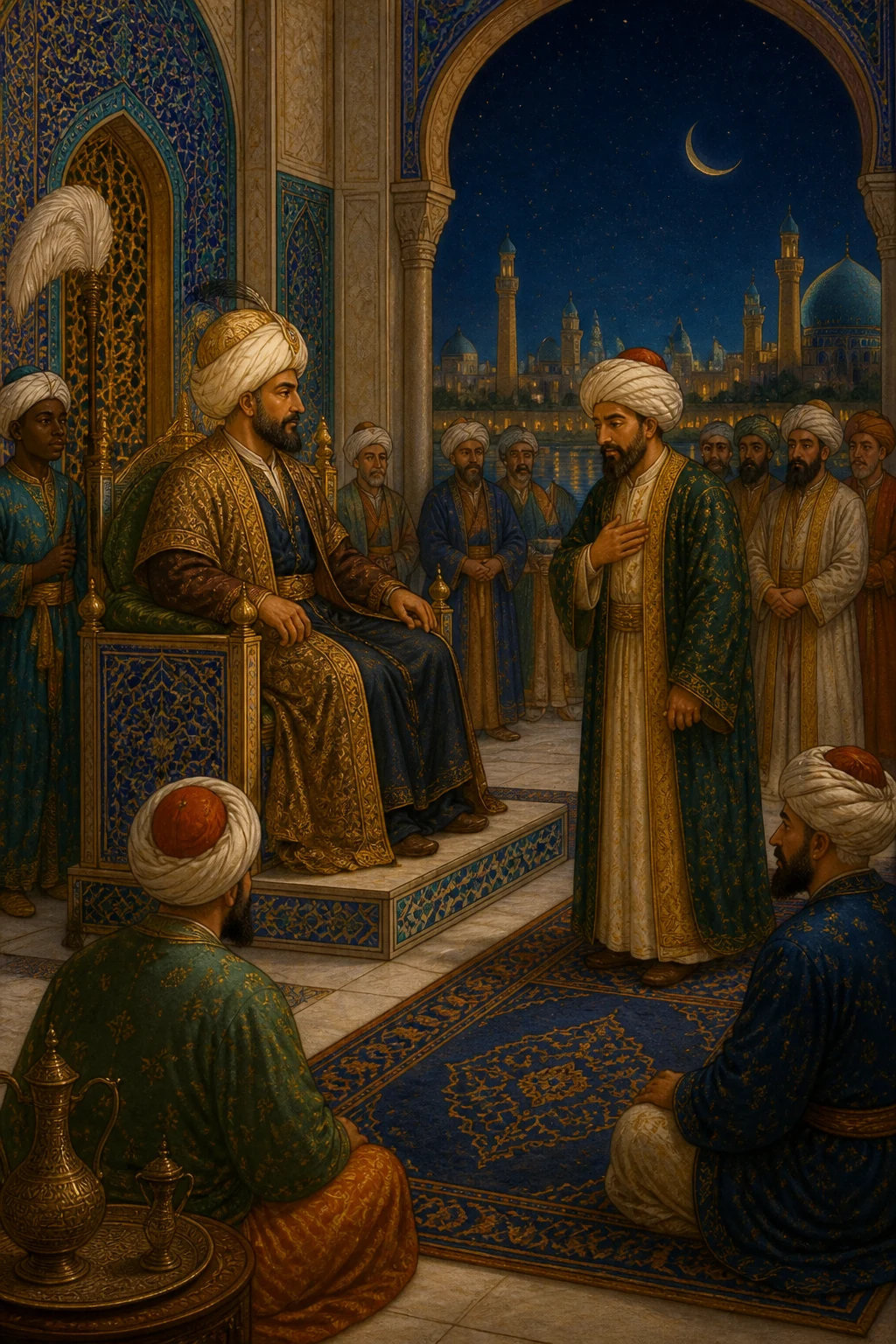
She said: It has reached me, O fortunate king, that the executioner raised his arm until the hair of his armpit showed and was about to strike off Taj al-Muluk’s head, when suddenly loud cries arose and the people began closing their shops. “Do not be hasty,” the king told the executioner. Then he sent a messenger to discover what had happened. The man went out and returned, saying, “I saw an army like a stormy sea with waves crashing together. Their horses are galloping, and the earth shakes beneath them. I do not know who they are.” The king was alarmed and feared that he would lose his kingdom. Turning to his vizier, he asked, “Has no one from our army gone out to meet them?” Scarcely had he finished speaking when his chamberlains entered with envoys from the newly arrived king, among them the vizier. They greeted him, and he rose, welcomed them, and asked the reason for their coming. The vizier rose from among them, stepped forward, and said, “Know that the king who has encamped in your land is unlike the kings of old or the sultans who have gone before.” “Who is he?” asked the king. The vizier replied, “He is the lord of justice and security, whose lofty spirit is celebrated by travelers: Sultan Sulayman Shah, ruler of the Green Land, the Two Pillars, and the uplands of Isfahan. He loves justice and fairness and hates oppression and tyranny. He tells you that his son is here with you, in your city, the very life of his heart and the fruit of his soul. If he finds him safe, his purpose is fulfilled, and you shall have his thanks and praise. But if his son has disappeared from your land or any harm has befallen him, then expect destruction and the ruin of your dwellings. He will turn your country into a wilderness where only ravens cry. I have delivered my message. Peace be upon you.”
When King Shahriman heard the envoy’s words, his heart trembled and he feared for his kingdom. He called for the lords of his realm, his viziers, chamberlains, and deputies. When they came, he said, “Woe to you! Go down and find that young man!” Taj al-Muluk was still in the executioner’s hands, his appearance altered by the terror he had endured. Then the envoy happened to turn and saw his king’s son upon the leather execution mat. Recognizing him, he sprang up and threw himself upon him, as did the other envoys. They untied his bonds and kissed his hands and feet. Taj al-Muluk opened his eyes and recognized his father’s vizier and his friend Aziz, then fainted from the joy of seeing them. King Shahriman was at a loss and became terribly afraid when he realized that this army had come on account of the young man. He rose, went to Taj al-Muluk, and kissed his head, his eyes filling with tears. “My son,” he said, “do not hold me to account, nor requite a wrongdoer for his deed. Have mercy on my gray hairs and do not lay waste my kingdom.” Taj al-Muluk drew near, kissed his hand, and said, “Have no fear. You are as a father to me. But take care that no harm comes to my beloved, Lady Dunya.” “My lord,” replied the king, “do not fear for her. Nothing but happiness shall come to her.” The king continued to apologize to him and sought to soothe King Sulayman Shah’s vizier, promising him great wealth if he would conceal from his master what he had seen. Then he ordered the chief men of his realm to take Taj al-Muluk to the bath, dress him in the finest royal garments, and bring him back quickly. They did so, taking him to the bath and dressing him in the suit King Shahriman had set aside for him. Then they brought him to the council chamber. As he entered, King Shahriman and all the lords of his realm rose to honor him, and everyone attended upon him. Taj al-Muluk sat down and told his father’s vizier and Aziz all that had happened. They said, “Meanwhile, we went to your father and told him that you had entered the princess’s palace and had not returned, and that we knew nothing of your fate. When he heard this, he mustered his armies, and we came to this land. Our arrival has brought deliverance and joy.” Taj al-Muluk replied, “From first to last, blessings have come to me through your hands.”
Meanwhile the king had gone to his daughter, Lady Dunya. He found her weeping for Taj al-Muluk. She had taken a sword, planted its hilt against the ground, and set its point against her heart between her breasts. Leaning over it, she was saying, “I must kill myself. I will not live after my beloved.” When her father entered and saw her in this state, he cried out, “Lady of all princesses, do not do it! Have mercy on your father and the people of your country!” He approached her and said, “Surely you would not allow harm to befall your father because of you.” Then he told her what had happened, and that her beloved was the son of King Sulayman Shah and wished to marry her. “The matter of the betrothal and marriage,” he said, “is yours to decide.” She smiled and replied, “Did I not tell you he was a sultan’s son? I shall have him crucify you on a wooden cross worth two dirhams!” “By God,” he pleaded, “have mercy on your father!” “Go to him and bring him to me,” she said. “Upon my head and eyes,” he replied. He hurried back to Taj al-Muluk and privately told him what she had said, then rose and accompanied him to her. When she saw Taj al-Muluk, she embraced him before her father and clung to him, saying, “How I have missed you!” Then she turned to her father and said, “Would anyone give up this handsome young man, a king and the son of a king?” King Shahriman withdrew and closed the door upon them. He went to Taj al-Muluk’s father’s vizier and the other envoys and told them to inform Sultan Sulayman Shah that his son was safe and well and living in the greatest happiness.
Then Sultan Shahriman ordered provisions and fodder sent to the armies of Sultan Sulayman Shah, Taj al-Muluk’s father. When all this had been delivered, he brought out a hundred fine horses, a hundred riding camels, a hundred mamluks, a hundred concubines, a hundred male slaves, and a hundred slave girls, and sent them all to him as a gift. Afterward he set out with the lords of his realm and his closest attendants to meet him outside the city. When Sultan Sulayman Shah learned of his approach, he walked a few paces to welcome him. The vizier and Aziz had already told him the news, and he had rejoiced, saying, “Praise be to God, who has granted my son his heart’s desire!” King Sulayman Shah embraced King Shahriman and seated him beside him on the throne, and they began to converse. Food was brought, and they ate their fill, after which sweetmeats were served. A little later Taj al-Muluk arrived in all his finery and adornment. When his father saw him, he rose and kissed him. Everyone present also rose, and Taj al-Muluk sat among them as they talked. King Sulayman Shah said, “I wish to have my son’s marriage contract with your daughter drawn up before witnesses.” “I hear and obey,” replied Shahriman. He sent for the judge and witnesses, who came and drew up the contract. The armies rejoiced, and King Shahriman began preparing his daughter’s bridal furnishings. Then Taj al-Muluk said to his father, “Aziz is a generous and noble man. He has rendered me a great service, suffered hardship, traveled with me, and brought me to my desire. He never ceased to comfort me until my purpose was fulfilled. He has spent two years with us, far from his own country. I should like us to provide him with merchandise to trade, for his homeland is near.” His father replied, “An excellent thought.” So they prepared a hundred loads of the costliest fabrics for him. Taj al-Muluk came to bid him farewell and said, “My brother, accept these as a gift.” Aziz accepted and kissed the ground before him and his father, King Sulayman Shah. Then Taj al-Muluk mounted and accompanied Aziz for three miles, after which Aziz implored him to return. “Were it not for my mother,” he said, “I could not bear to leave you. For God’s sake, do not cease to send me news of yourself.” Then he bade him farewell and traveled on to his own city. There he found that his mother had built a tomb for him in the middle of the house and had taken to visiting it. When he entered, he found her with her hair unbound and spread across the tomb, tears streaming from her eyes as she recited these two verses:
“By God, O grave, has his beauty faded, or has that radiant countenance changed? O grave, you are neither garden nor sky: how, then, can you hold both the full moon and the flowers?”
Then her sighs rose, and she recited these verses: “Why, when I passed among the graves and greeted my beloved’s tomb, did he return no answer? The beloved said, ‘How can I answer you, held captive as I am beneath stones and earth? The dust has devoured my beauty, and I have forgotten you; I am veiled from my family and my loved ones.’” Scarcely had she finished her verses when Aziz came in. At the sight of him she rose, embraced him, and asked why he had been absent. He told her everything that had happened to him, from beginning to end, and how Taj al-Muluk had given him a hundred camel-loads of money and fine cloth. She rejoiced at this, and Aziz remained with his mother, bewildered by what had befallen him at the hands of the crafty Delilah who had castrated him.
Such was the case with Aziz. As for Taj al-Muluk, he went in to his beloved, the Lady Dunya, and took her maidenhead. King Shahriman then began preparing his daughter to depart with her husband and his father. He provided them with provisions, gifts, and precious rarities; then they loaded their baggage and set out. King Shahriman accompanied them for three days to bid them farewell, until King Sulayman Shah adjured him to return, and he turned back. Taj al-Muluk, his father, and his wife continued traveling by night and day until they came within sight of their own country, where the city was adorned to welcome them. And dawn overtook Shahrazad, and she fell silent, leaving her tale untold.
When it was the hundred and thirty-seventh night,
She said: It has reached me, O fortunate King, that King Sulayman Shah traveled with his son and his son’s wife until they came within sight of their country, where the city was adorned to welcome them. They entered the city, and King Sulayman Shah seated himself upon his royal throne with his son Taj al-Muluk beside him. He bestowed gifts and largesse and released those who were in prison. Then he held a second wedding feast for his son, with music and entertainments lasting a whole month. The bridal attendants crowded about the Lady Dunya; she never wearied of being arrayed in her finery, nor did they weary of gazing at her. Then Taj al-Muluk, after meeting with his father and mother, went in to his wife, and they continued to live in the sweetest happiness and contentment.
At this, Daw al-Makan said to the vizier Dandan, “A man such as you is fit to be the companion of kings and to guide their affairs in the wisest fashion.” All this took place while they were besieging Constantinople. Four years passed, and they began to long for their homeland, while the troops grew weary of the siege and the ceaseless warfare by night and day. King Daw al-Makan ordered Bahram, Rustam, and Tarkash to be brought before him. When they appeared, he said, “Know that we have spent these years here without attaining our purpose, and have only increased our sorrow and care. We came to avenge King Umar al-Numan, yet my brother Sharkan has been slain, so that our grief is doubled and our calamity made twofold. The cause of all this is the old woman Dhat al-Dawahi. She murdered the sultan in his own kingdom and carried off his wife, Queen Safiyya. Not content with that, she deceived us and cut my brother’s throat. I have sworn the most solemn oaths that vengeance must be taken. What do you say? Consider my words and give me your answer.” They bowed their heads and left the matter to the vizier Dandan. Then Dandan stepped forward and said to King Daw al-Makan, “Know, O King of the Age, that there is no longer any profit in remaining here. The wise course is to return to our homeland and stay there for a time, then come back and wage war against the idolaters.” The king said, “That is sound counsel, for the men long to see their families. I too am tormented with longing for my son Kan ma Kan and my brother’s daughter Qudiya fa-Kan, for she is in Damascus, and I do not know what has become of her.” When the troops heard this, they rejoiced and called down blessings upon the vizier Dandan.
Then King Daw al-Makan ordered the herald to proclaim that they would depart in three days, and they began making their preparations. On the fourth day the kettledrums were beaten and the banners unfurled. The vizier Dandan rode at the head of the army, while the king traveled in its midst with the Grand Chamberlain at his side. The hosts set forth and pressed on by night and day until they reached Baghdad. The people rejoiced at their coming, and sorrow and distress departed from them. Each emir went to his own house, while the king ascended to his palace and went in to his son Kan ma Kan, who was now seven years old and could mount and dismount a horse. When the king had rested from the journey, he went to the bath with his son Kan ma Kan, then returned and seated himself upon his royal throne. The vizier Dandan stood before him, and the emirs and chief officers of state came up and stood in attendance. King Daw al-Makan then ordered that his friend the bath-furnace stoker, who had shown him kindness during his wanderings, be brought before him. When the king saw him approaching, he rose to greet him and seated him at his side. King Daw al-Makan had told the vizier of the kindness his friend the stoker had shown him, and the man was held in high esteem by both the vizier and the emirs. The stoker had grown stout and fat from good food and ease: his neck was like an elephant’s, and his face like a dolphin’s belly. His wits had grown dull, for he never left the place where he was lodged, and he did not recognize the king by his appearance. The king turned to him with a smiling face, greeted him most warmly, and said, “How quickly you have forgotten me!” The stoker peered closely at him, and when at last he recognized him, he sprang to his feet and said, “My dear friend, who made you a sultan?” The king laughed at him, and the vizier began speaking to the stoker, explaining what had happened. “He was once your brother and companion,” he said, “and now he has become king of the land. You are sure to receive great bounty from him. Here is my advice: if he says, ‘Ask a favor of me,’ ask for nothing less than something great, for he holds you dear.” The stoker replied, “I am afraid I may ask him for something he will not grant me, or that is beyond his power.” The vizier said, “Whatever you ask, he will give you.” “By God,” said the stoker, “I shall certainly ask him for what I have in mind. Every day I hope he will consent to it.” The vizier said, “Set your heart at ease. By God, if you asked to govern Damascus in his brother’s place, he would appoint you.”
At this the stoker rose to his feet. Daw al-Makan motioned him to sit, but he refused, saying, “God forbid! The days when I could sit in your presence are over.” The sultan replied, “No, they are not over yet, for it was you who saved my life. By God, whatever you asked of me, I would give you. Ask, then, trusting in God.” The stoker said, “My lord, I fear I may ask for something you will not grant me, or that is beyond your power.” The sultan laughed and said, “If you asked for half my kingdom, I would share it with you. Ask for whatever you wish.” The stoker said, “I fear I may ask for something beyond your power.” The sultan grew angry and said, “Ask for whatever you want!” He replied, “I wish you to write me a decree appointing me head of all the furnace stokers in Jerusalem.” The sultan and everyone present laughed, and he said, “Ask for something else.” The stoker answered, “Did I not tell you I was afraid of asking for something you would neither grant nor have the power to give?” The vizier nudged him a second and a third time, but each time he said, “I ask you to make me chief of the rubbish collectors in Jerusalem, or in Damascus.” Those present fell back laughing at him, and the vizier struck him. The stoker turned to the vizier and said, “Who are you to strike me when I have done nothing wrong? You were the one who told me to ask for something great!” Then he said, “Let me go back to my own country.” The sultan realized that he was jesting, so he waited a little, then turned to him and said, “My brother, ask me for something great, befitting my station.” He replied, “I ask for the sultanate of Damascus in your brother’s place.” The king had the decrees drawn up to that effect, then said to the vizier Dandan, “None but you shall accompany him. When you return, bring my brother’s daughter Qudiya fa-Kan with you.” The vizier replied, “I hear and obey.” Then he took the stoker away and began preparing for the journey. Sultan Daw al-Makan ordered a new royal litter and a full set of royal equipment to be brought out for the stoker, and said to the emirs, “Let whoever loves me present him with a splendid gift.” Then the sultan named him Ziblakan and gave him the title al-Mujahid, the Holy Warrior. After a month, all his preparations were complete, and Ziblakan appeared with the vizier Dandan in attendance. Daw al-Makan came in to bid him farewell. Ziblakan rose to greet him and embraced him, and the king charged him to deal justly with his subjects and ordered him to be ready for holy war in two years. Then he bade him farewell and departed.
King al-Mujahid, now named Ziblakan, set out after King Daw al-Makan had charged him to treat his subjects well. The emirs presented him with mamluks until their number reached five thousand, and these rode behind him. The Grand Chamberlain, Bahram the emir of the Daylamites, Rustam the emir of the Turks, and Tarkash the emir of the Arabs rode out to bid him farewell. They accompanied him for three days, then returned to Baghdad. Sultan Ziblakan and the vizier Dandan continued on their way until they reached Damascus. News had already flown there on the wings of birds that King Daw al-Makan had appointed a king over Damascus called Ziblakan, with the title al-Mujahid. On receiving the news, the people adorned the city, and everyone in Damascus came out to meet him. He entered Damascus, ascended to the citadel, and seated himself upon the royal throne. The vizier Dandan stood in attendance, acquainting him with the stations and ranks of the emirs as they came in, kissed his hands, and invoked blessings upon him. King Ziblakan received them, bestowed robes of honor, and gave gifts and largesse. Then he opened the treasuries and distributed money among all the soldiers, great and small, and ruled with justice. Ziblakan began preparing Sultan Sharkan’s daughter, the Lady Qudiya fa-Kan, for her journey, and had a silk litter made for her. He also made ready the vizier’s traveling supplies and offered him a sum of money, but Dandan refused, saying, “You are newly come to the throne and may need the money. We may even send to ask you for funds for the holy war or some other purpose.” When the vizier Dandan was ready to depart, Sultan al-Mujahid rode out to bid him farewell. He brought Qudiya fa-Kan, seated her in the litter, and sent ten slave girls to attend her. After the vizier Dandan had left, King al-Mujahid returned to govern his kingdom, applied himself to preparing weapons, and awaited the time when King Daw al-Makan would send for him.
Such was the case with Sultan Ziblakan. As for the vizier Dandan, he traveled onward with Qudiya fa-Kan, stage after stage, until after a month he reached al-Rahba. Then he continued until he came within sight of Baghdad, and sent word to Daw al-Makan of his arrival. The king mounted and rode out to meet him. The vizier Dandan wished to dismount, but King Daw al-Makan adjured him not to do so, and he rode on until he came alongside him. The king asked him about al-Mujahid, and he told him that he was well, then informed him of the arrival of his brother Sharkan’s daughter, Qudiya fa-Kan. The king rejoiced and said, “Rest for three days from the hardships of your journey, then come to me.” He replied, “With love and honor.” The vizier went home, while the king ascended to his palace and went in to his brother’s daughter Qudiya fa-Kan, who was eight years old. At the sight of her he rejoiced, yet grieved for her father. He gave her splendid jewels and ornaments, and ordered that she be lodged together with her cousin Kan ma Kan. She was the fairest and bravest of her generation, for she possessed judgment, intelligence, and an understanding of the consequences of things.
As for Kan ma Kan, he was devoted to noble conduct, but gave no thought to the consequences of anything. In time they both reached the age of ten, and Qudiya fa-Kan began riding horses and going out into the open country with her cousin. They learned swordsmanship and the use of the lance, until each was twelve years old. By then the king had finished his preparations for holy war and made everything ready. He summoned the vizier Dandan and said, “Know that I have resolved upon something which I wish to lay before you. Be swift with your answer.” The vizier Dandan said, “What is it, O King of the Age?” He replied, “I have resolved to make my son Kan ma Kan sultan, so that I may rejoice in him while I am still alive and fight before him until death overtakes me. What is your opinion?” The vizier Dandan kissed the ground before King Daw al-Makan and said, “Know, O fortunate King, whose judgment is sound, that what has occurred to you is good, but it is not fitting at this time, for two reasons. First, your son Kan ma Kan is young; second, experience shows that a man who makes his son sultan during his own lifetime seldom lives long afterward. That is my answer.” The king said, “Know, Vizier, that we shall entrust him to the Grand Chamberlain, for he has become one of us and belongs to us. He has married my sister and is therefore as a brother to me.” The vizier replied, “Do as you see fit; we obey your command.” The king sent for the Grand Chamberlain and the great officers of his kingdom. When they had assembled, he said, “This is my son Kan ma Kan. You know that he is the foremost horseman of the age, without equal in battle or in the use of the lance. I have made him sultan over you, with the Grand Chamberlain as his guardian.” The chamberlain said, “O King of the Age, I am but a sapling nurtured by your bounty.” Daw al-Makan said, “Chamberlain, my son Kan ma Kan and my brother’s daughter Qudiya fa-Kan are cousins, and I have married her to him. I call all those present to witness this.”
Then he transferred to his son wealth beyond the power of words to describe. Afterward he went in to his sister Nuzhat al-Zaman and told her what he had done. She rejoiced and said, “They are both my children. May God Most High preserve you for them for all time.” He said, “My sister, I have fulfilled my purpose in this world and set my mind at rest concerning my son. But you must watch over him and his mother.” For days and nights he continued commending his son and wife to the care of the chamberlain and Nuzhat al-Zaman. Certain now that he must drink the cup of death, he took to his bed, while the chamberlain assumed the administration of the people’s affairs. After a year he summoned his son Kan ma Kan and the vizier Dandan and said, “My son, this vizier shall be your father after me. Know that I am departing from this passing abode to the abode everlasting. I have fulfilled my purpose in the world, yet one sorrow remains in my heart, which God may remove through your hands.” His son asked, “What is that sorrow, Father?” He answered, “My son, it is that I should die before we have avenged your grandfather King al-Numan and your uncle King Sharkan upon an old woman called Dhat al-Dawahi. If God grants you victory, do not neglect to take vengeance and wipe away the shame inflicted by the unbelievers. Beware the old woman’s cunning, and heed what the vizier Dandan tells you, for he has long been the mainstay of our kingdom.” His son replied, “I hear and obey,” and tears streamed from his eyes. After this, Daw al-Makan’s illness grew worse, and the affairs of the kingdom passed to the chamberlain, who governed, commanded, and forbade. He continued thus for a full year while Daw al-Makan was wholly taken up with his sickness. The king’s illnesses afflicted him for four years, during which the Grand Chamberlain managed the kingdom. The people were content with him, and all the provinces prayed for him.
Such was the case with Daw al-Makan and the chamberlain. As for Kan ma Kan, he occupied himself with nothing but riding, practicing with the lance, and shooting arrows, and his cousin Qudiya fa-Kan did likewise. She would go out with him from early morning until night; then she would return to her mother, and he to his, whom he would find sitting at his father’s head, weeping. He would tend his father through the night, and when morning came he would go out with his cousin as usual. Daw al-Makan’s sufferings dragged on, and he wept and recited these verses:
“My strength is spent, my time has passed, and here I linger, as you see. In the days of glory I was the mightiest of my people, the foremost in attaining all I wished. Now I have left my kingdom and my splendor for abasement steeped in shame. Shall I, before I die, behold my boy a king over mankind in my stead, striking down our foes to take revenge with the sword’s edge or the spear’s keen point? In jest and earnest I am cheated of my due, unless my Lord should heal my heart.” When he had finished his verses, he laid his head upon the pillow and slept. In his dream he heard a voice saying, “Rejoice, for your son shall rule the lands, and the people shall obey him.” He awoke delighted by his dream. A few days later death came to him, and the people of Baghdad were stricken with a great calamity; infant and elder alike wept for him. Time passed over him as though he had never been. Kan ma Kan’s fortunes changed: the people of Baghdad deposed him and lodged him and his household in a separate house. When Kan ma Kan’s mother saw this, she found herself reduced to the deepest humiliation. Then she said, “I must go to the Grand Chamberlain, and hope for mercy from the All-Gentle, the All-Aware.” She left her dwelling and went to the house of the chamberlain, who had now become sultan. Finding him seated upon his couch, she went in to his wife Nuzhat al-Zaman and said, “The dead have no friends. May God never let you know want through all the years and ages, and may you always rule justly over high and low. Your ears have heard and your eyes have seen the sovereignty, glory, rank, wealth, and comfortable life we once enjoyed. Now fortune has turned against us, and time has assailed us with hostility. I have come seeking your kindness, after having shown kindness myself, for when a man dies, the women and daughters he leaves behind are brought low.” Then she recited these verses:
“Let this suffice you: death reveals strange wonders, and the unseen end of our lives is never far from us. These days are only stages on a journey, their watering places mingled with calamity. Nothing has wounded my heart like the loss of noble souls whom overwhelming sorrows have encompassed.” When Nuzhat al-Zaman heard these words, she remembered her brother Daw al-Makan and his son Kan ma Kan. She drew his widow close, turned to her, and said, “Now I am wealthy and you are poor. By God, we have left your poverty unrelieved only for fear of wounding your heart, lest you should think that what we offered you was charity. Yet all the blessings we enjoy come from you and your husband. Our house is your house; what is ours is yours, and your burdens are ours.” Then she clothed her in splendid garments and set aside rooms for her in the palace adjoining her own chambers. She and her son Kan ma Kan lived comfortably with them. Nuzhat al-Zaman clothed him in royal garments and assigned slave girls to attend them both. A little while later, Nuzhat al-Zaman told her husband about the wife of her brother Daw al-Makan. His eyes filled with tears, and he said, “If you wish to see what the world will be like after you are gone, look at it after another has departed. Give her an honored home.” And dawn overtook Shahrazad, and she fell silent, leaving her tale untold.