Prevod
The young man said, “Know, my lord, that my father was a great merchant and had no child but me. I had a cousin, my paternal uncle’s daughter, who was brought up with me in my father’s house, for her father had died. Before his death, he and my father had agreed to marry us to one another. When I reached manhood and she reached womanhood, they did not keep her secluded from me, nor me from her. Then my father spoke to my mother, saying, ‘This year we shall draw up the marriage contract between Aziz and Aziza.’ My mother agreed, and my father began laying in provisions for the wedding feasts. All this while, my cousin and I slept together in one bed, knowing nothing of such matters, though she was more perceptive, knowledgeable, and understanding than I. When my father had completed the wedding preparations and nothing remained but the marriage contract and my taking my cousin as my wife, he decided that the contract should be drawn up after Friday prayers. He went to his friends, merchants and others, and told them, while my mother invited her women friends and relatives. When Friday came, they washed the reception hall and its marble floor, spread carpets throughout our house, and furnished it with everything needed, having hung the walls with gold-brocaded cloth. The guests agreed to come to our house after Friday prayers. My father had sweets and dishes of sugar confections prepared, and nothing remained but the signing of the contract. My mother sent me to the bathhouse and had a new suit of the finest clothes sent after me. When I came out of the bath, I put on these splendid garments, which had been perfumed, and their sweet fragrance filled the street. I was about to go to the mosque when I remembered a friend of mine and turned back to look for him, so that he might attend the signing of the marriage contract. ‘I shall occupy myself with this,’ I thought, ‘until it is nearly time for prayers.’
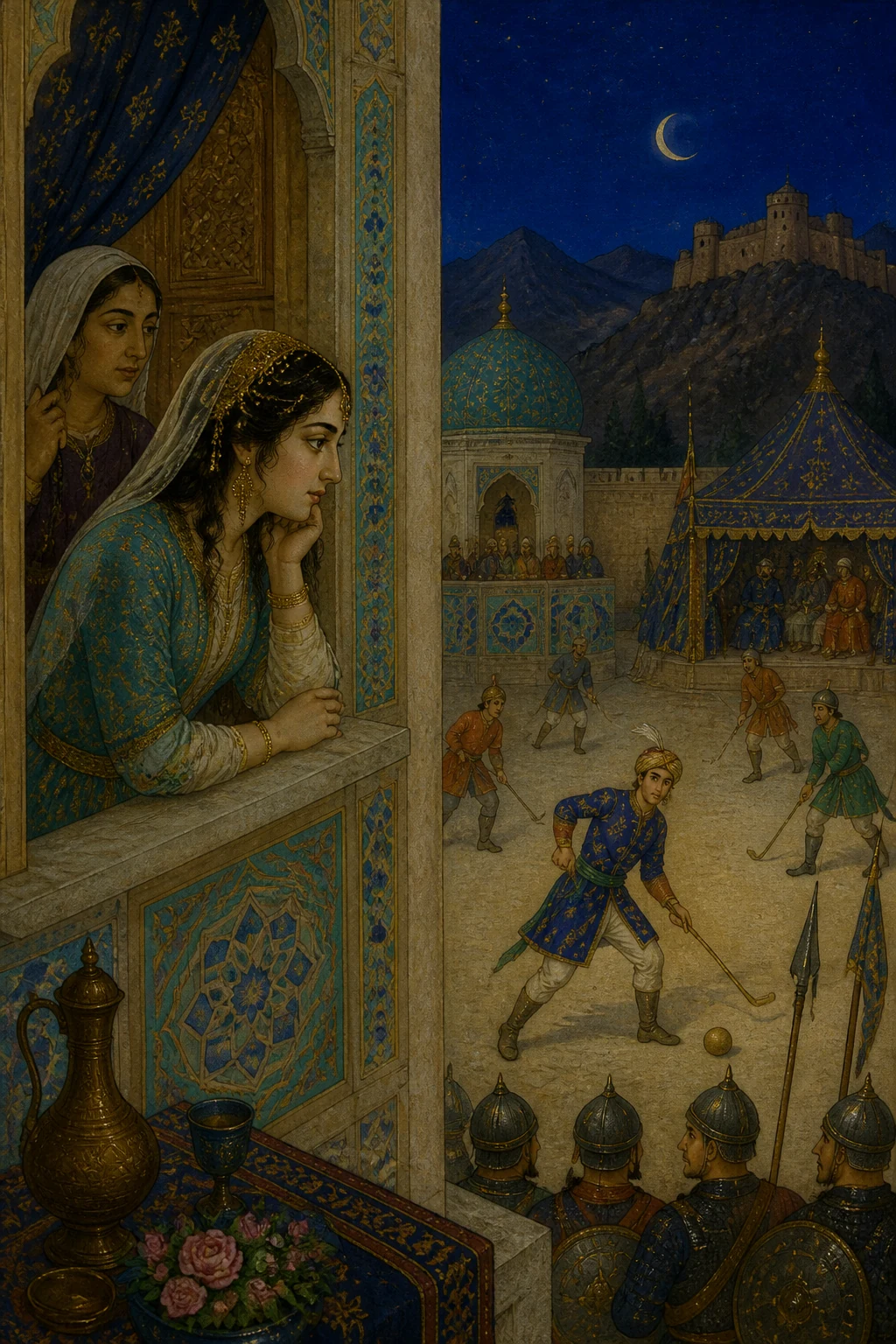
“Then I entered an alley I had never entered before. I was sweating from the bath and the new clothes I wore, and as my sweat flowed, my perfume rose about me. I sat down to rest on a stone bench at the entrance to the alley, spreading beneath me an embroidered handkerchief I had with me. The heat grew oppressive, and sweat trickled from my brow down my face. I could not wipe it away with the handkerchief, since I was sitting on it, so I reached for the skirt of my outer robe to wipe my cheeks. Suddenly a white handkerchief fell upon me from above, finer than the breeze and more welcome to the eye than recovery to the sick. I took it in my hand and raised my head to see where it had fallen from, and my eyes met those of the mistress of this gazelle.” But morning overtook Shahrazad, and she fell silent, leaving her tale untold.
When it was the hundred and thirteenth night
She said, “I have heard, O fortunate king, that the young man said to Taj al-Muluk, ‘I raised my head to see where the handkerchief had fallen from, and my eyes met those of the mistress of this gazelle. She was leaning out through an opening in a brass lattice window, and my eyes had never beheld anyone more beautiful. In short, my tongue cannot describe her. When she saw me looking at her, she put a finger in her mouth, then joined her middle finger to her forefinger and laid them on her breast between her bosoms. Then she drew her head back, shut the little window, and went away. Fire blazed in my heart, its heat grew fiercer, and that single glance left me with a thousand regrets. I was bewildered, for I had heard nothing she said and understood nothing of her signs. I looked up again, but the window was closed. I waited patiently until sunset without hearing a sound or seeing a soul. At last, despairing of seeing her, I rose and took the handkerchief with me. I unfolded it, and a fragrance of musk wafted from it, filling me with such delight that I seemed to be in Paradise. Then I spread it out before me, and a delicate slip of paper fell from it. I opened the paper and found it steeped in sweet perfumes, with these verses written upon it:
“‘I sent him my complaint of love’s deep pain, in slender script—for many are writing’s arts. He said, “My friend, why is your writing thus, so fine and faint the eye can scarcely read it?” I said, “Because I too am wasted, frail; such is the writing of all lovers’ hands.” After reading these verses, I let my eyes wander over the lovely handkerchief and found these two couplets embroidered along one border:
“‘His down has written—what a scribe it is!—two lines of basil on his tender cheeks. How dazzled are sun and moon when he appears; how shamed the boughs when he sways as he walks!’ On the other border were these two couplets:
“‘His down has traced, in ambergris on pearl, two lines of jet upon the apples of his cheeks. Death lies within his languid eyes when they gaze forth; drunkenness dwells in his cheeks, not in the wine.’ When I saw the poetry on the handkerchief, flames leapt within my heart, and my longing and distraction grew. I took the handkerchief and the paper home, knowing no way to attain union and unable to make sense of all that love had brought me. It was some time into the night before I reached the house. There I found my cousin sitting in tears. When she saw me, she wiped her eyes, came over to me, and helped me out of my clothes. She asked why I had been absent and told me that all the guests—emirs, dignitaries, merchants, and others—had gathered at our house. The judge and witnesses had come, and everyone had eaten and sat for a long time waiting for me, so that the marriage contract could be drawn up. When they despaired of my coming, they dispersed and went their ways. ‘Your father was furiously angry,’ she said, ‘and swore he would not have our marriage contract drawn up until next year, for he has spent a great deal of money on this wedding.’ Then she asked, ‘What happened to you today, that you stayed away so late and caused all this by your absence?’ I told her what had happened, mentioned the handkerchief, and related the whole story from beginning to end. She took the paper and the handkerchief and read what was written on them. Tears flowed down her cheeks, and she recited these verses:
“‘If someone says that love begins in choice, tell him, “You lie: it is compulsion, all.” What shame can follow what we cannot help? The tales of lovers bear this truth out well. Call it, if you wish, a torment that tastes sweet, a throbbing in the heart, a beating dealt; a blessing, curse, or longing of the soul, in which it finds its solace—or its death. Yet all its days are festivals of joy, and ever smiling are those days’ bright lips; its fragrant breaths return like festive seasons, and love effaces all that brings disgrace.’ Then she said to me, ‘What did she say to you, and what signs did she make?’ I answered, ‘She said nothing. She only put a finger in her mouth, then joined it to her middle finger and laid the two fingers on her breast. She pointed to the ground, drew in her head, and shut the window. I never saw her again, and she took my heart with her. I sat until sunset, hoping she would look out again, but she did not. When I lost hope, I left that place. That is my story, and I beg you to help me in this affliction.’ She raised her head and said, ‘Cousin, if you asked for my eye, I would pluck it from beneath my eyelids for you. I shall certainly help you gain what you desire, and help her gain what she desires, for she is as much in love with you as you are with her.’ ‘What do her signs mean?’ I asked. She replied, ‘Putting her finger in her mouth means that you are as dear to her as the soul within her body, and that she would cling to union with you with her very teeth. The handkerchief is a lover’s greeting to the beloved, and the paper means that her soul is bound to you. As for laying two fingers on her breast between her bosoms, she is telling you, “Come here in two days, so that the sight of you may relieve my suffering.” Know, cousin, that she loves you and trusts you. That is my interpretation of her signs. If I were free to come and go, I would bring you together without delay and shelter you both beneath the hem of my robe.’” The young man continued, “When I heard this, I thanked her for her words and told myself that I would wait two days. I stayed at home for those two days, neither going out nor coming in, neither eating nor drinking. I laid my head in my cousin’s lap while she comforted me, saying, ‘Be steadfast and brave; set your heart and mind at ease.’” But morning overtook Shahrazad, and she fell silent, leaving her tale untold.
When it was the hundred and fourteenth night
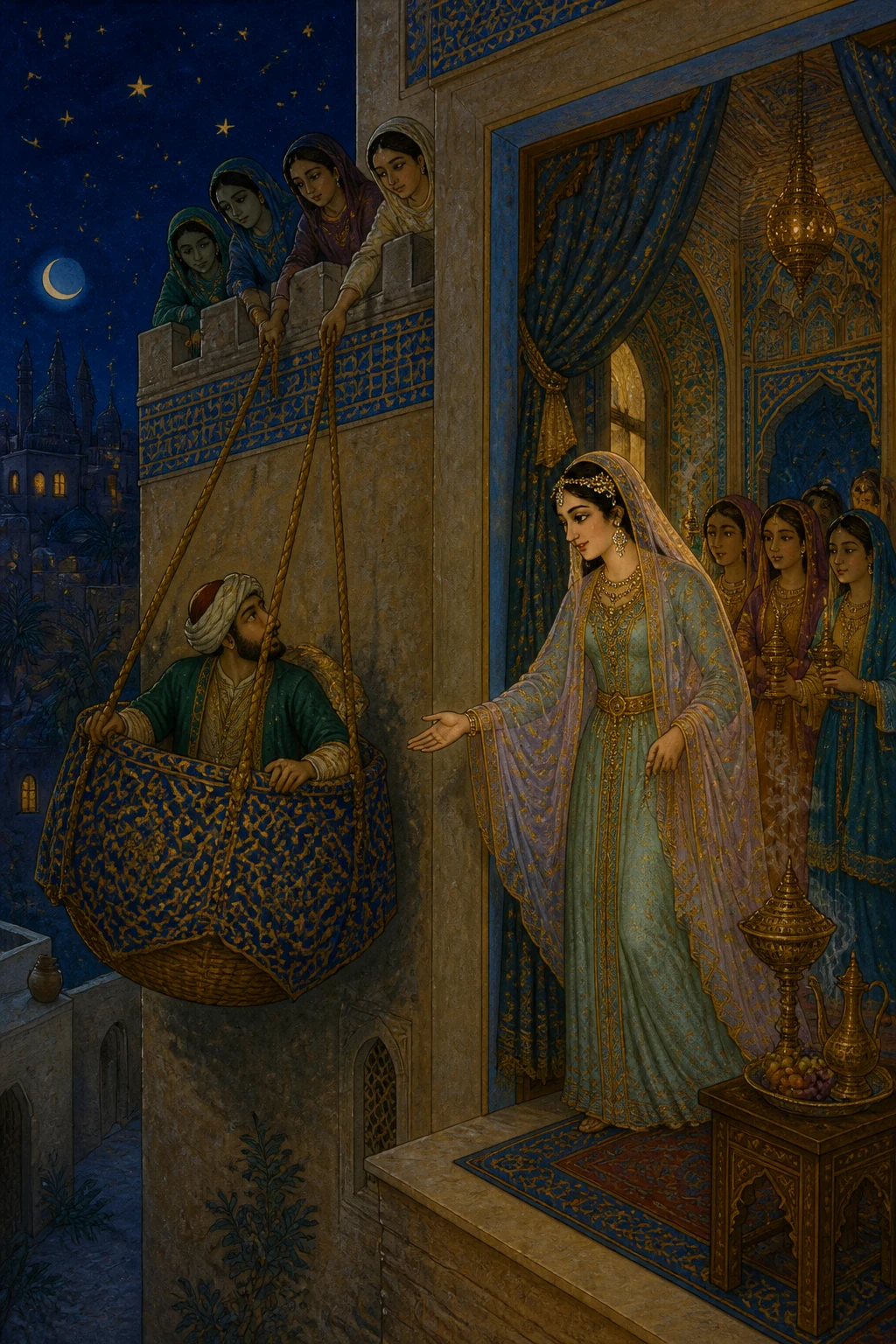
She said, “I have heard, O fortunate king, that the young man said to Taj al-Muluk, ‘When the two days had passed, my cousin said, “Be happy and take comfort. Summon your courage, put on your clothes, and go to her at the appointed time.” She rose, changed my clothes, and perfumed me with incense. Then I gathered my strength, took heart, and went out. I walked until I reached the alley and sat for a while on the bench. Suddenly the window opened. I looked up at her, and the moment I saw her, I fainted. When I recovered, I summoned my courage and looked at her again, only to lose all awareness once more. When I came to, I saw that she had a mirror and a red handkerchief. On seeing me, she bared her forearms, spread her five fingers, and struck her breast with her open palm. Then she raised her hands and held the mirror out of the window. Taking the red handkerchief, she went inside and returned, then lowered it from the window towards the alley three times, letting it down and drawing it up. After that she wrung it, folded it in her hand, and bowed her head. Then she withdrew into the room, shut the window, and went away without speaking a single word. She left me bewildered, not knowing what her signs meant. I remained sitting there until nightfall and came home near midnight. I found my cousin with her hand against her cheek, tears pouring from her eyes as she recited these verses:
“‘What ails me? None reproaches me for loving you. How can I find forgetfulness, when you are a slender bough? O face that stole my heart and turned away, my chaste devotion has no path but yours. Your Turkish eyes work such havoc in my breast as no keen, polished blade could ever wreak. You load me with the heavy weight of love, when I can scarcely bear my shirt, so weak am I. I have wept blood to hear my chiders say, “A naked blade will frighten you from your beloved’s eye.” Would that my heart were like your heart! My body, like your waist, is wasted into slenderness. My prince, among your beauties is a gaze too hard for me to bear, a brow that does me no justice. Whoever said all beauty dwelt in Joseph lied: how many Josephs live within your loveliness! I force myself to turn away from you, fearing the watchers’ eyes—how hard the effort is!’ When I heard her poetry, my grief increased and sorrows crowded in upon me. I collapsed in a corner of the room. She rose, lifted me up, took off my clothes, and wiped my face with her sleeve. Then she asked what had happened, and I told her everything the girl had done. She said, ‘Cousin, the open palm and five fingers mean, “Come back after five days.” As for showing you the mirror and putting her head out of the window, that means, “Sit at the dyer’s shop until my messenger comes to you.”’ At her words, fire blazed in my heart. ‘By God, cousin,’ I said, ‘your interpretation must be true, for I saw a Jewish dyer in the alley.’ Then I wept, and my cousin said, ‘Be brave and keep your heart firm. Other men spend years in love and bear its burning heat with patience, yet you have been in love scarcely a week. How can you give way to such despair?’ She went on soothing me and brought me food. I took a morsel and tried to eat it, but could not. I would neither eat nor drink, and sweet sleep deserted me. My face yellowed and my good looks faded, for I had never loved before and had never tasted love’s burning heat until then. I grew weak, and my cousin grew weak on my account. Every night she told me stories of lovers and their trials to comfort me until I slept. Whenever I woke, I found her keeping watch over me, tears running down her cheeks. So I remained until the five days had passed. Then my cousin rose, heated water, bathed me, and dressed me. ‘Go to her,’ she said. ‘May God grant your desire and bring you all you seek from your beloved.’ I went out and walked until I reached the entrance to the alley. It was a Saturday, and I found the dyer’s shop shut. I sat on its bench through the call to afternoon prayers, until the sun grew pale, the sunset prayer was called, and night fell. Still I saw no sign of her, heard no sound, and received no message. Sitting there alone, I began to fear for my safety, so I rose and walked home like a drunken man. When I entered, I saw my cousin Aziza gripping a peg driven into the wall with one hand and pressing the other against her breast, heaving sighs and reciting these verses:
“‘The longing of a Bedouin woman whose people have departed, who yearns for the moringa and laurel of the Hijaz—who, whenever she spies a caravan, has longing enough to kindle its welcoming fire, and tears enough to water it—is no greater than my longing for my love; yet he believes my love for him a sin.’ When she had finished her verses, she turned and saw me weeping. She wiped both her tears and mine with her sleeve, smiled at me, and said, ‘Cousin, may God give you joy in what He has bestowed on you! Why did you not spend the night with your beloved and obtain your desire from her?’ When I heard her words, I kicked her in the chest. She fell backwards onto the raised platform, and her forehead struck its edge, where there was a peg. I looked at her and saw that her forehead had split open and blood was flowing.” But morning overtook Shahrazad, and she fell silent, leaving her tale untold.
When it was the hundred and fifteenth night
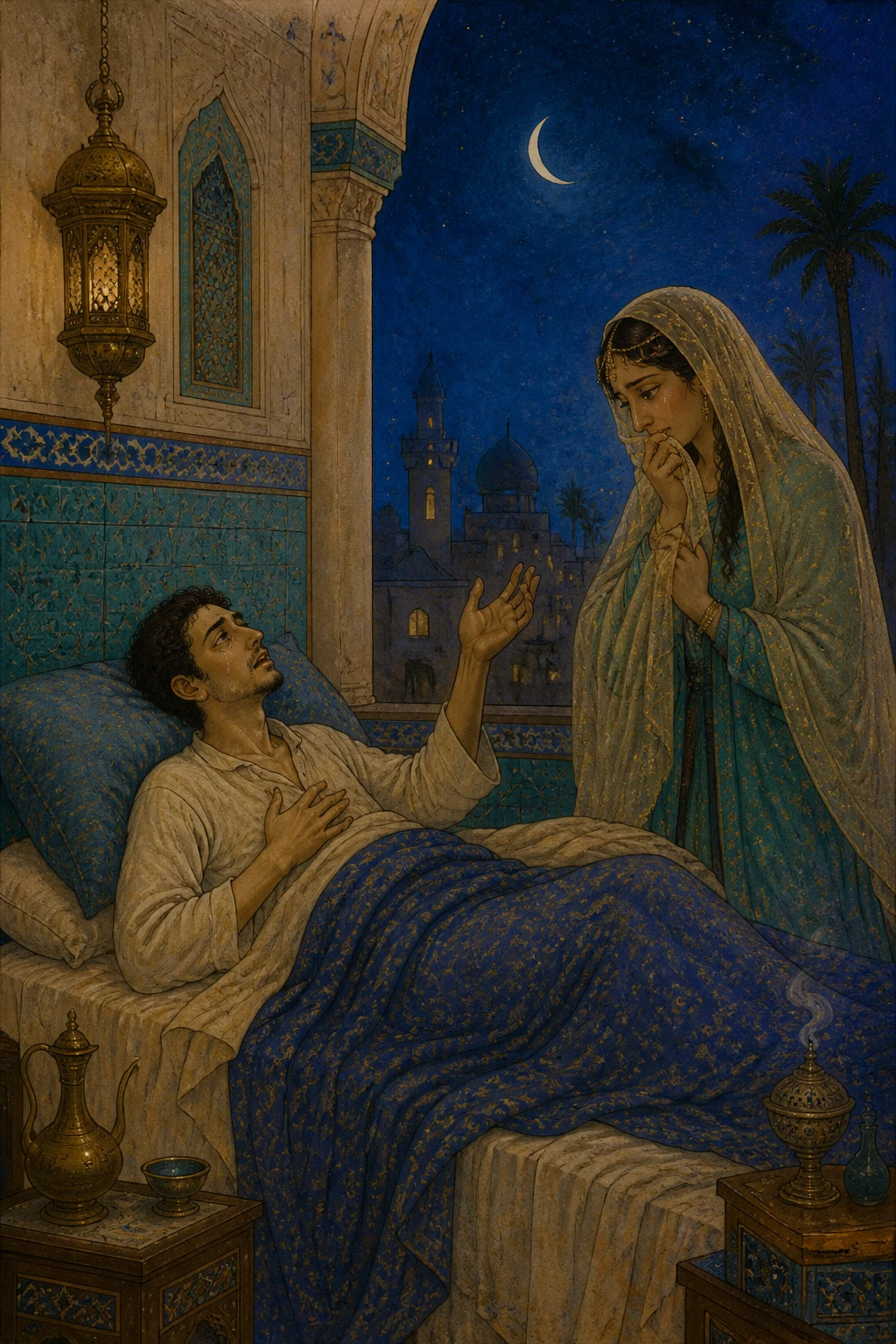
She said, “I have heard, O fortunate king, that the young man said to Taj al-Muluk, ‘When I kicked my cousin in the chest, she fell against the edge of the platform and struck her forehead on the peg. Her brow split open and blood flowed, but she remained silent and did not utter a word. She rose at once, burned some tinder, packed the wound with it, and bound her head with a bandage. Then she wiped the blood from the carpet as though nothing had happened. She came over, smiled at me, and said gently, “By God, cousin, I did not say those words to mock either you or her. I have been occupied with the pain in my head and wiping away the blood, but now my head and forehead feel easier. Tell me what happened to you today.” I told her everything that had happened that day and then burst into tears. She said, “Cousin, rejoice: you will gain your wish and fulfil your hopes. This is a sign of acceptance. She stayed away only to test you, to discover whether you are patient and whether your love is sincere. Go back tomorrow to your former place and see what signs she makes. Your happiness is near, and your sorrows are passing.” She continued to console me, though my grief and anxiety only grew. Then she brought me food, but I kicked it away, sending each bowl flying in a different direction. “Every lover is mad,” I said. “He has no appetite for food and takes no pleasure in sleep.” “By God, cousin,” Aziza said, “that is indeed the sign of love.” Her tears flowed as she gathered the broken bowls and wiped up the food. Then she sat keeping me company while I prayed to God for morning to come.
“‘When morning dawned and its light shone forth, I hurried to her alley and sat on the bench. The window opened, and she put out her head, laughing. She disappeared and returned with a mirror, a bag, a pot full of green plants, and a lamp in her hand. First she took the mirror, put it into the bag, tied the bag, and threw it into the room. Then she let her hair fall over her face and set the lamp for a moment on top of the plants. After that she took everything away and shut the window. My heart was breaking over her conduct, her secret signs and hidden meanings, for she had never spoken a single word to me. My passion grew fiercer, and my longing and bewilderment increased. I turned back, weeping and heartsick, and went home. There I found my cousin sitting with her face to the wall, her heart burning with sorrow, distress, and jealousy. Yet her love prevented her from telling me anything of her own passion, seeing how consumed I was by longing and distraction. I looked at her and saw two bandages about her head: one over the wound on her forehead, the other over an eye that had become painful from excessive weeping. She was in a wretched state, weeping and reciting these verses:
“‘Wherever you may be, may you remain in safety, O you who have departed, yet dwell within my heart. Wherever night may find you, may God be your protector, saving you from the turns of time and all calamity. You are gone: my eyes grow desolate in your absence, and my tears pour down in streams. Would that I knew in what land and dwelling you have settled, in what abode or valley. If pure, clear water is your drink, the tears that flow from my eyes are mine. Everything but parting from you is sweet, even the estrangement between my side and sleep.’ When she had finished her verses, she looked up and saw me through her tears. She wiped them away and rose to meet me, but her grief was so great that she could not speak. She remained silent for some time before saying, ‘Cousin, tell me what happened with her this time.’ I told her everything, and she said, ‘Be patient. The hour of union has come, and your hopes will be fulfilled. By putting the mirror into the bag, she was telling you, “Wait until the sun has sunk from sight.” By letting her hair fall over her face, she meant, “When night comes and the blackness of darkness veils the light of day, come to me.” The pot of plants means, “When you come, enter the garden behind the alley.” As for the lamp, she was saying, “When you enter the garden, walk through it, and wherever you see a lamp burning, go there, sit beneath it, and wait for me, for love of you is killing me.”’ When I heard my cousin’s words, I cried out in the violence of my passion. ‘How often you promise me!’ I said. ‘Yet I go to her and gain nothing, and find no truth in your interpretations.’ My cousin laughed and said, ‘All the patience you still need is to wait out the rest of this day, until daylight departs and night comes with its darkness. Then you will enjoy union and fulfil your hopes. This is the truth, without a lie.’ Then she recited these two couplets:
“‘Let the days pass, and pass they will; do not enter the houses of sorrow. Many a thing beyond all reach is brought near by the hour of deliverance.’ Then she came over and comforted me with gentle words. She did not dare bring me any food, fearing my anger and hoping to win my affection. All she sought was to come close and help me out of my clothes. Then she said, ‘Cousin, sit with me, and let me tell you something to while away the hours until evening. God willing, night will not come before you are with your beloved.’ I paid her no heed, but waited for night, saying, ‘Lord, hasten the coming of night!’ When darkness fell, my cousin wept bitterly and gave me a pellet of pure musk. ‘Cousin,’ she said, ‘put this in your mouth. When you meet your beloved, have your desire of her, and she has granted you all you wish, recite this verse to her:
“‘O lovers, tell me, in God’s name: when love overwhelms a young man, what should he do?’ Then she kissed me and made me swear that I would not recite the verse until I was leaving her. ‘I hear and obey,’ I said. I went out at nightfall and walked until I reached the garden. Its gate was open, so I entered and saw a light in the distance. I made towards it and found a great pavilion beneath a dome of ivory and ebony, with a lamp hanging from its centre. The pavilion was spread with silk carpets embroidered in gold and silver, and beneath the lamps a great candle burned in a golden candlestick. In the middle stood a fountain adorned with figures of every kind. Beside it was a table covered with a silken cloth, and next to that a great porcelain bowl filled with wine, with a crystal cup ornamented in gold inside it. Nearby stood a large covered silver platter. I uncovered it and found all manner of fruit—figs, pomegranates, grapes, and bitter oranges—interspersed with fragrant flowers and herbs: roses, jasmine, myrtle, wild roses, narcissi, and every kind of sweet-scented bloom. I was enchanted by the place and filled with the greatest joy. All grief and sorrow left me, yet I found not a single soul in the house.” But morning overtook Shahrazad, and she fell silent, leaving her tale untold.
When it was the hundred and sixteenth night
She said, “I have heard, O fortunate king, that the young man said to Taj al-Muluk, ‘I was enchanted by the place and filled with joy, yet I found not a single soul there: no slave, no maidservant, no one attending to any of these things. I sat in the pavilion waiting for my heart’s beloved. The first hour of the night passed, then the second and the third, but she did not come. Hunger began to torment me, for in the anguish of my longing I had eaten nothing for a long time. Once I saw the place and knew that my cousin had correctly understood my beloved’s signs, I felt at ease and became aware of my hunger. From the moment I arrived, the smell of the food on the table had tempted me. Now, reassured that I would meet my beloved, I longed to eat. I went to the table and lifted the cover. In the centre I found a porcelain platter containing four chickens, roasted and seasoned with spices. Around it stood four bowls: one of sweetmeats, another of pomegranate seeds, a third of baklava, and a fourth of qatayif, offering both sweet and tart flavours. I ate some qatayif and a piece of meat, then turned to the baklava and ate a good deal of it. Next I tried the sweetmeats, taking one spoonful, or two, or three, or four. I ate part of a chicken and another mouthful, until my belly was full, my limbs relaxed, and I felt too sluggish to stay awake. I washed my hands and laid my head on a cushion. Sleep overcame me, and I knew nothing of what happened afterwards. I did not wake until the heat of the sun scorched me, for I had scarcely tasted sleep for days. When I awoke, I found salt and charcoal on my belly. I sprang to my feet and shook out my clothes, looking to right and left, but there was no one there. I discovered that I had been sleeping on the bare marble, without any bedding. Bewildered and deeply distressed, I wept with pity for myself. Then I rose and went home. When I arrived, I found my cousin beating her breast, her tears vying with rain clouds, and reciting these verses:
“‘A wind blew from the beloved’s land, a breeze whose fragrant breath awakened love. O breeze of youth, come hither to us; each lover has his share, his destined portion. Could we but do so, in our passion we would embrace you as a lover clasps the breast of his beloved. Since my cousin’s face has vanished, God has forbidden me all sweetness and delight in life. Would that I knew if his heart, like mine, were melting in love’s heat and flame.’ When she saw me, she rose quickly, wiped her tears, and came to me with gentle words. ‘Cousin,’ she said, ‘God has shown you kindness in your love, for the one you love loves you in return. Who, then, can blame me for weeping and grieving over our separation? But may God not call you to account for what you have done to me.’ Then she gave me a bitter smile, treated me tenderly, took off my clothes, and spread them out. ‘By God,’ she said, ‘these are not the scents of a man who has enjoyed his beloved. Tell me what happened, cousin.’ I told her everything, and she smiled bitterly again. ‘My heart is full of pain,’ she said, ‘but may no one live who brings pain to yours. This woman is treating you with great haughtiness. By God, cousin, I fear her on your behalf. Know that the salt means you were so lost in sleep that you were like a tasteless dish from which the appetite recoils. You must acquire some salt, some charm, lest people find you repellent. You claim to be one of love’s noble devotees, yet sleep is forbidden to lovers. Your claim to love is false, and so too is her love for you, for when she saw you asleep she did not wake you. Had her love been true, she would have woken you. As for the charcoal, it means, “May God blacken your face, for falsely claiming to be in love! You are only a child whose sole ambition is to eat, drink, and sleep.” That is the meaning of her signs. May Almighty God deliver you from her!’ When I heard her words, I struck my breast. ‘By God, this is the truth!’ I said. ‘I slept, and lovers do not sleep. I have wronged myself. Nothing has harmed me more than eating and sleeping. What am I to do?’ I wept still harder and said to my cousin, ‘Tell me what to do. Have mercy on me, and may God have mercy on you, or I shall die.’ My cousin loved me with a great love.” But morning overtook Shahrazad, and she fell silent, leaving her tale untold.
When it was the hundred and seventeenth night
She said, “I have heard, O fortunate king, that the young man said to Taj al-Muluk, ‘I said to my cousin, “Tell me what to do. Have mercy on me, and may God have mercy on you.” She loved me dearly, and replied, “With all my heart. But cousin, I have told you many times that if I were free to come and go, I would bring you together at once and shelter you both beneath the hem of my robe. I do all this only to please you, and, God willing, I shall spare no effort to unite you. But listen to my words and obey me. Go back to that same place and sit there. When night falls, take your seat where you sat before, but beware of eating anything, for eating brings on sleep. Above all, do not fall asleep, for she will not come until a quarter of the night has passed. May God preserve you from her harm.” I rejoiced at her words and began praying for night to come. When it fell and I was about to leave, my cousin said, “When you meet her, recite the verse I gave you before, just as you are leaving.” “With all my heart,” I replied.
“‘I went out to the garden and found everything arranged as before, with food, drink, delicacies, fragrant flowers, and all else one could need. I mounted the pavilion, and the smell of the food stirred my appetite. Again and again I tried to restrain myself, but I could not. I rose, went to the table, and lifted its cover. There was a dish of chicken surrounded by four bowls containing four different kinds of food. I ate a mouthful of each, helped myself to some sweetmeats, ate a piece of meat, and tasted the zarda. I liked it so much that I went on spooning it down until I was satisfied and my belly was full. Then my eyelids began to close. I took a cushion, put it beneath my head, and said, “Perhaps I can lean on it without sleeping.” I closed my eyes and slept, and did not wake until sunrise. On my belly I found a knucklebone, a tab gaming stick, a date stone, and a carob seed. There was no bedding or anything else left in the place, as though nothing had been there the day before. I rose, shook everything off, and went home in a rage. There I found my cousin sighing deeply and reciting these verses:
“‘A wasted body and a wounded heart, and tears that stream upon my cheeks; a beloved cruel in his unjust rebukes—yet all the lovely one does is lovely. Cousin, you have filled my heart with longing, and my eyes are sore with tears.’ I shouted at my cousin and abused her. She wept, then wiped away her tears, came over, and kissed me. She tried to clasp me to her breast while I drew away, reproaching myself. ‘Cousin,’ she said, ‘it seems you fell asleep again tonight.’ ‘Yes,’ I replied, ‘but when I woke I found a knucklebone on my belly, a tab stick, a date stone, and a carob seed. I do not know why she did this.’ Then I wept and turned to her, saying, ‘Explain the meaning of what she has done, tell me what to do, and help me in my distress.’ ‘With all my heart,’ she said. ‘The tab stick she put on your belly means that you came in person, but your heart was absent. It is as though she were saying, “This is not how love should be. Do you really count yourself among lovers?” As for the date stone, she means that if you were a lover, your heart would burn with passion and you would never taste the sweetness of sleep, for love’s sweetness is like a date that kindles a coal within the heart. The carob seed means that a lover’s heart is stolen from him, and she is telling you, “Bear our separation with the patience of Job.”
“‘When I heard this interpretation, flames blazed within my heart and my sorrow increased. I cried out, “God has decreed sleep for me because of my ill fortune!” Then I said to her, “Cousin, by the love you bear me, devise some way for me to reach her.” She wept and said, “Aziz, my cousin, my heart is so full of care that I can scarcely speak. But go there tonight and take care not to sleep; then you will attain your desire. That is my counsel, and there is no more to say.” “God willing, I shall not sleep,” I answered. “I shall do as you command.” My cousin rose, brought me food, and said, “Eat your fill now, so that you will have no appetite left.” I ate until I had enough. When night came, she brought me a splendid suit of clothes and dressed me in it. She made me swear to recite the verse she had given me and warned me against sleeping. Then I left her, went to the garden, and mounted the pavilion. As night deepened, I gazed out into the garden, holding my eyes open with my fingers and shaking my head.” But morning overtook Shahrazad, and she fell silent, leaving her tale untold.
When it was the hundred and eighteenth night
She said: It has reached me, O fortunate king, that the young man said to Taj al-Muluk: I entered the garden, climbed up to the pavilion, and gazed out over the grounds. When night fell, I kept prising my eyes open with my fingers and shaking my head. Staying awake made me hungry, and the scents of food wafted toward me, sharpening my hunger. I went over to the table, lifted its cover, and ate a mouthful of every dish, as well as a piece of meat. Then I went to the bowl of wine and said to myself, “I shall drink one cup.” I drank it, then a second and a third, until I had drunk ten. Desire overcame me, and I fell to the ground like a slain man. I lay there until daybreak, when I awoke to find myself outside the garden, with a sharp knife and an iron dirham on my belly. Trembling, I took them and carried them home. There I found my cousin saying, “Here in this house I am wretched and sorrowful, with no comfort but my tears.” When I entered, I fell full length, flung the knife and the dirham from my hand, and fainted. On recovering, I told her what had happened and said, “I have not attained my desire.” Her grief for me deepened at the sight of my tears and anguish, and she said, “I have worn myself out warning you against sleep, but you would not heed me. My words do you no good.” I said, “I beg you, by God, explain what she means by the knife and the iron dirham.” She replied, “As for the iron dirham, it stands for her right eye, by which she swears, saying, ‘By the Lord of all the worlds and by my right eye, if you return a second time and fall asleep, I shall slaughter you with this knife.’ Cousin, I fear her cunning on your account. My heart is so full of sorrow for you that I can scarcely speak. If you know that you can return to her without sleeping, go back and beware of sleep, and you will attain your desire. But if you know that you will fall asleep as usual, and you go back and do so, she will slaughter you.” “What am I to do, cousin?” I asked. “For God’s sake, help me out of this trouble.” “With all my heart,” she replied. “But if I am to obtain what you desire, you must listen to me and obey my instructions.” “I shall listen and obey,” I said. “When it is time for you to go,” she answered, “I shall tell you.”
Then she drew me into her arms and laid me on the bed, and kept massaging me until drowsiness overcame me and I fell into a deep sleep. She took a fan and sat by my head, fanning my face until the end of the day, when she woke me. I opened my eyes to find her at my head, the fan in her hand, weeping so bitterly that her tears had soaked her clothes. When she saw that I was awake, she wiped away her tears and brought me some food. I refused it, but she said, “Did I not tell you to listen to me? Eat.” So I ate rather than disobey her. She placed the food in my mouth, and I chewed until I was full. Then she gave me a sweetened infusion of jujubes to drink, washed my hands, dried them with a cloth, and sprinkled me with rosewater. I sat with her, feeling quite restored. When darkness fell, she dressed me and said, “Cousin, stay awake all night and do not sleep. She will not come to you tonight until the last hours of darkness. God willing, you will be united with her tonight, but do not forget my request.” Then she wept, and her copious tears made my heart ache for her. “What was the request you promised to tell me?” I asked. “When you leave her,” she said, “recite to her the verse I mentioned before.” I left her joyfully and went to the garden, where I climbed up to the pavilion with a full stomach. I sat awake until a quarter of the night had passed. Then the night seemed so long that it might have been a year. Still I kept awake until three quarters of it had gone and the cocks crowed. By then, staying awake had made me ravenous, so I went to the table and ate my fill. My head grew heavy and I wanted to sleep, when suddenly I heard a commotion in the distance. I sprang up, washed my hands and mouth, and roused myself. Before long she appeared with ten slave girls, among whom she shone like the full moon among the stars. She wore a robe of green satin embroidered with red gold, and was as the poet described:
She flaunts her beauty before her lovers in robes of green, her buttons undone and her hair flowing free. I asked her, “What is your name?” She said, “I am she who has seared lovers’ hearts over burning coals.” I complained to her of the torments of my love. “You have complained to a rock,” she said, “without knowing it.” I answered, “Even if your heart is stone, God has made sweet water spring from stone.” When she saw me, she laughed and said, “How have you stayed awake without sleep overcoming you? Now that you have kept vigil, I know you are a lover, for lovers are known by their wakeful nights as they struggle with longing.” Then she turned to the slave girls and signaled to them with her eyes, and they withdrew. She came to me, clasped me to her breast, and kissed me, and I kissed her. She sucked my lower lip and I sucked her upper one. Then I put my hand to her waist and squeezed it, and we sank to the ground together. She untied her trousers, which slipped down to her anklets, and we set about our playful tussling and embracing, our coquetry and tender words, our biting and lifting of legs, our circuits of the House and its corners, until her limbs grew slack and she swooned away into oblivion. That night was a joy to the heart and a delight to the eye, as the poet said:
The sweetest night of all my life was one when, for all my labors, I never neglected the cup. I kept my eyelids and sleep apart, and brought the earring and the anklet together. When morning came, I wished to leave, but she caught hold of me and said, “Wait, until I tell you something.” And dawn overtook Shahrazad, and she fell silent, leaving her tale untold.
When it was the hundred and nineteenth night
She said: It has reached me, O fortunate king, that the young man said to Taj al-Muluk: When morning came, I wished to leave, but she caught hold of me and said, “Wait, until I tell you something and give you a charge.” I waited, and she untied a kerchief, took out this piece of cloth, and spread it before me. On it I saw the figure of a gazelle, just as you see here, and I marveled greatly at it. I took it, and we agreed that I should come to her every night in that garden. Then I left her rejoicing, and in my joy I forgot the verse my cousin had asked me to recite. When she gave me the cloth with the gazelle upon it, she said, “This is my sister’s work.” “What is your sister’s name?” I asked. “Her name is Nur al-Huda,” she replied. “Take good care of this cloth.” I bade her farewell and went away in delight, walking until I came home to my cousin, whom I found lying down. When she saw me, she rose, her tears falling, came up to me, kissed my breast, and said, “Did you do as I asked and recite the verse?” “I forgot it,” I replied. “It was this picture of a gazelle that put it out of my mind.” I tossed the cloth before her. She rose and sat down again, unable to contain herself, and her eyes overflowed with tears as she recited these two verses:
You who seek parting, take care; do not let embraces deceive you. Take care, for treachery is the nature of time, and every companionship ends in separation. When she had finished her verses, she said, “Cousin, give me this cloth.” I gave it to her, and she took it, spread it out, and examined what was on it. When the time came for me to go, my cousin said, “Go in safety, but when you leave her, recite the verse I first gave you, which you forgot.” “Repeat it to me,” I said. She repeated it, and I went to the garden and entered the pavilion, where I found the girl waiting for me. When she saw me, she rose, kissed me, and seated me in her lap. Then we ate and drank and fulfilled our desires as before; there is no need to repeat it. When morning came, I recited the verse to her:
O lovers, tell me, by God: when love overwhelms a young man, what is he to do? When she heard it, her eyes streamed with tears, and she replied in verse: Let him soothe his passion and conceal his secret, and in all things be patient and submit. I committed this to memory, glad to have fulfilled my cousin’s request. Then I left and went home to her. I found her lying down, with my mother sitting at her head, weeping over her condition. When I entered, my mother said, “A curse on you for a cousin! How can you leave your cousin in such distress and not even ask about her illness?” When my cousin saw me, she lifted her head and sat up. “Aziz,” she said, “did you recite the verse I gave you?” “Yes,” I replied. “When she heard it, she wept and recited another verse, which I have learned by heart.” “Let me hear it,” said my cousin. When I recited it, she wept bitterly and spoke this verse:
He has tried to bear it with noble patience, but found only a heart distraught with longing. Then my cousin said, “When you go to her as usual, recite this verse you have heard.” “I hear and obey,” I replied. I went to the girl in the garden as usual, and what passed between us was beyond the power of the tongue to describe. When I wished to leave, I recited that verse to her, beginning, “He has tried…” When she heard it, the tears welled from her eyes, and she recited the poet’s words:
If he can find no patience to conceal his secret, then I know of no better remedy for him than death. I learned it by heart and went home. When I entered my cousin’s room, I found her lying unconscious, with my mother seated at her head. At the sound of my voice she opened her eyes and said, “Aziz, did you recite the verse to her?” “Yes,” I answered. “And when she heard it, she wept and recited this verse: ‘If he can find no patience…’” When my cousin heard it, she fainted once more. On recovering, she recited this verse:
We have heard and obeyed, and then we died; bear my farewell to the one who denied us union. When night fell, I went to the garden as usual and found the girl waiting for me. We sat down, ate and drank, took our pleasure, and then slept until morning. As I was about to leave, I recited what my cousin had said. On hearing it, she gave a great cry of distress and said, “By God, the woman who spoke those verses is dead!” Then she wept and said, “Wretch! What relation is their author to you?” “She is my cousin,” I replied. “You lie, by God!” she said. “If she were your cousin, you would have had as much love for her as she had for you. You have killed her! May God kill you as you killed her! By God, had you told me you had a cousin, I would never have let you near me.” I said, “She is indeed my cousin. She used to explain the signs you made to me, and she taught me how to behave with you. It was only through her good counsel that I reached you.” “Did she know about us?” she asked. “Yes,” I said. “May God make you grieve over your youth as you made her grieve over hers!” she cried. Then she said, “Go and see her.” I went away greatly troubled and walked until I reached our alley, where I heard wailing. I asked what had happened and was told, “We found Aziza dead behind the door.” I entered the house, and when my mother saw me, she said, “The guilt of her death is on your neck. May God never forgive you for her blood!” And dawn overtook Shahrazad, and she fell silent, leaving her tale untold.
When it was the hundred and twentieth night
She said: It has reached me, O fortunate king, that the young man said to Taj al-Muluk: I entered the house, and when my mother saw me, she said, “The guilt of her death is on your neck. May God never forgive you for her blood! A curse on you for a cousin!” Then my father came, and we prepared her body, followed her funeral procession, and buried her. We had the whole Quran recited over her grave and remained there for three days. Then I returned home, grieving for her. My mother came to me and said, “I want to know what you did to her to break her heart. My son, I was forever asking her the cause of her illness, but she would never tell me or reveal it. By God, tell me what you did to her to bring about her death.” “I did nothing,” I said. “May God exact justice from you on her behalf,” she answered. “She told me nothing, but concealed her trouble until she died, still bearing you no ill will. I was with her when she died. She opened her eyes and said to me, ‘My uncle’s wife, may God absolve your son of my blood. I do not hold him accountable for what he has done to me. God has only taken me from this fleeting world to the everlasting hereafter.’ I said, ‘My daughter, may you and your youth be spared!’ I kept asking the cause of her illness, but she would not speak. Then she smiled and said, ‘My uncle’s wife, when your son wishes to go to the place he is accustomed to visiting, tell him to say these two sayings as he leaves it: “Faithfulness is fair, and treachery is foul.” This is out of my concern for him, so that I may care for him in life and after death.’ Then she gave me something for you, making me swear not to give it to you until I saw you weeping and lamenting for her. I have it with me, and when I see you in the state she described, I shall give it to you.” “Show it to me,” I said, but she refused. Then I became absorbed in my pleasures and gave no thought to my cousin’s death, for I was light-minded and wished in my heart to spend every night and day with my beloved. I could scarcely wait for night to fall before going to the garden. There I found the girl sitting as though on burning coals from the anguish of waiting. No sooner did she see me than she hurried toward me, clung to my neck, and asked about my cousin. “She is dead,” I said. “We held prayers and recitations of the Quran for her. Four nights have passed since her death, and this is the fifth.”
When she heard this, she cried out and wept. “Did I not tell you that you had killed her?” she said. “Had you told me about her before she died, I would have rewarded her for the kindness she did me. She served me by bringing you to me; without her, I should never have been united with you. I fear that some calamity will befall you because of her tragic fate.” “She absolved me before she died,” I replied. Then I told her what my mother had said. “For God’s sake,” she said, “when you go to your mother, find out what it is she has.” I said, “My mother told me, ‘Before your cousin died, she charged me, saying: “When your son wishes to go to the place he is accustomed to visiting, tell him these two sayings: Faithfulness is fair, and treachery is foul.”’” On hearing this, the girl said, “May Almighty God have mercy on her! She has saved you from me. I had intended to harm you, but now I shall neither harm nor trouble you.” I was astonished and asked, “What had you intended to do to me, after all the affection that has passed between us?” She replied, “You are infatuated with me, but you are young, and your heart is free of deceit. You know nothing of our wiles and cunning. Had she remained alive, she would have helped you, for she was the cause of your safety and saved you from destruction. Now I warn you: do not speak to another woman or address any of our kind, young or old. Beware, and beware again! You know nothing of women’s deceit and cunning, and she who used to explain the signs to you is dead. I fear you will fall into some calamity and find no one to rescue you now that your cousin is gone.” And dawn overtook Shahrazad, and she fell silent, leaving her tale untold.
When it was the hundred and twenty-first night
She said: It has reached me, O fortunate king, that the young man said to Taj al-Muluk: Then the girl said to me, “I fear you will fall into some calamity and find no one to rescue you now that your cousin is dead. Alas for your cousin! If only I had known of her before she died, so that I might have rewarded her for her kindness to me. May Almighty God have mercy on her! She kept her secret and never revealed what lay in her heart. Without her, you would never have reached me. There is something I would ask of you.” “What is it?” I said. “Take me to her grave,” she replied, “so that I may visit her where she lies and inscribe some verses upon it.” “Tomorrow, God willing,” I answered. I slept with her that night, and hour after hour she said to me, “If only you had told me about your cousin before she died!” I asked, “What do those two sayings mean: ‘Faithfulness is fair, and treachery is foul’?” But she did not answer. In the morning she rose, took a purse of dinars, and said, “Get up and show me her grave, so that I may visit it, write some verses upon it, build a dome over it, pray for mercy upon her, and give these dinars in alms for her soul.” “I hear and obey,” I replied. I walked ahead and she followed, giving alms along the way. Each time she gave something, she said, “These alms are for the soul of Aziza, who kept her secret until she drank the cup of death, never revealing the secret of her love.” She continued giving from the purse and dedicating the gifts to Aziza’s soul until we reached the grave and the purse was empty. When she saw the grave, she flung herself upon it and wept bitterly. Then she took out a pair of steel compasses and a small hammer, and with the compasses she traced fine lettering on the stone at the head of the grave, inscribing these verses:
I passed a weathered grave amid a garden, with seven crimson anemones growing upon it. “Whose grave is this?” I asked. The earth replied, “Show reverence: this grave is a lover’s resting place.” I said, “May God keep you, O victim of love, and lodge you in Paradise upon its loftiest heights! Wretched are lovers: even their graves bear the dust of humiliation among mankind. If I could plant, I would plant a garden over you, and water it with my streaming tears.” Then she wept bitterly and rose, and I rose with her. We returned to the garden, and she said, “I beg you, by God, never to cease visiting me.” “I hear and obey,” I replied. Thereafter I visited her regularly. Whenever I spent the night with her, she treated me with kindness and honor, and asked about the two sayings my cousin Aziza had spoken to my mother, which I repeated to her. I continued in this fashion, eating and drinking, clasping and embracing, and changing from one fine garment to another, until I grew stout and plump. I had no care, sorrow, or grief, and I forgot my cousin. I remained immersed in those pleasures for a whole year. At the year’s end I went to the bathhouse, groomed myself, and put on a splendid suit of clothes. When I came out, I drank a cup of wine and breathed in the fragrance of my garments, steeped in every kind of perfume, my heart heedless of time’s betrayals and the blows of fate. When the hour of the evening prayer came, I longed to go to her, but I was drunk and scarcely knew where I was going. I set out for her, and my drunkenness led me into a lane called the Captain’s Alley. As I was walking there, I saw an old woman coming along with a lighted candle in one hand and a folded letter in the other. And dawn overtook Shahrazad, and she fell silent, leaving her tale untold.
When it was the hundred and twenty-second night
She said: It has reached me, O fortunate king, that the young man, whose name was Aziz, said to Taj al-Muluk: When I entered the lane called the Captain’s Alley, I walked along it, and there I saw an old woman carrying a lighted candle in one hand and a folded letter in the other. I approached her as she walked with tearful eyes, reciting these two verses:
God bless the bearer of the news of your arrival, for he has brought the sweetest tidings to my ears. If he would accept a cast-off garment, I would give him a heart torn to pieces at the hour of parting. When she saw me, she said, “My son, can you read?” “Yes, old mother,” I answered. “Then take this letter and read it to me,” she said, handing it over. I took it, opened it, and read its contents aloud: it was a letter from an absent loved one, sending greetings to those at home. When she heard it, she rejoiced and brightened, and prayed for me, saying, “May God dispel your sorrow as you have dispelled mine.” She took the letter and walked a few steps away. Just then I felt an urgent need to pass water, so I squatted in a suitable place to relieve myself. Then I rose, wiped myself clean, let down my clothes, and was about to walk on when the old woman came back, kissed my hands, and said, “My lord, may Almighty God let you enjoy your youth and never bring you to disgrace! I beg you to walk a few steps with me to that door. I told them what you read to me from the letter, but they would not believe me. Come a few steps and read it to them from behind the door, and accept my prayers in return.” “What is the story of this letter?” I asked. “My son,” she replied, “this letter is from my son, who has been away from me for ten years. He went abroad with merchandise and remained away all that time, until we gave up hope and thought him dead. Then this letter arrived from him. He has a sister who has wept for him throughout his absence, by night and by day. I told her that he was safe and well, but she would not believe me. She said, ‘You must bring me someone who can read this letter and tell me what it says, so that my heart may be reassured and my mind set at ease.’ You know, my son, that love is ever prone to anxious doubts. Do me the kindness of reading this letter while you stand behind the curtain, with his sister listening from within the doorway. Thus you will gain the reward of one who fulfills a Muslim’s need and relieves his distress. The Messenger of God, God bless him and grant him peace, said, ‘Whoever relieves an afflicted person of one of the troubles of this world, God will relieve him of one of the troubles of the Day of Resurrection.’ And in another tradition: ‘Whoever relieves his brother of one of the troubles of this world, God will relieve him of seventy-two troubles on the Day of Resurrection.’ I have turned to you, so do not disappoint me.” “I hear and obey,” I said. “Lead the way.” She walked ahead, and I followed a short distance until we reached the door of a great house, plated with red copper. I stood outside the door, and the old woman called out in a foreign tongue. Before I knew it, a girl came forward, light and lively, with her clothes tucked up to her knees, revealing legs that bewildered both eye and mind. She was as the poet described:
O you who bare a leg before your lovers, that they may guess the rest! You hurry round with a cup toward your lover: what has ever bewitched mankind but the cup and its bearer? Her legs, like two pillars of marble, were adorned with gold anklets set with jewels. The girl had tucked her garments up beneath her armpits and bared her arms. I saw her white wrists, with two pairs of bracelets upon them, pearl earrings in her ears, and a necklace of precious gems about her neck. On her head was a cap of finely hammered metal, crowned with costly stones. She had tucked the ends of her shift into her waistband, as though she had been busy at some task. When she saw me, she spoke in a clear, sweet voice, sweeter than any I had ever heard: “Mother, is this the man who has come to read the letter?” “Yes,” said the old woman. The girl held out the letter to me, standing about half a rod from the door. I stretched out my hand to take it and thrust my head and shoulders through the doorway to get closer to her. Suddenly the old woman put her head against my back and shoved me forward while I was holding the letter. I turned and found myself inside the house, beyond the vestibule. The old woman darted in faster than a flash of lightning, intent on nothing but locking the door. And dawn overtook Shahrazad, and she fell silent, leaving her tale untold.
When it was the hundred and twenty-third night
She said: It has reached me, O fortunate king, that the young man said to Taj al-Muluk: I turned and found myself inside the house, beyond the vestibule, and the old woman darted in faster than a flash of lightning, intent on nothing but locking the door. When the girl saw me inside, she came up, clasped me to her breast, threw me to the ground, and straddled my chest. She squeezed my belly with her hand until I lost all sense of the world. Then she seized me, holding me so tightly that I could not escape, and carried me inside. The old woman went ahead with the lighted candle, leading us through seven passageways. At last the girl brought me into a great courtyard with four iwans, so spacious that a horseman might have played polo there. She sat me down and said, “Open your eyes.” I opened them, dizzy from the force of her embrace and squeezing, and saw that the whole hall was built of the most beautiful marble, and all its furnishings, its cushions and mattresses, were of brocade. There were two benches of yellow brass and a bed of red gold, inlaid with pearls and jewels, fit only for a king such as yourself. Then she said, “Aziz, which do you prefer: death or life?” “Life,” I answered. “If you prefer life,” she said, “then marry me.” “I should hate to marry someone like you,” I replied. She said, “If you marry me, you will be safe from the daughter of Dalila the Crafty.” “Who is Dalila the Crafty?” I asked. She laughed and said, “How can you not know her, when you have been keeping company with her daughter for a year and four months? May Almighty God destroy her! By God, there is no one more cunning. How many men she has killed before you, and how many tricks she has played! How have you escaped her all this time without her killing or harming you?”
I was utterly astonished at her words. “My lady,” I asked, “who told you about her?” “I know her as well as time knows its own calamities,” she replied. “But I want you to tell me everything that has happened between you, so that I may understand how you have escaped her.” I told her everything that had passed between me and the girl, and between me and my cousin Aziza. She prayed for mercy upon my cousin, her eyes filled with tears, and she struck her hands together when she heard of Aziza’s death. “May God make good your loss, Aziz,” she said. “She was the reason you escaped the daughter of Dalila the Crafty. Without her, you would have perished. I fear that woman’s cunning and wickedness on your account, but I cannot say more.” “By God,” I said, “it all happened just as I have told you.” She shook her head and said, “There is no one like Aziza in the world today.” I said, “When she died, she charged me to say only these two sayings: ‘Faithfulness is fair, and treachery is foul.’” On hearing this, she said, “Aziz, by God, those two sayings saved you from her. It was because of them that she did not kill you. Your cousin saved you both in life and in death. By God, I had longed to meet you, if only for a single day, but I could find no way until now, when I contrived this trick against you, and it has succeeded. You are still young and know nothing of women’s cunning or old women’s schemes.” “No, by God,” I said. She replied, “Then be of good cheer and set your heart at rest. The dead receive mercy, and the living are tenderly cared for. You are a handsome young man, and I desire you only in accordance with the law of God and His Messenger, God bless him and grant him peace. Whatever money or clothing you wish for will be brought to you at once, and I shall never burden you with any expense. Besides, my bread is always baked and the water is in the jug. All I ask is that you do with me as the cock does.” “What does the cock do?” I asked. She laughed, clapped her hands, and fell flat on her back with laughter. Then she sat up and said, “Do you not know the cock’s trade?” “No, by God,” I replied, “I do not know the cock’s trade.” “The cock’s trade,” she said, “is to eat, drink, and fuck.” I blushed at her words and asked, “Is that the cock’s trade?” “Yes,” she replied. “And all I ask of you now is to gird your loins, summon your strength, and fuck with all your might.” Then she clapped her hands and said, “Mother, bring in those you have with you.” The old woman appeared with four legally accredited witnesses and lit four candles. The witnesses entered, greeted me, and sat down. The girl rose, wrapped a veil about herself, and appointed one of them to act on her behalf in contracting the marriage. They drew up the contract, and she declared before them that she had received the whole marriage portion, both the immediate and the deferred payment, and that she owed me ten thousand dirhams. And dawn overtook Shahrazad, and she fell silent, leaving her tale untold.
When it was the hundred and twenty-fourth night
She said: It has reached me, O fortunate king, that the young man said to Taj al-Muluk: She declared before them that she had received the whole marriage portion, both the immediate and the deferred payment, and that she owed me ten thousand dirhams. Then she paid the witnesses their fees, and they went back whence they had come. The girl rose and took off her clothes, appearing in a fine shift embroidered with gold. She removed her trousers, took me by the hand, led me up onto the bed, and said, “There is no shame in what is lawful.” She threw herself onto the bed, stretched out on her back, and pulled me onto her breast. She gave a gasp, followed it with a coquettish moan, and lifted her shift above her breasts. At the sight of her in that state, I could not restrain myself from entering her after sucking her lip, while she moaned and displayed surrender and submission, her eyes shedding tears. In that moment she reminded me of the poet’s words:
When I lifted her garment from her cunt, I found it as tight as my temper and my means. I thrust half of it into her, and she sighed. “Why is that?” I asked. “For the rest,” she said. Then she said, “My beloved, take your pleasure, for I am your slave. Take it—give me all of it, by the love you bear me! Give it to me so that I may put it in with my own hand and ease my heart.” She kept up her coquettish moans and gasps amid our kisses and embraces, until our cries rang out into the street and we attained our bliss and good fortune. Then we slept until morning. When I wished to go out, she came toward me laughing and said, “Do you think leaving the bathhouse is as easy as entering it? I suspect you imagine I am like the daughter of Dalila the Crafty. Beware of thinking so! You are my husband according to the Book and the Sunna. If you are drunk, come to your senses. This house you are in is opened only one day in every year. Go to the great door and look at it.” I went to the great door and found it locked and nailed shut. I returned and told her so, and she said, “Aziz, we have enough flour, grain, fruit, pomegranates, sugar, meat, sheep, chickens, and other provisions to last us many years. From tonight our door will not be opened for another year, and I know you will not find yourself outside this house before then.” “There is no power and no strength save in God,” I said. “What harm can it do you,” she replied, “when you know the cock’s trade I told you of?” Then she laughed, and I laughed too and yielded to her wishes. I stayed with her, plying the cock’s trade: eating, drinking, and fucking, until a year of twelve months had passed over us. In the course of that year she conceived by me and bore me a son. At the year’s end I heard the door being opened, and men came in carrying cakes, flour, and sugar. I wanted to go out, but she said, “Wait until the evening prayer, and leave at the same hour you entered.” I waited until the evening prayer and was about to leave, fearful and trembling, when she said, “By God, I shall not let you go until you swear to return tonight before the door is shut.” I agreed, and she bound me with solemn oaths upon the sword and the Quran, and upon pain of divorce, that I would return to her. Then I left and went to the garden, where I found the gate open as usual. I was vexed and said to myself, “I have been away from this place for a whole year, and now I come unexpectedly and find it open as usual! I wonder whether the girl is still as she was. I must go in and see before going home to my mother, since it is still only the hour of the evening prayer.” Then I entered the garden. And dawn overtook Shahrazad, and she fell silent, leaving her tale untold.
When it was the hundred and twenty-fifth night
She said: It has reached me, O fortunate king, that Aziz said to Taj al-Muluk: Then I entered the garden and walked until I came to the pavilion. There I found the wily Dalila sitting with her head on her knee and her hand against her cheek. Her complexion had changed, and her eyes were sunken. When she saw me, she said, “Praise be to God for your safe return!” She tried to rise, but fell in her joy. I felt ashamed before her and lowered my head, then went up to her, kissed her, and said, “How did you know I would come to you at this hour?” She replied, “I knew nothing of it. By God, for a whole year I have not tasted sleep, but have stayed awake every night waiting for you. I have been like this ever since the day you left me, when I gave you the new suit of clothes and you promised to return. I waited for you, but you came neither the first night, nor the second, nor the third, and still I went on waiting. Such is the way of a lover. Now I want you to tell me what has kept you away from me all this year.”
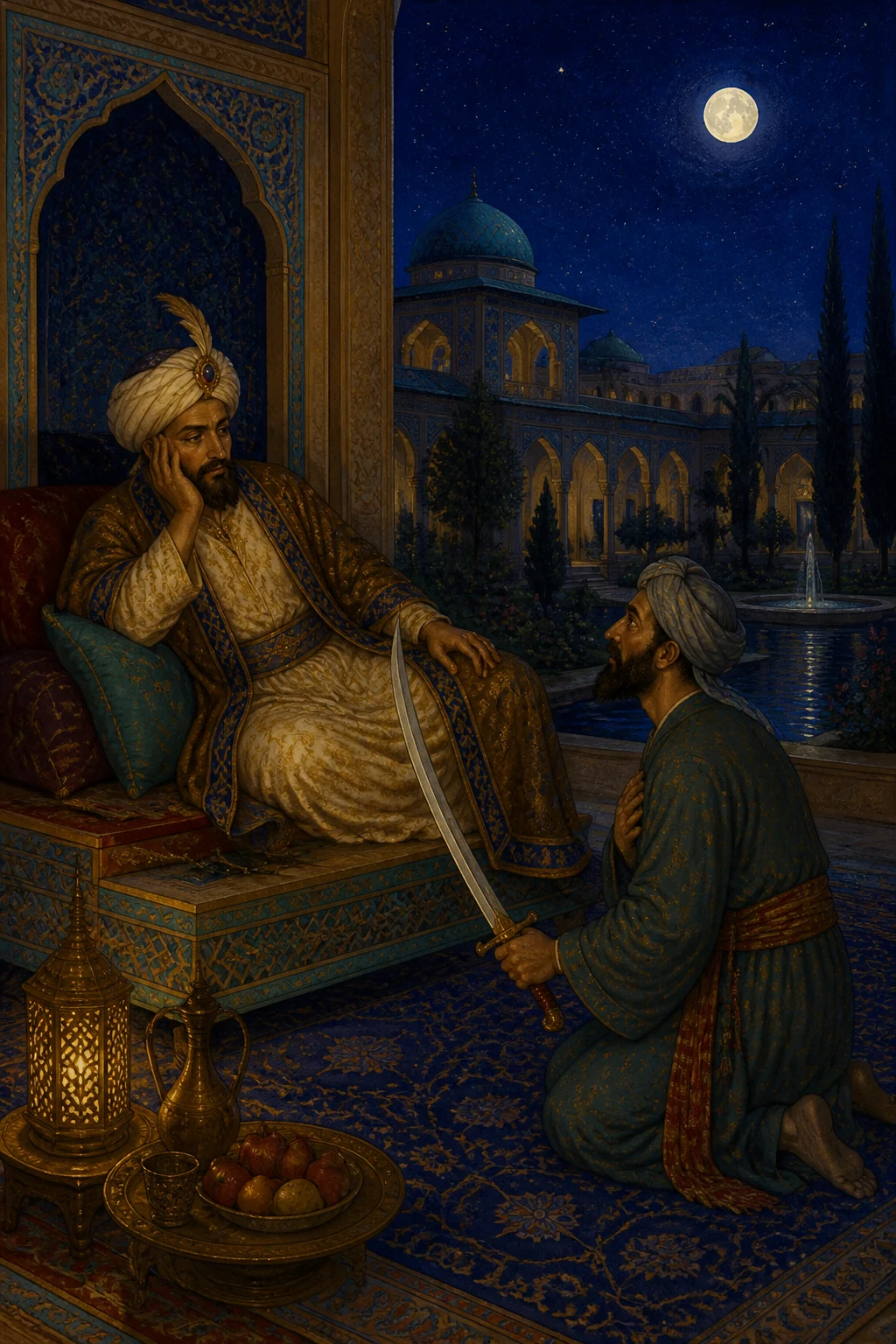
So I told her, and when she learned that I had married, her face turned pale. Then I said, “I have come to you tonight, but I must leave before morning.” She said, “Was it not enough for her to marry you, trick you, and keep you shut up with her for a whole year? Must she also make you swear, on pain of divorce, to return before morning, allowing you no leisure with either your mother or me? Could she not bear to let you spend a single night with one of us? Then what of the woman from whom you have been absent a whole year, though you knew her first? But God have mercy on Aziza! What befell her has befallen no other, and she endured what no woman like her could have endured. She died of the grief you caused her, yet she was the one who protected you from me. I thought you would return, so I let you go, though I had the power to imprison you and destroy you.” Then she wept and grew enraged, looking at me with angry eyes. When I saw her in that state, my limbs trembled with fear, and I was like a bean over the fire. Then she said, “You are of no use now that you have married and have a child. You are no longer fit to be my companion, for only an unmarried man will suit me; a married man is no use to me. You have sold me for that whore. By God, I shall make her mourn her loss of you, and you shall belong neither to me nor to her!” Then she cried out, and before I knew it ten slave girls had come and thrown me to the ground. When I lay in their grasp, she rose, took a knife, and said, “I shall slaughter you like a he-goat, and that will be the least you deserve for what you did to your cousin.” When I saw myself beneath her slave girls, my cheek ground into the dust, and the knife in her hand, I knew that death was certain. Then morning overtook Shahrazad, and she fell silent, leaving her permitted tale untold.
When it was the hundred and twenty-sixth night,
She said: It has reached me, O fortunate king, that the vizier Dandan said to Daw al-Makan: Then the young Aziz said to Taj al-Muluk: When I saw myself beneath her slave girls, my cheek ground into the dust, and the knife in her hand, I knew that death was certain. I begged her for mercy, but she only grew more cruel. She ordered them to bind my arms, and they did so, then threw me on my back. Some sat on my belly and held my head, while two girls grasped my toes and two others sat on my shins. Then she stood over me with two more girls and ordered them to beat me. They beat me until I fainted and my voice failed. When I came to my senses, I said to myself, “To have my throat cut would be easier to bear than this beating.” I remembered my cousin’s words: “May God protect you from her wickedness.” I screamed and wept until my voice gave out. Then she sharpened the knife and said to the girls, “Strip him.” But God inspired me to utter the two sayings my cousin had charged me to remember: “Faithfulness is fair, and treachery is foul.” When she heard this, she cried, “God have mercy on you, Aziza! Your innocent youth has served your cousin both in your lifetime and after your death.” Then she said to me, “By God, those two sayings have saved you from my hands. Yet I must leave a mark upon you, to spite that whore who kept you from me.”
Then she called to the girls, “Get on top of him!” She ordered them to bind my legs with ropes, and they did so. Then she left me, set a copper pan on the fire, poured sesame oil into it, and fried some cheese, while I scarcely knew what was happening around me. Then she came back, undid my clothes, tied a cord around my privates, and handed it to two girls, saying, “Pull the cord.” They pulled, and the agony carried me into another world. Then she raised her hand and cut off my member with a razor, leaving me like a woman. She cauterized the wound and packed it with medicinal powder while I lay unconscious. When I came to, the bleeding had stopped. She gave me a cup of wine to drink and said, “Go now to the woman you married, who begrudged me a single night. God have mercy on your cousin, who was the cause of your deliverance! Had you not repeated her two sayings to me, I would have cut your throat. Go this instant to whomever you please. All I wanted of you was what I have cut off, and now I have no desire for you and no need of you. Get up, stroke your head in gratitude for its safety, and pray for mercy upon your cousin.” Then she kicked me. I rose, but could scarcely walk, and made my way little by little until I reached my wife’s door. Finding it open, I flung myself inside, hardly conscious. My wife came out, lifted me, and carried me into the hall, where she discovered that I had been made like a woman. I lay down and sank into a deep sleep. When I awoke, I found myself thrown outside the garden gate. Then morning overtook Shahrazad, and she fell silent, leaving her permitted tale untold.
When it was the hundred and twenty-seventh night,
She said: It has reached me, O fortunate king, that the vizier Dandan said to King Daw al-Makan: Then the young Aziz said to Taj al-Muluk: When I awoke, I found myself thrown outside the garden gate. I rose in distress and walked until I reached my home. I entered and found my mother weeping for me and saying, “My son, in what land can you be?” I went up to her and threw myself into her arms. When she looked at me, she saw how ill I was, my face pale and darkened. I remembered my cousin and all her kindness to me, and realized that she had truly loved me. I wept for her, and my mother wept too. Then she said, “My son, your father is dead.” My anguish grew, and I wept until I fainted. When I recovered, I looked at the place where my cousin used to sit, and again I wept so bitterly that I lost consciousness. I continued weeping and lamenting until midnight, when my mother said, “Your father has been dead for ten days.” I replied, “I can think of no one but my cousin, for I deserve what has happened to me, since I neglected her though she loved me.” She asked, “What has happened to you?” So I told her, and she wept for a while. Then she rose and brought me some food. I ate a little and drank, then told her my story again, relating everything that had befallen me. She said, “Praise be to God that she did this to you and did not cut your throat.” Then she nursed and tended me until I recovered and my health was fully restored. She said, “My son, now I shall bring out what your cousin left in my keeping, for it belongs to you. She made me swear not to give it to you until I saw that you remembered her, grieved for her, and had severed your ties with all other women. Now I trust that these conditions have been fulfilled.” Then she rose, opened a chest, and took out this piece of cloth bearing the image of this gazelle—the very one I had first given my cousin. When I took it, I found these verses written upon it:
You roused my heart to love, then sat at ease; You slept, while my sore eyes kept their vigil. You came between my heart and all it saw: Though it melt for you, my heart cannot forget. You pledged to keep our love a secret, Yet the slanderer tempted you: he spoke, and you spoke too. By God, my friends, when I am dead, inscribe Upon my gravestone: “Here lies one enslaved by love.” When I read these verses, I wept bitterly and struck my face. I unfolded the cloth, and another paper fell from it. I opened it and found written there: “Know, my cousin, that I absolve you of responsibility for my death, and I pray that God may unite you with the one you love. But if any harm should befall you at the hands of the wily Dalila, do not return to her or to any other woman. Thereafter, bear your affliction patiently. Had your appointed hour not been fixed, you would have perished long ago; but praise be to God, who has made my day come before yours. Peace be upon you. Keep this cloth with the gazelle upon it, and do not part with it, for that image kept me company whenever you were away.” Then morning overtook Shahrazad, and she fell silent, leaving her permitted tale untold.
When it was the hundred and twenty-eighth night,
She said: It has reached me, O fortunate king, that the vizier Dandan said to King Daw al-Makan: Then the young Aziz said to Taj al-Muluk: My cousin wrote to me: “Keep this cloth with the gazelle upon it, and never part with it, for that image kept me company whenever you were away. By God, if you should find the woman who made this picture, keep your distance from her, do not let her come near you, and do not marry her. If you cannot find her or discover any way of reaching her, approach no other woman after her. Know that the woman who made this picture makes another like it every year and sends it to the farthest lands, so that her fame may spread, and the beauty of her workmanship, which no one on earth can equal, may become known. As for your beloved, the wily Dalila, when this cloth with its gazelle came into her hands, she began showing it to people and telling them, ‘I have a sister who makes these,’ though she was lying. May God expose her shame! I give you this advice only because I know that the world may close in upon you after my death, and perhaps you will leave home on that account and travel through the lands. You may hear of the woman who made this image and long to know her. Know, then, that the girl who made it is the daughter of the king of the Camphor Isles.”
When I had read that paper and understood its contents, I wept, and my mother wept to see my tears. I kept looking at it and weeping until night fell, and remained in that state for a whole year. At the end of the year, some merchants from my city prepared to travel—the very men with whom I am now travelling in this caravan. My mother urged me to make ready and go with them, saying, “Perhaps travel will dispel this sorrow. You may be away a year, or two, or three, until the caravan returns, and perhaps your heart will find relief.” She continued coaxing me gently until I prepared a stock of merchandise and set out with them. Throughout my journey my tears have never dried. At every place where we halt, I spread this cloth before me and gaze at this image, remembering my cousin and weeping for her, as you see me do now. She loved me beyond measure and died of the grief I caused her. I did her nothing but harm, though she showed me nothing but kindness. When the merchants return from their journey, I shall go back with them, and my absence will have lasted a year, all spent in bitter sorrow. My grief only deepened when I passed through the Camphor Isles and the Crystal Castle. There are seven islands, ruled by a king named Shahriman, who has a daughter called Dunya. I was told, “She is the one who makes the pictures of gazelles, and the picture you have is among her works.” When I learned this, my longing grew, and I sank into a sea of brooding and anguish. I wept for myself, for I had been made like a woman and no longer possessed the organ of a man, nor could I do anything to remedy it. Ever since I left the Camphor Isles, my eyes have been wet with tears and my heart heavy with grief. I have been in this state for some time, and I do not know whether I shall be able to return to my homeland and die beside my mother. I have had my fill of this world.” Then he wept, moaned, and lamented, gazing at the image of the gazelle while tears streamed down his cheeks, and recited these two verses:
Someone said to me, “Relief must surely come.” “Must it?” I answered bitterly. “How long?” “In time,” he said. “How strange!” I cried. “Who guarantees my life till then, you with your cold consolations?” “That, O king, is my story.” When Taj al-Muluk heard the young man’s tale, he marvelled greatly, and flames blazed in his heart at the account of Lady Dunya’s beauty. Then morning overtook Shahrazad, and she fell silent, leaving her permitted tale untold.
When it was the hundred and twenty-ninth night,
She said: It has reached me, O fortunate king, that the vizier Dandan said to Daw al-Makan: When Taj al-Muluk heard the young man’s tale, he marvelled greatly. Flames blazed in his heart when he heard of Lady Dunya’s beauty and learned that she was the one who had made the image of the gazelle. His yearning and unrest increased, and he said to the young man, “By God, what has happened to you has happened to no other man. Yet such was your Lord’s decree. But there is something I wish to ask you.” Aziz said, “What is it?” He replied, “Tell me how you came to see the girl who made the image of the gazelle.” Aziz said, “My lord, I contrived to see her by a stratagem. When I entered her country with the caravan, I used to go out and wander among the gardens, which were thick with trees. The keeper of the gardens was a very old man. I asked him, ‘Old man, to whom does this garden belong?’ He replied, ‘To the king’s daughter, Lady Dunya. We are beneath her palace. If you wish to look about, open the private gate and stroll through the garden, where you may enjoy the scent of the flowers.’ I said, ‘Do me the kindness of allowing me to sit in this garden until she passes, so that I may be fortunate enough to catch a glimpse of her.’ The old man answered, ‘There is no harm in that.’ When he said this, I gave him some dirhams and said, ‘Buy us something to eat.’ He was pleased to take the money, opened the gate, and led me inside. We walked on until we reached a lovely spot, where he brought me some fine fruit and said, ‘Sit here while I go away and come back to you.’ He left me and was gone for a while, then returned with a roast lamb. We ate our fill, though my heart was longing to see the girl. While we were sitting there, a door suddenly opened. He said to me, ‘Get up and hide!’ I rose and hid, and a black eunuch put his head through the doorway and asked, ‘Old man, is anyone with you?’ He answered, ‘No.’ The eunuch said, ‘Close the gate.’ The old man closed the garden gate, and Lady Dunya came out through the doorway. When I saw her, I thought the moon had descended to earth. My senses were bewildered, and I longed for her as a thirsty man longs for water. After a while she went back, closed the door, and departed. Then I left the garden and returned to my lodgings, knowing that I could never reach her and was not a man fit for her, especially now that I had been made like a woman. I said to myself, ‘She is a king’s daughter, and I am a merchant. How could I ever attain her?’ When my companions prepared to leave, I made ready and set out with them, bound for this city. When we reached this road, we met you. Such is my story and all that befell me. And peace be upon you.”
When Taj al-Muluk heard these words, his heart became engrossed in love for Lady Dunya. He mounted his horse, took Aziz with him, and brought him to his father’s city. There he gave him a house of his own and furnished it with everything he needed. Then he left him and went to his palace, tears flowing down his cheeks, for hearing can take the place of seeing and meeting. Taj al-Muluk remained in this condition until his father came in and found his complexion altered. Seeing that he was troubled and sorrowful, he said, “My son, tell me what ails you. What has happened to change your complexion so?” He told him the whole story of Dunya from beginning to end, and how he had fallen in love with her through hearing of her, though he had never seen her with his own eyes. His father said, “My son, her father is a king, and his country is far from ours. Put this matter from your mind and go into your mother’s palace.” Then morning overtook Shahrazad, and she fell silent, leaving her permitted tale untold.