Waltey
Zgodba o Anis al Džalis in Aliju Nuru
Tisoč in ena noč · arabska pripovedna tradicijaO besedilu
Zgodba o Anis al Džalis in Aliju Nuru
- Vir
- Tisoč in ena noč
- Avtor
- arabska pripovedna tradicija
- Jezik branja
- English
- Jezik izvirnika
- Arabic
- Čas branja
- 79 min branja
- Obseg
- 63 strani
- Naslov izvirnika
- حكاية أنيس الجليس وعلي نور - الليالي ٣٢ إلى ٣٦
O izvirniku
Tisoč in ena noč
Zgodbe v zgodbah, polne trgovcev, dvorov, preoblek in nočnih zapletov. Bralni jezik je English, izvirnik pa prihaja iz vira Tisoč in ena noč v jeziku Arabic.
Besedilo
Zgodba o Anis al Džalis in Aliju Nuru
She said: It has reached me, O fortunate king, that in Basra there was once a king who loved the poor and the destitute, dealt gently with his subjects, and bestowed his wealth upon those who believed in Muhammad, may God bless him and grant him peace. As one who described him said:
He made his spears his pens, his enemies’ hearts his parchment, and their blood his ink. I think it was for this the ancients chose to call them Khattiyah spears. This king was named Muhammad ibn Sulayman al-Zayni. He had two viziers, one called al-Mu‘in ibn Sawi and the other al-Fadl ibn Khaqan. Al-Fadl ibn Khaqan was the most generous man of his age, a man of upright conduct whom all hearts agreed in loving and all wise men agreed in consulting. Everyone prayed that he might long remain in office, for he brought good and banished evil and harm. The vizier al-Mu‘in ibn Sawi, however, hated people and had no love of goodness. He was a source of evil, as one who described him said:
His substance was gathered from mingled seed and fashioned of corrupt material. It is no wonder for God to gather a whole world into a single man. Thus each of these two viziers had his share in the poet’s words:
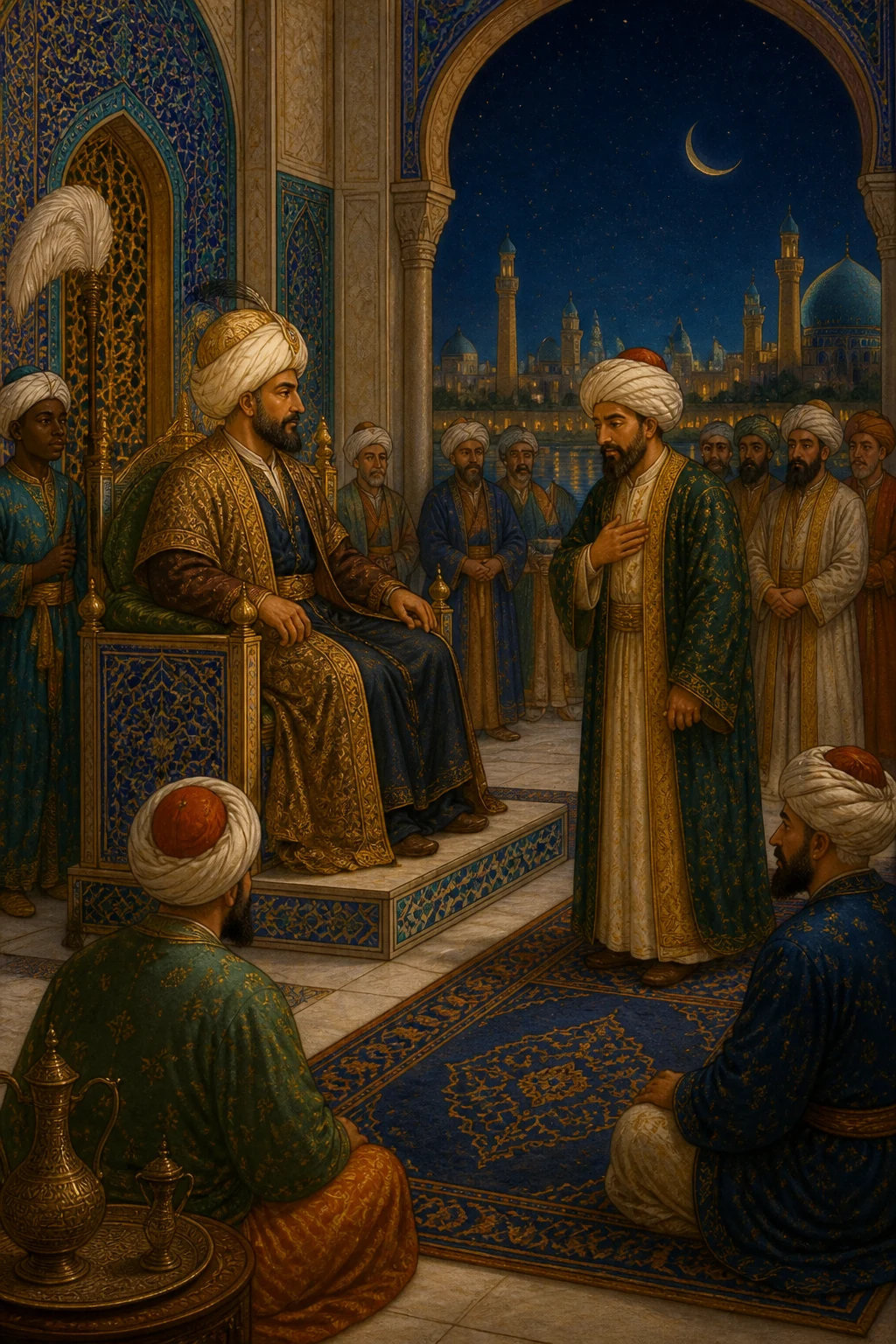
Seek refuge with the noble, sons of the noble, for noble parents bring forth noble children. Leave the base, sons of the base, for base parents bring forth only baseness. By the power of the Almighty, the people hated al-Mu‘in ibn Sawi as much as they loved Fadl al-Din ibn Khaqan. One day King Muhammad ibn Sulayman al-Zayni was sitting upon his royal throne, surrounded by the great officers of his realm, when he summoned his vizier al-Fadl ibn Khaqan and said, “I desire a slave girl whose beauty has no equal in her time: perfect in loveliness, exquisite in proportion, and praiseworthy in character.” The officers of state said, “Such a girl cannot be found for less than ten thousand dinars.” The sultan thereupon called to his treasurer and said, “Carry ten thousand dinars to the house of al-Fadl ibn Khaqan.” The treasurer obeyed, and the vizier departed, having been commanded by the sultan to visit the market every day and give the brokers instructions concerning his wishes. No slave girl valued above a thousand dinars was to be sold until she had been shown to the vizier. The brokers therefore offered none for sale without first presenting her to him. The vizier carried out his orders, and matters continued thus for some time, but no girl pleased him. Then one day a broker came to the house of the vizier al-Fadl ibn Khaqan and found him mounted, on his way to the king’s palace. He caught hold of his stirrup and recited these two verses:
O you who have restored the kingdom’s crumbling bones to life, you are the vizier whom victory never forsakes. You have revived the generosity that had died among men: may your efforts ever find favor with God. Then he said, “My lord, the girl whose purchase was ordered by your noble decree has arrived.” “Bring her to me,” said the vizier. The broker went away for a little while, then returned with a girl of slender figure and firm breasts, with darkly outlined eyes, smooth cheeks, a narrow waist, and ample hips. She wore the finest of garments; her lips were sweeter than rosewater syrup, her figure put the willow boughs to shame, and her speech was gentler than the breeze passing over garden flowers. As one who described her said:
Her skin is silk, her voice soft and melodious, neither rambling nor scant of words. Two eyes to which God said, “Be,” and they were, work upon men’s minds as wine does. O love of her, increase my yearning every night; O forgetfulness, we shall not meet until the Resurrection. Her tresses are night, yet when she unveils her brow, the dawn shines forth upon it. When the vizier saw her, he was utterly enchanted. He turned to the broker and asked, “What is the price of this girl?” “The bidding has reached ten thousand dinars,” he replied. “Her owner swears that ten thousand dinars would not pay for the chickens she has eaten, nor for the robes of honor she has bestowed upon her teachers. For she has learned calligraphy, grammar, language, the interpretation of the Koran, the principles of jurisprudence and religion, medicine, the reckoning of the calendar, and the playing of musical instruments.” The vizier said, “Bring me her master.” The broker brought him at once. He was a Persian who had lived so long that time had reduced him to skin and bone, as the poet said:
Time has made me tremble, how I tremble! For time is mighty and fierce. Once I walked without growing weary; now I grow weary without walking. The vizier asked him, “Are you content to accept ten thousand dinars for this girl from Sultan Muhammad ibn Sulayman al-Zayni?” The Persian replied, “Since she is intended for the sultan, it is my duty to offer her to him as a gift, without payment.” The vizier ordered the money brought, and when it arrived he weighed out the dinars to the Persian. Then the slave dealer turned to the vizier and said, “With our lord the vizier’s permission, may I speak?” “Say what you have to say,” replied the vizier. “My advice is that you should not take this girl to the sultan today. She has just come from a journey; the change of air and the hardships of travel have wearied her. Keep her in your palace for ten days, so that she may rest and her beauty increase. Then have her bathed, dress her in the finest clothes, and take her to the sultan. You will gain far greater favor thereby.” The vizier considered the slave dealer’s words and found them sound. He took her to his palace, assigned her a private chamber, and arranged for her daily needs of food, drink, and all else to be supplied. She remained for some time in this comfort. Now the vizier al-Fadl ibn Khaqan had a son like the full moon when it shines, with a radiant face and rosy cheeks bearing a mole like a drop of amber, and the first dark down upon them. Of such a youth the poet said:
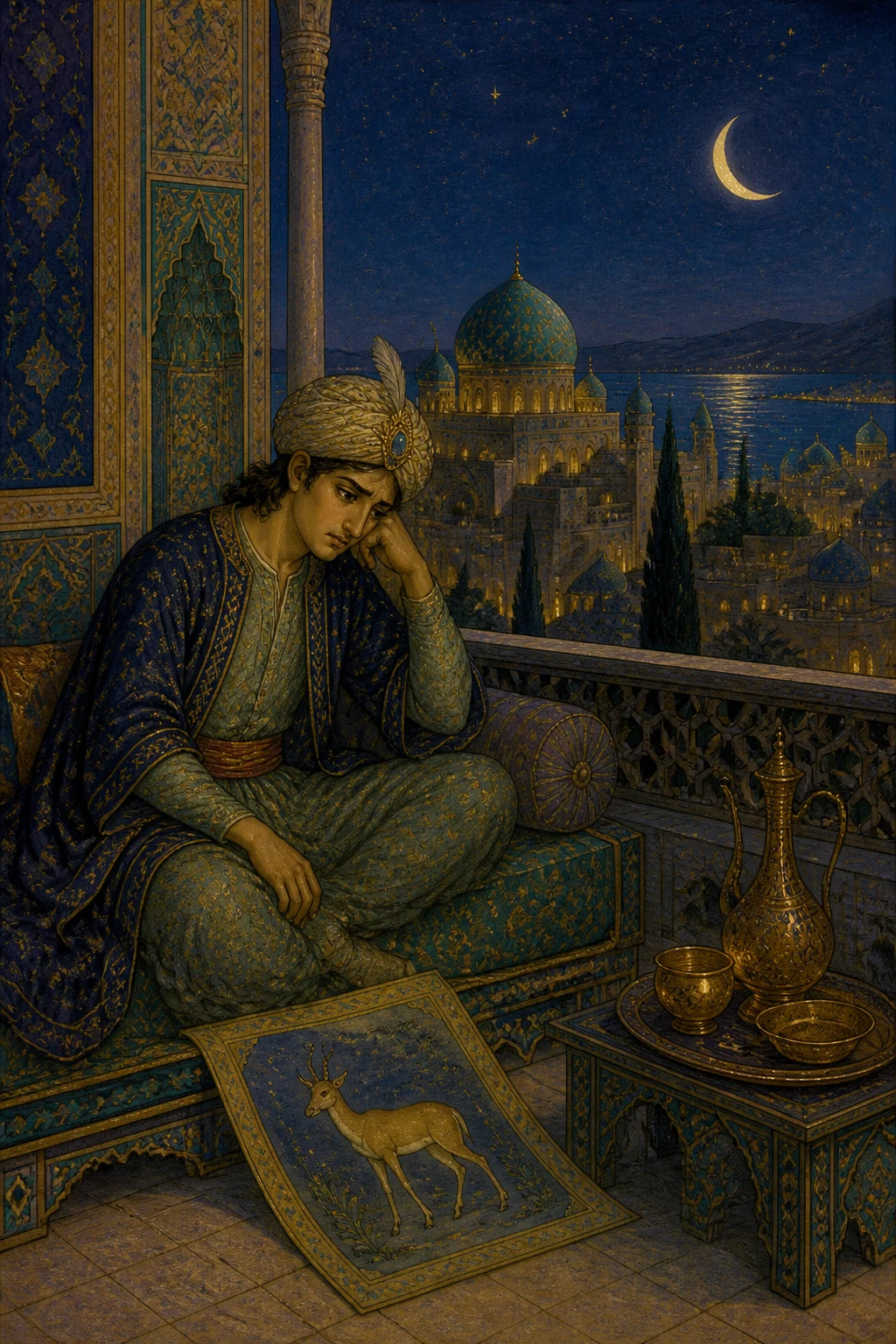
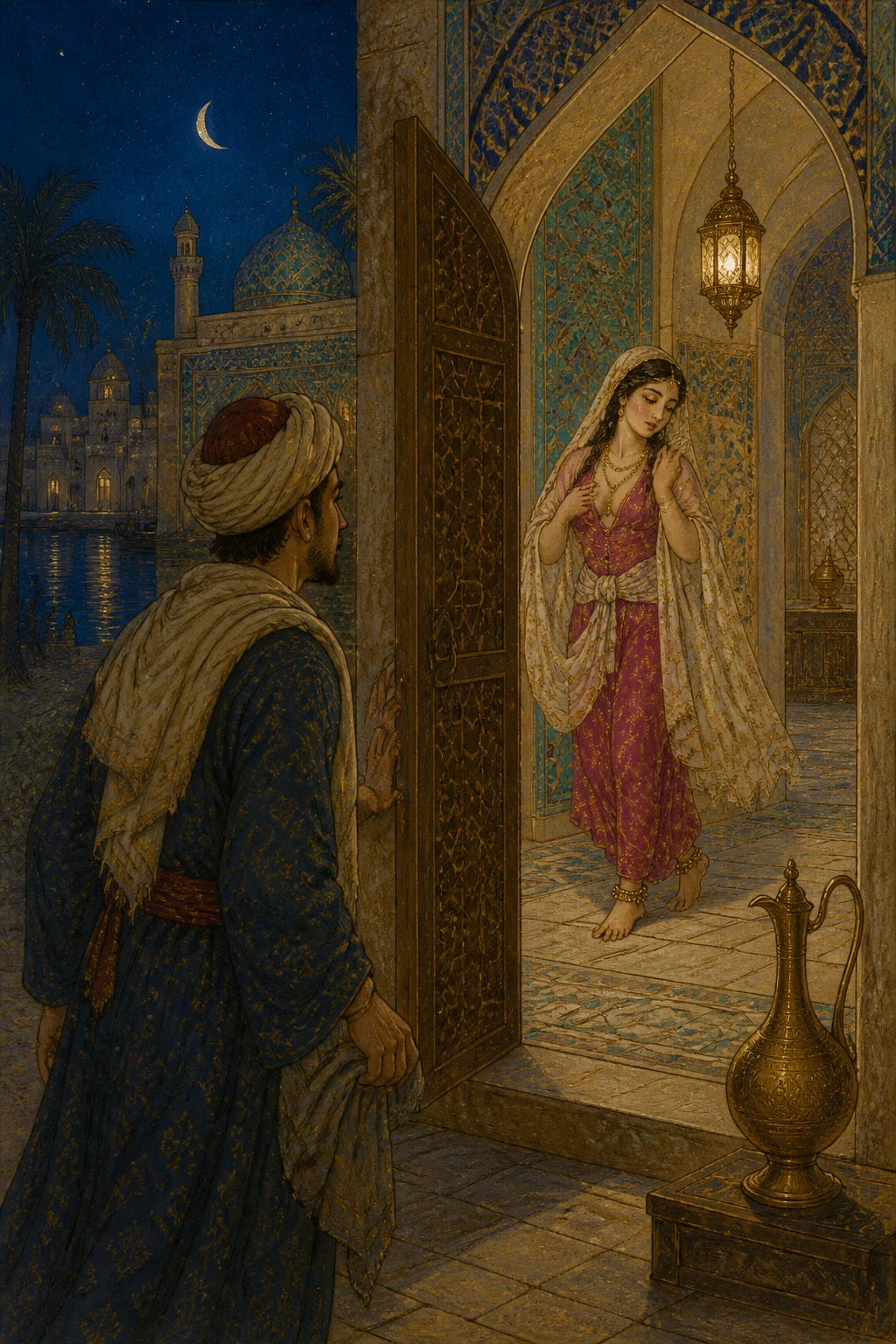
The roses of his cheeks are guarded by the thorns of spears: who would dream of plucking them? Stretch no hand toward him; how often they have waged war merely because we stretched our eyes his way! O hardness of his heart, O softness of his waist, why not move something from here to there? Were the softness of his waist within his heart, he would never wrong a lover or do him harm. You who reproach me for loving him, excuse me instead! Who will restore the body that wasting sickness has possessed? The fault is all my heart’s and my eyes’: but for those two, I should not suffer so. The young man knew nothing of this girl’s story. His father had warned her, saying, “My daughter, know that I have bought you only to be a concubine to King Muhammad ibn Sulayman al-Zayni. I have a son who has never been alone with a girl in the neighborhood without having his way with her. Guard yourself against him, and take care that he neither sees your face nor hears your voice.” “I hear and obey,” the girl replied. Then he left her and went away. As fate had ordained, one day the girl entered the bathhouse within the mansion. Some of the slave girls bathed her, and she put on splendid clothes, so that her loveliness and beauty were enhanced. She went to the vizier’s wife and kissed her hand. “May it bring you well-being, Anis al-Jalis,” the lady said. “How did you find the bath?” “My lady,” she replied, “all I lacked there was your presence.” The mistress of the house then said to the slave girls, “Come, let us go to the bath.” They obeyed and set off with their mistress among them. She had stationed two young slave girls at the door of the chamber where Anis al-Jalis was staying, telling them, “Allow no one to enter the girl’s room.” “We hear and obey,” they replied. While Anis al-Jalis was sitting in her chamber, the vizier’s son, whose name was Ali Nur al-Din, came in and asked after his mother and the household. “They have gone to the bath,” the two girls told him. From within her chamber, Anis al-Jalis heard the voice of Ali Nur al-Din, the vizier’s son, and said to herself, “I wonder what this young man is like, of whom the vizier told me that he had never been alone with a girl in the neighborhood without lying with her. By God, I long to see him.” Still glowing from her bath, she rose, went toward the door of her chamber, and looked at Ali Nur al-Din. She saw a youth like the moon at its full, and that single glance filled her with a thousand longings. The young man happened to turn toward her, and his glance filled him with a thousand longings too. Each fell into the snare of love for the other.
The young man advanced upon the two girls and shouted at them. They fled before him and stood at a distance, waiting and watching to see what he would do. He went to the chamber door, opened it, and entered. “Are you the girl my father bought for me?” he asked. “Yes,” she replied. Then the young man, who was drunk, approached her, took her legs and put them about his waist. She clasped her hands around his neck and welcomed him with kisses, sighs, and endearments. He sucked her tongue and she his, and he took her virginity. When the two girls saw their young master enter the chamber of Anis al-Jalis, they screamed. By then the young man had satisfied his desire and fled, seeking safety, frightened by what he had done. Hearing the girls’ cries, the mistress of the house hurried out of the bath, sweat dripping from her. “Why is there screaming in the house?” she asked. She approached the two girls she had stationed at the chamber door and said, “Woe to you both! What has happened?” When they saw her, they said, “Our master Ali Nur al-Din came and struck us, so we ran away from him. He went in to Anis al-Jalis and embraced her. We do not know what he did after that, but when we cried out for you, he fled.” The mistress of the house went to Anis al-Jalis and asked, “What has happened?” “My lady,” she answered, “I was sitting here when a handsome young man came in and said, ‘Are you the girl my father bought for me?’ I said yes. By God, my lady, I believed that what he said was true. Then he came to me and embraced me.” “Did he do anything else to you?” she asked. “Yes,” she replied, “he took three kisses from me.” “He did not leave you a virgin, did he?” said the lady. Then she and the slave girls wept and struck their faces, fearing that Nur al-Din’s father would kill him.
While they were in this state, the vizier came in and asked what had happened. His wife said, “Swear that you will hear me out.” “Yes,” he said. She told him what his son had done, and in his grief he tore his clothes, struck his face, and plucked at his beard. His wife said, “Do not destroy yourself. I will give you ten thousand dinars from my own money to cover her price.” He raised his head toward her and said, “Woe to you! It is not her price I care about. I fear the loss of both my life and my wealth.” “My lord,” she asked, “why should that be?” He replied, “Do you not know that we have an enemy lying in wait for us, that man called al-Mu‘in ibn Sawi? Once he hears of this, he will go to the sultan and say to him…” But morning overtook Shahrazad, and she fell silent, leaving her tale untold.
When it was the thirty-third night
She said: It has reached me, O fortunate king, that the vizier said to his wife, “Do you not know that we have an enemy lying in wait for us, called al-Mu‘in ibn Sawi? Once he hears of this, he will go to the sultan and say, ‘Your vizier, whom you believe to be devoted to you, took ten thousand dinars from you and bought a girl the like of whom no one has ever seen. When she pleased him, he said to his son, “Take her; you have a better right to her than the sultan.” So his son took her and deprived her of her virginity, and she is there with him now.’ The king will say, ‘You lie.’ Then he will say to the king, ‘With your permission, I will raid his house and bring her to you.’ The king will give him leave, and he will descend upon the house, seize the girl, and bring her before the sultan. Then the sultan will question her, and she will be unable to deny it. Al-Mu‘in will say to him, ‘My lord, you know that I am your faithful counselor, yet I have no favor with you.’ Then the sultan will have me mutilated while all the people look on, and I shall lose my life.” His wife said, “Tell no one. This happened in secret, so entrust your affairs to God in this matter.” At that the vizier’s heart grew calm, and his mind was eased.
Such was the case with the vizier. As for Ali Nur al-Din, he feared the consequences of what he had done. He spent his days in the gardens and came to his mother only late at night. He would sleep in her rooms and rise before dawn, unseen by anyone. He continued thus for a month without seeing his father’s face. Then his mother said to his father, “My lord, must you lose both the girl and your son? If this goes on much longer, the boy will run away.” “What is to be done?” he asked. She replied, “Stay awake tonight. When he comes, catch hold of him and make peace with him. Give him the girl, for she loves him and he loves her, and I will give you her price.” The vizier stayed awake all night. When his son came, he seized him and was about to cut his throat, but his mother came to the rescue. “What are you going to do to him?” she asked. “I am going to slaughter him,” he replied. The boy said to his father, “Am I worth so little to you?” His father’s eyes filled with tears, and he said, “My son, how could you think so lightly of the loss of my wealth and my life?” The young man replied, “Listen, Father, to what the poet said:
Grant that I have sinned: men of understanding have always bestowed full pardon upon the sinner. What more can your enemy hope for, when he lies in the lowest depths and you stand far above him? Then the vizier rose from his son’s chest and took pity on him. The young man stood and kissed his father’s hand. His father said, “My son, if I knew you would treat Anis al-Jalis fairly, I would give her to you.” “Father,” he replied, “how could I fail to treat her fairly?” “My son,” he said, “I charge you not to take a wife in addition to her, nor harm her, nor sell her.” “Father,” he replied, “I swear to you that I will neither marry another nor sell her.” He bound himself by solemn oaths to what he had promised, then went in to the girl and lived with her for a year. And God Most High caused the king to forget the matter of the girl.
As for al-Mu‘in ibn Sawi, he heard the news, but could say nothing because of the vizier’s high standing with the sultan. When the year had passed, the vizier Fadl al-Din ibn Khaqan went to the bath and came out sweating. A draft struck him, and he took to his bed. Sleeplessness tormented him, and his weakness steadily increased. He summoned his son Ali Nur al-Din, and when he came before him, he said, “My son, each man’s provision is allotted and his appointed hour decreed. Every soul must drink the cup of death.” Then he recited these verses:
He whom death misses today will not escape it tomorrow; every one of us must come to death’s pool. It makes the mighty equal to those who were despised, and its terror spares no one among mankind. It has left neither angel nor king untouched, nor shall we be granted life everlasting. Then he said, “My son, I have no counsel for you except to fear God, consider the consequences of your actions, and take good care of the girl Anis al-Jalis.” His son said, “Father, who is there like you, known as you have been for good deeds, with preachers praying for you from their pulpits?” “My son,” he replied, “I hope that God Most High will accept them.” Then he uttered the two testimonies of faith, gave a final gasp, and was numbered among the blessed. The palace filled with cries of mourning, and the news reached the sultan. The people of the city heard of the death of al-Fadl ibn Khaqan, and even the children wept for him in their schools. His son Ali Nur al-Din rose and made ready his body for burial. The emirs, viziers, officers of state, and people of the city attended his funeral. Among those present was the vizier al-Mu‘in ibn Sawi. As the funeral procession left the house, someone recited these verses:
I said to the man entrusted with washing his body—would that he had heeded me, for my counsel was sincere: “Keep your water from him; wash him instead with the tears that Glory’s eyes have shed in mourning him. Remove the heaps of embalming spices; embalm him with the fragrance of his praise. Bid the noble angels bear him as an honor: do you not see them standing at his side? Do not burden men’s necks with carrying him; enough the weight of his favors they have borne.” Ali Nur al-Din remained in deep mourning for his father for a long time. One day, as he was sitting in his father’s house, someone knocked at the door. He rose and opened it, and found one of his father’s friends and boon companions. The man kissed Ali Nur al-Din’s hand and said, “My lord, a man who leaves behind a son like you has not died. This is the fate even of the lord of all men, first and last. My lord, take heart and put aside your grief.” Then Ali Nur al-Din went to the reception hall and had all he needed brought there. His friends gathered around him, he brought in his slave girl, and ten sons of merchants joined his company. He ate and drank, held gathering after gathering, and began to give freely and lavish gifts. Then his steward came in and said, “My lord Nur al-Din, have you not heard the saying, ‘He who spends without reckoning grows poor’? How well the poet spoke in these verses:
I guard my dirhams and defend them, knowing they are my sword and shield. Shall I lavish them upon my bitterest foe and trade my good fortune for misery, so that he may eat and drink them at his ease, yet never give a penny to anyone? I keep my dirham from every mean-spirited man who offers me no true friendship. This is dearer to me than saying to a scoundrel, “Lend me a dirham, and tomorrow I will repay you five,” only to have him turn his face and shun me, leaving my soul as abject as a dog’s. How humiliated are men without money, though their virtues shine like the sun! Then he said, “My lord, this extravagant spending and these lavish gifts will exhaust your wealth.” When Ali Nur al-Din heard his steward’s words, he looked at him and said, “I will not listen to a word of what you have said. How fine are the poet’s words:
If ever I possess wealth and fail to give, may my hand never open and my foot never rise! Show me a miser who won glory through his miserliness; show me a generous man who died of giving. Then he said, “Know, steward, that if you have enough left to provide my midday meal, I do not wish you to burden me with concern for my supper.” The steward left him and went his way, while Ali Nur al-Din continued in what he considered his noble generosity. Whenever one of his companions said, “This is a lovely thing,” he would answer, “It is yours as a gift.” If another said, “My lord, such-and-such a house is beautiful,” he would reply, “It is yours as a gift.” Ali Nur al-Din continued to hold gatherings for his friends and companions at the beginning and end of every day, until a whole year had passed in this fashion. One day after that year, as he sat among them, the girl recited these two verses:
You thought well of the days when they treated you well, and did not fear the evils fate might bring. The nights made peace with you, and you were deceived by them: it is when the nights are clearest that trouble comes. As she finished her verses, someone knocked at the door. Nur al-Din rose, and one of his companions followed him without his knowing. When he opened the door, he found his steward. “What news?” Ali Nur al-Din asked. “My lord,” he replied, “what I feared for you has come to pass.” “How so?” he asked. “Know that there is nothing left in my hands belonging to you worth a dirham, or even less than a dirham. Here are the accounts of your expenditure, and here are the records of your original fortune.” At these words Ali Nur al-Din bowed his head toward the ground and said, “There is no power and no strength save in God.” The man who had secretly followed him to listen heard what the steward said, then returned to his companions and told them, “Decide what you are going to do, for Ali Nur al-Din is bankrupt.” When Ali Nur al-Din returned to them, they could see the grief in his face. One of his companions rose, looked at him, and said, “My lord, I ask your leave to depart.” “Why must you leave today?” Ali Nur al-Din asked. “My wife is giving birth tonight,” he replied, “and I cannot stay away from her. I wish to go and see how she is.” He gave him leave. Another rose and said, “My lord Nur al-Din, today I must visit my brother, for he is having his son circumcised.” Each in turn asked leave on some pretext and went his way, until they had all departed and Ali Nur al-Din was left alone. Then he called his slave girl and said, “Anis al-Jalis, do you see what has befallen me?” He told her what the steward had said. She replied, “My lord, some nights ago I meant to speak to you of this state of affairs, but I heard you recite these two verses:
When fortune is generous to you, bestow its gifts on all mankind before it slips away. Generosity will not exhaust it while it comes your way, nor will miserliness preserve it once it turns its back. When I heard you recite them, I fell silent and said nothing.” Ali Nur al-Din said to her, “Anis al-Jalis, you know that I spent my wealth only on my friends. I do not think they will leave me without help.” “By God,” Anis al-Jalis replied, “they will do you no good at all.” Ali Nur al-Din said, “Then I shall rise this very moment, go to them, and knock at their doors. Perhaps I may obtain something from them to use as capital. I shall trade with it and give up pleasure and amusement.” He rose at once and walked until he reached the lane where his ten companions lived, for they all dwelt in the same lane. He went to the first door and knocked. A slave girl came out and asked, “Who are you?” He said, “Tell your master that Ali Nur al-Din is standing at the door and says, ‘Your servant kisses your hands and awaits your generosity.’” The girl went in and told her master, but he shouted at her, saying, “Go back and tell him I am not here.” The girl returned to Nur al-Din and said, “My lord, my master is not here.” Ali Nur al-Din turned away, saying to himself, “If this one is a bastard and denies his presence, the next need not be a bastard too.” He went to the second door and said what he had said before, but this man also denied that he was at home. Then he recited this verse:
Gone are those who, when you stood before their doors, bestowed upon you all the bounty you desired. When he had finished, he said, “By God, I must put them all to the test. Perhaps among them there will be one who makes up for all the rest.” He went around to all ten, but not one opened his door, showed his face, or ordered so much as a loaf of bread for him. Then he recited these verses:
A man in prosperous times is like a tree: people gather round it so long as it bears fruit. But once it is stripped of all it bore, they scatter or seek another tree. A curse upon all the sons of this age! Among ten I found not one true friend. Then he returned to his slave girl, his sorrow greater than before. She said, “My lord, did I not tell you that they would do you no good?” “By God,” he replied, “not one of them would even show me his face.” She said, “My lord, sell the household furnishings little by little and live on the proceeds.” He sold them until he had sold everything in the house and nothing remained. Then he looked at Anis al-Jalis and said, “What are we to do now?” She replied, “My lord, my advice is that you rise at once, take me down to the market, and sell me. You know that your father bought me for ten thousand dinars. Perhaps God will grant you relief through some part of that price, and if God decrees that we should be reunited, we shall meet again.” “Anis al-Jalis,” he said, “I cannot bear to be parted from you for a single hour.” “Nor I from you,” she replied, “but necessity has its own laws, as the poet said:
Necessity drives us in our affairs to follow paths that do not accord with propriety. No one forces himself to take such a course except for a reason that warrants it. Then he took Anis al-Jalis, tears flowing down his cheeks, and recited these two verses:
Stay, and grant me one last look before you depart, to comfort a heart that parting almost kills. But if granting me this comfort burdens you, leave me to my yearning and trouble yourselves no more. Then he went and handed her over to the broker, saying, “Mind what price you call for her.” “My lord Nur al-Din,” the broker replied, “her original value is on record.” Then he asked, “Is she not Anis al-Jalis, whom your father bought from me for ten thousand dinars?” “Yes,” he said. The broker went up to the merchants, but found that they had not all assembled. He waited until they were all present and the market was filled with slave girls of every kind: Turkish, Greek, Circassian, Georgian, and Abyssinian. When the broker saw that the market was crowded, he rose and cried, “Merchants, men of wealth! Not every round thing is a walnut, nor every long thing a banana; not every red thing is meat, nor every white thing fat; not every tawny thing is wine, nor every brown thing a date. Merchants, here is a peerless pearl whose worth no fortune can equal. At what price will you open the bidding?” One merchant said, “Four thousand five hundred dinars.” Now the vizier al-Mu‘in ibn Sawi happened to be in the market. Seeing Ali Nur al-Din standing there, he said to himself, “Why is he standing here? He has nothing left with which to buy slave girls.” He looked about and heard the broker calling in the market, with the merchants gathered around him. The vizier said to himself, “I suspect he has gone bankrupt and brought the girl down to sell her.” Then he thought, “If that is true, how it will soothe my heart!” He summoned the broker, who came and kissed the ground before him. “I want this girl you are offering,” he said. The broker could not refuse, so he brought the girl and set her before him. When the vizier looked at her and considered her charms, her graceful figure and gentle speech, she pleased him. He asked, “How high has her price reached?” “Four thousand five hundred dinars,” replied the broker. When the merchants heard this, not one dared add a dirham or a dinar. Instead, they all drew back, knowing the vizier’s tyranny.
Then the vizier al-Mu‘in ibn Sawi looked at the broker and said, “Why are you standing there? Go. The girl is mine for four thousand dinars, and you shall have five hundred.” The broker went to Ali Nur al-Din and said, “My lord, your girl is as good as lost to you for nothing.” “Why is that?” he asked. The broker replied, “We opened the bidding at four thousand five hundred dinars. Then this tyrant al-Mu‘in ibn Sawi came into the market, and when he saw the girl, she pleased him. He told me, ‘Obtain the owner’s consent at four thousand dinars, and you shall have five hundred.’ I suspect he has discovered that the girl belongs to you. If he pays you her price now, it will be by God’s grace. But knowing his tyranny, I expect he will write you a draft upon one of his agents, then send word to them, saying, ‘Give him nothing.’ Whenever you go to demand payment, they will say, ‘We shall pay you tomorrow.’ They will keep promising and breaking their promises, day after day, while you are a man too proud to endure such treatment. At last, when they grow tired of your demands, they will say, ‘Give us the draft.’ Once they have taken it from you, they will tear it up, and the girl’s price will be lost to you.”
When Ali Nur al-Din heard the broker’s words, he looked at him and said, “What is to be done?” The broker replied, “I shall offer you some advice. If you accept it, it will be much to your advantage.” “What is it?” he asked. “Come to me now as I stand in the middle of the market,” he replied. “Take the girl from my hand, strike her, and say, ‘Woe to you! I have fulfilled the oath I swore. I have brought you to the market, for I swore that you must be taken to market and offered for sale by the broker.’ If you do this, the trick may deceive him and everyone else, and they will believe that you brought her here only to fulfill your oath.” “That is sound advice,” he said. The broker left him, went into the middle of the market, and took the girl by the hand. He gestured to the vizier al-Mu‘in ibn Sawi and said, “My lord, here comes her owner.” Ali Nur al-Din came up to the broker, snatched the girl from his hand, and struck her, saying, “Woe to you! I brought you to the market to fulfill my oath. Go home, and do not disobey me again. I have no need of your price that I should sell you. Were I to sell the furnishings of my house and as much again many times over, they would not equal your worth.”
When al-Mu‘in ibn Sawi saw Ali Nur al-Din, he said, “Woe to you! Have you anything left to buy or sell?” Then al-Mu‘in ibn Sawi made to lay violent hands on him. The merchants looked toward Ali Nur al-Din, for they all loved him, and he said to them, “Here I am before you, and you know his tyranny.” The vizier said, “By God, were it not for you…” Then they all exchanged knowing glances and said, “Not one of us will interfere between you and him.” Ali Nur al-Din, who was a brave young man, advanced upon the vizier ibn Sawi, dragged him from his saddle, and threw him to the ground. There was a pit of kneaded mud nearby, and the vizier landed in the middle of it. Ali Nur al-Din began to punch him, and one blow struck his teeth, staining his beard with blood. The vizier had ten mamluks with him. When they saw what Nur al-Din was doing to their master, they laid their hands on their sword hilts and were about to rush upon Nur al-Din and cut him to pieces. But the people said to them, “This man is a vizier, and that one is a vizier’s son. They may make peace with each other, and then you will be hated by both. Perhaps one of your blows will strike him, and you will all die the most dreadful deaths. It is wiser not to come between them.” When Ali Nur al-Din had finished beating the vizier, he took his slave girl and went home. As for the vizier ibn Sawi, he rose at once. His clothes had been white, but now they bore three colors: the color of mud, the color of blood, and the color of ashes. Seeing himself in this state, he took a coarse mat and hung it about his neck, took two bundles of halfa grass in his hands, and went to stand beneath the palace where the sultan was. He cried, “O king of the age, I have been wronged!” They brought him before the sultan, who looked closely and recognized his vizier al-Mu‘in ibn Sawi. “Who has done this to you?” he asked. The vizier wept and sobbed, then recited these two verses:
“Shall Time wrong me while you are here, and dogs devour me while you are a lion? Shall every thirsty soul drink from your pools, while I thirst beneath your protection, though you are the rain?” Then he said, “My lord, must everyone who loves and serves you endure such hardships?” The sultan asked, “Who has done this to you?” The vizier replied, “Know that I went today to the slave-girl market, hoping to buy a girl who could cook. There I saw a girl whose like I had never seen in all my life. The broker told me she belonged to Ali ibn Khaqan. Some time ago, our lord the sultan gave his father ten thousand dinars to buy him a beautiful slave girl. He bought this very girl, but took such a liking to her that he gave her to his son. When his father died, the son took to squandering his wealth until he had sold all his estates, gardens, and household vessels. When he was bankrupt and had nothing left, he brought the girl down to the market to sell her and handed her over to the broker. The broker cried her for sale, and the merchants bid against one another until her price reached four thousand dinars. I thought to myself, ‘I shall buy her for our lord the sultan, since the money that first paid for her came from him.’ So I said, ‘My son, here are four thousand dinars for her.’ When he heard me, he looked at me and said, ‘You old bird of ill omen! I would sell her to Jews and Christians rather than sell her to you.’ I said, ‘I am not buying her for myself, but for our lord the sultan, the source of all our blessings.’ At these words he flew into a rage, seized me, and threw me from my horse, old man that I am. Then he beat me, and went on beating me until he left me as you see. Nothing brought all this upon me but my coming to buy this girl for Your Highness.”
Then the vizier flung himself to the ground and began weeping and trembling. When the sultan saw his condition and heard his account, the vein of anger swelled between his eyes. He turned to the officers of state attending him, and forty swordsmen stood before him. “Go this instant to the house of Ali ibn Khaqan,” he ordered. “Plunder it and tear it down. Bind him and the girl, drag them on their faces, and bring them before me.” “We hear and obey,” they replied, and set off for Ali Nur al-Din’s house. Now the sultan had a chamberlain named Alam al-Din Sanjar, who had formerly been one of the mamluks of al-Fadl ibn Khaqan, Ali Nur al-Din’s father. When he heard the sultan’s command and saw the enemies preparing to kill his master’s son, he could not bear it. He mounted his horse and rode to Ali Nur al-Din’s house, where he knocked at the door. Nur al-Din came out, recognized him, and was about to greet him, but Sanjar said, “My lord, this is no time for greetings or conversation. Listen to what the poet says:
‘Save your life if you fear oppression, and leave the house to mourn the man who built it. One land may be exchanged for another, but you will never find another life to replace your own.’ Nur al-Din asked, “Alam al-Din, what has happened?” He replied, “Rise and escape with your life, you and the girl. Al-Mu‘in ibn Sawi has laid a snare for you both, and if you fall into his hands he will kill you. The sultan has sent forty swordsmen after you. My advice is to flee before harm overtakes you.” Then Sanjar held out some dinars to Nur al-Din, who counted them and found there were forty. “My lord, take these,” Sanjar said. “If I had more with me, I would give it to you, but this is no time for reproaches.” Nur al-Din went in to the girl and told her what had happened, and she was beside herself with fear. The two of them immediately left the city, and God spread His veil of protection over them. They walked to the shore, where they found a ship ready to sail. The captain stood amidships, calling, “If anyone still has farewells to make, provisions to fetch, or anything he has forgotten, let him see to it now, for we are leaving.” They all answered, “We need nothing more, captain.” Then the captain told his crew, “Come, cast off the ropes and pull up the mooring stakes.” Ali Nur al-Din asked, “Where are you bound, captain?” “To the Abode of Peace, Baghdad,” he replied. And dawn overtook Shahrazad, and she fell silent, leaving her tale untold.
When the thirty-fourth night came
She said: It has reached me, O fortunate king, that when the captain told Ali Nur al-Din, “To the Abode of Peace, the city of Baghdad,” Ali Nur al-Din boarded the ship with the girl. They put out and spread the sails, and the ship sped forward like a bird on the wing, as someone said in these two verses:
“Look at the ship whose beauty holds you captive, racing the wind in her joyful passage. She is like a bird with outstretched wings, swooping from the sky upon the water.” The ship carried them onward with a fair wind. Such was their fate. As for the forty men the sultan had sent, they reached Ali Nur al-Din’s house, broke down the doors, and searched every room, but found no trace of either of them. They demolished the house and returned to inform the sultan. “Find them, wherever they may be,” he said. “We hear and obey,” they replied. Then the vizier al-Mu‘in ibn Sawi returned to his own house, after the sultan had bestowed a robe of honor upon him and said, “I myself shall avenge you.” The vizier prayed for his long life and went away reassured. Then the sultan ordered a proclamation to be made throughout the city: “O people, one and all! The sultan decrees that whoever finds Ali Nur al-Din ibn Khaqan and brings him before the sultan shall receive a robe of honor and a thousand dinars. Whoever conceals him, or knows his whereabouts and fails to report them, deserves whatever punishment befalls him.” Everyone began searching for Nur al-Din, but no one could find a trace of him.
So much for them. As for Ali Nur al-Din and his slave girl, they reached Baghdad in safety. The captain said, “This is Baghdad, a city of security. Winter and its cold have departed, and spring has come with its roses. Its trees are in blossom and its rivers flow.” Ali Nur al-Din and his girl disembarked, and he gave the captain five dinars. They walked a little way, and fate led them among the gardens. They came to a place that had been swept and sprinkled with water, with long raised benches and earthen jars hanging full of water. Above it ran a trellis of reeds the length of the lane, and at the far end stood the gate of a garden, closed. Nur al-Din said to the girl, “By God, this is a lovely place.” She replied, “My lord, let us sit on these benches for a while.” They climbed up and sat down, washed their faces and hands, and delighted in the passing breeze. Then they fell asleep—glory be to Him who never sleeps. This garden was called the Garden of Delight, and within it stood a pavilion called the Pavilion of Pleasure, belonging to the caliph Harun al-Rashid. Whenever the caliph felt troubled, he would come to this garden and sit in the pavilion. It had eighty windows and eighty hanging lamps, with a great golden candelabrum in the center. When the caliph entered, he would order the slave girls to open the windows, and command Ishaq the court musician and the girls to sing. Then his heart would lift and his cares would leave him. The garden had an elderly keeper named Sheikh Ibrahim. Once, when he went out on some business, he found pleasure-seekers there with women of dubious reputation, and was greatly angered. He waited until the caliph visited him one day and told him what had happened. The caliph said, “Whoever you find at the garden gate, do with him as you please.”
Now on that day Sheikh Ibrahim the gardener went out to attend to some business and found the two of them asleep at the garden gate, covered with a single mantle. “Do they not know,” he said, “that the caliph has given me leave to kill anyone I find here? Still, I shall give these two a light beating, so that no one will come near the garden gate again.” He cut a green palm switch, went up to them, and raised his arm until the white of his armpit showed. He was about to strike them when he thought to himself, “Ibrahim, how can you beat them when you know nothing of their circumstances? They may be strangers or travelers whom fate has cast here. I shall uncover their faces and look at them.” He lifted the mantle from their faces and said, “These two are beautiful. I ought not to beat them.” He covered their faces again, went to Ali Nur al-Din’s feet, and began rubbing them. Nur al-Din opened his eyes and saw an old man. Embarrassed, he drew in his legs, sat upright, and took the sheikh’s hand and kissed it. “My son,” the sheikh asked, “where are you from?” “My lord, we are strangers,” he replied, and a tear escaped his eye. Sheikh Ibrahim said, “My son, know that the Prophet, God bless him and grant him peace, enjoined us to honor strangers.” Then he added, “My son, why not get up and enter the garden? A stroll through it will cheer your heart.” Nur al-Din asked, “My lord, whose garden is this?” “My son,” he answered, “I inherited this garden from my family.” Sheikh Ibrahim said this only to put them at ease and persuade them to enter.
When Nur al-Din heard his words, he thanked him and rose with his girl. Sheikh Ibrahim walked ahead of them, and they entered the garden. Vines arched over its gateway, bearing grapes of many colors: the red like rubies and the black like ebony. They passed beneath a trellis and found fruits growing in clusters and singly, while birds sang melodies among the branches. The nightingale warbled, the turtledove filled the air with its call, the blackbird sang as though with a human voice, and the ringdove cooed like a merry drunkard. The trees were laden with ripe fruit of every edible kind, two varieties of every fruit: apricots white as camphor, almond apricots, and apricots from Khurasan; plums with the complexion of lovely women; cherries that bewildered the mind; and figs of the fairest colors, red, white, and green. The blossoms were like pearls and coral. Roses put the blush of lovely cheeks to shame, and violets were like sulfur brought close to flame. There were myrtle, stock, lavender, and anemones. The leaves were crowned with the tears of clouds, and the daisy’s mouth smiled. Narcissi gazed at the roses with dark eyes. Citrons were like goblets and lemons like little balls of gold. Flowers of every hue carpeted the earth, and spring had come to make the place radiant with its beauty. The river murmured, the birds cooed, the wind whistled; the weather was mild and the breeze languid.
Then Sheikh Ibrahim led them into the raised hall. They delighted in its beauty and the rare marvels it contained, and sat in one of its window alcoves. Ali Nur al-Din remembered his former circumstances and said, “By God, this place is exceedingly beautiful. It has brought the past back to me and quenched the burning embers of my grief.” Sheikh Ibrahim brought them food, and they ate their fill and washed their hands. Nur al-Din sat at one of the windows and called the girl to him. She came, and they gazed out at the trees laden with every sort of fruit. Then Ali Nur al-Din turned to Sheikh Ibrahim and said, “Sheikh Ibrahim, have you nothing to drink? People generally drink after eating.” Sheikh Ibrahim brought him sweet, cold water. Nur al-Din said, “This is not the drink I meant.” “Do you mean wine?” the sheikh asked. “Yes,” Nur al-Din replied. “God preserve me from it!” said the sheikh. “For thirteen years I have done nothing of the kind. The Prophet, God bless him and grant him peace, cursed the man who drinks it, the man who presses it, and the man who carries it.” Nur al-Din said, “Hear me out for a moment.” “Say what you please.” “If you neither press the wine, nor drink it, nor carry it, will any part of their curse fall upon you?” “No.” “Then take this dinar and these two dirhams, mount this donkey, and wait at a distance. When you see someone buying wine, call to him and say, ‘Take these two dirhams, buy wine with these two dinars, and load it onto the donkey.’ Then you will be neither its carrier, its presser, nor its buyer, and none of the curse that falls upon the others will touch you.” Sheikh Ibrahim laughed at his words and said, “By God, I have never seen anyone wittier than you, or heard sweeter speech.” Nur al-Din replied, “We are under your care now, and you have only to indulge us. Bring us everything we need.” Sheikh Ibrahim said, “My son, there is my storeroom before you, the store laid by for the Commander of the Faithful. Go in and take whatever you like. There is more in it than you could wish for.”
Ali Nur al-Din entered the storeroom and saw vessels of gold, silver, and crystal, set with all kinds of jewels. He brought out what he wanted, poured the wine into bowls and flagons, and began drinking with the girl, both of them marveling at the beauty of all they saw. Sheikh Ibrahim brought them fragrant flowers and sat some distance away. They went on drinking in the greatest delight until the wine took hold of them: their cheeks flushed, their eyes exchanged tender glances, and their hair fell loose. Sheikh Ibrahim said to himself, “Why am I sitting so far away? Why should I not sit beside them? When have two such people, lovely as a pair of moons, ever met in our pavilion?” He moved closer and sat at the edge of the dais. Ali Nur al-Din said, “My lord, by my life, come and sit with us.” Sheikh Ibrahim came over, and Nur al-Din filled a cup, looked at him, and said, “Drink, and discover how delicious it tastes.” Sheikh Ibrahim replied, “God forbid! For thirteen years I have done nothing of the kind.” Nur al-Din turned away as though paying him no further attention, drank the cup, and threw himself to the floor, pretending that drunkenness had overcome him. Anis al-Jalis looked at the sheikh and said, “Sheikh Ibrahim, see what he has done to me!” “My lady, what is the matter with him?” he asked. “He always treats me like this,” she said. “He drinks for a while and falls asleep, leaving me alone without a companion to share my cup. If I drink, who will drink with me? If I sing, who will listen?” Her words stirred Sheikh Ibrahim, and his heart inclined toward her. “A drinking companion ought not to behave like that,” he said. The girl filled a cup, looked at him, and said, “By my life, take this and drink it. Do not refuse it. Accept it and gladden my heart.” Sheikh Ibrahim reached out, took the cup, and drank. She filled a second and held it out to him. “My lord,” she said, “this one is still yours.” “By God, I cannot drink it,” he replied. “What I have already drunk is enough.” “By God, you must,” she said. He took the cup and drank it. Then she gave him a third, and he had taken it and was about to drink when Nur al-Din suddenly sat up. And dawn overtook Shahrazad, and she fell silent, leaving her tale untold.
When the thirty-fifth night came
She said: It has reached me, O fortunate king, that Ali Nur al-Din suddenly sat up and said, “Sheikh Ibrahim, what is this? Did I not urge you to drink only a little while ago, and you refused, saying, ‘I have not done so for thirteen years’?” Sheikh Ibrahim was ashamed and replied, “By God, it is not my fault. She insisted.” Nur al-Din laughed, and they sat drinking together. The girl turned and whispered to her master, “My lord, drink, but do not press Sheikh Ibrahim to join us, and I shall show you something amusing.” She began filling cups and giving them to her master, while he filled cups and gave them to her. They did this again and again, until Sheikh Ibrahim looked at them and said, “What is this? What sort of companionship is this? Why do you not give me a drink, now that I am your drinking companion?” They laughed at his words until they almost fainted. Then they drank and gave him wine too, and went on carousing until a third of the night had passed. The girl said, “Sheikh Ibrahim, with your permission, may I get up and light one of these candles set out here?” He replied, “Get up, but light only one.” She rose and, beginning at one end of the row, lit all eighty candles, then sat down. After that Nur al-Din said, “Sheikh Ibrahim, what favor will you grant me? Will you not let me light one of the lamps?” “Get up and light one lamp,” Sheikh Ibrahim said, “and do not you make a nuisance of yourself as well.” Nur al-Din rose and, beginning at the first, lit all eighty lamps. The whole place danced with light. Sheikh Ibrahim, now overcome with wine, said, “You two are more shameless than I am!”
Then he stood up, opened all the windows, and sat with them again as they drank and recited poetry, filling the place with delight. Now God, the All-Hearing, the All-Knowing, who appoints a cause for everything, decreed that at that very hour the caliph should be sitting in the moonlight at the windows overlooking the Tigris. He looked in that direction and saw the light of lamps and candles shining upon the river. Turning his gaze toward the pavilion in the garden, he saw it blazing with their light. “Bring me Ja‘far al-Barmaki,” he ordered. Within moments Ja‘far stood before the Commander of the Faithful. “You dog of a vizier!” the caliph said. “Do you deceive me and keep me ignorant of what is happening in Baghdad?” Ja‘far asked, “What has occasioned these words?” The caliph replied, “If Baghdad had not been taken from me, the Pavilion of Pleasure would not be glowing with lamps and candles, its windows standing open! Wretch, who would dare do such a thing unless the caliphate had been wrested from me?” Trembling, Ja‘far said, “Who told you that the lamps and candles in the Pavilion of Pleasure have been lit and its windows opened?” “Come here and look,” the caliph replied. Ja‘far approached him and looked toward the garden. The pavilion was like a flame whose radiance outshone the moon. He wished to find an excuse for Sheikh Ibrahim the gardener, thinking that perhaps the affair had taken place with his permission and that he had seen some good in it. So he said, “Commander of the Faithful, last Friday Sheikh Ibrahim said to me, ‘My lord Ja‘far, I wish to hold a celebration for my children, in your lifetime and that of the Commander of the Faithful.’ I asked him, ‘What do you mean?’ He replied, ‘I wish you to obtain the caliph’s permission for me to have my sons circumcised in Basra.’ I told him, ‘Celebrate for your children as you please. God willing, I shall meet the caliph and tell him.’ He left me on that understanding, and I forgot to inform you.”
The caliph said, “Ja‘far, you had one offense against you, and now you have two, for you have erred in two respects: first, in this matter of informing me; and second, in failing to fulfill Sheikh Ibrahim’s wish. He only came and spoke to you as a way of hinting that he wanted some money to help him carry out his purpose. Yet you gave him nothing, nor did you tell me so that I might give him something.” Ja‘far replied, “Commander of the Faithful, I forgot.” The caliph said, “By my fathers and forefathers, I shall spend the rest of this night nowhere but with him. He is a righteous man who frequents holy sheikhs, honors the poor, and comforts the needy. I imagine they are all with him tonight. We must go to him, for perhaps one of them will offer a prayer for us that brings us good in this world and the next. My presence may also prove of some benefit to him in this affair, and make him and his friends happy.” Ja‘far said, “Commander of the Faithful, most of the night has passed, and by now they must be about to disperse.” The caliph replied, “I must go to him.”
Ja‘far fell silent, bewildered and at a loss what to do. The caliph rose, and Ja‘far stood before him, with Masrur the eunuch beside them. The three disguised themselves as merchants, left the palace, and made their way through the lanes until they reached the gate of the garden. The caliph went forward and found it open. Astonished, he said, “Look, Ja‘far, how Sheikh Ibrahim has left the gate open so late! This is not his custom.” They entered, walked to the far end of the garden, and stood beneath the pavilion. The caliph said, “Ja‘far, before I go up to them, I should like to steal a look and see what spiritual graces and miraculous revelations have descended upon the holy men. They have their own ways, both in solitude and in company. Yet so far we have heard no sound from them and seen no sign of them.” Then the caliph noticed a tall walnut tree and said, “Ja‘far, I want to climb this tree. Its branches are close to the windows, and I can look in at them.” He climbed the tree, making his way from branch to branch until he reached one opposite a window, where he sat down. Looking into the pavilion, he saw a girl and a young man, lovely as two moons—glory be to their Creator! He also saw Sheikh Ibrahim sitting with a cup in his hand, saying, “Mistress of beauties, drinking without music is no pleasure. Have you not heard the poet’s words:
‘Pass the cup round to great and small, and take it from the hand of the shining moon. Do not drink without music, for I have seen even horses drink to the sound of whistling.’” When the caliph saw Sheikh Ibrahim behaving in this way, the vein of anger swelled between his eyes. He climbed down and said, “Ja‘far, never have I witnessed such miracles of the saints as I have seen tonight. You too must climb this tree and look, lest you miss the blessings of the holy men.” At the Commander of the Faithful’s words, Ja‘far was filled with apprehension. He climbed the tree and looked in, and there he saw Nur al-Din, Sheikh Ibrahim, and the girl, with the cup in Sheikh Ibrahim’s hand. At the sight, Ja‘far knew that he was doomed. He climbed down and stood before the Commander of the Faithful. The caliph said, “Ja‘far, praise be to God, who has made us followers of the plain precepts of the holy Law, and spared us the deceits of a counterfeit spiritual path.” Ja‘far was too ashamed to speak. Then the caliph looked at him and said, “I wonder who brought these people here and admitted them to my pavilion. Yet never have my eyes seen a young man and girl so lovely, so handsome, so graceful and well formed.” Ja‘far, beginning to hope for the caliph’s favor, replied, “You speak truly, Commander of the Faithful.” The caliph said, “Ja‘far, let us climb onto that branch opposite them and watch.” The two climbed the tree and looked in. They heard Sheikh Ibrahim saying, “My lady, I have cast dignity aside by drinking wine, and wine is only sweet to the sound of strings.” Anis al-Jalis replied, “Sheikh Ibrahim, by God, if only we had a musical instrument, our happiness would be complete.” At her words Sheikh Ibrahim got to his feet. The caliph asked Ja‘far, “What do you suppose he means to do?” “I do not know,” Ja‘far replied. Sheikh Ibrahim disappeared and returned with a lute. The caliph looked closely and saw that it was the lute of Ishaq the court musician. “By God,” he said, “if the girl sings badly, I shall have all of you crucified. But if she sings well, I shall pardon them and crucify you alone.” Ja‘far said, “O God, let her sing badly!” “Why?” the caliph asked. “So that you will crucify us all, and we may keep one another company.” The caliph laughed. The girl took the lute, tuned its strings, and played with a touch that could melt iron and awaken the dullest mind. Then she began to sing these verses:
“Separation has taken the place of our closeness; just as the sweetness of meeting drew near, you turned away. You departed, and we too were parted: longing for you, our hearts have found no relief, nor have our eyes run dry. Our enemies begrudged us the love we drank together; they prayed that we might choke, and Time answered, ‘Amen.’ By God, our fear is not that you will kill us in your dwelling, but that through us you may incur a sin.” The caliph said, “By God, Ja‘far, never in my life have I heard so enchanting a voice.” Ja‘far replied, “Perhaps the caliph’s anger has now departed?” “Yes,” he said, “it has.” He and Ja‘far climbed down from the tree. Then he turned to Ja‘far and said, “I want to go up and sit with them, and hear the girl sing in my presence.” Ja‘far replied, “Commander of the Faithful, if you go up to them, you may spoil their pleasure. As for Sheikh Ibrahim, he will die of fright.” The caliph said, “Ja‘far, you must devise some means by which I can discover the truth of this affair without their realizing that we have been watching them.” The caliph and Ja‘far went toward the Tigris, pondering the matter, and there they found a fisherman standing beneath the pavilion windows, casting his net to catch something for his living. Now the caliph had once called out to Sheikh Ibrahim, “What is that noise I hear beneath the pavilion windows?” Sheikh Ibrahim had replied, “It is the sound of fishermen catching fish.” “Go down and forbid them to use that place,” the caliph had ordered. The fishermen had therefore kept away. But that night a fisherman named Karim had come and found the garden gate open. He said to himself, “No one is keeping watch. Perhaps I can seize the chance to make a catch.” He took his net, cast it into the river, and began reciting these verses:
“You who brave the sea, its terrors and destruction, spare yourself your toil: livelihood does not come from restless effort. Do you not see the sea, and the fisherman standing through the night beneath its interwoven stars? He has spread his ropes while waves buffet him, his gaze fixed always on the belly of the net. At last he spends the night rejoicing in his catch, the fish having thrust their jaws into the snare of death. Meanwhile the palace-dweller passes his night at ease, blessed with every comfort. He wakes again from sleep with a gazelle in his possession, wholly his own. Glory to my Lord, who gives to one and withholds from another: some catch the fish, and others eat it.” When he finished his verses, he found the caliph standing alone beside him. The caliph recognized him and said, “Karim!” Hearing his name, he turned, and when he saw the caliph he began to tremble. “By God, Commander of the Faithful,” he said, “I did not do this in defiance of the decree. Poverty and the needs of my family drove me to what you see.” The caliph said, “Cast your net on my luck.” Overjoyed, the fisherman stepped forward and cast his net. He waited until it had spread fully and settled on the bottom, then drew it in. It came up filled with more kinds of fish than could be counted. The caliph was pleased and said, “Karim, take off your clothes.” The fisherman stripped off his robe. It was made of coarse wool and had a hundred patches, with so many long-tailed lice and fleas in it that they could almost have carried it across the ground. He also removed his turban, which he had not unwound for three years, merely wrapping another rag around it whenever he found one. When he had taken off the robe and turban, the caliph removed two garments of Alexandrian and Baalbek silk, a mantle, and an outer robe. “Take these and put them on,” he told the fisherman. Then the caliph put on the fisherman’s robe and turban, covered the lower part of his face with a cloth, and said, “Go about your business.” The fisherman kissed the caliph’s foot, thanked him, and recited these two verses:
“You have bestowed on me more than my thanks can repay, and relieved me of every care. I shall thank you for as long as I live; and when I die, my bones will thank you in their grave.” Before the fisherman had finished his verses, the lice were roaming over the caliph’s skin. He began plucking them from either side of his neck and throwing them away. “Fisherman,” he said, “confound you! What are all these lice in this robe?” “My lord,” he replied, “they trouble you now, but after a week you will no longer feel them or give them a thought.” The caliph laughed. “Confound you!” he said. “How could I keep this robe on my body?” The fisherman said, “There is something I should like to say, but awe of the caliph makes me ashamed to speak.” “Say what you have to say,” he replied. “It occurred to me, Commander of the Faithful, that you might wish to learn fishing, so as to have a useful trade in your hands. If that is your wish, Commander of the Faithful, this robe would suit you well.” The caliph laughed at the fisherman’s words, and the fisherman went on his way. The caliph took the fish, laid a little grass over them, and went to Ja‘far. When he stood before him, Ja‘far took him for Karim the fisherman. Fearing for him, he said, “Karim, what brings you here? Save yourself! The caliph is here tonight.” At these words the caliph laughed until he fell backward. Ja‘far said, “Can it be our lord the Commander of the Faithful?” “Yes, Ja‘far,” the caliph replied. “You are my vizier, you came here with me, and even you did not recognize me! How, then, will Sheikh Ibrahim recognize me when he is drunk? Stay here until I return.” Ja‘far replied, “I hear and obey.”
The caliph went to the pavilion door and knocked. Sheikh Ibrahim rose and asked, “Who is at the door?” “It is I, Sheikh Ibrahim,” he replied. “Who are you?” “Karim the fisherman. I heard you had guests, so I have brought you some fine fish.” Nur al-Din and the girl were both fond of fish, and when they heard it mentioned they were delighted. “My lord,” they said, “open the door and let him bring in his fish.” Sheikh Ibrahim opened the door, and the caliph entered in the guise of the fisherman and offered a greeting. Sheikh Ibrahim said, “Welcome, you thieving, gambling rogue! Come and show us the fish you have brought.” He showed them, and they saw that the fish were still alive and wriggling. The girl said, “By God, my lord, these are fine fish. If only they were fried!” “By God, she is right,” said Sheikh Ibrahim. Then he said to the caliph, “Fisherman, I wish you had brought these fish fried. Go and fry them for us, then bring them back.” The caliph replied, “On my head be it. I shall fry them and bring them.” “Be quick about frying them and bringing them back,” the sheikh said. The caliph hurried off to Ja‘far and said, “Ja‘far, they want the fish fried.” “Commander of the Faithful,” he replied, “give them to me and I shall fry them.” But the caliph said, “By the graves of my fathers and forefathers, no one shall fry them but I, with my own hands.”
The caliph went to the gardener’s hut and searched it. He found everything needed for frying, even salt, thyme, and the other seasonings. He went to the hearth, set the pan over it, and fried the fish beautifully. When they were done, he laid them on banana leaves, picked some lemons from the garden, and carried the fish upstairs and set them before the company. The young man, the girl, and Sheikh Ibrahim drew near and ate. When they had finished and washed their hands, Nur al-Din said, “By God, fisherman, you have done us a kindness tonight.” He put his hand into his pocket and took out three dinars from the money Sanjar had given him when he set out on his journey. “Fisherman,” he said, “forgive me. By God, if I had known you before the misfortunes that befell me, I would have banished the bitterness of poverty from your heart. But take this, such as my circumstances allow.” He tossed the dinars to the caliph, who took them, kissed them, and put them in his pocket. All the caliph wanted was to hear the girl sing, so he said, “You have been kind and generous. But one more favor I would ask of your boundless charity: let this girl sing us a song, so that I may hear her.” Ali Nur al-Din called, “Anis al-Jalis!” “Yes,” she answered. “By my life,” he said, “sing us something to please this fisherman, for he wishes to hear you.” At her master’s words she took up the lute, turned its pegs, touched its strings, and recited these two verses:
“A lovely maiden’s fingers played upon the lute, and at their touch the soul was all but stolen away. Her songs reached even the deaf, and the mute cried out to the singer, ‘Well done!’” Then she played with such wondrous skill that she bewildered every mind, and began to sing these two verses:
“Honored are we that you have come to our land; your radiance has swept away the deepest darkness. Well may I perfume my dwelling with musk, rosewater, and camphor.” At this the caliph was overcome with emotion. Unable to contain himself for delight, he kept saying, “God bless you! God bless you! God bless you!” Nur al-Din said, “Fisherman, did the girl and her playing upon the strings please you?” “Indeed, by God!” replied the caliph. “Then she is my gift to you,” said Nur al-Din, “the gift of a generous man who never takes back what he has given.” Nur al-Din rose to his feet, took a robe, and threw it over the caliph, who was still disguised as the fisherman, then bade him depart with the girl. She looked at Nur al-Din and said, “My master, are you going without a farewell? If go you must, then wait while I bid you goodbye.” And she recited these two verses:
“Though you depart from me, your dwelling will remain within my heart, between my ribs and in my breast. I pray the Merciful will bring us together once again: such is God’s bounty, which He grants to whom He will.” When she had finished her verses, Nur al-Din answered her:
“She bade me farewell on the day of parting and said, weeping with anguish at our separation, ‘What will you do when I am gone?’ I answered, ‘Ask that of one who will remain alive.’” When the caliph heard this, he could hardly bear to part them. He turned to the young man and said, “My lord, do you fear punishment for some offense, or are you in debt to someone?” Nur al-Din replied, “By God, fisherman, this girl and I have a wondrous tale, a strange story, which, were it written with needles upon the inner corners of the eyes, would be a lesson to all who take heed.” “Will you not tell us your story and acquaint us with your troubles?” said the caliph. “Perhaps you may find relief in doing so, for God’s relief is near.” Nur al-Din said, “Fisherman, would you hear our story in verse or prose?” The caliph answered, “Prose is speech, but poetry is artfully ordered.” Then Nur al-Din bowed his head toward the ground and recited these verses:
“My friend, I have forsaken sleep, and my sorrows have grown with my distance from home. I had a father tenderly devoted to me; he left me to dwell among the graves. After his death, such things befell me that my heart was torn to pieces. He had bought me a lovely girl, whose swaying figure was like a supple bough. I spent my inheritance upon her, choosing her above all precious steeds. When my troubles grew, I offered her for sale, though the anguish of parting was never my desire. As the broker cried her praises, a thoroughly wicked old man raised his bid. At this I was seized with furious anger and drew her back into my possession with my own hands. The vile man fell disgracefully, and flames of wickedness blazed within him. In my passion I struck him with my right hand and my left until my heart was satisfied. In fear I returned to my house, certain my enemies would strike. The ruler of the land was urged to imprison me, but a wise and upright chamberlain came, signaling that I should flee far from their domain and leave my envious foes to grieve. So we left our house under cover of night, seeking a home in Baghdad. I have no treasures with me to offer the fisherman in her stead. Yet I give you the beloved of my heart: know, then, that I have given you my very heart.” When he had finished his verses, the caliph said, “My lord Nur al-Din, explain your affairs to me.” So Nur al-Din told him his story from beginning to end. When the caliph understood all that had happened, he asked, “Where do you intend to go now?” “God’s lands are wide,” he replied. The caliph said, “I will write you a letter to take to Sultan Muhammad ibn Sulayman al-Zayni. Once he has read it, he will do you no harm.” And dawn overtook Shahrazad, and she ceased her permitted tale.
When it was the thirty-sixth night
She said: I have heard, O fortunate king, that when the caliph said to Ali Nur al-Din, “I will write you a letter to take to Sultan Muhammad ibn Sulayman al-Zayni. Once he has read it, he will do you no harm,” Ali Nur al-Din replied, “Is there a fisherman anywhere in the world who corresponds with kings? Such a thing could never be.” The caliph said, “You are right, but I shall tell you how it comes about. Know that he and I studied in the same school under a learned teacher, and I was his monitor. Fortune favored him, and he became a sultan, while God made me a fisherman. Yet I have never sent him a request that he has not granted. Even if I sent him a thousand requests every day, he would fulfill them.” When Nur al-Din heard this, he said, “Write, then, and let me see.” The caliph took an inkwell and a pen, and, after writing the invocation in the name of God, wrote: “To proceed: This letter is from Harun al-Rashid ibn al-Mahdi to His Excellency Muhammad ibn Sulayman al-Zayni, who enjoys my favor and whom I have appointed my deputy over a portion of my dominions. Know that this letter will reach you in the company of Nur al-Din, son of the vizier Ibn Khaqan. The moment he arrives, you are to relinquish your sovereignty and seat him in your place, for I have appointed him to the office I formerly bestowed upon you. Do not disobey my command. Peace.” He then handed the letter to Ali Nur al-Din ibn Khaqan, who took it, kissed it, and tucked it into his turban, then went down at once and set out on his journey.
Such was his case. As for the caliph, Shaykh Ibrahim looked at him, still in the guise of a fisherman, and said, “You lowliest of fishermen! You brought us two fish worth twenty half-dirhams and took three dinars for them, and now you want to take the girl as well?” On hearing this, the caliph shouted at him and beckoned to Masrur, who revealed himself and rushed upon him. Meanwhile, Ja‘far had sent one of the garden boys to the palace gatekeeper to fetch a suit of clothes for the Commander of the Faithful. The man went and returned with the clothes, then kissed the ground before the caliph. The caliph bestowed upon him the garments he was wearing and put on the suit he had brought. Shaykh Ibrahim was sitting on a chair while the caliph stood watching what was happening. The shaykh was dumbfounded and began biting his fingers in shame, saying, “Am I asleep or awake?” The caliph looked at him and said, “Shaykh Ibrahim, what is this state you are in?” At once he sobered, threw himself to the ground, and recited these two verses:
“Forgive the offense of one whose foot has slipped, for a servant looks for generosity from his masters. I have done what calls for punishment, and I confess it: where, then, is the response that pardon and generosity require?” The caliph pardoned him and ordered that the girl be taken to the palace. When she arrived, he assigned her apartments of her own and appointed servants to attend her. He said to her, “Know that I have sent your master to be sultan of Basra. God willing, we shall send him a robe of honor and send you to him with it.”
Such was what befell them. As for Nur al-Din Ali ibn Khaqan, he traveled on until he entered Basra and went up to the sultan’s palace. There he gave a mighty shout. The sultan heard him and summoned him, and when he stood before him, he kissed the ground, then brought out the letter and handed it to him. When the sultan saw the address in the handwriting of the Commander of the Faithful, he rose to his feet, kissed the letter three times, and said, “I hear and obey Almighty God and the Commander of the Faithful.” Then he summoned the four judges and the emirs, intending to abdicate his throne. Just then the vizier al-Mu‘in ibn Sawi arrived, and the sultan handed him the letter from the Commander of the Faithful. When he had read it, he tore it into shreds, put them into his mouth, chewed them, and spat them out. The sultan cried angrily, “Wretch! What made you do such a thing?” He replied, “This fellow has met neither the caliph nor his vizier. He is nothing but a scoundrel, a cunning devil. He came upon a sheet bearing the caliph’s handwriting, forged a letter, and wrote whatever he pleased in it. Why should you give up your throne when the caliph has sent you no messenger bearing an imperial decree? If this matter were genuine, he would have sent a chamberlain or a vizier with him, but he has come alone.” “What is to be done?” asked the sultan. The vizier replied, “Hand this young man over to me. I will take charge of him and send him with a chamberlain to Baghdad. If his story is true, he will bring us an imperial decree and a patent of appointment. If it is false, they will send him back to us with the chamberlain, and I shall exact my due from my enemy.”
When the sultan heard the vizier’s words and was persuaded by them, he shouted for the attendants, who threw Nur al-Din down and beat him until he fainted. Then he ordered them to put fetters on his feet and called for the jailer. When the man appeared, he kissed the ground before him. This jailer was named Qutayt, and the sultan said to him, “Qutayt, take this fellow and throw him into one of the underground cells in your prison, and torment him night and day.” “I hear and obey,” replied the jailer. He took Nur al-Din into the prison and locked the door behind him, then ordered a raised bench behind the door to be swept and spread with a rug and a cushion. He seated Nur al-Din upon it, removed his fetters, and treated him kindly. Every day the sultan sent orders to the jailer to beat him, and the jailer pretended to punish him while in fact treating him gently. This went on for forty days. On the forty-first day, a gift arrived from the caliph. The sultan was pleased when he saw it and consulted his viziers about it. One of them said, “Perhaps this gift was intended for the new sultan.” The vizier al-Mu‘in ibn Sawi said, “We should have killed him the moment he arrived.” The sultan replied, “By God, you have reminded me of him! Go down, bring him here, and cut off his head.” “I hear and obey,” said the vizier. Rising, he added, “I intend to have it proclaimed throughout the city that anyone wishing to see Nur al-Din Ali ibn Khaqan beheaded should come to the palace. Then all the people will come to watch him, and I shall soothe my heart and fill my enemies with grief.” “Do as you wish,” said the sultan. The vizier went down, happy and delighted, and sought out the governor, ordering him to issue the proclamation. When the people heard the crier, they grieved and wept, even the children in their schools and the merchants in their shops. People hurried to secure places from which to watch, and some went to the prison so that they might accompany him. The vizier went down to the prison with ten mamluks. Qutayt the jailer asked, “What do you require, my lord vizier?” “Bring me that scoundrel,” he replied. The jailer said, “He is in a dreadful state from all the beatings I have given him.” Then he went inside and found Nur al-Din reciting these verses:
“Who will help me bear my affliction? My sickness has grown grievous, and its cure is hard to find. Separation has wasted my heart and the last remnant of my strength, and time has turned my loved ones into enemies. O people, is there among you a compassionate friend who will pity my condition or answer my call? Death, with all its agonies, has become an easy thing to me, and I have abandoned hope of life’s delights. O Lord, by the guiding, chosen bearer of glad tidings, that ocean of generosity, the foremost of intercessors, I beseech You to deliver me, forgive my fault, and take away my misery and suffering.” Then the jailer stripped him of his clean clothes, dressed him in two dirty garments, and brought him down to the vizier. Nur al-Din looked at him and recognized the enemy who had never ceased seeking his death. At the sight of him he wept and said, “Do you think yourself safe from the turns of fortune? Have you not heard the poet’s words:
“‘They ruled and grew arrogant in their rule; soon it will be as though their power had never been.’” Then he said, “Vizier, know that God—glorious and exalted is He—does whatever He wills.” The vizier replied, “Ali, do you think to frighten me with such words? Today I shall cut off your head in defiance of all the people of Basra. I shall pay no heed to your counsel, but rather to the poet’s words:
“‘Let the days do as they will, and be content with what fate has decreed.’ And how fine is another poet’s saying: ‘Whoever outlives his enemy by a single day has attained his heart’s desire.’” Then the vizier ordered his attendants to mount Nur al-Din on a mule. Moved by pity for him, the attendants said to Ali Nur al-Din, “Let us stone him and tear him to pieces, even if it costs us our lives.” Ali Nur al-Din replied, “Never do such a thing. Have you not heard the poet’s words:
“‘I must live out the span ordained for me; when its days are spent, I shall die. Though lions dragged me into their thickets, they could not end my life while any of my allotted time remained.’” Then they proclaimed over Ali Nur al-Din, “This is the least punishment for anyone who forges a letter from the caliph to the sultan!” They paraded him through Basra until they brought him beneath the palace window and set him on the blood-soaked ground. The executioner stepped forward and said, “I am a servant obeying orders. If you have any wish, tell me, so that I may fulfill it, for you have only as long to live as it takes the sultan to show his face at the window.” Nur al-Din looked to his right and left, then recited these verses:
“Is there among you a tenderhearted friend to help me? I adjure you by God, answer my plea. My lifetime is spent, and my death is at hand. Will no one pity me and earn a reward, look upon my plight and relieve my distress with a drink of water to ease my suffering?” The people wept for him. The executioner rose and fetched him a drink of water, but the vizier sprang from his seat and struck the water jug with his hand, shattering it. He shouted at the executioner and ordered him to cut off Nur al-Din’s head. Then the executioner bound Ali Nur al-Din’s eyes. The people cried out against the vizier, raising a great clamor, and voices clamored on every side. While they were thus occupied, a cloud of dust rose, filling the air and the open country. The sultan, sitting in the palace, saw it and said, “Find out what is happening!” The vizier said, “Let us cut off this fellow’s head first.” But the sultan replied, “Wait until we find out what the news is.” The dust was raised by Ja‘far, the caliph’s vizier, and his company. The reason for their coming was that the caliph had passed thirty days without remembering the affair of Ali ibn Khaqan, nor had anyone reminded him of it. Then one night he came to the apartments of Anis al-Jalis and heard her weeping and reciting in a delicate voice the poet’s words:
“Your image is with me, whether far or near, and your name is never absent from my tongue.” Her weeping grew more bitter. Just then the caliph opened the door and entered her chamber, where he found Anis al-Jalis in tears. When she saw him, she fell at his feet and kissed them three times, then recited these two verses:
“O you of noble roots and gracious birth, whose bough bears ripe fruit and whose lineage is pure, I remind you of the promise your generous goodness freely gave—far be it from you to forget.” The caliph asked, “Who are you?” She replied, “I am Ali ibn Khaqan’s gift to you, and I ask that you fulfill your promise to send me to him with the robe of honor. I have now been here thirty days without tasting sleep.” At once the caliph summoned Ja‘far al-Barmaki and said, “For thirty days I have heard no news of Ali ibn Khaqan. I fear the sultan has killed him. But by my head and the dust of my fathers and forefathers, if any harm has come to him, I will destroy whoever caused it, even if he is the dearest of men to me. I want you to leave this very hour for Basra and bring me news of King Muhammad ibn Sulayman al-Zayni’s dealings with Ali ibn Khaqan.” Ja‘far obeyed and set out. As he approached, he saw the tumult, confusion, and crowds, and asked, “What is this gathering?” They told him what was happening to Ali Nur al-Din ibn Khaqan. On hearing their words, Ja‘far hurried up to the sultan, greeted him, and explained his mission, warning him that if any harm had come to Ali Nur al-Din, the caliph would destroy whoever had caused it. Then he arrested the sultan and the vizier al-Mu‘in ibn Sawi, ordered the release of Ali Nur al-Din ibn Khaqan, and seated him on the throne in place of Sultan Muhammad ibn Sulayman al-Zayni. He remained in Basra for three days of hospitality. On the morning of the fourth day, Ali ibn Khaqan turned to Ja‘far and said, “I long to see the Commander of the Faithful.” Ja‘far said to King Muhammad ibn Sulayman, “Prepare to travel, for we shall pray and then set out for Baghdad.” “I hear and obey,” he replied.
They offered the dawn prayer, then all mounted and departed, taking the vizier al-Mu‘in ibn Sawi with them. He now began to repent of what he had done. As for Ali Nur al-Din ibn Khaqan, he rode beside Ja‘far. They traveled on until they reached Baghdad, the Abode of Peace, and went before the caliph. When they entered his presence, they told him Nur al-Din’s story. The caliph turned to Ali ibn Khaqan and said, “Take this sword and strike off your enemy’s head.” He took it and advanced toward al-Mu‘in ibn Sawi, who looked at him and said, “I acted according to my nature. Now act according to yours.” Nur al-Din cast the sword from his hand, looked at the caliph, and said, “Commander of the Faithful, he has beguiled me.” And he recited the poet’s words:
“I beguiled him with a subtle trick when he came, for gracious words can beguile a noble man.” The caliph said to him, “Leave him be.” Then he said to Masrur, “Masrur, rise and strike off his head.” Masrur rose and beheaded him. Then the caliph said to Ali ibn Khaqan, “Ask of me what you will.” He replied, “My lord, I have no desire for the sovereignty of Basra. I wish only to behold your face and remain in your service.” “With pleasure and honor,” said the caliph. Then he sent for the girl, and she appeared before him. He showered favors upon them both, gave them one of the palaces of Baghdad, and assigned them regular allowances. He made Nur al-Din one of his boon companions, and he remained with him until death overtook him.
Izvirnik
حكاية أنيس الجليس وعلي نور - الليالي ٣٢ إلى ٣٦
Naslednje strani prikazujejo izvirno besedilo za primerjavo.
فلما كانت الليلة ٣٢
قالت: بلغني أيها الملك السعيد أنه كان بالبصرة ملك من الملوك يحب الفقراء والصعاليك، ويرفق بالرعية، ويَهِبُ من ماله لمَن يؤمن بمحمد ﷺ ، وهو كما قال فيه بعضُ واصفيه:
جَعَلَ الْقَنَا أَقْلَامَهُ وَطُرُوسَهُ مُهَجَ الْعِدَى وَرَأَى الْمِدَادَ دَمَاءَهَا
وَأَظُنُّ أَنَّ الْأَقْدَمِينَ لِذَا رَأَوْا أَنْ يَجْعَلُوا خَطِّيَّةً أَسْمَاءَهَا
وكان يقال لهذا الملك محمد بن سليمان الزيني، وكان له وزيران، أحدهما يقال له المعين بن ساوى، والثاني يقال له الفضل بن خاقان، وكان الفضل بن خاقان أكرمَ أهل زمانه، حسَنَ السيرةِ، أجمعت القلوب على محبته، واتفقت العقلاء على مشورته، وكل الناس يدعون له بطول مدَّته؛ لأنه محضر خير، مزيل للشر والضير. وكان الوزير المعين بن ساوى يكره الناس ولا يحب الخير، وكان محضر سوء، كما قال فيه بعض واصفيه:
تَجَمَّعَتْ مِنْ نُطَفٍ ذَاتُهُ فَرُكِّبَتْ مِنْ عُنْصُرٍ فَاسِدِ
لَيْسَ عَلَى اللهِ بِمُسْتَنْكَرٍ أَنْ يَجْمَعَ الْعَالَمَ فِي وَاحِدِ
فلكلٍّ من هذين الوزيرين نصيب من قول الشاعر:
لُذْ بِالْكِرَامِ بَنِي الْكِرَامِ فَإِنَّمَا تَلِدُ الْكِرَامَ بَنُو الْكِرَامِ كِرَامَا
وَدَعِ اللِّئَامَ بَنِي اللِّئَامِ فَإِنَّمَا تَلِدُ اللِّئَامَ بَنُو اللِّئَامِ لِئَامَا
وكان الناس على قدر محبتهم لفضل الدين بن خاقان يبغضون المعين بن ساوى بقدرة القادر، ثم إن الملك محمد بن سليمان الزيني كان قاعدًا يومًا من الأيام على كرسي مملكته وحوله أرباب دولته، إذ نادى وزيره الفضل بن خاقان وقال له: إني أريد جاريةً لا يكون في زمانها أحسن منها بحيث تكون كاملةً في الجمال، فائقةً في الاعتدال، حميدةَ الخصال. فقال أرباب الدولة: وهذه لا توجد إلا بعشرة آلاف دينار. فعند ذلك صاح السلطان على الخازندار وقال: احمل عشرة آلاف دينار إلى دار الفضل بن خاقان. فامتثل الخازندار أمر السلطان، ونزل الوزير بعدما أمره السلطان أن يعمد إلى السوق في كل يوم، ويوصي السماسرة على ما ذكره، وأنه لا تُباع جاريةٌ ثمنُها فوق الألف دينار حتى تُعرَض على الوزير، فلم تَبِعِ السماسرةُ جاريةً حتى يعرضوها عليه، فامتثل الوزير أمره، واستمر على هذه الحال مدةً من الزمان، ولم تُعجِبْه جارية، فاتفق يومًا من الأيام أن بعض السماسرة أقبَلَ على دار الوزير الفضل بن خاقان، فوجده راكبًا متوجِّهًا إلى قصر الملك، فقبض على ركابه وأنشد هذين البيتين:
يَا مَنْ أَعَادَ رَمِيمَ الْمُلْكِ مَنْشُورًا أَنْتَ الْوَزِيرُ الَّذِي لَا زَالَ مَنْصُورًا
أَحْيَيْتَ مَا مَاتَ بَيْنَ النَّاسِ مِنْ كَرَمٍ لَا زَالَ سَعْيُكَ عِنْدَ اللهِ مَشْكُورًا
ثم قال: يا سيدي، إن الجارية التي صدر بطلبها المرسوم الكريم قد حضرت. فقال له الوزير: عليَّ بها. فغاب ساعة، ثم حضر ومعه جارية رشيقة القد، قاعدة النهد، بطرفٍ كحيل، وخدٍّ أسيل، وخصر نحيل، وردف ثقيل، وعليها أحسن ما يكون من الثياب، ورُضابها أحلى من الجلَّاب، وقامتها تفضح غصونَ البان، وكلامُها أرقُّ من النسيم إذا مرَّ على زهرِ البستان، كما قال فيها بعض واصفيها هذه الأبيات:
لَهَا بَشَرٌ مِثْلُ الْحَرِيرِ وَمَنْطِقٌ رَخِيمُ الْحَوَاشِي لَا هُرَاءٌ وَلَا نَذْرُ
وَعَيْنَانِ قَالَ اللهُ كُونَا فَكَانَتَا فَعُولَانِ بِالْأَلْبَابِ مَا تَفْعَلُ الْخَمْرُ
فَيَا حُبَّهَا زِدْنِي جَوًى كُلَّ لَيْلَةٍ وَيَا سَلْوَةَ الْأَيَّامِ مَوْعِدُكِ الْحَشْرُ
ذَوَائِبُهَا لَيْلٌ وَلَكِنْ جَبِينُهَا إِذَا أَسْفَرَتْ يَوْمًا يَلُوحُ بِهِ الْفَجْرُ
فلما رآها الوزير أعجبَتْه غايةَ الإعجاب، فالتفَتَ إلى السمسار وقال له: كم ثمن هذه الجارية؟ فقال: وقف سعرُها عليَّ عشرة آلاف دينار، وحلف صاحبها أن العشرة آلاف دينار لم تجئ ثمنَ الفراريج التي أكلَتْها، ولا ثمن الخِلع التي خلعتها على معلميها؛ فإنها تعلَّمَتِ الخطَّ والنحوَ واللغةَ والتفسير وأصول الفقه والدين والطب والتقويم والضرب بالآلات المطرِبة. فقال الوزير: عليَّ بسيدها. فأحضره السمسار في الوقت والساعة، فإذا هو رجل أعجمي عاشَ زمنًا طويلًا حتى صيَّرَه الدهرُ عظمًا في جلد، كما قال الشاعر:
أَرْعَشَنِي الدَّهْرُ أَيَّ رَعْشٍ وَالدَّهْرُ ذُو قُوَّةٍ وَبَطْشِ
قَدْ كُنْتُ أَمْشِي وَلَسْتُ أَعْيَا وَالْيَوْمَ أَعْيَا وَلَسْتُ أَمْشِي
فقال له الوزير: أرضيت أن تأخذ في هذه الجارية عشرة آلاف دينار من السلطان محمد بن سليمان الزيني؟ فقال العجمي: حيث كانت للسلطان، فالواجب عليَّ أن أقدِّمها إليه هديةً بلا ثمن. فعند ذلك أمر الوزير بإحضار الأموال، فلما حضرَتْ وزَنَ الدنانيرَ للعجمي، ثم أقبَلَ النخَّاسُ على الوزير وقال: عن إذن مولانا الوزير أتكلم. فقال الوزير: هات ما عندك. فقال: عندي من الرأي ألَّا تطلع بهذه الجارية إلى السلطان في هذا اليوم، فإنها قادمة من السفر، واختلَفَ عليها الهواء وأتعَبَها السفرُ، ولكن خلِّها عندك في القصر عشرةَ أيام حتى تستريح، فيزداد جمالها، ثم أَدْخِلْها الحمامَ، وألبسها أحسنَ الثياب، واطلعْ بها إلى السلطان، فيكون لك في ذلك الحظ الأوفر. فتأمَّلَ الوزيرُ كلامَ النخاس فوجده صوابًا، فأتى بها إلى قصره، وأخلى لها مقصورةً، ورتَّبَ لها كلَّ يوم ما تحتاج إليه من طعام وشراب وغيره، فمكثَتْ مدةً على تلك الرفاهية، وكان للوزير الفضل بن خاقان ولدٌ كأنه البدر إذا أشرَقَ بوجه أقمر، وخد أحمر، عليه خال كنقطة عنبر، وفيه عذار أخضر، كما قال الشاعر في مثله هذه الأبيات:
وَرْدُ الْخُدُودِ وَدُونَهُ شَوْكُ الْقَنَا فَمَنِ الْمُحَدِّثُ نَفْسَهُ أَنْ يُجْتَنَى
لَا تَمْدُدِ الْأَيْدِي إِلَيْهِ فَطَالَمَا شَنُّوا الْحُرُوبَ لِأَنْ مَدَدْنَا الْأَعْيُنَا
يَا قَلْبَهُ الْقَاسِي وَرِقَّةَ خَصْرِهِ هَلَّا نَقَلْتَ إِلَى هُنَا مِنْ هَا هُنَا
لَوْ كَانَ رِقَّةُ خَصْرِهِ فِي قَلْبِهِ مَا جَارَ قَطُّ عَلَى الْمُحِبِّ وَلَا جَنَى
يَا عَاذِلِي فِي حُبِّهِ كُنْ عَاذِرِي مَنْ لِي بِجِسْمٍ قَدْ تَمَلَّكَهُ الضَّنَى
مَا الذَّنْبُ إِلَّا لِلْفُؤَادِ وَنَاظِرِي لَوْلَاهُمَا مَا كُنْتُ فِي هَذَا الْعَنَا
وكان الصبي لم يعرف قضية هذه الجارية، وكان والده أوصاها وقال لها: يا بنتي، اعلمي أني ما اشتريتك إلا سرية للملك محمد بن سليمان الزيني، وأن لي ولدًا ما خلا بصبية في الحارة إلا فعل بها، فاحفظي نفسك منه، واحذري أن تريه وجهك أو تسمعيه كلامك. فقالت الجارية: السمع والطاعة. ثم تركها وانصرف، واتفق بالأمر المقدر أن الجارية دخلت يومًا من الأيام الحمام الذي في المنزل، وقد حماها بعض الجواري، ولبست الثياب الفاخرة، فتزايد حسنها وجمالها، ودخلت على زوجة الوزير، فقبَّلَتْ يدها، فقالت لها: نعيمًا يا أنيس الجليس، كيف حالك في هذا الحمام؟ فقالت: يا سيدتي، ما كنتُ محتاجةً إلا حضورك فيه. فعند ذلك قالت سيدة البيت للجواري: قوموا بنا ندخل الحمام. فامتثلن أمرها، ومضين وسيدتهن بينهن، وقد وكَّلَتْ بباب المقصورة التي فيها أنيس الجليس جاريتين صغيرتين، وقالت لها: لا تمكِّنا أحدًا من الدخول على الجارية. فقالتا: السمع والطاعة. فبينما أنيس الجليس قاعدة في المقصورة، وإذا بابن الوزير الذي اسمه علي نور الدين قد دخل وسأل عن أمه وعن العائلة، فقالت له الجاريتان: دخلوا الحمام. وقد سمعت الجارية أنيس الجليس كلامَ علي نور الدين ابن الوزير، وهي من داخل المقصورة، فقالت في نفسها: يا ترى، ما شأن هذا الصبي الذي قال لي الوزير عنه إنه ما خلا بصبية في الحارة إلا واقَعَها؟ والله إني أشتهي أن أنظره. ثم إنها نهضت على قدمَيْها وهي من أثر الحمام، وتقدَّمَتْ جهةَ باب المقصورة، ونظرت إلى علي نور الدين، فإذا هو صبي كالبدر في تمامه، فأورثَتْها النظرةُ ألفَ حسرة، ولاحت من الصبي التفاتة إليها، فنظرها نظرةً أورثَتْه ألفَ حسرة، ووقع كلٌّ منهما في شَرَك هوى الآخَر.
فتقدَّمَ الصبي إلى الجاريتين وصاح عليهما، فهربتا من بين يديه ووقفتا من بعيدٍ تنتظرانه وتنظران ما يفعل، وإذا به تقدَّمَ إلى باب المقصورة، وفتحه ودخل على الجارية، وقال لها: أنت التي اشتَرَاكِ إليَّ أبي؟ فقالت له: نعم. فعند ذلك تقدَّمَ الصبي إليها وكان في حال السُّكر، وأخذ رجلَيْها وجعلهما في وسطه، وهي شبكت يدَيْها في عنقه واستقبلته بتقبيل وشهيق وغنج، فمصَّ لسانها ومصَّتْ لسانه فأزال بكارتها. فلما رأت الجاريتان سيدهما الصغير دخل على الجارية أنيس الجليس، صرختا وكان قد قضى الصبي حاجته وخرج هاربًا وللنجاة طالبًا، وفرَّ من الخوف عقب الفعل الذي فعله. فلما سمعت سيدة البيت صراخَ الجاريتين مضَتْ وخرجت من الحمام والعرق يقطر منها وقالت: ما سبب هذا الصراخ الذي في الدار؟ فلما قربت من الجاريتين اللتين أقعدتهما على باب المقصورة قالت لهما: ويلكما ما الخبر؟ فلما رأيتاها قالتا: إن سيدي علي نور الدين جاء إلينا وضربنا فهربنا منه، ودخل على أنيس الجليس وعانَقَها، وما ندري أي شيء عمل بعد ذلك، فلما صحنا لك هرب. فعند ذلك تقدَّمَتْ سيدةُ البيت إلى أنيس الجليس، وقالت لها: ما الخبر؟ فقالت لها: يا سيدتي، أنا قاعدة، وإذا بصبي جميل الصورة دخل عليَّ، وقال لي: أنت التي اشتَرَاكِ أبي إليَّ؟ فقلت: نعم، واللهِ يا سيدتي اعتقدتُ أن كلامه صحيح، فعند ذلك أتى إليَّ وعانقني. فقالت لها: هل فعل بك شيئًا غير ذلك؟ قالت: نعم، وأخذ مني ثلاث قبلات. فقالت: ما تركَكِ من غير افتضاض؟ ثم بكت ولطمت وجهها هي والجواري؛ خوفًا على نور الدين أن يذبحه أبوه.
فبينما هم كذلك، وإذا بالوزير دخل وسأل عن الخبر، فقالت له زوجته: احلف أن ما قلته لك تسمعه. قال: نعم. فأخبرَتْه بما فعله ولده، فحزن ومزَّق ثيابه، ولطم على وجهه، ونتف لحيته، فقالت له زوجته: لا تقتل نفسك، أنا أعطيك من مالي عشرة آلاف دينار ثمنها. فعند ذلك رفع رأسه إليها، وقال لها: ويلك، أنا ما لي حاجة بثمنها، ولكن خوفي أن تروح روحي ومالي. فقالت له: يا سيدي، ما سبب ذلك؟ قال لها: أَمَا تعلمين أن وراءنا هذا العدو الذي يقال له المعين بن ساوى؟ ومتى سمع هذا الأمر تقدَّمَ إلى السلطان، وقال له: … وأدرك شهرزاد الصباح، فسكتَتْ عن الكلام المباح.
فلما كانت الليلة ٣٣
قالت: بلغني أيها الملك السعيد أن الوزير قال لزوجته: أَمَا تعلمين أن وراءنا عدوًّا يقال له المعين بن ساوى؟ ومتى سمع بهذا الأمر تقدَّمَ إلى السلطان وقال له: إن وزيرك الذي تزعم أنه يحبك أخذ منك عشرة آلاف دينار، واشترى بها جارية ما رأى أحد مثلها، فلما أعجبته قال لابنه: خذها أنت أحقُّ بها من السلطان، فأخذها وأزال بكارتها، وها هي الجارية عنده. فيقول الملك: تكذب. فيقول للملك: عن إذنك أهجم عليه، وآتيكَ بها. فيأذن له في ذلك، فيهجم على الدار، ويأخذ الجارية ويحضرها بين يدي السلطان، ثم يسألها فما تقدر أن تنكر، فيقول له: يا سيدي، أنت تعلم أني ناصح لك، ولكن ما لي عندكم حظ. فيمثل بي السلطان، والناس كلهم يتفرجون عليَّ، وتروح روحي. فقالت له زوجته: لا تُعلِم أحدًا، وهذا الأمر حصل خفية، وسَلِّمْ أمرَكَ إلى الله في هذه القضية. فعند ذلك سكن قلب الوزير، وطاب خاطره.
هذا ما كان من أمر الوزير، وأما ما كان من أمر علي نور الدين، فإنه خاف عاقبة الأمر، فكان يقضي نهاره في البساتين، ولا يأتي إلا في آخِر الليل لأمه، فينام عندها ويقوم قبل الصبح، ولا يراه أحد، ولم يزل كذلك شهرًا، وهو لم يَرَ وجْهَ أبيه، فقالت أمه لأبيه: يا سيدي، هل تعدم الجارية وتعدم الولد؟ فإن طال هذا الأمر على الولد هَجَّ. قال لها: وكيف العمل؟ قالت له: اسهر هذه الليلة، فإذا جاء أمسِكْه، واصطلح أنت وإياه، وأعْطِه الجاريةَ، فإنها تحبه وهو يحبها، وأعطيك ثمنها. فسهر الوزير طول الليل، فلما أتى ولده أمسكه وأراد نحره، فأدركته أمه وقالت له: أي شيء تريد أن تفعل معه؟ فقال لها: أريد أن أذبحه. فقال الولد لأبيه: هل أهون عليك؟ فتغرغرت عيناه بالدموع وقال له: يا ولدي، كيف هان عليك ذهاب مالي وروحي؟! فقال الصبي: اسمع يا والدي ما قال الشاعر:
هَبْنِي جَنَيْتُ فَلَمْ تَزَلْ أَهْل النُّهَى يَهِبُونَ لِلْجَانِي سَمَاحًا شَامِلَا
مَاذَا عَسَى يَرْجُو عَدُوُّكَ وَهْوَ فِي دَرَكِ الْحَضِيضِ وَأَنْتَ أَعْلَى مَنْزِلَا
فعند ذلك قام الوزير من على صدر ولده وأشفق عليه، وقام الصبي وقبَّلَ يد والده، فقال: يا ولدي، لو علمتُ أنك تنصف أنيس الجليس كنتُ وهبتُها لك. فقال: يا والدي كيف لا أنصفها؟ قال: أوصيك يا ولدي أنك لا تتزوج عليها، ولا تضارها، ولا تبيعها. قال له: يا والدي، أنا أحلف لك إني لا أتزوج عليها، ولا أبيعها. ثم حلف له أيمانًا على ما ذكر، ودخل على الجارية فأقام معها سنة، وأنسى الله تعالى الملكَ قصةَ الجارية.
وأما المعين بن ساوى، فإنه بلغه الخبر، ولكنه لم يقدر أن يتكلم لعظم منزلة الوزير عند السلطان، فلما مضت السنة دخل الوزير فضل الدين بن خاقان الحمام، وخرج وهو عرقان، فأصابه الهواء، فلزم الوساد، وطال به السهاد، وتسلسل به الضعف، فعند ذلك نادَى ولدَه عليًّا نور الدين، فلما حضر بين يديه قال له: يا ولدي، إن الرزق مقسوم، والأجل محتوم، ولا بد لكل نسمة من شرب كأس المنون، وأنشد هذه الأبيات:
مَنْ فَاتَهُ الْمَوْتُ يَوْمًا لَمْ يَفُتْهُ غَدًا وَالْكُلُّ مِنَّا عَلَى حَوْضِ الرَّدَى وَرَدَا
سَوَّى الْعَظِيمَ بِمَنْ قَدْ كَانَ مُحْتَقَرًا وَلَمْ يَدَعْ هَيْبُهُ بَيْنَ الْوَرَى أَحَدَا
لَمْ يُبْقِ مِنْ مَلَكٍ كَلَّا وَلَا مَلِكٍ وَلَا نُبَقَّى بِعَيْشٍ دَائِمٍ أَبَدَا
ثم قال: يا ولدي، ما لي عندك وصية إلا تقوى الله والنظر في العواقب، وأن تستوصي بالجارية أنيس الجليس. فقال له: يا أبتِ، ومَن مثلك، وقد كنت معروفًا بفعل الخير، ودعاء الخطباء لك على المنابر؟ فقال: يا ولدي، أرجو من الله تعالى القبول. ثم نطق بالشهادتين، وشهق شهقة، فكُتِب من أهل السعادة، فعند ذلك امتلأ القصر بالصراخ، ووصل الخبر إلى السلطان، وسمعت أهل المدينة بوفاة الفضل بن خاقان، فبكت عليه الصبيان في مكاتبها، ونهض ولده علي نور الدين وجهَّزَه، وحضرت الأمراء والوزراء وأرباب الدولة وأهل المدينة مشهده، وكان ممَّن حضر الجنازةَ الوزيرُ المعين بن ساوى، وأنشد بعضهم عند خروج جنازته من الدار هذه الأبيات:
قَدْ قُلْتُ لِلرَّجُلِ الْمَوَلَّى غَسْلُهُ هَلَّا أَطَاعَ وَكُنْتَ مِنْ نُصَحَائِهِ
جَنِّبْهُ مَاءَكَ ثُمَّ غَسِّلْهُ بِمَا أَزَرَتْ عُيُونَ الْمَجْدِ عِنْدَ بُكَائِهِ
وَأَزِلْ مَجَامِيعَ الْحَنُوطِ وَنَحِّهَا عَنْهُ وَحَنِّطْهُ بِطِيبِ ثَنَائِهِ
وَمُرِ الْمَلَائِكَةَ الْكِرَامَ بِحَمْلِهِ شَرَفًا أَلَسْتَ تَرَاهُمُو بِإِزَائِهِ
لَا تُوهِ أَعْنَاقَ الرِّجَالِ بِحَمْلِهِ يَكْفِي الَّذِي حَمَلُوهُ مِنْ نَعْمَائِهِ
ثم مكث علي نور الدين شديدَ الحزن على والده مدةً مديدةً، فبينما هو جالس يومًا من الأيام في بيت والده إذ طرق الباب طارق، فنهض علي نور الدين وفتح الباب، وإذا برجل من ندماء والده وأصحابه، فقبَّلَ يدَ علي نور الدين، وقال: يا سيدي، مَن خلف مثلك ما مات، وهذا مصير سيد الأولين والآخِرين، يا سيدي، طِبْ نفسًا، ودَعِ الحزنَ. فعند ذلك نهض علي نور الدين إلى قاعة الجلوس، ونقل إليها ما يحتاج إليه، واجتمع عليه أصحابه، وأخذ جاريته، واجتمع عليه عشرة من أولاد التجار، ثم إنه أكل الطعام، وشرب الشراب، وجدَّدَ مقامًا بعد مقام، وصار يعطي ويتكرَّم، فعند ذلك دخل عليه وكيله، وقال له: يا سيدي نور الدين، أَمَا سمعتَ قوْلَ بعضهم: مَن ينفق ولم يحسب افتقر؟ ولقد أحسن مَن قال هذه الأبيات:
أَصُونُ دَرَاهِمِي وَأَذُبُّ عَنْهَا لِعِلْمِي أَنَّهَا سَيْفِي وَتُرْسِي
أَأَبْذُلُهَا إِلَى أَعْدَى الْأَعَادِي وَأُبْدِلُ فِي الْوَرَى سَعْدِي بِنَحْسِي
فَيَأْكُلَهَا وَيَشْرَبَهَا هَنِيئًا وَلَا يَسْخُو إِلَى أَحَدٍ بِفَلْسِ
وَأَحْفَظُ دِرْهَمِي عَنْ كُلِّ شَخْصٍ لَئِيمِ الطَّبْعِ لَا يَصْفُو لِأُنْسِي
أَحَبُّ إِلَيَّ مِنْ قَوْلِي لِنَذْلٍ أَنِلْنِي دِرْهَمًا لِغَدٍ بِخَمْسِ
فَيَعْرِضَ وَجْهَهُ وَيَصُدُّ عَنِّي فَتَبْقَى مِثْلَ نَفْسِ الْكَلْبِ نَفْسِي
فَيَا ذُلَّ الرِّجَالِ بِغَيْرِ مَالٍ وَلَوْ كَانَتْ فَضَائِلُهُمْ كَشَمْسِ
ثم قال: يا سيدي، هذه النفقة الجزيلة والمواهب العظيمة تُفني المال. فلما سمع علي نور الدين من وكيله هذا الكلام، نظر إليه وقال له: جميع ما قلتُه لا أسمع منه كلمة، فما أحسن قول الشاعر:
إِذَا مَا مَلَكْتُ الْمَالَ يَوْمًا وَلَمْ أَجِدْ فَلَا بَسَطَتْ كَفِّي وَلَا نَهَضَتْ رِجْلِي
فَهَاتُوا بَخِيلًا نَالَ مَجْدًا بِبُخْلِهِ وَهَاتُوا أَرُونِي بَاذِلًا مَاتَ مِنْ بَذْلِ
ثم قال: اعلم أيها الوكيل أني أريد إذا فضل عندك ما يكفيني لغدائي ألَّا تحمِّلني همَّ عشائي. فانصرف الوكيل من عنده إلى حال سبيله، وأقبل علي نور الدين على ما هو فيه من مكارم الأخلاق، وكل مَن يقول له من ندمائه: إن هذا الشيء مليح. يقول: هو لك هبة. أو يقول: يا سيدي، إن الدار الفلانية مليحة. يقول: هي لك هبة. ولم يزل علي نور الدين يعقد لندمائه وأصحابه في أول النهار مجلسًا، وفي آخِره مجلسًا، إلى أنْ مكث على هذه الحال سنةً كاملة، وبعد السنة فبينما هو جالس يومًا وإذا بالجارية تنشد هذين البيتين:
أَحْسَنْتَ ظَنَّكَ بِالْأَيَّامِ إِذْ حَسُنَتْ وَلَمْ تَخَفْ سُوءَ مَا يَأْتِي بِهِ الْقَدَرُ
وَسَالَمَتْكَ اللَّيَالِي فَاغْتَرَرْتَ بِهَا وَعِنْدَ صَفْوِ اللَّيَالِي يَحْدُثُ الْكَدَرُ
فلما فرغَتْ من شعرها إذا بطارق يطرق الباب، فقام نور الدين فتبعه بعض جلسائه من غير أن يعلم به، فلما فتح الباب رآه وكيله، فقال له علي نور الدين: ما الخبر؟ فقال له: يا سيدي، الذي كنتُ أخاف عليك منه قد وقع لك. قال: وكيف ذلك؟ قال: اعلم أنه ما بقي لك تحت يدي شيء يساوي درهمًا، ولا أقل من درهم، وهذه دفاتر المصروف الذي صرفته، ودفاتر أصل مالك. فلما سمع علي نور الدين هذا الكلام أطرق برأسه إلى الأرض، وقال: لا حول ولا قوة إلا بالله. فلما سمع الرجل — الذي تبعه خفيةً وخرج ليتسلَّلَ عليه — ما قاله الوكيل، رجع إلى أصحابه وقال لهم: انظروا أي شيء تعملون، فإن عليًّا نور الدين قد أفلس. فلما رجع إليهم علي نور الدين ظهر لهم الغمُّ في وجهه، فعند ذلك نهض واحد من الندماء على قدمَيْه، ونظر إلى علي نور الدين، وقال له: يا سيدي، إني أريد أن تأذن لي بالانصراف. فقال علي نور الدين: لماذا الانصراف في هذا اليوم؟ فقال: إن زوجتي تلد في هذه الليلة، ولا يمكنني أن أتخلف عنها، وأريد أن أذهب إليها وأنظرها. فأذن له، ونهض آخَر وقال له: يا سيدي نور الدين، أريد اليوم أن أحضر عند أخي، فإنه يطاهِرُ ولده. وكل واحد يستأذنه بحيلةٍ، ويذهب إلى حال سبيله حتى انصرفوا كلهم، وبقي علي نور الدين وحده، فعند ذلك دعا جاريته، وقال لها: يا أنيس الجليس، أَمَا تنظرين ما حلَّ بي؟ وحكى لها ما قاله الوكيل، فقالت: يا سيدي، من منذ ليالٍ هممتُ أن أقول لك على هذه الحال، فسمعتُك تنشد هذين البيتين:
إِذَا جَادَتِ الدُّنْيَا عَلَيْكَ فَجُدْ بِهَا عَلَى النَّاسِ طُرًّا قَبْلَ أَنْ تَتَفَلَّتْ
فَلَا الْجُودُ يُفْنِيهَا إِذَا هِيَ أَقْبَلَتْ وَلَا الشُّحُّ يُبْقِيهَا إِذَا هِيَ وَلَّتْ
فلما سمعتُكَ تنشدهما سكتُّ، ولم أُبْدِ لك خطابًا، فقال لها علي نور الدين: يا أنيس الجليس، أنت تعرفين أني ما صرفت مالي إلا على أصحابي، وأظنهم لا يتركونني من غير مواساة. فقالت أنيس الجليس: واللهِ ما ينفعونك بنافعة. فقال علي نور الدين: فأنا في هذه الساعة أقوم وأروح إليهم، وأطرق أبوابهم؛ لعلي أنال منهم شيئًا، فأجعله في يدي رأس مال، وأتَّجِر فيه وأترك اللهو واللعب. ثم إنه نهض من وقته وساعته، ولا زال سائرًا حتى أقبل على الزقاق الذي فيه أصحابه العشرة، وكانوا كلهم ساكنين في ذلك الزقاق، فتقدَّمَ إلى أول باب وطرَقَه، فخرجت له جارية وقالت له: مَن أنت؟ فقال لها: قولي لسيدك، عليٌّ نور الدين واقفٌ على الباب ويقول لك: مملوكك يقبِّل أياديك وينتظر فضلك. فدخلت الجارية وأعلمت سيدها، فصاح عليها وقال لها: ارجعي وقولي له ما هو هنا. فرجعت الجارية إلى نور الدين وقالت له: يا سيدي، إن سيدي ما هو هنا. فتوجَّهَ علي نور الدين وقال في نفسه: إن كان هذا ولد زنا وأنكر نفسه، فغيره ما هو ولد زنا. ثم تقدَّمَ إلى الباب الثاني وقال كما قال أولًا، فأنكر الآخَرُ نفسه، فعند ذلك أنشد هذا البيت:
ذَهَبَ الَّذِينَ إِذَا وَقَفْتَ بِبَابِهِمْ مَنُّوا عَلَيْكَ بِمَا تُرِيدُ مِنَ النَّدَى
فلما فرغ من شعره قال: واللهِ لا بد أن أمتحنهم كلهم، عسى أن يكون فيهم واحد يقوم مقام الجميع. فدار على العشرة فلم يجد أحدًا منهم فتح الباب، ولا أراه نفسه، ولا أمر له برغيف، فأنشد هذه الأبيات:
الْمَرْءُ فِي زَمْنِ الْإِقْبَالِ كَالشَّجَرَةْ فَالنَّاسُ مِنْ حَوْلِهَا مَا دَامَتِ الثَّمَرَةْ
حَتَّى إِذَا عَرِيَتْ مِنْ كُلِّ مَا حَمَلَتْ تَفَرَّقُوا أَوْ أَرَادُوا غَيْرَهَا شَجَرَةْ
تَبًّا لِأَبْنَاءِ هَذَا الدَّهْرِ كُلِّهِمِ فَلَمْ أَجِدْ وَاحِدًا يَصْفُو مِنَ الْعَشَرَةْ
ثم إنه رجع إلى جاريته، وقد تزايَدَ همه، فقالت له: يا سيدي، أَمَا قلتُ لك إنهم لا ينفعونك بنافعة؟ فقال: والله ما فيهم مَن أراني وجهه. فقالت له: يا سيدي، بِعْ من أثاث البيت شيئًا فشيئًا، وأنفق. فباع إلى أن باع جميعَ ما في البيت، ولم يَبْقَ عنده شيء، فعند ذلك نظر إلى أنيس الجليس، وقال لها: ما نفعل الآن؟ فقالت له: يا سيدي، عندي من الرأي أن تقوم في هذه الساعة، وتنزل بي السوقَ فتبيعني، وأنت تعلم أن والدك كان اشتراني بعشرة آلاف دينار، فلعل الله يفتح عليك ببعض هذا الثمن، وإذا قدر الله باجتماعنا نجتمع. فقال لها: يا أنيس الجليس، ما يهون عليَّ فراقك ساعةً واحدةً. فقالت له: ولا أنا، لكن للضرورة أحكام كما قال الشاعر:
تُلْجِي الضَّرُورَاتُ فِي الْأُمُورِ إِلَى سُلُوكِ مَا لَا يَلِيقُ بِالْأَدَبِ
مَا حَامِلٌ نَفْسَهُ عَلَى سَبَبٍ إِلَّا لِأَمْرٍ يَلِيقُ بِالسَّبَبِ
فعند ذلك أخذ أنيس الجليس ودموعُه تسيل على خدَّيْه، ثم أنشد هذين البيتين:
قِفُوا زَوِّدُونِي نَظْرَةً قَبْلَ بَيْنِكُمْ أُعَلِّلُ قَلْبًا كَادَ بِالْبَيْنِ يَتْلَفُ
فَإِنْ كَانَ تَزْوِيدِي بِذَلِكَ كُلْفَةً دَعَوْنِيَ فِي وَجْدِي وَلَا تَتَكَلَّفُوا
ثم مضى وسلَّمَها إلى الدَّلَّال، وقال له: اعرف مقدار ما تنادي عليه. فقال الدلال: يا سيدي نور الدين، الأصول محفوظة. ثم قال له: أَمَا هي أنيس الجليس الذي كان اشتراها والدك مني بعشرة آلاف دينار؟ قال: نعم. فعند ذلك طلع الدلال إلى التجار، فوجدهم لم يجتمعوا كلهم، فصبر حتى اجتمع سائر التجار، وامتلأ السوق بسائر أجناس الجواري من تركية ورومية وشركسية وجرجية وحبشية، فلما نظر الدلال إلى ازدحام السوق نهض قائمًا وقال: يا تجار، يا أرباب الأموال، ما كل مدور جوزة، ولا كل مستطيلة موزة، ولا كل حمراء لحمة، ولا كل بيضاء شحمة، ولا كل صهباء خمرة، ولا كل سمراء تمرة، يا تجار، هذه الدرة اليتيمة التي لا تفي الأموال لها بقيمة، بكم تفتحون باب الثمن؟ فقال واحد من التجار: بأربعة آلاف دينار وخمسمائة. وإذا بالوزير المعين بن ساوى في السوق، فنظر عليًّا نور الدين واقفًا، فقال في نفسه: ما باله واقفًا، فإنه ما بقي عنده شيء يشتري به جواري. ثم نظر بعينه فسمع المنادي وهو واقف ينادي في السوق والتجار حوله، فقال الوزير في نفسه: ما أظنه إلا أفلس، ونزل بالجارية ليبيعها. ثم قال في نفسه: إنْ صحَّ ذلك فما أبرده على قلبي! ثم دعا المنادي فأقبل عليه، وقبَّلَ الأرضَ بين يديه، فقال: إني أريد هذه الجارية التي تنادي عليها. فلم يمكنه المخالفة، فجاء بالجارية وقدَّمَها بين يدَيْه، فلما نظر إليها وتأمَّلَ محاسنها من قامتها الرشيقة وألفاظها الرقيقة، أعجبته، فقال له: إلى كم وصل ثمنها؟ فقال له: أربعة آلاف وخمسمائة دينار. فلما سمع ذلك التجار ما قدر واحد منهم أن يزيد درهمًا ولا دينارًا، بل تأخروا جميعًا لما يعلمون من ظلم ذلك الوزير.
ثم نظر الوزير المعين بن ساوى إلى الدلال، وقال له: ما سبب وقوفك، رح والجارية عليَّ بأربعة آلاف دينار ولك خمسمائة دينار. فراح الدلال إلى علي نور الدين، وقال له: يا سيدي، راحت الجارية عليك بلا ثمن. فقال له: وما سبب ذلك؟ قال له: نحن فتحنا باب سعرها بأربعة آلاف دينار وخمسمائة، فجاء هذا الظالم المعين بن ساوى ودخل السوق، فلما نظر الجارية أعجبته، وقال لي: شاوِرْ على أربعة آلاف دينار ولك خمسمائة، وما أظنه إلا عرف أن الجارية لك، فإن كان يعطيك ثمنها في هذه الساعة يكون ذلك من فضل الله، لكن أنا أعرف من ظلمه أنه يكتب لك ورقة حوالة على بعض عملائه، ثم يرسل إليهم، ويقول لهم: لا تعطوه شيئًا، فكلما ذهبْتَ إليهم لتطالبهم يقولون في غدٍ نعطيك. ولا يزالون يَعِدُونك ويُخلِفون يومًا بعد يوم وأنت عزيز النفس، وبعد أن يضجوا من مطالبتك إياهم يقولون: أعطنا ورقة الحوالة. فإذا أخذوا الورقةَ منك قطعوها وراح عليك ثمن الجارية.
فلما سمع علي نور الدين من الدلال هذا الكلام، نظر إليه وقال له: كيف يكون العمل؟ فقال له: أنا أشير عليك بمشورة، فإن قبلتها مني كان لك الحظ الأوفر. وقال: وما هي؟ قال: تجيء في هذه الساعة عندي، وأنا واقف في وسط السوق، وتأخذ الجارية من يدي وتلكمها وتقول لها: ويلك، قد فديتُ يميني التي حلفتُها، ونزلتُ بك السوق حيث حلفتُ عليك أنه لا بد من إخراجك إلى السوق ومناداة الدلال عليك. فإن فعلتَ ذلك ربما تدخل عليه الحيلة وعلى الناس، ويعتقدون أنك ما نزلتَ بها إلا لأجل إبرار اليمين. فقال: هذا هو الرأي الصواب. ثم إن الدلال فارَقَه، وجاء إلى وسط السوق، وأمسك يد الجارية وأشار إلى الوزير المعين بن ساوى، وقال: يا مولاي، هذا مالِكُها قد أقبَلَ. ثم جاء علي نور الدين إلى الدلال، ونزع الجارية من يده ولكمها وقال لها: ويلكِ، قد نزلتُ بكِ إلى السوق لأجل إبرار يميني، روحي إلى البيت، وبعد ذلك لا تخالفيني، فلستُ محتاجًا إلى ثمنك حتى أبيعَكِ، وأنا لو بعتُ أثاثَ البيت وأمثالَه مراتٍ عديدةً ما بلغ قدر ثمنك.
فلما نظر المعين بن ساوى إلى علي نور الدين قال له: ويلك! وهل بقي عندك شيء يباع أو يُشترَى؟ ثم إن المعين بن ساوى أراد أن يبطش به، فعند ذلك نظر التجار إلى علي نور الدين، وكانوا كلهم يحبونه، فقال لهم: ها أنا بين أيديكم وقد عرفتم ظلمه. فقال الوزير: والله لولا أنتم. ثم رمزوا كلهم لبعضهم بعين الإشارة، وقالوا: ما أحد منَّا يدخل بيتك وبيته. فعند ذلك تقدَّمَ علي نور الدين إلى الوزير ابن ساوى، وكان نور الدين شجاعًا، فجذَبَ الوزير من فوق سرجه فرماه على الأرض، وكان هناك معجنة طين فوقع الوزير في وسطها، وجعل علي نور الدين يلكمه، فجاءت لكمة على أسنانه فاختضبت لحيته بدمه، وكان مع الوزير عشرة مماليك، فلما رأوا نور الدين فعل بسيدهم هذه الأفعال، وضعوا أيديهم على مقابض سيوفهم، وأرادوا أن يهجموا على نور الدين ويقطعوه، وإذا بالناس قالوا للمماليك: هذا وزير، وهذا ابن وزير، وربما اصطلحَا مع بعضهما، وتكونون مبغوضين عند كلٍّ منهما، وربما جاءت فيه ضربة فتموتون جميعًا أقبحَ الميتات، ومن الرأي ألَّا تدخلوا بينهما. فلما فرغ عليَّ نور الدين من ضرب الوزير، أخذ جاريته ومضى إلى داره، وأما الوزير ابن ساوى فإنه قام من ساعته، وكان قماش ثيابه أبيض، فصار ملوَّنًا بثلاثة ألوان: لون الطين، ولون الدم، ولون الرماد، فلما رأى نفسه على هذه الحالة أخذ برشًا، وجعله في رقبته، وأخذ في يده حزمتين من حلفة، وسار إلى أن وقف تحت القصر الذي فيه السلطان، وصاح: يا ملك الزمان، مظلوم. فأحضروه بين يدَيْه، فتأمَّلَه فرآه وزيرَه المعين بن ساوى، فقال له: مَن فعل بك هذه الفعال؟ فبكى وانتحب، وأنشد هذين البيتين:
أَيَظْلِمُنِي الزَّمَانُ وَأَنْتَ فِيهِ وَتَأْكُلُنِي الْكِلَابُ وَأَنْتَ لَيْثُ
وَيُرْوَى مِنْ حِيَاضِكَ كُلُّ صَادٍ وَأَعْطَشُ فِي حِمَاكَ وَأَنْتَ غَيْثُ
ثم قال: يا سيدي، أهكذا كلُّ مَن يحبك ويخدمك تجري له هذه المشاق؟ قال له: ومَن فعل بك هذه الفعال؟ فقال الوزير: اعلم أني خرجت اليومَ إلى سوق الجواري لعَلِّي أشتري جاريةً طبَّاخة، فرأيتُ في السوق جاريةً ما رأيت في طول عمري مثلها، فقال الدلال: إنها لعلي بن خاقان. وكان مولانا السلطان أعطى إياه سابقًا عشرة آلاف دينار ليشتري له بها جارية مليحة، فاشترى تلك الجارية، فأعجبته فأعطى ولده إياها، فلما مات أبوه سلك طريقَ الإسراف حتى باع جميعَ ما عنده من الأملاك والبساتين والأواني، فلما أفلَسَ ولم يَبْقَ عنده شيء، نزل بالجارية إلى السوق على أن يبيعها، ثم سلَّمَها إلى الدلال، فنادَى عليها، وتزايَدَتْ فيها التجارُ حتى بلغ ثمنها أربعةَ آلاف دينار. فقلتُ لعقلي: أشتري هذه لمولانا السلطان، فإنَّ أصلَ ثمنها كان من عنده، فقلت: يا ولدي، خذ ثمنها أربعة آلاف دينار. فلما سمع كلامي نظر إليَّ وقال: يا شيخ النحس، أبيعها لليهود والنصارى ولا أبيعها لك. فقلت: أنا ما أشتريها لنفسي، وإنما أشتريها لمولانا السلطان الذي هو وليُّ نعمتنا. فلما سمع مني هذا الكلام اغتاظ وجذبني، ورماني عن الجواد، وأنا شيخ كبير، وضربني، ولم يزل يضربني حتى تركني كما تراني، وأنا ما أوقعني في هذا كله إلا أنني جئتُ لأشتري هذه الجارية لسعادتك.
ثم إن الوزير رمى نفسه على الأرض، وجعل يبكي ويرتعد، فلما نظر السلطان حالته وسمع مقالته، قام عِرق الغضب بين عينَيْه، ثم التفَتَ إلى مَن بحضرته من أرباب الدولة، وإذا بأربعين ضاربَ سيفٍ وقفوا بين يديه، فقال لهم السلطان: انزلوا في هذه الساعة إلى دار علي بن خاقان، وانهبوها واهدموها، وائتوني به وبالجارية مكتَّفَيْنِ، واسحبوهما على وجوههما، وائتوا بهما بين يدي. فقالوا له: السمع والطاعة. ثم إنهم نزلوا وقصدوا المسير إلى علي نور الدين، وكان عند السلطان حاجب يقال له علم الدين سنجر، وكان أولًا من مماليك الفضل بن خاقان والد علي نور الدين، فلما سمع أمر السلطان، ورأى الأعداء تهيَّئوا إلى قتل ابن سيده، لم يهن عليه ذلك، فركب جواده وسار إلى أن أتى بيت علي نور الدين، فطرق الباب فخرج له نور الدين، فلما رآه عرفه وأراد أن يسلِّم عليه، فقال: يا سيدي، ما هذا وقت سلام ولا كلام، واسمع ما قال الشاعر:
وَنَفْسُكَ فُزْ بِهَا إِنْ خِفْتَ ضَيْمًا وَخَلِّ الدَّارَ تَنْعِي مَنْ بَنَاهَا
فَإِنَّكَ وَاجِدٌ أَرْضًا بِأَرْضٍ وَنَفْسُكَ لَمْ تَجِدْ نَفْسًا سِوَاهَا
فقال نور الدين: يا علم الدين، ما الخبر؟ فقال: انهض، وفُزْ بنفسك أنت والجارية؛ فإن المعين بن ساوى نصب لكما شَرَكًا، ومتى وقعتما في يده قتلكما، وقد أرسل إليكما السلطان أربعين ضاربًا بالسيف، والرأي عندي أن تهربا قبل أن يحل الضرر بكما. ثم إن سنجر مد يده إلى نور الدين بدنانير، فعَدَّها فوجدها أربعين دينار، وقال له: يا سيدي، خذ هذه، ولو كان معي أكثر من ذلك لَأعطيتك إياه، لكن ما هذا وقت معاتبة. فعند ذلك دخل نور الدين على الجارية، وأعلَمَها بذلك فتخبَّلت، ثم خرج الاثنان في الوقت إلى ظاهر المدينة، وأسبَلَ الله عليهما ستْرَه، ومشَيَا إلى ساحل البحر، فوجدَا مركبًا تجهَّزَتْ للسفر، والريس واقف في وسط المركب، يقول: مَن بقي له حاجة من وداع أو زوادة أو نسي حاجة فَلْيأتِ بها، فإننا متوجهون. فقالوا كلهم: لم يَبْقَ لنا حاجة يا ريس. فعند ذلك قال الريس لجماعته: هيا حلُّوا الطرفَ وأقلعوا الأوتاد. فقال علي نور الدين: إلى أين يا ريس؟ فقال: إلى دار السلام بغداد. وأدرك شهرزاد الصباح فسكتَتْ عن الكلام المباح.
فلما كانت الليلة ٣٤
قالت: بلغني أيها الملك السعيد أن الريس لما قال لعلي نور الدين: إلى دار السلام مدينة بغداد. طلع علي نور الدين، وطلعت معه الجارية، وعوموا ونشروا القلوع، فاندفعت المركب كأنها طير بجناحيه، كما قال فيها بعضهم هذين البيتين:
انْظُرْ إِلَى مَرْكَبٍ يُسْبِيكَ مَنْظَرُهُ تُسَابِقُ الرِّيحَ فِي سَيْرٍ بِسَرَّاءِ
كَأَنَّهُ طَائِرٌ قَدْ مَدَّ أَجْنِحَةً أَتَى مِنَ الْجَوِّ مُنْقَضًّا عَلَى الْمَاءِ
فسارت بهم المركب، وطاب لهم الريح؛ هذا ما جرى لهؤلاء، وأما ما جرى للأربعين الذين أرسلهم السلطان، فإنهم جاءوا إلى بيت علي نور الدين فكسروا الأبواب، ودخلوا وطافوا جميع الأماكن، فلم يقعوا لهما على خبر، فهدموا الدار ورجعوا وأعلموا السلطان، فقال: اطلبوهما من أي مكان كانَا فيه. فقالوا: السمع والطاعة. ثم نزل الوزير المعين بن ساوى إلى بيته بعد أن خلع عليه السلطان خلعة، وقال له: لا يأخذ بثأرك إلا أنا. فدعا له بطول البقاء، واطمأن قلبه، ثم إن السلطان أمر أن يُنادَى في المدينة: يا معاشر الناس كافة، قد أمر السلطان أن مَن عثر بعلي نور الدين ابن خاقان، وجاء به إلى السلطان، خلع عليه خلعة، وأعطاه ألف دينار، ومَن أخفاه أو عرف مكانه ولم يخبر به، فإنه يستحق ما يجري له من النكال، فصار جميع الناس في التفتيش على نور الدين، فلم يعرفوا له أثرًا.
هذا ما كان من هؤلاء، وأما ما كان من أمر علي نور الدين وجاريته، فإنهما وصلَا بالسلامة إلى بغداد، فقال الريس: هذه بغداد، وهي مدينة أمينة، قد ولَّى عنها الشتاء ببرده، وأقبَلَ عليها فصلُ الربيع بورده، وأزهرت أشجارها، وجرَتْ أنهارها. فعند ذلك طلع علي نور الدين هو وجاريته من المركب، وأعطى الريِّس خمسةَ دنانير، ثم سارَا قليلًا فرمتهما المقادير بين البساتين، فجاءَا إلى مكانٍ فوجداه مكنوسًا مرشوشًا بمساطب مستطيلة، وقواديس معلقة ملآنة بالماء، وفوقه مكعب من القصب بطول الزقاق، وفي صدر الزقاق باب بستان إلا أنه مغلوق، فقال نور الدين للجارية: والله إن هذا محل مليح. فقالت: يا سيدي، اقعد بنا ساعة على هذه المساطب. فطلعَا وجلسَا على المساطب، ثم غسلَا وجهَيْهما وأيديهما، واستلذَّا بمرور النسيم، فنامَا وجلَّ مَن لا ينام. وكان هذا البستان يُسمَّى بستان النزهة، وهناك قصر يقال له قصر الفرجة، وهو للخليفة هارون الرشيد، وكان الخليفة إذا ضاق صدره يأتي إلى هذا البستان، ويدخل ذلك القصر فيقعد فيه، وكان القصر له ثمانون شباكًا، ومعلَّق فيه ثمانون قنديلًا، وفي وسطه شمعدان كبير من الذهب. فإذا دخله الخليفة أمر الجواري أن تفتح الشبابيك، وأمر إسحاق النديم والجواري أن يغنوا، فينشرح صدره ويزول همه، وكان للبستان خولي شيخ كبير يقال له الشيخ إبراهيم، واتفق أنه خرج ليقضي حاجةً من أشغاله، فوجد المتفرِّجين معهم النساء أهل الريبة، فغضب غضبًا شديدًا، فصبر الشيخ إبراهيم حتى جاء عنده الخليفة في بعض الأيام، فأعلمه بذلك، فقال الخليفة: كلُّ مَن وجدْتَه على باب البستان فافعل به ما أردتَ.
فلما كان ذلك اليوم، خرج الشيخ إبراهيم الخولي لقضاء حاجةٍ عرضَتْ له، فوجد الاثنين نائمين على باب البستان مغطَّيَيْن بإزار واحد، فقال: أَمَا عرفَا أن الخليفة أعطاني إذنًا أن كلَّ مَن لقيتُه هنا أقتله؟ ولكن أنا أضرب هذين ضربًا خفيفًا حتى لا يقترب أحد من باب البستان. ثم قطع جريدة خضراء، وخرج إليهما، ورفع يده فبان بياضُ إبطه، وأراد ضربهما فتفكَّرَ في نفسه وقال: يا إبراهيم، كيف تضربهما ولم تعرف حالهما، وقد يكونان غريبَيْن، أو من أبناء السبيل، ورمَتْهما المقادير هنا؟ فأنا أكشف وجوههما وأنظر إليهما. فرفع الإزار عن وجوههما وقال: هذان حسنان لا ينبغي أن أضربهما. ثم غطَّى وجهَيْهما وتقدَّمَ إلى رِجْل علي نور الدين وجعل يكبسها، ففتح عينه فوجده شيخًا كبيرًا، فاستحى علي نور الدين ولمَّ رجلَيْه واستوى قاعدًا، وأخذ يد الشيخ فقبَّلَها، فقال له: يا ولدي، من أين أنتم؟ فقال له: يا سيدي، نحن غرباء. وفَرَّتِ الدمعة من عينه، فقال الشيخ إبراهيم: يا ولدي، اعلم أن النبي ﷺ أوصى بإكرام الغريب. ثم قال له: يا ولدي، أَمَا تقوم وتدخل البستان وتتفرَّج فيه فينشرح صدرك؟ فقال له نور الدين: يا سيدي، هذا البستان لمَنْ؟ قال: يا ولدي، هذا البستان ورثتُه من أهلي. وما كان قصد الشيخ إبراهيم بهذا الكلام إلا أن يَطْمَئِنَّا ويدخلَا البستان.
فلما سمع نور الدين كلامه شكره، وقام هو وجاريته، والشيخ إبراهيم قدَّامهما، فدخلوا البستان، فإذا هو بستان بابه مقنطر عليه كروم، وأعنابه مختلفة الألوان، الأحمر كأنه ياقوت، والأسود كأنه أبنوس، فدخلوا تحت عريشة فوجدوا فيها الأثمار صنوانًا وغير صنوان، والأطيار تغرِّد بالألحان على الأغصان، والهَزار يترنم، والقمري ملأ بصوته المكانَ، والشحرور كأنه في تغريده إنسان، والفاخت كأنه شاربٌ نشوان، والأشجار قد أينعت أثمارُها من كل مأكول، ومن كل فاكهة زوجان، والمشمش ما بين كافوري ولوزي ومشمش خراسان، والبرقوق كأنه لون الحسان، والقراصية تذهل عقل كل إنسان، والتين ما بين أحمر وأبيض وأخضر من أحسن الألوان، والزهر كأنه اللؤلؤ والمرجان، والورد يفضح بحمرته خدودَ الحسان، والبنفسج كأنه كبريت دنَا من النيران، والآس والمنشور والخذامة مع شقائق النعمان، وتكلَّلَتْ تلك الأوراق بمدامع الغمام، وضحك ثغر الأقحوان، وصار النرجس ناظرًا إلى الورد بعيون السودان، والأترج كأنه أكواب، والليمون كبنادق من ذهب، وفُرِشت الأرض بالزهر من سائر الألوان، وأقبَلَ الربيعُ فأشرَقَ ببهجته المكان، والنهر في خرير، والطير في هدير، والريح في صفير، والزمان في اعتدال، والنسيم في اعتلال.
ثم دخل بهما الشيخ إبراهيم القاعة المعلَّقة؛ فابتهجوا بحسن تلك القاعة، وما فيها من اللطائف الغريبة، وجلسوا في بعض الشبابيك، فتذكَّرَ علي نور الدين المقامات التي مضت له، فقال: واللهِ إن هذا المكان في غاية الحسن، لقد ذكَّرني بما مضى، وأطفأ من كربي جمر الغضا. ثم إن الشيخ إبراهيم قدَّمَ لهما الأكل فأكلَا كفايتهما، ثم غسلَا أيديهما، وجلس نور الدين في شباك من تلك الشبابيك، وصاح على جاريته فأتَتْ إليه، فصارَا ينظران إلى الأشجار وقد حملت سائر الأثمار، ثم التفت علي نور الدين إلى الشيخ إبراهيم، وقال له: يا شيخ إبراهيم، أَمَا عندك شيء من الشراب؟ لأن الناس يشربون بعد أن يأكلوا. فجاءه الشيخ إبراهيم بماء حلو بارد، فقال له نور الدين: ما هذا الشراب الذي أريده. فقال له: أتريد الخمر؟ فقال له نور الدين: نعم. فقال: أعوذ بالله منها، إن لي ثلاثة عشر عامًا ما فعلتُ ذلك؛ لأن النبي ﷺ لعن شارِبَه وعاصِرَه وحامِلَه. فقال له نور الدين: اسمع مني كلمتين. قال: قُلْ ما شئتَ. قال: إذا لم تكن عاصِرَ الخمر ولا شارِبَه ولا حامِلَه، فهل يصيبك من لعنهم شيء؟ قال: لا. قال: خذ هذا الدينار وهذين الدرهمين، واركب هذا الحمار وقف بعيدًا، وأي إنسان وجدته يشتري فصِحْ عليه وقُلْ له: خذ هذين الدرهمين، واشترِ بهذين الدينارين خمرًا، واحمله على الحمار، وحينئذٍ لا تكون حاملًا ولا عاصرًا ولا مشتريًا، ولا يصيبك شيء مما أصاب الجميع. فقال الشيخ إبراهيم وقد ضحك من كلامه: والله ما رأيتُ أظرف منك، ولا أحلى من كلامك. فقال له نور الدين: نحن صرنا محسوبين عليك، وما عليك إلا الموافقة، فأتِ لنا بجميع ما نحتاج إليه. فقال له الشيخ إبراهيم: يا ولدي، هذا كراري قدامك، وهو الحاصل المُعَدُّ لأمير المؤمنين، فادخله وخذ منه ما شئتَ، فإن فيه فوق ما تريد.
فدخل علي نور الدين الحاصل، فرأى فيه أواني من الذهب والفضة والبللور مرصَّعة بأصناف الجواهر، فأخرج منها ما أراد، وسكب الخمر في البواطي والقناني، وصار هو وجاريته يتعاطيان، واندهشَا من حُسْن ما رأيا، ثم إن الشيخ إبراهيم جاء لهما بالمشموم، وقعد بعيدًا عنهما، فلم يزالَا يشربان وهما في غاية الفرح حتى تحكَّمَ معهما الشراب واحمَرَّت خدودهما، وتغازلت عيونهما، واسترخت شعورهما، فقال الشيخ إبراهيم: ما لي قاعدًا بعيدًا عنهما؟ كيف لا أقعد عندهما؟ وأي وقت اجتمع في قصرنا مثل هذين الاثنين اللذين كأنهما قمران؟ ثم إن الشيخ إبراهيم تقدَّمَ وقعد في طرف الإيوان، فقال له علي نور الدين: يا سيدي، بحياتي عليك أن تتقدَّمَ عندنا. فتقدَّمَ الشيخ إبراهيم عندهما، فملأ نور الدين قدحًا، ونظر إلى الشيخ إبراهيم وقال له: اشرب حتى تعرف ما لذة طعمه. فقال الشيخ إبراهيم: أعوذ بالله، إن لي ثلاث عشرة سنة ما فعلتُ شيئًا من ذلك. فتغافَلَ عنه نور الدين وشرب القدح، ورمى نفسه في الأرض، وأظهر أنه غلب عليه السكر، فعند ذلك نظرَتْ إليه أنيس الجليس، وقالت له: يا شيخ إبراهيم، انظر هذا كيف عمل معي؟ قال لها: يا سيدتي، ما له؟ قالت: دائمًا يعمل معي هكذا، فيشرب ساعة وينام، وأبقى أنا وحدي لا أجد لي نديمًا ينادمني على قدحي، فإذا شربتُ فمَن يعاطيني؟ وإذا غنَّيْتُ فمَن يسمعني؟ فقال لها الشيخ إبراهيم وقد حنَّتْ أعضاؤه، ومالت نفسه إليها من كلامها: لا ينبغي من النديم أن يكون هكذا. ثم إن الجارية ملأَتْ قدحًا، ونظرت إلى الشيخ إبراهيم، وقالت: بحياتي أن تأخذه وتشربه ولا ترده، فاقبله واجبر خاطري. فمَدَّ الشيخ إبراهيم يده، وأخذ القدح وشربه، وملأت له ثانيًا ومدت إليه يدها به، وقالت له: يا سيدي، بقي لك هذا. فقال لها: والله لا أقدر أن أشربه، فقد كفاني الذي شربته. فقالت له: واللهِ لا بد منه. فأخذ القدح وشربه، ثم أعطته الثالث فأخذه وأراد أن يشربه، وإذا بنور الدين هَمَّ قاعدًا. وأدرك شهرزاد الصباح فسكتَتْ عن الكلام المباح.
فلما كانت الليلة ٣٥
قالت: بلغني أيها الملك السعيد أن عليًّا نور الدين هَمَّ قاعدًا، فقال له: يا شيخ إبراهيم، أي شيء هذا؟ أَمَا حلفتُ عليك من ساعة فأبيتَ وقلتَ: إن لي ثلاثة عشر عامًا ما فعلتُه؟ فقال الشيخ إبراهيم وقد استحى: والله ما لي ذنب، فإنما هي شدَّدَتْ عليَّ. فضحك نور الدين، وقعدوا للمنادمة، فالتفتَتِ الجارية وقالت لسيدها سرًّا: يا سيدي، اشرب ولا تحلف على الشيخ إبراهيم حتى أفرجك عليه. فجعلت الجارية تملأ وتسقي سيدها، وسيدها يملأ ويسقيها، ولم يزالا كذلك مرةً بعد مرة، فنظر لهما الشيخ إبراهيم وقال لهما: أي شيء هذا، وما هذه المنادمة؟ لِمَ لا تسقياني وقد صرتُ نديمكما؟ فضحكَا من كلامه إلى أن أُغمِيَ عليهما، ثم شربا وسقياه، وما زالوا في المنادمة إلى ثلث الليل، فعند ذلك قالت الجارية: يا شيخ إبراهيم، عن إذنك هل أقوم وأوقد شمعةً من هذا الشمع المصفوف؟ فقال لها: قومي، ولا توقدي إلا شمعة واحدة. فنهضت على قدميها وابتدأت من أول الشمع إلى أن أوقدت ثمانين شمعة، ثم قعدت، وبعد ذلك قال نور الدين: يا شيخ إبراهيم، وأنا أي شيء حظي عندك؟ أَمَا تخليني أوقد قنديلًا من القناديل؟ فقال له الشيخ إبراهيم: قُمْ وأوقد قنديلًا واحدًا، ولا تتثاقل أنت الآخَر. فقام وابتدأ من أولها إلى أن أوقد ثمانين قنديلًا، فعند ذلك رقص المكان، فقال لهما الشيخ إبراهيم وقد غلب عليه السكر: أنتما أخرع مني.
ثم إنه نهض على قدميه، وفتح الشبابيك جميعًا، وجلس معهما يتنادمون ويتناشدون الأشعار، وابتهج بهم المكان، فقدَّرَ الله السميع العليم الذي جعل لكل شيء سببًا أن الخليفة كان في تلك الساعة جالسًا في الشبابيك المطلة على ناحية الدجلة في ضوء القمر، فنظر إلى تلك الجهة فرأى ضوء القناديل والشموع في البحر ساطعًا، فلاحت من الخليفة التفاتة إلى القصر الذي في البستان، فرآه يرهج من تلك الشموع والقناديل، فقال: عليَّ بجعفر البرمكي. فما كان إلا لحظة وقد حضر جعفر بين يدي أمير المؤمنين، فقال له: يا كلب الوزراء، أتخدعني ولم تُعلِمني بما يحصل في مدينة بغداد؟ فقال له جعفر: وما سبب هذا الكلام؟ فقال: لولا أن مدينة بغداد أُخِذَتْ مني ما كان قصر الفرجة مبتهجًا بضوء القناديل والشموع، وانفتحت شبابيكه! ويلك مَن الذي يكون له قدرة على هذه الفعال إلا إذا كانت الخلافة أُخِذَت مني؟ فقال جعفر وقد ارتعدت فرائصه: ومَن أخبرك بأن قصر الفرجة أُوقِدت فيه القناديل والشموع وفُتِحت شبابيكه؟ فقال له: تقدَّمْ عندي وانظر. فتقدَّمَ جعفر عند الخليفة، ونظر ناحية البستان، فوجد القصر كأنه شعلة نار، نورها غلب على نور القمر، فأراد جعفر أن يعتذر عن الشيخ إبراهيم الخولي، ربما يكون هذا الأمر بإذنه لما رأى فيه من المصلحة، فقال: يا أمير المؤمنين، كان الشيخ إبراهيم في الجمعة التي مضت قال لي: يا سيدي جعفر، إني أريد أن أفرح أولادي في حياتك وحياة أمير المؤمنين. فقلت له: وما مرادك بهذا الكلام؟ فقال لي: مرادي أن تأخذ إذنًا من الخليفة بأني أطاهر أولادي في البصرة. فقلتُ له: افعل ما شئتَ من فرح أولادك، وإن شاء الله أجتمع بالخليفة وأُعلِمه بذلك. فراح من عندي على هذه الحال، ونسيت أن أعلمك.
فقال الخليفة: يا جعفر، كان لك عندي ذنب واحد، فصار لك عندي ذنبان؛ لأنك أخطأتَ من وجهين: الوجه الأول أنك أعلمتَني بذلك، والوجه الثاني أنك ما بلغتَ الشيخ إبراهيم مقصوده، فإنه ما جاء إليك وقال لك هذا الكلام إلا تعريضًا بطلب شيء من المال يستعين به على مقصوده، فلم تعطه شيئًا، ولم تُعلِمني حتى أعطيه. فقال جعفر: يا أمير المؤمنين، نسيت. فقال الخليفة: وحق آبائي وأجدادي، ما أتم بقية ليلتي إلا عنده، فإنه رجل صالح يتردَّد إلى المشايخ، ويحتفل بالفقراء، ويواسي المساكين، وأظن أن الجميع عنده في هذه الليلة، فلا بد من الذهاب إليه لعل واحدًا منهم يدعو لنا دعوة يحصل لنا بها خير في الدنيا والآخرة، وربما يحصل له نفع في هذا الأمر بحضوري، ويفرح بذلك هو وأحبابه. فقال جعفر: يا أمير المؤمنين، إن معظم الليل قد مضى، وهم في هذه الساعة على وجه الانفضاض. فقال الخليفة: لا بد من الرواح عنده.
فسكت جعفر، وتحيَّرَ في نفسه، وصار لا يدري ما يفعل، فنهض الخليفة على قدميه، وقام جعفر بين يديه، ومعهما مسرور الخادم، ومشوا الثلاثة متنكِّرين ونزلوا من القصر، وجعلوا يشقون في الأزقة وهم في زيِّ التجار إلى أن وصلوا إلى باب البستان المذكور، فتقدَّمَ الخليفة فرأى البستان مفتوحًا، فتعجَّبَ وقال: انظر يا جعفر الشيخ إبراهيم كيف خلى الباب مفتوحًا إلى هذا الوقت، وما هي عادته؟ ثم إنهم دخلوا إلى أن انتهوا إلى آخِر البستان ووقفوا تحت القصر، فقال الخليفة: يا جعفر، أريد أن أتسلَّل عليهم قبل أن أطلع عندهم، حتى أنظر ما على المشايخ من النفحات وواردات الكرامات، فإن لهم شئونًا في الخلوات والجلوات؛ لأننا الآن لم نسمع لهم صوتًا، ولم نَرَ لهم أثرًا. ثم إن الخليفة نظر فرأى شجرةَ جوز عالية، فقال: يا جعفر، أريد أن أطلع على هذه الشجرة، فإن فروعها قريبة من الشبابيك، وأنظر إليهم. ثم إن الخليفة طلع فوق الشجرة، ولم يزل يتعلَّق من فرع إلى فرع حتى وصل إلى الفرع الذي يقابل الشباك وقعد فوقه، ونظر من شباك القصر فرأي صبية وصبيًّا كأنهما قمران سبحان مَن خلقهما، ورأى الشيخ إبراهيم قاعدًا وفي يده قدح وهو يقول: يا سيدة الملاح، الشرب بلا طرب غير فلاح، أَلَم تسمعي قول الشاعر:
أَدِرْهَا بِالْكَبِيرِ وَبِالصَّغِيرِ وَخُذْهَا مِنْ يَدِ الْقَمَرِ الْمُنِيرِ
وَلَا تَشْرَبْ بِلَا طَرَبٍ فَإِنِّي رَأَيْتُ الْخَيْلَ تَشْرَبُ بِالصَّفِيرِ
فلما عايَنَ الخليفة من الشيخ إبراهيم هذه الفِعَالَ، قام عِرْقُ الغضب بين عينيه، ونزل وقال: يا جعفر، أنا ما رأيتُ شيئًا من كرامات الصالحين مثل ما رأيتُ في هذه الليلة، فاطلع أنت الآخَر على هذه الشجرة، وانظر لئلا تفوتُكَ بركاتُ الصالحين. فلما سمع جعفر كلامَ أمير المؤمنين صار متحيِّرًا في أمره، وصعد إلى أعلى الشجرة، وإذا به نظر فرأى نور الدين والشيخ إبراهيم والجارية، وكان الشيخ إبراهيم في يده القدح، فلما عايَنَ جعفر تلك الحالة أيقَنَ بالهلاك، ثم نزل فوقف بين يدي أمير المؤمنين، فقال الخليفة: يا جعفر، الحمد لله الذي جعلنا من المتبعين لظاهر الشريعة المطهرة، وكفانا شرَّ تلبيسات الطريقة المزوَّرة. فلم يقدر جعفر أن يتكلَّمَ من شدة الخجل، ثم نظر الخليفة إلى جعفر، وقال: يا تُرَى مَن أوصَلَ هؤلاء إلى هذا المكان؟ ومَن أدخَلَهم قصري؟ ولكن مثل هذا الصبي وهذه الصبية ما رأت عيني حسنًا وجمالًا، وقدًّا واعتدالًا. فقال جعفر وقد استرجى رضاء الخليفة: صدقتَ يا أمير المؤمنين. فقال: يا جعفر، اطلع بنا على هذا الفرع الذي هو مقابلهم لنتفرج عليهم. فطلع الاثنان على الشجرة ونظراهما، فسمعَا الشيخَ إبراهيم يقول: يا سيدتي، قد تركتُ الوقارَ بشرب العقار، ولا يلذُّ ذلك إلا بنغمات الأوتار. فقالت له أنيس الجليس: يا شيخ إبراهيم، والله لو كان عندنا شيء من آلات الطرب لَكان سرورنا كاملًا. فلما سمع الشيخ إبراهيم كلام الجارية نهض قائمًا على قدميه، فقال الخليفة لجعفر: يا تُرَى ماذا يريد أن يعمل؟ فقال جعفر: لا أدري. فغاب الشيخ إبراهيم وعاد ومعه عود، فتأمَّلَه الخليفة، فإذا هو عود إسحاق النديم، فقال الخليفة: والله إنْ غنَّتِ الجارية ولم تُحسِن الغناء صلبتُكم كلكم، وإن غنَّتْ وأحسنَتِ الغناءَ، فإني أعفو عنهم وأصلبك أنت. فقال جعفر: اللهم اجعلها لا تُحسِن الغناءَ. فقال الخليفة: لأي شيء؟ فقال: لأجل أن تصلبنا كلنا، فيؤانس بعضنا بعضًا. فضحك الخليفة، وإذا بالجارية أخذَتِ العود، وأصلحَتْ أوتاره، وضربَتْ ضربًا يذيب الحديد، ويفطن البليد، وجعلت تنشد هذه الأبيات:
أَضْحَى التَّنَائِي بَدِيلًا مِنْ تَدَانِينَا وُمُذْ دَنَا طِيبُ لُقْيَانَا تُجَافِينَا
بِنْتُمْ وَبِنَّا فَمَا ابْتَلَّتْ جَوَانِحُنَا شَوْقًا إِلَيْكُمْ وَلَا جَفَّتْ مَآقِينَا
غِيظَ الْعِدَى مِنْ تَسَاقِينَا الْهَوَى فَدَعُوا بِأَنْ نَغَصَّ فَقَالَ الدَّهْرُ آمِينَا
وَاللهِ مَا الْخَوْفُ أَنْ تَقْتُلُونَا فِي مَنَازِلِكُمْ وَإِنَّمَا خَوْفَنَا أَنْ تَأْثَمُوا فِينَا
فقال الخليفة: والله يا جعفر عمري ما سمعتُ صوتًا مطربًا مثل هذا. فقال جعفر: لعل الخليفة ذهب ما عنده من الغيظ. قال: نعم، ذهب. ثم نزل من على الشجرة هو وجعفر، ثم التفت إلى جعفر وقال: أريد أن أطلع وأجلس عندهم، وأسمع الصبية تغني قدامي. فقال: يا أمير المؤمنين، إذا طلعت عليهم ربما تكدَّروا، وأما الشيخ إبراهيم فإنه يموت من الخوف. فقال الخليفة: يا جعفر، لا بد أن تعرِّفني حيلةً أحتال بها على معرفة حقيقة هذا الأمر من غير أن يشعروا باطِّلاعنا عليهم. ثم إن الخليفة وجعفر ذهبا إلى ناحية الدجلة، وهما متفكران في هذا الأمر، وإذا بصياد واقف يصطاد، وكان الصياد تحت شبابيك القصر، فرمى شبكته ليصطاد ما يقتات به، وكان الخليفة سابقًا صاح على الشيخ إبراهيم وقال له: ما هذا الصوت الذي سمعتُه تحت شبابيك القصر؟ فقال له الشيخ إبراهيم: صوت الصيادين الذين يصطادون السمك. فقال: انزل وامنعهم من ذلك الموضع. فامتنع الصيادون من ذلك الموضع، فلما كانت تلك الليلة جاء صياد يُسمَّى كريمًا، ورأى بابَ البستان مفتوحًا، فقال في نفسه: هذا وقت غفلة، لعلي أستغنم في هذا الوقت صيدًا. ثم أخذ شبكته وطرحها في البحر، وصار ينشد هذه الأبيات:
يَا رَاكِبَ الْبَحْرِ فِي الْأَهْوَالِ وَالْهَلَكَةْ أَقْصِرْ عَنَاكَ فَلَيْسَ الرِّزْقُ بِالْحَرَكَةْ
أَمَا تَرَى الْبَحْرَ وَالصَّيَّادَ مُنْتَصِبٌ فِي لَيْلِهِ وَنُجُومُ اللَّيْلِ مُحْتَبِكَةْ
قَدْ مَدَّ أَطْنَابَهُ وَالْمَوْجُ يَلْطِمُهُ وَعَيْنُهُ لَمْ تَزَلْ فِي كَلْكَلِ الشَّبَكَةْ
حَتَّى إِذَا بَاتَ مَسْرُورًا بِهَا فَرِحًا وَالْحُوتُ قَدْ حَطَّ فِي فَخِّ الرَّدَى حَنَكَهْ
وَصَاحِبُ الْقَصْرِ أَمْسَى فِيهِ لَيْلَتَهُ مُنَعَّمَ الْبَالِ فِي خَيْرٍ مِنَ الْبَرَكَةْ
وَصَارَ مُسْتَيْقِظًا مِنْ بَعْدِ رَقْدَتِهِ لَكِنَّ فِي مُلْكِهِ ظَبْيًا وَقَدْ مَلَكَهْ
سُبْحَانَ رَبِّيَ يُعْطِي ذَا وَيَمْنَعُ ذَا بَعْضٌ يَصِيدُ وَبَعْضٌ يَأْكُلُ السَّمَكَةْ
فلما فرغ من شعره، وإذا بالخليفة وحده واقف على رأسه، فعرفه الخليفة فقال له: كريم! فالتفَتَ إليه لما سمعه سمَّاه باسمه، فلما رأى الخليفة ارتعدَتْ فرائصُه، وقال: والله يا أمير المؤمنين ما فعلتُه استهزاءً بالمرسوم، ولكن الفقر والعيلة قد حملاني على ما ترى. فقال الخليفة: اصطَدْ على بختي. فتقدَّمَ الصيادُ، وقد فرح فرحًا شديدًا، وطرح الشبكة وصبر إلى أن أخذت حدَّها، وثبتَتْ في القرار، ثم جذبها إليه، فطلع فيها من أنواع السمك ما لا يُحصَى، ففَرِح بذلك الخليفةُ، فقال: يا كريم، اقلع ثيابك. فقلع ثيابه، وكانت عليه جبَّةٌ فيها مائة رقعة من الصوف الخشن، وفيها من القمل الذي له أذناب، ومن البراغيث ما يكاد أن يسير بها على وجه الأرض، وقلع عمامته من فوق رأسه، وكان له ثلاث سنين ما حَلَّها، وإنما كان إذا رأى خرقة لفَّها عليها، فلما قلع الجبة والعمامة، خلع الخليفة من فوق جسمه ثوبَيْن من الحرير الإسكندراني والبعلبكي وملوطة وفرجية، ثم قال للصياد: خذ هذه والبسها. ثم لبس الخليفة جبة الصياد وعمامته، ووضع على وجهه لثامًا، ثم قال للصياد: رُحْ أنت إلى شغلك. فقبَّلَ رِجْلَ الخليفة وشكره، وأنشد هذين البيتين:
أَوْلَيْتَنِي مَا لَا أَقُومُ بِشُكْرِهِ وَكَفَيْتَنِي كُلَّ الْأُمُورِ بِأَسْرِهَا
فَلَأَشْكُرَنَّكَ مَا حَيِيتُ وَإِنْ أَمُتْ شَكَرَتْكَ مِنِّي أَعْظُمِي فِي قَبْرِهَا
فما فرغ الصياد من شعره حتى جال القمل على جلد الخليفة، فصار يقبض بيده اليمين والشمال من على رقبته ويرمي، ثم قال: يا صياد، ويلك ما هذا القمل الكثير في هذه الجبة؟ فقال: يا سيدي، إنه في هذه الساعة يؤلمك، فإذا مضَتْ عليك جمعة فإنك لا تحس به، ولا تفكر فيه. فضحك الخليفة، وقال له: ويلك! كيف أخلي هذه الجبة على جسدي؟ فقال الخليفة: إني أشتهي أن أقول لك كلامًا، ولكني أستحي من هيبة الخليفة. فقال له: قُلْ ما عندك. فقال له: قد خطر ببالي يا أمير المؤمنين أنك إنْ أردتَ أن تتعلَّمَ الصيدَ لأجل أن تكون في يدك صنعة تنفعك، فإنْ أردتَ ذلك يا أمير المؤمنين فإن هذه الجبة تناسبك. فضحك الخليفة من كلام الصياد، ثم ولى الصياد إلى حال سبيله، وأخذ الخليفة السمك، ووضع فوقه قليلًا من الحشيش، وأتى به إلى جعفر، ووقف بين يديه، فاعتقد جعفر أنه كريم الصياد، فخاف عليه وقال: يا كريم، ما جاء بك هنا؟ انجُ بنفسك، فإن الخليفة هنا في هذه الليلة. فلما سمع الخليفة كلامَ جعفر، ضحك حتى استلقى على قفاه، فقال له جعفر: لعلك مولانا أمير المؤمنين؟ فقال الخليفة: نعم يا جعفر، وأنت وزيري، وجئتُ أنا وإياك هنا وما عرفتني! فكيف يعرفني الشيخ إبراهيم وهو سكران؟ فكُنْ مكانك حتى أرجع إليك. فقال جعفر: سمعًا وطاعةً.
ثم إن الخليفة تقدَّمَ إلى باب القصر ودقَّه، فقام الشيخ إبراهيم وقال: مَن بالباب؟ فقال له: أنا يا شيخ إبراهيم. قال له: مَن أنت؟ قال له: أنا كريم الصياد، وسمعتُ أن عندك أضيافًا، فجئتُ إليك بشيءٍ من السمك، فإنه مليح. وكان نور الدين هو والجارية يحبان السمك، فلما سمعَا ذِكْرَ السمك فرحَا به فرحًا شديدًا، وقالَا: يا سيدي، افتح له ودَعْه يدخل لنا بالسمك الذي معه. ففتح الشيخ إبراهيم الباب، فدخل الخليفة وهو في صورة الصياد، وابتدأ بالسلام، فقال له الشيخ إبراهيم: أهلًا باللص السارق المقامر؟ تعالَ أَرِنا السمكَ الذي معك. فأراهم إياه، فلما نظروه فإذا هو حيٌّ يتحرَّك، فقالت الجارية: والله يا سيدي إن هذا السمك مليح، يا ليته مقلي. فقال الشيخ إبراهيم: والله صدقَتْ. ثم قال للخليفة: يا صياد، ليتك جئتَ بهذا السمك مقليًّا، قُمْ فاقْلِهِ لنا وهاته. فقال الخليفة: على الرأس، أقليه وأجيء به. فقال له: عجِّلْ بقليه والإتيان به. فقام الخليفة يجري حتى وصل إلى جعفر، وقال: يا جعفر، طلبوا السمك مقليًّا. فقال: يا أمير المؤمنين، هاته وأنا أقليه. فقال الخليفة: وتربة آبائي وأجدادي ما يقليه إلا أنا بيدي.
ثم إن الخليفة ذهب إلى خص الخولي وفتَّشَ فيه، فوجد فيه كل شيء يحتاج إليه من آلة القلي، حتى الملح والزعتر وغير ذلك، فتقدَّمَ للكانون، وعلَّق الطاجن وقلاه قليًا مليحًا، فلما استوى جعله على ورق الموز، وأخذ من البستان ليمونًا، وطلع بالسمك ووضعه بين أيديهم، فتقدَّمَ الصبي والصبية والشيخ إبراهيم وأكلوا، فلما فرغوا غسلوا أيديهم، فقال نور الدين: والله يا صياد إنك صنعتَ معنا معروفًا هذه الليلة. ثم وضع يده في جيبه، وأخرج له ثلاثةَ دنانير من الدنانير التي أعطاه إياها سنجر وقتَ خروجه للسفر، وقال: يا صياد، اعذرني فوالله لو عرفتُكَ قبل الذي حصل لي سابقًا، لَكنتُ نزعتُ مرارةَ الفقر من قلبك، لكن خُذْ هذا بحسب الحال. ثم رمى الدنانير للخليفة، فأخذها الخليفة وقبَّلها، ووضعها في جيبه، وما كان مراد الخليفة بذلك إلا السماع من الجارية وهي تغني، فقال الخليفة: أحسنتَ وتفضَّلْتَ، لكنَّ مرادي من تصدُّقاتك العميمة أن هذه الجارية تغنِّي لنا صوتًا حتى أسمعها. فقال علي نور الدين: يا أنيس الجليس. قالت: نعم. قال لها: وحياتي أن تغني لنا شيئًا من شأن خاطر هذا الصياد؛ لأنه يريد أن يسمعك. فلما سمعَتْ كلامَ سيدها أخذت العود وغمزته بعد أن عركَتْ أذنَه، وأنشدت هذين البيتين:
وَغَادَةٌ لَعِبَتْ بِالْعُودِ أَنْمُلُهَا فَعَادَتِ النَّفْسُ عِنْدَ الْجَسِّ تَخْتَلِسُ
قَدْ أَسْمَعَتْ بِالْأَغَانِي مَنْ بِهِ صَمَمُ وَقَالَ أَحْسَنْتِ مُغْنَى مَنْ بِهِ خَرَسُ
ثم إنها ضربَتْ ضربًا غريبًا إلى أن أذهلَتِ العقول، وأنشدت تقول هذين البيتين:
وَلَقَدْ شَرُفْنَا إِذْ نَزَلْتُمْ أَرْضَنَا وَمَحَا سَنَاكُمْ ظُلْمَةَ الدَّيْجُورِ
فَيَحِقُّ لِي أَنِّي أُخَلِّقُ مَنْزِلِي بِالْمِسْكِ وَالْمَاوَرْدِ وَالْكَافُورِ
فعند ذلك اضطرب الخليفة عليه الوَجْد، فلم يملك نفسه من شدة الطرب وصار يقول: طيَّبَك الله، طيَّبَك الله، طيَّبَك الله. فقال نور الدين: يا صياد، هل أعجبَتْك الجارية وتحريكها الأوتار؟ فقال الخليفة: إي والله. فقال نور الدين: هي هبة مني إليك، هبة كريم لا يرجع في عطائه. ثم إن نور الدين نهض قائمًا على قدميه، وأخذ ملوطة ورماها على الخليفة وهو في صورة الصياد، وأمره أن يخرج ويروح بالجارية. فنظرَتِ الجاريةُ إليه وقالت: يا سيدي، هل أنت رائح بلا وداع؟ إنْ كان ولا بدَّ فقِفْ حتى أودِّعَك. وأنشدَتْ هذين البيتين:
لَئِنْ غِبْتُمُ عَنِّي فَإِنَّ مَحَلَّكُمْ لَفِي مُهْجَتِي بَيْنَ الْجَوَانِحِ وَالْحَشَا
وَأَرْجُو مِنَ الرَّحْمَنِ جَمْعًا لِشَمْلِنَا وَذَلِكَ فَضْلُ اللهِ يُؤْتِيهِ مَنْ يَشَا
فلما فرغَتْ من شعرها أجابها نور الدين وهو يقول:
وَدَّعَتْنِي يَوْمَ الْفِرَاقِ وَقَالَتْ وَهْيَ تَبْكِي مِنْ لَوْعَةٍ وَفِرَاقِ
مَا الَّذِي أَنْتَ صَانِعٌ بَعْدَ بُعْدِي قُلْتُ قُولِي هَذَا لِمَنْ هُوَ بَاقِ
ثم إن الخليفة لما سمع ذلك، صعب عليه التفريق بينهما، والتفت إلى الصبي وقال له: يا سيدي، هل أنت خائف من جناية أو لأحد عليك دَيْن؟ فقال نور الدين: واللهِ يا صياد إنه جرى لي ولهذه الجارية حديثٌ عجيب وأمرٌ غريب، لو كُتِبَ بالإبر على آماق البصر لَكان عِبرةً لمَنِ اعتبر. فقال الخليفة: أَمَا تحدِّثنا بحديثك وتعرِّفنا بخبرك؛ عسى أن يكون لك فيه فرج، فإن فرجَ الله قريب. فقال نور الدين: يا صياد، هل تسمع حديثَنا نظمًا أم نثرًا؟ فقال الخليفة: النثر كلام والشعر نظام. فعند ذلك أطرق نور الدين رأسَه إلى الأرض وأنشأ يقول هذه الأبيات:
يَا خَلِيلِي إِنِّي هَجَرْتُ رُقَادِي وَهُمُومِي نَمَتْ لِبُعْدِ بِلَادِي
كَانَ لِي وَالِدٌ عَلَيَّ شَفُوقًا غَابَ عَنِّي مُجَاوِرَ الْأَلْحَادِ
وَجَرَتْ لِي مِنْ بَعْدِ ذَاكَ أُمُورٌ صِرْتُ مِنْهَا مُفَتَّتَ الْأَكْبَادِ
اشْتَرَى لِي مِنَ الْحِسَانِ فَتَاةً مِثْلَ غُصْنٍ بِقَدَّهَا الْمَيَّادِ
فَصَرَفْتُ الَّذِي وَرِثْتُ عَلَيْهَا وَتَخَيَّرَتْهُا عَلَى الْأَجْوَادِ
سِمْتُهَا الْبَيْعَ إِذْ تَزَايَدَ هَمِّي وَجَوَى الْبَيْنِ لَمْ يَكُنْ بِمُرَادِي
وَإِذَا مَا دَعَا إِلَيْهَا مُنَادٍ زَادَ فِيهَا شَيْخٌ كَثِيرُ الْفَسَادِ
فَلِهَذَا اغْتَظْتُ غَيْظًا شَدِيدًا وَلِمُلْكِي جَذَبْتُهَا بِأَيَادِ
فَتَرَدَّى ذَاكَ اللَّئِيمُ بِقُبْحٍ ثُمَّ قَادَتْ فِيهِ لَظَى الْأَلْحَادِ
مِنْ غَرَامِي لَكَمْتُهُ بِيَمِينِي وَشِمَالِي حَتَّى شَفَيْتُ فُؤَادِي
وَمِنَ الْخَوْفِ قَدْ أَتَيْتُ لِدَارِي وَتَيَقَّنْتُ سَطْوَةَ الْأَضْدَادِ
فَهُدِي مَالِكُ الْبِلَادِ لِحَبْسِي فَأَتَى الْحَاجِبُ الرَّشِيدُ السَّدَادِ
رَامِزًا كَيْ أَسِيرَ سَيْرًا بَعِيدًا عَنْ ذُرَاهُمْ مُكَمِّدًا حُسَّادِي
فَطَلَعْنَا مِنْ دَارِنَا جُنْحَ لَيْلٍ طَالِبِينَ الْمُقَامَ فِي بَغْدَادِ
لَيْسَ شَيْءٌ مِنَ الذَّخَائِرِ عِنْدِي دُونَهَا مِنْحَةٌ إِلَى الصَّيَّادِ
غَيْرَ أَنِّي أُعْطِيكَ مَحْبُوبَ قَلْبِي فَتَيَقَّنْ أَنِّي وَهَبْتُ فُؤَادِي
فلما فرغ من شعره، قال الخليفة: يا سيدي نور الدين، اشرح لي أمرك. فأخبره نور الدين بحاله من أوله إلى آخِره، فلما فهم الخليفة هذه الحال، قال له: أين تقصد في هذه الساعة؟ قال له: بلاد الله فسيحة. فقال له الخليفة: أنا أكتب لك ورقةً توصلها إلى السلطان محمد بن سليمان الزيني، فإذا قرأها لا يضرُّكَ بشيء. وأدرك شهرزاد الصباح، فسكتَتْ عن الكلام المباح.
فلما كانت الليلة ٣٦
قالت: بلغني أيها الملك السعيد أن الخليفة لما قال لعلي نور الدين: أنا أكتب لك ورقةً توصلها إلى السلطان محمد بن سليمان الزيني، فإذا قرأها لا يضرُّكَ بشيء. فقال له علي نور الدين: وهل في الدنيا صيَّاد يكاتب الملوك? إن هذا شيء لا يكون أبدًا. فقال له الخليفة: صدقتَ، ولكن أنا أخبرك بالسبب؛ اعلم أني قرأتُ أنا وإياه في مكتب واحد عند فقيه، وكنت أنا عريفه، ثم أدركَتْه السعادة وصار سلطانًا، وجعلني الله صيادًا، ولكن لم أرسل إليه في حاجة إلا قضاها، ولو أرسلتُ إليه في كل يومٍ من شأن ألف حاجة لَقضاها. فلما سمع نور الدين كلامه قال له: اكتب حتى أنظر. فأخذ دواةً وقلمًا وكتب بعد البسملة: أما بعدُ، فإن هذا الكتاب من هارون الرشيد بن المهدي إلى حضرة محمد بن سليمان الزيني، المشمول بنعمتي الذي جعلتُه نائبًا عني في بعض مملكتي، وأعرِّفك أن الواصل إليك هذا الكتاب صحبة نور الدين بن خاقان الوزير، فساعةَ وصوله عندكم تنزع نفسك من الملك، وتُجلِسه مكانك، فإني قد ولَّيْتُه على ما كنتُ ولَّيْتُكَ عليه سابقًا، فلا تخالف أمري، والسلام. ثم أعطى علي نور الدين بن خاقان الكتاب، فأخذه نور الدين وقبَّلَه وحطَّه في عمامته، ونزل في الوقت مسافرًا.
هذا ما كان من أمره، وأما ما كان من أمر الخليفة، فإن الشيخ إبراهيم نظر إليه وهو في صورة الصياد، وقال له: يا أحقر الصيادين، قد جئتَ لنا بسمكتين تساويان عشرين نصفًا، فأخذتَ ثلاثةَ دنانير، وتريد أن تأخذ الجارية أيضًا؟ فلما سمع كلامه صاح عليه وأومأ إلى مسرور، فأشهر نفسه وهجم عليه. وكان جعفر قد أرسَلَ رجلًا من صبيان البستان إلى بوَّاب القصر يطلب منه بدلةً لأمير المؤمنين، فذهب الرجل وطلع بالبدلة وقبَّلَ الأرض بين يدي الخليفة، فخلع عليه الخليفة ما كان عليه ولبس تلك البدلة. وكان الشيخ إبراهيم جالسًا على كرسي، والخليفة واقف ينظر ما يجري، فعند ذلك بُهِت الشيخُ إبراهيم وصار يعضُّ في أنامله من الخجل، ويقول: يا تُرَى هل أنا نائم أم يقظان؟ فنظر إليه الخليفة وقال: يا شيخ إبراهيم، ما هذا الحال الذي أنت فيه؟ فعند ذلك أفاقَ من سُكْره ورمى نفسه على الأرض، وأنشد هذين البيتين:
هَبْ لِي جِنَايَةَ مَنْ زَلَّتْ بِهِ الْقَدَمُ فَإِنَّ لِلْعَبْدِ مِنْ سَادَاتِهِ كَرَمُ
فَعَلْتُ مَا يَقْتَضِيهِ الذَّنْبُ مُعْتَرِفًا فَأَيْنَ مَا يَقْتَضِيهِ الْعَفْوُ وَالْكَرَمُ
فعفا عنه الخليفة وأمر الجارية أن تُحمَل إلى القصر، فلما وصلَتْ إلى القصر أفرد لها الخليفة منزلًا وحدها، ووكَّل بها مَن يخدمها، وقال لها: اعلمي أني أرسلتُ سيدك سلطانًا على البصرة، فإن شاء نرسل إليه خلعة ونرسلك إليه صحبتها.
هذا ما جرى لهؤلاء، وأما ما جرى لنور الدين علي بن خاقان، فإنه ما زال مسافرًا حتى دخل البصرة وطلع قصر السلطان، ثم صرخ صرخة عظيمة، فسمعه السلطان فطلبه، فلما حضر بين يدَيْه قبَّلَ الأرضَ قدَّامه، ثم أخرَجَ الورقةَ وأعطاه إياها، فلما رأى عنوانَ الكتاب بخطِّ أمير المؤمنين، قام واقفًا على قدميه وقبَّلَها ثلاثَ مرات، وقال: السمع والطاعة لله تعالى ولأمير المؤمنين. ثم أحضر القضاة الأربعة والأمراء، وأراد أن يخلع نفسه من الملك، وإذا بالوزير المعين بن ساوى قد حضر، فأعطاه السلطان ورقةَ أمير المؤمنين، فلما قرَأَها قطَّعَها عن آخِرها، وأخذها في فمه ومضغها ورماها، فقال له السلطان وقد غضب: ويلك! ما الذي حملك على هذه الفعال؟ قال له: هذا ما اجتمع بالخليفة ولا بوزيره، وإنما هو علق شيطان مكَّار، وقع بورقة فيها خطُّ الخليفة فزوَّرَها، وكتب فيها ما أراد؛ فلأيِّ شيء تعزل نفسك من السلطنة، مع أن الخليفة لم يرسل إليك رسولًا بخط شريف؟ ولو كان هذا الأمر صحيحًا لَأرسَلَ معه حاجبًا أو وزيرًا، لكنه جاء وحده. فقال له: وكيف العمل؟ قال له: أرسِلْ معي هذا الشاب، وأنا آخذه وأتسلَّمه منك، وأُرسِلُه صحبة حاجبٍ إلى مدينة بغداد، فإن كان كلامه صحيحًا يأتينا بخط شريف وتقليد، وإن كان غير صحيح يرسلوه إلينا مع الحاجب، وأنا آخذ حقي من غريمي.
فلما سمع السلطان كلامَ الوزير ودخل عقله، صاح على الغلمان فطرحوه وضربوه إلى أن أغمي عليه، ثم أمر أن يضعوا في رجلَيْه قيدًا، وصاح على السجَّان، فلما حضر قبَّلَ الأرضَ بين يدَيْه، وكان هذا السجان يقال له قطيط، فقال له: يا قطيط، أريد أن تأخذ هذا وترميه في مطمورة من المطامير التي عندك في السجن، وتعاقبه بالليل والنهار. فقال له السجَّان: سمعًا وطاعةً. ثم إن السجان أدخَلَ نور الدين في السجن، وقفل عليه الباب، ثم أمر بكنس مصطبة وراء الباب وفرشها بسجادة أو مخدة، وأقعد نور الدين عليها، وفكَّ قيده وأحسَنَ إليه، وكان كلَّ يوم يرسل إلى السجَّان ويأمره بضربه، والسجان يُظهِر أنه يعاقبه وهو يلاطفه، ولم يزل كذلك مدةَ أربعين يومًا، فلما كان اليوم الحادي والأربعون، جاءت هدية من عند الخليفة، فلما رآها السلطان أعجبَتْه، فشاوَرَ الوزراء في أمرها، فقال بعضٌ: لعل هذه الهدية كانَتْ للسلطان الجديد. فقال الوزير المعين بن ساوى: إنما كان المناسِب قتله وقتَ قدومه. فقال السلطان: والله لقد ذكَّرْتَني به، انزل هاته واضرب عنقه. فقال الوزير: سمعًا وطاعةً. فقام وقال له: إن قصدي أن أنادي في المدينة مَن أراد أن يتفرج على ضرب رقبة نور الدين علي بن خاقان فَلْيَأْتِ إلى القصر، فيأتي جميع الناس ليتفرَّجوا عليه لأشفي فؤادي، وأكمد حسادي. فقال له السلطان: افعل ما تريد. فنزل الوزير وهو فرحان مسرور، وأقبَلَ على الوالي وأمره أن ينادي بما ذكره، فلما سمع الناس المنادي حزنوا وبكوا جمعًا حتى الصغار في المكاتب والسوقة في دكاكينهم، وتسابَقَ الناسُ يأخذون لهم أماكنَ ليتفرجوا فيها، وذهب بعض الناس إلى السجن حتى يأتون معه، ونزل الوزير ومعه عشرة مماليك إلى السجن، فقال قطيط السجان: ما تطلب يا مولانا الوزير؟ فقال: أحضر لي هذا العلق. فقال السجَّان: إنه في أقبح حالٍ من كثرة ما ضربتُه. ثم دخل السجَّان فوجده ينشد هذه الأبيات:
مَنْ لِي يُسَاعِدُنِي عَلَى بَلْوَائِي فَقَدِ اعْتَلَى دَائِي وَعَزَّ دَوَائِي
وَالْهَجْرُ أَضْنَى مُهْجَتِي وَحُشَاشَتِي وَالدَّهْرُ رَدَّ أَحِبَّتِي أَعْدَائِي
يَا قَوْمُ هَلْ فِيكُمْ رَفِيقٌ مُشْفِقٌ يَرْثِي لِحَالِي أَوْ يُجِيبُ نِدَائِي
فَالْمَوْتُ هَانَ عَلَيَّ مَعْ سَكَرَاتِهِ وَقَطَعْتُ مِنْ طِيبِ الْحَيَاةِ رَجَائِي
يَا رَبُّ بِالْهَادِي الْبَشِيرِ الْمُصْطَفَى بَحْرِ الْمَكَارِمِ سَيِّدِ الشُّفَعَاءِ
أَدْعُوكَ تُنْقِذُنِي وَتَغْفِرُ زَلَّتِي وَتَزِيلُ عَنِّي شَقْوَتِي وَعَنَائِي
فعند ذلك نزع عنه السجَّان ثيابَه النظاف، وألبَسَه ثوبين وَسِخين، ونزل به إلى الوزير، فنظره نور الدين فرآه عدوَّه الذي لا زال يطلب قتله؛ فلما رآه بكى وقال له: هل آمنتَ الدهرَ؟ أَمَا سمعتَ قولَ الشاعر:
تَحَكَّمُوا فَاسْتَطَالُوا فِي تَحَكُّمِهِمْ وَعَنْ قَرِيبٍ كَأَنَّ الْحُكْمَ لَمْ يَكُنْ
ثم قال: يا وزير، اعلم أن الله — سبحانه وتعالى — هو الفعَّال لما يريد. فقال له: يا علي، أتخوِّفني بهذا الكلام؟! فأنا في هذا اليوم أضرب رقبتَكَ على رغم أنف أهل البصرة، ولا ألتفت إلى نصحك، وإنما ألتفتُ إلى قول الشاعر:
دَعِ الْأَيَّامَ تَفْعَلُ مَا تَشَاءُ وَطِبْ نَفْسًا بِمَا فَعَلَ الْقَضَاءُ
وما أحسن قول الآخَر:
مَنْ عَاشَ بَعْدَ عَدُوِّهِ يَوْمًا فَقَدْ بَلَغَ الْمُنَى
ثم إن الوزير أمر غلماه أن يحملوه على ظهر بغل، فقال الغلمان لعلي نور الدين وقد صعب عليهم: دَعْنا نرجمه ونقطِّعه ولو تروح أرواحنا. فقال لهم علي نور الدين: لا تفعلوا ذلك أبدًا، أَمَا سمعتم قول الشاعر:
لَا بُدَّ لِي مِنْ مُدَّةٍ مَحْتُومَةٍ فَإِذَا انْقَضَتْ أَيَّامُهَا مُتُّ
لَوْ أَدْخَلَتْنِي الْأُسْدُ فِي غَابَاتِهَا لَمْ تُفْنِهَا مَا دَامَ لِي وَقْتُ
ثم إنهم نادوا علي نور الدين: هذا أقل جزاء مَن يزوِّرُ مكتوبًا على الخليفة إلى السلطان. وما زالوا يطوفون به في البصرة إلى أن أوقفوه تحت شباك القصر، وجعلوه في منقع الدم، وتقدَّمَ إليه السياف وقال له: أنا عبد مأمور، فإن كان لك حاجة فأخبرني بها حتى أقضيها لك؛ فإنه ما بقي من عمرك إلا قدر ما يُخرِج السلطانُ وجهَه من الشباك. فعند ذلك نظر يمينًا وشمالًا، وأنشد هذه الأبيات:
فَهَلْ فِيكُمُ الْخِلُّ الشَّفُوقُ يُعِينُنِي أُحَلِّفُكُمْ بِاللهِ رُدَّ جَوَابِي
مَضَى الْوَقْتُ مِنْ عُمْرِي وَحَانَتْ مَنِيَّتِي فَهَلْ رَاحِمٌ لِي كَيْ يَنَالَ ثَوَابِي
وَيَنْظُرَ فِي حَالِي وَيَكْشِفَ كُرْبَتِي بِشُرْبَةِ مَاءٍ كَيْ يَهُونَ عَذَابِي
فتباكت الناس عليه، وقام السيَّاف وأخذ شربة ماء يناوله إياها، فنهض الوزير من مكانه وضرب قلَّةَ الماء بيده فكسرها، وصاح على السياف وأمره بضرب عنقه، فعند ذلك عصب عيني علي نور الدين، فصاح الناس على الوزير وأقاموا عليه الصراخ، وكثر بينهم القيل والقال. فبينما هم كذلك وإذا بغبارٍ قد عَلَا، وعجاج ملأ الجو والخلَا، فلما نظر إليه السلطان وهو قاعد في القصر قال لهم: انظروا ما الخبر! فقال الوزير: حتى نضرب عنق هذا قبلُ. فقال له السلطان: اصبر أنت حتى ننظر الخبر. وكان ذلك الغبار غبار جعفر وزير الخليفة ومَن معه، وكان السبب في مجيئهم أن الخليفة مكث ثلاثين يومًا لم يتذكَّرْ قصةَ علي بن خاقان، ولم يذكرها له أحدٌ، إلى أن جاء ليلةً من الليالي إلى مقصورة أنيس الجليس فسمع بكاءَها، وهي تنشد بصوت رقيق قوْلَ الشاعر:
خَيَالُكَ فِي التَّبَاعُدِ وَالتَّدَانِي وَذِكْرُكَ لَا يُفَارِقُهُ لِسَانِي
وتزايد بكاؤها، وإذا بالخليفة قد فتح الباب ودخل المقصورة، فرأى أنيس الجليس وهي تبكي، فلما رأت الخليفة وقعَتْ على قدمَيْه، وقبَّلَتْهما ثلاثَ مرات، ثم أنشدَتْ هذين البيتين:
أَيَا مَنْ زَكَا أَصْلًا وَطَابَ وِلَادَةً وَأَثْمَرَ غُصْنًا يَانِعًا وَزَكَا جِنْسَا
أُذَكِّرُكَ الْوَعْدَ الَّذِي سَمَحَتْ بِهِ مَحَاسِنُكَ الْحُسْنَى وَحَاشَاكَ أَنْ تَنْسَى
فقال الخليفة: مَن أنتِ؟ قالت: أنا هدية علي بن خاقان إليك، وأريد إنجاز الوعد الذي وعدتَني به من أنك ترسلني إليه مع التشريف، والآن لي هنا ثلاثون يومًا لم أَذُقْ طعمَ النوم. فعند ذلك طلب الخليفة جعفر البرمكي وقال: من منذ ثلاثين يومًا لم أسمع بخبر علي بن خاقان، وما أظن إلا أن السلطان قتله، ولكن وحياة رأسي وتربة آبائي وأجدادي إنْ كان جرى له أمرٌ مكروه، لَأُهْلِكَنَّ مَن كان سببًا فيه، ولو كان أعزَّ الناس عندي، وأريد أن تسافر أنت في هذه الساعة إلى البصرة، وتأتي بأخبار الملك محمد بن سليمان الزيني مع علي بن خاقان. فامتثل أمره وسافَرَ، فلما أقبل جعفر نظر ذلك الهرج والمرج والازدحام، فقال الوزير جعفر: ما هذا الازدحام؟ فذكروا له ما هم فيه من أمر علي نور الدين بن خاقان، فلما سمع جعفر كلامهم أسرع بالطلوع إلى السلطان، وسلَّمَ عليه، وأعلمه بما جاء فيه، وأنه إذا كان وقع لعلي نور الدين أمرٌ مكروه، فإن السلطان يُهلِك مَن كان السببَ في ذلك، ثم إنه قبض على السلطان والوزير المعين بن ساوى، وأمر بإطلاق علي نور الدين بن خاقان، وأجلَسَه سلطانًا في مكان السلطان محمد بن سليمان الزيني، وقعد ثلاثةَ أيامٍ في البصرة مدةَ الضيافة، فلما كان صبح اليوم الرابع التفَتَ علي بن خاقان إلى جعفر، وقال: إني اشتقتُ إلى رؤية أمير المؤمنين. فقال جعفر للملك محمد بن سليمان: تجهَّزْ للسفر، فإننا نصلي ونتوجَّه إلى بغداد. فقال: السمع والطاعة.
ثم إنهم صلوا الصبح، وركبوا جميعهم ومعهم الوزير المعين بن ساوى، وصار يتندَّمَ على فعله؛ وأما علي نور الدين ابن خاقان فإنه ركب بجانب جعفر، وما زالوا سائرين إلى أن وصلوا إلى بغداد دار السلام، وبعد ذلك دخلوا على الخليفة، فلما دخلوا عليه حكوا له قصةَ نور الدين، فعند ذلك أقبَلَ الخليفة على علي بن خاقان وقال له: خذ هذا السيف واضرب به رقبة عدوك. فأخذه وتقدَّمَ إلى المعين بن ساوى، فنظر إليه وقال له: أنا عملتُ بمقتضى طبيعتي، فاعمل أنت بمقتضى طبيعتك. فرمى السيف من يده، ونظر إلى الخليفة وقال: يا أمير المؤمنين، إنه خدعني. وأنشَدَ قوْلَ الشاعر:
فَخَدَعْتُهُ بِخَدِيعَةٍ لَمَّا أَتَى وَالْحُرُّ يَخْدَعُهُ الْكَلَامُ الطَّيِّبُ
فقال له الخليفة: اتركه أنت. ثم قال لمسرور: يا مسرور، قُمْ أنت واضرب رقبته. فقام مسرور ورمى رقبته، فعند ذلك قال الخليفة لعلي بن خاقان: تَمَنَّ عليَّ. فقال له: يا سيدي، أنا ما لي حاجة بمُلْك البصرة، وما أريد إلا مشاهدة وجه خدمتك. فقال الخليفة: حبًّا وكرامةً. ثم إن الخليفة دعا بالجارية فحضرت بين يديه، فأنعم عليهما، وأعطاهما قصرًا من قصور بغداد، ورتَّبَ لهما مرتبات، وجعله من ندمائه، وما زال مقيمًا عنده إلى أن أدركه الممات.
Nadaljuj z branjem