Waltey
Zgodba o Ardaširju in Hajat an Nufus
Tisoč in ena noč · arabska pripovedna tradicijaO besedilu
Zgodba o Ardaširju in Hajat an Nufus
- Vir
- Tisoč in ena noč
- Avtor
- arabska pripovedna tradicija
- Jezik branja
- English
- Jezik izvirnika
- Arabic
- Čas branja
- 112 min branja
- Obseg
- 89 strani
- Naslov izvirnika
- حكاية أردشير وحياة النفوس - الليالي ٧١٩ إلى ٧٣٨
O izvirniku
Tisoč in ena noč
Zgodbe v zgodbah, polne trgovcev, dvorov, preoblek in nočnih zapletov. Bralni jezik je English, izvirnik pa prihaja iz vira Tisoč in ena noč v jeziku Arabic.
Besedilo
Zgodba o Ardaširju in Hajat an Nufus
It is also told, O fortunate King, that in the city of Shiraz there lived a mighty king named Sayf al-Azam Shah. He had grown old without being blessed with a child, so he gathered the sages and physicians and said to them, “I am advanced in years, and you know my condition and the affairs and government of my kingdom. I fear for my subjects after my death, yet to this day I have been granted no child.” They replied, “We shall prepare a remedy for you from medicinal herbs, which will benefit you, if God Most High wills.” They made him a preparation, and he took it, then lay with his wife. She conceived by the leave of God Most High, who says to a thing, “Be,” and it is. When her months were fulfilled, she gave birth to a boy as lovely as the moon, and the king named him Ardashir. He grew and flourished, studying learning and letters, until he reached the age of fifteen. Now in Iraq there was a king called King Abd al-Qadir, who had a daughter like the rising full moon. Her name was Hayat al-Nufus, and she hated men so much that scarcely anyone dared mention them in her presence. Mighty kings had asked her father for her hand, but whenever he spoke to her about it, she would say, “I will never do this. If you force me, I shall kill myself.” Prince Ardashir heard tell of her and spoke of her to his father. Seeing his condition, the king took pity on him and promised him every day that he would marry her. At last he sent his vizier to her father to ask for her hand, but her father refused. When the vizier returned from King Abd al-Qadir, he related what had passed between them and told his master that his request had not been granted. The king was deeply distressed and flew into a terrible rage. “Shall a man such as I,” he cried, “send a request to another king and have it refused?” He ordered a herald to proclaim throughout the army that the tents were to be brought out and every preparation made, even if money had to be borrowed for the expenses. “I shall not return,” he declared, “until I have laid waste King Abd al-Qadir’s realm, killed his men, wiped out every trace of him, and plundered his wealth.” When his son Ardashir heard this news, he rose from his bed, went in to his father, and kissed the ground before him. “Most mighty King,” he said, “do not put yourself to any of this trouble.” But morning overtook Shahrazad, and she fell silent, leaving her tale untold.
When it was the seven hundred and twentieth night,
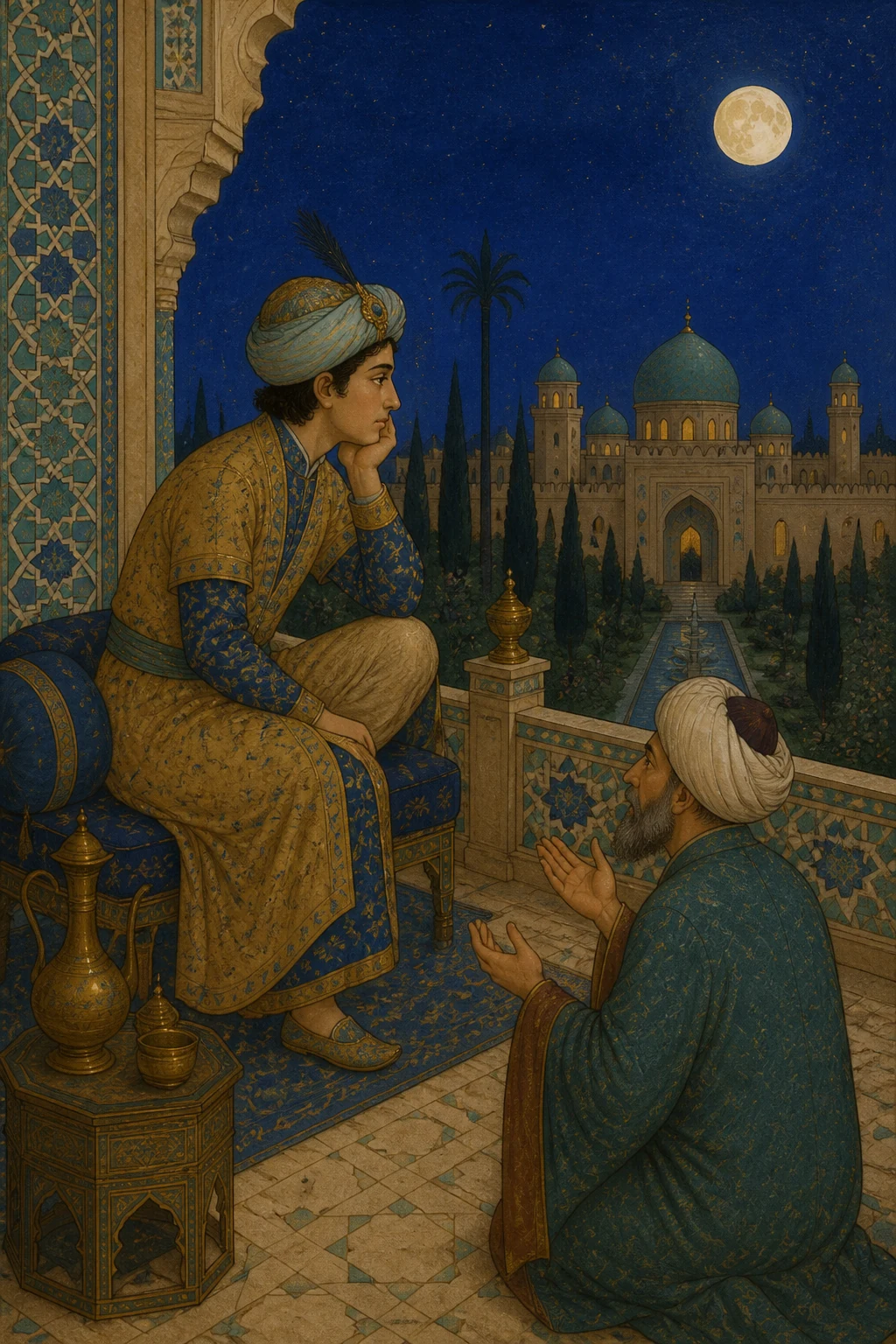
She said: It has reached me, O fortunate King, that when the prince heard this news, he went in to his father the king, kissed the ground before him, and said, “Most mighty King, do not put yourself to all this trouble, mustering these champions and armies and spending your wealth. You are stronger than he, and if you march against him with this army of yours, you will lay waste his lands and cities, kill his men and champions, and plunder his wealth. He too will be killed, and when his daughter hears what has befallen her father and the others on her account, she will kill herself. Then I shall die for her sake, for I could never live after her.” The king asked, “What do you propose, my son?” He replied, “I shall go myself to pursue my desire. I shall dress as a merchant and devise some means of reaching her, and see how I may win what I seek.” “Have you settled upon this course?” his father asked. “Yes, Father,” he replied. The king summoned the vizier and said to him, “Travel with my son, the fruit of my heart. Help him achieve his purpose, watch over him, and guide him with your sound judgment, for you will be taking my place beside him.” “I hear and obey,” answered the vizier. Then the king gave his son three hundred thousand gold dinars, together with jewels, precious stones, gold ornaments, merchandise, treasures, and other such things. The young man went in to his mother, kissed her hands, and asked for her prayers. She prayed for him, then rose at once, opened her treasury, and brought out treasures, necklaces, ornaments, robes, and rarities: all the priceless things laid away since the days of former kings. He took with him as many of his mamluks, servants, and beasts as he would need on the road and elsewhere. He, the vizier, and their companions dressed as merchants, and he bade farewell to his mother, his household, and his kinsfolk. They set out, crossing wildernesses and deserts by night and day. When the journey began to seem long to him, he recited these verses:
My passion grows with longing and with pain; against the tyranny of time I have no aid. I watch the Pleiades and Spica when it rises, as though excess of love had made me their devotee. I wait upon the morning star, and when it comes, I wander lost in longing, my anguish ever greater. I love you, and no other do I love; my heart is sick, my eyes sleepless with yearning. If what I hope for proves beyond my reach, my wasting sickness grows; without you, patience fails and helpers dwindle. I shall endure until God brings us together, and enemies and enviers pine away at our reunion. When he had finished his verses, he fainted for a time. The vizier sprinkled rose water over him, and when he revived, said, “Prince, be patient. Patience ends in deliverance, and you are already on your way to what you seek.” The vizier continued to soothe and comfort him until his agitation subsided, and they pressed on with their journey. When the road once more seemed long to the prince, he remembered his beloved and recited these verses:
Long has our parting lasted; grief and care increase, and my very soul burns in a blazing fire. My hair has whitened from the love that plagues me, and tears pour from my eyes. I swear, O my desire, the utmost of my hopes, by Him who made all creatures, branch and leaf among them: gladly have I borne from you, my destiny, a torment no other lover could endure. Ask the night about me; it will tell you whether my eyelids ever close throughout its length. When he had finished reciting his verses, he wept bitterly from the violence of his passion. The vizier soothed and comforted him, promising that he would attain his desire. They journeyed for a few more days until, after sunrise, they came in sight of the White City. The vizier said to the prince, “Rejoice, Prince, for good fortune awaits you! Look: there is the White City you seek.” The prince was overjoyed and recited these verses:
My two companions, my heart is lost in love; my yearning abides, and passion never leaves me. I lament like one bereaved whom sorrow keeps awake; when night enfolds me, love shows me no mercy. Whenever winds blow from the land where you dwell, I feel their cooling breath come to my heart. My eyes pour down like rain-laden clouds, and in this sea of tears my heart is swimming. When they reached the White City, they entered it and asked for the merchants’ khan, where men of wealth lodged. They were directed to it and took lodgings there, renting three storerooms. Once they had received the keys, they opened them and carried in their goods and belongings. They rested for a while, and then the vizier set about devising a plan for the prince. But morning overtook Shahrazad, and she fell silent, leaving her tale untold.
When it was the seven hundred and twenty-first night,
She said: It has reached me, O fortunate King, that when the vizier and the prince had taken lodgings at the khan, stored their merchandise in the storerooms, and stationed their servants there, they rested for a while. Then the vizier set about devising a plan for the prince and said, “An idea has occurred to me which I think will serve you well, if God Most High wills.” The prince replied, “Vizier of excellent counsel, do whatever has occurred to you, and may God guide your judgment.” The vizier said, “I wish to rent you a shop in the cloth merchants’ market, where you may sit, for everyone, high and low, has need of the market. I believe that if you sit in a shop and people see you with their own eyes, their hearts will incline toward you, and you will be better able to attain your desire. Your face is beautiful: hearts are drawn to you, and eyes delight in you.” “Do whatever you choose and wish,” he replied. At once the vizier rose and put on his finest clothes, and the prince did likewise. The vizier placed in his pocket a purse containing a thousand dinars, and they went out to walk through the city. People gazed at them, astonished by the prince’s beauty, and said, “Glory be to Him who created this youth from a lowly drop! Blessed be God, the best of creators!” There was much talk of him, and they said, “This is no mortal; he can only be a noble angel.” Others said, “Has Ridwan, the keeper of Paradise, neglected its gate, so that this youth has escaped?” People followed them as far as the cloth market. When they entered it and stopped, an old man of dignity and commanding presence approached and greeted them. They returned his greeting, and he said, “My masters, is there some service with which we may have the honor of assisting you?” The vizier asked, “And who are you, venerable sir?” “I am the headman of the market,” he replied. The vizier said, “Know, sir, that this young man is my son. I wish to obtain a shop for him in this market, where he may sit and learn to buy and sell, to give and take, and to acquire the manners of merchants.” “I hear and obey,” said the headman. He immediately brought them the key to a shop and ordered the brokers to sweep it. They swept and cleaned it, and the vizier sent for a lofty cushion stuffed with ostrich down, with a small carpet laid over it and edging embroidered in red gold. He also had a bolster brought, together with enough of the merchandise and cloth he had brought with him to fill the shop.
The next day the young man came, opened the shop, and seated himself upon the cushion. Before him he stationed two mamluks dressed in the finest clothes, and at the lower end of the shop he placed two slaves of the most handsome Abyssinian stock. The vizier had instructed him to conceal his secret from everyone, so that he might more easily accomplish his purpose. Then he left him and went to the storerooms, telling him to report each day everything that happened in the shop. The young man sat there like the moon at its full. People heard of him and his beauty and came without any business to transact, visiting the market merely to gaze upon his loveliness, his stature, and his graceful proportions, and to glorify God Most High, who had created and fashioned him. The market became so crowded that no one could make his way through it. The prince looked to right and left, bewildered by the people who stood gazing at him in wonder. He hoped to befriend someone close to the court who might bring him news of the king’s daughter, but he found no means of doing so. His heart grew heavy, while every day the vizier encouraged him with hopes of attaining his desire. He remained in this state for a long time. Then one day, as he sat in his shop, an old woman appeared, modest, dignified, and commanding respect. She wore the dress of a pious woman, and behind her came two maidservants like a pair of moons. She stopped at the shop and studied the young man for a while, then said, “Glory be to Him who created this countenance and perfected this handiwork!” She greeted him, and he returned her greeting and seated her beside him. “What country are you from, fair-faced one?” she asked. “I come from the lands of India, Mother,” he replied, “and have come to this city to see its sights.” “An honored visitor indeed!” she said. Then she asked, “What goods, wares, and fabrics have you? Show me something fine, fit for royalty.” When he heard her words, he said, “Would you like something fine for me to show you? I have something suited to every wearer.” “My son,” she said, “I want something costly and beautiful—the most expensive thing you have.” He replied, “You must tell me for whom you seek these goods, so that I may show you something worthy of the person who desires them.” “You are right, my son,” she said. “I want something for my mistress Hayat al-Nufus, daughter of King Abd al-Qadir, lord of this land and ruler of this country.”
When the prince heard her words, he was beside himself with joy, and his heart fluttered. Without calling upon his mamluks or slaves, he reached behind him, took out a purse containing a hundred dinars, and handed it to the old woman. “This purse is to pay for washing your clothes,” he said. Then he reached for a bundle and drew from it a robe worth ten thousand dinars or more. “This is one of the things I have brought to your country,” he said. The old woman admired it greatly when she saw it and asked, “How much is this robe, O youth perfect in every grace?” “It has no price,” he replied. She thanked him and repeated her question, but he said, “By God, I will take no payment for it. Indeed, if the princess does not accept it, it is a gift from me to you, a token of my welcome. Praise be to God who has brought us together, so that if some day I have a need, I may find you ready to help me fulfill it.” The old woman marveled at his gracious speech, his great generosity, and his exquisite manners. “What is your name, my lord?” she asked. “Ardashir,” he replied. “By God,” she said, “that is a remarkable name, such as kings give their sons, yet you are dressed as a merchant’s son!” He answered, “My father gave me this name out of his love for me. A name signifies nothing.”
The old woman wondered at him and said, “My son, take the price of your goods.” But he swore that he would accept nothing. Then she said, “My dear boy, know that truthfulness is the greatest of virtues. All this generosity you are showing me must have some purpose behind it. Tell me your circumstances and what is in your heart. Perhaps you have some need that I can help you fulfill.” At that he placed his hand in hers, bound her to secrecy, and told her his whole story, explaining his love for the king’s daughter and all he was suffering for her sake. The old woman shook her head and said, “Now that is the truth. But, my son, the wise have a familiar saying: ‘If you wish to be obeyed, ask for what cannot be done.’ You, my son, are known as a merchant, and even if you possessed the keys to every treasury, you would still be called nothing but a merchant. If you wish to rise above your station, ask for the daughter of a judge or an emir. Why, my son, must you seek none but the daughter of the king of this age and time? She is an untouched maiden, knowing nothing of worldly affairs, who has never in her life seen anything beyond the palace where she lives. Yet despite her youth she is wise, intelligent, perceptive, and shrewd, with sound judgment, virtuous conduct, and a penetrating mind. Her father has been granted no other child, and she is dearer to him than his own soul. Every day he comes to see her and calls out to her. Everyone in her palace fears her. Do not imagine, my son, that anyone can speak to her of such matters: there is no way of doing so. By God, my son, I love you with all my heart and soul, and I wish you could dwell beside her. But let me tell you something in which God may perhaps grant healing to your heart. I shall risk my life and wealth with you to fulfill your desire.” “What is it, Mother?” he asked. She said, “Ask me for the daughter of a vizier or an emir. If you ask that of me, I shall grant your request, for no one can leap from earth to heaven in a single bound.” The young man replied with courtesy and good sense, “Mother, you are a wise woman who knows the proper place of things. If a man has a pain in his head, does he bind up his hand?” “No, by God, my son,” she said. “So it is with me,” he replied. “My heart seeks no one but her, and nothing but love of her is killing me. By God, I am doomed unless I find someone to guide and help me. I implore you by God, Mother, take pity on my loneliness in this foreign land and on my streaming tears.” But morning overtook Shahrazad, and she fell silent, leaving her tale untold.
When it was the seven hundred and twenty-second night,
She said: It has reached me, O fortunate King, that Prince Ardashir said to the old woman, “I implore you by God, Mother, take pity on my loneliness in this foreign land and on my streaming tears.” She replied, “By God, my son, your words tear my heart apart, but there is no means within my power.” He said, “I ask this kindness of you: will you carry a letter from me, deliver it to her, and kiss her hands on my behalf?” Her heart softened toward him, and she said, “Write whatever you wish, and I shall deliver it.” When he heard this, he almost flew with joy. He called for ink and paper and wrote her these verses:
O Hayat al-Nufus, grant the joy of union to a lover whom separation has consumed. Once I lived in pleasure and delight; today I am distraught and lost. All through the length of night I keep my sleepless vigil, with spirits of the darkness for companions. Have mercy on a lover, sorrowful and tormented, whose eyelids longing has made raw. If my heart feels a moment’s intoxication, it is drunk upon the wine of love. When he had finished writing the letter, he folded and kissed it, then gave it to the old woman. He reached into his chest and took out another purse containing a hundred dinars, which he handed to her, saying, “Distribute this among the maidservants.” She refused it, saying, “By God, my son, it is not for anything of this kind that I am helping you.” He thanked her and said, “You must take it.” She accepted it, kissed his hands, and departed. She went in to the princess and said, “My lady, I have brought you something that no one in our city possesses. It comes from a handsome young man whose beauty has no equal upon the face of the earth.” “Nurse,” said the princess, “where does this young man come from?” “From the lands of India,” she replied. “He gave me this robe, woven with gold and set with pearls and jewels, worth the kingdoms of Chosroes and Caesar.” When she unfolded it, the palace shone with its radiance, so fine was its workmanship and so abundant its gems and jewels. Everyone in the palace marveled at it. The king’s daughter examined it and could set no price upon it short of a full year’s revenues from her father’s kingdom. She asked the old woman, “Nurse, does this robe belong to him or to someone else?” “It belongs to him,” she replied. “Nurse, is this merchant from our city, or is he a stranger?” “He is a stranger, my lady, and has only lately arrived in our city. By God, he has attendants and servants, a handsome face, a well-proportioned figure, generous manners, and a gracious heart. I have never seen anyone more beautiful except yourself.” The king’s daughter said, “This is astonishing. How does a merchant come to possess such a robe, whose price no fortune could meet? What did he tell you it cost, Nurse?” The old woman replied, “By God, my lady, he told me no price. He only said, ‘I will take no payment for it. It is a gift from me to the king’s daughter, for it is fit for no one else.’ He returned the gold you sent with me and swore he would not accept it, saying, ‘The robe is yours if the princess does not accept it.’” The king’s daughter said, “By God, this is extraordinary liberality and immense generosity. I fear what may come of it; perhaps it will lead to harm. Why did you not ask him, Nurse, whether he had some need that we could fulfill?” She replied, “My lady, I did ask him whether he had any request. He said that he did, but did not reveal it to me. He merely gave me this letter and said, ‘Present it to the princess.’” She took it from her, opened it, and read it to the end. Her expression changed, she lost command of herself, and her face turned yellow. “Woe to you, Nurse!” she cried. “What is this dog called, who dares address such words to a king’s daughter? What connection is there between me and this dog, that he should write to me? By Almighty God, Lord of Zamzam and the Hatim, were it not for my fear of God Most High, I would send men to bind this dog’s hands, slit his nostrils, cut off his nose and ears, and mutilate him. After that I would have him crucified at the gate of the market where he keeps his shop.” When the old woman heard these words, her face turned yellow, her limbs trembled, and her tongue failed her. Then she took courage and said, “Peace, my lady! What is in the letter to upset you so? Is it not simply a petition he has submitted to you, complaining of poverty or oppression, and hoping for your charity or for redress of some wrong?” “No, by God, Nurse,” she replied. “It is poetry and indecent talk. But, Nurse, this dog must be one of three things: either he is a madman without reason, or he means to bring about his own death—or has some mighty power and great ruler to help him obtain what he wants from me—or else he has heard that I am one of the harlots of this city who spends a night or two with anyone who summons her. Otherwise, why would he send me such shameless verses, seeking to corrupt my mind?” The old woman said, “By God, my lady, you speak the truth. But pay no heed to this ignorant dog. You are seated in your lofty, strongly built, impregnable palace, over which no bird can soar and through which no breeze can pass, while he wanders bewildered. Write him a letter, however, and rebuke him. Spare him no kind of reproach, threaten him with the severest threats, and set death before his eyes. Say to him, ‘How do you know me, that you write to me, you dog of a merchant, who spends his whole life wandering through wildernesses and deserts to earn a dirham or a dinar? By God, unless you wake from your slumber and sober from your drunkenness, I will have you crucified at the gate of the market where you keep your shop.’” The king’s daughter said, “I fear that if I write to him, he will grow hopeful.” “What is he worth?” asked the old woman. “What rank has he, that he should aspire to us? We shall write only to destroy his hopes and increase his fear.” She continued to coax the king’s daughter until she called for ink and paper and wrote him these verses:
You who claim love, affliction, and sleeplessness, passing your nights in yearning and in thought: do you seek union, deluded one, with a moon? Can any man win his desire from the moon? Hear the counsel I offer you in words: desist, for you stand between peril and death. If you renew this plea, there shall come from us a punishment of grievous harm. Be courteous and discerning, sensible and wise; I have counseled you in verse and plain speech. By Him who created all things out of nothing and adorned the face of heaven with shining stars, if you return to what you now declare, I shall have you crucified upon a tree. Then she folded the letter and gave it to the old woman, who took it and went to the young man’s shop, where she handed it to him. But morning overtook Shahrazad, and she fell silent, leaving her tale untold.
When it was the seven hundred and twenty-third night,
She said: It has reached me, O fortunate King, that the old woman took what Hayat al-Nufus had written and carried it to the young man in his shop. “Read your answer,” she said, “and know that when she read your letter, she flew into a terrible rage. I kept soothing her with gentle words until she wrote you this reply.” He took the letter joyfully, read it, and understood its meaning. When he had finished, he wept bitterly. The old woman’s heart ached for him, and she said, “My son, may God never bring tears to your eyes or sorrow to your heart. Yet after what you have done, what gentler answer could there be to your letter?” He replied, “Mother, what more gentle means can I devise? She sends threats of death and crucifixion and forbids me to write to her. By God, I think death would be better for me than life. But I ask this favor of you: take this letter and deliver it to her.” She said, “Write, and I shall bring you the answer. By God, I shall risk my life to help you attain your desire, even if I perish in pleasing you.” He thanked her, kissed her hands, and wrote these verses:
You threaten to kill me for loving you, but death would be my rest, and death is ordained. Sweeter is death to a lover than a lengthened life of rejection and rebuke. If you would visit a lover with few to aid him, know that every kindly deed is worthy of thanks. If you have resolved upon some act, then do it: I have become your slave, and a slave is captive. What way is there, when I cannot bear to be without you? How can this be, when the lover’s heart is compelled? O my sovereigns, have mercy on one whom love of you has wasted: whoever loves the noble is to be forgiven. Then he folded the letter and gave it to the old woman, together with two purses containing two hundred dinars. She refused to take them, but he insisted with an oath, and she accepted them, saying, “I shall bring you to your desire, despite your enemies.” She departed and went in to Hayat al-Nufus, to whom she gave the letter. “What is this, Nurse?” the princess asked. “We are exchanging letters now, and you are going back and forth! I fear our business will be discovered and we shall be disgraced.” “How could that be, my lady?” asked the old woman. “Who would dare speak of such a thing?” She took the letter from her, read it, and understood its meaning, then struck one hand against the other. “What an affliction has befallen us!” she cried. “We do not even know where this young man has come from!” The old woman said, “My lady, I beg you by God to write him a letter, but speak harshly to him and say, ‘If you send another letter after this, I shall have your head cut off.’” She replied, “Nurse, I know that this will not end in such a way. It would be better not to write at all. If this dog does not desist after the earlier threat, I shall have his head cut off.” The old woman said, “Write him a letter and tell him so.” The king’s daughter called for ink and paper and wrote him these threatening verses:
You who heed not the calamities that strike by night, whose lover’s heart longs for union: consider, deluded one, can you reach the sky? Can you ever overtake the shining moon? I shall burn you in a fire whose flames never fade, and you shall fall slain by annihilating swords. Between you and your desire, my friend, lies a far greater distance, and a hidden peril that turns the hair white. Take my advice, then leave off love; abandon your purpose, for it is unfitting. Then she folded the letter and gave it to the old woman, deeply agitated by the affair. The old woman took it and went to the young man, to whom she handed it. He took it, read it, and bowed his head toward the ground, tracing lines with his finger without speaking. The old woman asked, “My son, why do I see you saying nothing and making no reply?” He answered, “Mother, what can I say, when she threatens me and grows only harder and more averse?” She said, “Write her a letter saying whatever you wish. I shall defend you, so keep your heart at ease. I shall surely bring you together.” He thanked her for her kindness, kissed her hands, and wrote these verses:
O God, behold a heart that will not soften toward a lover, and a lover yearning to be joined with his beloved! Behold these eyelids, ever raw and wounded whenever the darkness of night enfolds them. Show favor, be generous, have mercy, bestow your charity upon one whom love and separation have consumed. All through the night he lies awake in torment, burning, drowned in a sea of tears. Do not cut off the hopes within my heart, for it is sorrowful and tormented, trembling with love. Then he folded the letter and gave it to the old woman, along with three hundred dinars. “This is for washing your hands,” he said. She thanked him, kissed his hands, and departed. She went in to the king’s daughter and gave her the letter. The princess took it, read it to the end, then flung it from her hand and sprang to her feet. Wearing golden clogs set with pearls and jewels, she walked to her father’s palace, the vein of anger standing out between her eyes. No one dared ask what troubled her. When she reached the palace, she asked for her father the king, and the maidservants and concubines told her, “My lady, he has gone out hunting.” She returned like a raging lioness and spoke to no one for three hours, until her face had cleared and her anger subsided. When the old woman saw that her distress and fury had passed, she approached, kissed the ground before her, and said, “My lady, where did those noble footsteps lead?” “To my father’s palace,” the princess replied. “My lady, was there no one who could have attended to your need?” She said, “I went only to tell him what has happened to me through that dog of a merchant, and to set my father upon him, so that he would seize him and everyone else in his market and crucify them upon their shops, and allow no foreign merchant to remain in our city.” The old woman asked, “Was that your only reason for going to your father, my lady?” “Yes,” she replied, “but I did not find him there. He was away hunting, and I am waiting for his return.” The old woman said, “I seek refuge in God, the All-Hearing, the All-Knowing! My lady, praise be to God, you are the wisest of people. How can you tell the king this nonsense, which no one should ever divulge?” “Why not?” she asked. The old woman said, “Suppose you had found the king in his palace and told him this story, and he had sent for the merchants and ordered them hanged upon their shops. When people saw them, would they not ask, ‘Why were they hanged?’ And would they not be told in reply, ‘They sent messages to corrupt the king’s daughter’?” But morning overtook Shahrazad, and she fell silent, leaving her tale untold.
When it was the seven hundred and twenty-fourth night,
She said: It has reached me, O fortunate King, that the old woman said to the king’s daughter, “Suppose you had told the king of this and he had ordered the merchants hanged. Would people not see them and ask, ‘Why were they hanged?’ They would be told in reply, ‘They sought to corrupt the king’s daughter.’ Then they would spread all manner of tales about you. Some would say, ‘She stayed with them for ten days, absent from her palace, until they had had their fill of her.’ Others would say something else. A woman’s honor, my lady, is like milk: the slightest dust soils it. It is like glass: once cracked, it cannot be made whole. Beware of telling your father or anyone else of this affair, lest your honor be defiled, my lady. Telling people will do you no good at all. Weigh these words with your sound judgment, and if you do not find them true, do as you please.” When the king’s daughter heard the old woman’s words, she considered them and found them entirely sound. “What you say is true, Nurse,” she said, “but anger had blinded my heart.” The old woman replied, “Your intentions are pure before God Most High, since you have told no one. But one thing remains: we must not pass over the shamelessness of this dog, this vilest of merchants. Write him a letter and say, ‘You lowest of merchants, had I not found the king absent, I would by now have ordered you and all your neighbors crucified. But none of this shall escape you. I swear by God Most High that if you ever return to such words, I shall wipe every trace of you from the face of the earth.’ Speak harshly enough to turn him from this business and awaken him from his heedlessness.” The king’s daughter asked, “Will such words make him abandon his purpose?” “How could he fail to desist,” she replied, “when I too shall speak to him and tell him what has happened?” So she called for ink and paper and wrote him these verses:
You have set your hopes upon union with us, seeking to gain your desires from us. Yet nothing kills a man but his delusion, and what he seeks from us will bring him only calamity. You have neither might nor a band of followers; you are neither sultan nor governor. Even if one of our own rank had acted thus, terror and warfare would have turned him gray. But for now I shall pardon what you have done, in the hope that from this moment you will turn back in repentance. Then she handed the letter to the old woman and said, “Nurse, restrain this dog, lest I cut off his head and we incur the sin of his death.” The old woman replied, “By God, my lady, I shall give him no peace.” She took the letter and went to the young man, whom she greeted. He returned her greeting, and she handed him the letter. He took it, read it, and shook his head, saying, “We belong to God, and to Him we shall return.” Then he said, “Mother, what am I to do? My patience is almost gone, and my strength has failed.” The old woman replied, “My son, be patient. Perhaps God will bring about some change after this. Write what is in your heart, and I shall bring you the answer. Be at ease and take comfort: I shall surely bring you together, if God Most High wills.” He prayed for her and wrote a letter in which he included these verses:
If I have none to shelter me in love, and passion’s tyranny must be my death, I bear a fire blazing deep within my breast by day, while night affords me neither sleep nor rest. Why should I not hope in you, O summit of desire, and gladly bear all I have suffered for love? I have begged the Lord of the Throne to grant me contentment, for love of beautiful women has consumed me, and to decree a swift reunion that will satisfy my heart, so sorely tried by love’s terrors. Then he folded the letter and gave it to the old woman, together with a purse containing four hundred dinars. She took everything and went to the king’s daughter, to whom she offered the letter. The princess would not take it. “What is this paper?” she asked. “My lady,” replied the old woman, “this is the answer to the letter you sent that dog of a merchant.” “Did you forbid him as I instructed you?” “Yes, and this is his reply.” The princess took the letter and read it to the end, then turned to the old woman. “Where is the effect of your words?” “My lady, he says in his answer that he has mended his ways, repented, and apologized for what is past.” “No, by God! He has only gone further.” “My lady, write him a letter, and you shall hear what I do to him.” “I have no need of letters or replies.” The old woman said, “There must be an answer, so that I may rebuke him and put an end to his hopes.” “Put an end to his hopes without taking a letter with you,” said the king’s daughter. “To rebuke him and end his hopes, I must take a letter.” So the princess called for an inkwell and paper, and wrote him these verses:
Long have I reproached you, yet no reproach restrains you; how often have I forbidden you in verses written by my own hand! Conceal your passion; never proclaim it. If you disobey, I shall show you no mercy. If you return to what you have been saying, it is your own death that the herald announces. Soon you shall see the winds raging over you, and the birds descending upon you in the wilderness. Turn to worthy deeds and prosper for a time; but seek indecency or lewdness, and it will destroy you. When she had finished writing, she flung the paper angrily from her hand. The old woman picked it up and carried it to the young man, who took it from her. When he had read it to the end, he knew that the princess had not softened toward him but had only grown angrier, and that he would never reach her. It occurred to him to write an answer and call down a curse upon her, so he wrote these verses:
O Lord, by the five holy elders, deliver me from her whose love has plunged me into suffering. You know the fire of anguish within me, and my boundless longing for one who has no mercy on me. She has shown no pity for my affliction; how cruelly she oppresses me in my weakness! I wander, lost in the depths of devotion to her, and find no one, my friends, to come to my aid. How many nights, beneath the spreading wings of darkness, have I lamented, secretly and aloud! I have found no solace for my love of you; how could I forget, when love has exhausted all my patience? O bird of parting, tell me: is she safe from the blows of changing fortune and its trials?
Then he folded the letter and gave it to the old woman, together with a purse containing five hundred dinars. She took the paper and went to the king’s daughter. When the princess had read and understood it, she flung it from her hand and said, “Tell me, you wicked old woman! All that has happened to me is your doing, with your tricks and your approval of him, until I have written you letter after letter. You have kept carrying messages between us until you have involved me in correspondence and gossip with him. All the while you say, ‘I shall spare you his mischief and put an end to his words.’ You say this only to make me write him another letter, so that you can keep going back and forth between us, until you have dishonored me. Wretches! Servants! Seize her!” She ordered the servants to beat her, and they beat her until blood flowed from every part of her body and she fainted. Then she ordered the slave girls to drag her away, and they dragged her by the feet to the far end of the palace. She commanded one of them to stand by the old woman’s head and, when she regained consciousness, to tell her, “The queen has sworn that you shall never return to this palace or enter it again. If you do, she will certainly have you killed.” When the old woman recovered, the girl delivered the queen’s message, and she answered, “I hear and obey.”
The slave girls then brought a large carrying basket and ordered a porter to take her home in it. He carried her to her house, and they sent a physician after her with orders to treat her gently until she recovered. The physician obeyed. When she had regained her strength, she mounted and rode to the young man. He had been deeply distressed by her absence and was longing for news of her. At the sight of her he sprang up, welcomed her, and greeted her, but found her weak and frail. He asked how she was, and she told him everything the queen had done to her. He was greatly troubled, and struck his hands together. “By God,” he said, “I am grieved by what has happened to you. But tell me, mother, why does the queen hate men?” “My son,” she replied, “you must know that she has a beautiful garden, the finest on the face of the earth. One night she was sleeping there, and in the sweetness of her sleep she dreamed that she went down into the garden and saw a hunter who had laid a snare, scattered wheat around it, and sat some distance away to watch for whatever game might fall into it. Before long the birds gathered to peck at the wheat. A male bird was caught in the snare and began to struggle. The other birds flew away from him, his mate among them. But she was gone only a little while before she returned, approached the snare, and began working at the loop around her mate’s leg. She kept worrying it with her beak until she severed it and set him free. All this time the hunter sat dozing. When he woke, he looked at his snare and found it broken, so he repaired it, scattered fresh wheat, and sat down some distance away. After a while the birds gathered again, the male and female among them. They came forward to peck at the grain, and the female was caught in the snare and began to struggle. All the doves flew away from her, including the mate she had rescued, and he did not return. The hunter had been overcome by sleep and did not wake for a long time. When at last he awoke, he found the female in the snare. He rose, went over to her, freed her feet, and cut her throat. The king’s daughter woke in terror and said, ‘This is how men treat women. A woman feels compassion for a man and risks her life for him when he is in distress. But afterward, if the Lord decrees that she herself should fall into trouble, he abandons her and does not rescue her, forgetting all the kindness she has shown him. God curse whoever trusts men, for they deny the kindness women do them!’ From that day onward she hated men.”
The prince said to the old woman, “Mother, does she never go out into the streets?” “No, my son. But she has a garden, one of the loveliest pleasure grounds of our time. Every year, when its fruit is ripe, she goes down to enjoy it for a single day, though she sleeps only in her palace. She enters the garden by a private door that leads straight into it. Now I mean to tell you something which, God willing, may help you. There is only a month left until the fruit ripens and she goes down to enjoy the garden. From this day forward, I advise you to visit its keeper and make a close friend of him. He allows no soul that Almighty God has created to enter the garden, because it adjoins the princess’s palace. I shall tell you two days before she goes down. Then you must visit as usual, enter the garden, and find some way to spend the night there. When the king’s daughter comes down, you will be hidden somewhere within.” Dawn overtook Shahrazad, and she ceased her permitted tale.
When it was the seven hundred and twenty-fifth night
She said: It has reached me, O fortunate king, that the old woman advised the prince, saying, “The king’s daughter will come down into the garden, and I shall tell you two days beforehand. When she comes, you must be hidden somewhere inside. When you see her, come out before her, for once she sees you, she will love you, and love veils all things. Know, my son, that if she set eyes on you, she would be enchanted by your beauty. So take comfort and be glad, my son: I shall surely bring you together.” He kissed her hand and thanked her, then gave her three lengths of Alexandrian silk and three lengths of satin in different colors. With each he gave enough fabric for a shirt, a piece for trousers, a kerchief for a headband, and cloth from Baalbek for lining, until she had three complete outfits, each finer than the next. He also gave her a purse containing six hundred dinars, saying, “This is for the sewing.” She took everything and said, “My son, would you like to know the way to my house, and for me to know where you live?” “Yes,” he replied. He sent a slave with her to learn where she lived and show her his house. When the old woman had gone, the prince rose, ordered his servants to close the shop, and went to the vizier, whom he told everything that had happened with her, from beginning to end.
When the vizier had heard the prince’s account, he said, “My son, if Hayat al-Nufus comes out and shows you no favor, what will you do?” “I shall have no recourse but to pass from words to deeds,” he answered. “I shall risk my life for her, snatch her from among her servants, lift her onto my horse behind me, and make for the open wilderness. If I escape, I shall have gained my desire; if I perish, I shall at least find rest from this wretched life.” The vizier said, “My son, is this the judgment by which you mean to live? How could we make the journey, when our own country is so far away? How can you attempt such a thing against one of the kings of this age, who commands a hundred thousand horsemen? He might send some of his troops to cut off our escape. This is no sound plan, nor would any sensible man attempt it.” “What, then, is to be done, O resourceful vizier?” asked the prince. “For I shall surely die.” The vizier replied, “Wait until tomorrow, so that we may see this garden, learn how it is laid out, and discover how we fare with its keeper.”
When morning came, the vizier rose with the prince, put a thousand dinars in his pocket, and walked with him to the garden. They found it enclosed by high walls and sturdy corners, rich in trees and flowing streams and lovely fruit. Its blossoms breathed their fragrance and its birds sang, as though it were one of the gardens of Paradise. Just inside the gate an elderly man sat on a stone bench. When he saw them and perceived their dignity, he rose to his feet as they greeted him. Returning their greeting, he said, “My lords, is there some service I may have the honor of performing for you?” The vizier said, “Good sir, we are strangers here. The heat has become oppressive, and our lodging is far away at the other end of the city. We ask you, in your kindness, to take these two dinars and buy us something to eat. Open the garden gate and seat us in a shady place where there is cool water to refresh us until you bring the food. Then you and we shall eat together, and when we have rested we shall go on our way.” The vizier put his hand into his pocket, drew out two dinars, and placed them in the gardener’s hand. The man was seventy years old and had never held such a sum. When he saw the two dinars in his palm, he was beside himself. He immediately opened the gate, admitted them, and seated them beneath a fruit tree that cast a generous shade. “Sit here,” he told them, “and do not venture farther into the garden, for it contains the private door leading to the palace of Queen Hayat al-Nufus.” “We shall not stir from this spot,” they replied.
The old gardener went off to buy what they had requested. After a while he returned with a porter carrying roast lamb and bread on his head. They all ate and drank together, then talked for a time. The vizier looked about him, turning his eyes to either side of the garden, and saw within it a lofty pavilion, old and worn, its whitewash peeling from the walls and its corners crumbling. “Good sir,” he asked, “do you own this garden, or do you rent it?” “My lord, I neither own it nor rent it. I am only its keeper.” “What are your wages?” “One dinar a month, sir.” The vizier said, “They have wronged you, especially if you have a family to support.” “By God, sir, I have eight children, besides myself.” “There is no power and no might save in God, the Most High, the Almighty!” exclaimed the vizier. “By God, poor man, you have burdened my heart with your troubles. But what would you say of someone who did you a kindness for the sake of these children?” “My lord, whatever good you do will be laid up for you with Almighty God.” The vizier said, “Know, good sir, that this garden is a delightful place, and this pavilion stands within it, but it is old and ruined. I wish to repair it, whitewash it, and have it beautifully painted, until it becomes the finest spot in the garden. When the owner comes and finds it restored and beautiful, he is sure to ask you who repaired it. If he does, say, ‘My lord, I restored it when I saw it lying in ruins, of no use to anyone, and too dilapidated for anyone to sit in. So I repaired it and spent money on it.’ If he asks, ‘Where did you get the money you spent?’ tell him, ‘I used my own money, hoping to win your esteem and favor.’ He is bound to reward you for what you have spent on the place. Tomorrow I shall bring builders, plasterers, and painters to restore it, and I shall give you what I have promised.” Then he took a purse containing five hundred dinars from his pocket and said, “Take these dinars and spend them on your children, and have them pray for me and this son of mine.” The prince asked him, “Why are you doing this?” “You will see the outcome,” replied the vizier. Dawn overtook Shahrazad, and she ceased her permitted tale.
When it was the seven hundred and twenty-sixth night
She said: It has reached me, O fortunate king, that when the vizier gave the old gardener the five hundred dinars, saying, “Take these dinars and spend them on your children, and have them pray for me and this son of mine,” the old man gazed at the gold and was beside himself. He flung himself at the vizier’s feet and kissed them, praying for him and his son. When they took their leave, he said, “I shall be waiting for you tomorrow. May Almighty God never part me from you, by night or by day!” The next day the vizier came to the place and sent for the master builder. When the man appeared, he took him to the garden, where the keeper was delighted to see him. The vizier gave him the money for materials and everything the workmen would need to restore the pavilion. They repaired it, whitewashed it, and painted it. Then the vizier said to the painters, “Masters, listen to my words and understand my purpose. You must know that I have a garden like this one. One night I was sleeping there, and dreamed that a hunter laid a snare and scattered wheat around it. The birds gathered to peck at the wheat, and a male bird was caught in the snare. All the other birds flew away, his mate among them. After a while she returned alone and gnawed through the loop around her mate’s leg until she set him free. The hunter was asleep at the time. When he woke, he found the snare damaged, repaired it, scattered fresh wheat, and sat some distance away, waiting for game to be caught. The birds came forward to peck at the wheat, the male and female among them. The female became entangled in the snare, and all the birds fled, including her mate, who did not return. The hunter rose, took the female, and cut her throat. As for the male, when he fled with the others, a bird of prey seized him, killed him, drank his blood, and ate his flesh. I wish you to paint this entire dream, just as I have described it, using fine paints. Make it part of your decoration of the garden, with its walls, trees, and birds. Depict the hunter and his snare, and show what happened to the male bird when the bird of prey carried him off. If you do as I have explained, and I am pleased when I see it, I shall give you a handsome reward over and above your wages.”
When the painters heard his words, they applied themselves diligently and carried out the work with the greatest skill. When it was finished, they showed it to the vizier. He was delighted: the dream he had described to them appeared before him as though it were real. He thanked them and rewarded them generously. Then the prince came as usual and entered the pavilion, unaware of what the vizier had done. Looking about him, he saw the garden, the hunter, the snare, and the birds depicted there, and the male bird in the talons of the bird of prey, which had killed him, drunk his blood, and eaten his flesh. He was bewildered. Returning to the vizier, he said, “O resourceful vizier, today I have seen a marvel which, were it written with needles upon the inner corners of the eyes, would be a lesson to all who take heed.” “What is it, my lord?” “Did I not tell you of the dream the king’s daughter had, and how it caused her hatred of men?” “Yes.” “By God, vizier, I have seen it painted among the decorations, as though I were witnessing it with my own eyes. And I found something else, something hidden from the princess that she did not see, upon which all hope of gaining our purpose depends.” “What is that, my son?” “I found that when the male bird vanished from his mate after she was caught in the snare, and failed to return, a bird of prey had seized him, killed him, drunk his blood, and eaten his flesh. If only the king’s daughter had seen the whole dream and its ending, and witnessed the bird of prey carrying off the male! That was why he did not return to free her from the snare.” The vizier said, “O fortunate king, by God, this is a strange and marvelous thing!” The prince continued to wonder at the painting and to lament that the princess had not seen the dream to its end, saying to himself, “If only she had seen the end of that dream, or could see it all a second time, even in a confusion of dreams!” The vizier said, “You asked me why I was restoring this place, and I told you that you would see the result. Now you have seen it. It was I who arranged this and ordered the painters to depict the dream, placing the male bird in the talons of a bird of prey that had killed him, drunk his blood, and eaten his flesh. When the king’s daughter comes down and looks at the paintings, she will see her dream depicted and the bird slain by the bird of prey. Then she will excuse him and abandon her hatred of men.”
When the prince heard this, he kissed the vizier’s hands and thanked him for what he had done. “A man such as you deserves to be vizier to the greatest of kings,” he said. “By God, if I gain my desire and return happily to the king, I shall tell him of this, so that he may honor you still more, exalt your rank, and heed your counsel.” The vizier kissed his hand. Then they went to the old gardener and said, “Look how beautiful this place has become!” “All through your blessed good fortune,” he replied. They said, “Good sir, if the owners ask who restored this pavilion, tell them, ‘I restored it with my own money,’ so that you may receive their kindness and reward.” “I hear and obey,” he answered. From then on the prince visited the old man continually.
Such was the course of events with the vizier and the prince. As for Hayat al-Nufus, when the letters and messages ceased and the old woman no longer came to her, she was overjoyed and believed that the young man had departed for his own country. One day a covered platter arrived from her father. She uncovered it and found lovely fruit inside. “Has the season for this fruit arrived?” she asked. “Yes,” they answered. “If only I had made ready for a visit to the garden!” she said. Dawn overtook Shahrazad, and she ceased her permitted tale.
When it was the seven hundred and twenty-seventh night
She said: It has reached me, O fortunate king, that when the king’s daughter received the fruit her father sent, she asked, “Has the season for this fruit arrived?” They answered, “Yes.” “We ought to make ready for a visit to the garden,” she said. Her slave girls replied, “An excellent idea, my lady! By God, we have longed for that garden.” “But how are we to manage?” she asked. “Every year it is my nurse who shows us around and explains the different branches to us. Yet I had her beaten and banished her from my presence. I regret what I did to her, for whatever else she may be, she is my nurse, and I owe her a debt for bringing me up. There is no power and no might save in God, the Most High, the Almighty!” When the slave girls heard these words, they all rose, kissed the ground before her, and said, “By God, my lady, forgive her and order that she be brought.” “By God, I have resolved to do so,” she replied. “Which of you will go to her? I have prepared a splendid robe of honor for her.” Two girls came forward, one named Bulbul and the other Sawad al-Ayn. They were the foremost of the princess’s slave girls and her particular favorites, both graceful and beautiful. “We shall go to her, O queen,” they said. “Do as you think best,” she answered. They went to the nurse’s house, knocked at her door, and entered. When she recognized them, she embraced them and welcomed them warmly. Once they were seated, they said, “Nurse, the queen has forgiven you and restored you to favor.” “Never!” replied the nurse. “Not even if I must drink the cup of death! Have you forgotten how she punished me before those who love me and those who hate me, until my clothes were stained with blood and I nearly died from the beating? Afterward they dragged me by the feet like a dead dog and threw me outside the door. By God, I shall never return to her or set eyes on her again!” The two girls said, “Do not let us come to you in vain. Where is your regard for us? Consider who has come to visit you. Could you ask for anyone of higher standing with the princess than ourselves?” “God forbid!” she replied. “I know that my rank is beneath yours. It was only because the king’s daughter exalted me above her slave girls and servants that even the greatest of them would tremble in her skin if I grew angry with her.” “Things are just as they were,” the girls replied, “indeed, better than you remember. The king’s daughter has humbled herself before you and sought reconciliation of her own accord.” “By God,” said the nurse, “had you two not come to me, I would never return to her, even if she ordered me killed.” They thanked her for yielding.
She rose at once, dressed, and went out with them. Together they made their way to the king’s daughter. When the nurse entered, the princess rose to her feet. “For God’s sake, princess,” the nurse said, “was the fault mine or yours?” “The fault was mine,” replied the princess, “and forgiveness and favor are yours to grant. By God, nurse, I hold you in great esteem, and I owe you a debt for bringing me up. But you know that God, glorified and exalted be He, has allotted four things to His creatures: their form, their span of life, their livelihood, and their appointed hour of death. No human being can avert what is decreed. I could not master myself or hold myself back. Nurse, I regret what I did.” At this the old woman’s anger vanished. She rose and kissed the ground before the princess, who called for a splendid robe of honor and had her clothed in it. She was overjoyed by the gift, while the servants and slave girls stood attending them. When the gathering was over, the princess asked, “Nurse, how are the fruits in our orchards?” “By God, my lady, I have seen most kinds of fruit in the town. But today I shall look into the matter and bring you word.” She left her, honored in the highest degree, and went to the prince. He welcomed her joyfully, embraced her, and rejoiced at her arrival. His heart was eased, for he had been waiting anxiously to see her. The old woman told him what had happened with the king’s daughter and that the princess intended to visit the garden on a certain day. Dawn overtook Shahrazad, and she ceased her permitted tale.
When it was the seven hundred and twenty-eighth night
She said: It has reached me, O fortunate king, that when the old woman came to the prince and told him what had happened between herself and Queen Hayat al-Nufus, and that the queen would visit the garden on a certain day, she asked him, “Have you done as I instructed you concerning the garden’s gatekeeper? Has he received any kindness from you?” “Yes,” he replied. “He has become my friend; we are always together, and he longs for me to ask him a favor.” Then he told her what the vizier had done: how he had the princess’s dream painted, with the hunter, the snare, and the bird of prey. When the old woman heard this, she was delighted. “For God’s sake,” she said, “keep your vizier in the very heart of your affections. What he has done shows the soundness of his judgment, and he has helped you toward your desire. Rise at once, my son, go to the bath, and put on your finest clothes. No better device remains to us. Go to the gatekeeper and contrive some way to make him let you spend the night in the garden. Even if he were given the earth’s weight in gold, he would allow no one inside. Once you are there, hide yourself from every eye. Remain concealed until you hear me say, ‘O You whose kindness works unseen, keep us safe from what we fear.’ Then come out of hiding and reveal your beauty and grace. Move among the trees, for your loveliness puts the moons to shame, until Queen Hayat al-Nufus sees you and love for you fills her heart and all her being. Then you will gain your wish and your desire, and your sorrow will depart.” “I hear and obey,” said the young man. He brought out a purse containing a thousand dinars, which she took before leaving. The prince immediately went to the bath, refreshed himself, and dressed in the finest garments worn by Persian kings. He draped himself in a sash set with many kinds of precious gems and put on a turban woven with bands of red gold and crowned with pearls and jewels. His cheeks were rosy, his lips red; his glances rivaled the gazelles’, and he swayed like a man drunk with wine. Beauty and grace clothed him, and his supple figure put the branches to shame. He placed a purse containing a thousand dinars in his pocket and went to the garden, where he knocked at the gate. The keeper answered and opened it. At the sight of him, he was overjoyed and greeted him with the utmost warmth. But finding the prince gloomy, he asked what was wrong. “Good sir,” he replied, “my father has always treated me with honor and never raised a hand against me until today. We exchanged words, and he cursed me, slapped my face, beat me with sticks, and drove me out. I no longer know where to turn for a friend. I fear the treachery of fortune, and you know that a parent’s anger is no small matter. So I have come to you, uncle, for my father knows you well. I beg you, in your kindness, to let me stay in the garden for the rest of the day and spend the night here, until God puts things right between my father and me.”
When the old man heard this, he was grieved by what the prince’s father had done to him. “My lord,” he said, “will you allow me to go to your father and help reconcile you?” “Uncle,” replied the young man, “my father has an unbearable temper. If you approach him about making peace while his anger is still hot, he will not listen to you.” “I hear and obey,” said the old man. “But come home with me, my lord. You can sleep among my children and family, and no one can object.” “Uncle, when I am distressed I can bear no company.” The old man said, “It pains me to have you sleep alone in the garden when I have a home.” “Uncle, I have a reason for this. Let me stay until my distress has passed. I know that this will please him and soften his heart toward me.” “If you insist,” said the old man, “I shall bring you bedding to sleep on and a cover to keep you warm.” “That would be good, uncle,” he replied. The old man rose, opened the garden gate for him, and brought him bedding and a cover, not knowing that the king’s daughter intended to visit the garden.
Such was the prince’s case. As for the nurse, she went to the king’s daughter and told her that the fruit was ripe on the trees. “Nurse,” said the princess, “come down with me tomorrow to enjoy the garden, God Almighty willing. But send word to the keeper and tell him that we shall be there tomorrow.” So the nurse sent him word that the queen would be in the garden the following day, and that he must leave no watermen or laborers there, nor allow any soul that God had created to enter. When the princess’s message reached him, he put the watercourses in order, then went to the young man and said, “The king’s daughter owns this garden. My lord, forgive me: the place is yours, and I live only through your kindness, but my tongue lies beneath my foot. I must tell you that Queen Hayat al-Nufus means to visit the garden early tomorrow morning, and she has ordered me to leave no one here who might see her. I beg you, in your generosity, to leave the garden today. The queen will stay only for that one day, until the afternoon; afterward it will be yours for months and years and ages.” “Good sir,” said the prince, “have we perhaps done you some harm?” “No, by God, my lord! I have received nothing but honor from you.” “If that is so,” the young man replied, “you shall receive only good from us. I shall hide in this garden, and no one will see me until the king’s daughter returns to her palace.” The keeper said, “My lord, if she catches so much as a glimpse of any human creature, she will have my head struck off.” Dawn overtook Shahrazad, and she ceased her permitted tale.
When it was the seven hundred and twenty-ninth night
She said: It has reached me, O fortunate king, that when the old man said to the young man, “If the king’s daughter catches so much as a glimpse of a human being, she will have my head struck off,” the young man replied, “I shall let no one see me at all. No doubt you are short of money today for your family’s expenses.” He reached into his purse, took out five hundred dinars, and said, “Take this gold and spend it on your children, so that you may be at ease about them.” At the sight of the gold, the old man thought little of his own life. He earnestly warned the prince not to show himself in the garden, then left him sitting there.
Such was the case of the keeper and the prince. As for the king’s daughter, early the next morning her servants came to attend her. She ordered them to open the private door leading to the garden where the pavilion stood. She dressed in a robe fit for a Persian monarch, set with pearls and jewels, and beneath her outer garment wore a delicate shirt studded with rubies. Beneath all these was that which no tongue can describe, which bewilders the heart, and for love of which even a coward grows brave. Upon her head she wore a crown of red gold set with pearls and precious stones. She stepped gracefully in clogs fashioned from red gold and adorned with lustrous pearls, gems, and rare minerals. Resting her hand on the old woman’s shoulder, she gave the order to go out through the private door. The old woman looked into the garden and found it filled with servants and slave girls, eating the fruit, muddying the streams, and eager to spend the day in play and pleasure. She said to the queen, “You are endowed with sound judgment and perfect understanding, and you know that you have no need of these servants in the garden. If you were going out beyond your father’s palace, their accompanying you would be a mark of respect. But, my lady, you are merely passing through a private door into the garden, where no soul that Almighty God has created can see you.” “You are right, nurse,” she said. “What should we do?” The old woman replied, “Order the servants to go back. I say this only out of respect for the king.” So she ordered the servants to return. The nurse said, “Some servants remain who seek only to make mischief in the land. Send them away, and keep only two slave girls with you, so that we may enjoy ourselves with them.” When the nurse saw that the princess’s heart was at ease and her mood serene, she said, “Now we can have a truly pleasant outing. Come, let us go into the garden.” The king’s daughter rose, placed her hand on the nurse’s shoulder, and went out through the private door. Her two slave girls walked ahead of her, and she laughed at them, swaying in her fine robes. The nurse led her onward, showing her the trees and giving her fruit to taste as she wandered from place to place.
She went on with her until they reached the palace. When the princess looked at it, she saw that it was as good as new, and said, “Nurse, do you not see this palace, how its walls have been rebuilt and freshly whitewashed?” The nurse replied, “By Allah, my lady, I have heard a story about it. The gardener took some cloth from a company of merchants and sold it, then bought bricks, lime, plaster, stone, and other materials with the money. I asked him what he had done with them, and he told me, ‘I restored the ruined palace.’ Then the old man said, ‘The merchants have been pressing me for what I owe them, but I told them to wait until the king’s daughter came down to the garden, saw the repairs, and was pleased with them. When she leaves, I shall take whatever she graciously bestows on me and pay them their due.’ I asked him, ‘What made you do this?’ He answered, ‘I saw the palace falling down, its corners crumbling and its whitewash peeling, and found no one generous enough to restore it. So I borrowed the money on my own credit and repaired it, hoping that the king’s daughter will act with her accustomed generosity.’ I told him, ‘The king’s daughter is all goodness and bounty.’ He did all this only in the hope of your kindness.” The king’s daughter said, “By Allah, he has rebuilt it out of noble feeling, and acted as generous men do. Call my treasurer.” The nurse called the lady treasurer, who came at once, and the princess ordered her to give the gardener two thousand dinars. Then the old woman sent a messenger to the gardener, and when he reached him, he said, “You must obey the princess’s summons.”
When the gardener heard the messenger’s words, his limbs trembled and his strength failed him. He said to himself, “There is no doubt that the king’s daughter has seen the young man. This will be the most ill-fated of days for me.” He went home and told his wife and children, gave them his last instructions, and bade them farewell, while they wept over him. Then he walked on until he stood before the king’s daughter, his face yellow as turmeric, scarcely able to keep from falling to the ground. The old woman saw his condition and came to his rescue with her words. “Old man,” she said, “kiss the ground in thanks to Almighty Allah and pray earnestly for the princess. I have told her how you restored the ruined palace, and she was delighted. In return she has graciously bestowed two thousand dinars on you. Take them from the treasurer, pray for her, kiss the ground before her, and go about your business.” When the gardener heard this from the nurse, he took the two thousand dinars, kissed the ground before the king’s daughter, and prayed for her. Then he returned home, where his family rejoiced to see him and blessed whoever had brought all this about. And dawn overtook Shahrazad, and she fell silent, leaving her tale untold.
When it was the seven hundred and thirtieth night,
She said: It has reached me, O fortunate king, that when the old keeper took the two thousand dinars from the princess and returned home, his family rejoiced and blessed whoever had brought all this about. Such was their case. As for the old woman, she said, “My lady, this place has become beautiful. Never have I seen whiter walls or finer paintwork. I wonder whether the outside or the inside is better. Or has he made it white outside and black within? Let us go in and see the interior.” The nurse entered, with the king’s daughter following her, and they found the inside painted and decorated in the finest manner. The king’s daughter looked to right and left until she reached the far end of the great hall. There she stared and gazed for a long time. The nurse realized that her eyes had fallen on the painting of her dream, and drew the two maidservants aside so that they would not distract her. When the king’s daughter had finished examining the painting, she turned to the old woman in astonishment, striking one hand against the other. “Nurse,” she said, “come and look at a marvel which, were it written with needles upon the inner corners of the eyes, would be a lesson to all who took heed.” “What is it, my lady?” asked the old woman. The princess replied, “Go to the far end of the hall and look, then tell me what you see.” The old woman went in, studied the painting of the dream, and came out full of wonder. “By Allah, my lady,” she said, “this is the very picture of the garden, the hunter, the snare, and everything you saw in your dream. Nothing but a mighty obstacle kept the male bird, after he flew away, from returning to his mate and freeing her from the hunter’s snare. For I saw him beneath the claws of a bird of prey, which had killed him, drunk his blood, torn his flesh, and devoured him. That, my lady, is why he failed to return and release her from the snare. But the marvel, my lady, is that this dream has been rendered in paint. Even if you yourself had wished to do so, you could not have depicted it. By Allah, this is a wonder fit to be recorded in chronicles! Yet perhaps, my lady, the angels appointed to watch over mankind knew that the male bird had been wronged, since we condemned him and blamed him for not returning. So they established his innocence and made his excuse plain. And now I have seen him with my own eyes, lying slain in the talons of the bird of prey.”
The king’s daughter said, “Nurse, fate and destiny overtook this bird, and we have wronged him.” The old woman replied, “My lady, those who dispute shall meet before Almighty Allah. But now the truth has become plain to us, and the male bird’s excuse is clear. Had the bird of prey not caught him in its talons, killed him, drunk his blood, and eaten his flesh, he would not have delayed returning to his mate, but would have gone back and freed her from the snare. Yet against death there is no remedy. Consider, above all, a man: he goes hungry to feed his wife, goes naked to clothe her, angers his family to please her, and disobeys his parents to obey her. She knows his secrets and all that he conceals, and cannot bear to be without him for a single hour. If he is absent for one night, her eyes find no sleep. No one is dearer to her; she cherishes him more than her own parents. When they sleep, they embrace, his arm beneath her neck and hers beneath his, as the poet said:
I pillowed her upon my arm and lay beside her, and said to my night, ‘Be long, for the full moon has risen!’ O night, whose like Allah has never made: sweet was its beginning, bitter its end. “Then he kisses her, and she kisses him. Among the tales told of kings and their wives is that of a king whose wife fell ill and died. He had himself buried alive with her, gladly accepting death for love of her and for the deep affection that united them. So too, when another king fell ill and died, and they were about to bury him, his wife said to her family, ‘Let me bury myself alive with him, or I shall kill myself and you will bear the guilt.’ When they saw that she would not be turned from her purpose, they left her to it, and she cast herself into the grave with him out of her great love and tenderness.” The old woman continued telling her stories of men and women until the hatred of men had vanished from her heart. When she perceived the affection for men newly awakened in her, she said, “Now it is time for us to stroll in the garden.” They left the palace and walked among the trees. The king’s son happened to turn, and his eyes fell upon her. He saw her lovely form, her graceful stature, her rosy cheeks, her dark eyes, her exquisite charm, her dazzling beauty, and her abundant perfections. His mind reeled, his gaze became fixed upon her, and love robbed him of his reason. Passion swept him beyond all bounds; every limb burned to serve her, and the fire of love blazed within his breast, until he swooned and fell senseless to the ground. When he recovered, he found that she had vanished from his sight among the trees. And dawn overtook Shahrazad, and she fell silent, leaving her tale untold.
When it was the seven hundred and thirty-first night,
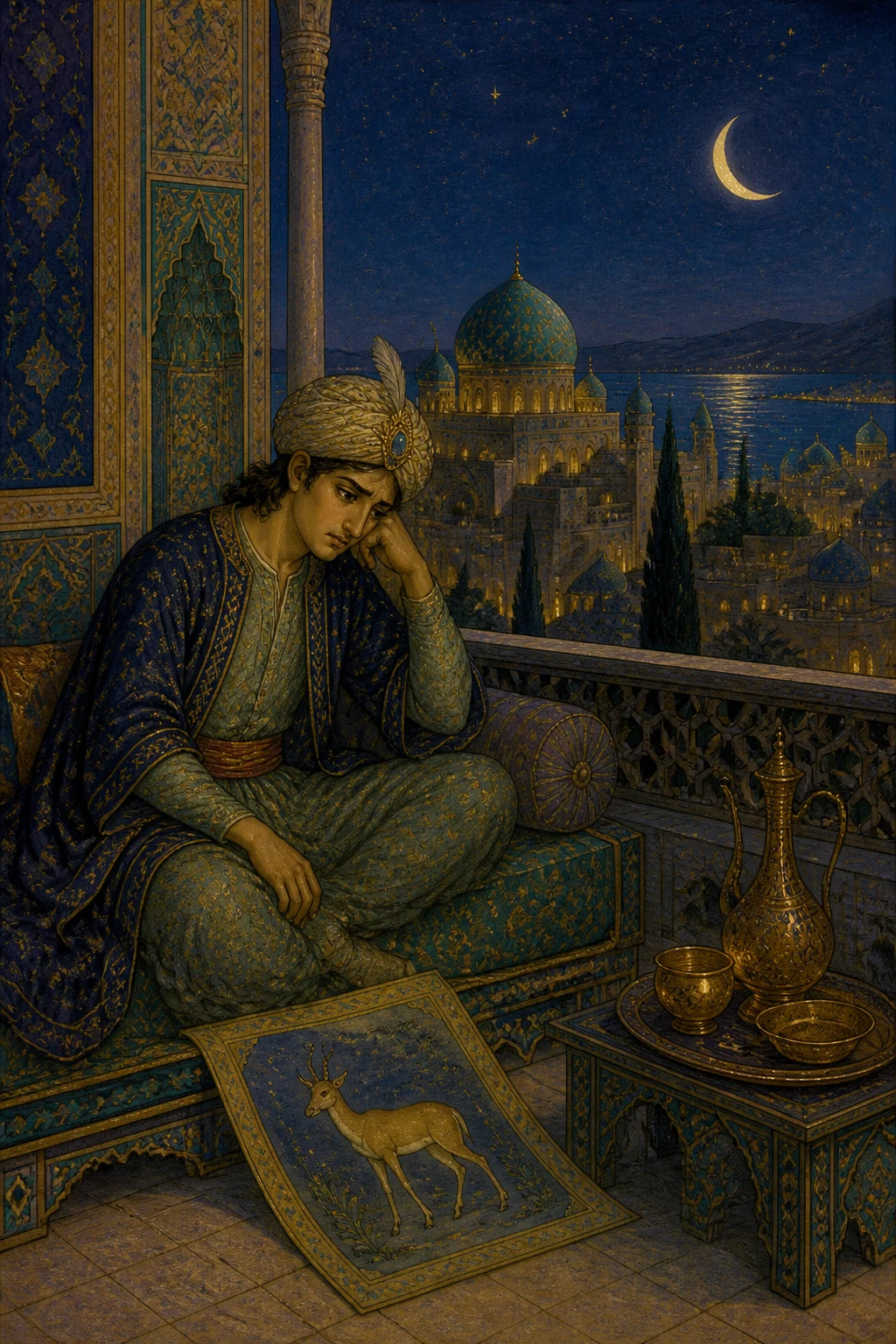
She said: It has reached me, O fortunate king, that while Prince Ardashir lay hidden in the garden, the king’s daughter came down with the old woman, and they walked among the trees. The prince saw her and swooned from the violence of his love. When he recovered, he found that she had vanished from his sight among the trees. He sighed from the depths of his heart and recited these verses:
When my eyes beheld her wondrous beauty, my heart was torn with longing and desire. I lay cast down and stricken in the dust, while the king’s daughter knew nothing of my plight. She swayed, and set a captive lover’s heart aflame: by Allah, be gentle, pity one whose passion is true! O Lord, bring near our union; grant me the darling of my heart, for I dread the darkness of the grave. Ten kisses, ten, and ten again I would lay upon her cheek, the tribute of a wasted, grieving lover. The old woman went on showing the king’s daughter around the garden until she reached the place where the prince was hidden. Then she said, “O You whose kindness works unseen, keep us safe from what we fear!” When the king’s son heard the signal, he came out of his hiding place, bewildered and beside himself. He walked among the trees with a figure that put their branches to shame; sweat crowned his brow, and his cheeks glowed like the twilight. Glory be to Almighty Allah for what He has created! The king’s daughter happened to turn and saw him. At the sight of him she stood gazing for a long while, beholding his beauty and loveliness, his stature and perfect proportions, his eyes that rivaled those of gazelles, and his figure that shamed the branches of the moringa tree. He bewildered her mind, stole her reason, and pierced her heart with the arrows of his eyes. She said to the old woman, “Nurse, where has this handsome, well-formed youth come from?” “Where is he, my lady?” she asked. “There he is, close by among the trees.” The old woman began looking right and left as though she knew nothing of him, and said, “Who showed this young man the way into the garden?” Hayat al-Nufus said to her, “Who can tell us about this young man? Glory be to Him who created men! But, nurse, do you know him?” She replied, “My lady, this is the young man who used to send you messages through me.” The king’s daughter, drowning in the sea of love and burning with longing and desire, said, “Nurse, how handsome this young man is! What a lovely face he has! I do not believe there is anyone more beautiful on the face of the earth.”
When the old woman saw that love for him had taken possession of her, she said, “Did I not tell you, my lady, that he was a handsome youth with a lovely face?” The king’s daughter replied, “Nurse, kings’ daughters know nothing of the ways of the world or the qualities of those who live in it. They have never mixed with people or had dealings with them. Nurse, how can I reach him? How can I bring myself to face him? What shall I say to him, and what will he say to me?” The old woman said, “What stratagem is left to me now? You have bewildered us in this matter.” The king’s daughter said, “Nurse, know that no one ever died of love as I shall. I am certain that I shall die this very moment, all from the fire of my longing.” When the old woman heard her words and saw the passion of her love for him, she said, “My lady, there is no way to bring him to you. You may be excused for not going to him, since you are so young. But come with me, and I shall walk ahead of you until you reach him. I shall speak to him, so you need not be embarrassed, and in the twinkling of an eye you will be at ease together.” The princess said, “Go before me, for Allah’s decree cannot be turned aside.” Then the nurse rose with the king’s daughter, and they approached the king’s son, who sat like the moon at its fullest. When they reached him, the old woman said, “Look, young man, who has come before you! This is Hayat al-Nufus, daughter of the king of this age. Know her worth, and honor her for walking to you and coming into your presence. Rise to show her respect, and stand before her.” The youth rose to his feet at once. His eyes met hers, and each became as one drunk without wine. His longing and passion grew still stronger. The king’s daughter opened her arms, and so did the youth, and they embraced in the utmost yearning. Love and passion overwhelmed them both, and they swooned and fell to the ground, remaining there for a long while. Fearing a scandal, the old woman brought them into the palace, sat at its door, and told the maidservants, “Make the most of your stroll, for the princess is asleep.” The maidservants went back to their diversions. Then the two recovered from their swoon and found themselves inside the palace. The youth said, “By Allah, lady of all beauties, is this a dream, or a tangle of dreams?” Again they embraced, drunk without wine, and told one another of the anguish of their love. Then the youth recited these verses:
The sun rises from her radiant face, and from her cheeks comes the crimson of twilight. Wherever her face appears to those who gaze, the star upon the horizon hides in shame. If lightning flashes from her smiling lips, morning breaks and scatters the gloom of dusk. If she bends her supple form, the leafy moringa branches envy her. In seeing her I have what makes all else needless; I commend her to the Lord of mankind and of daybreak. She lent the full moon a portion of her beauty; the sun sought to resemble her, but could not. Where has the sun such swaying limbs? Where has the moon such beauty of form and character? Who can blame me, when all of me is given to her love, alike in discord and accord? With a single glance she took possession of my heart: what has she left for the hearts of other lovers? And dawn overtook Shahrazad, and she fell silent, leaving her tale untold.
When it was the seven hundred and thirty-second night,
She said: It has reached me, O fortunate king, that when the king’s son finished his poem, the king’s daughter clasped him to her breast and kissed his mouth and the space between his eyes. His spirit returned to him, and he began to tell her what he had endured from the violence of love, the tyranny of passion, the intensity of his longing and distraction, and all he had suffered from her hardness of heart. When she heard his words, she kissed his hands and feet and uncovered her head, so that night’s darkness spread and full moons shone within it. She said, “My beloved, the utmost of my desire, may the day of estrangement be blotted out, and may Allah never let it return between us!” Then they embraced and wept together, and the king’s daughter recited these verses:
O you who shame the full moon and the sun of day, you have decreed a bewildered lover’s death with the sword of a glance that cleaves the heart—and where is escape from the sword of the eyes? Your eyebrows are a bow that has shot into my heart an arrow of yearning and fire. In the fruits of your cheeks I have a paradise: can my heart endure to forgo its harvest? Your swaying form is a flourishing branch, and from the burden of that branch fruit is gathered. You have drawn me helplessly to you and robbed me of sleep; for love of you I have cast restraint aside. May Allah sustain you with radiant light, shorten the distance, and bring our meeting near. Have mercy on a heart scorched by love of you, a weary heart that seeks refuge in your nobility. When she finished her verses, passion overflowed within her. She was lost in love and wept copious, streaming tears, setting the youth’s heart ablaze. He sang of his love for her, beside himself, then approached, kissed her hands, and wept bitterly. They continued exchanging tender reproaches, intimate talk, and poetry until the call to afternoon prayer sounded, and nothing more than this passed between them. Then they made ready to part. The king’s daughter said, “Light of my eyes, life of my heart, this is the hour of parting. When shall we meet again?” Her words struck the youth like arrows, and he said, “By Allah, I cannot bear the mention of parting.” Then she left the palace. He turned toward her and saw her moaning with a sorrow that would melt stone, her tears falling like rain. Love plunged him into a sea of destruction, and he recited these verses:
O desire of my heart, my distress grows through the excess of my love for you: what can I do? Your face, whenever it appears, is like the dawn; your hair in color rivals the nights. Your figure is a branch that bends when the north winds stir it. Your glances resemble those of gazelles when noble men behold them. Your waist is wasted beneath the weight of your hips: these are heavy, while that is frail. The wine of your mouth is the sweetest drink, fragrant musk and cool, pure water. O gazelle of the encampment, put sorrow aside, and grant me at least the vision of your passing shade. When the king’s daughter heard him describe her thus, she returned and embraced him, her heart burning with a fire kindled by parting that nothing but kisses and embraces could quench. She said, “As the proverb has it, ‘Better to bear with the beloved than to lose him.’ I must devise a way for us to meet.” Then she bade him farewell and went away, scarcely knowing where she set her feet, so great was her love. She continued until she reached her chamber and threw herself down. As for the youth, his yearning and distraction increased, and he was denied the sweetness of sleep. The princess tasted no food; her patience was exhausted and her endurance failed. When morning came, she sent for the nurse. On entering, the old woman found her condition altered. The princess said, “Do not ask what I am suffering, for everything I suffer is your doing.” Then she asked, “Where is the beloved of my heart?” The old woman replied, “My lady, when did he leave you? Has he been away from you longer than this one night?” She said, “Can I bear to be without him for a single hour? Go, devise some scheme and bring us together quickly, for my soul is about to leave my body.” The nurse said, “Be patient, my lady, until I arrange some subtle plan for you both that no one will discover.” She replied, “By Almighty Allah, if you do not bring him today, I shall tell the king that you have corrupted me, and he will strike off your head.” The old woman said, “I implore you by Allah to be patient with me, for this is a dangerous business.” She continued entreating her until she persuaded her to wait three days. After that, the princess said, “Nurse, these three days have been three years to me. If the fourth day passes without your bringing him here, I shall see to your death.” The nurse left her and went home.
On the morning of the fourth day, she sent for the women who dressed and adorned the brides of the city, and asked them for a beautiful pattern with which to decorate, paint, and ornament a maiden bride. They brought her the finest designs they had. Then she summoned the youth, and he came. She opened her chest and took out a bundle containing a suit of women’s clothes worth five thousand dinars, with a headdress embroidered with all kinds of jewels. “My son,” she said, “do you wish to be with Hayat al-Nufus?” “Yes,” he replied. She took out a depilatory implement and removed his unwanted hair, then darkened his eyes with kohl. She undressed him and applied the designs to his hands and arms, from his nails to his shoulders, and from the tops of his feet to his thighs, tracing patterns over the rest of his body until he seemed like red roses upon slabs of marble. After a little while she washed and cleansed him, and brought him a shirt and drawers. Then she dressed him in that imperial Persian finery, bound on his headdress, veiled him, and taught him how to walk. “Put your left foot forward and hold your right foot back,” she said. He did as she instructed and walked before her, looking like a houri newly come from Paradise. Then she said, “Be brave, for you are entering a king’s palace. There are bound to be soldiers and servants at the gate. If you take fright or show alarm, they will scrutinize you and recognize you. Then harm will come to us, and we shall lose our lives. If you cannot do this, tell me.” He replied, “This business does not frighten me. Set your mind at ease and be reassured.” She went out and walked ahead of him until they reached the palace gate, which was thronged with servants. The old woman turned to see whether he was alarmed, and found him unchanged and composed. When she approached, the chief eunuch saw and recognized her, and noticed behind her a maiden whose beauty baffled description. He said to himself, “The old woman is the nurse, but as for the one behind her, there is no one in our land whose looks resemble hers or whose beauty and grace come near hers, unless it is Princess Hayat al-Nufus. But she is secluded and never goes out. How can she have come into the street? I wonder whether she went out with the king’s permission or without it.” He rose to his feet to investigate, and some thirty eunuchs followed him. When the old woman saw them, her wits flew from her, and she said, “We belong to Allah, and to Him we return! Without a doubt, our lives are lost this very hour.” And dawn overtook Shahrazad, and she fell silent, leaving her tale untold.
When it was the seven hundred and thirty-third night,
She said: It has reached me, O fortunate king, that when the old woman saw the chief eunuch approaching with his attendants, she was seized with the greatest fear and said, “There is no power and no strength save in Allah! We belong to Allah, and to Him we return! Without a doubt, our lives are lost this very hour.” When the chief eunuch heard these words from the old woman, misgivings seized him, for he knew the power of the king’s daughter and how completely her father was under her sway. He said to himself, “Perhaps the king ordered the nurse to take his daughter out on some business, and she does not want anyone to know of it. If I approach her, she will be deeply offended and say, ‘This eunuch confronted me to pry into my affairs.’ Then she will seek my death. I have no need to concern myself with this.” He turned back, and the thirty eunuchs returned with him to the palace gate, driving the people away from it. The nurse entered and greeted them with a nod of her head. The thirty eunuchs rose respectfully and returned her greeting. Then she went in, with the king’s son following her. They passed through gate after gate and crossed all the vestibules, sheltered by Him who veils all things, until they reached the seventh gate. This was the gate of the great palace where the king’s throne stood, and from it one could reach the apartments of the concubines, the halls of the harem, and the palace of the king’s daughter. There the old woman stopped and said, “My son, here we are at last. Glory be to Him who has brought us to this place! But, my son, we cannot meet her until night, for night shelters those who are afraid.” He said, “You are right. What shall we do?” She replied, “Hide in this dark place.” He crouched in the pit, and the old woman went elsewhere, leaving him there until the day had passed. Then she returned, brought him out, and entered the palace with him. They went on until they reached the chamber of Hayat al-Nufus. The nurse knocked, and a little maid came out and asked, “Who is at the door?” “It is I,” replied the nurse. The maid returned and asked her mistress’s permission to admit the nurse. She said, “Open the door and let her in, with whoever is with her.” So they entered.
As they approached, the nurse looked at Hayat al-Nufus and saw that she had prepared the room, arranged the lamps, spread carpets over the couches and raised seats, set out cushions, and lit candles in gold and silver candlesticks. She had laid out food, fruit, and sweetmeats, and perfumed the air with musk, aloeswood, and ambergris. She sat among the lamps and candles, the radiance of her face outshining them all. When she saw the nurse, she said, “Nurse, where is the beloved of my heart?” She replied, “My lady, I could not find him and have not set eyes on him, but I have brought his own sister here before you.” “Are you mad?” she asked. “I have no use for his sister. If a person’s head aches, does he bandage his hand?” “No, by Allah, my lady,” said the nurse. “But look at her, and if she pleases you, keep her with you.” She uncovered his face. When the princess recognized him, she sprang to her feet and clasped him to her breast, and he clasped her to his. Then they fell senseless to the ground and remained so for a long while. The nurse sprinkled rosewater over them, and they revived. The princess kissed him on the mouth more than a thousand times and recited these verses:
The beloved of my heart visited me in the darkness; I rose in reverence and stood until he sat. I said, “O my desire, O all my hopes, you have come to me by night—did you not fear the watch?” He said, “I feared them, but love is taking my soul and breath away.” We embraced and held each other for a while: “Here, grant me your favor, and fear no guard.” Then we rose with nothing shameful between us, shaking out our garments, free of stain. And dawn overtook Shahrazad, and she fell silent, leaving her tale untold.
When it was the seven hundred and thirty-fourth night,
She said: It has reached me, O fortunate king, that when Hayat al-Nufus’s beloved came to her in the palace, they embraced, and she recited verses suited to the occasion. When she had finished, she said, “Can it be true that I see you in my own home, my companion and my comfort?” Her love grew stronger and longing set her aflame, until she almost lost her reason for joy in him. Then she recited these verses:
My life be the ransom of him who visited in the deep of night, while I watched and waited for his promised coming. Nothing startled me but the gentle sound of his weeping, and I said, “Welcome, welcome, a thousand welcomes!” I kissed his cheek a thousand times and embraced him a thousand times, though he had come veiled. I said, “I have attained what I have long desired; to Allah are due all praise and thanks.” We passed the fairest of nights as we wished, until morning swept the darkness from our night. When morning came, she hid him in a place within her apartments where no one could discover him. At nightfall she brought him out, and they sat enjoying each other’s company. He said to her, “I wish to return to my own country and tell my father about you, so that he may send his vizier to your father to ask for your hand.” She replied, “My beloved, I fear that if you return to your country and your royal station, you will be distracted from me and forget your love; or perhaps your father will not agree to this proposal, and then I shall die, and that will be the end. The wiser course is for you to remain here with me, in my keeping, where you can look upon my face and I upon yours, until I devise a plan for us to leave together one night and journey to your country. For I have abandoned all hope of my own family.” He said, “I hear and obey.” They continued as before, drinking wine together. One night they enjoyed their wine so much that they neither rested nor slept until dawn appeared. Now a certain king had sent her father a gift, which included a necklace of incomparable gems, twenty-nine in all, whose price could not have been met by a king’s entire treasury. The king said, “This necklace is fit for none but my daughter Hayat al-Nufus.” He turned to a eunuch whose back teeth she had had pulled out on a certain occasion, called him, and said, “Take this necklace to Hayat al-Nufus and tell her, ‘One of the kings has sent this as a gift to your father. No fortune could equal its worth, so place it around your neck.’” The servant took it, saying, “May Almighty Allah make this the last thing she ever wears in this world! She has deprived me of the use of my teeth.”
He went on until he reached the door of her chamber and found it locked, with the old woman asleep at the threshold. He woke her, and she started up in terror. “What do you want?” she asked. “The king has sent me on an errand to his daughter,” he replied. She said, “The key is not here. Go away until I bring it.” He answered, “I cannot go back to the king.” The old woman went off to fetch the key, but fear overcame her, and she sought her own safety. When she was slow to return, the eunuch grew afraid of keeping the king waiting. He shook and rattled the door until its fastening broke and it opened. He entered and went on until he reached the seventh door. When he came into the chamber, he found it magnificently furnished, with candles and wine bottles set out. Wondering at this, he walked on until he reached the bed, which was screened by a silk curtain hung with a net of jewels. He drew the curtain aside and found the king’s daughter asleep, holding in her arms a young man more beautiful than herself. He glorified Almighty Allah, who had created him from a humble drop of fluid, then said, “What fine conduct from one who hates men! How did she come to this? I suspect she had my teeth pulled out for his sake.” He let the curtain fall back into place and turned toward the door. She awoke in terror, saw the eunuch Kafur, and called to him, but he did not answer. She got down, caught up with him, took the hem of his robe and laid it on her head, kissed his feet, and said, “Conceal what Allah has concealed.” He replied, “May Allah conceal neither your disgrace nor that of anyone who conceals it! You had my teeth pulled out, and used to tell me, ‘Let no one say anything to me about the qualities of men!’” He broke free of her and ran out, locking the door upon them and posting a servant to guard it. Then he went to the king, who asked, “Did you give the necklace to Hayat al-Nufus?” The eunuch replied, “By Allah, you deserve worse than all this!” The king said, “What has happened? Tell me, and be quick!” He answered, “I will tell you only in private.” “Speak without privacy,” said the king. The eunuch said, “Grant me safe conduct.” The king threw him the handkerchief of safe conduct, and the eunuch said, “O king, I entered Princess Hayat al-Nufus’s apartments and found her in a furnished chamber, asleep with a young man in her arms. I locked the door upon them and came before you.” When the king heard his words, he sprang to his feet, took a sword in his hand, and shouted for the chief eunuch. “Take your attendants,” he said, “go to Hayat al-Nufus, and bring her and whoever is with her here, lying upon their bed, covered with their bedclothes.” And dawn overtook Shahrazad, and she fell silent, leaving her tale untold.
When it was the seven hundred and thirty-fifth night,
She said: It has reached me, O fortunate king, that when the king ordered the eunuch to take his attendants, go to Hayat al-Nufus, and bring her and whoever was with her before him, the eunuch went out with his men. They entered and found Hayat al-Nufus standing, wasted by weeping and lamentation, and the king’s son in the same condition. The chief eunuch said to the youth, “Lie down on the bed as you were, and let the king’s daughter do the same.” Fearing for him, the king’s daughter said, “This is no time to disobey.” So they both lay down, and the men carried them before the king. When he drew the covering away, his daughter rose to her feet. The king looked at her and was about to strike off her head, but the youth forestalled him, flinging himself against the king’s breast and saying, “O king, she is innocent. The fault is mine alone. Kill me before her.” The king turned to kill him, but Hayat al-Nufus threw herself upon her father and said, “Kill me, not him! He is the son of the greatest of kings, lord of all the earth in its length and breadth.”
When the king heard his daughter’s words, he turned to his vizier, who was an evil counselor, and said, “What do you say to this, Vizier?” The vizier replied, “I say that anyone caught in such a situation will resort to lies. There is nothing for it but to cut off both their heads, after subjecting them to every kind of torture.” Then the king summoned the executioner of his vengeance, who came with his assistants. The king said, “Take this vile wretch and strike off his head, then this shameless woman’s. Burn them both, and do not consult me about them again.” The executioner laid a hand on her back to lead her away, but the king shouted at him and hurled something he held at him, almost killing him. “Dog!” he said. “How dare you be gentle when I am angry? Seize her by the hair and drag her until she falls upon her face!” The executioner did as the king commanded, dragging her on her face, and the youth likewise, until he brought them to the place of blood. He tore a strip from the hem of the youth’s robe and bound his eyes, then drew his keen-edged sword. He left the king’s daughter until last, hoping someone might intercede for her, and turned his attention to the youth. Three times he flourished the sword, while all the soldiers wept and prayed to Allah that someone might intercede for them both. The executioner raised his hand, when suddenly a cloud of dust arose and filled the horizons. The cause was that the young man’s father, having waited so long without news of his son, had mustered a mighty army and set out in person to search for him.
Such was his case. As for King Abd al-Qadir, when that cloud of dust appeared, he said, “My people, what is the news? What is this dust that blinds our eyes?” The chief vizier rose and went out from his presence toward the cloud to discover its cause. He found a multitude like locusts, beyond all counting, with reinforcements that seemed without end, filling the mountains, valleys, and hills. The vizier returned to the king and told him what he had seen. “Go down,” said the king, “and learn what you can of this army and why it has come to our land. Ask for its commander, convey my greetings to him, and inquire what has brought him here. If he has some need to fulfill, we shall help him; if he seeks vengeance upon another king, we shall ride beside him; and if he desires a gift, we shall give him one. For this is a mighty host and a formidable army, and we fear its assault upon our land.” So the vizier went down and walked among the tents, soldiers, and attendants. From early morning until nearly sunset he continued on his way, until he reached the men with gilded swords and star-spangled tents. Beyond them he came to the emirs, viziers, chamberlains, and deputies, and still he walked on until he reached the sultan, whom he found to be a mighty monarch indeed. When the officers of state saw him, they cried, “Kiss the ground!” He kissed the ground and rose, but they cried out a second and a third time, until at last he raised his head and ventured to draw himself up to his full height, overwhelmed with awe. Standing before the king, he said, “May God prolong your days, exalt your dominion, and raise your rank, O fortunate king! King Abd al-Qadir sends you greetings and kisses the ground before you. He asks what great business has brought you here. If you seek vengeance upon another king, he will ride in your service; and if you have some purpose he can fulfill, he will serve you in that matter.” The king replied, “Messenger, go to your master and tell him that the Supreme King has a son who has long been absent from him. News of him has been slow in coming, and all trace of him has been lost. If he is in this city, his father will take him and depart from you. But if some misfortune has befallen him, or he has come to harm among you, his father will lay waste your dwellings, plunder your wealth, kill your men, and carry your women away captive. Return swiftly to your master and tell him this before calamity descends upon him.” “I hear and obey,” said the vizier. He was about to withdraw when the chamberlains shouted, “Kiss the ground! Kiss the ground!” He kissed it twenty times, and when at last he rose, he was more dead than alive. Then he left the king’s presence and made his way back, pondering this monarch and the multitude of his armies, until he reached King Abd al-Qadir, pale with terror and trembling in every limb. He told him all that had happened. But morning overtook Shahrazad, and she ceased her permitted tale.
When it was the seven hundred and thirty-sixth night,
She said: It has reached me, O fortunate king, that when the vizier returned from the Supreme King and told King Abd al-Qadir what had happened, his face pale and his limbs trembling with terror, King Abd al-Qadir, seized with dread for himself and his people, asked him, “Vizier, who can this king’s son be?” He replied, “His son is the very youth whose death you ordered. Praise be to God, who did not hasten his execution, for his father would have laid waste our dwellings and plundered our wealth!” The king said, “See what a wicked counsel yours was, when you advised us to put him to death! Where is the youth, the son of this mighty king?” “O mighty king,” he replied, “you ordered him to be killed.” At these words the king lost his wits and cried from the depths of his heart, “Woe to you! Stop the executioner before he puts him to death!” They brought the executioner at once, and when he appeared he said, “O King of the Age, I have struck off his head as you commanded.” “You dog!” cried the king. “If that is true, I shall surely send you after him!” The man replied, “O king, you ordered me to kill him without consulting you a second time.” “I was in a rage,” said the king. “Speak the truth before you lose your life!” “O king,” he answered, “he is still alive.” The king rejoiced, his heart was set at ease, and he ordered the youth to be brought before him. When he appeared, the king rose to his feet, kissed him on the mouth, and said, “My son, I ask Almighty God to forgive the wrong I have done you. Say nothing that might lower me in the esteem of your father, the Supreme King.” The youth asked, “O King of the Age, where is the Supreme King?” “He has come on your account,” he replied. The youth said, “By the honor I owe you, I shall not leave your presence until I have cleared my honor and your daughter’s of the charge brought against us. She is an untouched virgin. Summon the midwives to examine her here before you. If you find that she has lost her virginity, I give you leave to shed my blood; but if she is a virgin, proclaim the innocence of us both.” So the king summoned the midwives, and when they examined her they found her a virgin. They told the king and asked him for a reward. He rewarded them lavishly, bestowing even the robes he wore, and likewise gave gifts to everyone in the women’s quarters. Bowls of perfume were brought out, and the officers of state were perfumed, and all rejoiced exceedingly.
Then the king embraced the youth and treated him with great honor and reverence. He ordered him to be taken to the bath with his own trusted servants. When he came out, the king clothed him in a splendid robe of honor, crowned him with a jeweled crown, and girded him with a silken sash embroidered in red gold and studded with pearls and precious stones. He mounted him on one of the finest horses, with a golden saddle set with pearls and gems, and ordered the dignitaries and chiefs of his kingdom to ride in attendance upon him until he reached his father. Then he charged the youth to say to the Supreme King, “King Abd al-Qadir is at your command, hearing and obeying all that you bid or forbid.” “I shall certainly do so,” said the youth. He took his leave and set out toward his father. When his father saw him, he was beside himself with joy. He rose to his feet, walked several paces to meet him, and embraced him. Joy and gladness spread throughout the Supreme King’s army. All the viziers and chamberlains, soldiers and commanders came and kissed the ground before the prince, rejoicing at his arrival, and it was a great day of celebration for them. The king’s son gave those who had accompanied him, and all others from King Abd al-Qadir’s city, leave to look about the Supreme King’s army, with no one to hinder them, so that they might see the multitude of his troops and the might of his dominion. Everyone who had entered the cloth merchants’ market and seen the youth sitting there before now marveled that he could have consented to such a life, noble as he was and so exalted in station. Yet it was his love and longing for the king’s daughter that had driven him to it. News of his vast army spread until it reached Hayat al-Nufus. She looked out from the top of the palace toward the mountains and saw them filled with troops and armies. She was imprisoned in her father’s palace, awaiting his command concerning her: whether he would relent and set her free, or have her killed and burned.
When Hayat al-Nufus saw these armies and learned that they belonged to his father, she feared that the king’s son would forget her, be taken up with his father, and depart without her, leaving her father to put her to death. So she sent to him the slave girl who attended her in her private chamber, saying, “Go to Ardashir, the king’s son, and do not be afraid. When you reach him, kiss the ground before him, tell him who you are, and say, ‘My mistress sends you greetings. She is now imprisoned in her father’s palace, awaiting his command, whether he intends to pardon her or put her to death. She begs you not to forget or forsake her, for today you have power, and whatever you command, no one can oppose you. If you see fit to deliver her from her father and take her to yourself, it will be an act of kindness on your part, for she has endured these afflictions for your sake. But if you do not see fit to do so, now that you have had your desire of her, speak to your father, the Supreme King, so that he may intercede for her with her father. Let him not depart until he has secured her release and obtained her father’s solemn pledge that he will neither harm her nor seek her death. This is the last of my words. May God never make me desolate through losing you. Peace be with you.’” But morning overtook Shahrazad, and she ceased her permitted tale.
When it was the seven hundred and thirty-seventh night,
She said: It has reached me, O fortunate king, that when Hayat al-Nufus sent the slave girl to Ardashir, son of the Supreme King, she reached him and delivered her mistress’s message. When he heard these words, he wept bitterly and said to her, “Know that Hayat al-Nufus is my mistress, and I am the slave and captive of her love. I have forgotten neither what passed between us nor the bitterness of the day we parted. Kiss her feet and tell her, ‘I shall speak to my father about you, and he will send his vizier, who first asked your father for your hand, to ask for it again. Your father will not be able to refuse. If he sends to consult you about the matter, do not withhold your consent, for I shall not return to my own country without you.’” The slave girl returned to her mistress, kissed her hands, and delivered his message. When she heard it, she wept for joy and praised God Most High.
Such was her case. As for the youth, he went to his father in private that night, and his father asked him about his circumstances and all that had befallen him. He told him everything from beginning to end, and his father said, “What would you have me do for you, my son? If you wish to destroy him, I shall lay waste his dwellings, plunder his wealth, and violate his women’s quarters.” “I do not wish that, Father,” he replied, “for he has done nothing to me that calls for such a punishment. I wish only to be united with her, and I ask you, out of your kindness, to prepare a gift and present it to her father. Let it be a precious gift, and send it with your wise and discerning vizier.” His father said, “I hear and obey.” Then he went to the treasures he had stored up over many years and brought out every kind of precious object. He showed them to his son, who was pleased with them. Then he summoned the vizier, entrusted the gifts to him, and ordered him to take them to King Abd al-Qadir, ask for his daughter’s hand for his son, and say to him, “Accept this gift,” then bring back his answer. The vizier set out for King Abd al-Qadir. Ever since the youth’s departure, the king had been sorrowful and troubled in mind, expecting his kingdom to be laid waste and his estates seized. Suddenly the vizier appeared, greeted him, and kissed the ground before him. The king rose to his feet and received him with honor, but the vizier hastened forward, fell at his feet, and kissed them, saying, “Forgive me, O King of the Age! One such as you should not rise for one such as I, the least of your servants’ slaves. Know, O king, that the prince has spoken with his father and told him something of your kindness and generosity toward him. The king thanks you for it and has sent you a gift by the hand of this servant who stands before you. He sends you his greetings, together with particular assurances of his regard and honor.” Such was the king’s fear that he could not believe these words until the gift was brought before him. When it was displayed, he saw that it was beyond all price, such as no king on earth could equal, and he felt humbled in his own eyes. He rose to his feet, praised and glorified God Most High, and gave thanks to the youth.
Then the vizier said to him, “O generous king, listen to my words. Know that the Supreme King has come to you, desiring kinship with you. I have come to ask for your daughter, the guarded lady and hidden jewel, Hayat al-Nufus, in marriage to his son Ardashir. If you consent to this matter and are pleased with it, agree with me upon her bridal dower.” When the king heard these words, he said, “I hear and obey. For my own part, I have no objection; indeed, nothing could be dearer to me. As for the girl, she is of age and sound judgment, and the decision rests with her. Know that this matter is hers to decide, for she is free to choose.” Then he turned to the chief eunuch and said, “Go to my daughter and tell her of these matters.” “I hear and obey,” replied the chief eunuch. He went up to the women’s palace, entered the princess’s presence, kissed her hands, and told her what the king had said. Then he asked, “What answer do you give to this?” She replied, “I hear and obey.” But morning overtook Shahrazad, and she ceased her permitted tale.
When it was the seven hundred and thirty-eighth night,
She said: It has reached me, O fortunate king, that when the chief eunuch of the women’s quarters told the princess that her hand had been sought for the son of the Supreme King, she said, “I hear and obey.” On hearing this, the chief eunuch returned to the king and gave him her answer. The king rejoiced exceedingly. He called for a splendid robe of honor and bestowed it upon the vizier, ordered that he be given ten thousand dinars, and said to him, “Carry this answer to the king, and ask his permission for me to come down to him.” “I hear and obey,” said the vizier. He left King Abd al-Qadir and made his way to the Supreme King, to whom he delivered the answer and the message entrusted to him. The king rejoiced, while his son was beside himself with happiness, his heart relieved and filled with delight. The Supreme King then granted King Abd al-Qadir permission to come down and meet him. The following day, King Abd al-Qadir mounted and went to the Supreme King, who received him, accorded him an exalted place, and greeted him with honor. They sat together, with the prince standing before them. Then an orator from among King Abd al-Qadir’s intimates rose and delivered an eloquent address, congratulating the prince on attaining his desire through marriage to the royal lady, foremost among the daughters of kings. When the orator had sat down, the Supreme King ordered a chest filled with pearls and precious stones to be brought, together with fifty thousand dinars. He said to King Abd al-Qadir, “I act on my son’s behalf in all that has been agreed.” King Abd al-Qadir acknowledged receipt of the bridal dower, which included fifty thousand dinars for the wedding festivities of his daughter Hayat al-Nufus, foremost among the daughters of kings. Then they summoned the judges and witnesses and drew up the marriage contract between King Abd al-Qadir’s daughter and Ardashir, son of the Supreme King. It was a memorable day, bringing joy to all who loved them and vexation to all who hated or envied them. They held banquets and feasts, after which the prince went in to his bride and found her a pearl unpierced, a filly no other man had ridden, a matchless treasure guarded and a jewel concealed. Her father, too, learned that this was so.
Then the Supreme King asked his son whether there was anything else he desired before their departure. “Yes, O king,” he replied. “Know that I wish to take vengeance upon the vizier who wronged us and the eunuch who spread lies about us.” The Supreme King immediately sent to King Abd al-Qadir, asking him to deliver up the vizier and the eunuch, and he sent them to him. When they were brought before him, he ordered them to be hanged at the city gate. They remained a little while longer, then asked King Abd al-Qadir to allow his daughter to prepare for the journey. Her father made her ready, and they seated the princess in a litter of red gold, studded with pearls and precious stones and drawn by noble horses. She took all her slave girls and servants with her. The nurse returned to her post after her flight and resumed her former duties. The Supreme King and his son mounted, and King Abd al-Qadir rode out with all the people of his kingdom to bid farewell to his daughter and his son-in-law. It was a day to be counted among the happiest of days. When they were far from the city, the Supreme King adjured his fellow king to return to his own country. So King Abd al-Qadir took leave of him and turned homeward, after embracing him, kissing him between the eyes, thanking him for his grace and kindness, and commending his daughter to his care. After bidding farewell to the Supreme King and his son, he went back to his daughter and embraced her. She kissed his hands, and they wept as they parted. Then he returned to his kingdom, while the Supreme King’s son journeyed on with his wife and father until they reached their own land, where they renewed their celebrations. Thereafter they lived in the sweetest and happiest, the most abundant and delightful of lives, until there came to them the Destroyer of Delights and Sunderer of Gatherings, who lays palaces waste and fills the graves. And this is the end of the tale.
Izvirnik
حكاية أردشير وحياة النفوس - الليالي ٧١٩ إلى ٧٣٨
Naslednje strani prikazujejo izvirno besedilo za primerjavo.
فلما كانت الليلة ٧١٩
ومما يُحكَى أيضًا أيها الملك السعيد، أنه كان بمدينة شيراز ملك عظيم يُسمَّى السيف الأعظم شاه، وكان قد كبر سنه ولم يُرزَق ولدًا، فجمع الحكماء والأطباء وقال لهم: إني قد كبر سني وقد علمتم حالي وحال المملكة ونظامها، وإني خائف على الرعية من بعدي، وإلى الآن لم أُرزَق ولدًا. فقالوا: نحن نصنع لك شيئًا من العقاقير يكون فيه النفع إن شاء الله تعالى. فصنعوا له شيئًا واستعمله، ثم واقَعَ زوجته فحملت بإذن الله تعالى الذي يقول للشيء كن فيكون، فلما استكملتْ شهورَها وضعتْ ولدًا ذكرًا مثل القمر فسمَّاه أردشير، فكبر وانتشى وتعلَّم العلم والأدب إلى أن صار له من العمر خمس عشرة سنة. وكان بالعراق ملك يُسمَّى الملك عبد القادر، وكان له بنت كالبدر الطالع، وكانت تُسمَّى حياة النفوس، وكانت تبغض الرجال، فلا يكاد أحد أن يذكر الرجال بحضرتها، وقد خطبها من أبيها الملوكُ الأكاسرة، فيكلمها أبوها فتقول: لا أفعل هذا أبدًا، وإنْ غصبتَني عليه قتلتُ نفسي. فسمع ابن الملك أردشير بذِكْرها فأعلم والده بذلك، فنظر إلى حاله ورقَّ له وصار كل يوم يوعده بزواجها، ثم أرسل وزيره إلى أبيها ليخطبها فأبى، فلما رجع الوزير من عند الملك عبد القادر أخبره بما اتفق له معه، وأعلمه بعدم قضاء حاجته، فصعب ذلك على الملك واغتاظ غيظًا شديدًا وقال: هل مثلي يرسل إلى أحدٍ من الملوك في حاجةٍ فلا يقضيها؟ ثم أمر مناديًا أن ينادي في العسكر بتبريز الخيام وكثرة الاهتمام، ولو بالقرض في النفقة، وقال: ما بقيت أرجع حتى أخرب ديار الملك عبد القادر، وأقتل رجاله، وأمحو آثاره، وأنهب أمواله. فلما بلغ ولده أردشير هذا الخبر، قام عن فراشه ودخل على أبيه الملك وقبَّل الأرض بين يديه وقال له: أيها الملك الأعظم، لا تكلف نفسك بشيء من هذا. وأدرك شهرزاد الصباح فسكتَتْ عن الكلام المباح.
فلما كانت الليلة ٧٢٠
قالت: بلغني أيها الملك السعيد، أن ابن الملك لما بلغه هذا الخبر، دخل على أبيه الملك وقبَّلَ الأرض بين يديه وقال له: أيها الملك الأعظم، لا تكلف نفسك بشيء من هذا، وتجرد هذه الأبطال وهذا العسكر وتنفق مالك، فإنك أقوى منه، ومتى جرَّدْتَ عليه هذا العسكر الذي معك أخربت دياره وبلاده، وقتلت رجاله وأبطاله، ونهبت أمواله ويقتل هو أيضًا، فيبلغ ابنته ذلك مما حصل لأبيها وغيره من تحت رأسها، فتقتل نفسها وأنا أموت بسببها، ولا أعيش بعدها أبدًا. فقال له الملك: فما يكون رأيك يا ولدي؟ قال له: أنا أتوجَّه في حاجتي بنفسي، وألبس لبس التجار وأتحيَّل في الوصول إليها، وأنظر كيف يكون قضاء حاجتي منها. فقال له أبوه: هل اخترتَ هذا الرأي؟ فقال له: نعم يا والدي. فدعا الملك بالوزير وقال له: سافِرْ مع ولدي وثمرة فؤادي، وساعِدْه على مقاصده، واحتفظ عليه ودبِّرْه برأيك الرشيد، فإنك معه عوضًا عني. فقال الوزير: سمعًا وطاعة. ثم إن الملك أعطى ولده ثلاثمائة ألف دينار من الذهب، وأعطاه جواهر وفصوصًا ومصاغًا ومتاعًا وذخائر وما أشبه ذلك. ثم إن الولد دخل إلى والدته وقبَّلَ يديها وسألها الدعاء، فدعَتْ له، ثم قامت من ساعتها وفتحت خزانتها وأخرجت له ذخائر وقلائد ومصاغًا وملابس وتُحَفًا، وجميع الشيء الذي كان مدَّخَرًا من عهد الملوك السالفة ممَّا لا تعادله أموال. ثم أخذ معه من مماليكه وغلمانه ودوَّابه جميعَ ما يحتاج إليه في الطريق وغيره، وتزيَّا بزي التجار هو والوزير ومَن معهما، وودَّعَ والدته وأهله وقرائبه وساروا يقطعون البراري والقفار آناء الليل والنهار، فلما طالت عليه الطريق أنشد هذه الأبيات:
غَرَامِي مِنَ الْأَشْوَاقِ وَالسَّقْمِ زَائِدُ وَمَا لِي عَلَى جَوْرِ الزَّمَانِ مُسَاعِدُ
أُرَاعِي الثُّرَيَّا وَالسِّمَاكَ إِذَا بَدَا كَأَنِّيَ مِنْ فَرْطِ الصَّبَابَةِ عَابِدُ
أُرَاقِبُ نَجْمَ الصُّبْحِ حَتَّى إِذَا أَتَى أَهِيمُ بِأَشْوَاقِي وَوَجْدِي زَائِدُ
أُحِبُّكُمُ لَسْتُ أُحِبُّ سِوَاكُمُ سَقِيمٌ فُؤَادِي سَاهِرُ الْجَفْنِ وَاجِدُ
فَإِنْ عَزَّ مَا أَرْجُوهُ زَادَ بِيَ الضَّنَا وَقَلَّ اصْطِبَارِي بَعْدَكُمْ وَالْمُسَاعِدُ
صَبَرْتُ إِلَى أَنْ يَجْمَعَ اللهُ شَمْلَنَا وَتَكْمَدُ مِنْ ذَاكَ الْعِدَى وَالْحَوَاسِدُ
فلما فرغ من شعره غُشِي عليه ساعة، فرشَّ الوزير عليه ماء الورد، فلما أفاق قال له: يابن الملك صبِّرْ نفسك، فإن الصبر عاقبته الفرج، وها أنت سائر إلى ما تريد. ولم يزل الوزير يلاطفه ويسليه إلى أن سكن روعه وجدُّوا في السير، فلما طالت على ابن الملك الطريقُ تذكَّرَ محبوبته، فأنشد هذه الأبيات:
طَالَ الْبِعَادُ وَزَادَ الْهَمُّ وَالْقَلَقُ وَمُهْجَتِي فِي لَهِيبِ النَّارِ تَحْتَرِقُ
وَشَابَ رَأْسِيَ مِمَّا قَدْ بُلِيتُ بِهِ مِنَ الْغَرَامِ وَدَمْعُ الْعَيْنِ يَنْدَفِقُ
أَقْسَمْتُ يَا مُنْيَتِي يَا مُنْتَهَى أَمَلِي بِخَالِقِ الْخَلْقِ مِنْهَا الْغُصْنُ وَالْوَرَقُ
سَهْلًا حَمَلْتُ عَذَابًا مِنْكِ يَا قَدَرِي فَلَمْ يُطِقْ حَمْلَهُ فِي النَّاسِ مَنْ عَشِقُوا
فَاسْتَخْبِرُوا اللَّيْلَ عَنِّي فَهْوَ يُخْبِرُكُمْ إِنْ كَانَ جَفْنِيَ طُولَ اللَّيْلِ يَنْطَبِقُ
فلما فرغ من إنشاد شعره بكى بكاءً شديدًا مما يلاقيه من شدة الغرام، فلاطفه الوزير وسلاه ووعده ببلوغ مُنَاه، وساروا أيامًا قلائل حتى أشرفوا على المدينة البيضاء بعد طلوع الشمس، فقال الوزير لابن الملك: أبشِرْ يا ابن الملك بكل خير، وانظر هذه المدينة البيضاء التي أنت طالبها. ففرح ابن الملك بذلك فرحًا شديدًا، وأنشد هذه الأبيات:
خَلِيلَيَّ إِنِّي مُغْرَمُ الْقَلْبِ هَائِمُ وَوَجْدِي مُقِيمٌ وَالْغَرَامُ مُلَازِمُ
أَنُوحُ كَمَا الثَّكْلَانُ أَسْهَرَهُ الْأَسَى إِذَا جَنَّ لَيْلِي لَيْسَ فِي الْعِشْقِ رَاحِمُ
وَإِنْ هَبَّتِ الْأَرْيَاحُ مِنْ نَحْوِ أَرْضِكُمُ وَجَدْتُ لَهَا بَرْدًا عَلَى الْقَلْبِ قَادِمُ
وَتَنْهَلُّ أَجْفَانِي كَغَيْمٍ مَوَاطِرٍ فَفِي بَحْرِ دَمْعِي ذَا فُؤَادِي عَائِمُ
فلما وصلا إلى المدينة البيضاء دخلاها وسألا عن خان التجار ومحل أرباب الأموال، فدلُّوهما عليه، فنزلا فيه وأخذا لهما ثلاثة حواصل، فلما أخذا المفاتيح فتحاها وأدخلا فيها بضائعهما وأمتعتهما، وأقاما حتى استراحَا، ثم قام الوزير يتحيَّل في أمر ابن الملك. وأدرك شهرزاد الصباح فسكتَتْ عن الكلام المباح.
فلما كانت الليلة ٧٢١
قالت: بلغني أيها الملك السعيد، أن الوزير وابن الملك لما نزلا في الخان وأدخلا بضائعهما في الحواصل وأجلسا هناك غلمانهما، ثم أقاما حتى استراحا، قام الوزير يتحيل في أمر ابن الملك فقال له: قد خطر ببالي شيء وأظن أن فيه الصلاح لك إن شاء الله تعالي. فقال له: أيها الوزير الحسن التدبير، افعل ما خطر ببالك سدَّد الله رأيك. قال له الوزير: أريد أن أستكري لك دكانًا في سوق البزازين وتقعد فيها؛ لأن كل أحد من الخاص والعام يحتاج إلى السوق، وأنا أظن أنك إذا جلست في الدكان ونظر إليك الناس بالعيون، تميل إليك القلوب فتقوى على نيل المطلوب؛ لأن صورتك جميلة وتميل إليك الخواطر وتبتهج بك النواظر. فقال له: افعل ما تختار وتريد. فعند ذلك نهض الوزير من ساعته ولبس أفخر ثيابه، وكذلك ابن الملك، وأخذ في جيبه كيسًا فيه ألف دينار، ثم خرجا يمشيان في المدينة، فنظرت الناس إليهما وبُهِتوا في حُسْن ابن الملك وقالوا: سبحان مَن خلق هذا الشاب من ماء مهين، فتبارك الله أحسن الخالقين. وكثر الكلام فيه وقالوا: ما هذا بشرًا، إن هذا إلا ملك كريم. ومن الناس مَن يقول: هل سها رضوان خازن الجنان عن باب الجنة فخرج منها هذا الغلام؟ وصارت الناس تتبعهما إلى سوق القماش حتى دخلا فيه ووقفا، فتقدَّم إليهما شيخ ذو هيبة ووقار، فسلَّمَ عليهما فردَّا عليه السلام، ثم قال لهما: يا سادتي، هل لكم من حاجة نتشرَّف بقضائها؟ قال له الوزير: ومَن تكون أنت يا شيخ؟ قال: أنا عريف السوق. فقال له الوزير: اعلم يا شيخ أن هذا الشاب ولدي، وأنا أشتهي أن آخذ له دكانًا في هذا السوق، ليجلس فيها ويتعلم البيع والشراء والأخذ والعطاء، ويتخلق بأخلاق التجار. قال العريف: سمعًا وطاعة. ثم إن العريف أحضر لهما مفتاح دكان في الوقت والساعة، وأمر الدلالين أن يكنسوها، فكنسوها ونظفوها وأرسل الوزير أحضر من أجل الدكان مرتبة عالية محشوة بريش النعام وعليها سجادة صغيرة، ودائرها مزركش بالذهب الأحمر، وأحضر أيضًا مخدة وأحضر من المتاع والقماش الذي حضر معه ما يملأ الدكان.
فلما كان في اليوم الثاني، حضر الغلام وفتح الدكان وجلس على تلك المرتبة وأوقف قدامه مملوكين لابسين أحسن الملابس، وأوقف في أسفل الدكان عبدين من أحسن الحبوش، وقد أوصاه الوزير بكتمان سرِّه عن الناس ليجد بذلك الإعانة على قضاء حوائجه، ثم تركه ومضى إلى المخازن، وأوصاه أن يعرفه بجميع ما يتفق له في الدكان يومًا بيوم، فصار الغلام جالسًا في دكانه كأنه البدر في تمامه، وكانت الناس تتسامع به وبحسنه، فيأتون إليه لغير حاجة ويحضرون السوق حتى ينظروا إلى حُسْنه وجماله، وقَدِّه واعتداله، ويسبحون الله تعالى الذي خلقه وسَوَّاه. وصار ذلك السوق لا يقدر أحد أن يشقه من فرط ازدحام الخلق عليه، وصار ابن الملك يتلفت يمينًا وشمالًا وهو متحير في أمره من الناس الذين هم باهتون له، ويترجَّى أن يعمل صحبة من أحد المقربين إلى الدولة؛ لعله أن يجلب إليه ذكر ابنة الملك، فلم يجد إلى ذلك سبيلًا، وضاق صدره لذلك والوزير يمنيه في كل يوم بحصول مراده، ولم يزل على هذا الحال مدة مديدة. فبينما هو جالس في الدكان يومًا من الأيام، وإذا بامرأة عجوز عليها حشمة وهيبة ووقار، وهي لابسة ثياب الصلاح وخلفها جاريتان كأنهما قمران، فوقفت على الدكان وتأملت الغلام ساعة وقالت: سبحان مَن خلق هذه الطلعة وأتقن هذه الصنعة. ثم إنها سلمت عليه فردَّ عليها السلام وأجلسها إلى جانبه، فقالت له: من أي البلاد أنت يا مليح الوجه؟ قال لها: أنا من نواحي الهند يا أمي، وقد جئت إلى هذه المدينة على سبيل الفرجة. فقالت له: كرمتَ مِن قادمٍ. ثم قالت له: أي شيء عندك من البضائع والمتاع والقماش؟ أَرِني شيئًا مليحًا يصلح للملوك. فلما سمع كلامها قال: أتريدين المليح حتى أعرضه عليك؟ فإن عندي كل شيء يصلح لأربابه. قالت له: يا ولدي، أنا أريد شيئًا يكون غالي الثمن مليح الشكل، أغلى شيء يكون عندك. قال لها: لا بد أن تعلميني لمَن تطلبين البضاعة؛ حتى أعرض عليك مقام الطالب. قالت: صدقتَ يا ولدي، أنا اريد شيئًا لسيدتي حياة النفوس بنت الملك عبد القادر صاحب هذه الأرض وملك هذه البلاد.
فلما سمع ابن الملك كلامها، طار عقله فرحًا وخفق قلبه، فمدَّ يده إلى خلفه ولم يأمر مماليكه ولا عبيده، وأخرج صرة فيها مائة دينار ودفعها للعجوز وقال لها: هذه الصرة من أجل غسيل ثيابك. ثم مد يده إلى بقجة وأخرج منها حلة تساوي عشرة آلاف دينارٍ وأكثر، وقال: هذا من جملة ما جئت به إلى أرضكم. فلما نظرت إليها العجوز أعجبتها وقالت: بكم هذه الحلة يا كامل الأوصاف؟ فقال: بغير ثمن. فشكرته وأعادت عليه القول، فقال: والله ما آخذ لها ثمنًا بل هي هبة مني إليكِ إذا لم تقبله الملكة، ويكون ضيافة مني لكِ والحمد لله الذي جمع بيني وبينك، حتى إذا احتجت في بعض الأيام حاجة وجدتك معينة لي على قضائها. فتعجبت العجوز من حسن ذلك الكلام وكثرة كرمه وزيادة أدبه، فقالت له: ما الاسم يا سيدي؟ قال لها: أردشير. قالت: والله هذا اسم عجيب يُسمَّى به أولاد الملوك، وأنت في زيِّ بني التجار؟! قال لها: من محبة والدي إياي سمَّاني بهذا الاسم، وليس الاسم يدل على شيء.
فتعجَّبَتْ منه العجوز وقالت: يا ولدي، خذ ثمن بضاعتك. فحلف أنه لا يأخذ شيئًا، ثم قالت العجوز: يا حبيبي، اعلم أن الصدق أعظم الأشياء، وما هذا الكرم الذي أنت تصنعه معي إلا من أجل أمر، فأَعْلِمني بأمرك وضميرك لعل لك حاجة فأساعدك على قضائها. فعند ذلك حطَّ يده في يدها وعاهَدَها على الكتمان، وحدثها بحديثه كله وأخبرها بمحبته لبنت الملك، وبما هو فيه من أجلها، فهزت العجوز رأسها وقالت: هذا هو الصحيح، ولكن يا ولدي قالت العقلاء في المثل السائر: إذا أردت أن تُطاع، فاسأل عمَّا لا يُستطاع، وأنت يا ولدي اسمك تاجر، ولو كان معك مفاتيح الكنوز لا يقال لك إلا تاجر، وإذا أردتَ أن تُعطَى درجة عالية عن درجتك، فاطلب بنت قاضٍ أو بنت أمير، فلأي شيء يا ولدي ما تطلب إلا بنت ملك العصر والزمان؟ وهي بنتٌ بِكْرٌ عذراء لم تعلم شيئًا من أمور الدنيا، ولا رأت في عمرها غير قَصْرها الذي هي فيه، ومع صغر سنها فإنها عاقلة لبيبة فطنة حاذقة، ذات عقل راجح وفعل صالح ورأي قادح، وإن أباها ما رُزِق إلا هي، وهي عنده أعز من روحه، وفي كل يوم يأتي إليها ويصيح عليها. وكلُّ مَن في قصرها يخاف منها، ولا تظن يا ولدي أن أحدًا يقدر أن يكلِّمها بشيء من هذا الكلام؛ فلا سبيل إلى ذلك. والله يا ولدي إن قلبي وجوارحي تحبك، ومرادي لو كنت مقيمًا عندها، ولكن أنا أعرفك بشيء لعل الله أن يجعل فيه شفاء قلبك، وأخاطر معك بروحي ومالي حتى أقضي لك حاجتك. فقال لها: وما هو يا أمي؟ قالت له: اطلب مني بنت وزير أو بنت أمير، فإن طلبت مني ذلك فأنا أجيبك إلى سؤالك؛ لأنه لا يمكن لأحد أن يصعد من الأرض إلى السماء بوثبة واحدة. فقال لها الغلام بأدب وعقل: يا أمي، أنت امرأة عاقلة تعرفين مواقع الأمور، هل الإنسان إذا وجعته رأسه يربط يده؟ قالت: لا والله يا ولدي. قال: وهكذا إن قلبي ما يطلب أحدًا سواها، ولم يقتلني غير هواها، والله إني من الهالكين إذا لم أجد لي إرشادَ معينٍ، فبالله عليك يا إمي أن ترحمي غربتي وانسكاب عَبْرتي. وأدرك شهرزاد الصباح فسكتَتْ عن الكلام المباح.
فلما كانت الليلة ٧٢٢
قالت: بلغني أيها الملك السعيد، أن أردشير ابن الملك قال للعجوز: بالله عليك يا أمي أن ترحمي غربتي وانسكاب عَبْرتي. قالت له: والله يا ولدي إن قلبي يتقطع من أجل كلامك هذا، وليس في يدي حيلة أفعلها. قال: أريد من إحسانك أن تحملي مني هذه الورقة وتوصليها إليها وتقبِّلي لي يدَيْها؟ فحنت عليه وقالت له: اكتب فيها ما تريد وأنا أوصلها إليها. فلما سمع ذلك كاد أن يطير من الفرح، ودعا بدواة وقرطاس وكتب إليها هذه الأبيات:
يَا حَيَاةَ النُّفُوسِ جُودِي بِوَصْلٍ لِمُحِبٍّ أَذَابَهُ الْهِجْرَانُ
كُنْتُ فِي لَذَّةٍ وَفِي طِيبِ عَيْشٍ فَأَنَا الْيَوْمَ وَالِهٌ حَيْرَانُ
وَلَزِمْتُ السُّهَادَ فِي طُولِ لَيْلِي وَسَمِيرِي بِطُولِهِ أَجْنَانُ
فَارْحَمِي عَاشِقًا كَئِيبًا مُعَنَّى مِنْهُ شَوْقًا تَقَرَّحَتْ أَجْفَانُ
قَلْبِي الْقَلْبُ إِنْ أَحَسَّ بِنَشْوَةْ فَهْوَ مِنْ قَرْقَفِ الْهَوَى نَشْوَانُ
فلما فرغ من رقم الكتاب، طواه وقبَّله وأعطى العجوز إياه، ثم مدَّ يده إلى الصندوق وأخرج لها صرة أخرى فيها مائة دينار، وأعطاها إياها وقال لها: فرِّقي هذه على الجواري. فامتنعت وقالت: والله يا ولدي ما أنا معك بسبب شيء من ذلك. فشكرها وقال: لا بد من ذلك. فأخذتها منه وقبَّلت يدَيْه وانصرفت. فدخلتْ عليها وقالت: يا سيدتي، جئتك بشيء ما هو عند أهل مدينتنا، وهو من عند شاب مليح ما على وجه الأرض أحسن منه. قالت: يا دايتي، ومن أين الشاب؟ قالت: هو من نواحي الهند، أعطاني هذه الحلة المنسوجة بالذهب مرصَّعة بالدر والجوهر تساوي ملك كسرى وقيصر. فلما فتحَتْها أضاء القصر من نور تلك الحلة بسبب حُسْن صنعتها وكثرة الفصوص والجواهر التي فيها، فتعجَّب منها كلُّ مَن في القصر، وتأملتها بنت الملك فلم تجد لها قيمة ولا ثمنًا إلا خراج مُلْك أبيها عامًا كاملًا، فقالت للعجوز: يا دايتي، هل هذه الحلة من عنده أم من عند غيره؟ قالت: هي من عنده. قالت: يا دايتي، هل هذا التاجر من مدينتنا أم غريب؟ قالت: هو غريب يا سيدتي، وما نزل مدينتنا إلا عن قريب، وهو والله صاحب حشم وخدم، مليح الوجه، معتدل القَدِّ، كريم الأخلاق، واسع الصدر، ما رأيت أحسن منه إلا أنتِ. قالت بنت الملك: إن هذا الشيء عجيب، كيف تكون هذه الحلة التي لا يفي بثمنها مالٌ مع تاجر من التجار؟ وما قدر ثمنها الذي أخبرك به يا دايتي؟ فقالت العجوز: والله يا سيدتي ما أخبرني بمقدار ثمنها، وإنما قال: لا آخذ لها ثمنًا، وإنما هي هدية مني لابنة الملك، فإنها لا تصلح لأحد غيرها. وردَّ الذهب الذي أرسلتِه معي وحلف أنه لا يأخذه وقال: هو لك إن لم تقبله الملكة. قالت بنت الملك: والله ما هذا إلا سماح عظيم وكرم جزيل، وأخشى من عاقبة أمره، ربما يؤدي إلى ضرر، فلأي شيء لم تسأليه يا دايتي إنْ كان له حاجة تقضيها له؟ فقالت: يا سيدتي، سألته وقلت له: هل لك حاجة؟ فقال لي حاجة، ولم يُطْلِعني عليها، إلا أنه قد أعطاني هذه الورقة وقال لي: قدِّميها للملكة. فأخذتها منها وفتحتها وقرأتها إلى آخرها، فتغيَّرَ حالها، وغاب صوابها، واصفرَّ لونها، وقالت للعجوز: ويلك يا دايتي، ما يقال لهذا الكلب الذي يقول هذا الكلام لبنت الملك؟ وما المناسبة بيني وبين هذا الكلب حتى يكاتبني؟ والله العظيم رب زمزم والحطيم، لولا أني أخاف الله تعالى لأبعثن إلى هذا الكلب بتكتيف يديه، وشرم مناخيره، وقطع أنفه وأذنه، وأمثِّل به، وبعد هذا أصلبه على باب السوق الذي فيه دكانه. فلما سمعت العجوز الكلام، اصفرَّ لونها، وارتعدت فرائصها، وانعقد لسانها، ثم قوَّت قلبها وقالت: خيرًا يا سيدتي، وما في الورقة حتى أزعجك؟ هل هو غير قصة رفعها إليك تتضمَّن شكاية حاله من فقر أو ظلم يرجو بها إحسانك إليه أو كشف ظلامته؟ قالت: لا والله يا دايتي، بل هو شِعْر وكلام مستهجن، ولكن يا دايتي هذا الكلب ما يخلو من ثلاثة أحوال: إما أن يكون مجنونًا ليس عنده عقل، وإما أن يكون قاصدًا قتل نفسه أو مستعينًا على مراده مني بذي قوة شديدة وسلطان عظيم، وإما أن يكون سمع بأني من بغايا هذه المدينة التي تبيت عند مَن يطلبها ليلةً أو ليلتين، حتى يراسلني بالأشعار المستهجنة ليفسد عقلي بذلك الأمر. قالت لها العجوز: والله يا سيدتي، لقد صدقت، ولكن لا تعتني بهذا الكلب الجاهل، فأنتِ قاعدة في قصرك العالي المشيد المنيع الذي لا تعلوه الطيور ولا يمر عليه الهواء وهو حائر، ولكن اكتبي له كتابًا ووبِّخيه فيه ولا تتركي له شيئًا من أنواع التوبيخ، وهدِّديه غاية التهديد، واعرضي عليه الموت وقولي له: من أين تعرفني حتى تكاتبني يا كلب التجار؟ يا مَن هو طول دهره مشتَّت في البراري والقفار على درهم يكتسبه أو دينار، والله إن لم تنتبه من رقدتك وتصحُ من سكرتك، لَأصلبنك على باب السوق الذي فيه دكانك. قالت بنت الملك: إني أخاف إن كاتبته أن يطمع. قالت العجوز: وما مقداره؟ وما درجته حتى يطمع فينا؟ وإنما نكتب له لأجل أن ينقطع طمعه ويكثر خوفه. ولم تزل تتحيَّل على بنت الملك حتى أحضرت دواة وقرطاسًا وكتبت إليه هذه الأبيات:
يَا مُدَّعِي الْحُبِّ وَالْبَلْوَى مَعَ السَّهَرِ تَقْضِي اللَّيَالِي فِي وَجْدٍ وَفِي فِكْرِ
أَتَطْلُبُ الْوَصْلَ يَا مَغْرُورَ مِنْ قَمَرٍ وَهَلْ يَنَالُ الْمُنَى شَخْصٌ مِنَ الْقَمَرِ
إِنِّي نَصَحْتُكَ فِي الْأَقْوَالِ مُسْتَمِعًا أَقْصِرْ فَإِنَّكَ بَيْنَ الْمَوْتِ وَالْخَطَرِ
فَإِنْ رَجَعْتَ إِلَى هَذَا السُّؤَالِ فَقَدْ أَتَاكَ مِنَّا عَذَابٌ زَائِدُ الضَّرَرِ
فَكُنْ أَدِيبًا لَبِيبًا عَاقِلًا فَطِنًا هَا قَدْ نَصَحْتُكَ فِي شِعْرِي وَفِي خَبَرِي
وَحَقِّ مَنْ خَلَقَ الْأَشْيَاءَ مِنْ عَدَمٍ وَزَانَ وَجْهَ السَّمَا بِالْأَنْجُمِ الزُّهْرِ
لَئِنْ رَجَعْتَ إِلَى مَا أَنْتَ قَائِلُهُ لَأَصْلِبَنَّكَ فِي جِذْعٍ مِنَ الشَّجَرِ
ثم طوت الكتاب وأعطت العجوز إياه، فأخذته وسارت إلى أن وصلت إلى دكان الغلام فأعطته إياه. وأدرك شهرزاد الصباح فسكتَتْ عن الكلام المباح.
فلما كانت الليلة ٧٢٣
قالت: بلغني إيها الملك السعيد، أن العجوز قد أخذت ما كتبته حياة النفوس وسارت إلى أن أعطت الغلام إياه وهو في دكانه، وقالت له: اقرأ جوابك واعلم أنها لما قرأت الكتاب اغتاظت غيظًا عظيمًا، وما زلت ألاطفها بالحديث حتى ردت لك الجواب. فأخذ الكتاب بفرحة وقرأه وفهم معناه، فلما فرغ من قراءته بكى بكاءً شديدًا، فتألم قلب العجوز وقالت: يا ولدي، لا أبكى الله لك عينا، ولا أحزن لك قلبًا، فأي شيء ألطف من هذا في جواب كتابك حين فعلتَ هذه الفعال؟ فقال: يا أمي، وماذا أفعل من الحيل ألطف من هذا، وهي ترسل تهدِّدني بالقتل وبالصلب، وتنهاني عن مكاتبتها؟ وإني والله أرى موتي خيرًا من حياتي، ولكن أريد من فضلك أن تأخذي هذه الورقة وتوصليها إليها. فقالت له: اكتب وعلي رد الجواب، والله لأخاطرن معك بروحي في حصول مرادك، ولو هلكت في رضاك. فشكرها وقبَّلَ يديها وكتب إليها هذه الأبيات:
تُهَدِّدُونِي بِقَتْلِي فِي مَحَبَّتِكُمْ وَالْقَتْلُ لِي رَاحَةٌ وَالْمَوْتُ مَقْدُورُ
وَالْمَوْتُ أَهْنَى لِصَبٍّ أَنْ تَطُولَ بِهِ حَيَاتَهُ وَهْوَ مَطْرُودٌ وَمَنْهُورُ
فَإِنْ تَزُورُوا مُحِبًّا قَلَّ نَاصِرُهُ فَإِنَّ سَعْيَ الْوَرَى فِي الْخَيْرِ مَشْكُورُ
وَإِنْ عَزَمْتُمْ عَلَى أَمْرٍ فَدُونَكُمُ قَدْ صِرْتُ عَبْدًا لَكُمْ وَالْعَبْدُ مَأْسُورُ
كَيْفَ السَّبِيلُ وَلَا لِي عَنْكَ مُصْطَبَرٌ فَكَيْفَ هَذَا وَقَلْبُ الصَّبِّ مَجْبُورُ
يَا سَادَتِي فَارْحَمُوا فِي حُبِّكُمْ دَنِفًا فَكُلُّ مَنْ يَعْشَقِ الْأَحْرَارَ مَعْذُورُ
ثم طوى الكتاب وأعطى العجوز إياه وأعطاها صرتين فيهما مائتا دينار، فامتنعت من أخذهما، فحلف عليها، فأخذتهما وقالت: لا بد أنني أبلغك مناك على رغم أنف عداك. وسارت حتى دخلت على حياة النفوس وأعطتها الكتاب، فقالت لها: ما هذا يا دايتي؟ قد صرنا في مراسلة وأنت رائحة جائية، إني أخاف أن ينكشف خبرنا فنُفضَح. قالت العجوز: وكيف ذلك يا سيدتي؟ ومَن يقدر أن يتكلم بهذا الكلام؟ فأخذت الكتاب منها وقرأته وفهمت معناه ودقت يدًا على يدٍ، وقالت: قد بُلِينا بهذا، ما عرفنا من أين جاءنا هذا الغلام! قالت العجوز: يا سيدتي، بالله عليك أن تكتبي له كتابًا، ولكن أغلِظِي عليه القول وقولي له: إنْ أرسلتَ كتابًا بعد ذلك ضربتُ عنقك. فقالت لها: يا دايتي، أنا أعرف أن هذا ما ينتهي على هذه الصورة والأليق عدم المكاتبة، وإن لم يرجع هذا الكلب بالتهديد السابق ضربتُ عنقه. قالت لها العجوز: اكتبي له كتابًا وعرِّفيه بهذا الحال. فدعت بنت الملك بدواة وقرطاس وكتبت له تهدِّده بهذه الأبيات:
أَيَا غَافِلًا عَنْ حَادِثَاتِ الطَّوَارِقِ وَيَا مَنْ إِلَى وَصْلٍ لَهُ قَلْبُ عَاشِقِ
تَأَمَّلْ أَيَا مَغْرُورُ هَلْ تُدْرِكُ السَّمَا وَهَلْ أَنْتَ لِلْبَدْرِ الْمُنِيرِ بِلَاحِقِ
سَأُصْلِيكَ نَارًا لَيْسَ يَخْبُو لَهِيبُهَا وَتُضْحِي قَتِيلًا بِالسُّيُوفِ الْمَوَاحِقِ
فَمَنْ دُونَهُ يَا صَاحَ أَبْعَدَ شِقَّةً وَأَمْرٌ خَفِيٌّ فِيهِ شَيْبُ الْمَفَارِقِ
خُذِ النُّصْحَ مِنِّي ثُمَّ كُفَّ عَنِ الْهَوَى وَعَنْ أَمْرِكَ ارْجِعْ إِنَّهُ غَيْرُ لَائِقِ
ثم طوت الكتاب وأعطت العجوز إياه وهي في حال عجيب من أجل هذا الكلام، فأخذته العجوز وسارت حتى وصلت به إلى الغلام فناولته إياه، فأخذه منها وقرأه وأطرق برأسه إلى الأرض يخط بإصبعه ولم يتكلم، فقالت له العجوز: يا ولدي، ما لي أراك لا تبدي خطابًا ولا ترد جوابا؟ قال لها: يا أمي، أي شيء أقول وهي تهدِّدني وما تزداد إلا قسوةً ونفورًا؟ قالت: اكتب لها كتابًا بما تريد وأنا أدافع عنك ولا يكون قلبك إلا طيبًا، فلا بد أن أجمع بينكما. فشكر فضلها وقبَّلَ يديها وكتب إليها هذه الأبيات:
فَلِلَّهِ قَلْبٌ لَا يَلِينُ لِعَاشِقٍ وَصَبٌّ إِلَى وَصْلِ الْأَحِبَّةِ شَائِقُ
وَأَجْفَانُ عَيْنٍ لَا تَزَالُ قَرِيحَةً إِذَا جَنَّهَا مِنْ حَالِكِ اللَّيْلِ غَاسِقُ
فَمِنُّوا وَجِدُّوا وَارْحَمُوا وَتَصَدَّقُوا عَلَى مَنْ ضَنَاهُ الْعِشْقُ وَهْوَ مُفَارِقُ
يُقَاسِي طَوَالَ اللَّيْلِ وَهْوَ مُسَهَّدٌ حَرِيقًا وَفِي بَحْرِ الْمَدَامِعِ غَارِقُ
فَلَا تَقْطَعِي أَطْمَاعَ قَلْبِي لِأَنَّهُ كَئِيبٌ مُعَنَّى وَهْوَ فِي الْحُبِّ خَافِقُ
ثم طوى الكتاب وأعطى العجوز إياه وأعطاها ثلاثمائة وقال لها: هذه غسيل يدك. فشكرته وقبَّلت يديه وسارت حتى دخلت على بنت الملك وأعطتها الكتاب، فأخذته وقرأته إلى آخِره ورمته من يدها ونهضت قائمة على رجليها، وتمشَّتْ على قبقاب من الذهب مرصَّع بالدر والجوهر حتى وصلت إلى قصر أبيها وعرق الغضب قائم بين عينيها، وما جسر أحد أن يسأل عن حالها، فلما وصلت إلى القصر سألت عن الملك والدها، فقال لها الجواري والمحاظي: يا سيدتي، إنه قد خرج إلى الصيد والقنص. فرجعت وهي مثل الأسد الضاري ولم تكلم أحدًا إلا بعد ثلاث ساعات، وقد راق وجهها وسكن غيظها، فلما رأت العجوز أنها زال عنها ما عندها من الكدر والغيظ، تقدمت إليها وقبَّلَتِ الأرض بين يديها وقالت لها: يا سيدتي، أين كانت هذه الخطوات الشريفة؟ قالت لها الملكة: إلى قصر أبي. قالت: يا سيدتي، أَمَا كان أحد يقضي حاجتك؟ قالت: أنا ما رحت إلا لأجل أن أعلمه بما جرى لي من كلب التجار، وأسلط عليه أبي فيمسكه ويمسك جميع مَن كان في سوقه ويصلبهم على دكاكينهم، ولا يدع أحدًا من التجار الغرباء يقيم في مدينتنا. فقالت لها العجوز: وهل ما ذهبت إلى أبيك يا سيدتي إلا لهذا السبب؟ قالت لها: نعم، إلا أني ما وجدته حاضرًا، بل رأيته غائبًا في الصيد والقنص، وأنا منتظرة رجوعه. قالت العجوز: أعوذ بالله السميع العليم يا سيدتي، الحمد لله أنت أعقل الناس، وكيف تعلمين الملك بهذا الكلام الهذيان الذي لا ينبغي لأحد إفشاؤه؟ قالت: ولِمَ ذلك؟ قالت العجوز: افرضي أنك لقيت الملك في قصره وعرَّفتِه بهذا الحديث، وأرسل خلف التجار وأمر بشنقهم على دكاكينهم ورآهم الناس، أَلَا يسألون عن ذلك ويقولون: ما سبب شنقهم؟ فيقال لهم في الجواب: إنهم أرسلوا ليفسدوا بنت الملك. وأدرك شهرزاد الصباح فسكتَتْ عن الكلام المباح.
فلما كانت الليلة ٧٢٤
قالت: بلغني أيها الملك السعيد، أن العجوز قالت لبنت الملك: افرضي أنك أعلمت الملك بذلك وأمر بشنق التجار، أليس يراهم الناس ويسألون: ما سبب شنقهم؟ فيقال لهم في الجواب: إنهم أرادوا أن يفسدوا بنت الملك، فيختلفون في نقل الحكايات عنك! فبعضهم يقول: قعدت عندهم عشرة أيام وهي غائبة عن قصرها حتى شبعوا منها. وبعضهم يقول غير ذلك، والعرض يا سيدتي مثل اللبن، أدنى غبار يدنسه، وكالزجاج إذا انصدع لا يلتئم، فإياك أن تخبري أباك أو غيره بهذا الأمر؛ لئلا ينهتك عرضك يا سيدتي، ولا يفيدك إخبار الناس شيئًا أبدًا، وميِّزِي هذا الكلام بعقلك الراجح، فإن لم تجديه صحيحًا فافعلي ما تريدين. فلما سمعت بنت الملك من العجوز هذا الكلام تأمَّلَتْه، فوجدته في غاية الصواب، فقالت لها: ما قلته يا دايتي صحيح، ولكن كان الغيظ طمس على قلبي. قالت العجوز: إن نيتك طيبة عند الله تعالى، حيث لم تخبري أحدًا، ولكن بقي شيء آخر، وهو أننا لا نسكت عن قلة حياء هذا الكلب أخس التجار، فاكتبي له كتابًا وقولي له: يا أخس التجار، لولا أني وجدت الملك غائبًا لَكنت في هذه الساعة أمرت بصلبك أنت وجميع جيرانك، ولكن ما يفوتك من هذا الأمر شيء، وأنا أقسم بالله تعالى متى رجعت إلى مثل هذا الكلام قطعت أثرك من على وجه الأرض. وأغلِظِي عليه بالكلام حتى ترديه عن هذا الأمر، ونبِّهيه من غفلته. قالت لها بنت الملك: وهل يرجع عمَّا هو فيه بهذا الكلام؟ قالت: وكيف لا يرجع وأنا أكلمه وأعرفه بما وقع. فدعت بدواة وقرطاس وكتبت إليه هذه الأبيات:
تَعَلَّقَتِ الْآمَالُ مِنْكَ بِوَصْلِنَا وَتَقْصِدُ مِنَّا أَنْ تَنَالَ الْمَآرِبَا
وَمَا يَقْتُلُ الْإِنْسَانَ إِلَّا غُرُورُهُ وَيُولِيهِ مَا يَبْغِيهِ مِنَّا الْمَصَائِبَا
فَمَا أَنْتَ ذُو بَأْسٍ وَلَا لَكَ عُصْبَةٌ وَلَا كُنْتَ سُلْطَانًا وَلَا كُنْتَ نَائِبَا
وَلَوْ كَانَ هَذَا فِعْلَ مَنْ هُوَ مِثْلُنَا لَعَادَ مِنَ الْأَهْوَالِ وَالْحَرْبِ شَائِبَا
وَلَكِنْ سَأَعْفُو الآنَ عَمَّا جَنَيْتَهُ لَعَلَّكَ مِنْ ذَا الْحِينِ تَرْجِعُ تَائِبَا
ثم قدَّمت الكتاب للعجوز وقالت لها: يا دايتي، انهي هذا الكلب لئلا أقطع رأسه وندخل في خطيئته. قالت لها العجوز: والله يا سيدتي ما أخلي له جنبًا ينقلب عليه. وأخذت الكتاب وسارت به حتى وصلت إلى الغلام وسلمت عليه، فردَّ عليها السلام وناولته الكتاب، فأخذه وقرأه وهز رأسه وقال: إنا لله وإنا إليه راجعون. وقال: يا أمي، ما يكون عملي وقد قل صبري وضعف جَلَدي؟ فقالت له العجوز: يا ولدي، صبر نفسك لعل الله يُحدِث بعد ذلك أمرًا، واكتب ما في نفسك وأنا أجيء إليك بالجواب، وطب نفسًا وقر عينًا، فلا بد أن أجمع بينك وبينها إن شاء الله تعالى. فدعا لها وكتب كتابًا وضمَّنَه هذه الأبيات:
إِذَا لَمْ يَكُنْ لِيَ فِي الْهَوَى مَنْ يُجِيرُنِي وَجَوْرُ غَرَامِي قَاتِلِي وَمُمِيتُ
أُقَاسِي لَهِيبَ النَّارِ مِنْ دَاخِلِ الْحَشَى نَهَارًا وَلَيْلِي لَيْسَ فِيهِ مَبِيتُ
فَمَا لِي لَا أَرْجُوكَ يَا غَايَةَ الْمُنَى وَأَرْضَى عَلَى مَا بِالْغَرَامِ لَقِيتُ
سَأَلْتُ إِلَهَ الْعَرْشِ يَرْزُقُنِي الرِّضَا لِأَنِّي بِحُبِّ الْغَانِيَاتِ فَنِيتُ
وَيَقْضِي بِوَصْلٍ عَاجِلٍ لِي فَأَرْتَضِي لِكَوْنِي بِأَهْوَالِ الْغَرَامِ رُمِيتُ
ثم طوى الكتاب وأعطى العجوز إياه، وأخرج لها صرة فيها أربعمائة دينار، فأخذت الجميع وانصرفت إلى أن وصلت لبنت الملك وأعطتها الكتاب، فلم تأخذه منها وقالت لها: ما هذه الورقة؟ فقالت لها: يا سيدتي، هذه جواب الكتاب الذي أرسلته إلى هذا الكلب التاجر. قالت لها: هل نهيته كما عرفتك؟ قالت: نعم، وهذا جوابه. فأخذت الكتاب منها وقرأته إلى آخِره ثم التفتت نحو العجوز وقالت: أين نتيجة كلامك؟ قالت: يا سيدتي، ما ذكره في جوابه من أنه رجع وتاب واعتذر عمَّا مضى. قالت: لا والله بل زاد. قالت: يا سيدتي، اكتبي له كتابًا وسوف يَبلغك ما أفعل به. فقالت: ما لي حاجة بكتاب ولا جواب. قالت العجوز: لا بد من جواب حتى أزجره وأقطع أمله. قالت لها بنت الملك: اقطعي أمله من غير استصحاب كتاب. فقالت العجوز: لا بد في زجره وقطع أمله من استصحاب كتاب. فدعت بدواة وقرطاس وكتبت إليه هذه الأبيات:
طَالَ الْعِتَابُ وَلَمْ تَمْنَعْكَ مَعْتَبَةٌ وَكَمْ بِخَطِّ يَدِي بِالشِّعْرِ أَنْهَاكَا
اكْتُمْ هَوَاكَ وَلَا تَجْهَرْ بِهِ أَبَدًا وَإِنْ تُخَالِفْ فَإِنِّي لَسْتُ أَرْعَاكَا
وَإِنْ رَجَعْتَ إِلَى مَا أَنْتَ قَائِلُهُ فَإِنَّمَا جَاءَ نَاعِي الْمَوْتِ يَنْعَاكَا
فَعَنْ قَلِيلٍ تَرَى الْأَرْيَاحَ عَاصِفَةً عَلَيْكَ وَالطَّيْرُ فِي الْبَيْدَاءِ تَغْشَاكَا
ارْجَعْ إِلَى خَيْرِ أَعْمَالٍ تَفُزْ زَمَنًا فَإِنْ قَصَدْتَ خَنًى أَوْ فُحْشَ أَرْدَاكَ
فلما فرغت من كتابتها رمت الورقة من يدها بغيظ، فأخذتها العجوز وسارت حتى وصلت إلى الغلام فأخذها منها، فلما قرأها إلى آخرها علم أنها لم تَرُقْ له ولم تزدد إلا غيظًا عليه، وأنه ما يصل إليها، فخطر بقلبه أنه يكتب جوابها ويدعو عليها، فكتب إليها هذه الأبيات:
يَا رَبِّ بِالْخَمْسَةٍ الْأَشْيَاخِ تُنْقِذُنِي مِنَ الَّتِي فِي هَوَاهَا صِرْتُ فِي مِحَنِ
وَأَنْتَ تَعْلَمُ مَا بِي مِنْ لَهِيبِ جَوًى وَفَرْطِ شَوْقٍ إِلَى مَنْ لَيْسَ يَرْحَمُنِي
فَلَمْ تَرِقَّ إِلَى مَا قَدْ بُلِيتُ بِهِ كَمْ قَدْ تَجُورُ عَلَى ضَعْفِي وَتَظْلِمُنِي
أَهِيمُ فِي غَمَرَاتِ الانْقِطَاعِ لَهَا وَلَمْ أَجِدْ مُسْعِفًا يَا قَوْمُ يُسْعِفُنِي
وَكَمْ أَبِيتُ وَجُنْحُ اللَّيْلِ مُنْسَبِلٌ أُرَدِّدُ النَّوْحَ فِي سِرِّي وَفِي عَلَنِي
وَلَمْ أَجِدْ لِي سُلُوًّا عَنْ مَحَبَّتِكُمْ وَكَيْفَ أَسْلُو وَصَبْرِي فِي الْغَرَامِ فُنِي
يَا طَائِرَ الْبَيْنِ أَخْبِرْنِي فَهَلْ أَمِنَتْ مِنْ نَائِبَاتِ صُرُوفِ الدَّهْرِ وَالْمِحَنِ؟
ثم طوى الكتاب وأعطى العجوز إياه وأعطاها صرة فيها خمسمائة دينار، فأخذت الورقة وسارت حتى دخلت على بنت الملك وأعطتها الورقة، فلما قرأتها وفهمتها رمتها من يدها وقالت لها: عرفيني يا عجوز السوء، سبب جميع ما جرى لي منك ومن مكرك واستحسانك منه حتى كتبت لك ورقة بعد ورقة، ولم تزالي في حمل الرسائل بيننا حتى جعلتِ له مَعَنا مكاتبات وحكايات، وفي كل وقت تقولين: أنا أكفيك شره وأقطع عنك كلامه. وما تقولين هذا الكلام إلا لأجل أن أكتب له كتابًا وتصيرين بيننا رائحة غادية حتى هتكت عرضي، ويلكم يا خدام امسكوها. وأمرت الخدام بضربها، فضربوها إلى أن جرت دماؤها من جميع بدنها وغُشِي عليها، وأمرت الجواري أن يجروها فَجَرُّوها من رجليها إلى آخر القصر، وأمرت أن تقف جارية عند رأسها، فإذا أفاقت من غشيتها تقول لها: إن الملكة حلفت يمينًا أنك لا تعودين إلى هذا القصر ولا تدخلينه، فإن عدت إليه أمرت بقتلك جزمًا. فلما أفاقت من غشيتها بلَّغَتْها الجارية ما قالته الملكة فقالت: سمعًا وطاعة.
ثم إن الجواري أحضرْنَ لها قفصًا وأمرْنَ حمَّالًا أن يحملها إلى بيتها، فحملها الحمَّال وأوصلها إلى بيتها، وأرسلْنَ وراءها طبيبًا وأمرْنَه أن يداويها بملاطفة حتى تبرأ، فامتثل الطبيب الأمر. فلما أفاقت ركبت وتوجهت عند الغلام، وكان قد حزن حزنًا شديدًا لانقطاعها عنه وصار متشوقًا إلى أخبارها، فلما رآها قام إليها ناهضًا وتلقَّاها وسلَّمَ عليها فوجدها متضعفة، فسألها عن حالها، فأخبرته بجميع ما جرى لها من الملكة، فصعب عليه ذلك الأمر ودقَّ يدًا على يد وقال: والله عسر عليَّ ما جرى لك، لكن يا أمي ما سبب كون الملكة تبغض الرجال؟ فقالت: يا ولدي، اعلم أن لها بستانًا مليحًا، ما على وجه الأرض أحسن منه، فاتفق أنها كانت نائمة فيه ذات ليلة من الليالي، فبينما هي في لذيذ النوم إذ رأت في المنام أنها نزلت في البستان فرأت صيادًا قد نصب شَرَكًا، ونثر حوله قمحًا وقعد على بُعْدٍ منه ينظر ما يقع فيه من الصيد، فلم يكن إلا مقدار ساعة وقد اجتمعت الطيور لتلتقط القمح، فوقع طير ذكر في الشَّرَك وصار يتخبَّط فيه، فنفرت الطيور عنه وأنثاه من جملتها، فلم تغب عنه غير ساعة لطيفة ثم عادت إليه وتقدَّمت إلى الشَّرَك، وحاولت العين التي في رِجْل طيرها، ولم تزل تعالج فيها بمنقارها حتى قرضتها وخلَّصت طيرها، كل هذا والصياد قاعد ينعس، فلما أفاق نظر إلى الشَّرَك فرآه قد انفسد، فأصلحه وجدَّدَ نثر القمح وقعد على بُعْد من الشَّرَك، فبعد ساعة وإذا بالطيور قد اجتمعت عليه ومن جملتها الأنثى والذكر، فتقدَّمَتِ الطيور لتلتقط الحب وإذا بالأنثى قد وقعت في الشَّرَك وصارت تختبط فيه، فطار الحمام جمعيه عنها وطيرها الذي خلَّصَتْه من جملة الطيور ولم يَعُدْ إليها، وكان الصياد غلب عليه النوم ولم يفق إلا بعد مدة مديدة، فلما أفاق من نومه وجد الطيرة وهي في الشَّرَك، فقام وتقدَّمَ إليها وخلص رجلَيْها من الشَّرَك وذبحها؛ فانتبهت بنت الملك وهي مرعوبة وقالت: هكذا يفعل الرجال مع النساء، فالمرأة تشفق على الرجال وترمي روحها عليه وهو في المشقة، وبعد ذلك إذا قضى عليها المولى ووقعت في مشقةٍ، فإنه يفوتها ولا يخلصها، ويضيع ما فعلته معه من المعروف، فلعن الله من يثق بالرجال؛ فإنهم ينكرون المعروف الذي يفعله معهم النساء. ثم إنها بغضت الرجال من ذلك اليوم.
فقال ابن الملك للعجوز: يا أمي، هل هي ما تخرج إلى الطريق أبدًا؟ قالت: لا يا ولدي، إلا أن لها بستانًا وهو نزهة من أحسن منتزهات الزمان، وفي كل عام عند انتهاء الأثمار فيه تنزل إليه وتتفرج فيه يومًا واحدًا، ولا تبيت إلا في قصرها، وما تنزل إلى البستان إلا من باب السر، وهو واصل إلى البستان، وأنا أريد أن أعلمك شيئًا وإن شاء الله يكون فيه صلاح لك، فاعلم أنه بقي إلى أوان الثمر شهر واحد وتنزل تتفرج فيه، فمن يومنا هذا أوصيك أن تروح إلى خولي ذلك البستان وتعمل بينك وبينه صحبة مودة، فإنه ما يدع أحدًا من خلق الله تعالى يدخل هذا البستان؛ لكونه متصلًا بقصر بنت الملك، فإذا نزلتْ بنت الملك، أكون قد أعلمتك قبل نزولها بيومين، فتروح أنت على جاري عادتك وتدخل البستان وتتحيَّل على بياتك فيه، فإذا نزلتْ بنت الملك تكون أنت مختفيًا في بعض الأماكن. وأدرك شهرزاد الصباح فسكتَتْ عن الكلام المباح.
فلما كانت الليلة ٧٢٥
قالت: بلغني أيها الملك السعيد، أن العجوز أوصت ابن الملك وقالت له: إن بنت الملك تنزل في البستان، وقبل نزولها بيومين أُعْلِمك، فإذا نزلتْ تكون أنت فيه مختفيًا في بعض الأماكن، فإذا رأيتَها فاخرج لها، فإنها إذا رأَتْكَ تحبك، فإن المحبة تستر كل شيء. واعلم يا ولدي أنها لو نظرتك لافتتنتْ بحبك؛ لأنك جميل الصورة، فقرَّ عينًا وطِبْ نفسًا يا ولدي، فلا بد أن أجمع بينك وبينها. فقبَّلَ يدها وشكرها، ودفع إليها ثلاث شقات من الحرير الإسكندراني، وثلاث شقات من الأطلس ألوانهن مختلفة، ومع كل شقة تفصيلة من أجل القمصان، وخرقة من أجل السراويل، ومنديل من أجل العصابة، وثوب بعلبكي من أجل البطانة، حتى كمل لها ثلاث بدلات، كل بدلة أحسن من أختها، ودفع لها صرة فيها ستمائة دينار وقال لها: هذه من أجل الخياطة. فأخذت الجميع وقالت له: يا ولدي، أتحب أن تعرف طريق بيتي، وأنا أيضًا أعرف مكانك؟ قال: نعم. فأرسل معها مملوكًا ليعرف مكانها ويعرِّفها بيته، فلما توجَّهت العجوز، قام ابن الملك وأمر غلمانه أن يغلقوا الدكان وتوجَّه إلى الوزير وأعلمه بما جرى مع العجوز من أوله إلى آخره.
فلما سمع الوزير كلام ابن الملك قال له: يا ولدي، فإذا خرجت حياة النفوس، ولم يحصل لك منها إقبال، فما تفعل؟ قال: ما يصير في يدي حيلة غير أني أخرج من القول إلى الفعل، وأخاطر بنفسي معها وأخطفها من بين خدمها وأردفها الحصان، وأطلب بها عرض البر الأقفر، فإن سلمت حصل المراد، وإن عطبت فإني أستريح من هذه الحياة الذميمة. قال له الوزير: يا ولدي، أبهذا العقل تعيش؟ كيف يكون سفرنا وبيننا وبين بلدنا مسافة بعيدة؟ وكيف تفعل هذه الفعال مع ملك من ملوك الزمان تحت يده مائة ألف عنان؟ وربما لا نأمن من أن يأمر بعض عساكره فتقطع علينا الطرق، وهذا ما هو مصلحة ولا يفعله عاقل. قال ابن الملك: فكيف يكون العمل أيها الوزير الحسن التدبير، فإني ميت لا محالة. قال له الوزير: اصبر إلى غد حتى نرى هذا البستان، ونعلم حاله وما يجري لنا مع الخولي الذي فيه.
فلما أصبح الصباح، نهض الوزير هو وابن الملك وأخذ في جيبه ألف دينار وتمشيا حتى وصلا إلى البستان، فرأياه عالي الحيطان، قوي الأركان، كثير الأشجار، غزير الأنهار، مليح الأثمار، قد فاحت أزهاره وترنمت أطياره كأنه روضة من رياض الجنان، ومن داخل الباب رجل شيخ كبير جالس على مصطبة. فلما رآهما وعاين هيبتهما، قام على قدميه بعد أن سلما عليه. فرد عليهما السلام وقال لهما: يا أسيادي، لعل لكما حاجة أتشرف بقضائها. قال له الوزير: اعلم يا شيخ، أننا قوم غرباء وقد حمي علينا الحر، ومنزلنا بعيد في آخِر المدينة، وقصدنا من إحسانك أن تأخذ منَّا هذين الدينارين وتشتري لنا شيئًا نأكله، وتفتح لنا باب هذا البستان وتقعدنا في مكانٍ مظل، فيه ماء بارد لنتبرَّد به حتى تحضر لنا بالأكل فنأكل نحن وأنت، ونكون قد استرحنا ونروح إلى حال سبيلنا، ثم إن الوزير حط يده في جيبه فأخرج دينارين وحطهما في يد الخولي، وكان هذا الخولي عمره سبعون سنة وما نظر في يده شيئًا من ذلك، فلما نظر الخولي الدينارين في يده، طار عقله وقام من وقته وفتح الباب وأدخلهما وأجلسهما تحت شجرة مثمرة كثيرة الظل وقال لهما: اجلسا في هذا المكان ولا تدخلا البستان أبدًا؛ لأن فيه باب السر الموصل إلى قصر الملكة حياة النفوس. قالا له: ما ننتقل عن مكاننا أبدًا.
ثم توجه الشيخ البستاني ليشتري لهما ما أمراه به، فغاب ساعة وأتى إليهما ومعه حمَّال على رأسه خروف مشوي وخبز، فأكلوا وشربوا جميعًا وتحدثوا ساعة، ثم تطلع الوزير والتفت يمينًا وشمالًا إلى جوانب البستان، فنظر في داخله قصرًا عالي البنيان إلا أنه عتيق، قد تقشرت حيطانه من البياض وتهدمت أركانه. فقال الوزير: يا شيخ، هل هذا البستان ملكك أم أنت مستأجره؟ قال: يا مولاي، هو ليس ملكي ولا أنا مستأجره، وإنما أنا حارس فيه. قال له الوزير: فكم أجرتك؟ قال: يا سيدي، في كل شهر دينار، قال الوزير: إنهم ظلموك وخصوصًا إن كنت صاحب عيال. قال الشيخ: والله يا سيدي، إن لي من العيال ثمانية أولاد وأنا. قال الوزير: لا حول ولا قوة إلا بالله العلي العظيم، والله لقد حملتني همك يا مسكين، لكن ما تقول فيمَن يفعل معك خيرًا لأجل هذه العيال التي معك؟ قال الشيخ: يا مولاي، مهما فعلته من الخير يكون لك ذخيرة عند الله تعالى. قال الوزير: اعلم يا شيخ أن هذا البستان مكان مليح وفيه هذا القصر، ولكنه عتيق خرب وأنا أريد أن أُصلِحه وأبيِّضه وأدهنه دهانًا مليحًا، حتى يصير هذا المكان أحسن ما يكون في هذا البستان، فإذا حضر صاحب البستان ووجده قد تعمر وصار مليحًا، فإنه لا بد أن يسألك عن عمارته، فإن سألك فقل له: أنا يا مولاي عمَّرته لما رأيته خرابًا لا ينتفع به أحد، ولا يقدر أن يقعد فيه؛ لأنه خرب داثر، فعمرته وصرفت عليه، فإذا قال لك: من أين لك المال الذي صرفته عليه؟ فقل له: من مالي لأجل بياض وجهي عندك ورجاء إنعامك. فلا بد أنه ينعم عليك في نظير ما صرفته في المكان، وفي غدٍ أحضر البنَّائين والمبيضين والدهانين لأجل أن يصلحوا شأن هذا المكان وأعطيك ما وعدتك به. ثم أخرج من جيبه كيسًا فيه خمسمائة دينار وقال له: خذ هذه الدنانير وأنفقها على عيالك ودعهم يدعون إليَّ وإلى ولدي هذا. فقال له ابن الملك: ما سبب ذلك؟ قال له الوزير: ستظهر لك نتيجته. وأدرك شهرزاد الصباح فسكتَتْ عن الكلام المباح.
فلما كانت الليلة ٧٢٦
قالت: بلغني أيها الملك السعيد، أن الوزير لما أعطى الشيخ البستاني الذي في البستان الخمسمائة دينار وقال له: خذ هذه الدنانير وأنفقها على عيالك ودعهم يدعون لي ولولدي هذا. فنظر الشيخ إلى ذلك الذهب، فخرج عقله وانطرح على قدمي الوزير يقبِّلهما، وصار يدعو له ولولده، ولما انصرفا من عنده قال لهما: إني لكما غدًا في الانتظار، والله تعالى لا يفرق بيني وبينكما لا ليلًا ولا نهارًا. فلما كان في اليوم الثاني جاء الوزير إلى ذلك المكان وطلب عريف البنائين، فلما حضر بين يديه أخذه الوزير وتوجه به إلى البستان، فلما رآه الخولي فرح به، ثم إن الوزير أعطاه ثمن المئونة وما يحتاج إليه العملة في عمارة ذلك القصر، فبنوه وبيضوه ودهنوه، فقال الوزير للدهانين: يا أيها المعلمون، أصغوا إلى كلامي وافهموا قصدي ومرامي، واعلموا أن لي بستانًا مثل هذا المكان كنت نائمًا فيه ليلةً من الليالي، فرأيت في المنام أن صيادًا نصب شَرَكًا ونثر حوله قمحًا، فاجتمعت عليه الطيور لتلتقط القمح، فوقع طيرٌ ذَكَر في الشَّرَك ونفرت عنه جميع الطيور ومن جملتها أنثى ذلك الذكر، ثم أن تلك الأنثى غابت ساعة وعادت إليه وحدها وقرضت العين التي في رِجْل ذَكَرها حتى خلَّصته، وكان الصياد في ذلك الوقت نائمًا، فلما أفاق من نومه وجد الشَّرَك مختلًّا فأصلحه وجدَّدَ نثْرَ القمح مرةً ثانية، وقعد بعيدًا عنه ينتظر وقوع صيد في ذلك الشَّرَك، فتقدمت الطيور لتلتقط القمح، فتقدم الطير والطيرة من جملة الطير، فانشبكت الطيرة في الشَّرَك ونفر الطير جميعه عنها وطيرها الذَّكَر من جملة الطير ولم يَعُدْ إليها، فقام الصياد وأخذ الطيرة وذبحها. وأما الذكر فإنه لما نفر مع الطيور قد اختطفه جارح من الجوارح وذبحه وشرب دمه وأكل لحمه، وأنا أشتهي منكم أن تصوِّروا لي هذا المنام جميعه على صفات ما ذكرتُ لكم بالدهان الجيد، وتجعلوا ذلك منالًا في تزاويق البستان وحيطانه وأشجاره وأطياره، وتصوروا مثال الصياد وشَرَكه وصفة ما جرى للطير الذكر مع الجارح حين اختطفه، فإذا فعلتم ما شرحت لكم ونظرته وأعجبني، فإني أُنْعِم عليكم بما يسرُّ خاطركم زيادة عن أجرتكم.
فلما سمع كلامه الدهانون اجتهدوا في الدهان وأتقنوه غاية الإتقان، فلما انتهى وخلص أطلعوا الوزير عليه، فأعجبه ونظر إلى تصوير المنام الذي وصفه للدهانين كأنه هو، فشكرهم وأنعم عليهم بجزيل الإنعام. ثم أتى ابن الملك على العادة ودخل ذلك القصر ولم يعلم بما فعله الوزير، فلما نظر إليه رأى صفة البستان والصياد والشَّرَك والطيور والطير الذَّكَر وهو بين مخالب الجارح وقد ذبحه وشرب دمه وأكل لحمه، فتحيَّرَ عقله، ثم رجع إلى الوزير وقال: أيها الوزير الحَسَن التدبير، إني رأيت اليوم عجبًا لو كُتِب بالإبر على مآقي البصر، لَكان عِبْرةً لمَن اعتبر. قال: وما هو يا سيدي؟ قال: أَمَا أخبرتك بالمنام الذي رأته بنت الملك، وأنه هو السبب في بغضها الرجال؟ قال: نعم. ثم قال: والله يا وزير لقد رأيته مصورًا في جملة النقش بالدهان حتى كأني عاينته عيانًا، ووجدتُ شيئًا آخَر خفي أمره على ابنة الملك فما رأته، وهو الذي عليه الاعتماد في نيل المراد. قال: وما هو يا ولدي؟ قال: وجدت الطير الذكر لما غاب عن طيرته حين وقعت في الشَّرَك ولم يرجع إليها، قد قبض عليه جارح وذبحه وشرب دمه وأكل لحمه، فيا ليت بنت الملك كانت رأت المنام كله وقصته لآخِره وعاينَتِ الطير الذكر لمَّا اختطفه الجارح، وهذا سبب عدم عوده إليها وتخليصها من الشَّرَك. قال له الوزير: أيها الملك السعيد، والله إن هذا أمر عجيب وهو من الغرائب. وصار ابن الملك يتعجب من هذا الدهان، ويتأسف حيث لم تره ابنة الملك إلى آخره ويقول في نفسه: يا ليتها رأت هذا المنام إلى آخِره، أو تراه جميعه مرةً ثانية ولو في أضغاث الأحلام. قال الوزير: إنك كنت قلت لي: ما سبب عمارتك في هذا المكان؟ فقلت لك: سوف يظهر لك نتيجة ذلك، والآن قد ظهر لك نتيجته، وأنا الذي قد فعلت ذلك الأمر وأمرت الدهانين بتصوير المنام، وأن يجعلوا الطير الذكر في مخالب الجارح وقد ذبحه وشرب دمه وأكل لحمه، حتى إذا نزلت بنت الملك ونظرت إلى هذا الدهان ترى صورة هذا المنام وتنظر إلى الطير وقد ذبحه الجارح، فتعذره وترجع عن بغضها الرجال.
فلما سمع ابن الملك هذا الكلام، قبَّلَ أيادي الوزير وشكره على فعله وقال له: مثلك يكون وزير الملك الأعظم، والله لئن بلغت قصدي ورجعت مسرورًا إلى الملك، لَأعلمنه بذلك حتى يزيدك في الإكرام ويعظم شأنك ويسمع كلامك. فقبَّلَ الوزير يده، ثم إنهما ذهبا إلى الشيخ البستاني وقالا له: انظر إلى هذا المكان وما أحسنه. قال الشيخ: كل هذا بسعادتكم. ثم قالا له: يا شيخ، إذا سألك أصحاب هذا المكان عن عمارة هذا القصر، فقل لهم: أنا عمَّرته من مالي. لأجل أن يحصل لك الخير والإنعام. فقال: سمعًا وطاعة. وصار ابن الملك لا ينقطع عن ذلك الشيخ.
هذا ما جرى من الوزير وابن الملك، وأما ما كان من أمر حياة النفوس، فإنها لما انقطعت عنها الكتب والمراسلة وغابت عنها العجوز، فرحت فرحًا شديدًا واعتقدت أن الغلام سافر إلى بلاده، فلما كان في بعض الأيام حضر إليها طبقٌ مغطًّى من عند أبيها، فكشفته فوجدتْ فيه فاكهة مليحة، فسألت وقالت: هل جاء أوان هذه الفاكهة؟ قالوا: نعم. قالت: يا ليتني تجهَّزْتُ للفرجة في البستان. وأدرك شهرزاد الصباح فسكتَتْ عن الكلام المباح.
فلما كانت الليلة ٧٢٧
قالت: بلغني أيها الملك السعيد، أن بنت الملك لما أرسل إليها أبوها الفاكهة سألت وقالت: هل جاء أوان هذه الفاكهة؟ فقالوا لها: نعم. قالت: يا ليتنا نتجهَّز للفرجة في البستان. فقال لها جواريها: نِعْمَ الرأي يا سيدتي، والله لقد اشتقنا إلى ذلك البستان. قالت: كيف العمل؟ وفي كل سنة ما يفرجنا في البستان ويبين لنا اختلاف هذه الأغصان إلا الداية، وأنا قد ضربتها ومنعتها عني، وقد ندمت على ما كان مني في حقها؛ لأنها على كل حال دايتي ولها عليَّ حق التربية، فلا حول ولا قوة إلا بالله العلي العظيم. فلما سمعت الجواري ذلك الكلام من بنت الملك، نهضن جميعًا وقبَّلن الأرض بين يديها وقلن لها: بالله عليك يا سيدتي أن تصفحي عنها وتأمري بإحضارها. قالت: والله إني عزمت على ذلك الأمر، فمَن فيكم يروح لها؟ فإني قد جهزت لها خلعة سنية. فتقدم إليها جاريتان، إحداهما تسمى بلبل والأخرى تسمى سواد العين، وهما أكبر جواري بنت الملك وخواصها عندها، وهما ذاتا حسن وجمال، فقالتا: نحن نروح إليها أيتها الملكة. قالت: افعلا ما بدا لكما. فذهبتا إلى بيت الداية وطرقا عليها الباب ودخلا عليها، فلما عرفتهما تلقتهما بأحضانها ورحبت بهما، فلما استقر بهما الجلوس قالتا لها: يا داية، إن الملكة قد حصل منها العفو والرضى عنك. قالت الداية: لا كان ذلك أبدًا ولو سقيت كئوس الردى، فهل نسيت تعزيري قدام مَن يحبني ومَن يبغضني حين صُبِغت أثوابي بالدم وكدت أن أموت من شدة الضرب، وبعد ذلك سحبوني من رجلي مثل الكلب الميت حتى رموني خارج الباب؟ فوالله لا أرجع إليها أبدًا ولا أملأ عيني من رؤيتها. فقال لها الجاريتان: لا تردي سعينا إليك خائبًا، فأين إكرامك إيانا؟ فابصري مَن حضر عندك ودخل عليك، فهل تريدين أحدًا أكبر منا منزلةً عند بنت الملك؟ قالت: أعوذ بالله، أنا أعرف أن مقداري أقل منكما، لولا أن ابنة الملك عظمت قدري عند جواريها وخدمها، فكنت إذا غضبت على أكبر مَن فيهن تموت في جلدها. فقالت الجاريتان: إن الحال باقٍ على عهده لم يتغير أبدًا بل هو أكثر مما تعهدين، فإن بنت الملك وضعت نفسها لك وطلبت الصلح من غير واسطة. فقالت: والله لولا حضوركما عندي ما كنت أرجع إليها ولو أمرَتْ بقتلي، فشكرتاها على ذلك.
ثم قامت من وقتها ولبست ثيابها وطلعت معهما وسرن جميعًا حتى دخلت على بنت الملك، فلما دخلت عليها قامت على قدميها، فقالت لها الداية: الله يا بنت الملك، هل الخطأ مني أو منك؟ فقالت بنت الملك: الخطأ مني والعفو والرضى منك، والله يا دايتي إن قدرك عالٍ عندي ولكِ عليَّ حق التربية، ولكن أنت تعلمين أن الله سبحانه وتعالى قسم للخلق أربعة أشياء: الخلق والعمر والرزق والأجل، وليس في قدرة الإنسان أن يرد القضاء، وإني ما ملكت نفسي ولا قدرت على رجوعها، وأنا يا دايتي ندمت على ما فعلت. فعند ذلك زال ما عند العجوز من الغيظ فنهضت وقبلت الأرض بين يديها، فدعت الملكة بخلعة سنية وأفرغتها عليها، ففرحت بتلك الخلعة فرحًا شديدًا والخدم والجواري واقفات بين يديها، فلما انتهى ذلك المجلس قالت لها: يا دايتي، كيف حال الفواكه وثمر غيطاننا؟ قالت: ولله يا سيدتي، نظرت غالب الفواكه في البلد، ولكن في هذا اليوم أفتش على هذه القضية وأرد لك الجواب. ثم نزلت من عندها وهي مكرمة في غاية الإكرام وسارت حتى أتت ابن الملك، فتلقاها بفرح وعانقها واستبشر بقدومها وانشرح خاطره؛ لأنه كان كثير الانتظار لرؤيتها، ثم إن العجوز حكت له على ما وقع لها مع بنت الملك، وأن بنت الملك مرادها أن تنزل إلى البستان في اليوم الفلاني. وأدرك شهرزاد الصباح فسكتَتْ عن الكلام المباح.
فلما كانت الليلة ٧٢٨
قالت: بلغني أيها الملك السعيد، أن العجوز لما أتت عند ابن الملك وأخبرته بما جرى لها مع الملكة حياة النفوس، وأنها تنزل البستان اليوم الفلاني، قالت له: هل فعلت ما أمرتك به من قضية بواب البستان؟ وهل وصل إليه شيء من إحسانك؟ قال لها: نعم، إنه صار صديقي وطريقه طريقي وفي خاطره لو يكون لي إليه حاجة. ثم أخبرها بما جرى له من أمر الوزير وتصويره المنام الذي رأته بنت الملك، وخبر الصياد والشَّرَك والجارح، فلما سمعت العجوز هذا الكلام فرحت فرحًا شديدًا ثم قالت: بالله عليك أن تجعل وزيرك في وسط قلبك، فإن فعله يدل على رجاحة عقله؛ ولأنه أعانك على بلوغ مرادك، فانهض يا ولدي من ساعتك وادخل الحمام والبس أفخر الثياب، فما بقي لنا حيلة أكبر من هذه، واذهب إلى البواب واعمل عليه حيلة حتى يمكنك من بياتك في البستان، فلو أُعطِي ملْءَ الأرض ذهبًا ما يمكِّن أحدًا من الدخول في البستان، فإذا دخلت فاختفِ حتى لا تراك العيون، ولا تزل مختفيًا حتى تسمعني أقول: يا خفي الألطاف أمِّنَّا ممَّا نخاف. فاخرج من خبائك وأظهِرْ حُسْنك وجمالك، وتوارَ في الأشجار فإن حسنك يخجل الأقمار حتى تنظرك الملكة حياة النفوس وتملأ قلبها وجوارحها بهواك، فتبلغ قصدك ومناك ويذهب همك. قال الغلام: سمعًا وطاعة. وأخرج صرة فيها ألف دينار فأخذتها منه ومضت، وخرج ابن الملك من وقته وساعته ودخل الحمام وتنعم ولبس أفخر الثياب من لباس الملوك الأكاسرة، وتوشح بوشاحٍ قد جمع فيه من أصناف الجواهر المثمنة، وتعمم بعمامة منسوجة بشرائط الذهب الأحمر مكللة بالدر والجوهر، وقد توردت وجنتاه واحمرت شفتاه، وغازلت أجفانه الغزلان وهو يتمايل كما النشوان، وعمه الحسن والجمال وفضح الأغصان قوامه الميال، ثم إنه حطَّ في جيبه كيسًا فيه ألف دينار وسار إلى أن أقبل على البستان ودق بابه، فأجابه البواب وفتح له الباب، فلما نظره فرح فرحًا شديدًا وسلَّم عليه أفخر السلام، ثم إنه وجد ابن الملك عابس الوجه فسأله عن حاله، فقال له: اعلم أيها الشيخ، أني عند والدي مكرم ولا وضع يده عليَّ إلا في هذا اليوم، فوقع بيني وبينه كلام فشتمني ولطمني على وجهي وبالعِصِيِّ ضربني وطردني، فصرت لا أعرف صديقًا، فخفت من غدر الزمان وأنت تعرف أن غضب الوالدين ما هو قليل، وقد حضرت إليك يا عم، فإن والدي بك خبير وأريد من إحسانك أن أقيم في البستان إلى آخر النهار، وأبيت فيه إلى أن يصلح الله الشأن بيني وبين والدي.
فلما سمع كلامه توجع لما جرى له من والده، فقال له: يا سيدي، اتأذن لي أن أروح إلى والدك وأدخل عليه وأكون سببًا في الصلح بينك وبينه؟ قال له الغلام: يا عم، إن والدي له أخلاق لا تطاق ومتى عارضته في الصلح وهو في حرارة خلقه لا يرجع إليك. قال الشيخ: سمعًا وطاعة، ولكن يا سيدي امشِ معي إلى بيني فأبيتك بين أولادي وعيالي ولا ينكر أحد علينا. فقال له الغلام: يا عم، ما أقيم إلا وحدي في حالة الغيظ. فقال الشيخ: يعز عليَّ أن تنام وحدك في البستان وأنا لي بيت. قال: يا عم، لي في ذلك غرض حتى يزول العارض عني، وأنا أعلم أن في هذا الأمر رضاه، فيعطف عليَّ خاطره. قال له الشيخ: فإن كان ولا بد فإني أحضر لك فراشًا تنام عليه وغطاء تتغطَّى به. قال له: يا عم، لا بأس بذلك. فنهض الشيخ وفتح له باب البستان وأحضر له الفرش والغطاء، والشيخ لا يعلم أن بنت الملك تريد الخروج إلى البستان.
هذا ما كان من أمر ابن الملك، وأما ما كان من أمر الداية، فإنها لما ذهبت إلى بنت الملك وأخبرتها بأن الأثمار طابت على أشجارها، قالت لها: يا دايتي، انزلي معي إلى البستان لتتفرجي في غدٍ إن شاء الله تعالى، ولكن أرسلي إلى الحارس وعرفيه أننا في غد نكون عنده في البستان، فأرسلت له الداية أن الملكة تكون عنده غدًا في البستان، وأنه لا يترك في البستان سواقين ولا مرابعين، ولا يدع أحدًا من خلق الله أجمعين يدخل البستان. فلما جاءه الخبر من عند بنت الملك، أصلح المجاري واجتمع بالغلام وقال له: إن بنت الملك صاحبة هذا البستان، ويا سيدي لك المعذرة والمكان مكانك وأنا ما أعيش إلا في إحسانك، غير أن لساني تحت قدمي، فأعرفك أن الملكة حياة النفوس تريد الخروج إلى البستان غدًا في أول النهار، وقد أمرت أني لا أخلي أحدًا في البستان يراها، وأريد من فضلك أن تخرج من البستان في هذا النهار، فإن الملكة لم تقم فيه سوى هذا اليوم إلى العصر، ويصير لك مدة الشهور والدهور والأعوام. قال له: يا شيخ، لعلك حصل لك من جهتنا ضرر؟ قال: لا والله يا مولاي، ما حصل لي من جهتك إلا الشرف. فقال له الغلام: إن كان الأمر كذلك فما يحل لك من جهتنا إلا كل خير، فإني أختفي في هذا البستان ولا يراني أحد حتى تروح بنت الملك إلى قصرها. قال الخولي: يا سيدي، متى نظرت خيال بشر من خلق الله تعالى ضربت عنقي. وأدرك شهرزاد الصباح فسكتَتْ عن الكلام المباح.
فلما كانت الليلة ٧٢٩
قالت: بلغني أيها الملك السعيد، أن الشيخ لما قال للغلام: إن بنت الملك متى رأت خيال بشر ضربت عنقي. قال له الغلام: أنا ما أخلي أحدًا يراني جملة كافية، ولا شك أنك اليوم مقصِّر في النفقة على العيال. ومدَّ يده إلى الكيس وأخرج منه خمسمائة دينار وقال له: خذ هذا الذهب وأنفقه على عيالك، فيطيب قلبك من جهتهم. فلما نظر الشيخ إلى الذهب هانت عليه نفسه، وأكَّدَ على ابن الملك في عدم الظهور في البستان، ثم تركه جالسًا.
هذا ما كان من أمر الخولي وابن الملك، وأما ما كان من أمر بنت الملك، فإنه لما كان بكرة النهار دخل عليها خدامها، فأمرت بفتح باب السر الموصل إلى البستان الذي فيه القصر، ولبسَتْ حلة كسروية مرصَّعة باللؤلؤ والدر والجوهر، ولبسَتْ حلةً ومن تحتها قميص لطيف مرصع بالياقوت، ومن تحت الجميع ما يعجز عن وصفه اللسان ويتحيَّر فيه الجنان، وفي هواه يشجع الجبان، ومن فوق رأسها تاج من الذهب الأحمر مرصَّع بالدر والجوهر، وهي تخطر في قبقاب من اللؤلؤ الرطب مصوغ من الذهب الأحمر مرصَّع بالفصوص والمعادن، وجعلت يدها على كتف العجوز، وأمرت بالخروج من باب السر. وإذا بالعجوز قد نظرت البستان فوجدته قد امتلأ من الخدم والجواري، وهن يأكلن الثمار ويعكرن الأنهار، ويردن التمتُّع باللعب والفرجة في هذا النهار، فقالت للملكة: إنك صاحبة العقل الوافر والفطنة الكاملة، وأنت تعلمين أنك غير محتاجة لهذه الخدم في البستان، ولو كنت خارجة من قصر أبيك لكان سيرهم معك احترامًا لك، ولكنك يا سيدتي طالعة من باب السر إلى البستان بحيث لا يراك أحدٌ من خلق الله تعالى. قالت لها: لقد صدقتِ يا دايتي، فكيف يكون العمل؟ ثم قالت لها العجوز: اؤمري الخدام أن ترجع، وما أخبرك بهذا إلا احترامًا للملك. فأمرت الخدام بالرجوع. قالت الداية: بقي بقية من الخدام الذين يبغون في الأرض الفساد، فاصرفيهم ولا تدعي معك غير جاريتين من الجواري لننشرح معهما. فلما نظرتها الداية قد صفى قلبها وراق لها الوقت قالت: الآن قد تفرجنا فرجة مليحة، فقومي بنا الآن إلى البستان. فقامت بنت الملك وجعلت يدها على كتف الداية وخرجت من باب السر، وجاريتاها يمشيان قدامها وهي تضحك عليهما وتتمايل في غلائلها، والداية تمشي قدامها وتريها الأشجار وتطعمها من الأثمار، وهي تروح من مكان إلى مكان.
ولم تزل سائرة بها إلى أن وصلت إلى ذلك القصر، فلما نظرته الملكة رأته جديدًا، فقالت: يا دايتي، أَمَا تنظرين هذا القصر قد عمرت أركانه وابيضت حيطانه؟ قالت الداية: والله يا سيدتي إني سمعت كلامًا، وهو أن جماعة من التجار أخذ منهم الخولي قماشًا وباعه، وأخذ بثمنه طوبًا وجيرًا وجبسًا وحجرًا وغير ذلك، فسألته ما فعل بذلك، فقال لي: عمرت به القصر الذي كان داثرًا. ثم قال الشيخ: إن التجار طالبوني بحقهم الذي لهم عليَّ فقلت: حتى تنزل بنت الملك إلى البستان وتنظر العمارة وتعجبها، فإذا طلعت أخذت منها ما تتفضَّل به عليَّ وأعطيهم حقهم الذي لهم. فقلت له: ما حملك على ذلك؟ قال: رأيته قد وقع وتهدمت أركانه وتقشر بياضه، وما رأيت لأحد مروءة أن يعمره، فاقترضت في ذمتي وعمرته، وأرجو من ابنة الملك أن تعمل ما هي أهله. فقلت له: إن ابنة الملك كلها خير وعوض. وما فعل هذا كله إلا طمعًا في إحسانك. قالت بنت الملك: والله لقد بناه عن مروءة وفَعَل فِعْل الأجواد، ولكن نادي لي الخازندارة. فنادت الداية الخازندارة فحضرت في الحال عند ابنة الملك، فأمرتها أن تعطي الخولي ألفَيْ دينار، فأرسلت العجوز رسولًا إلى الخولي، فلما وصل إليه الرسول قال له: واجب عليك امتثال أمر الملكة.
فلما سمع الخولي من الرسول هذا الكلام، ارتعدت مفاصله وضعفت قوته وقال في نفسه: لا شك أن ابنة الملك نظرت الغلام ولا يكون هذا اليوم عليَّ إلا أشأم الأيام. فخرج حتى وصل إلى داره وأعلم زوجته وأولاده بذلك، وأوصى وودَّعهم فتباكوا عليه، ثم إنه تمشى إلى أن وقف بين يدي ابنة الملك ووجهه مثل الكركم وهو يكاد أن يسقط من طوله، فعلمت العجوز منه ذلك، فأدركته بكلامها وقالت: يا شيخ، قبِّلِ الأرض شكرًا لله تعالى وابتهِلْ بالدعاء للملكة، فقد أعلمتها بما فعلتَ من عمارة القصر الداثر، ففرحت بذلك وقد أنعمت عليك في نظير ذلك بألفَيْ دينار، فاقبضهما من الخازندارة وادعُ لها وقَبِّلِ الأرض بين يديها وارجع إلى حالك. فلما سمع الخولي ذلك الكلام من الداية، قبض الألفَيْ دينار وقبَّل الأرض بين يدي ابنة الملك ودعا لها، ثم عاد إلى منزله وفرحت عياله به ودعوا لمَن كان سببًا في هذا الأمر كله. وأدرك شهرزاد الصباح فسكتَتْ عن الكلام المباح.
فلما كانت الليلة ٧٣٠
قالت: بلغني إيها الملك السعيد، أن الشيخ الحارس لما أخذ الألفَيْ دينار من الملكة وعاد إلى منزله، فرحت عياله ودعوا لمَن كان سببًا في ذلك كله. هذا ما كان من أمر هؤلاء، وأما ما كان من أمر العجوز، فإنها قالت: يا سيدتي، لقد صار هذا المكان مليحًا، وما رأيتُ قطُّ أنصع من بياضه ولا أحسن من دهانه، يا ترى هل الأصلح ظاهره أو باطنه؟ وإلا عمل ظاهره بياضًا وباطنه سوادًا؟ فادخلي بنا حتى نتفرج على باطنه. فدخلت الداية وبنت الملك خلفها، فوجداه مدهونًا ومزوقًا من داخلٍ بأحسن التزويق، فنظرت بنت الملك يمينًا وشمالًا إلى أن وصلت إلى صدر الإيوان، فشخصت إليه وأطالت النظر فيه، فعلمت الداية أن عينها لحظت تصوير ذلك المنام، فأخذت الجاريتين عندها حتى لا يشغلاها. فلما انتهت بنت الملك إلى رؤية تصوير المنام، التفتت إلى العجوز وهي متعجبة تدق يدًا على يد وقالت: يا دايتي، تعالي انظري شيئًا عجيبًا لو كُتِب بالإبر على آماق البصر لكان عبرة لمَن اعتبر. قالت العجوز: وما هو يا سيدتي؟ قالت لها الملكة: ادخلي صدر الإيوان وانظري، وأي شيء تنظريه فعرِّفيني به. فدخلت العجوز وتأمَّلت تصوير المنام وخرجت وهي متعجبة وقالت: والله يا سيدتي، إن هذا هو صورة البستان والصياد والشَّرَك وجميع ما رأيته في المنام، وما منع الذَّكَر لما طار من أن يعود إلى أنثاه ويخلصها من شَرَك الصياد إلا مانع عظيم، فإني نظرته تحت مخالب الجارح، وقد ذبحه وشرب دمه ومزَّق لحمه وأكله، وهذا يا سيدتي سبب تأخيره عن العود إليها وتخليصها من الشَّرَك، ولكن يا سيدتي إنما العجب من تصوير هذا المنام بالزواق، ولو كنتِ أنتِ أردتِ أن تفعلي ذلك لَعجزتِ عن تصويره، والله إن هذا الشيء عجيب يُؤرَّخ في السِّيَر، ولكن يا سيدتي لعل الملائكة المُوكَّلين ببني آدم علموا أن الطير الذكر مظلوم، حيث ظلمناه ولمناه على عدم عوده، فأقاموا حجة الذكر وبيَّنوا عذره، وها أنا قد رأيته في هذه الساعة بين مخالب الجارح وهو مذبوح.
قالت بنت الملك: يا دايتي، هذا الطير الذي جرى عليه القضاء والقدر، ونحن قد ظلمناه. قالت العجوز: يا سيدتي، بين يدي الله تعالى تلتقي الخصوم، ولكن يا سيدتي قد تبين لنا الحق ووضح لنا عذر الطير الذكر، ولولا أنه تعلقت به مخالب الجارح وذبحه وشرب دمه وأكل لحمه، ما تأخر عن الرجوع إلى الطيرة، بل كان يرجع إليها ويخلصها من الشَّرَك، ولكن الموت ما فيه حيلة وخصوصًا ابن آدم، فإنه يجوِّع نفسه ويُطعِم زوجته، ويعرِّي نفسه ويكسوها، ويُغضِب أهله ويرضيها، ويعصي والدَيْه ويطيعها، وهي تطَّلِع على سره وخبيئته، ولا تصبر عنه ساعة واحدة، فلو غاب عنها ليلة واحدة لم تنم عينها ولم يكن عندها أعز منه، فتعزه أكثر من والديها، وإذا ناما يتعانقان ويجعل يده تحت عنقها وهي تجعل يدها تحت عنقه، كما قال الشاعر:
تَوَسَّدْتُهَا زَنْدِي وَبِتُّ ضَجِيعَهَا وَقُلْتُ لِلَيْلِي طُلْ فَقَدْ أَشْرَقَ الْبَدْرُ
فَيَا لَيْلَةً لَمْ يَخْلُقِ اللهُ مِثْلَهَا فَأَوَّلُهَا حُلْوٌ وَآخِرُهَا مُرُّ
وبعد ذلك فهو يقبِّلها وتقبِّله، ومن جملة ما جرى لبعض الملوك مع زوجته أنها ضعفت وماتت، فدفن نفسه معها بالحياة ورضي لنفسه بالموت من محبته إياها، ومن فرط الألفة التي كانت بينهما. وكذلك جرى لبعض الملوك حين ضعف ومات، فلما قصدوا أن يدفنوه قالت زوجته لأهلها: دعوني أدفن نفسي معه بالحياة وإلا أقتل نفسي وأبقى في ذمتكم، فلما علموا أنها لا ترجع عن ذلك تركوها، فرمت نفسها في القبر معه من كثرة محبتها إياه وشفقتها عليه. وما زالت العجوز تحدِّثها بحديث أخبار الرجال والنساء حتى زال ما كان في قلبها من بغض الرجال، فلما عرفت العجوز المودة التي تجدَّدت عندها للرجال قالت: إنه آن أوان تفرجنا في البستان. فخرجتا من القصر يتمشيان بين الأشجار، فلاحت من ابن الملك التفاتة فوقعت عينه عليها ونظر إلى شكلها، واعتدال قدِّها، وتورُّد خدها، وسواد طرفها، وبارع ظرفها، وباهر جمالها، ووافر كمالها؛ فاندهش عقله، وشخص إليها بصره، وعدم في الغرام رشده، وتجاوَزَ به العشق حدَّه، واشتعلت بخدمتها جوارحه، والتهبت بنار العشق جوانحه، فغشي عليه ووقع على الأرض مُغمًى عليه. فلما أفاق وجدها غابت عن عينه، وتوارت منه في الأشجار. وأدرك شهرزاد الصباح فسكتَتْ عن الكلام المباح.
فلما كانت الليلة ٧٣١
قالت: بلغني أيها الملك السعيد، أن ابن الملك أردشير لما كان مختفيًا في البستان ونزلت بنت الملك هي والعجوز مشيا بين الأشجار، رآها ابن الملك فغُشِي عليه من شدة ما حصل له من العشق، فلما أفاق وجدها غابت عن عينه وتوارت منه في الأشجار، فتنهَّدَ من قلبه وأنشد هذه الأبيات:
وَلَمَّا رَأَتْ عَيْنِي بَدِيعَ جَمَالِهَا تَمَزَّقَ قَلْبِي بِالصَّبَابَةِ وَالْوَجْدِ
فَأَصْبَحْتُ مَرْمِيًّا طَرِيحًا عَلَى الثَّرَى وَمَا عَلِمَتْ بِنْتُ الْمَلِيكِ بِمَا عِنْدِي
تَثَنَّتْ فَأَحْمَتْ قَلْبَ صَبٍّ مُتَيَّمٍ فَبِاللهِ رِقِّي وَارْحَمِي صَادِقَ الْوَجْدِ
فَيَا رَبِّ قَرِّبْ لِي الْوِصَالَ وَأَحْظِنِي بِمُهْجَةِ قَلْبِي، خَشْيَتِي ظُلْمَةُ اللَّحْدِ
أُقَبِّلُهَا عَشْرًا وَعَشْرًا وَعَشْرَةً تَكُونُ مِنَ الْمُضْنَى الْكَئِيبِ عَلَى الْخَدِّ
ولم تزل العجوز تفرج بنت الملك في البستان إلى أن وصلت إلى المكان الذي فيه ابن الملك، وإذا بالعجوز قالت: يا خفي الألطاف أمِّنَّا ممَّا نخاف. فلما سمع ابن الملك الإشارة خرج من خبائه وتعجَّب في نفسه وتاه، وتمشى بين الأشجار بقدٍّ يُخجِل الأغصان، وتكلَّلَ جبينه بالعرق وصارت وجنتاه كالشفق، فسبحان الله العظيم فيما خلق. فلاحت التفاتة من بنت الملك فنظرته، فلما رأته صارت شاخصة له ساعة طويلة، ورأت حُسْنه وجماله، وقدَّه واعتداله، وعيونه التي تغازل الغزلان، وقامته التي تفضح غصون البان، فأذهل عقلها وسلب لبها ورشقها بسهام عينيه في قلبها، فقالت للعجوز: يا دايتي، من أين لنا هذا الغلام المليح القوام؟ قالت: أين هو يا سيدتي؟ قالت: ها هو قريب بين الأشجار. فصارت العجوز تتلفَّت يمينًا وشمالًا كأنه لم يكن عندها خبر به وقالت: ومَن عرَّف هذا الشاب طريقَ هذا البستان؟ قالت لها حياة النفوس: ومَن يعرفنا بخبر هذا الشاب؟ فسبحان مَن خلق الرجال! ولكن يا دايتي، هل أنت تعرفينه؟ قالت لها: يا سيدتي، هو الشاب الذي كان يراسلك معي. قالت لها بنت الملك وهي غريقة في بحر هواها ونار شوقها وجواها: يا دايتي، ما أحسن هذا الشاب! فإنه مليح الطلعة، وأظن أنه ما على وجه الأرض أحسن منه.
فلما علمت العجوز أن هواه ملكها قالت لها: أَمَا قلتُ لك يا سيدتي إنه شاب مليح بوجه صبيح. قالت لها بنت الملك: يا دايتي، إن بنات الملوك لا يعرفن أحوال الدنيا، ولا يعرفن صفات مَن فيها، ولا عاشرْنَ ولا أخذْنَ ولا أعطيْنَ. يا دايتي، كيف الوصول إليه؟ وبأي حيلةٍ أُقْبِل بوجهي عليه؟ وماذا أقول له ويقول لي؟ قالت العجوز: أي شيء في يدي الآن من الحيلة؟ قد صرنا متحيرين في هذا الأمر من أجلك. قالت بنت الملك: يا دايتي، اعلمي أنه ما مات أحد بالغرام إلا أنا، فها أنا أيقنت بالممات من وقتي، وكل هذا من نار وجدي. فلما سمعت العجوز كلامها، ورأت في هواه غرامها قالت لها: يا سيدتي، أما حضوره عندك فلا سبيل إليه، وأنت معذورة في عدم رواحك إليه لأنك صغيرة، لكن قومي معي وأنا قدامك إلى أن تصلي إليه وأنا أكون مخاطبة له، فما يحصل لك خجل وهي لحظة عين، حتى يحصل الأنس بينكما. قالت الملكة: قومي قدامي فقضاء الله لا يُرَدُّ. ثم قامت الداية وبنت الملك حتى أقبلا على ابن الملك وهو جالس كأنه البدر في تمامه، فلما وصلتا إليه قالت له العجوز: انظر يا فتى مَن حضر بين يديك، وهي بنت ملك الزمان حياة النفوس، فاعرف قيمتها ومقدار مشيها إليك وقدومها عليك، قم تعظيمًا لها وتمثَّل قائمًا على قدمَيْك. فنهض الغلام من وقته وساعته قائمًا على قدميه، ووقعت عينه في عينها، فصار كلُّ واحد منهما كالسكران بغير مدام، وقد زاد بها شوقه وغرامه، ففتحت بنت الملك يديها وكذلك الغلام، واعتنقا وهما في غاية الاشتياق، فغلب عليهما الهوى والغرام، فغُشِي عليهما الاثنان، ووقعا على الأرض واستمرا ساعة طويلة، فخشيت العجوز من الهتيكة فأدخلتهما القصر وقعدت على بابه وقالت للجواري: اغتنموا الفرجة فإن الملكة نائمة. فرجع الجواري إلى الفرجة. ثم إنهما قاما من غشيتهما فوجدا أنفسهما داخل القصر، ثم قال الغلام: بالله عليك يا سيدة الملاح، هل هذا منام أم أضغاث أحلام؟ ثم اعتنقا الاثنان وسكرا من غير مدام، وتشاكيا لوعة الغرام، فأنشد الغلام هذه الأبيات:
الشَّمْسُ مِنْ وَجْهِهَا الْوَضَّاحِ طَالِعَةٌ كَذَاكَ مِنْ وَجْنَتَيْهَا حُمْرَةُ الشَّفَقِ
فَإِنَّهُ حَيْثُمَا لِلنَّاظِرِينَ بَدَا يَغِيبُ مِنْهُ حَيَاءً كَوْكَبُ الْأُفُقِ
وَإِنْ بَدَا بَارِقٌ مِنْ ثَغْرِ مَبْسِمِهَا لَاحَ الصَّبَاحُ فَأَجْلَى غَيْهَبَ الْغَسَقِ
وَإِنْ تُثَنِّي قَوَامًا مِنْ مَعَاطِفِهَا تَغَارُ مِنْهُ غُصُونُ الْبَانِ فِي الْوَرَقِ
عِنْدِي عَنِ الْكُلِّ مَا يُغْنِي بِرُؤْيَتِهَا أُعِيذُهَا بِإِلَهِ النَّاسِ وَالْفَلَقِ
أَعَارَتِ الْبَدْرَ جُزْءًا مِنْ مَحَاسِنِهَا وَرَامَتِ الشَّمْسُ تَحْكِيهَا فَلَمْ تُطِقِ
مِنْ أَيْنَ لِلشَّمْسِ أَعْطَافٌ تَمِيسُ بِهَا مِنْ أَيْنَ لِلْبَدْرِ حُسْنُ الْخَلْقِ وَالْخُلُقِ
فَمَنْ يَلُمْنِي وَكُلِّي فِي مَحَبَّتِهَا مَا بَيْنَ مُفْتَرِقٍ فِيهَا وَمُتَّفِقِ
هِيَ الَّتِي مَلَكَتْ قَلْبِي بِلَفْتَتِهَا فَمَا الَّذِي لِقُلُوبِ الْعَاشِقِينَ بَقِي
وأدرك شهرزاد الصباح فسكتَتْ عن الكلام المباح.
فلما كانت الليلة ٧٣٢
قالت: بلغني أيها الملك السعيد، أن ابن الملك لما فرغ من شعره ضمته بنت الملك إلى صدرها وقبَّلت فاه وما بين عينيه، فعادت إليه روحه وصار يشكو إليها ما قاساه من شدة العشق وجور الغرام، وكثرة الشوق والهيام، وما جرى له من قسوة قلبها؛ فلما سمعت كلامه قبَّلَتْ يدَيْه وقدمَيْه، وكشفت رأسها فأظلم الديجور وأشرقت فيه البدور، وقالت: يا حبيبي وغاية مرادي، لا كان يوم الصدود ولا جعله الله بيننا يعود. فعندها تعانقا وتباكيا وأنشدت بنت الملك هذه الأبيات:
يَا مُخْجِلَ الْبَدْرِ وَشَمْسَ النَّهَارِ حَكَمْتَ فِي قَتْلِ مُحِبٍّ فَحَارْ
بِسَيْفِ لَحْظٍ قَاطِعٍ فِي الْحَشَا وَأَيْنَ مِنْ سَيْفِ اللِّحَاظِ الْفِرَارْ
وَشِبْهُ قَوْسٍ حَاجِبَاكَ ارْتَمَى مِنْهَا بِقَلْبِي سَهْمُ وَجْدٍ وَنَارْ
وَمِنْ جَنَى خَدَّيْكَ لِي جَنَّةٌ فَهَلْ لِقَلْبِي عَنْ جَنَاهَا اصْطِبَارْ
وَقَدُّكَ الْمَايِسُ غُصْنٌ زَهَا مِنْ حَمْلِ هَذَا الْغُصْنِ تُجْنَى الثِّمَارْ
جَذَبْتَنِي قَهْرًا وَأَسْهَرْتَنِي وَقَدْ خَلَعْتُ فِي هَوَاكَ الْعِذَارْ
أَعَانَكَ اللهُ بِنُورِ الضِّيَا وَقَرَّبَ الْبُعْدَ وَأَدْنَى الْمَزَارْ
فَارْحَمْ فُؤَادًا فِي هَوَاكَ انْكَوَى وَقَلْبَ مُضْنًى بِعُلَاكَ اسْتَجَارْ
فلما فرغت من شعرها، فاض عليها الغرام، وهامت وبكت بدموع غزار سجام، فأحرقت قلب الغلام فتغنَّى في هواها وهام، وتقدم إليها وقبَّل يديها وبكى بكاءً شديدًا، ولم يزالا في عتاب ومنادمات وأشعار إلى أن أذَّن العصر، ولم يكن بينهما غير ذلك، فهَمَّا بالانصراف، فقالت له بنت الملك: يا نور عيني وحشاشة كبدي، هذا وقت الفراق فمتى يكون التلاق؟ قال الغلام وقد أصابه من كلامها سهام: والله لا أحبُّ ذِكْرَ الفراق. ثم إنها خرجت من القصر، فالتفت إليها فوجدها تئنُّ أنينًا يذيب الحجر، وتبكي بدموع كالمطر، فغرق من العشق في بحر الهلكات، وأنشد هذه الأبيات:
أَيَا مُنْيَةَ الْقَلْبِ زَادَ اشْتِغَالِي لِفَرْطِ هَوَاكِ فَكَيْفَ احْتِيَالِي
فَوَجْهُكِ كَالصُّبْحِ مَهْمَا بَدَا وَشَعْرُكِ فِي اللَّوْنِ يَحْكِي اللَّيَالِي
وَقَدُّكِ غُصْنٌ إِذَا مَا انْثَنَى وَقَدْ حَرَّكَتْهُ رِيَاحُ الشَّمَالِ
وَأَلْحَاظُ عَيْنَيْكِ تَحْكِي الظِّبَا إِذَا رَمَقَتْهَا كِرَامُ الرِّجَالِ
وَخَصْرُكِ مُضْنًى بِرِدْفٍ ثَقِيلٍ فَهَذَا ثَقِيلٌ وَهَذَاكَ بَالِ
وَمِنْ خَمْرِ رِيقِكِ أَحْلَى شَرَابٍ وَمِسْكٍ زَكِيٍّ وَبَرْدِ الزُّلَالِ
فَيَا ظَبْيَةَ الْحَيِّ كُفِّي الْأَسَى وَجُودِي عَلَيَّ بِطَيْفِ الْخَيَالِ
فلما سمعت ذلك بنت الملك في وصفها، رجعت إليه واعتنقته بقلب حريق أضرم ناره الفراق، ولا يُطْفِئه غير التقبيل والعناق، وقالت: إن صاحب المثل السائر يقول: الصبر على الحبيب ولا فقده. ولا بد أن أدبِّر حيلةً في الاجتماع. ثم ودَّعَتْه وراحت وهي لا تدري أين تضع قدمها من شدة عشقها. ولم تزل سائرة حتى ألقت نفسها في مقصورتها، وأما الغلام فإنه قد زاد به الشوق والهيام، وحُرِم لذيذ المنام. ثم إن الملكة لم تذق طعامًا، وفرغ صبرها وضعف جلدها، فلما أصبح الصباح طلبت الداية، فلما حضرت بين يديها وجدت حالها تغيَّر، فقالت لها: لا تسألي عمَّا أنا فيه؛ لأن جميع ما أنا فيه من يدك. ثم قالت لها: أين محبوب قلبي؟ قالت لها العجوز: يا سيدتي، ومتى فارقك؟ هل بعد عنك غير هذه الليلة؟ قالت لها: وهل يمكنني أن أصبر عنه ساعة واحدة؟ قومي تحيَّلِي واجمعي بيني وبينه بسرعةٍ، فإن روحي كادت أن تخرج. قالت لها الداية: طوِّلي روحك يا سيدتي حتى أدبِّر لكما أمرًا لطيفًا لا يشعر به أحد. فقالت لها: والله العظيم إذا لم تأتِ به في هذا اليوم لَأقولن للملك وأخبره أنكِ أفسدتِ حالي، فيبر عنقك. قالت العجوز: سألتك بالله أن تصبري عليَّ، فإن هذا الأمر خطر. ولم تزل تخضع لها حتى صبَّرتها ثلاثة أيام، وبعد ذلك قالت لها: يا دايتي، إن الثلاثة أيام مقوَّمة عليَّ بثلاث سنين، فإن فات اليوم الرابع ولم تحضريه عندي سعيتُ في قتلك. فخرجت الداية من عندها وتوجهت إلى منزلها.
فلما كان صبح اليوم الرابع دعت بمواشط البلد، وطلبت منهم نقشًا مليحًا من أجل تزويق بنتٍ بِكْرٍ وتنقيشها وتكتيبها، فأحضرن إليها مطلوبها من أحسن ما يكون، ثم دعت بالغلام فحضر، وفتحت صندوقها وأخرجت منه بقجة فيها حلة من ثياب النساء تساوي خمسة آلاف دينار بعصابة مطرزة بأنواع الجواهر، وقالت: يا ولدي، أتحب أن تجتمع بحياة النفوس؟ قال لها: نعم. فأخرجت محفة وحفَّفَتْه بها وكحَّلته، ثم أعرته وركبت النقش على يديه من ظفره إلى كتفه، ومن مشط رجليه إلى فخذيه، وكتبت سائر جسده، فصار كأنه ورد أحمر على صفايح المرمر، ثم بعد مدة لطيفة غسلته ونظفته وأخرجت له قميصًا ولباسًا، ثم ألبسته تلك الحلة الكسروية وعصبته وقنَّعته وعلَّمته كيف يمشي، وقالت له: قدِّمِ الشمال وأخِّرِ اليمين. ففعل ما أمرته به ومشى قدامها، فصار كأنه حورية خرجت من الجنة، ثم قالت له: قوِّ قلبك فإنك قادم على قصر ملك، ولا بد أن يكون على باب القصر جنود وخدم، ومتى فزعت منهم أو حصل عندك وهم، تفرَّسوا فيك وعرفوك، فيحصل لنا الأذى وتروح أرواحنا، فإن لم يكن عندك مقدرة على ذلك فأَعْلِمْني. قال: إن هذا الأمر لا يروِّعني، فطيبي نفسًا وقرِّي عينًا. فخرجت تمشي أمامه إلى أن وصلا إلى باب القصر وهو ملآن بالخدام، والتفتت العجوز إليه لتنظر هل حصل عنده وهم أم لا؟ فوجدته على حاله ولم يتغيَّر، فلما وصلت العجوز نظر إليها رئيس الخدام فعرفها، ووجد خلفها جارية تتحيَّر العقول في وصفها، فقال في نفسه: أما العجوز فهي الداية، وأما التي خلفها فما في أرضنا مَن يشبه شكلها ولا يقارب حُسْنها ولا ظرفها، إلا إن كانت الملكة حياة النفوس، ولكنها محجوبة لا تخرج أبدًا، فيا ليت شعري كيف خرجت في الطريق؟ ويا ترى هل خرجت بإذن الملك أم بغير إذنه؟ فنهض قائمًا على قدميه حتى يكشف خبرها فتبعه نحو ثلاثين خادمًا، فلما نظرتهم العجوز طار عقلها وقالت: إنا لله وإنا إليه راجعون، قد راحت أرواحنا في هذه الساعة بلا شكٍّ. وأدرك شهرزاد الصباح فسكتَتْ عن الكلام المباح.
فلما كانت الليلة ٧٣٣
قالت: بلغني أيها الملك السعيد، أن العجوز لما رأت رئيس الخدام مُقبِلًا هو وغلمانه حصل لها غاية الخوف وقالت: لا حول ولا قوة إلا بالله، إنا لله وإنا إليه راجعون، قد راحت أرواحنا في هذه الساعة بلا شك. فلما سمع رئيس الخدام من العجوز هذا الكلام، أدركه الوهم لما يعلمه من سطوة بنت الملك، وأن أباها تحت حكمها. ثم قال في نفسه: لعل الملك أمر الداية أن تأخذ ابنته لقضاء حاجةٍ ولا تريد أن يعلم أحد بحالها، ومتى تعرَّضتُ لها يصير في نفسها شيء عظيم مني وتقول: إن هذا الطواشي واجهني ليكشف عن حالي. فتسعى في قتلي، فليس لي بهذا الأمر حاجة. فولَّى راجعًا ورجع الثلاثون خادمًا معه نحو باب القصر، وطردوا الخلق من عند باب القصر، فدخلت الداية وسلَّمت برأسها، فوقف الثلاثون خادمًا إجلالًا لها وردُّوا عليها السلام. ثم دخلت ودخل ابن الملك خلفها، ولم يزالا داخلين من الأبواب حتى عدوا جميع الدركات، وستر عليهما الستار إلى أن وصلا إلى الباب السابع، وهو باب القصر الأكبر الذي فيه سرير الملك، ومنه يتوصل إلى مقاصير السراري وقاعات الحريم وقصر بنت الملك، فوقفت العجوز هناك وقالت: يا ولدي، ها نحن قد وصلنا إلى ها هنا، فسبحان مَن أوصلنا إلى هذا المكان، ويا ولدي، ما يتأتى لنا الاجتماع إلا في الليل، فإنه ستر على الخائف. قال لها: صدقتِ، فكيف الحيلة؟ قالت له: اختفِ في هذا المكان المظلم. فقعد في الجب وراحت العجوز إلى محل آخَر وخلَّتْه فيه حتى ولَّى النهار، فحضرت إليه وأخرجته ودخلا من باب القصر، ولم يزالا داخلين حتى وصلا إلى مقصورة حياة النفوس، فطرقت الدايةُ البابَ فخرجت جارية صغيرة وقالت: مَن بالباب؟ فقالت الداية: أنا. فرجعت الجارية واستأذنت سيدتها في دخول الداية، فقالت لها: افتحي لها ودعيها تدخل هي ومَن معها. فدخلا.
فلما أقبلا التفتت الداية إلى حياة النفوس، فوجدتها قد جهَّزت المجلس وصفَّتِ القناديل وفرشت المراتب واللواوين بالبسط، وحطت المساند وأوقدت الشموع على الشمعدانات الذهب والفضة، وحطَّتِ السماط والفواكه والحلويات، وأطلقت المسك والعود والعنبر، وقعدت بين القناديل والشموع، فصار ضوء وجهها يغلب ضوء الجميع. فلما نظرت الداية قالت لها: يا دايتي، أين محبوب قلبي؟ قالت لها: يا سيدتي، ما لقيته ولا وقعت عيني عليه، ولكن جئتُ لكِ بأخته شقيقته بين يديك. قالت لها: هل أنت مجنونة؟ ليس لي حاجة بأخته، فهل إذا وجع الإنسان رأسه ربط يده؟ قالت: لا والله يا سيدتي، ولكن انظري إليها فإن أعجبتك خليها عندك. وكشفت عن وجهها، فلما عرفته قامت على أقدامها وضمَّتْه إلى صدرها وضمَّها إلى صدره، ثم وقعا على الأرض مغشيًّا عليهما ساعة طويلة، فرشت عليهما الداية ماءَ الورد فأفاقا، ثم إنها قبَّلته في فمه ما ينوف عن ألف قُبْلة، وأنشدت هذه الأبيات:
زَارَنِي مَحْبُوبُ قَلْبِي فِي الْغَلَسْ قُمْتُ إِجْلَالًا لَهُ حَتَّى جَلَسْ
قُلْتُ: يَا سُؤْلِي وَيَا كُلَّ الْمُنَى زُرْتَنِي فِي اللَّيْلِ مَا خِفْتَ الْعَسَسْ
قَالَ لِي: خِفْتُ وَلَكِنَّ الْهَوَى آخِذٌ لِلرُّوحِ مِنِّي وَالنَّفَسْ
فَاعْتَنَقْنَا وَالْتَزَمْنَا سَاعَةً هَا هُنَا امْنُنْ فَلَا تَخْشَ حَرَسْ
ثُمَّ قُمْنَا مَا بِنَا مِنْ رِيبَةٍ نَنْفُضُ الْأَذْيَالَ مَا فِيهَا دَنَسْ
وأدرك شهرزاد الصباح فسكتَتْ عن الكلام المباح.
فلما كانت الليلة ٧٣٤
قالت: بلغني أيها الملك السعيد، أن حياة النفوس لما أتاها محبوبها في القصر، تعانقا وأنشدت أشعارًا فيما يناسب ذلك، فلما فرغت من إنشادها قالت: هل هذا صحيح من كوني نظرتك في منزلي وأنت نديمي ومؤنسي؟ ثم قوي بها الهوى وأضرمها الجوى، حتى كاد أن يطير عقلها من الفرح به، فأنشدت هذه الأبيات:
بِنَفْسِي الَّذِي قَدْ زَارَ فِي غَسَقِ الدُّجَى وَكُنْتُ إِلَى مِيعَادِهِ مُتَرَقِّبَا
فَمَا رَاعَنِي إِلَّا رَخِيمُ بُكَائِهِ فَقُلْتُ لَهُ: أَهْلًا وَسَهْلًا وَمَرْحَبَا
وَقَبَّلْتُهُ فِي خَدِّهِ أَلْفَ قُبْلَةٍ وَعَانَقْتُهُ أَلْفًا وَكَانَ مُحَجَّبَا
وَقُلْتُ: لَقَدْ نُلْتُ الَّذِي كُنْتُ أَرْتَجِي فَلِلَّهِ حَمْدٌ قَدْ أَحَقَّ وَأَوْجَبَا
وَبِتْنَا كَمَا شِئْنَا بِأَحْسَنِ لَيْلَةٍ إِلَى أَنْ جَلَا مِنْ لَيْلِنَا الصُّبْحُ غَيْهَبَا
فلما أصبح الصباح أدخلته في محل عندها لم يطَّلِع عليه أحدٌ إلى أن أتى الليل، فأطلعته وجلسا يتنادمان، فقال لها: قصدي أن أعود إلى دياري وأُعْلِم أبي بأخبارك لأجل أن يجهِّز وزيره إلى أبيك فيخطبك منه. قالت: يا حبيبي، أخشى أن تروح إلى أرضك وحكمك فتلتهي عني وتَسْلَى محبتي، أو أن أباك لا يوافقك على هذا الكلام فأموت أنا والسلام، والرأي السديد أن تكون أنت معي وفي قبضتي فتنظر إلى طلعتي وأنظر إلى طلعتك، حتى أدبر لك حيلة وأخرج أنا وأنت في ليلة فننزح إلى بلادك، فإني قطعت رجائي ويئست من أهلي. فقال لها: سمعًا وطاعةً. واستمرَّا على ما هما فيه من شرب الخمر. ثم إنه طاب لهما الشراب في ليلة من الليالي، فلم يهجعا ولم يناما إلى أن لاح الفجر، وإذا بأحد الملوك أرسل إلى أبيها هدية ومن جملتها قلادة من الجوهر اليتيم، وهي تسعة وعشرون حبة لا تفي خزائن ملك بثمنها. ثم إن الملك قال: ما تصلح هذه القلادة إلا لبنتي حياة النفوس. والتفت إلى خادم كانت قلعت أضراسه لمقتضى ذلك، فناداه الملك وقال: خذ هذه القلادة وأوصلها إلى حياة النفوس وقل لها: إن أحد الملوك أرسلها هدية لأبيك ولا يوجد مالٌ يَفِي لها بقيمة، فضعيها في عنقك. فأخذها الغلام وهو يقول: الله تعالى يجعلها آخِر لبسها من الدنيا، لقد أعدمتني نفع أضراسي.
ثم إنه سار حتى وصل إلى باب المقصورة فوجد الباب مغلوقًا والعجوز نائمة على الباب، فأيقظها فانتبهت مرعوبةً وقالت له: ما حاجتك؟ قال لها: إن الملك أرسلني في حاجة إلى ابنته. قالت: إن المفتاح ما هو حاضر، رح إلى أن أحضر المفتاح. قال لها: ما أقدر أن أروح للملك. فراحت العجوز لأجل أن تحضر المفتاح فأدركها الخوف، فطلبت النجاة لنفسها. فلما أبطأت على الخادم خاف من إبطائه على الملك، فحرَّكَ الباب وهزَّه فانكسر القفيز وانفتح الباب فدخل، ولم يزل داخلًا إلى أن وصل إلى الباب السابع، فلما دخل المقصورة وجدها مفروشة بفرش عظيم وهناك شموع وقناني، فتعجَّبَ الخادم من ذلك الأمر وتمشى إلى أن وصل إلى التخت وعليه ستر من الإبريسم، وعليه شبكة من الجوهر، فكشف الستر عنه فوجد بنت الملك وهي راقدة وفي حضنها شاب أحسن منها، فعظَّمَ الله تعالى الذي خلقه من ماء مهين، ثم قال: ما أحسن هذه الفعال ممَّن تبغض الرجال؟ ومن أين وصلت إلى هذا؟ وأظنها ما قلعت أضراسي إلا من أجله. ثم إنه رد الستر إلى مكانه وخرج طالبًا الباب، فانتبهت مرعوبة ونظرت للخادم كافور ونادته فلم يُجِبْها، فنزلت ولحقته وأخذت ذيله ووضعته على رأسها وقبَّلت رجليه، وقالت له: استر ما ستر الله. فقال: الله لا يستر عليك ولا على مَن يستر عليك، أنت قلعتِ أضراسي وتقولين لي: لا يذكر لي أحد شيئًا من صفات الرجال. وانفلت منها وخرج وهو يجري وقفل عليهما الباب، وحط عليه خادمًا يحرسه ودخل على الملك، فقال له الملك: هل أعطيت القلادة لحياة النفوس؟ فقال الخادم: والله إنك تستحق أكثر من هذا كله. فقال الملك: وما حصل؟ قل لي وأسرع في الكلام. قال: لا أقول لك إلا في خلوة بيني وبينك. فقال له: قل بلا خلوة. فقال الخادم: أعطني الأمان. فرمى له منديل الأمان، فقال الخادم: أيها الملك، دخلت على الملكة حياة النفوس فوجدتها في مجلس مفروش، وهي نائمة وفي حضنها شاب، فقفلتُ عليهما الباب وحضرت بين يديك. فلما سمع الملك كلامه، نهض قائمًا وأخذ سيفًا في يده وصاح على رئيس الخدام وقال له: خذ معك صبيانك وادخل على حياة النفوس وهاتها هي ومَن معها، وهما على التخت نائمان وغطوهما بغطائهما. وأدرك شهرزاد الصباح فسكتَتْ عن الكلام المباح.
فلما كانت الليلة ٧٣٥
قالت: بلغني أيها الملك السعيد، أن الملك لما أمر الخادم أن يأخذ صبيانه ويتوجهوا إلى حياة النفوس ويأتوا بها هي ومَن معها بين يديه، خرج الخادم ومَن معه ودخلوا فوجدوا حياة النفوس واقفة على أقدامها والبكاء والعويل قد أذابها، وكذلك ابن الملك، فقال رئيس الخدام للغلام: اضطجع على السرير كما كنتَ وكذلك ابنة الملك. فخشيت بنت الملك عليه وقالت له: ما هذا وقت المخالفة. فاضطجع الاثنان وحملوهما إلى أن أوصلوهما بين يدي الملك، فلما كشف الملك عنهما نهضت ابنة الملك على أقدامها، فنظر لها الملك وأراد أن يضرب عنقها، فسبق الغلام ورمى نفسه في صدر الملك وقال: أيها الملك، ليس لها ذنب، الذنب مني أنا، فاقتلني قبلها. فقصده ليقتله فرمت حياة النفوس نفسها على أبيها وقالت: اقتلني أنا ولا تقتله، فإنه ابن الملك الأعظم صاحب جميع الأرض في طولها والعرض.
فلما سمع الملك الكلام كلام ابنته، التفت إلى وزيره وكان محضر سوء وقال له: ما تقول يا وزير في هذا الأمر؟ قال الوزير: الذي أقوله: كل مَن وقع في هذا الأمر يحتاج للكذب، وما لهما إلا ضرب أعناقهما بعد أن تعذِّبهما بأنواع العذاب. فعندها دعا الملك بسيَّاف نقمته فجاء ومعه صبيانه، فقال الملك: خذوا هذا العلق واضربوا عنقه، وبعده هذه الفاجرة، واحرقوهما ولا تشاوروني في أمرهما مرةً ثانية. فعند ذلك حط السياف يده في ظهرها ليأخذها، فصاح الملك عليه ورجمه بشيء كان في يده كاد أن يقتله وقال له: يا كلب، كيف تكون حليمًا عند غضبي؟ حطَّ يدك في شعرها وجرها منه حتى تقع على وجهها. ففعل كما أمره الملك وسحبها على وجهها، وكذلك الغلام، إلى أن وصل بهما إلى محل الدم، وقطع من ذيل ثوبه وعصب عينيه، وجرَّدَ سيفه وكان ماضيًا، وأخَّرَ بنت الملك ترجيًا أن تقع فيها شفاعة، وقد اشتغل بالغلام ولعب السيف ثلاث مرات وجميع العسكر يتباكون ويدعون الله أن يحصل لهما شفاعة، فرفع السياف يده وإذا بغبار قد ثار حتى ملأ الأقطار. وكان السبب في ذلك أن الملك أبا الغلام لما أبطأ عليه خبر ولده، تجهَّزَ في عسكر عظيم وتوجَّهَ بنفسه للبحث عن ولده.
هذا ما كان من أمره، وأما ما كان من أمر الملك عبد القادر، فإنه لما ظهر ذلك الغبار قال: يا قوم ما الخبر؟ وما هذا الغبار الذي غشي الأبصار؟ فنهض الوزير الأكبر ونزل من بين يديه متوجهًا إلى ذلك الغبار ليعرف حقيقة أمره، فوجد خلقًا كالجراد لا يُحصَى لهم عدد ولا ينفذ لهم مدد، قد ملئوا الجبال والأودية والتلال، فعاد الوزير إلى الملك وأخبره بالقضية، فقال الملك للوزير: انزل واعرف لنا خبر هذا العسكر، وما السبب في مجيئهم إلى بلادنا؟ واسأل عن قائد هذا الجيش وبلغه مني السلام واسأله: ما سبب حضوره؟ فإن كان يقصد قضاء حاجة ساعدناه، وإن كان له ثأر عند أحد الملوك ركبنا معه، وإن كان يريد هدية هاديناه، فإن هذا عدد عظيم وجيش جسيم، ونخشى على أرضنا من سطوته. فنزل الوزير ومشى بين الخيام والجنود والأعوان، ولم يزل ماشيًا من أول النهار إلى قرب المغرب حتى وصل إلى أصحاب السيوف المذهبة والخيام المكوكبة، ثم وصل من بعدهم إلى الأمراء والوزراء والحجاب والنواب. ولم يزل يتمشى إلى أن وصل إلى السلطان، فرآه ملكًا عظيمًا، فلما رآه أرباب الدولة صاحوا عليه: قبِّلِ الأرض. فقبَّل الأرض وقام، فصاحوا عليه ثانيًا وثالثًا إلى أن رفع رأسه وقصد أن يقوم من طوله من شدة الهيبة، فلما تمثَّلَ بين يدي الملك قال: أدام الله أيامك، وأعز سلطانك، ورفع قدرك أيها الملك السعيد وبعدُ، فإن الملك عبد القادر يسلم عليك ويقبِّل الأرض بين يديك، ويسألك في أي المهمات أتيت؟ فإن كنت قاصدًا أخذ ثأر من الملوك ركب في خدمتك، وإن كنت قاصدًا غرضًا يمكنه قضاؤه قام بخدمتك في شأنه. قال له الملك: أيها الرسول، اذهب إلى صاحبك وقل له: إن الملك الأعظم له ولد غاب عنه مدة، وقد أبطأت عليه أخباره، وانقطعت عنه آثاره، فإن كان في هذه المدينة أخذه وارتحل عنكم، وإن كان جرى عليه أمر من الأمور وارتمى عندكم بمحظور، فإن والده يخرب دياركم وينهب أموالكم ويقتل رجالكم ويسبي نساؤكم، فارجع إلى صاحبك سرعة وعرِّفه بذلك من قبل أن يحل به البلاء. قال: سمعًا وطاعة. ثم قصد الانصراف فصاح عليه الحجاب: قبِّلِ الأرض، قبِّلِ الأرض. فقبَّلها عشرين مرة، فما قام إلا وروحه في أنفه. ثم خرج من مجلس الملك، ولم يزل سائرًا وهو متفكر في أمر هذا الملك وكثرة جيوشه إلى أن وصل إلى الملك عبد القادر وهو مقطوف اللون في غاية الوجل مرتعد الفرائص، ثم عرَّفه بما اتفق له. وأدرك شهرزاد الصباح فسكتَتْ عن الكلام المباح.
فلما كانت الليلة ٧٣٦
قالت: بلغني أيها الملك السعيد، أن الوزير لما رجع من عند الملك الأعظم، وأخبر الملك عبد القادر بما وقع له وهو مقطوف اللون ترتعد فرائصه من شدة الوجل، قال له الملك عبد القادر وقد داخله الوسواس والمخافة على نفسه وعلى الناس: يا وزير، مَن يكون ولد هذا الملك؟ قال: إن ولده هو الذي أمرتَ بقتله، والحمد لله الذي لم يعجِّل قتله، فإن أباه كان يخرب ديارنا وينهب أموالنا. فقال له الملك: انظر رأيك الفاسد حيث أشرتَ علينا بقتله، فأين الغلام ولد هذا الملك الهمام؟ قال له: أيها الملك الهمام، إنك قد أمرت بقتله. فلما سمع هذا الكلام اندهش عقله، وصاح من صميم قلبه ورأسه: ويلكم، أدركوا السياف لئلا يوقع عليه القتل. ففي الوقت أحضروا السياف، فلما حضر قال له: يا ملك الزمان، قد ضربت عنقه كما أمرتَني. فقال له: يا كلب، إنْ صحَّ ذلك لا بد أن ألحقك به. قال: أيها الملك، إنك أمرتني بقتله من غير أن أشاورك فيه مرةً ثانية. قال الملك: كنت في غيظي، فتكلَّمِ الحقَّ قبل تلف روحك. قال له: أيها الملك، هو في قيد الحياة. ففرح الملك واطمأنَّ قلبه وأمر بإحضاره. فلما حضر بين يديه نهض له قائمًا على قدميه، وقبَّل فاه وقال له: يا ولدي، أستغفرُ الله العظيم مما وقع مني في حقك، فلا تتكلم بما يحط قدري عند والدك الملك الأعظم. قال الغلام: يا ملك الزمان، وأين الملك الأعظم؟ قال له: لقد جاء بسببك. قال الغلام: وحق حرمتك ما أبرح من بين يديك حتى أبرِّئ عرضي وعرض بنتك ممَّا نُسِبنا إليه، وهي بكر عذراء، فاطلب الدايات القوابل لتكشف عليها بين يديك، فإن وجدتَ بكارتها زالت فقد أبحتك دمي، وإن كانت عذراء فأَظْهِر براءة عرضي وعرضها. فدعا القوابل، فلما كشفْنَ عليها وجدْنَها عذراء، فأخبرن الملك بذلك وطلبن منه الإنعام، فأنعم عليهم وخلع ما كان عليه، وكذلك أنعم على جميع مَن في الحريم، وأخرجوا طاسات الطيب فطيبوا أرباب الدولة وفرحوا غاية الفرح.
ثم إن الملك اعتنق الغلام وعامله بالتعظيم والإكرام، وأمر بإدخاله الحمام مع خاصته من الخدام، فلما خرج أفرغ عليه خلعة سنية وتوجه بتاج من الجوهر ووشحه بوشاح من الإبريسم مزركش بالذهب الأحمر، مرصَّع بالدر والجوهر، وأركبه فرسًا من أحسن الخيل بسرج من الذهب مرصَّع بالدر والجوهر، وأمر أرباب ورؤساء مملكته بالركوب في خدمته إلى أن يصل إلى أبيه. ثم أوصى الغلام أن يقول لأبيه الملك الأعظم: إن الملك عبد القادر تحت أمرك، سامع مطيع لك في جميع ما تأمره وتنهاه. فقال الغلام: لا بد من ذلك. ثم ودَّعه وسار متوجِّهًا إلى أبيه، فلما نظر إليه أبوه طار عقله من الفرح، ثم نهض له قائمًا على قدميه ومشى له خطوات وعانقه، وشاع الفرح والسرور في عسكر الملك الأعظم، ثم حضر جميع الوزراء والحجاب، وجميع الجند والقواد، وقبَّلوا الأرض بين يديه وفرحوا بقدومه، وكان لهم في الفرح يوم عظيم، وأباح ابن الملك لمَن معه وغيرهم من مدينة الملك عبد القادر أن يتفرجوا على ما عليه عساكر الملك الأعظم، ولا يعارضهم أحد حتى يروا كثرة جنوده وقوة سلطانه، فصار كلُّ مَن دخل سوق البزازين ونظر الغلام قبل ذلك وهو جالس في المكان، يتعجَّب منه كيف رضي لنفسه ذلك مع شرف نفسه وعظيم منزلته! ولكن أحوجه إلى ذلك حبه وميله لبنت الملك. وشاعت الأخبار بكثرة عساكره، فبلغ ذلك حياة النفوس فأشرفت من أعلى القصر ونظرت إلى الجبال، فرأتها امتلأت بعساكر وجيوش، وكانت في قصر أبيها مسجونة تحت الأمر حتى يعلموا ما يأمر به الملك في شأنها، إما بالرضى والإطلاق، وإما بالقتل والإحراق.
فلما رأت حياة النفوس هذه العساكر وعلمت أنها عساكر أبيه، خافت أن ابن الملك ينساها ويلتهي عنها بأبيه، ثم يرحل عنها فيقتلها أبوها، فأرسلت إليه الجارية التي كانت عندها في المقصورة برسم الخدمة، وقالت لها: امضي إلى أردشير ابن الملك ولا تخافي، فإذا وصلتِ إليه فقبِّلي الأرض بين يديه وعرفيه بنفسك وقولي له: إن سيدتي تسلِّم عليك وإنها الآن محبوسة في قصر أبيها تحت الأمر، فإما أن يقصد العفو عنها، وإما أن يقصد قتلها، وتسألك أنك لا تنساها ولا تتركها، فإنك اليومَ ذو مقدرة، ومهما أشرت إليه لا يقدر أحد أن يخالف أمرك، فإن حسن عندك أن تخلِّصها من أبيها وتأخذها عندك كان من فضلك، فإنها قد تحملت هذه المكاره من أجلك، وإن لم يحسن عندك ذلك حيث فرغ غرضك منها، فقل لوالدك الملك الأعظم لعله يشفع لها عند أبيها، ولا يرحل حتى يطلقها من أبيها، ويأخذ عليه العهد والميثاق ألَّا يفعل بها سوءًا ولا يتعمَّد قتلها، وهذا آخر الكلام ولا أوحش الله منك والسلام. وأدرك شهرزاد الصباح فسكتَتْ عن الكلام المباح.
فلما كانت الليلة ٧٣٧
قالت: بلغني أيها الملك السعيد، أن الجارية حين أرسلتها حياة النفوس إلى أردشير ابن الملك الأعظم، وصلت إليه وأخبرته بكلام سيدتها، فلما سمع منها هذا الكلام بكى بكاءً شديدًا وقال لها: اعلمي أن حياة النفوس سيدتي وأنا عبد هواها وأسيرها، ولا نسيت ما كان بيننا ولا مرارة يوم الفراق، فقولي لها بعد أن تقبِّلي قدمَيْها: إني أحدِّث أبي في أمرها، ويرسل وزيره الذي خطبك منه أولًا يخطبك، فإنه لم يقدر أن يخالف، فإن أرسل إليك أبوك ليشاورك في ذلك، فلا تخالفي، فإني لا أروح بلادي إلا بك. فرجعت الجارية إلى سيدتها وقبَّلت يديها وبلَّغَتْها رسالته، فلما سمعت ذلك الكلام بكت من شدة الفرح وحمدت الله تعالى.
هذا ما كان من أمرها، وأما ما كان من أمر الغلام فإنه اختلى بأبيه في الليل وسأله عن حاله وما جرى له، فحدثه بجميع ما جرى من أوله إلى آخره، فقال له: ما تريد أن أفعل لك يا ولدي؟ فإن أردت إتلافه أخربت دياره ونهبت أمواله وهتكت حريمه. فقال له: لا أريد ذلك يا أبي، فإنه لم يفعل معي شيئًا يوجب ذلك، بل أريد اتصالي بها وأريد من إحسانك أن تجهز هدية وتقدمها لأبيها، ولكن تكون هدية نفيسة وترسلها مع وزيرك صاحب الرأي السديد. فقال له أبوه: سمعًا وطاعة. ثم إن أباه قصد ما ادَّخره من قديم الزمان، وأخرج منه كل شيء نفيس ثم عرضه على ولده فأعجبه، ثم دعا بالوزير وأرسل ذلك صحبته وأمره أن يسير بذلك إلى الملك عبد القادر، ويخطب منه بنته لابنه ويقول له: اقبل هذه الهدية وردَّ له الجواب. فسار الوزير متوجهًا إلى الملك عبد القادر، وكان الملك عبد القادر حزينًا من وقت فارق الغلام، ولم يزل مشغولَ الخاطر متوقعًا خراب ملكه وأخذ ضياعه، وإذا بالوزير قد أقبل عليه وسلَّمَ وقبَّلَ الأرض بين يديه، فقام له الملك على الأقدام وقابله بالإكرام، فأسرع الوزير ووقع على قدميه وقبَّلهما وقال له: العفو يا ملك الزمان، إن مثلك لا يقوم لمثلي، وأن أقل عبيد الخدام، واعلم أيها الملك أن ابن الملك تكلم مع أبيه وعرَّفه ببعض فضلك عليه وإحسانك له، فشكرك الملك على ذلك، وقد جهز لك صحبة خادمك الذي بين يديك هديةً، وهو يُقْرِئك السلام ويخصُّك بالتحية والإكرام. فلما سمع الملك منه ذلك لم يصدقه من شدة خوفه حتى تقدَّمت إليه الهدية، فلما عُرِضت عليه وجدها هدية لا يفي بقدرها مالٌ، ولا يقدر ملك من ملوك الأرض على مثلها، فصغرت نفسه عنده؛ فعند ذلك نهض الملك قائمًا على قدميه، وحمد الله تعالى وأثنى عليه، وقد شكر الملك ذلك الغلام.
ثم قال له الوزير: أيها الملك الكريم، أصغِ لكلامي، واعلم أن الملك الأعظم قد ورد عليك واختار القرب منك، وقد جئتك قاصدًا راغبًا في بنتك السيدة المصونة والجوهرة المكنونة حياة النفوس وزواجها بولده أردشير، فإن أجبتَ لهذا الأمر وكنتَ به راضيًا فاتفق معي على صداقها. فلما سمع منه ذلك الكلام قال: سمعًا وطاعة، أما من جهتي أنا فليس عندي مخالفة، وهو أحب ما يكون عندي، وأما من جهة البنت فإنها بالغة رشيدة وأمرها بيد نفسها، واعلم أن ذلك الأمر راجع إلى البنت، فإنها بالاختيار إلى نفسها. ثم إنه التفت إلى رئيس الخدام وقال له: امضِ إلى بنتي وعرِّفها بهذه الأحوال. فقال رئيس الخدام: سمعًا وطاعة. ثم إنه مشى حتى طلع قصر الحريم ودخل على بنت الملك وقبَّل يديها وأخبرها بما ذكره الملك، ثم قال لها: ما تقولين أنت في جواب هذا الكلام؟ فقالت: سمعًا وطاعة. وأدرك شهرزاد الصباح فسكتَتْ عن الكلام المباح.
فلما كانت الليلة ٧٣٨
قالت: بلغني أيها الملك السعيد، أن رئيس خدام الحريم لما أخبر بنت الملك بخطبتها لابن الملك الأعظم قالت: سمعًا وطاعةً. فلما سمع رئيس خدام الحريم هذا الكلام رجع إلى الملك وأعلمه الجواب، ففرح بذلك فرحًا شديدًا، ثم إنه دعا بخلعة سنية وأفرغها على الوزير، وأمر له بعشرة آلاف دينار وقال له: أوصل الجواب إلى الملك، واستأذنه لي في أن أنزل إليه. فقال الوزير: سمعًا وطاعة. ثم إن الوزير خرج من عند الملك عبد القادر ومشى حتى وصل إلى الملك الأعظم، وأوصل إليه الجواب وبلغه ما معه من الكلام، ففرح الملك بذلك، وأما ابن الملك فإنه قد طار عقله من الفرح، واتسع صدره وانشرح. ثم أذن الملك الأعظم بأن الملك عبد القادر ينزل إليه ويقابله، فلما كان في اليوم الثاني، ركب الملك عبد القادر وحضر عند الملك الأعظم فتلقاه ورفع مكانه وحيَّاه، وجلس هو وإياه، ووقف ابن الملك بين أيديهما. ثم قام خطيب من خاصة الملك عبد القادر وخطب خطبة بليغة، وهنَّأ ابن الملك بما قد حصل له من بلوغ مراده بتزويجه بالملكة سيدة بنات الملوك. ثم إن الملك الأعظم بعد جلوس الخطيب أمر بإحضار صندوق مملوء بالدر والجوهر وخمسين ألف دينار، وقال للملك عبد القادر: إني وكيل عن ولدي في جميع ما استقر عليه الأمر. فاعترف الملك عبد القادر بقبض الصداق، ومن جملته خمسون ألف دينار من أجل فرح بنته سيدة بنات الملوك حياة النفوس، وبعد هذا الكلام أحضروا القضاة والشهود، وكتبوا كتاب بنت الملك عبد القادر على ابن الملك الأعظم أردشير، وكان يومًا مشهودًا، وفرح فيه سائر المحبين واغتاظ به سائر المبغضين والحاسدين. ثم إنهم عملوا الولائم والدعوات، وبعد ذلك دخل عليها ابن الملك فوجدها درةً ما ثُقِبت، ومهرًا لغيره ما رُكِبت، فريدة مصونة وجوهرة مكنونة، وظهر ذلك لأبيها.
ثم إن الملك الأعظم سأل ولده: هل بقي في نفسه حاجة قبل الرحيل؟ قال: نعم أيها الملك، اعلم أني أريد الانتقام من الوزير الذي أساءنا، والطواشي الذي افترى الكذب علينا. فبعث الملك الأعظم إلى الملك عبد القادر في الحال، يطلب منه ذلك الوزير والطواشي فأرسلهما إليه، فلما حضرا بين يديه أمر بشنقهما على باب المدينة، ثم أقاموا بعد ذلك مدة يسيرة وطلبوا من الملك عبد القادر إذنًا لابنته أن تتجهَّز للسفر، فجهَّزَها أبوها وأركبوا ابنه الملك في تخت من الذهب الأحمر، مرصَّع بالدر والجوهر، تجره الخيل الجياد، وأخذت معها جميع جواريها وخدمها، وعادت الداية إلى مكانها بعد هروبها وصارت على عادتها، وركب الملك الأعظم وولده وركب الملك عبد القادر وجميع أهل مملكته لوداع صهره وابنته، وكان يومًا يُعَدُّ من أحسن الأيام. فلما بعدوا عن الديار حلف الملك الأعظم على صهره أن يرجع إلى بلاده، فودَّعه ورجع إلى دياره بعد أن ضمه إلى صدره وقبَّله بين عينيه، وشكره على فضله وإحسانه، وأوصاه على ابنته. وبعد وداع الملك الأعظم وولده رجع إلى ابنته وعانقها، ثم قبَّلَتْ يدَيْه وبكيا في موقف الوداع، ثم رجع إلى مملكته وسار ابن الملك الأعظم هو وزوجته ووالده إلى أن وصلوا إلى أرضهم وجدَّدوا فرحهم، ثم أقاموا في ألذ عيش وأهناه، وأرغده وأحلاه، إلى أن أتاهم هادم اللذات ومفرق الجماعات، ومخرِّب القصور ومعمِّر القبور، وهذا آخِر القصة.
Nadaljuj z branjem