Prevod
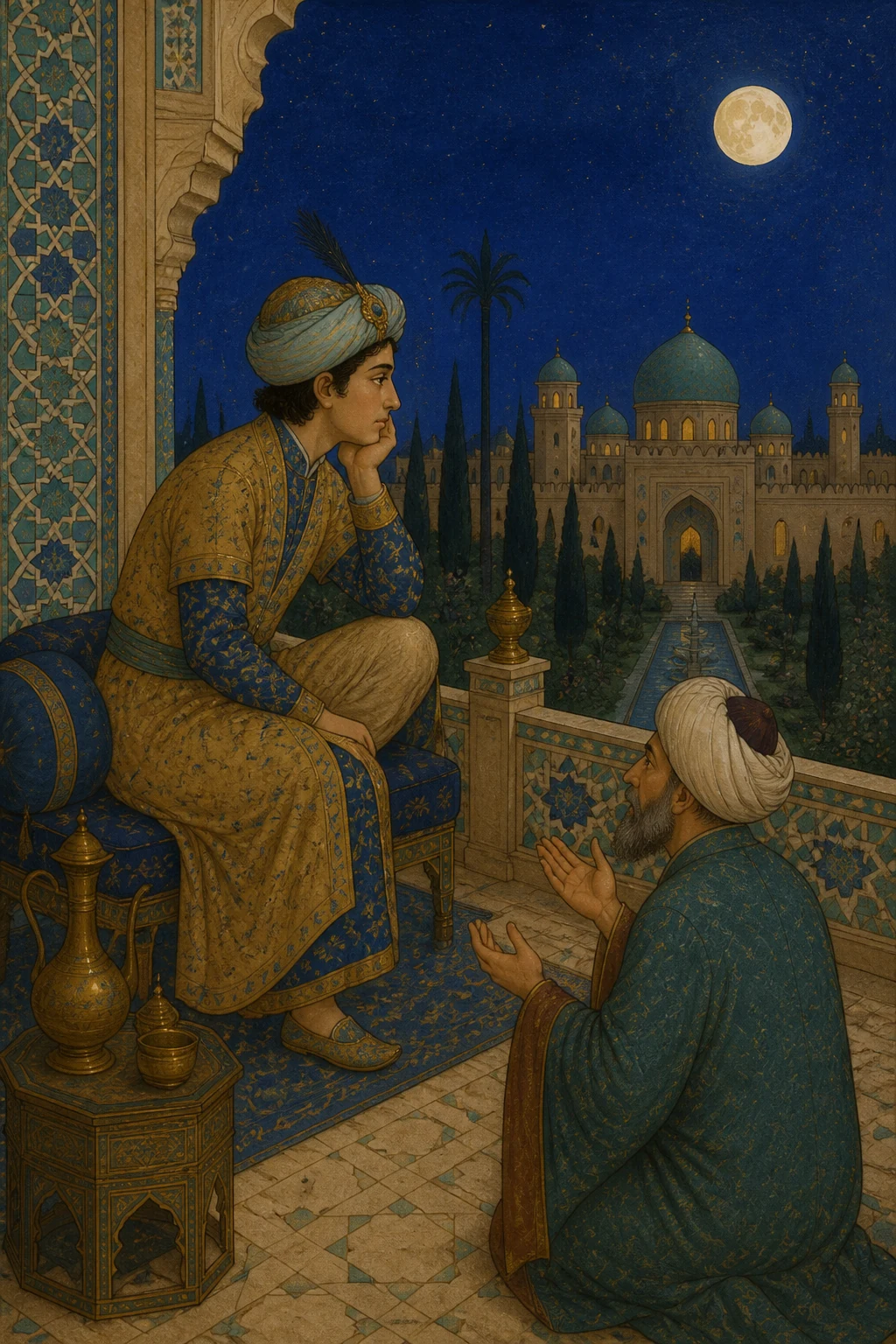
It is also related, O happy King, that al-Khasib, ruler of Egypt, had a son whose beauty was unequalled in his day. So fearful was he for the boy that he would allow him to go out only for Friday prayers. One day, as the youth was returning from the prayers, he passed an old man with many books before him. He dismounted, sat beside him, and began turning over the books and examining them. In one he saw the portrait of a woman who seemed almost ready to speak, and whose like in beauty he had never seen upon the face of the earth. She stole his reason and bewildered his senses, and he said, “Old man, sell me this picture.” The bookseller kissed the ground before him and replied, “My lord, it is yours without payment.” But the youth gave him a hundred dinars, took the book containing the portrait, and spent his days and nights gazing at it and weeping, refusing food, drink, and sleep. At last he said to himself, “Had I asked the bookseller who painted this portrait, perhaps he could have told me. If the woman is alive, I shall find some way to reach her; but if she is merely a creature of fancy, I shall cease doting on her and torment myself no longer over something that has no reality.” And dawn overtook Shahrazad, and she fell silent, leaving her tale untold.
When it was the nine hundred and fifty-third night,
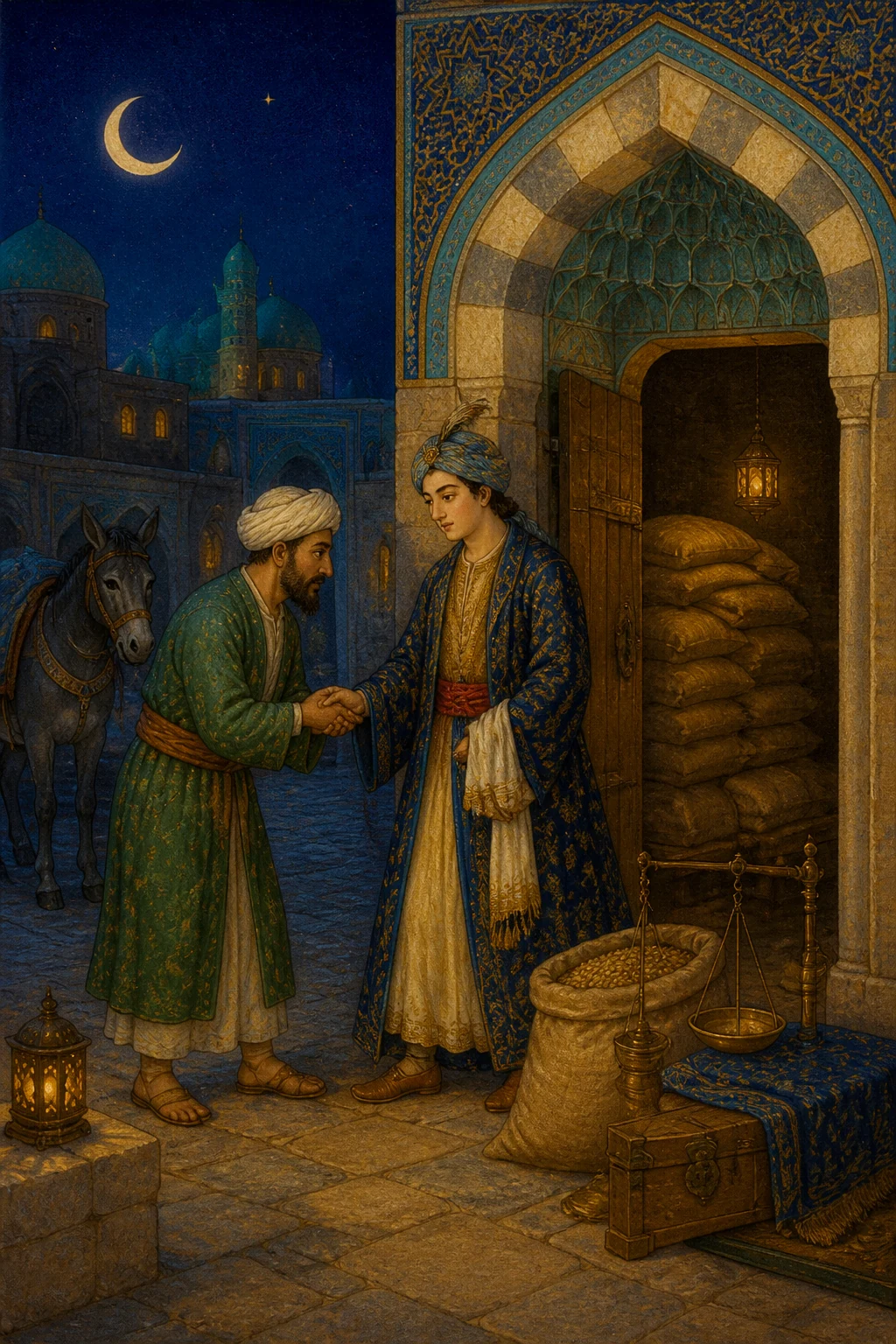
She said: It has reached me, O happy King, that the youth said to himself, “Had I asked the bookseller about this portrait, perhaps he could have told me. If it is merely a creature of fancy, I shall cease doting on it and torment myself no longer over something that has no reality.” When Friday came, he went to the bookseller, who rose to greet him. “Uncle,” said the youth, “tell me who painted this portrait.” “My lord,” he replied, “it was painted by a man of Baghdad named Abu al-Qasim al-Sandalani, who lives in the quarter of al-Karkh. But I do not know whose portrait it is.” The youth left him, telling no one in his father’s kingdom of his plight. He performed the Friday prayers and returned home, where he took a leather bag and filled it with jewels and gold, the jewels alone being worth thirty thousand dinars. He waited until morning, then departed without telling anyone. He caught up with a caravan, and, seeing a Bedouin, asked him, “Uncle, how far am I from Baghdad?” “My son,” he replied, “where are you, and where is Baghdad! It is two months’ journey from here.” “Uncle,” said the youth, “if you bring me to Baghdad, I shall give you a hundred dinars and this horse I am riding, which is worth a thousand.” The Bedouin replied, “God is witness to your promise. But tonight you must lodge nowhere but with me.” The youth agreed and spent the night with him. At the first light of dawn, the Bedouin took him by a short road and travelled swiftly, eager for the horse he had been promised. They journeyed on until they reached the walls of Baghdad. “Praise be to God for your safe arrival, my lord,” said the Bedouin. “This is Baghdad.” The youth was overjoyed. He dismounted and gave the Bedouin the horse and the hundred dinars, then took his bag and went on, asking for the quarter of al-Karkh and the merchants’ lodgings. Fate led him to a lane with ten dwellings, five facing five. At its far end stood a double door with a silver ring, flanked by two marble benches spread with the finest coverings. On one sat a handsome, imposing man in splendid clothes, with five slave boys before him, each as fair as the moon. When the youth saw this, he recognized the signs the bookseller had described. He greeted the man, who returned his greeting, welcomed him, seated him, and asked about his circumstances. “I am a stranger here,” said the youth, “and I beg you, in your kindness, to find me a house in this lane where I may lodge.” The man called out, “Ghazala!” A slave girl appeared and said, “At your service, my lord.” “Take some servants,” he told her, “and go and clean one of the dwellings, furnish it, and put in all the utensils and whatever else this handsome young man may need.” The girl went and did as he commanded. Then the old man took the youth and showed him the house. “My lord,” asked the youth, “what is the rent?” “Fair-faced youth,” he replied, “I shall take no rent from you for as long as you stay here.” And the youth thanked him.
Then the old man called another slave girl, and a maiden as radiant as the sun appeared. “Bring the chessboard,” he told her. She brought it, and a slave boy set out the board. “Will you play with me?” the old man asked the youth. “Yes,” he replied. They played several games, and the youth won them all. “Well done, young man!” said his host. “Your accomplishments are complete. By God, there is no one in Baghdad who can beat me, yet you have defeated me.” When the house had been furnished and supplied with everything needful, he handed the youth its keys and said, “My lord, will you not honour us by entering my home and sharing my bread?” The youth accepted and went with him. When they reached the house, he found it beautiful and adorned with gold, filled with pictures of every kind and with furnishings and treasures beyond the power of the tongue to describe. His host renewed his welcome and ordered food to be brought. They set before them a table made in Sana’a in Yemen, and served an array of rare dishes, none finer or more delicious than these. The youth ate his fill and washed his hands, then began looking about at the house and its furnishings. At last he turned to look for the bag he had brought, but could not see it. “There is no power and no strength save in God, the Most High, the Almighty,” he said to himself. “I have eaten a mouthful worth a dirham or two, and lost a bag containing thirty thousand dinars! Yet I seek God’s help.” He fell silent, unable to speak. And dawn overtook Shahrazad, and she fell silent, leaving her tale untold.
When it was the nine hundred and fifty-fourth night,
She said: It has reached me, O happy King, that when the youth found his bag missing, he was overcome with grief and fell silent, unable to speak. The old man brought out the chessboard and asked, “Will you play with me?” “Yes,” he answered. They played, and the old man won. “Well done,” said the youth. Then he gave up the game and rose. “What is the matter, young man?” asked his host. “I want my bag,” he replied. The old man rose, brought it out, and said, “Here it is, my lord. Will you return to the game?” “Yes,” said the youth. They played again, and this time the youth won. “When your thoughts were occupied with the bag, I defeated you,” said the man, “but when I brought it back, you defeated me.” Then he asked, “My son, tell me what country you come from.” “From Egypt,” he replied. “And what has brought you to Baghdad?” The youth took out the portrait and said, “Know, uncle, that I am the son of al-Khasib, ruler of Egypt. I saw this portrait in a bookseller’s shop, and it stole my reason. When I asked who had painted it, I was told that its painter was a man of Baghdad named Abu al-Qasim al-Sandalani, who lived in the quarter of al-Karkh, in a lane called Saffron Lane. So I took some money and came alone, without anyone knowing of my affairs. Now I beg you to complete your kindness by directing me to him, so that I may ask him why he painted this portrait and whose likeness it is. Whatever he asks of me, I shall give him.” “By God, my son,” replied the man, “I myself am Abu al-Qasim al-Sandalani! What a marvel this is! How has fate brought you to me?” At these words the youth rose, embraced him, and kissed his head and hands. “By God,” he pleaded, “tell me whose portrait it is!” “Gladly and willingly,” he replied. He rose, opened a cupboard, and brought out several books in which he had painted the same portrait. “Know, my son,” he said, “that the woman in this portrait is my cousin, my father’s brother’s daughter. She lives in Basra, where her father, Abu al-Layth, is governor. Her name is Jamila, and there is no woman upon the face of the earth more beautiful than she. But she shuns men and cannot bear to hear a man mentioned in her presence. I went to my uncle intending to ask for her hand, and offered him great sums of money, but he would not consent. When his daughter learned of it, she was enraged and sent me a message, saying, among other things, ‘If you have any sense, do not remain in this city, or you will perish and have only yourself to blame.’ She is a tyrant among tyrants, so I left Basra brokenhearted. I painted this likeness in books and sent them through the lands, hoping that one might fall into the hands of a handsome youth such as you, who would devise some way of reaching her. Perhaps she would fall in love with him; and I would have him promise that, once he had won her, he would let me see her, if only for a single glance from afar.” When Ibrahim ibn al-Khasib heard this, he bowed his head and reflected for a while. Al-Sandalani said to him, “My son, I have never seen anyone in Baghdad more handsome than you, and I think that if she sees you, she will love you. If you meet her and win her, can you let me see her, if only for one glance from afar?” “Yes,” he replied. “Then stay with me until you set out.” “I cannot stay,” said the youth, “for the fire of my love for her burns fiercely in my heart.” “Wait three days,” said the man, “until I can fit out a vessel to take you to Basra.” The youth waited while he prepared a vessel and stocked it with all the food, drink, and other provisions he might need. After three days he said to the youth, “Make ready to depart. I have prepared a vessel for you with everything you need. The vessel is mine, and the sailors are in my service. There are enough provisions aboard to last until your return, and I have charged the sailors to serve you until you come back in safety.” The youth rose and went aboard, bade his host farewell, and sailed until he reached Basra. There he took out a hundred dinars for the sailors, but they said, “We have already received our wages from our master.” “Take these as a gift,” he replied. “I shall not tell him.” So they accepted the money and prayed for him.
The youth entered Basra and asked, “Where do the merchants lodge?” “In a khan called the Khan of Hamdan,” he was told. He walked on until he reached the market where the khan stood, and all eyes turned towards him, so great were his beauty and grace. He entered the khan with one of the sailors and asked for the doorkeeper. They directed him to an imposing old man, whom he greeted. The old man returned his greeting, and the youth asked, “Uncle, have you a pleasant room?” “Yes,” he replied. He took him and the sailor to a fine room adorned with gold, opened it, and said, “Young man, this room will suit you.” The youth took out two dinars and said, “Take these as a gift for opening the door.” The doorkeeper accepted them and prayed for him. The youth told the sailor to return to the vessel and entered the room. The doorkeeper remained to attend him, saying, “My lord, your coming has brought us joy.” The youth gave him a dinar and said, “Bring us bread, meat, sweetmeats, and wine with this.” The man took it, went to the market, and returned with the purchases, which had cost ten dirhams. He offered the youth the change, but he said, “Spend it on yourself.” At this the doorkeeper was delighted. The youth ate only one loaf with a little relish, then told him, “Take this to your family.” He carried the food home and said to them, “I do not believe there is anyone on earth more generous or more charming than the young man who has come to lodge with us today. If he stays, we shall grow rich.” When the doorkeeper returned to Ibrahim, he found him weeping. He sat down and began massaging his feet, then kissed them and said, “My lord, why do you weep? May God never give you cause for tears!” “Uncle,” he replied, “I wish you and me to drink together tonight.” “Gladly and willingly,” said the man. The youth gave him five dinars and said, “Buy us fruit and wine.” Then he gave him another five and said, “With these buy us nuts and sweetmeats, fragrant flowers, and five fat chickens, and bring me a lute.” The doorkeeper went out and bought all he had been commanded, then told his wife, “Prepare this food and strain this wine for us, and do your work well, for this young man has showered us with kindness.” His wife prepared everything just as he wished, and he carried it in to Ibrahim, the sultan’s son. And dawn overtook Shahrazad, and she fell silent, leaving her tale untold.
When it was the nine hundred and fifty-fifth night,
She said: It has reached me, O happy King, that when the doorkeeper’s wife had prepared the food and wine, he carried it in to the sultan’s son. They ate and drank and made merry, until the youth began to weep and recited these two verses:
“My friend, were you to give your very soul, all your wealth, the world and all it holds, and everlasting Paradise, with all its gardens, for one hour of union, the heart would deem it well bought.” Then he gave a great cry and fell unconscious, and the doorkeeper sighed. When he came to himself, the man asked, “My lord, what makes you weep? Who is she of whom you speak in these verses? She is fit only to be dust beneath your feet.” The youth rose and brought out a bundle of the finest women’s clothes. “Take these to your wife,” he said. The doorkeeper took them and gave them to his wife, who came back with him and entered the youth’s room. Finding him in tears, she said, “You have broken our hearts. Tell us which beauty you desire; she is fit only to be your handmaid.” “Uncle,” he said, “know that I am the son of al-Khasib, ruler of Egypt, and that I am in love with Jamila, daughter of al-Layth the governor.” “For God’s sake, brother,” cried the doorkeeper’s wife, “leave off such talk, lest someone overhear us and we perish! There is no one on earth more tyrannical than she, and no one dares mention a man’s name to her, for she shuns men. My son, turn from her to another.” When he heard this, he wept bitterly. The doorkeeper said, “I have nothing but my life, and I shall risk it for your love. I shall devise some means of bringing you to your desire.” Then the couple left him. The next morning the youth went to the bath and dressed in a robe fit for a king. The doorkeeper and his wife came to him and said, “My lord, there is a hunchbacked tailor here who sews for Lady Jamila. Go to him and tell him your plight; perhaps he can show you a way to attain your desire.” The youth rose and went to the hunchback’s shop. Entering, he found ten slave boys there, each as fair as the moon. He greeted them, and they returned his greeting, welcomed him joyfully, and seated him, marvelling at his beauty and grace. The hunchback too was bewildered by his handsome face. “I want you to sew up the opening of my robe,” the youth said. The tailor came forward, took a strand of silk, and sewed it up, for the youth had deliberately unpicked the seam. When the work was done, he gave him five dinars and returned to his room. “What have I done for this young man,” the tailor asked himself, “that he should give me five dinars?” All that night he thought of his beauty and generosity. The next morning the youth returned to the hunchback’s shop and greeted him. The tailor returned his greeting and welcomed him with honour. When he had sat down, the youth said, “Uncle, sew up the opening of my robe, for it has come unstitched again.” “My son, with the greatest pleasure,” he replied. He came forward and sewed it, and the youth gave him ten dinars. The tailor took them, astonished at his beauty and generosity, then said, “By God, young man, there must be some reason for this conduct. This is no mere matter of sewing a robe. Tell me the truth of your affair. If you have fallen in love with one of these boys, by God, there is not one among them more handsome than you. They are all dust beneath your feet, and here they stand before you as your slaves. But if it is something else, tell me.” “Uncle,” he replied, “this is no place to speak, for my story is strange and my affair extraordinary.” “If that is so,” said the tailor, “come with me somewhere private.”
The tailor rose, took him by the hand, and led him into a room at the back of the shop. “Young man,” he said, “tell me your story.” The youth related his affairs from beginning to end. The tailor was aghast. “Young man,” he said, “fear God and have mercy on yourself! The woman you speak of is a tyrant who shuns men. Guard your tongue, brother, or you will bring about your own destruction.” At these words the youth wept bitterly and clung to the hem of the tailor’s robe. “Help me, uncle,” he pleaded, “for I am perishing! I have forsaken my own kingdom and the kingdom of my father and grandfather, and have become a lonely stranger in foreign lands. I cannot endure being parted from her.” Seeing his distress, the tailor took pity on him and said, “My son, I have nothing but my life, and I shall risk it for your love, for you have wounded my heart. Tomorrow I shall devise something to comfort you.” The youth prayed for him and returned to the khan, where he told the doorkeeper what the hunchback had said. “He has shown you great kindness,” the man replied. The next morning the youth put on his finest clothes, took a purse of dinars, and went to the hunchback. He greeted him, sat down, and said, “Uncle, fulfil your promise to me.” “Go at once,” the tailor replied, “and buy three fat chickens, three ounces of sugar candy, and two handsome jars, which you must fill with wine. Take a drinking cup, and tie all these things in a bundle. After the dawn prayer, go aboard a boat with a boatman and tell him, ‘I want you to take me downstream from Basra.’ If he says, ‘I cannot go farther than a parasang,’ tell him, ‘As you think best.’ Once he is under way, tempt him with money until he takes you all the way. The first garden you see when you arrive belongs to Lady Jamila. Go to its gate, and there you will see two high steps spread with brocade, and seated upon them a man who is a hunchback like me. Tell him your plight and entreat him; perhaps he will pity you and enable you to see her, if only for one glance from afar. There is nothing more I can do. If he does not take pity on you, you and I are both lost. This is all I can suggest; the matter rests with God Most High.” “I seek God’s help,” replied the youth. “What God wills shall be, and there is no power and no strength save in God.” He left the hunchbacked tailor, returned to his room, and packed everything he had been told to bring in a neat bundle. The next morning he went down to the bank of the Tigris, where he found a boatman asleep. He woke him, gave him ten dinars, and said, “Take me downstream from Basra.” “My lord,” replied the man, “only on condition that I go no farther than a parasang. If I go so much as a handspan beyond it, you and I shall perish.” “As you think best,” said the youth. The boatman took him aboard and rowed downstream. When they drew near the garden, he said, “My son, I can go no farther than this. If I pass this boundary, you and I shall perish.” The youth took out another ten dinars and said, “Take this money to help you with your needs.” The man was ashamed to refuse him and said, “I commit the matter to God Most High.” And dawn overtook Shahrazad, and she fell silent, leaving her tale untold.
When it was the nine hundred and fifty-sixth night,
She said: It has reached me, O happy King, that when the youth gave the boatman another ten dinars, he took them and said, “I commit the matter to God Most High.” He rowed downstream with him, and when they reached the garden, the youth sprang up for joy and leapt from the boat, flinging himself ashore a spear’s cast away. The boatman turned and fled. The youth went forward and found the garden just as the hunchback had described it. Its gate stood open, and in the entrance hall was an ivory couch on which sat a pleasant-looking hunchback in gold-embroidered clothes, holding a silver mace plated with gold. The youth hurried up, bent over his hand, and kissed it. “Who are you?” the man asked. “Where have you come from, and who brought you here, my son?” The sight of Ibrahim ibn al-Khasib had dazzled him with its beauty. “Uncle,” Ibrahim replied, “I am an ignorant young stranger.” Then he wept. The man’s heart softened, and he seated him beside him on the couch, wiped away his tears, and said, “Do not be troubled. If you are in debt, may God discharge it; and if you are afraid, may God set your fears at rest.” “Uncle,” he replied, “I am neither afraid nor in debt. By God’s grace and help, I have abundant wealth.” “My son,” said the man, “what need has brought you to risk your life and your beauty in a place of destruction?” The youth told him his story and explained his plight. When the man had heard it, he bowed his head towards the ground for a while, then asked, “Was it the hunchbacked tailor who directed you to me?” “Yes,” he replied. “He is my brother, and a good and blessed man.” Then he said, “My son, had affection for you not entered my heart, and had I not taken pity on you, you would have perished, together with my brother, the doorkeeper of the khan, and his wife.” He went on, “Know that this garden has no equal upon the face of the earth. It is called the Garden of the Pearl, and in all my time here no one has entered it except the sultan, myself, and its mistress, Jamila. I have lived here twenty years, and have never seen anyone else come to this place. Every forty days she comes here by boat and walks up among her slave girls, wearing a robe of satin whose hems ten maidens carry with golden hooks until she has entered. Thus I have never seen any part of her. But I have nothing except my life, and I shall risk it for your sake.” The youth kissed his hand, and he said, “Stay with me until I devise a plan for you.” Then he took him by the hand and led him into the garden.
When Ibrahim saw the garden, he thought himself in Paradise. He saw trees with interlacing branches, towering palms, flowing waters, and birds calling to one another in a multitude of voices. The gardener took him to a pavilion and said, “This is where Lady Jamila sits.” He examined it and found it one of the most wondrous pleasure houses, decorated with all manner of designs in gold and lapis lazuli. It had four doors, approached by five steps, and in its centre was a pool reached by golden steps inlaid with precious minerals. In the middle of the pool stood a golden fountain with figures great and small, from whose mouths the water flowed. As the water came forth, the figures rang out in different tones, so that anyone hearing them might imagine himself in Paradise. Around the pavilion ran a waterwheel with silver buckets, draped in brocade. To its left was a silver lattice overlooking a green enclosure filled with wild beasts, gazelles, and hares; to its right was another lattice overlooking a court full of birds of every kind, all singing in different voices that enchanted the listener. The sight filled the youth with delight. He sat by the garden gate, with the gardener beside him. “What do you think of my garden?” the man asked. “It is the paradise of this world,” the youth replied. The gardener laughed, then rose and disappeared for a while, returning with a tray of chicken, quails, delicious dishes, and sugar confections. He set it before the youth and said, “Eat your fill.” Ibrahim said: “I ate until I was satisfied. When he saw me eat, he was pleased and said, ‘By God, this is the way of kings and the sons of kings!’ Then he asked, ‘Ibrahim, what have you in this bundle?’ I opened it before him, and he said, ‘Keep it with you. It will serve you when Lady Jamila arrives, for once she is here I shall not be able to bring you anything to eat.’ Then he rose, took me by the hand, and led me to a place opposite Jamila’s pavilion. There he made a bower among the trees and said, ‘Climb up here. When she comes, you will see her, but she will not see you. This is the utmost I can devise, and on God we must rely. When she sings, drink to her singing; and when she leaves, return the way you came, in safety, God willing.’” The youth thanked him and tried to kiss his hand, but he would not allow it. He placed his bundle in the bower the gardener had made for him. Then the gardener said, “Ibrahim, stroll about the garden and eat its fruits, for your beloved is due tomorrow.” Ibrahim wandered through the garden, eating its fruits, and spent the night with him. When morning dawned and the light spread, he performed the dawn prayer. Then the gardener came to him, pale-faced, and said, “Rise, my son, and climb into the bower. The slave girls have come to furnish the place, and she will follow them.” And dawn overtook Shahrazad, and she fell silent, leaving her tale untold.
When it was the nine hundred and fifty-seventh night,
She said: It has reached me, O happy King, that when the gardener came to Ibrahim ibn al-Khasib in the garden, he said, “Rise, my son, and climb into the bower. The slave girls have come to furnish the place, and she will follow them. Take care not to spit, blow your nose, or sneeze, or you and I will perish.” The youth rose and climbed into the bower, and the gardener departed, saying, “May God keep you safe, my son.” As the youth sat there, five maidens approached, the like of whom no one had ever seen. They entered the pavilion, took off their clothes, washed it, sprinkled it with rosewater, burned aloeswood and ambergris, and spread out brocade coverings. After them came fifty slave girls bearing musical instruments, with Jamila among them inside a red brocade tent. The girls held up the skirts of the tent with golden hooks until she entered the pavilion, so that the youth saw nothing of her, not even her clothes. He said to himself, “By God, all my labour has been wasted! Yet I must be patient and see how matters turn out.” The maidens brought food and drink, ate, and washed their hands. Then they set up a chair for her, and she sat upon it. They all began playing their instruments and singing in voices of unsurpassed sweetness. Presently an old housekeeper came forward, clapping her hands and dancing, and the girls pulled her this way and that. Then the curtain was raised, and Jamila came out laughing. Ibrahim saw her arrayed in jewels and splendid robes, with a crown set with pearls and gems upon her head, a necklace of pearls about her neck, and at her waist a girdle with bars of chrysolite and strings of rubies and pearls. The maidens rose and kissed the ground before her as she laughed. Ibrahim ibn al-Khasib said: “When I saw her, I lost all awareness of myself. My reason reeled and my thoughts were bewildered by a beauty whose like was nowhere on earth. I fell unconscious; then I came to myself with tears in my eyes and recited these two verses:
“I gaze on you and dare not turn my eyes, lest my eyelids veil the sight of you. Were every glance I cast an eye itself, still all those eyes could not encompass your beauty.” The old woman said to the maidens, “Let ten of you rise and dance and sing.” When Ibrahim saw them, he said to himself, “How I wish Lady Jamila would dance!” When the ten maidens had finished dancing, they gathered around her and said, “Our lady, we long for you to dance here, so that our joy may be complete, for we have never known a day more delightful than this.” Ibrahim ibn al-Khasib said to himself, “Surely the gates of heaven have opened, and God has answered my prayer.” The maidens kissed her feet and said, “By God, we have never seen you so lighthearted as you are today.” They continued coaxing her until she took off her robes and stood in a shift of cloth of gold embroidered with jewels of every kind, revealing breasts like pomegranates and unveiling a face like the moon on the night of its fullness. Ibrahim saw movements whose like he had never witnessed in all his life. She danced with such rare invention and wondrous grace that she made us forget the dance of bubbles in the wine cups, and put us in mind of turbans tilting from men’s heads. She was as the poet said:
“She was fashioned as desire would wish, cast in beauty’s mould, neither too tall nor too short. As though created from a pearl’s pure lustre, in every lovely limb she bears a moon.” And as another said:
“A dancer, slender as a willow bough—my soul all but departs as the dancer moves. No foot rests still throughout the dance, as though my heart’s fire burned beneath those feet.” Ibrahim said: “As I watched her, she happened to glance towards me and saw me. Her face changed, and she said to her maidens, ‘Go on singing until I return.’ Then she went to fetch a knife half a cubit long, took it, and came towards me, saying, ‘There is no power and no strength save in God, the Most High, the Almighty.’ As she drew near, I lost all awareness of myself. But when she saw me and her face came close to mine, the knife fell from her hand, and she said, ‘Glory be to Him who turns hearts!’ Then she said to me, ‘Young man, take comfort. You are safe from all you fear.’ I began to weep, and she wiped away my tears with her hand. ‘Young man,’ she said, ‘tell me who you are and what has brought you here.’ I kissed the ground before her and clung to the hem of her robe. ‘Have no fear,’ she said. ‘By God, I have never gazed my fill upon any man but you. Tell me who you are.’” Ibrahim said: “I told her my story from beginning to end. She marvelled and asked, ‘My lord, I beseech you by God, are you Ibrahim ibn al-Khasib?’ ‘Yes,’ I replied. She threw herself upon me and said, ‘My lord, it is you who made me shun men! When I heard that in Egypt there was a youth more beautiful than anyone on earth, I fell in love with you from the description, and my heart became bound to yours because of the wondrous beauty reported to me. I became, through you, as the poet said:
“‘My ear outstripped my eye in loving him; sometimes the ear falls in love before the eye.’ Praise be to God who has shown me your face! By God, had you been anyone else, I would have crucified the gardener, the doorkeeper of the khan, the tailor, and all who belonged to them.” Then she asked me, “How can I contrive to bring you something to eat without my maidens knowing?” “I have food and drink with me,” I replied. I untied the bundle before her. She took a chicken and began feeding me morsels, while I fed her in turn. When I saw her doing this, I thought it must be a dream. Then I brought out the wine, and we drank. All this while she stayed beside me and the maidens sang. We remained so from morning until noon. Then she rose and said, “Go now and make ready a vessel, and wait for me at such-and-such a place until I come. I can no longer endure being parted from you.” “My lady,” I replied, “I have a vessel of my own, with sailors in my hire, and they are waiting for me.” “That is just what we need,” she said. Then she returned to her maidens. And dawn overtook Shahrazad, and she fell silent, leaving her tale untold.
When it was the nine hundred and fifty-eighth night,
She said: It has reached me, O happy King, that when Lady Jamila returned to her maidens, she said, “Come, let us return to our palace.” “How can we leave at this hour,” they asked, “when we usually stay three days?” “I feel a great heaviness within me,” she replied, “as though I were ill, and I fear it may grow worse.” “We hear and obey,” they said. They put on their clothes, went down to the bank, and boarded the boat. Then the gardener came to Ibrahim, knowing nothing of what had passed, and said, “Ibrahim, you have had no luck in enjoying the sight of her. She usually stays here three days, and I fear she may have seen you.” “She did not see me, nor did I see her,” Ibrahim replied, “and I did not come out of the pavilion.” “You speak truly, my son,” said the man, “for had she seen you, we should have perished. But stay with me until she comes again next week; then you may see her and gaze your fill.” “My lord,” replied Ibrahim, “I have money with me, and I fear for it. I have also left men behind, and I am afraid they will miss me.” “My son,” said the gardener, “it grieves me to part from you.” He embraced him and bade him farewell. Ibrahim went to the khan where he had been lodging, met the doorkeeper, and collected his money. “Good news, God willing?” the doorkeeper asked. “I could find no way to attain my desire,” Ibrahim replied, “and I wish to return to my family.” The doorkeeper wept and bade him farewell, carried his belongings, and accompanied him to the vessel. Afterwards Ibrahim went to the place she had named and waited for her. When night fell, she came to him disguised as a gallant warrior, with a rounded beard and a belt drawn tightly about her waist, carrying a bow and arrows in one hand and a naked sword in the other. “Are you the son of al-Khasib, ruler of Egypt?” she demanded. “I am,” Ibrahim replied. “What sort of wretch are you,” she said, “to come here corrupting the daughters of kings? Get up and answer to the sultan!” Ibrahim said: “I fell unconscious, while the sailors were all but dead in their skins from terror. When she saw what had happened to me, she pulled off the beard, cast aside the sword, and loosened the belt. Then I saw that she was Lady Jamila, and said to her, ‘By God, you have torn my heart to pieces!’”
Then I said to the boatmen, “Make the boat go faster.” They unfurled the sail and sped on, and within a few days we reached Baghdad. There we saw a boat moored beside the riverbank. When its boatmen caught sight of us, they called to ours by name, saying, “Welcome back, safe and sound!” Then they brought their boat alongside ours, and we looked and saw Abu al-Qasim al-Sandalani aboard. When he saw us, he said, “Here is the very man I was looking for. Go in God’s keeping; I have business to attend to.” A candle stood before him, and he said to me, “Praise be to God for your safe return. Have you accomplished your purpose?” “Yes,” I replied. He brought the candle closer to us, and when Jamila saw him, her expression changed and her face turned pale. On seeing her, al-Sandalani said, “Go in God’s protection. I am on my way to Basra on the sultan’s business, but a gift is for whoever is at hand.” He then brought out a box of sweets and tossed it into our boat; the sweets were laced with henbane. Ibrahim said, “Delight of my eyes, eat some of these.” But she wept and said, “Ibrahim, do you know who that is?” I answered, “Yes, it is so-and-so.” She said, “He is my cousin. He once asked my father for my hand, but I would not have him. He is bound for Basra and may tell my father about us.” I said, “My lady, before he reaches Basra, we shall have reached Mosul”—neither of them knowing what fate held in store for them. I ate some of the sweets, and scarcely had they reached my stomach when I fell headlong to the ground. In the hour before dawn, I sneezed and the henbane came out through my nostrils. I opened my eyes and found myself stripped and cast among some ruins. I slapped my face and said to myself, “This is a trick al-Sandalani has played on me!” I had no idea where to go, with nothing on me but a pair of drawers. I rose and walked a little way, when suddenly the governor came toward me with a band of men carrying swords and maces. I was frightened, and, seeing a ruined bathhouse, I hid inside it. My foot stumbled over something, and when I put my hand on it, my hand was stained with blood. I wiped it on my drawers, not knowing what it was. Then I reached out again and touched a murdered body, and its head came away in my hand. I flung it aside and said, “There is no power and no strength save in God, the Most High, the Almighty!” I retreated into a corner of the bathhouse. Just then the governor stopped at the entrance and said, “Go into this place and search it.” Ten of his men entered with torches, and in my fear I slipped behind a wall. I looked closely at the murdered person and saw that it was a young woman, her face like the full moon, her head lying in one place and her body in another. She wore costly clothes. At the sight of her, my heart trembled. The governor came in and said, “Search every part of the bathhouse.” They entered the place where I was hiding, and one of the men saw me and approached, holding a knife half a cubit long. When he came near, he said, “Glory be to God, who created this handsome face! Young man, where are you from?” Then he took me by the hand and said, “Young man, why did you kill this woman?” I replied, “By God, I did not kill her, nor do I know who did. I only came into this place because I was afraid of you.” I told him my story and said, “For God’s sake, do not wrong me. I have troubles enough of my own.” But he took me and brought me before the governor. When the governor saw the traces of blood on my hands, he said, “This needs no further proof. Strike off his head.” And dawn overtook Shahrazad, and she fell silent, leaving her tale untold.
When it was the nine hundred and fifty-ninth night
She said: It has reached me, O fortunate king, that Ibn al-Khasib said: When they brought me before the governor and he saw the traces of blood on my hands, he said, “This needs no further proof. Strike off his head.” When I heard these words, I wept bitterly, tears streaming from my eyes, and recited these two verses:
We walked the steps decreed for us to tread; whoever has such steps decreed must tread them. And he whose death is destined in one land shall never meet his death in any other. Then I gave a great sob and fell unconscious. The executioner’s heart softened toward me, and he said, “By God, this is no murderer’s face!” But the governor said, “Strike off his head.” They seated me on the leather execution mat and bound a cloth over my eyes. The headsman took up his sword, asked the governor’s leave, and was about to strike off my head when I cried, “Alas, to die so far from home!” Just then a troop of horsemen approached, and a voice called out, “Leave him! Stay your hand, headsman!” There was a wondrous reason and a strange circumstance behind this. Al-Khasib, the ruler of Egypt, had sent his chamberlain to the Caliph Harun al-Rashid with gifts and rarities, and with a letter saying, “My son has been missing for a year, and I have heard that he is in Baghdad. I beg the favor of God’s Caliph: let him inquire after my son, make every effort to find him, and send him back to me with the chamberlain.” When the Caliph read the letter, he ordered the governor to discover what had become of the boy. The governor and the Caliph continued to inquire after him until word came that he was in Basra. The Caliph was informed, and he wrote a letter, gave it to the Egyptian chamberlain, and ordered him to travel to Basra, taking with him a party of the vizier’s retainers. Such was the chamberlain’s concern for his master’s son that he set out that very hour, and came upon the young man seated on the execution mat before the governor. When the governor saw and recognized the chamberlain, he dismounted to greet him. The chamberlain asked, “Who is this young man, and what is his affair?” The governor told him what had happened. Though the chamberlain had not yet recognized the sultan’s son, he said, “This young man’s face is not the face of a murderer.” He ordered the governor to unbind him, and the governor did so. “Bring him to me,” he said, and the young man was brought before him. His beauty had faded from the terrible ordeals he had suffered. The chamberlain said, “Tell me your story, young man. What have you to do with this murdered woman?” When Ibrahim looked at the chamberlain, he recognized him and said, “Woe to you! Do you not know me? Am I not Ibrahim, your master’s son? Perhaps you have come in search of me.” The chamberlain gazed intently at him until he knew him beyond all doubt, then threw himself at his feet. When the governor saw what the chamberlain had done, his face turned pale. The chamberlain said to him, “Woe to you, tyrant! Did you mean to kill the son of my master al-Khasib, ruler of Egypt?” The governor kissed the hem of the chamberlain’s robe and said, “My lord, how was I to know him? We found him in this state, with the murdered girl beside him.” The chamberlain replied, “Woe to you! You are unfit to hold office. This is a boy of fifteen who has never killed a sparrow. How could he have murdered anyone? Why did you not give him time and question him about his circumstances?” Then the chamberlain and the governor said, “Search for the girl’s murderer.” The men went into the bathhouse again and found her killer. They seized him and brought him to the governor, who took him to the caliph’s palace and informed the Caliph of all that had happened. Al-Rashid ordered the girl’s murderer to be put to death, then commanded that Ibn al-Khasib be brought before him. When he stood in his presence, al-Rashid smiled and said, “Tell me your story and all that has befallen you.” He related his tale from beginning to end, and the Caliph was deeply moved. He summoned Masrur the headsman and said, “Go this very hour, raid the house of Abu al-Qasim al-Sandalani, and bring him and the girl to me.” Masrur went at once and burst into his house. There he found the girl bound by her hair and close to death. He freed her and brought both her and al-Sandalani before the Caliph. When al-Rashid saw her, he marveled at her beauty. Then he turned to al-Sandalani and said, “Seize him and cut off the two hands with which he beat this girl. Crucify him, and hand over his wealth and property to Ibrahim.” They carried out his command. While they were thus occupied, Abu al-Layth, the governor of Basra and the father of Lady Jamila, arrived to seek the Caliph’s aid against Ibrahim ibn al-Khasib, son of the ruler of Egypt, complaining that he had carried off his daughter. Al-Rashid said to him, “It was he who brought about her deliverance from torment and death.” He ordered Ibn al-Khasib to be brought in, and when he arrived, the Caliph said to Abu al-Layth, “Will you not accept this young man, the son of the sultan of Egypt, as your daughter’s husband?” He answered, “I hear and obey God and you, O Commander of the Faithful.” The Caliph summoned the judge and witnesses and married the girl to Ibrahim ibn al-Khasib. He bestowed all al-Sandalani’s wealth upon him and made provision for his journey home. Ibrahim lived with her in perfect happiness and the fullest joy until there came to them the Destroyer of Delights and the Sunderer of Companies. Glory be to the Ever-Living, who never dies!