Prevod
It is also related that one night the Caliph Harun al-Rashid was sorely troubled by sleeplessness. He summoned Masrur, who came before him, and said, “Bring me Ja‘far at once.” Masrur went and brought him, and when he stood before the Caliph, al-Rashid said, “Ja‘far, sleeplessness has come upon me tonight and robbed me of my rest, and I do not know what will dispel it.” “Commander of the Faithful,” he replied, “the sages have said that looking into a mirror, visiting the bath, and listening to music banish care and anxious thought.” “Ja‘far,” said the Caliph, “I have done all these things, and none has brought me any relief. By my pure forefathers, unless you find some means of ridding me of this affliction, I shall strike off your head.” “Commander of the Faithful,” said Ja‘far, “will you do as I advise?” “And what do you advise?” “That you come down with us into a boat and drift with the current along the Tigris to a place called Qarn al-Sirat. Perhaps we shall hear something we have never heard or see something we have never seen. For it has been said that sorrow is relieved by one of three things: seeing what one has never seen, hearing what one has never heard, or setting foot on ground one has never trodden. Perhaps this will ease your restlessness, Commander of the Faithful.” At this, al-Rashid rose, accompanied by Ja‘far and his brother al-Fasl, Ishaq the boon companion, Abu Nuwas, Abu Dulaf, and Masrur the swordsman. And dawn overtook Shahrazad, and she fell silent, leaving her tale untold.
When it was the nine hundred and forty-seventh night,
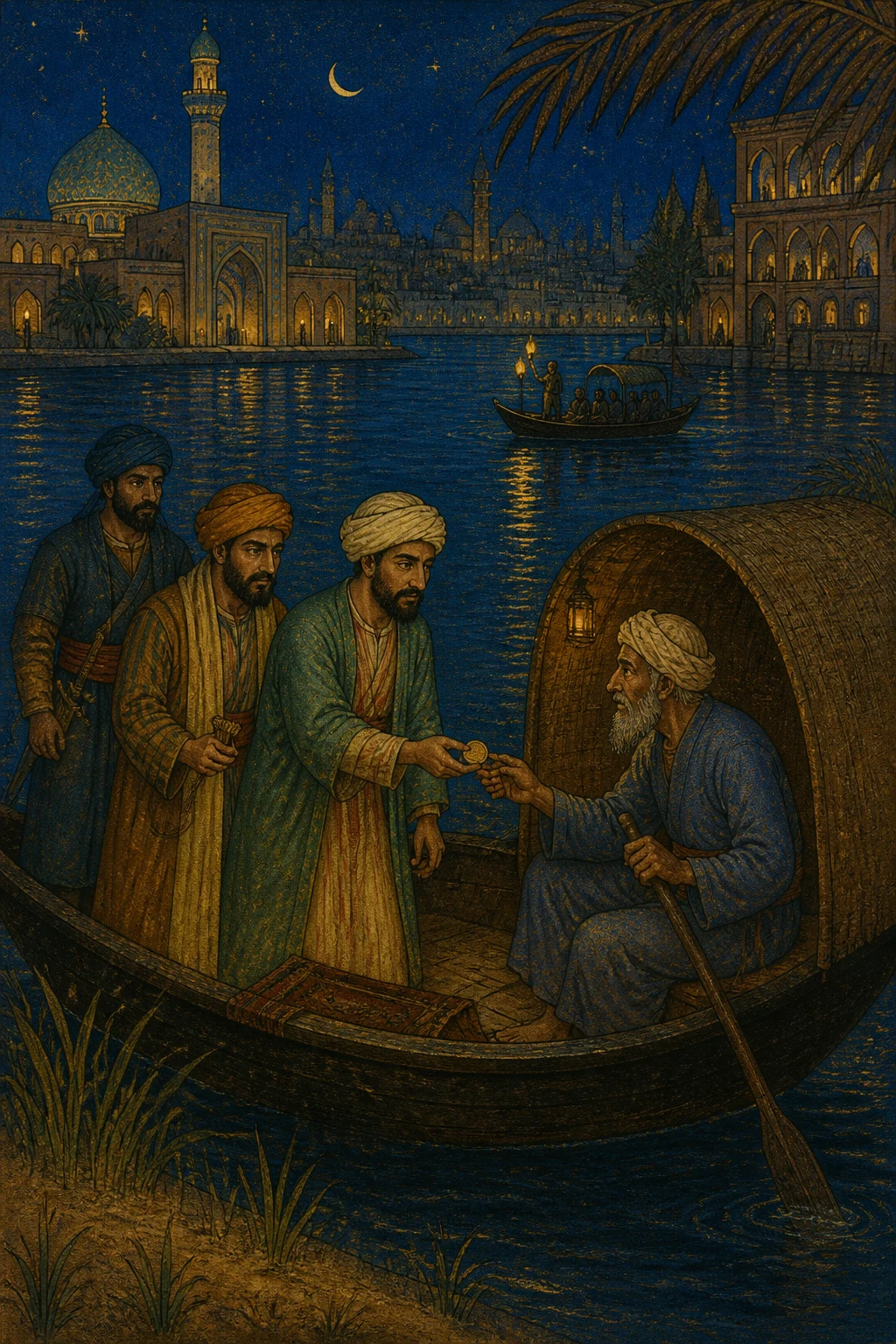
She said: It has reached me, O fortunate King, that when the Caliph rose with Ja‘far and the rest of his companions, they entered the wardrobe chamber and all dressed as merchants. Then they made their way to the Tigris, boarded a boat adorned with gold, and drifted downstream until they reached the place they sought. There they heard the voice of a girl singing to the lute and reciting these verses:
I said to him, when wine was brought and the nightingale sang in the grove: “How long will you hold back from joy? Awaken! Life is only lent to us. Take the cup from the hands of a dear beloved whose eyelids droop in languid grace. I planted fresh roses upon his cheek, and pomegranate blossoms flowered upon his temples. You would think the scratches there were cold ashes, while the cheek itself was fire. The censor tells me, ‘Forget him!’ Yet what excuse have I, now that the down upon his face has betrayed him?” When the Caliph heard this voice, he said, “Ja‘far, what a lovely voice!” Ja‘far replied, “My lord, never has sweeter or finer singing reached my ears. Yet, my master, to listen from behind a wall is to hear only half; what then of listening from behind a curtain?” “Come, Ja‘far,” said the Caliph, “let us invite ourselves into the house. Perhaps we shall see the singer with our own eyes.” “I hear and obey,” replied Ja‘far. They left the boat and asked leave to enter. A young man came out to them, handsome in appearance, sweet-spoken and eloquent, and said, “Welcome, my lords, who do me this honor! Enter and be at ease.” They went in, with him leading the way, and found a house built around four sides, its ceiling gilded and its walls patterned in lapis blue. Within was an audience chamber with a lovely dais, upon which sat a hundred girls like moons. He called out to them, and they rose from their couches. Then the master of the house turned to Ja‘far and said, “My lord, I do not know which of you is the most distinguished. In God’s name, let the highest among you take the place of honor, and let his brethren sit each according to his rank.” Each took his proper place, while Masrur stood before them to serve. Then their host said, “My guests, with your permission, shall I have some food brought?” “Yes,” they replied. He ordered the girls to bring the meal, and four of them came forward with their waists girded, bearing a table spread with rare dishes of creatures that walked, flew, and swam in the seas: sandgrouse, quail, young fowl, and pigeons. Around the edges of the tablecloth were verses suited to the occasion. They ate their fill and washed their hands. Then the young man said, “My lords, if you have any wish, tell us, so that we may have the honor of fulfilling it.” They replied, “Indeed we have. We came to your house only because of a voice we heard from beyond its wall, and we longed to hear it again and learn who its owner was. If you would graciously grant us this favor, it would be worthy of your noble character; then we shall return whence we came.” “You are most welcome,” he said. Turning to a black slave girl, he told her, “Bring your mistress, so-and-so.” The girl went away and returned with a chair, which she set down. Then she went a second time and brought back a girl like the moon at its fullest, who seated herself upon the chair. The black girl handed her a length of satin, from which she drew a lute studded with jewels and rubies, with tuning pegs of gold. And dawn overtook Shahrazad, and she fell silent, leaving her tale untold.
When it was the nine hundred and forty-eighth night,
She said: It has reached me, O fortunate King, that when the girl came forward, she seated herself upon the chair and drew the lute from its case. It was studded with jewels and rubies, and its tuning pegs were gold. She tuned its strings to ring sweetly, and she was as the poet said of her and her lute:
She cradled it upon her lap as a tender mother cradles her child, its polished tuning pegs gleaming above it. Whenever her right hand moved to sound its strings, her left adjusted the pegs. Then she clasped the lute to her breast and bent over it as a mother bends over her child. She touched its strings, and it cried out as a child cries to its mother. Then she played and sang these verses:
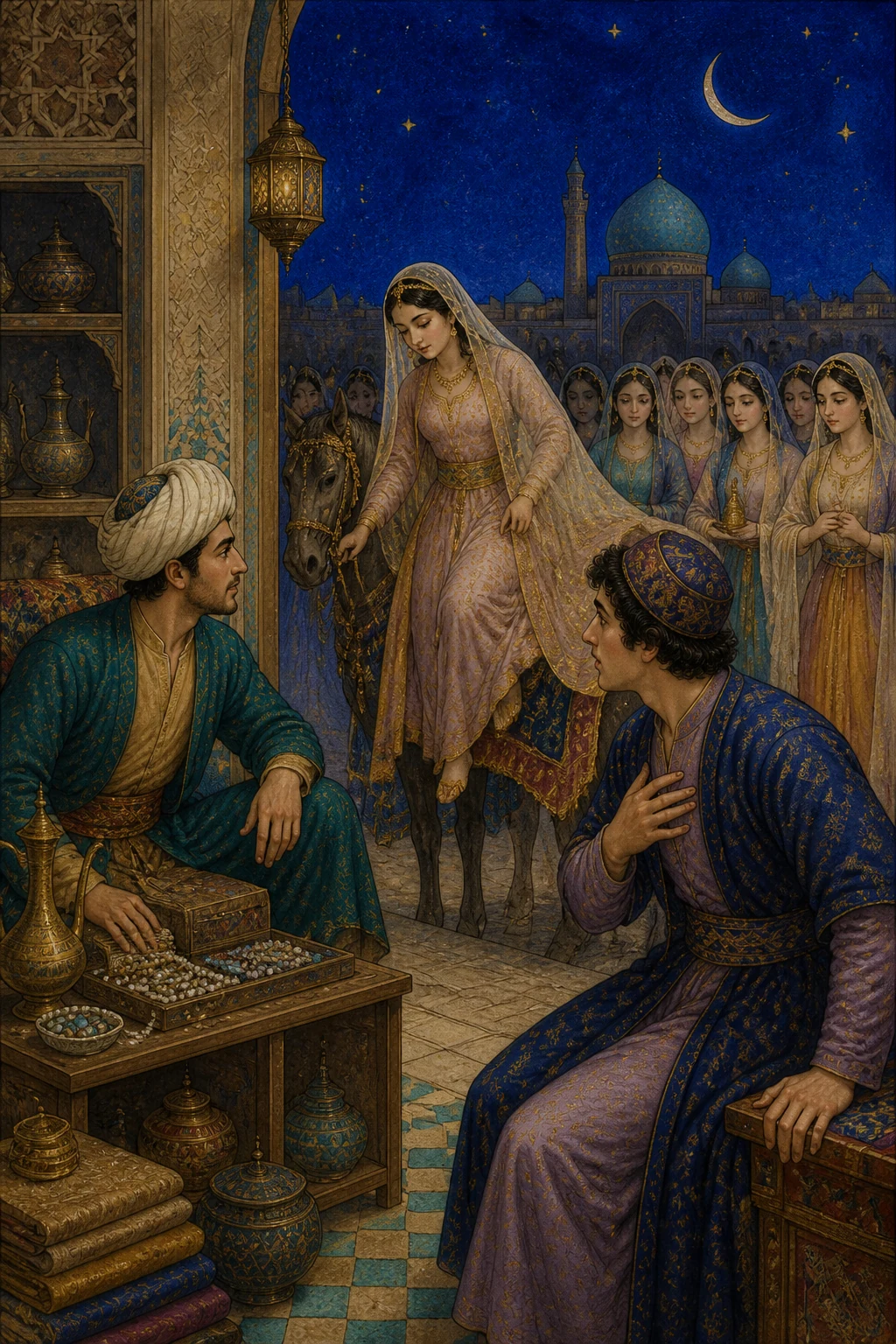
Time has relented and granted me the one I love. My friends, pass round your cups and drink of a wine that never mingles with a mortal heart but fills it with delight. A figure slender as the breeze rose bearing it in a cup—have you ever seen the full moon carrying a star? How many a night have I kept company with that moonlike beauty above the Tigris, lighting up the darkness, while the moon inclined toward its setting as though it had stretched a gilded sword across the water! When she finished her verses, she wept bitterly, and everyone in the house broke into such sobbing that they nearly perished. Not one of them but lost all sense of himself, tore his clothes, and struck his face for the beauty of her singing. Al-Rashid said, “This girl’s singing tells me she is a lover parted from her beloved.” Her master replied, “She is mourning her mother and father.” “This is not the weeping of one who has lost her parents,” said al-Rashid, “but the grief of one who has lost a beloved.” Enraptured by her singing, he said to Ishaq, “By God, I have never seen her like.” Ishaq replied, “My lord, I am utterly amazed by her, and so moved by delight that I cannot contain myself.” All the while, al-Rashid was studying the master of the house, admiring his handsome features and graceful manners. Noticing a trace of yellow pallor in his face, he turned to him and said, “Young man!” “At your service, my lord,” he replied. “Do you know who we are?” “No.” Ja‘far said, “Would you like us to tell you each of our names?” “Yes,” he replied. “This,” said Ja‘far, “is the Commander of the Faithful, cousin of the Lord of the Messengers.” He named the rest of the company, after which al-Rashid said, “I wish you to tell me about this pallor in your face. Did it come upon you, or have you had it from birth?” “Commander of the Faithful,” he replied, “my story is strange and my case wondrous. Were it written with needles upon the inner corners of the eyes, it would serve as a lesson to those who take heed.” “Tell it to me,” said the Caliph. “Perhaps your cure may come through my hands.” “Commander of the Faithful,” he said, “lend me your ear and hear me patiently.” “Go on and tell me, for you have made me eager to hear.” The young man said, “Know, Commander of the Faithful, that I am a merchant who trades by sea, and I come from the city of Oman. My father was a wealthy merchant who owned thirty ships plying the seas, whose hire brought him thirty thousand dinars a year. He was a generous man, and he taught me writing and all that a man needs to know. When death drew near, he called me to him and gave me the customary final counsels. Then Almighty God received him into His mercy—and may God preserve the Commander of the Faithful. My father had partners who traded with his money and voyaged by sea. One day, while I was sitting at home with a company of merchants, one of my servants came in and said, ‘My lord, there is a man at the door asking leave to enter.’ I gave him permission, and he entered carrying something covered upon his head. He set it before me and uncovered it, revealing fruits out of season, curiosities, and rare things not found in our country. I thanked him and gave him a hundred dinars, and he went away blessing me. I divided the gifts among the friends who were present, then asked the merchants, ‘Where is this man from?’ ‘From Basra,’ they replied. They praised him and began describing the beauty of Basra. Yet all agreed that no city was finer than Baghdad, nor any people finer than its inhabitants. They spoke of Baghdad, the good manners of its people, the sweetness of its air, and the beauty of its buildings, until my soul yearned for it and all my hopes were fixed upon seeing it. So I sold my lands and properties, sold the ships for a hundred thousand dinars, and sold the male and female slaves. When I gathered my wealth together, it amounted to a million dinars, apart from jewels and precious minerals. I hired a ship, loaded it with my money and all my goods, and sailed for days and nights until I reached Basra. I stayed there a while, then hired a vessel and loaded my possessions aboard it. We traveled downstream for a few days until we reached Baghdad. I asked where the merchants lived and which quarter was the pleasantest to dwell in. ‘The Karkh quarter,’ they told me. I went there and rented a house in a lane called Saffron Lane, moved all my possessions into it, and lived there for some time. One day I went out to see the sights, taking some money with me. It was a Friday, and I came to a mosque called the Mosque of al-Mansur, where the Friday prayers were held. When we had finished praying, I went out with the people to a place called Qarn al-Sirat. There I saw a fine, lofty building with a projecting balcony overlooking the riverbank, and a latticed window. I went there with the crowd and saw an old man sitting in splendid clothes, with a sweet fragrance wafting from him. His beard was combed and parted over his breast in two tresses like rods of silver. Around him were four slave girls and five serving boys. I asked someone, ‘What is this old man’s name, and what is his occupation?’ He replied, ‘This is Tahir ibn al-‘Ala, master of the young men. Whoever visits him eats and drinks and gazes upon beauties.’ I said, ‘By God, I have been looking for just such a place for a long time.’” And dawn overtook Shahrazad, and she fell silent, leaving her tale untold.
When it was the nine hundred and forty-ninth night,
She said: It has reached me, O fortunate King, that after the young man said, “By God, I have been looking for just such a place for a long time,” he continued: “I approached him, Commander of the Faithful, greeted him, and said, ‘My lord, I have a request to make of you.’ ‘What is your request?’ he asked. ‘I should like to be your guest tonight.’ ‘With pleasure and honor,’ he replied. Then he said, ‘My son, I have many girls. Some charge ten dinars a night, some forty, and some more. Choose whichever you wish.’ ‘I choose one whose night costs ten dinars,’ I said. I weighed out three hundred dinars for a month, and he entrusted me to a serving boy, who took me to the bath in the palace and attended me well. When I came out of the bath, he led me to a private apartment and knocked at its door. A girl came out, and he said to her, ‘Take charge of your guest.’ She welcomed me warmly, smiling and delighted, and brought me into a marvelous house adorned with gold. I looked closely at her and saw that she was like the moon on the night of its fullness, with two girls attending her like two stars. She seated me and sat beside me, then made a sign to the girls. They brought a table spread with all manner of meats: chicken, quail, sandgrouse, and pigeon. We ate our fill, and never in my life had I tasted more delicious food. When we had eaten, she had the table removed and another brought, bearing wine, fragrant flowers, sweets, and fruit. I stayed with her in this fashion for a month. When the month was over, I went to the bath, then came to the old man and said, ‘My lord, I want the one whose night costs twenty dinars.’ ‘Weigh out the gold,’ he replied. I went and fetched it, and weighed him six hundred dinars for a month. He called a serving boy and said, ‘Take your master.’ The boy took me to the bath, and when I came out, he brought me to the door of a private apartment and knocked. A girl came out, and he said, ‘Take charge of your guest.’ She welcomed me most graciously, and I found four girls attending her. She ordered food to be brought, and a table appeared laden with every kind of dish. I ate, and when I had finished and the table had been removed, she took up the lute and sang these verses:
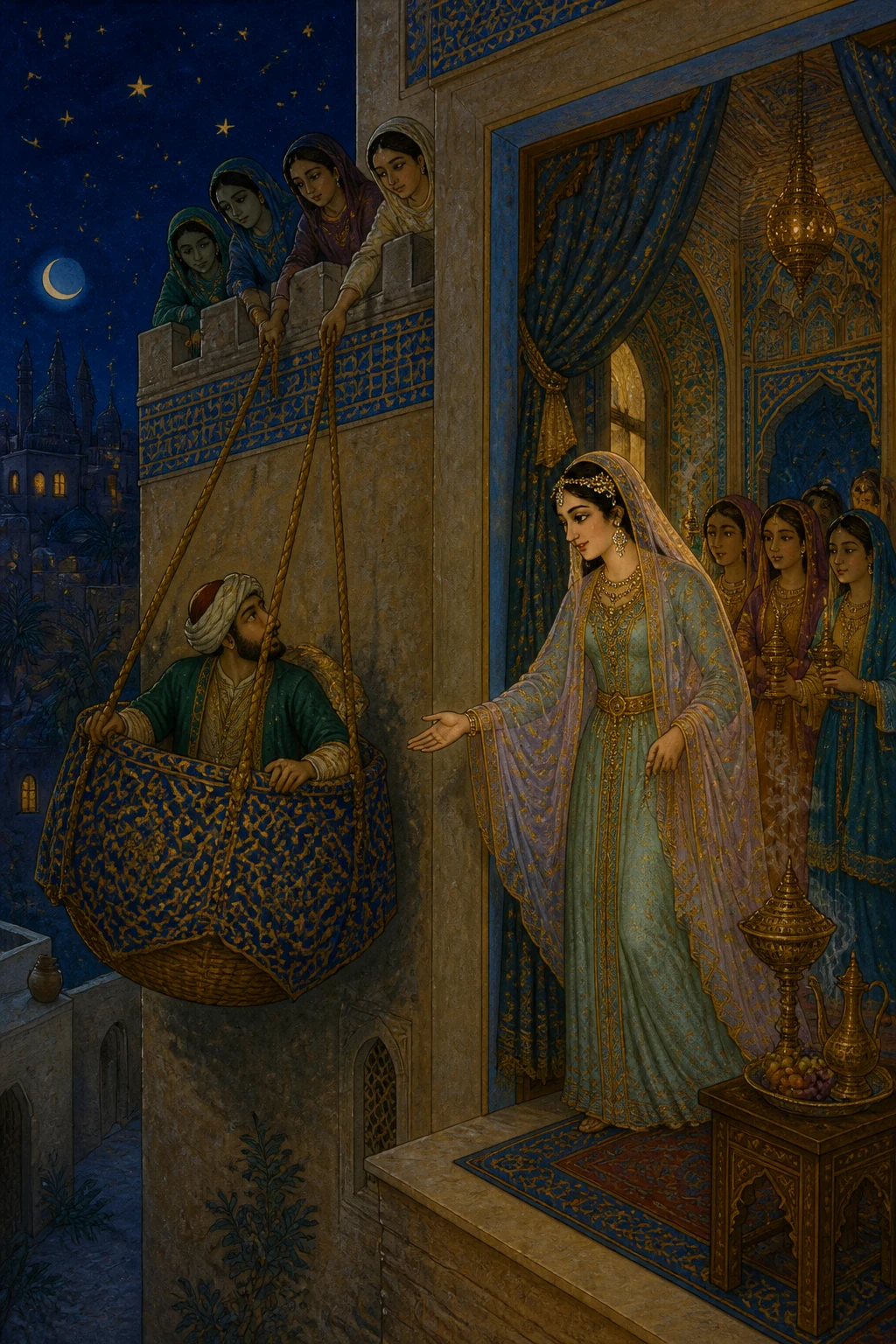
O musk-laden breezes from the land of Babylon, by my passion, carry my messages! In those lands I once knew the dwellings of our beloved—how noble those dwellings were! There lives she whose love has made every lover sing, though none has gained his heart’s desire. I stayed with her a month, then went to the old man and said, ‘I want the one who costs forty dinars.’ ‘Weigh out the gold for me,’ he replied. I weighed him twelve hundred dinars for a month, and stayed with her a month that seemed no more than a day, so lovely was she and so delightful her company. Then I went to the old man one evening and heard a great commotion and loud voices. ‘What is happening?’ I asked. He replied, ‘This is our most celebrated night, when everyone comes out to look at one another. Would you like to go up to the roof and watch the people?’ ‘Yes,’ I said. I went up to the roof and saw a fine curtain. Beyond it was a spacious place with a dais spread with beautiful bedding. There sat a young woman whose beauty, loveliness, shapeliness, and grace dazzled all who looked upon her. Beside her was a youth with his arm about her neck, kissing her while she kissed him in return. When I saw them, Commander of the Faithful, I lost all command of myself and no longer knew where I was, so overwhelmed was I by her beauty. When I came down, I asked the girl with whom I was staying about her and described her. ‘What have you to do with her?’ she asked. ‘By God,’ I replied, ‘she has stolen my reason!’ She smiled and said, ‘Abu al-Hasan, do you desire her?’ ‘Indeed, by God! She has taken possession of my heart and mind.’ ‘She is the daughter of Tahir ibn al-‘Ala,’ she said, ‘and our mistress; we are all her slaves. Do you know, Abu al-Hasan, what a day and a night with her cost?’ ‘No,’ I replied. ‘Five hundred dinars. She is the unfulfilled longing in the hearts of kings.’ ‘By God,’ I said, ‘I shall spend all my wealth upon this girl.’ I passed the whole night tormented by love. In the morning I went to the bath, put on the finest clothes worn by kings, and came to her father. ‘My lord,’ I said, ‘I want the one whose night costs five hundred dinars.’ ‘Weigh out the gold,’ he replied. I weighed him fifteen thousand dinars for a month. He took them and said to the serving boy, ‘Bring him to your mistress, so-and-so.’ The boy led me to a house more exquisite than any my eyes had ever seen upon the earth. I entered and found the young woman seated there. At the sight of her, Commander of the Faithful, her beauty bewildered my mind. She was like the full moon on its fourteenth night.” And dawn overtook Shahrazad, and she fell silent, leaving her tale untold.
When it was the nine hundred and fiftieth night,
She said: It has reached me, O fortunate King, that when the young man described the girl to the Commander of the Faithful, he said: “She was like the full moon on its fourteenth night, lovely and beautiful, shapely and graceful, with a voice that put the ringing of lutes to shame. She seemed the very woman meant by the poet who said:
She said, as desire stirred her supple body beneath the deep black folds of night: ‘O night, is there no companion to keep me company in your darkness? Is there no one to fuck this cunt?’ She struck it with her palm and sighed as one sighs in sorrow, grieving and in tears. A mouth’s beauty is revealed by the tooth-stick, and a cock is to cunts what the tooth-stick is to the mouth. ‘O Muslims, will your cocks not rise? Is there none among you to relieve a woman’s plaint?’ Then from beneath my garments my cock sprang up erect and said to her, ‘He comes to you! He comes!’ I loosened the knot of her drawers, and she started. ‘Who are you?’ ‘A youth who answered your call,’ I said. Then I thrust into her with a thing as long as her forearm, thrusting that gently bruised her hips. When I rose after three rounds, she said, ‘Did the fucking please you?’ I said, ‘And you!’ And how fine are the words of another poet:
Had she shown herself to idolaters, they would have taken her as their deity instead of their idols. Had she spat into the sea, salt though it is, its waters would have grown sweet from her saliva. Had she appeared in the east before a monk, he would have abandoned his eastward course and followed her west. And how fine are the words of another:
I cast one glance at her, and all the subtleties of my thought were lost in the wonder of her charms. Intuition whispered to her that I loved her, and that intuition left its mark upon her cheeks. I greeted her, and she said, ‘Welcome, welcome indeed!’ She took me by the hand, Commander of the Faithful, and seated me beside her. So great was my yearning that I wept for fear of parting, letting the tears stream from my eyes as I recited these two verses:
I love the nights of estrangement, not for any joy they bring, but in the hope that time may grant reunion after them. I dread the days of union, for I see that everything is followed by its end. Then she began to soothe me with gentle words, while I was drowning in the sea of love, fearing the pain of separation even as we sat together, so fierce were my passion and longing. Remembering the anguish of absence and parting, I recited these two verses:
In the hour of union I thought of separation, and tears flowed from my eyes as red as dragon’s blood. I began to wipe my eyes upon her neck, for camphor is known to staunch the flow of blood. Then she ordered food to be brought, and four full-breasted virgin girls came forward. They set before us food, fruit, sweets, fragrant flowers, and wine fit for kings. We ate, Commander of the Faithful, then sat over our wine, surrounded by sweet herbs, in a gathering worthy of none but a king. A girl brought her a silken case. She took it, drew out a lute, and laid it upon her lap. She touched its strings, and it cried out as a child cries to its mother. Then she sang these two verses:
Drink wine only from the hands of a gazelle-like youth, whom it resembles in delicacy, as he resembles it. For the drinker finds no pleasure in wine unless the one who pours it has a smooth, unblemished cheek. I lived with her in this fashion, Commander of the Faithful, for some time, until all my money was gone. As I sat beside her, the thought of leaving her came upon me. My tears ran down my cheeks like rivers, and I no longer knew night from day. ‘Why are you weeping?’ she asked. I replied, ‘My lady, ever since I came to you, your father has taken five hundred dinars from me every night, and now I have no money left. Truly the poet said:
Poverty makes exiles of us in our native land, while wealth makes a homeland for us in exile. She said, ‘Know that when a merchant staying with my father becomes penniless, it is his custom to entertain him for three days, then turn him out, never to return. But keep your secret and conceal your plight, and I shall devise a way for us to remain together as long as God wills, for I have a great love for you in my heart. All my father’s money is in my keeping, and he does not know how much there is. Each day I shall give you a purse containing five hundred dinars. Give it to my father and tell him, “From now on I shall pay only day by day.” Whenever you give it to him, he will hand it to me, and I shall give it back to you. Thus we shall continue as long as God wills.’ I thanked her and kissed her hand, and lived with her in this fashion, Commander of the Faithful, for a whole year. Then one day she beat her maidservant severely, and the girl said to her, ‘By God, I shall hurt your heart as you have hurt me!’ She went to her mistress’s father and told him everything about us, from beginning to end. When Tahir ibn al-‘Ala heard her account, he rose at once and came in while I was sitting with his daughter. ‘You there!’ he said. ‘At your service,’ I replied. ‘It is our custom,’ he said, ‘that when a merchant staying with us becomes penniless, we entertain him for three days. Yet you have been here a whole year, eating, drinking, and doing as you please!’ He turned to his servants and said, ‘Strip off his clothes.’ They did so and gave me shabby garments worth five dirhams, then handed me ten dirhams. He said, ‘Get out! I shall neither beat you nor insult you. Go your way, but if you remain in this city, your blood may be shed with impunity.’ So I went out against my will, Commander of the Faithful, not knowing where to turn. Every sorrow in the world settled in my heart, and dark thoughts consumed me. I said to myself, ‘How could I come across the sea with a hundred million, including the price of thirty ships, only to squander it all in the house of this ill-omened old man and leave him naked and brokenhearted? There is no power and no strength save in God, the Most High, the Almighty!’ I remained in Baghdad for three days without tasting food or drink. On the fourth day I saw a vessel bound for Basra. I boarded it and agreed on a fare with its master, and at last it reached Basra. I entered the market, ravenous with hunger. A grocer saw me and came forward to embrace me, for he had been a friend of mine and of my father before me. He asked how I fared, and I told him all that had happened. ‘By God,’ he said, ‘these are not the deeds of a sensible man! But now that all this has befallen you, what do you intend to do?’ ‘I do not know,’ I replied. ‘Will you stay with me,’ he asked, ‘and keep an account of my expenses and receipts? You shall have two dirhams a day, besides your food and drink.’ I accepted and stayed with him, Commander of the Faithful, for a whole year, buying and selling until I had a hundred dinars. Then I rented a room by the sea, hoping that a ship would arrive with merchandise, so that I might spend my dinars on goods and take them to Baghdad. One day a ship came in, and all the merchants went to buy from it. I went with them. Two men emerged from the hold, had two chairs set up, and seated themselves upon them. The merchants approached to make their purchases, and the men told some servants, ‘Bring the carpet.’ They brought it, and another servant came with a pair of saddlebags. He took out a leather bag, opened it, and emptied it onto the carpet. Its contents dazzled the eyes: gems, pearls, coral, rubies, and agates of every hue.” And dawn overtook Shahrazad, and she fell silent, leaving her tale untold.
When it was the nine hundred and fifty-first night,
She said: It has reached me, O fortunate King, that when the young man told the Caliph about the merchants, the leather bag, and all the kinds of jewels it contained, he continued: “Commander of the Faithful, one of the two men seated upon the chairs turned to the merchants and said, ‘Merchants, I shall not sell today, for I am weary.’ The merchants went on bidding against one another until the price reached four hundred dinars. The owner of the bag, with whom I had an old acquaintance, said to me, ‘Why have you said nothing and made no bid like the other merchants?’ ‘By God, my lord,’ I replied, ‘I have nothing left in this world but a hundred dinars.’ I felt ashamed before him, and tears came to my eyes. He looked at me, distressed by my plight, then said to the merchants, ‘Bear witness that I have sold all the jewels and precious minerals in this bag to this man for a hundred dinars, though I know they are worth so many thousand dinars. It is a gift from me to him.’ He gave me the saddlebags, the leather bag, the carpet, and all the jewels upon it. I thanked him, and all the merchants present praised him. Then I took everything to the jewel market and began buying and selling. Among these precious stones was a talismanic disc made by master craftsmen, weighing half a ratl. It was a deep, vivid red, with lines of writing on both sides as fine as the tracks of ants, but I did not know what use it served. I bought and sold for a whole year. Then I took up the talismanic disc and said, ‘I have had this for some time, yet I do not know what it is or what it is good for.’ I gave it to the broker, who carried it around, then returned and said, ‘None of the merchants has offered more than ten dirhams for it.’ ‘I shall not sell it for that!’ I said. He flung it in my face and went away. I offered it for sale another day, and the bidding reached fifteen dirhams. Angrily, I took it back from the broker and tossed it aside.
“One day, while I was sitting there, a man approached, greeted me, and said, ‘With your permission, may I examine your wares?’ ‘Yes,’ I replied. I was still vexed, Commander of the Faithful, because no one wanted the talismanic disc. The man examined the goods but picked up nothing except the disc. When he saw it, Commander of the Faithful, he kissed his hand and said, ‘Praise be to God!’ Then he asked, ‘My lord, will you sell this?’ My annoyance grew, and I said, ‘Yes.’ ‘What is its price?’ ‘What will you give for it?’ I asked. ‘Twenty dinars,’ he replied. Thinking he was mocking me, I said, ‘Go on your way.’ ‘Then fifty dinars,’ he said. I did not speak to him. ‘A thousand dinars,’ he said. All this time, Commander of the Faithful, I remained silent and gave him no answer, while he laughed at my silence and asked, ‘Why do you not answer me?’ ‘Go on your way,’ I said, and was about to quarrel with him. But he went on raising his offer, a thousand at a time, while I made no reply, until he said, ‘Will you sell it for twenty thousand dinars?’ I still thought he was mocking me. People gathered around us, and they all told me, ‘Sell it! If he does not buy it, we shall all turn on him, beat him, and drive him out of town.’ I asked him, ‘Are you buying, or are you making a mockery of me?’ He replied, ‘Are you selling, or are you making a mockery of me?’ ‘I am selling,’ I said. ‘Then thirty thousand dinars,’ he replied. ‘Take them and conclude the sale.’ I said to those present, ‘Bear witness against him—but on condition that you tell me what it is good for and what use it serves.’ ‘Conclude the sale,’ he said, ‘and I shall tell you its purpose and its use.’ ‘I sell it to you,’ I said. ‘God is witness to what I say,’ he replied. He brought out the gold and paid it to me, took the talismanic disc, and put it in his pocket. Then he asked, ‘Are you satisfied?’ ‘Yes,’ I replied. ‘Bear witness,’ he said, ‘that he has concluded the sale and received the price of thirty thousand dinars.’ Then he turned to me and said, ‘Poor fellow! By God, had you held back from selling, we would have raised our offer to a hundred thousand dinars—indeed, to a million!’ When I heard these words, Commander of the Faithful, the blood fled from my face, and from that day it took on the yellow pallor you now see. I asked him, ‘Tell me why. What is the use of this disc?’ He replied, ‘Know that the King of India has a daughter more beautiful than any ever seen, but she suffers from a malady of the head. The king summoned scholars, men of learning, and soothsayers, but none could relieve her. I was present at his court and said, “O King, I know a man called Sa‘d Allah al-Babili. There is no one on earth more knowledgeable in such matters. If you see fit to send me to him, do so.” “Go to him,” he said. I asked him to have a piece of agate brought to me. He gave me a large piece of agate, a hundred thousand dinars, and a gift. I took them and traveled to the land of Babylon. I asked for the sheikh, and they directed me to him. I handed him the hundred thousand dinars and the gift, which he accepted. Then he took the piece of agate and summoned an engraver, who fashioned it into this amulet. For seven months the sheikh watched the stars until he chose an auspicious moment for the inscription and wrote upon it these talismanic signs you see. Then I brought it to the king.’” And dawn overtook Shahrazad, and she fell silent, leaving her tale untold.
When it was the nine hundred and fifty-second night,
She said: It has reached me, O fortunate King, that the young man said to the Commander of the Faithful: “The man told me, ‘I took this amulet and brought it to the king. As soon as he placed it upon his daughter, she recovered. She had been bound with four chains, and each night a slave girl would keep watch beside her, only to be found with her throat cut in the morning. Yet the moment this amulet was laid upon her, she was cured. The king rejoiced greatly, bestowed a robe of honor upon me, and gave much money in charity. Then he fastened it to her necklace. One day she went aboard a boat with her slave girls to take her pleasure upon the sea. One of the girls reached out to play with her, and the necklace broke and fell into the water. From that moment the affliction returned to the king’s daughter, and the king was overcome with grief. He gave me a great sum of money and said, “Go to the sheikh and have him make her another amulet in its place.” I traveled to him, but found that he had died. I returned to the king and told him, and he sent me with ten other men to wander through the countries in the hope of finding a cure for her. And God has led me to it here with you.’ So he took it from me, Commander of the Faithful, and went away. That affair was the cause of the yellow pallor in my face.
“Then I set out for Baghdad with all my wealth and lodged in the same house as before. When morning came, I dressed and went to the house of Tahir ibn al-‘Ala, hoping to see the woman I loved, for my love for her had only grown in my heart. When I reached his house, I saw that the latticed window had been torn down. I asked a servant, ‘What has God done with the old man?’ He replied, ‘Brother, one year a merchant called Abu al-Hasan al-‘Umani came to him and lived with his daughter for some time. When his money was gone, the old man turned him out, brokenhearted. The girl loved him dearly, and after he left her she fell so gravely ill that she came close to death. When her father learned of this, he sent men throughout the lands to search for him, promising a hundred thousand dinars to whoever brought him back. But no one has seen him or found any trace of him, and she remains at death’s door.’ ‘And how is her father?’ I asked. ‘He has sold the slave girls, so great is the calamity that has befallen him.’ I said, ‘Shall I show you where Abu al-Hasan al-‘Umani is?’ ‘For God’s sake, brother,’ he replied, ‘show him to me!’ ‘Go to her father,’ I said, ‘and tell him, “You owe me a reward for good news: Abu al-Hasan al-‘Umani is standing at the door.”’ The man ran off like a mule released from a mill. He was gone a little while, then returned with the old man. When the old man saw me, he went back into his house and gave the man a hundred thousand dinars. The man took them and departed, blessing me. Then the old man came forward, embraced me, and wept. ‘My lord,’ he said, ‘where have you been all this time? My daughter is dying because she is parted from you. Come into the house with me.’ When I entered, he prostrated himself in thanks to Almighty God and said, ‘Praise be to God, who has brought us together again!’ Then he went in to his daughter and said, ‘God has cured you of this illness.’ She replied, ‘Father, I shall not recover from my illness unless I see Abu al-Hasan’s face.’ ‘When you have eaten a meal and gone to the bath,’ he said, ‘I shall bring you together.’ Hearing this, she asked, ‘Is what you say true?’ ‘By Almighty God,’ he replied, ‘what I have told you is true.’ ‘By God,’ she said, ‘if I see his face, I shall have no need of food.’ He told his servant, ‘Bring in your master.’ I entered, and when she saw me, Commander of the Faithful, she fainted. When she recovered, she recited this verse:
God may bring together two who have been parted, after they have utterly despaired of ever meeting again. Then she sat upright and said, ‘By God, my lord, I never thought I should see your face again except in a dream.’ She embraced me and wept, then said, ‘Abu al-Hasan, now I shall eat and drink.’ They brought food and drink, and I remained with them, Commander of the Faithful, for some time, until her former beauty returned. Then her father summoned the judge and the witnesses, had our marriage contract drawn up, and gave a splendid feast. She is my wife to this day.”
Then the young man rose and left the caliph, returning with a boy of exquisite beauty, graceful and well proportioned. “Kiss the ground before the Commander of the Faithful,” he told him. The boy kissed the ground before the caliph, who marvelled at his beauty and glorified his Creator. Then al-Rashid departed with his companions, saying, “Ja‘far, this is a wonder indeed! Never have I seen or heard anything stranger!” When al-Rashid was seated in the palace of the caliphate, he called, “Masrur!” “At your service, my lord,” he replied. “Bring into this hall the revenues of Basra, Baghdad, and Khurasan.” Masrur gathered them there, and they amounted to a vast fortune whose extent God alone could reckon. Then the caliph called, “Ja‘far!” “At your service,” he replied. “Bring me Abu al-Hasan.” “I hear and obey.” He brought him, and when Abu al-Hasan arrived, he kissed the ground before the caliph, fearful that he had been summoned because of some offence he had committed while the caliph was a guest in his house. Al-Rashid said, “Omani!” “At your service, Commander of the Faithful,” he replied. “May God perpetuate His blessings upon you.” “Draw back this curtain,” said the caliph. For he had ordered that the revenues of the three provinces be placed in the hall and concealed behind a curtain. When the Omani drew it aside, he was dumbfounded by the wealth before him. The caliph said, “Abu al-Hasan, is this fortune greater, or the one you lost through the amulet disc?” “This is many times greater, Commander of the Faithful,” he replied. Al-Rashid said, “Let all who are present bear witness that I have bestowed this wealth upon this young man.” Abu al-Hasan kissed the ground and, overcome with bashfulness and joy, wept before al-Rashid. As he wept and the tears ran down his cheeks, the blood returned to its proper place, and his face became like the moon on the night of its fullness. The caliph said, “There is no god but God! Glory be to Him who changes one condition into another, while He abides unchanged!” Then he had a mirror brought and showed him his face in it. When Abu al-Hasan saw it, he prostrated himself in gratitude to God Most High. The caliph then ordered the wealth to be carried to his house and asked him not to cease coming to keep him company. So he continued to visit him until the caliph passed into the mercy of God Most High. Glory be to the Ever-Living who never dies, Lord of all dominion and sovereignty.