Prevod
It is also related, O fortunate King, that al-Mu‘tadid Billah was a man of lofty ambition and noble spirit. He had six hundred viziers in Baghdad, and nothing concerning his subjects escaped his notice. One day he went out with Ibn Hamdun to observe the people and hear their latest news. The midday heat grew fierce, and when they came to a pleasant alley opening off a street, they turned into it. At its far end they saw a handsome house, its lofty buildings proclaiming its owner’s worth more eloquently than words of praise. They sat down at the gate to rest, and two servants came out, each as fair as the moon on its fourteenth night. One said to the other, “If only some guest would ask admittance today! My master never eats except in the company of guests, yet it is already this late and I have seen no one.” The Caliph marvelled at their words and said, “This is proof of the owner’s generosity. We must enter his house and see his hospitality for ourselves, so that we may find occasion to bestow some favour upon him.” Then he said to the servant, “Ask your master’s leave for a party of strangers to enter.” In those days, whenever the Caliph wished to observe his subjects, he disguised himself as a merchant. The servant went in and told his master, who was delighted and rose to welcome them himself. He was a handsome man of pleasing appearance, wearing a Nishapuri shirt and a gold-embroidered cloak. He was fragrant with perfume and wore a ruby ring on his hand. When he saw them, he said, “Welcome, gentlemen! By coming here you have bestowed upon us the greatest of favours.” They entered the house and found it a place that could make a man forget his family and homeland, as though it were a piece of Paradise. But morning overtook Shahrazad, and she ceased her permitted tale.
When it was the nine hundred and sixtieth night
She said: It has reached me, O fortunate King, that when the Caliph and his companion entered the house, they found it a place that could make a man forget his family and homeland, as though it were a piece of Paradise. Within lay a garden filled with trees of every kind, a wonder to behold, and its rooms were furnished with the finest carpets and cushions. They sat down, and al-Mu‘tadid began to examine the house and its furnishings. Ibn Hamdun said: “I looked at the Caliph and saw that his expression had changed. I knew how his face looked in pleasure and in anger, and when I saw him I said to myself, ‘What can have angered him?’ Then they brought a golden basin, and we washed our hands. Next they spread a silk cloth and set a bamboo table upon it. When the covers were lifted from the dishes, we saw food as lovely as spring flowers in their prime, in pairs and singly. The master of the house said, ‘In the name of God, my lords! Hunger has quite worn me out, so do me the kindness of eating this food, as generous men are wont to do.’ He began carving the chickens and setting portions before us, laughing, reciting poetry, telling stories, and enlivening the gathering with graceful conversation. We ate and drank, then were led to another room, astonishing to behold and filled with sweet perfumes. There he offered us freshly gathered fruit and delicious sweetmeats, and our joy increased while our cares departed. Yet through all this the Caliph remained grim and never smiled at anything that gladdened the heart, though he usually loved amusement and music and the banishment of care. I knew him to be neither envious nor unjust, so I said to myself, ‘What can be the cause of this frown, and why does his displeasure linger?’
“Then they brought the wine tray, which draws friends together, and set out clear wine and bowls of gold, crystal, and silver. Our host tapped with a bamboo wand upon the door of an inner chamber. It opened, and out came three young slave girls, full-breasted virgins whose faces shone like the midday sun: a lute-player, a harpist, and a dancer. He then set dried fruits and fresh fruit before us. A brocade curtain was hung between us and the three girls, with silken tassels and golden rings. The Caliph paid no attention to any of this, while our host had no idea whom he was entertaining. At last the Caliph asked him, ‘Are you descended from the Prophet?’ ‘No, my lord,’ he replied. ‘I am merely the son of a merchant, known among men as Abu al-Hasan Ali ibn Ahmad al-Khurasani.’ The Caliph asked, ‘Do you know who I am?’ He answered, ‘By God, my lord, I have never had the honour of knowing any of you gentlemen.’ Then Ibn Hamdun said, ‘This is the Commander of the Faithful, al-Mu‘tadid Billah, grandson of al-Mutawakkil ‘ala Allah.’ The man rose and kissed the ground before the Caliph, trembling with fear. ‘Commander of the Faithful,’ he said, ‘by your pure forefathers, if you have seen any failing or discourtesy in my conduct before you, forgive me.’ The Caliph replied, ‘As for your hospitality, nothing could surpass it. But there is something here of which I disapprove. If you tell me the truth about it and your explanation satisfies my reason, you will escape my wrath. If you do not reveal the truth, I shall have clear grounds against you and will punish you as I have punished no man before.’ ‘God forbid that I should tell you anything false!’ he answered. ‘What is it that you disapprove of, Commander of the Faithful?’ The Caliph said, ‘Ever since I entered this house I have been looking at its beauty, its vessels, furnishings, and ornaments—even your clothes—and I find upon them the name of my grandfather, al-Mutawakkil ‘ala Allah.’ He replied, ‘Yes, Commander of the Faithful—may God uphold you! Know that justice is your watchword and truth your mantle, and no man can speak anything but the truth in your presence.’ The Caliph bade him sit, and when he had done so, said, ‘Tell me your story.’ He answered, ‘Know, Commander of the Faithful—may God support you with His victory and surround you with His gracious care—that no one in Baghdad was wealthier than my father and myself. But give me your undivided attention, your ears and your eyes, so that I may explain the things you have found objectionable.’ ‘Tell your tale,’ said the Caliph.
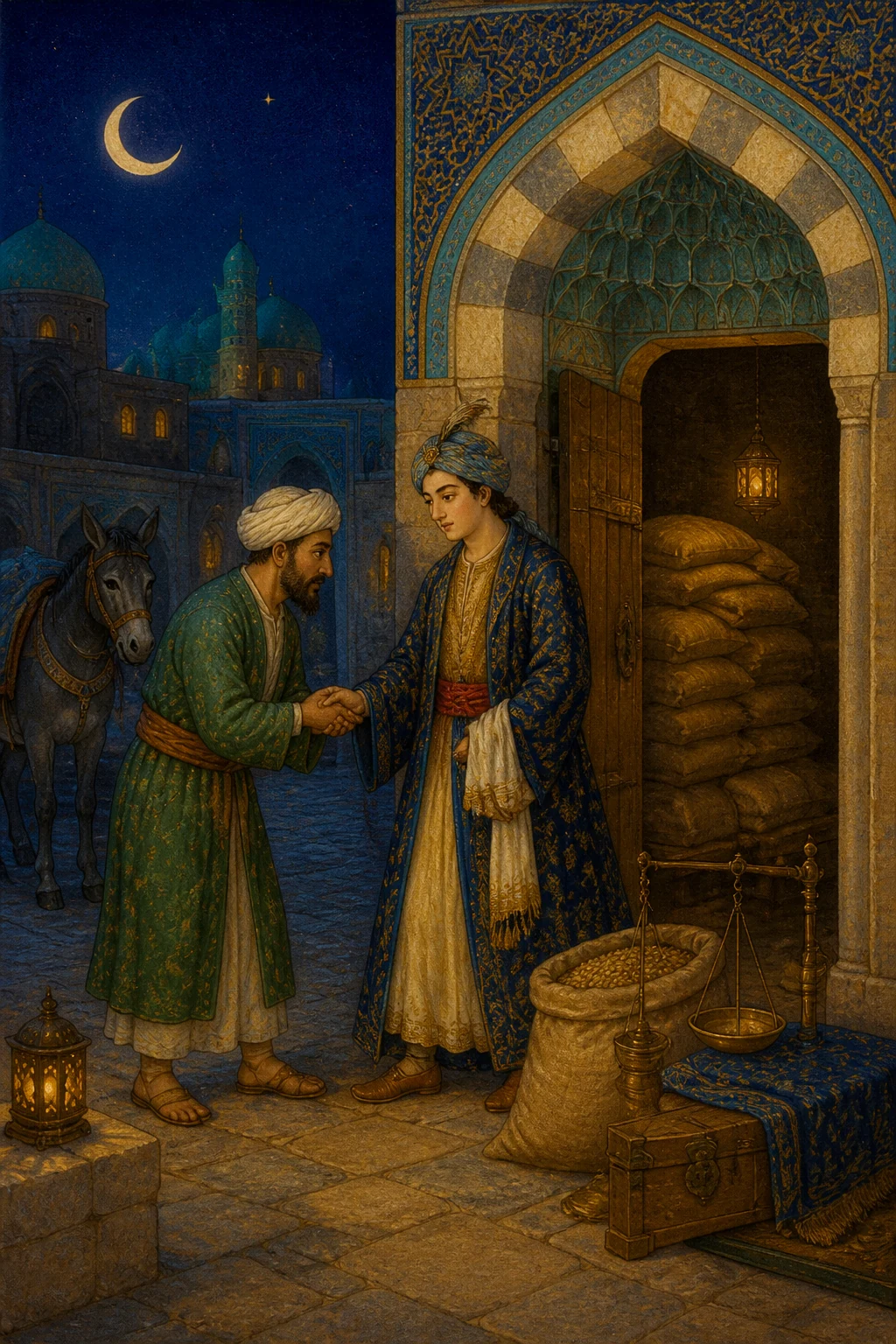
“He began: ‘Know, Commander of the Faithful, that my father traded in the markets of the money-changers, the perfumers, and the cloth merchants. In each market he had a shop, an agent, and merchandise of every kind. At the back of his shop in the money-changers’ market he had a private chamber where he could withdraw, while the shop itself was used for buying and selling. His wealth was beyond counting and knew no bounds. I was his only child, and he loved me dearly and treated me tenderly. When death drew near, he summoned me and charged me to care for my mother and fear God Most High. Then he died—may God have mercy on him and preserve the Commander of the Faithful. I gave myself up to pleasure, eating and drinking, and gathered friends and companions around me. My mother forbade this and reproached me, but I would not listen until all the money was gone and I had sold the properties. Nothing remained to me but the house in which I lived, a handsome house, Commander of the Faithful. I said to my mother, “I want to sell the house.” She replied, “My son, if you sell it, you will be disgraced and have nowhere to shelter.” “It is worth five thousand dinars,” I said. “With part of the price I shall buy a house for a thousand and trade with the rest.” She asked, “Will you sell me this house for that sum?” “Yes,” I answered. She went to a trapdoor, opened it, and brought out a porcelain vessel containing five thousand dinars. It seemed to me then that the whole house must be filled with gold. But she said, “My son, do not imagine that this money belonged to your father. By God, it came from my own father, and I saved it against a time of need, for while your father lived I had no need to touch it.” I took the money from her, Commander of the Faithful, and returned to my eating, drinking, and companions until the five thousand dinars were spent. I would heed neither my mother’s words nor her advice. Then I told her, “I intend to sell the house.” She answered, “My son, I forbade you to sell it because I knew you would need it. How can you wish to sell it a second time?” I said, “Spare me your lengthy speeches. Sell it I must.” “Then sell it to me for fifteen thousand dinars,” she replied, “on condition that I manage your affairs myself.” So I sold it to her for that sum on the condition she had named. She summoned my father’s agents and gave each of them a thousand dinars, keeping the money under her own control and overseeing every payment and receipt. She gave me some money to trade with and told me, “Take your place in your father’s shop.” I did as she said, Commander of the Faithful, and went to the chamber in the money-changers’ market. My companions came and bought from me, and I sold to them. I began to enjoy making a profit, and my wealth increased. When my mother saw how well I was doing, she revealed the jewels, precious metals, pearls, and gold she had stored away. In time I recovered the properties I had squandered, and my fortune grew as great as before. I continued thus for a while, and my father’s agents came to me and I supplied them with merchandise.
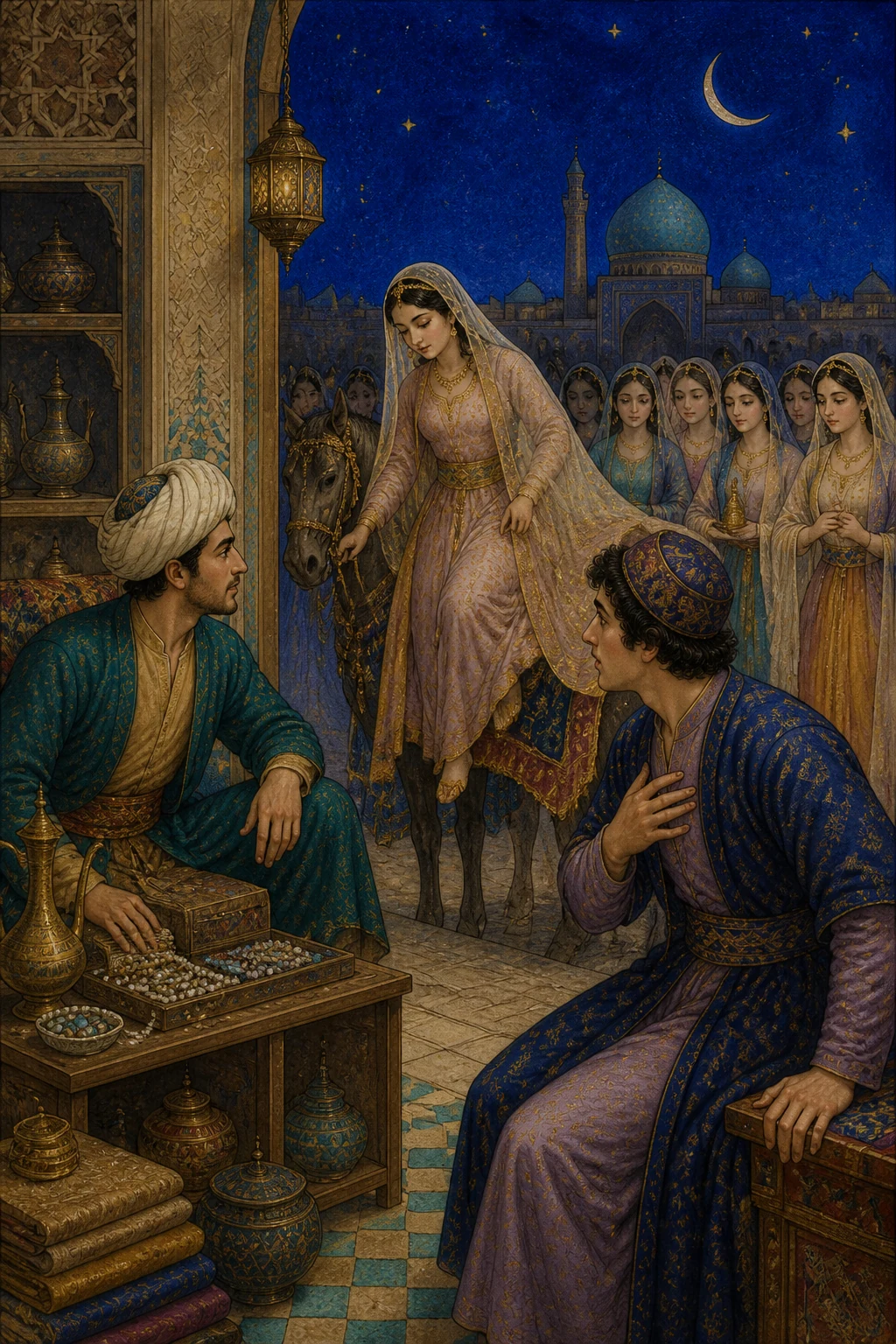
“‘Then I built a second chamber behind the shop. One day, Commander of the Faithful, while I was sitting there as usual, a young woman came to me, more beautiful than any the eye had ever seen. “Is this the chamber of Abu al-Hasan Ali ibn Ahmad al-Khurasani?” she asked. “Yes,” I replied. “Where is he?” “I am he,” I said, though her extraordinary beauty had bewildered my senses. She sat down and said, “Tell your servant to weigh out three hundred dinars for me.” I ordered him to weigh out that sum, and she took it and went away, leaving me utterly dazed. My servant asked, “Do you know her?” “No, by God.” “Then why did you tell me to weigh out the money for her?” I answered, “By God, her loveliness so dazzled me that I did not know what I was saying.” Without my knowledge the servant rose and followed her. He returned weeping, with the mark of a blow upon his face. “What happened to you?” I asked. He said, “I followed the young woman to see where she was going. When she noticed me, she turned and struck me this blow, almost putting out my eye.” A month passed without my seeing her or receiving a visit, and all that time, Commander of the Faithful, love for her left me beside myself. At the end of the month she came and greeted me, and I almost flew for joy. She asked how I had been, then said, “Perhaps you said to yourself, ‘What sort of swindler is this, who takes my money and goes away?’” I answered, “By God, my lady, both my wealth and my life are yours.” She unveiled her face and sat down to rest, her jewels and rich garments shimmering about her face and breast. Then she said, “Weigh out three hundred dinars for me.” “Gladly and obediently,” I replied. I weighed out the dinars, and she took them and left. I told the servant, “Follow her.” He did so, then returned in bewilderment. Some time passed without her coming. Then one day, as I sat there, she appeared, spoke with me for a while, and said, “Weigh out five hundred dinars for me, for I am in need of them.” I wanted to ask, “On what account am I giving you my money?” But the strength of my passion silenced me. Whenever I saw her, Commander of the Faithful, my limbs trembled, my face grew pale, and I forgot what I meant to say. I became as the poet describes:
“‘No sooner do I see her suddenly than I am struck dumb, scarcely able to reply. Then I weighed out the five hundred dinars for her, and she took them and went away. I rose and followed her myself until she reached the jewellers’ market. She stopped at a man’s shop and took a necklace from him. Turning, she saw me and said, “Weigh out five hundred dinars for me.” When the owner of the necklace saw me, he rose to greet me with great respect. I said to him, “Give her the necklace, and charge the price to me.” “Gladly and obediently,” he answered. She took the necklace and went away.’ But morning overtook Shahrazad, and she ceased her permitted tale.
When it was the nine hundred and sixty-first night
She said: It has reached me, O fortunate King, that Abu al-Hasan al-Khurasani said: “‘I told him, “Give her the necklace, and charge the price to me.” She took it and went away, and I followed her until she reached the Tigris and stepped into a boat. I bent towards the ground to kiss it before her, and she departed laughing. I stood watching until she entered a palace. Looking closely, I saw that it was the palace of the Caliph al-Mutawakkil. I returned, Commander of the Faithful, with every sorrow in the world lodged in my heart. She had taken three thousand dinars from me, and I said to myself, “She has taken my money and stolen my reason. Perhaps love for her will cost me my life as well!” I went home and told my mother everything that had happened. “My son,” she said, “take care never to approach her again, or you will perish!” When I went to my shop, my agent in the perfumers’ market, an elderly man, came to me and said, “My master, why do I see you so changed and so plainly sorrowful? Tell me what has happened.” I told him all that had passed between us. He said, “My son, she is one of the slave girls of the Commander of the Faithful’s palace, and a favourite of the Caliph. Count the money as given for God’s sake, and think no more of her. If she comes again, beware of letting her draw you in, and tell me, so that I may contrive some means of saving you from destruction.” Then he left me, with fire raging in my heart. At the end of the month she came again, to my boundless delight. “What made you follow me?” she asked. I replied, “The overwhelming longing in my heart.” I wept before her, and she wept in pity for me. “By God,” she said, “there is no love in your heart that is not surpassed by the love in mine. But what can I do? By God, I have no means of seeing you more than once a month.” Then she handed me a paper and said, “Take this to so-and-so, my agent, and receive from him the sum written in it.” I answered, “I have no need of money. My wealth and my life are your ransom.” “I shall find some way for you to reach me,” she said, “even if it costs me trouble.” Then she bade me farewell and left.
“‘I went to the old perfumer and told him what had happened. He came with me to al-Mutawakkil’s palace, and I recognized it as the place the young woman had entered. The old man pondered what device he might employ. Then he turned and saw a tailor with his workmen, opposite a window overlooking the riverbank. “Through this man you will gain your desire,” he said. “Unpick the neck of your robe, go to him, and ask him to mend it. When he has done so, give him ten dinars.” “Gladly and obediently,” I replied. I went to the tailor, taking two lengths of Byzantine brocade, and said, “Cut these into four garments, two open-fronted robes and two of another kind.” When he had finished cutting and sewing them, I paid him far more than his usual wage. He handed me the garments, but I said, “Keep them for yourself and those who are here with you.” I began to sit with him for long stretches of time. Then I had him make other garments and told him, “Hang them at the front of the shop, so that passers-by may see them and buy them.” He did so, and whenever anyone coming out of the Caliph’s palace admired a garment, I gave it to him—even the gatekeeper. One day the tailor said, “My son, I want you to tell me the truth about yourself. You have had me make a hundred costly suits, each worth a considerable sum, and you have given most of them away. This is no merchant’s conduct, for a merchant reckons every dirham. How great can your capital be, that you make such gifts? What can your yearly profit amount to? Tell me the truth, so that I may help you gain your desire.” Then he said, “I adjure you by God, are you not in love?” “Yes,” I answered. “With whom?” “With one of the slave girls in the Caliph’s palace.” “God confound them!” he exclaimed. “How many men they bewitch!” Then he asked, “Do you know her name?” “No,” I said. “Describe her to me.” I did so, and he cried, “Alas! She is al-Mutawakkil’s lute-player and his favourite. But she has a young male slave. Make friends with him, and perhaps he may bring you together.”
“‘While we were talking, the young slave came out through the Caliph’s gate, looking like the moon on its fourteenth night. Before me lay the garments the tailor had made, of brocade in every colour. The youth began to look them over, then approached me. I rose and greeted him. “Who are you?” he asked. “A merchant,” I replied. “Do you sell these clothes?” “Yes.” He chose five and asked, “What is the price of these five?” I answered, “They are a gift from me to you, to bind a friendship between us.” He was delighted. Then I went home and fetched him a garment studded with gems and rubies, worth three thousand dinars. I took it to him, and he accepted it. He brought me into a chamber within the palace and asked, “By what name are you known among the merchants?” “I am merely one of them,” I replied. “Your conduct has made me suspicious,” he said. “Why?” “Because you have given me so much that you have won my heart. I am now certain that you are Abu al-Hasan al-Khurasani, the money-changer.” I began to weep, Commander of the Faithful. “Why do you weep?” he asked. “By God, the woman for whom you weep feels an even greater and deeper love for you than you feel for her. Every slave girl in the palace knows the story of you two.” Then he asked, “What do you wish?” I replied, “I wish you to help me in my distress.” He promised to do so the next day, and I went home. In the morning I returned and entered his chamber. When he came, he said, “Yesterday, when she had finished attending the Caliph and retired to her chamber, I told her your whole story. She has resolved to meet you, so remain here with me until the end of the day.” I stayed with him. When night fell, he brought me a shirt woven with gold and one of the Caliph’s suits of clothes. He dressed me in them and perfumed me with incense, so that I resembled the Caliph. Then he led me to a passage with chambers ranged on either side and said, “These are the chambers of the Caliph’s favourite slave girls. As you pass, place a broad bean at every door, for that is what the Caliph does each night.”’ But morning overtook Shahrazad, and she ceased her permitted tale.
When it was the nine hundred and sixty-second night
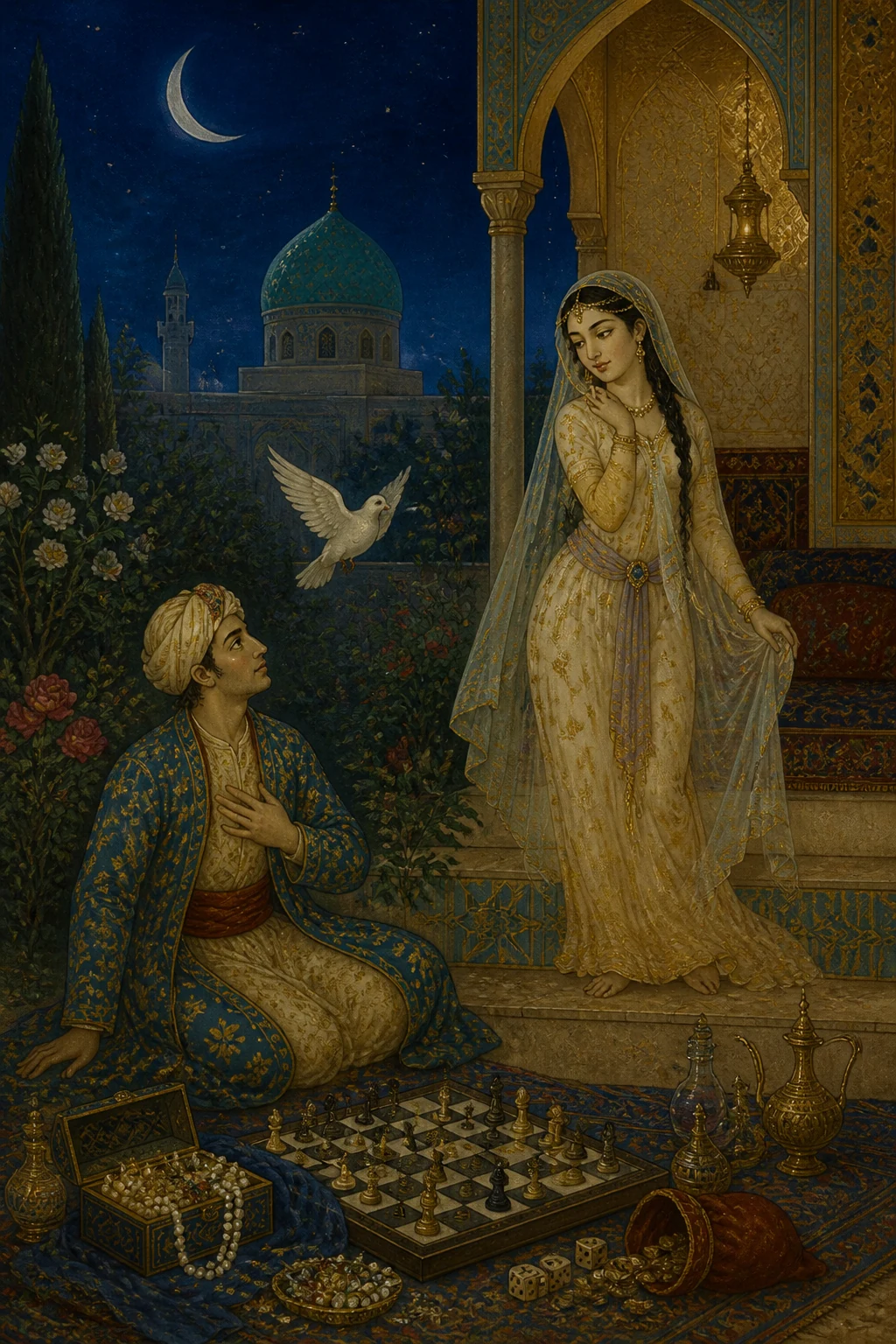
She said: It has reached me, O fortunate King, that the young slave said to Abu al-Hasan: “‘As you pass, place a broad bean at every door, for that is the Caliph’s custom, until you reach the second passage on your right. There you will see a chamber with a marble threshold. When you reach it, feel it with your hand. If you wish, count the doors: there are so many of them. Enter the door marked in such-and-such a way, and your beloved will see you and take you in. As for getting you out, God will make that easy for me, even if I have to carry you out in a chest.” Then he left me and went back. I walked on, counting the doors and placing a broad bean at each. When I was halfway among the chambers, I heard a great commotion and saw the light of candles coming towards me. As it drew near, I looked closely and saw the Caliph surrounded by slave girls carrying candles. I heard one of them say to another, “Sister, have we two caliphs? The Caliph has already passed my chamber. I smelled his perfume and incense, and he placed a broad bean at my door as usual. Yet now I see the light of the Caliph’s candles, and here he comes with them!” The other replied, “This is strange indeed, for no one would dare dress in the Caliph’s clothes!” The light drew closer, and all my limbs began to shake. Then a servant called to the girls, “Here!” They turned aside into one of the chambers, entered it, and came out again. They walked on until they reached my beloved’s room, and I heard the Caliph ask, “Whose chamber is this?” “It is Shajarat al-Durr’s,” they replied. “Call her,” he said. They called her, and she came out and kissed the Caliph’s feet. He asked, “Will you drink tonight?” She answered, “Were it not for your presence and the sight of your face, I would not drink, for I have no inclination for wine tonight.” He told the servant, “Tell the treasurer to give her such-and-such a necklace.” Then he ordered them to enter her chamber, and the candles went in before him. One of the girls was walking ahead, and the radiance of her face outshone the candle she carried. She came close to me and said, “Who is this?” Then she seized me and took me into one of the chambers. “Who are you?” she asked. I kissed the ground before her and said, “I implore you by God, my lady, spare my blood and have mercy on me. Save my life, and earn God’s favour.” I wept in terror of death. “You must be a thief,” she said. “No, by God, I am no thief,” I answered. “Do you see any sign of a thief about me?” “Tell me the truth,” she said, “and I will keep you safe.” I replied, “I am a foolish, ignorant lover. Passion and ignorance have driven me to what you see and brought me into this peril.” She said, “Stay here until I return.” She went out and brought back the clothes of one of her slave girls, dressed me in them in that corner, and said, “Come out behind me.” I followed her until she reached her chamber. “Come in here,” she said. I entered, and she led me to a couch spread with splendid bedding. “Sit down,” she said. “You need not fear. Are you not Abu al-Hasan al-Khurasani, the money-changer?” “I am,” I replied. “Then God has spared your blood, if you are speaking the truth and are no thief. Otherwise you would perish, especially dressed in the Caliph’s clothes and scented with his incense. But if you are Abu al-Hasan al-Khurasani, you are safe and have nothing to fear, for you are the beloved of Shajarat al-Durr, who is my sister. She never ceases speaking of you. She tells us how she took your money and your affection never changed, and how you followed her to the riverbank and bent towards the ground in reverence before her. The fire in her heart for you burns more fiercely than yours for her. But how did you get here? Did she bid you come, or did you come without her leave? You have indeed risked your life! What do you seek in meeting her?” I answered, “By God, my lady, I ventured here of my own accord. I desire nothing from meeting her but to look upon her and listen to her speech.” “Well said,” she replied. I told her, “My lady, God is witness to what I say: not once has my soul suggested any sin with her.” She said, “It is through that intention that God has saved you and put compassion for you into my heart.” Then she told her servant girl, “Go to Shajarat al-Durr and say, ‘Your sister sends you greetings and invites you to visit her tonight, as you are accustomed to do, for she is troubled at heart.’” The girl went, then returned with this answer: “May God grant me the joy of your long life, and make me your ransom! By God, had you invited me to anything else, I would not have hesitated, but I dread the trouble the Caliph may cause, and you know my position with him.” She told the girl, “Go back and say, ‘You must come, for there is a secret matter between you and her.’” The girl went away, and after a while returned with Shajarat al-Durr, whose face shone like the full moon. Her sister greeted and embraced her, then said, “Abu al-Hasan, come out to her and kiss her hands.” I had been in an inner alcove. I came out, Commander of the Faithful, and when she saw me she threw herself upon me and clasped me to her breast. “How did you come to wear the Caliph’s clothes and ornaments and smell of his incense?” she asked. “Tell me what has happened to you.” I told her all that had happened and the fear and other hardships I had endured. She said, “It grieves me that you have suffered this for my sake. Praise be to God, who has brought it to a safe conclusion! Your safety is complete now that you have entered my home and my sister’s.” Then she took me to her chamber and said to her sister, “I have pledged to him that I will never meet him in sin. But since he has risked his life and braved these terrors, I shall be the earth beneath his feet and the dust beneath his sandals.”’ But morning overtook Shahrazad, and she ceased her permitted tale.
When it was the nine hundred and sixty-third night
She said: It has reached me, O fortunate King, that the young woman said to her sister, “‘I have pledged to him that I will never meet him in sin. But since he has risked his life and braved these terrors, I shall be the earth beneath his feet and the dust beneath his sandals.” Her sister answered, “It was through that intention that God Most High saved him.” She said, “You shall see what I will do to be lawfully united with him. I shall spare neither my strength nor my life in contriving it.” While we were talking, there came a great commotion. We turned and saw the Caliph approaching her chamber, so deeply enamoured of her was he. She took me, Commander of the Faithful, and hid me in an underground chamber, closing the hatch over me. Then she went out to meet the Caliph and welcomed him. He sat down, and she stood before him and attended him, then ordered wine to be brought. Now the Caliph loved a slave girl named al-Banjah, the mother of al-Mu‘tazz Billah. She had estranged herself from him and he from her. Proud of her beauty and loveliness, she would not seek a reconciliation, while al-Mutawakkil, proud of his caliphate and kingship, would neither make peace nor humble himself before her, though his heart burned with love for her. Instead, he distracted himself with her fellow slave girls and visited them in their chambers. He loved Shajarat al-Durr’s singing, and now he ordered her to sing. She took the lute, tightened its strings, and sang these verses:
“‘I marvelled at Fate’s tireless work to part us; when all between us ended, Fate lay still. I shunned you till men said I knew no passion; I sought you till they said I had no patience. O love of her, increase my pain each night! O comfort of forgetting, await me at the Resurrection! Her skin is silk; her speech is soft and sweet, neither idle chatter nor scant of words. Two eyes to which God said, “Be!” and they were: they do to men’s minds what wine will do. When the Caliph heard her, he was transported with delight, as was I in the underground chamber, Commander of the Faithful. But for God’s gracious protection, I would have cried out and exposed us both. Then she sang these verses too:
“‘I clasp him, yet my soul still longs for him—can any closeness follow an embrace? I kiss his mouth to quench my burning thirst, yet fiercer grows the passion I endure. It seems my heart will never find relief until it sees our two souls blend as one. The Caliph was delighted and said, “Ask a boon of me, Shajarat al-Durr.” She replied, “I ask you to grant me my freedom, Commander of the Faithful, for the heavenly reward it brings.” He said, “You are free for the sake of God Most High.” She kissed the ground before him. Then he said, “Take up the lute and sing us something about the girl whose love holds me captive. All men seek my favour, while I seek hers.” She took the lute and sang these two verses:
“‘O queen of beauty, who has stripped me of devotion, whatever my condition, I cannot do without you: either in humility, as best befits a lover, or in majesty, as best befits a king. The Caliph was delighted and said, “Take up the lute and sing a poem describing my condition with three girls who have seized my reins and robbed me of sleep: yourself, the girl who shuns me, and a third whom I shall not name, who has no equal.” She took the lute, entranced him with its melodies, and sang these verses:
“‘Three lovely maidens hold my reins and dwell in the dearest chamber of my heart. Why does the whole world bow to my command, while I obey these three who disobey me? Only because the sovereignty of love, by which they conquer, is greater than my own. The Caliph marvelled exceedingly at how closely the verses matched his condition. His delight moved him to seek reconciliation with the girl who had shunned him, and he went out and made for her chamber. A servant girl hurried ahead to tell her he was coming. She received him, kissed the ground before him, then kissed his feet, and they made their peace.
“‘Such was his case. As for Shajarat al-Durr, she came to me rejoicing and said, “Through your blessed coming I have gained my freedom. Perhaps God will help me carry out my plan, so that I may be lawfully united with you.” “Praise be to God,” I answered. While we were talking, her servant came in. We told him what had happened, and he said, “Praise be to God, who has brought this to a happy conclusion! We pray that He will complete it by bringing you safely out.” As we talked, her sister, whose name was Fatir, came to us. Shajarat al-Durr said, “Sister, how shall we get him safely out of the palace? God Most High has favoured me with emancipation, and through the blessing of his coming I am free.” Her sister replied, “I know no way to get him out except to dress him in women’s clothes.” She brought a woman’s outfit and dressed me in it, and I went out at once, Commander of the Faithful. When I reached the middle of the palace, I found the Commander of the Faithful sitting with his servants before him. He looked at me and was greatly suspicious. “Hurry,” he told his attendants, “and bring me that girl.” They brought me before him and raised my veil. When he saw me, he recognized me and questioned me. I told him the whole story, concealing nothing. After hearing me, he considered my case, then rose at once and entered Shajarat al-Durr’s chamber. “How can you prefer some merchant’s son to me?” he asked. She kissed the ground before him and truthfully told him her story from beginning to end. When he heard it, he pitied her and his heart softened towards her. He excused her, knowing love and its ways, then departed. Her servant came in and said, “Be of good cheer. When your beloved was brought before the Caliph and questioned, he told him exactly what you did, word for word.” Then the Caliph returned and had me brought before him. “What emboldened you to trespass in the palace of the caliphate?” he asked. I replied, “Commander of the Faithful, ignorance and passion drove me to it, together with my hope of your pardon and generosity.” Then I wept and kissed the ground before him. “I pardon you both,” he said. He bade me sit, and I sat down. Then he summoned the judge Ahmad ibn Abi Du’ad and married me to her. He ordered all her possessions to be conveyed to me, and she was brought to me as a bride in her own chamber. Three days later I departed and moved everything to my house. All the things you see here, Commander of the Faithful, and have questioned are part of her bridal furnishings.
“‘One day she said to me, “Know that al-Mutawakkil is a generous man, but I fear he may remember us, or that some envious person may speak of us before him. I want to do something that will deliver us from that danger.” “What is it?” I asked. She said, “I want to ask his leave to make the pilgrimage and repent of singing.” “An excellent plan,” I replied. While we were talking, a messenger came from the Caliph to summon her, for he loved her singing. She went and attended him. “Do not keep away from us,” he told her. “Gladly and obediently,” she replied. It happened that one day she went to him, having been summoned as usual. Before I knew it, she returned with her clothes torn and her eyes streaming with tears. I was terrified and exclaimed, “We belong to God, and to Him we return!” Thinking he had ordered our arrest, I asked, “Is al-Mutawakkil angry with us?” She replied, “Where is al-Mutawakkil now? His reign is ended and his trace effaced.” “Tell me what has happened,” I said. She answered, “He was sitting behind the curtain, drinking with al-Fath ibn Khaqan and Sadaqah ibn Sadaqah, when al-Muntasir burst in with a band of Turks and killed him. Joy turned to calamity, and good fortune to weeping and lamentation. The other girl and I escaped, and God preserved us.” I rose at once, Commander of the Faithful, and went down to Basra. Later news reached me that war had broken out between al-Muntasir and al-Musta‘in. I was afraid, and moved my wife and all my wealth to Basra. This is my story, Commander of the Faithful. I have neither added nor omitted a single letter. Everything you have seen in my house bearing the name of your grandfather al-Mutawakkil came from his bounty to us, for the source of our good fortune was your most noble forebears. Yours is the house of blessings and the wellspring of generosity.’ The Caliph was greatly pleased and marvelled at his story. ‘Then I brought my wife and our children before the Caliph, and they kissed the ground before him. He marvelled at their beauty, called for an inkwell, and wrote us an exemption from the land tax on our properties for twenty years.’ The Caliph rejoiced and made him one of his intimate companions. So they remained until Time parted them, and after their palaces they dwelt in graves. Glory be to the King, the All-Forgiving!