Prevod
Among the tales that are told is this: One night the Commander of the Faithful, Harun al-Rashid, could not sleep. So severe was his sleeplessness that he kept tossing from side to side, until, worn out, he summoned Masrur and said, “Masrur, find me someone to divert me from this wakefulness.” Masrur replied, “My lord, would you care to go into the palace garden, admire its flowers, and gaze at the stars, so beautifully set in the sky, with the moon among them shining upon the water?” “Masrur,” he said, “my heart longs for none of that.” “My lord, there are three hundred concubines in your palace, each with her own chamber. Command each to withdraw into her chamber alone, then walk about and look at them without their knowing.” “Masrur, the palace is mine and the girls are mine, yet my heart longs for none of that.” “My lord, summon the scholars, sages, and poets to your presence. Let them discourse upon learned subjects, recite poetry, and tell you tales and histories.” “My heart longs for none of that.” “My lord, summon the learned men, boon companions, and wits, and let them entertain you with curious jests.” “Masrur, my heart longs for none of that.” “Then, my lord, strike off my head!” And dawn overtook Shahrazad, and she fell silent, leaving her tale untold.
When it was the three hundred and twenty-eighth night
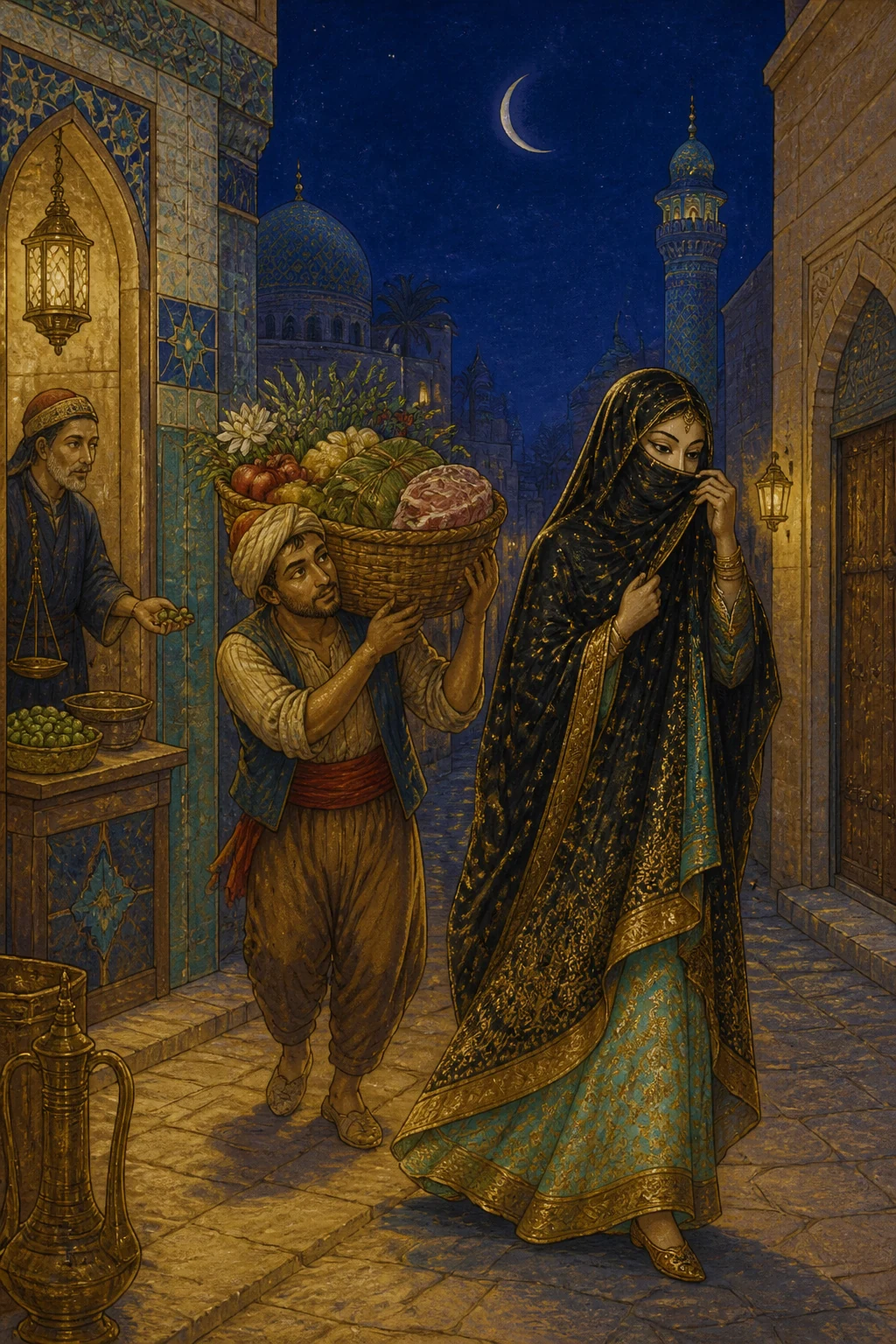
She said: It has reached me, O fortunate King, that Masrur said to the Caliph, “My lord, strike off my head! Perhaps that will cure your sleeplessness and dispel your unease.” Al-Rashid laughed at his words and said, “Masrur, see which of our companions is at the door.” Masrur went out, then returned and said, “My lord, Ali ibn Mansur al-Khali‘i of Damascus is at the door.” “Bring him to me.” He went and brought him in. On entering, Ali said, “Peace be upon you, Commander of the Faithful.” The Caliph returned his greeting and said, “Ibn Mansur, tell us something of your adventures.” “Commander of the Faithful, shall I tell you something I witnessed with my own eyes, or something I have heard?” “If you have witnessed something strange, tell us of it, for hearing is not like seeing.” “Commander of the Faithful, lend me your ear and your heart.” “Ibn Mansur, my ears are listening, my eyes are upon you, and my heart is attentive.” He said, “Commander of the Faithful, know that every year I receive an allowance from Muhammad ibn Sulayman al-Hashimi, Sultan of Basra. I went to him as usual, and when I arrived, I found him preparing to ride out hunting and fowling. I greeted him, and he returned my greeting and said, ‘Ibn Mansur, ride out hunting with us.’ I replied, ‘My lord, I am not fit to ride. Lodge me in the guesthouse, and commend me to the care of your chamberlains and deputies.’ He did so, then went off to the hunt. They treated me with the greatest honor and entertained me most generously. I said to myself, ‘By Allah, how strange! For all this time I have been coming from Baghdad to Basra, yet I know nothing of Basra beyond the way from the palace to the garden and from the garden to the palace. When shall I have another chance like this to see the city? I shall get up now and take a walk alone, to look about me and digest my meal.’ So I put on my finest clothes and went walking through Basra. As you know, Commander of the Faithful, it has seventy thoroughfares, each seventy Iraqi parasangs long. I lost my way in its lanes and grew thirsty. As I walked, Commander of the Faithful, I came upon a great doorway with two brass rings, hung with curtains of red brocade. On either side stood a stone bench, and above it was a trellis of grapevines shading the entrance. I stopped to admire the place. As I stood there, I heard a plaintive voice rising from a sorrowful heart, moving through the melodies and singing these verses:
“‘My body has become a dwelling place for sickness and affliction, for love of a gazelle whose home and country lie far away. O twin breezes of Zarud, you have awakened my sorrow! By Allah, your Lord, turn aside to where my beloved dwells. Sweeten your words when my beloved listens, and between you gently bring the lovers’ tale into your speech. Do me this gracious kindness: allude to me, and say as you converse, “Through no fault committed, no disobedience, no turning of the heart to another, no deceit, no breaking of a solemn pledge, no harshness…” And if my beloved smiles, say tenderly, “This lover is devoted to you as a lover should be, with sleepless eyes that weep and sob.” If favor appears, be modest and courteous; and if you see anger upon that face…’ I said to myself, ‘If the singer is beautiful, then beauty, eloquence, and a lovely voice are all united in one person.’ I approached the door and began to lift the curtain little by little. There I saw a fair-skinned girl, like the full moon rising on its fourteenth night, with meeting eyebrows, languorous eyelids, and breasts like two pomegranates. Her delicate lips were like two chamomile blossoms, her mouth like Solomon’s seal, and her rows of teeth could bewilder poet and prose writer alike, as the poet said:
“‘O pearls in the beloved’s mouth, who strung you there? Who placed wine and chamomile within those lips? Who lent the dawn your smile, and sealed you round with carnelian? Whoever sees you reels with delight and pride—what, then, of one who kisses you?’ And another poet said:
“‘O pearls of my beloved’s mouth, be gentle with the carnelian. Do not exalt yourselves above it: did it not find you orphaned and alone?’ In short, she possessed every kind of beauty and had become a temptation to women and men alike. No eye could ever tire of gazing on her loveliness. She was as the poet described her:
“‘When she approaches, she slays; when she turns away, she makes all people her lovers. Sun-bright and moon-fair is she, yet coldness and rejection are not among her ways. Gardens of Eden blossom within her gown, and above her collars the full moon moves in its sphere.’ As I gazed at her through the curtain, she turned and saw me standing at the door. She said to her maid, ‘See who is at the door.’ The maid rose, came over to me, and said, ‘Old man, have you no shame? White hair and disgrace together?’ I replied, ‘My lady, as for the white hair, we know it well; but as for disgrace, I do not believe I have done anything disgraceful.’ Her mistress said, ‘What could be more disgraceful than intruding upon a house that is not yours and looking upon women who are not of your household?’ ‘My lady, I have an excuse.’ ‘And what is your excuse?’ ‘I am a stranger and thirsty; thirst is killing me.’ ‘We accept your excuse,’ she said.” And dawn overtook Shahrazad, and she fell silent, leaving her tale untold.
When it was the three hundred and twenty-ninth night
She said: It has reached me, O fortunate King, that the girl said, “We accept your excuse.” Then she called to one of her maids, “Lutf, give him a drink in the golden cup.” “The maid brought me a cup of red gold set with pearls and jewels, filled with water scented with fragrant musk and covered with a green silk kerchief. I began to drink, lingering over it and stealing glances at her, until I had stood there a long while. Then I returned the cup to the maid and remained where I was. The lady said, ‘Old man, go your way.’ ‘My lady,’ I replied, ‘my thoughts are troubled.’ ‘By what?’ ‘By the changes of fortune and the turns of fate.’ ‘Well they may be, for time is full of wonders. But what wonder have you seen to make you ponder so?’ ‘I am thinking of the owner of this house, for he was my friend while he lived.’ ‘What was his name?’ ‘Muhammad ibn Ali the Jeweler. He was a man of great wealth. Did he leave any children?’ ‘Yes, he left a daughter called Budur, who inherited all his wealth.’ ‘You must be his daughter.’ ‘Yes,’ she said, laughing. Then she added, ‘Old man, you have talked long enough. Go your way.’ ‘Go I must, but I see that sorrow has altered your beauty. Tell me your story; perhaps Allah may bring you relief through me.’ She said, ‘Old man, if you are one who can keep a secret, we shall reveal ours to you. Tell me who you are, so that I may know whether you are worthy of my confidence. As the poet says:
“‘Only the trustworthy can keep a secret; with the best of men a secret stays concealed. I have guarded mine within a locked house: its key is lost, and its door is sealed.’ I said, ‘My lady, it seems you wish to know who I am. I am Ali ibn Mansur al-Khali‘i of Damascus, companion to the Commander of the Faithful, Harun al-Rashid.’ When she heard my name, she rose from her chair and greeted me, saying, ‘Welcome, Ibn Mansur! Now I shall tell you my story and entrust you with my secret. I am a lover parted from her beloved.’ I said, ‘My lady, you are beautiful, and surely you love none but the beautiful. Who is it whom you love?’ ‘I love Jubayr ibn Umayr al-Shaybani, prince of the Banu Shayban.’ She described a young man whose beauty had no equal in Basra. I asked, ‘My lady, have there been meetings or letters between you?’ ‘Yes, but he loved me with his tongue, not with his heart and soul, for he kept no promise and honored no pledge.’ ‘My lady, what caused the breach between you?’ ‘One day I was sitting while this maid combed my hair. When she had finished combing it, she braided my locks. So taken was she with my beauty that she bent over me and kissed my cheek. At that moment he was coming in, and he saw it. The instant he saw the maid kissing my cheek, he turned away in anger, resolved that our parting should be lasting, and recited these two verses:
“‘If another shares the one I love, I leave my love and live alone. There is no good in a beloved whose desires in love run counter to the lover’s wishes.’ From the moment he turned away from me until now, Ibn Mansur, neither letter nor answer has come from him.’ ‘What would you have me do?’ I asked. ‘I wish to send him a letter with you. If you bring me his reply, you shall have five hundred dinars from me; if you bring no reply, you shall have a hundred dinars for your trouble.’ ‘Do as you wish,’ I said. ‘Gladly and willingly,’ she replied. Then she called to one of her maids, ‘Bring me an inkwell and paper.’ The maid brought them, and she wrote these verses:
“‘My beloved, what is this estrangement and aversion? Where is the forbearance and tenderness that were between us? Why do you shun me and turn away? Yours is no longer the face I knew. Yes, the talebearers carried lies about me; you heeded them, and they grew ever more extravagant. Can you have believed their tales? Far be it from you—I know your judgment better. By your life, tell me what you have heard, for you can weigh what is said and judge fairly. If words have truly been spoken by me, words may be interpreted and turned to other meanings. Even suppose they were words sent down by Allah: men have altered the Torah and distorted it. How many lies were told of others before us! Was not Joseph blamed before Jacob? Here are you, the slanderer, and I: a great day shall come when we must all stand to account.’ Then she sealed the letter and handed it to me. I took it and went to the house of Jubayr ibn Umayr al-Shaybani, but found him out hunting, so I sat down to wait. While I was sitting there, he returned from the hunt. When I saw him on his horse, Commander of the Faithful, his beauty and grace bewildered me. He turned and saw me seated at his door, dismounted, came over, embraced me, and greeted me. It seemed to me that I had embraced the whole world and everything in it. Then he took me into his house, seated me upon his couch, and ordered the table to be brought. They brought a table of Khurasan khalanj wood with legs of gold, laden with every sort of food and meat, fried, roasted, and otherwise prepared. When I sat down at the table, I looked closely at it and found these verses inscribed upon it…” And dawn overtook Shahrazad, and she fell silent, leaving her tale untold.
When it was the three hundred and thirtieth night
She said: It has reached me, O fortunate King, that Ali ibn Mansur said, “When I sat down at the table of Jubayr ibn Umayr al-Shaybani, I looked closely at it and found these verses inscribed upon it:
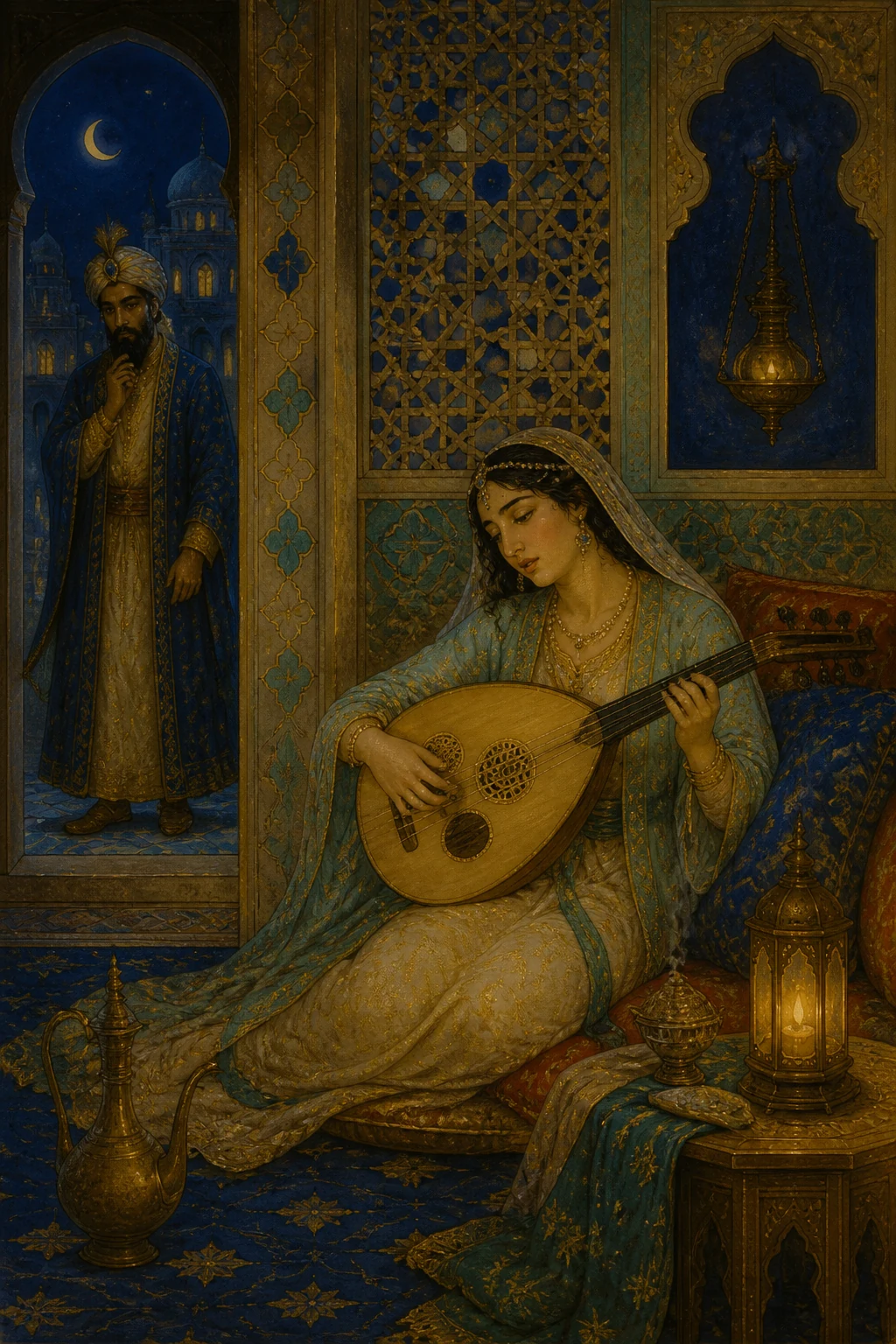
“‘Turn aside to the cranes in the quarter of the little dishes, and alight among the fried meats and vinegar stews. Lament the sandgrouse—as I have long lamented them—with the browned meats amid the young chickens. How my heart yearns for two kinds of fish beside a fresh loaf upon the trays! Allah bless that supper: how fine it was, with greens dipped in the vinegar of the little bowls, and rice with buffalo milk, into which hands plunged as far as their bracelets! Patience, my soul, for Allah is generous: when distress overwhelms you, He will send relief.’ Then Jubayr ibn Umayr said, ‘Reach out your hand to our food, and gladden our hearts by eating our fare.’ I replied, ‘By Allah, I shall not eat a single morsel of your food until you grant my request.’ ‘What is your request?’ I took out the letter and gave it to him. When he had read it and understood its contents, he tore it up, threw it on the ground, and said, ‘Ibn Mansur, whatever you ask of us we shall grant, except this request concerning the woman who wrote this letter. Her letter shall have no answer from me.’ I rose angrily to leave, but he caught the hem of my robe and said, ‘Ibn Mansur, I can tell you what she said to you, though I was not there with you.’ ‘What did she say?’ ‘Did not the writer of this letter say, “If you bring me his reply, you shall have five hundred dinars from me; if you bring no reply, you shall have a hundred dinars for your trouble”?’ ‘Yes,’ I replied. ‘Stay with me today, eat and drink, take your pleasure and be merry, and accept five hundred dinars.’ So I stayed with him, ate and drank, enjoyed myself, and kept him company. Then I said, ‘My lord, is there no music in your house?’ ‘For some time now we have been drinking without music,’ he replied. Then he called to one of his slave girls, ‘Shajarat al-Durr!’ A girl answered from her chamber, bringing an Indian-made lute wrapped in a silk bag. She came and sat down, laid it in her lap, and played twenty-one modes. Then she returned to the first, delighted us with her melodies, and sang these verses:
“‘Whoever has not tasted love’s sweetness and bitterness cannot know union with the beloved from estrangement. And whoever has strayed from the paths of passion cannot know its easy road from its rugged one. I never ceased reproaching lovers until I was afflicted with love’s sweetness and bitterness myself. I drank its bitter cup, gulp by gulp, and bowed before both its slaves and its free men. How many nights my beloved sat drinking with me, while I sipped sweet moisture from those lips! How brief was the life of our night of union: its dusk came together with its dawn. Time vowed to part us, and now time has fulfilled its vow. Time has passed judgment, and its judgment cannot be reversed. Who can oppose a master’s command?’ When the girl finished her song, her master gave a tremendous cry and fell unconscious. The girl said, ‘May Allah not punish you, old man! We have been drinking without music for some time, for fear just such a fit would overcome our master. Go into that chamber and sleep there.’ I went to the chamber she indicated and slept until morning. Then a servant came to me with a purse containing five hundred dinars and said, ‘This is what my master promised you. But do not return to the girl who sent you. Let it be as though you had heard nothing of this affair, and neither had we.’ ‘I hear and obey,’ I replied. I took the purse and went my way, saying to myself, ‘The girl has been waiting for me since yesterday. By Allah, I must go back and tell her what passed between him and me. If I do not return, she may curse me and everyone who ever came from my country.’ So I went to her and found her standing behind the door. When she saw me, she said, ‘Ibn Mansur, you have not accomplished my errand.’ ‘Who told you that?’ ‘Ibn Mansur, I have another revelation for you. When you handed him the letter, he tore it up, threw it down before you, and said, “Ibn Mansur, whatever you ask of us we shall grant, except the request of the woman who wrote this letter. She shall have no answer from me.” You rose angrily to leave, but he caught the hem of your robe and said, “Ibn Mansur, stay with me today as my guest. Eat and drink, take your pleasure and be merry, and accept five hundred dinars.” So you stayed with him, ate and drank, enjoyed yourself, and kept him company. The girl sang such-and-such a melody and such-and-such verses, and he fell unconscious.’ I said to her, Commander of the Faithful, ‘Were you there with us?’ She replied, ‘Ibn Mansur, have you not heard the poet’s words:
“‘Lovers’ hearts have eyes that see what other eyes cannot.’ But, Ibn Mansur, night and day never pass over anything without changing it.” And dawn overtook Shahrazad, and she fell silent, leaving her tale untold.
When it was the three hundred and thirty-first night
She said: It has reached me, O fortunate King, that the girl said, “Ibn Mansur, night and day never pass over anything without changing it.” “Then she raised her eyes to heaven and said, ‘My God, my Lord and Master, as You have afflicted me with love for Jubayr ibn Umayr, afflict him with love for me, and transfer this love from my heart to his.’ She then gave me a hundred dinars for my trouble. I took them and went to the Sultan of Basra, whom I found returned from the hunt. I received my allowance from him and went back to Baghdad. The following year I traveled to Basra to claim my allowance as usual, and the Sultan paid it to me. As I was about to return to Baghdad, I recalled the girl Budur and said to myself, ‘By Allah, I must go to her and see what has happened between her and her beloved.’ I went to her house and found the ground before the door swept and sprinkled, with servants, attendants, and pages all about. I said, ‘Perhaps grief overwhelmed the girl’s heart and she died, and some emir has taken up residence in her house.’ I left and went to the house of Jubayr ibn Umayr al-Shaybani. I found its stone benches demolished, and none of the usual pages at the door. ‘Perhaps he has died,’ I thought. I stood at his door, shedding tears and lamenting him in these verses:
“‘O lords who have departed, with my heart following after you, return, and with your return my days of festival will return! I stand within your house bewailing your deserted rooms, while tears pour down and my eyelids beat together. I ask the house about you, and it weeps: “Where is he from whom generosity and blessings flowed?” “Go your way, for the beloved have left these dwellings and lie buried beneath the earth.” May Allah never deprive us of the sight of all their beauty, nor let their noble qualities vanish!’ As I lamented the people of the house with these verses, Commander of the Faithful, a black slave came out and said, ‘Be silent, old man—may your mother mourn you! Why are you lamenting this house in such verses?’ I replied, ‘I knew it as the house of a friend of mine.’ ‘What is his name?’ ‘Jubayr ibn Umayr al-Shaybani.’ ‘And what has happened to him? Praise be to Allah, he still has his wealth, prosperity, and possessions. But Allah has afflicted him with love for a girl called Lady Budur, and he is utterly consumed by it. So great are his longing and torment that he lies like a discarded stone. If he is hungry, he does not ask them to feed him; if thirsty, he does not ask for water.’ I said, ‘Ask permission for me to see him.’ ‘My lord, would you visit someone who can understand you, or someone who cannot?’ ‘I must see him, whatever his condition.’ The slave went inside to ask permission, then returned to admit me. I entered and found him like a stone cast upon the ground, understanding neither gesture nor plain speech. I spoke to him, but he made no answer. One of his attendants said, ‘My lord, if you know any poetry, recite it to him in a loud voice. That will rouse him, and he will speak to you.’ So I recited these two verses:
“‘Have you forgotten your love for Budur, or do you merely feign endurance? Do you lie awake all night, or do your eyelids sleep? If your tears stream down unchecked, know that you shall dwell forever in Paradise.’ When he heard these verses, he opened his eyes and said, ‘Welcome, Ibn Mansur! Jest has turned to earnest.’ I asked, ‘My lord, is there anything I can do for you?’ ‘Yes. I wish to write her a letter and send it with you. If you bring me her reply, you shall have a thousand dinars from me; if you bring no reply, you shall have two hundred dinars for your trouble.’ ‘Do as you wish,’ I replied.” And dawn overtook Shahrazad, and she fell silent, leaving her tale untold.
When it was the three hundred and thirty-second night
She said: It has reached me, O fortunate King, that Ibn Mansur said, “I told him, ‘Do as you wish.’ He called to one of his maids, ‘Bring me an inkwell and paper.’ She brought what he asked for, and he wrote these verses:
“‘I beseech you by Allah, my lady, deal gently with me, for love has left me no reason. Your love and passion have mastered me, clothing me in sickness and bequeathing me humiliation. Before this day I thought little of love, my lady, and reckoned it a light and easy thing. But when love showed me the waves of its sea, I submitted to Allah’s decree and learned to pity the afflicted. If you wish to make me happy, my happiness lies in union with you; if you wish to forsake me, remember kindness.’ Then he sealed the letter and handed it to me. I took it to Budur’s house and began lifting the curtain little by little, as before. There I saw ten full-breasted virgin girls, lovely as moons, with Lady Budur seated among them like the full moon among the stars, or the sun when the clouds have cleared away. She showed no sign of pain or suffering. While I gazed at her, marveling at the change, she turned, saw me standing at the door, and said, ‘Welcome, a thousand welcomes, Ibn Mansur! Come in.’ I entered, greeted her, and handed her the letter. When she had read it and understood its contents, she laughed and said, ‘Ibn Mansur, the poet spoke truly when he said:
“‘I shall endure my love for you with steadfast patience until a messenger comes to me from you.’ Ibn Mansur, I shall write you an answer, so that he may give you what he promised.’ ‘May Allah reward you,’ I said. She called to one of her maids, ‘Bring me an inkwell and paper.’ When the maid brought them, she wrote him these verses:
“‘Why did I keep faith with you, only for you to betray me? You showed me fairness, then dealt unjustly with me. You were the first to break with me and turn cold; you betrayed me, and your treachery is plain. I never ceased to honor your pledge before the world, defending your good name and swearing to your innocence, until I saw with my own eyes what grieved me and heard reports of your shameful deeds. Must I lose worth when I exalt yours? By Allah, had you shown honor, you would have been honored. I shall turn my heart away from you and forget, and wash my hands of you in despair.’ I said, ‘By Allah, my lady, nothing stands between him and death but the reading of this letter.’ I tore it up and said, ‘Write him something other than these verses.’ ‘Gladly and willingly,’ she replied, and wrote these verses:
“‘I have forgotten you, and sleep lies sweet upon my eyes; I have heard all the reproachers had to say. My heart has answered my call to forget you, and my eyelids have scorned to keep vigil after your departure. Whoever said separation was bitter lied: I have tasted nothing in absence but sugar. I have come to loathe anyone who makes mention of you, and find the very sight of him offensive. Now I have forgotten you with every part of me: let the talebearer know it, and whoever else may care to know.’ I said, ‘By Allah, my lady, no sooner will he read these verses than his soul will leave his body.’ She replied, ‘Ibn Mansur, my anguish brought me to that very point, until I spoke as you have spoken.’ I said, ‘You would be justified in saying more, but forgiveness is the way of the noble.’ When she heard my words, her eyes filled with tears, and she wrote him a letter. By Allah, Commander of the Faithful, no one in your chancery could write its equal. In it she set down these verses:
“‘How long this coyness and these accusations? By your own worth, you have given those who envy me their heart’s delight. Perhaps I have offended without knowing: tell me what you have been told of me. My wish, beloved, is to place you where sleep lies, between my eye and eyelid. How could you drink love’s cup unmixed? If you see me drunk, do not reproach me.’ When she had finished writing the letter…” And dawn overtook Shahrazad, and she fell silent, leaving her tale untold.
When it was the three hundred and thirty-third night
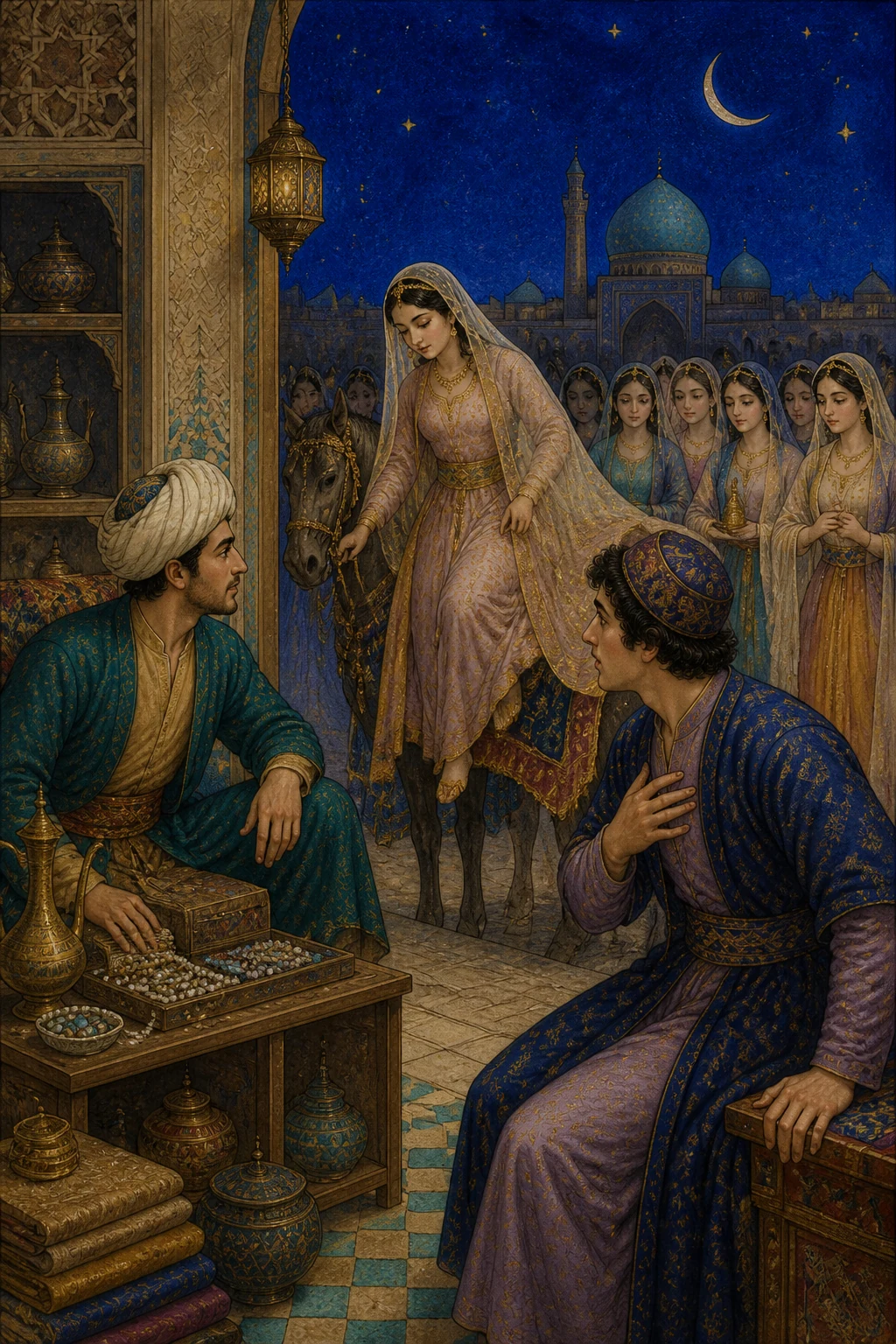
She said: It has reached me, O fortunate King, that when Budur had finished writing and sealing the letter, she handed it to him. “I said to her, ‘My lady, this letter will heal the sick and soothe the burning heart.’ I took it and went out. After I had left her, she called me back and said, ‘Ibn Mansur, tell him that tonight she will be his guest.’ I was overjoyed and carried the letter to Jubayr ibn Umayr. When I entered, I found his eyes fixed on the door, awaiting the answer. I handed him the letter; he opened it, read it, and understood its meaning, then gave a great cry and fell unconscious. When he recovered, he said, ‘Ibn Mansur, did she write this letter with her own hand and touch it with her fingertips?’ ‘My lord,’ I replied, ‘do people write with their feet?’ By Allah, Commander of the Faithful, we had scarcely finished speaking when we heard her anklets jingling in the passage as she entered. The moment he saw her, he sprang to his feet as though he had never suffered at all. He embraced her as the letter lam embraces alif, and the malady that would not yield at last departed. Then he sat down, but she remained standing. I asked, ‘My lady, why do you not sit?’ ‘Ibn Mansur, I shall not sit until the condition between us is fulfilled.’ ‘What condition is that?’ ‘Lovers do not let others into their secrets.’ Then she put her lips to his ear and whispered something to him. ‘I hear and obey,’ he said. Jubayr then lay down and whispered to one of his slaves. The slave went away for a while, then returned with a judge and two witnesses. Jubayr rose, brought a purse containing a hundred thousand dinars, and said, ‘Judge, draw up my marriage contract with this young woman for this sum.’ The judge said to her, ‘Say, “I consent to this.”’ ‘I consent to this,’ she replied. They concluded the contract. Then she opened the purse, took out a handful of coins, and gave them to the judge and witnesses, before handing Jubayr the rest of the purse. The judge and witnesses departed, and I sat with the pair in ease and pleasure until most of the night had passed. I thought to myself, ‘These two are lovers, and they have been estranged for a long time. I shall get up now and sleep somewhere far from them, leaving them alone together.’ But when I rose, she caught the hem of my robe and said, ‘What have you been saying to yourself?’ I told her what I had been thinking. ‘Sit down,’ she said. ‘When we wish you to leave, we shall send you away.’ So I sat with them until dawn was near. Then she said, ‘Ibn Mansur, go into that chamber. We have prepared a bed for you there; it is where you are to sleep.’ I went and slept there until morning. When I awoke, a servant brought me a basin and ewer. I performed my ablutions, said the dawn prayer, and sat down.
“As I sat there, Jubayr and his beloved came out of a bathhouse within the dwelling, each wringing out their locks. I wished them good morning and congratulated them on their well-being and reunion. Then I said to him, ‘What begins with an agreed condition ends in contentment.’ ‘You speak truly,’ he replied, ‘and you deserve a reward.’ He called his treasurer and said, ‘Bring me three thousand dinars.’ The man brought a purse containing three thousand dinars, and Jubayr said to me, ‘Do us the favor of accepting this.’ I replied, ‘I shall not accept it until you tell me how love passed from her to you after all your great disdain.’ ‘Gladly and willingly,’ he said. ‘Know that we have a festival called Nawruz, when people go out in boats to enjoy themselves upon the water. I went out with my companions and saw a boat carrying ten girls, lovely as moons, with this Lady Budur seated among them, her lute beside her. She played eleven modes, then returned to the first and sang these two verses:
“‘Fire is cooler than the flames within my breast, and rock is softer than my master’s heart. I marvel at the fashioning of his form: a heart of stone within a body made of water.’ I said to her, ‘Repeat those verses and that melody.’ But she refused.” And dawn overtook Shahrazad, and she fell silent, leaving her tale untold.
When it was the three hundred and thirty-fourth night
She said: It has reached me, O fortunate King, that Jubayr said, “I told her, ‘Repeat those verses and that melody,’ but she refused. So I ordered the boatmen to pelt her, and they pelted her with bitter oranges until we feared that her boat would sink. Then she went her way. That was how love passed from her heart into mine.” “I congratulated them upon their reunion, took the purse with its contents, and returned to Baghdad.” The Caliph’s heart grew light, and the sleeplessness and distress that had troubled him departed.