Prevod
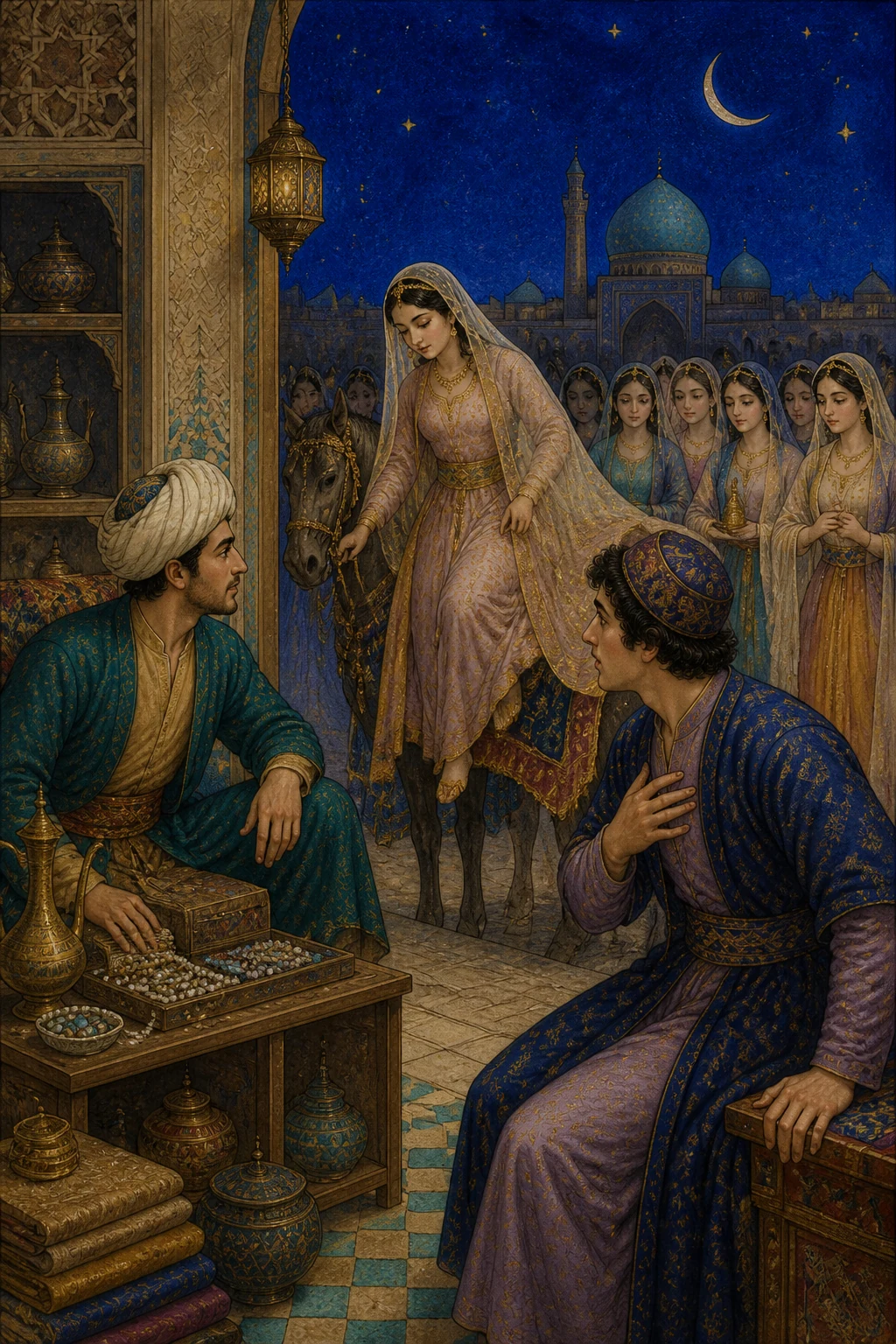
It is told that one day the Commander of the Faithful, al-Ma’mun, sat in his palace and summoned all the chief officers of his state and the grandees of his kingdom, together with the poets and boon companions of his court. Among his companions was a man named Muhammad al-Basri. Al-Ma’mun turned to him and said, “Muhammad, I want you this very hour to tell me something I have never heard before.” He replied, “Commander of the Faithful, would you have me tell you something I have heard with my own ears, or something I have witnessed with my own eyes?” “Tell me whichever is the stranger, Muhammad,” said al-Ma’mun. He answered, “Know, Commander of the Faithful, that in days gone by there was a man of great wealth who lived in Yemen. He journeyed from Yemen to this city of Baghdad and found it so pleasant a place to live that he brought his household, his wealth, and his dependents here. He had six slave girls, each as lovely as the moon: the first was fair, the second brown, the third plump, the fourth slender, the fifth golden, and the sixth black. All had beautiful faces and exquisite accomplishments, and all were skilled in singing and playing musical instruments. One day he summoned these girls before him and called for food and wine. They ate and drank, delighted themselves, and made merry. Then he filled a cup, took it in his hand, and beckoned to the fair girl, saying, ‘O crescent face, let us hear some sweet words from you.’ She took the lute, tuned it, and swept through its melodies until the very room seemed to dance. Then, enchanting them with her music, she sang these verses:
‘I have a beloved whose image is ever before my eyes, whose name lies hidden in every limb. When I remember him, I am all hearts; when I gaze upon him, I am all eyes. My reprover asked, “Will you forget your love for him?” I answered, “How can what cannot be ever come to be?” I said, “Leave me, reprover, and let me alone. Do not make light of what I cannot bear.”’ Their master was delighted. He drank his cup and gave the girls wine, then filled the cup again, took it in his hand, and beckoned to the brown girl. ‘O lamplight, O sweet breath,’ he said, ‘let us hear that lovely voice which bewitches all who hear it.’ She took the lute and played its melodies until the whole room thrilled with delight. Capturing their hearts with her glances, she sang these verses:
‘By the life of your face, I shall love none but you until I die, nor ever betray your love. O full moon veiled in beauty, all lovely ones march beneath your banner. You surpass them all in grace: God, Lord of the Worlds, has endowed you.’ Their master was delighted. He drank his cup and gave the girls wine, then filled the goblet again, took it in his hand, and beckoned to the plump girl, bidding her sing and stir their passions. She took the lute and struck its strings in a way that banished sorrow, then sang these verses:
‘If I am truly blessed with your favor, O you whom I desire, I care not though all mankind be angry. If your lovely face appears before me, I care not though all the kings of the earth be hidden from my sight. Of all this world, your favor alone is my desire, O you to whom all beauty traces its descent.’ Their master was delighted. He took his cup and gave the girls wine, then filled it again, held it in his hand, and beckoned to the slender girl. ‘O houri of Paradise,’ he said, ‘let us hear some lovely words.’ She took the lute, tuned it, played its melodies, and sang these two verses:
‘For God’s sake, consider what I suffer at your hands: you turn away, though I cannot bear to be without you. Is there no judge in love to judge between us, recover what is mine, and grant me justice against you?’ Their master was delighted. He drank his goblet and gave the girls wine, then filled it again, took it in his hand, and beckoned to the golden girl. ‘O sun of day,’ he said, ‘let us hear some delicate verse.’ She took the lute and played it most beautifully, then sang these verses:
‘I have a beloved who, whenever I look upon him, draws a sword against me from his eyes. May God exact some of my due from him, for he shuns me while my very life is in his hands. Whenever I say, “My heart, forsake him,” my heart inclines to him alone. Of all mankind, he is my desire, but the eye of Time has envied me his love.’ Their master was delighted. He drank and gave the girls wine, then filled his cup, took it in his hand, and beckoned to the black girl. ‘O dark-eyed one,’ he said, ‘let us hear even a word or two.’ She took the lute, tuned it, tightened its strings, and played several modes before returning to the first. Then, enchanting them with her music, she sang these verses:
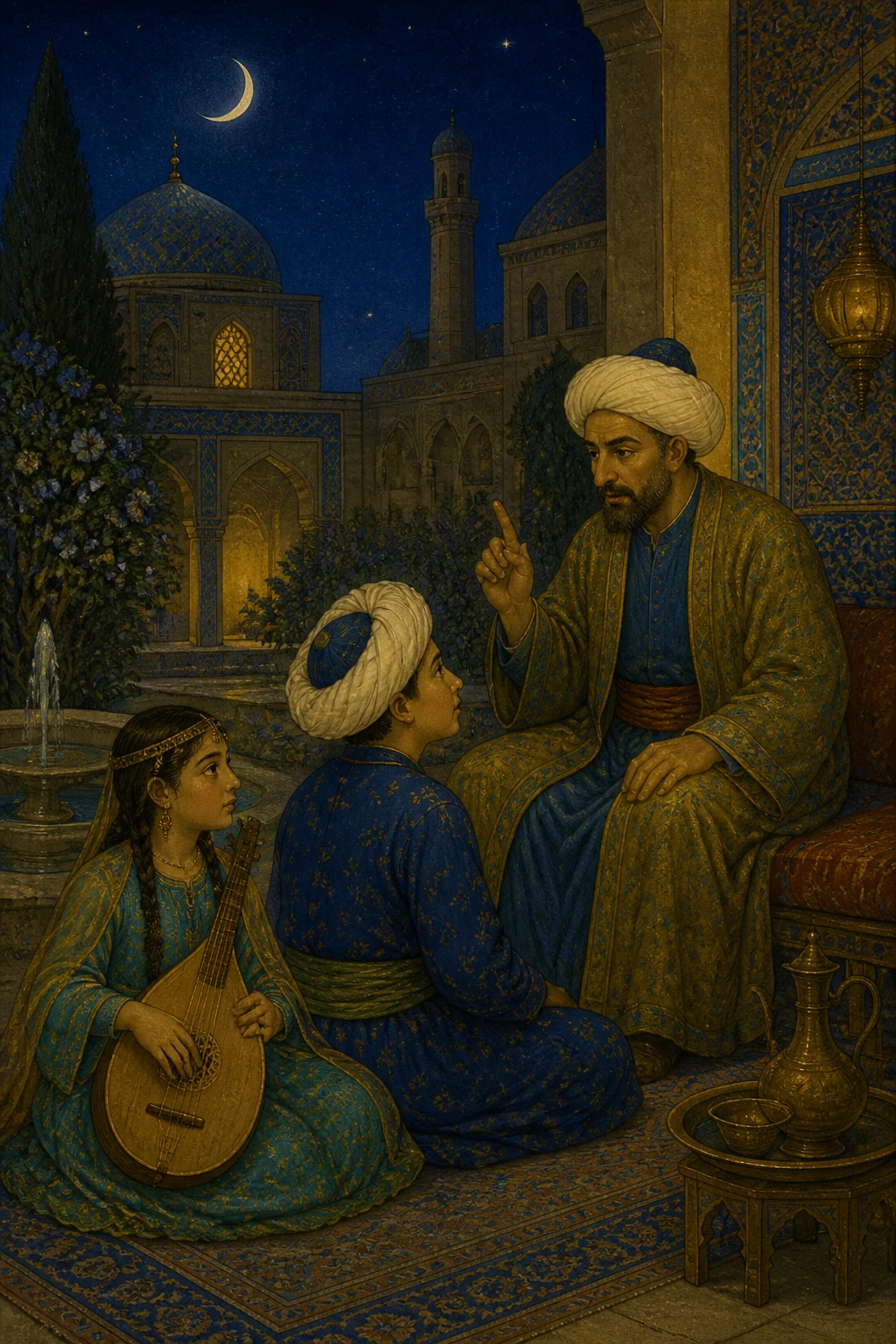
‘O eyes, be generous with your tears, for in my passion I have lost myself. I endure every torment for a beloved I have cherished, while my envier gloats over me. Reprovers keep me from the roses of a cheek, though mine is a heart that yearns for roses. There cups of wine went round in joy, to the sound of strings and lute. My beloved came to me, and I was lost in love; through faithfulness, the star of fortune shone. Then he took to shunning me, though I had done no wrong: is anything more bitter than disdain? Fresh roses bloom upon his cheeks—O God, those roses of the cheeks! Were bowing before any but God permitted by the Law, before him would I bow.’ After this the girls rose, kissed the ground before their master, and said, ‘Judge fairly between us, my lord.’ Their master gazed at their loveliness and beauty and their different complexions, and praised and glorified God Most High. Then he said, ‘Every one of you has read the Quran, learned music, studied the accounts of the ancients, and acquainted herself with the histories of bygone nations. I wish each of you to rise and point to her rival—the fair to the brown, the plump to the slender, and the golden to the black—and let each praise herself and disparage her rival. Then let her rival rise and do the same to her. But all this must be supported by evidence from the noble Quran, and by something from traditional accounts and poetry, so that we may judge your learning and the elegance of your speech.’ ‘We hear and obey,’ they replied.” But morning overtook Shahrazad, and she fell silent, ceasing her permitted tale.
When it was the three hundred and thirty-fifth night
She said, “I have heard, O fortunate King, that the Yemeni’s slave girls said to him, ‘We hear and obey.’ Then the first of them, the fair girl, rose, pointed to the black girl, and said, ‘Woe to you, black girl! It is related that Whiteness said, “I am the shining light, I am the rising moon. My color is radiant, and my brow shines with beauty.” As the poet said:
‘“Fair, smooth-cheeked, and soft, she is like a pearl sheltered in its beauty. Her figure is a proud alif, her smiling mouth a mim, and her eyebrow above it a nun. Her glances are arrows, her eyebrow a bow, yet one whose companion is death. Cheek and figure, neck and rosy face: rose, myrtle, sweet basil, and wild rose. A bough is known to grow in a garden, but no garden has beheld a bough like your figure.” My color is like the pleasant day, the freshly gathered blossom, the brilliant star. God Most High said in His mighty Book to His prophet Moses—peace be upon him—“Put your hand into the bosom of your robe; it will come forth white, without blemish.” And God Most High said, “As for those whose faces are whitened, they shall dwell in God’s mercy, abiding therein forever.” Thus my color is a sign, my beauty the utmost, my loveliness beyond compare. Clothes look best upon such as me, and hearts incline toward us. Whiteness has many virtues: snow falls white from heaven, and it is related that the finest of colors is white. Muslims take pride in their white turbans. Were I to recount all that has been said in its praise, my discourse would be long; but a little that suffices is better than much that falls short. Now I shall begin to disparage you, black girl: color of ink, soot of the smith, face of the crow that parts lovers! As the poet said, praising whiteness and disparaging blackness:
‘“Do you not see that pearls fetch a high price for their color, while a load of black charcoal costs a dirham? That white faces enter Paradise, while black faces fill Hell?” It is related in certain traditional accounts that Noah—peace be upon him—lay asleep one day with his sons Shem and Ham seated at his head. A wind lifted his clothes and exposed his nakedness. Ham looked at him and laughed, but did not cover him; Shem rose and covered him. Their father awoke, learned what his two sons had done, and blessed Shem and cursed Ham. Shem’s face became white, and from his descendants came the prophets, the rightly guided caliphs, and kings. Ham’s face became black, and he fled to Abyssinia; from his descendants came the black peoples. People are agreed that black people have little sense, and the proverb asks, “How can a black man be wise?”’ Her master said, ‘Sit down. That is enough; you have gone too far.’ Then he beckoned to the black girl. She rose, pointed at the fair girl, and said, ‘Do you not know that in the Quran revealed to His appointed Prophet, God Most High says, “By the night when it covers, and the day when it shines forth”? Had night not been the more exalted, God would not have sworn by it and placed it before day, and thousands of discerning minds and seeing eyes have acknowledged this. Do you not know that blackness is the adornment of youth? When gray hair descends, delights depart and the hour of death draws near. Were blackness not the noblest of things, God would not have placed it in the core of the heart and the pupil of the eye. How well the poet said:
‘“I love the dark ones only because theirs is the color of youth, the heart’s core, and the pupil of the eye. No, it was no mistake that made me turn from the whiteness of the fair: I stand in dread of gray hairs and shrouds.” And another said:
‘“The dark, rather than the fair, deserve my love and have the better claim: the dark have the hue of dusky lips, the fair the hue of leprous skin.” Another said: “Black, but white in all her deeds, she is like the eyes, singled out for light. If love of her drives me mad, do not wonder: madness has its source in black bile. My color is like the deep darkness of night; without it, no moon would shed its light.” Besides, is any meeting of lovers sweeter than at night? This honor and distinction alone should suffice you. Nothing shields lovers from talebearers and reprovers like the blackness of darkness, and nothing makes them fear discovery like the whiteness of dawn. How many virtues blackness has! How well the poet said:
‘“I visit them, and the blackness of night pleads my cause; I turn homeward, and the whiteness of dawn betrays me.” And another said: “How many a night my beloved kept me company, while the tresses of its darkness sheltered us! When morning’s light appeared, it filled me with dread, and I said to him, ‘The Magians are liars indeed!’” And another said:
‘“He visited me wrapped in the robe of night, hurrying his steps in fear and caution. I rose to spread my cheek upon his path in humility, trailing my robes behind me. A crescent’s gleam appeared and almost exposed us, like a paring clipped from a fingernail. Then happened what I shall not mention: think well of it, and ask no further.” And another said:
‘“Meet the one you love only at night: the sun is a tattler, and night a procurer.” And another said: “I do not love the fair one swollen with fat; I love the slender, dark-skinned ones. I am a man who rides a lean young horse on the day of the race, while another rides an elephant.” And another said:
‘“My beloved visited me by night, and we embraced. Then we lay down, and all too soon the dawn arose. I pray to God, my Lord, to reunite us once again, and to prolong the night for me as long as my beloved shares my bed.” Were I to recount all that has been said in praise of blackness, my discourse would be long; but a little that suffices is better than much that falls short. As for you, fair girl, yours is the color of leprosy, and union with you brings anguish. It is related that cold and bitter frost are among the torments of Hell for the unbelievers. Among the virtues of blackness is that ink is black, and with it the word of God is written. Were it not for black musk and ambergris, perfume would neither be carried to kings nor held in esteem. How many glories blackness has! How well the poet said:
‘“Do you not see how highly musk is prized, while a load of white lime costs a dirham? That whiteness in the eye disfigures a man, while the blackness of the eye shoots arrows?”’ Her master said, ‘Sit down. That is enough.’ She sat down, and he beckoned to the plump girl, who rose.” But morning overtook Shahrazad, and she fell silent, ceasing her permitted tale.
When it was the three hundred and thirty-sixth night
She said, “I have heard, O fortunate King, that the Yemeni, the girls’ master, beckoned to the plump girl, who rose and pointed to the slender girl. She bared her calves and wrists, then uncovered her belly, revealing its folds and the roundness of her navel. Next she put on a fine, sheer shift through which her whole body showed, and said, ‘Praise be to God, who created me and made my form beautiful, who made me plump and made my plumpness lovely, who likened me to boughs and increased my beauty and splendor. Praise be to Him for the favors He has bestowed and the honor He has granted me, for He mentioned me in His mighty Book, saying, “Then he brought a fat calf.” He has made me like a garden filled with peaches and pomegranates. City dwellers crave plump birds and eat them, but have no liking for scrawny ones. The children of Adam desire fat meat and eat it. How many glories plumpness has! How well the poet said:
‘“Bid your beloved farewell, for the caravan is departing—yet can you endure farewell, O man? Her gait within her neighbor’s house is the gait of a plump woman, without fault or weariness.” Never have I seen anyone standing at the butcher’s without asking for fat meat. The sages say, “Pleasure lies in three things: eating flesh, riding upon flesh, and putting flesh into flesh.” As for you, skinny one, your legs are like a sparrow’s, or a poker for the oven. You are the gibbet’s timber, the flesh of a sickly beast. There is nothing in you to gladden the heart, as the poet said of you:
‘“I take refuge in God from circumstances that drive me to a bedmate like the rasp of a palm-fiber rope. Every limb of hers has a horn that butts me as I lie beside her, until my body is weak and sore.”’ Her master said, ‘Sit down. That is enough.’ She sat down, and he beckoned to the slender girl. She rose, like a moringa bough, a bamboo cane, or a sprig of basil, and said, ‘Praise be to God, who created me and made me lovely, made union with me the highest object of desire, and likened me to a bough toward which hearts incline. When I rise, I rise lightly; when I sit, I sit gracefully. I am lighthearted in jest and sweet-tempered in contentment. Never have I heard anyone describe his beloved by saying, “My beloved is the size of an elephant,” or “like a mountain broad and tall.” Rather, he says, “My beloved has a slender waist and a graceful figure.” A little food suffices me, a little water quenches my thirst. My play is light, my nature charming. I am livelier than a sparrow, nimbler than a starling. Union with me is the lover’s wish and the seeker’s delight. My figure is lovely, my smile beautiful; I am like a moringa bough, a bamboo cane, or a sprig of basil. In beauty I have no equal, as the poet said of me:
‘“I likened your figure to a supple branch, and took your beauty as my share. I wandered after you, distracted, fearing the watcher’s eye upon you.” Lovers are enthralled by such as me, and longing hearts are driven wild. If my beloved draws me, I yield to him; if he inclines me toward him, I lean with him, not against him. But you, fat-bodied one, eat like an elephant, and neither little nor much can satisfy you. When you lie with a lover, he finds no comfort, nor any means of ease. Your great belly prevents him from coupling with you; when he reaches your sex, the thickness of your thighs thrusts him away. What charm is there in your bulk? What delicacy or grace in your coarseness? Fat flesh is fit only for slaughter, and has nothing in it that deserves praise. If anyone jests with you, you grow angry; if he plays with you, you become sullen. When you coquet, you snort; when you walk, you pant; when you eat, you are never full. You are heavier than mountains, uglier than madness and calamity. You have neither movement nor blessing, and no occupation but eating and sleeping. When you piss, you gush; when you shit, you splutter. You are like an inflated wineskin or a misshapen elephant. When you enter the privy, you want someone to wash your sex and pluck the hair above it. This is laziness at its utmost and the very mark of foolishness. In short, you have nothing to boast of, as the poet said of you:
‘“Heavy as a swollen skin of urine, her thighs are like pillars hewn from a mountain. If she walks or sways in the lands of the west, the folly she displays travels all the way east.”’ Her master said, ‘Sit down. That is enough.’ She sat down, and he beckoned to the golden girl. She rose to her feet, praised and glorified God Most High, and invoked blessings and peace upon the choicest of His creatures. Then she pointed to the brown girl and said…” But morning overtook Shahrazad, and she fell silent, ceasing her permitted tale.
When it was the three hundred and thirty-seventh night
She said, “I have heard, O fortunate King, that the golden girl rose to her feet, praised and glorified God Most High, then pointed to the brown girl and said, ‘I am the one described in the Quran. The All-Merciful described my color and preferred it above all others when He said in His clear Book, “Bright yellow in color, delighting those who behold her.” Thus my color is a sign, my beauty the utmost, my loveliness beyond compare. Mine is the color of the dinar, the color of stars and moons, the color of apples; my form is the form of the lovely. Saffron’s hue outshines all other colors. My appearance is rare, my color marvelous. My body is soft, my price is high, and I possess every fair quality. My color is precious in this world, like pure gold. How many merits it has! Of such as me the poet said:
‘“Her golden hue is like the sun in splendor, like dinars in the beauty of their gleam. Saffron cannot match even a little of her radiance; no, her appearance surpasses the moon.” Now I shall begin to disparage you, brown girl. Yours is the color of a buffalo; hearts recoil at the sight of you. Whatever bears your color is despised, and if food bears it, it is poisoned. Yours is the color of flies, with the ugliness of dogs; it is a perplexing color among colors, and one of the signs of sorrow. Never have I heard of brown gold, or brown pearls or jewels. When you enter the privy, your color changes; when you come out, you are uglier still. You are neither black, so as to be known, nor white, so as to be praised. You have nothing to boast of, as the poet said of you:
‘“Soot is her color, and her dinginess is like the dust my visitors trample underfoot. When I looked upon her, I stood staring, while my cares and vexations multiplied.”’ Her master said, ‘Sit down. That is enough.’ She sat down, and he beckoned to the brown girl. She was endowed with loveliness and beauty, a shapely, well-proportioned figure, splendor and perfection. Her body was soft, her hair coal-black, her stature graceful, her cheeks rosy. Her eyes were darkly outlined, her cheek smooth, her face lovely, her tongue eloquent, her waist slender, and her hips full. She said, ‘Praise be to God, who created me neither fat and blameworthy nor thin and pitiable, neither white as leprosy nor yellow as colic, nor black as soot. Rather, He made my color beloved of those endowed with understanding. All poets praise the brown in every tongue, preferring their complexion to every other. The brown-skinned are of praiseworthy qualities. God bless the poet who said:
‘“The brown have a quality which, if you knew its true meaning, would turn your eyes from both the fair and the rosy: eloquent words and coquettish glances that would teach Harut divination and magic.” And another said:
‘“Who will bring me a brown beloved, whose slender, dusky limbs are the models from which tall, supple spears are fashioned? Drowsy-eyed, with silken down upon his cheeks, he holds high stations in his wasting lover’s heart.” And another said:
‘“My soul for a brown beloved! A speck of his color would let whiteness boast against the moons; yet were he to lose that much of his own darkness, his beauty would be changed to shame. It was not the wine of his mouth that made me drunk: the lovelocks at his temples left all mankind intoxicated. His beauties envied one another, until every beauty longed to become the down upon his cheeks.” And he said:
‘“Why should I not incline toward the cheek-down when it appears upon a brown beloved, straight as a dusky spear? All the tales of beauty are contained in it; its ant-like tracery is booty for the poets. I have seen all lovers lose restraint over a mole beneath a dark eye. Will you reprovers blame me for one who is a mole all over? Leave me, then, you fools.” My form is lovely, my figure peerless, my color desired by kings and adored by rich man and pauper alike. I am delicate and light, lovely and charming, soft of body and costly in price. I am perfect in beauty, refinement, and eloquence. My appearance is lovely, my tongue fluent, my humor light, my play delightful. As for you, you are like the molokhia of Bab al-Luq: yellow and all stalks. A curse on you, pot of the sheep’s-head seller, rust of copper, owl’s visage, food of the infernal zaqqum tree! Whoever lies beside you is short of breath, as though buried in a tomb. You have no claim to beauty. Of such as you the poet said:
‘“A yellowness spreads over her without illness, tightening my chest and making my head ache. If my soul will not repent, I shall humble it by kissing her face until my teeth fall out.”’ When she had finished her verses, her master said, ‘Sit down. That is enough.’ Then, after this…” But morning overtook Shahrazad, and she fell silent, ceasing her permitted tale.
When it was the three hundred and thirty-eighth night
She said, “I have heard, O fortunate King, that when the girl had finished her verses, her master said, ‘Sit down. That is enough.’ Afterward he reconciled them, dressed them in splendid robes of honor, and showered them with precious jewels from land and sea. Never, Commander of the Faithful, in any place or at any time, have I seen anyone lovelier than those beautiful girls.”
When al-Ma’mun heard this story from Muhammad al-Basri, he turned to him and said, “Muhammad, do you know where these girls and their master live? Can you buy them for us from him?” Muhammad replied, “Commander of the Faithful, I have heard that their master is deeply in love with them and cannot bear to part with them.” Al-Ma’mun said, “Take their master ten thousand dinars for each girl, making a total price of sixty thousand dinars. Carry it with you to his house and buy them from him.” Muhammad al-Basri took that sum and set out. When he reached the girls’ master, he told him that the Commander of the Faithful wished to buy them for that amount. To oblige the Commander of the Faithful, he consented to sell them and sent them to him. When the girls reached the Commander of the Faithful, he prepared a pleasant chamber for them, where he would sit with them and enjoy their companionship. He marveled at their loveliness and beauty, their different complexions, and the elegance of their speech, and continued in this way for some time. Their former master, however, could not endure separation from them. He sent the Commander of the Faithful, al-Ma’mun, a letter lamenting his passionate longing for the girls, and included these verses:
“Six lovely beauties have robbed me of myself: upon those six beauties be my greeting. They are my hearing, my sight, my life, my drink, my pleasure, and my food. I cannot forget the joy of union with their beauty; since they departed, sweet sleep has left me. Alas, how long my grief and weeping! Would that I had never been born among men. And those eyes, adorned by lids like bows, have shot their arrows into me.” When this letter came into the hands of the Caliph al-Ma’mun, he clothed the girls in costly garments, gave them sixty thousand dinars, and sent them back to their master. They reached him, and his joy in them was boundless, greater than his joy in the money that had come to him. He lived with them in the sweetest and most contented life until there came to them the Destroyer of Delights and the Sunderer of Companions.
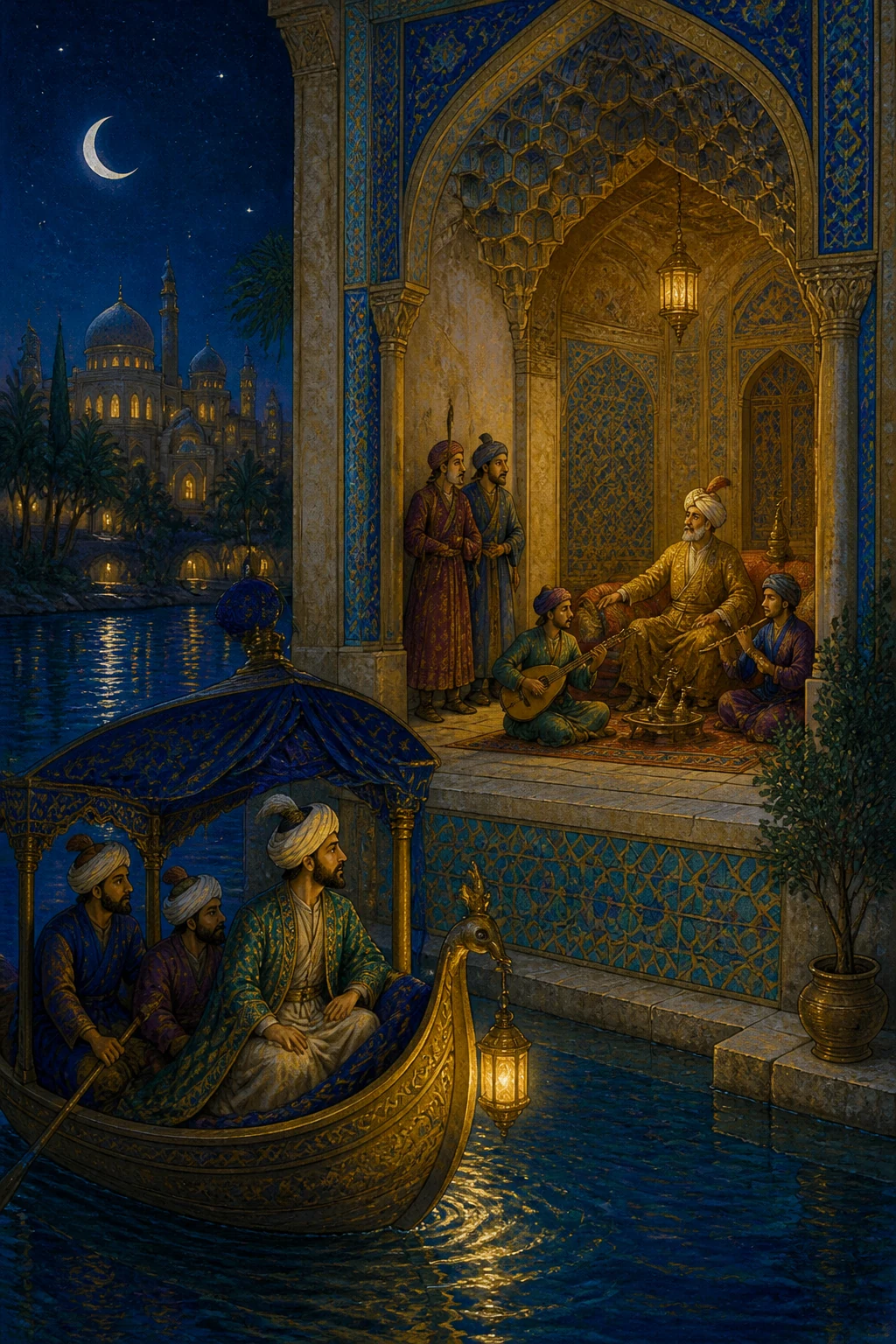
It is also told that one night the Caliph Harun al-Rashid, Commander of the Faithful, was exceedingly restless and deeply troubled in thought. He rose and wandered through his palace until he came to a chamber hung with a curtain. Lifting it, he saw a couch at the far end, and on the couch a black shape like a sleeping person, with a candle on either side. As he stood looking at this in wonder, he noticed a bowl filled with old wine and a cup resting upon it. At the sight, the Commander of the Faithful wondered to himself, “Can such entertainment be intended for this black fellow?” Then he approached the couch and discovered that the person upon it was a sleeping girl wrapped in her own hair. He uncovered her face and found it like the moon on the night of its fullness. The Caliph filled the cup with wine and drank to the roses of her cheeks. His heart inclined toward her, and he kissed a mark upon her face. She awoke, saying, “O trustee of God, what brings you here?” He replied, “A guest has come by night to your abode, that you may entertain him until dawn.” “Gladly,” she said, “with eyes and ears at your service.” Then she served the wine, and they drank together. She took the lute, tuned its strings, and played twenty-one modes before returning to the first. Enchanting him with her melodies, she sang these verses:
“The tongue of love speaks for you within my soul, declaring that I am your lover. I have a witness that proclaims my wasting sickness, and a heart wounded by your absence, beating still. I have not concealed the love that has consumed me; my passion grows, and my tears race forth. Before I loved you, I knew not what love was, but God’s decree precedes all things among His creatures.” When she had finished her verses, she said, “I have been wronged, Commander of the Faithful.” But morning overtook Shahrazad, and she fell silent, ceasing her permitted tale.
When it was the three hundred and thirty-ninth night
She said, “I have heard, O fortunate King, that the girl said, ‘I have been wronged, Commander of the Faithful.’ He asked, ‘How so? And who has wronged you?’ She answered, ‘Some time ago your son bought me for ten thousand dirhams, intending to give me to you. But your cousin sent him that sum and ordered him to keep me hidden from you in this chamber.’ He said, ‘Ask a boon of me.’ She replied, ‘My wish is that you spend tomorrow night with me.’ ‘God Most High willing,’ he said. Then he left her and went away. In the morning he went to his audience chamber and sent for Abu Nuwas, but he could not be found. He sent the chamberlain to inquire after him, and the chamberlain discovered him detained in a tavern as security for a thousand dirhams he had spent on a beardless youth. The chamberlain asked him how he had come to this, and he told him his story and what had happened with the handsome youth on whom he had spent the thousand dirhams. The chamberlain said, ‘Show him to me. If he is worth it, you are excused.’ ‘Wait,’ said Abu Nuwas, ‘and you will see him this very hour.’ As they were talking, the youth approached and came in to them, wearing a white robe over a red one, with a black robe underneath. When Abu Nuwas saw him, he heaved deep sighs and recited these verses:
‘He appeared in a robe of white, with languishing eyes and lids. I said to him, “You passed without greeting me, though a greeting from you would content me. Blessed be He who clothed your cheeks in roses, who creates whatever He wills, with none to gainsay Him.” He said, “Leave off disputing: my Lord’s workmanship is wondrous and without flaw. My robe is like my face, like my good fortune: white upon white upon white.”’ When the youth heard these words, he took off the white robe that covered the red one. At the sight, Abu Nuwas marveled still more and recited these verses:
‘He appeared in a robe of poppy red, an enemy of mine whom men call the beloved. I said in wonder, “You are a full moon, yet you approach in a strange attire! Has the blush of your cheeks clothed you in this, or have you dyed it in the blood of hearts?” He said, “The sun has given me a robe newly fashioned from the glow of sunset. My robe, the wine, and the color of my cheek are poppy red upon poppy red upon poppy red.”’ When Abu Nuwas had finished his verses, the youth took off the red robe and remained in the black. At the sight, Abu Nuwas turned his eyes toward him again and again, and recited these verses:
‘He appeared in a robe of black, shining upon mankind out of the darkness. I said to him, “You passed without greeting me, making my enviers and enemies rejoice. Your robe is like your hair, like my misfortune: black upon black upon black.”’ When the chamberlain saw this, he understood Abu Nuwas’s plight and passion. He returned to the Caliph and told him how matters stood. The Caliph had a thousand dirhams brought and ordered the chamberlain to take them back to Abu Nuwas, pay his debt, and release him from his pledge. The chamberlain returned with the money, freed Abu Nuwas, and brought him to the Caliph. When he stood before him, the Caliph said, ‘Recite some verses for me containing the words, “O trustee of God, what brings you here?”’ He replied, ‘I hear and obey, Commander of the Faithful.’” But morning overtook Shahrazad, and she fell silent, ceasing her permitted tale.
When it was the three hundred and fortieth night
She said, “I have heard, O fortunate King, that Abu Nuwas said, ‘I hear and obey, Commander of the Faithful.’ Then he recited these verses: ‘My night grew long with cares and sleeplessness; my body wasted, and my thoughts increased. I rose and walked a while about my dwelling, then through the chambers built of stone. My eyes beheld a figure black—a fair girl who had covered herself with hair. What a radiant full moon she was, swaying like a bough in rain! Bewitched by her, I drank the wine, then drew near and kissed the mark. She woke, still dazed with sleep, and clapped her hands like fluttering leaves. Then she came toward me, saying, “O trustee of God, what brings you here?”’
I said, “A guest comes by night to your quarter, seeking shelter until dawn.” She replied, “With pleasure, my lord! I shall honor my guest with all my eyes and ears can offer.” The caliph said to him, “God confound you! It is as though you had been there with us.” Then he took him by the hand and led him to the slave girl. When Abu Nuwas saw her, dressed in blue and wearing a blue veil, he exclaimed in wonder again and again, then recited these verses:
“Say to the beauty in the veil of blue: I beseech you, by God, be gentle. When a lover’s beloved treats him coldly, sighs of longing surge within his breast. By your beauty and the fair complexion that adorns it, will you not pity a lover’s burning heart? Be tender toward him, aid him in his love, and heed no fool’s words against him.” When Abu Nuwas had finished his poem, the girl served the caliph wine, then took up the oud and delighted them with her melodies, singing these verses:
“Will you be fair to others in your love, yet wrong me? You keep me far away, while others bask in your favor. If lovers had a judge, I would bring my complaint against you before him, in the hope that he might judge justly. And if you forbid me even to pass your door, then from afar I shall send you my greeting.” Then the Commander of the Faithful ordered that Abu Nuwas be plied with wine until he lost his senses. He handed him a cup, from which he took a sip, then kept it in his hand. The caliph ordered the girl to take the cup from him and hide it. She took it from his hand and concealed it between her thighs. Then the caliph drew his sword, stood over Abu Nuwas, and prodded him with it. He came to his senses and saw the naked sword in the caliph’s hand, and the drunkenness flew from his head. The caliph said to him, “Recite a poem telling me where your cup is, or I shall strike off your head.” So he recited these verses:
“Mine is the strangest tale: the gazelle has turned thief! She stole my cup of wine while I was sipping from it. She hid it in a place that fills my heart with anguish. Out of reverence I shall not name it: the caliph has a share in it.” The Commander of the Faithful said to him, “God confound you! How did you know? Still, we accept what you have said.” He ordered that Abu Nuwas be given a robe of honor and a thousand dinars, and he departed rejoicing.