Prevod
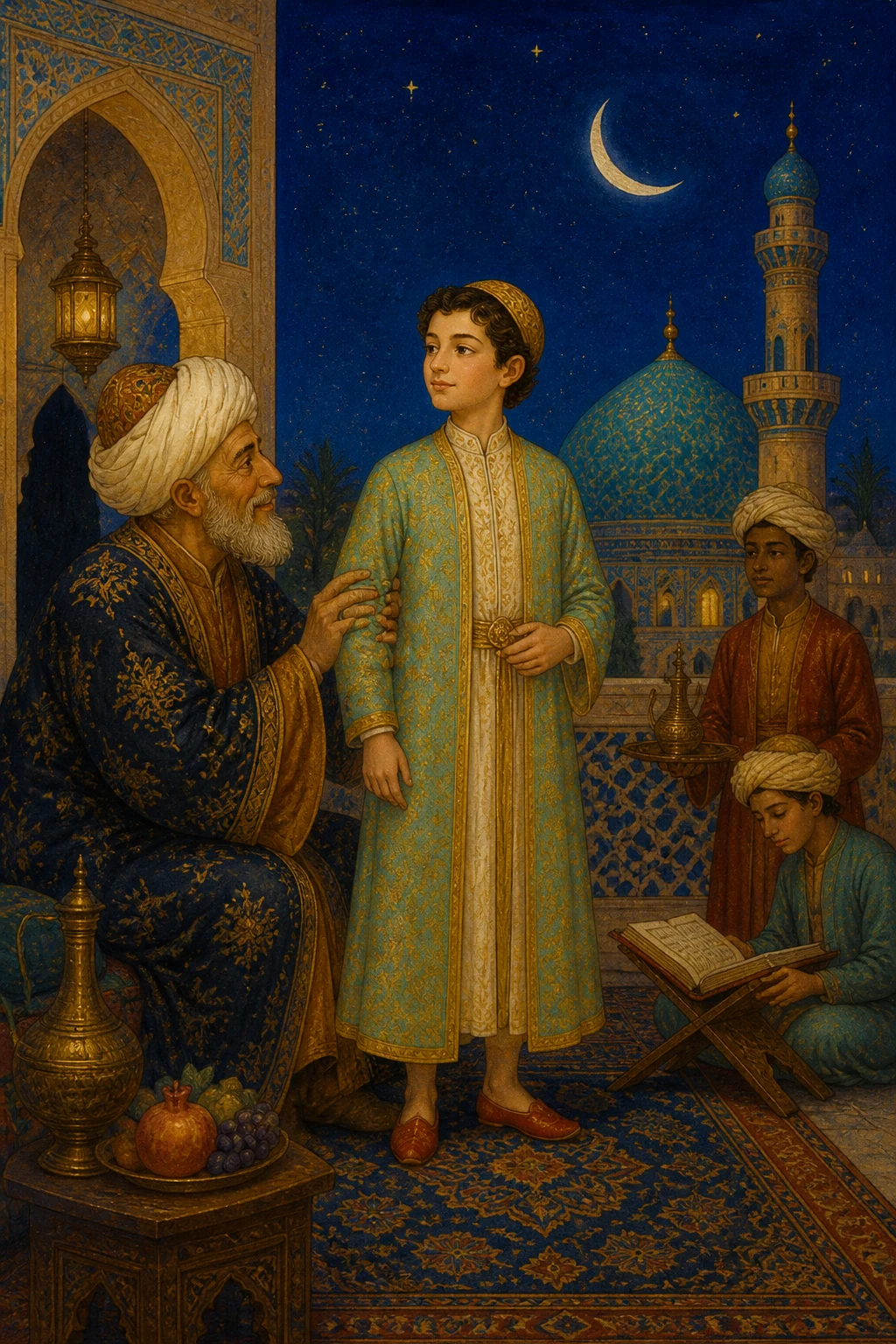
It is told that in ancient times, in ages long gone, there lived in the land of Khurasan a merchant named Majd al-Din. He possessed great wealth, slaves, mamluks, and serving boys, yet he had reached the age of sixty without being blessed with a child. At last God Most High granted him a son, whom he named Ali. As the boy grew, he became as fair as the moon on the night of its fullness. When he reached manhood and attained every perfection, his father fell ill with the sickness that was to end his life. He summoned his son and said, “My son, the hour of death draws near, and I wish to leave you some counsel.” “What is it, Father?” he asked. His father replied, “My counsel is that you keep company with no one and avoid whatever brings harm and misery. Beware of an evil companion, for he is like a blacksmith: if his fire does not burn you, his smoke will hurt you. How well the poet said:
‘In your time there is none whose affection you may hope for, no friend who stays faithful when fortune betrays. Live alone, then, and lean upon no one: I have given you counsel enough in these words.’ And another said:
‘People are a hidden sickness; never put your trust in them. Within them lie deceit and cunning, if you could only see.’ And another said: ‘Meeting people brings no benefit beyond the babble of idle talk. So meet with them as little as you can, unless to gain knowledge or improve your lot.’ And another said:
‘If a wise man has put people to the test, I have tasted them through and through. I found their affection nothing but deceit, and their piety nothing but hypocrisy.’” The son said, “Father, I hear and obey. What else should I do?” He replied, “Do good whenever you can. Persevere in kindness to others, and seize every chance to bestow a favor, for a request cannot be granted at every hour. How well the poet said:
‘Not at every hour and season does the chance for kindness come. Whenever you can, hasten to it, lest the chance should pass beyond your reach.’” He said, “I hear and obey.” And dawn overtook Shahrazad, and she fell silent, leaving her tale untold.
When it was the three hundred and ninth night,
She said: It has reached me, O fortunate King, that the youth said to his father, “I hear and obey. What else?” He replied, “My son, be mindful of God, and He will watch over you. Guard your wealth and do not squander it, for if you squander it you will be forced to beg of the meanest of men. Know that a man’s worth is what his right hand possesses. How well the poet said:
‘When my wealth is scant, no friend will keep me company; when my wealth increases, all men are my friends. How many an enemy has befriended me for money, and how many a friend has turned against me when it was gone!’” He asked, “What else?” His father said, “My son, take counsel from those older than yourself, and do not rush into anything you wish to undertake. Show mercy to those beneath you, and those above you will show you mercy. Wrong no one, lest God set over you someone who will wrong you. How well the poet said:
‘Join another’s judgment to your own and seek advice, for the sound course will not escape two minds. A single mirror shows a man his face; with two together he may see the back of his head.’ And another said:
‘Be patient; do not rush into what you wish to do. Show mercy to others, and you will encounter mercy. There is no hand but God’s hand is above it, and no oppressor but shall be tried by one more oppressive.’ And another said:
‘Do not act unjustly when you have the power, for the unjust stand on the brink of vengeance. Your eyes may sleep while the wronged lie awake, calling down curses on you—and God’s eye never sleeps.’ Beware, too, of drinking wine, for it is the root of every evil. It takes away the reason and debases the drinker. How well the poet said:
‘By God, wine shall never cloud my mind while my soul inhabits my body and my tongue can speak plainly. Never shall I yearn for wine cooled by the north wind, nor choose any drinking companion but one who is sober.’ This is my counsel to you: keep it ever before your eyes. God will watch over you in my stead.” Then he fainted and lay silent for a while. When he recovered, he begged God’s forgiveness, pronounced the testimony of faith, and passed into the mercy of God Most High. His son wept and lamented him, then set about preparing him for burial as duty required. Great and humble alike walked in his funeral procession, while reciters read the Quran around his bier. His son left no duty toward him unfulfilled. They prayed over him, laid him in the earth, and inscribed these two verses upon his grave:
‘You were fashioned from dust and became a living man, and were taught eloquence in speech. You returned to dust and became dead, as though you had never departed from the dust.’ His son Ali Shar grieved deeply for him and held the mourning observances customary among people of distinction. He continued to mourn his father until, a short time afterward, his mother too died. He did for her all that he had done for his father, then took his place in the shop, buying and selling and keeping company with none of God’s creatures, in obedience to his father’s counsel. He continued thus for a year. After that year, however, the sons of whores wormed their way into his company and befriended him, until he joined them in corruption and turned aside from the path of righteousness. He drank cup after cup of wine and spent his days and nights seeking out beauties. He said to himself, “My father amassed this wealth for me. If I do not spend it, for whom should I leave it? By God, I shall do just as the poet said:
‘If all your life you keep on gathering and hoarding, when will you enjoy what you have gained and stored?’” Ali Shar went on scattering his money by night and day until he had exhausted it all and fallen into poverty. His circumstances grew wretched and his mind was troubled. He sold the shop, his properties, and everything else; then he sold even the clothes from his back, keeping only a single suit for himself. When the drunkenness passed and reflection came, he was overcome with remorse. One day he sat from morning until late afternoon without breaking his fast, and said to himself, “I shall go around to those on whom I used to spend my money. Perhaps one of them will feed me today.” He visited them all, but whenever he knocked at a man’s door, the fellow denied being at home and hid from him. At last hunger burned within him, and he went to the merchants’ market. And dawn overtook Shahrazad, and she fell silent, leaving her tale untold.
When it was the three hundred and tenth night,
She said: It has reached me, O fortunate King, that hunger burned within Ali Shar, and he went to the merchants’ market. There he found a great press of people gathered in a circle. He said to himself, “I wonder why all these people are gathered here. By God, I shall not leave this place until I have seen what is happening.” He went forward and found a slave girl five spans tall, with a shapely figure, rosy cheeks, and firm breasts. In beauty and loveliness, splendor and perfection, she surpassed all the people of her time. As one who described her said:
‘She was fashioned as she herself would wish, perfected in beauty’s mold, neither tall nor short. Beauty itself is enamored of her form, while aloofness, pride, and modesty contend with her. Her face is the full moon, her figure a slender bough, her breath musk; no mortal is her equal. It is as though she were cast from the liquid essence of a pearl, and every part of her beauty holds a moon.’ The girl’s name was Zumurrud. When Ali Shar saw her, he marveled at her beauty and loveliness, and said, “By God, I shall not stir until I see what price this girl fetches and learn who buys her.” He took his place among the merchants, who supposed that he intended to buy, knowing how wealthy he had been from the fortune inherited from his parents. The broker stood beside the girl and cried, “Merchants! Men of wealth! Who will open the bidding for this girl, mistress of moons, this radiant pearl, Zumurrud the cat’s-eye emerald, the seeker’s desire and the suitor’s delight? Open the bidding: no blame or reproach falls on the first bidder!” One merchant said, “Five hundred dinars from me.” Another said, “And ten more.” An old man named Rashid al-Din, who was blue-eyed and ugly, said, “And a hundred.” Another said, “And ten more.” The old man said, “A thousand dinars.” The merchants held their tongues and fell silent. The broker consulted her master, who said, “I have sworn to sell her only to someone she chooses. Ask her.” So the broker went to her and said, “Mistress of moons, this merchant wishes to buy you.” She looked at him and found him as we have described, then said to the broker, “I will not be sold to an old man whom age has brought to such a sorry state. God bless the poet who said:
‘One day I asked her for a kiss; she saw my gray hair, though I was a man of wealth and comfort. She turned away and shunned me, saying, “No, by Him who created man from nothing! I have no desire for the whiteness of old age. Shall my mouth be stuffed with cotton while I am still alive?”’
When the broker heard her words, he said, “By God, you are justified. You are worth ten thousand dinars.” He told her master that she would not accept the old man, and he said, “Ask her about someone else.” Another man stepped forward and said, “I offer what the old man she rejected offered.” She looked at the man and saw that his beard was dyed. “What disgrace and deceit!” she said. “He has blackened the face of old age!” She went on exclaiming in astonishment, then recited these verses:
‘I saw what I saw of that fellow: a nape, by God, fit to be slapped with shoes; a beard where mosquitoes have room to roam, and a horn bent crooked by the tug of ropes. You who are bewitched by my cheeks and figure, go on, falsify the impossible without a care! Do you stain the white of age with disgrace, hoping by trickery to hide what has appeared? You go out with one beard and come back with another, concealing the work of the makers of illusions.’ And how well the poet said:
‘She said, “I see you have dyed your gray hair.” I told her, “I hid it from you, O my hearing and my sight.” She burst out laughing, then said, “How strange! Deceit has spread so far that now it reaches even the hair!”’” When the broker heard her verses, he said, “By God, you speak the truth.” The merchant asked, “What did she say?” He repeated the verses, and the man knew that he had only himself to blame and gave up trying to buy her. Another merchant stepped forward and said, “Ask whether she will accept me at the price you have heard.” The broker asked her, and she looked at him and found that he had only one eye. She said, “This man is one-eyed, and the poet has said of such a man:
‘Never take a one-eyed man for a companion; beware of his wickedness and lies. Had there been any good in a one-eyed man, God would not have put blindness in his eye.’” The broker said to her, “Will you be sold to that merchant?” She looked at him and saw that he was short, with a beard hanging down to his navel. She said, “He is the one of whom the poet said:
‘I have a friend who has a beard that God has grown to no purpose. It is like one of winter’s nights: long, dark, and cold.’” The broker said, “My lady, look among those present and tell me who pleases you, so that I may sell you to him.” She looked around the circle of merchants, studying them one by one, until her gaze fell upon Ali Shar. And dawn overtook Shahrazad, and she fell silent, leaving her tale untold.
When it was the three hundred and eleventh night,
She said: It has reached me, O fortunate King, that when the girl’s gaze fell upon Ali Shar, she gave him a look that brought a thousand sighs of longing in its wake, and her heart became attached to him. For he was wonderfully handsome and gentler than the north wind. She said, “Broker, I will be sold to none but this master of mine, with his lovely face and graceful figure, of whom one poet said:
‘They displayed your lovely face, then blamed the man it bewitched. Had they wished to keep me safe, they would have veiled your beauty.’ None but he shall possess me, for his cheeks are smooth, his lips yield the nectar of Salsabil, and his saliva heals the sick. His charms bewilder poets and prose writers alike, as the poet said:
‘His saliva is wine, his breath is musk, and his mouth is camphor. Ridwan drove him from his abode, fearing that the houris would be bewitched. People reproach him for his pride, but the full moon may be as proud as it pleases.’ He has curling hair, rosy cheeks, and an enchanting glance, of which the poet said:
‘A young gazelle has promised me union; my heart is troubled and my eye waits. His eyelids have guaranteed the truth of his promise, but how can they honor a pledge when they are so languidly broken?’ And another said:
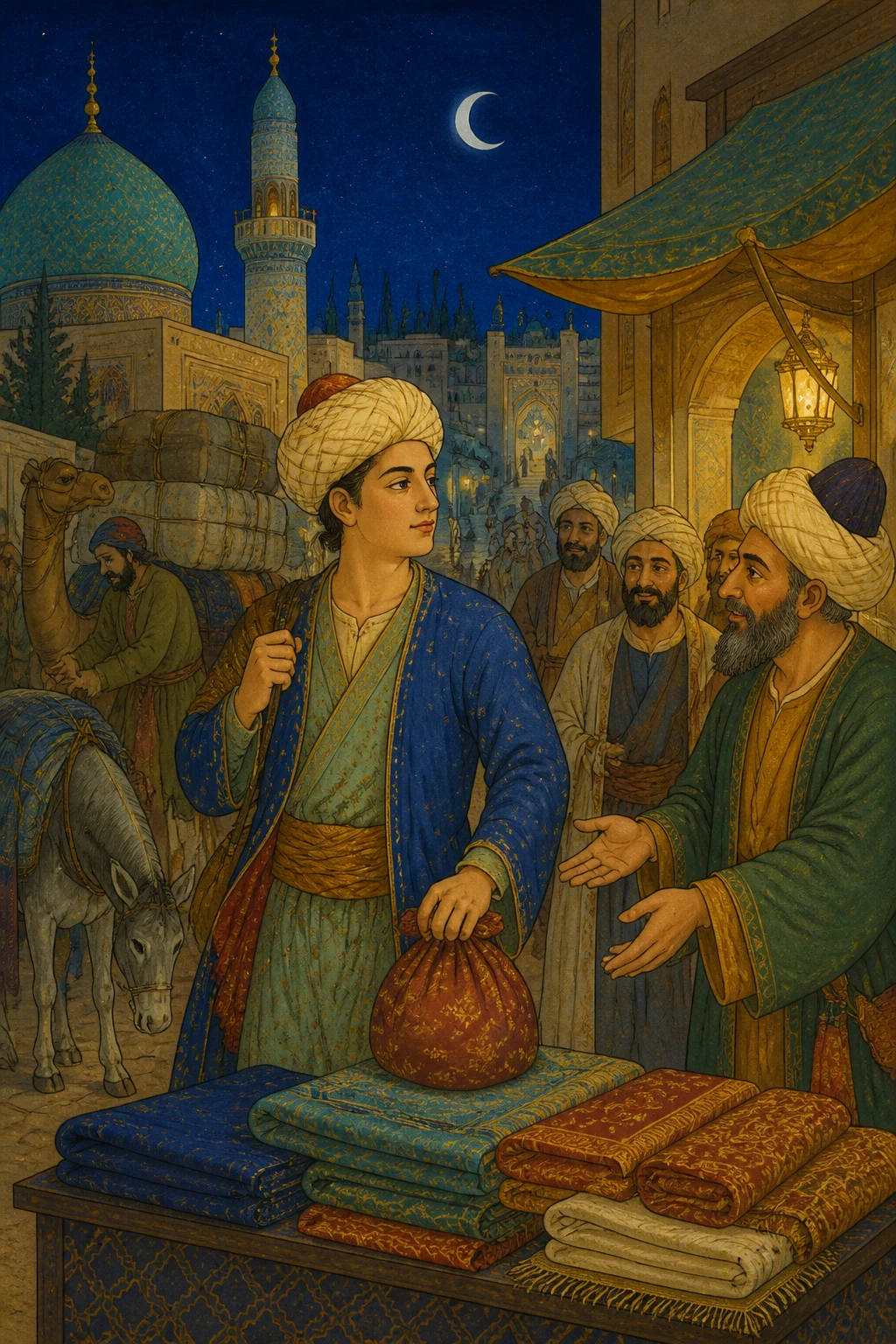
‘They said, “The line of a beard has appeared on his cheek. How can you love him now that he is bearded?” I answered, “Cease your reproaches and say no more. If that is truly a written line, then it is a forgery! The gardens of Eden lie in the fruit of his cheeks: the proof is that his lips are Kawthar.”’” When the broker heard the verses she recited in praise of Ali Shar’s charms, he marveled at her eloquence and radiant beauty. Her owner said, “Do not marvel at her loveliness, which puts the daylight sun to shame, nor at her store of tender poetry. Besides all that, she recites the glorious Quran in its seven readings, relates the noble traditions according to authentic accounts, and writes in the seven styles of calligraphy. She knows branches of learning unknown even to the most learned scholar, and her hands are better than gold and silver: she makes silk curtains and sells them, earning fifty dinars for each one, and she completes a curtain in eight days.” The broker said, “How fortunate the man who has her in his house and makes her one of his hidden treasures!” Her master then said, “Sell her to whomever she desires.” The broker returned to Ali Shar, kissed his hands, and said, “My lord, buy this girl, for she has chosen you.” He described her qualities and accomplishments, then said, “Joy be yours if you buy her! The One who never withholds His bounty has bestowed her on you.” Ali Shar lowered his head toward the ground for a while, laughing inwardly at himself. “I have not even broken my fast yet,” he thought, “but I am ashamed to tell the merchants that I have no money to buy her.” The girl saw him bow his head and said to the broker, “Take me by the hand and lead me to him, so that I may offer myself and persuade him to take me. I will be sold to none but him.” The broker took her and stood her before Ali Shar, saying, “What do you think, my lord?” He made no reply. The girl said, “My lord and beloved of my heart, why will you not buy me? Buy me for whatever price you please, and I shall be the cause of your good fortune.” He raised his head and said, “Must a man be forced to buy? You are expensive at a thousand dinars.” She said, “My lord, buy me for nine hundred.” “No,” he said. “For eight hundred.” “No.” She went on lowering the price until she said, “For a hundred dinars.” He replied, “I do not have a full hundred.” She laughed and asked, “How much short of a hundred are you?” He said, “I have neither a hundred nor anything else. By God, I possess neither white silver nor red gold, neither dirham nor dinar. Find yourself another buyer.” When she learned that he had nothing, she said, “Take me by the hand and lead me into a side alley, as though you mean to kiss me.” He did so, and she drew from her pocket a purse containing a thousand dinars. “Weigh out nine hundred of these for my price,” she said, “and keep the hundred with you for our needs.” He did as she instructed, bought her for nine hundred dinars, paid her price from the purse, and took her home. When she reached the house, she found it bare and empty, without furnishings or utensils. She gave him a thousand dinars and said, “Go to the market and spend three hundred dinars on furnishings and utensils for the house.” He did so. Then she said, “Buy us food and drink.” And dawn overtook Shahrazad, and she fell silent, leaving her tale untold.
When it was the three hundred and twelfth night,
She said: It has reached me, O fortunate King, that the girl said to him, “Buy us food and drink for three dinars.” He did so. Then she said, “Buy us a piece of silk large enough for a curtain, along with gold and silver thread and silk thread in seven colors.” He did as she asked. She furnished the house, lit the candles, and sat down to eat and drink with him. Afterward they went to bed and fulfilled their desires with one another, then passed the night in each other’s arms behind the curtains. They were as the poet said:
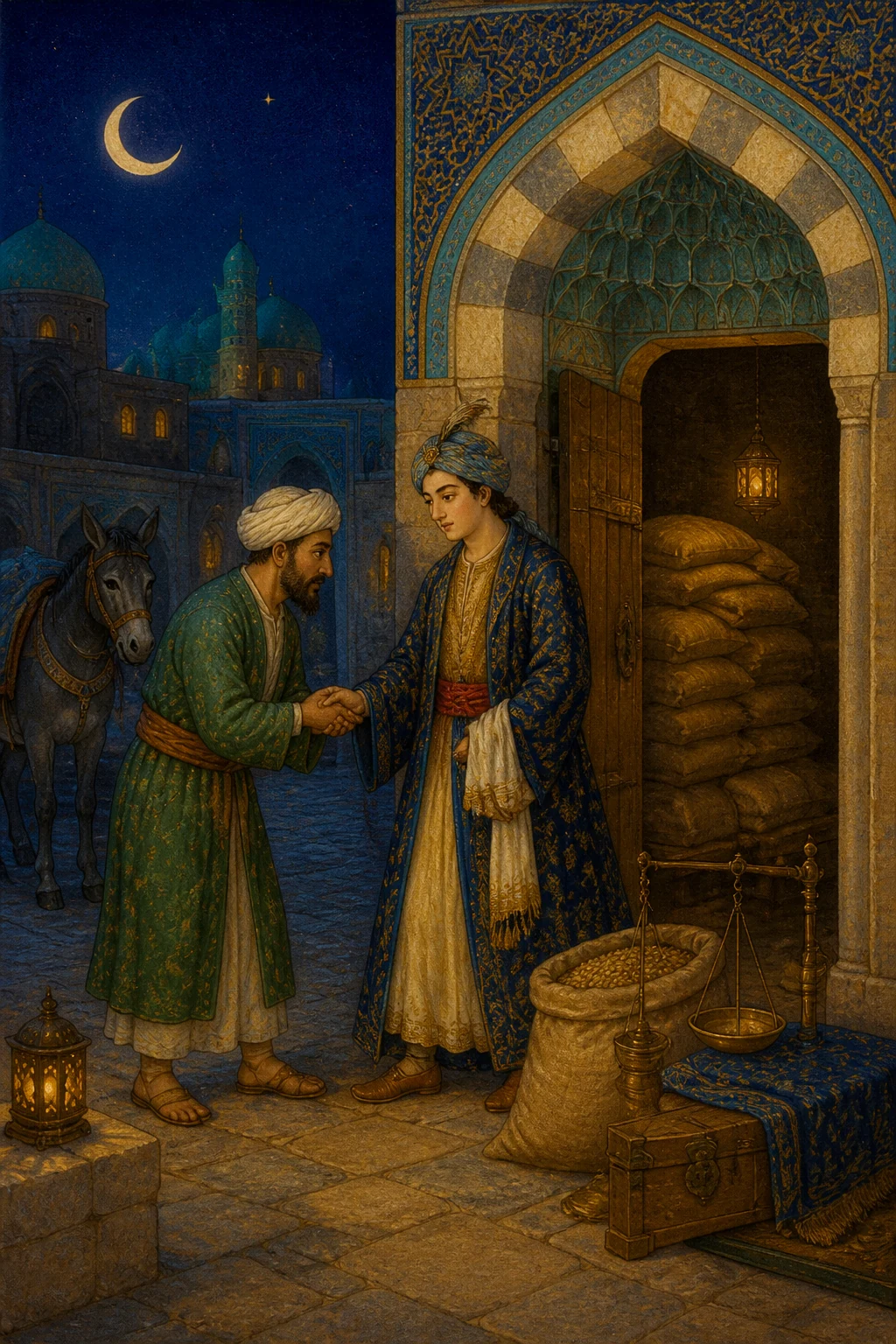
‘Visit the one you love and heed no envious talk: the envious never lend a hand to love. I saw you in a dream lying beside me, and kissed the sweetest coolness from your lips. All that I saw was true and certain, and I shall attain it despite the envious. No eyes have ever seen a fairer sight than two lovers upon a single bed, embracing, clothed in mutual contentment, each pillowed on the other’s wrist and arm. When hearts are joined in harmony, the world beats upon cold iron. You who reproach lovers for their love, can you set right a heart undone? If time grants you one true companion, that is all you need: live for that one alone.’ They remained in each other’s arms until morning, and love for each took root in the other’s heart. Then she took the curtain, embroidered it with colored silk, and adorned it with gold and silver thread. She made a band of birds upon it and worked wild beasts around its border, leaving no beast in the world without its likeness there. She spent eight days working on it. When it was finished, she trimmed and smoothed it, then gave it to her master, saying, “Take this to the market and sell it to a merchant for fifty dinars. Beware of selling it to a passing stranger, for that would cause us to be parted. We have enemies who never cease watching for us.” He said, “I hear and obey.” He took it to the market and sold it to a merchant as she had instructed. Then he bought the cloth, silk thread, and gold and silver thread as before, along with the food they needed. He brought everything to her and handed her the money that remained. Every eight days she gave him a curtain, which he sold for fifty dinars, and they continued in this way for a whole year. At the end of the year, he took a curtain to the market as usual and gave it to the broker. A Christian approached and offered sixty dinars for it. The offer was refused, but he kept raising his bid until it reached a hundred dinars, and he bribed the broker with ten dinars. The broker returned to Ali Shar, told him the price, and used all his cunning to persuade him to sell the curtain to the Christian for that sum. “My lord,” he said, “have no fear of this Christian. No harm will come to you from him.” The merchants pressed him too, and he sold it to the Christian, though his heart was full of dread. He took the money and set off for home, only to find the Christian walking behind him. “Christian,” he said, “why are you following me?” He replied, “My lord, I have an errand at the far end of the alley. May God never leave you in need.” Ali Shar had scarcely reached his house when the Christian caught up with him. “You accursed fellow,” he said, “why do you follow me wherever I go?” He replied, “My lord, give me a drink of water, for I am thirsty, and God Most High will reward you.” Ali Shar said to himself, “This man is one of the protected people and has asked me for a drink of water. By God, I shall not turn him away.” And dawn overtook Shahrazad, and she fell silent, leaving her tale untold.
When it was the three hundred and thirteenth night,
She said: It has reached me, O fortunate King, that Ali Shar said to himself, “This man is one of the protected people and has asked me for a drink of water. By God, I shall not turn him away.” He entered the house and took a jug of water. His slave girl Zumurrud saw him and said, “My beloved, have you sold the curtain?” “Yes,” he said. “To a merchant or to a passing stranger? My heart has felt that we shall be parted.” “I sold it only to a merchant.” She said, “Tell me the truth, so that I may take steps to save myself. And why have you taken that jug of water?” He replied, “To give the broker a drink.” She said, “There is no power and no strength save in God, the Most High, the Almighty.” Then she recited these two verses:
‘You who seek our parting, wait: do not let an embrace deceive you. Wait, for treachery is the way of time, and the end of companionship is parting.’ He went out with the jug and found that the Christian had come into the entrance hall. “Have you come this far, you dog?” he said. “How dare you enter my house without permission?” The man replied, “My lord, there is no difference between the doorway and the entrance hall. I shall not move from this spot except to leave. Yours are grace and kindness, generosity and favor.” He took the jug, drank its contents, and handed it back to Ali Shar. Ali Shar took it and waited for him to rise, but he did not. “Why do you not get up and go your way?” he asked. The man said, “My lord, do not be one of those who do a kindness and then reproach the recipient for it, nor one of those of whom the poet said:
‘Gone are those who, when you stood at their doors, met your needs with the noblest generosity. Now, when you stand at other men’s doors, they hold even a drink of water against you.’” Then he said, “My lord, I have drunk, but I would like you to feed me whatever there is in the house, even a crust or a piece of dry bread and an onion.” Ali Shar said, “Get up and stop arguing. There is nothing in the house.” He replied, “My lord, if there is nothing in the house, take these hundred dinars and bring us something from the market, even a single loaf, so that there may be bread and salt between us.” Ali Shar said to himself, “This Christian is mad. I shall take his hundred dinars and bring him something worth two dirhams, and have the laugh of him.” The Christian said, “My lord, I want only something to drive away hunger, even a dry loaf and an onion. The best provision is what keeps hunger at bay, not sumptuous food. How well the poet said:
‘Hunger can be driven off with a dry loaf: alas for my grand pretensions and anxious fancies! Death is most just, dealing evenhandedly with the caliph and the wretched pauper.’” Ali Shar said, “Wait here while I lock the inner room and bring you something from the market.” “I hear and obey,” the man replied. Ali Shar went out, locked the inner room, secured the lock on the door, and took the key with him. He went to the market and bought fried cheese, white honey, bananas, and bread, then brought them back. When the Christian saw the food, he said, “My lord, this is a great deal, enough for ten men, and I am alone. Perhaps you will eat with me.” “Eat by yourself,” he replied, “for I have had my fill.” The man said, “My lord, the wise have said, ‘He who does not eat with his guest is a bastard.’” When Ali Shar heard these words from the Christian, he sat down and ate a little with him. He was about to withdraw his hand … And dawn overtook Shahrazad, and she fell silent, leaving her tale untold.
When it was the three hundred and fourteenth night,
She said: It has reached me, O fortunate King, that Ali Shar sat down and ate a little with him. When he was about to withdraw his hand, the Christian took a banana, peeled it, and split it in two. In one half he put refined henbane mixed with opium, a single dirham’s weight of which would bring down an elephant. Then he dipped that half of the banana in honey and said, “My lord, by your faith, you must take this.” Ali Shar was ashamed to make him break his oath, so he took it and swallowed it. Scarcely had it settled in his stomach when his head overtook his feet, and he lay as though he had been asleep for a year. When the Christian saw this, he sprang to his feet like a ravening, mangy wolf, took the key to the inner room, and left him lying there. He ran to his brother and told him what had happened. Now this Christian’s brother was the decrepit old man who had wished to buy Zumurrud for a thousand dinars, whom she had rejected and mocked in verse. Inwardly he was an unbeliever, though outwardly he professed Islam and called himself Rashid al-Din. When she had mocked and rejected him, he complained to his Christian brother, the man who had contrived to take her from her master Ali Shar, whose name was Barsum. Barsum had told him, “Do not grieve over this. I shall devise a way to get her for you without a dirham or a dinar.” For he was a cunning, deceitful, wicked priest, and he went on scheming and plotting until he carried out the trick we have described. He took the key, went to his brother, and told him what had happened. His brother mounted his mule, took his servants, and went with him to Ali Shar’s house, carrying a purse containing a thousand dinars to give the governor should he encounter him. He opened the inner room, and the men with him rushed in upon Zumurrud and seized her by force, threatening to kill her if she spoke. They left the house as it was and took nothing from it. Ali Shar they left sleeping in the entrance hall, shutting the door on him and putting the key to the inner room beside him. The Christian took her to his palace and placed her among his slave girls and concubines. “You hussy,” he said, “I am the old man you rejected and mocked, and now I have taken you without a dirham or a dinar.” Her eyes filled with tears, and she said, “May God requite you, wicked old man, for parting me from my master.” He replied, “You hussy, you lovesick wench, you shall see what torments I have in store for you. By the Messiah and the Virgin, unless you obey me and embrace my religion, I shall torture you in every way.” She said, “By God, even if you cut my flesh to pieces, I will not abandon Islam. Perhaps God Most High will grant relief soon, for He has power to do whatever He wills. The wise have said, ‘Better affliction in the body than affliction in the faith.’” At this he shouted to the servants and slave girls, “Throw her down!” They threw her down, and he beat her savagely. She cried for help, but none came. Then she ceased calling for help and began to say, “God is sufficient for me; He alone suffices.” At last her breath failed and her moaning grew faint. When he had satisfied his rage against her, he told the servants, “Drag her away by her feet, throw her into the kitchen, and give her nothing to eat.” The accursed man passed the night, and in the morning he sent for her and beat her again, then ordered the servants to throw her back where she had been. They did so. When the pain of the beating had eased, she said, “There is no god but God, and Muhammad is the Messenger of God. God is sufficient for me, and He is the best guardian.” Then she called for help upon our lord Muhammad, God bless him and grant him peace. And dawn overtook Shahrazad, and she fell silent, leaving her tale untold.
When it was the three hundred and fifteenth night,
She said: It has reached me, O fortunate King, that Zumurrud called for help upon the Prophet, God bless him and grant him peace. Such was her case. As for Ali Shar, he remained asleep until the following day. Then the drug cleared from his head, and he opened his eyes and cried, “Zumurrud!” No one answered. He entered the inner room and found it deserted, with his beloved far beyond his reach. He knew that all this had befallen him through the Christian. He yearned and wept, moaned and lamented, and shed streams of tears, reciting these verses:
‘O anguish, spare me nothing; leave nothing of me! Here is my heart between suffering and peril. My lords, have mercy on a slave brought low beneath love’s law, a man once rich among his people, now impoverished. What can an archer do when enemies surround him, and, as he would loose his arrow, the bowstring snaps? When sorrows crowd upon a youth and pile one upon another, where can he flee from fate?
How often I feared the breaking of our union! Yet when destiny descends, the eyes are blind.’ When he had finished his verses, he heaved deep sighs and recited these as well:
‘She left her forms upon the sandy reaches of the sanctuary, and the grieving heart yearned longingly for her dwelling. She turned toward the old abodes, stirred by a home whose traces had faded and fallen apart. She stood and questioned it, and the echo returned her answer: “There is no road to reunion.” It was as though a flash of lightning had gleamed over the sanctuary and passed, never to show its radiance to you again.’ He repented when repentance could no longer avail him. Weeping and tearing his clothes, he took two stones in his hands and wandered around the city, beating his breast with them and crying, “Zumurrud!” Children gathered around him, shouting, “Madman! Madman!” Everyone who knew him wept for him and said, “This is so-and-so. What has happened to him?” He continued in this state until the end of the day. When night fell, he slept in an alley until morning, then rose and wandered around the city with his stones until evening. Afterward he returned to his house to spend the night. His neighbor, a good-hearted old woman, saw him and said, “My son, may you be well! When did you lose your reason?” He answered her with these two verses:
‘They said, “You have gone mad for the one you love.” I told them, “Who but the mad can taste the sweetness of life? Leave my madness be and bring me the one who drove me mad. If he can cure my madness, do not reproach me.”’ The old woman knew then that he was a lover parted from his beloved. She said, “There is no power and no strength save in God, the Most High, the Almighty. My son, I would like you to tell me the story of your misfortune. Perhaps God will enable me to help you, if He wills.” He told her everything that had happened to him with Barsum the Christian, brother of the priest who called himself Rashid al-Din. When she had heard it all, she said, “My son, you have every excuse.” Then tears flowed from her eyes, and she recited these two verses:
‘The torment lovers suffer in this world is enough for them. By God, may Hell not torment them afterward! For they have perished of love, concealing it and remaining chaste; to this the tradition bears witness.’ When she had finished her verses, she said, “My son, go now and buy a basket like those the jewelers use. Buy bracelets, rings, earrings, and ornaments suitable for women, and do not stint the money. Put them all in the basket and bring it to me. I shall carry it on my head in the guise of a peddler and go from house to house searching for her, until I discover news of her, God Most High willing.” Ali Shar rejoiced at her words and kissed her hand, then hurried off and brought her what she had requested. When everything was before her, she rose, put on a patched robe, draped a honey-colored mantle over her head, took a staff in her hand, and lifted the basket. She went about the lanes and houses, roaming from place to place, quarter to quarter, and street to street, until God Most High guided her to the palace of the accursed Christian Rashid al-Din. She heard moaning within and knocked at the door. And dawn overtook Shahrazad, and she fell silent, leaving her tale untold.
When it was the three hundred and sixteenth night,
She said: It has reached me, O fortunate king, that when the old woman heard moaning from within the house, she knocked at the door. A slave girl came down, opened it, and greeted her. The old woman said, “I have these little wares to sell. Is there anyone here who would buy something?” “Yes,” replied the girl. Then she brought her into the house and seated her. The slave girls gathered around, and each chose something from her stock. The old woman spoke kindly to them and was easy with them over the prices, so they were delighted by her generosity and gentle speech. All the while she was looking about for the woman who had been moaning. At last her glance fell upon her; she continued to favor the girls and treat them kindly, while looking more closely, until she recognized Zumurrud lying there. She wept and said, “My children, why is this young woman in such a state?” The girls told her the whole story, adding, “We have no choice in this matter. Our master ordered us to do it, and he is away traveling now.” She said, “My children, I have a favor to ask of you. Untie this poor creature until you learn that your master is coming, then bind her as before. Thus you will earn a reward from the Lord of All Worlds.” “We hear and obey,” they answered. They untied her and gave her food and drink. Then the old woman said, “Would that I had broken my leg rather than entered this house of yours!” After that she went over to Zumurrud and said, “May you be well, my daughter. God will bring you relief.” Then she told her that she had come from her master, Ali Shar, and arranged that the following night Zumurrud should be ready and listen carefully for a sound. She said, “Your master will come beneath the raised platform outside the palace and whistle to you. When you hear him, whistle back, then lower yourself to him from the window by a rope, and he will take you away.” Zumurrud thanked her, and the old woman left and went to Ali Shar. She told him what she had done and said, “Tomorrow night, at midnight, go to such-and-such a street. The accursed man’s house is there, and you will recognize it by these signs. Stand beneath his palace and whistle. She will lower herself to you, so take her and go wherever you please.” He thanked her, then shed abundant tears and recited these verses:
“Keep the reproachers from their idle talk: my heart is tormented, my body wasted and worn. My tears recount a chain of tales, sound in their source, though broken and obscure in their transmission. You whose mind is free of my sorrow and my longing, spare yourself the trouble of asking how I fare. One sweet of lip, slender and graceful, has stolen my heart with honeyed mouth and supple form. Since you departed, my heart has known no rest, my eyes no sleep, and all my hopes of patience have been vain. You left me a prisoner of longing, grieving, tossed between the envious and those who blame. As for forgetting, it is a thing I do not know; no one but you has ever crossed my mind.” When he had finished his poem, he sighed, shed tears, and recited these two verses:
“God bless the bearer of the news that you are coming: he has brought the sweetest tidings ears could hear. If he would take a cast-off garment as his gift, I would give him my heart, torn at the hour of farewell.” Then he waited until night had fallen and the appointed hour arrived. He went to the street his neighbor had described, saw the palace, and recognized it. He sat on a raised stone bench beneath it, but sleep overcame him, and he slept—glory be to Him who never sleeps! For so long had his anguish kept him wakeful that he was like a drunken man. And while he lay sleeping… Dawn overtook Shahrazad, and she fell silent, leaving her tale untold.
When it was the three hundred and seventeenth night
She said: It has reached me, O fortunate king, that while he lay sleeping, a thief went out that night to the outskirts of the city in search of something to steal. Fate brought him beneath the Christian’s palace. He went around it but could find no way to climb up, and continued circling until he reached the stone bench. There he saw Ali Shar asleep and took his turban. Scarcely had he done so when Zumurrud looked out. Seeing him standing in the darkness, she took him for her master and whistled. The thief whistled back, and she lowered herself to him by the rope, bringing with her a saddlebag full of gold. At the sight of it the thief said to himself, “This is a strange business indeed, with some stranger cause behind it.” Then he took up the saddlebag, hoisted her onto his shoulders, and sped away with them like a flash of lightning. She said, “The old woman told me you had grown weak on my account, yet here you are, stronger than a horse!” He made no answer. She felt his face and found a beard like a bathhouse broom, as though he were a pig that had swallowed feathers and their down had sprouted from his throat. Terrified, she said, “What are you?” He answered, “You whore, I am the rogue Jawan the Kurd, of Ahmad al-Danaf’s band. There are forty of us, and tonight every one of them will have his wicked way with you, from nightfall until morning.” When she heard this, she wept and struck her face. She knew that fate had overcome her and that she had no recourse but to entrust herself to Almighty God. So she endured and submitted to His decree, saying, “There is no god but God! Whenever we escape one sorrow, we fall into another greater than the first.” Now the reason Jawan had come to that place was that he had said to Ahmad al-Danaf, “My gallant fellow, I have been to this city before, and I know a cave outside it large enough to hold forty people. I want to go ahead of you and put my mother in that cave, then return to the city and steal something on the strength of your good fortune. I shall keep it in your name until you arrive, and that day you shall feast at my expense.” Ahmad had said, “Do as you wish.” So he had gone ahead of them to that place and left his mother in the cave. On coming out, he had found a soldier asleep with a horse tethered beside him. He slit his throat, took his clothes, horse, and weapons, and hid them in the cave with his mother, tethering the horse there. Then he returned to the city and walked until he reached the Christian’s palace, where he did what has already been related: he took Ali Shar’s turban and carried off his slave girl Zumurrud. He kept running with her until he set her down beside his mother and said, “Keep watch over her until I return to you early tomorrow morning.” Then he went away. Dawn overtook Shahrazad, and she fell silent, leaving her tale untold.
When it was the three hundred and eighteenth night
She said: It has reached me, O fortunate king, that Jawan the Kurd said to his mother, “Keep watch over her until I return to you early tomorrow morning.” Then he went away. Zumurrud said to herself, “Why am I neglecting to save myself by some trick? How can I wait until these forty men come and take their turns with me until they leave me like a ship sunk in the sea?” Then she turned to the old woman, Jawan the Kurd’s mother, and said, “Aunt, why do we not go outside the cave, so that I may pick the lice from your hair in the sunshine?” “Yes, by God, my daughter,” she answered. “It is a long time since I have been to the bathhouse, for these pigs keep dragging me from place to place.” She went out with her, and Zumurrud began picking through her hair and killing the lice, until the old woman grew so comfortable that she fell asleep. Then Zumurrud rose, put on the clothes of the soldier Jawan the Kurd had murdered, buckled his sword about her waist, and wound his turban around her head, until she looked like a man. She mounted the horse, took the saddlebag of gold, and said, “O You who graciously veil our faults, conceal me, for the sake of Muhammad, God bless him and grant him peace!” Then she said to herself, “If I go to the city, one of the soldier’s people may see me, and that will bode me no good.” So she turned away from the city and rode into the empty wilderness. For ten days she traveled on with the saddlebag and the horse, eating the plants of the earth and feeding her horse on them, and drinking from the rivers. On the eleventh day she approached a fine and peaceful city, firmly established in prosperity. Winter and its cold had departed, and spring had come with its blossoms and roses. Its flowers flourished, its rivers flowed, and its birds sang.
When she reached the city and drew near its gate, she found the troops, the emirs, and the leading townspeople gathered there. Astonished at the sight, she said to herself, “All the people of this city are assembled. There must be some reason for it.” She rode toward them, and as she approached, the soldiers hurried to meet her, dismounted, and kissed the ground before her, saying, “God grant you victory, our lord the sultan!” The dignitaries formed ranks before her, and the soldiers began putting the people in order, crying, “God grant you victory and make your coming a blessing to the Muslims, O sultan of all the world! God uphold you, king of the age, peerless one of our time!” Zumurrud said to them, “What is this, people of the city?” The chamberlain answered, “He who is never grudging with His gifts has bestowed His bounty upon you and made you sultan of this city, with authority over the lives of all who dwell in it. Know that when our king dies leaving no son, it is the custom of this city for the troops to go outside the walls and wait three days. Whoever then comes along the road by which you have come, they make their sultan. Praise be to God, who has brought us a handsome son of the Turks! Even had someone less worthy than you appeared, he would have become sultan.” Now Zumurrud was prudent in all she did, so she said, “Do not suppose that I am the son of common Turks. I come of a noble family, but I quarreled with my kin, left them, and went away. Look at this saddlebag of gold I have brought beneath me, so that I may give alms to the poor and needy along my way.” They prayed for her and rejoiced exceedingly, and Zumurrud too was delighted with them. Then she said to herself, “Now that I have attained this position…” Dawn overtook Shahrazad, and she fell silent, leaving her tale untold.
When it was the three hundred and nineteenth night
She said: It has reached me, O fortunate king, that Zumurrud said to herself, “Now that I have attained this position, perhaps God will reunite me with my master here. He has power to do whatever He wills.” Then she rode on, and the troops accompanied her into the city. They dismounted before her and escorted her into the palace. She alighted, and the emirs and grandees supported her beneath the arms until they seated her on the throne. They all kissed the ground before her. Once seated, she ordered the treasuries opened, and when this was done she distributed money among all the troops. They prayed that her reign might endure, and the people and all the inhabitants of the land obeyed her. For some time she continued thus, issuing commands and prohibitions, and her generosity and virtue inspired great awe in the people’s hearts. She abolished oppressive tolls, released the prisoners, and redressed injustices, so that everyone loved her. Whenever she remembered her master, she wept and prayed that God would reunite them. One night she thought of him and of the days she had spent with him, and, shedding tears, recited these two verses:
“My longing for you is ever renewed with time; tears have wounded my eyes, and still they flow. Whenever I weep, I weep from the pain of love: separation bears heavily upon the lover.” When she had finished her verses, she wiped away her tears, went up into the palace, and entered the harem. She assigned separate quarters to the slave girls and concubines and fixed their allowances and provisions, claiming that she wished to remain alone in a place devoted to worship. She began fasting and praying, until the emirs said, “This sultan is deeply devout.” She kept no servants about her except two young eunuchs to attend to her needs. She had occupied the royal throne for a year without hearing any news of her master or finding any trace of him, and this distressed her. When her anxiety grew severe, she summoned the viziers and chamberlains and ordered them to bring engineers and builders and have a square laid out below the palace, a parasang in length and a parasang in breadth. They carried out her orders with all speed, and the square was made just as she wished. When it was finished, she went down into it. A great pavilion was erected for her there, and chairs were arranged for the emirs. She ordered a banquet of every kind of sumptuous food to be spread in the square, and they did as she commanded. Then she told the officers of state to eat, and they ate. Afterward she said to the emirs, “When the new month begins, I want you to do this again and proclaim throughout the city that no one is to open his shop. All must attend and eat at the king’s table. Anyone who disobeys shall be hanged at his own door.” When the new month began, they did as she had ordered, and they continued this custom until the first month of the second year. Then she went down to the square, and the herald proclaimed, “O people, one and all! Whoever opens his shop, warehouse, or house shall be hanged at once at his own door. You must all come and eat at the king’s table!” When the proclamation was over and the feast laid out, the people came in crowds. She ordered them to sit at the table and eat their fill of all the dishes. They sat and ate as she had commanded, while she sat upon the royal throne watching them. Each person seated at the feast said to himself, “The king is looking at no one but me.” They went on eating, and the emirs said to them, “Eat without embarrassment, for this pleases the king.” They ate until they were satisfied, then went away praying for the king. They said to one another, “Never in our lives have we seen a sultan who loves the poor as this sultan does.” They prayed that he might live long, and she returned to her palace. Dawn overtook Shahrazad, and she fell silent, leaving her tale untold.
When it was the three hundred and twentieth night
She said: It has reached me, O fortunate king, that Queen Zumurrud returned to her palace, pleased with what she had arranged, and said to herself, “God willing, this will lead me to news of my master Ali Shar.” When the second month began, she held the feast as usual. The table was spread, and Zumurrud went down and sat upon her throne, ordering the people to sit and eat. As she sat at the head of the table and the people took their places, group after group and one by one, her eye fell upon Barsum the Christian, who had bought the curtain from her master. She recognized him and said, “This is the beginning of relief and the fulfillment of my hopes.” Barsum came forward and sat down with the others to eat. He saw a dish of sweet rice sprinkled with sugar some distance away, pushed toward it, reached out, and drew it in front of him. A man beside him said, “Why do you not eat what is in front of you? Have you no shame, reaching for something so far away? Are you not embarrassed?” Barsum answered, “I will eat nothing but this.” “Eat, then,” said the man, “and may God give you no enjoyment of it!” A hashish smoker said, “Leave him to eat it, so that I too may share it with him.” The man replied, “You most ill-omened of hashish smokers, this is not food for the likes of you. It is food for emirs. Leave it, so that it may go back to those it belongs to, and they may eat it.” Barsum ignored him, took a mouthful, and put it into his mouth. He was about to take a second when the queen, who had been watching him, called to some soldiers and said, “Bring me that man with the dish of sweet rice before him. Do not let him eat the mouthful in his hand; knock it away.” Four soldiers came, knocked the food from his hand, dragged him face-down along the ground, and stood him before Zumurrud. The people stopped eating and said to one another, “By God, he has done wrong, for he would not eat the food of his own kind.” One said, “I am content with this kishk in front of me.” The hashish smoker said, “Praise be to God, who kept me from eating any of that sweet rice! I was waiting for him to settle the dish before him and enjoy it, and then I was going to share it with him. Now look what has happened to him!” The people said to one another, “Wait and see what becomes of him.” When he was brought before Queen Zumurrud, she said, “Woe to you, blue-eyed fellow! What is your name, and why have you come to our country?” The accursed man, who was wearing a white turban, concealed his name and said, “O king, my name is Ali, my trade is weaving, and I have come to this city to do business.” Zumurrud said, “Bring me a geomancer’s sandboard and a brass stylus.” They brought what she asked for at once. She took the sandboard and stylus, cast a geomantic figure, and drew a shape resembling a monkey. Then she raised her head, studied Barsum for a while, and said, “You dog, how dare you lie to kings? Are you not a Christian named Barsum, and have you not come in search of something? Tell me the truth, or, by the majesty of the Lord, I shall strike off your head!” The Christian stammered, and the emirs and all those present said, “This king understands geomancy! Glory be to Him who bestowed this gift upon him!” Then she shouted at the Christian, “Tell me the truth, or I shall destroy you!” He said, “Mercy, king of the age! Your divination is true, for this wretch is indeed a Christian.” Dawn overtook Shahrazad, and she fell silent, leaving her tale untold.
When it was the three hundred and twenty-first night
She said: It has reached me, O fortunate king, that the Christian said, “Mercy, king of the age! Your divination is true, for this wretch is indeed a Christian.” The emirs and everyone else present marveled at the accuracy of the king’s geomancy and said, “There is no astrologer in the world to equal this king!” Then the queen ordered that the Christian be flayed, his skin stuffed with straw and hung at the entrance to the square, and a pit dug outside the city, in which his flesh and bones were to be burned and covered with filth and refuse. “We hear and obey,” they said, and carried out all her commands. When the people saw what had befallen the Christian, they said, “He has received his deserts. What an ill-fated mouthful that was for him!” One of them said, “May this wretch’s wife be divorced if I ever eat sweet rice again!” The hashish smoker said, “Praise be to God, who spared me what befell this man by keeping me from eating that rice!” Then all the people departed, having sworn never to sit beside the sweet rice in the Christian’s place. When the third month came, they spread the feast as usual and filled it with dishes. The queen sat upon the throne, and the soldiers stood in their accustomed places, fearful of her might. The townspeople entered as usual, gathered around the table, and looked at the place where the dish stood. One said to another, “Hajj Khalaf!” “At your service, Hajj Khalid,” he answered. “Keep clear of the sweet rice,” said the first, “and beware of eating it. If you do, you will find yourself hanged.”
Then they sat around the table to eat. While they were eating and Queen Zumurrud sat watching, she happened to glance toward a man hurrying in from the city gate. She looked closely and recognized Jawan the Kurd, the thief who had killed the soldier. The reason for his coming was this: after leaving his mother, he had gone to his companions and told them, “I made a fine haul last night. I killed a soldier and took his horse, and that same night I came by a saddlebag full of gold and a girl worth more than all the gold in it. I left everything in the cave with my mother.” They were delighted and set off for the cave toward the end of the day. Jawan the Kurd went in first, with the others behind him, intending to bring them what he had promised, but he found the place empty. He asked his mother what had happened, and she told him the whole story. He bit his hands in remorse and said, “By God, I shall search for that harlot and drag her from wherever she may be, even if she is hidden in a pistachio shell, and I shall satisfy my fury upon her!” He went out in search of her and wandered from country to country until he reached Queen Zumurrud’s city. When he entered, he found no one about, so he asked some women looking out of their windows. They told him that on the first day of every month the sultan spread a feast, and everyone went to eat there. They directed him to the square where the feast was laid, and he hurried there. He could find no empty seat except beside the dish already mentioned, so he sat down with it before him and reached toward it. The people cried out, “Brother, what are you about to do?” He answered, “I mean to eat from this dish until I am full.” One said, “If you eat from it, you will find yourself hanged.” “Be quiet,” he replied, “and say no such thing!” Then he reached out and pulled the dish toward him. The hashish smoker already mentioned was sitting beside him, but when he saw him draw the dish near, he fled his place, all the hashish fumes driven from his head. He sat some distance away and said, “I want nothing to do with that dish!” Then Jawan the Kurd stretched out his hand, shaped like a crow’s foot, and scooped up the rice, drawing it out shaped like a camel’s hoof. Dawn overtook Shahrazad, and she fell silent, leaving her tale untold.
When it was the three hundred and twenty-second night
She said: It has reached me, O fortunate king, that Jawan the Kurd drew his hand from the dish shaped like a camel’s hoof, rolled the mouthful in his palm until it was as large as a big bitter orange, and tossed it swiftly into his mouth. It went down his throat with a crack like thunder, leaving the bottom of the dish bare where he had scooped it up. The man beside him said, “Praise be to God, who did not make me food before you, for you have dug a crater in the dish with a single mouthful!” The hashish smoker said, “Let him eat, for I can already picture him hanging.” Then he turned to him and said, “Eat, and may God give you no enjoyment of it!” Jawan reached for a second mouthful and was about to roll it in his hand like the first when the queen called to some soldiers, “Bring that man here quickly, and do not let him eat the mouthful in his hand!” The soldiers rushed upon him as he bent over the dish, seized him, and brought him before Queen Zumurrud. The people gloated over him and said to one another, “He deserves it. We warned him, but he would not listen. Death is appointed for whoever sits in that place, and that rice brings misfortune to everyone who eats it.”
Then Queen Zumurrud said to him, “What is your name, what is your trade, and why have you come to our city?” He replied, “Our lord the sultan, my name is Uthman, and I am a gardener. I have come to this city because I am searching for something I have lost.” The queen said, “Bring me the sandboard.” They brought it before her, and she took the stylus and cast a geomantic figure. She studied it for a while, then raised her head and said, “Woe to you, villain! How dare you lie to kings? These figures tell me that your name is Jawan the Kurd, and your trade is robbery: you take people’s wealth unlawfully and slay those whom God has forbidden anyone to kill except by right.” Then she shouted, “You pig, tell me the truth about yourself, or I shall cut off your head!” When he heard her words, his face turned yellow and his teeth chattered. Thinking he might escape by telling the truth, he said, “You have spoken truly, O king. But from this moment I repent at your hands and turn back to Almighty God.” The queen answered, “It is not lawful for me to leave a scourge in the path of the Muslims.” Then she said to some of her attendants, “Take him and flay him, and do to him as you did to his like last month.” They carried out her orders. When the hashish smoker saw the soldiers seize the man, he turned his back on the rice dish and said, “It is forbidden for me ever to face you again!” When they had finished eating, the people dispersed and went their ways. The queen went up to her palace and gave the mamluks leave to depart.
When the fourth month began, they went down to the square as usual and brought the food. The people sat waiting for permission to eat. Then the queen came and seated herself upon the throne, looking over them. She saw that the place beside the rice dish was empty, though it could hold four people, and wondered at this. As her gaze wandered, she caught sight of someone hurrying in through the entrance to the square. He hurried on until he reached the table, where he found no empty place except beside the dish, and sat down there. She looked closely and recognized the accursed Christian who called himself Rashid al-Din. She said to herself, “How blessed is this feast, which has caught this unbeliever in its snares!” There was a strange reason for his coming, for when he returned from his travels… Dawn overtook Shahrazad, and she fell silent, leaving her tale untold.
When it was the three hundred and twenty-third night
She said: It has reached me, O fortunate king, that when the accursed man who called himself Rashid al-Din returned from his travels, his household told him that Zumurrud had disappeared with a saddlebag of money. At this news he tore his clothes, struck his face, and plucked out his beard. He sent his brother Barsum to search for her in other lands. When no news of him came for a long time, he set out himself to search the countries for both his brother and Zumurrud. Fate brought him to Zumurrud’s city, which he entered on the first day of the month. Walking through its streets, he found them empty and the shops shut. He saw women at the windows and asked some of them what was happening. They said, “On the first day of every month the king gives a feast for everyone. All the people eat there, and no one may stay in his house or shop.” They directed him to the square. When he entered it, he found the people crowded around the food, with no empty place except beside the familiar rice dish. He sat there and stretched out his hand to eat. The queen called to some soldiers, “Bring me the man sitting beside the rice dish!” Knowing what to do from past occasions, they seized him and stood him before Queen Zumurrud. She said, “Woe to you! What is your name, what is your trade, and why have you come to our city?” He answered, “King of the age, my name is Rustam, and I have no trade, for I am a poor dervish.” She said to her attendants, “Bring me a sandboard and the brass stylus.” They brought them as usual. She took the stylus, traced a geomantic figure upon the board, and studied it for a while. Then she raised her head toward him and said, “You dog, how dare you lie to kings? Your name is Rashid al-Din the Christian, and your trade is to ensnare the slave girls of Muslims by tricks and carry them off. Outwardly you are a Muslim, but inwardly a Christian. Speak the truth, or I shall strike off your head!” He stammered, then said, “You have spoken truly, king of the age.” She ordered him stretched out and given a hundred lashes on each foot and a thousand on his body, after which he was to be flayed and his skin stuffed with chaff. Then a pit was to be dug outside the city and his body burned in it, and afterward they were to heap filth and refuse over him. They did as she commanded. Then she gave the people permission to eat, and they ate. When they had finished and gone their ways, Queen Zumurrud went up to her palace and said, “Praise be to God, who has eased my heart of those who harmed me!” Then she gave thanks to the Creator of earth and heaven and recited these verses:
“They held power and grew overbearing in their rule; a little while, and it was as though their rule had never been. Had they dealt justly, justice would have been theirs; but they oppressed, and time brought calamities and trials upon them. Now their very plight proclaims to them: ‘This is for that; lay no blame upon time.’” When she had finished her verses, her master Ali Shar came to mind, and she wept abundant tears. Then she recovered her composure and said to herself, “Perhaps God, who has given me power over my enemies, will favor me with the return of those I love.” And she sought forgiveness from God, the Almighty and Glorious. Dawn overtook Shahrazad, and she fell silent, leaving her tale untold.
When it was the three hundred and twenty-fourth night
She said: It has reached me, O fortunate king, that the queen sought forgiveness from God, the Almighty and Glorious, and said, “Perhaps God will soon reunite me with my beloved Ali Shar. He has power to do whatever He wills, and He is gracious to His servants and knows them well.” Then she praised God, continued to seek His forgiveness, and submitted to the decrees of fate. Certain that every beginning must have an end, she recited the poet’s words:
“Be easy in your heart, for the destinies of all things lie in the hand of God. Whoever fears them cannot harm you, nor can what He ordains fall short of reaching you.” And the words of another:
“Let the days pass, and pass they will; do not enter the houses of sorrow. Many a thing hard to attain is brought near by the hour of deliverance.” And another’s words: “Be forbearing when tried by anger, and patient when calamity comes upon you. For the nights of time are heavy with child and bring forth every wondrous thing.” And the words of another:
“Be patient, for patience holds a good which, if you knew it, would ease your soul and still your cries of pain. Know that if you do not bear with noble patience, you must bear against your will what the Pen has written.” When she had finished her verses, she passed another full month judging between the people and issuing commands by day, while at night she wept and sobbed over her separation from her master Ali Shar. When the new month began, she ordered the feast spread in the square as usual and took her seat above the people, who waited for permission to eat. The place beside the rice dish remained empty. She sat at the head of the table, keeping her eyes on the entrance to the square so that she could see everyone who came in. In her heart she prayed, “O You who restored Joseph to Jacob and lifted affliction from Job, favor me by restoring my master Ali Shar through Your power and majesty! You have power over all things, Lord of All Worlds, Guide of the lost, Hearer of voices, Answerer of prayers. Answer me, Lord of All Worlds!” Scarcely had she finished her prayer when someone entered the square, his figure like a willow bough, though his body was thin and his face pale. He was a most handsome young man, endowed with perfect understanding and manners. On entering, he found no empty place except beside the rice dish, so he sat there. When Zumurrud saw him, her heart fluttered. She looked intently and realized that he was her master Ali Shar. She almost cried out for joy, but restrained herself, fearing to expose herself before the people. Her whole being trembled and her heart raced, yet she concealed her feelings. Now the reason for Ali Shar’s coming was this: after he had fallen asleep upon the stone bench, and Zumurrud had come down and been carried off by Jawan the Kurd, he awoke to find his head bare. He knew that someone had robbed him of his turban as he slept, and uttered the words that bring no shame upon the speaker: “We belong to God, and to Him we shall return.” Then he went back to the old woman who had told him where Zumurrud was and knocked at her door. She came out, and he wept before her until he fell unconscious. When he recovered, he told her everything that had happened. She blamed and scolded him for what he had done, saying, “You have brought your misfortune and calamity upon yourself!” She went on reproaching him until blood poured from his nostrils and he fell unconscious again. When he came out of his swoon… Dawn overtook Shahrazad, and she fell silent, leaving her tale untold.
When it was the three hundred and twenty-fifth night
She said: It has reached me, O fortunate king, that when Ali Shar came out of his swoon, he saw the old woman weeping for him and shedding tears. In his anguish he recited these two verses: “How bitter is parting to those who love, and how sweet reunion to lovers! May God reunite every loving pair and watch over me, for I am at death’s door.” She grieved for him and said, “Stay here while I discover what has happened. I shall return quickly.” “I hear and obey,” he answered. Then she left him and was gone until midday. When she returned, she said, “Ali, I fear you will die of grief, for you will never see your beloved again except upon the Bridge of Judgment. When the people of the palace rose this morning, they found the window overlooking the garden torn from its frame, and Zumurrud gone, together with a saddlebag of the Christian’s money. When I arrived there, I found the governor and his men standing at the palace gate. There is no strength and no power save in God, the Most High, the Almighty!” When Ali Shar heard her words, the light in his face gave way to darkness. He despaired of life and felt certain of death. He wept until he fell unconscious, and when he recovered, love and separation had so afflicted him that he became gravely ill and took to his house. For a whole year the old woman kept bringing him physicians, giving him medicinal draughts, and preparing broths for him, until life returned to him. Then he remembered all that had passed and recited these verses:
Grief crowds upon me, while those I love are scattered; tears race down my cheeks, and my heart burns. Passion weighs ever more heavily on one who knows no rest, worn thin by love and longing and distress. O Lord, if anything can bring me relief, bestow it on me while a breath of life remains! When the second year of his sorrow began, the old woman said to him, “My son, this gloom and grief will not bring your beloved back to you. Rise, take heart, and search for her from land to land; perhaps you will hear some news of her.” She went on encouraging and strengthening him until she roused his spirits. She took him to the bathhouse, gave him wine to drink and chicken to eat, and tended him in this way every day for a month, until he regained his strength and set out. He journeyed on until he reached Zumurrud’s city, where he entered the square, sat down at the feast, and stretched out his hand to eat. The people pitied him and said, “Young man, do not eat from that dish, for whoever eats from it comes to harm.” He replied, “Let me eat from it, and let them do with me what they will. Perhaps I shall find rest from this weary life.” He ate his first mouthful, and Zumurrud was about to have him brought before her when it occurred to her that he was hungry. “It would be better,” she thought, “to let him eat his fill.” So he ate while the crowd stared at him, waiting to see what would happen. When he had eaten his fill, she said to some of the eunuchs, “Go to that young man eating the rice and bring him here gently. Tell him, ‘Come speak with the king, who has a simple question for you to answer.’” “We hear and obey,” they replied. They went over and stood beside him, saying, “Sir, be so good as to come and speak with the king, and have no fear.” “I hear and obey,” he answered, and went with the eunuchs. But dawn overtook Shahrazad, and she fell silent, leaving her tale untold.
When it was the three hundred and twenty-sixth night
She said: It has reached me, O fortunate King, that Ali Shar said, “I hear and obey,” and went with the eunuchs. The people said to one another, “There is no might and no power save in God, the Most High, the Almighty! What do you suppose the king will do to him?” Some said, “He means him nothing but good. Had he wished to harm him, he would not have let him eat his fill.” When Ali Shar stood before Zumurrud, he greeted her and kissed the ground at her feet. She returned his greeting, received him with honor, and asked, “What is your name? What is your trade? And what has brought you to this city?” He replied, “O King, my name is Ali Shar. I am the son of a merchant, and my homeland is Khurasan. I have come to this city in search of a slave girl I lost, who was dearer to me than my hearing and my sight. Since I lost her, my very soul has hung in suspense. That is my story.” Then he wept until he fainted. She ordered them to sprinkle rosewater on his face, and they did so until he revived. When he had recovered from his swoon, she said, “Bring me the sand tray and the brass stylus.” They brought them, and she took the stylus, traced figures in the sand, and studied them for a while. Then she said, “You have spoken the truth. May God soon reunite you with her, so do not be troubled.” She ordered the chamberlain to take him to the bathhouse, dress him in a fine suit of royal clothes, mount him on one of the king’s own horses, and bring him to the palace at the day’s end. “I hear and obey,” said the chamberlain, and led him away. The people said to one another, “Why has the sultan shown this young man such kindness?” Some said, “Did I not tell you he would do him no harm? He is a handsome youth, and when the king waited for him to eat his fill, I knew it.” Each had something to say, and then they dispersed and went their ways. Zumurrud could scarcely wait for night to fall so that she might be alone with her heart’s beloved. When night came, she retired to her bedchamber, pretending to be overcome with sleep. It was not her custom to have anyone sleep in her room except two young servants who attended her. Once she had settled there, she sent for her beloved Ali Shar. She sat upon the bed, with candles burning at her head and feet and golden hanging lamps gleaming about the chamber. When the people heard that she had sent for him, they marveled, and each formed his own suspicions and had something to say. Some declared, “The king has certainly fallen in love with this young man. Tomorrow he will make him commander of the army.” When they brought him into her presence, he kissed the ground before her and prayed for her. “I must tease him a little,” she thought, “and not let him know who I am.” Then she said, “Ali, have you been to the bathhouse?” “Yes, my lord,” he replied. “Go and eat some of this chicken and meat, and drink some of this sweet cordial and wine, for you are weary. Then come here.” “I hear and obey,” he answered, and did as she had commanded. When he had finished eating and drinking, she said, “Climb onto the bed beside me and massage me.” He began to knead her feet and calves and found them softer than silk. “Move your hands higher,” she said. “Forgive me, my lord,” he replied, “but I will not go beyond the knee.” She said, “Would you disobey me and make this an ill-fated night for yourself?” But dawn overtook Shahrazad, and she fell silent, leaving her tale untold.
When it was the three hundred and twenty-seventh night
She said: It has reached me, O fortunate King, that Zumurrud said to her master Ali Shar, “Would you disobey me and make this an ill-fated night for yourself? You had better obey me. I shall make you my beloved and appoint you one of my emirs.” Ali Shar replied, “O King of the Age, in what am I to obey you?” She said, “Untie your trousers and lie facedown.” He answered, “This is something I have never done in all my life. If you force me to it, I shall plead my case against you before God on the Day of Resurrection. Take back everything you have given me and let me leave your city.” Then he wept and sobbed. She said, “Untie your trousers and lie facedown, or I shall strike off your head.” He obeyed, and she climbed onto his back. He felt something soft, softer than silk and more yielding than butter, and thought, “This king is better than any woman.” She remained on his back a little while, then rolled off onto the floor. “Praise be to God!” said Ali Shar. “It seems his cock did not rise.” She said, “Ali, it is the nature of my cock not to rise unless it is rubbed by hand. Get up and rub it with your hand until it rises, or I shall kill you.” Then she lay on her back, took his hand, and placed it on her sex. He found a vulva softer than silk, white, plump, and full, as hot as the bathhouse or the heart of a lover consumed by passion. Ali Shar thought, “The king has a cunt! This is the wonder of wonders!” Desire seized him, and his cock grew fully erect. When she saw this, she laughed aloud and said, “My master, after all this, do you still not know me?” “Who are you, O King?” he asked. She replied, “I am your slave girl Zumurrud.” When he knew her, he kissed and embraced her, then sprang upon her like a lion upon a ewe. He made certain beyond all doubt that she was his slave girl, sheathed his shaft in her scabbard, and remained the doorkeeper at her gate and the prayer leader at her niche, while with him she bowed and prostrated herself, stood and sat. But she followed her praises with wanton cries and motions, until the eunuchs heard her and came to peer from behind the curtains. They found the king lying down with Ali Shar above, thrusting and heaving while she moaned and sighed with pleasure. The eunuchs said, “Those are no man’s cries of pleasure. Perhaps this king is a woman!” But they kept the matter to themselves and revealed it to no one.
In the morning, Zumurrud sent for all the troops and officers of state. When they had assembled, she said, “I wish to travel to this man’s homeland. Choose a deputy to govern you until I return.” They answered that they heard and obeyed. Then she began preparing for the journey, gathering provisions, money, supplies, gifts, camels, and mules. She set out from the city and traveled on until she reached Ali Shar’s homeland. He entered his house, gave alms, bestowed gifts, and dealt generously with all. She bore him children, and they lived in the greatest happiness until there came to them the Destroyer of Pleasures and the Sunderer of Companions. Glory be to Him who endures and never passes away, and praise be to God in every circumstance.