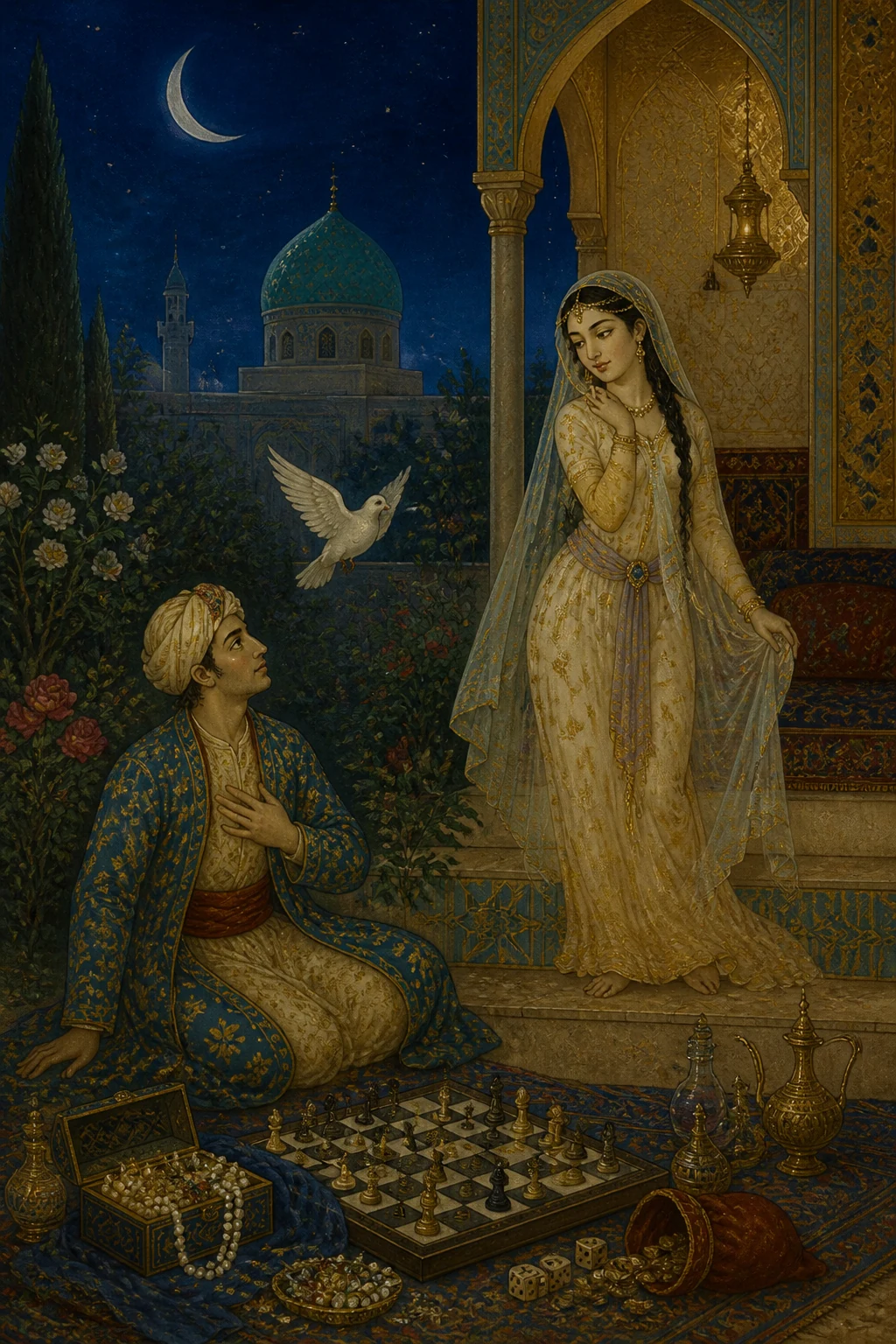
Waltey
Masrur in Zajn al Mavasif
Tisoč in ena noč · arabska pripovedna tradicijaO besedilu
Masrur in Zajn al Mavasif
- Vir
- Tisoč in ena noč
- Avtor
- arabska pripovedna tradicija
- Jezik branja
- English
- Jezik izvirnika
- Arabic
- Čas branja
- 92 min branja
- Obseg
- 74 strani
- Naslov izvirnika
- مسرور وزين المواصف - الليالي ٨٤٥ إلى ٨٦٣
O izvirniku
Tisoč in ena noč
Zgodbe v zgodbah, polne trgovcev, dvorov, preoblek in nočnih zapletov. Bralni jezik je English, izvirnik pa prihaja iz vira Tisoč in ena noč v jeziku Arabic.
Besedilo
Masrur in Zajn al Mavasif
It is told that in ancient times, in ages long past, there lived a merchant named Masrur. He was among the finest men of his day, wealthy and comfortably situated, but much given to strolling through gardens and orchards and diverting himself with the love of beautiful women. One night, as he slept, he dreamed that he was in a garden more beautiful than any he had ever seen. There were four birds in it, among them a white dove like burnished silver. The dove delighted him, and a great longing for it took hold of his heart. Then he saw a mighty bird swoop down upon him and snatch the dove from his hand, which grieved him sorely. He awoke from sleep and found no dove beside him, and struggled with his longing until morning. “Today,” he said to himself, “I must go to someone who can interpret this dream for me.” And morning overtook Shahrazad, and she fell silent, leaving her tale untold.
When it was the eight hundred and forty-sixth night
She said: It has reached me, O fortunate King, that when Masrur the merchant awoke, he struggled with his longing until morning. At daybreak he said, “Today I must go to someone who can interpret this dream for me.” So he rose and wandered this way and that until he was far from home, but found no one who could explain his dream. At last he turned homeward. As he walked, it occurred to him to turn aside toward one of the merchants’ houses, a mansion belonging to a wealthy man. When he reached it, he heard within the plaintive voice of a sorrowing heart, reciting these verses:
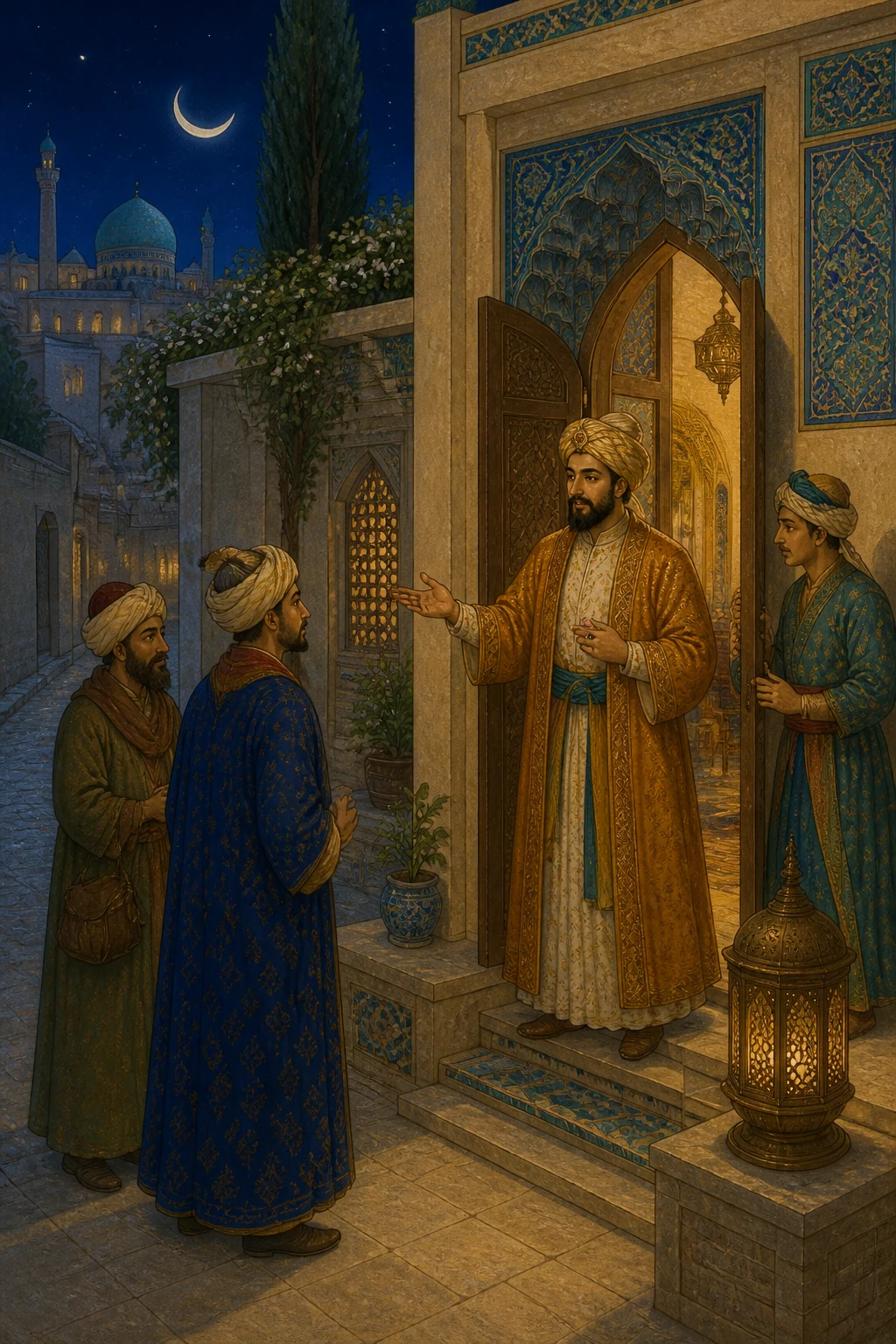
The east wind blew from the traces of her dwelling, fragrant with a breath that heals the ailing. I stood among its crumbling ruins, questioning them, but only their dust answered my tears. “O wandering breeze,” I said, “tell me, by God: will happiness ever return to this house? Shall I again possess that gazelle whose supple figure swayed my heart, whose languid, lovesick eyes have wasted me away?” When Masrur heard the voice, he looked inside the house and saw a most beautiful garden. At its heart hung a curtain of red brocade, crowned with pearls and jewels. Behind it were four maidens, and among them a young woman whose height was between four and five spans. She was like the radiant full moon, with kohl-darkened eyes, meeting eyebrows, a mouth like Solomon’s seal, and lips and teeth like coral and pearls. Her beauty, grace, and shapely figure stole the wits of all who saw her. At the sight of her, Masrur entered the house and went on until he reached the curtain. She raised her head and looked at him. He greeted her, and she returned his greeting in the sweetest of voices. As he gazed at her and studied her face, his reason fled and his heart was lost. Then he looked about the garden, which was filled with jasmine, stocks, violets, roses, bitter orange, and every kind of fragrant plant. All the trees were draped with fruit, and water flowed down from four iwans facing one another. Looking closely at the first iwan, he saw these two verses inscribed around it in red cinnabar:
O house, may sorrow never enter you, nor time betray your master. Blessed is the dwelling that shelters every guest when the wide world offers him no room. Then he examined the second iwan and saw these verses written around it in red gold:
May the robes of happiness shine upon you, O house, so long as birds sing among the garden boughs. May fragrant perfumes linger within you, and lovers find their wishes fulfilled. May your people live in honour and abundance so long as a wandering star shines in the heights. Then he examined the third iwan and saw these two verses written around it in blue lapis lazuli:
May you endure in honour and prosperity, O house, as long as night falls and daylight shines. At your door happiness shelters all who enter, and goodness pours from you upon all who come. Then he examined the fourth iwan and saw this verse written around it in yellow pigment:
Here is a garden, here a pool: a pleasant gathering place, and a forgiving Lord. In that garden were turtledoves, pigeons, nightingales, and doves, each singing in its own voice. The young woman swayed with such beauty and grace that everyone who saw her was enchanted. Then she said, “Sir, what has emboldened you to enter a house that is not yours, among maidens who do not belong to you, without their owners’ permission?” “My lady,” he replied, “I saw this garden and was delighted by its lovely greenery, its fragrant blossoms, and its singing birds. I entered to admire it for a little while, and then go on my way.” “You are most welcome,” she said. When Masrur the merchant heard her words and looked at her eyes and her graceful figure, he was bewildered by her beauty and by the charm of the garden and its birds. His reason flew away, and in his confusion he recited these verses:
A moon has appeared in wondrous beauty amid green hills, sweet air, and basil, amid myrtle, wild roses, and violets whose fragrance breathes from the branches. O garden, perfect in all your beauties, embracing every flower and bough! Beneath your branches’ shade the full moon shines, and birds sing their sweetest melodies. Your turtledoves, your nightingales, your doves and songbirds have stirred my sorrows. Love stands bewildered in my heart before her beauty, like a drunken man astray. When Zayn al-Mawasif heard Masrur’s verses, she gave him a glance that brought a thousand sighs in its wake and robbed him of his reason and understanding. She answered his poem with these verses:
Hope not for union with the one you love; abandon the desires you have cherished. Forsake your hopes, for you cannot endure the rejection of the beauty you adore. My glances wreak havoc among lovers, and I do not shrink from what I have declared. When Masrur heard her words, he summoned patience and self-command, concealing his feelings and giving no sign of them. “There is no remedy for affliction,” he told himself, “but patience.” They remained thus until night fell. Then she ordered food to be brought, and a table was set before them with every kind of dish: quails, young pigeons, and lamb. They ate their fill, and she ordered the tables removed. Washing vessels were brought, and they washed their hands. Then she called for candlesticks, which were set out and furnished with camphor candles. After this Zayn al-Mawasif said, “By God, my heart is oppressed tonight, for I am feverish.” Masrur replied, “May God ease your heart and dispel your sorrow.” “Masrur,” she said, “I am accustomed to playing chess. Do you know anything of the game?” “Yes,” he answered, “I know it well.” She had a chess set placed before them. It was made of ebony inlaid with ivory, its board adorned with gleaming gold, and its pieces fashioned from pearls and rubies. And morning overtook Shahrazad, and she fell silent, leaving her tale untold.
When it was the eight hundred and forty-seventh night
She said: It has reached me, O fortunate King, that when she ordered the chess set brought, they placed it before them. Its beauty astonished Masrur. Zayn al-Mawasif turned to him and asked, “Would you like the red pieces or the white?” “O queen of beauties and ornament of the morning,” he replied, “take the red pieces, for they are lovely and become one as lovely as yourself. Leave the white pieces to me.” “Agreed,” she said. She took the red pieces and arranged them opposite the white, then stretched out her hands to make the opening moves. He looked at her fingers and saw that they were as soft as dough, and their beauty and the delicacy of her gestures left him dazed. Turning to him, she said, “Masrur, do not lose your wits. Be patient and steady.” He answered, “O you whose beauty puts the moons to shame, how can your lover look upon you and remain composed?” While he was still in this state, she declared, “Checkmate!” Having defeated him, Zayn al-Mawasif knew that love for her had driven him mad. “Masrur,” she said, “I will play with you only for a fixed and clearly stated stake.” “I hear and obey,” he answered. “Swear to me,” she said, “and I will swear to you, that neither of us will deceive the other.” They exchanged oaths, and she said, “Masrur, if I defeat you, I shall take ten dinars from you; but if you defeat me, I shall give you nothing.” Thinking he would beat her, he replied, “My lady, do not break your oath, for I see that you are the stronger player.” “I agree to that,” she said. They began to play, racing their pawns forward. She brought her knights up behind them, marshalled her forces, supported them with her rooks, and boldly advanced her knights. Zayn al-Mawasif was wearing a veil of blue brocade over her head. She took it off and bared a wrist like a column of light, passed her hand over the red pieces, and said, “Take care!” Masrur was dazzled; his reason fled and his wits deserted him. Gazing at her grace and delicacy, he was overcome with wonder. He reached toward the white pieces, but his hand strayed to the red. “Masrur,” she said, “where are your wits? The red pieces are mine, and the white are yours.” “No one who looks at you,” he answered, “can keep possession of his wits.” Seeing his condition, Zayn al-Mawasif took the white pieces from him and gave him the red. He played with them, and she defeated him.
He continued playing against her, and she continued to win, taking ten dinars from him each time. When Zayn al-Mawasif saw how wholly absorbed he was in love for her, she said, “Masrur, you will never attain your desire unless you defeat me, as you have stipulated; and from now on I will play only for a hundred dinars a game.” “With pleasure and all honour,” he replied. She played him and beat him, again and again, and each time he paid her a hundred dinars. They went on until morning, and he did not win once. At last he rose to his feet. “What do you intend, Masrur?” she asked. “I shall go home and bring more money,” he replied. “Perhaps I may yet fulfil my hopes.” “Do whatever you think best,” she said. He went home and brought her all his money. When he reached her, he recited these two verses:
In sleep I saw a bird nurtured in a garden of delight, whose blossoms smiled. When it appeared before me, I caught it: let your faithfulness fulfil the meaning of my dream. When Masrur had brought her all his money, he began playing against her again, and she defeated him. He could not win a single game. They continued thus for three days, until she had taken all his money. When it was gone, she asked, “Masrur, what do you wish to do?” “I will stake my perfumery shop,” he replied. “How much is that shop worth?” “Five hundred dinars.” He played five games upon that stake, and she won them all. Then he played for his slave girls, his properties, his gardens, and his buildings, and she took them all, together with everything else he possessed. At last she turned to him and asked, “Have you any wealth left to wager?” He answered, “By Him who ensnared me with you in the net of love, my hands possess nothing now, neither money nor anything else, little or much.” “Masrur,” she said, “what begins in consent should not end in regret. If you repent, take back your wealth and go your way. For my part, I release you from every obligation.” Masrur replied, “By Him who decreed these things for us, if you wished to take my life, it would be a small price for your pleasure. I love no one but you.” “Then, Masrur,” she said, “go and bring the judge and witnesses, and make over all your possessions and properties to me.” “With pleasure and all honour,” he replied. He rose at once and brought the judge and witnesses before her. When the judge saw her, his reason fled, his wits deserted him, and his thoughts were thrown into confusion by the beauty of her fingers. “My lady,” he said, “I will draw up the deed only on condition that you purchase the properties, slave girls, and possessions, so that they all pass into your ownership and keeping.” “We are agreed,” she answered. “Draw up a deed stating that Masrur’s property, his slave girls, and everything he possesses are transferred to Zayn al-Mawasif for a total price of such and such.” The judge wrote the deed, the witnesses signed it, and Zayn al-Mawasif took possession of it. And morning overtook Shahrazad, and she fell silent, leaving her tale untold.
When it was the eight hundred and forty-eighth night
She said: It has reached me, O fortunate King, that when Zayn al-Mawasif received from the judge the deed declaring that everything Masrur had owned now belonged to her, she said, “Masrur, go your way.” Her maid Hubub turned to him and said, “Recite us some poetry.” So he recited these verses concerning the game of chess:
I complain of time and all that has befallen me; I complain of loss, of chess, and of a glance, for love of a slender, tender maiden whose equal, man or woman, cannot be found. She aimed the arrows of her eyes at me and advanced armies that conquer humankind: red and white, with charging horsemen. She challenged me and said, “Beware!” She left me helpless as her fingers moved beneath a night as dark as her hair. I could not move the white pieces to safety, and longing set my tears flowing. Pawns and rooks, with their counsellors, charged, and the white army fled defeated. She shot an arrow from her eyes and cleft my heart with that same shaft. She offered me my choice of armies, and I chose the white to wager on. “These white troops will suit me,” I said. “Be patient,” she answered, “while I consider my move.” She played me for a stake to which I had agreed, yet I could not win the fulfilment of my wish through her favour. Alas for my heart, my longing, and my grief, yearning for union with a girl like the moon! No, my heart does not burn or grieve for my estates; it longs only to gaze upon her. Bewildered, astonished, and afraid, I reproach time for all that has befallen me. “Why are you so dazed?” she asked. I answered, “Does a drinker grow sober while still drunk?” A mortal woman robbed me of my reason with her graceful form—if only her stony heart would soften! I fed my hopes and said, “Today I shall win her by this wager, without fear or caution.” My heart kept hoping for her favour until I was left poor in both wealth and love. Can a lover turn from a passion that destroys him, though he sink into the seas of longing? Now your servant has no wealth to employ, a prisoner of yearning, his desire unfulfilled. When Zayn al-Mawasif heard these verses, she marvelled at his eloquence. “Masrur,” she said, “give up this madness, return to your senses, and go your way. You have squandered your money and property at chess without attaining your desire, and there is no path left by which you may reach it.” Masrur turned to her and said, “My lady, ask for anything you wish. Whatever you demand, I shall bring and lay before you.” “Masrur,” she replied, “you have no money left!” “O utmost of my hopes,” he answered, “if I have no money, there are men who will help me.” “Does the giver become a beggar?” she asked. “I have relatives and friends,” he replied. “Whatever I ask, they will give me.” She said, “I want four pods of the most fragrant musk, four vessels of ghaliya perfume, four ratls of ambergris, four thousand dinars, and four hundred robes of embroidered royal brocade. If you bring me these things, Masrur, I shall consider granting you my favour.” “That is easy for me,” he answered, “O you who put the moons to shame.” Masrur left her to fetch what she had requested, and she sent her maid Hubub after him to discover his standing among the people he had spoken of. As he walked through the city streets, he happened to glance around and saw Hubub some way behind him. He stopped until she caught up and asked, “Hubub, where are you going?” “My mistress sent me after you for such and such a reason,” she replied, and told him everything Zayn al-Mawasif had said, from beginning to end. “By God, Hubub,” he said, “I do not possess a single coin.” “Then why did you promise her?” she asked. “How many promises go unfulfilled!” he replied. “In love, there must always be a little delay.” When Hubub heard this, she said, “Masrur, take heart and be at ease. By God, I shall bring you together with her.”
Then she left him and walked on until she reached her mistress. Weeping bitterly, she said, “My lady, by God, he is a man of great standing, much respected by everyone.” Her mistress replied, “There is no remedy against the decree of God Most High. This man has found no merciful heart in us: we have taken his wealth and shown him neither affection nor compassion in granting him our company. Yet if I yield to his wishes, I fear the matter will become known.” Hubub said, “My lady, his condition and the loss of his wealth have not been easy for us to bear. But there is no one with you except me and your maid Sukub. Which of us would dare speak against you, when we are your own servants?” At this she lowered her head toward the ground. The maids said, “My lady, we think you should send for him and show him kindness. Do not leave him to beg from the mean-spirited. How bitter it is to beg!” She accepted their advice, called for ink and paper, and wrote him these verses:
Our meeting draws near, Masrur: rejoice, there shall be no delay. When night grows dark, be sure to come. Ask no money of the base, young man: I was intoxicated, but my senses have returned. All your wealth is restored to you, and with it, Masrur, I grant you my company. For you have patience and a sweetness that endured the injustice of a beloved who shunned you without cause. Hasten to enjoy our meeting, and may happiness be yours. Do not delay, lest my household discover us. Come swiftly, without lingering, and taste the fruits of reunion while my husband is away. Then she folded the letter and gave it to her maid Hubub, who carried it to Masrur. She found him weeping and reciting the poet’s words:
A breeze of passion blew upon my heart and shattered it with the violence of my anguish. My longing has grown since my beloved went away, and my eyes overflow with ever-mounting tears. Such fancies haunt me that, if I confided them to unyielding pebbles and rock, they would quickly soften. Would that I knew whether I shall see what gladdens me and win the fulfilment of my hopes; whether the nights of rejection will pass after her estrangement, and I shall be healed of the wound within my heart. And morning overtook Shahrazad, and she fell silent, leaving her tale untold.
When it was the eight hundred and forty-ninth night
She said: It has reached me, O fortunate King, that as Masrur’s passion increased, he began reciting poetry in the extremity of his longing. While he chanted those verses over and over, Hubub heard him and knocked at his door. He rose and opened it. She entered and handed him the letter, which he took and read. “Hubub,” he asked, “what news do you bring of your mistress?” “My lord,” she answered, “this letter contains all the answer you need, and you are a man of understanding.” Masrur was overjoyed and recited these two verses:
The letter came, and its contents delighted me; gladly I preserve it in my heart. My longing grew when I kissed it, as though the hidden pearls of love lay folded within. Then he wrote a reply and gave it to Hubub, who took it back to Zayn al-Mawasif. On reaching her, she began praising his merits, describing his fine qualities and generosity, and doing all she could to bring them together. Zayn al-Mawasif said, “Hubub, he is slow in coming to us.” “He will be here soon,” Hubub answered. She had scarcely finished speaking when he arrived and knocked at the door. She opened it, led him inside, and seated him beside her mistress. Zayn al-Mawasif greeted him warmly, welcomed him, and gave him a place at her side. Then she said to Hubub, “Bring him one of the finest suits of clothes.” Hubub rose and brought a gold-embroidered suit, which her mistress took and put on him. She herself dressed in one of her most magnificent outfits and set upon her head a band of lustrous pearls. Around it she bound a brocade headband crowned with pearls, jewels, and rubies. Beneath the headband she let two side-locks hang, each adorned with a red ruby mounted in gleaming gold, and she loosened her hair, dark as the deepest night. She perfumed herself with aloeswood smoke and anointed herself with musk and ambergris. “May God protect you from the evil eye,” said Hubub. Then she began walking with a swaying, graceful step, and the maid recited these lovely verses of her own:
The willow boughs are shamed by her gait, and with her glances she assails lovers. A moon appears amid the darkness of her hair, like sunlight breaking through her abundant tresses. Blessed is the one beside whom she spends the night in all her beauty, who dies for love of her, swearing by her life. Zayn al-Mawasif thanked her, then approached Masrur, radiant as the full moon. At the sight of her he rose to his feet and said, “If my judgment is true, she is no mortal woman, but one of the brides of Paradise.” Then she called for the table, and it was brought. Around its edges were written these verses:
Turn with your spoons toward the realm of little bowls, and seek refuge among fried dishes and grouse. Upon it … I have always loved them, with young birds … and chickens. God bless the kebab, splendid in its ruddy colour, and the greens dipped in the vinegar of the bowls! Excellent is rice with fresh milk, into which hands plunge as far as their bracelets. How my heart yearns for two kinds of fish beside two loaves of patterned bread! Then they ate and drank, delighted themselves, and made merry. The food was cleared away and the wine set out. Cups and goblets passed among them, and their spirits grew light. Masrur filled a cup and said, “O you whose servant I am, and who are my mistress!” Then he began chanting these verses:
I marvel that my eyes could ever tire of gazing at a maiden radiant in her beauty. None in her age resembles her in delicacy of manner and excellence of character. The willow branch envies her supple form when she walks, gracefully arrayed in her robe. Her shining face puts the full moon to shame in the darkness, and the parting of her hair gleams like the crescent’s light. When she walks upon the earth, her fragrance spreads like a breeze over its plains and hills. When Masrur had finished his poem, she said, “Masrur, whoever holds fast to his faith and has eaten our bread and salt has a claim upon us. Put these matters aside, and I shall restore your properties and everything we have taken from you.” He replied, “My lady, I freely release you from everything you mention. If I have broken the oath between us, I shall go and become a Muslim.” Her maid Hubub said, “My lady, you are young, yet you know a great deal. I plead with you in the name of Almighty God: unless you listen to me and grant my wish, I will not sleep in your house tonight.” “Hubub,” she answered, “it shall be as you wish. Rise and prepare another gathering for us.” Hubub rose and prepared a fresh room, decorating it and scenting it with the finest perfumes, just as her mistress liked. She made ready the food and brought the wine. Cups and goblets passed among them, and their spirits grew light. And morning overtook Shahrazad, and she fell silent, leaving her tale untold.
When it was the eight hundred and fiftieth night
She said: It has reached me, O fortunate King, that when Zayn al-Mawasif ordered her maid Hubub to prepare a fresh gathering, she rose and replenished the food and wine. Cups and goblets passed among them, and their spirits grew light. Then Zayn al-Mawasif said, “Masrur, the time has come for us to meet and draw near. If you suffer for love of us, recite some poetry of exquisite meaning.” So Masrur recited this poem:
I was taken captive, with a fire blazing in my heart, when the cord of union was severed by separation. I love a maiden whose graceful figure has pierced my heart, whose tender cheek has stolen my reason. Her brows meet, her eyes are dark and bright, and her smile flashes like lightning. She is fourteen years of age, and for love of her my tears have flowed as red as dragon’s blood. I saw her between a river and a garden, her face outshining the full moon in the heavens. I stood before her like an awestruck captive and said, “God’s peace upon you, dweller in this sanctuary.” She willingly returned my greeting, with gentle words like strung pearls. When she heard what I said, she understood my purpose, and my heart was firmly set upon her. “Is not such talk mere folly?” she asked. I answered, “Cease reproaching one who loves you. If you accept me today, the matter is simple: one such as you is beloved, and one such as I is love’s captive.” When she understood my intention, she smiled and said, “By the Lord who created earth and heaven, I am a Jewess, most steadfast in my faith, while you belong to the Christians. How can you hope to join me when you are not of my religion? Whoever attempts this will come to regret it. Would you trifle with two faiths? Is such a thing permitted in love, that you should become, like me, wounded by reproach, pursuing this affair in every direction and remaining guilty against both my faith and yours? If you love me, become a Jew for love, and forbid yourself every union but mine. Swear truly upon the Gospel to preserve my secret in your love and conceal it; and I shall swear sincerely upon the Torah to keep the pledge already made.” I swore by my religion, my law, and my belief, and made her swear a solemn oath like mine. “What is your name,” I asked, “O utmost of my hopes?” She answered, “Here I am called Zayn al-Mawasif.” I cried, “Zayn al-Mawasif, I am consumed with love for you: help your captive lover!” I glimpsed her beauty beneath her veil and grew sorrowful, wretched, and enamoured. Beneath the curtain I remained, humbly lamenting the mighty passion that ruled my heart. When she saw my condition and the depth of my bewilderment, she showed me a smiling, laughing face. … What adornment has the world except the one you love, close beside you to make you happy? When morning shone, she rose and bade farewell, her lovely face surpassing the moon in heaven. As we parted she recited, while her tears and mine lay like strings of pearls upon our cheeks: “Whatever I forget, I shall never forget the promises I made, the beauty of those nights, and the solemn oath.” Zayn al-Mawasif was delighted. “Masrur,” she said, “how lovely are your thoughts! May no enemy of yours prosper.” Then she entered the inner chamber and called for Masrur, who went in to join her. … Zayn al-Mawasif said to him, “Masrur, your wealth is forbidden to us and lawful to you, for we have become dear to one another.” She returned everything she had taken from him and asked, “Masrur, have you a garden where we might go and enjoy ourselves?” “Yes, my lady,” he replied. “I have a garden without equal.” He went home and ordered his maids to prepare a splendid meal, a beautiful gathering place, and a grand entertainment. Then he invited her to his house. She came with her maids, and they ate and drank, delighted themselves, and made merry. Cups and goblets passed among them, and their spirits grew light. Each companion sat with the one they loved. She said, “Masrur, some delicate verses have come to mind, and I should like to sing them to the lute.” “Sing them,” he replied. She took the lute in her hands, tuned it, plucked its strings, and fashioned a lovely melody, singing these verses:
The music of the strings has swayed me with delight, and our morning cup is clear before the dawn. Love lays bare an enamoured heart, and passion appears as the veils are torn away. Beside us is wine, exquisite in all its qualities, like sunlight displayed in the hands of moons, on a night that has brought us its gladness, washing every cloud of sorrow away. When she had finished, she said, “Masrur, recite some of your poetry, and delight us with the fruits of your invention.” He recited these two verses:
We rejoiced in a moon passing the wine, and in the music of a lute within our garden retreat. Its turtledoves sang and its branches swayed at dawn, while among its bowers our dearest hopes were fulfilled. When he finished, Zayn al-Mawasif said, “Recite us some verses about what has happened to us, if you are truly absorbed in loving us.” And morning overtook Shahrazad, and she fell silent, leaving her tale untold.
When it was the eight hundred and fifty-first night
She said: It has reached me, O fortunate King, that Zayn al-Mawasif said to Masrur, “If you are truly absorbed in loving us, recite some verses about what has happened to us.” “With pleasure and all honour,” he replied, and recited this poem:
Stop and hear what befell me through love of this gazelle: a white doe who shot her arrows at me and conquered me with her glance. I was bewitched with passion, and love left me no resource. I loved a coy beauty, guarded by blades. I saw her amid a garden, her figure straight and graceful. I greeted her; she listened to my words and returned my greeting. I asked her name, and she said, “My name befits my beauty: I am called Zayn al-Mawasif.” I said, “Have pity on my plight, for such passion possesses me that nowhere will you find a lover like me.” She said, “If you love me and hope to enjoy my embrace, I want abundant riches, beyond all ordinary gifts. I want costly silken robes from you, and a quarter-quintal of musk for the night of our union; pearls and agates of the finest, dearest kind; silver and pure gold fashioned into lovely ornaments.” I showed seemly patience, though my heart was sorely troubled, and she granted me her embrace on a night of the crescent moon. If others blame me for loving her, I cry, “Men, come to my aid!” Her hair is long, its hue the hue of night; roses bloom upon her cheeks like flames ablaze. A sword lies in her eyelid, and her glances fly like arrows. Her mouth holds wine, her saliva is pure spring water, and her teeth are like a necklace of pearls strung in perfect order. Her neck is a gazelle’s neck; her loveliness is complete. Her breast is marble, her breasts like rounded jars; her belly has folds scented with precious perfumes. Beneath it lies that thing in which all my hopes find their end: well tended, plump, and rounded, my masters, like a royal throne before which I plead my case. Between the two pillars you find raised terraces. Yet it has a feature that confounds the minds of men: great lips and a hollow like a mule’s, showing the red of an eye and a lip like a camel’s. When you approach it, eager for the deed, you find it hot in its welcome, strong and vigorous. It sends every brave warrior back with his fighting resolve undone. Sometimes you encounter it with a long beard. A lovely creature, radiant and beautiful, could tell you of it—one like Zayn al-Mawasif, perfect in her loveliness. I came to her by night and took my lawful pleasure. The night I passed with her surpassed all other nights. When morning came she rose, her face like the crescent moon, swaying her figure as tall spears sway. She bade me farewell and said, “When will those nights return?” I said, “O light of my eyes, come whenever you wish.” This poem delighted Zayn al-Mawasif beyond measure and filled her with joy. “Masrur,” she said, “morning is near, and we must leave now, lest we be exposed.” “Gladly and with pleasure,” he replied. He rose to his feet and escorted her home, then went back to his own lodging and spent the night pondering her charms. When morning dawned and its light shone forth, he prepared a magnificent gift for her, brought it to her, and sat with her. They continued thus for several days, living in the greatest ease and happiness. Then one day a letter came to her from her husband, saying that he would soon return. “May God neither bring him safely home nor spare his life,” she said to herself. “If he comes back, our happiness will be spoiled. Would that I had given up all hope of him!” When Masrur came and sat talking with her as usual, she said, “Masrur, a letter has come from my husband, saying that he will soon return from his travels. What are we to do, when neither of us can bear to be without the other?” He replied, “I do not know what is to be done. You know your husband’s character better than I do. Besides, you are among the cleverest of women, a mistress of stratagems, able to devise things that men could never contrive.” “He is a difficult man,” she said, “and jealous of the women of his household. But when he returns from his travels and you hear that he has arrived, go to him, greet him, sit beside him, and say, ‘Brother, I am a dealer in perfumes and spices.’ Buy some of his wares, visit him often, and talk with him at length. Whatever he asks you to do, do not oppose him. Perhaps the scheme I devise will succeed.” “I hear and obey,” he answered. Masrur left her with the fire of love blazing in his heart. When her husband reached the house, she showed delight at his arrival, welcomed him, and greeted him. He looked into her face and saw that it was yellow: she had washed it with saffron and employed certain women’s tricks. He asked how she was, and she told him that she and the slave girls had been ill ever since he went away. “Our hearts have been anxious for you,” she said, “because you have been gone so long.” She began to complain of the hardship of separation, weeping floods of tears. “Had you a companion with you,” she said, “my heart would not have borne all this anxiety. For God’s sake, my lord, never travel again without a companion, and do not leave me without news of you, so that my heart and mind may be at ease.” But morning overtook Shahrazad, and she ceased her permitted tale.
When it was the eight hundred and fifty-second night,
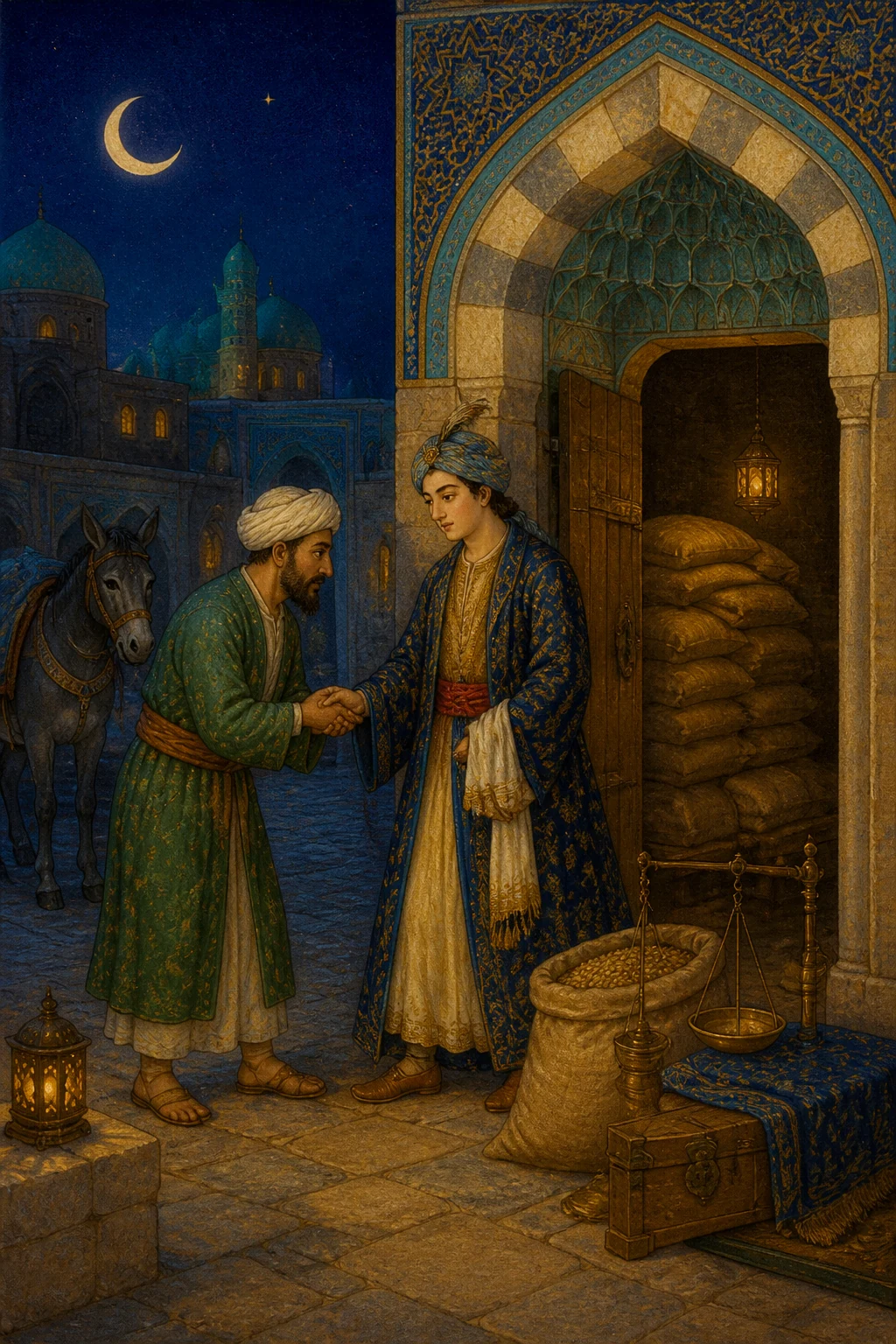
She said: It has reached me, O fortunate King, that when Zayn al-Mawasif said to her husband, “Do not travel without a companion, and do not leave me without news of you, so that my heart and mind may be at ease,” he replied, “Gladly and with pleasure! By God, your counsel is wise and your judgment sound. By your life, so dear to my heart, it shall be just as you wish.” Then he took some of his merchandise to his shop, opened it, and sat selling in the market. As he sat there, Masrur approached, greeted him, and sat beside him, exchanging courtesies. After talking with him for a while, Masrur took out a purse, untied it, drew out some gold, and handed it to Zayn al-Mawasif’s husband. “Give me some perfumes and spices for these dinars,” he said, “so that I may sell them in my shop.” “I hear and obey,” the man replied, and gave him what he asked for. Masrur continued to visit him for several days, until Zayn al-Mawasif’s husband turned to him and said, “I am looking for a man to take as a partner in trade.” Masrur replied, “I too am looking for a partner in trade, for my father was a merchant in Yemen and left me a great fortune, which I fear I may lose.” Zayn al-Mawasif’s husband turned to him and said, “Would you become my companion, while I become your companion, comrade, and friend, both on journeys and at home, and teach you buying and selling, taking and giving?” “Gladly and with pleasure,” Masrur answered.
He took Masrur home, seated him in the entrance hall, and went in to his wife, Zayn al-Mawasif. “I have made a friend,” he told her, “and invited him to be my guest, so prepare a fine meal for us.” Zayn al-Mawasif rejoiced, knowing that it was Masrur. She prepared a splendid feast and made delicious dishes in her delight that Masrur had come and her scheme had succeeded. When Masrur was in the house, her husband said to her, “Come out with me to welcome him, and tell him how pleased we are to have him.” Zayn al-Mawasif flew into a rage. “Would you bring me before a strange man?” she said. “God forbid! Even if you cut me to pieces, I would not appear before him.” Her husband said, “Why should you feel shy before him? He is a Christian, we are Jews, and we are to be friends.” “I have no wish to appear before a stranger whom I have never set eyes on and do not know,” she replied. Her husband believed she spoke sincerely, and kept coaxing her until she rose, wrapped herself up, took the food, and went out to welcome Masrur. He lowered his head to the ground as though overcome with modesty. Seeing his downcast gaze, the man said to himself, “This is surely a pious man.” They ate their fill, then the food was removed and wine brought in. Zayn al-Mawasif sat opposite Masrur, and they gazed at one another until the day had passed. Masrur then went home with fire blazing in his heart, while Zayn al-Mawasif’s husband reflected on his friend’s graciousness and good looks. When night fell, his wife brought him supper as usual. He kept a nightingale in the house, and whenever he sat down to eat, the bird would come and eat with him and flutter about his head. Now the bird had grown familiar with Masrur and would flutter around him whenever he sat at table. When Masrur was gone and its master returned, it did not recognize him and would not come near him. He began to ponder the bird’s conduct and why it kept away. As for Zayn al-Mawasif, she could not sleep, for her heart was occupied with Masrur. This continued through the second and third nights. The Jew perceived her condition and watched her as she sat distracted, and he grew suspicious. On the fourth night he awoke at midnight and heard his wife murmuring Masrur’s name in her sleep as she lay in his arms. His suspicions deepened, but he kept them to himself.
When morning came, he went to his shop and sat there. Presently Masrur approached and greeted him. He returned the greeting and said, “Welcome, brother! I have missed you.” They sat talking for a while, then he said, “Come home with me, brother, so that we may seal our bond of brotherhood.” “Gladly and with pleasure,” Masrur replied. When they reached the house, the Jew went ahead and told his wife that Masrur had come, and that he wished to enter into trade with him and make him his sworn brother. “Prepare a pleasant room for us,” he said. “You must be present and witness our bond of brotherhood.” She replied, “For God’s sake, do not bring me before this stranger. I have no wish to appear before him.” He said no more to her, but ordered the slave girls to serve food and drink. Then he called the nightingale, which flew down into Masrur’s lap and did not recognize its master. At this he asked, “Sir, what is your name?” “My name is Masrur,” he replied—the very name his wife had been murmuring all night in her sleep. Then the husband raised his head and saw her signaling to Masrur and winking at him. He knew that he had been duped. “Sir,” he said, “allow me to fetch my cousins to witness our bond of brotherhood.” “Do as you please,” Masrur replied. Zayn al-Mawasif’s husband rose, went out of the house, and came round behind the room. But morning overtook Shahrazad, and she ceased her permitted tale.
When it was the eight hundred and fifty-third night,
She said: It has reached me, O fortunate King, that Zayn al-Mawasif’s husband said to Masrur, “Allow me to fetch my cousins to witness the bond of brotherhood between us.” Then he went round behind the room and stood there. There was a little window overlooking them, and he approached it and began watching them without their seeing him. Presently Zayn al-Mawasif said to her slave girl Sukub, “Where has your master gone?” “Outside the house,” she replied. “Shut the door,” her mistress said, “and secure it with the iron bar. Do not open it when he knocks until you have told me.” “It shall be done,” the girl replied. Her husband watched all this. Then Zayn al-Mawasif took a cup, scented it with rosewater and powdered musk, and came to Masrur. He rose to meet her and said, “By God, your saliva is sweeter than this wine.” She gave him to drink, and he gave her to drink. Then she sprinkled him with rosewater from head to foot, until its fragrance filled the room. All the while her husband watched them, marveling at the strength of their love. His heart filled with fury at what he saw, and anger and fierce jealousy seized him. He went to the door and found it locked, and pounded on it violently in his rage. “My lady,” said the slave girl, “my master has come.” “Open the door for him,” she replied. “May God not bring him safely back!” Sukub went and opened it. “Why have you locked the door?” he asked her. “This is how we kept it while you were away,” she replied. “It was always locked and never opened, night or day.” “Well done,” he said. “That pleases me.” Then he went in to Masrur, smiling and concealing what he knew. “Masrur,” he said, “let us leave this bond of brotherhood for today and seal it another day.” “I hear and obey,” he answered. “Do as you wish.” Masrur went home, while Zayn al-Mawasif’s husband pondered his plight, not knowing what to do, his mind deeply troubled. “Even the nightingale has disowned me,” he said to himself, “and the slave girls shut the doors in my face and side with another.” In his anguish he kept reciting these verses:
Masrur has long lived in delight, enjoying days of pleasure and a life now past. Time opposes me in the one I love, while the fires in my heart blaze ever higher. A season of happiness with that beauty has passed for you, yet you remain enthralled by her charms. My own eyes have beheld her loveliness, and my heart has become the slave of her love. How often, willingly, she let me sip the nectar of her sweet mouth to quench my thirst! Why, nightingale, have you forsaken me and gone at dawn to greet my foes? My eyes have seen strange things that would wake my eyelids were they sleeping. I have seen my beloved cast my affection aside, and my nightingale no longer circles about me. By the God of all worlds, who makes firm whatever decree He wills for His creatures, I shall give that wrongdoer his deserts, who in his folly approached her and sought her embrace. When Zayn al-Mawasif heard his verses, she trembled and turned pale. “Did you hear that poem?” she asked her slave girl. “Never in my life have I heard him recite such verses,” the girl replied. “But let him say what he will.” Once her husband was certain of the truth, he began selling everything he possessed. “Unless I take them far from their homeland,” he said to himself, “they will never abandon their ways.” When he had sold all his property, he forged a letter and read it to her, claiming that it had come from his cousins and contained an invitation for him and his wife to visit them. “How long shall we stay with them?” she asked. “Twelve days,” he replied. She agreed and asked, “May I take some of my slave girls?” “Take Hubub and Sukub,” he said, “and leave Khutub here.” Then he prepared a fine howdah for them and made ready to depart. Zayn al-Mawasif sent word to Masrur: “If the time appointed between us passes and we have not returned, know that he has tricked us, plotted against us, and carried us far from one another. Do not forget our pledges and vows, for I fear his cunning and deceit.” Her husband prepared for the journey, while Zayn al-Mawasif wept and sobbed, unable to find rest by night or day. Seeing this, her husband made no objection. When she realized that he was determined to travel, she gathered up her clothes and possessions and entrusted them all to her sister. She told her what had happened, bade her farewell, and left her weeping. Then she returned home and found that her husband had brought the camels and was loading them. He had chosen the finest camel for Zayn al-Mawasif. When she saw that she must indeed be parted from Masrur, she was distraught. Her husband happened to go out on some business, and she went to the first door and wrote these verses upon it. But morning overtook Shahrazad, and she ceased her permitted tale.
When it was the eight hundred and fifty-fourth night,
She said: It has reached me, O fortunate King, that when Zayn al-Mawasif saw that her husband had brought the camels and knew that they were to depart, she was distraught. Her husband happened to go out on some business, and she went to the first door and wrote these verses upon it:
O dove of the house, carry our greetings from the lover to her beloved at our parting. Tell him that I remain sorrowful, grieving for the happy times we knew, just as my beloved remains enthralled, mourning the joy that is past. We spent a season in gladness and bliss, enjoying union by night and by day. We did not awaken until the raven of separation cried above us, announcing our parting. We have departed and left our dwellings desolate. Would that we had never left those homes! Then she went to the second door and wrote these verses upon it:
O you who come to the door, for God’s sake look for your beloved’s camels in the darkness, and tell him that I weep whenever I remember his embrace; the tears I shed will never end. If you cannot bear what has befallen me, take up the dust beside my camels and strew it upon yourself. Journey east and west through the lands, and live in patience, for God has ordained what must be. Then she went to the third door, wept bitterly, and wrote these verses upon it:
Pause, Masrur, if you visit her home; go to the doors and read the lines upon them. Do not forget the pledge of love, if you are true: how often she has tasted the sweetness and bitterness of nights! For God’s sake, Masrur, do not forget her closeness, for she has left her happiness and joy with you. Weep for the days of union and their sweetness, when, whenever you came, she lowered her curtains. Journey to the farthest lands for our sake; cross their seas and search their shores for us. The nights of our union have passed away, and the deep darkness of separation has quenched their light. May God cherish those days gone by—how happy they were, when we plucked flowers in the garden of desire! Why did they not endure as I had hoped? God willed that they should come and go. Will the days return and bring us together again, so that I may fulfill my vows to my Lord? Know that all things lie in the hand of Him who writes their lines upon the tablet of the brow. Then she wept bitterly and returned indoors, sobbing and lamenting. She began to recall the past and said, “Glory be to God, who has decreed this for us.” Her grief at parting from her beloved and leaving her home grew greater, and she recited these verses:
God’s peace be upon you, O house left empty, where the days have spent their store of joy. O dove of the house, may you ever mourn for her who has left her moons and full moons behind! Pause, Masrur, and weep at losing us, for in losing you my eyes have lost their light. Had your eyes seen the day of our departure, when my tears fed the flames within my heart! Do not forget that pledge beneath the shade of a garden that gathered us together and drew its curtains about us. Then she appeared before her husband, who helped her into the howdah he had made for her. When she was seated on the camel’s back, she recited these verses:
God’s peace be upon you, O house left empty, where for so long we grew in happiness and grace. Would that the nights of my life had run their course beneath your shelter, until love itself had slain me! I am distraught at my exile and my longing for a home I loved with all my heart, not knowing what was to come. Would that I knew whether I shall return there and find the same delight we knew at first! Her husband said, “Zayn al-Mawasif, do not grieve at leaving your home. You will soon return to it.” He soothed her and spoke tenderly to her. Then they set off, passed beyond the town, and took the road. She knew that their parting had truly come, and it weighed heavily upon her. All this time Masrur sat at home, pondering his own plight and that of his beloved. His heart sensed their separation, and he sprang to his feet at once and went to her house. He found the door locked and saw the verses Zayn al-Mawasif had written. He read those on the first door and fell unconscious to the ground. When he recovered, he opened the first door and went in to the second, where he saw what she had written, and then to the third. After reading all these words, his passion, yearning, and bewilderment grew greater. He hurried after her until he caught up with the caravan. He saw her at the rear, while her husband was at the front, attending to his affairs. At the sight of her he clung to the howdah, weeping in grief at the pain of parting, and recited these verses:
Would that I knew for what sin we have been struck by the arrows of estrangement through the long years! O heart’s desire, one day I came to the house when my grief for love of you had grown. I found the dwellings empty and deserted, and lamented our separation with ever deeper groans. I asked the wall about my heart’s sole desire: “Where have they gone?” And my heart became a captive. It said, “They have left their dwellings, lodging anguish deep within the heart. I have written lines upon the wall, as the faithful among mankind will do.” When Zayn al-Mawasif heard these verses, she knew that it was Masrur. But morning overtook Shahrazad, and she ceased her permitted tale.
When it was the eight hundred and fifty-fifth night,
She said: It has reached me, O fortunate King, that when Zayn al-Mawasif heard these verses, she knew that it was Masrur. She and her slave girls wept, and she said to him, “Masrur, I beg you by God to go back, lest my husband see us together.” At these words Masrur fainted. When he recovered, they bade one another farewell, and he recited these verses:
The guide called for departure before dawn, in the quiet darkness, as the dew-laden breeze arose. They saddled their mounts and hastened to leave; the caravan sped on when the camel-driver chanted. They filled the earth about them with fragrance and hurried on through that valley. They took possession of my heart through love, then departed, leaving me to follow in their tracks. O neighbors whom I wished never to leave, I have soaked the earth with my streaming tears! Alas for my heart, alas for me, after what the hand of separation has done, against my will, to my very soul! Masrur stayed beside the caravan, weeping and sobbing, while she pleaded with him to return before morning for fear of exposure. He approached the howdah, bade her farewell a second time, and fainted for a while. When he recovered, he found them traveling on. He turned toward the way they had gone, breathed in the east wind, and began to chant these verses:
Never does a breeze from the beloved’s country reach the yearning lover without his lamenting the anguish of desire. A breath of dawn blew over him; when he awoke, he was already far away, cast upon a bed of sickness, wasted, weeping blood with his streaming tears for neighbors who departed, taking my heart among the mounts driven on by their drivers. By God, no breeze ever blew from near them but I rose to greet it with my eyes! Then Masrur returned to the house, consumed with longing. He found it stripped of its supports, desolate without its loved ones. He wept until his clothes were drenched and fell unconscious, his soul almost leaving his body. When he recovered, he recited these two verses:
O dwelling, pity my abasement and submission, my wasted body and my flowing tears. Send us a fragrant breath of their sweet breeze, to heal my wounded heart. When Masrur returned to his own home, he was bewildered by all that had happened, his eyes filled with tears. He remained in this state for ten days.
Such was Masrur’s case. As for Zayn al-Mawasif, she knew that she had been tricked, for her husband continued traveling with her for ten days before lodging her in a certain town. Zayn al-Mawasif wrote a letter to Masrur, handed it to her slave girl Hubub, and said, “Send this letter to Masrur, so that he may know how we have been deceived and how the Jew has betrayed us.” The girl took the letter and sent it to Masrur. When it reached him, its news distressed him greatly, and he wept until he soaked the dust. He wrote a letter and sent it to Zayn al-Mawasif, ending it with these two verses:
Where is the road to the gates of consolation? How can one forget who burns amid the fire? How sweet were the hours they once enjoyed! Would that some of them were ours again! When the letter reached Zayn al-Mawasif, she took it, read it, and gave it to her slave girl Hubub. “Keep this secret,” she told her. But her husband learned that they were exchanging letters, so he took Zayn al-Mawasif and her slave girls and traveled with them for twenty days before settling them in another town. Such was Zayn al-Mawasif’s case. As for Masrur, he could neither sleep peacefully nor find rest, and he had no patience left. He continued thus until one night his eyes closed in sleep, and he dreamed that Zayn al-Mawasif had come to him in the garden and was embracing him. He woke and did not find her. His reason fled, his senses reeled, and tears streamed from his eyes, while his heart burned with longing. He recited these verses:
Peace be upon her whose phantom visited me in sleep, stirring my longing and increasing my love. I rose from that dream enthralled by the vision that had visited my slumber. Will dreams prove true concerning the one I love, and quench love’s thirst and heal my sickness? Now she offered me drink, now she embraced me, now she comforted me with gentle words. When our reproaches in the dream were ended and my eyes were bleeding tears, I sipped the sweetness of her dark lips, like nectar whose final fragrance seemed to me pure musk. I marveled at what passed between us in sleep, when I attained my desire and all I sought from her. Yet I rose from that dream and found nothing of the vision but my anguish and my love. I became like a madman when I saw her, and by evening I was drunk without wine. O wandering breeze, for God’s sake carry them the greeting of my longing and my peace. Tell them that the man they once knew has been made by the turns of time to drink the cup of death. Then he set off for her house, weeping all the way. He looked at the place and found it empty, yet saw her image glimmering before him, as though she stood there in person. His fires blazed higher, his sorrows deepened, and he fell unconscious. But morning overtook Shahrazad, and she ceased her permitted tale.
When it was the eight hundred and fifty-sixth night,
She said: It has reached me, O fortunate King, that when Masrur saw Zayn al-Mawasif embracing him in his dream, he rejoiced beyond measure. Then he awoke and went to her house, but found it empty. His sorrows deepened and he fell unconscious. When he recovered, he began to recite these verses:
I breathed their wafting scent of perfume and ben oil, and went away with a heart ever more distraught with longing. I struggle with desire, sorrowful and enslaved by love, in a dwelling emptied of my dear companions and friends. It has sickened me with separation, passion, and grief; the old pledge has reminded me of those I love. When he had finished his poem, he heard a raven cawing beside the house. He wept and said, “Glory be to God! A raven caws only over a ruined dwelling.” Then he gathered his courage, sighed, and recited these verses:
Why does the raven mourn over the house of love, while fire burns and sears my inward parts? For a season spent in loving them, my heart has wandered, lost in its abysses. I die of longing, with the fire of desire within me; I write letters, but have no one to deliver them. Alas for my wasting body, now that my beloved has departed! Will the nights with her ever return? O east wind, if you visit her before dawn, greet her, pause at her house, and give her my salutation. Now Zayn al-Mawasif had a sister named Nasim, who was watching him from a high place. When she saw him in this state, she wept, sighed, and recited these verses:
How often will you return to these dwellings, weeping over them, while the house mourns its builder in sorrow? Joy lived here before its people departed, and suns shone within it. Where are the full moons that once rose here? The turns of misfortune have erased their brightest charms. Leave the beauties of the past, whose company you knew, and watch: perhaps the days will bring them back. But for you, its people would never have departed, nor would you have seen a raven upon its heights. When Masrur heard these words and understood the verses, he wept bitterly. Her sister knew of their love and passion, their longing and bewilderment. “For God’s sake, Masrur,” she said, “keep away from this house, lest someone notice you and suppose that you come here for my sake. You have driven my sister away, and now you wish to drive me away too. You know that but for you these houses would not have lost their people. Forget her and leave her be. What is past is past.” At these words from her sister, Masrur wept bitterly. “Nasim,” he said, “if I could fly, I would fly to her in my longing. How can I forget her?” “You have no remedy but patience,” she replied. “I beg you by God,” he said, “write her a letter on your own behalf and bring us an answer, so that my heart may be comforted and the fire within me quenched.” “Gladly and with pleasure,” she answered. She took an inkwell and paper, and Masrur began to describe the intensity of his longing and the pain of separation he endured, saying, “This letter speaks for a sorrowful, bewildered lover, a poor soul parted from his beloved, who finds no rest by night or day, but weeps abundant tears. Those tears have ulcerated his eyelids, and grief has kindled flames within his heart. Long has he mourned, and great is his yearning, like a bird that has lost its mate and hastens toward death. Alas for my parting from you! How I yearn for your company! My body is wasted away, my tears stream down, and mountains and plains alike have grown too narrow for me. In the excess of my passion I have come to say:
My yearning for those dwellings still endures, and ever greater grows my longing for their people. I have sent you the tale of my passion, and the cupbearer has given me to drink from the cup of your love. At your departure, and the distance of your home, my eyes poured forth their streaming tears. O driver of the laden camels, turn aside toward the beloved’s grounds, for the fire within my heart burns ever fiercer. Bear my greeting to my beloved, and say: “No healer can cure him save the sweetness of your dusky lips. Time has undone him, scattered all he held together, and pierced his last remnant of life with the arrow of parting.” Tell them of my yearning and my bitter anguish since they left, and all that I endure. By your love I swear a solemn oath: I shall remain faithful to our covenant and pledge. Never have I turned aside, nor forgotten my love for you; how can a yearning lover find forgetfulness? From me, then, peace be upon you—a greeting mingled with musk upon these pages. Her sister Nasim marveled at his eloquence, the beauty of his thoughts, and the tenderness of his verses. Her heart softened toward him, and she sealed the letter with pungent musk, perfumed it with fragrant incense and ambergris, and entrusted it to a merchant, saying, “Deliver this to no one but my sister or her maid Hubub.” “With pleasure and all honor,” he replied. When the letter reached Zayn al-Mawasif, she knew that Masrur had dictated it, and recognized his spirit in its delicate sentiments. She kissed it and laid it upon her eyes, and tears flowed from her eyelids. She went on weeping until she fainted. When she recovered, she called for an inkwell and paper and wrote him a reply, describing her longing, her passion, her anguish, and her yearning for those she loved. She lamented her plight to him and the suffering she endured for his sake. But morning overtook Shahrazad, and she fell silent, leaving her tale untold.
When it was the eight hundred and fifty-seventh night,
She said: I have heard, O fortunate king, that when Zayn al-Mawasif wrote her reply to Masrur’s letter, she said: “This letter is for my lord, my master, the possessor of my bondage, the keeper of my secrets and my whispered confidences. To proceed: sleeplessness has troubled me, and my anxious thoughts have multiplied. I have no strength to bear your absence, O you whose beauty surpasses the sun and moon. Longing has robbed me of rest, and passion has destroyed me. How could it be otherwise, when I am among the perishing? O joy of the world and adornment of life, can the cup taste sweet to one whose breath has ceased? For such a one belongs neither to the living nor the dead.” Then she recited these verses:
Your letter, Masrur, has stirred my grief anew; by God, I have neither patience in your absence nor consolation. When I read your writing, every limb yearned for you, and I drank unceasingly of tears and burning sorrow. Were I a bird, I would fly to you beneath the wing of night, for since you left I have tasted neither manna nor quails. Life’s pleasures are forbidden me now that you are far away: I cannot bear the scorching fire of separation. Then she dusted the letter with powdered musk and ambergris, sealed it, and sent it with a merchant, saying, “Deliver it to no one but my sister Nasim.” When it reached her sister Nasim, she took it to Masrur, who kissed it, laid it upon his eyes, and wept until he fainted.
Such was their case. As for Zayn al-Mawasif’s husband, when he learned of the letters passing between them, he began moving her and her two maids from place to place. Zayn al-Mawasif said to him, “Glory be to God! Where are you taking us, carrying us so far from our homeland?” He replied, “I shall keep traveling with you for a year, so that no letters from Masrur can reach you. And I shall find out how you took all my money and gave it to him! Everything I have lost I shall recover from you. We shall see whether Masrur can help you and rescue you from my hands!” Then he went to a blacksmith and had three sets of iron fetters made for them. He brought them back, stripped the women of their silken clothes, dressed them in haircloth, and began fumigating them with sulfur. Then he brought the blacksmith to them and said, “Put these fetters on the feet of these slave girls.” The first he brought forward was Zayn al-Mawasif. At the sight of her, the blacksmith lost his senses, bit his fingertips, and felt his reason fly from his head as passion rose within him. He said to the Jew, “What have these girls done?” “They are my slaves,” he answered. “They stole my money and ran away from me.” The blacksmith said, “May God confound your suspicions! By God, if this girl belonged to the chief judge, and committed a thousand offenses every day, he would never punish her. Besides, there is no sign of thieving about her, and no man could bring himself to put irons on her feet.” He begged him not to fetter her and pleaded on her behalf. When she saw the blacksmith interceding for her, she said to the Jew, “I beseech you by God, do not expose me before this stranger.” He answered, “Then how did you show yourself before Masrur?” She made no reply. He accepted the blacksmith’s intercession, though he still put a small fetter on her feet, while shackling the maids with heavy irons. Zayn al-Mawasif’s body was delicate and could not bear rough treatment, yet she and her maids continued to wear haircloth night and day until their bodies wasted and their complexions changed. As for the blacksmith, a great love for Zayn al-Mawasif had taken possession of his heart. He returned home in the deepest distress and began reciting these verses:
May your right hand be withered, blacksmith, for the chains it fastened about those feet and sinews! You have fettered the feet of a pampered lady, a sweet companion fashioned as the wonder of all wonders. Had you been just, her anklets would not be iron, when once they were of gold. Had the chief judge seen her beauty, he would have pitied her and proudly seated her upon his knees. Now the chief judge happened to be passing the blacksmith’s house while he was chanting these verses. He sent for him, and when he appeared, said, “Blacksmith, who is this woman whose name is ever on your tongue, and whose love occupies your heart?” The blacksmith rose before the judge, kissed his hand, and said, “May God prolong our lord the judge’s days and grant him a long life! She is a girl of such and such a description.” He began describing her beauty and loveliness, her graceful, well-proportioned figure, her charm and perfection, her lovely face, slender waist, and ample hips. Then he told him of her humiliation, her confinement, her fetters, and her scant allowance of food. The judge said, “Blacksmith, direct her to us and bring her here, so that we may secure her rights. This girl has become your responsibility, and if you do not direct her to us, God will call you to account on the Day of Resurrection.” “I hear and obey,” said the blacksmith. He went at once to Zayn al-Mawasif’s house, where he found the door locked. From within he heard a melodious voice rising from a sorrowful heart, for Zayn al-Mawasif was reciting these verses:
I lived in my homeland with all my dear ones gathered close, and love filled my cups with pure delight. Those cups passed among us with all the joys we desired, familiar to us morning and evening. We spent our days refreshed by wine, the lute, the qanun, and merriment. Then time and changing fortune sundered our union; love turned away, and the days of happiness were gone. Would that the raven of separation might be driven from us! Would that the dawn of reunion in love might shine! When the blacksmith heard this poetry, tears rained from his eyes like water from the clouds. Then he knocked at the door. “Who is there?” the women asked. “It is I, the blacksmith,” he replied. He told them what the judge had said: that he wished them to appear before him and bring their complaint to his court, so that he might secure their rights. But morning overtook Shahrazad, and she fell silent, leaving her tale untold.
When it was the eight hundred and fifty-eighth night,
She said: I have heard, O fortunate king, that when the blacksmith told Zayn al-Mawasif what the judge had said, and that he wished them to appear before him and lodge their complaint, so that he might exact redress from their adversary and secure their rights, she said, “How can we go to him when the door is locked upon us, our feet are in fetters, and the keys are with the Jew?” The blacksmith answered, “I shall make keys for the locks and use them to open the door and the fetters.” “And who will show us the judge’s house?” she asked. “I shall tell you how to find it,” he replied. Zayn al-Mawasif said, “How can we go before the judge wearing haircloth reeking of sulfur?” The blacksmith answered, “The judge will not reproach you for being in such a state.” He rose at once and made keys for the locks, opened the door, unlocked the fetters and removed them from their feet, then brought the women out and directed them to the judge’s house.
Her maid Hubub stripped her mistress of the haircloth, took her to the bathhouse, washed her, and dressed her in silk, until her color returned. To complete their good fortune, her husband was attending a feast at a merchant’s house. Zayn al-Mawasif adorned herself in her finest attire and went to the judge’s house. When he saw her, he rose to his feet. She greeted him with sweet words and gracious speech, shooting arrows from her eyes all the while, and said, “May God preserve our lord the judge and through him uphold all those who seek justice.” Then she told him about the blacksmith and the generous kindness he had shown her, and of the Jew’s treatment of her and his tortures, which appalled the mind. She told him that they had been brought to the brink of destruction and could find no way to escape. The judge asked, “Girl, what is your name?” She answered, “My name is Zayn al-Mawasif, and this maid of mine is called Hubub.” The judge said, “Your name, ‘Adornment of All Qualities,’ truly suits its bearer; its wording matches its meaning.” She smiled and turned her face aside. Then he asked, “Zayn al-Mawasif, have you a husband or not?” “I have no husband,” she answered. “And what is your religion?” “My religion is Islam, the faith of the best of mankind.” He said, “Swear by the sacred law, with its signs and admonitions, that you follow the faith of the best of men.” She swore to him and pronounced the testimony of faith. Then the judge asked, “How did you come to spend your youth with this Jew?” She replied, “Know, O judge—may God prolong your days in contentment, grant your hopes, and crown your deeds with righteousness—that when my father died, he left me fifteen thousand dinars. He had entrusted them to this Jew to trade with, the profits to be shared between us, while the principal was secured by lawful testimony. When my father died, the Jew coveted me and asked my mother for my hand in marriage. My mother said to him, ‘How could I take her out of her religion and make her a Jew? By God, I shall report you to the authorities!’ Frightened by her words, the Jew took the money and fled to the city of Aden. When we heard that he was in Aden, we came in search of him. Upon finding him there, he told us that he was trading in merchandise, buying one consignment after another. We believed him, and he went on deceiving us until he imprisoned us, put us in fetters, and tortured us most cruelly. We are strangers here, with no one to help us but Almighty God and our lord the judge.”
When the judge heard this story, he said to her maid Hubub, “Is this your mistress, and are you strangers here, and has she no husband?” “Yes,” she replied. He said, “Arrange for me to marry her. I bind myself to free slaves, fast, make the pilgrimage, and give alms if I fail to recover your rights from this dog after punishing him for what he has done.” Hubub answered, “We hear and obey.” The judge said, “Go and set your own heart and your mistress’s at ease. Tomorrow, if Almighty God wills, I shall send for this unbeliever and recover what is yours. You will see wonders in the punishment I inflict on him.” The maid prayed for him and departed, leaving him in distress and infatuation, longing and passion. When she and her mistress had left him, they asked for the house of the second judge and were directed there. They appeared before him and told him the same story, and did likewise with the third and fourth, until she had laid her case before all four judges. Each asked her to marry him, and to each she replied, “Yes.” None knew what the others had been told, and each began to cherish hopes of possessing her. The Jew knew nothing of any of this, for he was still at the house where the feast was being held.
When morning came, her maid rose and dressed her in a suit of the finest clothes, then took her before the four judges in the court of justice. Seeing them assembled, she uncovered her face, raised her veil, and greeted them. They returned her greeting, and each recognized her. One had been writing, and his pen fell from his hand; another had been speaking, and his tongue faltered; a third had been reckoning, and he lost count. Then they said to her, “O lady of gracious qualities, let your heart be at ease. We shall assuredly recover your rights and grant your desire.” She prayed for them, then took her leave and departed. But morning overtook Shahrazad, and she fell silent, leaving her tale untold.
When it was the eight hundred and fifty-ninth night,
She said: I have heard, O fortunate king, that the judges said to Zayn al-Mawasif, “O lady of gracious qualities and wondrous beauty, let your heart rest assured that your wish will be fulfilled and your desire attained.” She prayed for them, then took her leave and departed. All this while, the Jew remained at the feast with his friends, knowing nothing of what was happening. Zayn al-Mawasif appealed to the magistrates and officers of the court to support her against this faithless unbeliever and deliver her from her painful torment. Then she wept and recited these verses:
O eyes, pour forth your tears in floods; perhaps my tears will quench my sorrows. Once I wore embroidered silk; now I am clothed in the garb of monks. Sulfur has become the incense of my garments—how far removed from fragrant aloes and sweet herbs! If you, Masrur, knew our plight, you would never consent to my abasement and disgrace, or to my Hubub’s lying captive in iron chains with one who denies the One, the Judge of all. I have renounced the ways of the Jews and their religion; today my faith is the noblest of faiths. I have bowed before the All-Merciful as a Muslim bows, and followed the clear law of Muhammad. Masrur, do not forget the love between us; keep our binding covenant and solemn oaths. For love of you I changed my faith, yet in the excess of my love I have kept my secret hidden. Hasten to us, if you preserve our affection as the noble do, and do not delay. Then she wrote a letter setting out everything the Jew had done to her from beginning to end, and included the verses in it. She folded the letter, handed it to her maid Hubub, and said, “Keep this letter in your bosom until we can send it to Masrur.” While they were thus occupied, the Jew came in upon them and saw them looking happy. “Why do I see you both so cheerful?” he asked. “Has a letter come from your friend Masrur?” Zayn al-Mawasif replied, “We have no helper against you but God, glorified and exalted be He. He will deliver us from your oppression. If you do not return us to our own country and homeland, tomorrow we shall take our case against you before the governor and judge of this city.” The Jew said, “Who removed the fetters from your feet? I shall certainly have a shackle weighing ten ratls made for each of you, and parade you about the city.” Hubub answered, “God willing, everything you intend for us will fall upon you, just as you have driven us far from our homeland. Tomorrow we shall stand with you before the governor of the city.” They continued thus until morning. Then the Jew rose and went to the blacksmith to have fetters made for them. At that, Zayn al-Mawasif and her maids rose and went to the courthouse. Upon entering, she saw the judges and greeted them, and all returned her greeting. The chief judge said to those around him, “This girl is born under Venus: whoever sees her loves her and submits to her beauty and loveliness.” Then he sent four officers with her, all men of high standing, and told them, “Bring her adversary here in the most wretched state.”
Such was her case. As for the Jew, when he had had the fetters made, he returned to the house and found the women gone. He stood bewildered, and while he was in this state, the officers seized him, beat him severely, and dragged him on his face until they brought him before the judge. At the sight of him, the judge shouted, “Woe to you, enemy of God! Have you gone so far as to do all this, carrying these women away from their homeland, stealing their money, and seeking to make them Jews? How dare you seek to turn Muslims into unbelievers?” The Jew answered, “My lord, this woman is my wife.” When the judges heard these words, they all cried out, “Throw this dog on the ground! Strike his face with your shoes and beat him soundly, for his offense is unforgivable!” They stripped him of his silken clothes, dressed him in haircloth, threw him to the ground, plucked out his beard, and beat his face mercilessly with their shoes. Then they mounted him backward on a donkey, facing its rump, put the donkey’s tail in his hand, and paraded him through the city, making a public spectacle of him throughout the town. They brought him back to the judge in utter humiliation, and the four judges sentenced him to have his hands and feet cut off and then to be crucified. The accursed man was stunned by this sentence and lost his wits. “My lords the judges,” he said, “what do you want of me?” They replied, “Say: ‘This girl is not my wife, the money is hers, and I wronged her and drove her far from her homeland.’” He confessed to this, and they drew up a legal deed recording his admission. They took the money from him, gave it to Zayn al-Mawasif, and handed her the deed. She went out, and everyone who beheld her beauty and loveliness was bewildered, while each of the judges believed that she would finally be his. When she reached her house, she prepared everything she needed and waited until nightfall. Then she took what was light to carry and precious in value, and set out with her maids under cover of darkness. She continued traveling for three days and nights. Such was the case of Zayn al-Mawasif. As for the judges, after her departure they ordered her Jewish husband to be imprisoned. But morning overtook Shahrazad, and she fell silent, leaving her tale untold.
When it was the eight hundred and sixtieth night,
She said: I have heard, O fortunate king, that the judges ordered Zayn al-Mawasif’s Jewish husband to be imprisoned. When morning came, the judges and court witnesses waited for Zayn al-Mawasif to appear, but she came to none of them. Then the judge whom she had first visited said, “Today I wish to take an outing beyond the city, for I have some business there.” He mounted his mule, took his servant, and began roaming the city’s lanes in every direction, searching for Zayn al-Mawasif, but could discover no news of her. While he was thus engaged, he came upon the other judges making their rounds, each believing that she had made an appointment with no one but himself. He asked why they were riding through the streets, and they told him their business. He found their plight the same as his, their quest the same as his own. They all began searching for her, but could learn nothing, and each returned home sick and took to his bed in wasting misery. Then the chief judge remembered the blacksmith and sent for him. When he appeared before him, he said, “Blacksmith, do you know anything of the girl whom you directed to us? By God, unless you show me where she is, I shall have you flogged!” On hearing the judge’s words, the blacksmith recited these two verses:
She who has enslaved me in love possesses every beauty, leaving none for any other. She gazes like a gazelle, breathes fragrance like ambergris, appears like the sun, sways like a pool, and bends like a bough. Then the blacksmith said, “By God, my lord, since I left your noble presence, my eyes have never beheld her again. She has taken possession of my heart and mind; she is all my talk and all my concern. I went to her house but did not find her, nor did I see anyone who could tell me what had become of her. It is as though she had sunk to the bottom of the sea or been carried up to heaven.” When the judge heard this, he gave a gasp so great that his soul nearly left his body. Then he said, “By God, we had no need to see her!” The blacksmith departed, and the judge fell upon his bed and began wasting away for her sake. So too did the witnesses and the remaining judges. Physicians came and went, though theirs was no illness that needed a doctor. Then the leading men of the city visited the first judge, greeted him, and asked about his condition. He sighed, revealed what was in his heart, and recited these verses:
Cease your reproaches: the pain of sickness is enough for me. Find an excuse for a judge who passes judgment upon nations. Let those who blame my love forgive me and refrain from censure, for one whom love has slain is not to blame. I was a judge, and fortune favored me in rank, in worldly portion, and in the power of my pen, until I was struck by an arrow no physician could remove, shot from the eye of a girl who came to shed my blood. Never was there such a Muslim woman pleading against her wrongs, her teeth a string of matchless pearls. When she unveiled, I saw beneath her veil a full moon rising in the darkness under night’s wing: a radiant face, a wondrous smiling mouth, beauty enfolding her from the parting of her hair to her feet. By God, my eyes have never seen her like among all humankind, Arab or non-Arab. How sweet was the promise she made me when she said, “When I promise, I fulfill it, O judge of nations!” Such is my state, and such the trial that has befallen me. Ask no more about my sorrows, O men of noble purpose. When the judge had finished these verses, he wept bitterly. Then he gave a gasp, and his soul departed from his body. Seeing this, they washed him, shrouded him, prayed over him, and buried him. Upon his grave they inscribed these verses:
All the qualities of lovers were perfected in him who lies in this grave, slain by his beloved and her rejection. He was a judge among mankind, whose reed pen kept the sword imprisoned in its sheath. Then love passed judgment upon him. Never before had we seen a master abase himself before his slave. They prayed for mercy upon him and went on to the second judge, taking the physician with them. They found no injury or ailment in him that required a physician, and asked him about his condition and what troubled his mind. He told them his story, and they reproached him and rebuked him for being in such a state. He answered by chanting these verses:
I have been afflicted through her, and one such as I is not to blame: an archer’s hand has struck me with an arrow. A woman named Hubub came to me, counting the passage of time year after year. With her was a young maiden who revealed a face surpassing the full moon beneath the wing of darkness. She displayed her charms as she told her grievance, while tears streamed from her eyes. I heard her words and gazed upon her, and with her smiling mouth she brought me to this wasting sickness. When she departed, she carried off my heart, leaving me captive to my passion. This is my story: pity my condition, and appoint another judge in my place, my boy. Then he gave a gasp, and his soul departed from his body. They prepared him for burial, buried him, and prayed for mercy upon him. Next they went to the third judge and found him ill, and what had befallen the second befell him also. The same was true of the fourth. They found them all sick with love for her, and the court witnesses likewise. Everyone who saw her died of love for her, and those who did not die lived on, enduring the burning anguish of passion. But morning overtook Shahrazad, and she fell silent, leaving her tale untold.
When it was the eight hundred and sixty-first night,
She said: I have heard, O fortunate king, that the townspeople found all the judges and witnesses sick with love for her. Everyone who saw her died of passion for her, and those who did not die lived on, enduring the burning anguish of their mighty love. May God have mercy upon them all! Such was their case. As for Zayn al-Mawasif, she pressed on for several days until she had covered a great distance. As she and her maids traveled, they happened to pass a monastery beside the road. There lived an elder monk named Danis, who had forty monks under him. When he beheld Zayn al-Mawasif’s beauty, he came down to her and pressed his hospitality upon her, saying, “Rest with us for ten days, then continue your journey.” She and her maids lodged with him in the monastery. Once she had settled there and he beheld her beauty and loveliness, she unsettled his faith, and he became infatuated with her. He began sending the monks to her one after another to win her favor for him. But every man he sent fell in love with her himself and sought to seduce her on his own behalf, while she made excuses and refused. Danis continued sending them one by one until he had sent all forty. Each, on seeing her, became enamored of her, lavished attentions upon her, and tried to win her for himself, without once mentioning Danis’s name. She refused them all and answered them in the harshest terms. At last Danis’s patience was exhausted and his passion grew unbearable. He said to himself, “As the proverb says, ‘No one scratches my body like my own fingernail, and no feet pursue my purpose like my own.’” Then he rose, prepared a sumptuous meal, carried it to her, and set it before her. This was on the ninth of the ten days they had agreed she would remain there to rest. As he placed it before her, he said, “Pray, eat in God’s name. The best provision is what is at hand.” She stretched out her hand, saying, “In the name of God, the Compassionate, the Merciful,” and she and her maids ate. When she had finished, he said, “My lady, I should like to recite some verses to you.” “Recite them,” she said. So he recited:
You have possessed my heart with your glances and your cheeks, and all my prose and verse have come to speak of love for you. Will you abandon a lover, passionate and wasting, who struggles with desire even in his dreams? Do not leave me stricken and distraught: I have forsaken my pleasures and the duties of my monastery. O graceful maiden, who has deemed it lawful to shed my blood in love, have mercy on my state and compassion for my pleas! When Zayn al-Mawasif heard his poem, she answered with these two verses:
O seeker of union, let no hope of me deceive you. Cease your entreaties, man. Do not let your soul covet what you cannot possess, for covetous hopes go hand in hand with fear. When he heard her verses, he returned to his cell, lost in thought and not knowing what to do about her. He spent that night in the most wretched state. When darkness had fallen, Zayn al-Mawasif rose and said to her maids, “Come, let us go. We cannot contend with forty monks, each of whom seeks to seduce me.” “With pleasure and all honor,” the maids replied. They mounted their beasts and rode out through the monastery gate by night. But morning overtook Shahrazad, and she fell silent, leaving her tale untold.
When it was the eight hundred and sixty-second night,
She said: I have heard, O fortunate king, that when Zayn al-Mawasif and her maids left the monastery by night, they continued on their way until they came upon a traveling caravan and mingled with it. The caravan was from Aden, the city where Zayn al-Mawasif had been living. She heard its people talking about her, saying that the judges and witnesses had died of love for her, that the townspeople had appointed other judges and witnesses in their place, and that Zayn al-Mawasif’s husband had been released from prison. When she heard this, she turned to her maids and said to Hubub, “Do you hear what they are saying?” Her maid replied, “If the monks, who believe that abstaining from women is an act of worship, were bewitched by love for you, what could be expected of judges whose belief is that there is no monasticism in Islam? But let us press on to our homeland while our secret is still concealed.” So they traveled on, making all possible haste.
Such was the case of Zayn al-Mawasif and her maids. As for the monks, when morning came, they went to greet Zayn al-Mawasif and found her quarters empty. Sickness seized them in their very entrails. The first monk tore his clothes and began reciting these verses:
Come to me, my companions, for soon I shall leave you and depart. Within my breast are the pangs of burning anguish; love’s sighs have dealt my heart a mortal wound, all for a maiden who came into our country, a rival to the full moon in the heavens. She went away and left me slain by her beauty, struck down by arrows that found my vital parts. Then the second monk recited these verses:
O you who depart bearing my very soul, have mercy on your wretched captive and kindly return. They departed, and with them all my ease departed; they went far away, while their sweet speech still lingered in my ears. They traveled far, and far beyond reach became their dwelling. Would that they might grant us a return, if only in a dream! When they set out, they took my heart and left all that remained of me amid my streaming tears. Then the third monk recited these verses:
My heart, my eyes, my ears all conjure up your image; my heart is your dwelling, and so is all my being. Your memory is sweeter than honey in my mouth, and flows like life itself through every rib. With wasting sorrow you have made me slender as a toothpick, and drowned me in the tears of passion. Let me behold you in a dream, that you may ease my cheeks of the torment of my tears. Then the fourth monk recited these two verses:
My tongue is dumb, and few are the words I speak of you; love is the source of all my pain and sickness. O full moon whose dwelling is in heaven, my bewilderment and passion for you have only grown! Then the fifth monk recited these verses:
I love a moon, graceful and straight of stature, with a slender waist that seems to complain of pain. Her saliva is like the purest, choicest wine; her hips are full, her countenance carefree. My heart is scorched by passion, and the lover lies slain amid the dark spear shafts. Tears, crimson as carnelian, flow down my cheeks like rain. Then the sixth monk recited these verses:
O you whose cruel rejection destroys me in love, O willow bough whose lucky star has risen! To you I complain of my grief and longing, O you who burn me in the fire of your rosy cheeks. Was ever a lover like the one who, for your sake, abandoned his devotions and no longer bows or prostrates himself in prayer? Then the seventh monk recited these verses:
She imprisoned my heart and set the tears of my eyes free, renewed my anguish and tore my patience apart. Sweet are her ways, but how bitter her rejection! At every meeting she shoots her arrow into my heart. O you who blame me, desist and repent of all you have said: in matters of passion, your account is not to be believed. Thus all the remaining monks wept and recited poetry. As for their elder, Danis, his tears and lamentations grew ever greater, and he could find no means of attaining union with her. Then he began chanting these verses:
I lost all patience on the day my loved ones journeyed forth, and she who was my heart’s desire departed from me. O driver of their camel litters, gently urge their mounts: perhaps they will be gracious and return to my abode. Since they departed, sleep has shunned my eyes; my sorrows are renewed, and all delight has left me. To God I bring my plaint of what I suffer for her love: she has wasted my body and robbed me of my strength. Then, when they had given up all hope of her, they agreed to paint her likeness and keep it with them, and in this resolve they remained until the Destroyer of Delights came to them. Such was the fate of the monks of the monastery. As for Zayn al-Mawasif, she set out in search of her beloved Masrur and journeyed on until she reached her house. She opened the doors and went inside, then sent for her sister Nasim. When her sister heard the news, she rejoiced exceedingly and brought her bedding and fine garments. She spread the bedding for her, dressed her, and let down the curtains over the doorways. Then she burned aloeswood, fragrant incense, ambergris, and pungent musk, until the whole house was steeped in their fragrance and became a place of surpassing delight. Zayn al-Mawasif put on her finest clothes and adorned herself most beautifully. All this took place while Masrur knew nothing of her return, but remained sunk in grievous distress and sorrow beyond measure. And dawn overtook Shahrazad, and she fell silent, leaving off her permitted tale.
Then, when it was the eight hundred and sixty-third night,
She said: It has reached me, O fortunate king, that when Zayn al-Mawasif entered her house, her sister brought her bedding and garments, spread the bedding for her, and dressed her in the finest clothes. All this took place while Masrur knew nothing of her return, but remained sunk in grievous distress and sorrow beyond measure. Then Zayn al-Mawasif sat talking with the slave girls who had stayed behind instead of travelling with her, and told them everything that had befallen her from beginning to end. Turning to Habub, she gave her some dirhams and told her to go and fetch food for herself and her slave girls. Habub went and brought the food and drink she had asked for. When they had finished eating and drinking, she ordered Habub to go to Masrur, find out where he was, and see how he fared. Now Masrur could find neither rest nor patience. As longing and passion, love and distraction overwhelmed him, he sought solace in reciting verses, and would go to her house and kiss its walls. It so happened that he went to the place where they had parted and began to recite these lovely verses:
I hid the pain I suffered, yet it showed; sleep fled my eyes, and wakefulness took its place. When thoughts had taken my heart captive, I cried, “O Time, spare nothing of me, leave me nothing!” Had Love’s sovereign dealt justly with me, sleep would not have been banished from my eyes. O my lords, have mercy on a lover wasted by longing; pity a chieftain of his people brought low. Those who reproached me persisted over you, but I would not heed them; I stopped my ears against them all and hid my secret from them. I kept faith with those I love. They said, “You love one who has gone away,” and I answered them. Then he returned to his house and sat weeping until sleep overcame him. In his dream he saw Zayn al-Mawasif come home. He awoke in tears, then set out for her house, reciting these verses:
Shall I forget her who holds me captive in love, while my heart burns in a fire hotter than glowing coals? I love her whose absence I lament to God, together with the turns of night and the calamities of my days. When shall we meet, O my heart’s utmost hope and desire? When shall I rejoice in our reunion, O face like the full moon? He was finishing these verses as he walked along the lane where Zayn al-Mawasif lived. There he caught the sweet fragrances, and his senses reeled, his heart seemed to leap from his breast, his passion flamed, and his longing grew more wild. Just then Habub appeared, on her way to carry out her errand. He saw her coming from the far end of the lane and rejoiced exceedingly. When Habub caught sight of him, she came up, greeted him, and gave him the glad news that her mistress Zayn al-Mawasif had returned. “She sent me to bring you to her,” she said. His joy at this knew no bounds. Habub took him with her and brought him back to her mistress. When Zayn al-Mawasif saw him, she came down from her couch and kissed him, and he kissed her; she embraced him, and he embraced her. They went on kissing and embracing until, overcome by love and the anguish of their separation, they both swooned and lay unconscious for a long while. When they recovered, she ordered her slave girl Habub to bring a jar filled with sugar sherbet and another filled with lemon sherbet. The girl brought everything she asked for, and they ate and drank, remaining thus until nightfall, when they began recounting all that had happened to them from beginning to end. Then she told him that she had embraced Islam. He rejoiced and became a Muslim too, as did her slave girls, and they all repented before Almighty God. When morning came, she sent for the judge and the witnesses and told them that she was free to marry, that her waiting period was over, and that she wished to wed Masrur. They drew up her marriage contract, and the pair lived in the sweetest contentment.
Such was the story of Zayn al-Mawasif. As for her Jewish husband, when the people of the city released him from prison, he set out for his own country and travelled on until he was three days’ journey from the city where Zayn al-Mawasif lived. She was told of this, and summoned her slave girl Habub. “Go to the Jewish cemetery,” she said, “and dig a grave. Lay fragrant herbs upon it and sprinkle water around it. If the Jew comes and asks you about me, tell him, ‘My mistress died of grief over you, and she has been dead these twenty days.’ If he says, ‘Show me her grave,’ take him to it and contrive to bury him alive there.” “I hear and obey,” she replied. Then they took up the bedding and put it away in an inner chamber, and Zayn al-Mawasif went to Masrur’s house. There she sat with him, eating and drinking, and so they continued until the three days had passed.
Such was their case. As for her husband, when he returned from his journey, he knocked at the door. “Who is there?” asked Habub. “Your master,” he answered. She opened the door, and he saw tears running down her cheeks. “Why are you weeping?” he asked. “And where is your mistress?” “My mistress died of grief over you,” she replied. When he heard these words, he was bewildered and wept bitterly. Then he said, “Habub, where is her grave?” She took him to the cemetery and showed him the grave she had dug. At this he wept bitterly and recited these two verses:
There are two things for which, though my eyes wept blood until they threatened to fail, they could not pay a tenth of the mourning due: the bloom of youth and parting from those we love. Then he wept bitterly and recited these verses:
Alas, my sorrow! My endurance has betrayed me; parted from my beloved, I have died of grief. What woes have struck me since my love was lost! How my heart is torn by what my own hands have wrought! Would that I had kept my secret all my days and never spoken of the passion raging in my breast. Once I lived in ease and sweet contentment; now I have fallen into humiliation and misery. O Habub, what grief you have stirred in me with news of the death of her who was my support above all others! Zayn al-Mawasif, would that there had been no parting, nor that which has torn my soul from my body! I rue the vows I broke, and have reproached myself for wilfully neglecting what sustained me. When he had finished his verses, he wept, groaned, and lamented, then fell unconscious. Habub hastened to drag him into the grave, still alive but insensible. She closed it over him and returned to her mistress to tell her what had happened. Zayn al-Mawasif rejoiced exceedingly and recited these two verses:
Time swore that it would never cease to trouble me. Your oath is broken, Time: make your atonement! The reproacher is dead, and my beloved is united with me; rise, then, and hasten to the call of joy! Thereafter they lived together in eating and drinking, amusement, play, and delight, until there came to them the Destroyer of Delights, the Sunderer of Companies, the Slayer of Sons and Daughters.
Izvirnik
مسرور وزين المواصف - الليالي ٨٤٥ إلى ٨٦٣
Naslednje strani prikazujejo izvirno besedilo za primerjavo.
فلما كانت الليلة ٨٤٥
ومما يُحكَى أنه كان في قديم الزمان وسالف العصر والأوان رجل تاجر اسمه مسرور، وكان ذلك الرجل من أحسن أهل زمانه، كثير المال مرفَّه الحال، ولكنه كان يحِبُّ النزهةَ في الرياض والبساتين، ويلتهي بهوى النساء المِلَاح، فاتفق أنه كان نائمًا في ليلة من الليالي فرأى في نومه أنه في روضةٍ من أحسن الرياض، وفيها أربعة طيور ومن جملتهما حمامة بيضاء مثل الفضة المجلية، فعجبَتْه تلك الحمامة وصار في قلبه منها وَجْدٌ عظيم، وبعد ذلك رأى أنه نزل عليه طائر عظيم خطف تلك الحمامة من يده؛ فعَظُمَ ذلك عليه، ثم بعد ذلك انتبه من نومه فلم يجد الحمامةَ، فصار يعالج أشواقَه إلى الصباح، فقال في نفسه: لا بد أن أروح اليومَ إلى مَن يفسِّر لي هذا المنام. وأدرك شهرزاد الصباح فسكتَتْ عن الكلام المباح.
فلما كانت الليلة ٨٤٦
قالت: بلغني أيها الملك السعيد، أن مسرور التاجر لما انتبَهَ من نومه، صار يعالج أشواقه إلى الصباح، فلما أصبح الصباح قال: لا بد أن أروح اليومَ إلى مَن يفسِّر لي هذا المنام. فقام وصار يمشي يمينًا وشمالًا إلى أنْ بَعُدَ عن منزله، فلم يجد مَن يفسِّر له هذا المنام، ثم بعد ذلك طلب الرجوع إلى منزله، فبينما هو في الطريق إذ خطَرَ بباله أنه يميل إلى دارٍ من دُورِ التجار، وكانت تلك الدار لبعض الأغنياء، فلما وصل إليها وإذا به يسمع بها صوتَ أنينٍ من كَبِد حزين، وهو ينشد هذه الأبيات:
نَسِيمُ الصَّبَا هَبَّتْ لَنَا مِنْ رُسُومِهَا مُعَطَّرَةً يَشْفِي الْعَلِيلَ شَمِيمُهَا
وَقَفْتُ بِأَطْلَالٍ دَوَارِسَ سَائِلًا وَلَيْسَ يُجِيبُ الدَّمْعَ إِلَّا رَمِيمُهَا
فَقُلْتُ نَسِيمَ الرِّيحِ بِاللهِ خَبِّرِي هَلِ الدَّارُ هَذِي قَدْ يَعُودُ نَعِيمُهَا
وَأَحْظَى بِظَبْيٍ مَالَ بِي لِينُ قَدِّهِ وَأَجْفَانُهُ الْوَسْنَى ضَنَانِي سَقِيمُهَا
فلما سمع مسرور ذلك الصوت نظَرَ في داخل البيت، فرأى روضةً من أحسن الرياض، في باطنها سِتْرٌ من ديباج أحمر مكلَّل بالدر والجوهر، وعليه من وراء السِّتْر أربعُ جوارٍ بينهن صبية دون الخماسية وفوق الرباعية، كأنها البدر المنير والقمر المستدير، بعينين كحيلتين، وحاجبين مقرونين، وفَمٍ كأنه خاتم سليمان، وشفتين وأسنانٍ كالدر والمرجان، وهي تسلب العقولَ بحُسْنها وجمالها وقَدِّها واعتدالها، فلما رآها مسرور دخل الدار وبالَغَ في الدخول حتى وصل إلى الستر، فرفعَتْ رأسها إليه ونظرته، فعند ذلك سلَّمَ عليها فردَّتْ عليه السلام بعذوبة الكلام، فلما نظرها وتأمَّلَها طاشَ عقله وذهب قلبه، ونظر إلى الروضة وكانت من الياسمين والمنثور والبنفسج والورد والنارنج، وجميع ما يكون فيها من المشموم، وقد توشَّحَتْ جميعُ الأشجار بالأثمار، والماءُ منحدرٌ من أربعة لواوين يقابل بعضها بعضًا، فتأمَّلَ في الليوان الأول فرأى مكتوبًا على دائره بالزنجفر الأحمر هذان البيتان:
أَلَا يَا دَارُ لَمْ يَدْخُلْكِ حُزْنٌ وَلَمْ يَغْدُرْ بِصَاحِبِكِ الزَّمَانُ
فَنِعْمَ الدَّارُ تَأْوِي كُلَّ ضَيْفٍ إِذَا مَا الضَّيْفُ ضَاقَ بِهِ الْمَكَانُ
ثم تأمَّلَ في الليوان الثاني، فرأى مكتوبًا في دائره بالذهب الأحمر هذه الأبيات:
لَاحَتْ عَلَيْكِ ثِيَابُ السَّعْدِ يَا دَارُ مَا غَرَّدَتْ فِي غُصُونِ الرَّوْضِ أَطْيَارُ
وَدَامَ فِيكِ عُبَيْرَاتٌ مُعَطَّرَةٌ وَتَنْقَضِي بِكِ لِلْأَحْبَابِ أَوْطَارُ
وَعَاشَ أَهْلُكِ فِي عِزٍّ وَفِي نِعَمٍ مَا لَاحَ نَجْمٌ عَلَى الْعَلْيَاءِ سَيَّارُ
ثم تأمَّلَ في الليوان الثالث، فرأى مكتوبًا في دائره باللازورد الأزرق هذان البيتان:
بَقِيتِ فِي الْعِزِّ وَالْإِقْبَالِ يَا دَارُ مَا جَنَّ لَيْلٌ وَمَا قَدْ لَاحَ أَنْوَارُ
فِي بَابِكِ السَّعْدُ يَأْوِي كُلَّ مَنْ دَخَلُوا وَالْخَيْرُ مِنْكِ لِمَنْ وَافَاكِ مِدْرَارُ
ثم تأمَّلَ الليوان الرابع، فرأى مكتوبًا في دائره بالمدار الأصفر هذا البيت:
هَذِهِ رَوْضَةٌ وَهَذَا غَدِيرُ مَجْلِسٌ طَيِّبٌ وَرَبٌّ غَفُورُ
وفي تلك الروضة طيورٌ من قرى وحمام وبلبل ويمام، وكل طير يغرِّد بصوته، والصبِيَّة تتمايل في حُسْنها وجمالها وقَدِّها واعتدالها يفتتن بها كلُّ مَن رآها، ثم قالت: أيها الرجل، ما الذي أقْدَمَكَ على دارٍ غير داركَ، وعلى جَوَارٍ غير جواريكَ من غير إجازة أصحابها؟ فقال لها: يا سيدتي، رأيتُ هذه الروضةَ فأعجبني حُسْن اخضرارِها وفيح أزهارها وترنُّم أطيارها، فدخلتها لأتفرج فيها ساعة من الزمان وأروح إلى حال سبيلي. فقالت له: حبًّا وكرامة. فلما سمع مسرور التاجر كلامَها، ونظر إلى طَرْفها ورشاقة قَدِّها، تحيَّرَ من حُسْنها وجمالها، ومن لطافة الروضة والطير؛ فطار عقله من ذلك وصار متحيِّرًا في أمره، وأنشد هذه الأبيات:
قَمَرٌ تَبَدَّى فِي بَدِيعِ مَحَاسِنٍ بَيْنَ الرُّبَا وَالرُّوحِ وَالرَّيْحَانِ
وَالْآسِ وَالنِّسْرِينِ ثُمَّ بَنَفْسَجٍ فَاحَتْ رَوَائِحُهُ مِنَ الْأَغْصَانِ
يَا رَوْضَةً كَمُلَتْ بِحُسْنِ صِفَاتِهَا وَحَوَتْ جَمِيعَ الزَّهْرِ وَالْأَفْنَانِ
فَالْبَدْرُ يَجْلُو تَحْتَ ظِلِّ غُصُونِهَا وَالطَّيْرُ تَنْشُدُ أَطْيَبَ الْأَلْحَانِ
قُمْرِيُّهَا وَهَزَارُهَا وَيَمَامُهَا وَكَذَا الْبَلَابِلُ هَيَّجَتْ أَشْجَانِي
وَقَفَ الْغَرَامُ بِمُهْجَتِي مُتَحَيِّرًا فِي حُسْنِهَا كَتَحَيُّرِ السَّكْرَانِ
فلما سمعت زين المواصف شعر مسرور، نظرَتْ له نظرةً أعقبَتْه ألفَ حسرة، وسلبَتْ بها عقلَه ولبَّه، وأجابته على شعره بهذه الأبيات:
لَا تَرْتَجِي وَصْلَ الَّتِي عُلِّقْتَهَا وَاقْطَعْ مَطَامِعَكَ الَّتِي أَمَّلْتَهَا
وَذَرِ الَّذِي تَرْجُوهُ إِنَّكَ لَمْ تُطِقْ صَدَّ الَّتِي فِي الْغَانِيَاتِ عَشِقْتَهَا
تَجْنِي عَلَى الْعُشَّاقِ أَلْحَاظِي وَلَمْ يَعْظُمْ عَلَيَّ مَقَالَةٌ قَدْ قُلْتُهَا
فلما سمع مسرور كلامها تجلَّدَ وصبر، وكتم أمرها في سره وتنكَّر، وقال في نفسه: ما للبَلِيَّة إلا الصبر. ثم داموا على ذلك إلى أن هجم الليل، فأمرَتْ بحضور المائدة فحضرت بين أيديهما وفيها من سائر الألوان، من السمان وأفراخ الحمام ولحوم الضأن، فأكَلَا حتى اكتفَيَا، ثم أمرت برفع الموائد فرُفِعت، وحضرت آلات الغسل فغسَلَا أيديهما، ثم أمرَتْ بوضع الشمعدانات فوُضِعت وجُعِل فيها شمعُ الكافور، ثم بعد ذلك قالت زين المواصف: والله إن صدري ضيَّق في هذه الليلة لأني محمومة. فقال لها مسرور: شرح الله صدرك، وكشف غمَّك. فقالت: يا مسرور، أنا معوَّدة بلعب الشطرنج، فهل تعرف فيه شيئًا؟ قال: نعم، أنا عارف به. فقدَّمَتْه بين أيديهما، وإذا هو من الأبنوس مقطَّع بالعاج، له رقعة مرموقة بالذهب الوهَّاج، وحجارته من درٍّ وياقوت. وأدرك شهرزاد الصباح، فسكتَتْ عن الكلام المباح.
فلما كانت الليلة ٨٤٧
قالت: بلغني أيها الملك السعيد، أنها لمَّا أمرَتْ بإحضار الشطرنج أحضروه بين أيديهما، فلما رآه مسرور حارَ فكْرُه، فالتفتَتْ إليه زين المواصف وقالت له: هل أنت تريد الحُمْر أم البيض؟ فقال: يا سيدة الملاح وزين الصباح، خذِي أنتِ الحُمْر لأنها ملاح ولمثلك أملح، ودَعِي لي الحجارة البيض. فقالت: رضيتُ بذلك. فأخذت الحمر وصَفَّتْها مقابلة البيض، ومدَّتْ يديها إلى القطع تنقل في أول الميدان، فنظر إلى أناملها فرآها كأنها من عجين، فاندهش مسرور من حسن أناملها ولطف شمائلها، فالتفتَتْ إليه وقالت له: يا مسرور، لا تندهش واصبر واثبت. فقال لها: يا ذات الحُسْن الذي فضح الأقمار، إذا نظرَكِ المحِبُّ كيف يكون له اصطبار؟ فبينما هو كذلك وإذا هي تقول له: الشاه مات. فغلبَتْه عند ذلك وعلمت زين المواصف أنه بحبِّها مجنون، فقالت له: يا مسرور، لا ألعب معك إلا برَهْنٍ معلومٍ وقدر مفهوم. فقال لها: سمعًا وطاعة. فقالت له: احلفْ لي وأحلفُ لك أن كلًّا منَّا لا يغدر صاحبه. فتحالَفَا معًا على ذلك، فقالت له: يا مسرور، إنْ غلبتُكَ أخذتُ منك عشرة دنانير، وإنْ غلبتَني لم أُعطِكَ شيئًا. فظَنَّ أنه يغلبها فقال لها: يا سيدتي، لا تحنثي في يمينك، فإني أراكِ أقوى مني في اللعب. فقالت له: رضيتُ بذلك. وصارَا يلعبان ويتسابقان بالبيادق وألحقتهم بالأفراس وصفَّتْهم وقرنتهم بالرِّخَاخ، وسمحت النفس بتقديم الأفراس، وكان على رأس زين المواصف وِشاح من الديباج الأزرق، فوضعَتْه عن رأسها وشمَّرَتْ عن مِعْصَم كأنه عامود من نورٍ، ومرَّتْ بكفها على القِطَع الحُمْر، وقالت له: خُذْ حذرَكَ. فاندهش مسرور وطار عقله وذهب لبُّه، ونظر إلى رشاقتها ورِقَّة معانيها، فاحتار وأخذه الانبهار، فمدَّ يده إلى البيض فراحت إلى الحُمْر، فقالت: يا مسرور، أين عقلك؟ الحُمْر لي والبيض لك. فقال لها: إنَّ مَن ينظر إليكِ ليس يملك عقله. فلما نظرَتْ زين المواصف إلى حاله أخذَتْ منه البيض وأعطَتْه الحُمْر، فلعب بها فغلبته.
ولم يزل يلعب معها وهي تغلبه ويدفع لها في كل مرة عشرةَ دنانير، فلما عرفَتْ زين المواصف أنه مشغول بهواها، قالت: يا مسرور، ما بقيت تنال مرادك إلا إذا كنتَ تغلبني كما هو شرطك، ولا بقيت ألعب معك في كل مرة إلا بمائة دينار. فقال لها: حبًّا وكرامة. فصارت تلاعبه وتغلبه وتكرِّر ذلك، وهو في كل مرة يدفع لها المائة دينار، ودامَا على ذلك إلى الصباح، وهو لم يغلبها قطُّ، فنهض قائمًا على أقدامه، فقالت له: ما الذي تريد يا مسرور؟ قال: أمضي إلى منزلي وآتي بمالٍ لَعَلِّي أبلغ آمالي. فقالت له: افعلْ ما تريد ممَّا بَدَا لك. فمضى إلى منزله وأتاها بالمال جميعه، فلما وصَلَ إليها أنشد هذين البيتين:
رَأَيْتُ طَيْرًا قَدْ تَرَبَّى فِي الْمَنَامْ فِي رَوْضِ أُنْسٍ زَهْرُهُ ذُو ابْتِسَامْ
لَكِنَّهُ لَمَّا بَدَا لِي صِدْتُهُ مِنْكَ الْوَفَا تَأْوِيلُ هَذَا الْمَنَامْ
فلما حضر عندها مسرور بجميع ماله، صار يلعب معها وهي تغلبه، ولم يقدر أن يغلبها بِدَورٍ واحدٍ، ولم يزالَا كذلك ثلاثة أيام حتى أخذت منه جميع ماله؛ فلما نفد ماله قالت له: يا مسرور، ما الذي تريد؟ قال: ألاعبكِ على دكان العطارة. قالت له: كم تساوي تلك الدكان؟ قال: خمسمائة دينار. فلعب بها خمسة أشواط فغلبَتْه، ثم لعب معها على الجواري والعقارات والبساتين والعمارات، فأخذت منه ذلك كله وجميع ما يملكه، وبعد ذلك التفتَتْ إليه وقالت له: هل بقي معك شيء من المال تلعب به؟ فقال لها: وحقِّ مَن أوقَعَني معك في شَرَك المحبة، ما بقيَتْ يدي تملك شيئًا من المال وغيره، لا قليلًا ولا كثيرًا. فقالت له: يا مسرور، كل شيء يكون أوله رضًا لا يكون آخِره ندامة، فإنْ كنتَ ندمتَ فخُذْ مالَكَ واذهبْ عنَّا إلى حال سبيلك، وأنا أجعلك في حِلٍّ من قِبَلي. فقال مسرور: وحقِّ مَن قضى علينا بهذه الأمور، لو أردتِ أخذَ روحي لَكانت قليلةً في رضاكِ، فما أعشق أحدًا سواكِ. فقالت له: يا مسرور، حينئذٍ اذهبْ وأحضِرِ القاضي والشهود، واكتبْ لي جميعَ الأملاك والعقارات. فقال: حبًّا وكرامة. ثم نهض قائمًا في الوقت والساعة، وأتى بالقاضي والشهود وأحضَرَهم عندها، فلما رآها القاضي طار عقله وذهَبَ لبُّه وتبلبل خاطره من حُسْن أناملها، وقال لها: يا سيدتي، لا أكتب الحجةَ إلا بشرط أن تشتري العقارات والجواري والأملاك وتصير كلها تحت تصرُّفكِ وفي حيازتك. فقالت: قد اتفقنا على ذلك، فاكتبْ لي حجةً بأن ملك مسرور وجواريه وما تملكه يده يُنقَل إلى ملك زين المواصف بثمنٍ جملته كذا وكذا. فكتب القاضي ووضع الشهود خطوطَهم على ذلك، وأخذت الحجةَ زين المواصف. وأدرك شهرزاد الصباح، فسكتَتْ عن الكلام المباح.
فلما كانت الليلة ٨٤٨
قالت: بلغني أيها الملك السعيد، أن زين المواصف لما أخذَتِ الحجةَ من القاضي مشتملةً على أن جميع ما كان مِلْكًا لمسرور صار مِلْكًا لها، قالت له: يا مسرور، اذهبْ إلى حال سبيلك. فالتفتَتْ إليه جاريتُها هبوب وقالت له: أنشِدْنا شيئًا من الأشعار. فأنشَدَ في شأن لعب الشطرنج هذه الأبيات:
أَشْكُو الزَّمَانَ وَمَا قَدْ حَلَّ بِي وَجَرَى وَأَشْتَكِي الْخَسْرَ وَالشَّطَرَنْجَ وَالنَّظَرَا
فِي حُبِّ جَارِيَةٍ غَيْدَاءَ نَاعِمَةٍ مَا مِثْلُهَا فِي الْوَرَى أُنْثَى وَلَا ذَكَرَا
فَفَوَقَّتْ لِي سِهَامًا مِنْ لَوَاحِظِهَا وَقَدَّمَتْ لِي جُيُوشًا تَغْلِبُ الْبَشَرَا
حُمْرًا وَبِيضًا وَفُرْسَانًا مُصَادِمَةً فَبَارَزَتْنِي وَقَالَتْ لِي خُذِ الْحَذَرَا
وَأَهْمَلَتْنِي إِذَا مَرَّتْ أَنَامِلُهَا فِي جُنْحِ لَيْلٍ بَهِيمٍ يُشْبِهُ الشَّعَرَا
لَمْ أَسْتَطِعْ لِخَلَاصِ الْبِيضِ أَنْقُلُهَا وَالْوَجْدُ صَيَّرَ مِنِّي الدَّمْعَ مُنْهَمِرَا
بَيَاذِقٌ وَرُخُوخٌ مَعْ فَرَازِنَةٍ كَرَّتْ فَأَدْبَرَ جَيْشُ الْبِيضِ مُنْكَسِرَا
لَقَدْ رَمَتْنِي بِسَهْمٍ مِنْ لَوَاحِظِهَا فَصَارَ قَلْبِي بِذَاكَ السَّهْمِ مُنْفَطِرَا
وَخَيَّرَتْنِيَ بَيْنَ الْعَسْكَرَيْنِ مَعًا فَاخْتَرْتُ تِلْكَ الْجُيُوشَ الْبِيضَ مُقْتَمِرَا
وَقُلْتُ هَذِي جُيُوشُ الْبِيضُ تَصْلُحُ لِي قَالَتْ تَصَبَّرْ بِفِكْرِي أَنْقُلُ الْحَجَرَا
وَلَاعَبَتْنِي عَلَى رَهْنٍ رَضِيتُ بِهِ وَلَمْ أَكُنْ عَنْ رِضَاهَا أَبْلُغُ الْوَطَرَا
يَا لَهْفَ قَلْبِي وَيَا شَوْقِي وَيَا حَزَنِي عَلَى وِصَالِ فِتَاةٍ تُشْبِهُ الْقَمَرَا
مَا الْقَلْبُ فِي حُرَقٍ كَلَّا وَلَا أَسَفٍ عَلَى عُقَارِي وَلَكِنْ يَأْلَفُ النَّظَرَا
وَصِرْتُ حَيْرَانَ مَبْهُوتًا عَلَى وَجَلٍ أُعَاتِبُ الدَّهْرَ فِيمَا تَمَّ لِي وَجَرَى
قَالَتْ فَمَا لَكَ مَبْهُوتًا فَقُلْتُ لَهَا هَلْ شَارِبُ الْخَمْرِ قَدْ يَصْحُو إِذَا سَكِرَا
إِنْسِيَّةٌ سَلَبَتْ عَقْلِي بِقَامَتِهَا إِنْ لَانَ مِنْهَا فُؤَادٌ يُشْبِهُ الْحَجَرَا
أَطْمَعْتُ نَفْسِي وَقُلْتُ الْيَوْمَ أَمْلُكُهَا عَلَى الرَّهَانِ وَلَا خَوْفًا وَلَا حَذَرَا
لَا زَالَ يَطْمَعُ قَلْبِي فِي تَوَاصُلِهَا حَتَّى بَقِيتُ عَلَى الْحَالَيْنِ مُفْتَقِرَا
هَلْ يَرْجِعُ الصَّبُّ عَنْ عِشْقٍ أَضَرَّ بِهِ وَلَوْ غَدَا فِي بِحَارِ الْوَجْدِ مُنْحَدِرَا
فَأَصْبَحَ الْعَبْدُ لَا مَالٌ يُقَلِّبُهُ أَسِيرَ شَوْقٍ وَوَجْدٍ مَا قَضَى وَطَرَا
فلما سمعَتْ زين المواصف هذه الأبيات تعجَّبَتْ من فصاحة لسانه، وقالت له: يا مسرور، دَعْ عنك هذا الجنون، وارجعْ إلى عقلك وامضِ إلى حال سبيلك، فقد أفنيتَ مالَكَ وعقارَك في لعب الشطرنج ولم تحصل غرضك، وليس لك جهة من الجهات توصِّلك إليه. فالتفَتَ مسرور إلى زين المواصف وقال لها: يا سيدتي، اطلبي أيَّ شيءٍ ولكِ كلُّ ما تطلبينه، فإني أجيء به إليك وأحضره بين يدَيْكِ. فقالت: يا مسرور، ما بقي معك شيء من المال! فقال لها: يا منتهى الآمال، إذا لم يكن عندي شيء من المال تساعدني الرجال. فقالت له: هل الذي يعطي يصير مستعطيًا؟ فقال لها: إنَّ لي قرائب وأصحابًا، ومهما طلبته يعطوني إياه. فقالَتْ له: أريد منك أربعَ نوافح من المسك الأدفر، وأربعةَ أوانٍ من الغالية، وأربعة أرطال من العنبر، وأربعة آلاف دينار، وأربعمائة حلة من الديباج الملوكي المزركش، فإنْ كنتَ يا مسرور تأتي بذلك الأمر، أبحث لك الوصال. فقال لها: هذا عليَّ هيِّن يا مخجلة الأقمار. ثم إن مسرورًا خرج من عندها ليأتيها بذلك الذي طلبَتْه منه، فأرسلت خلفه هبوبَ الجارية حتى تنظر قدره عند الناس الذين ذكرهم لها، فبينما هو يمشي في شوارع المدينة إذ لاحت منه التفاتة، فرأى هبوبَ على بُعْدٍ، فوقف إلى أنْ لحقَتْه، فقال لها: يا هبوب، إلى أين ذاهبة؟ فقالت له: إن سيدتي أرسلَتْني خلفك من أجل كذا وكذا. وأخبرته بما قالته لها زين المواصف من أوله إلى آخِره. فقال: والله يا هبوب إن يدي لا تملك شيئًا من المال. قالت له: فلأي شيء وعدْتَها؟ فقال: كَمْ من وعدٍ لا يَفِي به صاحبُه، والمَطْل في الحب لا بدَّ منه. فلما سمعت هبوب ذلك منه قالت له: يا مسرور، طِبْ نفسًا وقرَّ عينًا، والله لأكونن سببًا في اتصالك بها.
ثم إنها تركته ومشت، وما زالت ماشيةً إلى أن وصلَتْ إلى سيدتها، فبكَتْ بكاءً شديدًا وقالت لها: يا سيدتي، والله إنه رجل كبير المقدار محترم عند الناس. فقالت لها سيدتها: لا حيلةَ في قضاء الله تعالى، إن هذا الرجل ما وجد عندنا قلبًا رحيمًا لأننا أخذنا ماله، ولم يجد عندنا مودة ولا شفقة في الوصال، وإنْ ملتُ إلى مراده أخاف أن يشيع الأمر. فقالت لها هبوب: يا سيدتي، ما سهل علينا حاله وأخذ ماله، ولكن ما عندك إلا أنا وجاريتك سكوب، فمَن يقدر أن يتكلَّم منَّا فيكِ ونحن جواريك؟ فعند ذلك أطرقَتْ برأسها إلى الأرض، فقال لها الجواري: يا سيدتي، الرأي عندنا أن ترسلي خلفه وتُنعِمي عليه، ولا تدعيه يسأل أحدًا من اللئام، فما أمَرَّ السؤال! فقبلت كلامَ الجواري، ودعَتْ بدواةٍ وقرطاسٍ، وكتبَتْ إليه هذه الأبيات:
دَنَا الْوَصْلُ يَا مَسْرُورُ فَابْشِرْ بِلَا مَطْلِ إِذَا اسْوَدَّ جُنْحُ اللَّيْلِ فَلْتَأْتِ بِالْفِعْلِ
وَلَا تَسْأَلِ الْأَنْذَالَ فِي الْمَالِ يَا فَتًى فَقَدْ كُنْتُ فِي سُكْرِي وَقَدْ رُدَّ لِي عَقْلِي
فَمَالُكَ مَرْدُودٌ عَلَيْكَ جَمِيعُهُ وَزِدْتُكَ يَا مَسْرُورُ مِنْ فَوْقِهِ وَصْلِي
لِأَنَّكَ ذُو صَبْرٍ وَفِيكَ حَلَاوَةٌ عَلَى جَوْرِ مَحْبُوبٍ جَفَاكَ بِلَا عَدْلِ
فَبَادِرْ لِتَغْنَمْ وَصْلَنَا وَلَكَ الْهَنَا وَلَا تُعْطِ إِهْمَالًا فَيَدْرِي بِنَا أَهْلِي
هَلُمَّ إِلَيْنَا مُسْرِعًا غَيْرَ مُبْطِئٍ وَكُلْ مِنْ ثِمَارِ الْوَصْلِ فِي غَيْبَةِ الْبَعْلِ
ثم إنها طوَتِ الكتابَ وأعطَتْه لجاريتها هبوب، فأخذته ومضَتْ به إلى مسرور، فوجدَتْه يبكي وينشد قول الشاعر:
وَهَبَّ عَلَى قَلْبِي نَسِيمٌ مِنَ الْجَوَى فَفَتَّتَ الْأَكْبَادَ مِنْ فَرْطِ لَوْعَتِي
لَقَدْ زَادَ وَجْدِي بَعْدَ بُعْدِ أَحِبَّتِي وَفَاضَتْ جُفُونِي فِي تَزَايُدِ عَبْرَتِي
وَعِنْدِي مِنَ الْأَوْهَامِ مَا إِنْ أَبُحْ بِهِ لِصُمِّ الْحَصَى وَالصَّخْرِ لَانَتْ بِسُرْعَةِ
أَلَا لَيْتَ شِعْرِي هَلْ أَرَى مَا يَسُرُّنِي وَأَحْظَى بِمَا أَرْجُوهُ مِنْ نَيْلِ بُغْيَتِي
وَتُطْوَى لَيَالِي الصَّدِّ مِنْ بَعْدِ هَجْرِهَا وَأَبْرَأُ مِمَّا دَاخَلَ الْقَلْبَ خَلَّتِي
وأدرك شهرزاد الصباح، فسكتَتْ عن الكلام المباح.
فلما كانت الليلة ٨٤٩
قالت: بلغني أيها الملك السعيد، أن مسرورًا لما زاد به الهيام، صار ينشد الأشعار وهو في غاية الشوق، فبينما هو يترنَّم بتلك الأبيات ويردِّدها؛ إذ سمعته هبوب فطرقَتْ عليه الباب، فقام وفتح لها فدخلَتْ وناولَتْه الكتاب، فأخذه وقرأه وقال لها: يا هبوب، ما وراءك من أخبار سيدتك؟ فقالت: يا سيدي، إن في هذا الكتاب ما يُغنِي عن ردِّ الجواب، وأنت من ذوي الألباب. ففرح مسرور فرحًا شديدًا وأنشد هذين البيتين:
وَرَدَ الْكِتَابُ فَسَرَّنَا مَضْمُونُهُ وَسُرِرْتُ أَنِّي فِي الْفُؤَادِ أَصُونُهُ
وَازْدَدْتُ شَوْقًا عِنْدَمَا قَبَّلْتُهُ فَكَأَنَّمَا دُرُّ الْهَوَى مَكْنُونُهُ
ثم إنه كتب كتابًا جوابًا لها وأعطاه لهبوب، فأخذته وأتَتْ به إلى زين المواصف، فلما وصلَتْ إليها به صارت تشرح لها محاسنه، وتذكر أوصافه وكرمه، وصارت مساعِدةً له على جَمْع شمْلِه بها، فقالت لها زين المواصف: يا هبوب، إنه أبطأ عن الوصول إلينا. فقالت لها هبوب: إنه سيأتي سريعًا. فلم تستتم كلامها وإذا به قد أقبَلَ وطرق الباب، ففتحَتْ له وأخذَتْه وأجلسَتْه عند سيدتها زين المواصف، فسلَّمَتْ عليه ورحَّبَتْ به وأجلسته إلى جانبها، ثم قالت لجاريتها هبوب: هاتِ له بدلةً من أحسن ما يكون. فقامت هبوب وأتَتْ ببدلة مذهبة، فأخذتها وأفرغتها عليه، وأفرغت على نفسها بدلة أيضًا من أفخر الملابس، ووضعت على رأسها سبيكةً من اللؤلؤ الرطب، وربطت على السبيكة عصابةً من الديباج مكلَّلة بالدر والجوهر واليواقيت، وأرخَتْ من تحت العصابة سالفتين، ووضعت في كل سالفة ياقوتة حمراء مرقومة بالذهب الوهَّاج، وأرخَتْ شَعْرها كأنه الليل الداجي، وتبخَّرَتْ بالعود وتعطَّرَتْ بالمسك والعنبر، فقالت لها جاريتها هبوب: الله يحفظك من العين. فصارَتْ تمشي وتتبختر في خطواتها وتتعطَّف، فأنشدت الجارية من بديع شعرها هذه الأبيات:
خَجِلَتْ غُصُونُ الْبَانِ مِنْ خَطَوَاتِهَا وَسَطَتْ عَلَى الْعُشَّاقِ مِنْ لَحَظَاتِهَا
قَمَرٌ تَبَدَّى فِي غَيَاهِبِ شَعْرِهَا كَالشَّمْسِ تُشْرِقُ فِي دُجَى وَفَرَاتِهَا
طُوبَى لِمَنْ بَاتَتْ تَلِيهِ بِحُسْنِهَا وَيَمُوتُ فِيهَا حَالِفًا بِحَيَاتِهَا
فشكَرَتْها زين المواصف، ثم إنها أقبَلَتْ على مسرور وهي كالبدر المشهور، فلما رآها مسرور نهض قائمًا على قدمَيْه، وقال: إنْ صدقني ظني، فما هي إنسية وإنما هي من عرائس الجنة. ثم إنها دعَتْ بالمائدة فحضرت، وإذا مكتوب على أطراف المائدة هذه الأبيات:
عُجْ بِالْمَلَاعِقِ فِي رَبْعِ السَّكَارِيجِ وَلُذْ بِنَوْعِ الْقَلَايَا وَالطَّيَاهِيجِ
عَلَيْهِ … مَا زِلْتُ أَعْشَقُهَا مَعَ الْفِرَاخِ … وَالْفَرَارِيجِ
لِلهِ دَرُّ الْكَبَابِ الَّذِي يَزْهُو بِحُمْرَتِهِ وَالْبَقْلُ يُغْمَسُ فِي خَلِّ السَّكَارِيجِ
نِعْمَ الْأَرُزُّ بِأَلْبَانِ الْحَلِيبِ غَدَتْ فِيهِ الْكُفُوفُ إِلَى حَدِّ الدَّمَالِيجِ
يَا لَهْفَ قَلْبِي عَلَى لَوْنَيْنِ مِنْ سَمَكٍ لَدَى رَغِيفَيْنِ مِنْ خُبْزِ التَّوَارِيجِ
ثم إنهم أكلوا وشربوا وتلذَّذوا وطربوا، ورُفِعت سُفْرة الطعام وقدَّموا سُفْرة المُدَام، ودار بينهم الكأس والطاس، وطابت لهم الأنفاس، وملأ الكأسَ مسرور وقال: يا مَن أنا عبدها وهي سيدتي. ثم صار يترنَّم بإنشاد هذه الأبيات:
عَجِبْتُ لِعَيْنِي إِنْ تَمِلْ لِمُلَالِهَا بِحُسْنِ فَتَاةٍ أَشْرَقَتْ بِجَمَالِهَا
وَلَيْسَ لَهَا فِي عَصْرِهَا مِنْ مُشَابِهٍ لِلُطْفِ مَعَانِيهَا وَحُسْنِ خِصَالِهَا
وَيَحْسُدُ غُصْنُ الْبَانِ لِينَ قَوَامِهَا إِذَا خَطَرَتْ فِي حُلَّةٍ بِاعْتِدَالِهَا
بِوَجْهٍ مُنِيرٍ يُخْجِلُ الْبَدْرَ فِي الدُّجَى وَفَرْقٍ حَكَى فِي النُّورِ ضَوْءَ هِلَالِهَا
إِذَا خَطَرَتْ فِي الْأَرْضِ يَعْبَقُ نَشْرُهَا نَسِيمًا يُرَى فِي سَهْلِهَا وَجِبَالِهَا
فلما فرغ مسرور من شعره قالت: يا مسرور، كلُّ مَن تمسَّكَ بدينه وقد أكل خبزنا وملحنا، وجَبَ حقُّه علينا، فخلِّ عنك هذه الأمور، وأنا أرد عليك أملاكك وجميع ما أخذناه منك. فقال: يا سيدتي، أنتِ في حِلٍّ مما تذكرينه، وإنْ كنت غدرت في اليمين التي بيني وبينك فأنا أروح وأصير مسلمًا. فقالت لها جاريتها هبوب: يا سيدتي، أنتِ صغيرة السن وتعرفين كثيرًا، وأنا أستشفع عندك بالله العظيم، فإنْ لم تطيعيني في أمري وتَجْبري خاطري، لا أنام الليلةَ عندك في الدار. فقالت لها: يا هبوب، لا يكون إلا ما تريدينه، قومي جدِّدِي لنا مجلسًا آخَر. فنهضَتِ الجاريةُ هبوب وجدَّدَتْ مجلسًا وزيَّنَتْه وعطَّرَتْه بأحسن العطر كما تحب وتختار، وجهَّزَتِ الطعامَ وأحضرَتِ المُدَام، ودار بينهم الكأس والطاس، وطابت منهم الأنفاس. وأدرك شهرزاد الصباح، فسكتَتْ عن الكلام المباح.
فلما كانت الليلة ٨٥٠
قالت: بلغني أيها الملك السعيد، أن زين المواصف لما أمرَتْ جاريتها هبوب بتجديد مجلس الأنس، قامت وجدَّدَتِ الطعام والمُدام، ودار بينهم الكأس والطاس، وطابت منهم الأنفاس، فقالت زين المواصف: يا مسرور، قد آنَ أوانُ اللقاء والتداني، فإن كنتَ لحبِّنا تعاني، فأنشِدْ لنا شعرًا بديعَ المعاني. فأنشَدَ مسرور هذه القصيدة:
أُسِرْتُ وَفِي قَلْبِي لَهِيبٌ تَضَرَّمَا بِحَبْلِ وِصَالٍ فِي الْفِرَاقِ تَصَرَّمَا
أُحِبُّ فَتَاةً قَدَّ قَلْبِي قَوَامُهَا وَقَدْ سَلَبَتْ عَقْلِي بِخَدٍّ تَنَعَّمَا
لَهَا الْحَاجِبُ الْمَقْرُونُ وَالطَّرْفُ أَحْوَرُ وَثَغْرٌ يُحَاكِي الْبَرْقَ حِينَ تَبَسَّمَا
لَهَا مِنْ سِنِينَ الْعُمْرِ عَشْرٌ وَأَرْبَعٌ وَدَمْعِي حَكَى فِي حُبِّ هَاتِيكَ عِنْدَمَا
فَعَايَنْتُهَا مَا بَيْنَ نَهْرٍ وَرَوْضَةٍ بِوَجْهٍ يَفُوقُ الْبَدْرَ فِي أُفُقِ السَّمَا
وَقَفْتُ لَهَا شِبْهَ الْأَسِيرِ مَهَابَةً وَقُلْتُ سَلَامُ اللهِ يَا سَاكِنَ الْحِمَى
فَرَدَّتْ سَلَامِي عِنْدَ ذَلِكَ رَغْبَةً بِلُطْفِ حَدِيثٍ مِثْلِ دُرٍّ تَنَظَّمَا
وَحِينَ رَأَتْ قَوْلِي لَدَيْهَا تَحَقَّقَتْ مَرَامِي وَصَارَ الْقَلْبُ مِنْهَا مُصَمَّمَا
وَقَالَتْ أَمَا هَذَا الْكَلَامُ جَهَالَةٌ فَقُلْتُ لَهَا كُفِّي عَنِ الصَّبِّ التَّلَوُّمَا
فَإِنْ تَقْبَلِينِي الْيَوْمَ فَالْخَطْبُ هَيِّنٌ فَمِثْلُكِ مَعْشُوقٌ وَمِثْلِي مُتَيَّمَا
فَلَمَّا تَيَقَّنَتِ الْمَرَامَ تَبَسَّمَتْ وَقَالَتْ وَرَبِّ خَالِقِ الْأَرْضِ وَالسَّمَا
يَهُودِيَّةٌ أَقْسَى التَّهَوُّدِ دِينُهَا وَمَا أَنْتَ إِلَّا لِلنَّصَارَى مُلَازِمَا
فَكَيْفَ تَرَى وَصْلِي وَلَسْتَ بِمِلَّتِي فَمَنْ رَامَ هَذَا الْفِعْلَ أَصْبَحَ نَادِمَا
أَتَلْعَبُ بِالدِّينَيْنِ هَلْ حُلَّ فِي الْهَوَى لِتُصْبِحَ مِثْلِي بِالمَلَامِ مُكَلَّمَا
وَتَمْضِي بِهَذَا الْأمْرِ فِي كُلِّ وُجْهَةٍ وَتَبْقَى عَلَى دِينِي وَدِينِكَ مُجْرِمَا
فَإِنْ كُنْتَ تَهْوَانِي تَهَوَّدْ مَحَبَّةً وَصَيِّرْ سِوَى وَصْلِي عَلَيْكَ مُحَرَّمَا
وَتَحْلِفُ بِالْإِنْجِيلِ قَوْلًا مُحَقَّقًا لِتَحْفَظَ سِرِّي فِي هَوَاكَ وَتَكْتُمَا
وَأَحْلِفُ بِالتَّوْرَاةِ أَيْمَانَ صَادِقٍ بِأَنِّي عَلَى الْعَهْدِ الَّذِي قَدْ تَقَدَّمَا
حَلَفْتُ عَلَى دِينِي وَشَرْعِي وَمَذْهَبِي وَحَلَّفْتُهَا مِثْلِي يَمِينًا مُعَظَّمَا
وَقُلْتُ لَهَا مَا الْإِسْمُ يَا غَايَةَ الْمُنَى فَقَالَتْ أَنَا زَيْنُ الْمَوَاصِفِ فِي الْحِمَى
فَنَادَيْتُ يَا زَيْنَ الْمَوَاصِفِ إِنَّنِي بِحُبِّكِ مَشْغُوفٌ فَعِينِي الْمُتَيَّمَا
وَعَايَنْتُ مِنْ تَحْتِ اللِّثَامِ جَمَالَهَا فَصِرْتُ كَئِيبًا سَيِّئَ الْحَالِ مُغْرَمَا
فَمَا زِلْتُ تَحْتَ السِّتْرِ أَخْضَعُ شَاكِيًا كَثِيرَ غَرَامٍ فِي الْفُؤَادِ تَحَكَّمَا
فَلَمَّا رَأَتْ حَالِي وَفَرْطَ تَوَلُّهِي جَلَتْ لِيَ وَجْهًا ضَاحِكًا مُتَبَسِّمَا
وَهَبَّ لَنَا رِيحُ الْوِصَالِ وَعَطَّرَتْ نَوافِحُ عِطْرِ الْمِسْكِ جِيدًا وَمِعْصَمَا
وَقَدْ عَبَقَتْ مِنْهَا الْأَمَاكِنُ كُلُّهَا وَقَبَّلْتُ مِنْ فِيهَا رَحِيقًا وَمَبْسِمَا
وَمَالَتْ كَغُصْنِ الْبَانِ تَحْتَ غَلَائِلَ وَحَلَّلْتُ وَصْلًا كَانَ قَبْلُ مُحَرَّمَا
نَعِمْنَا جَمِيعًا وَالْقُمَيْرُ سَمِيرُنَا بِضَمٍّ وَلَثْمٍ وَارْتِشَافٍ مِنَ اللَّمَى
وَمَا زِينَةُ الدُّنْيَا سِوَى مَنْ تُحِبُّهُ يَكُونُ قَرِيبًا مِنْكَ كَيْ تَتَنَعَّمَا
فَلَمَّا تَجَلَّى الصُّبْحُ قَامَتْ وَوَدَّعَتْ بَوَجْهٍ جَمِيلٍ فَائِقٍ قَمَرَ السَّمَا
وَقَدْ أَنْشَدَتْ عِنْدَ الْوَدَاعِ وَدَمْعُهَا وَدَمْعِي عَلَى الْخَدَّيْنِ دُرًّا مُنَظَّمَا
فَإِنْ أَنْسَ مَا أَنْسَى عُهُودًا قَطَعْتُهَا وَحُسْنَ اللَّيَالِي وَالْيَمِينَ الْمُعَظَّمَا
فعند ذلك طربت زين المواصف وقالت: يا مسرور، ما أحسن معانيك! ولا عاش مَن يُعادِيك. ثم دخلت المقصورة ودعَتْ بمسرور، فدخل عندها واحتضَنَها وعانَقَها وقبَّلها، وبلغ منها ما ظنَّ أنه محالٌ، وفرح بما نال من طِيبِ الوصال، فعند ذلك قالت له زين المواصف: يا مسرور، إن مالك حرام علينا حلال لك؛ لأننا قد صرنا أحبابًا. ثم إنها ردَّتْ عليه جميعَ ما أخذته من الأموال، وقالت له: يا مسرور، هل لك من روضة تأتي إليها ونتفرج عليها؟ قال: نعم يا سيدتي، لي روضة ليس لها نظير. ثم مضى إلى منزله وأمر جواريه أن يصنعْنَ طعامًا فاخرًا، وأن يهيِّئن مجلسًا حسنًا وصحبة عظيمة، ثم إنه دعاها إلى منزله، فحضرت هي وجواريها فأكلوا وشربوا وتلذَّذوا وطربوا، ودار بينهم الكأس والطاس، وطابت منهم الأنفاس، وخلا كل حبيب بحبيبه، فقالت له: يا مسرور، إنه خطر ببالي شعر رقيق أريد أن أقوله على العود. فقال لها: قوليه. فأخذت العود بيدها وأصلحَتْ شأنه وحرَّكَتْ أوتاره وحسَّنت النغمات، وأنشدت تقول هذه الأبيات:
قَدْ مَالَ بِي طَرَبٌ مِنَ الْأَوْتَارِ وَصَفَا الصَّبُوحُ لَنَا لَدَى الْأَسْحَارِ
وَالْحُبُّ يَكْشِفُ عَنْ فُؤَادِ مُتَيَّمٍ فَبَدَا الْهَوَى بَتَهَتُّكِ الْأَسْتَارِ
مَعْ خَمْرَةٍ رَقَّتْ بِحُسْنِ صِفَاتِهَا كَالشَّمْسِ تُجْلَى فِي يَدِ الْأَقْمَارِ
فِي لَيْلَةٍ جَاءَتْ لَنَا بِسُرُورِهَا تَمْحُو بِصَفْوٍ شَائِبَ الْأَكْدَارِ
فلما فرغت من شعرها قالت له: يا مسرور، أنشِدْنا شيئًا من أشعارك، ومتِّعْنا بفواكه أثمارك. فأنشَدَ هذين البيتين:
طَرِبْنَا عَلَى بَدْرٍ يُدِيرُ مُدَامَةً وَنَغْمَةَ عُودٍ فِي رِيَاضِ مَقَامِنَا
وَغَنَّتْ قَمَارِيهَا وَمَالَتْ غُصُونُهَا سُحَيْرًا وَفِي أَنْحَائِهَا غَايَةُ الْمُنَى
فلما فرغ من شعره، قالت له زين المواصف: أنشِدْ لنا شعرًا فيما وقَعَ لنا، إنْ كنتَ مشغولًا بحبنا. وأدرك شهرزاد الصباح، فسكتَتْ عن الكلام المباح.
فلما كانت الليلة ٨٥١
قالت: بلغني أيها الملك السعيد أن زين المواصف قالت لمسرور: إن كنتَ مشغولًا بحبنا فأنشِدْ لنا شعرًا فيما وقَعَ لنا. فقال: حبًّا وكرامة. وأنشَدَ هذه القصيدة:
قِفْ وَاسْتَمِعْ مَا جَرَى لِي فِي حُبِّ هَذَا الْغَزَالِ
رِيمٌ رَمَانِي بِنَبْلٍ وَلَحْظِهِ قَدْ غَزَا لِي
فُتِنْتُ عِشْقًا وَإِنِّي فِي الْحُبِّ ضَاقَ احْتِيَالِي
هَوِيتُ ذَاتَ دَلَالٍ مَحْجُوبَةٌ بِالنِّصَالِ
أَبْصَرْتُهَا وَسْطَ رَوْضٍ وَقَدُّهَا ذُو اعْتِدَالِ
سَلَّمْتُ قَالَتْ سَلَامًا لَمَّا صَغَتْ لِمَقَالِي
سَأَلْتُ مَا الْإِسْمُ قَالَتْ اسْمِي وِفَاقَ جَمَالِي
سُمِّيتُ زَيْنَ الْمَوَاصِفْ فَقُلْتُ رِقِّي لِحَالِي
فَإِنَّ عِنْدِي غَرَامًا هَيْهَاتَ صَبٌّ مِثَالِي
قَالَتْ فَإِنْ كُنْتَ تَهْوَى وَطَامِعًا فِي وِصَالِي
أُرِيدُ مَالًا جَزِيلًا يَفُوقُ كُلَّ نَوَالِ
أُرِيدُ مِنْكَ ثِيَابًا مِنَ الْحَرِيرِ غَوَالِ
وَرُبْعَ قِنْطَارِ مِسْكٍ بِرَسْمِ لَيْلِ وِصَالِي
وَلُؤْلُؤًا وَعَقِيقًا مِنَ النَّفِيسِ الْغَالِي
وَفِضَّةً وَنُضَارًا مِنَ الْحُلِيِّ الْحَالِي
أَظْهَرْتُ صَبْرًا جَمِيلًا عَلَى عَظِيمِ اشْتِغَالِي
فَأَنْعَمَتْ لِي بِوَصْلٍ فِي لَيْلَةٍ ذِي هِلَالِ
إِنْ لَامَنِي الْغَيْرُ فِيهَا أَقُولُ يَا لِلرِّجَالِ
لَهَا شُعُورٌ طِوَالٌ وَاللَّوْنُ لَوْنُ اللَّيَالِي
وَخَدُّها فِيهِ وَرْدٌ مِثْلُ اللَّظَى فِي اشْتِعَالِ
وَجَفْنُهَا فِيهِ سَيْفٌ وَلَحْظُهَا كَالنِّبَالِ
وَثَغْرُهَا فِيهِ خَمْرٌ وَرِيقُهَا كَالزُّلَالِ
كَأَنَّهُ عِقْدُ دُرٍّ حَوَى نِظَامَ اللَّآلِي
وَجِيدُهَا جِيدُ ظَبْيٍ مَلِيحَةٌ فِي كَمَالِ
وَصَدْرُهَا كَرُخَامٍ وَنَهْدُهَا كَالْقِلَالِي
وَبَطْنُهَا فِيهِ طَيٌّ مُعَطَّرٌ بِالْغَوَالِي
وَتَحْتَ ذَلِكَ شَيْءٌ لَهُ انْتَهَتْ آمَالِي
مُرَبَّبٌ وَسَمِينٌ مُكَلْثَمٌ يَا مَوَالِي
كَأَنَّهُ تَخْتُ مِلْكٍ عَلَيْهِ أَعْرِضُ حَالِي
بَيْنَ الْعَمُودَيْنِ تَلْقَى مصَاطِبًا بِتَعَالِ
لَكِنَّهُ فِيهِ وَصْفٌ يُدْهِي عُقُولَ الرِّجَالِ
لَهُ شِفَاهٌ كِبَارٌ وَنُقْرَةٌ كَالْبِغَالِ
يَبْدُو بِحُمْرَةِ عَيْنٍ وَمِشْفَرٍ كَالْجِمَالِ
إِذَا أَتَيْتَ إِلَيْهِ بِهِمَّةٍ فِي الْفِعَالِ
تَلْقَاهُ حَرَّ الْمَلَاقِي بِقُوَّةٍ وَحِقَالِي
يَرُدُّ كُلَّ شُجَاعٍ مَحْلُولِ عَزْمِ الْقِتَالِ
وَتَارَةً تَلْتَقِيهِ بِلِحْيَةٍ فِي مِطَالِ
يُنْبِيكَ عَنْهُ مَلِيحٌ ذُو بَهْجَةٍ وَجَمَالِ
كَمِثْلِ زَيْنِ الْمَوَاصِفْ مَلِيحَةٍ فِي الْكَمَالِ
أَتَيْتُ لَيْلًا إِلَيْهَا وَنِلْتُ شَيْئًا حَلَالِي
وَلَيْلَةٍ بِتُّ مَعَهَا فَاقَتْ جَمِيعَ اللَّيَالِي
لَمَّا أَتَى الصُّبْحُ قَامَتْ وَوَجْهُهَا كَالْهِلَالِ
تَهُزُّ مِنْهَا قَوَامًا هَزَّ الرِّمَاحِ الْعَوَالِي
وَوَدَّعَتْنِي وَقَالَتْ مَتَى تَعُودُ اللَّيَالِي
فَقُلْتُ يَا نُورَ عَيْنِي إِذَا أَرَدْتِ تَعَالِي
فطربَتْ زين المواصف من هذه القصيدة طربًا عظيمًا، وحصل لها غاية الانشراح وقالت: يا مسرور، قد دَنَا الصباح، ولم يَبْقَ إلا الرواح خوفًا من الافتضاح. فقال: حبًّا وكرامة. ثم نهض قائمًا على قدمَيْه وأتى بها إلى أن أوصَلَها إلى منزلها، ومضى إلى محله وباتَ وهو متفكِّر في محاسنها، فلما أصبح الصباح وأضاء بنوره ولاح، هيَّأَ لها هدية فاخرة، وأتى بها إليها وجلس عندها، وأقامَا على ذلك مدة أيام وهما في أرغد عيش وأهنئه، ثم إنه ورد عليها في بعض الأيام كتابٌ من عند زوجها، مضمونه أنه يصل إليها عن قريب، فقالت في نفسها: لا سلَّمَه الله ولا أحياه؛ لأنه إنْ وصَلَ إلينا تكدَّرَ علينا عيشنا، يا ليتني كنتُ يئست منه. فلما أتى إليها مسرور جلس يتحدث معها على العادة، فقالت له: يا مسرور، قد ورَدَ علينا كتابٌ من عند زوجي، مضمونه أنه يصل إلينا من سفره عن قريبٍ، فكيف يكون العمل وما لأحد منَّا عن صاحبه صبر؟ فقال لها: لستُ أدري ما يكون، بل أنتِ أخبر وأدرى بأخلاق زوجك، ولا سيما أنتِ من أعقل النساء، صاحبة الحِيَل التي تحتال بشيء تعجز عن مثله الرجال. فقالت: إنه رجل صعب، وله غيرة على أهل بيته، ولكن إذا قَدِم من سفره وسمعت بقدومه فأقدِمْ عليه وسلِّم عليه واجلس إلى جانبه وقُلْ له: يا أخي، أنا رجل عطَّار. واشترِ منه شيئًا من أنواع عطارة، وتردَّدْ عليه مرارًا، وأطِلْ معه الكلامَ، ومهما أمرك به فلا تخالفه فيه، فلعل ما أحتال به يكون مصادفًا. فقال لها: سمعًا وطاعة. وخرج مسرور من عندها وقد اشتعلت في قلبه نار المحبة، فلما وصل زوجها إلى الدار فرحت بوصوله ورحَّبَتْ به وسلَّمَتْ عليه، فنظر في وجهها فرأى فيه لون الاصفرار، وكانت غسلت وجهها بالزعفران، وعملت فيه بعض حِيَل النساء، فسألها عن حالها، فذكرت له أنها مريضة من وقت ما سافَرَ، هي والجواري، وقالت له: إن قلوبنا مشغولة عليك لطول غيابك. وصارت تشكو إليه مشقة الفراق وتبكي بدمع مهراق، وتقول: لو كان معك رفيقٌ، ما حمل قلبي هذا الهمَّ كله، فبالله عليك يا سيدي ما بقيتَ تسافر إلا برفيق، ولا تقطع عني أخبارك لأجل أن أكون مطمئنةَ القلب والخاطر عليك. وأدرك شهرزاد الصباح، فسكتَتْ عن الكلام المباح.
فلما كانت الليلة ٨٥٢
قالت: بلغني أيها الملك السعيد أن زين المواصف لما قالت لزوجها: لا تسافِرْ إلا برفيق، ولا تقطعْ عني أخبارك لأجل أن أكون مطمئنةَ القلب والخاطر عليك. قال لها: حبًّا وكرامة، والله إن أمركِ رشيد، ورأيكِ سديد، وحياتكِ على قلبي ما يكون إلا ما تريدينه. ثم إنه خرج بشيء من بضاعته إلى دكانه وفتحها وجلس يبيع في السوق، فبينما هو في دكانه وإذا بمسرور قد أقبَلَ وسلَّمَ عليه وجلس إلى جانبه وصار يحيِّيه، ومكث يتحدَّث معه ساعة، ثم أخرَجَ كيسًا وحلَّه وأخرَجَ منه ذهبًا ودفعه إلى زوج زين المواصف، وقال له: أَعطِني بهذه الدنانير شيئًا من أنواع العطارة لأبيعه في دكاني. فقال له: سمعًا وطاعة. ثم أعطاه الذي طلبه وصار مسرور يتردَّد عليه أيامًا، فالتفَتَ إليه زوج زين المواصف وقال له: أنا مرادي رجل أشاركه في المتجر. فقال له مسرور: أنا الآخَر مرادي رجل أشاركه في المتجر؛ لأن أبي كان تاجرًا في بلاد اليمن، وخلف لي مالًا عظيمًا وأنا خائف على ذهابه. فالتفَتَ إليه زوج زين المواصف وقال له: هل لك أن تكون رفيقًا لي وأكون لك رفيقًا وصاحبًا وصديقًا في السفر والحضر، وأعلِّمك البيع والشراء والأخذ والعطاء؟ فقال له مسرور: حبًّا وكرامة.
ثم إنه أخذه وأتى به إلى منزله وأجلسه في الدهليز، ودخل إلى زوجته زين المواصف وقال لها: إني رافقتُ رفيقًا ودعوتُه إلى الضيافة، فجهِّزي لنا ضيافةً حسنةً. ففرحَتْ زين المواصف وعرفَتْ أنه مسرور، فجهَّزَتْ وليمة فاخرة وصنعت طعامًا حسنًا من فرحتها بمسرور، حيث تمَّ تدبير حيلتها. فلما حضر مسرور في دار زوج زين المواصف قال: اخرجي معي إليه ورحِّبي به وقولي له آنستنا. فغضبَتْ زين المواصف وقالت له: أتحضرني قدام رجل غريب أجنبي؟ أعوذ بالله، ولو قطَّعتَني قطعًا ما أحضر قدامه. فقال لها زوجها: لأي شيء تستحيين منه وهو نصراني ونحن يهود ونصير أصحابًا؟ فقالت: أنا ما أشتهي أن أحضر قدام الرجل الأجنبي الذي ما نظرَتْه عيني قطُّ ولا أعرفه. فظَنَّ زوجها أنها صادقة في قولها، ولم يزل يعالجها حتى قامت وتلفلفت وأخذت الطعام وخرجت إلى مسرور ورحَّبَتْ به؛ فأطرَقَ رأسه إلى الأرض كأنه مستحٍ، فنظر الرجل إلى إطراقه وقال: لا شك أن هذا زاهد. فأكلوا كفايتهم، ثم رفعوا الطعام وقدَّموا المُدام، فجلست زين المواصف قبال مسرور، وصارت تنظره وينظرها إلى أن مضى النهار، فانصرف مسرور إلى منزله والتهبَتْ في قلبه النار، وأما زوج زين المواصف فإنه صار متفكِّرًا في لطف صاحبه وفي حُسْنه. فلما أقبَلَ الليلُ قدَّمَتْ إليه زوجته طعامًا ليتعشَّى كعادته، وكان عنده في الدار طير هزار، إذا جلس يأكل يأتي إليه ذلك الطير ويأكل معه ويرفرف على رأسه، وكان ذلك الطير قد ألف مسرورًا فصار يرفرف عليه كلما جلس على الطعام، فحين غاب مسرور وحضر صاحبه لم يعرفه ولم يقرب منه، فصار متفكِّرًا في أمر ذلك الطير وفي بُعْدِه عنه. وأما زين المواصف فإنها لم تَنَمْ، بل صار قلبها مشغولًا بمسرور، واستمرَّ ذلك الأمر إلى ثاني ليلة وثالث ليلة، ففهم اليهودي أمرها ونقد عليها وهي مشغولة البال، فأنكَرَ عليها. وفي رابع ليلة انتبه من منامه نصف الليل، فسمع زوجته تلهج في منامها بذِكْرِ مسرور وهي نائمة في حضنه، فأنكر ذلك عليها وكتم أمره.
فلما أصبح الصباح ذهب إلى دكانه وجلس فيها، فبينما هو جالس وإذا بمسرور قد أقبَلَ وسلَّمَ عليه، فردَّ عليه السلام وقال: مرحبًا يا أخي. ثم قال له: إني مشتاق إليك. وجلس يتحدَّث معه ساعة زمانية، ثم قال له: قُمْ يا أخي معي إلى منزلي حتى نعقد المؤاخاة. فقال مسرور: حبًّا وكرامة. فلما وصَلَا إلى المنزل تقدَّمَ اليهودي وأخبر زوجته بقدوم مسرور، وأنه يريد أن يتَّجِر هو وإياه ويؤاخيه، وقال لها: هيِّئِي لنا مجلسًا حسنًا، ولا بد أنك تحضرين معنا وتنظرين المؤاخاة. فقالت له: بالله عليك لا تحضرني قدام هذا الرجل الغريب، فما لي غرض أن أحضر قدامه. فسكَتَ عنها وأمر الجواري أن تقدِّم الطعام والشراب، ثم إنه استدعى الطير الهزار، فنزل في حجر مسرور ولم يعرف صاحبه؛ فعند ذلك قال له: يا سيدي، ما اسمك؟ قال: اسمي مسرور. والحال أن زوجته طول الليل تلهج في منامها بهذا الاسم. ثم رفع رأسه فنظرها وهي تشير إليه وتغمزه بحاجبها، فعرف أن الحيلة قد تمَّتْ عليه، فقال: يا سيدي، أمهِلْني حتى أجيء بأولاد عمي يحضرون المؤاخاة. فقال له مسرور: افعل ما بَدَا لك. فقام زوج زين المواصف وخرج من الدار وجاء من وراء المجلس. وأدرك شهرزاد الصباح، فسكتَتْ عن الكلام المباح.
فلما كانت الليلة ٨٥٣
قالت: بلغني أيها الملك السعيد، أن زوج زين المواصف قال لمسرور: أمهِلْني حتى أجيء بأولاد عمي ليحضروا عقد المؤاخاة بيني وبينك. ثم إنه مشى وجاء من وراء المجلس ووقف، وكان هناك طاقة تشرف عليهما، فجاء إليها وصار ينظرهما منها وهما لا ينظرانه، وإذا بزين المواصف قالت لجاريتها سكوب: أين راح سيدك؟ قالت: إلى خارج الدار. فقالت لها: أغلقي البابَ ومكِّنيه بالحديد، ولا تفتحي له حتى يدق الباب بعد أن تخبريني. قالت لها الجارية: وهو كذلك. كل ذلك وزوجها يعايِنُ حالهم، ثم إن زين المواصف أخذَتِ الكأس وطيَّبَتْه بماء الورد وسحيق المسك وجاءت إلى مسرور، فقام لها وتلقَّاها وقال لها: والله إن ريقك أحلى من هذا الشراب. وصارت تسقيه ويسقيها، وبعد ذلك رشَّتْه بماء الورد من فوقه إلى قدمه حتى فاحت روائحه في المجلس، كل ذلك وزوجها ينظر إليهما ويتعجَّب من شدة الحب الذي بينهما، وقد امتلأ قلبه غيظًا مما قد رآه، ولحقه الغضب وغار غيرةً عظيمةً؛ فأتى إلى الباب فوجَدَه مغلقًا، فطرقه طرقًا قويًّا من شدة غيظه، فقالت الجارية: يا سيدتي، قد جاء سيدي. فقالت: افتحي له الباب، فلا ردَّه الله بسلامة. فمضَتْ سكوب إلى الباب وفتحته، فقال لها: ما لكِ تغلقين الباب؟ فقالت: هكذا في غيابك، لم يزل مغلقًا ولا يُفتَح ليلًا ولا نهارًا. فقال: أحسنتِ، فإنه يعجبني ذلك. ثم دخل على مسرور وهو يضحك، ولكنه كتم أمره وقال: يا مسرور، دَعْنا من المؤاخاة في هذا اليوم ونتآخى في يوم آخَر غير هذا اليوم. فقال: سمعًا وطاعة، افعل ما تريد. فعند ذلك مضى مسرور إلى منزله، وصار زوج زين المواصف متفكِّرًا في أمره ولا يدري ما يصنع، وصار خاطره في غاية التكدير، وقال في نفسه: حتى الهزار أنكَرَني، والجواري أغلقَتِ الأبوابَ في وجهي ومِلْنَ إلى غيري. ثم إنه صار من شدة قهره يردِّد إنشاده هذه الأبيات:
لَقَدْ عَاشَ مَسُرورٌ زَمَانًا مُنَعَّمَا بِلَذَّةِ أَيَّامٍ وَعَيْشٍ تَصَرَّمَا
تُعَانِدُنِي الْأَيَّامُ فِيمَنْ أُحِبُّهُ وَقَلْبِي بِنِيرَانٍ يَزِيدُ تَضَرُّمَا
صَفَا لَكَ دَهْرٌ بِالْمَلِيحَةِ قَدْ مَضَى وَلَا زِلْتَ فِي ذَاكَ الْجَمَالِ مُهَيَّمَا
لَقَدْ عَايَنَتْ عَيْنَايَ حُسْنَ جَمَالِهَا فَأَصْبَحَ قَلْبِي فِي هَوَاهَا مُتَيَّمَا
لَقَدْ طَالَمَا قَدْ أَرْشَفَتْنِي مَعَ الرِّضَا بَعَذْبِ ثَنَايَاهَا رَحِيقًا عَلَى ظَمَا
فَمَا لَكَ يَا طَيْرَ الْهَزَارِ تَرَكْتَنِي وَصِرْتَ عَلَى الْعُذَّالِ صُبْحًا مُسَلِّمَا
وَقَدْ أَبْصَرَتْ عَيْنِي أُمُورًا عَجِيبَةً تُنَبِّهُ أَجْفَانِي إِذَا كُنَّ نُوَّمَا
رَأَيْتُ حَبِيبِي قَدْ أَضَاعَ مَوَدَّتِي وَطَيْرُ هَزَارِي لَمْ يَكُنْ لِي مُحَوِّمَا
وَحَقِّ إِلَهِ الْعَالَمِينَ الَّذِي إِذَا أَرَادَ قَضَاءً فِي الْخَلِيقَةِ أَبْرَمَا
لَأَفْعَلُ مَا يَسْتَوْجِبُ الظَّالِمَ الَّذِي بِجَهْلٍ دَنَا مِنْ وَصْلِهَا وَتَقَدَّمَا
فلما سمعت زين المواصف شِعْره ارتعدت فرائصها، واصفرَّ لونها، وقالت لجاريتها: هل سمعتِ هذا الشعر؟ فقالت الجارية: ما سمعته في عمري قال مثل هذا الشعر، ولكنْ دَعِيه يقول ما يقول. فلما تحقَّقَ زوجها أن هذا الأمر صحيح، صار يبيع في كل ما تملكه يده، وقال في نفسه: إنْ لم أغربهما عن أوطانهما فلن يرجعَا عمَّا هما فيه أبدًا. فلما باع جميع أملاكه كتب كتابًا مزوَّرًا، ثم قرأه عليها وادَّعَى أن هذا الكتاب جاءه من عند أولاد عمه، يتضمَّن طلب زيارته لهم هو وزوجته، فقالت: وكَمْ نقيم عندهم؟ قال: اثني عشر يومًا. فأجابته إلى ذلك وقالت له: هل آخذ معي بعض جواريَّ؟ قال: خذي منهن هبوب وسكوب، ودعي هنا خطوب. ثم هيَّأ لهن هودجًا مليحًا، وعزم على الرحيل بهن، فأرسلَتْ زين المواصف إلى مسرور: إنْ فاتَ الميعاد الذي بيننا ولم نأتِ، فاعلم أنه قد عمل علينا حيلةً ودبَّرَ لنا مكيدةً، وأبعَدَنا عن بعضنا، فلا تَنْسَ العهود والمواثيق التي بيننا، فإني أخاف من حيله ومَكْره. ثم إن زوجها جهَّزَ حاله للسفر، وأما زين المواصف فإنها صارت تبكي وتنتحب ولا يقرُّ لها قرارٌ في ليل ولا نهار، فلما رأى زوجها ذلك لم ينكر عليها، فلما رأت زين المواصف أن زوجها لا بد له من السفر، لمَّتْ قماشها ومَتاعها وأودعَتْ جميعَ ذلك عند أختها، وأخبرتها بما جرى لها وودَّعَتْها وخرجت من عندها وهي تبكي، ثم رجعت إلى بيتها فرأَتْ زوجها قد أحضَرَ الجِمال، وصار يضع عليها الأحمال، وهيَّأَ لزين المواصف أحسن الجِمال. فلما رأت زين المواصف أنه لا بد من فراقها لمسرور تحيَّرَتْ، فاتفق أن زوجها قد خرج لبعض أشغاله، فخرجت إلى الباب الأول وكتبَتْ عليه هذه الأبيات. وأدرك شهرزاد الصباح، فسكتَتْ عن الكلام المباح.
فلما كانت الليلة ٨٥٤
قالت: بلغني أيها الملك السعيد، أن زين المواصف لما رأت زوجها أحضَرَ الجِمال، وعلمت بالسفر تحيَّرَتْ، فاتفق أن زوجها خرج لبعض أشغاله، فخرجت إلى الباب الأول وكتبت عليه هذه الأبيات:
أَلَا يَا حَمَامَ الدَّارِ بَلِّغْ سَلَامَنَا مِنَ الصَّبِّ لِلْمَحْبُوبِ عِنْدَ فِرَاقِنَا
وَبَلِّغْهُ أَنِّي لَا أَزَالُ حَزِينَةً نَدِمْتُ عَلَى مَا كَانَ مِنْ طِيبِ وَقْتِنَا
كَمَا أَنَّ حُبِّي لَا يَزَالُ مُتَيَّمًا حَزِينًا عَلَى مَا قَدْ مَضَى مِنْ سُرُورِنَا
قَضَيْنَا زَمَانًا بِالْمَسَرَّةِ وَالْهَنَا وَفُزْنَا بِوَصْلٍ لَيْلَنَا وَنَهَارَنَا
فَلَمْ نَسْتَفِقْ إِلَّا وَأَصْبَحَ صَائِحًا عَلَيْنَا غُرَابُ الْبَيْنِ يَنْعَى فِرَاقَنَا
رَحَلْنَا وَخَلَّيْنَا الدِّيَارَ بَلَاقِعَ فَيَا لَيْتَنَا لَمْ نُخْلِ تِلْكَ الْمَسَاكِنَا
ثم أتَتْ إلى الباب الثاني وكتبَتْ عليه هذه الأبيات:
أَيَا وَاصِلًا لِلْبَابِ بِاللهِ فَانْظُرَا جِمَالَ حَبِيبِي فِي الدَّيَاجِي وَأَخْبِرَا
بِأَنِّيَ بَاكٍ إِنْ تَذَكَّرْتُ وَصْلَهُ وَلَا يَنْفُدُ الدَّمْعُ الَّذِي بِالْبُكَا جَرَى
فَإِنْ لَمْ تَجِدْ صَبْرًا عَلَى مَا أَصَابَنِي فَضَعْ قُرْبَ أَجْمَالِي التُّرَابَ وَغَبِّرَا
وَسَافِرْ إِلَى شَرْقِ الْبِلَادِ وَغَرْبِهَا وَعِشْ صَابِرًا فَاللهُ لِلْأَمْرِ قَدَّرَا
ثم أتَتْ إلى الباب الثالث وبكَتْ بكاءً شديدًا، وكتبَتْ عليه هذه الأبيات:
رُوَيْدَكَ يَا مَسْرُورُ إِنْ زُرْتَ دَارَهَا فَأَعْبِرْ إِلَى الْأَبْوَابِ وَاقْرَأْ سُطُورَهَا
وَلَا تَنْسَ عَهْدَ الْوُدِّ إِنْ كُنْتَ صَادِقًا فَكَمْ طَعِمَتْ حُلْوَ اللَّيَالِي وَمُرَّهَا
فَبِاللهِ يَا مَسْرُورُ لَا تَنْسَ قُرْبَهَا فَقَدْ تَرَكَتْ فِيكَ الْهَنَا وَسُرُورَهَا
أَلَا وَابْكِ أَيَّامَ الْوِصَالِ وَطِيبَهَا وَأَنْتَ مَتَّى مَا جِئْتَ أَرْخَتْ سُتُورَهَا
فَسَافِرْ قُصِيَّاتِ الْبِلَادِ لِأَجْلِنَا وَخُضْ بَحْرَهَا وَاسْتَقْصِ عَنَّا بُرُورَهَا
لَقَدْ ذَهَبَتْ عَنَّا لَيَالِي وِصَالِنَا وَفَرْطُ ظَلَامِ الْهَجْرِ أَطْفَأَ نُورَهَا
رَعَى اللهُ أَيَّامًا مَضَتْ مَا أَسَرَّهَا بَرَوْضِ الْأَمَانِي إِذْ قَطَفْنَا زُهُورَهَا
فَهَلَّا اسْتَمَرَّتْ مِثْلَ مَا كُنْتُ أَرْتَجِي أَبَى اللهُ إِلَّا وِرْدَهَا وَصُدُورَهَا
فَهَلْ تَرْجِعُ الْأَيَّامُ تَجْمَعُ شَمْلَنَا وَأُوفِي إِذَا وَافَتْ لِرَبِّي نُذُورَهَا
وَكُنْ عَالِمًا أَنَّ الْأُمُورَ بِكَفِّ مَنْ يَخُطُّ عَلَى لَوْحِ الْجَبِينِ سُطُورَهَا
ثم بكَتْ بكاءً شديدًا ورجعت إلى الدار تبكي وتنتحب، وصارت تتذكر ما مضى وقالت: سبحان الله الذي حكَمَ علينا بهذا. ثم زاد تأسُّفُها على مفارقة الأحباب وعلى فراق الديار، وأنشدت هذه الأبيات:
عَلَيْكَ سَلَامُ اللهِ يَا مَنْزِلًا خَلَا لَقَدْ قَضَتِ الْأَيَّامُ فِيكَ سُرُورَهَا
أَلَا يَا حَمَامَ الدَّارِ لَا زِلْتَ نَائِحًا لِمَنْ فَارَقَتْ أَقْمَارَهَا وَبُدُورَهَا
رُوَيْدَكَ يَا مَسْرُورُ فَابْكِ لِفَقْدِنَا لَقَدْ فَقَدَتْ عَيْنِي لِفَقْدِكَ نُورَهَا
وَلَوْ نَظَرَتْ عَيْنَاكَ يَوْمَ رَحِيلِنَا وَنِيرَانُ قَلْبِي زَادَ دَمْعِي سَعِيرَهَا
وَلَا تَنْسَ ذَاكَ الْعَهْدَ فِي ظِلِّ رَوْضَةٍ حَوَتْ شَمْلَنَا فِيهَا وَأَرْخَتْ سُتُورَهَا
ثم حضرَتْ بين يدَيْ زوجها، فحملها على الهودج الذي صنعه لها، فلما أن صارت على ظهر البعير أنشدَتْ هذه الأبيات:
عَلَيْكَ سَلَامُ اللهِ يَا مَنْزِلًا خَلَا وَقَدْ طَالَ مَا زِدْنَا هُنَاكَ تَجَمُّلَا
فَلَيْتَ زَمَانِي فِي ذُرَاكَ تَصَرَّمَتْ لَيَالِيهِ حَتَّى فِي الصَّبَابَةِ أُقْتَلَا
جَزِعْتُ عَلَى بُعْدِي وَشَوْقِي لِمَوْطِنٍ شُغِفْتُ بِهِ لَمْ أَدْرِ مَا قَدْ تَحَصَّلَا
فَيَا لَيْتَ شِعْرِي هَلْ أَرَى فِيهِ عَوْدَةً تَرُوقُ كَمَا رَاقَتْ لَنَا فِيهِ أَوَّلَا
فقال لها زوجها: يا زين المواصف، لا تحزني على فراق منزلك، فإنك تعودين إليه عن قريب. وصار يطيِّب خاطرها ويلاطفها، ثم ساروا حتى خرجوا إلى ظاهر البلد واستقبلوا الطريق، وعلمت أن الفراق قد تحقَّقَ فعَظُم ذلك عليها. كل هذا ومسرور قاعد في منزله متفكِّرٌ في أمره وأمر محبوبته، فأحَسَّ قلبه بالفراق، فنهض قائمًا على قدمَيْه من وقته وساعته، وسار حتى جاء إلى منزلها، فرأى الباب مقفولًا، ورأى الأبيات التي كتبَتْها زين المواصف، فقرأ ما على الباب الأول، فلما قرأه وقع على الأرض مغشيًّا عليه. ثم أفاق من غشيته، وفتح الباب الأول ودخل إلى الباب الثاني فرأى ما كتبته، وكذلك الثالث، فلما قرأ جميع هذه الكتابة زاد به الغرام والشوق والهيام، فخرج في إثرها يُسرِع في خطاه حتى لحق بالرَّكْب، فرآها في آخِره وزوجها في أوله لأجل حوائجه، فلما رآها تعلَّقَ بالهودج باكيًا حزينًا من ألم الفراق، وأنشد هذه الأبيات:
لَيْتَ شِعْرِي بِأَيِّ ذَنْبٍ رُمِينَا بِسِهَامِ الصُّدُودِ طُولَ السِّنِينَا
يَا مُنَى الْقَلْبِ جِئْتُ لِلدَّارِ يَوْمًا عِنْدَمَا ازْدَدْتُ فِي هَوَاكِ شُجُونَا
فَرَأَيْتُ الدِّيَارَ قَفْرًا يَبَابًا فَشَكَوْتُ النَّوَى وَزِدْتُ أَنِينَا
وَسَأَلْتُ الْجِدَارَ عَنْ كُلِّ قَصْدِي أَيْنَ رَاحُوا وَصَارَ قَلْبِي رَهِينَا
قَالَ سَارُوا عَنِ الْمَنَازِلِ حَتَّى صَيَّرُوا الْوَجْدَ فِي الْفُؤَادِ كَمِينَا
قَدْ كَتَبْتُ عَلَى الْجِدَارِ سُطُورًا فِعْلُ أَهْلِ الْوَفَا مِنَ الْعَالَمِينَا
فلما سمعت زين المواصف هذا الشعر علمت أنه مسرور. وأدرك شهرزاد الصباح، فسكتَتْ عن الكلام المباح.
فلما كانت الليلة ٨٥٥
قالت: بلغني أيها الملك السعيد، أن زين المواصف لما سمعَتْ منه هذا الشعر علمت أنه مسرور، فبكَتْ هي وجواريها، ثم قالت له: يا مسرور، سألتك بالله أن ترجع عنَّا لئلا يراكَ ويراني زوجي. فلما سمع مسرور ذلك غُشِي عليه، فلما أفاق ودَّعَا بعضهما وأنشد هذه الأبيات:
نَادَى الرَّحِيلُ سُحَيْرًا فِي الدُّجَى الْهَادِي قَبْلَ الصَّبَاحِ وَهَبَّتْ نَسْمَةُ النَّادِي
شَدُّوا الْمَطَايَا وَجَدُّوا فِي تَرَحُّلِهِمْ وَأَسْرَعَ الرَّكْبُ لَمَّا زَمْزَمَ الْحَادِي
وَعَطَّرُوا أَرْضَهُمْ مِنْ كُلِّ نَاحِيَةٍ وَعَجَّلُوا سَيْرَهُمْ فِي ذَلِكَ الْوَادِي
تَمَلَّكُوا مُهْجَتِي عِشْقًا وَقَدْ رَحَلُوا وَغَادَرُونِي عَلَى آثَارِهِمْ غَادِي
يَا جِيرَةً مَقْصَدِي أَنْ لَا أُفَارِقَهُمْ حَتَّى بَلَلْتُ الثَّرَى مِنْ دَمْعِيَ الْغَادِي
يَا وَيْحَ قَلْبِي وَوَيْحِي بَعْدَمَا صَنَعَتْ يَدُ الْفِرَاقِ عَلَى رُغْمِي بِأَكْبَادِي
وما زال مسرور ملازمًا للركب وهو يبكي وينتحب، وهي تستعطفه في أن يرجع قبل الصباح خشيةَ الافتضاح، فتقدَّمَ إلى الهودج وودَّعَها ثاني مرة وغُشِي عليه ساعةً زمانيةً، فلما أفاق وجدهم سائرين، فالتفت نحو سيرهم وشَمَّ ريحَ القبول، وصار يترنَّم بإنشاد هذه الأبيات:
مَا هَبَّ رِيحُ الْقُرْبِ لِلْمُشْتَاقِ إِلَّا شَكَا مِنْ لَوْعَةِ الْأَشْوَاقِ
هَبَّتْ عَلَيْهِ نَسْمَةٌ سِحْرِيَّةٌ مَا فَاقَ إِلَّا وَهْوَ فِي الْآفَاقِ
مُلْقًى عَلَى فُرُشِ السَّقَامِ مِنَ الضَّنَى يَبْكِي الدِّمَاءَ بِدَمْعِهِ الْمُهْرَاقِ
مِنْ جِيرَةٍ رَحَلُوا وَقَلْبِي مَعْهُمُ بَيْنَ الرِّكَابِ يُسَاقُ بِالسُّوَّاقِ
وَاللهِ مَا فِي الْقُرْبِ هَبَّتْ نَسْمَةٌ إِلَّا وَقَفْتُ لَهَا عَلَى الْأَحْدَاقِ
ثم رجع مسرور إلى الدار وهو في غاية الاشتياق، فرآها خاليةً من الأطناب، موحشةً من الأحباب، فبكى حتى بلَّ الثيابَ وغُشِي عليه، وكادت أن تخرج روحه من جسده، فلما أفاق أنشد هذين البيتين:
يَا رَبْعُ رِقَّ لِذِلَّتِي وَخُضُوعِي وَنُحُولِ جِسْمِي وَانْهِمَالِ دُمُوعِي
وَانْشُرْ إِلَيْنَا مِنْ عَبِيرِ نَسِيمِهِمْ أَرَجًا لِتَشْفِيَ خَاطِرِي الْمَوْجُوعِ
فلما رجع مسرور إلى منزله صار متحيِّرًا من أجل ذلك، باكيَ العين، ولم يزل على هذا الحال مدة عشرة أيامٍ.
هذا ما كان من أمر مسرور، وأما ما كان من أمر زين المواصف فإنها عرفَتْ أن الحيلة قد تمَّتْ عليها، فإن زوجها ما زال سائرًا بها مدة عشرة أيامٍ، ثم أنزَلَها في بعض المدن، فكتبَتْ زين المواصف كتابًا لمسرور وناولَتْه لجاريتها هبوب، وقالت: أرسِلي هذا الكتاب إلى مسرور ليعرف كيف تمَّت الحيلةُ علينا، وكيف غدر بنا اليهودي. فأخذت الجارية منها الكتابَ وأرسلته إلى مسرور، فلما وصل إليه عَظُم عليه هذا الخطاب، فبكى حتى بلَّ التراب، وكتب كتابًا وأرسله إلى زين المواصف وختمه بهذين البيتين:
كَيْفَ الطَّرِيقُ إِلَى أَبْوَابِ سُلْوَانِ وَكَيْفَ يَسْلُو الَّذِي فِي حَرِّ نِيرَانِ
مَا كَانَ أَطْيَبَ أَوْقَاتٍ لَهُمْ سَلَفَتْ فَلَيْتَ مِنْهَا لَدَيْنَا بَعْضُ أَحْيَانِ
فلما وصَلَ الكتاب إلى زين المواصف أخذته وقرأته وأعطَتْه لجاريتها هبوب وقالت لها: اكتمي خبره. فعلم زوجها أنهما يتراسلان، فأخذ زين المواصف وجواريها وسافَرَ بهن مسافةَ عشرين يومًا، ثم نزل بهن في بعض المدن. هذا ما كان من أمر زين المواصف، وأما ما كان من أمر مسرور فإنه صار لا يهنأ له نوم ولا يَقرُّ له قرار، ولم يكن له اصطبار، ولم يزل كذلك إذ هجعَتْ عيناه في بعض الليالي فرأى في منامه أن زين المواصف قد جاءت إليه في الروضة وصارت تعانقه، فانتبه من نومه فلم يَرَها، فطار عقله وذهل لبُّه وهملت عيناه بالدموع، وقد أصبح قلبه في غاية الولوع، فأنشد هذه الأبيات:
سَلَامٌ عَلَى مَنْ زَارَ فِي النَّوْمِ طَيْفُهَا فَهَيَّجَ أَشْوَاقِي وَزَادَ غَرَامِي
وَقَدْ قُمْتُ مِنْ ذَاكَ الْمَنَامِ مُوَلَّعًا بِرُؤْيَةِ طَيْفٍ زَارَنِي بِمَنَامِي
فَهَلْ تَصْدُقُ الْأَحْلَامُ فِيمَنْ أُحِبُّهُ وَتَشْفِي غَلِيلِي فِي الْهَوَى وَسَقَامِي
فَطَوْرًا تُعَاطِينِي وَطَوْرًا تَضُمُّنِي وَطَوْرًا تُوَاسِينِي بِطِيبِ كَلَامِ
وَلَمَّا تَقَضَّى فِي الْمَنَامِ عِتَابُنَا وَصَارَتْ عُيُونِي بِالدُّمُوعِ دَوَامِي
رَشَفْتُ رِضَابًا مِنْ لَمَاهَا كَأَنَّهُ رَحِيقٌ أَرَى رَيَّاهُ مِسْكَ خِتَامِ
عَجِبْتُ لِمَا قَدْ كَانَ فِي النَّوْمِ بَيْنَنَا وَقَدْ نِلْتُ مِنْهَا مُنْيَتِي وَمَرَامِي
وَقَدْ قُمْتُ مِنْ ذَاكَ الْمَنَامِ وَلَمْ أَجِدْ مِنَ الطَّيْفِ إِلَّا لَوْعَتِي وَغَرَامِي
فَأَصْبَحْتُ كَالْمَجْنُونِ حِينَ رَأَيْتُهَا وَأَمْسَيْتُ سَكْرَانًا بِغَيْرِ مُدَامِ
أَلَا يَا نَسِيمَ الرِّيحِ بِاللهِ بِلِّغِي تَحِيَّةَ أَشْوَاقِي لَهُمْ وَسَلَامِي
وَقُولِي لَهُمْ ذَاكَ الَّذِي تَعْهَدُونَهُ سَقَتْهُ صُرُوفُ الدَّهْرِ كَأْسَ حِمَامِ
ثم إنه توجَّهَ إلى منزلها، وما زال يبكي حتى وصل إليه، فنظر إلى المكان فوجده خاليًا، ورأى خيالها يلوح قدامه وكأن شخصها أمامه، فاشتعلت نيرانه وزادت أحزانه ووقع مغشيًّا عليه. وأدرك شهرزاد الصباح، فسكتَتْ عن الكلام المباح.
فلما كانت الليلة ٨٥٦
قالت: بلغني أيها الملك السعيد، أن مسرورًا لما رأى في المنام زين المواصف وهي تعانقه فرح غايةَ الفرح، ثم انتبه من النوم وراح إلى دارها، فرأى الدارَ خالية، فزادت أحزانه ووقع مغشيًّا عليه، فلما أفاق جعل ينشد هذه الأبيات:
تَنَشَّقْتُ مِنْهُمْ فَائِحَ الْعِطْرِ وَالْبَانِ فَرُحْتُ بِقَلْبٍ زَائِدِ الْوَجْدِ وَلْهَانِ
أُعَالِجُ أَشْوَاقِي كَئِيبًا مُتَيَّمًا بِرَبْعٍ خَلَا عَنْ حُسْنِ أُنْسِي وَخِلَّانِي
فَأَمْرَضَنِي بِالْبَيْنِ وَالْوَجْدِ وَالْأَسَى وَذَكَّرَنيِ الْعَهْدُ الْقَدِيمُ بِخِلَّانِي
فلما فرغ من شعره سمع غرابًا ينعق على جانب الدار، فبكى وقال: سبحان الله، لا ينعق الغراب إلا على الدار الخراب. ثم تجسَّرَ وتنهَّدَ وأنشد هذه الأبيات:
مَا لِلْغُرَابِ بِدَارِ الْحُبِّ يَبْكِيهَا وَالنَّارُ تَحْرِقُ أَحْشَائِي وَتَكْوِيهَا
عَلَى زَمَانٍ تَقَضَّى فِي مَحَبَّتِهِمْ قَدْ رَاحَ قَلْبِي ضِيَاعًا فِي مَهَاوِيهَا
أَمُوتُ وَجْدًا وَنَارُ الشَّوْقِ فِي كَبِدِي وَأَكْتُبُ الْكُتْبَ مَا لِي مَنْ يُؤَدِّيهَا
وَا حَسْرَتِي لِضَنَى جِسْمِي وَقَدْ رَحَلَتْ حَبِيبَتِي يَا تُرَى تَأْتِي لَيَالِيهَا
فَيَا نَسِيمَ الصَّبَا إِنْ زُرْتَهَا سَحَرًا سَلِّمْ عَلَيْهَا وَقِفْ بِالدَّارِ حَيِّيهَا
وقد كان لزين المواصف أختٌ تُسمَّى نسيمًا، وكانت تنظر إليه من مكانٍ عالٍ، فلما رأته على تلك الحالة بكَتْ وتحسَّرَتْ وأنشدَتْ هذه الأبيات:
كَمْ ذَا التَّرَدُّدِ فِي الْأَوْطَانِ تَبْكِيهَا وَالدَّارُ تَنْدُبُ بِالْأَحْزَانِ بَانِيهَا
كَانَ السُّرُورُ بِهَا مِنْ قَبْلِ أَنْ رَحَلَتْ سُكَّانُهَا وَشُمُوسٌ أَشْرَقَتْ فِيهَا
أَيْنَ الْبُدُورُ الَّتِي كَانَتْ طَوَالِعَةً مَحَتْ صُرُوفُ الرَّدَى أَبْهَى مَعَانِيهَا
دَعْ مَا مَضَى مِنْ مِلَاحٍ كُنْتَ تَأْلَفُهَا وَانْظُرْ عَسَى تَرْجَعُ الْأَيَّامُ تُبْدِيهَا
لَوْلَاكَ مَا رَحَلَتْ سُكَّانُهَا أَبَدًا وَلَا رَأَيْتَ غُرَابًا فِي أَعَالِيهَا
فبكى مسرور بكاءً شديدًا لمَّا سمع هذا الكلام، وفهم الشعر والنظام، وكانت أختها تعرف ما هما عليه من العِشق والغرام، والوَجْد والهيام، فقالت له: بالله عليك يا مسرور، كُفَّ عن هذا المنزل لِئلَّا يشعر بك أحدٌ فيظنُّ أنك تأتي من أجلي؛ لأنك رحَّلْتَ أختي وتريد أن ترحِّلَني أنا الأخرى، وأنت تعرف أنه لولا أنت ما خلَتِ الديار من سكَّانها، فتسلَّ عنها واتركها، فقد مضى ما مضى. فلما سمع مسرور ذلك من أختها بكى بكاءً شديدًا، وقال لها: يا نسيم، لو قدرت أن أطيرَ لَطِرتُ شوقًا إليها، فكيف أتسلَّى عنها؟ فقالت: ما لك حيلة إلا الصبر. فقال لها: سألتك بالله أن تكتبي لها كتابًا من عندك وتردِّي لنا جوابًا ليطيب خاطري، وتنطفئ النار التي في ضمائري. فقالت: حبًّا وكرامة. ثم أخذت دواة وقرطاسًا، وصار مسرور يصف لها شدة شوقه وما يكابده من ألم الفراق، ويقول: إن هذا الكتاب عن لسان الهائم الحزين، المفارق المسكين، الذي لا يقرُّ له قرارٌ في ليلٍ ولا في نهار، بل يبكي بدموع غزار، قد قرَّحَتِ الدموعُ أجفانَه، وأضرمَتْ في كَبِده أحزانَه، وطال تأسُّفه وكثر تلهُّفه، مثل طَيْر فقَدَ إلْفَه وعجَّلَ تلَفَه، فيا أسفي من مفارقتك، ويا لهفي على معاشرتك! لقد ضرَّ جسمي النحول، ودمعي صار في همول، وضاقت عليَّ الجبال والسهول، فأمسيت من فَرط وَجْدي أقول:
وَجْدِي عَلَى تِلْكَ الْمَنَازِلِ بَاقِ زَادَتْ إِلَى سُكَّانِهَا أَشْوَاقِي
وَبَعَثْتُ نَحْوَكُمُ حَدِيثَ صَبَابَتِي وَبِكَأْسِ حُبِّكُمُ سَقَانِي السَّاقِي
وَعَلَى رَحِيلِكُمُ وَبُعْدِ دِيَارِكُمْ جَرَتِ الْجُفُونُ بِدَمْعِهَا الْمُهْرَاقِ
يَا حَادِيَ الْأَظْعَانِ عَرِّجْ بِالْحِمَى فَالْقَلْبُ مِنِّي زَائِدُ الْإِحْرَاقِ
وَاقْرَأْ سَلَامِي لِلْحَبِيبِ وَقُلْ لَهُ مَا إِنْ لَهُ غَيْرُ اللَّمَى مِنْ رَاقِ
أَوْدَى الزَّمَانُ بِهِ فَشَتَّتَ شَمْلَهُ وَرَمَى حُشَاشَتَهُ بِسَهْمِ فِرَاقِ
بَلِّغْ لَهُمْ وَجْدِي وَشِدَّةَ لَوْعَتِي مِنْ بَعْدِ فُرْقَتِهِمْ وَمَا أَنَا لَاقِ
قَسَمًا بِحُبِّكُمُ يَمِينًا إِنَّنِي أُوفِي لَكُمْ بِالْعَهْدِ وَالْمِيثَاقِ
مَا مِلْتُ قَطُّ وَلَا سَلَوْتُ هَوَاكُمُ كَيْفَ السُّلُوُّ لِعَاشِقٍ مُشْتَاقِ
فَعَلَيْكُمُ مِنِّي السَّلَامُ تَحِيَّةً مَمْزُوجَةً بِالْمِسْكِ فِي الْأَوْرَاقِ
فتعجَّبَتْ أختها نسيم من فصاحة لسانه وحسن معانيه ورقة أشعاره، فرقَّتْ له وختمت الكتاب بالمسك الأدفر، وبخَّرَتْه بالندى والعنبر، وأوصلته إلى بعض التجار وقالت له: لا تسلِّم هذا إلا لأختي أو جاريتها هبوب. فقال: حبًّا وكرامة. فلما وصل الكتاب إلى زين المواصف عرفَتْ أنه من إملاء مسرور، وعرفتْ نفْسَه فيه بلطفِ مَعانيه، فقبَّلَتْه ووضعَتْه على عينيها، وأجرَتِ الدموعَ من جَفنَيْها، ولم تزل تبكي حتى غُشِي عليها. فلما أفاقَتْ دعَتْ بدواةٍ وقرطاس، وكتبَتْ له جوابَ الكِتاب، ووصفتْ شوْقَها وغَرامها ووَجْدها، وما هي فيه من الحنين إلى الأحباب، وشكت حالَها إليه وما نالها من الوَجْد عليه. وأدرك شهرزاد الصباح، فسكتَتْ عن الكلام المباح.
فلما كانت الليلة ٨٥٧
قالت: بلغني أيها الملك السعيد، أن زين المواصف لما كتبَتْ جوابَ الكِتاب لمسرور، قالت له فيه: إنَّ هذا كِتابٌ إلى سيدي ومالِك رِقِّي ومولاي، وصاحب سِرِّي ونَجْواي. أما بعدُ، فقد أقلقني السهَرُ وزاد بي الفِكر، وما لي على بُعْدِك مصطبر، يا مَن حُسْنه يفوق الشمس والقمر، فالشوق أقلقني والوَجْد أهلكني، وكيف لا أكون كذلك وأنا مع الهالكين، فيا بهجة الدنيا وزينة الحياة، هل لمَنِ انقطعَتْ أنفاسُه أن يطيب كأسه؟ لأنه لا هو مع الأحياء ولا مع الأموات. ثم أنشدت هذه الأبيات:
كِتَابُكَ يَا مَسْرُورُ قَدْ هَيَّجَ الْبَلْوَى فَوَاللهِ مَا لِي عَنْكَ صَبْرٌ وَلَا سَلْوَى
وَلَمَّا قَرَأْتُ الْخَطَّ حَنَّتْ جَوَارِحِي وَمِنْ مَاءِ دَمْعِي وَالْجَوَى لَمْ أَزَلْ أُرْوَى
وَلَوْ كُنْتُ طَيْرًا طِرْتُ فِي جُنْحِ لَيْلَةٍ فَلَمْ أَدْرِ طَعْمَ الْمَنِّ بَعْدَكَ وَالسَّلْوَى
حَرَامٌ عَلَيَّ الْعَيْشُ مِنْ بَعْدِ بُعْدِكُمْ فَإِنِّي عَلَى حَرِّ التَّفَرُّقِ لَا أَقْوَى
ثم ترَّبَتِ الكتابَ بسحيق المسك والعنبر، وختمَتْه وأرسلته مع بعض التجار وقالت له: لا تسلِّمه إلا لأختي نسيم. فلما وصل إلى أختها نسيم أوصلته إلى مسرور، فقبَّلَه ووضعه على عينَيْه وبكى حتى غُشِي عليه.
هذا ما كان من أمرهم، وأما ما كان من أمر زوج زين المواصف، فإنه لمَّا علم بالمراسلات بينهما، صار يرحل بها وبجاريتيها من محل إلى محل، فقالت له زين المواصف: سبحان الله، إلى أين تسير بنا وتبعدنا عن الأوطان؟ قال: إلى أن أقطع بكم سَنَةً حتى لا يصل إليكن مُراسَلاتٌ من مسرور، وأنظر كيف أخذتنَّ جميعَ مالي وأعطيتنه لمسرور؟ فكل شيء ضاعَ لي آخُذه منكن، وأنظر هل ينفعكنَّ مسرورٌ ويَقدرُ على خلاصكنَّ من يدي؟ ثم إنه مضى إلى الحدَّاد وصنع لهن ثلاثةَ قيود من الحديد، وأتى بها إليهن ونزع ما كان عليهنَّ من الثياب الحرير، وألبسهنَّ ثيابًا من الشَّعْر، وصار يبخِّرهن بالكبريت، ثم جاء إليهن بالحداد وقال له: ضَعْ هذه القيود في أرجل هؤلاء الجواري. فأولُ ما قدَّمَ زينُ المواصف، فلما رآها الحداد غاب صوابه وعضَّ على أنامله وطار عقله من رأسه وزاد غرامه، وقال لليهودي: ما ذنب هؤلاء الجواري؟ فقال: إنهن جواريَّ وسرقْنَ مالي وهربْنَ مني. فقال له الحداد: خيَّبَ الله ظنك، والله لو كانت هذه الجارية عند قاضي القضاة وأذنبَتْ كلَّ يوم ألفَ ذنبٍ لا يؤاخذها، وأيضًا لا يظهر عليها علامة السرقة، ولا يَقدرُ على وضع الحديد في رجلَيْها. ثم سأله ألَّا يقيِّدها، وصار يستشفع عنده في عدم تقييدها. فلما نظرَتِ الحدادَ وهو يستشفع لها عنده قالت لليهودي: سألتك بالله لا تُخرِجني قدام هذا الرجل الغريب. فقال لها: وكيف خرجتِ قدام مسرور؟ فلم تردَّ له جوابًا، ثم قَبِلَ شفاعة الحداد ووضع في رجلَيْها قيدًا صغيرًا، وقيَّدَ الجواري بالقيود الثقيلة. وكان لزين المواصف جسمٌ ناعم لا يتحمَّل الخشونة، فلم تزل لابسة ثياب الشَّعْر هي وجواريها ليلًا ونهارًا إلى أن انتحلت جسومهن وتغيَّرَتْ ألوانهن. وأما الحداد فإنه وقع في قلبه لزين المواصف عشق عظيم، فسار إلى منزله وهو بأشد الحسرات، وجعل ينشد هذه الأبيات:
شُلَّتْ يَمِينُكَ يَا قَيْنُ بِمَا وَثَقَتْ تِلْكَ الْقُيُودُ عَلَى الْأَقْدَامِ وَالْعَصَبِ
قَيَّدْتَ أَقْدَامَ مَوْلَاةٍ مُنَعَّمَةٍ أَنِيسَةٍ خُلِقَتْ مِنْ أَعْجَبِ الْعَجَبِ
لَوْ كُنْتَ تُنْصِفُ مَا كَانَتْ خَلَاخِلُهَا مِنَ الْحَدِيدِ وَقَدْ كَانَتْ مِنَ الذَّهَبِ
وَلَوْ رَأَى حُسْنَهَا قَاضِي الْقُضَاةِ رَثَى لَهَا وَأَجْلَسَهَا تِيهًا عَلَى الرُّكَبِ
وكان قاضي القضاة مارًّا على دار الحداد وهو يترنَّمُ بإنشاد هذه الأبيات، فأرسَلَ إليه، فلما حضر قال: يا حدَّاد، مَن هذه التي تَلهجُ بذِكْرها وقلبُك مشغولٌ بحبها؟ فنهض الحداد قائمًا على قدمَيْه بين يدَي القاضي وقبَّلَ يده، وقال: أدامَ اللهُ أيامَ مولانا القاضي وفسح في عُمره، أنها جارية صفتها كذا وكذا. وصار يصف له الجارية وما هي فيه من الحُسْن والجَمال، والقَدِّ والاعتدال، والظُّرف والكمال، وأنها بوجه جميل، وخَصْر نحيل، ورِدْف ثقيل. ثم أخبره بما هي فيه من الذُّل والحبس والقيود وقِلَّة الزاد، فقال القاضي: يا حدَّاد، دِلَّها علينا وأوصِلْها إلينا حتى نأخذ لها حقَّها؛ لأن هذه الجارية صارت متعلِّقةً برقبتك، وإنْ كنتَ لا تدلها علينا فإن الله يجازيك يومَ القيامة. فقال الحدَّاد: سمعًا وطاعة. ثم إنه توجَّهَ من وقته وساعته إلى دار زين المواصف، فوجد الباب مُغلَقًا، وسمع كلامًا رخيمًا من كَبِد حزين؛ لأن زين المواصف كانت في ذلك الوقت تنشد هذه الأبيات:
قَدْ كُنْتُ فِي وَطَنِي وَالشَّمْلُ مَجْتَمِعٌ وَالْحُبُّ يَمْلَأُ لِي بِالصَّفْوِ أَقْدَاحَا
دَارَتْ عَلَيْنَا بِمَا نَهْوَاهُ مِنْ طَرَبٍ فَلَيْسَ تُنْكِرُ إِمْسَاءً وَإِصْبَاحَا
لَقَدْ قَضَيْنَا زَمَانًا كَانَ يُنْعِشُنَا كَأْسًا وَعُودًا وَقَانُونًا وَأَفْرَاحَا
فَفَرَّقَ الدَّهْرُ وَالتَّصْرِيفُ إِلْفَتَنَا وَالْحُبُّ وَلَّى وَوَقْتُ الصَّفْوِ قَدْ رَاحَ
فَلَيْتَ عَنَّا غُرَابَ الْبَيْنِ مُنْزَجِرٌ وَلَيْتَ فَجْرَ وِصَالِي فِي الْهَوَى لَاحَ
فلما سمع الحدَّاد هذا الشِّعر والنظام، بكى بدمع كدمع الغمام، ثم طرق الباب عليهن، فقلْنَ: مَن بالباب؟ فقال لهن: أنا الحدَّاد. ثم أخبرهن بما قاله القاضي، وأنه يريد حضورَهن لديه وإقامة الدعوى بين يدَيْه، حتى يخلص لهن حقهن. وأدرك شهرزاد الصباح، فسكتَتْ عن الكلام المباح.
فلما كانت الليلة ٨٥٨
قالت: بلغني أيها الملك السعيد، أن الحدَّاد لمَّا أخبر زين المواصف بكلام القاضي، وأنه يريد حضورَهن لديه وإقامة الدعوة بين يدَيْه، ويقتصُّ لهن من غريمهن حتى يخلِّص لهن حقهن، قالت للحدَّاد: كيف نروح إليه والباب مغلوق علينا، والقيود في أرجلنا، والمفاتيح مع اليهودي؟ قال لهن الحدَّاد: أنا أعمل للأقفال مفاتيح وأفتح بها الباب والقيود. قالت: فمَن يعرِّفنا بيت القاضي؟ فقال الحداد: أنا أصِفُه لَكُنَّ. فقالت زين المواصف: وكيف نمضي عند القاضي ونحن لابسات ثياب الشَّعْر المبخَّرة بالكبريت؟ فقال لهن الحداد: إن القاضي لا يَعِيبكنَّ وأنتنَّ في هذه الحالة. ثم نهض الحدَّاد من وقته وساعته وصنع مفاتيح للأقفال، ثم فتح الباب وفتح القيود وحلَّها من أرجلهن وأخرجهن ودلَّهن على بيت القاضي.
ثم إن جاريتها هبوب نزعت ما كان على سيدتها من الثياب الشَّعْر، وذهبت بها إلى الحمَّام وغسلتها وألبستها ثيابَ الحرير، فرجع لونها إليها، ومن تمام السعادة أن زوجها كان في وليمةٍ عند بعض التجار، فتزيَّنَتْ زين المواصف بأحسن الزينة ومضَتْ إلى بيت القاضي، فلما نظرها القاضي وقف قائمًا على قدمَيْه، فسلَّمَتْ عليه بعذوبةِ كلامٍ وحلاوةِ ألفاظ، ورشَقَتْه في ضمن ذلك بسِهام الألحاظ، وقالت له: أدامَ الله مولانا القاضي، وأيَّدَ به المتقاضي. ثم أخبرته بأمر الحدَّاد وما فعل معها من فعل الأجواد، وبما صنع بها اليهودي من العذاب الذي يُدهِش الألباب، وأخبرته أنه قد زاد بهن الهلاك، ولم يَجِدْنَ لهنَّ مِن فَكَاك. فقال القاضي: يا جارية، ما اسمك؟ قالت: اسمي زين المواصف، وجاريتي هذه اسمها هبوب. فقال لها القاضي: إن اسمك وافَقَ مُسمَّاه، وطابَقَ لفظُه معناه. فتبسَّمَتْ ولفَّتْ وجهها، فقال لها القاضي: يا زين المواصف، ألَكِ بعْلٌ أم لا؟ قالت: ما لي بعل. قال: وما دِينُكِ؟ قالت: دِيني الإسلام ومِلَّة خير الأنام. فقال لها: أقسمي بالشريعة ذات الآيات والعِبَر، أنك على مِلَّة خير البشر. فأقسمت له وتشهَّدَتْ، فقال لها القاضي: كيف انقضى شَبابك مع هذا اليهودي؟ فقالت له: اعلم أيها القاضي أدامَ الله أيامك بالتراضي، وبلغك آمالك وختم بالصالحات أعمالك، أنَّ أبي خلف لي بعدَ وفاته خمسةَ عشرَ ألف دينار، وجعلها في يد هذا اليهودي ليتَّجِر فيها، والكسب بينَنا وبينه، ورأسُ المال ثابتٌ بالبيِّنة الشرعية، فعندما مات أبي طمع اليهودي فيَّ وطلبني من أمي ليتزوَّجَ بي، فقالت له أمي: كيف أُخرِجها من دِينها وأجعلها يهودية؟ فوالله لَأعرِّفن الدولةَ بك. فخاف ذلك اليهودي من كلامها وأخذ المال وهرب إلى مدينة عدن، وعندما سمعنا به أنه في مدينة عدن جئنا في طلبه، فلما اجتمعنا عليه في تلك المدينة، ذكر لنا أنه يتاجر في البضائع ويشتري بضاعةً بعدَ بضاعةٍ فصدَّقناه، ولم يزل يخادعنا حتى حبَسَنا وقيَّدَنا وعذَّبَنا أشدَّ العذاب، ونحن غرباء وما لنا معين إلا الله تعالى ومولانا القاضي.
فلما سمع القاضي هذه الحكاية قال لجاريتها هبوب: هل هذه سيدتك وأنتنَّ غرباء وليس لها بَعْل؟ قالت: نعم. قال: زوِّجيني بها وأنا يلزمني العِتق والصيام والحج والصدقة إنْ لم أخلِّص لكُنَّ حقَّكنَّ من هذا الكلب، بعد أن أجازيه بما فعل. فقالت هبوب: لك السمع والطاعة. فقال القاضي: روحي طيِّبي قلبك وقلب سيدتك، وفي غدٍ إن شاء الله تعالى أُرسِل إلى هذا الكافر وأخلِّص لكُنَّ حقَّكنَّ منه، وتنظرين العجب في عذابه. فدعَتْ له الجارية وانصرفت من عنده وخلَّته في كرب وهيام، وشوق وغرام. وبعد أن انصرفت من عنده هي وسيدتها، سألَتَا عن دار القاضي الثاني فدلُّوهما عليه، فلما حضرَتَا لديه أعلمتاه بذلك، وكذلك الثالث والرابع، حتى رفعت أمرها إلى القضاة الأربعة، وكل واحد يسألها أن تتزوَّج به، فتقول له: نعم. ولم يعرف بعضهم خبرَ بعضٍ، فصار كل واحد يطمع فيها، ولم يعلم اليهودي بشيء من ذلك؛ لأنه في دار الوليمة.
فلما أصبح الصباح نهضَتْ جاريتها وأفرغَتْ عليها حُلَّة من أفخر الملابس، ودخلت بها على القضاة الأربعة في مجلس الحكم، فلما رأت القضاةَ حاضرين أسفَرَتْ عن وجهها، ورفعت قِناعَها، وسلَّمَتْ عليهم، فردوا عليها السلام وعرَفَها كلُّ واحدٍ منهم، وكان أحدهم يكتب فوقع القلم من يده، وأحدهم كان يتحدَّث فتلجلج لسانه، وأحدهم كان يحسب فغلط في حسابه، فعند ذلك قالوا لها: يا ظريفة الخصال، لا يكن قلبك إلا طيبًا، فلا بد من أن نخلِّص لك حقك ونبلِّغك مرادك. فدعَتْ لهم، ثم ودَّعَتْهم وانصرفت. وأدرك شهرزاد الصباح، فسكتَتْ عن الكلام المباح.
فلما كانت الليلة ٨٥٩
قالت: بلغني أيها الملك السعيد، أن القضاة قالوا لزين المواصف: يا ظريفة الخصال وبديعة الجمال، لا يكن قلبك إلا طيبًا بقضاء غرضك وبلوغ مرادك. فدعَتْ لهم، ثم ودَّعَتْهم وانصرفت. هذا كله واليهودي مقيم عند أصحابه في الوليمة، وليس له علم بذلك، وصارت زين المواصف تدعو وُلاةَ الأحكام وأرباب الأقلام لينصروها على هذا الكافر المرتاب، ويخلِّصوها من أليم العذاب. ثم بكت وأنشدت هذه الأبيات:
يَا عَيْنُ سِحِّي الدَّمْعَ كَالطُّوفَانِ فَعَسَى بِدَمْعِي تَنْطَفِي أَحْزَانِي
مِنْ بَعْدِ لُبْسِي لِلْحَرِيرِ مُطَرَّزًا أَضْحَى لِبَاسِي مَلْبَسُ الرُّهْبَانِ
قَدْ صَارَ كِبْرِيتًا بُخُورُ مَلَابِسِي شَتَّانَ بَيْنَ النَّدِّ وَالرَّيْحَانِ
لَوْ كُنْتَ يَا مَسْرُورُ تَعْلَمُ حَالَنَا مَا كُنْتَ تَرْضَى ذِلَّتِي وَهَوَانِي
وَهُبُوبِي فِي قَيْدِ الْحَدِيدِ أَسِيرَةً مَعْ كَافِرٍ بِالْوَاحِدِ الدَّيَّانِ
وَزَهِدْتُ أَحْوَالَ الْيَهُودِ وَدِينَهُمْ وَالْيَوْمَ دِينِي أَشْرَفُ الْأَدْيَانِ
وَسَجَدْتُ لِلرَّحْمَنِ سَجْدَةَ مُسْلِمٍ وَتَبِعْتُ شَرْعَ مُحَمَّدٍ بِبَيَانِ
مَسْرُورُ لَا تَنْسَ الْمَوَدَّةَ بَيْنَنَا وَاحْفَظْ وَثِيقَ الْعَهْدِ وَالْإِيمَانِ
أَبْدَلْتُ دِينِي فِي هَوَاكَ وَإِنَّنِي مِنْ فَرْطِ حُبِّي لَمْ يَزَلْ كِتْمَانِي
بَادِرْ إِلَيْنَا إِنْ حَفِظْتَ وِدَادَنَا حِفْظَ الْكِرَامِ وَلَا تَكُنْ مُتَوَانِي
ثم إنها كتبَتْ كتابًا يتضمَّن جميعَ ما عمله معها اليهودي من الأول إلى الآخر، وسطَّرَتْ فيه الأشعار، ثم طوَتِ الكتابَ وناولَتْه لجاريتها هبوب وقالت لها: احفظي هذا الكتاب في جيبك حتى نرسله إلى مسرور. فبينما هما كذلك وإذا باليهودي قد دخل عليهما، فرآهما فرحانتين فقال: ما لي أراكما فرحانتين؟ هل جاءكما كتاب من عند صديقكما مسرور؟ فقالت له زين المواصف: نحن ما لنا معين عليك إلا الله سبحانه وتعالى، فإنه هو الذي يخلِّصنا من جَوْرِك، وإن لم ترُدَّنا إلى بلادنا وأوطاننا، فنحن في غدٍ نترافع وإياكَ إلى حاكم هذه المدينة وقاضيها. فقال اليهودي: ومَن خلَّص القيود من أرجلكما؟ ولكن لا بد أن أصنع لكلِّ واحدة منكن قيدًا قدْرُه عشرة أرطال، وأطوف بكُنَّ حول المدينة. فقالت له هبوب: جميع ما نويتَه لنا ستقع فيه إن شاء الله كما أبعدتنا عن أوطاننا، وفي غدٍ نقف وإياكَ قدام حاكم المدينة. واستمروا على ذلك إلى الصباح، ثم نهض اليهودي وجاء إلى الحدَّاد ليصنع قيودًا لهن، فعند ذلك قامت زين المواصف هي وجواريها وأتَتْ إلى دار الحكم ودخلَتْها، فرأَتِ القضاةَ فسلَّمَتْ عليهم، فردَّ عليها جميعُ القضاة السلامَ، ثم قال قاضي القضاة لمَن حوله: إن هذه الجارية زهراوية، وكل مَن رآها حَبَّها وخضع لحُسْنها وجمالها. ثم إن القاضي أرسل معها من الرُّسُل أربعة وكانوا أشرافًا، وقال لهم: أحضروا غريمها في أسوأ حال.
هذا ما كان من أمرها، وأما ما كان من أمر اليهودي، فإنه لما صنع لهن القيودَ توجَّهَ إلى المنزل فلم يجدهن فيه، فاحتار في أمره، فبينما هو كذلك وإذا بالرُّسُل قد تعلَّقوا به وضربوه ضربًا شديدًا وجرُّوه سحبًا على وجهه حتى أتوا به إلى القاضي، فلما رآه القاضي صرخ في وجهه وقال: ويلك يا عدوَّ الله، هل وصل من أمرك أنك فعلتَ ما فعلتَ، وأبعدْتَ هؤلاء عن أوطانهن، وسرقتَ مالَهن وتريد أن تجعلهن يهودًا؟ فكيف تريد تكفير المسلمين؟ فقال اليهودي: يا مولاي، إن هذه زوجتي. فلما سمع القضاة منه هذا الكلام صاحوا كلهم، وقالوا: ارموا هذا الكلب على الأرض، وانزلوا على وجهه بنعالكم واضربوه ضربًا وجيعًا، فإن ذنبه لا يُغفَر. فنزعوا عنه ثيابه الحرير، وألبسوه ثيابًا من الشَّعْر، وألقَوْه على الأرض، ونتفوا لحيته، وضربوه ضربًا وجيعًا على وجهه بالنعال، ثم أركبوه على حمار وجعلوا وجهه إلى كَفَله، وأمْسَكُوه ذيلَ الحمار في يده، وطافوا به حول المدينة حتى جرَّسوه في سائر البلد، ثم عادوا به إلى القاضي وهو في ذلٍّ عظيم، فحكم عليه القضاة الأربعة بأن تُقطَعَ يداه ورجلاه، وبعد ذلك يُصلَب؛ فاندهش الملعون من ذلك القول وغاب عقله وقال: يا ساداتي القضاة، ما تريدون مني؟ فقالوا له: قُلْ إنَّ هذه الجارية ما هي زوجتي، وإن المال مالها، وأنا تعدَّيْتُ عليها وشتَّتُّها عن أوطانها. فأقَرَّ بذلك وكتبوا بإقراره حجةً، وأخذوا منه المال ودفعوه إلى زين المواصف وأعطوها الحجَّةَ وخرجت، فصار كلُّ مَن رأى حُسْنَها وجمالها متحيِّرًا في عقله، وظنَّ كلُّ واحد من القضاة أنها يئول أمرُها إليه، فلما وصلت إلى منزلها جهَّزَتْ أمرها من جميع ما تحتاج إليه، وصَبَرت إلى أن دخل الليل، فأخذت ما خفَّ حمله وغلا ثمنه، وسارت هي وجواريها في ظلام الليل، ولم تزل سائرةً مسافة ثلاثة أيام ولياليها. هذا ما كان من أمر زين المواصف، وأما ما كان من أمر القضاة، فإنهم بعد ذهابها أمروا بحبس اليهودي زوجها. وأدرك شهرزاد الصباح، فسكتَتْ عن الكلام المباح.
فلما كانت الليلة ٨٦٠
قالت: بلغني أيها الملك السعيد، أن القضاة أمروا بحبس اليهودي زوج زين المواصف، فلما أصبح الصباح صار القضاة والشهود ينتظرون أن تحضر عندهم زين المواصف، فلم تحضر عند أحدٍ منهم، ثم إن القاضي الذي ذهبَتْ إليه أولًا قال: أنا أريد اليوم أن أتفرج على خارج المدينة لأنَّ لي حاجةً هناك. ثم ركب بغلته وأخذ غلامه وصار يطوف في أزِقَّة المدينة طولًا وعرضًا، ويفتِّش على زين المواصف فلم يقع لها على خبر، فبينما هو كذلك إذ وجد باقي القضاة دائرين، وكل واحد منهم يظن أنه ليس بينها وبين غيره ميعاد، فسألهم ما سبب ركوبهم ودورانهم في أزِقَّة المدينة، فأخبروه بشأنهم، فرأى حالهم كحاله وسؤالهم كسؤاله، ثم صار الجميع يفتِّشون عليها، فلم يقعوا لها على خبر، فانصرف كل واحد منهم إلى منزله مريضًا، ورقدوا على فرش الضنى. ثم إن قاضي القضاة تذكَّرَ الحدَّادَ فأرسَلَ إليه، فلما حضر بين يدَيْه قال: يا حداد، هل تعرف شيئًا من خبر الجارية التي دللتها علينا؟ فوالله إن لم تُطلِعني عليها ضربتك بالسياط. فلما سمع الحدَّادُ كلامَ القاضي أنشد هذين البيتين:
إِنَّ الَّتِي مَلَكَتْنِي فِي الْهَوَى مَلَكَتْ مَجَامِعَ الْحُسْنِ حَتَّى لَمْ تَدَعْ حَسَنَا
رَنَتْ غَزَالًا وَفَاحَتْ عَنْبَرًا وَبَدَتْ شَمْسًا وَمَاجَتْ غَدِيرًا وَانْثَنَتْ غُصُنَا
ثم إن الحداد قال: والله يا مولاي من حين انصرفت من الحضرة الشريفة ما نظرَتْها عيني قطُّ، وقد ملكت لبِّي وعقلي، وصار فيها حديثي وشغلي، وقد مضيت إلى منزلها فلم أجدها، ولم أَرَ أحدًا يخبرني عن شأنها، فكأنها غطست في قرار الماء أو عُرج بها إلى السماء. فلما سمع القاضي كلامَه شهق شهقةً كادَتْ روحُه أن تخرج منها، ثم قال: والله ما كان لنا حاجةٌ برؤيتها. فانصرف الحدَّاد ووقع القاضي على فرشه، وصار من أجلها في ضنًى، وكذا الشهود وباقي القضاة الأربعة، وصارت الحكماء تتردَّد عليهم، وما بهم من مرض يحتاج إلى الطبيب. ثم إن وجهاء الناس دخلوا على القاضي الأول فسلَّموا عليه واستخبروه عن حاله، فتنهَّدَ وباح بما في ضميره، وأنشد هذه الأبيات:
كُفُّوا الْمَلَامَ كَفَانِي مُؤْلِمُ السَّقَمِ وَاسْتَعْذِرُوا قَاضِيًا يَقْضِي عَلَى الْأُمَمِ
مَنْ كَانَ يَعْذُلُنِي فِي الْحُبِّ يَعْذِرُنِي وَلَا يَلُمْ فَقَتِيلُ الْحُبِّ لَمْ يُلَمِ
فَقَاضِيًا كُنْتُ وَالْأَقْدَارُ تُسْعِدُنِي عَلَى الْمَرَاتِبِ فِي حَظِّي وَفِي قَلَمِي
حَتَّى رُمِيتُ بِسَهْمٍ لَا طَبِيبَ لَهُ مِنْ طَرْفِ جَارِيَةٍ جَاءَتْ لِسَفْكِ دَمِي
مَا مِثْلُ مُسْلِمَةٍ تَشْكُو ظُلَامَتَهَا وَثَغْرُهَا كَيَتِيمِ الدُّرِّ مُنْتَظِمِ
نَظَرْتُ تَحْتَ مُحَيَّاهَا وَقَدْ سَفَرَتْ بَدْرًا بَدَا تَحْتَ جُنْحِ اللَّيْلِ فِي الظُّلَمِ
وَجْهًا مُنِيرًا وَثَغْرًا بَاسِمًا عَجَبًا قَدْ عَمَّهَا الْحُسْنُ مِنْ فَرْقٍ إِلَى قَدَمِ
وَاللهِ مَا نَظَرَتْ عَيْنِي كَطَلْعَتِهَا مِنَ الْبَرِيَّةِ فِي عُرْبٍ وَلَا عَجَمِ
يَا حُسْنَ مَا وَعَدَتْنِي وَهْيَ قَائِلَةٌ: إِذَا وَعَدْتُ أَفِي يَا قَاضِيَ الْأُمَمِ
هَذَا مَقَامِي وَهَذَا مَا بُلِيتُ بِهِ لَا تَسْأَلُوا عَنْ شُجُونِي يَا أُولِي الْهِمَمِ
فلما فرغ القاضي من هذه الأبيات بكى بكاءً شديدًا، ثم إنه شهق شهقة ففارقت روحه جسده، فلما رأوا ذلك غسَّلوه وكفَّنوه وصلَّوْا عليه ودفنوه، وكتبوا على قبره هذه الأبيات:
كَمُلَتْ صِفَاتُ الْعَاشِقِينَ لِمَنْ غَدَا فِي الْقَبْرِ مَقْتُولَ الْحَبِيبِ وَصَدِّهِ
قَدْ كَانَ هَذَا لِلْبَرِيَّةِ قَاضِيًا وَيَرَاعُهُ سَجَنَ الْحُسَامَ بِغِمْدِهِ
فَقَضَى عَلَيْهِ الْحُبُّ لَمْ نَرَ قَبْلَهُ مَوْلًى تَذَلَّلَ فِي الْأَنَامِ لِعَبْدِهِ
ثم إنهم ترحَّموا عليه وانصرفوا إلى القاضي الثاني ومعهم الطبيب، فلم يجدوا به ضررًا ولا ألمًا يحتاج إلى طبيب، فسألوه عن حاله وشغل باله، فعرَّفهم بقضيته، فلاموه وعنَّفوه على تلك الحالة، فأجابهم مترنِّمًا بهذه الأبيات:
بُلِيتُ بِهَا وَمِثْلِي لَا يُلَامُ رُمِيتُ بِنَبْلَةٍ مِنْ كَفِّ رَامِ
أَتَتْنِي امْرَأَةٌ تُدْعَى هُبُوبًا تَعُدُّ الدَّهْرَ عَامًا بَعْدَ عَامِ
وَمَعْهَا طِفْلَةٌ أَبْدَتْ مُحَيَّا يَفُوقُ الْبَدْرَ فِي جُنْحِ الظَّلَامِ
فَبَيَّنَتِ الْمَحَاسِنَ وَهْيَ تَشْكُو وَأَدْمُعُ جَفْنِهَا ذَاتُ انْسِجَامِ
سَمِعْتُ كَلَامَهَا وَنَظَرْتُ فِيهَا فَأَضْنَتْنِي بِثَغْرٍ ذِي ابْتِسَامِ
وَقَدْ رَحَلَتْ بِقَلْبِي حِينَ رَاحَتْ وَخَلَّتْنِي رَهِينًا فِي غَرَامِي
فَهَذِي قِصَّتِي فَارْثُوا لِحَالِي وَحُطُّوا قَاضِيًا غَيْرِي غُلَامِي
ثم إنه شهق شهقة، ففارقت روحه جسده، فجهَّزوه ودفنوه وترحَّموا عليه. ثم توجَّهوا إلى القاضي الثالث، فوجدوه مريضًا وحصل له ما حصل للثاني، وكذلك الرابع، فوجدوا الجميعَ مرضى بحبِّها، ووجدوا الشهود أيضًا مرضى بحبها، فإن كلَّ مَن رآها مات بحبها، وإنْ لم يَمُتْ عاش يكابد لوعة الغرام. وأدرك شهرزاد الصباح، فسكتت عن الكلام المباح.
فلما كانت الليلة ٨٦١
قالت: بلغني أيها الملك السعيد أن أهل المدينة وجدوا جميعَ القضاة والشهود مرضى بحبها، فإن كلَّ مَن رآها مات بعشقها، وإن لم يَمُتْ عاشَ يكابد لوعة الغرام من شدة حبها، رحمهم الله أجمعين. هذا ما كان من أمرهم، وأما ما كان من أمر زين المواصف، فإنها جدَّتْ في السير مدة أيام حتى قطعت مسافةً بعيدةً، فاتفق أنها خرجت هي وجواريها فمرَّتْ على دير في الطريق وفيه راهب كبير اسمه دانس، وكان عنده أربعون بطريقًا، فلما رأى جمالَ زينِ المواصف نزل إليها وعزم عليها، وقال لها: استريحوا عندنا عشرة أيام ثم سافروا. فنزلت عنده هي وجواريها في ذلك الدير، فلما نزلت ورأى حُسْنَها وجمالها أفسدَتْ عقيدته وافتتن بها، وصار يرسل إليها البطارقةَ واحدًا بعد واحد لأجل أن يؤلفها، فصار كلُّ مَن أرسله إليها يقع في حبها ويراودها عن نفسها له، وهي تتعذَّر وتتمنَّع. ولم يَزَلْ دانس يرسل إليها واحدًا بعد واحدٍ، حتى أرسل إليها الأربعين بطريقًا، وكل واحد حين يراها يتعلَّق بعشقها ويُكثِر من مُلاطَفتها ويُراوِدها عن نفسها، ولا يذكر لها اسم دانس، فتمتنع من ذلك وتجاوبهم بأغلظ جواب. فلما فرغ صبر دانس واشتدَّ غرامه، قال في نفسه: إن صاحب المثل يقول: ما حكَّ جسمي غير ظفري، ولا سعى في مرامي مثل أقدامي. ثم نهض قائمًا على قدمَيْه وصنع طعامًا مفتخرًا وحمله ووضعه بين يديها، وكان ذلك في اليوم التاسع من العشرة أيام التي اتفق معها على إقامتها عنده لأجل الاستراحة، فلما وضعه بين يدَيْها قال: تفضَّلي باسم الله، خير الزاد ما حصل. فمدَّتْ يدها وقالت: بسم الله الرحمن الرحيم. وأكلت هي وجواريها، فلما فرغت من الأكل قال لها: يا سيدتي، أريد أن أنشدك أبياتًا من الشعر. قالت له: قُلْ. فأنشد هذه الأبيات:
مَلَكْتِ قَلْبِي بِأَلْحَاظٍ وَوَجْنَاتِ وَفِي هَوَاكِ غَدَا نَثْرِي وَأَبْيَاتِي
أَتَتْرُكِينَ مُحِبًّا مُغْرَمًا دَنِفًا يُعَالِجُ الْعِشْقَ حَتَّى فِي الْمَنَامَاتِ
لَا تَتْرُكِينِي صَرِيعًا وَالِهًا فَلَقَدْ تَرَكْتُ أَشْغَالَ دَيْرِي بَعْدَ لَذَّاتِي
يَا غَادَةً جَوَّزَتْ فِي الْحُبِّ سَفْكَ دَمِي رِفْقًا بِحَالِي وَعَطْفًا فِي شُكَيَّاتِي
فلما سمعت زين المواصف شِعْرَه، أجابته عن شعره بهذين البيتين:
يَا طَالِبَ الْوَصْلِ لَا يَغْرُرْكَ بِي أَمَلٌ اكْفُفُ سُؤَالَكَ عَنِّي أَيُّهَا الرَّجُلُ
لَا تُطْمِعِ النَّفْسَ فِيمَا لَسْتَ تَمْلِكُهُ إِنَّ الْمَطَامِعَ مَقْرُونٌ بِهَا الْوَجَلُ
فلما سمع شعرها رجع إلى صومعته وهو متفكِّر في نفسه، ولم يَدْرِ كيف يصنع في أمرها، ثم بات تلك الليلة في أسوأ حالٍ، فلما جنَّ الليل قامت زين المواصف وقالت لجواريها: قوموا بنا فإننا لا نقدر على أربعين رجلًا رهبانًا، وكل واحد يراودني عن نفسي. فقالت لها الجواري: حبًّا وكرامة. ثم إنهن ركبن دوابهن وخرجن من باب الدير ليلًا. وأدرك شهرزاد الصباح، فسكتَتْ عن الكلام المباح.
فلما كانت الليلة ٨٦٢
قالت: بلغني أيها الملك السعيد، أن زين المواصف لما خرجَتْ هي وجواريها من الدير ليلًا، لم يَزَلْنَ سائرات، وإذا هن بقافلة سائرة فاختلطن بها، وإذا بالقافلة من مدينة عدن التي كانت فيها زين المواصف، فسمعت أهل القافلة يتحدَّثون بخبر زين المواصف ويذكرون أن القضاة والشهود ماتوا في حبها، وولَّى أهلُ المدينة قضاةً وشهودًا غيرهم، وأطلقوا زوجَ زين المواصف من الحبس، فلما سمعت زين المواصف هذا الكلام التفتَتْ إلى جواريها وقالت لجاريتها هبوب: أَلَا تسمعين هذا الكلام؟ فقالت لها جاريتها: إذا كان الرهبان الذين عقيدتهم أن الترهُّبَ عن النساء عبادة، قد افتتنوا في هواك، فكيف حال القضاة الذين عقيدتهم أنه لا رهبانية في الإسلام؟ ولكن امضِ بنا إلى أوطاننا ما دام أمرنا مكتومًا. ثم إنهن سِرْنَ وبالَغْنَ في السير.
هذا ما كان من أمر زين المواصف وجواريها، وأما ما كان من أمر الرهبان، فإنهم لما أصبح الصباح أتوا إلى زين المواصف لأجل السلام، فرأوا المكان خاليًا فأخذهم المرض في أجوافهم، ثم إن الراهب الأول مزَّقَ ثيابه وصار ينشد هذه الأبيات:
أَلَا يَا أُصَيْحَابِي تَعَالَوْا فَإِنَّنِي مُفَارِقُكُمْ عَمَّا قَلِيلٍ وَرَاحِلُ
فَإِنَّ فُؤَادِي فِيهِ آلَامُ لَوْعَةٍ وَقَلْبِي بِهِ مِنْ زَفْرَةِ الْحُبِّ قَاتِلُ
لَأَجْلِ فَتَاةٍ قَدْ أَتَتْ نَحْوَ أَرْضِنَا لَهَا الْبَدْرُ فِي أُفْقِ السَّمَاءِ يُعَادِلُ
فَرَاحَتْ وَخَلَّتْنِي قَتِيلَ جَمَالِهَا طَرِيحَ سِهَامٍ صَادَفَتْهَا مَقَاتِلُ
ثم إن الراهب الثاني أنشد هذه الأبيات:
يَا رَاحِلِينَ بِمُهْجَتِي رِفْقًا عَلَى مِسْكِينِكُمْ وَتَعَطَّفُوا بِالْمَرْجِعِ
رَاحُوا فَرَاحَتْ رَاحَتِي مِنْ بَعْدِهِمْ وَنَأَوْا وَطِيبُ حَدِيثِهِمْ فِي مَسْمَعِي
شَطُّوا فَشَطَّ مَزَارُهُمْ يَا لَيْتَهُمْ مَنُّوا عَلَيْنَا فِي الْمَنَامِ بِمَرْجَعِ
أَخَذُوا فُؤَادِي عِنْدَمَا رَحَلُوا وَقَدْ تَرَكُوا جَمِيعِي فِي سَوَافِحِ أَدْمُعِي
ثم إن الراهب الثالث أنشد هذه الأبيات:
يُصَوِّرُكُمْ قَلْبِي وَعَيْنِي وَمَسْمَعِي فَقَلْبِي لَكُمْ مَأْوًى وَكُلِّي بِأَجْمَعِي
وَذِكْرُكُمُ أَحْلَى مِنَ الشَّهْدِ فِي فَمِي وَيجْرِي كَمَجْرَى الرُّوحِ فِي كُلِّ أَضْلُعِي
وَصَيَّرْتُمُونِي كَالْخِلَالِ مِنَ الضَّنَى وَأَغْرَقْتُمُونِي فِي الْغَرَامِ بِمَدْمَعِي
دَعُونِي أَرَاكُمْ فِي الْمَنَامِ لَعَلَّكُمْ تُرِيحُوا خُدُودِي مِنْ تَبَارِيحِ أَدْمُعِي
ثم إن الراهب الرابع أنشد هذين البيتين:
خَرِسَ اللِّسَانُ وَقَلَّ فِيكَ كَلَامِي وَالْحُبُّ مِنْهُ تَوَجُّعِي وَسَقَامِي
يَا بَدْرُ تَمَّ فِي السَّمَاءِ مَحَلُّهُ قَدْ زَادَ فِيكَ تَوَلُّهِي وَهُيَامِي
ثم إن الراهب الخامس أنشد هذه الأبيات:
أَهْوَى قَمْرًا عَادِلَ الْقَدِّ رَشِيقْ وَالْخَصْرُ نَحِيلُ شَاكِي الضَّرَرْ
وَرِيقُهُ شِبْهُ سُلَافٍ وَرَحِيقْ وَالرِّدْفُ ثَقِيلُ لَاهِي الْبَشَرْ
وَالْقَلْبُ غَدَا بِالْغَرَامِ حَرِيقْ وَالصَّبُّ قَتِيلُ بَيْنَ السُّمُرْ
وَالدَّمْعُ عَلَى الْخَدِّ قَانٍ كَعَقِيقْ فِي الْخَدِّ يَسِيلُ مِثْلَ الْمَطَرْ
ثم إن الراهب السادس أنشد هذه الأبيات:
يَا مُتْلِفِي فِي الْحُبِّ فَرْطُ صُدُودِهِ يَا غُصْنَ بَانٍ لَاحَ نَجْمُ سُعُودِهِ
أَشْكُو إِلَيْكَ كَآبَتِي وَصَبَابَتِي يَا مُحْرِقِي فِي نَارِ وَرْدِ خُدُودِهِ
هَلْ مِثْلُ صَبٍّ فِيكَ غَادَرَ نُسْكَهُ وَغَدَا عَدَيمَ رُكُوعِهِ وَسُجُودِهِ
ثم إن الراهب السابع أنشد هذه الأبيات:
سَجَنَ الْفُؤَادَ وَدَمْعَ عَيْنِي أَطْلَقَا وَالْوَجْدُ جَدَّدَهُ وَصَبْرِي مَزَّقَا
حُلْوُ الشَّمَائِلِ مَا أَمَرَّ صُدُودَهُ يَرْمِي الْفُؤَادَ بِسَهْمِهِ عِنْدَ اللِّقَا
يَا عَاذِلِي أَقْصِرْ وَتُبْ عَمَّا مَضَى مَا أَنْتَ فِي خَبَرِ الْغَرَامِ مُصَدَّقَا
وهكذا باقي البطارقة والرهبان كلهم يبكون وينشدون الأشعار، وأما كبيرهم دانس فإنه زاد به البكاء والعويل، ولم يجد لوصالها من سبيل، ثم إنه صار يترنَّم بإنشاد هذه الأبيات:
عَدِمْتُ اصْطِبَارِي يَوْمَ سَارَ أَحِبَّتِي وَفَارَقَنِي مَنْ كَانَ سُؤْلِي وَمُنْيَتِي
فَيَا حَادِيَ الْأَظْعَانِ رِفْقًا بِعِيسِهِمْ عَسَى أَنْ يَمُنُّوا بِالرُّجُوعِ لِدَارَتِي
جَفَا جَفْنَ عَيْنِي النَّوْمُ بَعْدَ فِرَاقِهِمْ وَجَدَّدْتُ أَحْزَانِي وَفَارَقْتُ لَذَّتِي
إِلَى اللهِ أَشْكُو مَا أُلَاقِي بِحُبِّهَا لَقَدْ أَنْحَلَتْ جِسْمِي وَأَوْدَتْ بِقُوَّتِي
ثم إنهم لما يئسوا منها أجمع رأيهم على أنهم يصوِّرون صورتَها عندهم، واتفقوا على ذلك إلى أن أتاهم هادِمُ اللذات. هذا ما كان من أمر هؤلاء الرهبان أصحاب الدير، وأما ما كان من أمر زين المواصف، فإنها سارت تقصد محبوبها مسرورًا، ولم تزل سائرةً إلى أن وصلت إلى منزلها، وفتحت الأبواب ودخلت الدار، ثم أرسلت إلى أختها نسيم، فلما سمعت أختها بذلك فرحت فرحًا شديدًا وأحضرت لها الفراش ونفيس القماش، ثم إنها فرشت لها وألبستها وأرخَتِ الستورَ على الأبواب، وأطلقت العود والند والعنبر والمسك والأدفر حتى عبق المكان من تلك الرائحة، وصار أعظم ما يكون. ثم إن زين المواصف لبسَتْ أفخرَ قماشها وتزيَّنَتْ أحسن الزينة، كل ذلك جرى ومسرور لم يعلم بقدومها، بل كان في همٍّ شديد، وحزنٍ ما عليه من مزيد. وأدرك شهرزاد الصباح، فسكتَتْ عن الكلام المباح.
فلما كانت الليلة ٨٦٣
قالت: بلغني أيها الملك السعيد، أن زين المواصف لما دخلت دارها أتَتْ لها أختها بالفراش والقماش، وفرشت لها وألبستها أفخر الثياب، كل ذلك جرى ومسرور لم يعلم بقدومها، بل كان في همٍّ شديد، وحزن ما عليه من مزيد. ثم جلست زين المواصف تتحدَّث مع جواريها اللاتي تخلَّفن عن السفر معها، وذكرت لهن جميعَ ما وقع لها من الأول إلى الآخر، ثم إنها التفتَتْ إلى هبوب وأعطتها دراهم، وأمرتها أن تذهب وتأتي لها بشيء تأكله هي وجواريها، فذهبت وأتَتْ بالذي طلبته من الأكل والشرب، فلما انتهى أكلهن وشربهن أمرَتْ هبوبَ أن تمضي إلى مسرور وتنظر أين هو وتشاهد ما هو فيه من الأحوال، وكان مسرور لا يقرُّ له قرار، ولا يمكنه اصطبار، فلما زاد عليه الوَجْد والغرام، والعشق والهيام، صار يتسلَّى بإنشاد الأشعار، ويذهب إلى الدار ويقبِّل الجدار، فاتفق أنه مضى إلى محل التوديع، وصار ينشد هذا الشعر البديع:
أَخْفَيْتُ مَا أَلْقَاهُ مِنْهُ وَقَدْ ظَهَرْ وَالنَّوْمُ مِنْ عَيْنِي تَبَدَّلَ بِالسَّهَرْ
نَادَيْتُ لَمَّا قَدْ سَبَتْ قَلْبِي الْفِكَرْ يَا دَهْرُ لَا تُبْقِ عَلَيَّ وَلَا تَذَرْ
لَوْ كَانَ سُلْطَانُ الْمَحَبَّةِ مُنْصِفِي مَا كَانَ نَوْمِي مِنْ عُيُونِي قَدْ نُفِي
يَا سَادَتِي رِقُّوا لِصَّبٍّ مُدْنَفِ وَارْثُوا لِحَالِ كَبِيرِ قَوْمٍ زَلَّ فِي
لَجَّ الْعَوَاذِلُ فِيكَ مَا طَاوَعْتُهُمْ وَسَدَدْتُ كُلَّ مَسَامِعِي وَكَتَمْتُهُمْ
وَحَفِظْتُ مِيثَاقَ الَّذِينَ أُحِبُّهُمْ قَالُوا عَشِقْتَ مُفَارِقًا فَأَجَبْتُهُمْ
ثم إنه رجع إلى منزله وقعد يبكي، فغلب عليه النوم، فرأى في منامه كأنَّ زين المواصف أتَتْ إلى الدار، فانتبه من نومه وهو يبكي، ثم سار متوجِّهًا إلى منزل زين المواصف وهو ينشد هذه الأبيات:
أَأَسْلُوا الَّتِي فِي الْحُبِّ قَدْ مَلَكَتْ أَسْرِي وَقَلْبِي عَلَى نَارٍ أَحَرَّ مِنَ الْجَمْرِ
عَشِقْتُ الَّتِي أَشْكُو إِلَى اللهِ بُعْدَهَا وَصَرْفَ اللَّيَالِي وَالْحَوَادِثَ مِنَ دَهْرِي
مَتَّى الْمُلْتَقَى يَا غَايَةَ الْقَلْبِ وَالْمُنَى وَأَحْظَى بِجَمْعِ الشَّمْلِ يَا طَلْعَةَ الْبَدْرِ
وكان آخِر ما أنشد من الشعر وهو ماشٍ في زقاق زين المواصف، فشمَّ منه الروائح الزكية، فهاجَ لبُّه وفارَقَ صدرَه قلبُه، وتضرم غرامه وزاد هيامه، وإذا بهبوب متوجِّهة إلى قضاء حاجةٍ، فرآها وهي مُقبِلة من صدر الزقاق، فلما رآها فرح فرحًا شديدًا، فلما رأته هبوب أتَتْ إليه وسلَّمَتْ عليه وبشَّرَتْه بقدوم سيدتها زين المواصف، وقالت له: إنها أرسلتني في طلبك إليها. ففرح بذلك فرحًا شديدًا ما عليه من مزيد، ثم أخذته ورجعت به إليها، فلما رأته زين المواصف نزلت له من فوق سريرها وقبَّلَتْه وقبَّلَها، وعانقَتْه وعانَقَها، ولم يزالَا يقبِّلان بعضهما ويتعانقان حتى غُشِي عليهما زمنًا طويلًا من شدة المحبة والفراق، فلما أفاقَا من غشيتهما أمرَتْ جاريتها هبوب بإحضار قلةٍ مملوءةٍ من شراب السكر، وقلةٍ مملوءةٍ من شراب الليمون، فأحضرَتْ لها الجاريةُ جميعَ ما طلبته، ثم أكلوا وشربوا، وما زالوا كذلك إلى أن أقبَلَ الليلُ، فصاروا يذكرون الذي جرى لهم من أوله إلى آخره. ثم إنها أخبرته بإسلامها، ففرح وأسلَمَ هو أيضًا، وكذلك جواريها وتابوا إلى الله تعالى، فلما أصبح الصباح أمرَتْ بإحضار القاضي والشهود وأخبرتهم أنها عازبة، وقد وفت العدة ومُرادُها الزواج بمسرور، فكتبوا كتابَها وصاروا في ألذ عيش.
هذا ما كان من أمر زين المواصف، وأما ما كان من أمر زوجها اليهودي، فإنه حين أطلَقَه أهل المدينة من السجن، سافَرَ منها متوجِّهًا إلى بلاده، ولم يَزَلْ مسافرًا حتى صار بينه وبين المدينة التي فيها زين المواصف ثلاثة أيام، فأُخبِرت بذلك زين المواصف، فدعَتْ بجاريتها هبوب وقالت لها: امضِ إلى مقبرة اليهود واحفري قبرًا وضعي عليه الرياحين ورشِّي حوله الماء، وإن جاء اليهودي وسألكِ عني فقولي له: إن سيدتي ماتَتْ من قهرها عليك، ومضى لموتها مدة عشرين يومًا. فإن قال: أريني قبرها. فخذيه إلى القبر وتحيَّلِي على دفنه فيه بالحياة. فقالت: سمعًا وطاعةً. ثم إنهم رفعوا الفراشَ وأدخلوه في مخدع، ومضَتْ إلى بيت مسرور، فقعد هو وإياها في أكل وشرب، ولم يزالوا كذلك حتى مضت الثلاثة أيام.
هذا ما كان من أمرهم، وأما ما كان من أمر زوجها، فإنه لما أقبَلَ من السفر، دقَّ الباب، فقالت هبوب: مَن بالباب؟ فقال: سيدكِ. ففتحت له الباب، فرأى دموعها تجري على خدها، فقال لها: ما يُبكِيك؟ وأين سيدتكِ؟ فقالت له: إن سيدتي ماتَتْ بسبب قهرها عليك. فلما سمع منها ذلك الكلام تحيَّرَ في أمره وبكى بكاءً شديدًا، ثم قال لها: يا هبوب، أين قبرها؟ فأخذته ومضَتْ به إلى المقبرة وأرَتْه القبرَ الذي حفرته، فعند ذلك بكى بكاءً شديدًا ثم أنشد هذين البيتين:
شَيْئَانِ لَوْ بَكَتِ الدِّمَاءَ عَلَيْهِمَا عَيْنَايَ حَتَّى يُؤْذِنَا بِذَهَابِ
لَمْ يَقْضِيَا الْمِعْشَارَ مِنْ حَقَّيْهِمَا شَرْخُ الشَّبَابِ وَفُرْقَةُ الْأَحْبَابِ
ثم بكى بكاءً شديدًا وأنشد هذه الأبيات:
أَوَّاهُ وَا أَسَفِي قَدْ خَانَنِي جَلَدِي وَمِنْ فِرَاقِ حَبِيبِي مُتُّ بِالْكَمَدِ
يَا مَا دَهَانِيَ مِنْ بَعْدِ الْحَبِيبِ وَيَا تَقْطِيعَ قَلْبِي عَلَى مَا قَدَّمَتْهُ يَدِي
يَا لَيْتَنِي قَدْ كَتَمْتُ السِّرَّ فِي زَمَنِي وَلَمْ أَبُحْ بِغَرَامٍ هَاجَ فِي كَبِدِي
قَدْ كُنْتُ فِي عِيشَةٍ مَرْضِيَّةٍ رَغَدٍ وَصِرْتُ مِنْ بَعْدِهَا فِي الذُّلِّ وَالنَّكَدِ
فَيَا هَبُوبُ لَقَدْ هَيَّجْتِ لِي شَجَنًا بِمَوْتِ مَنْ كَانَ مِنْ دُونِ الْوَرَى سَنَدِي
زَيْنَ الْمَوَاصِفِ لَا كَانَ الْفِرَاقُ وَلَا كَانَ الَّذِي فَارَقَتْ رُوحِي بِهِ جَسَدِي
لَقَدْ نَدِمْتُ عَلَى نَقْضِ الْعُهُودِ وَقَدْ عَاتَبْتُ نَفْسِي عَلَى التَّفْرِيطِ فِي عَمَدِي
فلما فرغ من شعره بكى وأنَّ واشتكى، فخرَّ مغشيًّا عليه، فلما غُشِي عليه أسرعَتْ هبوب بجرِّه ووضْعِه في القبر وهو بالحياة ولكنه مدهوش، ثم سدَّتْ عليه ورجعت إلى سيدتها وأعلمَتْها بهذا الخبر، ففرحَتْ بذلك فرحًا شديدًا وأنشدت هذين البيتين:
الدَّهْرُ أَقْسَمَ لَا يَزَالُ مُكَدِّرِي حَنَثَتْ يَمِينُكَ يَا زَمَانُ فَكَفِّرِ
مَاتَ الْعَذُولُ وَمَنْ هَوِيتُ مُوَاصِلِي فَانْهَضْ إِلَى دَاعِي السُّرُورِ وَشَمِّرِ
ثم إنهم أقاموا مع بعضهم على الأكل والشرب، واللهو واللعب والطرب، إلى أن أتاهم هادم اللذات ومفرِّق الجماعات ومميت البنين والبنات.
Nadaljuj z branjem