Prevod
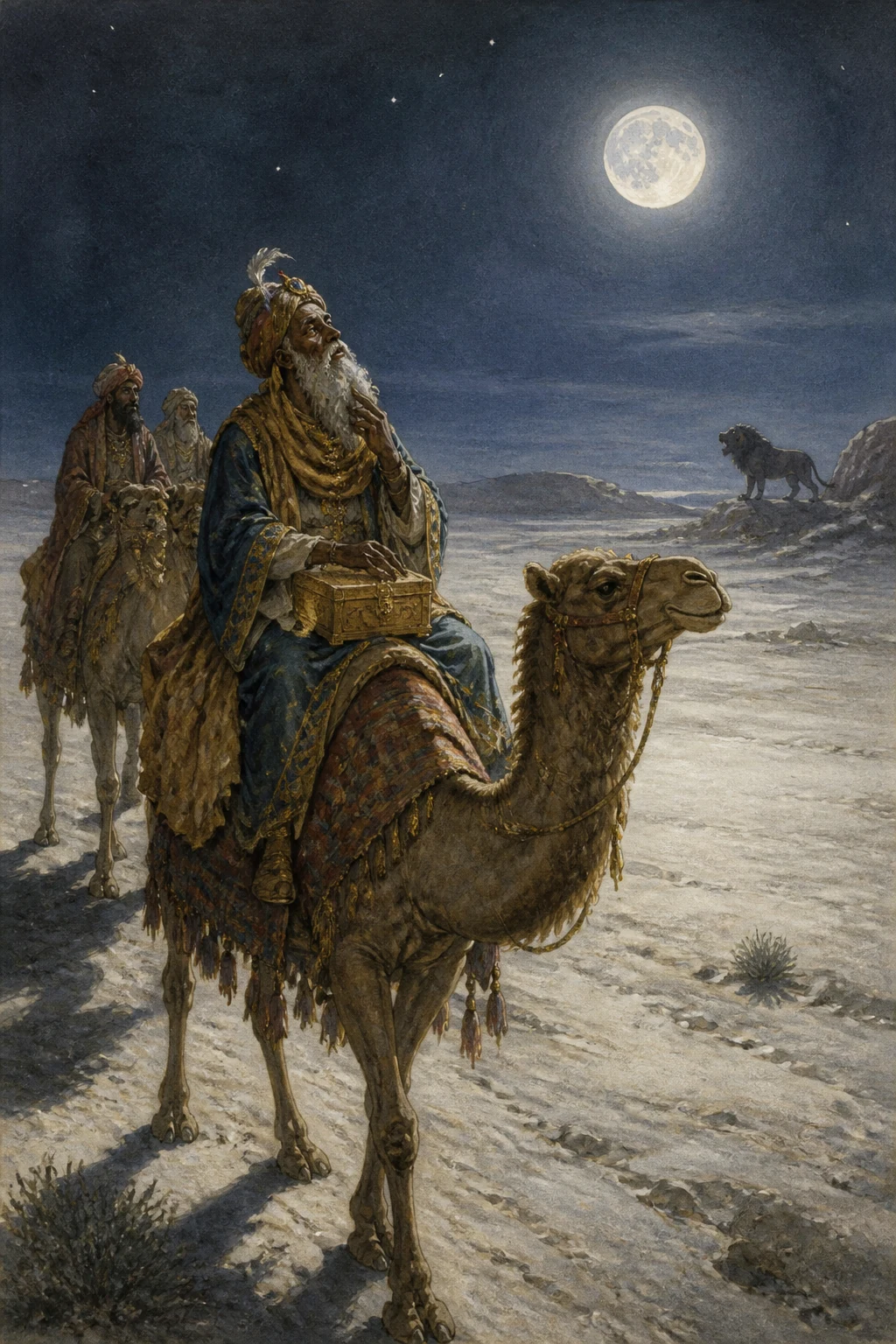
It is related that Abdullah ibn Abi Qilabah once set out in search of some camels of his that had strayed. As he was travelling through the deserts of Yemen and the land of Saba, he came upon a mighty city surrounded by a great fortress, around which stood palaces soaring into the sky. As he drew near, he thought there must be people living there whom he could ask about his camels, and so he made his way towards it. But when he reached it, he found it deserted, with not a soul to keep him company. He said, “I dismounted from my she-camel…” And morning overtook Shahrazad, and she fell silent, leaving her tale untold.
When it was the two hundred and seventy-sixth night,
She said: It has reached me, O fortunate king, that Abdullah ibn Abi Qilabah said, “I dismounted from my she-camel and hobbled her. Then I took courage, entered the city, and approached the fortress. I found that it had two immense gates, whose like in size and height had never been seen in this world. They were studded with all manner of gems and precious stones, white, red, yellow, and green. At the sight I was filled with the utmost wonder, and the marvel of it overwhelmed me. I entered the fortress trembling with fear and bewilderment, and found it vast and far-reaching, as spacious as a city. Within it stood lofty palaces, each containing upper chambers, all built of gold and silver and studded with rubies, chrysolite, pearls, and many-coloured jewels. The doors of those palaces were as beautiful as the gates of the fortress, and their floors were strewn with great pearls and pellets of musk, ambergris, and saffron. When I reached the heart of the city, I saw not a single human creature, and nearly died of fright. Then I looked out from the heights of the chambers and palaces and saw rivers flowing beneath them, and streets lined with fruit-bearing trees and towering palms. The buildings were made of alternating bricks of gold and silver. I said to myself, ‘Surely this is the Paradise promised in the hereafter.’ So I gathered as much as I could carry of its jewelled pebbles and its soil of musk, returned to my own country, and told the people what I had seen. The news reached Muawiyah ibn Abi Sufyan, who was then caliph in the Hijaz, and he wrote to his governor in Sanaa, in Yemen, ‘Summon this man and question him about the truth of the matter.’ The governor summoned me and asked about my adventure and what had befallen me, and I told him what I had seen. He then sent me to Muawiyah, to whom I also related all I had seen. Muawiyah would not believe it, so I showed him some of those pearls and pellets of ambergris, musk, and saffron. They still retained a little of their sweet fragrance, but the pearls had yellowed and lost their colour.” And morning overtook Shahrazad, and she fell silent, leaving her tale untold.
When it was the two hundred and seventy-seventh night,
She said: It has reached me, O fortunate king, that Abdullah ibn Abi Qilabah said, “But the pearls had yellowed and lost their colour.” Muawiyah ibn Abi Sufyan marvelled when he saw the pearls and the pellets of musk and ambergris that Abu Qilabah had brought. He sent for Kaab al-Ahbar, and when he came, said to him, “O Kaab al-Ahbar, I have summoned you concerning a matter whose truth I wish to establish, in the hope that you may know its true account.” “What is it, Commander of the Faithful?” he asked. Muawiyah said, “Do you know of a city built of gold and silver, with pillars of chrysolite and ruby, and pebbles of pearls and pellets of musk, ambergris, and saffron?” He replied, “Yes, Commander of the Faithful. It is Iram of the Pillars, whose like was never created in any land. It was built by Shaddad, son of Aad the Elder.” Muawiyah said, “Tell us something of its story.”
Kaab al-Ahbar said, “Aad the Elder had two sons, Shadid and Shaddad. When their father died, Shadid and his brother Shaddad ruled the land after him, and there was not a king on earth who was not subject to them. Then Shadid ibn Aad died, and his brother Shaddad became sole ruler of the earth. He was passionately fond of reading ancient books, and when he came upon descriptions of the hereafter and Paradise, with its palaces and chambers, its trees and fruits, and all its other delights, he conceived the desire to build its like in this world, in the manner already described. Under his command were a hundred thousand kings, under each king a hundred thousand stewards, and under each steward a hundred thousand soldiers. He summoned them all before him and said, ‘In ancient books and accounts I hear descriptions of the Paradise that exists in the hereafter, and I wish to make its like in this world. Go, then, to the fairest and broadest wilderness on earth, and build me there a city of gold and silver. Let its pebbles be chrysolite, rubies, and pearls; set pillars of chrysolite beneath its arches, fill it with palaces, and build chambers above the palaces. Beneath them, in the lanes and streets, plant trees of every kind bearing ripe fruits, and make rivers flow beneath them in channels of gold and silver.’ They all said, ‘How can we accomplish what you have described? And how are we to obtain the chrysolite, rubies, and pearls you speak of?’ He replied, ‘Do you not know that the kings of the world obey me and are under my command, and that no one in it dares disobey my orders?’ ‘Indeed we do,’ they said. He said, ‘Then go to the mines of chrysolite and ruby.’” And morning overtook Shahrazad, and she fell silent, leaving her tale untold.
When it was the two hundred and seventy-eighth night,
She said: It has reached me, O fortunate king, that Shaddad said to his followers, “Go to the places where chrysolite, rubies, pearls, gold, and silver are found. Extract them and gather all that the earth contains, sparing no effort. Take whatever people possess of these things, leaving nothing behind, and beware of disobedience.” Then he wrote to every king in every quarter of the earth, ordering them to collect all such treasures in the people’s possession, to go to their sources and extract the precious stones they contained, even from the depths of the seas. They spent twenty years gathering them, and the number of kings established throughout the earth was three hundred and sixty. Then he sent forth engineers, sages, labourers, and craftsmen from every land and region. They spread through wildernesses and deserts, travelling far and wide, until they reached a vast, open desert, clear of hills and mountains, with wholesome springs and flowing rivers. They said, “This is the kind of land the king commanded us to seek and sent us out to find.” They began to build there according to the length and breadth prescribed by Shaddad, king of the earth. They dug channels for the rivers and laid the foundations to the appointed measurements. The kings of all regions sent jewels and precious stones, pearls great and small, and the finest gold, carried on camels across the wildernesses and deserts, and in great ships over the seas. Such quantities of these treasures reached the workmen that they could neither be described nor counted nor measured. They laboured at the work for three hundred years. When they had finished, they came to the king and told him it was complete. He said, “Go and build around it a mighty fortress, lofty and impregnable. Around the fortress build a thousand palaces, with a thousand banners beneath each palace, so that in every palace a minister may dwell.” They left at once and accomplished this in twenty years. Then they came before Shaddad and told him that his desire had been fulfilled. He ordered his ministers, who numbered a thousand, and his favourites and trusted soldiers and others, to prepare for the journey and make ready to move to Iram of the Pillars in the retinue of the ruler of the world, Shaddad ibn Aad. He also ordered those of his wives and the women of his household whom he wished to take, along with his slave-girls and servants, to prepare to depart. They spent twenty years making ready. Then Shaddad set out with his armies… And morning overtook Shahrazad, and she fell silent, leaving her tale untold.
When it was the two hundred and seventy-ninth night,
She said: It has reached me, O fortunate king, that Shaddad ibn Aad set out with his armies, rejoicing that his desire was about to be fulfilled. When he was but a day’s journey from Iram of the Pillars, God sent down upon him and the faithless unbelievers with him a cry from the heaven of His might, and destroyed them all with a tremendous blast. Neither Shaddad nor any of his companions reached the city or so much as caught sight of it. God effaced every trace of the road leading to it, and there it remains, unchanged in its place, until the Day of Resurrection. Muawiyah marvelled at the story Kaab al-Ahbar had told him, and asked, “Will any human being ever reach that city?” He answered, “Yes, a man among the companions of Muhammad, upon whom be blessings and peace; and beyond all doubt, his description is that of this man sitting here.” Al-Shaabi said: It is related by the learned men of Himyar in Yemen that when Shaddad and his companions perished in the blast, his son Shaddad the Younger succeeded him. His father, Shaddad the Elder, had left him to rule his kingdom in Hadramawt and Saba when he set out with his armies for Iram of the Pillars. When the son heard that his father had died on the road before reaching the city of Iram, he ordered his body to be brought from those deserts to Hadramawt, and commanded that a tomb be hewn for him in a cavern. When they had dug it, he laid him there upon a couch of gold, draped him in seventy robes woven with gold and studded with precious jewels, and placed at his head a golden tablet on which these verses were inscribed:
Take warning, you who are beguiled by length of days: I am Shaddad, son of Aad, lord of the lofty fortress, possessor of power and strength and terrible might. The people of the earth obeyed me, fearing my force and threats, and I ruled East and West with sovereign power. Then one came bearing righteous counsel and called us to the path of truth. We disobeyed him, saying, “There is no escaping it.” And a cry came upon us from the far horizon, and we fell like crops reaped in the midst of a desert plain. Beneath the layers of the earth we wait for the Day of Reckoning. Al-Thaalibi said: It so happened that two men entered this cavern and found a stairway at its far end. They descended and discovered a vault measuring a hundred cubits in length, forty cubits in breadth, and a hundred cubits in height. In the middle stood a couch of gold, upon which lay a man of immense stature, filling its entire length and breadth. He wore jewels and robes woven with gold and silver, and at his head lay a golden tablet bearing an inscription. They took the tablet and carried away as much as they could bear of the gold and silver ingots and other treasures in that place.