Waltey
Kraljevske sanje
Cuentos de Navidad y Reyes
Cuentos de Navidad, de la patria y antiguos · Emilia Pardo BazánO besedilu
Kraljevske sanje
- Vir
- Cuentos de Navidad, de la patria y antiguos
- Avtor
- Emilia Pardo Bazán
- Jezik branja
- English
- Jezik izvirnika
- Español
- Čas branja
- 10 min branja
- Obseg
- 8 strani
- Naslov izvirnika
- 014 Sueños regios
O izvirniku
Cuentos de Navidad, de la patria y antiguos
Sedemintrideset avtorskih zgodb v treh zgodovinskih knjižnih skupinah. Bralni jezik je English, izvirnik pa prihaja iz vira Cuentos de Navidad, de la patria y antiguos v jeziku Español.
Besedilo
Kraljevske sanje
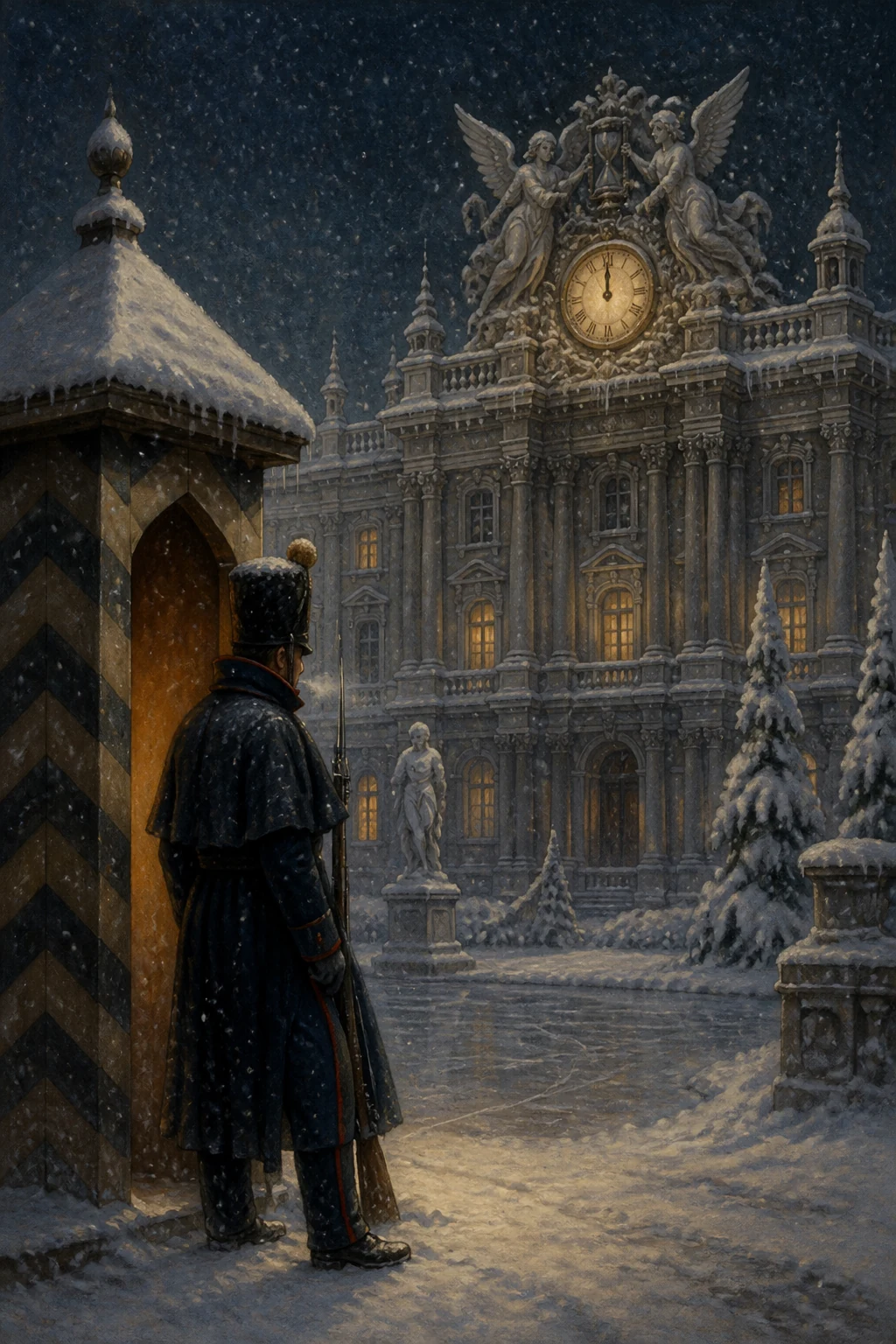
It is night. The temperature is twenty below zero. Outside, not the slightest sound can be heard: the snow, falling in fine, exquisitely delicate flakes that cushion the air, helps sustain the absolute, muffled silence weighing on the gardens in their fantastic whiteness. The snow has traced with exquisite care the outlines of the tree-lined avenues, the flower beds, the groves, the icebound ponds whose smooth surfaces were scored by skates at the last skating party, which so amused the court because the Prince of Circassia took several resounding tumbles. The statues seem to shiver, decked in ornaments of icicles. The conifers are embroidered, sculpted masses of ice. On the palace, the cornices, the balconies, the turrets, the monumental ornamentation of the façade, the clock supported by Spirits representing the destinies of the imperial house triumphing over Time, are gradually disappearing beneath the soft white padding. Shivering in their sentry boxes, feeling their breath first freeze and then melt inside the high collars of their military greatcoats, the sentries stamp their feet on the ground and think of the guardroom, where the stove is burning and a man can take a swig of something fermented; from time to time they send their guttural cry of “All’s well!” through the snow. The ornamental clock strikes twelve, slowly, as though the hour it tells were more solemn than any other. The clock outside is answered by those within, on their console tables; they have the piping, well-modulated little voices of courtiers.
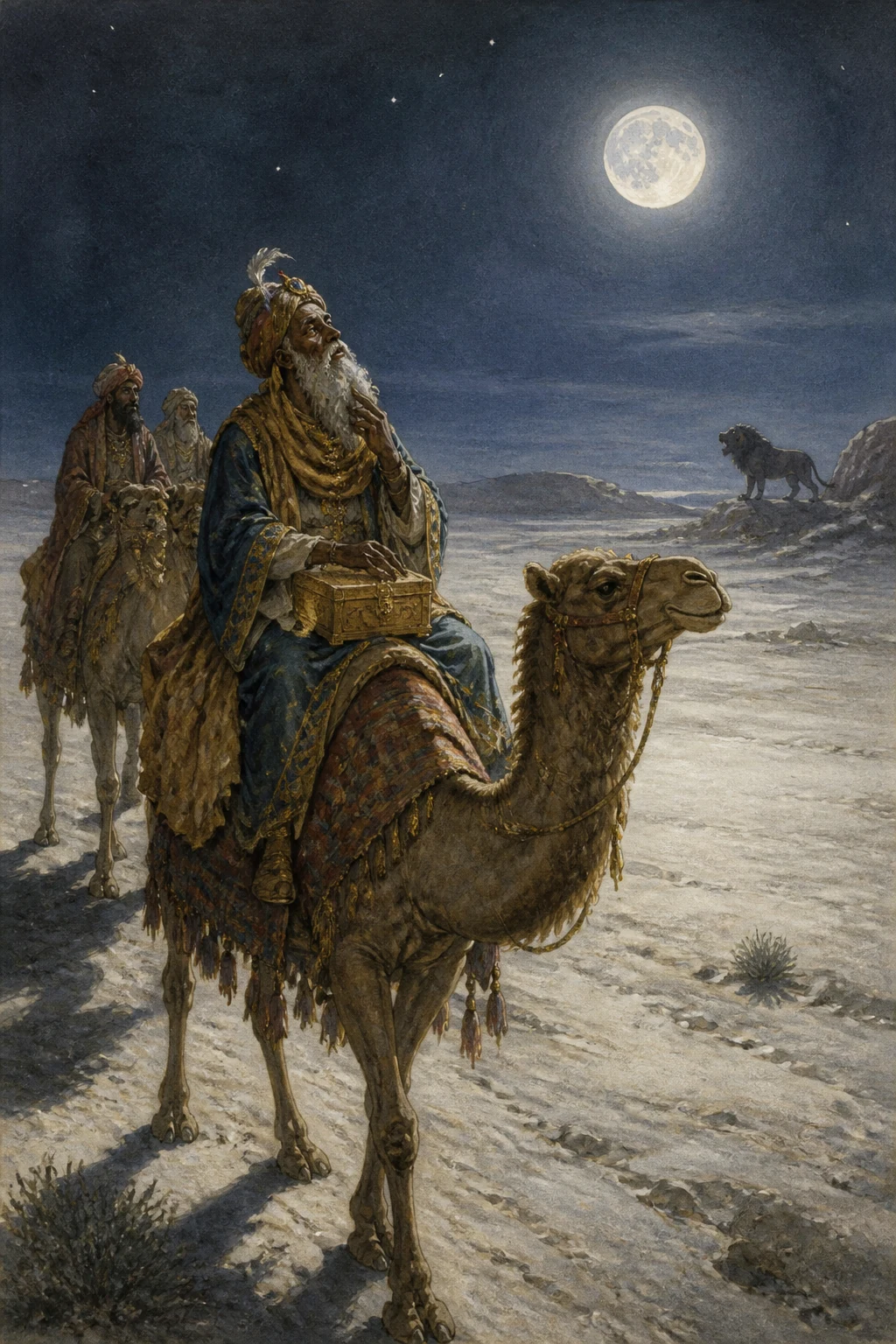
The emperor shudders and sits up in the great ivory-inlaid bed, amid the rarest of furs that cushion it. He has the impression that a hand has just been laid on his shoulder; and indeed, by the light of the lace-veiled alabaster lamp, he sees a venerable figure, an old man haloed by an immensely long beard and flowing hair in which the snow seems to have tangled its fleece. The old man’s garments dazzle: a tunic of gold brocade, a mantle of violet velvet edged with ermine. A kind of mitre, with pearls clustered over its filigree, encircles his temples, compressing his great snowy mane and making it billow out in abundant waves over his shoulders. In his hand he carries an open, finely chased casket filled with impalpable gold dust.
“What do you want of me, and who are you?” the emperor asks the old man. “One of the family. Baltasar, king of the lands of the East,” the patriarch replies in a tremulous voice.
“Welcome, my royal cousin! Why does Your Majesty travel on so bitter a night? Crowned heads should never expose themselves to the discomforts suffered by other mortals. May Your Majesty deign to rest beneath my hospitable roof.”
“I can accept only for a few moments, though I am exhausted from crossing Your Majesty’s dominions, which seem to have no end: they must cover a good part of the planet’s surface.”
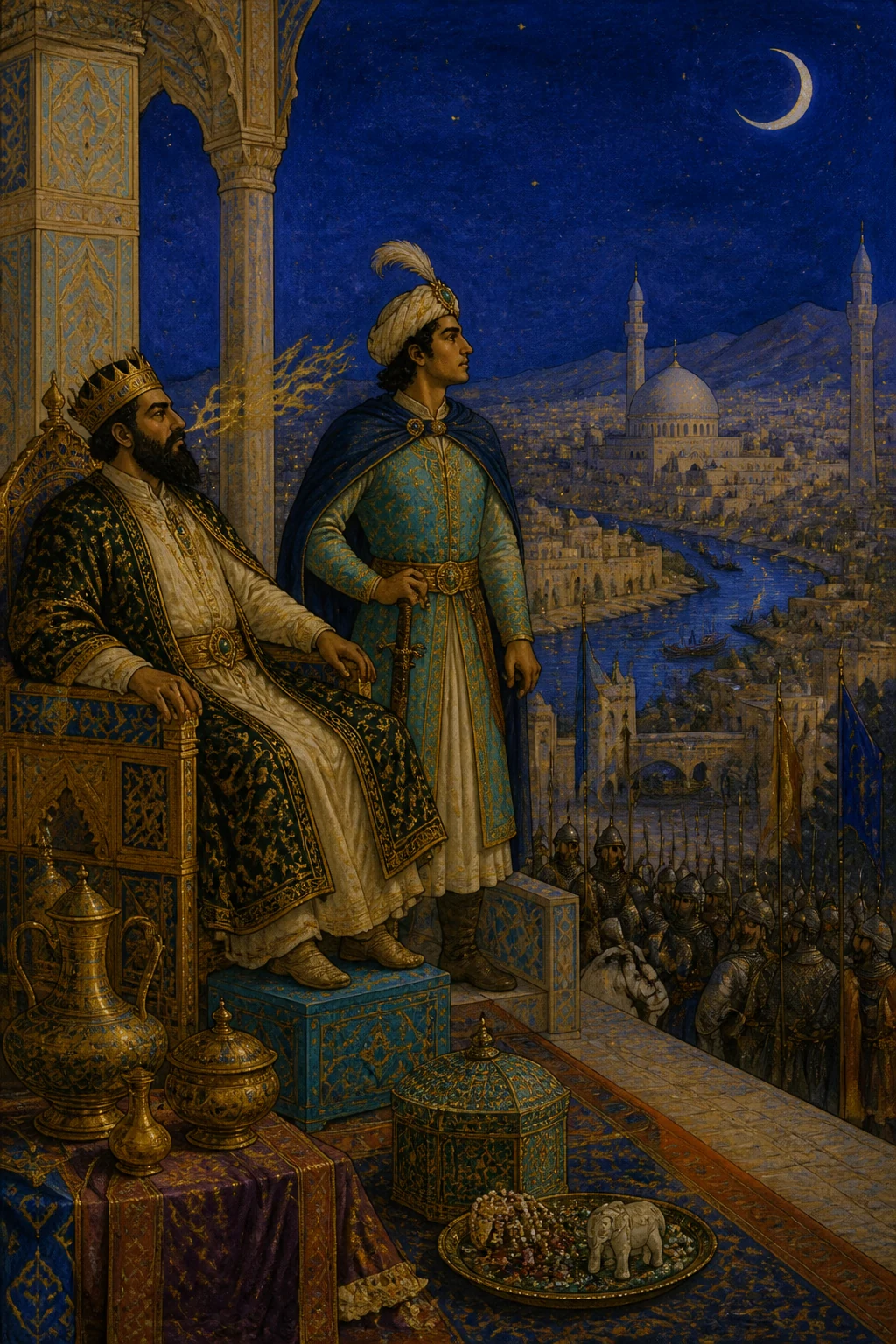
“Ah!” says the emperor, pleased. “Has Your Majesty travelled through them? Have you acquainted yourself with their extent and wealth? Every climate, every kind of produce, every race acknowledges my sovereignty. When I review my army, I see white-skinned, fair-haired soldiers with blue eyes; soldiers of dusky complexion; soldiers with yellow skin and flattened noses; Oriental garments and wrappings that ward off the harshness of the seasons in the hyperborean lands. My empire yields wheat and sapphires, minerals, furs, and fragrant woods; it is a giant whose head, like Your Majesty’s, is bathed in Arctic snows, and whose hands stretch towards the South to embrace it. And in this Empire I am God. At my voice, heads bow, multitudes prostrate themselves, prayers for me set the iconostases trembling. While the hurricane’s breath makes playthings of the Western monarchs, our foolish cousins, I, like a divinity, remain hidden in an inaccessible sanctuary.”
“I know Your Majesty’s might. That is why I suspect the task entrusted to me may prove fruitless; but in obedience, I carry it out.”
“What task is that, my royal cousin?” “The one the Child commanded me to perform. I am returning from Palestine, going home after my interminable yearly journey... It is a wonder how lovely the Child is, and how sweet and pure his Mother! Their immortal beauty has lost nothing in the nineteen hundred and two years since I first adored them. As always, I brought them my offering: gold dust from Ophir. And the Child, after holding out his little hands, which I kissed, and blessing the gold, told me to sprinkle it on the ground wherever I see man assailing the freedom of man.”
“So those are the tricks the Child is learning?” stammered the emperor. “His Mother and the carpenter are certainly bringing him up very badly—lowborn people, after all, though he is descended from the line of our august cousins, the kings of Judah! Your Majesty, with the experience your years afford you, must have understood that this whim of the Child’s ought not to be indulged.”
“It is impossible to disobey him, my royal cousin,” the Magus declared gravely. “I have sprinkled the vast expanse of land over which Your Majesty reigns, though I confess I doubt I shall see anything germinate upon the hard crust of ice that covers it. Without hope I go on scattering gold dust; and yet, a moment ago, in the gardens of this palace, as the golden dust fell, I thought the ground stirred and the layer of snow cracked. The earth trembled; I fancied a cavernous rumbling sounded deep within it. Is Your Majesty certain there are no mines beneath your palace?”
“Your Majesty is the one undermining it, and that must be stopped,” the emperor answers forcefully, striking a bell. The guard appears. The old man takes a pinch of dust, flings it into the soldiers’ eyes, and passes freely and majestically through their midst.
Another scene of snow upon gardens and a royal palace, but snow now packed hard and beginning to melt into filthy, blackish mud. Lights can still be seen in the palace: there has been a splendid family supper in the private dining room, with merry, affectionate toasts, and the emperor, worn out by receiving congratulations all afternoon, after blessing his children, who have respectfully kissed his hand one by one, and fondly embracing the prolific empress, stretches out on his narrow, hard camp bed, the only one on which habit allows him to fall asleep.
He has scarcely begun to doze when someone calls to him with a very soft “Psst!” and by the glow of the night-light he makes out a man in the prime of life, wrapped in a purple robe beneath which armour of admirable workmanship can be seen. A pointed crown encircles his temples; in his right hand he holds aloft a precious flask of myrrh, with a pungent, heady fragrance.
“What does Your Majesty desire, King Gaspar?” asks the emperor, who, recognising the traveller, leaps from his bed and gives a military salute. “To wish Your Majesty a happy Christmas and entrust you with a secret. The fact is that the Child—you know, Your Majesty, the Child whom I visit every year in his stable, to drink wisdom from his violet eyes!—after playing with this myrrh I offered him and breathing his heavenly breath upon it, commands me to scatter it, drop by drop, over the soil of the countries where man thirsts for the blood of man. And as the drops of this myrrh fall, my royal cousin, I see the sodden, clinging earth grow loose and open, and olive trees, roses, myrtles, rye, hops, and vines laden with grapes spring up and grow. Ah! This myrrh is a great marvel. And as for me, my royal cousin, my armour stifles me; my heart can no longer fit within it. Allow me to sprinkle Your Majesty’s august head with myrrh.”
“What the devil! Childish nonsense!” the emperor growled. “When the Child grows up and leaves his mother’s skirts and lap behind, his fancies will be different. Nothing is holier than war. God himself guides armies and instils in their commanders the courage and judgement to secure victory. Above the battlefield hovers the Archangel, his wings spattered with rubies, his sword aflame. The divine breath swells my breast the moment the gleaming cuirass covers it. Such things are beyond the understanding of children and women; granted. We, the shepherds of peoples, the leaders of races, smile at certain charming outbursts of weakness.”
“I must do as I am commanded,” Gaspar insists. And taking a few drops of myrrh, he flicks them onto the emperor’s forehead. The emperor gives a sigh, sinks onto his camp bed, and sees in a dream a towering pyramid of human bones, white and polished. On its summit a raven croaks plaintively, hungry, its feathers ruffled; and at its foot, in the branches of a young olive tree, two doves kiss, touching beaks.
In the palace courtyard, water falls back into the great porphyry basin supported by lions, melodious in its gentle persistence. The moon lights the filigreed arcades, plays upon the glossy leaves of the orange trees, reveals the pale gleam of their golden fruit. Two slaves watch over the sleep of the emir, who lies fully dressed on a divan, covered with a blanket of fine ostrich feathers—for the night is rather cold, and frost has hardened the desert roads—with his foot resting on the throat of a naked woman, who serves as a cushion and provides a more pleasing warmth than the blanket.
An elegant figure slips unseen between the slaves. He is a young black man, slender, with strong, steely muscles and sinewy legs encased in tight hose spangled with sequins like those worn by the youths in Carpaccio’s paintings; a surcoat of silver tissue outlines his figure; a jewelled belt holds a magnificent dagger against his lean belly; a crimson velvet cap sits jauntily upon his tightly curled hair, and beneath its brim gleams a diamond diadem. The handsome black man bends over the emir and bathes his face in a waft of incense smoking in a pierced censer suspended from little chains of pearls. With a start, the emir wakes and reaches for his curved dagger.
“Do not be afraid. I am Melchor, who, like you, rules over tribes of the desert and possesses mysterious palaces that seem to have been wrought by the spirits of the air. I come to carry out the commands of the Child Yesuá, son of Leila Mariem.”
“And what does that infidel prophet command you to do?” the emir exclaims scornfully. “To swing this censer in every country where man treats woman as a slave rather than a companion.”
The emir laughs, showing his white jackal’s teeth amid his black, silky beard. “Then go back to the land of the Rumis, Melchor. They too need the fragrance of your censer. But first, rest. You are my guest; I shall order two beautiful captives to prepare you a bath of rosewater.”
And the Emir sits up, kicking the woman on whose throat his foot had been resting.
Izvirnik
014 Sueños regios
Naslednje strani prikazujejo izvirno besedilo za primerjavo.
Es de noche. Temperatura, veinte bajo cero. Fuera no se escucha el menor ruido: la nevada, cayendo en finos copos delicadísimos que mullen la atmósfera, contribuye á sostener el silencio absoluto, ahogado, que pesa sobre los jardines blancos con blancura fantástica. La nieve ha perfilado primorosamente la traza de las calles de árboles, de los macizos, de los bosquetes, de los estanques cuajados por el hielo, y cuya superficie lisa rayaron los patines en la última sesión de patinaje que tanto divirtió á la corte, porque el príncipe de Circasia se dió unas costaladas regulares. Las estatuas parecen temblar y lucen aderezos de carámbanos. Las coníferas son témpanos bordados y esculpidos. En el alcázar, las cornisas, las balconadas, las torrecillas, la monumental ornamentación de la fachada, el reloj, sostenido por Genios que representan los destinos de la casa imperial venciendo al Tiempo, van desapareciendo bajo la suave acolchadura blanca. Los centinelas, en su garita, tiritando, sintiendo que el aliento se les cristaliza primero y se les liquida después dentro del alto cuello de sus capotes militares, hieren el suelo con el pie, se acuerdan del cuerpo de guardia donde arde la estufa y se puede echar un trago de lo fermentado, y de tiempo en tiempo lanzan, al través de la nieve, su «¡Alerta!» gutural. El decorativo reloj da las doce, pausadamente, como si la hora contada por él fuese más solemne que las otras. Al reloj de fuera contestan los de dentro, desde las consolas; tienen vocecillas aflautadas y bien moduladas de palaciegos.
El emperador se estremece y se incorpora en el gran lecho incrustado de marfil, bajo las pieles rarísimas que lo mullen. Se le figura que una mano acaba de posarse en su hombro; y en efecto, á la luz de la lámpara de alabastro velada de encaje, ve una figura venerable, un viejo aureolado por larguísima barba y melenas, donde la nieve se diría que enredó sus vellones. La vestidura del viejo deslumbra; túnica de brocado de oro, manto de terciopelo violeta orlado de armiño. Una especie de mitra en que las perlas se apiñan sobre la filigrana, rodea sus sienes y comprime y hace bufar su gran cabellera nevada, que se extiende caudalosa por los hombros. En la mano lleva cincelado cofrecillo abierto, lleno de polvo aurífero impalpable.
--¿Qué me quieres y quién eres?--pregunta el emperador al anciano.
--Como de casa. Baltasar, rey de los países de Oriente--contesta el patriarca en voz temblona.
--¡Bienvenido, primo y señor! ¿Por qué viaja Vuestra Majestad en tan cruda noche? Conviene á las testas coronadas no ponerse nunca en el caso de sufrir las molestias que padecen los demás mortales. Dígnese Vuestra Majestad descansar bajo mi hospitalario techo.
--No acepto sino breves instantes, aunque vengo rendido de atravesar los dominios de Vuestra Majestad, á los cuales no se les ve el fin: deben de cubrir buena parte de la superficie del planeta.
--¡Ah!--articula el emperador, satisfecho.--¿Los ha recorrido Vuestra Majestad? ¿Se ha enterado de su extensión y riqueza? Todos los climas, todas las producciones, todas las razas, reconocen mi soberanía. Cuando paso revista á mi ejército, en él veo soldados blancos y rubios, de ojos azules; soldados de morena tez; soldados de cutis amarillo y nariz achatada; ropajes orientales y envolturas que preservan del rigor de las estaciones en los países hiperbóreos. Mi imperio produce el trigo y el zafiro, los minerales, las pieles y las maderas odoríferas; es un gigante cuya cabeza, como la de Vuestra Majestad, se baña en las nieves árticas, y cuyas manos se tienden hacia el Mediodía para abarcarlo. Y en este Imperio yo soy Dios. A mi voz las frentes se inclinan, las muchedumbres se prosternan, la plegaria por mí hace retemblar los iconostasios. Mientras el soplo del huracán juega con los monarcas occidentales, nuestros necios primos, yo, como un numen, me oculto en santuario inaccesible.
--Conozco el poderío de Vuestra Majestad. Por eso sospecho si la tarea que me ha sido encomendada resultará estéril; pero, obedeciendo, la cumplo.
--¿Qué tarea es esa, primo y señor?
--La que me ordenó realizar el Niño. Vuelvo de Palestina; regreso á mi patria, después del interminable viaje anual... ¡Es una maravilla lo lindo que está el Niño y lo dulce y honesta que es la Madre! Nada perdió su inmortal hermosura en los mil novecientos dos años transcurridos desde que por vez primera les adoré. Como siempre, les he llevado mi ofrenda: polvo de oro del Ofir. Y el Niño, después de extender sus manitas, que besé, y bendecir el oro, me ha dicho que lo espolvoree por el suelo, allí donde vea que el hombre atenta á la libertad del hombre.
--¿Conque esas mañas saca el Niño?--tartamudeó el emperador.--¡Por cierto que lo educan bien mal su Madre y el carpintero, gente baja al fin, aunque descienda de la casta de nuestros augustos primos los reyes de Judá! Vuestra Majestad, con la experiencia que le dan los años, habrá comprendido que no debe cumplírsele al Niño ese antojo.
--No es posible desobedecerle, primo y señor--declaró gravemente el Mago.--He espolvoreado la enorme porción de tierra donde reina Vuestra Majestad, aunque confieso que dudo de ver germinar cosa alguna sobre la dura capa de hielo que la reviste. Sin esperanzas voy derramando polvillo de oro; y la verdad, hace un instante, en los jardines de este palacio, al caer el dorado polvillo, creí que el suelo se estremecía y se agrietaba la capa de nieve. Tembló la tierra; me pareció que un ruido cavernoso resonaba allá dentro. ¿Está seguro Vuestra Majestad de que no se halla minado su palacio?
--Vuestra Majestad es quien lo mina, y será preciso impedirlo;--contesta enérgicamente el emperador, hiriendo un timbre.
Aparece la guardia. El viejo toma una pulgarada de polvillo, lo arroja á los ojos de los soldados y pasa por entre ellos libre y majestuoso.
Otro efecto de nieve sobre jardines y palacio real, pero nieve ya cuajada y que empieza á derretirse formando un barro sucio y negruzco. En el alcázar se ven todavía luces: ha habido en el comedor de diario espléndida cena de familia, alegres y cariñosos brindis, y el emperador, rendido de recibir toda la tarde felicitaciones, después de bendecir á sus hijos, que uno por uno le han besado la mano respetuosamente, y de abrazar con afecto á la fecunda emperatriz, se tiende en su estrecha y dura cama de campaña, única donde concilia el sueño, á causa de la costumbre.
Apenas empieza á aletargarse, le llaman con un ¡Pssit! muy bajo, y á la claridad de la lamparilla divisa á un hombre en la fuerza de la edad, envuelto en ropón de púrpura, bajo el cual se parece una armadura de admirable trabajo. Rodea sus sienes una corona de picos; en su diestra alza rico pomo de mirra de fuerte aroma, acre y embriagador.
--¿Qué desea Vuestra Majestad, señor rey Gaspar?--pregunta el emperador que, conociendo al viajero, salta de la cama y saluda militarmente.
--Felicitar las Pascuas á Vuestra Majestad y confiarle un secreto.--Es el caso que el Niño, ¿no sabe Vuestra Majestad? ¡el Niño, á quien todos los años voy á visitar en su establo, para beber en sus ojos de violeta la sabiduría! después de jugar con esta mirra que le ofrecí y de arrojar sobre ella su aliento celestial, me manda que gota á gota la esparza por el suelo de los países donde el hombre tenga sed de la sangre del hombre. Y al caer gotitas de esta mirra, primo y señor, observo que la tierra, encharcada y pegajosa, se esponja, se entreabre, y nacen y surgen y crecen olivos, rosas, mirtos, centeno, lúpulo, viñas cargadas de racimos. ¡Ah! Es un gran portento la tal mirra. Y á mí, señor y primo, la armadura me asfixia, el corazón no me cabe en ella. Permítame Vuestra Majestad que salpique de mirra su cabeza augusta.
--¡Qué diantre! ¡Cosas de chiquillos!--gruñó el emperador.--Cuando el Niño crezca y se aparte de las faldas y del regazo materno, diferentes serán sus caprichos. No hay nada más santo que la guerra. Dios mismo guía á los ejércitos é infunde á los caudillos arrojo y tino para asegurar la victoria. Sobre el campo de batalla se cierne el Arcángel con sus alas salpicadas de rubíes y su gladio flamígero. El soplo divino hincha mi pecho apenas lo cubre la coraza rutilante. Esto no se les alcanza á los niños ni á las mujeres; convenido. Nosotros, pastores de pueblos, jefes de razas, sonreímos ante ciertos arranques de debilidad graciosa.
--Debo hacer lo que me mandan--insiste Gaspar.
Y tomando unas gotas de mirra, las dispara á la frente del emperador. Este exhala un suspiro; se deja caer en el lecho de campaña, y ve en sueños una pirámide de huesos humanos, blanca y pulida, altísima. Sobre la cúspide, un cuervo grazna plañideramente, hambriento, erizado el plumaje; y al pie, en las ramas de un olivo nuevo, dos palomas se besan, juntando los picos.
En el patio del alcázar, sobre el gran pilón de pórfido sostenido por leones, recae el agua, melodiosa, con dulce porfía. La luna ilumina las arcadas afiligranadas, juega en las charoladas hojas de los naranjos, descubre el reflejo pálido de sus pomas de oro. Dos esclavos velan el sueño del emir, que reposa vestido sobre un diván, cubierto con una manta de fina pluma de avestruz--porque la noche está algo fría y la helada ha endurecido los caminos del desierto--y apoyando el pie en la garganta de una mujer desnuda, que hace de cogín y presta calor más grato que el de la manta.
Elegante figura se desliza por entre los esclavos, invisible. Es un negro joven, esbelto, de robusta y acerada musculatura, de piernas nerviosas encerradas en calzas prietas y salpicadas de lentejuelas como las que ostentan los donceles en los cuadros de Carpaccio; una sobrevesta de tisú de plata acusa sus formas; un cinturón de pedrería sostiene sobre su vientre enjuto soberbio puñal; encima de sus cabellos crespos se ladea un gorro de velludo carmesí, y bajo el ala luce diadema de brillantes. El gallardo negro se inclina hacia el emir y le baña el rostro con una bocanada del incienso que humea en un incensario calado, pendiente de cadenillas de perlas. Sobresaltado, el emir despierta, echando mano á su gumía.
--No temas, soy Melchor, que como tú ejerce el mando en tribus del desierto y posee palacios misteriosos, que parecen labrados por los genios del aire. Vengo á cumplir órdenes del Niño Yesuá, hijo de Leila Mariem.
--¿Y qué te ordena ese profeta infiel?--exclama el emir con desprecio.
--Columpiar este incensario en todos los países donde el hombre trate á la mujer como esclava y no como compañera.
Ríese el emir, mostrando sus blancos dientes de chacal entre la negra y sedosa barba.
--Pues vuélvete á tierra de rumíes, Melchor. También allí necesitan el perfume de tu incensario. Pero antes, reposa. Eres mi huésped; voy á ordenar que te preparen un baño con agua de rosas dos bellas cautivas.
Y el Emir se incorpora, dando con el pie á la mujer en cuya garganta lo tenía apoyado.
Nadaljuj z branjem