Prevod
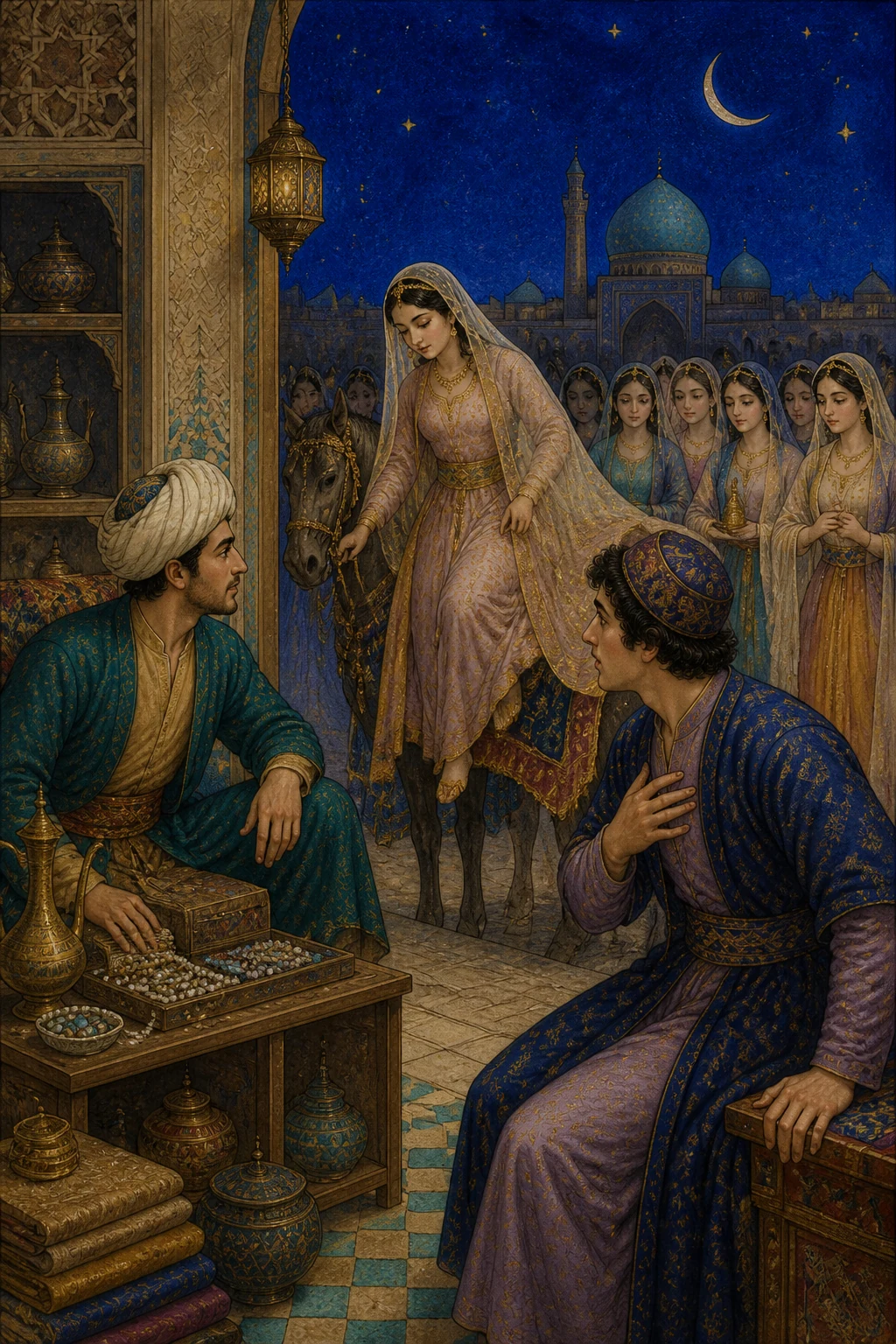
Among the tales that are told is this account of Ishaq al-Mawsili: “One night I left al-Ma’mun’s palace and was making my way home when an urgent need to pass water came upon me. Fearing that I might do myself harm by holding it in, I turned into an alley to relieve myself. As I crouched beside a wall, I noticed something hanging from one of the houses. I felt it to discover what it was, and found a large basket with four handles, covered in brocade. ‘There must be some reason for this,’ I said to myself. I stood there wondering, until drunkenness prompted me to climb into it. No sooner had I sat down than the people of the house began hauling it up, supposing me to be the man they were expecting. They raised the basket to the top of the wall, where four maidservants said to me, ‘Step out, and welcome!’ A girl bearing a candle walked before me, and I descended into a house whose reception rooms were furnished with a splendour I had seen nowhere save in the caliph’s palace. I sat down, and after a little while curtains were drawn aside at one end of the room. In came maidservants carrying candles and censers of Qaqili aloeswood, and among them was a young woman like the rising full moon. She came forward and said, ‘Welcome, dear visitor!’ Then she seated me and asked how I had come there. ‘I was returning from a friend’s house,’ I told her, ‘and had lost track of the hour. On the way I was seized by a need to pass water, so I turned into this alley and found a basket hanging there. The wine persuaded me to sit in it, and the basket was hauled up into this house. That is the whole of my story.’ ‘No harm has come to you,’ she replied, ‘and I hope you will have cause to be pleased with the outcome.’ Then she asked, ‘What is your occupation?’ ‘I am a merchant in the Baghdad market,’ I said. ‘Do you know any poetry by heart?’ ‘A little, and that poorly.’ ‘Then let us hear what you know, and recite something for us.’ ‘A newcomer is bound to feel a little shy,’ I said. ‘But you might begin.’ ‘You are right,’ she replied. Then she recited some exquisite verses by poets both ancient and modern, choosing the finest of their works. As I listened, I scarcely knew which to admire more: her beauty or the excellence of her recitation. At last she asked, ‘Has your shyness left you?’ ‘Indeed it has, by God,’ I replied. ‘Then, if you please, recite something you know.’ I recited a good selection of verses by several of the old poets, which she much admired. ‘By God,’ she said, ‘I never imagined such accomplishments were to be found among men of the marketplace.’ Then she ordered food to be brought.”
Her sister Dunyazad said to her, “How delightful your tale is, how lovely, how pleasant and sweet!” She replied, “What is this compared with what I shall tell you tomorrow night, if I live and the king spares me?” But morning overtook Shahrazad, and she fell silent, leaving her tale untold.
When the two hundred and eightieth night had come
She said, “It has reached me, O fortunate King, that Ishaq al-Mawsili continued: ‘The young woman ordered food to be brought, and when it arrived she began choosing morsels and setting them before me. The room was filled with fragrant herbs and rare fruits such as are found only in the houses of kings. Then she called for wine, drank a cup, and handed one to me, saying, “Now is the time for conversation and tales.” I began to entertain her, saying, “I have heard that such and such a thing happened, and that a certain man once said this,” until I had told her several pleasing stories. She was delighted and said, “I marvel that a merchant should know such tales by heart. These are stories told in the company of kings.” “I once had a neighbour,” I replied, “who conversed with kings and was their drinking companion. Whenever he had no duties to attend to, I would visit his house, and sometimes he would tell the stories you have heard from me.” “Upon my life,” she said, “you have remembered them well.”
“‘We continued our conversation, and whenever I fell silent she took it up, until most of the night had passed. The fragrance of aloeswood filled the air, and I was enjoying such bliss that, had al-Ma’mun imagined it, he would have flown to us in his longing to share it. She said to me, “You are among the most charming and agreeable of men, for your accomplishments are remarkable. Only one thing is lacking.” “What is that?” I asked. “If only you could sing poetry to the lute.” “I was once much taken with that art,” I replied, “but finding that I had no aptitude for it, I gave it up, though a yearning for it still burns in my heart. Here in this company, I wish I had some skill in it, so that my night might be perfect.” “It sounds as though you are hinting that a lute should be brought,” she said. “The choice is yours,” I replied. “You are generosity itself, and the favour would be yours.” She ordered a lute to be brought and sang in a voice whose like I had never heard, displaying exquisite artistry, superb playing, and a rare perfection in everything she did. Then she asked, “Do you know who composed this melody, and whose verses these are?” “No,” I replied. “The verses are by so-and-so, and the music is by Ishaq.” “Is Ishaq really so accomplished, may I be your ransom?” I asked. “Oh, indeed!” she said. “Ishaq is a master of this art.” “Glory be to God,” I said, “who has bestowed on this man what He has given to no other!” “What would you say if you heard him sing this himself?” she replied. We went on in this fashion until, as dawn began to break, an old woman who seemed to have been her nurse came up and said, “The time has come.” At these words the young woman rose and said to me, “Keep what has passed between us secret, for the confidences of a gathering are a sacred trust.”’” But morning overtook Shahrazad, and she fell silent, leaving her tale untold.
When the two hundred and eighty-first night had come
She said, “It has reached me, O fortunate King, that the young woman said, ‘Keep what has passed between us secret, for the confidences of a gathering are a sacred trust.’ Ishaq continued: ‘“May I be your ransom,” I replied, “I needed no reminder of that.” Then I bade her farewell, and she sent a maidservant to walk before me to the door. The girl opened it, and I left for home, where I said the dawn prayer and went to sleep. Presently a messenger from al-Ma’mun came for me, so I went to him and spent the day in his company. When evening came, I thought of the pleasures of the night before—pleasures only a fool could bear to forgo. I went out, came to the basket, and sat in it. I was hauled up to the same place as before, and the young woman said, “So you have come back.” “I can only think I have lost my senses,” I replied. Then we passed the night as we had the previous one, conversing, reciting poetry, and exchanging curious tales until dawn. I returned home, said the dawn prayer, and slept. Again al-Ma’mun’s messenger came, and I went to him and spent the day in his company. When evening came, the Commander of the Faithful said to me, “I adjure you to remain here while I go to attend to something and return.” But when the caliph had gone and was out of sight, my thoughts began to wander. I remembered the pleasures I had enjoyed, and whatever punishment the Commander of the Faithful might inflict seemed of little account. I sprang up and hurried out, running until I reached the basket. I sat in it and was raised to my accustomed place. “Why, can this be our friend?” she said. “Indeed it is, by God,” I replied. “Have you made our house your permanent lodging?” “May I be your ransom!” I said. “A guest has a right to three days’ hospitality. If I return after that, you may shed my blood without blame.” We then sat together as before. As the hour of departure drew near, I knew that al-Ma’mun was certain to question me and would be satisfied with nothing less than the whole story. So I said to her, “I see that you are fond of music. I have a cousin who is more handsome than I, of higher standing, and more accomplished. He also knows Ishaq better than anyone in all God’s creation.” “An uninvited guest, and now you make requests?” she said. “The decision rests entirely with you,” I replied. “If your cousin is as you describe him,” she said, “we should not be displeased to make his acquaintance.” Then the hour came, and she rose. I left for home, but scarcely had I reached my house when al-Ma’mun’s messengers fell upon me and dragged me roughly away.’” But morning overtook Shahrazad, and she fell silent, leaving her tale untold.
When the two hundred and eighty-second night had come
She said, “It has reached me, O fortunate King, that Ishaq al-Mawsili continued: ‘Scarcely had I reached my house when al-Ma’mun’s messengers fell upon me and dragged me roughly away. They took me to him, and I found him seated on a chair, furious with me. “Ishaq,” he said, “have you taken to disobeying me?” “No, by God, Commander of the Faithful,” I replied. “Then what is your story? Tell me the truth.” “I will,” I said, “but in private.” He motioned to those attending him, and they withdrew. I told him the whole story, adding, “I have promised her that you will come.” “Well done,” he said. We spent that day in our usual pleasures, but al-Ma’mun’s heart was already set upon her, and we could scarcely wait for the appointed hour. As we went, I cautioned him, saying, “Take care not to call me by my name before her. In her presence I shall be your attendant.” We agreed upon this and went on until we reached the place where the basket hung. There we found two baskets, so we sat in them and were raised to the familiar room. She came forward to greet us, and when al-Ma’mun saw her he was dazzled by her beauty. She began exchanging stories and verses with him, then had wine brought. We drank, and she gave him her delighted attention, while he was equally delighted with her. Then she took up the lute and sang a melody. Afterwards she asked me, pointing to al-Ma’mun, “Is your cousin a merchant too?” “Yes,” I replied. “You two bear a close resemblance to one another.” “Yes,” I said. When al-Ma’mun had drunk three ratls of wine, joy and rapture overcame him, and he cried, “Ishaq!” “At your service, Commander of the Faithful,” I answered. “Sing in this mode,” he said. As soon as she realized that he was the caliph, she withdrew into an inner room. When I had finished singing, al-Ma’mun said to me, “Find out who owns this house.” An old woman hastened to answer, “It belongs to al-Hasan ibn Sahl.” “Bring him to me,” he said. The old woman disappeared for a while, and presently al-Hasan arrived. “Have you a daughter?” al-Ma’mun asked him. “Yes. Her name is Khadija.” “Is she married?” “No, by God.” “Then I ask you for her hand.” “She is your handmaid, Commander of the Faithful, and her fate rests with you.” The caliph said, “I take her in marriage for a dowry of thirty thousand dinars, payable at once, which shall be brought to you this very morning. When you have received the money, send her to us that night.” “I hear and obey,” he replied. Then we departed, and al-Ma’mun said to me, “Ishaq, tell no one this story.” So I kept it secret until after his death. No one has ever enjoyed what I enjoyed during those four days: al-Ma’mun’s company by day and Khadija’s by night. By God, I have never seen a man like al-Ma’mun, nor a woman like Khadija—not even one who approached her in understanding, intelligence, or eloquence. And God knows best.’”