Prevod
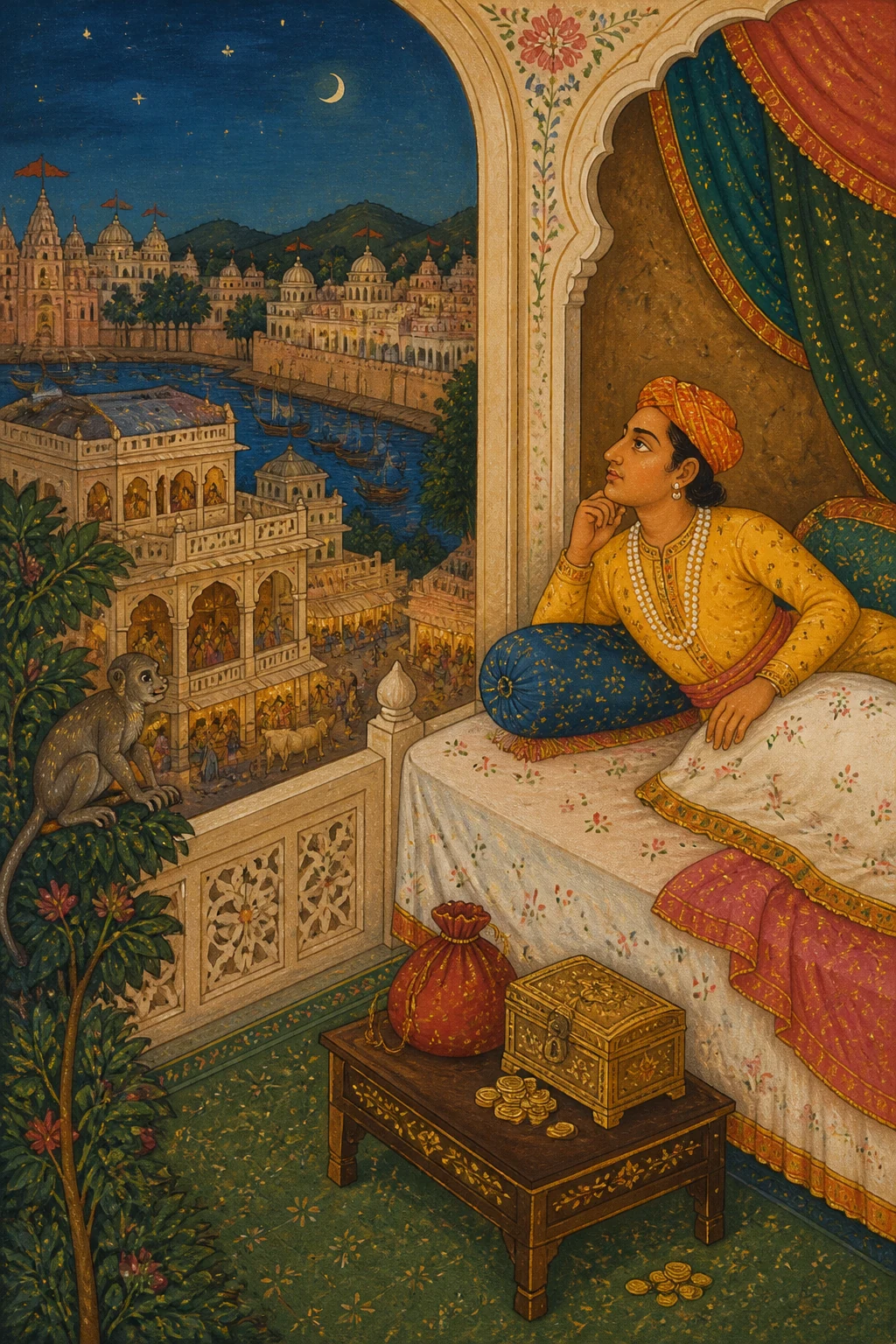
The barber turned pale when we questioned the young man. The young man then said, “Know, good people, that my father was one of the greatest merchants in Baghdad, and God Almighty had granted him no child but me. When I grew up and reached manhood, my father departed into the mercy of God, leaving me wealth, servants, and retainers. I dressed in the finest clothes and ate the choicest food, but God, glory be to Him, had made women hateful to me. Then one day, as I was walking through the lanes of Baghdad, a group of people accosted me in the street. I fled into a blind alley and took refuge on a stone bench at its far end. I had been sitting there only a little while when a window opened opposite me, and a young woman appeared, lovely as the full moon. Never in my life had I seen her equal. Beneath the window were some plants she had come to water. She looked to the right and left, then shut the window and vanished from my sight. Fire blazed in my heart, my thoughts were wholly taken up with her, and my hatred of women turned to love. I remained sitting there until sunset, lost to the world in the intensity of my passion. Then the city’s judge came riding up, with slaves before him and servants behind. He dismounted and entered the house from which the young woman had looked out, and I knew he was her father. I returned home in anguish and took to my bed, sick at heart. My slave girls came in and sat around me, but they could not discover what ailed me, for I revealed nothing to them and gave no answer to their questions. My illness grew worse, and people began coming to visit me. Among them was an old woman who understood my condition as soon as she saw me. She sat by my head, spoke kindly to me, and said, ‘My son, tell me what troubles you.’ I told her my story, and she said, ‘My son, this is the daughter of the judge of Baghdad. She is kept closely secluded, and the place where you saw her is her upstairs apartment. Her father has a large hall below, while she is alone upstairs. I often visit their house, and only through me can you hope to meet her. Take heart.’ When I heard her words, I rallied and gathered my strength. My household rejoiced that day, and by morning my limbs were steady again, and I hoped for a full recovery.
“The old woman went away, but when she returned her face had changed. ‘My son,’ she said, ‘do not ask what happened when I spoke to her of this. She said to me, “Unless you hold your tongue, you ill-omened old woman, and stop this talk, I shall give you what you deserve.” Still, I must go back to her a second time.’ At this news my illness grew worse than ever. A few days later the old woman came and said, ‘My son, I want a reward for good tidings.’ At her words my spirit returned to my body, and I said, ‘You shall have every kindness from me.’ She said, ‘Yesterday I went to that young woman. When she saw me looking brokenhearted, with tears in my eyes, she asked, “Auntie, why do you seem so troubled?” At this I wept and said, “My daughter and my lady, yesterday I came to you from a young man who loves you and is at death’s door because of you.” Her heart softened, and she asked, “Where does this young man you speak of come from?” I said, “He is my son, the fruit of my heart. Some days ago he saw you at the window watering your plants. He caught sight of your face and fell madly in love with you. When I first told him what had passed between us, his illness worsened and he took to his pillow. He will surely die.” Her face turned pale, and she said, “Is all this because of me?” “Yes, by God,” I said. “What would you have me do?” She said, “Go to him, give him my greetings, and tell him that I feel many times what he feels. On Friday, before the prayers, let him come to the house. I shall tell them to open the door for him and bring him up to me. We shall spend an hour together, and he can leave before my father returns from prayers.”’
“When I heard the old woman’s words, all my pain left me and my heart found peace. I gave her the clothes I was wearing, and she went away, saying, ‘Set your heart at rest.’ ‘Not a trace of pain remains in me,’ I replied. My household and friends rejoiced at my recovery, and I continued in this happy state until Friday. Then the old woman came and asked how I was. I told her I was well and in good health. I dressed and perfumed myself, and sat waiting for people to leave for prayers so that I could go to the young woman. The old woman said, ‘You have plenty of time. It would do you good to go to the bathhouse and have your hair removed, especially after your illness.’ I said, ‘That is sound advice, but first I shall have my head shaved, then go to the bathhouse.’ I sent for a barber to shave my head, telling my servant, ‘Go to the market and bring me a sensible barber, one who does not meddle and will not split my head with his chatter.’ The servant went and brought back this old man. When he entered, he greeted me, and I returned his greeting. He said, ‘May God take away your sorrow and anxiety, your misery and grief.’ ‘May God grant your prayer,’ I replied. He said, ‘Good news, my lord: health has come to you. Do you wish to have your hair trimmed or to be bled? It is related that Ibn Abbas said, “Whoever has his hair trimmed on Friday, God will turn seventy ailments away from him.” It is also related that he said, “Whoever is cupped on Friday is not safe from loss of sight and frequent illness.”’ I said, ‘Leave off this babble and shave my head at once, for I am a weak man.’
“He rose, reached out, and took up a cloth, which he unfolded to reveal an astrolabe with seven plates. Carrying it into the middle of the courtyard, he raised his head toward the sunlight and studied it for a long time. Then he said to me, ‘Know that this day is Friday, the tenth of Safar in the year seven hundred and sixty-three after the Prophet’s Migration—upon him be the best of blessings and peace. According to the calculations of my science, Mars is in the ascendant at seven degrees and six minutes, and happens to be in conjunction with Mercury. This indicates that shaving the hair is most auspicious. It also shows me that you intend to bestow a favor upon someone, and he is fortunate. But afterward there will be talk, and something else that I shall not mention to you.’ I said, ‘By God, you have worn me out, driven the life out of me, and brought me ill omens! I sent for you only to shave my head. Come, shave it, and do not weary me with talk.’ He said, ‘By God, if you knew the truth of the matter, you would ask me to explain further. I advise you today to do as I direct, according to the reckoning of the stars. You ought to thank God and not oppose me, for I am your sincere adviser and wish you well. I should like to remain in your service for a whole year, with you granting me my due respect, and I would ask no wages for it.’ When I heard this, I said, ‘You will surely be the death of me today.’” Dawn overtook Shahrazad, and she fell silent, leaving her tale untold.
When it was the twenty-ninth night
She said, “I have heard, O fortunate king, that the young man said to him, ‘You will be the death of me today!’ ‘My lord, I am the one people call the Silent, because I speak so little compared with my brothers. My eldest brother is called al-Baqbuq, the second al-Haddar, the third Baqbaq, the fourth al-Kuz al-Aswani, the fifth al-Ashshar, the sixth Shaqaliq, and the seventh al-Samit, the Silent—and that is I.’ As this barber talked on and on, I felt my gallbladder would burst. I said to the servant, ‘Give him a quarter-dinar and let him leave me, for God’s sake. I have no need to have my head shaved.’ When the barber heard me speaking to the servant, he said, ‘What is this you are saying, my master? By God, I shall take no payment from you until I have served you, and serve you I must. It is my duty to serve you and attend to your needs, and I do not care whether I receive any money from you. If you do not know my worth, I know yours. Your father, may God Almighty have mercy on him, was generous and treated us kindly. By God, one day, on a blessed day just like this, your father sent for me. I went to him and found a number of his friends with him. He said to me, “Bleed me.” I took out the astrolabe and measured the altitude for him, and found that the hour was ill-omened and unfavorable for bloodletting. I informed him of this, and he obeyed me, waiting patiently until an auspicious hour arrived, when I bled him. He did not oppose me; indeed, he thanked me, as did all those present, and your father gave me a hundred dinars for bleeding him.’
“I said, ‘May God have no mercy on my father for knowing the likes of you!’ The barber laughed and said, ‘There is no god but God, and Muhammad is the Messenger of God! Glory be to Him who changes all things and does not change! I thought you a sensible man, but your illness has addled your wits. God says in His glorious Book, “Those who restrain their anger and pardon others.” In any case, you are excused. I do not know why you are in such haste. You know that your father never did anything without consulting me, and it is said that a counselor holds a trust. You will find no one more knowledgeable in these matters than I. Here I stand on my feet to serve you, and I have not tired of you, so how is it that you have tired of me? I bear with you because of your father’s kindness to me.’ I said, ‘By God, you have talked far too long and said far too much! All I want is for you to shave my head and leave.’ I showed my anger and tried to rise, although he had already wetted my head. He said, ‘I know you have lost patience with me, but I do not blame you, for your understanding is weak and you are only a boy. Not so long ago I used to carry you on my shoulder to school.’ I said, ‘My good man, for God’s sake, leave me alone so that I can attend to my business, and go your way!’ Then I tore my clothes. When he saw this, he took up the razor and began to sharpen it. He went on sharpening until my soul almost left my body. Then he came up to my head, shaved a little of it, lifted his hand, and said, ‘My master, haste is of the Devil.’ Then he recited these two verses:
‘Be patient; do not rush the thing you seek. Show mercy to others, and mercy you shall meet. For above every hand is the hand of God, and every oppressor shall suffer an oppressor.’ Then he said, ‘My master, I do not think you know my standing. My hand rests upon the heads of kings, princes, and ministers, of sages and men of learning. It was of one like me that the poet said:
“All crafts are like a string of gems; the barber is the pearl upon the thread. Above all men of wisdom he is raised, while beneath his hands lie the heads of kings.”’ I said, ‘Leave what does not concern you alone! You have oppressed my heart and distracted my mind.’ He said, ‘I think you are in a hurry.’ ‘Yes, yes, yes!’ I replied. He said, ‘Take your time, for haste is of the Devil, and brings only regret and disappointment. The Prophet, blessings and peace be upon him, said, “The best affairs are those conducted with deliberation.” By God, your behavior has made me uneasy. I should like you to tell me why you are in such haste. I hope it is for something good, for I fear it may be otherwise. There are still three hours left.’ Then he grew angry, threw down the razor, took up the astrolabe, and went out into the sunshine. He stood there a long while, then returned and said, ‘There are three hours until prayer time, neither more nor less.’ I said, ‘For God’s sake, stop talking! You have torn my liver to pieces.’ He took up the razor, sharpened it as before, shaved a little more of my head, and said, ‘Your haste troubles me. It would be better for you to tell me the reason for it, for you know that your father never did anything without consulting me.’ When I realized there was no escaping him, I said to myself, ‘Prayer time has come. I want to get there before people leave the prayers. If I am delayed another hour, I do not know how I shall manage to reach her.’ So I said, ‘Make haste, and leave off this talk and meddling. I am going to a feast with some friends.’
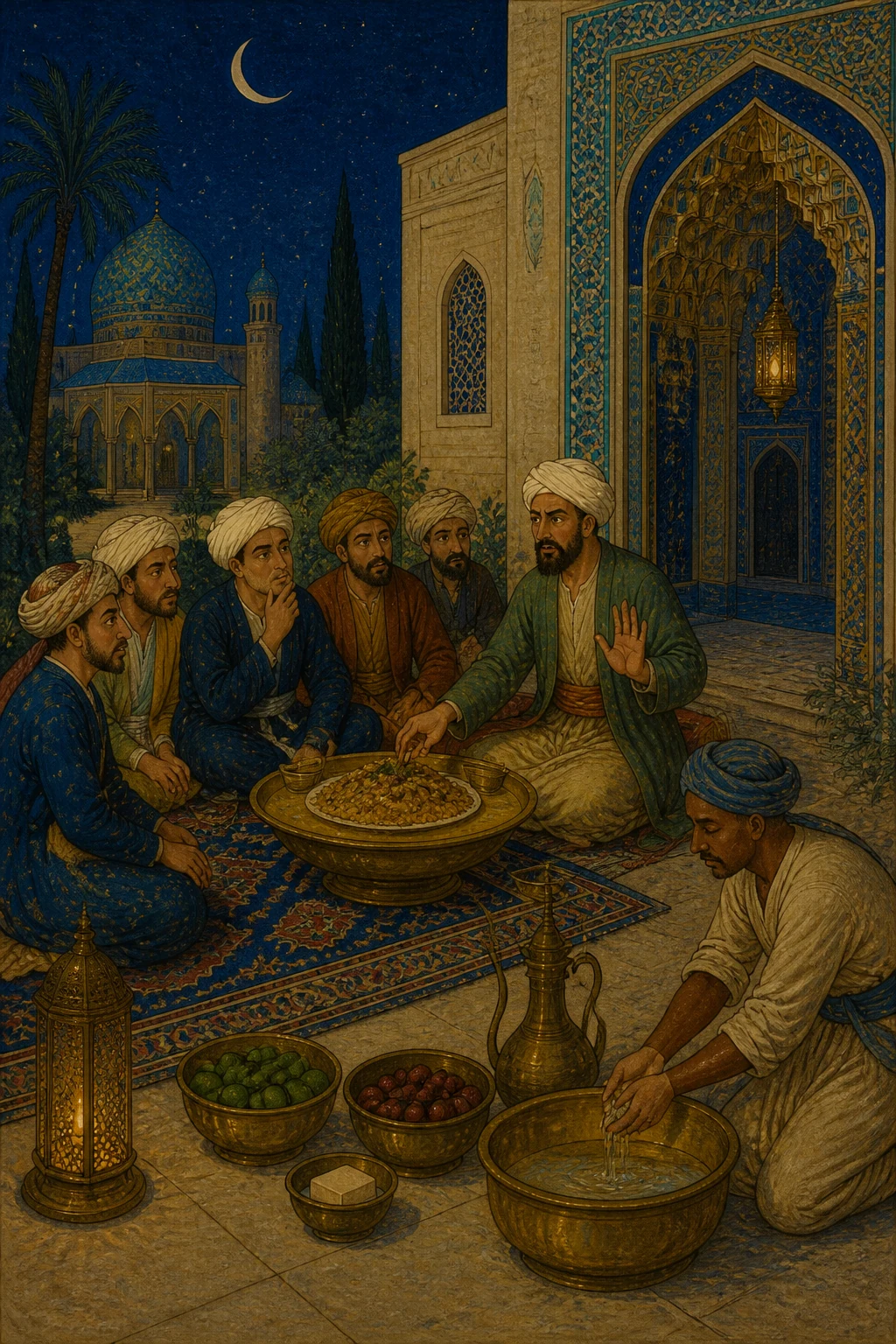
“When he heard mention of the feast, he said, ‘This is a blessed day for me! Last night I made a number of my friends swear to dine with me, and I forgot to prepare anything for them to eat. Only now have I remembered it. How ashamed I shall be before them!’ I said, ‘Do not trouble yourself about that. Now that you know I am dining out today, all the food and drink in my house is yours, if only you will finish your work and shave my head quickly.’ He said, ‘May God reward you! Tell me what you have for my guests, so that I may know.’ I said, ‘I have five dishes of food, ten roast chickens, and a roast lamb.’ ‘Have them brought here so that I can see them,’ he said. I had everything brought to him. When he had inspected it, he said, ‘There is still the drink.’ ‘I have that too,’ I said. ‘Bring it,’ he replied. I had it brought, and he said, ‘God bless you! What a generous soul you have! But there is still the fragrant incense.’ I had a box brought to him containing nadd incense, aloeswood, ambergris, and musk, worth fifty dinars. By now time had grown as straitened as my heart, and I said, ‘Take this and shave my whole head, by the life of Muhammad, God bless him and grant him peace!’ The barber said, ‘By God, I shall not take it until I have seen everything inside.’
“I ordered the servant to open the box for him. The barber cast the astrolabe from his hand and sat on the floor, turning over the perfumes, incense, and aloeswood in the box until my soul almost left my body. Then he came forward, took up the razor, shaved a tiny part of my head, and said, ‘By God, my son, I do not know whether to thank you or your father. My entire feast today is but a small part of your bounty and kindness. Yet none of my guests deserves all this. There will only be Zaytun the bathhouse keeper, Sulay‘ the attendant, ‘Awkal the bean seller, ‘Ikrishah the greengrocer, Humayd the refuse collector, and ‘Akarish the milk seller. Each has a dance he performs and verses he recites. The best thing about them is that they are like kings, while I, your servant, know nothing of chatter or meddling. As for the bathhouse keeper, he sings, “If I do not go to her, she will come to my house.” The refuse collector is a witty, carefree fellow who often dances and sings, “My wife has all the good things, none of them ever in a chest.” Each of my friends has charms the others lack, and hearing is not like seeing. If you chose to join us, it would be more pleasant for you and for us. Give up this visit to the friends you say you mean to see. You still bear the marks of illness, and you may find yourself among people who talk too much and discuss what does not concern them. There may even be a meddler among them, when your spirit is already troubled by sickness.’ I said, ‘God willing, it shall be another day.’ He replied, ‘It would be better to come to my friends first, enjoy their company and profit by their forbearance, and act upon the poet’s words:
“Do not put off a pleasure you may grasp, for time is full of perils.”’ I laughed, though my heart was seething with anger, and said, ‘Finish your work. Then I can go under God Almighty’s protection, and you can go to your friends, who are waiting for you.’ He said, ‘I only wished to bring you into the company of these good people. They are of respectable families, and not a meddler among them. If you saw them just once, you would abandon all your other friends.’ I said, ‘May God grant you joy in their company. I shall certainly invite them to my house one day.’ He said, ‘If that is your intention, but you have already invited your own friends today, wait while I take them these generous gifts of yours, so that they may eat and drink without waiting for me. Then I shall return and accompany you to your friends. There is no formality between my friends and me to prevent me from leaving them and coming straight back to you. I shall go with you wherever you are bound.’ I said, ‘There is no power and no strength save in God, the Most High, the Almighty! Go to your friends and enjoy yourself with them, and let me go to mine and spend the day with them, for they are expecting me.’ The barber said, ‘I shall not let you go alone.’ I said, ‘No one but me can enter the place where I am going.’ He said, ‘I think you have an appointment with a woman today. Otherwise you would take me with you. I have a better right than anyone else, and I would help you obtain what you desire. I fear you may visit a woman who is not yours to visit and lose your life. This is Baghdad, where no one can do such things, especially on a day like this, and the governor of Baghdad is a stern and formidable man.’ I said, ‘Damn you, you wicked old man! What sort of talk is this?’
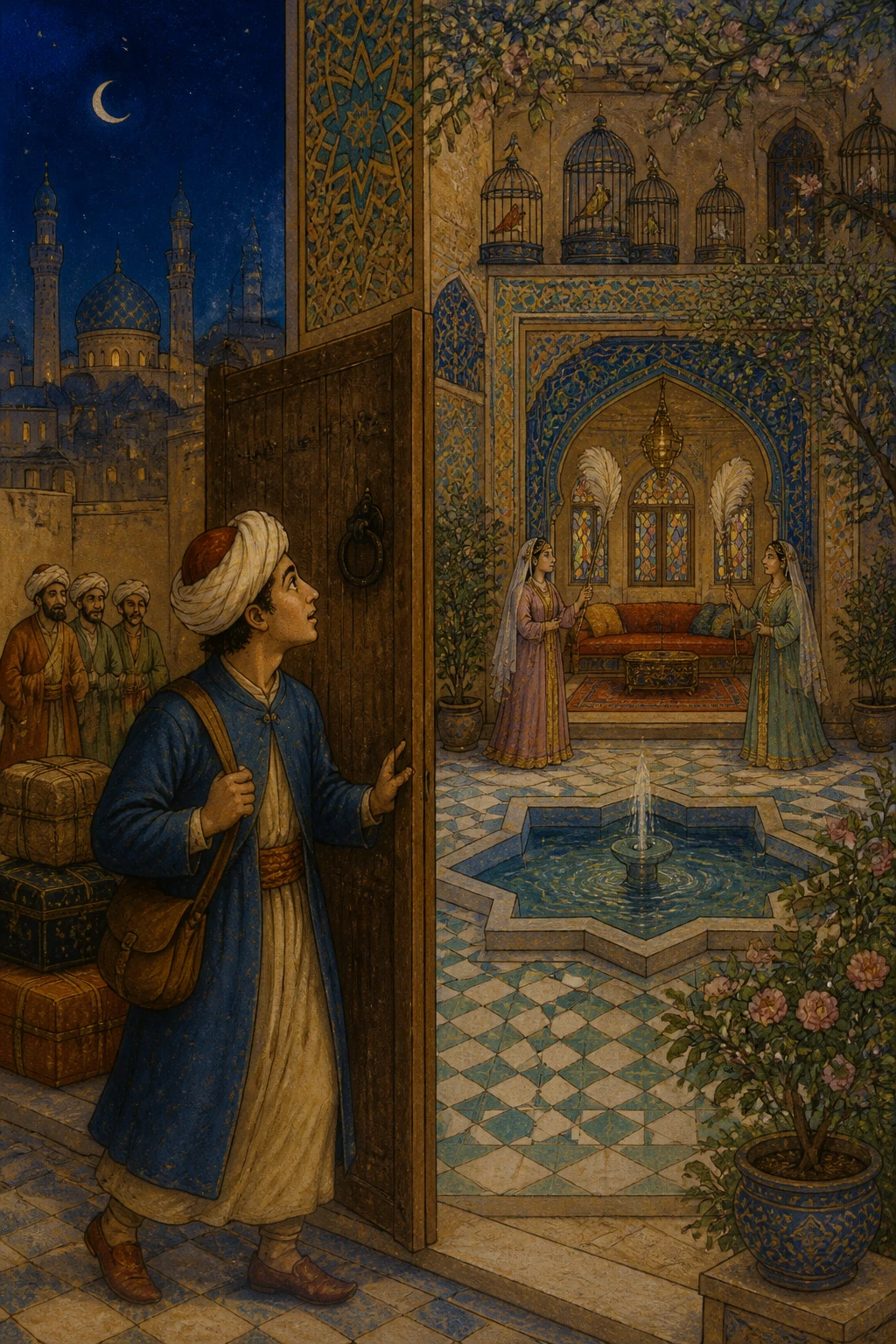
“He fell silent for a long time. The hour of prayer arrived, and the time for the sermon came. He had finished shaving my head, and I said to him, ‘Take this food and drink to your friends. I shall wait until you return, and then you can come with me.’ I kept trying to trick him into leaving, but he said, ‘You are deceiving me. You will go alone and fling yourself into a calamity from which there is no escape. For God’s sake, do not stir until I return. I shall go with you and see what becomes of your affair.’ I said, ‘Very well, but do not be long.’ He took the food, drink, and other things I had given him and left. He handed them to a porter to carry to his house, then hid himself in one of the lanes. I rose at once, as the Friday salutations were being proclaimed from the minarets, dressed, and went out alone. I came to the lane and stopped at the house where I had seen the young woman, unaware that the barber was behind me. Finding the door open, I went in. Just then the master of the house returned from prayers, entered the hall, and shut the door. I said to myself, ‘How did this devil find out about me?’ At that very moment, by a decree through which God willed my secret to be exposed, one of the master’s slave girls committed some offense. He beat her, and she cried out. A male slave went in to rescue her, so the master beat him too, and he also cried out. The barber imagined it was I who was being beaten. He screamed, tore his clothes, heaped dust on his head, and began crying for help. People gathered around him as he shouted, ‘My master has been murdered in the judge’s house!’ Then he ran to my house, shouting, with the crowd behind him, and told my household and servants. Before I knew what was happening, they were coming toward me, crying, ‘Alas, our master!’ The barber led them, his clothes in tatters, with the crowd accompanying them. They kept up their cries, and he was at their head, crying with them as they lamented, ‘Alas, the murdered man!’ They advanced toward the house where I was. When the judge heard this, he was greatly alarmed. He rose and opened the door, and stood bewildered at the sight of the vast crowd. ‘Good people,’ he said, ‘what is the matter?’ The servants said, ‘You have killed our master!’ He replied, ‘Good people, what has your master done that I should kill him?’” Dawn overtook Shahrazad, and she fell silent, leaving her tale untold.
When it was the thirtieth night
She said, “I have heard, O fortunate king, that the judge said to the servants, ‘What has your master done that I should kill him? And why do I not see this barber before you?’ The barber said to him, ‘You have just been beating him with whips. I heard his cries.’ The judge said, ‘What has he done that I should kill him? Who brought him into my house? Where has he come from, and where does he mean to go?’ The barber said, ‘Do not be a wicked old man! I know the story, why he entered your house, and the whole truth of the affair. Your daughter loves him and he loves her. You discovered that he had entered your house and ordered your servants to beat him. By God, the caliph shall judge between us unless you bring out our master and let his people take him away. Do not force me to go in and bring him out myself. Make haste and bring him out!’ The judge was struck speechless and became deeply ashamed before the crowd. He said to the barber, ‘If you are telling the truth, go in and bring him out yourself.’ The barber sprang up and entered the house. When I saw him, I tried to flee, but could find no escape. Then I noticed a large chest on the floor where I was. I climbed inside, closed the lid over me, and held my breath. He entered the hall and paid no attention to any other direction, but made straight for the place where I was. He looked right and left and found nothing but the chest in which I was hiding. He hoisted it onto his head. When I felt him do this, I lost my wits. He hurried away with it, and when I realized he would not leave me alone, I opened the chest, scrambled out, and flung myself to the ground, breaking my leg.
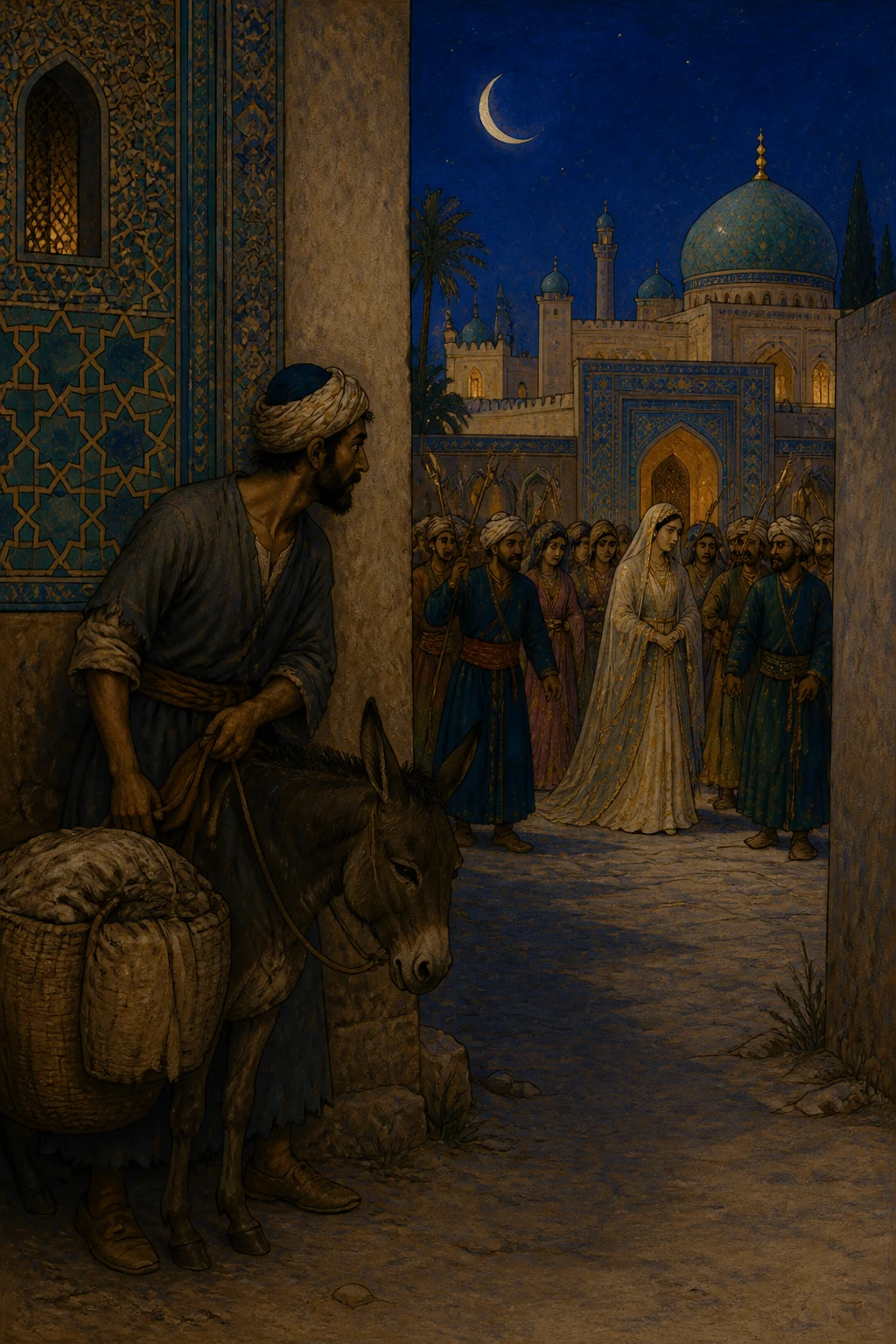
“When I made for the door, I found a vast crowd. Never in my life had I seen such a crush as there was that day. I began scattering gold among the people to distract them. As they busied themselves picking it up, I fled through the lanes of Baghdad, with the barber behind me. Wherever I went, he followed, saying, ‘They meant to rob me of my master! Praise be to God, who gave me victory over them and rescued my master from their hands! My lord, you have always been so fond of haste and so poor in judgment that you have brought all this upon yourself. Had God not favored you by sending me, you would never have escaped the calamity into which you fell. They might have cast you into a plight from which you could never have been delivered. I pray God may preserve my life for your sake, so that I may rescue you. By God, you have worn me out with your foolish conduct! You wanted to go alone, but I shall not hold your ignorance against you, for you have little sense and are hasty.’ I said to him, ‘Is what you have done not enough, that you must chase me through the markets too?’ I began to wish for death to rid me of him, but could find no death to deliver me. Beside myself with rage, I fled into a shop in the middle of the market and begged its owner for protection. He kept the barber away while I sat in a storeroom, saying to myself, ‘I shall never be able to get rid of this barber. He will stay with me night and day, and I can no longer bear to look at his face.’ At once I sent for witnesses, made a will for my family, divided my wealth among them, and appointed someone to oversee their affairs. I instructed him to sell my house and properties, and entrusted young and old alike to his care. Then I set out on my travels that very hour, to be rid of this procurer. I came to your country, settled here, and have lived here for some time. When you invited me and I came to your house, I saw this hideous procurer sitting in the place of honor. How can my heart be at ease or my stay with you be pleasant in his company, after all he has done to me, when it was because of him that my leg was broken?”
The young man still refused to sit down. When we had heard his story about the barber, we said to the barber, “Is what this young man has told us about you true?” He replied, “By God, I did all this for him knowingly. Had I not done it, he would have perished. I alone was the cause of his deliverance, and it was through me that God favored him, allowing him to suffer an injury to his leg rather than lose his life. Had I been a talkative man, I would never have done him this kindness. Now I shall tell you something that happened to me, so that you may believe that I am a man of few words and, unlike my brothers, do not meddle.”