Prevod
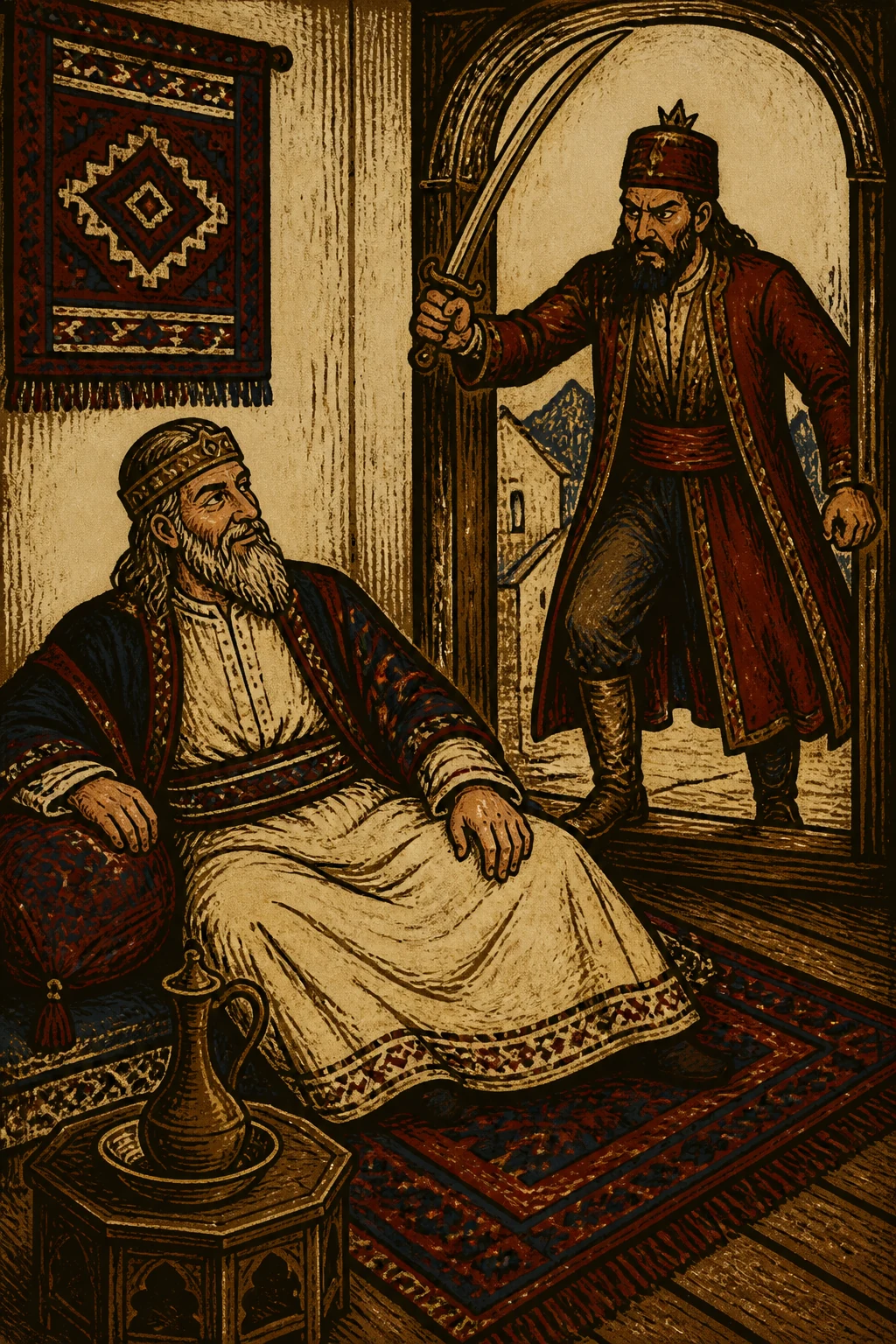
I was in Baghdad during the caliphate of the Commander of the Faithful, al-Muntasir Billah, who loved the poor and needy and kept company with scholars and holy men. One day he became angry with ten men and ordered the governor of Baghdad to bring them to him in a boat. When I saw them, I said to myself, “They can only have gathered for a feast. I imagine they mean to spend the day in this boat eating and drinking, and I shall be their companion.” So I rose, went down into the boat with them, and mingled among them. They sat on the other side, and the governor’s officers came with iron collars, which they fastened around their necks; they put one around mine as well. Now this, my friends, was entirely due to my noble spirit and my habit of saying little, for I would not deign to speak. They took us all away in chains and brought us before al-Muntasir Billah, Commander of the Faithful, who ordered the ten men to be beheaded. The executioner struck off all ten heads, leaving only me. The caliph turned, saw me, and said to the executioner, “Why have you not beheaded all ten?” “I have beheaded all ten,” he replied. The caliph said, “I think you have beheaded only nine, and this man before me is the tenth.” “By your bounty,” said the executioner, “there were ten.” “Count them,” said the caliph. They counted them, and there were indeed ten. Then the caliph looked at me and said, “What made you remain silent at such a moment? And how did you come to be among men condemned to death?”
When I heard the Commander of the Faithful address me, I said, “Know, O Commander of the Faithful, that I am the Silent Sheikh, a man possessed of great wisdom. As for my sound judgment, keen understanding, and sparing use of words, they know no bounds. My trade is that of a barber. Early yesterday morning, I saw these ten men making for the boat, so I joined them and went aboard, thinking they were off to a feast. Scarcely an hour had passed before it turned out that they were criminals. The officers came and fastened iron collars around their necks, putting one around mine along with the rest. Out of the sheer nobility of my spirit, I remained silent and said nothing; my silence at that moment arose solely from my noble nature. They brought us here and made us stand before you, and you ordered the ten men to be beheaded. I remained before the executioner without making myself known to you. Was it not a most noble spirit that moved me to share their death? But all my life I have done such fine deeds.” When the caliph heard my words and understood that I was a man of great nobility and few words, with none of the meddlesomeness attributed to me by this young man whom I rescued from such terrors, he said, “Are your six brothers like you in wisdom, learning, and sparing use of words?” I replied, “May they neither live nor prosper if they are anything like me! You do me an injustice, O Commander of the Faithful, and ought not to compare my brothers with me. Through their excessive talk and lack of noble feeling, each has acquired some affliction: one is lame, one has lost an eye, one is paralyzed, one is blind, one has had his ears and nose cut off, one has had his lips cut off, and one is cross-eyed. Do not suppose, O Commander of the Faithful, that I am a man of many words, but I must make it plain to you that I am far nobler than they. Each has a story of how he came by his affliction, and, if you wish, I shall tell you.”