O besedilu
Začarana košuta
- Vir
- Pentameron
- Avtor
- Giambattista Basile
- Jezik branja
- English
- Jezik izvirnika
- Neapolitan
- Čas branja
- 13 min branja
- Obseg
- 11 strani
- Naslov izvirnika
- Jornata I IX LA CERVA FATATA
O izvirniku
Pentameron
Baročna, divja starejša plast evropske pravljice, polna obratov in pretiravanj. Bralni jezik je English, izvirnik pa prihaja iz vira Pentameron v jeziku Neapolitan.
Besedilo
Začarana košuta
_Fonzo and Canneloro are born through enchantment. Canneloro arouses the jealousy of the Queen, Fonzo’s mother, who wounds him in the forehead. Canneloro leaves and becomes a king, but falls into grave danger. Through the power of a fountain and a myrtle bush, Fonzo learns of his troubles and goes to rescue him._ _They listened open-mouthed to Paola’s beautiful tale, and all agreed that a humble soul is like a ball: the harder it is dashed to the ground, the higher it bounces; or like a ram, which butts all the harder the farther it draws back. But when Taddeo signaled to Ciommetella to carry on with the proceedings, she set her tongue in motion as follows._ Great indeed is the power of friendship, which makes us think nothing of hardships and dangers when we can serve a friend. Wealth is reckoned as chaff, honor as a trifle, and life as a thing of no account, if they may be spent to help him. Fables proclaim it, histories are full of it, and today I shall give you an example that my grandmother Semmonella used to tell me, God rest her soul—if, to lend me a little attention, you will shut your mouths and stretch your ears.
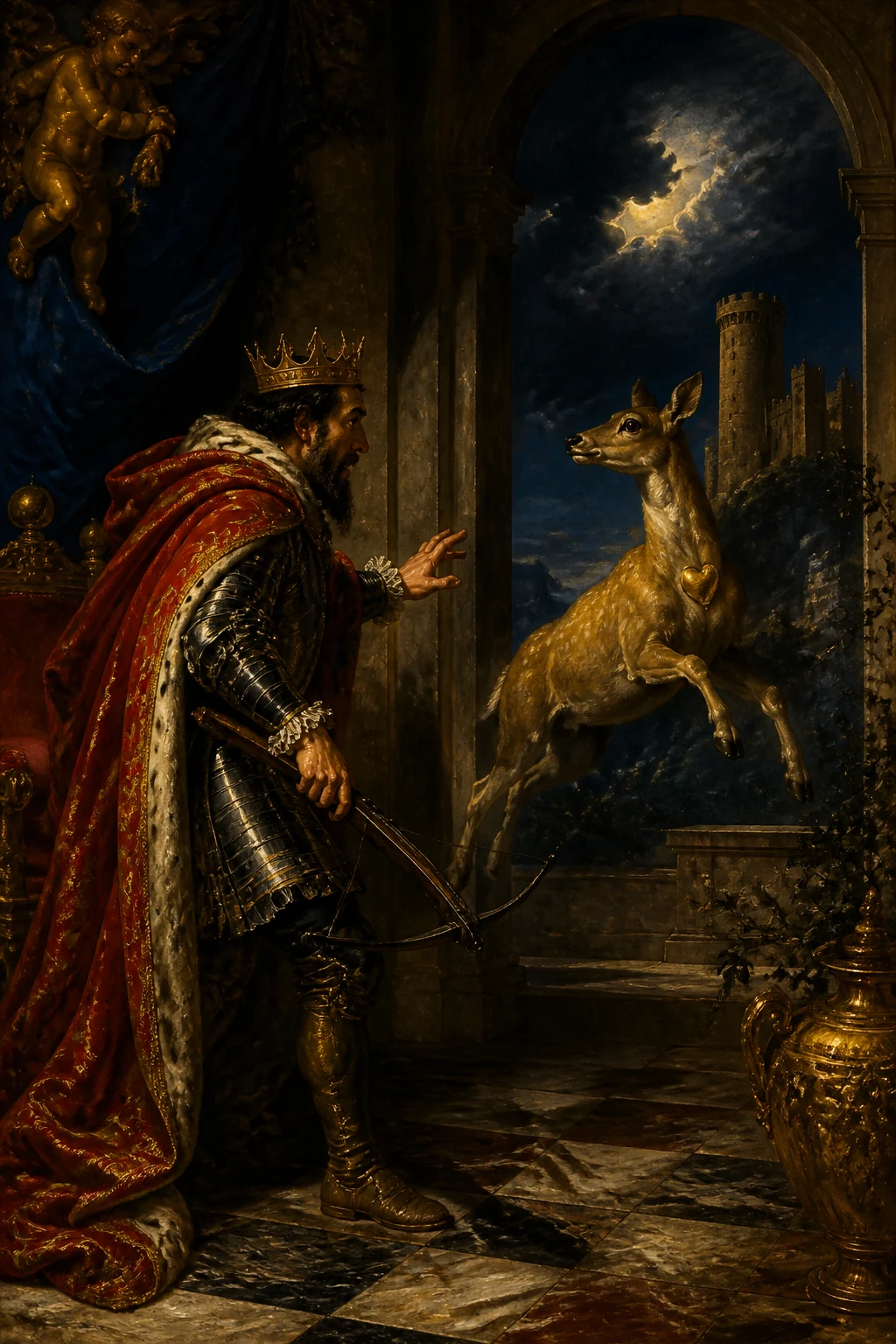
Once upon a time there was a certain King of Longa-pergola named Jannone, who longed so greatly for children that he was forever praying to the gods to make his wife’s belly swell. To persuade them to grant him this happiness, he was so charitable toward pilgrims that he would have given them the very stones of his doorstep. But when at last he saw that matters were dragging on, with no prospect of producing so much as a sprout, he bolted his door tight and fired his crossbow at anyone who came near. Now a venerable old man was passing through that country, and either knew nothing of the King’s change of tune or, knowing it, wished to remedy it. He went to Jannone and begged him for shelter in his house. With a sour face and a terrible scowl, the King replied, “If you have no candle but that one, you may go to bed in the dark. The days when Bertha spun are over; the kittens have opened their eyes now, and there’s no mother here to nurse you.” When the old man asked the reason for this change, the King answered, “Because I wanted children, I spent and scattered my wealth on everyone who came and went, throwing my possessions away. At last, seeing that I was losing by the bargain, I gave it up and took my iron out of the fire.” “If that is all,” the old man replied, “set your mind at rest, for I can make her pregnant in a trice, on pain of losing an ear.” “If you do that,” said the King, “I give you my word that you shall have half my kingdom.” And the old man answered:
“Now listen carefully. If you want to hit the mark, have the heart of a sea dragon brought to you and cooked by a maiden untouched by man. The mere smell of the pot will make her belly swell as well. When the heart is cooked, give it to the Queen to eat, and you will see her become pregnant at once, as though she were nine months gone.”
“How can such a thing be?” replied the King. “To tell you the truth, I find it very hard to swallow.” “Do not be surprised,” said the old man, “for if you read the fables, you will find that Juno, passing through the Olenian fields, smelled a flower, whereupon her belly swelled and she gave birth.” “If that is so,” the King replied, “let this dragon’s heart be found this very instant. After all, I have nothing to lose.” And so he sent a hundred fishermen out to sea. They laid out harpoons, nets, hooks, pots, creels, lines, and trawls, and cast about here and there until at last they caught a dragon. They cut out its heart and brought it to the King, who gave it to a pretty maid to cook. She shut herself in a room, and scarcely had she put the heart on the fire and the steam begun to rise from the pot than not only did this pretty cook become pregnant, but all the furniture in the room swelled up too. Within a few days it all gave birth: the bedstead produced a little bed, the chest a little coffer, the chairs little chairs, the table a little table, and the chamber pot a little glazed chamber pot so pretty it was a delight to see. As for the heart, no sooner was it cooked and the Queen had barely tasted it than she felt her belly swell; and four days later, at the very same moment, she and the maid each gave birth to a fine baby boy. The two were so exactly alike that no one could tell one from the other. They grew up together with such affection that they could not bear to be parted for an instant;
and their love for one another was so boundless that the Queen began to feel jealous, since her son showed greater affection for the son of one of her servants than for herself. She did not know how to rid herself of this thorn in her eye. Now one day the Prince, wishing to go hunting with his companion, had a fire lit in the hearth of his chamber and began melting lead to make bullets. Finding that he lacked something or other, he went himself to fetch it. Meanwhile the Queen came to see what her son was doing and found Canneloro, the maid’s son, alone. Thinking to send him out of this world, she struck at his face with a red-hot bullet mold. He ducked, and the blow caught him above one eyebrow, making a nasty gash. She was about to give him another when her son Fonzo arrived. Pretending that she had come to see how he was, she bestowed a few insipid caresses on him and went away. Canneloro pulled a hat down over his forehead so that Fonzo would not notice the wound, and remained perfectly composed, though the pain made him feel as if he were frying. When he had finished making bullets as round as beetles, he asked the Prince’s leave to go away. Astonished by this sudden decision, Fonzo asked him the reason;
and he answered, “Ask no more, my Fonzo. It is enough to know that I am forced to leave. Heaven knows that in parting from you, who are my very heart, my soul is torn piecemeal from my breast, my spirit reels back and forth within my body, and the blood is drawn thread by thread from my veins.
“But since nothing else can be done, take care of yourself and keep me in your thoughts.” And so, after they had embraced and lamented, Canneloro went to his chamber, where he took a suit of armor and a sword born of another weapon while the heart was cooking. He armed himself from head to foot and took a horse from the stable. He was just putting his foot in the stirrup when Fonzo came up in tears and said that, since he meant to abandon him, he should at least leave him some token of his love to lessen the pain of his absence. At these words Canneloro drew his dagger and thrust it into the ground. A beautiful fountain sprang up, and he said to the Prince, “This is the best remembrance I can leave you, for by the flow of this fountain you will know the course of my life. If you see it running clear, know that my fortunes too are clear and peaceful. If you see it troubled, imagine that I am in trouble; and if you find it dry—which Heaven forbid—reckon that the oil in my lamp has run out, and I have come to the tollgate where we must all pay nature her due.”
Having said this, he drew his sword and thrust it into the earth, making a myrtle bush spring up. “Whenever you see it green,” he said, “know that I am as green and flourishing as garlic. If you see it drooping, understand that my fortunes are none too healthy; and if it withers altogether, you may say, ‘Rest in peace, shoes and clogs and all,’ for your Canneloro.” With that they embraced once more, and he set out. After various adventures on his journey, which would take too long to relate—quarrels with carriers, tricks played by innkeepers, robberies by toll collectors, dangers at treacherous passes, and ambushes by thieves—he arrived at last in Longa-pergola, just as a splendid tournament was being held, with the King’s daughter promised to the champion. Canneloro entered the lists and acquitted himself so bravely that he defeated every knight who had come from distant lands to win renown. He was therefore given Fenizia, the King’s daughter, in marriage, and there was a great celebration. They had lived for some months in perfect peace when Canneloro was seized by a restless longing to go hunting. He mentioned it to the King, who told him, “Watch your step, my son-in-law! Take care that some bogeyman does not blind you. Keep your wits about you, sir, and your eyes open, for in these woods there is a devil of an ogre who changes his shape every day, appearing now as a wolf, now as a lion, now as a stag, now as a donkey, and now as one thing or another. With a thousand tricks he lures the poor souls who encounter him into a cave, where he gobbles them up.
“So do not stake your life on it, my son, or you will leave your bones behind.” But Canneloro, who had left all his fear in his mother’s womb, paid no heed to his father-in-law’s advice. No sooner had the Sun, with the stiff broom of his rays, swept away the cobwebs of night than he went hunting. He came to a wood where, beneath the leafy awning, the shadows gathered to hatch plots and conspire against the Sun. Seeing him approach, the ogre turned into a beautiful doe. The moment Canneloro caught sight of her, he began to chase her; and the doe led him such a dance, darting from place to place, that she drew him into the darkest part of the wood. There she raised such a storm of rain and snow that the sky seemed to be falling. Finding himself before the ogre’s cave, Canneloro went inside for shelter. Numb with cold, he gathered some wood he found there, took his flint and steel from his pocket, and lit a great fire. While he was warming himself and drying his clothes, the doe appeared at the mouth of the cave and said, “Sir Knight, allow me to warm myself a little, for I am stiff with cold.”
Canneloro, who was courteous, said, “Come closer; you are welcome.” “I will,” replied the doe, “but I am afraid you will kill me afterward.” “Have no fear,” Canneloro answered. “Come in; you have my word.” “If you want me to come,” the doe said, “tie up those dogs, so they cannot hurt me, and tether that horse, so he cannot kick me.” Canneloro tied up the dogs and hobbled the horse. Then the doe said, “Now I feel half safe, but unless you bind your sword, I will not come in, by my grandfather’s soul!” Canneloro, who was delighted to make friends with the doe, tied up his sword like a farmer carrying his into the city for fear of the constables. As soon as the ogre saw Canneloro defenseless, he resumed his own shape, seized him, and lowered him into a pit at the back of the cave. Then he covered it with a stone, intending to eat him later.
But Fonzo, who visited the myrtle and the fountain morning and evening for news of Canneloro’s condition, found the one drooping and the other troubled. He knew at once that his dear friend was in distress. Eager to help him, without asking leave of either father or mother, he armed himself well, mounted his horse, and set out into the world with two enchanted dogs. He traveled this way and that until at last he reached Longa-pergola, which he found all draped in mourning for Canneloro, who was believed dead. No sooner had he arrived at court than everyone, taking him for Canneloro because he looked so like him, rushed to Fenizia to claim a reward for the good news. She came headlong down the stairs and embraced Fonzo, saying, “My husband, my heart! Where have you been all these days?” At this, Fonzo immediately suspected that Canneloro had come to this country and then gone away again. He resolved to question the Princess discreetly, drawing her into conversation to discover where his friend might be. When he heard her say that this accursed hunting had exposed him to terrible danger, especially if he should meet the ogre, who was so cruel to men, he concluded at once that his friend had fallen into the monster’s clutches. Concealing what he knew, he went to bed that night; but, pretending to have vowed to Diana not to touch his wife that night, he laid his drawn sword as a barrier between himself and Fenizia. He could hardly wait for morning, when the Sun would come out to give the sky its golden pills and purge it of darkness. Rising from bed, undeterred by Fenizia’s pleas or the King’s commands, he insisted on going hunting. He mounted his horse and rode with the enchanted dogs into the wood, where everything happened just as it had to Canneloro. On entering the cave, he saw Canneloro’s weapons, his dogs, and his horse, all bound, and knew for certain that his friend had been trapped there. When the doe told him to bind his weapons, his dogs, and his horse, he set the dogs on her instead, and they tore her to pieces. Searching for some further sign of his friend, he heard him down in the pit. He lifted the stone and drew Canneloro out, along with all the others whom the ogre had buried alive there to fatten.
They embraced with great rejoicing and went home, where Fenizia, seeing the two so exactly alike, could not tell which was her husband. But when she lifted Canneloro’s hat, she saw the wound, recognized him, and embraced him. Fonzo spent a month enjoying himself in that country, then wished to return to his own land and his own nest. Canneloro sent a letter with him to his mother, asking her to come and share in his greatness, which she did. From that day forward he would have nothing to do with either dogs or hunting, remembering the saying, _Woe to him who learns his lesson at his own expense._
Izvirnik
Jornata I IX LA CERVA FATATA
Naslednje strani prikazujejo izvirno besedilo za primerjavo.
_Nasceno pe ffatazione Fonzo, e Ccanneloro; Canneloro è nvidejato da la Regina, mamma de Fonzo, e le rompe lo fronte. Canneloro se parte, e ddeventato Rrè, passa no gran pericolo. Fonzo pe bertute de na Fontana, e de na Mortella sa li travaglie suoje, e vace a lleberarelo._ _Stettero a canna aperta a sentire lo bellissemo cunto de Paola, e cconcrusero tutte, ca l’umele è comme la palla, che quanto cchiù se sbatte ’nterra, cchiù ssauta, e comme a lo caperrone, che quanto cchiù se tira arreto, cchiù fforte tozza. Ma fatto signo Taddeo a Cciommetella, che secotasse la robrica, cossì mettette la lengua nvota._ È granne senza dubbio la forza de l’amecizia, che nce fa tenere le
ffatiche, e li pericole sotto coscia pe sservizio de l’ammico: la rrobba se stimma la pagliosca, lo nnore na cufece, la vita na zubba, dove se pozza spennere pe ghiovare l’ammico, comme nne sbrommano le ffavole, ne sò chiene le storie ed io oje ve ne darraggio no ’nziempro, che me soleva contare vava Semmonella, ch’aggia recola: si pe ddareme no poco d’audienzia chiuderrite la vocca, ed allongarrite l’aurecchie.
Era na vota no cierto Rrè de Longa-pergola chiammato Jannone, lo quale avenno gran desederio de avere figlie, faceva pregare sempre li Deje, che ffacessero ’ntorzare la panza a la mogliere; e pperchè se movessero a darele sto contiento, era tanto caretativo de li pellegrine, che le dava pe fi a le bisole. Ma vedenno all’utemo che le ccose jevano a lluongo, e non c’era termene de criare na sporchia, serraje la porta a mmartiello, e ttirava de valestra a chi ’nce accostava: pe la quale cosa passanno no gran varvante da chella terra, e non sapenno la mutata de registro de lo Rrè, o puro sapennola, e bolennoce remmediare, juto a trovare Jannone, lo pregaje a ddarele recietto ne la casa soja: lo quale co na cera brosca, e co na gronna terribele le disse: Si n’aje
autra cannela de chesta, te puoje corcare a la scura: passaje lo tiempo, che Berta filava: mo hanno apierto l’uocchie li gattille; non c’è chiù mamma mò. E demannanno lo Viecchio la causa de sta motazione, respose lo Rrè. Io pe ddesiderare d’avere figlie; aggio spiso, e spaso co cchi jeva, e chi veneva, e ghiettato la rrobba mia; all’utemo, avenno visto ca nce perdeva la rasa, aggio levato mano, ed auzato lo fierro. Si n’è pe d’autro leprecaje chillo viecchio, cojetate, ca te la faccio scire subbeto prena a ppena de l’aurecchia. Si farraje chesto, disse lo Rrè, te dò pparola darete miezo lo Regno; e chillo respose; ora siente buono, si vuoje ’nzertare a ppiro, fa pigliare lo core de no Drago marino, e ffallo cocinare da na Zitella zita, la quale a
l’addore schitto de chella pignata, deventarrà essa perzì co la panza ’ntorzata, e ccuotto che sarrà sto core, dallo a mmangiare a la Regina, che vedarraje subbeto, che sciarrà prena, comme si fosse de nove mise. Comme po essere sta cosa? (repigliaje lo Rrè) mme pare pe te la dicere assaje dura a gliottere. Non te maravigliare (disse lo viecchio) ca si lieje le ffavole, trovarraje, che a Giunone passanno pe li campe olene sopra no sciore l’abbottaje la panza, e ffigliaje. Si è cossì, tornaje a ddicere lo Rrè, che se trova a sta mmedesema pedata sto core de Dragone. All’utemo no ’nce perdo niente. E ccosì mmannato ciente pescature a maro apararo sperune, chiusatane, pasangrese, buole, nasse, lenze, e ffelacciune, e tanto se votaje, e giraje, ficchè se pigliaje
no Dragone, e cacciatone lo core, lo portaro a lo Rrè, lo quale lo dette a cocinare a na bella damecella, la quale serratase a na cammara, non cossì priesto mese a lo ffuoco lo core, e scette lo fummo de lo vullo, che non sulo sta bella Coca deventaje prena, che tutte li mobele de la casa ntorzaro, e ’ncapo de poche juorne figliattero, tanto che la travacca fece no lettecciuolo, lo forziero fece no scrignetiello, le ssegge facettero seggiolelle, la tavola no tavolino, e lo cantaro fece no cantariello mpetenato accossì bello, ch’era no sapore. Ma cuotto, che fu lo core, e assaporato a ppena da la Regina, se sentette abbottare la panza, e fra quattro juorne tutto a no tiempo co la dammecella fecero no bello mascolone ped’una; cossì spiccecato l’uno
all’autro, che non se canosceva chisto da chillo; li quale crescettero ’nziemme co tanto ammore, che non se sapevano spartere punto fra loro; ed era ccossì sbisciolato lo bene, che se portavano, che la Regina commenzaje ad averne quarche mmidia, pocca lo figlio mostrava cchiù affezzione a lo figlio de na vajassa soja, ch’a se stessa, e non sapeva de che muode levarese sto spruoccolo da ll’uocchie; Ora no juorno volenno lo prencepe ire a ccaccia co lo compagno sujo, fece allommare fuoco a na cemmenera dinto la cammara soja; e accommenzaje a squagliare lo cchiummo pe fare pallottine, e mmancannole non saccio, che ccosa jette de perzona e ttrovarela; e fra sto miezo arrivanno la Regina pe bedere, che ffaceva lo figlio, e ttrovatoce sulo Canneloro lo figlio
de la dammecella; penzanno de levarelo da sto munno, le dette co na pallottera ’nfocata verzo la faccie, pe la quale cosa vasciannose, le cogliette sopra no ciglio, e le fece no male ’ntacco, e già voleva asseconnare l’autro, quanno arrevaje Fonzo lo figlio, ed essa fegnenno essere venuta a bedere comme steva, dapò quattro carizzielle ’nsipete, se nne jette: E Ccanneloro carcatose no cappiello ’nfronte non fece addonare Fonzo de lo chiajeto, e stette saudo saudo, si bè se sentette friere da lo dolore; e comme appe fornuto de fare palle comm’a scarafone, cercaje lecienzia a lo Prencepe de ire fore. E rrestanno maravegliato Fonzo de sta nova deleberazione, le demmannaje la causa: lo quale respose; non cercare autro Fonzo mio, vasta sapere schitto
ca sò fforzato a ppartire; e lo Cielo sà, si partenno da te, che ssi lo core mio, fa sparte casatiello ll’arma da sto pietto, lo spireto fa sia, e boca da lo cuorpo, e lo sango fa marco sfila da le bene: ma pocca non se pò ffare autro, covernamette, e tieneme a mmemoria. Cossì abbracciatose, e ttrivolejanno, s’abbiaje Canneloro a la cammara soja, dove pigliatose n’armatura, e na spata ch’era figliata da n’autra arma, a ttiempo, che se coceva lo core, ed armatose tutto, se pigliaje no cavallo da la stalla, e ttanno voleva mettere lo pede a la staffa, quanno l’arrivaje Fonzo chiagnenno, decennole ch’a lo mmanco pocca lo voleva abbannonare, le lassasse quarche segnale de l’ammore sujo, azzò potesse smesare l’affanno de l’assenzia soja: a le quale parole
Canneloro, caccianno mano a lo pognale, lo mpizzaje nterra, e sciutane na bella fontana, disse a lo Prencepe, chesta è la meglio memoria, che te pozzo lassare, pocca a lo correre de sta fontana saperraje lo curzo de la vita mia: che se la vederraje scorrere chiara, sacce ca starraggio cossì chiaro, e tranquillo de stato, se la vederraje trovola, mmagenate ca passarraggio travaglio; e si la trovarraje secca (non voglia lo Cielo) fa cunto ca sarrà ffornuto ll’uoglio de la cannela mia, e ssarraggio arrivato a la gabella, che tocca a la natura; e ditto chesto mese mano a la spata, e danno na ’mbroccata ’nterra, fece nascere no pede de mortella, decenno, sempre che la vide verde, sacce ca stò berde comm’aglio; se la vide moscia, penza ca non vanno
troppo ’ncriccate le ffortune meje, e si deventarrà secca affatto, puoje dire pe Ccanneloro tujo requie, scarpe, e zuoccolo. E ditto chesto, abbracciatose n’autra vota, se pose ’ncammino, e ccammenato, dapò varie cose, che l’accadettero, che sarria luongo a rraccontare, comme contraste de Vettorine, ’mbroglie de tavernare, assassinamiente de gabellote, pericole de male passe, cacavesse de mariuole, all’utemo arrevaje a Llonga pergola a ttiempo che se faceva na bellissema jostra, e se prometteva la figlia de lo Rrè a lo mantenetore; dove presentantose Canneloro, se portaje cossì bravamente, che frusciaje tutte li Cavaliere venute da deverze parte a guadagnarese nomme. Pe la quale cosa le fu data Fenizia la figlia de lo Rrè pe mmogliere, e se
fece na festa granne; ed essenno state per quarche mese ’nsanta pace venne n’ommore malenconico a Ccanneloro de ire a ccaccia, e decenno sta cosa a lo Rrè, le fu ditto guarda la gamma, jennero mio, vi che non te cecasse parasacco, sta ’ncellevriello, apre ll’uocchie, messere, ca pe ssi vuosche nc’è n’Uorco de lo diantane, lo quale ogne ghiuorno cagna forma, mò comparenno da Lupo, mo da Lione, mò da ciervo, mò da Aseno, e mò da na cosa, e mò da n’autra; e co mmille stratagemme carreja li poverielle, che ’nce mmatteno, a na grotta, dove se le cannareja; perzò non mettere figlio mio la sanetate ’ncostiune, ca ’nce lasse li stracce. Canneloro, ch’aveva lassato la paura ’ncuorpo a la mamma, non curanno li consiglie de lo suocro, non cossì priesto lo Sole co la
scopa de vrusco de li ragge annettaje le ffolinie de la notte, jette a la caccia, ed arrivato a no vosco, dove sotto la pennata de le ffronne, se congregavano l’ombre a ffare monopolio, ed a confarfare contra lo Sole, l’Uorco vedennolo venire, se trasformaje a na bella Cerva, la quale Canneloro, comme la vedde, accommenzaje a ddarele caccia, e tanto la Cerva lo traccheggiaje, e sbauzaje da luoco a lluoco, che l’arreddusse a lo scuro de lo vosco, dove fece venire tanta chioppeta de tanta neve, che pareva che lo Cielo cadesse, e ttrovatose Canneloro nnante la grotta de l’Uorco, trasette dinto pe ssarvarese; ed essenno aggrancato de friddo, pigliaje certe llegna, che trovaje llà dinto, e ccacciatose da la sacca lo focile, allommaje no gran focarone, e
stannose a scarfare, e asciugare li panne, se fece a la vocca de la grotta la cerva, e disse, o Signore Cavaliero, damme lecienzia, ch’io mme pozza scaglientare no pocorillo, ca sò ntesecata de lo friddo: Canneloro, ch’era cortese, disse ’nzeccate, che singhe la benvenuta. Io vengo, respose la Cerva, ma aggio paura, ca po m’accide: non dubetare, leprecaje Canneloro; viene sopra la parola mia. Si vuoje, che benga, tornaje a dicere la cerva, lega sti cane, che non me facciano dispiacere, e lega sto cavallo che non me dia de cauce. E Canneloro legaje li cane, ’mpastoraje lo cavallo, e la cerva disse, si mò sò meza assecorata, ma si non lighe la sferra, io non nce traso pe l’arma de vavo; e Ccanneloro, ch’aveva gusto addomestecarese co la cerva legaje
la spata, comme a parzonaro, quanno la porta dinto la Cetate, pe paura de li sbirre. E l’Uorco, comme vedde Canneloro senza defesa, pigliaje la forma propria, e datole de mano lo calaje dinto la fossa, ch’era ’nfunno a la grotta, e lo commegliaje co na preta pe mmagnaresillo. Ma Fonzo, che mmatina, e sera faceva la viseta a la mortella, ed a la fontana, pe sapere nova de lo stato de Canneloro, trovato l’una moscia, e l’autra trovola, subbeto penzaje che passava travaglie lo cardascio sujo, e desederuso de darele soccurzo, senza cercare lecienzia a lo patre, nè a la mamma, se mese a ccavallo, ed armatose buono co duje cane fatate s’abbiaje pe lo munno, e tanto giraje, e ttornaje da chesta, e da chella parte, che arrivaje a Llonga-pergola, la quale
trovaje tutta apparata de lutto pe la creduta morte de Canneloro, e non tanto priesto fu arrivato a la corte, che ognuno credenno, che ffosse Canneloro pe la someglianza ch’aveva a isso, corzero a ccercare lo veveraggio a Ffenizia, che scapizzannose pe le scale, abbracciaje a Ffonzo, dicenno: marito mio, core mio; dove si stato tanta juorne? Fonzo de sta cosa trasette subbeto ’nmalizia, ch’a sta terra fosse venuto Canneloro, e sse ne fosse partuto, e ffece penziero de ’nsammenare destramente, pe ppigliare ’nsermone la Prencepessa, dove se potesse trovare, e sentenno dire ca pe sta mmardetta caccia, s’era puosto a troppo pericolo, e mmassema si lo trovava l’Uorco, quale è tanto crodele coll’uommene, fece subbeto la massema, che lloco fosse
dato de pietto l’ammico sujo, e ssemmolato sto negozio, la notte se jeze a ccorcare: ma fegnenno avere fatto vuto a Diana de non toccare la mogliere la notte, mese la spata arrancata comme staccione ’miezo ad isso, ed a Fenizia, e non vedde l’ora la matina, che scesse lo Sole a dare li pinole nnaurate a lo Cielo pe ffarele vacoare l’ombra: perchè sosutose da lo lietto, non potennolo retenere li prieghe de Fenizia, nè lo ccommannamiento de lo Rrè, voze ire a ccaccia, e ppuostose a ccavallo co li cane fatate, jette a lo vosco, dove socceduto lo stisso, ch’era socciesso a Ccanneloro, e trasuto a la grotta, vedde l’arme de Canneloro, li cane, e lo cavallo legate, pe la quale cosa tenne pe ccierto, che lloco fosse ncappato l’ammico, e decennole la Cerva,
ch’avesse legate l’arme, cane, e cavallo, isso ’nce le ’nterretaje adduosso, e nne fecero petaccie; e ccercanno quarche autra notizia de l’ammico, lo ntese a bbascio lo fuosso, e auzato la preta nne cacciaje Canneloro co ttutte l’autre che pe ngrassare tenea atterrate vive: ed abbracciatose co na festa granne, jettero a la casa, dove Fenizia vedenno ssi duje simmele, non sapeva scegliere fra loro lo marito sujo: ma auzato lo cappiello de Canneloro, vedde la feruta, e ccanoscennolo l’abbracciaje: e dapò essere stato no mese Fonzo pigliannose spasso a cchillo pajese, voze repatriare, e ttornare a lo nido sujo, pe mmiezo de lo quale, scrisse Canneloro a la mamma, che benesse a ppartecepare de le grannizze soje, comme facette, e dall’ora ’nante non voze sapere
nè de cane, nè de caccia, arrecordannose de chella sentenzia, _Ammaro chi a soje spese se castica._
Nadaljuj z branjem