Prevod
_Fonzo and Canneloro are born through enchantment. Canneloro arouses the jealousy of the Queen, Fonzo’s mother, who wounds him in the forehead. Canneloro leaves and becomes a king, but falls into grave danger. Through the power of a fountain and a myrtle bush, Fonzo learns of his troubles and goes to rescue him._ _They listened open-mouthed to Paola’s beautiful tale, and all agreed that a humble soul is like a ball: the harder it is dashed to the ground, the higher it bounces; or like a ram, which butts all the harder the farther it draws back. But when Taddeo signaled to Ciommetella to carry on with the proceedings, she set her tongue in motion as follows._ Great indeed is the power of friendship, which makes us think nothing of hardships and dangers when we can serve a friend. Wealth is reckoned as chaff, honor as a trifle, and life as a thing of no account, if they may be spent to help him. Fables proclaim it, histories are full of it, and today I shall give you an example that my grandmother Semmonella used to tell me, God rest her soul—if, to lend me a little attention, you will shut your mouths and stretch your ears.
Once upon a time there was a certain King of Longa-pergola named Jannone, who longed so greatly for children that he was forever praying to the gods to make his wife’s belly swell. To persuade them to grant him this happiness, he was so charitable toward pilgrims that he would have given them the very stones of his doorstep. But when at last he saw that matters were dragging on, with no prospect of producing so much as a sprout, he bolted his door tight and fired his crossbow at anyone who came near. Now a venerable old man was passing through that country, and either knew nothing of the King’s change of tune or, knowing it, wished to remedy it. He went to Jannone and begged him for shelter in his house. With a sour face and a terrible scowl, the King replied, “If you have no candle but that one, you may go to bed in the dark. The days when Bertha spun are over; the kittens have opened their eyes now, and there’s no mother here to nurse you.” When the old man asked the reason for this change, the King answered, “Because I wanted children, I spent and scattered my wealth on everyone who came and went, throwing my possessions away. At last, seeing that I was losing by the bargain, I gave it up and took my iron out of the fire.” “If that is all,” the old man replied, “set your mind at rest, for I can make her pregnant in a trice, on pain of losing an ear.” “If you do that,” said the King, “I give you my word that you shall have half my kingdom.” And the old man answered:
“Now listen carefully. If you want to hit the mark, have the heart of a sea dragon brought to you and cooked by a maiden untouched by man. The mere smell of the pot will make her belly swell as well. When the heart is cooked, give it to the Queen to eat, and you will see her become pregnant at once, as though she were nine months gone.”
“How can such a thing be?” replied the King. “To tell you the truth, I find it very hard to swallow.” “Do not be surprised,” said the old man, “for if you read the fables, you will find that Juno, passing through the Olenian fields, smelled a flower, whereupon her belly swelled and she gave birth.” “If that is so,” the King replied, “let this dragon’s heart be found this very instant. After all, I have nothing to lose.” And so he sent a hundred fishermen out to sea. They laid out harpoons, nets, hooks, pots, creels, lines, and trawls, and cast about here and there until at last they caught a dragon. They cut out its heart and brought it to the King, who gave it to a pretty maid to cook. She shut herself in a room, and scarcely had she put the heart on the fire and the steam begun to rise from the pot than not only did this pretty cook become pregnant, but all the furniture in the room swelled up too. Within a few days it all gave birth: the bedstead produced a little bed, the chest a little coffer, the chairs little chairs, the table a little table, and the chamber pot a little glazed chamber pot so pretty it was a delight to see. As for the heart, no sooner was it cooked and the Queen had barely tasted it than she felt her belly swell; and four days later, at the very same moment, she and the maid each gave birth to a fine baby boy. The two were so exactly alike that no one could tell one from the other. They grew up together with such affection that they could not bear to be parted for an instant;
and their love for one another was so boundless that the Queen began to feel jealous, since her son showed greater affection for the son of one of her servants than for herself. She did not know how to rid herself of this thorn in her eye. Now one day the Prince, wishing to go hunting with his companion, had a fire lit in the hearth of his chamber and began melting lead to make bullets. Finding that he lacked something or other, he went himself to fetch it. Meanwhile the Queen came to see what her son was doing and found Canneloro, the maid’s son, alone. Thinking to send him out of this world, she struck at his face with a red-hot bullet mold. He ducked, and the blow caught him above one eyebrow, making a nasty gash. She was about to give him another when her son Fonzo arrived. Pretending that she had come to see how he was, she bestowed a few insipid caresses on him and went away. Canneloro pulled a hat down over his forehead so that Fonzo would not notice the wound, and remained perfectly composed, though the pain made him feel as if he were frying. When he had finished making bullets as round as beetles, he asked the Prince’s leave to go away. Astonished by this sudden decision, Fonzo asked him the reason;
and he answered, “Ask no more, my Fonzo. It is enough to know that I am forced to leave. Heaven knows that in parting from you, who are my very heart, my soul is torn piecemeal from my breast, my spirit reels back and forth within my body, and the blood is drawn thread by thread from my veins.
“But since nothing else can be done, take care of yourself and keep me in your thoughts.” And so, after they had embraced and lamented, Canneloro went to his chamber, where he took a suit of armor and a sword born of another weapon while the heart was cooking. He armed himself from head to foot and took a horse from the stable. He was just putting his foot in the stirrup when Fonzo came up in tears and said that, since he meant to abandon him, he should at least leave him some token of his love to lessen the pain of his absence. At these words Canneloro drew his dagger and thrust it into the ground. A beautiful fountain sprang up, and he said to the Prince, “This is the best remembrance I can leave you, for by the flow of this fountain you will know the course of my life. If you see it running clear, know that my fortunes too are clear and peaceful. If you see it troubled, imagine that I am in trouble; and if you find it dry—which Heaven forbid—reckon that the oil in my lamp has run out, and I have come to the tollgate where we must all pay nature her due.”
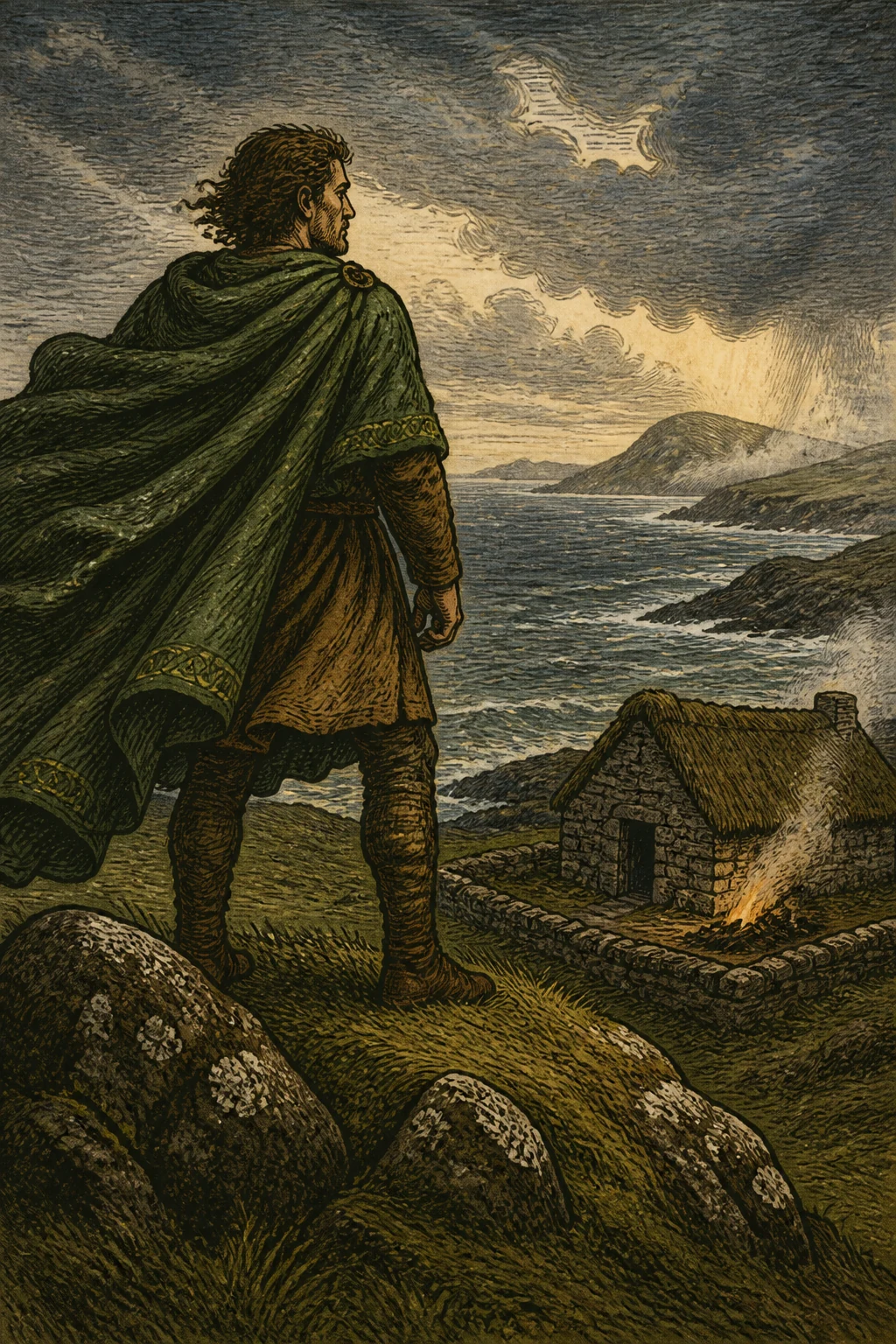
Having said this, he drew his sword and thrust it into the earth, making a myrtle bush spring up. “Whenever you see it green,” he said, “know that I am as green and flourishing as garlic. If you see it drooping, understand that my fortunes are none too healthy; and if it withers altogether, you may say, ‘Rest in peace, shoes and clogs and all,’ for your Canneloro.” With that they embraced once more, and he set out. After various adventures on his journey, which would take too long to relate—quarrels with carriers, tricks played by innkeepers, robberies by toll collectors, dangers at treacherous passes, and ambushes by thieves—he arrived at last in Longa-pergola, just as a splendid tournament was being held, with the King’s daughter promised to the champion. Canneloro entered the lists and acquitted himself so bravely that he defeated every knight who had come from distant lands to win renown. He was therefore given Fenizia, the King’s daughter, in marriage, and there was a great celebration. They had lived for some months in perfect peace when Canneloro was seized by a restless longing to go hunting. He mentioned it to the King, who told him, “Watch your step, my son-in-law! Take care that some bogeyman does not blind you. Keep your wits about you, sir, and your eyes open, for in these woods there is a devil of an ogre who changes his shape every day, appearing now as a wolf, now as a lion, now as a stag, now as a donkey, and now as one thing or another. With a thousand tricks he lures the poor souls who encounter him into a cave, where he gobbles them up.
“So do not stake your life on it, my son, or you will leave your bones behind.” But Canneloro, who had left all his fear in his mother’s womb, paid no heed to his father-in-law’s advice. No sooner had the Sun, with the stiff broom of his rays, swept away the cobwebs of night than he went hunting. He came to a wood where, beneath the leafy awning, the shadows gathered to hatch plots and conspire against the Sun. Seeing him approach, the ogre turned into a beautiful doe. The moment Canneloro caught sight of her, he began to chase her; and the doe led him such a dance, darting from place to place, that she drew him into the darkest part of the wood. There she raised such a storm of rain and snow that the sky seemed to be falling. Finding himself before the ogre’s cave, Canneloro went inside for shelter. Numb with cold, he gathered some wood he found there, took his flint and steel from his pocket, and lit a great fire. While he was warming himself and drying his clothes, the doe appeared at the mouth of the cave and said, “Sir Knight, allow me to warm myself a little, for I am stiff with cold.”
Canneloro, who was courteous, said, “Come closer; you are welcome.” “I will,” replied the doe, “but I am afraid you will kill me afterward.” “Have no fear,” Canneloro answered. “Come in; you have my word.” “If you want me to come,” the doe said, “tie up those dogs, so they cannot hurt me, and tether that horse, so he cannot kick me.” Canneloro tied up the dogs and hobbled the horse. Then the doe said, “Now I feel half safe, but unless you bind your sword, I will not come in, by my grandfather’s soul!” Canneloro, who was delighted to make friends with the doe, tied up his sword like a farmer carrying his into the city for fear of the constables. As soon as the ogre saw Canneloro defenseless, he resumed his own shape, seized him, and lowered him into a pit at the back of the cave. Then he covered it with a stone, intending to eat him later.
But Fonzo, who visited the myrtle and the fountain morning and evening for news of Canneloro’s condition, found the one drooping and the other troubled. He knew at once that his dear friend was in distress. Eager to help him, without asking leave of either father or mother, he armed himself well, mounted his horse, and set out into the world with two enchanted dogs. He traveled this way and that until at last he reached Longa-pergola, which he found all draped in mourning for Canneloro, who was believed dead. No sooner had he arrived at court than everyone, taking him for Canneloro because he looked so like him, rushed to Fenizia to claim a reward for the good news. She came headlong down the stairs and embraced Fonzo, saying, “My husband, my heart! Where have you been all these days?” At this, Fonzo immediately suspected that Canneloro had come to this country and then gone away again. He resolved to question the Princess discreetly, drawing her into conversation to discover where his friend might be. When he heard her say that this accursed hunting had exposed him to terrible danger, especially if he should meet the ogre, who was so cruel to men, he concluded at once that his friend had fallen into the monster’s clutches. Concealing what he knew, he went to bed that night; but, pretending to have vowed to Diana not to touch his wife that night, he laid his drawn sword as a barrier between himself and Fenizia. He could hardly wait for morning, when the Sun would come out to give the sky its golden pills and purge it of darkness. Rising from bed, undeterred by Fenizia’s pleas or the King’s commands, he insisted on going hunting. He mounted his horse and rode with the enchanted dogs into the wood, where everything happened just as it had to Canneloro. On entering the cave, he saw Canneloro’s weapons, his dogs, and his horse, all bound, and knew for certain that his friend had been trapped there. When the doe told him to bind his weapons, his dogs, and his horse, he set the dogs on her instead, and they tore her to pieces. Searching for some further sign of his friend, he heard him down in the pit. He lifted the stone and drew Canneloro out, along with all the others whom the ogre had buried alive there to fatten.
They embraced with great rejoicing and went home, where Fenizia, seeing the two so exactly alike, could not tell which was her husband. But when she lifted Canneloro’s hat, she saw the wound, recognized him, and embraced him. Fonzo spent a month enjoying himself in that country, then wished to return to his own land and his own nest. Canneloro sent a letter with him to his mother, asking her to come and share in his greatness, which she did. From that day forward he would have nothing to do with either dogs or hunting, remembering the saying, _Woe to him who learns his lesson at his own expense._