Prevod
There were once two brothers who lived together in one house. One did all the work, while the other idled his days away, eating and drinking whatever was set before him. And God granted them prosperity in everything: cattle, horses, sheep, pigs, bees, and all else besides. One day the brother who did the work thought to himself, “Why should I work for this lazy fellow too? Better to divide our property and work for myself, and let him do as he pleases!” So he said to his brother, “Brother, it is not fair: I do all the work, and you lend no hand in anything, but only eat and drink what is provided. I have made up my mind that we should divide our property.” The other tried to dissuade him. “Do not do it, brother. We are both well off as we are. Everything is in your hands, yours and mine alike, and I am content with whatever you do.”
But the hardworking brother stood firm, so at last the other agreed and said, “If that is how it must be, you have my blessing. Divide it yourself as you think best.” Then the first brother divided everything in turn, and each took charge of his own share. The idle one hired a cowherd for his cattle, a groom for his horses, a shepherd for his sheep, a goatherd for his goats, a swineherd for his pigs, and a beekeeper for his bees, and told them, “I leave all my property in your hands and God’s.” Then he went on living at home just as before. The other brother tended his property himself, as he had always done, watching over it and caring for it, but nothing prospered. Instead, everything went to ruin, growing worse from day to day, until he became so poor that he had not even a pair of opanci and went barefoot. Then he said to himself, “I shall go to my brother and see how he is faring.” On his way he came upon a flock of sheep in a meadow, but there was no shepherd with them. Instead, a beautiful maiden sat beside them, spinning a golden thread. He greeted her with “God be with you,” and asked whose sheep she was tending. She answered, “The sheep belong to the one I belong to.” “And who do you belong to?” he asked. “I am your brother’s Fortune,” she replied.
At this he grew angry and said, “And where is my Fortune?” The maiden answered, “Your Fortune is far away from you.” “Can I find her?” he asked. “You can,” she replied. “Go and seek her.” When he heard this, and saw that his brother’s sheep could not have been in better condition, he had no wish to go farther and look at the other livestock, but went straight to his brother’s house. When his brother saw him, he was filled with pity and began to weep. “Where have you been all this time?” Seeing him ragged and barefoot, he at once gave him a pair of opanci and some money. They spent several days feasting together, and then the poor brother rose to return to his own home.
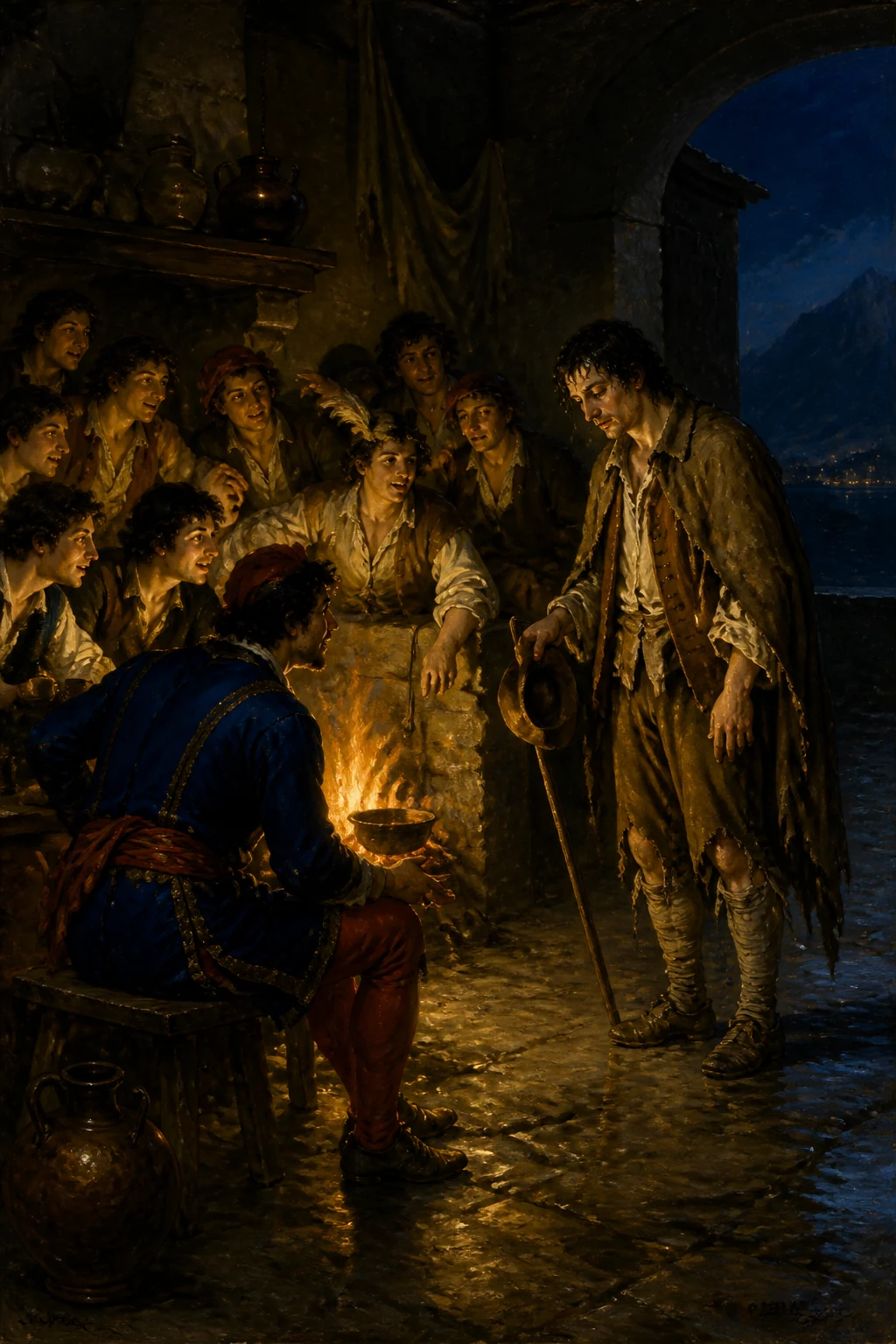
As soon as he reached home, he put some bread in a bag, slung it over his shoulder, took a staff in his hand, and set out into the world to seek his Fortune. In time he came to a great forest, and as he walked through it he found a grey-haired old maid asleep beneath a bush. He swung his staff and struck her across the backside. She could scarcely rouse herself or open her crusted eyes, but at last she spoke. “Thank God I was asleep! Had I been awake, you would never have got even those opanci.” “And who are you,” he asked, “that I should not have got even these opanci?” She answered, “I am your Fortune.” When he heard this, he began beating his breast. “So you are my Fortune! God strike you dead! Who gave you to me?” She hastened to answer, “Usud gave me to you.” Then he asked her, “And where is this Usud?” “Go and seek him,” she replied, and vanished that very instant. So the man set off to seek Usud. On his way he came to a village, where he saw a large, prosperous house with a great fire burning inside. “There must be some celebration here, or a slava feast,” he thought, and went in. Inside, a great cauldron of supper was cooking over the fire, and the master of the house sat beside it. The traveller greeted him. “Good evening!” “May God grant you good!” the host replied, inviting him to sit beside him. Then he asked where he had come from and where he was going. The traveller told him everything: how he had once been prosperous, how he had fallen into poverty, and how he was now going to Usud to ask why he was poor. Then he asked his host why he was preparing so much food. “Ah, brother,” the host replied, “I am a wealthy man and have plenty of everything, but I can never fill my household’s bellies. It is as though a ravenous monster gaped inside each of them. You will see for yourself when we sit down to supper.” And when they sat down, everyone snatched food from everyone else, and in the twinkling of an eye the great cauldron was empty. After supper, the woman whose turn it was to tend the kitchen gathered all the bones into a heap and threw them behind the stove. The traveller was wondering why the young woman had thrown the bones there when suddenly two decrepit old creatures emerged, as gaunt as ghosts, and began sucking the bones. “What have you got behind the stove, brother?” he asked his host. “Those are my father and mother, brother,” the man replied. “You would think they were chained to this world. They simply will not die and be done with it.” The next morning, as the traveller was leaving, his host said:
“Brother, remember me too if you find Usud, and ask him what misfortune this is, that I can never satisfy my household’s hunger, and why my father and mother will not die.” The traveller promised to ask, took his leave, and went on in search of Usud. After travelling a long time, he came one evening to another village and asked at a house whether they would take him in for the night. They welcomed him and asked where he was going, and he told them his whole story. Then they said, “For God’s sake, brother, since you are going there, ask about us too. Why do our cattle never thrive, but only grow worse?” He promised to ask Usud, and the next morning went on his way. In time he came to a river and began calling, “O river! O river! Carry me across!” The river asked him, “Where are you going?” He told it where he was bound. Then the river carried him across and said, “Please, brother, ask Usud why no life breeds in my waters.” He promised the river he would ask, and went on. After travelling for a long time, he at last came to a forest, where he found a hermit and asked whether he could tell him anything about Usud. The hermit answered, “Go this way over the mountain, and you will come straight to his palace. But when you appear before Usud, say nothing. Whatever he does, do likewise, until he himself asks you a question.” The man thanked the hermit and went over the mountain. When he reached Usud’s palace, what a sight met his eyes! It was like a royal court, with servants and maids hurrying about everywhere, while Usud sat alone at a table laid for supper. Seeing this, the man too sat down at the table and began to eat. After supper Usud lay down to sleep, and so did he. Around midnight a terrible rumbling arose, and out of it a voice was heard: “O Usud! O Usud! So many souls were born today. Give them what you will.” Then Usud rose, opened a chest of money, and began scattering gold ducats about the room, saying, “As it is with me today, so shall it be with them all their lives.” When morning dawned, the great palace was gone, and in its place stood a house of middling size, though there was still plenty of everything within it. Towards evening Usud sat down to supper, and the man sat down with him, but neither spoke a word. After supper they lay down to sleep. Around midnight a terrible rumbling began, and out of it a voice was heard: “O Usud! O Usud! So many souls were born today. Give them what you will.” Then Usud rose and opened the money chest, but instead of gold ducats there were silver coins, with only a ducat here and there. Usud began scattering the money about the room, saying, “As it is with me today, so shall it be with them all their lives.” When morning dawned, that house too was gone, and a smaller one stood in its place. So Usud did every night, and every morning his house grew smaller, until at last it became a little hut. Then Usud took a hoe and began to dig, and the man too took a hoe and began to dig, and they worked the whole day long. In the evening Usud took a piece of bread, broke it in half, and gave one half to the man. That was their supper, and afterwards they lay down to sleep. Around midnight the terrible rumbling began again, and out of it a voice was heard: “O Usud! O Usud! So many souls were born today. Give them what you will.”
Then Usud rose and opened the chest, and began scattering nothing but small change, with here and there a copper coin such as a labourer might earn, crying, “As it is with me today, so shall it be with them all their lives.” When morning dawned, the hut had turned into a great palace, just as it had been on the first day. Then Usud asked him, “Why have you come?” The man told him all his troubles in order, and said he had come to ask why Usud had given him such an evil Fortune. Usud answered, “You saw how I scattered ducats on the first night, and what happened afterwards. Whatever my lot was on the night a person was born, so will that person’s lot be for life. You were born on a night of poverty, and poor you will remain all your days. Your brother was born on a fortunate night, and fortunate he will remain all his days. But since you have been so determined and have taken such pains, I shall tell you how you may better your lot. Your brother has a daughter, Milica. She is as fortunate as her father. When you return home, take Milica to live with you, and whatever you acquire, always say that it is hers.” The man thanked Usud, then said, “In such-and-such a village there is a rich farmer who has plenty of everything. His only misfortune is that his household can never eat their fill. They devour a whole cauldron of food at a sitting, and even that is not enough. And the farmer’s father and mother seem chained to this world. They have grown old and dark and withered as ghosts, yet they cannot die. When I stayed the night with him, he begged me to ask you, Usud, what the cause might be.” Usud answered, “It is all because he does not honour his father and mother. He throws their food behind the stove. If he were to seat them in the place of honour and give them the first glass of rakija and the first glass of wine, his household would not eat even half as much, and those two souls would be released.” Then the man asked Usud another question. “In such-and-such a village, where I stayed the night in a house, my host complained that his cattle never throve, but only grew worse. He asked me to find out from you what the cause might be.” Usud answered, “That is because, for his family’s patron saint’s feast, he slaughters the worst beast he has. If he slaughtered his best, his cattle would flourish and multiply.” Then the man asked him about the river. “Why is it that no life breeds in its waters?” Usud answered, “Because it has never drowned a human being. But take care: do not tell it before it has carried you across, for if you do, it will drown you at once.” The man thanked Usud and set off for home. When he came to the river, it asked him, “What news from Usud?” He answered, “Carry me across, and then I shall tell you.” Once the river had carried him over, he took to his heels. When he was a good way off, he turned and shouted, “O river! O river! You have never drowned a human being. That is why no life breeds in your waters!” When the river heard this, it overflowed its banks and rushed after him, and he ran so hard that he barely escaped. When he reached the village of the man whose cattle would not thrive, his host could hardly wait to greet him. “Well, brother, for God’s sake! Did you ask Usud?” “I did,” he answered, “and Usud says that when you celebrate your patron saint’s feast, you slaughter your worst beast. If you slaughtered the best you have, your cattle would flourish and multiply.” When the man heard this, he said, “Stay with us, brother. Our feast is less than three days away, and if this proves true, I shall give you a gift.” So he stayed until the feast. When the day came, the host slaughtered his finest young bull, and from that moment his cattle began to thrive. Afterwards he gave the traveller five head of cattle. The traveller thanked him and went on his way. When he reached the village of the host with the insatiable household, that man too could hardly wait to greet him. “Well, brother, for God’s sake! What does Usud say?” The traveller answered, “Usud says you do not honour your father and mother, but throw their food behind the stove. If you were to seat them in the place of honour and give them the first glass of rakija and the first glass of wine, your household would not eat even half as much, and your father and mother would pass peacefully away.” When the host heard this, he told his wife, and she at once washed and combed her father-in-law and mother-in-law and dressed them in fresh clothes. That evening the host seated them in the place of honour and gave them the first glass of rakija and the first glass of wine. From that moment his household could not eat even half as much as before, and the next day both his father and his mother passed away.
Then the host gave the traveller two young bulls, and he thanked him and set off for home. When he reached his own country, people he knew came up to him and asked, “Whose cattle are you driving?” And he answered each of them, “They belong to Milica, my niece, my friends.” As soon as he reached home, he went straight to his brother and began to plead with him. “Brother, give me Milica to be my own. You see I have no one.” His brother answered, “Very well, brother. You may have Milica.” So he took Milica home with him, and afterwards he acquired great wealth, but of everything he had he said that it belonged to Milica. One day he went out to his field to look at the wheat, and it could not have been finer. Just then a traveller came by and asked, “Whose wheat is that?” The man forgot himself and said, “Mine.” The instant he spoke, the wheat caught fire and began to burn. Seeing this, he ran after the traveller. “Wait, brother! It is not mine, but Milica’s, my niece’s!” At once the fire in the wheat went out, and he and Milica lived happily ever after.