Prevod
Once upon a time there was a poor shepherd boy whose father and mother had died. The authorities had placed him in the household of a rich man, who was to feed him and bring him up. But the man and his wife were hard-hearted, and for all their wealth they were miserly and spiteful, begrudging anyone so much as a mouthful of their bread. Whatever the poor boy did, he received little food and all the more beatings.
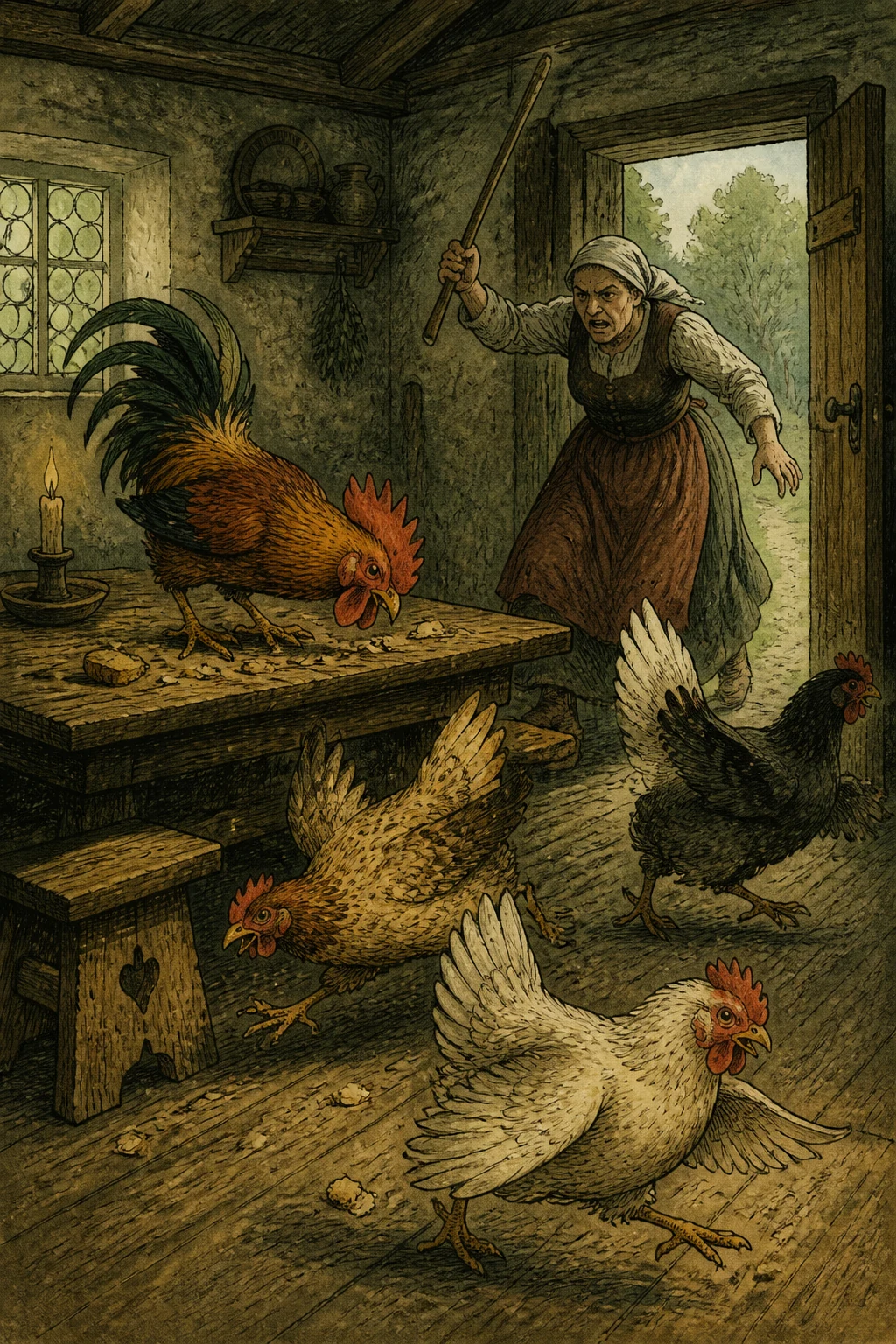
One day he was set to watch over the mother hen and her chicks. But she strayed through a hedge with her brood, and at once a hawk swooped down and carried her off through the air. The boy shouted at the top of his lungs, “Thief! Thief! Rogue!” But what good did that do? The hawk did not bring back its prey. The man heard the noise and came running, and when he learned that his hen was gone, he flew into a rage and gave the boy such a beating that he could not move for several days. Now he had to mind the chicks without their mother, but this was harder still, for one ran this way and another that. He thought it would be clever to tie them all together with a string, so that the hawk could not steal any of them. But he was sadly mistaken. A few days later, when he had fallen asleep, exhausted by hunger and running about, the bird of prey came and seized one of the chicks. Since the others were tied to it, the hawk carried them all away, settled in a tree, and swallowed them down. The farmer was just coming home, and when he saw what had happened, he grew furious and beat the boy so mercilessly that he had to stay in bed for several days.
When he was on his feet again, the farmer said to him, “You are too stupid for me. You are no use at minding animals, so you shall run errands instead.” He sent him to the judge with a basketful of bunches of grapes and gave him a letter to take as well. On the way, the poor boy was so tormented by hunger and thirst that he ate two of the bunches. He brought the basket to the judge, but when the judge had read the letter and counted the bunches, he said, “Two are missing.” The boy admitted quite honestly that hunger and thirst had driven him to eat the missing bunches. The judge wrote a letter to the farmer, asking for the same quantity of grapes again. The boy had to carry these too, along with another letter. When hunger and thirst once more grew too much for him, he could not help himself and ate another two bunches. But first he took the letter out of the basket, put it under a stone, and sat on it, so that it could not watch him and give him away. Yet the judge still called him to account for the missing bunches. “Oh,” said the boy, “how did you find out? The letter could not have known, for I put it under a stone beforehand.” The judge could not help laughing at his innocence, and sent the man a letter urging him to treat the poor boy better and see that he had enough to eat and drink. He should also teach him the difference between right and wrong.
“I shall soon show you the difference,” said the cruel man. “But if you want to eat, you must work too, and if you do anything wrong, a good beating will teach you better.” The next day he set him a heavy task. He was to cut up a few bundles of straw for the horses’ feed, and the man threatened him as he did so. “I shall be back in five hours,” he said, “and if the straw has not been cut into chaff by then, I shall beat you until you cannot move a limb.” The farmer went to the fair with his wife, the farmhand, and the maid, leaving the boy nothing but a small piece of bread. The boy took his place at the chaff cutter and began working with all his might. When he grew hot, he took off his little coat and threw it onto the straw. Afraid he would not finish in time, he kept on cutting, and in his haste he cut up his coat along with the straw without noticing. Too late he discovered the damage, which could not be undone. “Oh,” he cried, “now I am done for! That wicked man did not threaten me for nothing. When he comes back and sees what I have done, he will beat me to death. I would rather take my own life.”
The boy had once heard the farmer’s wife say, “I keep a pot of poison under the bed.” But she had only said it to keep people from stealing a taste, for the pot contained honey. The boy crawled under the bed, brought out the pot, and ate it all. “I do not understand,” he said. “People say death is bitter, but it tastes sweet to me. No wonder the farmer’s wife so often wishes she were dead.” He sat down on a little chair and prepared to die. But instead of growing weaker, he felt strengthened by the nourishing food. “It cannot have been poison,” he said. “But the farmer once said there was a little bottle of fly poison in his clothes chest. That must be real poison, and it will bring me death.” Yet it was not fly poison, but Hungarian wine. The boy took out the bottle and drank it dry. “This death tastes sweet too,” he said. Soon afterward, however, the wine began to go to his head and dull his senses, and he thought his end was drawing near. “I feel that I must die,” he said. “I shall go out to the churchyard and find a grave.” He staggered away, reached the churchyard, and lay down in a newly opened grave. His senses grew ever dimmer. Nearby stood an inn where a wedding was being celebrated, and when he heard the music, he thought he was already in paradise, until at last he lost consciousness altogether. The poor boy never woke again. The fiery heat of the wine and the cold night dew took his life, and he remained in the grave where he had laid himself.
When the farmer heard of the boy’s death, he was struck with terror and feared he would be brought to trial. Indeed, his fear seized him so violently that he fell to the ground in a faint. His wife, who was standing at the hearth with a pan full of lard, ran over to help him. But the flames caught the pan, spread through the whole house, and within a few hours it lay in ashes. They spent the remaining years of their lives in poverty and misery, tormented by remorse.