Prevod
In a mill there lived an old miller who had neither wife nor children, and three miller’s lads worked for him. After they had been with him for some years, he said to them one day, “I am old and mean to sit by the stove and take my ease. Go out into the world, and whichever of you brings me home the finest horse shall have the mill, and in return he must look after me until I die.” Now the third of the lads was the youngest servant, and the others thought him a simpleton. They did not want him to have the mill, though, as it turned out, he did not even want it himself.
So all three set out together, and when they had passed beyond the village, the other two said to simple Hans, “You may as well stay here. You’ll never get a horse as long as you live.” But Hans went along with them all the same, and when night fell they came to a cave, where they lay down to sleep. The two clever fellows waited until Hans was asleep, then got up and slipped away, leaving little Hans behind. They thought they had managed things very neatly indeed—but just you wait, things will not go so well for you!
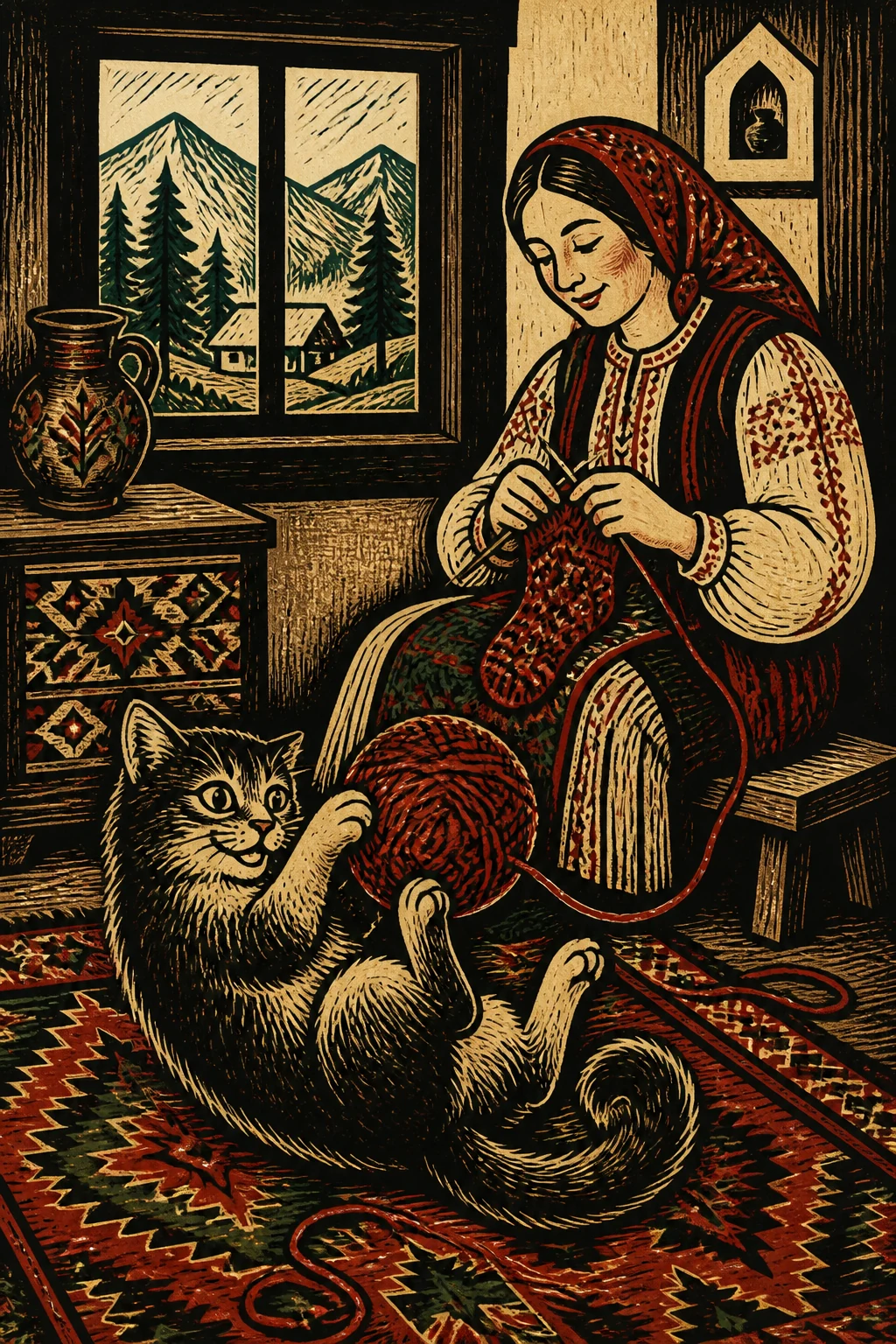
When the sun rose and Hans awoke, he found himself lying deep inside the cave. He looked all about him and cried, “Oh, dear God, where am I?” Then he got up, scrambled out of the cave, and went into the forest, thinking, Here I am, all alone and forsaken. How am I ever to get a horse? As he walked along, lost in thought, he met a little tortoiseshell cat, who said to him very kindly, “Hans, where are you going?” “Oh, you cannot help me.” “I know very well what you are after,” said the little cat. “You want a handsome horse. Come with me and be my faithful servant for seven years, and I will give you one finer than any you have ever seen in all your life.” Well, this is a strange cat, thought Hans, but I will see whether what she says is true. So she took him with her to her little enchanted castle, where she had nothing but little cats to serve her. They sprang nimbly up and down the stairs and were merry and in good spirits. In the evening, when they sat down to supper, three of them had to make music: one bowed the bass, another played the fiddle, and the third raised a trumpet and puffed out its cheeks as hard as it could. When they had eaten, the table was carried away, and the cat said, “Now come, Hans, and dance with me!” “No,” he answered, “I will not dance with a pussycat. I have never done such a thing.” “Then put him to bed!” she told the little cats. One lit his way to his bedchamber, another took off his shoes, another his stockings, and at last one blew out the light. The next morning they came back and helped him out of bed: one put on his stockings, another tied his garters, another fetched his shoes, another washed him, and another dried his face with its tail. “That feels very soft,” said Hans. But he also had to serve the cat and chop wood every day. For this he was given a silver axe, silver wedges and a silver saw, while the mallet was made of copper. So he chopped the wood and stayed there in the house, with plenty of good food and drink, but he saw no one except the tortoiseshell cat and her servants.
One day she said to him, “Go and mow my meadow and dry the grass for hay.” She gave him a silver scythe and a golden whetstone, but told him to be sure to bring everything back. Hans went and did as he was told. When the work was finished, he carried the scythe, the whetstone, and the hay home, and asked whether she would give him his wages now. “No,” said the cat, “there is one more thing you must do for me. Here are silver timbers, a carpenter’s axe, a square, and everything else you need, all made of silver. First build me a little house with them.” So Hans finished building the house and said that he had now done everything, yet still had no horse. The seven years had passed as though they were only half a year. The cat asked whether he would like to see her horses. “Yes,” said Hans. Then she opened the little house for him, and as she swung the door wide, there stood twelve horses. Oh, what splendid creatures they were! Their coats gleamed and shone so brightly that his heart leapt for joy. Then she gave him food and drink and said, “Go home. I will not send your horse with you, but in three days I will come and bring it to you.”
So Hans set off, and she showed him the way to the mill. But she had not even given him a new suit of clothes: he had to keep the old ragged little smock he had brought with him, which in those seven years had grown too short for him all over. When he reached home, the other two miller’s lads were already back. Each had brought a horse, it was true, but one horse was blind and the other lame. They asked, “Hans, where is your horse?” “It will be here in three days.” Then they laughed and said, “Oh, Hans, where would you get a horse? It will be a fine one, no doubt!” Hans went into the parlour, but the miller said he must not come to the table, for he was so ragged and tattered that they would be ashamed if anyone came in. So they sent him a little food outside, and when they went to bed that evening, the other two would not let him have a bed. At last he had to crawl into the goose-house and lie down on a little hard straw. The next morning, when he awoke, the three days had already passed, and a carriage came drawn by six horses. Ah, how beautifully they shone! A servant was bringing a seventh horse as well, and that one was for the poor miller’s lad. Out of the carriage stepped a magnificent princess, who went into the mill; and the princess was the little tortoiseshell cat whom poor Hans had served for seven years. She asked the miller where the miller’s lad, the youngest servant, was. The miller said, “We cannot have him in the mill, he is so ragged. He is lying in the goose-house.” The princess told them to fetch him at once. So they brought him out, and he had to gather his little smock about him to cover himself. Then the servant unstrapped a bundle of splendid clothes and had to wash and dress him; and when he was ready, no king could have looked more handsome.
After that, the maiden asked to see the horses the other miller’s lads had brought home. One was blind and the other lame. Then she told the servant to bring the seventh horse, and when the miller saw it, he said that no horse like that had ever entered his yard. “And this one is for the third miller’s lad,” she said. “Then he must have the mill,” said the miller. But the princess said that there was his horse, and he could keep his mill as well. Then she took her faithful Hans, seated him in the carriage, and drove away with him. First they went to the little house he had built with the silver tools, and there stood a great castle, with everything inside made of silver and gold. There she married him, and he was rich—so rich that he had enough for the rest of his life. So let no one say that because a person is a simpleton, he can never amount to anything.