O besedilu
Osliček
- Vir
- Grimmove pravljice
- Avtor
- Jacob in Wilhelm Grimm
- Jezik branja
- English
- Jezik izvirnika
- Deutsch
- Čas branja
- 7 min branja
- Obseg
- 6 strani
- Naslov izvirnika
- Das Eselein
O izvirniku
Grimmove pravljice
Gozdovi, čarobni predmeti in ljudska logika evropske pripovedne tradicije. Bralni jezik je English, izvirnik pa prihaja iz vira Grimmove pravljice v jeziku Deutsch.
Besedilo
Osliček
Once upon a time there lived a king and queen who were rich and had everything they could wish for, except children. The queen lamented this day and night, saying, "I am like a field where nothing grows." At last God granted their wish, but when the child came into the world, it did not look like a human child at all: it was a little donkey. When the mother saw it, her wailing and lamenting began in earnest. She would rather have had no child at all than a donkey, she said, and ordered that he be thrown into the water for the fish to eat. But the king said, "No, since God has given him to us, he shall be my son and heir, sit upon the royal throne after my death, and wear the royal crown." So the little donkey was brought up and grew, and his ears grew tall and straight as well. Otherwise he was a merry creature, leaping about and playing, and he took particular delight in music. So he went to a famous musician and said, "Teach me your art, so that I can play the lute as well as you."
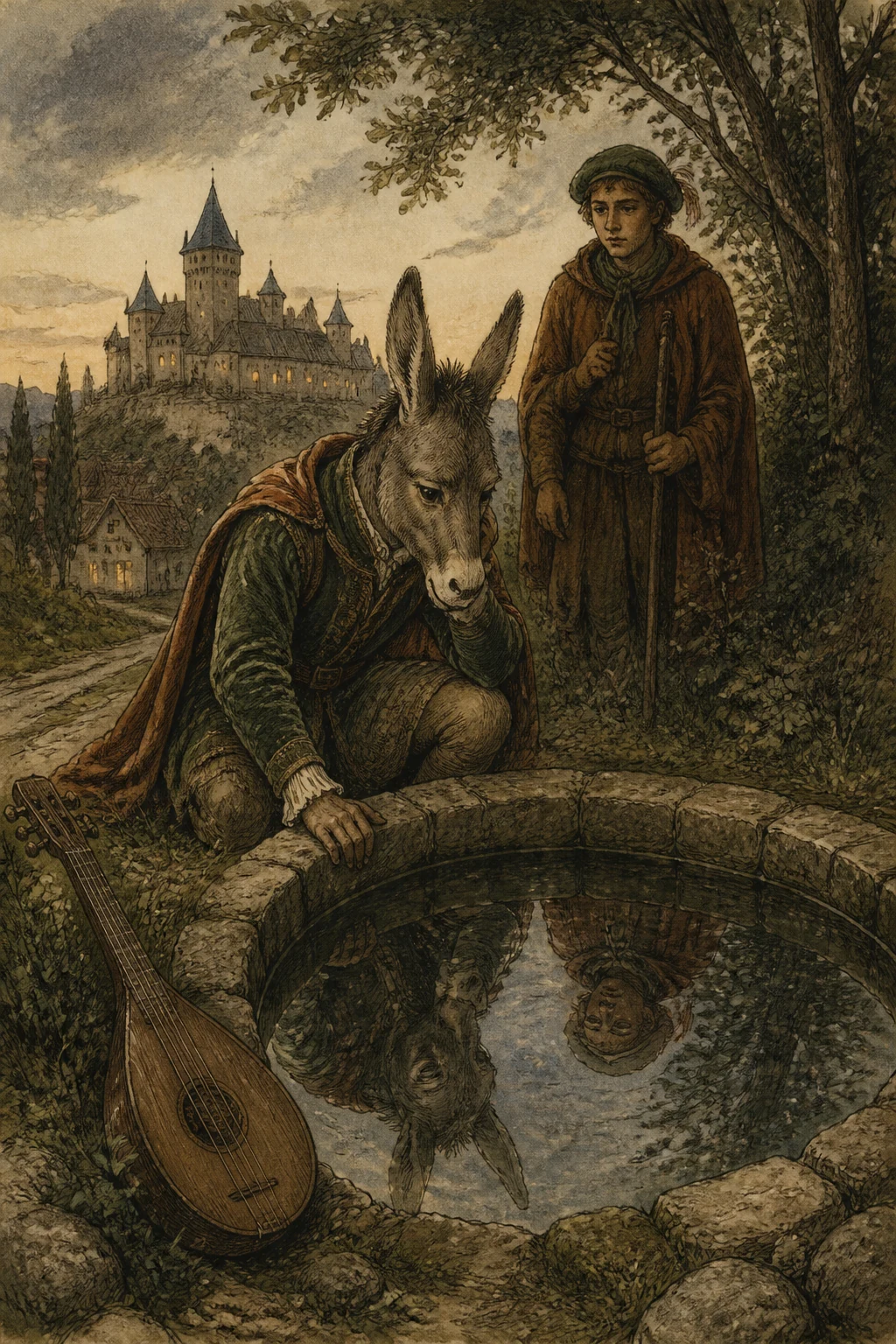
"Ah, my dear young lord," replied the musician, "you will find that difficult. Your fingers are not quite made for it, and they are far too large. I fear the strings will not stand it." No excuse would do: the little donkey was determined to play the lute. He was persistent and diligent, and in the end he learned to play as well as his master himself. One day the young lord went out for a thoughtful stroll and came to a well. Looking into it, he saw his donkey's shape reflected in the mirror-clear water. This saddened him so deeply that he set off into the wide world, taking only one faithful companion with him. They wandered far and wide, and at last came to a kingdom ruled by an old king who had only one daughter, but she was wonderfully beautiful. The little donkey said, "Here we shall stay," knocked at the gate, and called, "There is a guest outside. Open up and let him in." But when no one opened the gate, he sat down, took out his lute, and played it most sweetly with his two forefeet. The gatekeeper opened his eyes wide in astonishment, ran to the king, and said, "There is a little donkey sitting outside the gate, playing the lute as well as a trained master."
"Then let the musician come in," said the king. But when a little donkey entered, everyone began laughing at the lute player. They were going to seat him downstairs with the servants and feed him there, but he took offense and said, "I am no common stable donkey. I am a donkey of noble birth." Then they said, "If that is so, sit with the soldiers."
"No," he said, "I want to sit beside the king." The king laughed and said good-humoredly, "Yes, you shall have your wish, little donkey. Come here beside me." Then he asked, "Little donkey, how do you like my daughter?"
The little donkey turned his head toward her, looked at her, nodded, and said, "Very much indeed. I have never seen anyone so beautiful."
"Then you shall sit beside her too," said the king. "That suits me perfectly," said the little donkey. He sat down at her side, ate and drank, and conducted himself with grace and propriety. When the noble little creature had spent a good while at the king's court, he thought, "What good is all this? You must go home again." He hung his head sadly, went before the king, and asked leave to depart. But the king had grown fond of him and said, "Little donkey, what is the matter? You look as sour as a jug of vinegar. Stay with me, and I will give you whatever you ask. Do you want gold?"
"No," said the little donkey, shaking his head. "Do you want jewels and finery?" "No." "Do you want half my kingdom?" "Oh, no."
Then the king said, "If only I knew what would make you happy. Would you like my beautiful daughter for your wife?" "Oh, yes," said the little donkey, "I should like that very much." All at once he was merry and full of good cheer, for that was exactly what he had wished for. So a grand and splendid wedding was held. That evening, when the bride and bridegroom were led to their bedchamber, the king wanted to know whether the little donkey would behave with proper courtesy and good manners, so he ordered a servant to hide there. When the couple were inside, the bridegroom bolted the door and looked around. Once he believed they were quite alone, he suddenly cast off his donkey skin and stood there as a handsome young prince.
"Now you see," he said, "who I am, and you see that I was not unworthy of you." The bride was overjoyed, kissed him, and loved him with all her heart. But as morning approached, he sprang up and put on his animal skin again, and no one would have guessed who was hidden beneath it. Soon the old king came along.
"Well!" he cried. "Is the little donkey awake already? You must be very sad," he said to his daughter, "not to have a proper human being for a husband."
"Oh, no, dear father. I love him as much as if he were the handsomest man in the world, and I mean to keep him all my life." The king was astonished, but the servant who had hidden in the room came and told him everything. The king said, "That cannot possibly be true."
"Then keep watch yourself tomorrow night, and you will see it with your own eyes. And do you know what, Your Majesty? Take his skin away and throw it into the fire. Then he will have to show himself in his true form."
"Your advice is good," said the king. That evening, when they were asleep, he crept into the room. As he approached the bed, he saw a fine young man resting there in the moonlight, while the discarded skin lay on the floor. He took it away, ordered a great fire to be lit outside and the skin thrown into it, and stood by until it had burned entirely to ashes. But because he wanted to see what the young man would do when he found his skin gone, he stayed awake all night and listened. At the first light of dawn, when the young man had finished sleeping, he rose and meant to put on his donkey skin, but it was nowhere to be found. He was terrified, and said in grief and fear, "Now I must find a way to escape." But when he stepped outside, the king was standing there and said, "My son, where are you going in such a hurry? What have you in mind? Stay here. You are such a handsome man, and I will not have you leave me again. I shall give you half my kingdom now, and after my death you shall have it all."
"Then I hope this good beginning will have a good ending too," said the young man. "I shall stay with you." So the old king gave him half the kingdom, and when he died a year later, the young man had it all. After his own father's death, he inherited another kingdom besides, and lived in the greatest splendor.
Izvirnik
Das Eselein
Naslednje strani prikazujejo izvirno besedilo za primerjavo.
Ein Märchen der Brüder Grimm
Es lebte einmal ein König und eine Königin, die waren reich und hatten alles, was sie sich wünschten, nur keine Kinder. Darüber klagte sie Tag und Nacht und sprach: "Ich bin wie ein Acker, auf dem nichts wächst." Endlich erfüllte Gott ihre Wünsche; als das Kind aber zur Welt kam, sah's nicht aus wie ein Menschenkind, sondern war ein junges Eselein. Wie die Mutter das erblickte, fing ihr Jammer und Geschrei erst recht an, sie hätte lieber gar kein Kind gehabt als einen Esel und sagte, man sollt ihn ins Wasser werfen, damit ihn die Fische fräßen. Der König aber sprach: "Nein, hat Gott ihn gegeben, soll er auch mein Sohn und Erbe sein, nach meinem Tod auf dem königlichen Thron sitzen und die königliche Krone tragen." Also ward das Eselein aufgezogen, nahm zu, und die Ohren wuchsen ihm auch fein hoch und gerad hinauf. Es war aber sonst fröhlicher Art, sprang herum, spielte und hatte besonders seine Lust an der Musik, so daß es zu einem berühmten Spielmann ging und sprach: "Lehre mich deine Kunst, daß ich so gut die Laute schlagen kann als du."
"Ach, liebes Herrlein", antwortete der Spielmann, "das sollt Euch schwerfallen, Eure Finger sind nicht allerdings dazu gemacht und gar zu groß; ich sorge, die Saiten halten's nicht aus." Es half keine Ausrede, das Eselein wollte und mußte die Laute schlagen, war beharrlich und fleißig und lernte es am Ende so gut als sein Meister selber. Einmal ging das junge Herrlein nachdenksam spazieren und kam an einen Brunnen, da schaute es hinein und sah im spiegelhellen Wasser seine Eseleinsgestalt. Darüber war es so betrübt, daß es in die weite Welt ging und nur einen treuen Gesellen mitnahm. Sie zogen auf und ab, zuletzt kamen sie in ein Reich, wo ein alter König herrschte, der nur eine einzige, aber wunderschöne Tochter hatte. Das Eselein sagte: "Hier wollen wir weilen", klopfte ans Tor und rief: "Es ist ein Gast haußen, macht auf, damit er eingehen kann." Als aber nicht aufgetan ward, setzte er sich hin, nahm seine Laute und schlug sie mit seinen zwei Vorderfüßen aufs lieblichste. Da sperrte der Türhüter gewaltig die Augen auf, lief zum König und sprach: "Da draußen sitzt ein junges Eselein vor dem Tor, das schlägt die Laute so gut als ein gelernter Meister."
"So laß mir den Musikant hereinkommen", sprach der König. Wie aber ein Eselein hereintrat, fing alles an über den Lautenschläger zu lachen. Nun sollte das Eselein unten zu den Knechten gesetzt und gespeist werden, es ward aber unwillig und sprach: "Ich bin kein gemeines Stalleselein, ich bin ein vornehmes." Da sagten sie: "Wenn du das bist, so setze dich zu dem Kriegsvolk".
"Nein", sprach es, "ich will beim König sitzen." Der König lachte und sprach in gutem Mut: "Ja, es soll so sein, wie du verlangst, Eselein, komm her zu mir." Danach fragte er: "Eselein, wie gefällt dir meine Tochter?"
Das Eselein drehte den Kopf nach ihr, schaute sie an, nickte und sprach: "Aus der Maßen wohl, sie ist so schön, wie ich noch keine gesehen habe."
"Nun, so sollst du auch neben ihr sitzen", sagte der König.
"Das ist mir eben recht", sprach das Eselein und setzte sich an ihre Seite, aß und trank und wußte sich fein und säuberlich zu betragen. Als das edle Tierlein eine gute Zeit an des Königs Hof geblieben war, dachte es: Was hilft das alles, du mußt wieder heim, ließ den Kopf traurig hängen, trat vor den König und verlangte seinen Abschied. Der König hatte es aber liebgewonnen und sprach: "Eselein, was ist dir? Du schaust ja sauer wie ein Essigkrug; bleib bei mir, ich will dir geben, was du verlangst. Willst du Gold?"
"Nein", sagte das Eselein und schüttelte mit dem Kopf.
"Willst du Kostbarkeiten und Schmuck?"
"Nein."
"Willst du mein halbes Reich?"
"Ach nein."
Da sprach der König: "Wenn ich nur wüßte, was dich vergnügt machen könnte; willst du meine schöne Tochter zur Frau?"
"Ach ja," sagte das Eselein, "die möchte ich wohl haben", war auf einmal ganz lustig und guter Dinge, denn das war's gerade, was es sich gewünscht hatte. Also ward eine große und prächtige Hochzeit gehalten. Abends, wie Braut und Bräutigam in ihr Schlafkämmerlein geführt wurden, wollte der König wissen, ob sich das Eselein auch fein artig und manierlich betrüge, und hieß einem Diener sich dort verstecken. Wie sie nun beide drinnen waren, schob der Bräutigam den Riegel vor die Türe, blickte sich um, und wie er glaubte, daß sie ganz allein wären, da warf er auf einmal seine Eselshaut ab und stand da als ein schöner, königlicher Jüngling.
"Nun siehst du", sprach er, "wer ich bin, und siehst auch, daß ich deiner nicht unwert war." Da ward die Braut froh, küßte ihn und hatte ihn von Herzen lieb. Als aber der Morgen herankam, sprang er auf, zog seine Tierhaut wieder über, und hätte kein Mensch gedacht, was für einer dahinter steckte. Bald kam auch der alte König gegangen.
"Ei", rief er, "ist das Eselein schon munter! Du bist wohl recht traurig", sagte er zu seiner Tochter, "daß du keinen ordentlichen Menschen zum Mann bekommen hast?"
"Ach nein, lieber Vater, ich habe ihn so lieb, als wenn er der Allerschönste wäre, und will ihn mein Lebtag behalten." Der König wunderte sich, aber der Diener, der sich versteckt hatte, kam und offenbarte ihm alles. Der König sprach: "Das ist nimmermehr wahr."
"So wacht selber die folgende Nacht, Ihr werdet's mit eigenen Augen sehen, und wißt Ihr was, Herr König, nehmt ihm die Haut weg und werft sie ins Feuer, so muß er sich wohl in seiner rechten Gestalt zeigen."
"Dein Rat ist gut", sprach der König, und abends, als sie schliefen, schlich er sich hinein, und wie er zum Bett kam, sah er im Mondschein einen stolzen Jüngling da ruhen, und die Haut lag abgestreift auf der Erde. Da nahm er sie weg und ließ draußen ein gewaltiges Feuer anmachen und die Haut hineinwerfen und blieb selber dabei, bis sie ganz zu Asche verbrannt war. Weil er aber sehen wollte, wie sich der Beraubte anstellen würde, blieb er die Nacht über wach und lauschte. Als der Jüngling ausgeschlafen hatte, beim ersten Morgenschein, stand er auf und wollte die Eselshaut anziehen, aber sie war nicht zu finden. Da erschrak er und sprach voll Trauer und Angst: "Nun muß ich sehen, daß ich entfliehe." Wie er hinaustrat, stand aber der König da und sprach: "Mein Sohn, wohin so eilig, was hast du im Sinn? Bleib hier, du bist ein so schöner Mann, du sollst nicht wieder von mir. Ich gebe dir jetzt mein Reich halb, und nach meinem Tod bekommst du es ganz."
"So wünsch ich, daß der gute Anfang auch ein gutes Ende nehme", sprach der Jüngling, "ich bleibe bei Euch." Da gab ihm der Alte das halbe Reich, und als er nach einem Jahr starb, hatte er das ganze, und nach dem Tode seines Vaters noch eins dazu und lebte in aller Herrlichkeit.
Nadaljuj z branjem