Prevod
Once upon a time there was a poor man who lived in a cottage far away in the forest and earned his living by hunting. He had an only daughter, who was very beautiful, and as her mother had died when she was young and the girl was now half-grown, she said she wanted to go into service so that she too could learn to earn her bread. “Well, my daughter,” said her father, “it is true you have learned nothing with me but plucking birds and roasting them, but you must try earning your bread all the same.” So the girl went out to look for a place, and after she had walked for a while, she came to the royal palace. There she stayed, and the queen took such a liking to her that the other maids grew quite jealous. So they thought of telling the queen that the girl had boasted she could spin a pound of flax in twenty-four hours, for the queen was exceedingly fond of all kinds of handiwork. “Well, if you have said it, you shall do it,” the queen told her. “But you may have a little more time.” The poor girl dared not say that she had never spun, but asked for a room to herself. This she was given, and a spinning wheel and flax were carried up to it. There she sat, crying and grieving, at her wits’ end. She fiddled with the wheel, twisting and turning it, but had no idea how to set about the work—she had never even seen a spinning wheel before.
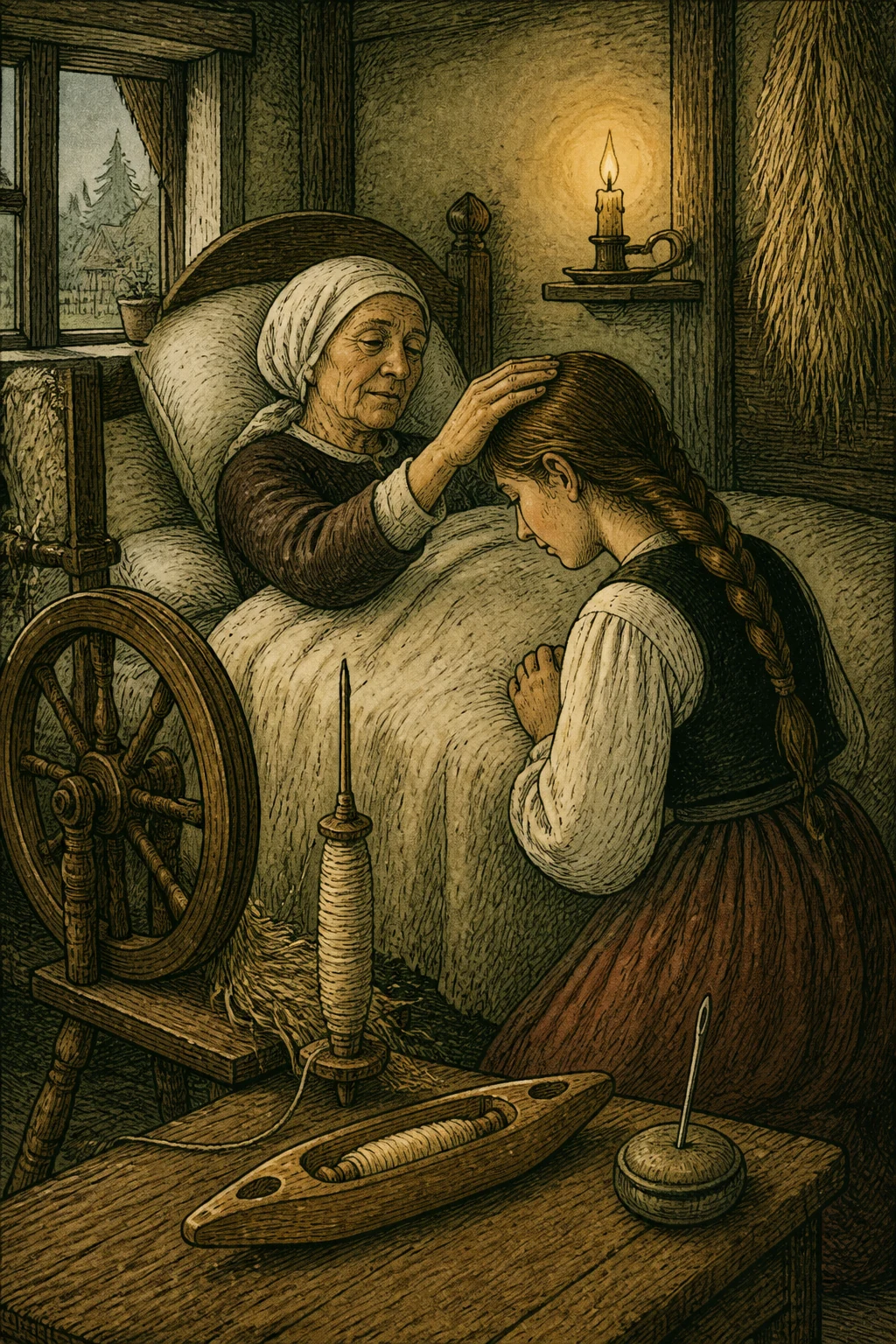
But as she sat there, an old woman came in. “What is the matter, my child?” she asked. “Oh,” answered the girl, “there is no use telling you. You cannot help me anyway!” “No one can be sure of that,” said the woman. “Perhaps I might know a way to help you after all.” Well, I may as well tell her, thought the girl, and she explained how the other servants had spread the tale that she had boasted she could spin a pound of flax in twenty-four hours. “And poor me,” she said, “I have never in all my days even seen a spinning wheel, let alone learned to spin so much in a day and a night.” “Well, never mind that, child,” said the woman. “If you will call me Aunt on your wedding day, I will do the spinning for you, and you can go and lie down to sleep.” The girl was very glad to promise this, and went and lay down.
In the morning, when she awoke, all the flax lay spun upon the table, so fine and beautiful that no one had ever seen such smooth, lovely yarn. The queen was delighted with the beautiful yarn she had been given, and grew still fonder of the girl. But this made the others more jealous than ever, and they thought of telling the queen that now the girl had boasted she could weave the yarn she had spun in twenty-four hours. Once again the queen said that if she had said it, she must do it, though if she could not finish in exactly twenty-four hours, she might have a little longer. This time too the girl dared not say no, but asked for a room to herself, where she could at least try. There she sat again, weeping and lamenting, not knowing what to do, when another old woman came in and asked, “What is the matter, my child?” At first the girl would not say, but at last she told her what was making her so unhappy. “Well,” answered the woman, “never mind that. If you will call me Aunt on your wedding day, I will do the weaving for you, and you can go and lie down to sleep.” The girl was very glad to promise this, and went and lay down. When she awoke, the cloth lay in a pile upon the table, woven as neatly and closely as could be. The girl took the cloth down to the queen, who was delighted with the beautiful weaving she had been given, and grew still fonder of the girl. But this made the others more bitter towards her than ever, and they could think of nothing but what tale to tell about her next.
At last they told the queen that now the girl had boasted she could make the whole pile of cloth into shirts in twenty-four hours. Well, it went just as before: the girl dared not say that she could not sew. Once again she was given a room to herself, and sat there weeping and grieving. But then another old woman came to her and promised to do the sewing if the girl would call her Aunt on her wedding day. The girl was more than glad to promise, and then did as the woman told her and went to lie down and sleep. In the morning, when she awoke, she found the cloth made into shirts and lying upon the table. No one had ever seen such beautiful stitching, and the shirts were marked with initials and finished in every detail. When the queen saw the work, she was so delighted with the sewing that she clapped her hands. “For I have never owned or seen such beautiful stitching,” she said, and from then on she loved the girl as dearly as her own child. “Now, if you would like to marry the prince, you shall have him,” she told the girl, “for you will never need to hire anyone to do anything. You can sew and spin and weave it all yourself.” As the girl was beautiful and the prince liked her well, the wedding was held at once. But scarcely had the prince sat down beside her at the wedding feast when an ugly old woman came in with a long nose—it must have been three ells long.
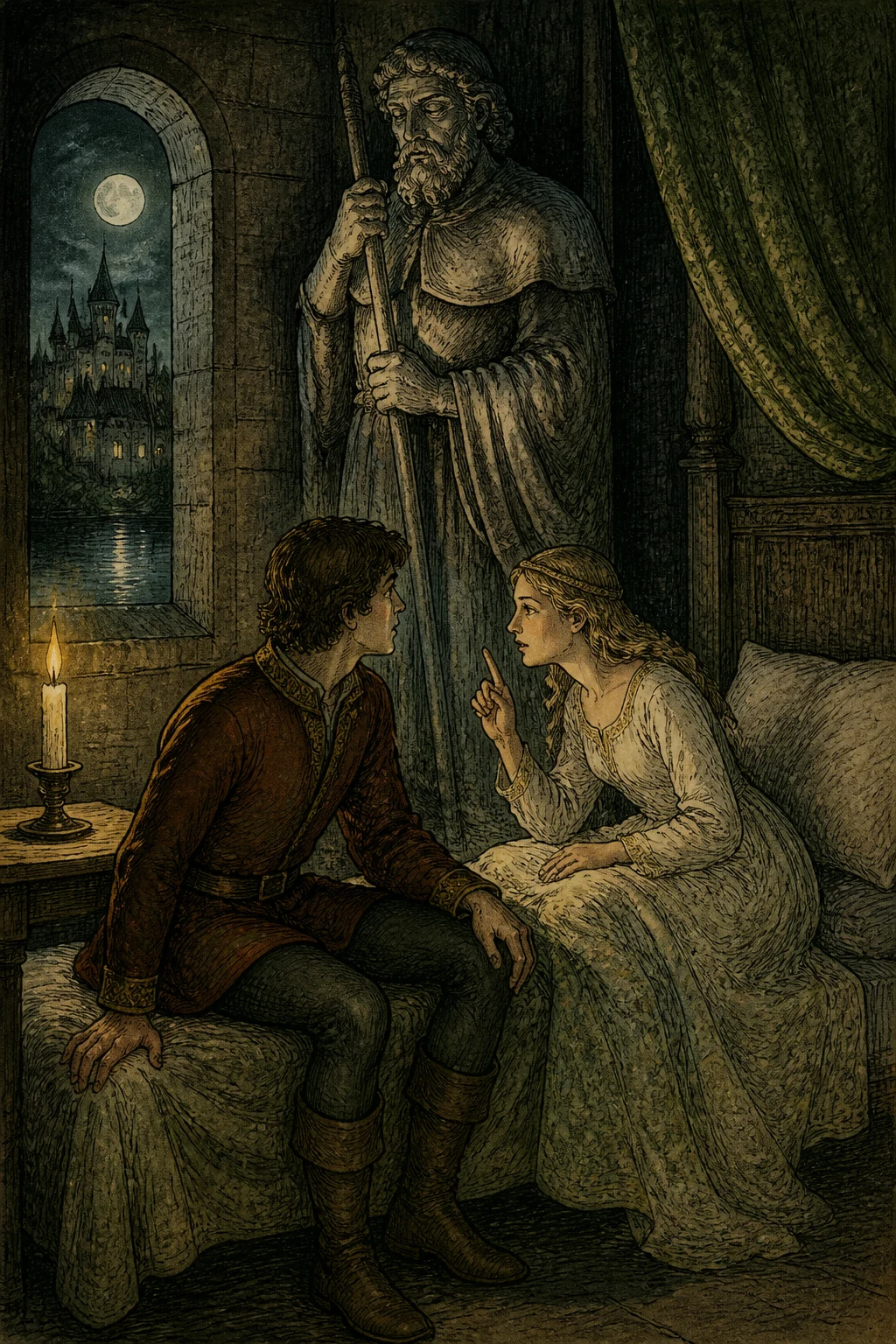
The bride rose, curtsied, and said, “Good day, Aunt!” “Is this my bride’s aunt?” asked the prince. Yes, indeed she was. “Well, then she must take a seat at the table,” said the prince, though both he and the others thought her a dreadful creature to have sitting with them.
But just then another ugly old woman came in. Her backside was so broad and fat that she could barely squeeze through the door. At once the bride rose again and greeted her. “Good day, Aunt!” And again the prince asked whether this was his bride’s aunt. Both said yes, and the prince said that in that case she too must take a seat at the table.
But scarcely had she sat down when yet another ugly old woman appeared, with eyes as large as plates, so red and watery that they were dreadful to look at. Again the bride rose and greeted her. “Good day, Aunt!” The prince invited her too to take a seat at the table, but he was not pleased, and thought to himself, “Heaven help me, what aunts my bride has!” After sitting for a while, he could contain himself no longer and asked, “But how in the world can my bride, who is so beautiful, have such hideous, misshapen aunts?” “I will tell you,” said the first. “I was just as pretty as your bride when I was her age. But the reason my nose has grown so long is that I have spent all my time nodding and bobbing over my spinning, and so my nose has stretched until it is as long as you see it now.” “And I,” said the second, “have sat shifting back and forth on the loom bench ever since I was young, and that is how my backside has grown as big and swollen as you see it now.” Then the third said, “Ever since I was a little girl, I have sat staring at my sewing, night and day. That is why my eyes have grown so dreadful and red, and now there is no remedy for them.” “Indeed!” said the prince. “It is just as well I learned this, for if such work can make people so ugly and dreadful, my bride shall never spin or weave or sew again for as long as she lives!”
Izvirnik
Der var engang en fattig Mand, som boede i en Stue langt borte i Skoven, og nærede sig ved Skytteri. Han havde en eneste Datter, der var særdeles smuk, og da Moderen tidlig var død og Pigen nu allerede var halvvoxen, sagde hun, at hun vilde bort til Folk, saa hun kunde lære at fortjene sit Brød, hun ogsaa. „Ja, min Datter,“ sagde Faderen, „rigtignok har du ikke lært Andet hos mig end at ribbe Fugl og stege, men du faaer vel prøve at tjene for dit Brød alligevel.“ Saa gik da Pigen ud at bede om Tjeneste, og da hun havde gaaet en Stund, kom hun til Kongsgaarden. Der blev hun, og Dronningen syntes saa vel om hende, at de øvrige Terner bleve ganske misundelige paa hende. De fandt derfor paa at sige til Dronningen,
at Pigen havde sagt sig god for at spinde et Pund Hør i fire og tyve Timer, for Dronningen holdt særdeles meget af alleslags Haandarbeider. „Ja, har du sagt det, skal du gjøre det“ — sagde Dronningen til hende —. „Men lidt længere Tid kan du vel faae.“ Pigen Stakkel turde ikke sige, at hun aldrig havde spundet, men bad om et Kammer for sig selv; det fik hun, og derop blev baaren Rok og Hør. Der sad hun nu og græd og var bedrøvet og vidste ikke sit arme Raad; hun stellede med Rokken, og snoede og dreiede paa den, og vidste ikke, hvorledes hun skulde bære sig ad — hun havde aldrig før seet en Hjulrok engang.
Men som hun saaledes sad, kom der en gammel Kone ind til hende; „hvad feiler dig, mit barn?“ sagde hun. „Ak,“ svarede Pigen, „det kan vel ikke nytte, jeg siger dig det; du kan saa ikke hjælpe mig ligevel!“ „Der kan Ingen vide det,“ sagde Konen. „Kan hende, jeg turde vide Raad for det alligevel jeg.“ Ja, jeg kan jo sagtens sige hende det, tænkte Pigen, og saa fortalte hun da, at Medtjenerne hendes havde sat ud, at hun havde sagt sig god for at spinde et Pund Hør i fire og tyve Timer; „og jeg, min Stakkel,“ sagde hun, „har aldrig i mine Dage seet en Hjulrok, end sige, jeg skulde kunne spinde saa meget i et Jævndøgn.“ „Ja, det er samme det, Barn,“ sagde Konen; „vil du kalde mig Moster paa din Hædersdag, skal jeg spinde for dig jeg, saa kan du gaae bort og lægge dig til at
sove.“ Ja, det vilde Pigen gjerne gjøre, og gik hen og lagde sig. Om Morgenen, da hun vaagnede, laa al Hørren spunden paa Bordet, og det saa peent og fiint, at aldrig Nogen havde seet saa jævnt og vakkert Garn. Dronningen blev meget glad over det smukke Garnet hun havde faaet, og holdt endnu meer af Pigen end før. Men herover bleve de Øvrige endnu misundeligere paa hende, og saa fandt de paa at sige til Dronningen, at nu havde hun sagt sig god for at væve det Garn, hun havde spundet, i fire og tyve Timer. Dronningen sagde igjen, at havde hun sagt det, saa skulde hun gjøre det, men om det ikke netop blev i fire og tyve Timer, saa kunde hun vel faae lidt længere Dag. Pigen turde heller ikke nu sige nei, men bad
om et Kammer for sig selv, saa fikk hun vel prøve. Der sad hun igjen og græd og bar sig ilde og vidste ikke, hvad hun skulde tage sig til; da kom der igjen en gammel Kone inn og spurgte: „Hvad feiler dig, mit Barn?“ Pigen vilde først ikke ud med det, men endelig fortalte hun hende, hvad hun var saa sørgmodig for. „Ja,“ svarede Konen, „det er det samme, vil du kalde mig Moster paa din Hædersdag, skal jeg væve for dig, saa kan du gaae bort og lægge dig til at sove.“ Ja, det vilde Pigen gjerne gjøre, og saa gik hun hen og lagde sig. Da hun vaagnede, laa Bunken paa Bordet, vævet saa net og saa tæt, som væves kunde. Pigen tog Bunken og gik ned til Dronningen med, og hun blev meget glad over den smukke Væv, hun havde faaet, og holdt endnu mere af Pigen end før. Men derover
bleve de Andre endda mere forbittrede paa hende og tænkte ikke paa Andet, end hvad de nu skulde finde paa at sige om hende. Tilsidst fortalte de Dronningen, at nu havde hun sagt sig god for at sye op Vævbunken til Skjorter i fire og tyve Timer. Ja, det gik lige eens, som før, Pigen turde ikke sige, at hun ikke kunde sye; hun kom igjen op paa et Kammer for sig selv, og sad der og græd og var bedrøvet. Men saa kom der atter en gammel Kone til hende, som lovede at sye for hende, naar Pigen vilde kalde hende Moster paa sin Hædersdag; det lovede Pigen meer end gjerne, og siden gjorde hun, som Konen sagde, og gik hen og lagde sig til at sove. Om Morgenen da hun
vaagnede, fandt hun Bunken opsyet til Skjorter, liggende paa Bordet; saa smuk Søm havde aldrig Nogen seet, og Skjorterne havde Navn og vare fuldt færdige. Da Dronningen fik see det Arbeide, blev hun saa glad i Sømmen, at hun slog Hænderne sammen; „for saa vakker Søm har jeg aldrig hverken havt eller seet,“ sagde hun, og siden holdt hun Pigen saa kjær, som sit eget Barn. „Dersom du nu vil have Prindsen, saa skal du faae ham,“ sagde hun til Pigen, „for du behøver aldrig at leie bort Nogenting; du kan sye og spinde og væve Altsammen selv.“ Da Pigen var smuk og Prindsen syntes vel om hende, blev der strax Bryllup. Men allerbedst Prindsen vel havde sat sig til Brudebordet med hende, kom der en gammel, styg Kjærring ind med en lang Næse — den var vist tre Alen lang.
Saa stod Bruden op og neiede og sagde: „God Dag, Moster!“ „Er det Moster til min Brud?“ sagde Prindsen. Ja, hun var da det. „Ja, saa faaer hun vel sætte sig ind til Bordet da,“ sagde Prindsen, men baade han og de Andre syntes, hun var fæl at sidde til Bords med. Men ret som det var, saa kom der igjen en gammel, styg Kjærring ind: hun havde en Bag saa tyk og bred, at hun med Nød og Neppe kunde komme ind igjennem Døren. Strax reiste Bruden sig igjen op og hilste: „God Dag, Moster!“ og Prindsen spurgte igjen om det var Moster til hans Brud. Begge svarede ja, og Prindsen sagde at naar saa var, saa fik vel hun ogsaa sætte sig ind til Bordet.
Men aldrig før hun havde sat sig, saa kom der atter en gammel, styg Kjærring, med Øine saa store som Talerkener og saa røde og rindende, at det var fælt at see. Bruden reiste sig igjen og hilste: „God Dag, Moster!“ og Prindsen bad ogsaa hende at sætte sig ind til Bordet, men glad var han ikke og han tænkte ved sig selv: „Gud hjælpe mig for Mostre, min Brud har!“ Da han havde siddet lidt, kunde han ikke bare sig, men spurgte: „Men hvorledes i al Verden kan da min Brud, som er saa deilig, have saa fæle og vanskabte Mostre?“ „Det skal jeg nok sige dig,“ sagde den Ene. „Jeg var ligesaa vakker jeg som Bruden din, da jeg var paa hendes Alder; men det at jeg har faaet saa lang Næse, det kommer af at jeg stedse og bestandig har siddet og hakket og nikket med Spinding, saa har Næsen
min tøiet sig, til den er bleven saa lang som du nu seer den. „Og jeg,“ sagde den Anden, „ligesiden jeg var ung, har jeg siddet og skubbet frem og tilbage paa Vævfjælen, og derved er min Bag bleven saa stor og hoven, som du nu seer.“ Saa sagde den Tredie: „Ligefra jeg var ganske liden, har jeg siddet og stirret og syet, Nat og Dag; deraf ere Øinene mine blevne saa fæle og røde, og nu er der ikke længer noget Raad for dem.“ „Ja saa!“ sagde Prindsen, „det var vel jeg fik vide det, for kan Folk blive saa stygge og fæle af det, saa skal da aldrig min Brud hverken spinde eller væve eller sye i sine Dage meer!"