Prevod
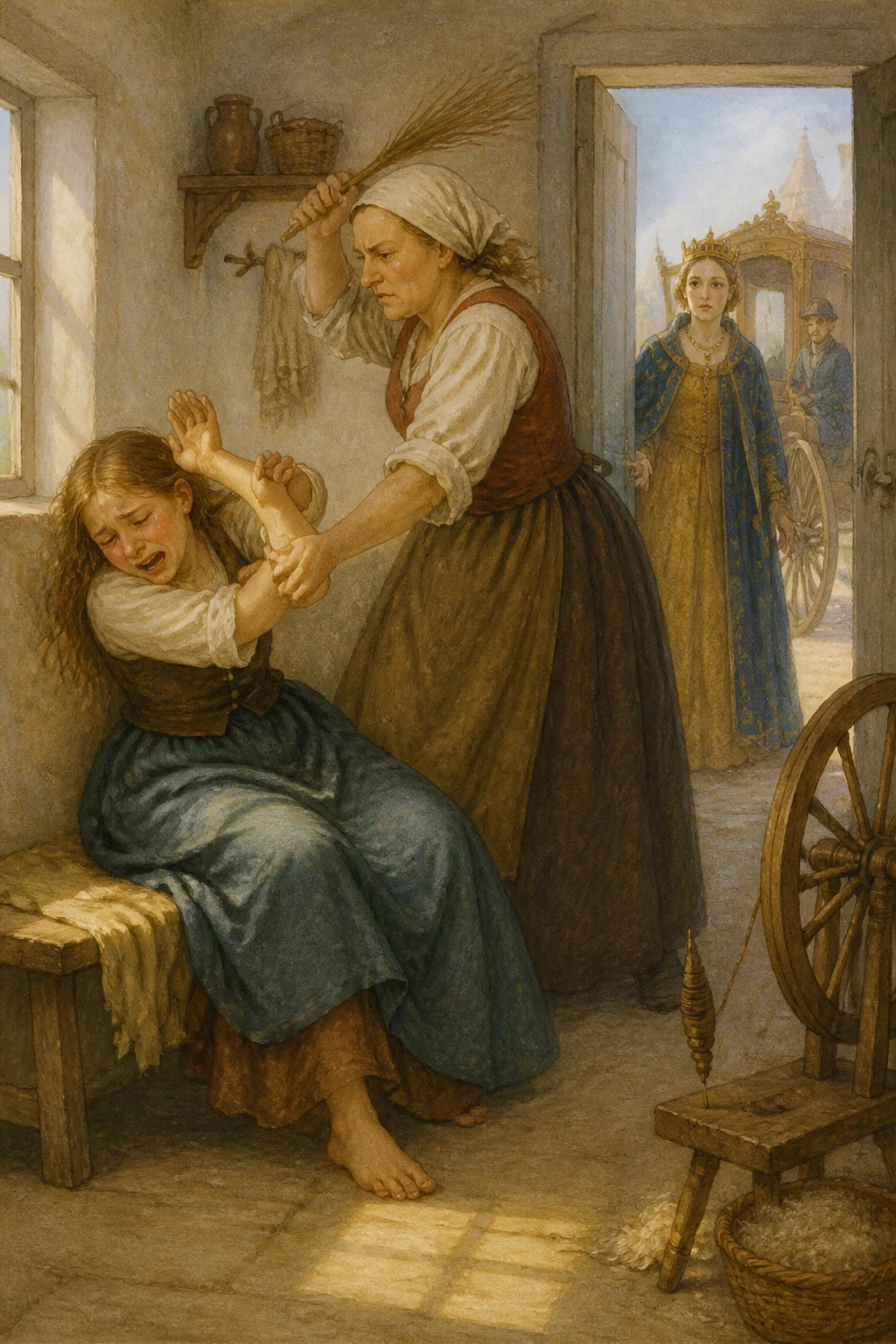
Once upon a time there was a poor man who lived in a cottage far away in the forest and earned his living by hunting. He had an only daughter, who was very beautiful, and as her mother had died when she was young and the girl was now half-grown, she said she wanted to go into service so that she too could learn to earn her bread. “Well, my daughter,” said her father, “it is true you have learned nothing with me but plucking birds and roasting them, but you must try earning your bread all the same.” So the girl went out to look for a place, and after she had walked for a while, she came to the royal palace. There she stayed, and the queen took such a liking to her that the other maids grew quite jealous. So they thought of telling the queen that the girl had boasted she could spin a pound of flax in twenty-four hours, for the queen was exceedingly fond of all kinds of handiwork. “Well, if you have said it, you shall do it,” the queen told her. “But you may have a little more time.” The poor girl dared not say that she had never spun, but asked for a room to herself. This she was given, and a spinning wheel and flax were carried up to it. There she sat, crying and grieving, at her wits’ end. She fiddled with the wheel, twisting and turning it, but had no idea how to set about the work—she had never even seen a spinning wheel before.
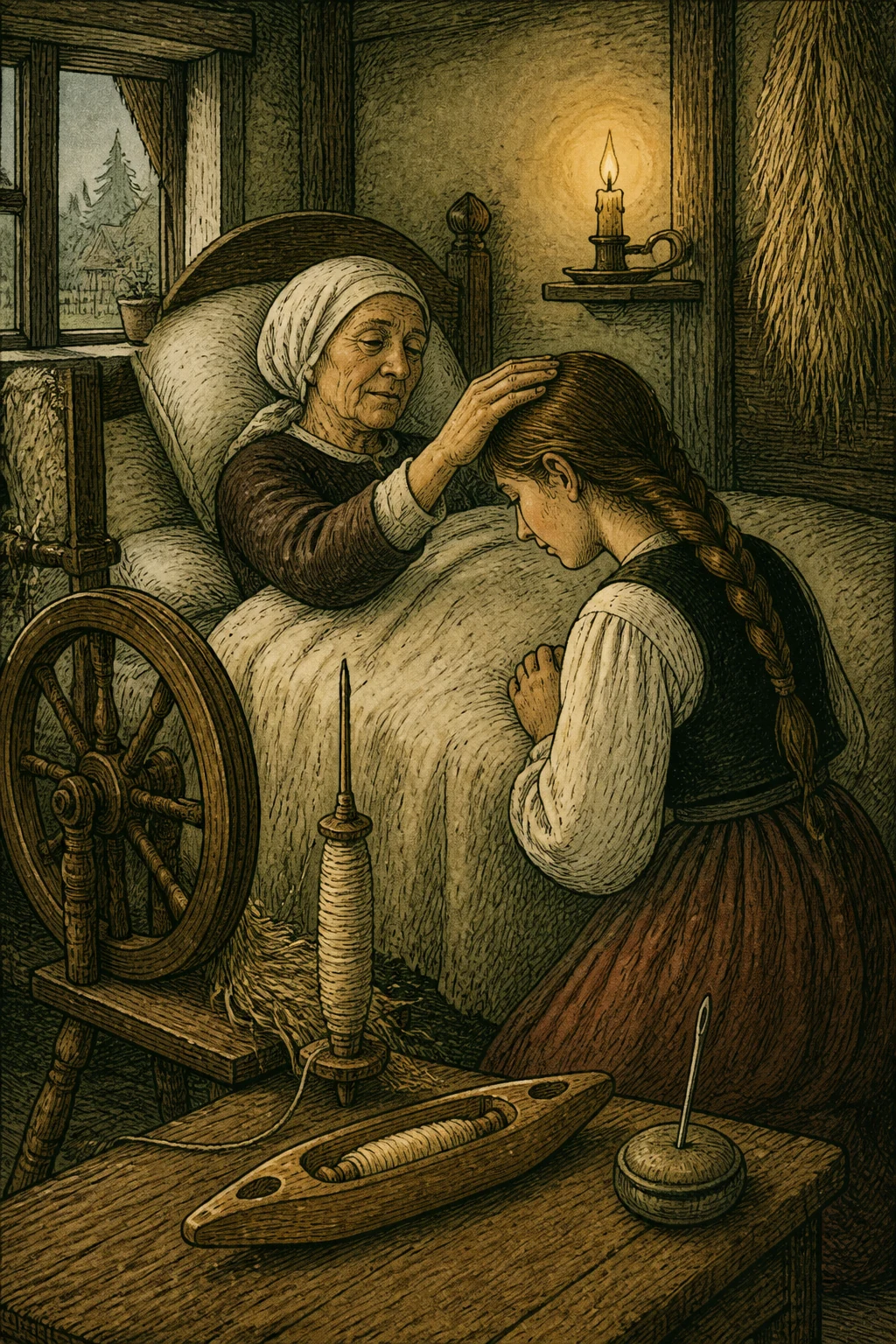
But as she sat there, an old woman came in. “What is the matter, my child?” she asked. “Oh,” answered the girl, “there is no use telling you. You cannot help me anyway!” “No one can be sure of that,” said the woman. “Perhaps I might know a way to help you after all.” Well, I may as well tell her, thought the girl, and she explained how the other servants had spread the tale that she had boasted she could spin a pound of flax in twenty-four hours. “And poor me,” she said, “I have never in all my days even seen a spinning wheel, let alone learned to spin so much in a day and a night.” “Well, never mind that, child,” said the woman. “If you will call me Aunt on your wedding day, I will do the spinning for you, and you can go and lie down to sleep.” The girl was very glad to promise this, and went and lay down.
In the morning, when she awoke, all the flax lay spun upon the table, so fine and beautiful that no one had ever seen such smooth, lovely yarn. The queen was delighted with the beautiful yarn she had been given, and grew still fonder of the girl. But this made the others more jealous than ever, and they thought of telling the queen that now the girl had boasted she could weave the yarn she had spun in twenty-four hours. Once again the queen said that if she had said it, she must do it, though if she could not finish in exactly twenty-four hours, she might have a little longer. This time too the girl dared not say no, but asked for a room to herself, where she could at least try. There she sat again, weeping and lamenting, not knowing what to do, when another old woman came in and asked, “What is the matter, my child?” At first the girl would not say, but at last she told her what was making her so unhappy. “Well,” answered the woman, “never mind that. If you will call me Aunt on your wedding day, I will do the weaving for you, and you can go and lie down to sleep.” The girl was very glad to promise this, and went and lay down. When she awoke, the cloth lay in a pile upon the table, woven as neatly and closely as could be. The girl took the cloth down to the queen, who was delighted with the beautiful weaving she had been given, and grew still fonder of the girl. But this made the others more bitter towards her than ever, and they could think of nothing but what tale to tell about her next.
At last they told the queen that now the girl had boasted she could make the whole pile of cloth into shirts in twenty-four hours. Well, it went just as before: the girl dared not say that she could not sew. Once again she was given a room to herself, and sat there weeping and grieving. But then another old woman came to her and promised to do the sewing if the girl would call her Aunt on her wedding day. The girl was more than glad to promise, and then did as the woman told her and went to lie down and sleep. In the morning, when she awoke, she found the cloth made into shirts and lying upon the table. No one had ever seen such beautiful stitching, and the shirts were marked with initials and finished in every detail. When the queen saw the work, she was so delighted with the sewing that she clapped her hands. “For I have never owned or seen such beautiful stitching,” she said, and from then on she loved the girl as dearly as her own child. “Now, if you would like to marry the prince, you shall have him,” she told the girl, “for you will never need to hire anyone to do anything. You can sew and spin and weave it all yourself.” As the girl was beautiful and the prince liked her well, the wedding was held at once. But scarcely had the prince sat down beside her at the wedding feast when an ugly old woman came in with a long nose—it must have been three ells long.
The bride rose, curtsied, and said, “Good day, Aunt!” “Is this my bride’s aunt?” asked the prince. Yes, indeed she was. “Well, then she must take a seat at the table,” said the prince, though both he and the others thought her a dreadful creature to have sitting with them.
But just then another ugly old woman came in. Her backside was so broad and fat that she could barely squeeze through the door. At once the bride rose again and greeted her. “Good day, Aunt!” And again the prince asked whether this was his bride’s aunt. Both said yes, and the prince said that in that case she too must take a seat at the table.
But scarcely had she sat down when yet another ugly old woman appeared, with eyes as large as plates, so red and watery that they were dreadful to look at. Again the bride rose and greeted her. “Good day, Aunt!” The prince invited her too to take a seat at the table, but he was not pleased, and thought to himself, “Heaven help me, what aunts my bride has!” After sitting for a while, he could contain himself no longer and asked, “But how in the world can my bride, who is so beautiful, have such hideous, misshapen aunts?” “I will tell you,” said the first. “I was just as pretty as your bride when I was her age. But the reason my nose has grown so long is that I have spent all my time nodding and bobbing over my spinning, and so my nose has stretched until it is as long as you see it now.” “And I,” said the second, “have sat shifting back and forth on the loom bench ever since I was young, and that is how my backside has grown as big and swollen as you see it now.” Then the third said, “Ever since I was a little girl, I have sat staring at my sewing, night and day. That is why my eyes have grown so dreadful and red, and now there is no remedy for them.” “Indeed!” said the prince. “It is just as well I learned this, for if such work can make people so ugly and dreadful, my bride shall never spin or weave or sew again for as long as she lives!”