Prevod
The sultan’s wife turned to her husband and said, “Your Majesty, people say all women are base. But women are not all alike: some are good and some are bad. Our lord Solomon himself was ruled by Lady Bilqis: she made him build her a dome out of birds’ bones. So our lord Solomon summoned the birds.
“They came, except for the owl and the house sparrow, who refused. He sent for them and had them brought by force. ‘Why did you not come?’ he asked. The owl turned to our lord Solomon and said, ‘I have come to loathe the company of women. Their wicked ways drove me from my nest, and now I nest on rubbish heaps, crying out.’ ‘Why is that?’ he asked. She said, ‘There is a house where I had nested for nearly forty years. In that house lived two married brothers. One had a daughter and the other a son. When the children grew up, they married them to one another. Their elders died, and the young couple lived lovingly together. One day the husband turned to his wife and said, “Let us make a vow: if I die, you will marry no other man, and if you die, I will marry no other woman.” “Gladly,” she said, and they made their vow. They lived on together for some time.
“‘Then the husband died and the wife was left alone. They carried him away and buried him. She wept, lamented, and mourned him. She pitched a tent over his grave and said, “I shall stay here until I die beside him.” Now there was a cunning thief in that country who had robbed everyone; he was not even ashamed to steal from the sultan’s palace. The sultan was at his wits’ end over how to catch him. He turned to his vizier and said, “Vizier, I appointed you to this office only so that you would spare me every trouble.
“‘“Unless you bring me this thief, alive or dead, I shall have you killed.” The poor vizier left the court, saying to himself, “The guards and soldiers have failed to catch him. How am I to do it?”
“‘He wandered aimlessly on horseback, rode out through the city gate, and came to the cemetery. There he saw a tent. He dismounted and went to look inside. When he peered in and saw a woman, he turned away. But she looked up and said, “Come here. What is the matter?”
“‘“I saw there was a woman here, so I turned back,” he said. “Never mind that. Sit down here.” He sat beside her. Seeing how troubled he was, she asked, “What is wrong?” “Leave me be,” he said. “I have only today and tomorrow left to live!” “Why?” she asked. “The sultan has laid a command on me such as no one could imagine.”
“‘“Let me find a way out for you. What is it?” she asked. “There is a thief in the country who has baffled everyone. The sultan sent for me and said, ‘Either bring him to me or lose your head.’” “Will you marry me if I find a way out for you?” she asked. “I will marry you. Only find me a way out, and quickly!” “Here lies my husband, my cousin,” she said. “He has been dead a fortnight.
“‘“We shall dig him out of the grave, cut off his head, and you can say, ‘Here is the thief’s head.’ The sultan does not know him.” The vizier looked at her and said, “But the thief has only one eye.” “Wait,” she said. “I shall put out one of his eyes and make him one-eyed.” She put out his eye, and the vizier took the head to the sultan. “My lord,” he said, “here is the thief’s head.” The next day she sent for the vizier. “Come,” she said, “you are to marry me.” He replied, “If there were any goodness in you, would you have dug your own cousin, your lifelong companion, out of his grave and cut off his head and put out his eye? Your cousin found no goodness in you; how could I expect to find any? Go your way. See whether you can find some servant willing to marry you!”’
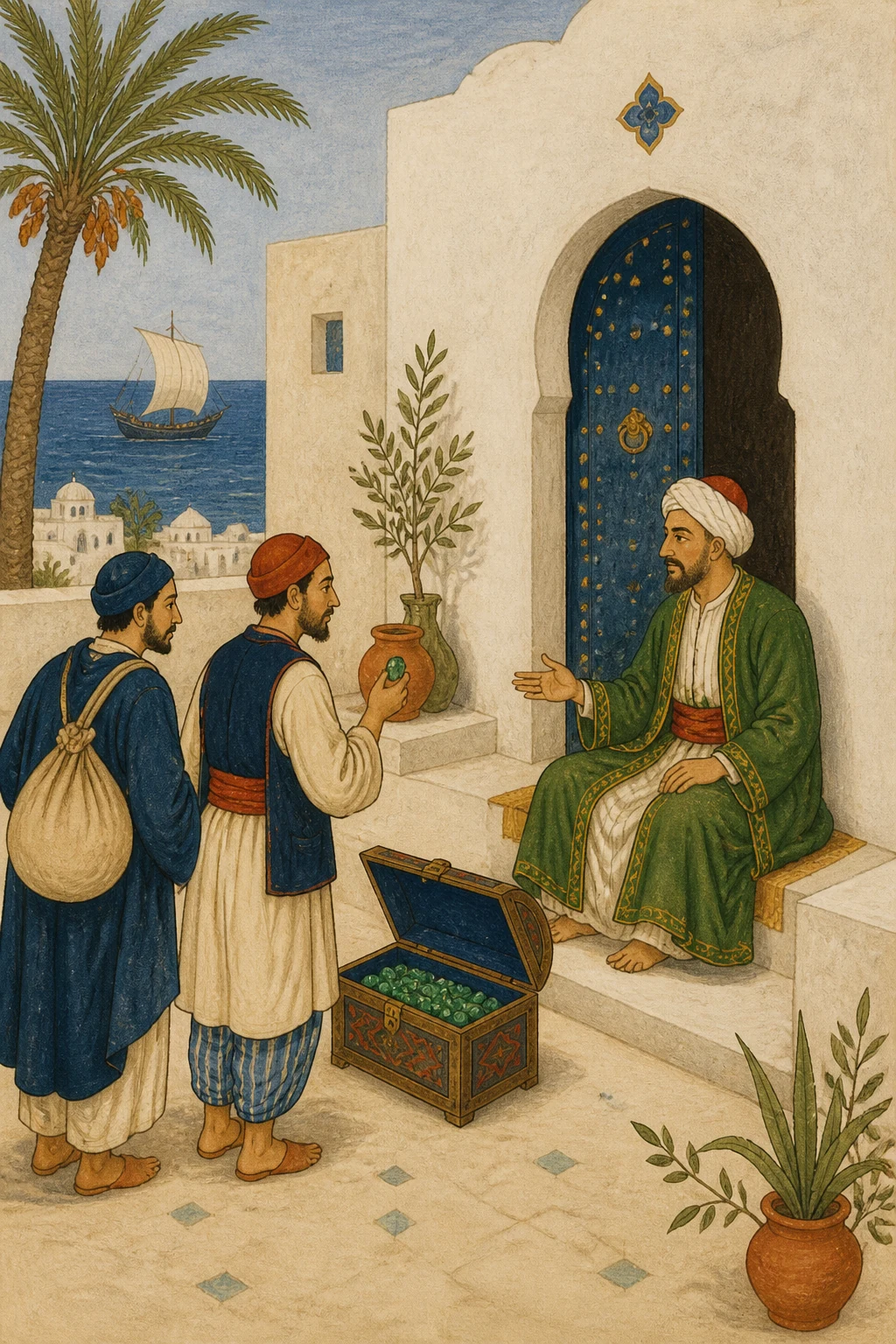
“The house sparrow turned to the owl and said, ‘Do not imagine that all women are alike. Some are good and some are bad. I have my nest in a very respectable household. There is a woman there who has been married to her cousin since they were young. He loves her so dearly that he had her portrait painted inside his snuffbox, so that whenever he takes out the box for a pinch of snuff, he can look at her. He is a wealthy merchant. Once he had to make a journey, so he took a cargo of goods to another country to trade. When he arrived, he put his wares in a shop and began buying and selling. Now that country was plagued with theft, and there were many thieves and murderers. One day he rose to go to the mosque to pray, thinking that morning had already come and he was late. But it was still night. The watchmen seized him and took him before the governor. “What is your occupation, my man?” he asked. “I am a merchant. I buy and sell in my shop.” “What brought you out so early?”
“‘“I thought it was already late in the morning, but it seems it was still night.” The governor looked at him. “Did you not hear the proclamation?” “I heard nothing.” “You are lying. You are a thief and the son of a thief. Take him to prison!” As they were leading him away, his snuffbox fell. He felt about for it but could not find it. The governor saw it and took it to the sultan to show him the remarkable portrait. When the sultan saw the box, he was struck with wonder. He turned to his vizier and said, “Question its owner. Find out what country he comes from and what his name is.” The vizier went to the prison and began speaking kindly to the merchant, reassuring him. “We shall intercede for you and get you released,” he said. Then he asked, “What country are you from?” “I am from such-and-such a country, and I live in such-and-such a quarter.” The vizier left him and went to the sultan. “I asked him where he comes from,” he said, “and he told me his country and the quarter where he lives.” “Come here, Vizier,” said the sultan. “I want you to load a ship with merchandise and sail to the country where his wife lives. Find some means of bringing her to me.” “Certainly,” he said. “A sultan’s command must be obeyed.” He loaded a ship and sailed away. When he reached the country where the merchant’s wife lived, he landed his goods at the port, rented a shop, and began buying and selling like any other merchant. One day an old woman came to buy from him. Seeing that he was newly arrived, she asked, “Have you any fine cloth, patterned stuffs, or cobweb-fine muslin?” “I have,” he said. “What do you want them for?” “I have an orphaned daughter, and I want to marry her off.” “Very good. May God bless you.” He began taking out fabrics and showing them to her, until he had brought out four or five thousand riyals’ worth. “Sir,” she said, “this is far beyond me.
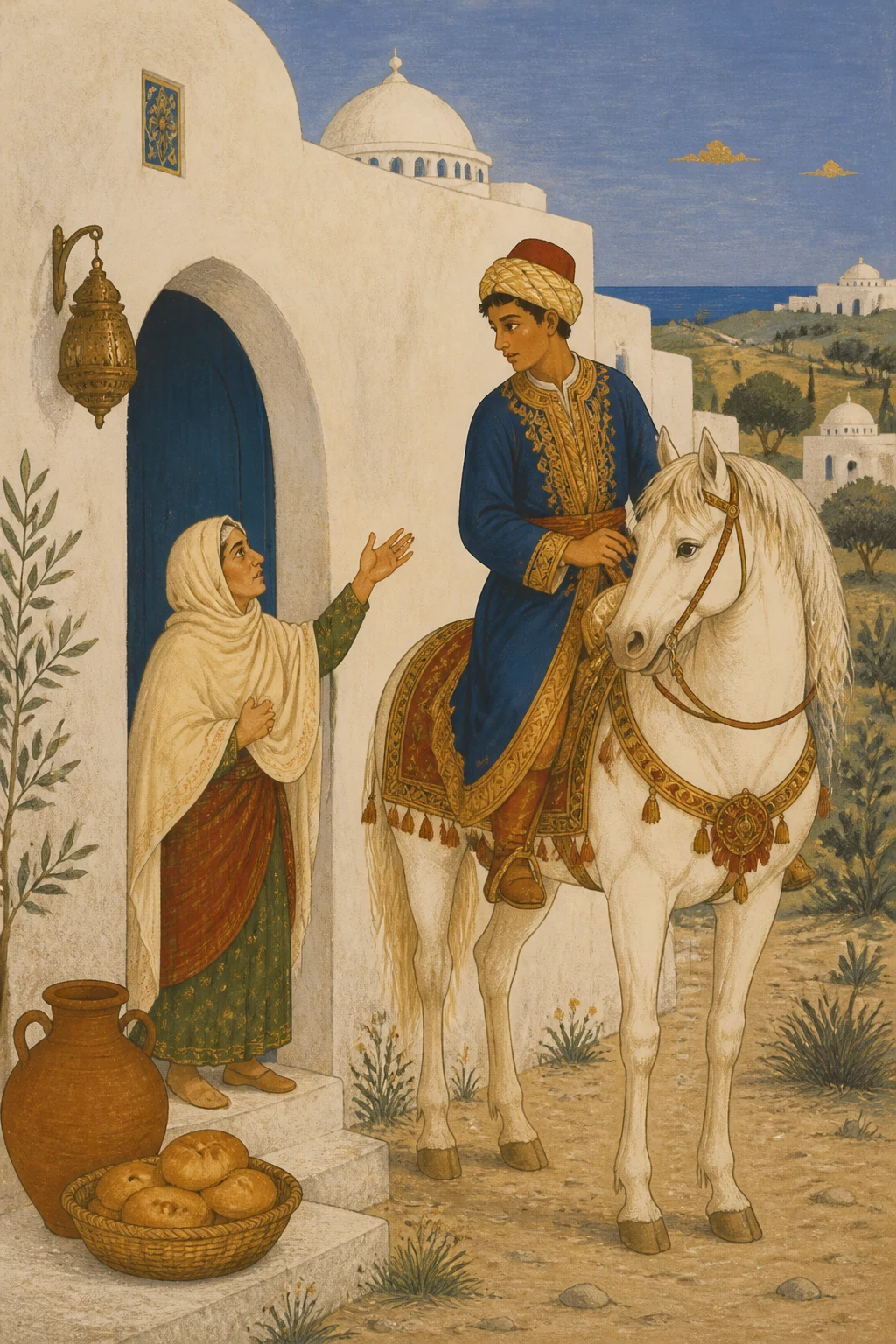
“‘“I am a poor woman. I do not have that much money.” “Take it as a gift from me,” he said, “and here is a purse of five hundred mahbubs to help you along. Come and see me often. Do not stay away too long.” She blessed him, took everything home, and went away delighted. She understood that he wanted something from her. The next day she returned. “Sir,” she said, “is there anything I can do for you?” “Do you know the house of so-and-so?” he asked. “I do.” “Take this purse to his wife, and here are five hundred mahbubs for yourself. Tell her I should like to spend a couple of hours in her company.” “Certainly,” she said. She took the purse and her five hundred mahbubs and went to the woman’s house. She knocked, and the maid came out. “What do you want?” “Go to your mistress and tell her that her mother’s midwife would like to sit with her for a little while.” The maid went to her mistress and gave the message. The old woman was admitted and warmly welcomed. “You are my little girl,” she said. “I brought your mother into the world, and I brought you into the world too. I held you in my arms when you were tiny.” She sat with her, and they made her coffee and gave her something to eat. Then she said, “My lady, do not send me away disappointed.
“‘“Certainly,” the woman replied. “Whatever you need, I shall do for you.” “A new merchant has arrived,” said the old woman, “and he has been asking where you live. He asked me about you and sent you this purse. It is a handsome present; do not refuse it.” The woman took the purse and put it in her chest. “What does he want?” she asked. “He would like to spend a couple of hours with you.” “Very well. Go and tell him to come two hours after sunset.” The vizier was overjoyed. He went to the bathhouse, groomed himself, and dressed in his finest clothes. The woman told the old woman, “If he does not know the house, show him the way, then go home.” Night fell. She dressed herself splendidly and laid out supper. She instructed the maid, “When the merchant comes, let him sit with me a minute or two, then slip outside and knock loudly at the door.” He came in, and she welcomed him with delight. “Welcome! You bring a blessing to our house!” “You are the source of every blessing,” he replied. He sat beside her. They had scarcely taken a mouthful or two when there was a knock at the door. He looked up and turned to her. “Who is that?” She sprang up, beating her thighs. “Oh, where can I hide you now?” Again he asked, “Who is it?” “My husband! He is a murderous man. Every day at about this time he comes to check on me and on his brother’s house.” “What are we to do?” he asked.
“‘“I have an underground store-pit,” she said. “I shall lower you into it. Stay there two or three minutes, and when he leaves I shall bring you out.” “Very well.” She and the maid lifted the stone covering the pit, tied a rope around him, and lowered him down. They replaced the stone and left him there until morning. In the morning she opened it and asked, “How are you?” “The rats are as big as cats, and the damp has done for me!” he said. “Is there nothing to eat? I have had nothing since breakfast yesterday.” “Come, girl,” she said to the maid, “bring the wool.” She lowered some wool, a pair of carding combs, and a lamp so that he could see his work. “Now, my man, you must work for your living. If you do a great deal, you will eat a great deal; if you do little, you will eat little.” “Neither my father nor my grandfather ever practised this trade!” “As you please. If you card, you eat; if you do not card, you starve.” “Give it here, then. I shall work.” She lowered a piece of bread, a few olives, and a vessel of water.
“‘He began to card. His hands blistered, and he managed very little. So she lowered less food to him: a quarter of a loaf. The poor man was dying of hunger. He wrapped his hands in rags and spent the whole night carding wool. In the morning she hauled up his work and found he had done a great deal. She looked down at him and said, “If you work hard, I shall give you plenty. If you do little, I shall give you a quarter ration.” So he went on carding diligently and eating his fill. Now let us return to the sultan. He turned to another vizier, one he trusted, and said, “Vizier, the vizier we sent has been gone a long time. It must be three or four months now, and he has not returned.” “My lord,” he replied, “perhaps he took a fancy to the woman, carried her off, and went to another country.” The sultan said, “I shall load a ship for you as I did for him. Follow him and find out.” “Certainly,” he replied.
“‘The sultan ordered one of his ships to be loaded with merchandise and gave him all the money he needed. The vizier put his trust in God and sailed away. He sailed on until he reached that country. Like the other, he opened a shop and began buying and selling. On the third day the old woman came. “Good morning, sir,” she said. “You seem to be new here. I have never seen you in this country before.” “Yes, I arrived only three days ago.” “Have you any silks, ambergris, civet, or musk?” “I have everything you could need.” He set out his wares for her to examine. “Sir,” she said, “this is beyond my means. I have no money to pay for it.” “These are a gift from me,” he said, “and here are two purses of mahbubs to help you along.” She took them home and returned the following day. “Sir,” she said, “you are a stranger here. Is there anything you need? Whatever you wish, you shall have it.” “Do you know the house of so-and-so?” he asked. “I know it very well.” “Here are ten thousand riyals for you, and take this purse to his wife. Tell her a stranger would like to spend a couple of hours in her company.”
“‘“Certainly,” she said. She took the purse and her money and went to the woman’s house. She knocked, and the maid answered, “Who is there?” “Tell your mistress it is her mother’s midwife.” The maid went to her mistress. “Show her in,” she said. The old woman entered and was warmly welcomed. She handed over the purse. “This is an even finer gift than the first.” The woman took it and put it in the chest beside the other. “Bring him as before,” she said, “an hour or an hour and a half after sunset.”
“‘He was waiting in his shop when the old woman returned. “Well, sir,” she said, “God has made the way easy. Stay where you are until I come to fetch you.” He waited until she came back. “Come along,” she said, and showed him the door of the house. As soon as he put his hand to the door, he found a maid waiting. “Come in,” she said. He entered and found everything splendidly prepared: candles set out, a table laid with food and drink. “Come, sir,” said the woman. “Let us have supper.” They sat down to eat. They had scarcely taken a mouthful or two when someone knocked at the door. “Oh, where can I hide you?” she cried. “Neither you nor I will escape alive!” “Who is it?” he asked. “My husband. He comes at about this time.” “Where can you put me? Where can you hide me?”
“‘“I have a cellar,” she said. She called the maid. They lifted the stone, tied a rope around him, and lowered him down, dangling between earth and sky. Down he went. The other vizier was busy carding wool when, suddenly, he found a man standing beside him. “How did you come to be here?” he asked.
“‘“The same way you did. The God who brought you here brought me here too.” He recognized him. “Is it you, so-and-so?” “Yes.” “What are you doing here, then? Working?” “Yes, here I am, earning my living.” “Well, God has not parted us!
“‘“We were together in the ministry, and now we are together in the cellar. Even when we die, we shall die together.” He sat down beside him in the cellar. The first arrival took out his supper and began to eat. “Give me a little,” said the other. “I have not tasted food since yesterday.” “No, my man. By God, you shall not taste it. This work takes bodily strength.”
“‘He ate his supper alone and gave his fellow vizier nothing. The newcomer spent the night without supper. In the morning the woman opened the pit and lowered the wool. “You must work like your companion,” she told the newcomer, “or there will be no food for you.” They began working. The one who was accustomed to it did a great deal, and she sent him plenty to eat. The newcomer did very little, and she sent him a quarter ration. He turned to his companion. “I have not had enough.” “What can I do for you? Am I to do your work as well?” During the night he said to himself, “Since the more a man works, the more he eats, I shall not sleep tonight. I shall work until morning.” Let us leave them at their work in the cellar and return to the sultan. He said to himself, “The first vizier goes and does not return. The second vizier goes and does not return. Perhaps they have taken the woman and are fighting over her, or have carried her off to another country.” Then he said, “I shall follow them myself.” He summoned a vizier whom he knew to be trustworthy. “Look after my kingdom,” he told him. “I may be away a month or two.” He fitted out a great ship, such as sultans use.
“‘He took precious merchandise, silks of every kind, and a great store of worldly wealth. Then he put his trust in God and sailed. When he reached that country and dropped anchor, word spread among the merchants that a new trader had arrived. They came aboard to welcome him. “Show us your list, sir,” they said. “We shall take your goods off your hands.” “No,” he replied. “I want to open a shop and sell them myself. I do not want to sell wholesale, but piece by piece.”
“‘He rented a shop and brought his goods ashore. On the third day the old woman came shopping and saw him. “Have you any fine fabrics, sir?” she asked. “I have brocades, Indian silks, silks of every sort, cashmere, and cloth embroidered with silver.” He cut generous lengths of the fabrics for her and gave her five thousand riyals as well. “May God increase your bounty,” she said. “Tell me, sir, whatever you need, I shall do it for you.” “Take these things home first, then come back. There is something I want from you.”
“‘She took the goods home and returned. “Do you know the house of so-and-so?” he asked. “I know it very well.” “Here is a purse of mahbubs and a purse of diamonds for his wife, and here are ten thousand silver riyals for your trouble.” She took them and went on her way. At the woman’s house she knocked. “Who is there?” asked the maid. “Go and tell your mistress that her mother’s midwife has come.” The maid went and told her. “Show her in,” she said. The old woman entered. “My lady,” she said, “this is an even finer gift than the others.” The woman took the purses and placed them in the chest beside the rest. “Tell him to come an hour or an hour and a half after sunset.” The old woman returned to him. “Sir,” she said, “an hour or an hour and a half after sunset I shall take you to her house.” After sunset she returned. “Come, sir. Let us go.” He shut the shop and followed her. “Here is the door,” she said. He knocked, and the maid came. “Come in, sir. Welcome.” He entered and found everything splendidly prepared.
“‘“Welcome, sir,” said the woman. “You bring a blessing to our house.” “You are the source of every blessing, my lady, my beauty.” “Please sit down, sir.” Then she told the maid, “Bring the supper.” She brought it, and they began to eat. Just then someone knocked at the door. “What is that, my lady?” he asked. “Oh, where shall I put you? That is my husband. He always comes at about this time. He is a murderous man: neither you nor I will escape alive!”
“‘She began beating her thighs and crying, “What am I to do?” Then she said, “Sir, I have a cellar. Let me lower you into it for a little while. Once he has searched the house and found no one, I shall bring you out.” “Very well,” he said. “Bring the rope,” she told the maid. They removed the stone, tied the rope around his waist, and lowered him down. The others were carding wool below when suddenly a man came down among them. When he reached the bottom, they asked, “How did you come to be here?” “How did you two come to be here?” he replied. They recognized him, rejoiced to see him, and greeted him with the honours due to a sultan.
“‘“Praise be to God who has brought you to us!” they said. “We are your servants in this world and the next. We were your viziers in our own country, and now we are your viziers in the cellar.” He sat beside them. Their supper was lowered, and each took his portion off to a corner to eat. He sat watching, but neither invited him to share. “You are eating,” he said. “Am I to sit here and watch?” “Yes, my lord. That is the rule of the cellar: whoever works, eats, and whoever does not work, does not eat.” The poor man spent the night hungry. In the morning the wool came down. “Card with us, my lord,” they told him, “or you will have neither food nor drink.” He called to the maid. “Fetch your mistress. I wish to speak to her.” The mistress came. “What do you want?” “My daughter,” he said, “I am a sultan. Since first I opened my eyes, I have never known how to work.” “Do not show a wolf the way, nor lead a blind man; and whoever scratches thorns with his own hands has only himself to blame!
“‘“Had it not been for your own deeds, God would not have brought you here. Come, confess: what brought you here?” The sultan said, “Your beauty brought us.” “My beauty? Where did you come to know my beauty?” The sultan took out the snuffbox. “Here is your beauty.” She took the box from his hand. “This is the snuffbox of my cousin, who has been away from me for nearly two years!”
“‘“Come,” she said to the sultan, “tell me the truth.” “My daughter,” he replied, “we wronged the owner of that box unjustly and cruelly. The poor man came as a stranger to our country. There was a great deal of theft there, and we had proclaimed that no one was to go out at night.
“‘“He knew nothing about it. He went out at night, and the watchmen seized him and brought him to us. We imprisoned him. When we found this box on him, we took it, and we coveted your beauty and wanted you for ourselves. We questioned him about his country and the whereabouts of his house. Then we began coming here, one after another, until God brought us to ruin.” “Now,” she said, “I want a letter bearing your seal and those of your viziers. You must grant me authority over the viziers in your country. Tell them in the letter: ‘Let the bearer of this letter govern you.
“‘“‘Make way for him to sit in my place.’ And you will remain here, eating and drinking well, without having to work any more, until I bring back my cousin and release you.” He wrote her a letter granting full authority. She instructed the maid, “Do not let them lack anything.” Then she set out on her journey. When she reached the country, she left her ship in the harbour and went straight to the palace and the council chamber. She handed them the letter. They kissed it and raised it reverently to their brows. “A sultan’s command must be obeyed,” they said. She took her seat and governed through the first day, the second, and the third. Then she sent word to the viziers: “Bring all the prisoners before me.” They brought them all. She released every one of them, but when they came to her cousin, she said, “Leave him. Take him back to prison.” She waited until nightfall, then said, “Bring me the prisoner we kept.” They brought him. “How are you faring, my man?” she asked.
“‘“Such is the lot of a stranger,” he replied. “Gather your possessions and your merchandise,” she said, “load them aboard, and go home. I shall give you one of my captains to load your belongings and take you back to your country.” She sent for a captain. When he came, she said, “Take this man and his goods to his own country. Before you weigh anchor, come to me.”
“‘“Certainly,” he replied. He made his preparations, and when he was ready to weigh anchor, he came to her. “I am going to sea with you,” she said. She waited until night and went with him. She boarded the ship and said, “Spread the sails.” It sailed on until they reached the harbour of their own country. She ordered a small boat brought alongside. “I want to go ashore first.” They brought a boat, and she went ashore and hurried home. She knocked at the door. Seeing a man’s clothes, the maid opened her mouth in alarm and fled inside. “Come here to your mistress! Do not be afraid.” The maid returned and opened the door, laughing. The woman went in, took off the men’s clothes, and put on her usual women’s dress. In time her cousin landed and brought his goods ashore. His wife met him and greeted him. “My lord, what a long absence!”
“‘He sat beside her, drank his coffee, and caught his breath. “Come, give it to me,” she said. He handed her another snuffbox. “Where is the box with my portrait in it?” she asked. He lowered his eyes and said nothing. “Tell me, where is your box?” “My good woman, it was taken from me.”
“‘“Who took it?” “I landed in a country where the ruler was unjust and his officials were unjust too. I went out at night, thinking it was already morning. The watchmen arrested me, put me in prison, and took my box.” “If they came into your power, what sentence would you pass on them?” “My dear, he is a king. If he commits injustice, God will punish him on the Day of Judgment, when God is the judge and the angels are witnesses.” She reached into her pocket. “Is this not your box?” “Who brought it here to you?” he asked. “The men who wronged you are here in your power, in prison.” “Where?” “Look!” She lifted the stone and opened the pit. She lowered a rope. “Tie yourselves to it. I am going to bring you up.” Then she turned to her husband. “Hide until all three have come out.” She hauled them up and showed them into a room. While they were sitting there, her husband entered. “Peace be upon you.” When they saw him, they were all but dead with fright. He stepped forward, and the sultan spoke. “Forgiveness is the mark of noble souls! Yet if you punish us for what we did, even God will not call you to account. We wronged you and treated you shamefully.” The merchant came forward, bent, and kissed the sultan’s hand. “My lord, God has granted you a kingdom and authority over men’s lives, but He has not granted you possession of their women.” “My son,” the sultan said, “I repent before God. Forgive me.” Then the sultan hurried to the woman and kissed her head. “May God make you my daughter in this world and the next.” They took out the shop keys and returned them with heartfelt goodwill, and he wrote her a decree granting her a yearly allowance from his treasury.
“‘The merchant accompanied them to the ship, and they parted from him and his wife with every good wish.’”