Prevod
_Cecella, mistreated by her stepmother, receives gifts from three fairies. The envious woman sends her own daughter to them, but she comes back disgraced. The stepmother then sends her stepdaughter to tend pigs, and a great lord falls in love with her. Through the stepmother’s malice, however, he is given the ugly daughter instead, while the stepdaughter is shut inside a barrel to be scalded. The lord discovers the deception and puts the daughter in her place. The stepmother comes, strips the flesh from her with boiling water, and, discovering her mistake, kills herself._ _Ciommetella’s tale was judged one of the finest yet told, so that Ghiacova, seeing everyone spellbound with wonder, said:_ Were it not for the command of the Prince and Princess, which is a windlass hauling me and a sledge dragging me along, I would put a full stop to my chatter; for it seems altogether too presumptuous to set the broken colascione of my mouth beside the bass viol of Ciommetella’s words. Still, since that is His Highness’s pleasure, I shall do my best to play you a little variation upon the punishment of an envious woman who, meaning to plunge her stepdaughter into the depths, raised her to the stars.
In the village of Marcianise there lived a widow called Caradonia, who was the very mother of envy. She could never see a neighbor prosper without choking on it, never hear of an acquaintance’s good fortune without taking it amiss, and never see a man or woman happy without being seized by a fit of strangulation.
This woman had a daughter named Grannizia, who was the quintessence of swellings, the choicest cut of sea monsters, the cream skimmed off burst boils. Her head was full of nits, her hair tangled, her temples plucked bare, her forehead like a mallet, her eyes bulging, her nose a plum, her teeth plastered with tartar; she had a grouper’s mouth, a wooden clog for a chin, a magpie’s neck, breasts like saddlebags, shoulders like a vaulted ceiling, arms like a reel, hooked legs, and heels like cheeses. In short, from head to foot she was a lovely hag, a fine pestilence, an ugly little lump, and above all a tiresome, thickheaded chatterbox. Yet, cockroach though she was, her mother thought her a painted butterfly. Now it happened that this good widow married a certain Micco Antuono, a very wealthy farmer from Pane-cuocolo, who had twice been bailiff and mayor of that village and was held in great esteem by all the people of Pane-cuocolo, who thought the world of him.
Micco Antuono also had a daughter, called Cecella, and nothing more marvelous or more beautiful could have been seen anywhere in the world. She had a little sidelong glance that bewitched you, a kissable little mouth that sent you into raptures, and a neck of milk and cream that made people swoon. In short, she was so charming, sweet, playful, and alluring, with so many little graces, endearments, winning ways, whims, and pretty airs, that she plucked hearts straight out of people’s breasts. But why so much talking and telling? Enough to say that she seemed painted with a brush: you could find no flaw in her. When Caradonia saw how her daughter compared with Cecella—as a kitchen scourer with a cushion of forty-pile velvet, the sooty bottom of a frying pan with a Venetian mirror, a harpy with the fairy Morgana—she began to look askance at her and bear her a grudge. Nor did the trouble end there, for the abscess in her heart burst outward, and, unable to keep her spite suspended any longer, she began openly tormenting the unfortunate girl. Her own daughter she dressed in a pinked woolen skirt and a fine linen bodice, while the poor stepdaughter wore the worst rags and tatters in the house. Her daughter she gave bread as white as flowers; her stepdaughter, hard and moldy crusts. Her daughter she cherished like a flask of the Savior’s blood, while her stepdaughter she drove about like a spinning top, making her sweep the house, scrub the dishes, make the beds, wash the laundry, feed the pig, tend the donkey, and empty the slops, begging your pardon. All these things the good girl did diligently, willingly, and promptly, sparing herself no trouble in trying to satisfy her wicked stepmother’s whims. But, as good fortune would have it, one day the poor girl went to throw the rubbish outside the house, at a place where there was a deep ravine, and her basket fell down into it. As she peered about, wondering how she could fish it out of that precipice, all at once she saw a dreadful scarecrow of a creature, and could not have said whether he was Aesop in the flesh or the portrait of the ugliest beggar. He was an ogre, with hair as black as pig’s bristles hanging down to his ankles; a wrinkled forehead, every crease like a furrow made by a plow; bristling, shaggy eyebrows; and pale, sunken eyes so full of you-know-what that they looked like filthy shops beneath two great awnings of eyelids. His mouth was crooked and slobbering, with two tusks sticking out like a wild boar’s; his chest was all lumps and so thickly overgrown with hair that you could have stuffed a mattress with it. To crown everything, he had a towering hump, an enormous belly, skinny legs, and twisted feet: enough to wrench your mouth awry with fright. Yet Cecella, though the dreadful apparition might have frightened the soul out of her, took courage and said, “My good man, hand me that basket I have dropped, and may I live to see you married and very, very rich.” The ogre answered, “Come down, my girl, and get it yourself.” So the good little thing, clinging to roots and grasping stones, managed at last to climb down. There, incredible to tell, she found three fairies, each more beautiful than the next, with hair of spun gold, faces like the full moon, eyes that spoke to you, and mouths that invited, above the accompaniment of any instrument, their fill of sugared kisses.
What more can I say? A neck of honey, a tempting bosom, a soft hand, a tender foot, and, in short, a grace that made a gilded frame for all those beauties. Cecella received more caresses and endearments from them than can be imagined. Taking her by the hand, they led her to a house beneath those crags where a crowned king might have lived. Once there, they sat upon Turkish carpets and cushions of smooth velvet with tassels of thread or silk, laid their heads in Cecella’s lap, and had her comb their hair. While she went about the task with the greatest delicacy, using a shining comb of buffalo horn, the fairies asked her:
“My lovely girl, what do you find on this little head?” And she answered most prettily, “I find little nits, little lice, pearls, and garnets.” The fairies were immensely pleased by Cecella’s good manners. Having braided their loosened hair, these noble ladies took her with them, showing her one after another all the exquisite wonders of that enchanted palace. Here were writing desks beautifully carved in chestnut and hornbeam; there, chests covered in horsehide with plates of tin; here, walnut tables in which you could see your reflection; there, cupboards with ranks of pewter that dazzled the eye. Here were bed canopies of flowered green cloth; there, leather chairs with armrests, and so many other splendors that anyone else would have been struck dumb merely at the sight.
Cecella gazed at the magnificence of that house as though it were no concern of hers, without making a miracle of it or gaping like a country bumpkin. At last they brought her into a wardrobe crammed with splendid clothes and showed her gowns of Spanish cloth of silver, dresses of gold-ground velvet with sleeves like hams, figured-silk mantles trimmed with enamel tags, shot-taffeta bodices, brow bands of lifelike flowers, and forehead ornaments shaped like circlets, shells, half-moons, and serpents’ tongues; beaded trimmings tipped with blue and white glass, ears of wheat, lilies, and plumes to wear upon the head, little enamel pomegranates mounted in silver, and a thousand other figures and trinkets to hang around the neck. They told the girl to choose whatever she liked and take a generous share of those things. But Cecella, who was as meek as oil, passed over everything of value and reached for a torn little skirt not worth three copper coins. Seeing this, the fairies asked her, “Which door would you like to leave by, my little sweet?” And she, bowing almost to the ground and nearly groveling, said, “The stable door is good enough for me.”
Then the fairies embraced her and kissed her a thousand times, dressed her in a magnificent gown embroidered all over with gold, and arranged her hair in the Scottish fashion and in little baskets, with so many bows and ribbons that it looked like a meadow of flowers. They raised her topknot high, with its padded roll and neatly hanging braids, and, escorting her to a door of solid gold with a frame inlaid with carbuncles, said:
“Go, my Cecella, and may we live to see you happily married. Go, and when you are outside this door, lift your eyes and see what is above it.” The girl made graceful curtsies and went away. When she stood beneath the doorway, she raised her head, and a golden star fell upon her forehead, a thing of wondrous beauty. Thus starred like a horse, all lovely and adorned, she came before her stepmother and told her everything from beginning to end. To that spite-swollen woman this was no tale but a blow from a cudgel. Unable to rest, she immediately had the fairies’ dwelling pointed out to her and sent her grouper of a daughter there. The girl reached the enchanted palace and found those three jewels of fairies, who first and foremost gave her their heads to search. When they asked what she found, she said, “Every louse is as big as a chickpea, and every nit as big as a spoon.” The fairies were bursting with vexation and choked with disgust at the ugly peasant’s boorish speech, but they concealed their feelings, foreseeing from such a morning what a bad day was coming. They took her into the rooms full of finery and told her to choose the best. Grannizia, offered a finger, seized the whole hand and snatched the finest gown in the cupboards. The enchantresses were astonished to see her so free with her hands; nevertheless, wishing to sound her to the bottom, they said, “Which way would you like to leave, my pretty girl: through the golden door or the garden door?” With a face as brazen as an awl, she answered, “Through the best one there is.” But the fairies, seeing the presumption of this little ragbag, gave her not so much as a pinch of salt and sent her away, saying, “When you are beneath the stable doorway, lift your face to heaven and see what comes to you.” Out she went through the dung, raised her head, and an ass’s testicle fell upon her forehead and stuck to the skin, looking like a birthmark caused by her mother’s cravings when she was pregnant. With this handsome prize she made her way slowly back to Caradonia. The woman, like a bitch with pups, foaming at the mouth, had Cecella stripped, tied a cloth around her backside, and sent her to tend some pigs, decking out her own daughter in Cecella’s clothes. With great composure and the patience of Orlando, Cecella endured this wretched life. Oh, cruelty enough to move the stones in the road! That mouth, deserving to utter the conceits of love, was forced to blow a horn and cry, “Piggy, piggy! Here, here!” That beauty, fit to dwell among suitors, was set among swine; that hand, worthy of leading a hundred souls by the halter, drove a hundred sows with a stick. A thousand curses upon the bowels of whoever condemned her to those woods, where fear and silence sheltered from the sun beneath the canopy of shade! But Heaven, which tramples the proud and raises the humble, sent across her path a lord of great consequence named Cuosemo. Seeing a jewel in the mud, a phoenix among pigs, and a lovely sun through the broken clouds of those rags, he fell so desperately in love that, after having inquiries made about who she was and where she lived, he went straight to her stepmother and asked for her hand, promising to settle countless ducats upon her. Caradonia fixed her eye upon that fortune for her own daughter and told him to return that night, since she wished to invite the relations. Cuosemo went away overjoyed, and it seemed a thousand years to him before the sun should lie down in the silver bed prepared for it by the river of India, so that he might lie beside that other sun which set his heart on fire. Meanwhile Caradonia had thrust Cecella into a barrel and fastened it shut, intending to give her a scalding bath: since she had left the pigs behind, she meant to strip her bristles like a pig’s with boiling water. By now the air had darkened and the sky had become like a wolf’s mouth. Cuosemo, beside himself and dying of longing to ease his lovesick heart by clasping those beloved beauties, set out in great delight, saying:
“Now is the very hour to tap the tree that Love has planted in my breast and draw from it the manna of amorous sweetness. Now is the very hour to dig up the treasure Fortune has promised me. So waste no time, Cuosemo: when you are promised a piglet, run with a little rope. O night, O happy night, O friend of lovers! O souls and bodies, O thingummy and spoon! O Love, hurry, hurry headlong, so that beneath the tent of your shadows I may shelter from the heat consuming me.” Saying this, he reached Caradonia’s house and found Grannizia in Cecella’s place: a horned owl instead of a goldfinch, a weed instead of a rose in bloom. For though she had put on Cecella’s clothes, and one might say, “Dress up a blockhead and he looks a baron,” she still looked like a cockroach in cloth of gold. Nor could all her mother’s primping, daubing, plastering, and polishing remove the dandruff from her head, the rheum from her eyes, the freckles from her face, the crust from her teeth, the warts from her neck, the grime from her chest, or the muck from her heels; she reeked of bilgewater a mile away. At the sight of this evil apparition, the bridegroom could not imagine what had happened to him. Drawing back as though he had seen the one who melts away, he said to himself, “Am I awake, or have I put my eyes on backward? Am I myself or someone else? What are you looking at, poor Cuosemo? You have shat in your own boat! This is not the face that caught me by the throat yesterday morning; this is not the image painted upon my heart. What is this, Fortune? Where is the beauty, the hook that caught me, the windlass that hauled me in, the arrow that pierced me? I knew that neither woman nor cloth should be judged by candlelight, but I chose this one in full sunshine. Alas, this morning’s gold has proved to be copper;
“the diamond, glass; and what I took for a beard has turned out a wisp of down.” These and other words he muttered and grumbled between his teeth; yet at last, compelled by necessity, he gave Grannizia a kiss.
But, as though he were kissing an ancient relic, he brought his lips close and drew them back more than three times before touching the bride’s mouth. Once near it, he thought he had found himself on the shore at Chiaia in the evening, when those worthy women bring the sea their tribute of something other than Arabian perfumes. But since the sky, wishing to look young, had dyed its white beard black, and this lord’s estate lay far away, he was obliged to take her for the night to a house not far beyond the borders of Panecuocolo. There, having arranged a straw mattress upon two chests, he lay down beside the bride. But who can describe the miserable night they both passed? Though it was summer, and the night scarcely eight hours long, it seemed to them the longest night of winter. On one side the lustful bride cleared her throat, coughed, gave a kick now and then, sighed, and with unspoken words demanded the rent for the house she had let. But Cuosemo pretended to snore and withdrew so far toward the edge of the bed to avoid touching Grannizia that he ran out of mattress and fell smack onto a chamber pot: thus the business ended in stink and shame. Oh, how often the bridegroom cursed the sun’s dead ancestors for dawdling so long and keeping him under that crushing weight! How he prayed that night would break its neck and the stars tumble into the abyss, so that the coming day might rid him of that evil day beside him! No sooner had Dawn come out to drive forth the hens and wake the cocks than he leaped from the bed and, scarcely fastening his breeches, ran to Caradonia’s house to give her daughter back and pay for the first use of her with a broom handle. He entered the house but did not find her: she had gone to the woods for a bundle of firewood to prepare a scalding bath for her stepdaughter, who lay bunged up in Bacchus’s tomb when she deserved to stretch at ease in Love’s cradle.
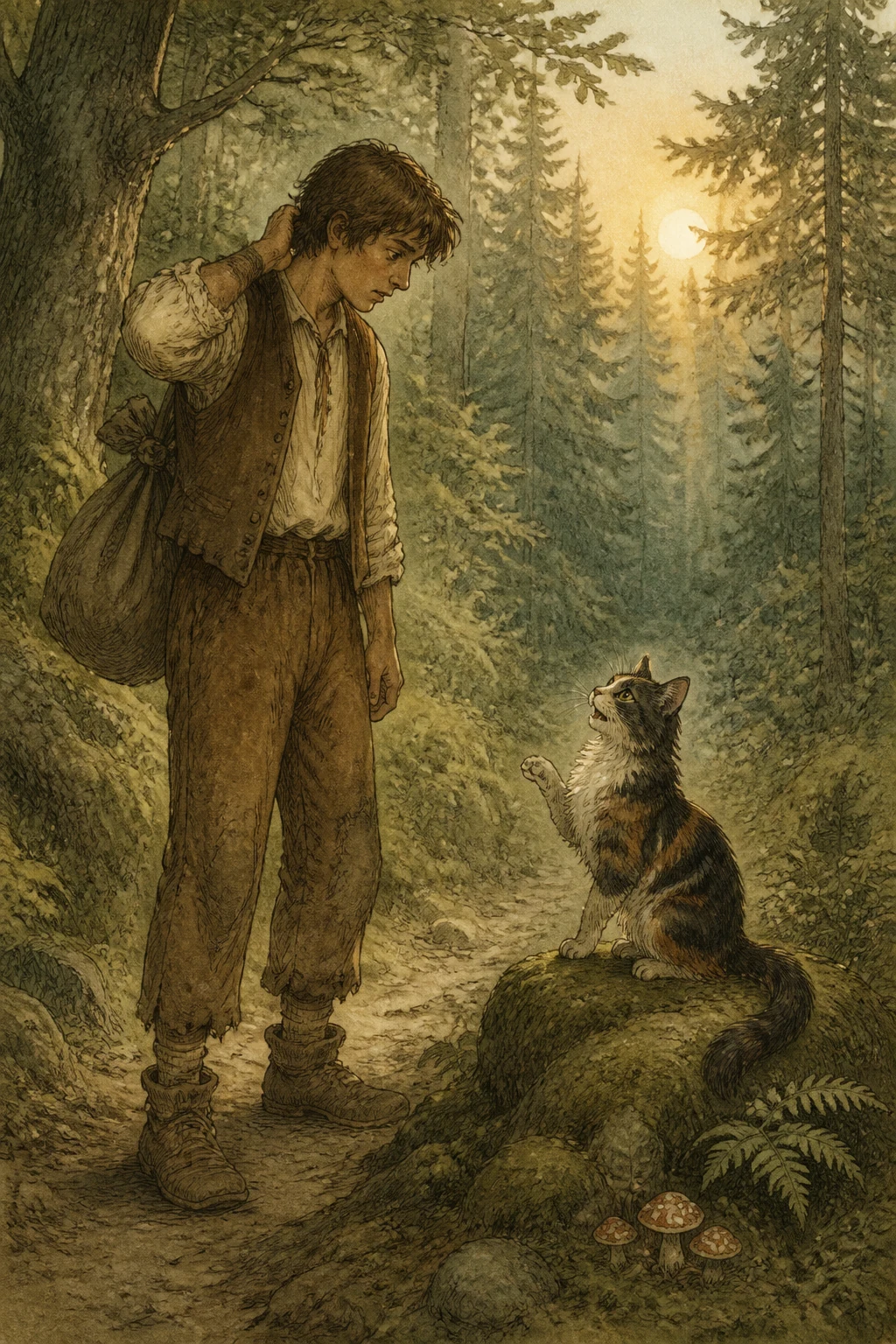
Cuosemo, searching for Caradonia and finding her vanished from the face of the earth, began to shout, “Hello there! Where are you?” Then a tabby cat brooding in the ashes suddenly struck in with a voice out of season: “Miaow, miaow! Your wife is shut inside the barrel!” Cuosemo went up to the barrel and heard a faint, muffled moaning. At that he seized an axe from beside the hearth and broke the barrel apart. As the staves fell, it was like the curtain dropping upon a stage to reveal a goddess about to speak the prologue. I cannot think how he failed to fall senseless at such radiance. At the sight, the bridegroom stood for a while like a man who has seen the little household goblin; then, coming to himself, he ran to embrace her, saying, “Who put you in this dreadful place, jewel of my heart? Who hid you away from me, hope of my life?
“What is this? The painted dove inside this cage of hoops, and the griffin coming to lie beside me? What is the meaning of this trick? Speak, my sweet lips, comfort my soul, let this heart breathe again!” Cecella answered by telling him the whole story, leaving out not a jot of all she had suffered in her stepmother’s house from the moment she first set foot there until Bacchus had buried her alive in a barrel to stop the flow of her life. Hearing this, Cuosemo had her crouch and hide behind the door. Then he put the barrel together again, sent for Grannizia, and, cramming her inside, said, “Stay here a little while, while I have a charm worked for you, so the evil eye can do you no harm.” Having fastened the barrel securely, he embraced his wife, set her upon a horse, and carried her straight away to Pascarola, his own estate. Caradonia came back with a great bundle of sticks, built a roaring fire, and set a large cauldron of water upon it. As soon as it began to boil, she poured it through the bunghole into the barrel and stripped all the flesh from her daughter, whose teeth drew back as though she had eaten the sardonic herb, and whose skin peeled away like a snake shedding its slough. When she thought Cecella had swallowed her last mouthful and stretched out her feet, she broke open the barrel and found—oh, what a sight!—
her own daughter, cooked by a mother so raw with cruelty. Tearing out her hair, clawing her face, beating her breast, wringing her hands, knocking her head against the walls, and stamping her feet, she raised such a wailing and commotion that the whole village came running. After doing and saying things beyond belief, with no comfort able to console her and no counsel able to calm her, she ran to a well and, splash! headfirst she went, breaking her neck and proving the truth of the saying, _Who spits at Heaven gets it back in his face._ Scarcely was this tale finished when, according to the Prince’s orders, Giallaise and Cola-Jacovo, the court cook and cellarer, came scampering forward. Dressed as old Neapolitan women, they performed the following eclogue.
THE STEW. AN ECLOGUE. _Giallaise and Cola Jacovo._ _G._ Well met, Cola Jacovo. _C._ Welcome, Giallaise. Tell me, where have you come from? _Gia._ From the sweating bath.
_C._ A sweating bath in this heat? _G._ The hotter it is, the better. _Col._ And don’t you burst? _G._ I would burst, my brother, if I did not go. _C._ And what pleasure do you find in it?
_G._ The pleasure of soothing the sorrows of this world, where you are forced to swell with vexation, since everything nowadays goes crooked. _Col._ I believe you are making fun of me.
You think I am a pumpkin and cannot fish deep. What has a sweating bath to do with the world? _G._ When you think you are fishing, you catch nothing. Do you imagine I mean that sweating bath where they shut you in a little room, tight as a drum, to suffocate and die of heat?
No, no! I mean the one where merely thinking about it halves every sorrow of this anguished life, for everything I see makes my you-know-what swell. _Col._ These are strange things I hear. You astonish me. Upon my word, you are not quite the ass you look.
_Gia._ Know, then, that this world is a sweating bath, where good and evil both come to be strained away. Have pleasure and delight by the armful, have greatness piled as high as a horse’s breast: everything leaves you stewed and sick of it.
And to prove it, open your ears and listen. Meanwhile take comfort, for every human pleasure and diversion must come to this pass. _Col._ Truly, you deserve a present. Go on, then: I am listening openmouthed.
_Gia._ You see, for instance, a pretty young girl. She takes your fancy; you send the marriage broker, negotiate the match, come to an agreement, and summon the notary to draw up the articles.
You go upstairs and kiss the bride, who is all finery and trinkets. You too put on a handsome new suit like a prince. The musicians are called, the feast is made, and there is dancing. In short, night is awaited with more longing than a sailor waits for wind, a clerk for a lawsuit, a thief for a crowd, or a doctor for an injury.
And here comes night, a night of evil omen, wearing its black mourning, for his freedom, poor wretch, is dead. His wife clasps him in her arms, and he does not know they are the chains of the galleys.
But the fondling and caresses, the pretty whims and winning ways, last three days. Before the fourth has come, he is already sick of it. He curses the moment it was ever mentioned.
A thousand times he damns whoever brought it about. If the poor woman speaks, he takes it amiss, scowls at her, and looks at her askance. When they lie down he becomes a double-headed eagle, and twists away if she kisses him; and never again is there peace in that house.
_Col._ An unlucky gardener is the man who marries: one night alone he plants a woman, then reaps a thousand days of torment. _Gia._ Now a father sees a little boy born to him. Oh, what delight, what pleasure! At once he has him wrapped in silk and cotton swaddling like a chamber pot. He decks him out and hangs so many things upon him—wolf’s teeth, little fists, half-moons, coral, badger’s teeth, and cowries—that he looks exactly like a saffron peddler.
He finds him a wet nurse and has eyes for nothing else. He talks to him in baby language: “How ith my pretty baby? I wuv you tho much! You are Daddy’th heart, Mummy’th little thweet!”
And while he stands spellbound, his mouth a hand’s breadth open, hearing “poo-poo” and “din-din,” he catches in his lap whatever slips out of the child. Meanwhile the boy grows like a weed and shoots up like a broccoli stalk. He sends him to school and spends good money on him; and just when he expects to see him a learned doctor, the boy slips out of his hands, takes the crooked road, mixes with wastrels, keeps company with rogues, and, among dice and gaming pieces, is always taking or handing over money.
He gets into quarrels with constables and clerks. Sick of it all, the father either turns him out or curses him, or, to straighten out that bitter little brain, has him shut in a fortress prison.
_Col._ What do you expect, Presonia? A wicked son, subject to the moon’s changes, grows up for the oars or the rope. _Gia._ What more do you want? Even eating, a necessity of life, becomes a weariness. Gulp, gobble, gorge, flatten the dishes and scrape them clean; guzzle, cram your gullet, work your jaws, shovel it under your nose, stuff your cheeks with things sweet and sour, lean and fat, and keep those jaws at a gallop;
Go on, stuffing yourself and gorging, until at the very last your stomach can digest no more: you let off sulphurous thunderclaps and belches of rotten eggs, lose your appetite, and grow so sick of everything that meat stinks to you, fish disgusts you, sweet things taste of wormwood and gall, wine becomes your enemy, and barely a little sip will stay you.
_Col._ Would that it were not true! Bad habits send more men to the grave than anything else, and every sickness enters by the throat. _Gia._ If you play at cards, at dice, at billiards or skittles, at bowls, at chess, or at tables, you waste your time, imperil your soul, put your honour at stake, leave your money behind, lose your friends, and never sleep a full night;
You never eat a proper mouthful, your thoughts always running on that accursed vice, where two men have an understanding to fleece you and divide the winnings between them;
Yet when you discover that you have been hooked and made a fool of, and grow weary of your losses, the very sight of gaming seems to you the plague itself, and hellfire.
_Col._ Blessed is the man who shuns it! Keep it far from me—mind where you tread! A man loses his days at it, even if he loses nothing else. _Gia._ And those entertainments that offer less risk and more pleasure
Wear you out as well: farces, comedies, and mountebanks; the woman dancing on the rope, the other with a beard, and the one who sews with her feet; the tumblers with their conjuring tricks, the goat that climbs upon the little spindles. In short, every diversion grows tiresome, with all its buffoons, jesters, fools, and madcaps.
_Col._ That is why Master Junno used to sing, “No pleasure lasts in this world.” _Gia._ Music is something that reaches to the very marrow of your bones, with all its varied graces and modes, trills, fugues, runs, and warblings, falsettos, counterpoints, and passacaglias; with voices melancholy or merry, solemn or dancing, singing by ear or from the score, in bass, falsetto, or tenor; with a bewildering wealth of keyboard and wind instruments, and strings of gut or metal. Yet it all grows tiresome, and if you are out of sorts, and they puff their lungs at you the least little bit, you would smash their theorbos and colasciones.
_Col._ When a man's wits are out of tune, sing and warble as you please—even Stella and Giammacco may sing, and a symphony is worse than a fishing net dragged over you.
_Gia._ As for dancing, I need say nothing: you see the round leaps and tumbles, the capers and bounds, the glides and bows; for a little while they please and delight you;
But soon enough they are a cure in August! Four changes of step are enough to weary you, and you cannot wait for the torch dance or the fan dance to begin, so that you can slip away. The feast ends with your feet worn out and your head reeling.
_Col._ It is certainly time wasted; all that capering wears a man away and earns him not a jot. _Gia._ Parties and gatherings, pleasures and little outings with a friend, drinking and carousing in those taverns, running wild through the mulberry groves, and turning the square upside down with swordplay and the clatter of privy lids:
Never a moment's peace, your brain on the windlass and your heart in the mill! Once that flowering season is past, when the blood runs hot, it wearies you more than anything. With your head bowed and your plaything hung up on high, you withdraw and mind your own affairs, sick of those years that offer shadows of pleasure and real troubles.
_Col._ And all that delights a man is like a fire of straw, which flares and fouls, and falls apart and melts away. _Gia._ There is not a sense in the head that has not its whims, yet each soon tires of them:
The eyes of gazing at painted, lovely things, finery, beauties, pictures, spectacles, gardens, statues, and buildings; the nose of smelling carnations, violets, roses, and lilies, ambergris, musk, civet, seasoned broth and roasts;
The hand of touching soft and tender things; the mouth of tasting dainty morsels and delicious mouthfuls; the ears of hearing fresh news and gazettes.
In short, if you count it on your fingers, whatever you do, whatever you see, whatever you hear, all grows stale, pleasures and hardships alike. _Col._ Man, who was made for heaven alone, would cling too closely to the earth
If he could find complete contentment in this world. That is why it stuffs troubles into your mouth by the basketful, and pleasures by the pinch. _Gia._ There is only one thing that never wearies you, but always refreshes you, always keeps you happy and consoled: learning and the ducat;
That is why the Greek poet said to Jove, in fervent prayers rising from his heart, “Give me, my lord, money and virtue.” _Col._ You are a hundredweight and a half in the right, for one can never have enough of either:
A man with wit and sense is great through gold, and immortal through virtue. _The eclogue was so delightful that, spellbound by pleasure, they scarcely noticed that the Sun, weary of dancing the canary all day through the fields of Heaven, had brought the stars out for the torch dance and retired to change his shirt. So, seeing the air grow dark, they gave the usual order to return, and each went home._ END OF VOLUME I.
CONTENTS To the Virtuous Neapolitan Readers Page 5 Sonnet 11 Introduction to the Entertainment of the Little Ones 13
I. The Tale of the Ogre 24
II. The Myrtle 35
III. Peruonto 47
IV. Vardiello 58
V. The Flea 66
VI. The Cinderella Cat 75
VII. The Merchant 84
VIII. Goat-Face 99
IX. The Enchanted Doe 108
X. The Flayed Old Woman 117 The Crucible. Eclogue 131 Second Day 159
I. Petrosinella 161
II. Green Meadow 167
III. Viola 175
IV. Gagliuso 183
V. The Serpent 190
VI. The She-Bear 202
VII. The Dove 212
VIII. The Little Slave Girl 227
IX. The Bolt 233
X. The Godfather 239 The Dye Vat. Eclogue 246 Third Day 257
I. Cannetella 258
II. Penta of the Severed Hands 268
III. The Face 282
IV. Sapia Liccarda 295
V. The Cockroach, the Mouse, and the Cricket 303
VI. The Garlic Patch 315
VII. Corvetto 323
VIII. The Simpleton 331
IX. Rosella 340
X. The Three Fairies 350 The Stove. Eclogue 363 Transcriber's Note This work was transcribed from the edition published in 1788, with the edition of 1749 consulted for corrections. Every effort has been made to keep the text as faithful as possible to the original, correcting minor typographical errors without annotation. More substantial corrections are listed below, with the original readings in brackets.
Page 39 cinco [ciuco] 51 facciano [faccianno] 94 apierto [apierre] 98 lenzola [llezenzola] 99 vederrite [vedertite] 105 vavomo [vavemo] 109 co na cera [co]
110 apararo [aparato] 117 SCORTECATA [SCOPERTA] 155 sentenzie [settenzie] 162 descrezzione [descrizione] 178 ummedetà [omodetà] 190 crastene [crastone]
205 facce [acce] 221 l’abbracciaje [l’bracciaje] 228 mannaje [mammaje] 236 fattole [ffottole] 242 pimmece [pemmece] 259 che calatose nterra, l’auzaje destramente, [missing text]
265 polizzatola [polizzarela] 270 stimmarrite [stimmarite] 276 sopponte [sepponte] 288 ramma [ffamma] 292 nievo [niego] 293 roine soje [rrose]
299 pera [ppeta] 324 negregato [negrenato] 333 giarne [giarre] 342 raccuoto [raccuonto] A table of contents has been added at the end of the volume for ease of reference.