Prevod
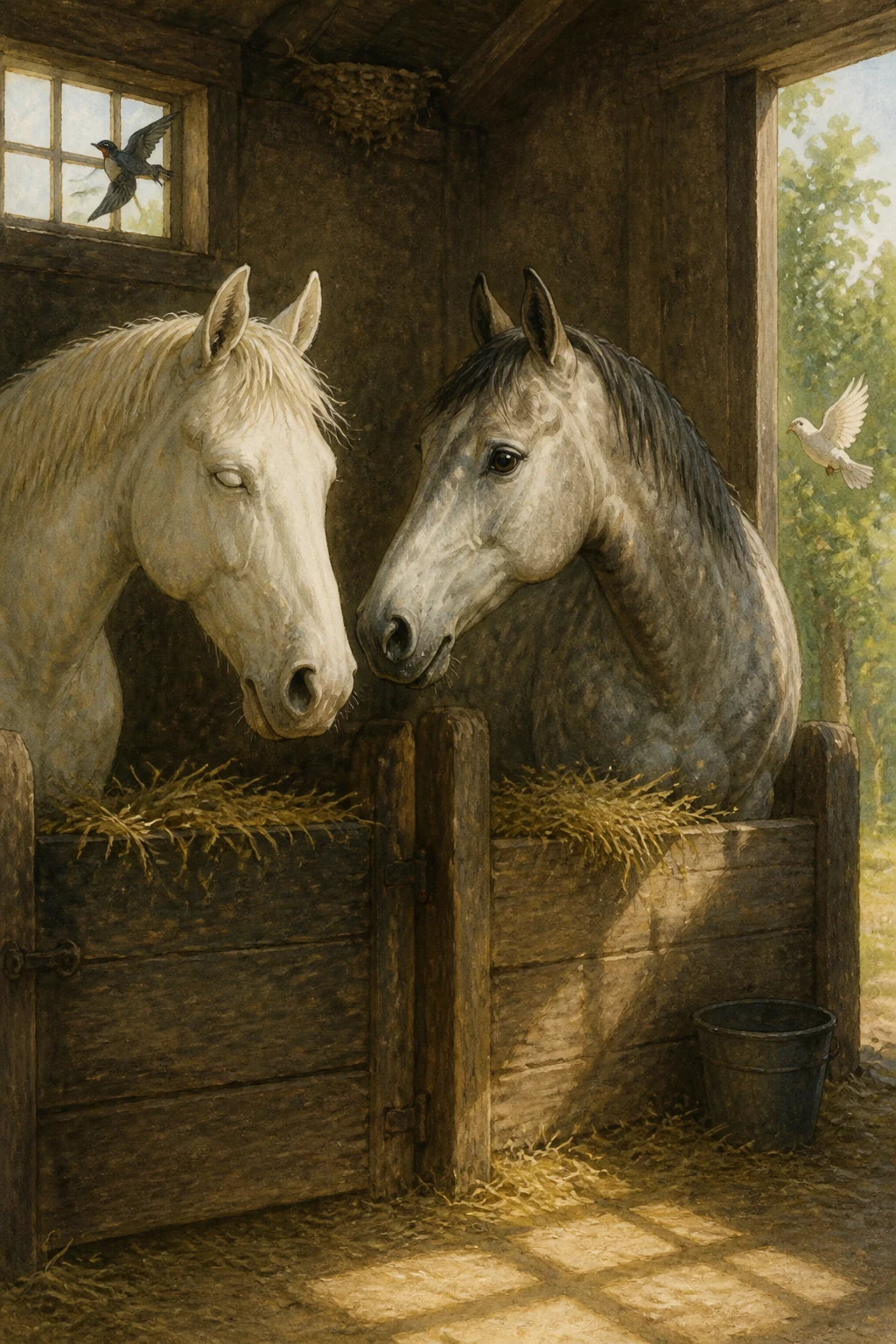
Rjavki iz iste vprege sta se pogovarjali vsaka v svojem stojišču, drugi konji pa so poslušali. To je bila ena od nadlog življenja v hlevu: sosedu nisi mogel ničesar reči, ne da bi te slišal še kdo drug. Kmet je med stojišči postavil trdne stene, odprtine v njih pa so bile tako daleč zadaj, da noben konj ni mogel pomoliti glave skoznje, ne da bi pretrgal oglavnik. Tako je uredil zato, da se konji ne bi grizli, in ker nikomur razen Jabolčastemu Sivcu kaj takega še na misel ni prišlo, so bili drugi zaradi tega po krivici prikrajšani. Materam je bilo težko pravilno vzgajati otroke, saj so morale žrebičku, ko je bil dovolj star za lastno stojišče, nasvete in svarila klicati tako glasno, da so jih slišali vsi. Saj veste, da otroka ni dobro karati pred drugimi, če se temu le lahko izognemo. In prav to vprašanje je zdaj skrbelo Rjavki. Vsaka je imela dveletnega žrebička in vedeli sta, da ju bo kmet kmalu začel navajati na delo. Rjavki sta bili sestri, zato sta bila njuna otroka seveda bratranec in sestrična. Vsi so se imeli zelo radi, radi pa so imeli tudi Slepega Konja, ki je bil stric Rjavk in prastric Rjavčka in Sivke.
»Skrbi me za Rjavčka,« je rekla njegova mati. »Odkar so ga lansko jesen pripeljali v hlev in mu dali stojišče proč od mene, se je navzel slabih navad. Neštetokrat sem mu že rekla, da ne sme glodati roba jasli, pa je bilo prvo, kar sem danes zjutraj zaslišala, škrtanje njegovih zob po lesu.«
»No,« je rekla njegova teta, »saj veš, da mu rastejo zobje. Morda je krivo to.« »To ni noben izgovor,« je strogo odvrnila mati. »Zobje mu rastejo že od petega dne življenja in zadnji mu bo zrasel šele čez tri leta. Zame ni nobena pridnost, če ne glodaš jasli takrat, ko ti sploh ni do glodanja. Odvaditi se mora zdaj. Sicer pa, če bo čakal, da mu zrastejo vsi zobje, se te razvade ne bo mogel več otresti, tudi če bo poskusil.«
»Res je,« je rekla teta, »pa še zobe si bo uničil.« »Pha!« je vzkliknil Rjavček, ki je slišal njun pogovor. »Lahko neham, kadar hočem, in navsezadnje so zobje moji. Nikogar drugega se ne tiče, če si jih uničim.«
»No, vidiš!« je rekla njegova mati teti. »Prav o tem govorim. Ves čas se tako pogovarja z menoj. Kaj bi ti storila?« »Pustite ga pri miru,« je prhnil Jabolčasti Sivec. »Pustite ga pri miru, pa bo že dobil nekaj konjske pameti, ko ga bodo vpregli. Težka mu bo predla, nazadnje pa bo že vse prav.«
Rjavček je bil tako nejevoljen, da je brcnil ob pregrado svojega stojišča. »Prav hvaležen vam bom, če me pustite pri miru,« je rekel. »Ne vem, zakaj mi vsi govorite, kaj naj počnem. Saj menda tudi sam kaj vem.«
»Ti bom jaz povedal, zakaj,« je rekel Jabolčasti Sivec z glasom, po katerem se je slišalo, kako zelo se trudi, da ne bi izgubil potrpljenja. »Zato, ker si mlad in te imamo radi, pa ti lahko prihranimo marsikatero težavo, če poslušaš, kar ti govorimo. Meni so črne jamice v sprednjih zobeh izginile, še preden si se ti rodil, in konj, ki živi dovolj dolgo, da mu izginejo črne jamice v sprednjih zobeh, že marsikaj ve. Zdaj še vzvodne brzde ne ločiš od navadne žvale, a ko te bodo navajali na vprego, se boš naučil marsičesa — prav zares marsičesa.«
Rjavček je vrgel glavo kvišku in ni odgovoril. Ko so ga odpeljali napajat, je Jabolčasti Sivec hitro nagovoril prijatelje. »Pustili ga bomo pri miru,« je rekel, »kakor si želi. Ne bomo mu svetovali, dokler nas sam ne prosi.« Vsi so še pritrjujoče rezgetali, ko se je Rjavček vrnil. Nato je nastala takšna tišina, da bi slišal pasti bilko sena.
Naslednjih nekaj dni se je Rjavček imenitno imel. Nihče mu ni ničesar svetoval in celo kadar je glodal rob jasli, se je zdelo, da mati tega niti ne opazi. Ko je ugotovil, da mu nič ne reče, je začel tudi sam manj glodati jasli. Bil je tako nespameten in svojeglav mladenič, da si je vselej, kadar so mu kaj prepovedali, prav tisto želel početi bolj kot karkoli drugega na svetu. Njegova sestrična Sivka mu ni bila prav nič podobna. Bila je krotka dveletna žrebička, ki so jo imeli vsi radi. Bila je razigrana in na travniku ni bilo veselejše družabnice od nje, vendar je starejše konje vselej poslušala in ubogala, kadar so ji kaj svetovali.
Rjavček je imel sestrično zelo rad, vendar jo je tudi rad dražil. Nekoč jeseni, preden so se za stalno preselili v hlev, ji je rekel »pridna punčka«, ker ni hotela z njim preskočiti ograje in pobegniti. Rekel je, da tega noče storiti, ker ne ve, kaj je zabava. Takrat pa je pokazala, da se tudi ona zna razjeziti: rjave oči so se ji zabliskale in mehke ustnice je privihala, da so se pokazali vsi njeni sekalci. »Nisem nobena ‘pridna punčka’,« je zavpila in s svojimi lepimi kopitci udarjala ob tla, »in še kako rada bi šla. Vsakič, ko pomislim na tisto ograjo, se mi zdi, kakor da me nevidne vrvi vlečejo k njej, pa ne bom šla! Ne bom šla! Mama pravi, da je kot žrebička nekoč preskočila ograjo in pobegnila, potem pa se je počutila strašno nizkotno.«
»Nič mi ni mar,« je rekel njen bratranec, »jaz grem vseeno, ti pa kar ostani doma, če hočeš. Zbogom!« Stekel je, preskočil ograjo in z visoko dvignjeno glavo ter privzdignjenim repom odkasal po cesti. In kako zelo si je Sivka želela za njim! »Ne bom!« je spet rekla. »Ne bom tega storila. Pogledala bom drugam in skušala pozabiti. Ko bi le vedel, kako težko je včasih biti priden.«
Naslednje jutro je bil Rjavček spet na pašniku. Kmet in njegov hlapec sta ga našla daleč proč in ga pripeljala nazaj. »Imenitno sem se imel,« je rekel sestrični, »in prav nič nizkotno se ne počutim. Danes grem spet, ampak nikomur ne povej.« Ko ga je mati oštela, kakor si je zaslužil, je samo švigal z repom in razmišljal o nečem drugem, dokler ni nehala govoriti. Potem je spet pobegnil.
Ko ga je Sivka naslednje jutro zagledala, je imel okoli vratu čudno leseno pripravo, na njej pa je bil pritrjen drog, ki je štrlel predenj. Od njega ga je bolel vrat in oviral ga je, kadar je hotel teči. Če bi poskusil preskočiti ograjo, bi ga prekucnilo na tla. Ko se mu je Sivka približala, se je pretvarjal, da je ne vidi. Prav tako dobro bi jo lahko pogledal naravnost v oči, takoj ko je prišla, saj jo je prej ali slej vendar moral pogledati. Toda počutil se je nizkotno, potuhnjeno in preplašeno, kakor se vselej počutimo, kadar storimo kaj napačnega in imamo potem čas o tem premišljevati. Poleg tega si je od tedaj, ko so mu nadeli leseni jarem, premislil in njegov pobeg se mu je zdaj zdel zelo neumen. Spraševal se je, kako se mu je to sploh kdaj lahko zdelo zabavno, in bil je tako nejevoljen sam nase, da mu uhlji niso mogli mirovati, ampak jih je nemirno premikal, kadar se je spomnil svoje neumnosti.
Sivka je bila preveč obzirna, da bi omenila njegov jarem, zato je govorila o travi, nebu, drevesih in vsem drugem, česar se je domislila. Nekoč je že hotela omeniti ograjo, pa se je spomnila in sredi stavka utihnila. Rjavček je to opazil. »Kar nadaljuj,« je rekel. »Zelo prijazna si, ampak sam dobro vem, kako neumen sem bil, zato nima smisla molčati. Prav si imela. Za nekaj minut domnevne zabave se res ne splača skakati čez ograje. Kar slabo mi postane, ko pomislim na to.«
»Kako zoprno,« je zarezgetala Sivka. »Zelo mi je žal zate.« »In veš kaj?« je rekel Rjavček. »Danes zjutraj sem slišal Jabolčastega Sivca reči, da sem kakor prašič! Pomisli, žrebiček pa podoben prašiču! Rekel je, da je prašičem čisto vseeno, na kateri strani ograje so, saj si vselej želijo na drugo stran, in da sem jaz prav tako neumen.«
Vse to se je zgodilo jeseni, preden jih je mraz pregnal v hlev, in dokler je Rjavček nosil jarem, ni prav zlahka pozabil nauka, ki ga je dobil o preskakovanju ograj in bežanju. Mati je postala prav ponosna nanj in celo Jabolčastega Sivca so slišali reči, da utegne iz njega še kaj biti. To je bilo iz ust Jabolčastega Sivca res veliko, kajti čeprav je imel zelo dobro srce, je druge le redko pohvalil, o dveletnikih pa skoraj nikoli ni govoril tako. Zato mu je bilo toliko težje, ko je Rjavček postal osoren, ker so mu rekli, naj neha glodati jasli.
Saj veste, nekateri žrebički se zlahka naučijo ubogati, drugi pa se morajo najprej hudo boriti, da nehajo preskakovati ograje, potem spet, da nehajo glodati jasli, pa znova, da nehajo brcati, in tako naprej skozi vsa žrebičja leta. Starejšim konjem se smilijo in skušajo jim pomagati, saj vedo, da ne žrebiček ne odrasel konj ne more zares uživati življenja, dokler si ne prizadeva ravnati prav. Seveda tudi tedaj včasih naredimo kaj narobe, a če sprejmemo nasvet in se še naprej trudimo, bo iz nas zagotovo kaj dobrega.
In zdaj, ko se je zdelo, da je Rjavček pozabil jesenski nauk, in potem ko je drugim konjem rekel, naj ga pustijo pri miru, so se začele dogajati prav nenavadne reči. Kmet ga je odpeljal iz stojišča in ga pripravil do tega, da je odprl gobec. Nato mu je vanj potisnil kos železa, ki mu je legel čez jezik in se na vsaki strani prilegal v brezzobi del čeljusti. Na obeh straneh tega železa so bile pripete dolge vajeti, in kadar je opletal z glavo ter se umikal vstran, jih je kmet narahlo potegnil, železna žvala pa mu je pritisnila na jezik.
Kmet je bil zelo prijazen, a Rjavček ni hotel imeti žvale v gobcu, zato se je vedel kar najbolj grdo: brcal je, hlastal z odprtim gobcem in skušal zbežati. Kmet ni postal ne jezen ne osoren, toda vsakič, ko se je Rjavček raztogotil, mu je žvala pritisnila na jezik in raztegnila ustna kotička, dokler ni moral odnehati. Tu in tam ga je kmet poskušal pobožati in mu pokazati, da je vse v redu, a Rjavček tega ni dovolil, in ko so ga odpeljali nazaj v stojišče, je bil zelo čemeren in prepoten dveletnik.
Opazil je, da Sivke ni na njenem običajnem mestu, toda kmalu je prišla z enim od kmetovih hlapcev. Tudi njo so prvič vodili z vajetmi.
»Hej!« je rekel. »Si imela tudi ti žvalo v gobcu? Ali ni bilo grozno? Tako sem jezen, da me kar ščemi v kopitih, tako rad bi brcnil tega kmeta.« »Težko je bilo,« je rekla Sivka, »ampak mož, ki me je vodil, je bil zelo prijazen in mi je večkrat pustil počivati. Tudi pobožal me je, in to mi je vlilo poguma. Mama pravi, da nas žvala ne bo prav nič več motila, ko se je bomo navadili.«
»No,« je rekel Rjavček, »jaz se je ne bom nikoli navadil. Tega ne bom trpel in pika.« Udaril je s kopiti ob tla in se držal zelo pomembno. Dveletniki so pogosto videti prav tako pomembni kakor desetletniki, počutijo pa se še veliko pomembnejše. Rjavček je bil precej ponosen na svoje noge in zdelo se mu je veliko lepše imeti cela kopita kakor preklana, kakršna imajo krave, prašiči in ovce.
Ko je rekel, da ne bo trpel, da bi ga vodili z vajetmi, je skozi stojišča šel nenavaden tih šum. Spominjal je na veter, ki se sprehodi čez žitno polje, povzročili pa so ga starejši konji, ki so globoko vzdihovali in šepetali sami pri sebi. Rjavčkova mati je govorila: »Ubogi otrok! Kako si sam otežuje življenje!«
Naslednji dan so oba žrebička spet vodili z vajetmi, pa dan zatem in še naslednji dan in spet naslednji. Dotlej se je Sivka tega že povsem navadila. Rekla je, da ji je kar všeč vedeti, kaj človek misli, in da njegove misli razbere iz potegov vajeti, podobno kakor je nekoč, ko je bila še čisto majhna žrebička, razumela mater, kadar sta se podrgnili s smrčkoma. Njen bratranec pa je imel od sunkovitega vlečenja vajeti ves gobec razbolel in pri jedi ni mogel prav nič uživati. Zaradi tega mu je bilo še težje, saj je postal zelo lačen, kadar smo lačni, pa ni tako lahko biti razumen.
Ko se je Sivka naučila enakomerno hoditi in zavijati, kakor je želel njen vodnik, so ji dovolili vleči lahek hlod po brazdah njive. To jo je utrudilo, a bila je tudi zelo ponosna, zato je usločila vrat in stopala nadvse ljubko. Hlod sicer ni bilo treba vleči po njivi, vendar tega ni vedela in je mislila, da opravlja pravo delo, čeprav so jo s tem le učili vleči. Mož, ki jo je vodil, jo je pobožal po vratu in ji z dlanjo objel smrček. Ko se je ustavil, da bi pojedel jabolko, ji je dal ogrizek in zdelo se ji je, da še nikoli ni okusila česa tako dobrega. Ko se je vračala v svoje stojišče, je zaklicala bližnjim konjem: »Delala sem! Hlod sem vlekla po vsej njivi.«
Slepi Konj jo je tiho nagovoril. »Srečno življenje boš imela, draga moja, ker rada delaš.« Rjavček ni rekel ničesar, veliko pa je premišljeval, in to o marsičem. Med premišljevanjem je začel glodati jasli, a škrtanje njegovih zob po lesu ga je zdramilo, da je stresel z glavo in si zašepetal: »Nikoli več ne bom glodal jasli.« Ko je jedel večerjo, ga je razboleli gobec pekel, vendar ni zastokal. »Saj si zaslužiš,« si je rekel. »Ne bi te bolelo, če bi bil miren kakor tvoja sestrična.« Rjavček je zelo hitro postajal pametnejši.
Jabolčasti Sivec je opazil, kako nenadoma je nehal glodati jasli, zato ga je nekaj dni opazoval. Videl je, da Rjavček misli resno, da brez vsakega upiranja vleče hlod sem ter tja, kmalu pa so ga skupaj z materjo vpregli v plug. Tisti dan sta orala tudi Jabolčasti Sivec in Slepi Konj in sta jima zaklicala s svoje njive. »Lep dan za oranje,« sta rekla.
»Imeniten,« je odgovoril Rjavček. »Sta videla zadnjo brazdo, ki sva jo zaorala? Jo znata vidva bolje? Če bi poskočil, bi bila kriva namesto ravna, in če bi se ustavil, še zdaj ne bi bila končana.«
»Lepa brazda! Čudovita brazda!« je odvrnil Jabolčasti Sivec. »Vedno sem vedel, da boš dober delavec, ko se boš enkrat lotil dela. Zdaj si eden izmed nas, eden izmed delovnih konj. Vesel sem tega. Zbogom!« In obrnil se je, da bi s plugom spet krenil čez njivo.
»Ti je všeč, da si odrasel?« ga je vprašala mati. »Všeč?« je v smehu odgovoril. »Tako sem ponosen, da sploh ne vem, kaj bi. Za nič na svetu se ne bi vrnil k prejšnjemu življenju, ko sem se samo igral. In moja mala sestrična mi je pomagala spoznati napake. Je bil sploh še kdaj kak žrebiček tako neumen kakor jaz?«
»Prav veliko jih je bilo,« je rekla mati. »Več, kot si misliš. Brcajo in grizejo in skušajo pobegniti, ker ne more biti zmeraj vse po njihovo. Potem pa, ko poskusijo po kmetovo in mu začnejo vračati za njegovo skrb, ugotovijo, da je to veliko lepše od življenja, polnega same igre. Žrebički bodo pač žrebički.«
Izvirnik
The span of Bays were talking together in their stalls, and the other Horses were listening. That was one trouble with living in the barn, you could not say anything to your next-door neighbor without somebody else hearing. The farmer had solid walls between the stalls, with openings so far back that no Horse could get his head to them without breaking his halter. This had been done to keep them from biting each other, and as nobody but the Dappled Gray ever thought of doing such a thing, it was rather hard on the rest. It made it difficult for the mothers to bring up their children properly, for after a Colt was old enough to have a stall to himself, his mother had to call out her advice and warnings so loudly that everybody could hear, and you know it is not well to reprove a child before company if it can be helped. Indeed, it was this very question that was troubling the span of Bays now. Each of them had a two-year-old Colt, and they knew that it was nearly time for the farmer to put these Colts to work. The span of Bays were sisters, so of course their children were cousins, and they were all very fond of each other and of the Blind Horse, who was the uncle of the Bays and the great-uncle of the Bay Colt and the Gray Colt.
"I am worried about the Bay Colt," said his mother. "Since he was brought into the barn last fall and had a stall away from me, he has gotten into bad ways. I have told him again and again that he must not nibble the edge of the manger, yet the first thing I heard this morning was the grating of his teeth on the wood."
"Well," said his aunt, "you know he is teething, and that may be the reason."
"That is no excuse," said his mother sternly. "He has been teething ever since he was five days old, and he will not cut his last tooth for three years yet. I don't call it goodness to keep from cribbing when you don't want to crib, and the time to stop is now. Besides, if he waits until he has all his teeth, he won't be able to break himself of the habit when he does try."
"That is so," said his aunt, "and he will ruin his teeth, too."
"Pooh!" exclaimed the Bay Colt, who had heard what they were saying. "I can stop whenever I want to, and they're my own teeth, anyway. It isn't anybody else's business if I do ruin them."
"There!" said his mother to his aunt, "you see what I mean. That is just the way he talks all the time. Now what would you do?"
"Let him alone," snorted the Dappled Gray. "Let him alone, and he will get some Horse sense after he has been broken. He'll have a hard time of it, but he'll come out all right."
The Bay Colt kicked against the side of the stall, he was so vexed. "I'll thank you to let me alone," said he. "I don't see why everybody tells me what I ought to do. Guess I know a thing or two."
"I'll tell you why," said the Dappled Gray, in a voice that sounded as though he were trying very hard not to lose his temper. "It is because you are young and we like you, and we can save you trouble if you mind what we tell you. I had lost the black pits in my front teeth before you were born, and when a Horse has lived long enough to lose the black pits from his front teeth, he knows a good deal. You don't know a curb-bit from a snaffle now, but you will learn many things when you are broken--a very great many things."
The Bay Colt tossed his head and did not answer. When he was led out to drink, the Dappled Gray spoke quickly to his friends. "We will let him alone," said he, "as he wishes. We will not advise him until he asks us to do so." They were all whinnying "Yes" when the Bay Colt came back. Then it became so still that you could have heard a stem of hay drop.
For a few days after this, the Bay Colt had a very good time. Nobody gave him any advice, and even when he gnawed at the edge of the manger, his mother did not seem to notice it. After he found that she didn't say anything, he didn't gnaw, or crib, so much. He was such a foolish and contrary young fellow that when people told him not to do a thing, he always wanted to do that thing worse than anything else in the world. His cousin, the Gray Colt, was not at all like him. She was a gentle little two-year-old whom everybody loved. She was full of fun and was the gayest possible companion in the meadow, yet when the older Horses gave her advice, she always listened and obeyed.
The Bay Colt was very fond of his cousin, but he did like to tease her, and once in the fall, before they came to stay in the barn, he called her a "goody-goody" because she wouldn't jump the fence and run away with him. He said she wouldn't do such things because she didn't know what fun was. Then she did show that she had a temper, for her brown eyes snapped and her soft lips were raised until she showed all her biting teeth. "I'm not a 'goody-goody,'" she cried, stamping the ground with her pretty little hoofs, "and I just ache to go. I feel as though there were ropes that I couldn't see, pulling me toward that fence every time I think of it, but I won't go! I won't go! My mother says that she jumped a fence and ran away when she was a Colt, and that she felt as mean as could be afterward."
"I don't care," said her cousin, "I'm going anyway, and you can stay at home if you want to. Good-bye!" He ran and leaped over the fence, and trotted down the road with his head well up and his tail in the air. And then how the Gray Colt did want to follow! "I won't!" she said again. "I won't do it. I'll look the other way and try to forget it, but I wish he knew how hard it is to be good sometimes."
The next morning the Bay Colt was in the pasture again. The farmer and his man had found him far away and led him back. "I had a fine time," he said to his cousin, "and I don't feel a bit mean. I'm going again to-day, but don't you tell." When his mother scolded him as he deserved, he just switched his tail and thought about something else until she stopped talking. Then he ran away again.
The next morning when the Gray Colt saw him, he had a queer wooden thing around his neck, and fastened to this was a pole that stuck out ahead of him. It tired his neck and bothered him when he wanted to run. If he had tried to jump the fence, it would have thrown him down. When the Gray Colt came toward him, he pretended not to see her. He might just as well have looked squarely at her as soon as she came, because, you know, he had to look at her sometime, but he had a mean, slinking, afraid feeling, such as people always have when they have done something wrong and have had time to think about it. Besides, he had changed his mind since the wooden poke had been put on him, and somehow his running away seemed very foolish now. He wondered how he could ever have thought it any fun, and he was so disgusted that he couldn't keep his ears still, but moved them restlessly when he remembered his own silliness.
The Gray Colt was too polite to say anything about his wearing the poke, and she talked about the grass, the sky, the trees, and everything else she could think of. Once she was about to speak of the fence, and then she remembered and stopped short. The Bay Colt noticed this. "You might just as well go on," said he. "You are very kind, but I know how foolish I have been, and there's no use in keeping still. You were right, and it doesn't pay to jump fences for a few minutes of what you think will be fun. I feel sick all over when I think about it."
"It's too bad," whinnied the Gray Colt. "I'm very sorry for you."
"And what do you think?" said the Bay Colt. "I heard the Dappled Gray say this morning that I was like a Pig! Imagine a Colt being like a Pig! He said that it didn't make any difference on which side of a fence Pigs were, they always wanted to be on the other side, and that I was just as stupid."
This was all in the fall, before the cold weather had sent them to live in the barn, and while the Bay Colt was wearing the poke he could not well forget the lesson he had learned about jumping and running away. His mother grew quite proud of him, and the Dappled Gray had been heard to say that he might amount to something yet. That was a great deal for the Dappled Gray to say, for although he had a very kind heart, he did not often praise people, and hardly ever said such things about two-year-olds. That made it all the harder for him when the Bay Colt became cross over being told to stop cribbing.
You know there are some Colts who learn obedience easily, and there are others who have one hard struggle to stop jumping, and another to stop cribbing, and another to stop kicking, and so on, all through their Colthood. The older Horses are sorry for them and try to help them, for they know that neither Colt nor Horse can really enjoy life until he is trying to do right. To be sure, people sometimes do wrong even then, but if they will take advice and keep on trying they are certain to turn out well.
And now, when the Bay Colt seemed to have forgotten the lesson he had in the fall, and after he had told the other Horses to let him alone, very strange things began to happen. The farmer took him from his stall and made him open his mouth. Then a piece of iron was slipped into it, which lay on top of his tongue and fitted into the place on each side of his jaw where there were no teeth. Long lines were fastened to this iron on either side, and when he tossed his head and sidled around, these lines were gently pulled by the farmer and the iron bit pressed down his tongue.
The farmer was very kind, but the Bay Colt did not want the bit in his mouth, so he acted as ugly as he knew how, and kicked, and snapped with his jaws open, and tried to run. The farmer did not grow angry or cross, yet whenever the Bay Colt showed his temper, the bit would press down his tongue and stretch the corners of his mouth until he had to stop. Once in a while the farmer would try to pat him and show him that it was all right, but the Bay Colt would not have this, and he was a very cross and sweaty two-year-old when he was taken back to his stall.
He missed the Gray Colt from her usual place, but soon she came in with one of the farmer's men. She had been driven for the first time also.
"Hallo!" said he. "Have you had a bit in your mouth too? Wasn't it dreadful? I am so angry that my hoofs fairly tingle to hit that farmer."
"It was hard," said the Gray Colt, "but the man who drove me was very kind and let me rest often. He patted me, too, and that helped me to be brave. My mother says we won't mind the bit at all after we are used to it."
"Well," said the Bay Colt, "I'm never going to be used to it. I won't stand it, and that's all there is about it." He stamped his hoofs and looked very important. Two-year-olds often look quite as important as ten-year-olds, and they feel much more so. The Bay Colt was rather proud of his feet, and thought it much nicer to have solid hoofs than to have them split, like those of the Cows, the Hogs, and the Sheep.
When he said that he would not stand it to be driven, a queer little sound ran through the stalls. It was like the wind passing over a wheatfield, and was caused by the older Horses taking a long breath and whispering to themselves. The Bay Colt's mother was saying, "Poor child! What hard work he does make of life!"
The next day both Colts were driven again, and the next day, and the next, and the next. By this time the Gray Colt was quite used to it. She said she rather enjoyed knowing what the man was thinking, and that she could tell his thoughts by the feeling of the lines, much as she used to understand her mother by rubbing noses when she was a tiny Colt. Her cousin had a sore mouth from jerking on the lines, and he could not enjoy eating at all. That made it even harder for him, because he got very hungry, and it is not so easy to be sensible when one is hungry.
When the Gray Colt learned to walk steadily and turn as her driver wished, she was allowed to draw a light log through the furrows of a field. This tired her, but it made her very proud, and she arched her neck and took the daintiest of steps. It was not necessary that the log should be drawn over the field; still, she did not know this, and thought it was real work, when it was done only to teach her to pull. The man who was driving her patted her neck and held her nose in his hand. When he stopped to eat an apple, he gave her the core, and she thought she had never tasted anything so good. As she went back to her stall, she called to the Horses near, "I have been working. I have drawn a log all around a field."
The Blind Horse spoke softly to her. "You will have a happy life, my dear, because you are a willing worker."
Although the Bay Colt didn't say anything, he thought a great deal, and about many things. While he was thinking he began to crib, but the noise of his biting teeth on the wood startled him, and he shook his head and whispered to himself, "I will never crib again." When he ate his supper, his sore mouth hurt him, but he didn't whimper. "You deserve it," he said to himself. "It wouldn't have been sore if you had been steady like your cousin." The Bay Colt was growing sensible very fast.
The Dappled Gray had noticed how suddenly he stopped cribbing, and so watched him for a few days. He saw that the Bay Colt was in earnest, that he drew the log up and down without making any fuss, and was soon hitched with his mother to a plow. The Dappled Gray and the Blind Horse were also plowing that day, and they called across from their field. "Fine day for plowing," they said.
"Perfect," answered the Bay Colt. "Did you notice the last furrow we turned? Can you do any better than that? If I had jumped, it would have been crooked instead of straight; and if I had stopped, it would not be done yet."
"Good furrow! Wonderful furrow!" answered the Dappled Gray. "Always knew you'd be a good worker when you got down to it. You are one of us now, one of the working Horses. Glad of it. Good-bye!" And he turned away to start his plow across the field again.
"Do you like being grown up?" said the Bay Colt's mother to him.
"Like it?" he answered with a laugh. "I'm so proud that I don't know what to do. I wouldn't go back to the old life of all play for anything in the world. And my little cousin made me see my mistakes. Was there ever another Colt as foolish as I?"
"A great many of them," said his mother. "More than you would guess. They kick and bite and try to run because they cannot always have their own way; and then, when they have tried the farmer's way, and begin to pay for his care of them, they find it very much better than the life of all play. Colts will be Colts."