Prevod
Once upon a time there was a Queen who gave birth to a son so ugly and so misshapen that for a long time people doubted whether he was even human. A Fairy who was present at his birth declared that he would nevertheless be lovable, for he would be blessed with great wit. She even added that, by virtue of the gift she had just bestowed on him, he would be able to give as much wit as he himself possessed to the person he loved best.
All this brought some comfort to the poor Queen, who was deeply distressed at having brought such an ugly little creature into the world. Indeed, scarcely had the child begun to speak when he said a thousand delightful things, and there was something so clever in everything he did that everyone was charmed. I forgot to mention that he was born with a little tuft of hair on his head, which was why he was called Riquet with the Tuft, for Riquet was the family name.
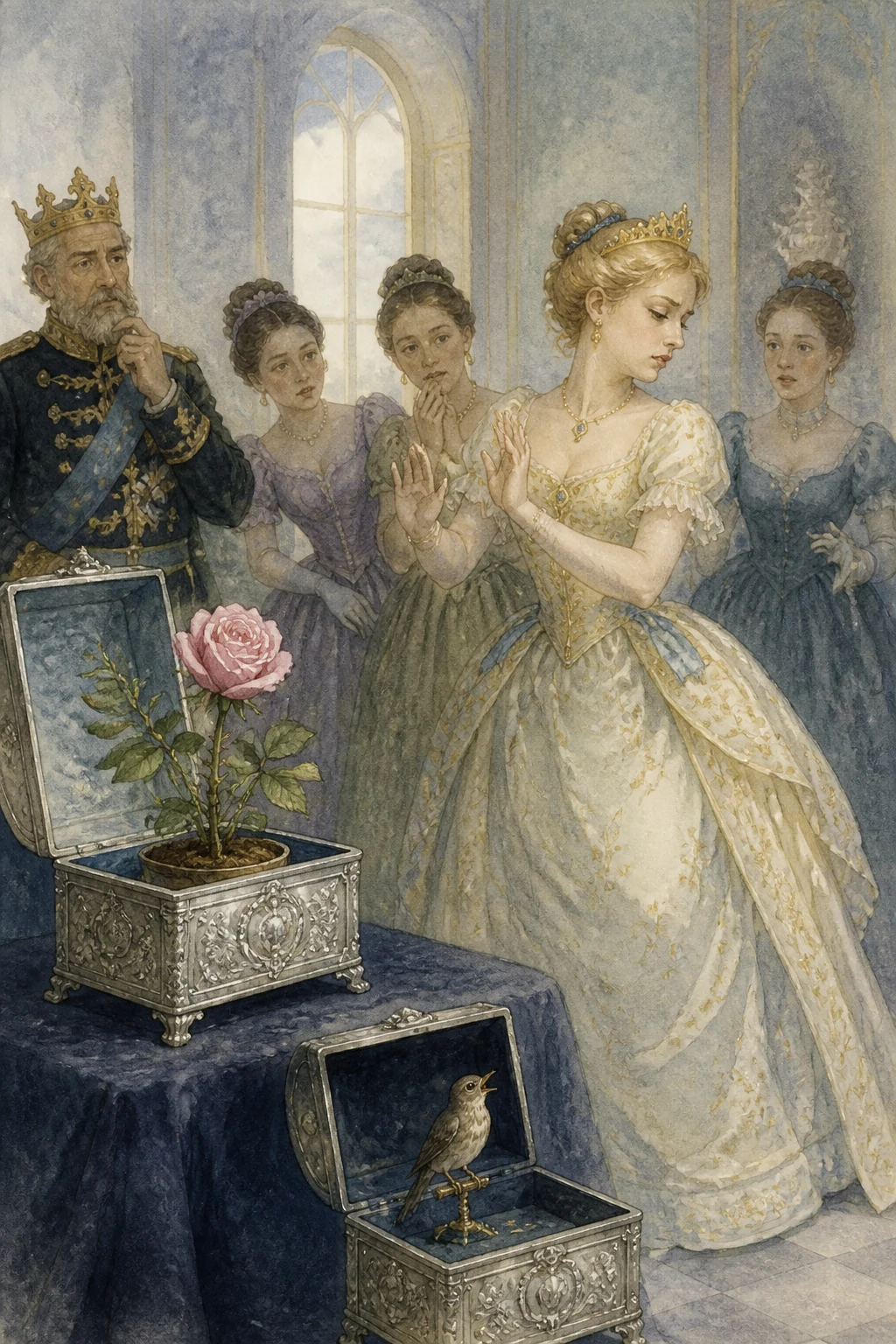
Seven or eight years later, the Queen of a neighbouring kingdom gave birth to two daughters. The first to be born was more beautiful than the day, and the Queen was so delighted that people feared such overwhelming joy might do her harm. The same Fairy who had attended the birth of little Riquet with the Tuft was present, and, to temper the Queen’s joy, she told her that this little Princess would have no wit at all, and would be as stupid as she was beautiful. This greatly distressed the Queen; but a few moments later she had a far greater sorrow, for the second daughter she bore proved to be exceedingly ugly. “Do not grieve so much, Madam,” the Fairy told her. “Your daughter will be blessed in other ways, and she will have so much wit that people will scarcely notice her lack of beauty.” “God grant it,” replied the Queen. “But could you not find some way to give a little wit to the elder one, who is so beautiful?” “I can do nothing for her, Madam, where wit is concerned,” said the Fairy, “but where beauty is concerned, I can do anything. And since there is nothing I would not do to please you, I shall give her the power to make the person of her choice beautiful.” As the two Princesses grew, their gifts grew with them, and everywhere people spoke of nothing but the elder’s beauty and the younger’s wit. It is also true that their faults increased greatly with age. The younger grew uglier before everyone’s eyes, while the elder became more stupid every day. Either she made no answer to the questions she was asked, or she said something foolish. Besides this, she was so clumsy that she could not have arranged four pieces of porcelain on a mantelpiece without breaking one, or drunk a glass of water without spilling half of it over her clothes. Although beauty is a great advantage in a young person, the younger sister nevertheless outshone her elder in almost every company. At first people would go to the more beautiful one, to gaze at her and admire her, but soon they would turn to the wittier one to hear her say a thousand delightful things. It was astonishing to see how, in less than a quarter of an hour, the elder would have no one beside her, while everyone had gathered around the younger. Stupid though the elder was, she noticed this well enough, and she would gladly have given all her beauty for half her sister’s wit. The Queen, wise as she was, could not help reproaching her several times for her stupidity, which very nearly made the poor Princess die of grief.
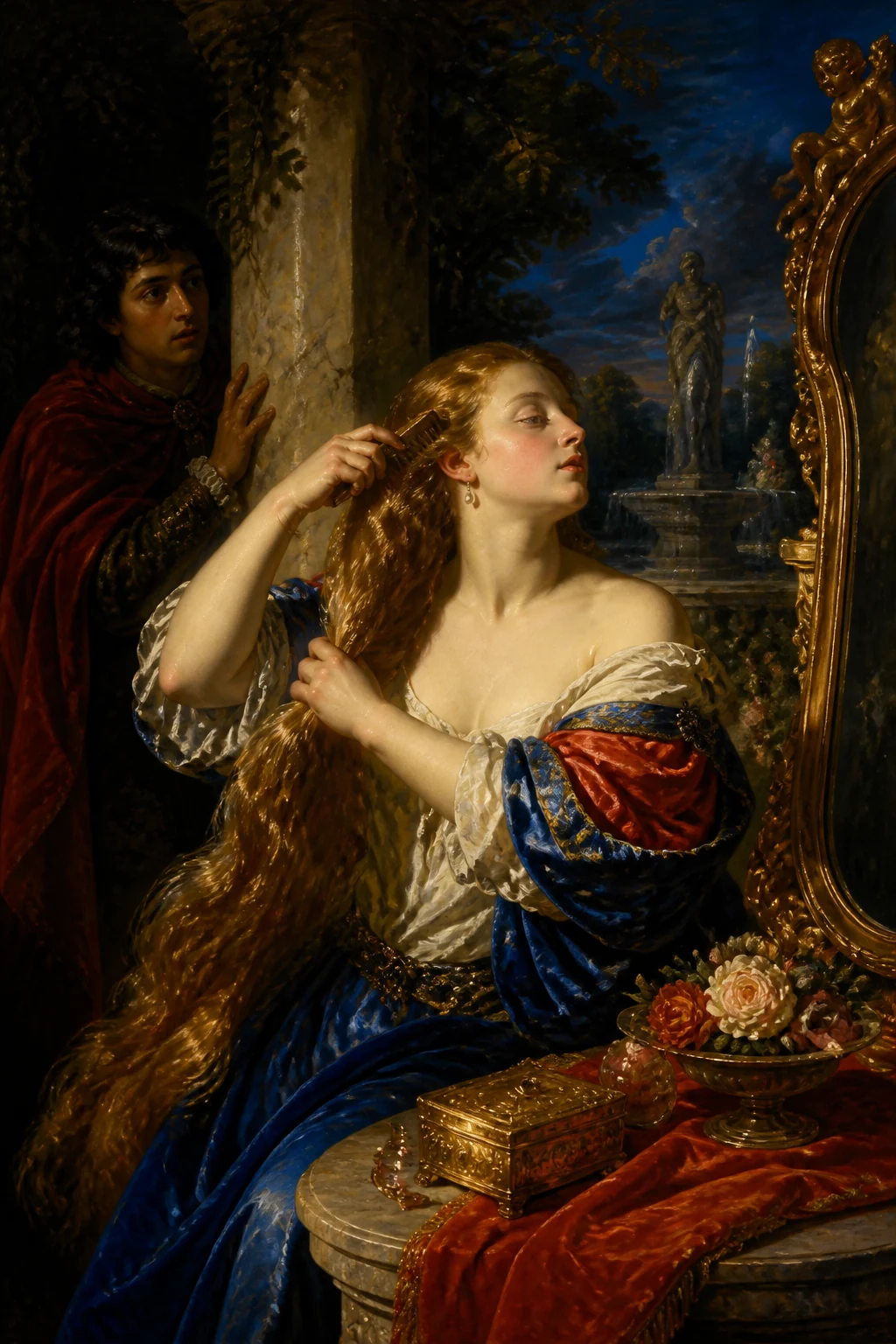
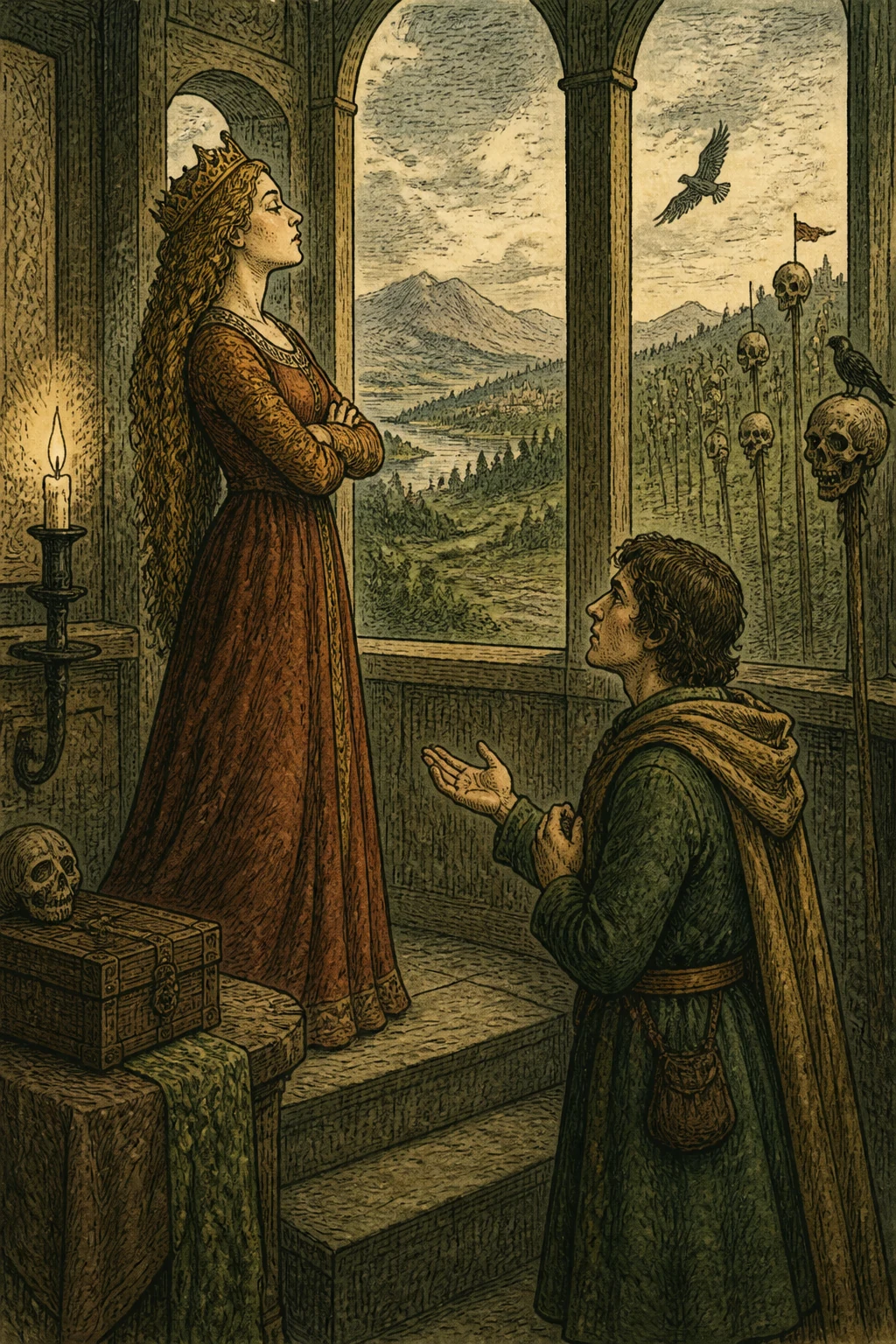
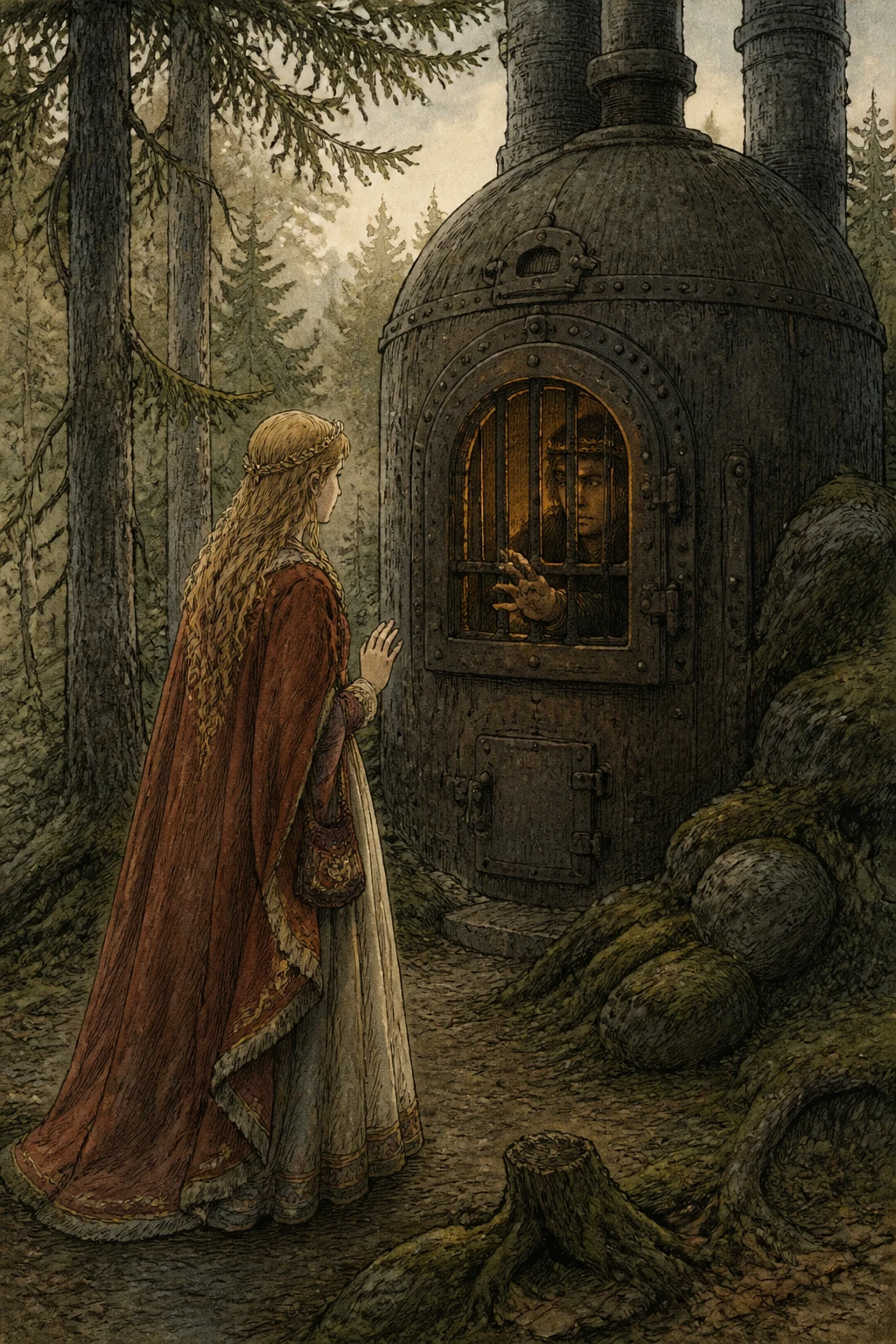
One day, when she had withdrawn into a wood to lament her misfortune, she saw a very ugly and disagreeable little man approaching her, though he was magnificently dressed. It was the young Prince Riquet with the Tuft, who had fallen in love with her from the portraits of her that had travelled all over the world, and had left his father’s kingdom for the pleasure of seeing her and speaking to her. Delighted to find her alone, he approached her with all the respect and courtesy imaginable. After paying her the usual compliments, he noticed that she was very melancholy, and said, “I cannot understand, Madam, how anyone as beautiful as you can be as sad as you appear. For although I may boast of having seen countless beautiful people, I can truly say that I have never seen anyone whose beauty approaches yours.” “You are pleased to say so, sir,” replied the Princess, and said no more. “Beauty,” Riquet with the Tuft continued, “is so great a blessing that it ought to make up for everything else. When one possesses it, I cannot see that anything could cause one much distress.” “I would rather,” said the Princess, “be as ugly as you and have wit than be as beautiful as I am and as stupid as I am.” “There is no surer sign of wit, Madam, than to believe oneself without it; and it is the nature of that gift that the more one has, the more one thinks one lacks.” “I know nothing about that,” said the Princess, “but I know very well that I am very stupid, and that is the cause of the sorrow that is killing me.” “If that is all that troubles you, Madam, I can easily put an end to your sorrow.” “And how will you do that?” asked the Princess. “I have the power, Madam,” said Riquet with the Tuft, “to give all the wit anyone could possess to the person I love best. And since you, Madam, are that person, it rests entirely with you to have as much wit as anyone could have, provided you are willing to marry me.” The Princess was quite taken aback and made no reply. “I see,” Riquet with the Tuft went on, “that this proposal troubles you, and I am not surprised. But I will give you a whole year to make up your mind.” The Princess had so little wit, and at the same time so great a desire to have some, that she imagined the end of that year would never come; and so she accepted his proposal. No sooner had she promised Riquet with the Tuft that she would marry him on that very day a year hence than she felt herself an entirely different person. She found it wonderfully easy to say whatever she wished, and to say it with subtlety, ease, and grace. At once she began a lively and sustained conversation with Riquet with the Tuft, in which she shone so brilliantly that he thought he had given her more wit than he had kept for himself. When she returned to the palace, the whole Court did not know what to make of so sudden and extraordinary a change; for where they had once heard nothing but foolish remarks, they now heard her say things full of good sense and sparkling wit. The joy of the whole Court was beyond imagining. Only her younger sister was displeased, for, having lost her advantage in wit over her elder, she now looked beside her like nothing more than a very disagreeable monkey. The King was guided by the elder Princess’s advice, and sometimes even held his Council in her apartments. As news of this transformation spread, all the young Princes of the neighbouring kingdoms did their utmost to win her love, and almost all asked for her hand in marriage. But she found none of them witty enough, and listened to them all without committing herself to any. At last, however, there came one so powerful, so rich, so witty, and so handsome that she could not help feeling favourably disposed towards him. Her father noticed this and told her that he left the choice of a husband entirely to her: she need only make her wishes known. But since the more wit one has, the harder it is to make a firm decision in such a matter, she thanked her father and asked him to allow her some time to think. By chance, she went walking in the very wood where she had met Riquet with the Tuft, so that she could reflect more freely on what she ought to do. As she walked, deep in thought, she heard a muffled noise beneath her feet, as though many people were bustling to and fro at their work. Listening more closely, she heard one say, “Bring me that pot,” another, “Give me that kettle,” and another, “Put some wood on that fire.” At that very moment the earth opened, and beneath her feet she saw what looked like a vast kitchen, full of cooks, scullions, and all the servants needed to prepare a magnificent feast. A band of twenty or thirty roasting cooks emerged and settled themselves in an avenue of the wood around a very long table. Each, with a larding needle in his hand and a fox’s tail tucked over his ear, began working in time to a melodious song. Astonished at this spectacle, the Princess asked whom they were working for. “For Prince Riquet with the Tuft, Madam,” replied the man who seemed to be in charge. “His wedding is to take place tomorrow.” Still more astonished than before, the Princess suddenly remembered that, a year ago that very day, she had promised to marry Prince Riquet with the Tuft, and she almost fell to the ground. The reason she had forgotten was that she had been a fool when she made the promise, and in receiving the new wit the Prince had given her, she had forgotten all her follies. She had not gone thirty paces farther when Riquet with the Tuft appeared before her, splendidly and magnificently dressed, as befitted a Prince about to be married. “You see me here, Madam,” he said, “faithful to my word, and I have no doubt that you have come to keep yours, and, by giving me your hand, to make me the happiest of men.” “I shall confess to you frankly,” replied the Princess, “that I have not yet made up my mind about that, and I do not believe I shall ever be able to decide as you wish.” “You astonish me, Madam,” said Riquet with the Tuft. “I can well believe it,” said the Princess. “And certainly, if I were dealing with a brute, a man without wit, I should find myself in great difficulty. ‘A Princess has only her word,’ he would tell me, ‘and you must marry me, since you promised you would.’ But as the man I am speaking to has more wit than anyone in the world, I am certain he will listen to reason. You know that even when I was a fool, I could not bring myself to marry you. How can you expect me, now that I have the wit you gave me, which makes me still more particular about people than I was before, to make a decision today that I could not make then? If you truly meant to marry me, you were very wrong to take away my stupidity and make me see more clearly than I did.” “If a man without wit,” replied Riquet with the Tuft, “would be justified, as you have just said, in reproaching you for breaking your word, why should I not do the same, Madam, in a matter on which the whole happiness of my life depends? Is it reasonable that people with wit should be worse off than those without it? Can you maintain such a thing, you who have so much wit and wished so dearly to possess it? But let us come to the point, if you please. Apart from my ugliness, is there anything in me that displeases you? Are you dissatisfied with my birth, my wit, my temper, or my manners?” “Not at all,” replied the Princess. “I like everything in you that you have just mentioned.” “If that is so,” Riquet with the Tuft continued, “I shall be happy, for you have the power to make me the most pleasing of men.” “How can that be?” asked the Princess. “It will happen,” replied Riquet with the Tuft, “if you love me enough to wish it so. And so that you may have no doubt of it, Madam, know that the same Fairy who, on the day of my birth, gave me the power to bestow wit on the person of my choice also gave you the power to make the man you love beautiful, if you wish to grant him that favour.” “If that is so,” said the Princess, “I wish with all my heart that you may become the handsomest and most lovable Prince in the world; and, as far as it lies in my power, I bestow that gift upon you.” No sooner had the Princess spoken these words than Riquet with the Tuft appeared to her the handsomest, most finely formed, and most lovable man she had ever seen. Some maintain that it was not the Fairy’s enchantments that brought this about, but that love alone worked the transformation. They say that the Princess, reflecting on her lover’s constancy, his good judgment, and all the fine qualities of his heart and mind, no longer saw his misshapen body or his ugly face; that his hump seemed to her merely the fine bearing of a man arching his back; and that, where she had hitherto seen him limping dreadfully, she now saw only a certain charming way of leaning to one side. They say, too, that his squinting eyes seemed to her only the brighter for it, that she took their waywardness as a sign of overwhelming love, and that even his great red nose had something martial and heroic about it in her eyes. Be that as it may, the Princess promised at once to marry him, provided he obtained the consent of the King, her father. The King, learning that his daughter held Riquet with the Tuft in great esteem, and knowing him already to be a Prince of great wit and wisdom, gladly welcomed him as his son-in-law. The very next day the wedding took place, just as Riquet with the Tuft had foreseen, and in accordance with the orders he had given long before.
MORAL. What you have read in this little tale Is less an idle fancy than the truth itself: All that we love is beautiful, And all we love is full of wit.
Another Moral. Though Nature grant a person lovely features And all the glowing colours of a complexion That Art could never hope to match, These gifts will do less to awaken a heart Than one unseen attraction That Love discovers there.
Izvirnik
RIQUET
A
LA HOUPPE.
CONTE.
Il estoit une fois une Reine qui accoucha d’un fils, si laid & si mal fait, qu’on douta longtemps s’il avoit forme humaine. Une Fée, qui se trouva à sa naissance, asseura qu’il ne laisseroit pas d’estre aimable, parce qu’il auroit beaucoup d’esprit : elle ajoûta même qu’il pourroit, en vertu du don qu’elle venoit de luy faire, donner autant d’esprit qu’il en auroit à la personne qu’il aimeroit le mieux.
Tout cela consola un peu la pauvre Reine, qui estoit bien affligée d’avoir mis au monde un si vilain marmot. Il est vray que cet enfant ne commença pas plutost à parler qu’il dit mille jolies choses, & qu’il avoit dans toutes ses actions je ne sçai quoi de si spirituel qu’on en estoit charmé. J’oubliois de dire qu’il vint au monde avec une petite houppe de cheveux sur la teste, ce qui fit qu’on le nomma Riquet à la houppe, car Riquet estoit le nom de la famille.
Au bout de sept ou huit ans, la Reine d’un Royaume voisin accoucha de deux filles. La premiere qui vint au monde estoit plus belle que le jour ; la Reine en fut si aise qu’on apprehenda que la trop grande joye qu’elle en avoit ne luy fit mal. La même Fée qui avoit assisté à la naissance du petit Riquet à la Houppe estoit presente, & pour moderer la joye de la Reine, elle luy declara que cette petite Princesse n’auroit point d’esprit, & qu’elle seroit aussi stupide qu’elle estoit belle. Cela mortifia beaucoup la Reine ; mais elle eut, quelques momens aprés un bien plus grand chagrin, car la seconde fille dont elle accoucha, se trouva extremement laide. Ne vous affligez point tant Madame, luy dit la Fée ; vostre fille sera recompensée d’ailleurs, & elle aura tant d’esprit, qu’on ne s’apercevra presque pas qu’il luy manque de la beauté. Dieu le veüille, répondit la Reine ; mais n’y auroit-il point moyen de faire avoir un peu d’esprit à l’aînée, qui est si belle ? Je ne puis rien pour elle, Madame, du costé de l’esprit, luy dit la Fée ; mais je puis tout du costé de la beauté ; & comme il n’y a rien que je ne veüille faire pour vôtre satisfaction, je vais luy donner pour don de pouvoir rendre beau ou belle la personne qui luy plaira. A mesure que ces deux Princesses devinrent grandes, leurs perfections crûrent aussi avec elles, & on ne parloit partout que de la beauté de l’aisnée, & de l’esprit de la cadette. Il est vray aussi que leurs défauts augmenterent beaucoup avec l’âge. La cadette enlaidissoit à veuë d’œil, & l’ainée devenoit plus stupide de jour en jour. Ou elle ne répondoit rien à ce qu’on lui demandoit, ou elle disoit une sottise. Elle estoit avec cela si maladroite qu’elle n’eust pû ranger quatre porcelaines sur le bord d’une cheminée sans en casser une, ny boire un verre d’eau sans en répandre la moitié sur ses habits. Quoy que la beauté soit un grand avantage dans une jeune personne, cependant la cadette l’emportoit presque toûjours sur son aînée dans toutes les Compagnies. D’abord on alloit du costé de la plus belle, pour la voir & pour l’admirer, mais bien tost aprés, on alloit à celle qui avoit le plus d’esprit pour luy entendre dire mille choses agreables ; & on estoit estonné qu’en moins d’un quart d’heure l’aînée n’avoit plus personne auprés d’elle, & que tout le monde s’estoit rangé autour de la cadette. L’aisnée quoy que fort stupide, le remarqua bien, & elle eut donné sans regret toute sa beauté pour avoir la moitié de l’esprit de sa sœur. La Reine toute sage qu’elle estoit, ne put s’empêcher de luy reprocher plusieurs fois sa bestise, ce qui pensa faire mourir de douleur cette pauvre Princesse.
Un jour qu’elle s’estoit retirée dans un bois pour y plaindre son malheur, elle vit venir à elle un petit homme fort laid & fort desagreable, mais vestu tres-magnifiquement. C’estoit le jeune Prince Riquet à la houppe, qui estant devenu amoureux d’elle sur ses Portraits qui courroient par tout le monde, avoit quitté le Royaume de son pere pour avoir le plaisir de la voir & de luy parler. Ravi de la rencontrer ainsi toute seule, il l’aborde avec tout le respect & toute la politesse imaginable. Ayant remarqué aprés luy avoir fait les complimens ordinaires, qu’elle estoit fort melancolique, il luy dit ; je ne comprens point, Madame, comment une personne aussi belle que vous l’estes, peut estre aussi triste que vous le paraissiez ; car quoy que je puisse me vanter d’avoir veu une infinité de belles personnes, je puis dire que je n’en ay jamais vû dont la beauté approche de la vostre. Cela vous plaist à dire, Monsieur, lui répondit la Princesse, & en demeura là. La beauté, reprit Riquet à la houppe, est un si grand avantage qu’il doit tenir lieu de tout le reste ; & quand on le possede, je ne voy pas qu’il y ait rien qui puisse nous affliger beaucoup. J’aimerois mieux, dit la Princesse, estre aussi laide que vous & avoir de l’esprit, que d’avoir de la beauté comme j’en ay, & estre beste autant que je le suis. Il n’y a rien, Madame, qui marque d’avantage qu’on a de l’esprit que de croire n’en pas avoir, & il est de la nature de ce bien-là, que plus on en a, plus on croit en manquer. Je ne sçay pas cela, dit la Princesse, mais je sçay bien que je suis fort beste, & c’est de là que vient le chagrin qui me tuë. Si ce n’est que cela, Madame, qui vous afflige, je puis aisement mettre fin à vostre douleur. Et comment ferez-vous, dit la Princesse ? J’ay le pouvoir, Madame, dit Riquet à la houppe, de donner de l’esprit autant qu’on en sçauroit avoir à la personne que je dois aimer le plus ; & comme vous estes, Madame, cette personne, il ne tiendra qu’à vous que vous n’ayez autant d’esprit qu’on en peut avoir, pourvû que vous vouliez bien m’épouser. La Princesse demeura toute interdite, & ne répondit rien. Je voy, reprit Riquet à la houppe, que cette proposition vous fait de la peine, & je ne m’en estonne pas ; mais je vous donne un an tout entier pour vous y resoudre. La Princesse avoit si peu d’esprit, & en mesme temps une si grande envie d’en avoir, qu’elle s’imagina que la fin de cette année ne viendroit jamais ; de sorte qu’elle accepta la proposition qui luy estoit faite. Elle n’eut pas plûtost promis à Riquet à la houppe, qu’elle l’épouseroit dans un an à pareil jour, qu’elle se sentit tout autre qu’elle n’estoit auparavant ; elle se trouva une facilité incroyable à dire tout ce qui luy plaisoit, & à le dire d’une maniere fine, aisée & naturelle : elle commença dés ce moment une conversation galante, & soutenuë avec Riquet à la houppe, où elle brilla d’une telle force que Riquet à la houppe crut luy avoir donné plus d’esprit qu’il ne s’en estoit réservé pour luy même. Quand elle fut retournée au palais, toute la Cour ne sçavoit que penser d’un changement si subit & si extraordinaire : car autant qu’on luy avoit oüy dire d’impertinences auparavant, autant luy entendoit-on dire des choses bien sensées & infiniment spirituelles. Toute la Cour en eut une joye qui ne se peut imaginer ; il n’y eut que sa cadette qui n’en fut pas bien aise, parce que n’ayant plus sur son aisnée l’avantage de l’esprit, elle ne paroissoit plus auprés d’elle qu’une Guenon fort desagreable. Le Roi se conduisoit par ses avis, & alloit même quelquefois tenir le Conseil dans son Appartement. Le bruit de ce changement s’estant répandu, tous les jeunes Princes des Royaumes voisins firent leurs efforts pour s’en faire aimer, & presque tous la demanderent en mariage ; mais elle n’en trouvoit point qui eust assez d’esprit, & elle les écoutoit tous, sans s’engager à pas un d’eux, Cependant il en vint un si puissant, si riche, si spirituel & si bien fait, qu’elle ne pust s’empêcher d’avoir de la bonne volonté pour luy. Son pere s’en estant apperçû, luy dit qu’il la faisoit la maistresse sur le choix d’un Epoux, & qu’elle n’avoit qu’à se déclarer. Comme plus on a d’esprit & plus on a de peine à prendre une ferme resolution sur cette affaire, elle demanda, aprés avoir remercié son pere, qu’il luy donnast du temps pour y penser. Elle alla par hasard se promener dans le même bois où elle avoit trouvé Riquet à la houppe, pour rêver plus commodement à ce qu’elle avoit à faire. Dans le tems qu’elle se promenoit, rêvant profondement, elle entendit un bruit sourd sous ses pieds, comme de plusieurs personnes qui vont & viennent & qui agissent. Ayant presté l’oreille plus attentivement, elle ouït que l’un disoit apporte-moy cette marmitte, l’autre donne-moy cette chaudiere, l’autre mets du bois dans ce feu. La terre s’ouvrit dans le même temps, & elle vit sous ses pieds comme une grande Cuisine pleine de Cuisiniers, de Marmitons & de toutes sortes d’Officiers necessaires pour faire un festin magnifique. Il en sortit une bande de vingt ou trente Rotisseurs, qui allerent se camper dans une allée du bois autour d’une table fort longue, & qui tous, la lardoire à la main & la queuë de Renard sur l’oreille, se mirent à travailler en cadence au son d’une Chanson harmonieuse. La Princesse estonnée de ce spectacle, leur demanda pour qui ils travailloient. C’est, Madame, luy répondit le plus apparent de la bande, pour le Prince Riquet à la houppe, dont les nopces se feront demain. La Princesse, encore plus surprise qu’elle ne l’avoit esté, & se resouvenant tout à coup qu’il y avoit un an qu’à pareil jour elle avoit promis d’épouser le Prince Riquet à la houppe, elle pensa tomber de son haut. Ce qui faisoit qu’elle ne s’en souvenoit pas, c’est que quand elle fit cette promesse, elle estoit une bête, & qu’en prenant le nouvel esprit que le Prince lui avoit donné, elle avoit oublié toutes ses sottises. Elle n’eut pas fait trente pas en continuant sa promenade, que Riquet à la houppe se presenta à elle, brave, magnifique, & comme un Prince qui va se marier. Vous me voyez, dit-il, Madame, exact à tenir ma parole, & je ne doute point que vous ne veniez ici pour executer la vostre, & me rendre, en me donnant la main, le plus heureux de tous les hommes. Je vous avouëray franchement, répondit la Princesse, que je n’ay pas encore pris ma resolution là-dessus, & que je ne croy pas pouvoir jamais la prendre telle que vous la souhaitez. Vous m’étonnez, Madame, lui dit Riquet à la houppe : Je le croy, dit la Princesse, & asseurement si j’avois affaire à un brutal, à un homme sans esprit, je me trouverois bien embarassée. Une Princesse n’a que sa parole, me diroit-il, & il faut que vous m’épousiez, puisque vous me l’avez promis ; mais, comme celuy à qui je parle est l’homme du monde qui a le plus d’esprit, je suis seure qu’il entendra raison. Vous sçavez que quand je n’estois qu’une beste, je ne pouvois neanmoins me resoudre à vous épouser, comment voulez-vous qu’ayant l’esprit que vous m’avez donné, qui me rend encore plus difficile en gens que je n’estois, je prenne aujourd’hui une resolution que je n’ay pû prendre dans ce temps-là. Si vous pensiez tout de bon à m’épouser, vous avez eu grand tort de m’oster ma bestise, & de me faire voir plus clair que je ne voyois. Si un homme sans esprit, répondit Riquet à la houppe, seroit bien receu, comme vous venez de le dire, à vous reprocher vostre manque de parole, pourquoi voulez-vous, Madame, que je n’en use pas de mesme, dans une chose où il y va de tout le bonheur de ma vie ; est-il raisonnable que les personnes qui ont de l’esprit, soient d’une pire condition que ceux qui n’en ont pas ; le pouvez-vous prétendre, vous qui en avez tant, & qui avez tant souhaité d’en avoir ? Mais venons au fait, s’il vous plaît : A la reserve de ma laideur, y a-t-il quelque chose en moy qui vous déplaise, estes-vous malcontente de ma naissance, de mon esprit, de mon humeur, & de mes manieres ? Nullement, répondit la Princesse, j’aime en vous tout ce que vous venez de me dire. Si cela est ainsi, reprit Riquet à la houppe, je vais estre heureux, puisque vous pouvez me rendre le plus aimable de tous les hommes. Comment cela se peut-il faire, lui dit la Princesse. Cela se fera, répondit Riquet à la houppe, si vous m’aimez assez pour souhaiter que cela soit ; & afin, Madame, que vous n’en doutiez pas, sçachez que la même Fée qui, au jour de ma naissance, me fit le don de pouvoir rendre spirituelle la personne qui me plairoit, vous a aussi fait le don de pouvoir rendre beau celuy que vous aimerez, & à qui vous voudrez bien faire cette faveur. Si la chose est ainsi, dit la Princesse, je souhaite de tout mon cœur que vous deveniez le Prince du monde le plus beau & le plus aimable ; & je vous en fais le don autant qu’il est en moy. La Princesse n’eut pas plustost prononcé ces paroles, que Riquet à la houppe parut à ses yeux, l’homme du monde le plus beau, le mieux fait, & le plus aimable qu’elle eust jamais vû. Quelques-uns asseurent que ce ne furent point les charmes de la Fée qui opererent, mais que l’amour seul fit cette Metamorphose. Ils disent que la Princesse, ayant fait reflexion sur la perseverance de son Amant, sur sa discretion, & sur toutes les bonnes qualitez de son ame & de son esprit, ne vit plus la difformité de son corps, ny la laideur de son visage, que sa bosse ne lui sembla plus que le bon air d’un homme qui fait le gros dos ; & qu’au lieu que jusqu’à lors elle l’avoit vû boitter effroyablement, elle ne lui trouva plus qu’un certain air penché qui la charmoit ; ils disent encore que ses yeux qui estoient louches, ne luy en parurent que plus brillans, que leur déreglement passa dans son esprit pour la marque d’un violent excez d’amour, & qu’enfin son gros nez rouge eut pour elle quelque chose de Martial & d’Heroïque ? Quoy qu’il en soit, la Princesse luy promit sur-le-champ de l’épouser, pourvû qu’il en obtînt le consentement du Roy son pere. Le Roy, ayant sçû que sa fille avait beaucoup d’estime pour Riquet à la houppe, qu’il connoissoit d’ailleurs pour un Prince trés-spirituel & trés-sage, le receut avec plaisir pour son gendre. Dés le lendemain les nopces furent faites, ainsi que Riquet à la houppe l’avoit prévû, & selon les ordres qu’il en avoit donnez long-temps auparavant.
MORALITÉ.
Ce que l'on voit dans cet écrit
Est moins un conte en l’air que la verité même ;
Tout est beau dans ce que l'on aime,
Tout ce qu’on aime a de l’esprit.
Autre Moralité.
Dans un objet où la Nature
Aura mis de beaux traits & la vive peinture
D’un teint où jamais l’Art ne sçauroit arriver,
Tous ces dons pourront moins pour rendre un cœur sensible
Qu’un seul agrément invisible
Que l’Amour y fera trouver.