Prevod
Once upon a time there were a woodcutter and his wife who had seven children, all boys. The eldest was only ten, and the youngest was just seven. You may wonder how the woodcutter had so many children in so short a time, but his wife was quick about her business and never had fewer than two at once.
They were very poor, and their seven children were a great burden to them, for none was yet able to earn his living. What troubled them still more was that the youngest was very delicate and scarcely spoke a word: they mistook for stupidity what was really a sign of a fine mind. He was very small, and when he came into the world he was hardly bigger than a thumb, which was why they called him Little Thumb.
This poor child was the household scapegoat, and everything was always his fault. Yet he was the cleverest and shrewdest of all his brothers, and if he spoke little, he listened a great deal.
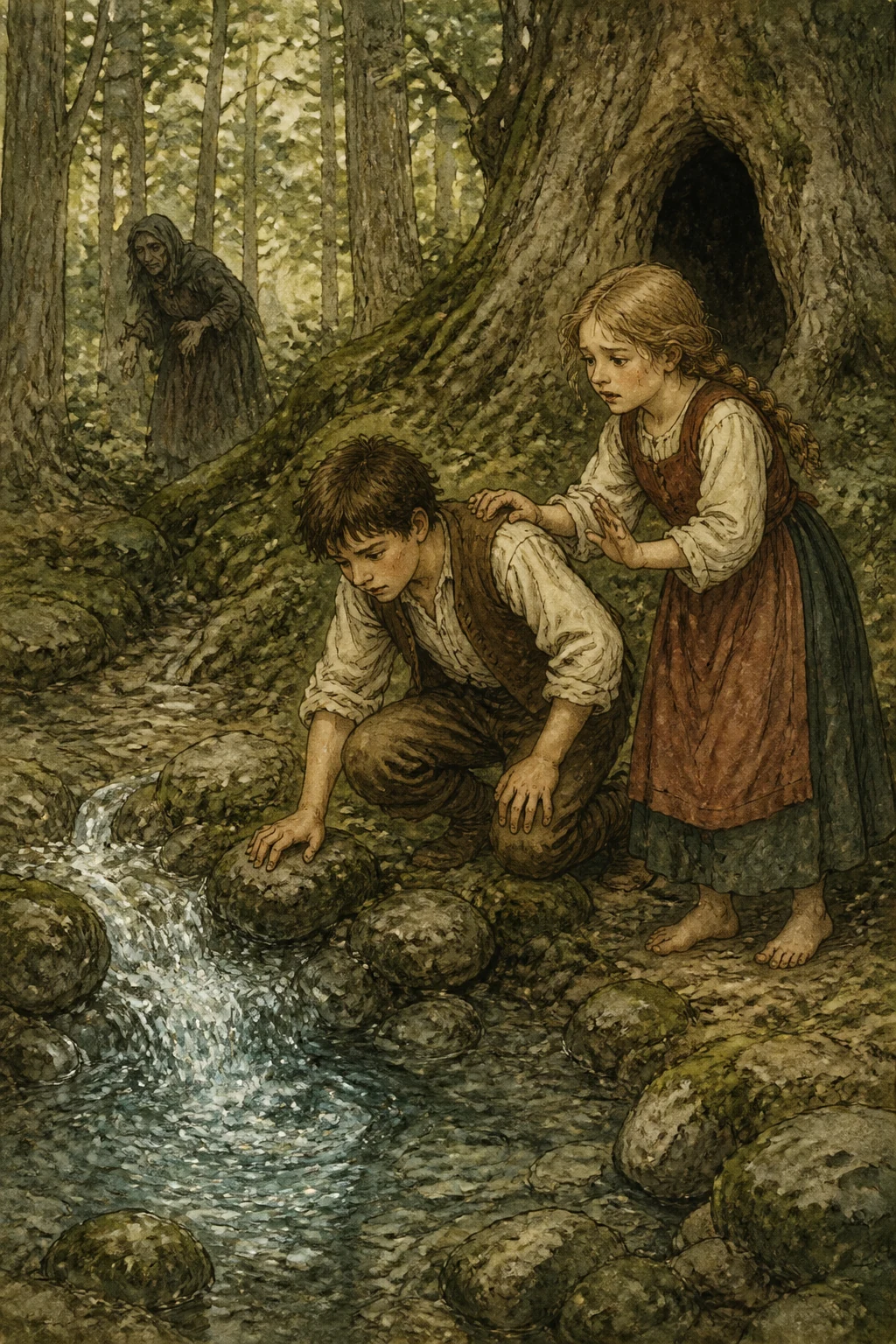
There came a very hard year, and the famine was so severe that these poor people resolved to rid themselves of their children. One evening, when the children were in bed and the woodcutter was sitting by the fire with his wife, he said to her, his heart heavy with grief, “You can see that we can no longer feed our children. I cannot bear to watch them starve before my eyes, and I have made up my mind to take them into the woods tomorrow and leave them there. It will be easy enough: while they are busy gathering sticks into bundles, we need only slip away without their seeing us.” “Ah!” cried his wife. “Could you really take your own children out and abandon them?” Her husband reminded her of their terrible poverty, but to no avail: she could not consent. She was poor, but she was their mother. At last, however, when she considered how painful it would be to see them starve, she agreed, and went to bed in tears. Little Thumb heard everything they said, for when he heard from his bed that they were discussing serious matters, he had got up quietly and slipped beneath his father’s stool to listen unseen. He went back to bed and lay awake for the rest of the night, thinking about what he must do. He rose early in the morning and went down to a stream, where he filled his pockets with little white pebbles, then returned home. They set out, and Little Thumb told his brothers nothing of what he knew. They went into a forest so thick that ten paces apart they could not see one another. The woodcutter began to cut wood, and his children to gather twigs into bundles. Seeing them busy at their work, the father and mother gradually drew away, then suddenly fled down a little winding path. When the children found themselves alone, they began to shout and weep as loudly as they could. Little Thumb let them cry, knowing very well how he would get home, for as they walked he had dropped the little white pebbles from his pockets along the path. “Do not be afraid, brothers,” he told them. “Father and Mother have left us here, but I shall take you safely home. Just follow me.” They followed him, and he led them back to their house by the very path they had taken into the forest. At first they dared not go in, but all pressed close to the door to listen to what their father and mother were saying.
Just as the woodcutter and his wife arrived home, the lord of the village sent them ten crowns he had owed them for a long time, which they had given up all hope of receiving. This put new life into them, for the poor people were starving. The woodcutter sent his wife straight to the butcher’s. Since it was so long since she had eaten, she bought three times as much meat as two people needed for supper. When they had eaten their fill, the woodcutter’s wife said, “Alas, where are our poor children now? What a feast they would make of what we have left! But then, Guillaume, it was you who wanted to abandon them. I told you we should regret it. What are they doing now in that forest? Alas, dear God, perhaps the wolves have eaten them already! How heartless you were to abandon your children like that!” At last the woodcutter lost patience, for she repeated more than twenty times that they would regret it and that she had told him so. He threatened to beat her if she would not be quiet. It was not that the woodcutter was not perhaps even more distressed than his wife, but she was giving him a headache; and he was like many other people, who are very fond of women who speak well, but find those who always knew better a great nuisance. His wife was in tears. “Alas, where are my children now, my poor children?” Once she said it so loudly that the children at the door heard her and all cried out together, “Here we are! Here we are!” She ran to open the door and said, embracing them, “How glad I am to see you again, my dear children! You must be so tired and so hungry! And you, Pierrot, how muddy you are! Come here and let me wash your face.” This Pierrot was her eldest son, whom she loved more than all the others because his hair was a little red, and hers was a little red too. They sat down at the table and ate with an appetite that delighted their father and mother, telling them how frightened they had been in the forest and almost always talking all at once. The good people were overjoyed to have their children with them again, and their happiness lasted as long as the ten crowns. But when the money was spent, they fell back into their former misery and resolved to abandon the children once more, taking them much farther away than before to make certain of succeeding.
They could not discuss this so secretly that Little Thumb did not overhear them, and he intended to get out of trouble just as he had before. But although he rose early to gather little pebbles, he could not manage it, for he found the door of the house locked and double-locked. He did not know what to do, until the woodcutter’s wife gave each of them a piece of bread for breakfast, and it occurred to him that he could use his bread instead of pebbles, scattering crumbs along the paths they took. So he tucked it into his pocket. Their father and mother led them into the thickest, darkest part of the forest, and as soon as they were there, slipped down a side path and left them. Little Thumb was not greatly troubled, for he believed he could easily find his way back by means of the bread he had scattered wherever he went. But he was astonished when he could not find a single crumb: the birds had come and eaten them all. Now they were in great distress, for the farther they walked, the more they lost their way and the deeper they went into the forest. Night fell, and a great wind rose, filling them with dreadful fears. They thought they heard nothing on every side but the howling of wolves coming to eat them. They scarcely dared speak to one another or turn their heads. A heavy rain began, soaking them to the bone; they slipped at every step and fell in the mud, getting up filthy all over and not knowing what to do with their hands. Little Thumb climbed to the top of a tree to see whether he could make anything out. Looking all around, he saw a little glimmer, like candlelight, far away beyond the forest. He climbed down, but once he was on the ground he could see nothing, which dismayed him. Nevertheless, after walking for some time with his brothers in the direction where he had seen the light, he caught sight of it again as they came out of the woods. At last they reached the house where the candle was burning, though not without many frights, for they often lost sight of it whenever they went down into a hollow. They knocked at the door, and a good woman came to open it. She asked them what they wanted. Little Thumb told her they were poor children who had lost their way in the forest, and begged her, out of charity, to give them shelter for the night. Seeing what pretty children they all were, the woman began to weep. “Alas, my poor children,” she said, “what a place you have come to! Do you know that this is the house of an ogre who eats little children?” “Alas, madam,” replied Little Thumb, trembling from head to foot like his brothers, “what are we to do? The wolves in the forest are certain to eat us tonight if you will not take us in. If we must be eaten, we would rather it were your husband who ate us. Perhaps he will take pity on us, if you would be so kind as to ask him.” The ogre’s wife thought she could hide them from her husband until the following morning, so she let them in and took them to warm themselves by a good fire, where a whole sheep was roasting on a spit for the ogre’s supper. Just as they began to warm themselves, they heard three or four heavy blows on the door: the ogre had come home. His wife at once hid them under the bed and went to open the door. The ogre immediately asked whether supper was ready and the wine had been drawn, then sat down at the table. The sheep was still quite bloody, but he thought it all the better for that. He sniffed to the right and left, saying he smelled fresh flesh. “It must be the calf I have just dressed that you smell,” his wife told him. “I smell fresh flesh, I tell you again,” the ogre replied, giving his wife a sidelong glare, “and there is something going on here that I do not understand.” With these words he rose from the table and went straight to the bed. “Aha!” he said. “So this is how you mean to deceive me, you wretched woman! I do not know what keeps me from eating you too. It is lucky for you that you are such a tough old creature. Here is some game that will come in very handy for entertaining three ogre friends of mine who are coming to visit in the next few days.” He dragged the children out from under the bed one by one. The poor children fell to their knees and begged for mercy, but they were dealing with the cruellest of all ogres, who, far from taking pity on them, was already devouring them with his eyes, and told his wife what tasty morsels they would be once she had made a good sauce for them. He went to fetch a great knife and, as he approached the poor children, sharpened it on a long stone he held in his left hand. He had already seized one of them when his wife said, “What are you thinking of, at this hour? Will you not have time enough tomorrow morning?” “Be quiet,” replied the ogre. “They will be all the more tender.” “But you still have so much meat,” his wife went on. “There is a calf, two sheep, and half a pig.” “You are right,” said the ogre. “Give them a good supper so they do not grow thin, and put them to bed.” The good woman was overjoyed and brought them a fine supper, but they were too terrified to eat. As for the ogre, he went back to his drinking, delighted to have such a feast for his friends. He drank a dozen more cups than usual, which went to his head a little and obliged him to go to bed.
The ogre had seven daughters who were still only children. These little ogresses all had lovely complexions, because they ate fresh flesh like their father; but they had small, round grey eyes, hooked noses, and very large mouths with long, sharp teeth set far apart. They were not yet very wicked, but they showed great promise, for they already bit little children to suck their blood. They had been put to bed early and lay all seven in one great bed, each with a golden crown on her head. In the same room there was another bed of the same size, and it was here that the ogre’s wife put the seven little boys to sleep, after which she went to bed beside her husband. Little Thumb had noticed the golden crowns on the heads of the ogre’s daughters, and feared that the ogre might regret not having cut their throats that very evening. Towards the middle of the night he got up, took his brothers’ caps and his own, and very gently placed them on the heads of the ogre’s seven daughters, first removing their golden crowns, which he put on his brothers’ heads and his own, so that the ogre would mistake them for his daughters, and his daughters for the boys whose throats he meant to cut. Everything happened as he had expected. The ogre woke around midnight and regretted having put off until morning what he could have done the night before. He leapt out of bed and took up his great knife. “Let us see how our little rascals are getting on,” he said. “We may as well finish the business now.” He groped his way upstairs to his daughters’ room and approached the bed where the little boys lay, all asleep except Little Thumb, who was very frightened when he felt the ogre’s hand feeling his head, as it had felt the heads of all his brothers. Feeling the golden crowns, the ogre said, “Well, that would have been a fine piece of work! I can see I drank too much last night.” He then went to his daughters’ bed, where he felt the boys’ little caps. “Ah, here are our young scamps!” he said. “Let us get to work.” With these words, he cut the throats of all seven daughters without a moment’s hesitation. Very pleased with what he had done, he went back to bed beside his wife. As soon as Little Thumb heard the ogre snoring, he woke his brothers and told them to dress quickly and follow him. They crept down into the garden and climbed over the walls. They ran for almost the whole night, trembling all the while and not knowing where they were going. When the ogre woke, he said to his wife, “Go upstairs and dress those little rascals from last night.” The ogress was much surprised by her husband’s kindness, having no suspicion of the way he meant her to dress them, and, believing he was telling her to put their clothes on, went upstairs. There she was horrified to find her seven daughters with their throats cut, lying in their own blood. Her first act was to faint, for that is the first remedy almost every woman finds on such occasions. Fearing that his wife was taking too long over the task he had given her, the ogre went upstairs to help. He was no less astonished than she had been at the dreadful sight. “Ah, what have I done?” he cried. “The wretches shall pay for this, and at once!” He immediately threw a potful of water in his wife’s face, and when he had revived her, said, “Quick, give me my seven-league boots, so I can catch them!” He set off across the countryside and, after running a great distance in every direction, at last came upon the road along which the poor children were walking, now only a hundred paces from their father’s house. They saw the ogre striding from mountain to mountain and crossing rivers as easily as the smallest brook. Little Thumb spotted a hollow rock nearby, made his six brothers hide inside, and squeezed in after them, keeping his eye on the ogre all the while. The ogre was very weary from the long journey he had made to no purpose, for seven-league boots are very tiring to their wearer. He wanted to rest, and by chance sat down on the very rock where the little boys were hiding. Being utterly exhausted, he fell asleep after resting a little, and began to snore so frightfully that the poor children were no less terrified than when he had held his great knife ready to cut their throats. Little Thumb was less afraid, and told his brothers to hurry home while the ogre was sound asleep and not to worry about him. They took his advice and made their way quickly home. Little Thumb crept up to the ogre, gently pulled off his boots, and put them on at once. The boots were very large and very wide, but as they were enchanted, they could grow larger or smaller to fit the legs of whoever wore them, so they fitted his feet and legs as neatly as if they had been made for him. He went straight to the ogre’s house, where he found the ogre’s wife weeping beside her murdered daughters. “Your husband is in great danger,” Little Thumb told her. “He has been captured by a band of robbers who have sworn to kill him unless he gives them all his gold and silver. Just as they were holding a dagger to his throat, he caught sight of me and begged me to come and tell you what had happened, and to ask you to give me everything he owns, holding nothing back, for otherwise they will kill him without mercy. Since the matter is so urgent, he insisted that I take his seven-league boots, which you see here, both to make haste and so that you would not think me an impostor.” Greatly frightened, the good woman immediately gave him everything she had, for although the ogre ate little children, he was nevertheless a very good husband. Laden with all the ogre’s riches, Little Thumb returned to his father’s house, where he was welcomed with great joy.
There are many people who dispute this last part of the story and maintain that Little Thumb never robbed the ogre at all. It is true, they say, that he had no scruples about taking his seven-league boots, because the ogre used them only to chase little children. These people claim to have it on good authority, and even to have eaten and drunk in the woodcutter’s house. They declare that once Little Thumb had put on the ogre’s boots, he went to court, where he knew there was great anxiety about an army two hundred leagues away and the outcome of a battle that had been fought. He went, they say, to see the king and told him that, if he wished, he would bring him news of the army before the day was out. The king promised him a large sum of money if he succeeded. Little Thumb brought back news that very evening, and as this first journey made him known, he could earn as much as he pleased. The king paid him handsomely to carry orders to the army, and countless ladies gave him whatever he asked for news of their lovers; indeed, this was his greatest source of profit. A few wives entrusted him with letters for their husbands, but they paid him so poorly, and it amounted to so little, that he did not deign to include these earnings in his accounts. After working as a courier for some time and amassing a great fortune, he returned to his father’s house, where the joy at seeing him again was beyond imagining. He made his whole family comfortable. He bought newly created offices for his father and brothers, and in this way provided for them all while at the same time winning great favour at court.
MORAL. No one grieves at having many children When all are handsome, tall, and strong, And pleasing to the eye; But if one is weak or scarcely speaks, He is scorned, and mocked, and bullied.
And yet sometimes it is this little child Who will bring happiness to the whole family. THE END.