Prevod
Once upon a time there was a Queen who gave birth to a son so ugly and so misshapen that for a long time people doubted whether he was even human. A Fairy who was present at his birth declared that he would nevertheless be lovable, for he would be blessed with great wit. She even added that, by virtue of the gift she had just bestowed on him, he would be able to give as much wit as he himself possessed to the person he loved best.
All this brought some comfort to the poor Queen, who was deeply distressed at having brought such an ugly little creature into the world. Indeed, scarcely had the child begun to speak when he said a thousand delightful things, and there was something so clever in everything he did that everyone was charmed. I forgot to mention that he was born with a little tuft of hair on his head, which was why he was called Riquet with the Tuft, for Riquet was the family name.
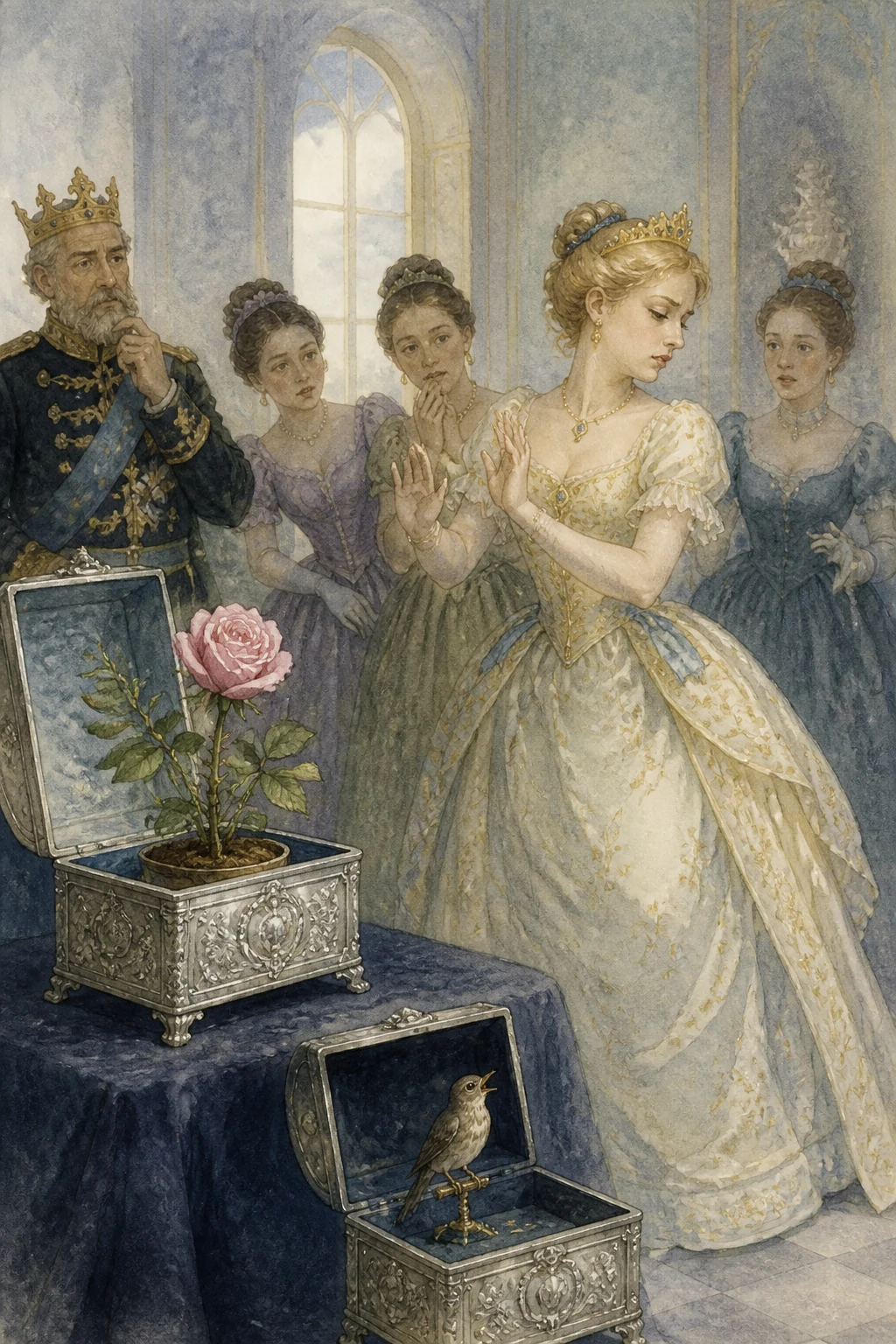
Seven or eight years later, the Queen of a neighbouring kingdom gave birth to two daughters. The first to be born was more beautiful than the day, and the Queen was so delighted that people feared such overwhelming joy might do her harm. The same Fairy who had attended the birth of little Riquet with the Tuft was present, and, to temper the Queen’s joy, she told her that this little Princess would have no wit at all, and would be as stupid as she was beautiful. This greatly distressed the Queen; but a few moments later she had a far greater sorrow, for the second daughter she bore proved to be exceedingly ugly. “Do not grieve so much, Madam,” the Fairy told her. “Your daughter will be blessed in other ways, and she will have so much wit that people will scarcely notice her lack of beauty.” “God grant it,” replied the Queen. “But could you not find some way to give a little wit to the elder one, who is so beautiful?” “I can do nothing for her, Madam, where wit is concerned,” said the Fairy, “but where beauty is concerned, I can do anything. And since there is nothing I would not do to please you, I shall give her the power to make the person of her choice beautiful.” As the two Princesses grew, their gifts grew with them, and everywhere people spoke of nothing but the elder’s beauty and the younger’s wit. It is also true that their faults increased greatly with age. The younger grew uglier before everyone’s eyes, while the elder became more stupid every day. Either she made no answer to the questions she was asked, or she said something foolish. Besides this, she was so clumsy that she could not have arranged four pieces of porcelain on a mantelpiece without breaking one, or drunk a glass of water without spilling half of it over her clothes. Although beauty is a great advantage in a young person, the younger sister nevertheless outshone her elder in almost every company. At first people would go to the more beautiful one, to gaze at her and admire her, but soon they would turn to the wittier one to hear her say a thousand delightful things. It was astonishing to see how, in less than a quarter of an hour, the elder would have no one beside her, while everyone had gathered around the younger. Stupid though the elder was, she noticed this well enough, and she would gladly have given all her beauty for half her sister’s wit. The Queen, wise as she was, could not help reproaching her several times for her stupidity, which very nearly made the poor Princess die of grief.
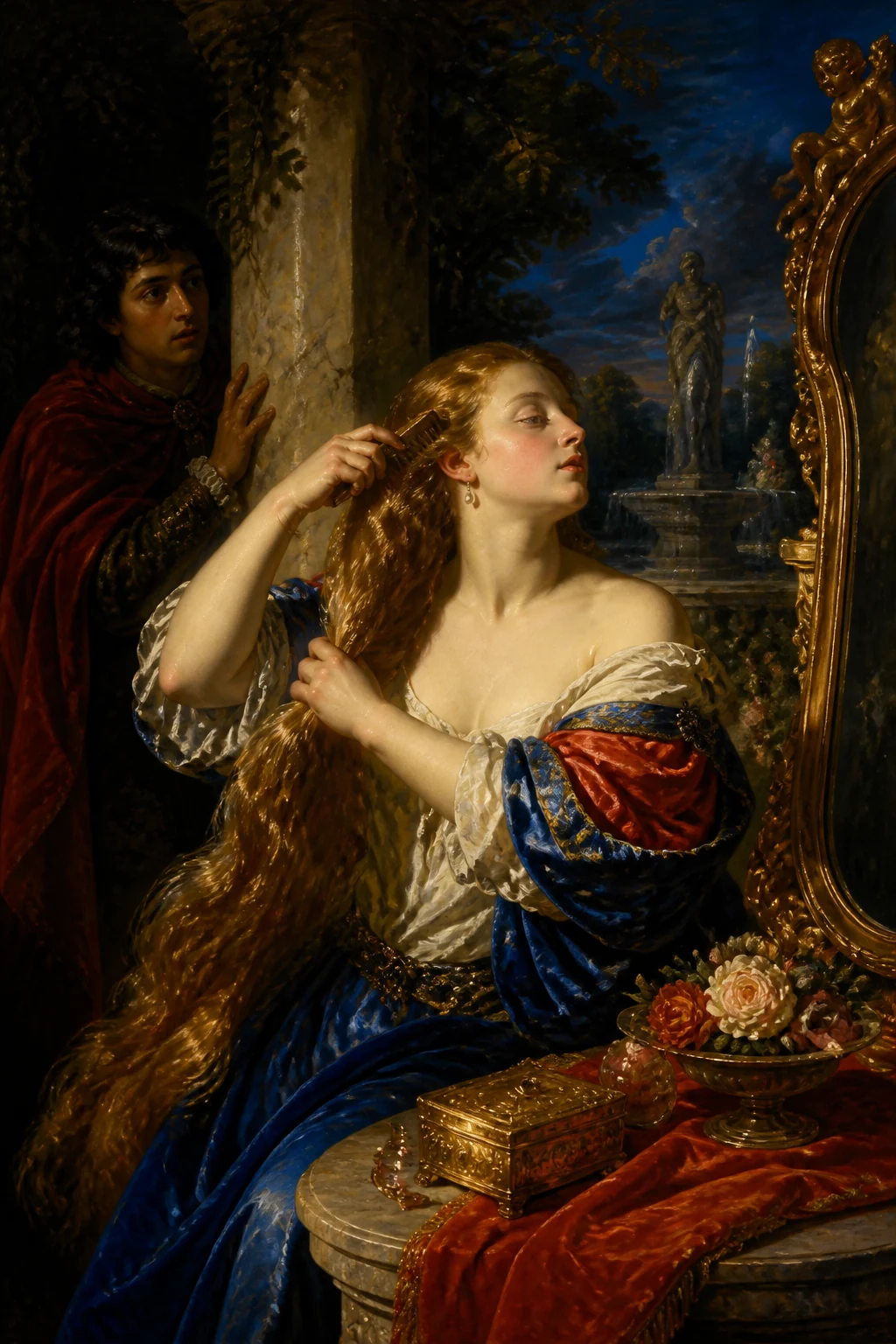
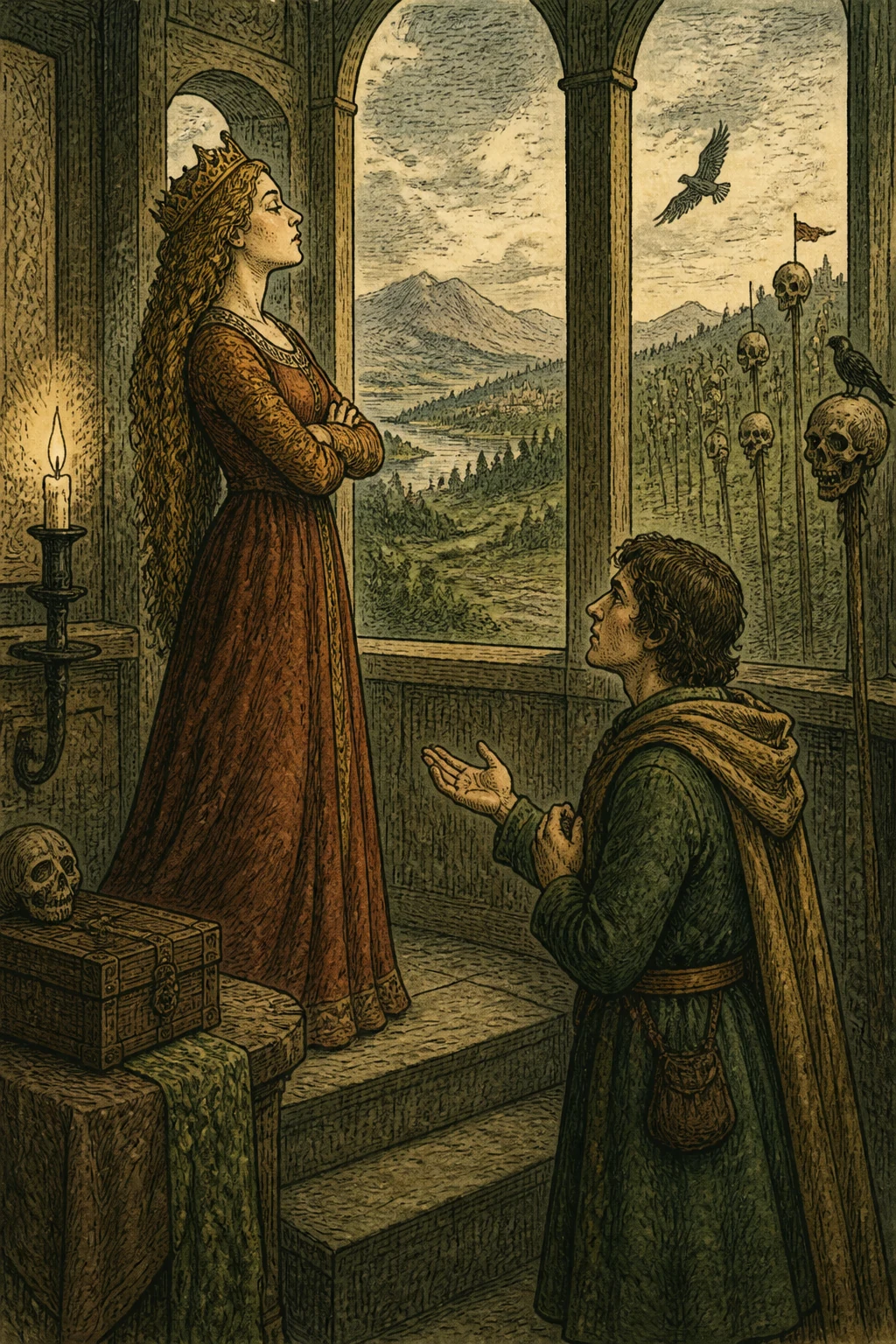
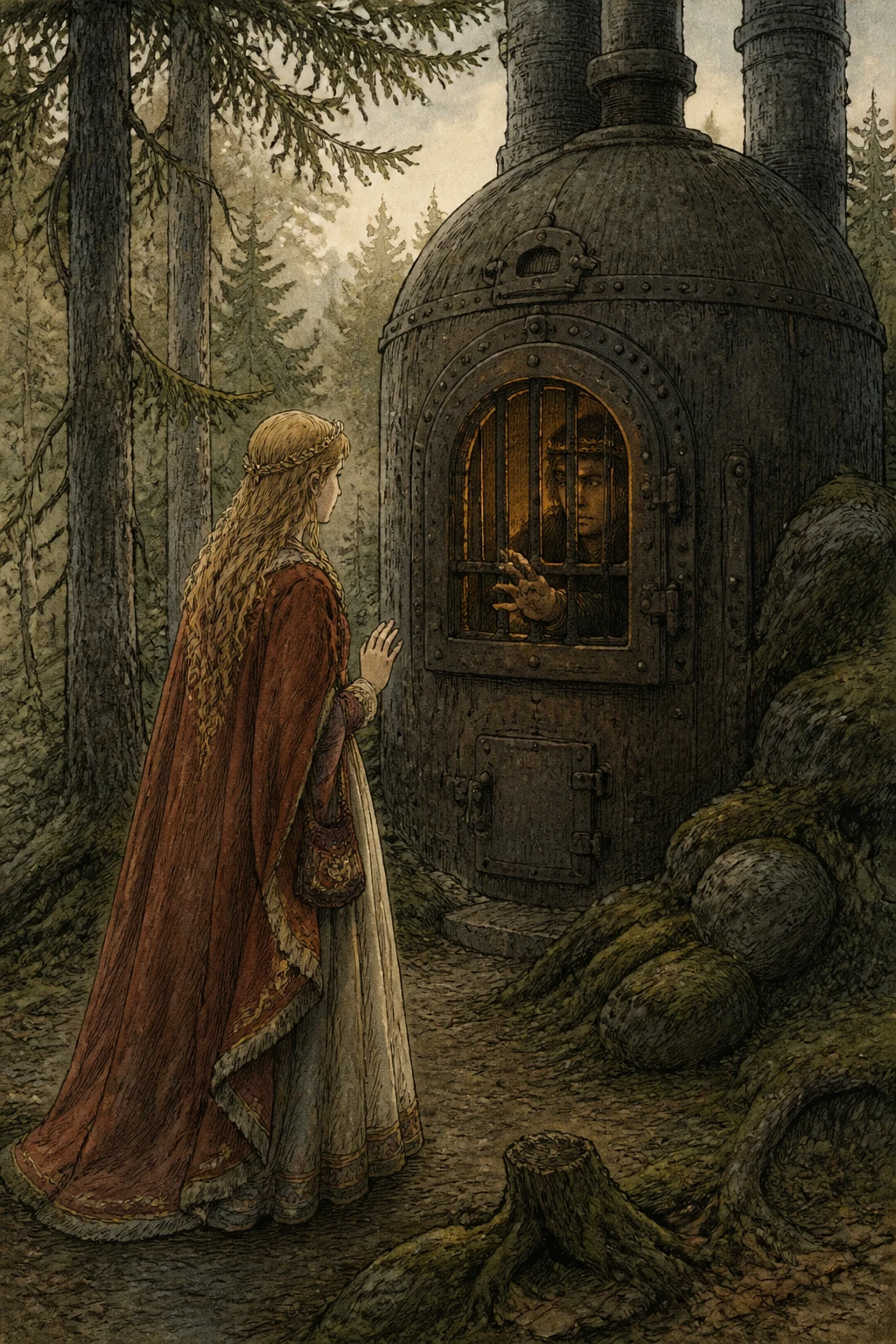
One day, when she had withdrawn into a wood to lament her misfortune, she saw a very ugly and disagreeable little man approaching her, though he was magnificently dressed. It was the young Prince Riquet with the Tuft, who had fallen in love with her from the portraits of her that had travelled all over the world, and had left his father’s kingdom for the pleasure of seeing her and speaking to her. Delighted to find her alone, he approached her with all the respect and courtesy imaginable. After paying her the usual compliments, he noticed that she was very melancholy, and said, “I cannot understand, Madam, how anyone as beautiful as you can be as sad as you appear. For although I may boast of having seen countless beautiful people, I can truly say that I have never seen anyone whose beauty approaches yours.” “You are pleased to say so, sir,” replied the Princess, and said no more. “Beauty,” Riquet with the Tuft continued, “is so great a blessing that it ought to make up for everything else. When one possesses it, I cannot see that anything could cause one much distress.” “I would rather,” said the Princess, “be as ugly as you and have wit than be as beautiful as I am and as stupid as I am.” “There is no surer sign of wit, Madam, than to believe oneself without it; and it is the nature of that gift that the more one has, the more one thinks one lacks.” “I know nothing about that,” said the Princess, “but I know very well that I am very stupid, and that is the cause of the sorrow that is killing me.” “If that is all that troubles you, Madam, I can easily put an end to your sorrow.” “And how will you do that?” asked the Princess. “I have the power, Madam,” said Riquet with the Tuft, “to give all the wit anyone could possess to the person I love best. And since you, Madam, are that person, it rests entirely with you to have as much wit as anyone could have, provided you are willing to marry me.” The Princess was quite taken aback and made no reply. “I see,” Riquet with the Tuft went on, “that this proposal troubles you, and I am not surprised. But I will give you a whole year to make up your mind.” The Princess had so little wit, and at the same time so great a desire to have some, that she imagined the end of that year would never come; and so she accepted his proposal. No sooner had she promised Riquet with the Tuft that she would marry him on that very day a year hence than she felt herself an entirely different person. She found it wonderfully easy to say whatever she wished, and to say it with subtlety, ease, and grace. At once she began a lively and sustained conversation with Riquet with the Tuft, in which she shone so brilliantly that he thought he had given her more wit than he had kept for himself. When she returned to the palace, the whole Court did not know what to make of so sudden and extraordinary a change; for where they had once heard nothing but foolish remarks, they now heard her say things full of good sense and sparkling wit. The joy of the whole Court was beyond imagining. Only her younger sister was displeased, for, having lost her advantage in wit over her elder, she now looked beside her like nothing more than a very disagreeable monkey. The King was guided by the elder Princess’s advice, and sometimes even held his Council in her apartments. As news of this transformation spread, all the young Princes of the neighbouring kingdoms did their utmost to win her love, and almost all asked for her hand in marriage. But she found none of them witty enough, and listened to them all without committing herself to any. At last, however, there came one so powerful, so rich, so witty, and so handsome that she could not help feeling favourably disposed towards him. Her father noticed this and told her that he left the choice of a husband entirely to her: she need only make her wishes known. But since the more wit one has, the harder it is to make a firm decision in such a matter, she thanked her father and asked him to allow her some time to think. By chance, she went walking in the very wood where she had met Riquet with the Tuft, so that she could reflect more freely on what she ought to do. As she walked, deep in thought, she heard a muffled noise beneath her feet, as though many people were bustling to and fro at their work. Listening more closely, she heard one say, “Bring me that pot,” another, “Give me that kettle,” and another, “Put some wood on that fire.” At that very moment the earth opened, and beneath her feet she saw what looked like a vast kitchen, full of cooks, scullions, and all the servants needed to prepare a magnificent feast. A band of twenty or thirty roasting cooks emerged and settled themselves in an avenue of the wood around a very long table. Each, with a larding needle in his hand and a fox’s tail tucked over his ear, began working in time to a melodious song. Astonished at this spectacle, the Princess asked whom they were working for. “For Prince Riquet with the Tuft, Madam,” replied the man who seemed to be in charge. “His wedding is to take place tomorrow.” Still more astonished than before, the Princess suddenly remembered that, a year ago that very day, she had promised to marry Prince Riquet with the Tuft, and she almost fell to the ground. The reason she had forgotten was that she had been a fool when she made the promise, and in receiving the new wit the Prince had given her, she had forgotten all her follies. She had not gone thirty paces farther when Riquet with the Tuft appeared before her, splendidly and magnificently dressed, as befitted a Prince about to be married. “You see me here, Madam,” he said, “faithful to my word, and I have no doubt that you have come to keep yours, and, by giving me your hand, to make me the happiest of men.” “I shall confess to you frankly,” replied the Princess, “that I have not yet made up my mind about that, and I do not believe I shall ever be able to decide as you wish.” “You astonish me, Madam,” said Riquet with the Tuft. “I can well believe it,” said the Princess. “And certainly, if I were dealing with a brute, a man without wit, I should find myself in great difficulty. ‘A Princess has only her word,’ he would tell me, ‘and you must marry me, since you promised you would.’ But as the man I am speaking to has more wit than anyone in the world, I am certain he will listen to reason. You know that even when I was a fool, I could not bring myself to marry you. How can you expect me, now that I have the wit you gave me, which makes me still more particular about people than I was before, to make a decision today that I could not make then? If you truly meant to marry me, you were very wrong to take away my stupidity and make me see more clearly than I did.” “If a man without wit,” replied Riquet with the Tuft, “would be justified, as you have just said, in reproaching you for breaking your word, why should I not do the same, Madam, in a matter on which the whole happiness of my life depends? Is it reasonable that people with wit should be worse off than those without it? Can you maintain such a thing, you who have so much wit and wished so dearly to possess it? But let us come to the point, if you please. Apart from my ugliness, is there anything in me that displeases you? Are you dissatisfied with my birth, my wit, my temper, or my manners?” “Not at all,” replied the Princess. “I like everything in you that you have just mentioned.” “If that is so,” Riquet with the Tuft continued, “I shall be happy, for you have the power to make me the most pleasing of men.” “How can that be?” asked the Princess. “It will happen,” replied Riquet with the Tuft, “if you love me enough to wish it so. And so that you may have no doubt of it, Madam, know that the same Fairy who, on the day of my birth, gave me the power to bestow wit on the person of my choice also gave you the power to make the man you love beautiful, if you wish to grant him that favour.” “If that is so,” said the Princess, “I wish with all my heart that you may become the handsomest and most lovable Prince in the world; and, as far as it lies in my power, I bestow that gift upon you.” No sooner had the Princess spoken these words than Riquet with the Tuft appeared to her the handsomest, most finely formed, and most lovable man she had ever seen. Some maintain that it was not the Fairy’s enchantments that brought this about, but that love alone worked the transformation. They say that the Princess, reflecting on her lover’s constancy, his good judgment, and all the fine qualities of his heart and mind, no longer saw his misshapen body or his ugly face; that his hump seemed to her merely the fine bearing of a man arching his back; and that, where she had hitherto seen him limping dreadfully, she now saw only a certain charming way of leaning to one side. They say, too, that his squinting eyes seemed to her only the brighter for it, that she took their waywardness as a sign of overwhelming love, and that even his great red nose had something martial and heroic about it in her eyes. Be that as it may, the Princess promised at once to marry him, provided he obtained the consent of the King, her father. The King, learning that his daughter held Riquet with the Tuft in great esteem, and knowing him already to be a Prince of great wit and wisdom, gladly welcomed him as his son-in-law. The very next day the wedding took place, just as Riquet with the Tuft had foreseen, and in accordance with the orders he had given long before.
MORAL. What you have read in this little tale Is less an idle fancy than the truth itself: All that we love is beautiful, And all we love is full of wit.
Another Moral. Though Nature grant a person lovely features And all the glowing colours of a complexion That Art could never hope to match, These gifts will do less to awaken a heart Than one unseen attraction That Love discovers there.