Prevod
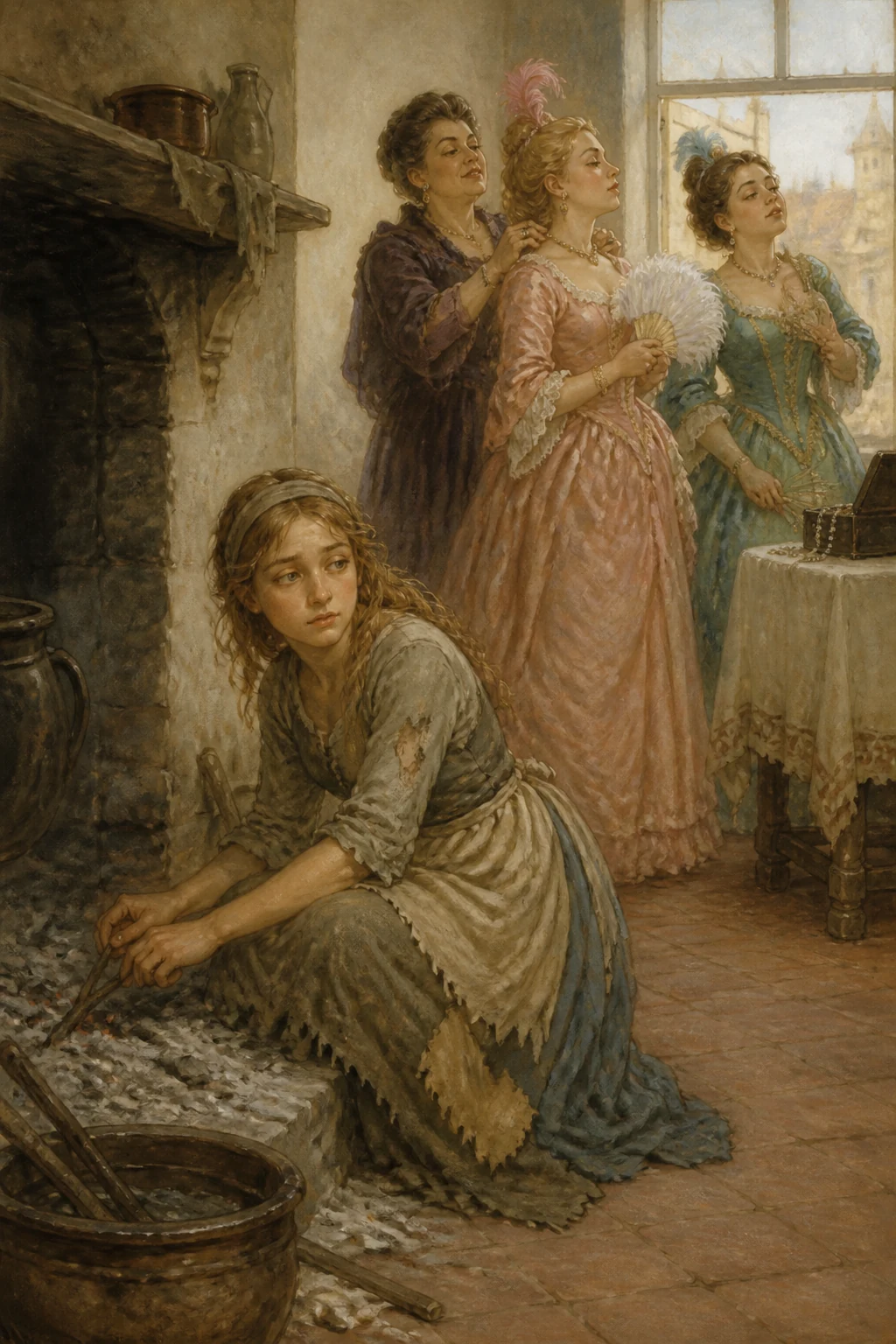
Once upon a time there was a gentleman who married for his second wife the proudest, haughtiest woman anyone had ever seen. She had two daughters of the same disposition, who resembled her in every way. The husband, for his part, had a young daughter of quite extraordinary sweetness and goodness: she took after her mother, who had been the best woman in the world. Scarcely was the wedding over when the stepmother began to show her ill temper. She could not bear the good qualities of this young child, which made her own daughters seem all the more hateful. She gave her the meanest work in the house: it was she who washed the dishes and cleaned the stairs, who scrubbed Madam’s room and those of her young ladies. She slept at the very top of the house, in an attic, on a wretched straw mattress, while her sisters had rooms with parquet floors, beds in the latest fashion, and mirrors in which they could see themselves from head to foot. The poor girl bore it all patiently and dared not complain to her father, who would have scolded her, for his wife ruled him completely. When she had finished her work, she would go to the chimney corner and sit among the ashes, which was why everyone in the house generally called her Cinderbottom. The younger sister, who was not quite so rude as the elder, called her Cinderella. Yet Cinderella, in her wretched clothes, was still a hundred times more beautiful than her sisters, magnificently dressed though they were.
It happened that the King’s son gave a ball and invited all the people of rank. Our two young ladies were invited too, for they cut quite a figure in the country. How delighted they were, and how busy choosing the gowns and headdresses that would suit them best! This meant fresh trouble for Cinderella, for it was she who ironed her sisters’ linen and pleated their cuffs. Nothing was talked of but what they would wear.
“For my part,” said the elder, “I shall wear my red velvet gown with my English trimming.” “I,” said the younger, “shall wear only my everyday skirt; but to make up for it, I shall put on my mantle with the gold flowers, and my diamond clasp, which is certainly nothing to be ashamed of.” They sent for the best hairdresser to arrange their caps in double rows, and had beauty patches bought from the finest maker. They called Cinderella to ask her opinion, for she had excellent taste. Cinderella gave them the best advice in the world, and even offered to dress their hair, which they graciously allowed her to do. As she worked, they said to her, “Cinderella, would you like to go to the ball?” “Alas, young ladies, you are making fun of me. It is no place for someone like me.” “You are right. People would laugh to see a Cinderbottom at the ball.”
Anyone but Cinderella would have dressed their hair crookedly; but she was good-hearted, and she did it to perfection. They went almost two days without eating, so carried away were they with delight. More than a dozen laces were broken in the effort to pull their waists ever smaller, and they were forever standing before their mirrors. At last the happy day arrived. They set off, and Cinderella watched them for as long as she could. When they were out of sight, she began to cry. Her godmother, seeing her in tears, asked what was the matter. “I should so like… I should so like…” She was crying so hard that she could not finish. Her godmother, who was a fairy, said, “You would like to go to the ball, would you not?”
“Oh, yes,” said Cinderella with a sigh. “Well, will you be a good girl?” said her godmother. “Then I shall see that you go.” She took her into her room and said, “Go into the garden and bring me a pumpkin.”
Cinderella went at once to pick the finest she could find and brought it to her godmother, quite unable to imagine how this pumpkin could help her go to the ball. Her godmother hollowed it out, leaving only the rind, then struck it with her wand, and the pumpkin was instantly changed into a splendid coach, gilded all over.
Next she looked in the mousetrap, where she found six mice, all alive. She told Cinderella to lift the trapdoor a little, and as each mouse came out, she tapped it with her wand. The mouse was instantly changed into a fine horse, making a handsome team of six horses, all a beautiful dappled mouse-grey.
As she was wondering what she could use for a coachman, Cinderella said, “I shall go and see whether there is a rat in the rat trap. We can make a coachman of him.” “Quite right,” said her godmother. “Go and look.”
Cinderella brought her the rat trap, which held three large rats. The fairy chose one of the three for his magnificent whiskers, and when she touched him, he became a stout coachman with one of the finest moustaches anyone had ever seen.
Then she said, “Go into the garden. You will find six lizards behind the watering can. Bring them to me.” No sooner had Cinderella brought them than her godmother changed them into six footmen, who immediately climbed up behind the coach in their richly braided liveries and held on as though they had never done anything else in their lives.
The fairy then said to Cinderella, “Well, there is everything you need to go to the ball. Are you not pleased?” “Yes, but must I go like this, in these dreadful clothes?” Her godmother merely touched her with her wand, and at once her clothes were changed into a gown of gold and silver cloth, all embroidered with precious stones. Then she gave her a pair of glass slippers, the prettiest in the world.
When she was dressed in all this finery, she stepped into the coach; but above all else her godmother charged her not to stay past midnight, warning her that if she remained at the ball a moment longer, her coach would turn back into a pumpkin, her horses into mice, her footmen into lizards, and her old clothes would return to their former state.
She promised her godmother that she would be sure to leave the ball before midnight, and set off beside herself with joy. The King’s son, who had been told that a great princess whom no one knew had just arrived, hurried to receive her. He gave her his hand as she stepped down from the coach and led her into the hall where the guests were gathered. A deep silence fell; the dancing stopped and the violins ceased playing, so intent was everyone on gazing at the great beauty of this unknown lady. Nothing could be heard but a murmur: “Oh, how beautiful she is!” Even the King, old as he was, could not help looking at her and whispering to the Queen that it was a long time since he had seen anyone so beautiful and charming. All the ladies studied her hair and her gown, meaning to have the same by the very next day, provided they could find fabrics fine enough and craftsmen skilful enough.
The King’s son seated her in the place of honour, then took her out to dance. She danced so gracefully that she was admired more than ever. A splendid supper was served, but the young Prince ate nothing, so absorbed was he in looking at her. She went and sat beside her sisters and showed them a thousand kindnesses, sharing with them the oranges and lemons the Prince had given her. This astonished them greatly, for they did not recognize her.
While they were talking, Cinderella heard the clock strike a quarter to twelve. At once she made a deep curtsy to the company and left as quickly as she could.
As soon as she arrived home, she went to find her godmother, and after thanking her, said that she very much wished to go to the ball again the next evening, because the King’s son had invited her. While she was busy telling her godmother everything that had happened at the ball, the two sisters knocked at the door. Cinderella went to let them in. “How late you are coming home!” she said, yawning, rubbing her eyes, and stretching as though she had only just woken up. Yet she had not felt the least desire to sleep since they had parted.
“If you had been at the ball,” one of her sisters told her, “you would not have been bored. The most beautiful princess came, the most beautiful anyone could ever see. She was wonderfully gracious to us, and gave us oranges and lemons.” Cinderella could scarcely contain her joy. She asked them the princess’s name, but they replied that no one knew her, that the King’s son was greatly troubled by this, and that he would give anything in the world to know who she was. Cinderella smiled and said, “Then she really was very beautiful? Good heavens, how fortunate you are! Could I not see her too? Oh, Miss Javote, lend me that yellow gown you wear every day.” “Indeed!” said Miss Javotte. “What a fine idea! Lend my gown to a grubby Cinderbottom like you? I should have to be quite mad.”
Cinderella had fully expected this refusal, and was glad of it, for she would have been greatly embarrassed if her sister had agreed to lend her the gown.
The next evening the two sisters went to the ball, and Cinderella went too, dressed even more splendidly than the first time. The King’s son stayed constantly at her side and never ceased whispering sweet things to her. The young lady was enjoying herself so much that she forgot her godmother’s warning, and heard the first stroke of midnight when she thought it was not yet eleven. She rose and fled as lightly as a doe. The Prince followed, but could not catch her. She dropped one of her glass slippers, which the Prince picked up with the greatest care. Cinderella reached home quite out of breath, without coach or footmen, and in her wretched old clothes. Nothing remained of all her splendour but one little slipper, the fellow of the one she had dropped. The guards at the palace gates were asked whether they had seen a princess leave. They said they had seen no one go out except a very poorly dressed girl, who looked more like a peasant than a young lady.
When the two sisters returned from the ball, Cinderella asked whether they had enjoyed themselves again, and whether the beautiful lady had been there. They said that she had, but that she had fled when midnight struck, and in such haste that she had dropped one of her little glass slippers, the prettiest in the world. The King’s son had picked it up and had done nothing but gaze at it for the rest of the ball; surely he was deeply in love with the beautiful person to whom the little slipper belonged. They spoke the truth, for a few days later the King’s son had it proclaimed to the sound of trumpets that he would marry the girl whose foot fitted the slipper exactly. They began by trying it on the princesses, then the duchesses, and all the court, but in vain. It was brought to the two sisters, who did everything they could to squeeze their feet into it, but could not manage it. Cinderella, who was watching them and had recognized her slipper, said with a laugh, “Let me see whether it will fit me.” Her sisters began to laugh and mock her. But the gentleman conducting the fitting looked closely at Cinderella, and finding her very beautiful, said that it was only fair, and that he had orders to try it on every girl. He seated Cinderella and brought the slipper to her little foot. It slipped on without the least difficulty and fitted as though it had been moulded in wax. Great was the astonishment of the two sisters, but greater still when Cinderella drew the other little slipper from her pocket and put it on her other foot. Just then her godmother arrived, and with a touch of her wand made Cinderella’s clothes more magnificent than any she had worn before.
Then her two sisters recognized her as the beautiful lady they had seen at the ball. They threw themselves at her feet to beg forgiveness for all the ill treatment they had made her suffer. Cinderella raised them up and, embracing them, said that she forgave them with all her heart and begged them always to love her dearly. She was taken to the young Prince, dressed in all her finery. He found her more beautiful than ever, and a few days later he married her. Cinderella, who was as good as she was beautiful, gave her two sisters lodgings in the palace, and married them that very day to two great lords of the court.
MORAL Beauty in a woman is a treasure rare; We never tire of gazing on its face. Yet what we call a gracious air Is priceless, and surpasses beauty’s grace.
This was the gift her godmother bestowed On Cinderella, teaching her so well, And guiding her, that she became a queen: (Such is the moral of the tale we tell.)
Fair ladies, more than well-dressed hair, This gift will win a heart and hold it true. A gracious manner is the fairies’ real gift: Without it, nothing; with it, all is yours to do.
ANOTHER MORAL It is undoubtedly a great advantage To have intelligence and courage, Noble birth and good sound sense, And other talents of that kind Which Heaven is pleased to grant us;
But have them as you may, They will not help you on your way Unless, to make their value known, You have a godfather or godmother of your own.