Prevod
Nekoč je živela deklica, ki sta jo oče in mati tako srčno ljubila, da zanjo nič ni bilo predobro. Mati ji je šivala najlepše oblekice; nogavice je imela iz fine preje, na čeveljčkih pa so se ji svetile zaponke. Mati ji je sešila tudi plašček s kapuco iz rdečega blaga in deklica je bila v njem tako prikupna, da jo je namesto Marija, kakor so jo krstili, začela klicati Rdeča kapica.
Rdeča kapica je imela babico, ki je bila že tako stara, da je včasih ves dan ležala v postelji in bila prešibka, da bi vstala. Nekega dne je mati poklicala deklico k sebi in ji rekla: »Otrok moj, v to košarico sem položila košček masla, nekaj svežih jajc in pšenični kolač. Vzemi jo in odnesi babici. Pojdi hitro, nikar se ne obiraj in se med potjo ne ustavljaj, da bi s kom klepetala, saj želim, da se vrneš, še preden se popoldne prevesi v večer.«
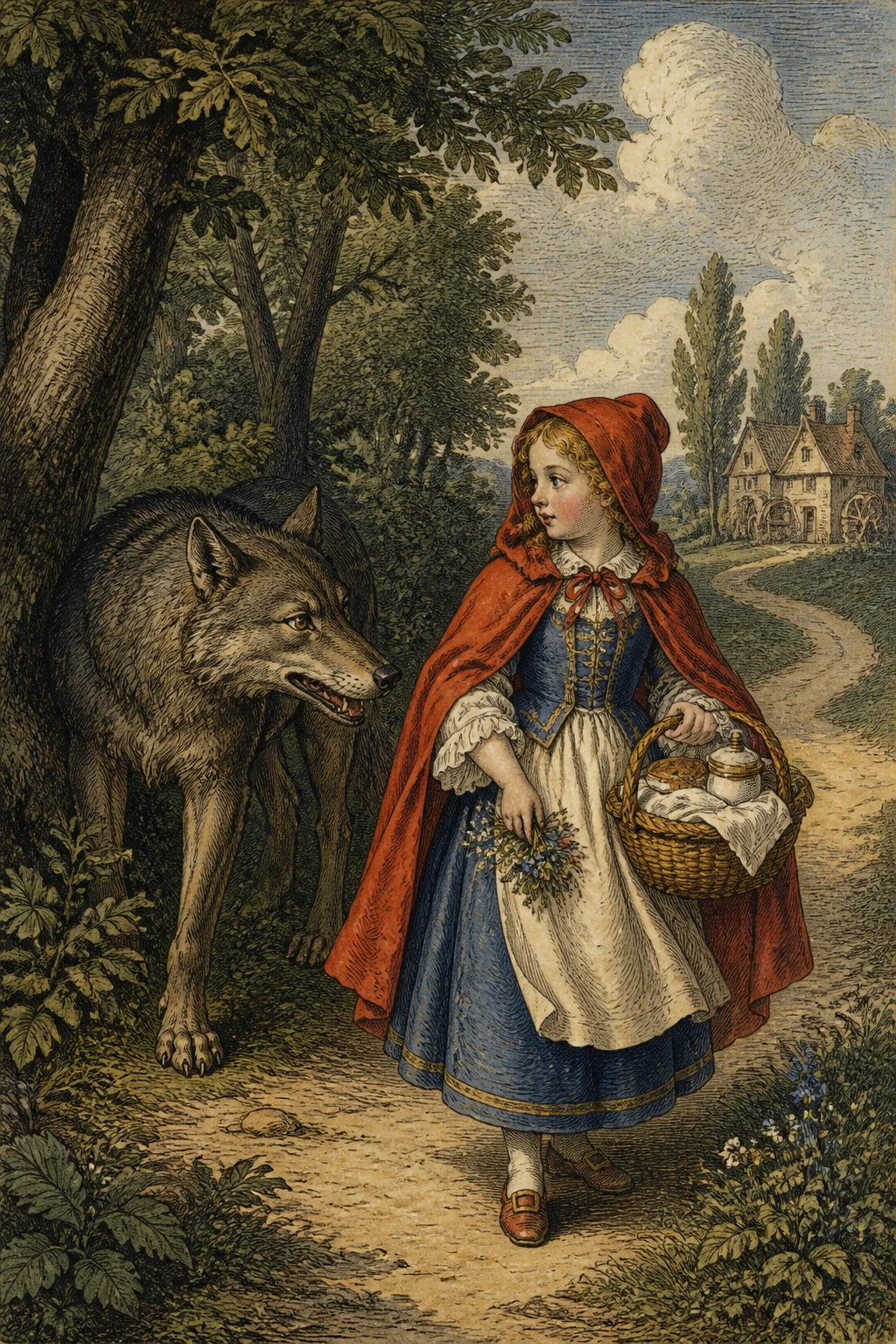
»Da, draga mama,« je rekla deklica, prijela košarico in se odpravila k babičini hišici. Sprva je urno tekla in se nikjer ni ustavljala, toda travniki so bili polni lepih cvetlic. »Prepričana sem,« je pomislila Rdeča kapica, »da bi bila babica vesela šopka marjetic in zlatic.« Začela jih je trgati, tu eno, tam drugo, dokler jih ni nabrala polnega prgišča.
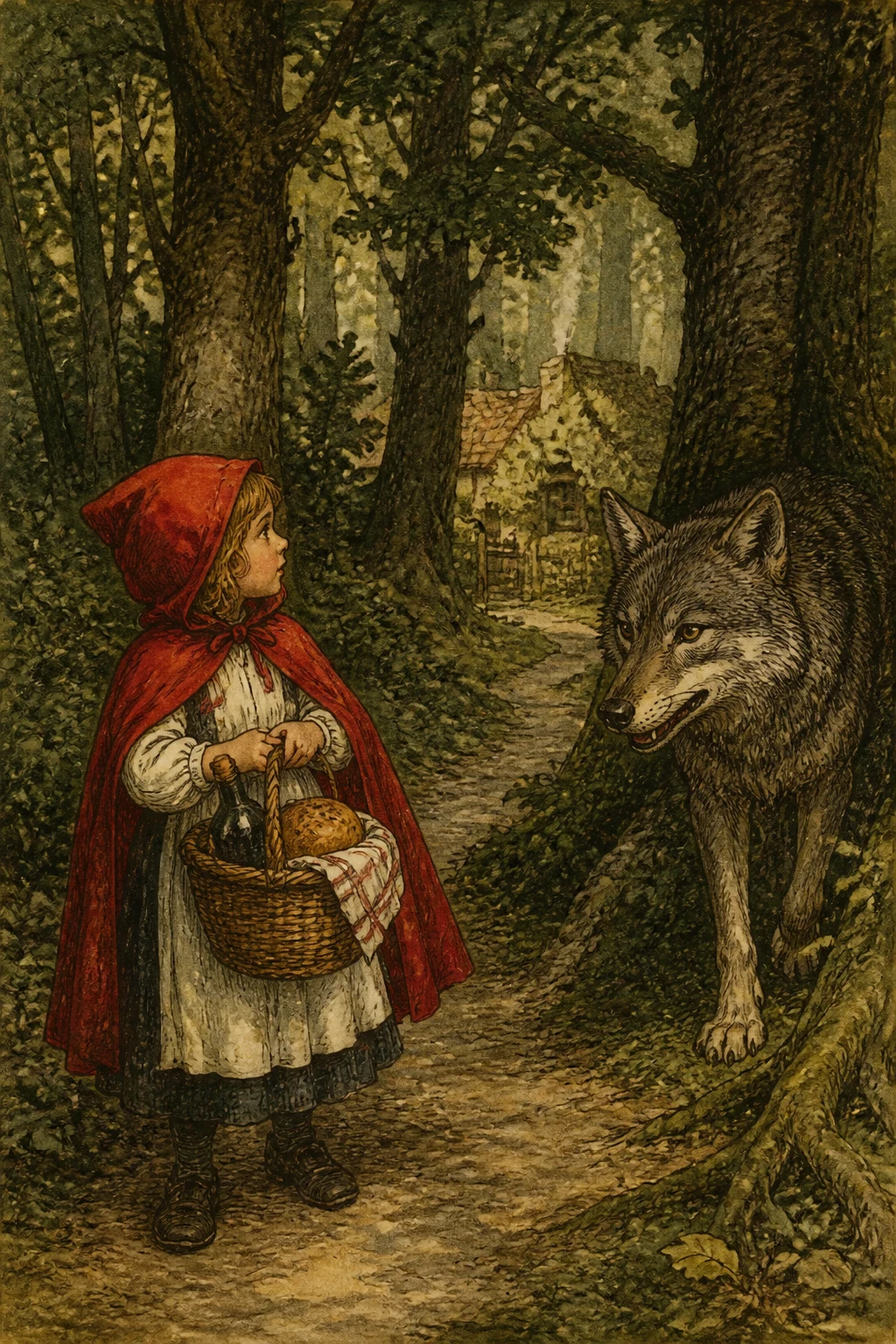
Kmalu je zaslišala mehke korake po stezi in mimo je pritekel stari sivi volk. »Dober dan, Rdeča kapica,« je rekel volk. »Dober dan,« je odgovorila deklica.
»Kam pa greš na ta lepi, sončni dan s košarico na roki?« »Oh, k babici grem. Že tako stara je, da včasih leži v postelji in ne more vstati, pa ji nesem malo masla, nekaj svežih jajc in pšenični kolač.«
»In kje živi tvoja babica?« »Na drugi strani gozda, v beli hišici s slamnato streho in zelenimi polkni. Steza vodi naravnost do nje.«
Volk je zdaj izvedel vse, kar ga je zanimalo. Poslovil se je od Rdeče kapice in urno odtekel naprej. Brž ko je prišel v gozd, kjer ga Rdeča kapica ni več mogla videti, se je pognal v dir. Drvel je naprej in naprej, kolikor so ga nesle noge, saj je hotel priti do bele hišice s slamnato streho in zelenimi polkni pred Rdečo kapico.
Globoko v gozdu je drvar pridno opravljal svoje delo. Videl je starega volka, ki je hitel mimo, in se vprašal, kaj neki namerava. »Gotovo ima za bregom kakšno hudobijo,« je rekel drvar. Zadel si je sekiro na ramo in šel za volkom, da bi videl, kaj bo storil.
Gospod volk je hitel naprej in kmalu prišel do gozdnega roba. Tam je stala bela hišica s slamnato streho in zelenimi polkni, steza pa je vodila naravnost do vrat, zato je volk vedel, da mora tam živeti babica.
Ustavil se je in se ozrl na vse strani, saj ni hotel, da bi ga kdo opazoval. Toda nikogar ni videl, kajti drvar se je skril za nekaj skal. Nato je volk potrkal na vrata: tok, tok, tok!
Nihče se ni oglasil, zato je potrkal še enkrat: tok, tok, tok! Še vedno ni bilo odgovora in v hiši se ni nič zganilo, čeprav je volk napel ušesa in pozorno poslušal. Potegnil je za vrvico zapaha, zapah se je dvignil, on pa je odrinil vrata in smuknil v hišo. Ozrl se je naokrog, a tam ni bilo nikogar, saj se je stara babica tistega dne počutila krepkejšo, zato se je oblekla in odšla obiskat sosedo.
Stari volk je brskal naokrog, dokler ni našel babičine spalne srajce; nato jo je navlekel čez svoje veliko kosmato telo. Na glavo si je poveznil in pod brado zavezal veliko čepico z naborki, na nos pa si je nataknil babičina očala. Potem je zlezel v posteljo in si potegnil odejo vse do brade.
Drvar zunaj se je spraševal, kaj volk počne v hiši, a ker ni slišal niti glasu, je sedel, da bi opazoval, kaj se bo zgodilo. Bil pa je zelo utrujen in je trdno zaspal.
Kmalu je po stezi pritekla Rdeča kapica. Zelo se ji je mudilo, saj se je dolgo zadržala pri nabiranju cvetlic. Drvar je ni videl, ker je spal. Deklica je pritekla do vrat in potrkala: tok, tok, tok!
Tedaj je stari volk spregovoril s tihim, slabotnim glasom, kakršnega je imela babica. »Kdo je?« je vprašal. »Jaz sem, babica, Rdeča kapica,« je odgovorila deklica.
»Potegni za vrvico in dvigni zapah,« je rekel volk. Rdeča kapica je dvignila zapah, odrinila vrata in vstopila. V sobi je bilo precej temno, ker je volk zagrnil zavese na oknu.
»Ne morem vstati, dragi otrok,« je rekel volk, še vedno z istim slabotnim glasom. »Postavi košarico na mizo in pridi sem.« Rdeča kapica je storila, kakor ji je naročil. Postavila je košarico na mizo in stopila k postelji, a ko se je približala, se ji je zazdelo, da je babica videti zelo čudna.
»Oh, babica, kako velike oči imaš!« je rekla. »Da te bolje vidim, draga moja,« je odgovoril volk. »Ampak, babica, kako dolga ušesa imaš!«
»Da te bolje slišim, draga moja!« »Ampak, babica, kako velike, ostre in bele zobe imaš!« »Da te laže požrem!« je zatulil volk, skočil iz postelje in zgrabil Rdečo kapico za plašček.
Deklica je zakričala, toda prav tedaj je drvar sunkoma odprl vrata in planil v hišo. Tuljenje ga je prebudilo, in to še ravno pravi čas. Volka je tako močno udaril po glavi, da se je mrtev zgrudil na tla.
Nato je vzel Rdečo kapico v naročje in jo potolažil, saj je bridko jokala. Bila je prestrašena, njen lepi rdeči plašček pa je bil raztrgan. Obrisal ji je solze in ji obljubil, da jo bo pospremil domov, toda najprej, je dejal, morata počakati, da se babica vrne.
Ko je babica naposled prišla, slišala, kaj se je zgodilo, in zagledala volka, ki je ležal na tleh, se drvarju kar ni mogla dovolj zahvaliti. In res, če ne bi bilo njega, bi volk deklico zagotovo požrl.
Od tedaj je Rdeča kapica skrbno ubogala mater in se ni več obirala med potjo, kadar jo je ta poslala po opravkih.
Izvirnik
There was once a little girl whose father and mother loved her so dearly that they thought nothing too good for her. Her mother made for her the prettiest of little dresses; her stockings were of fine yarn, and there were bright buckles on her shoes. Her mother also made for her a little cloak and hood of red cloth, and the little girl looked so pretty in them that her mother called her Little Red Riding-Hood instead of Mary, as she had been christened.
Little Red Riding-Hood had a grandmother who was so old that sometimes she lay in bed all day and felt too weak to get up.
One day the mother called the little girl to her and said, “My child, I have put a pat of butter and some fresh eggs and a wheatcake in this basket. Take it and carry it to your grandmother. Run along quickly, and do not loiter nor stop to talk to anyone along the way, for I want you to get back before the afternoon is late.”
“Yes, dear mother,” said the little girl, and she took the basket in her hand and set out for her grandmother’s house.
At first she ran along briskly and stopped for nothing, but the fields were full of pretty flowers. “I am sure,” thought Red Riding-Hood “that my grandmother would be glad to have a bunch of daisies and buttercups.” She began to pick one here and another there until she had quite a handful.
Presently she heard feet padding along the path, and the old gray wolf came trotting by.
“Good-day, Red Riding-Hood,” said the wolf.
“Good-day,” answered the child.
“And where are you going this fine bright day with your basket on your arm?”
“Oh, I am going to my grandmother’s house. She is so old that sometimes she lies in bed and cannot get up, and I am taking her some butter and some fresh eggs and a wheaten cake.”
“And where does your grandmother live?”
“She lives over beyond the wood in a little white house with a thatched roof and green blinds, and the path runs straight there.”
The wolf had now learned all he cared to know. He bade Red Riding-Hood good-by and trotted on briskly.
As soon as he came into the wood where Red Riding-Hood could not see him he began to gallop. On and on he galloped as fast as he could, for he was anxious to get to the little white house with the thatched roof and the green blinds before Red Riding-Hood did.
In the depths of the wood a woodcutter was busy at his work. He saw the old wolf go hurrying by, and he wondered what he was after. “He’s up to some mischief or other, and that is sure,” said the woodcutter. And he shouldered his axe and followed on after the wolf to see what he was going to do.
On went Mr. Wolf, and presently he came to the edge of the forest, and there stood the little white house with the thatched roof and green blinds, and the path led straight up to the door, so the wolf knew that must be where the grandmother lived.
He stopped and looked all about him, for he did not want anyone to watch him. He saw no one, however, for the woodchopper had hidden behind some rocks. Then the wolf knocked at the door, rap-tap-tap!
Nobody answered, so he knocked again, rap-tap-tap! Still no one answered, and there was no stir within the house, though the wolf cocked his ear and listened carefully. The wolf pulled the latchstring, the latch flew up, and he pushed the door open, and slipped inside. He looked about, and there was nobody there, for the old grandmother had been feeling stronger that day, so she had dressed and had gone out to see a neighbor.
The old wolf hunted about until he found the grandmother’s bedgown; then he pulled it on over his big hairy body. He tied on a big ruffled cap and put the grandmother’s spectacles on his nose, and after that he crawled into bed and drew the coverlet up under his chin.
The woodcutter, outside, wondered what the wolf was doing in the house, but he did not hear a sound, so he sat down to watch and see what would happen next, and as he was very tired he fell fast asleep.
It was not long before Little Red Riding-Hood came running along, and she was in a great hurry, for she had spent a long time gathering flowers. The woodcutter did not see her, however, for he was asleep. The little girl ran up to the door and knocked upon it, rap-tap-tap!
Then the old wolf made his voice very faint and weak like the grandmother’s. “Who is there?” he asked.
“It is I, grandmother; Little Red Riding-Hood,” answered the child.
“Pull the latchstring, and lift the latch,” said the wolf.
Red Riding-Hood lifted the latch and pushed the door open and went in.
There was not much light in the room, for the wolf had pulled the curtains across the window.
“I am not able to get up, dear child,” said the wolf, still in the same weak voice. “Put your basket on the table and come over here.”
Red Riding-Hood did as she was told. She put the basket on the table and came over to the bedside, but as she came closer she thought her grandmother looked very strange.
“Oh, grandmother, what great big eyes you have,” said she.
“The better to see you, my dear,” answered the wolf.
“But, oh grandmother, what long, long ears you have.”
“The better to hear you, my dear!”
“But, grandmother, what big sharp white teeth you have!”
“The better to eat you!” howled the wolf, and he sprang out of bed and caught Red Riding-Hood by the cloak.
The little girl cried out, but at this moment the woodcutter burst open the door and rushed in. The howl had awakened him from his sleep, and just in time. He struck the wolf such a blow on the head that it fell down dead.
Then he took Red Riding-Hood up in his arms and comforted her, for she was crying bitterly. She was frightened and her pretty red cloak had been torn. He wiped her eyes, and promised to walk home with her, but first, he said, they must wait until the grandmother came home.
When she came at last, and heard the story and saw the wolf lying there on the floor, she could not thank the woodcutter enough. And indeed, if it had not been for him the little girl would certainly have been eaten by the wolf.
But from then on Red Riding-Hood was careful to obey her mother, and not to loiter on the way when she was sent on errands.