Prevod
One summer morning a little tailor sat on his table by the window, in excellent spirits, sewing with all his might. Just then a peasant woman came down the street, crying, "Good jam for sale! Good jam for sale!" The sound was sweet to the little tailor's ears. He poked his delicate head out of the window and called, "Up here, good woman! Here you'll find a buyer for your wares."
The woman climbed the three flights of stairs with her heavy basket and had to unpack every one of her pots before him. He inspected them all, lifted them up, put his nose to them, and said at last, "The jam seems good. Weigh me out two ounces, good woman. Even if it comes to a quarter of a pound, I shan't mind." The woman, who had hoped to make a handsome sale, gave him what he asked for, but went away grumbling and thoroughly annoyed. "Now may God bless this jam for me," cried the little tailor, "and may it give me strength and vigor!" He fetched the bread from the cupboard, cut himself a slice right across the loaf, and spread the jam over it. "This won't taste bitter," he said, "but I'll finish the doublet before I take a bite." He laid the bread beside him, went on sewing, and in his delight made bigger and bigger stitches.
Meanwhile the smell of the sweet jam rose to the wall, where a great many flies were sitting, and lured them down to settle on it in swarms. "Well, who invited you?" said the little tailor, shooing the uninvited guests away. But the flies, who understood no German, would not be put off and came back in ever greater numbers. At last the little tailor lost his temper. He reached into the hollow beneath his worktable for a scrap of cloth, and crying, "Just wait! I'll teach you!" struck at them mercilessly. When he lifted the cloth and counted, no fewer than seven lay dead before him, their legs sticking up. "So that's the sort of fellow you are!" he said, unable to help admiring his own bravery. "The whole town shall hear of this." In great haste he cut himself a belt, sewed it, and embroidered on it in large letters: "Seven at one blow!"
"What do I care about the town?" he went on. "The whole world shall hear of it!" And his heart wagged with joy like a little lamb's tail. The tailor buckled the belt around his waist and decided to set out into the world, for he thought his workshop too small for his valor. Before leaving, he searched the house to see whether there was anything he could take with him, but found nothing except an old cheese, which he slipped into his pocket. Outside the town gate he noticed a bird caught in the bushes, and it had to join the cheese in his pocket. Then he boldly set off down the road, and being light and nimble, he felt no weariness.
The road led him up a mountain, and when he reached the highest peak, there sat a mighty giant, gazing leisurely about him. The little tailor walked bravely up to him and said, "Good day, comrade! Sitting here surveying the wide world, are you? That's just where I'm bound, to try my fortune. Would you care to come along?"
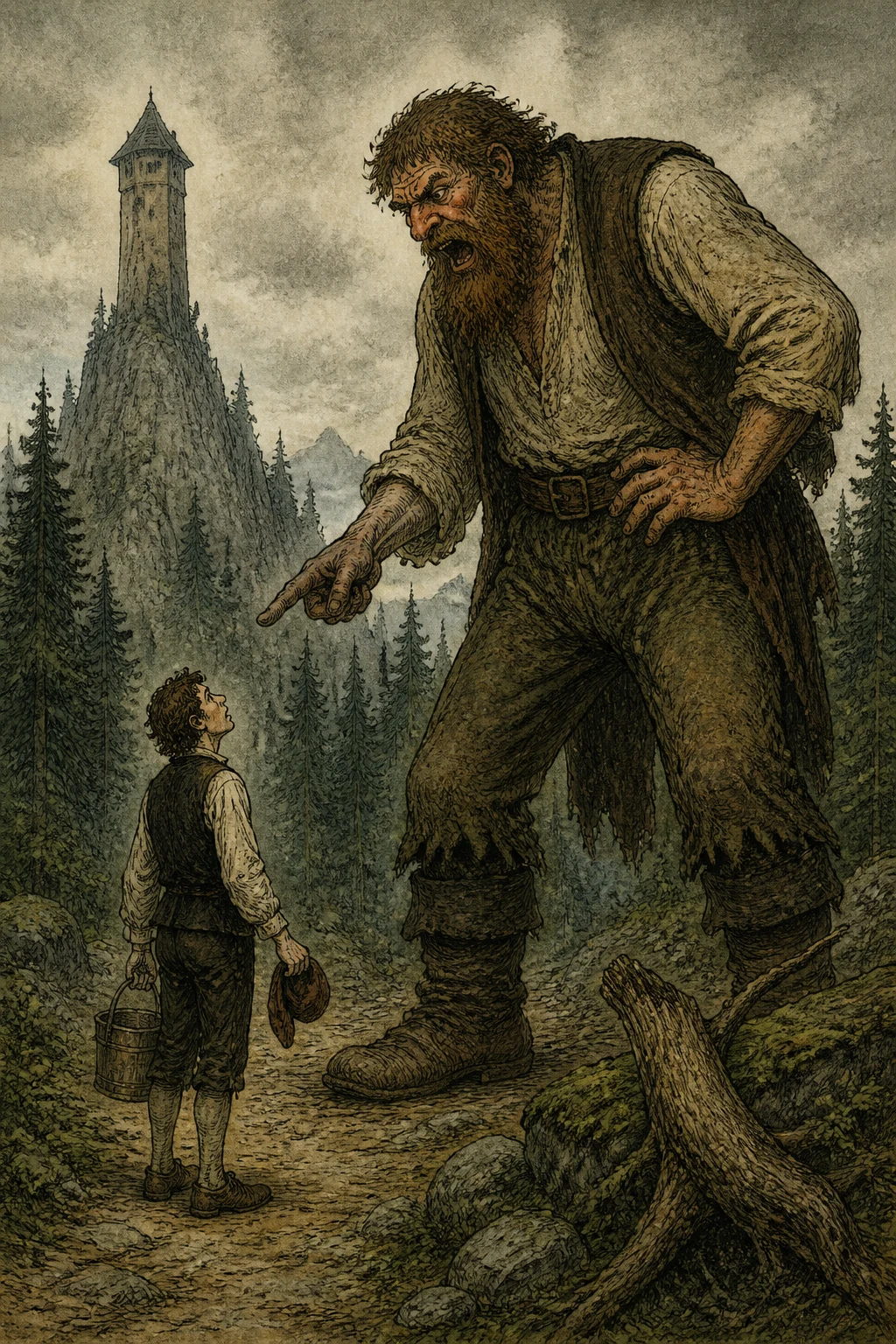
The giant looked scornfully at the tailor and said, "You ragamuffin! You miserable little wretch!" "What's that?" answered the little tailor. He unbuttoned his coat and showed the giant his belt. "There, you can read what sort of man I am." The giant read, "Seven at one blow," and, supposing they were men the tailor had killed, began to feel a little respect for the small fellow. Still, he wanted to put him to the test first, so he took a stone in his hand and squeezed it until water dripped out. "Do that," said the giant, "if you're so strong."
"Is that all?" said the little tailor. "That's child's play for the likes of me." He reached into his pocket, brought out the soft cheese, and squeezed it until the juice ran out. "Well," he said, "that was a little better, wasn't it?"
The giant did not know what to say and could hardly believe it of the little man. Then he picked up a stone and threw it so high that it could scarcely be seen. "Now, you little runt, do that."
"A good throw," said the tailor, "but the stone had to come down to earth again. I'll throw one that won't come back at all." He reached into his pocket, took out the bird, and tossed it into the air. Delighted to be free, the bird soared up, flew away, and did not return. "How do you like that trick, comrade?" asked the tailor. "You can certainly throw," said the giant, "but now let's see whether you can carry a proper load." He led the little tailor to a mighty oak that lay felled on the ground and said, "If you're strong enough, help me carry this tree out of the forest."
"Gladly," answered the little man. "You just take the trunk on your shoulder, and I'll lift and carry the branches and twigs. They're the heaviest part, after all." The giant hoisted the trunk onto his shoulder, but the tailor sat down on a branch, and the giant, who could not look behind him, had to carry the whole tree with the little tailor on top of it. Sitting at the back, the tailor was cheerful and quite at ease, whistling the little song, "Three tailors rode out through the gate," as though carrying trees were child's play. After dragging the heavy load some distance, the giant could go no farther and cried, "Listen, I'll have to drop the tree!"
The tailor nimbly jumped down, clasped the tree with both arms as though he had been carrying it, and said to the giant, "A great fellow like you, and you can't even carry a tree!"
They went on together, and as they passed a cherry tree, the giant took hold of its crown, where the ripest fruit hung, bent it down, put it into the tailor's hands, and told him to eat. But the little tailor was far too weak to hold the tree down, and when the giant let go, the tree sprang up and sent the tailor flying into the air. When he had fallen safely back to earth, the giant said, "What's this? Haven't you the strength to hold a slender switch?"
"There's nothing wrong with my strength," answered the little tailor. "Do you think that's anything for a man who struck down seven at one blow? I jumped over the tree because the huntsmen down there are shooting into the bushes. Jump after me, if you can." The giant tried, but could not clear the tree and got caught in its branches, so once again the little tailor had the upper hand.
The giant said, "If you're such a brave fellow, come along to our cave and spend the night with us." The little tailor readily agreed and followed him. When they reached the cave, other giants were sitting by the fire, each holding a roast sheep in his hand and eating it. The little tailor looked around and thought, "There's certainly more room here than in my workshop." The giant showed him a bed and told him to lie down and have a good sleep. But the bed was too big for the little tailor, so instead of lying in it, he crept into a corner.
At midnight, thinking the little tailor was fast asleep, the giant got up, took a great iron bar, and smashed the bed in two with a single blow, convinced that he had finished off the grasshopper.
At the first light of morning the giants went into the forest, having quite forgotten the little tailor, when suddenly he came striding along, cheerful and bold as ever. The giants took fright, fearing he would kill them all, and hurried away as fast as they could.
The little tailor traveled on, following his pointed nose. After walking for a long time, he came to the courtyard of a royal palace, and feeling tired, lay down on the grass and fell asleep. While he lay there, people came and looked him over from every side, reading on his belt, "Seven at one blow." "Oh!" they said. "What can this great warrior want here in peacetime? He must be a mighty lord." They went and told the king, saying that if war should break out, this would be an important and useful man, whom they must not let go at any price.
The king liked this advice and sent one of his courtiers to offer the little tailor a place in his army when he awoke. The envoy stood beside the sleeper, waited until he stretched his limbs and opened his eyes, and then presented his offer. "That is precisely why I came here," the tailor answered. "I am ready to enter the king's service." So he was received with honor and given quarters of his own. But the soldiers had been taken in by the little tailor and wished him a thousand miles away. "What will come of this?" they said among themselves. "If we quarrel with him and he strikes out, seven will fall at every blow. Men like us haven't a chance." So they made up their minds, went together to the king, and asked to be discharged. "We are not made," they said, "to serve beside a man who strikes down seven at one blow." The king was grieved that he should lose all his faithful servants for the sake of one man. He wished he had never set eyes on him and would gladly have been rid of him. But he did not dare dismiss him, fearing that he might kill both him and all his people and take the royal throne for himself.
He pondered the matter for a long time, and at last hit upon a plan. He sent word to the little tailor that, since he was so great a warrior, he wished to make him an offer. In a forest in his kingdom lived two giants who caused terrible destruction, robbing, murdering, burning, and laying waste, and no one could go near them without risking his life. If the tailor could overcome and kill these two giants, the king would give him his only daughter in marriage, with half the kingdom as her dowry. A hundred horsemen would also accompany him and lend their aid. "Now that's something for a man like you," thought the little tailor. "A beautiful princess and half a kingdom aren't offered to you every day."
"Oh, certainly," he replied. "I'll soon subdue the giants, and I shan't need the hundred horsemen to help me. A man who strikes down seven at one blow has no need to fear two."
The little tailor set out, and the hundred horsemen followed him. When he reached the edge of the forest, he said to his companions, "Just wait here. I'll deal with the giants on my own." Then he darted into the forest and looked about him to right and left. Before long he spotted the two giants. They lay asleep beneath a tree, snoring so loudly that the branches swayed up and down. The little tailor wasted no time. He filled both pockets with stones and climbed the tree with them. Halfway up, he slid along a branch until he was sitting directly above the sleepers, and let one stone after another fall onto one giant's chest. For a long time the giant felt nothing, but at last he woke, nudged his companion, and said, "Why are you hitting me?"
"You're dreaming," said the other. "I'm not hitting you." They settled down to sleep again, and the tailor dropped a stone onto the second giant. "What's this?" he cried. "Why are you throwing stones at me?"
"I'm not throwing anything at you," grumbled the first. They quarreled for a while, but being tired, they let the matter drop, and their eyes closed again. The little tailor began his game anew, picked out the biggest stone, and hurled it with all his might onto the first giant's chest. "That's too much!" the giant roared. He sprang up like a madman and shoved his companion against the tree so hard that it shook. The other paid him back in kind, and they flew into such a rage that they tore up trees and battered each other with them until at last both fell dead to the ground at the same time. Then the little tailor jumped down. "A good thing," he said, "that they didn't tear up the tree I was sitting in, or I'd have had to jump to another like a squirrel. Still, the likes of me are quick on their feet!" He drew his sword and gave each giant a few good blows to the chest, then went out to the horsemen and said, "The work is done. I've finished them both off. It was a hard fight, though. In their desperation they tore up trees to defend themselves, but all that is no use when they meet a man like me, who strikes down seven at one blow."
"But are you not wounded?" asked the horsemen. "Not a bit of it," answered the tailor. "They didn't harm a hair of my head." The horsemen would not believe him and rode into the forest. There they found the giants lying in pools of blood, with the uprooted trees strewn all around them. The little tailor demanded the promised reward from the king, but the king regretted his promise and began scheming again to rid himself of the hero. "Before you receive my daughter and half my kingdom," he told him, "you must perform one more heroic deed. There is a unicorn roaming the forest, doing great damage. You must catch it first."
"I am even less afraid of one unicorn than of two giants. Seven at one blow—that's my way." He took a rope and an axe with him, went into the forest, and once again told those assigned to accompany him to wait outside.
He did not have to search for long. The unicorn soon appeared and charged straight at the tailor as though it meant to run him through without further ado. "Easy, easy," he said. "Not so fast." He stood still and waited until the beast was very close, then nimbly sprang behind a tree. The unicorn charged against the tree with all its strength and drove its horn so firmly into the trunk that it could not pull it out again, and there it was, caught. "Now I've got my little bird," said the tailor. He came out from behind the tree, first slipped the rope around the unicorn's neck, then freed its horn from the trunk with his axe. When all was ready, he led the beast away and brought it to the king.
The king was still unwilling to grant him the promised reward and made a third demand. Before the wedding, the tailor must catch a wild boar that was doing great damage in the forest. The huntsmen would help him. "Gladly," said the tailor. "That's child's play." He did not take the huntsmen into the forest, and they were well pleased, for the wild boar had given them such a reception several times before that they had no wish to hunt it.
When the boar caught sight of the tailor, it charged at him, foaming at the mouth and gnashing its tusks, meaning to knock him to the ground. But the nimble hero darted into a nearby chapel and leaped straight out again through a window high in the wall. The boar had run in after him, but he skipped around the outside and slammed the door behind it. Now the raging beast was trapped, for it was far too heavy and clumsy to jump out of the window. The little tailor called the huntsmen over so that they could see the captive with their own eyes. The hero himself went to the king, who now, whether he liked it or not, had to keep his promise and give him his daughter and half the kingdom. Had he known that it was no great warrior but a little tailor who stood before him, he would have taken it still more to heart. So the wedding was celebrated with great splendor and little joy, and a tailor was made a king.
Some time later, the young queen heard her husband talking in his sleep one night. "Boy, make me that doublet and patch my breeches, or I'll box your ears with the yardstick!" Then she realized what sort of stock the young lord came from. The next morning she poured out her troubles to her father and begged him to rid her of this man, who was nothing but a tailor. The king comforted her and said, "Leave your bedchamber door open tomorrow night. My servants shall wait outside, and when he has fallen asleep, they will go in, bind him, and carry him aboard a ship that will take him far away." His daughter was satisfied with this, but the king's armor-bearer, who had overheard everything and was fond of the young lord, told him the whole plot. "I'll put a stop to that," said the little tailor.
That evening he went to bed with his wife at the usual hour. When she thought he had fallen asleep, she got up, opened the door, and lay down again. The little tailor, who was only pretending to be asleep, began calling out in a clear voice, "Boy, make that doublet and patch my breeches, or I'll box your ears with the yardstick! I've struck down seven at one blow, killed two giants, led away a unicorn, and caught a wild boar, and am I to be afraid of those fellows standing outside the chamber?" When they heard the tailor speaking, a great fear came over them. They fled as though the Wild Hunt were at their heels, and not one of them ever dared go near him again. So the little tailor remained a king for the rest of his life.