O besedilu
Mladi velikan
- Vir
- Grimmove pravljice
- Avtor
- Jacob in Wilhelm Grimm
- Jezik branja
- English
- Jezik izvirnika
- Deutsch
- Čas branja
- 16 min branja
- Obseg
- 13 strani
- Naslov izvirnika
- Der junge Riese
O izvirniku
Grimmove pravljice
Gozdovi, čarobni predmeti in ljudska logika evropske pripovedne tradicije. Bralni jezik je English, izvirnik pa prihaja iz vira Grimmove pravljice v jeziku Deutsch.
Besedilo
Mladi velikan
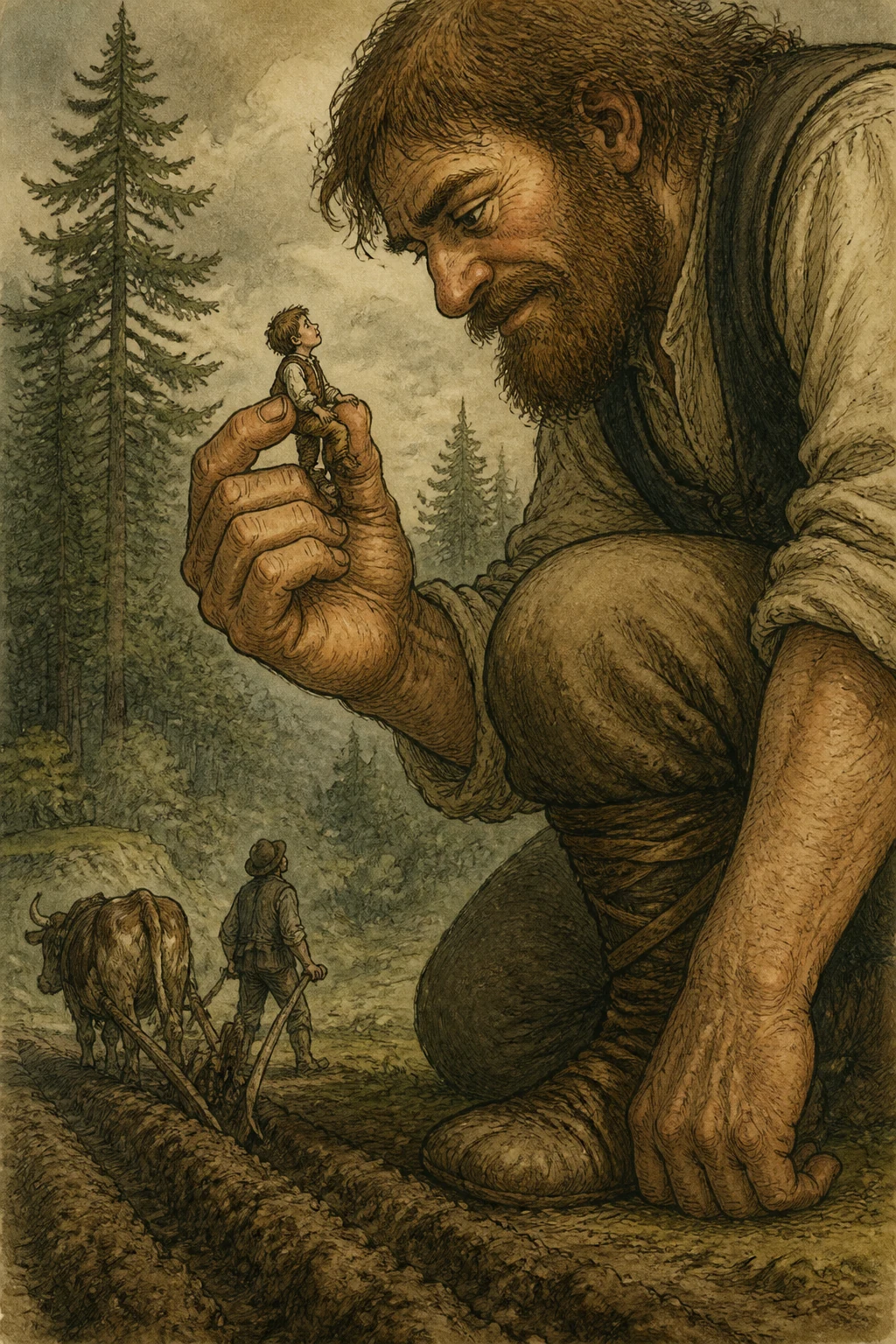
A farmer had a son who was no bigger than a thumb, and would grow no bigger, nor did he gain so much as a hair’s breadth in several years. One day the farmer was going out to plough his field, and the little fellow said, “Father, I want to come with you.” “You want to come with me?” said his father. “Stay here. You’d be no use out there, and I might lose you besides.” Then Tom Thumb began to cry, and for the sake of peace his father put him in his pocket and took him along. When they reached the field, he took him out again and set him in a freshly ploughed furrow. As he sat there, a great giant came striding over the hill. “Do you see that great bogeyman over there?” said his father, meaning to frighten the little fellow into behaving himself. “He’s coming to carry you off.” But the giant had taken scarcely a few strides on his long legs before he reached the furrow. He carefully lifted little Tom Thumb between two fingers, looked him over, and carried him away without a word. His father stood by, too terrified to utter a sound, and could only think that his child was lost and that he would never set eyes on him again as long as he lived.
But the giant carried him home and suckled him at his breast, and Tom Thumb grew tall and strong, as giants do. When two years had passed, the old giant took him into the forest to test him, and said, “Pull yourself up a switch.” By then the boy was so strong that he tore a young tree out of the ground, roots and all. But the giant said, “You must do better than that,” and took him home and suckled him for another two years. When he tested him again, his strength had increased so much that he could wrench an old tree out of the earth. Still this was not enough for the giant, who suckled him for two more years. Then he took him into the forest and said, “Now pull yourself up a proper switch.” The boy tore the thickest oak out of the ground with a great crack, and it was mere child’s play to him. “Now that will do,” said the giant. “You have finished your training.” And he led him back to the field where he had found him. His father was standing behind the plough. The young giant went up to him and said, “Well, Father, do you see what a man your son has become?” The farmer took fright and said, “No, you’re not my son. I don’t want you. Go away.” “Of course I’m your son. Let me get to work. I can plough as well as you, and better.” “No, no, you’re not my son, and you can’t plough either. Go away.” But he was afraid of the great fellow, so he let go of the plough, stepped back, and sat down at the edge of the field. Then the boy took hold of the plough and pressed down on it with just one hand, but so mighty was the pressure that the plough sank deep into the earth. The farmer could not bear to watch and called out, “If you mean to plough, you mustn’t press so hard. You’ll make a poor job of it.” But the boy unharnessed the horses and pulled the plough himself, saying, “Just go home, Father, and have Mother cook me a great bowlful of food. Meanwhile, I’ll turn this field over.” So the farmer went home and asked his wife to prepare the meal. The boy ploughed the whole field, two morgens of land, all by himself; then he harnessed himself to the harrows and harrowed it all with two at once. When he had finished, he went into the forest, tore up two oak trees, and laid them across his shoulders, with a harrow at either end and a horse at either end as well. Then he carried the whole load to his parents’ house as though it were a bundle of straw. When he came into the yard, his mother did not recognize him and asked, “Who is that dreadful great man?” The farmer said, “That is our son.” “No,” she said, “that can never be our son. We never had one so big. Ours was a tiny little thing.” She called to him, “Go away. We don’t want you.” The boy said nothing, but led his horses into the stable and gave them oats and hay, seeing to everything as he ought. When he had finished, he went into the house, sat down on the bench, and said, “Mother, I’m ready for something to eat now. Will it soon be done?” “Yes,” she said, and brought in two great, great bowlfuls, enough to have fed her and her husband for eight days. But the boy ate it all by himself and asked whether she could not bring him some more. “No,” she said, “that is all we have.” “Why, that was only a taste. I must have more.” She dared not refuse him, so she went and put a great kettle used for boiling the pigs’ food over the fire, filled to the brim, and when it was cooked she carried it in. “At last, a few more morsels,” he said, and ate the whole lot; but even that was not enough to satisfy his hunger. Then he said, “Father, I can see I shall never get enough to eat here. If you will get me an iron staff strong enough that I cannot break it across my knees, I will go out into the world.” The farmer was glad to hear this. He harnessed his two horses to the wagon and fetched from the smith a bar as long and thick as the two horses could possibly haul. The boy braced it against his knees, and snap! He broke it in two down the middle like a beanstalk and threw it away. His father harnessed four horses to the wagon and fetched a bar as long and thick as the four horses could haul. His son snapped this one across his knee as well, threw it down, and said, “Father, this is no use to me. You must harness more horses and fetch a stronger staff.” Then his father harnessed eight horses and fetched a bar as long and thick as the eight horses could bring. The moment his son took it in his hand, he broke a piece off the top and said, “Father, I see you cannot get me the sort of staff I need. I will stay with you no longer.”
So he went away and passed himself off as a journeyman smith. He came to a village where there lived a smith who was a miser, begrudging everyone everything and wanting it all for himself. The young giant went into his smithy and asked whether he needed a journeyman. “Yes,” said the smith, looking him over and thinking, “That is a sturdy fellow. He’ll wield the sledgehammer well and earn his bread.” He asked, “What wages do you want?” “I want no wages at all,” he answered. “Only, every fortnight, when the other journeymen are paid, I shall give you two blows, and you must bear them.” The miser was heartily pleased with this, thinking how much money he would save. The next morning the new journeyman was set to wield the sledgehammer, but when the master brought the glowing iron bar and the young man struck his first blow, the iron flew to pieces and the anvil sank so deep into the ground that they could not get it out again. Then the miser grew angry and said, “Well, you’re no use to me. You strike far too hard. What do you want for that one blow?” “I shall give you just one very little blow,” he said, “and nothing more.” He lifted his foot and gave the smith a kick that sent him flying over four wagonloads of hay. Then he chose the thickest iron bar in the smithy, took it in his hand for a walking stick, and went on his way.
After travelling for a while, he came to a farm on a large estate and asked the steward whether he needed a head farmhand. “Yes,” said the steward, “I could use one. You look like a sturdy fellow who can get something done. What yearly wages do you want?” Once again he answered that he wanted no wages, but every year he would give the steward three blows, which he must bear. The steward agreed, for he too was a miser. The next morning the farmhands were to drive into the woods, and the others were already up, but the young giant was still in bed. One of them called to him, “Get up. It’s time. We’re going to the woods, and you must come too.” “Oh,” he said, gruffly and defiantly, “off you go. I’ll still be back before the whole lot of you.” So the others went to the steward and told him that the head farmhand was still lying in bed and would not go with them to the woods. The steward said they should wake him once more and tell him to harness the horses. But the head farmhand answered as before, “Off you go. I’ll still be back before the whole lot of you.” Then he lay in bed for another two hours before he finally got up. First, however, he fetched two bushels of peas from the loft, cooked himself a porridge, and ate it at his leisure. Only when all this was done did he go and harness the horses and drive to the woods. Not far from the woods was a sunken lane through which he had to pass. He drove his wagon through, then halted the horses, went behind the wagon, and piled up trees and brushwood into a great barricade, so that no horse could get through. When he reached the woods, the others were just driving out with their loaded wagons, ready to go home. He said to them, “Off you go. I’ll still be home before you.” He drove only a little way into the woods, tore two of the very largest trees out of the earth, threw them on his wagon, and turned back. When he reached the barricade, the others were still standing there, unable to get through. “You see,” he said, “if you had stayed with me, you would have got home just as soon, and you could have had another hour’s sleep.” He was about to drive through, but his horses could not force their way past. So he unharnessed them, laid them on top of the wagon, took the shaft in his own hand, and heave-ho! He pulled the whole load through as easily as though it were feathers. Once he was on the other side, he said to the others, “You see, I’m through sooner than you,” and drove on, while they had to stay where they were. Back in the yard, he took one of the trees in his hand, showed it to the steward, and said, “Now, isn’t that a fine piece of firewood?” Then the steward said to his wife, “That is a good farmhand. He may sleep late, but he still gets back before the others.”
He served the steward for a year, and when the year was over and the other farmhands received their wages, he said that it was time for him to collect his too. But the steward was afraid of the blows he was to receive and begged him earnestly to forgo them. He would rather become head farmhand himself and let the young giant be steward. “No,” he said, “I don’t want to be steward. I am head farmhand and mean to remain so, but I intend to give you what we agreed upon.” The steward offered him anything he might ask, but it was no use: to everything the head farmhand said no. At his wits’ end, the steward begged for a fortnight’s grace so that he could think of something. The head farmhand said he might have it. The steward called all his clerks together and told them to think the matter over and advise him. The clerks pondered for a long time, and at last they said that no one’s life was safe with the head farmhand about: he could squash a man as easily as a fly. The steward should order him to climb down into the well and clean it. When he was at the bottom, they would roll over one of the millstones lying nearby and drop it on his head; then he would never see daylight again. The steward liked this advice, and the head farmhand was willing to climb down into the well. When he was standing at the bottom, they rolled the largest millstone down and thought they had crushed his skull. But he called out, “Chase the chickens away from the well. They’re scratching in the sand up there and throwing grit into my eyes, so that I can’t see.” The steward called, “Shoo! Shoo!” and pretended to drive the chickens away. When the head farmhand had finished his work, he climbed out and said, “Just look what a fine necklace I’m wearing!” It was the millstone he had round his neck. Now the head farmhand wanted to collect his wages, but the steward again begged for a fortnight to think. The clerks came together and advised him to send the head farmhand to the haunted mill to grind corn there that night, for no one had ever come out of it alive in the morning. The steward liked the scheme. That very evening he called the head farmhand and ordered him to take eight large measures of corn to the mill and grind it that night, for they needed it. So the head farmhand went up to the loft and put two measures in his right pocket and two in his left, then carried four more in a sack slung half over his back and half over his chest. Thus loaded, he went to the haunted mill. The miller told him that he could grind there well enough by day, but not at night, for then the mill was haunted, and everyone who had ventured inside had been found dead there in the morning. “I shall manage well enough,” he said. “Just be off with you and get some sleep.” Then he went into the mill and poured in the corn. Towards eleven o’clock he went into the miller’s room and sat down on the bench. He had been sitting there a little while when the door suddenly opened and a great, great table came in. Wine and roast meat and all manner of good food appeared upon it, all by themselves, for there was no one there to serve them. Then chairs drew up to the table, but no people appeared, until all at once he saw fingers handling knives and forks and putting food on plates. Beyond that, he could see nothing. As he was hungry and could see the food, he too sat down at the table, joined in the meal, and ate with great enjoyment. When he had had his fill and the others had emptied all their dishes as well, all the lights were suddenly snuffed out. He heard it quite plainly, and once it was pitch-dark, he felt something like a slap across the face. “If that happens again,” he said, “I shall start handing them out myself.” And when he received a second slap, he struck back. So it went on all night. He took nothing without giving plenty in return, and dealt blows all round him with a will. But at daybreak it all stopped. When the miller got up, he went to see how the young giant had fared and was astonished to find him still alive. “I have eaten my fill,” he said. “I have had my ears boxed, but I have boxed a few ears myself.” The miller was delighted and said that the mill was now freed from its spell, and he would gladly give him a handsome sum of money as a reward. But the young giant said, “I don’t want money. I have enough already.” Then he hoisted his flour onto his back, went home, and told the steward that he had done the job and now wanted the wages they had agreed upon. When the steward heard this, he was more frightened than ever. He did not know which way to turn, but paced up and down the room with sweat running down his forehead. He opened the window for some fresh air, but before he knew what was happening, the head farmhand had given him a kick that sent him flying out through the window and into the sky, farther and farther, until no one could see him any more. Then the head farmhand said to the steward’s wife, “If he doesn’t come back, you must take the next blow.” “No, no, I cannot bear it!” she cried, and opened the other window, for sweat was running down her forehead too. Then he gave her a kick that sent her flying out as well, and because she was lighter, she went much higher than her husband. The husband called, “Come over to me!” But she called back, “You come over to me. I can’t get to you.” And there they floated in the air, neither able to reach the other. Whether they are floating there still, I do not know; but the young giant took up his iron staff and went on his way.
Izvirnik
Der junge Riese
Naslednje strani prikazujejo izvirno besedilo za primerjavo.
Ein Märchen der Brüder Grimm
Ein Bauersmann hatte einen Sohn, der war so groß wie ein Daumen und ward gar nicht größer und wuchs in etlichen Jahren nicht ein Haarbreit. Einmal wollte der Bauer ins Feld gehen und pflügen, da sagte der Kleine 'Vater, ich will mit hinaus.' 'Du willst mit hinaus?' sprach der Vater, 'bleib du hier, dort bist du zu nichts nutz; du könntest mir auch verloren gehen.' Da fing der Däumling an zu weinen, und um Ruhe zu haben, steckte ihn der Vater in die Tasche und nahm ihn mit. Draußen auf dem Felde holte er ihn wieder heraus und setzte ihn in eine frische Furche. Wie er da so saß, kam über den Berg ein großer Riese daher. 'Siehst du dort den großen Butzemann?' sagte der Vater, und wollte den Kleinen schrecken, damit er artig wäre, 'der kommt und holt dich.' Der Riese aber hatte mit seinen langen Beinen kaum ein paar Schritte getan, so war er bei der Furche. Er hob den kleinen Däumling mit zwei Fingern behutsam in die Höhe, betrachtete ihn und ging, ohne ein Wort zu sprechen, mit ihm fort. Der Vater stand dabei, konnte vor Schrecken keinen Laut hervorbringen und dachte nicht anders als sein Kind für verloren, also daß ers sein Lebtag nicht wieder mit Augen sehen würde.
Der Riese aber trug es heim und ließ es an seiner Brust saugen, und der Däumling wuchs und ward groß und stark nach Art der Riesen. Nach Verlauf von zwei Jahren ging der Alte mit ihm in den Wald, wollte ihn versuchen und sprach 'zieh dir eine Gerte heraus.' Da war der Knabe schon so stark, daß er einen jungen Baum mit den Wurzeln aus der Erde riß. Der Riese aber meinte 'das muß besser kommen,' nahm ihn wieder mit und säugte ihn noch zwei Jahre. Als er ihn versuchte, hatte seine Kraft schon so zugenommen, daß er einen alten Baum aus der Erde brechen konnte. Das war dem Riesen noch immer nicht genug, er säugte ihn abermals zwei Jahre, und als er dann mit ihm in den Wald ging und sprach 'nun reiß einmal eine ordentliche Gerte aus,' so riß der Junge den dicksten Eichenbaum aus der Erde, daß er krachte, und war ihm nur ein Spaß. 'Nun ists genug,' sprach der Riese, 'du hast ausgelernt,' und führte ihn zurück auf den Acker, wo er ihn geholt hatte. Sein Vater stand da hinter dem Pflug, der junge Riese ging auf ihn zu und sprach 'sieht er wohl, Vater, was sein Sohn für ein Mann geworden ist.' Der Bauer erschrak und sagte 'nein, du bist mein Sohn nicht, ich will dich nicht, geh weg von mir.' 'Freilich bin ich sein Sohn, laß er mich an die Arbeit, ich kann pflügen so gut als er und noch besser.' 'Nein, nein, du bist mein Sohn nicht, du kannst auch nicht pflügen, geh weg von mir.' Weil er sich aber vor dem großen Mann fürchtete, ließ er den Pflug los, trat zurück und setzte sich zur Seite ans Land. Da nahm der Junge das Geschirr und drückte bloß mit einer Hand darauf, aber der Druck war so gewaltig, daß der Pflug tief in die Erde ging. Der Bauer konnte das nicht mit ansehen und rief ihm zu 'wenn du pflügen willst, mußt du nicht so gewaltig drücken, das gibt schlechte Arbeit.' Der Junge aber spannte die Pferde aus, zog selber den Pflug und sagte 'geh er nur nach Haus , Vater, und laß er die Mutter eine große Schüssel voll Essen kochen; ich will derweil den Acker schon umreißen.' Da ging der Bauer heim und bestellte das Essen bei seiner Frau: der Junge aber pflügte das Feld, zwei Morgen groß, ganz allein, und dann spannte er sich auch selber vor die Egge und eggte alles mit zwei Eggen zugleich. Wie er fertig war, ging er in den Wald und riß zwei Eichenbäume aus, legte sie auf die Schultern, und hinten und vorn eine Egge darauf, und hinten und vorn auch ein Pferd, und trug das alles, als wär es ein Bund Stroh, nach seiner Eltern Haus. Wie er in den Hof kam, erkannte ihn seine Mutter nicht und fragte 'wer ist der entsetzliche große Mann?' Der Bauer sagte 'das ist unser Sohn.' Sie sprach 'nein, unser Sohn ist das nimmermehr, so groß haben wir keinen gehabt, unser war ein kleines Ding.' Sie rief ihm zu 'geh fort, wir wollen dich nicht.' Der Junge schwieg still, zog seine Pferde in den Stall, gab ihnen Hafer und Heu, alles wie sichs gehörte. Als er fertig war, ging er in die Stube, setzte sich auf die Bank und sagte 'Mutter, nun hätte ich Lust zu essen, ists bald fertig?' Da sagte sie 'ja, und brachte zwei große große Schüsseln voll herein, daran hätten sie und ihr Mann acht Tage lang satt gehabt. Der Junge aber aß sie allein auf und fragte, ob sie nicht mehr vorsetzen könnte. 'Nein,' sagte sie, 'das ist alles, was wir haben.' 'Das war ja nur zum Schmecken, ich muß mehr haben.' Sie getraute nicht, ihm zu widerstehen, ging hin und setzte einen großen Schweinekessel voll übers Feuer, und wie es gar war, trug sie es herein. 'Endlich kommen noch ein paar Brocken,' sagte er und aß alles hinein; es war aber doch nicht genug, seinen Hunger zu stillen. Da sprach er 'Vater, ich sehe wohl, bei ihm werd ich nicht satt, will er mir einen Stab von Eisen verschaffen, der stark ist und den ich vor meinen Knien nicht zerbrechen kann, so will ich fort in die Welt gehen.' Der Bauer war froh, spannte seine zwei Pferde vor den Wagen und holte bei dem Schmied einen Stab so groß und dick, als ihn die zwei Pferde nur fortschaffen konnten. Der Junge nahm ihn vor die Knie und ratsch! brach er ihn wie eine Bohnenstange in der Mitte entzwei und warf ihn weg. Der Vater spannte vier Pferde vor und holte einen Stab so groß und dick, als ihn die vier Pferde fortschaffen konnten. Der Sohn knickte auch diesen vor dem Knie entzwei, warf ihn hin und sprach 'Vater, der kann mir nicht helfen, er muß besser vorspannen und einen stärkern Stab holen.' Da spannte der Vater acht Pferde vor und holte einen so groß und dick, als ihn die acht Pferde herbeifahren konnten. Wie der Sohn den in die Hand nahm, brach er gleich oben ein Stück davon ab und sagte 'Vater, ich sehe, er kann mir keinen Stab anschaffen, wie ich ihn brauche, ich will nicht länger bei ihm bleiben.'
Da ging er fort und gab sich für einen Schmiedegesellen aus.
Er kam in ein Dorf, darin wohnte ein Schmied, der war ein Geizmann, gönnte keinem Menschen etwas und wollte alles allein haben; zu dem trat er in die Schmiede und fragte, ob er keinen Gesellen brauchte. 'Ja,' sagte der Schmied, sah ihn an und dachte 'das ist ein tüchtiger Kerl, der wird gut vorschlagen und sein Brot verdienen.' Er fragte 'wieviel willst du Lohn haben?' 'Gar keinen will ich haben,' antwortete er, 'nur alle vierzehn Tage, wenn die andern Gesellen ihren Lohn bezahlt kriegen, will ich dir zwei Streiche geben, die mußt du aushalten.' Das war der Geizmann von Herzen zufrieden und dachte damit viel Geld zu sparen. Am andern Morgen sollte der fremde Geselle zuerst vorschlagen, wie aber der Meister den glühenden Stab brachte und jener den ersten Schlag tat, so flog das Eisen voneinander und der Amboß sank in die Erde, so tief, daß sie ihn gar nicht wieder herausbringen konnten. Da ward der Geizmann bös und sagte 'ei was, dich kann ich nicht brauchen, du schlägst gar zu grob, was willst du für den einen Zuschlag haben?' Da sprach er 'ich will dir nur einen ganz kleinen Streich geben, weiter nichts.' Und hob seinen Fuß auf und gab ihm einen Tritt, daß er über vier Fuder Heu hinausflog. Darauf suchte er sich den dicksten Eisenstab aus, der in der Schmiede war, nahm ihn als einen Stock in die Hand und ging weiter.
Als er eine Weile gezogen war, kam er zu einem Vorwerk und fragte den Amtmann, ob er keinen Großknecht nötig hätte. 'Ja,' sagte der Amtmann, 'ich kann einen brauchen: du siehst aus wie ein tüchtiger Kerl, der schon was vermag, wieviel willst du Jahrslohn haben?' Er antwortete wiederum, er verlangte gar keinen Lohn, aber alle Jahre wollte er ihm drei Streiche geben, die müßte er aushalten. Das war der Amtmann zufrieden, denn er war auch ein Geizhals. Am andern Morgen, da sollten die Knechte ins Holz fahren, und die andern Knechte waren schon auf, er aber lag noch im Bett. Da rief ihn einer an 'steh auf, es ist Zeit, wir wollen ins Holz, und du mußt mit.' 'Ach,' sagte er ganz grob und trotzig, 'geht ihr nur hin, ich komme doch eher wieder als ihr alle miteinander.' Da gingen die andern zum Amtmann und erzählten ihm, der Großknecht läge noch im Bett und wollte nicht mit ins Holz fahren. Der Amtmann sagte, sie sollten ihn noch einmal wecken und ihn heißen die Pferde vorspannen. Der Großknecht sprach aber wie vorher 'geht ihr nur hin, ich komme doch eher wieder als ihr alle miteinander.' Darauf blieb er noch zwei Stunden liegen, da stieg er endlich aus den Federn, holte sich aber erst zwei Scheffel voll Erbsen vom Boden, kochte sich einen Brei und aß den mit guter Ruhe, und wie das alles geschehen war, ging er hin, spannte die Pferde vor und fuhr ins Holz. Nicht weit vor dem Holz war ein Hohlweg, wo er durch mußte, da fuhr er den Wagen erst vorwärts, dann mußten die Pferde stille halten, und er ging hinter den Wagen, nahm Bäume und Reisig und machte da eine große Hucke (Verhack), so daß kein Pferd durchkommen konnte. Wie er nun vors Holz kam, fuhren die andern eben mit ihren beladenen Wagen heraus und wollten heim, da sprach er zu ihnen 'fahrt nur hin, ich komme doch eher als ihr nach Haus.' Er fuhr gar nicht weit ins Holz, riß gleich zwei der allergrößten Bäume aus der Erde, warf sie auf de n Wagen und drehte um. Als er vor der Hucke anlangte, standen die andern noch da und konnten nicht durch. 'Seht ihr wohl,' sprach er, 'wärt ihr bei mir geblieben, so wärt ihr ebenso schnell nach Haus gekommen und hättet noch eine Stunde schlafen können.' Er wollte nun zufahren, aber seine Pferde konnten sich nicht durcharbeiten, da spannte er sie aus, legte sie oben auf den Wagen, nahm selber die Deichsel in die Hand, und hüf! zog er alles durch, und das ging so leicht, als hätt er Federn geladen. Wie er drüben war, sprach er zu den andern 'seht ihr wohl, ich bin schneller hindurch als ihr,' fuhr weiter, und die andern mußten stehen bleiben. In dem Hof aber nahm er einen Baum in die Hand, zeigte ihn dem Amtmann und sagte 'ist das nicht ein schönes Klafterstück?' Da sprach der Amtmann zu seiner Frau 'der Knecht ist gut; wenn er auch lang schläft, er ist doch eher wieder da als die andern.'
Nun diente er dem Amtmann ein Jahr: wie das herum war und die andern Knechte ihren Lohn kriegten, sprach er, es wäre Zeit, er wollte sich auch seinen Lohn nehmen. Dem Amtmann ward aber angst vor den Streichen, die er kriegen sollte, und bat ihn inständig, er möchte sie ihm schenken, lieber wollte er selbst Großknecht werden, und er sollte Amtmann sein. 'Nein,' sprach er, 'ich will kein Amtmann werden, ich bin Großknecht und wills bleiben, ich will aber austeilen, was bedungen ist.' Der Amtmann wollte ihm geben, was er nur verlangte, aber es half nichts, der Großknecht sprach zu allem 'nein.' Da wußte sich der Amtmann nicht zu helfen und bat ihn um vierzehn Tage Frist, er wollte sich auf etwas besinnen. Der Großknecht sprach, die Frist sollte er haben. Der Amtmann berief alle seine Schreiber zusammen, sie sollten sich bedenken und ihm einen Rat geben. Die Schreiber besannen sich lange, endlich sagten sie, vor dem Großknecht wäre niemand seines Lebens sicher, der schlüge einen Menschen wie eine Mücke tot. Er sollte ihn heißen in den Brunnen steigen und ihn reinigen, wenn er unten wäre, wollten sie einen von den Mühlensteinen, die da lägen, herbeirollen und ihm auf den Kopf werfen, dann würde er nicht wieder an des Tages Licht kommen. Der Rat gefiel dem Amtmann, und der Großknecht war bereit, in den Brunnen hinabzusteigen. Als er unten auf dem Grund stand, rollten sie den größten Mühlenstein hinab, und meinten, der Kopf wäre ihm eingeschlagen, aber er rief 'jagt die Hühner vom Brunnen weg, die kratzen da oben im Sand und werfen mir die Körner in die Augen, daß ich nicht sehen kann.' Da rief der Amtmann 'husch! husch!' und tat, als scheuchte er die Hühner weg. Als der Großknecht mit seiner Arbeit fertig war, stieg er herauf und sagte 'seht einmal, ich habe doch ein schönes Halsband um,' da war es der Mühlenstein, den er um den Hals trug. Der Großknecht woll te jetzt seinen Lohn nehmen, aber der Amtmann bat wieder um vierzehn Tage Bedenkzeit. Die Schreiber kamen zusammen und gaben den Rat, er sollte den Großknecht in die verwünschte Mühle schicken, um dort in der Nacht Korn zu mahlen: von da wäre noch kein Mensch morgens lebendig herausgekommen. Der Anschlag gefiel dem Amtmann, er rief den Großknecht noch denselben Abend und hieß ihn acht Malter Korn in die Mühle fahren und in der Nacht noch mahlen; sie hättens nötig. Da ging der Großknecht auf den Boden und tat zwei Malter in seine rechte Tasche, zwei in die linke, vier nahm er in einem Quersack halb auf den Rücken, halb auf die Brust, und ging also beladen nach der verwünschten Mühle. Der Müller sagte ihm, bei Tag könnte er recht gut da mahlen, aber nicht in der Nacht, da wäre die Mühle verwünscht, und wer da noch hineingegangen wäre, den hätte man am Morgen tot darin gefunden. Er sprach 'ich will schon durchkommen, macht Euch nur fort und legt Euch aufs Ohr.' Darauf ging er in die Mühle und schüttete das Korn auf. Gegen elf Uhr ging er in die Müllerstube und setzte sich auf die Bank. Als er ein Weilchen da gesessen hatte, tat sich auf einmal die Tür auf und kam eine große große Tafel herein, und auf die Tafel stellte sich Wein und Braten und viel gutes Essen, alles von selber, denn es war niemand da, ders auftrug. Und danach rückten sich die Stühle herbei, aber es kamen keine Leute, bis auf einmal sah er Finger, die hantierten mit den Messern und Gabeln und legten Speisen auf die Teller, aber sonst konnte er nichts sehen. Da er hungrig war und die Speisen sah, so setzte er sich auch an die Tafel, aß mit und ließ sichs gut schmecken. Als er satt war und die andern ihre Schüsseln auch ganz leer gemacht hatten, da wurden die Lichter auf einmal alle ausgeputzt, das hörte er deutlich, und wies nun stockfinster war, so kriegte er so etwas wie eine Ohrfei ge ins Gesicht. Da sprach er 'wenn noch einmal so etwas kommt, so teil ich auch wieder aus.' Und wie er zum zweitenmal eine Ohrfeige kriegte, da schlug er gleichfalls mit hinein. Und so ging das fort die ganze Nacht, er nahm nichts umsonst, sondern gab reichlich zurück und schlug nicht faul um sich herum: bei Tagesanbruch aber hörte alles auf. Wie der Müller aufgestanden war, wollte er nach ihm sehen und verwunderte sich, daß er noch lebte. Da sprach er 'ich habe mich satt gegessen, habe Ohrfeigen gekriegt, aber ich habe auch Ohrfeigen ausgeteilt.' Der Müller freute sich und sagte, nun wäre die Mühle erlöst, und wollt ihm gern zur Belohnung viel Geld geben. Er sprach aber 'Geld will ich nicht, ich habe doch genug.' Dann nahm er sein Mehl auf den Rücken, ging nach Haus und sagte dem Amtmann, er hätte die Sache ausgerichtet und wollte nun seinen bedungenen Lohn haben. Wie der Amtmann das hörte, da ward ihm erst recht angst: er wußte sich nicht zu lassen, ging in der Stube auf und ab, und die Schweißtropfen liefen ihm von der Stirne herunter. Da machte er das Fenster auf nach frischer Luft, ehe er sichs aber versah, hatte ihm der Großknecht einen Tritt gegeben, daß er durchs Fenster in die Luft hineinflog, immer fort, bis ihn niemand mehr sehen konnte. Da sprach der Großknecht zur Frau des Amtmanns 'kommt er nicht wieder, so müßt Ihr den anderen Streich hinnehmen.' Sie rief 'nein, nein, ich kanns nicht aushalten,' und machte das andere Fenster auf, weil ihr die Schweißtropfen die Stirne herunterliefen. Da gab er ihr einen Tritt, daß sie gleichfalls hinausflog, und da sie leichter war, noch viel höher als ihr Mann. Der Mann rief 'komm doch zu mir,' sie aber rief 'komm du zu mir, ich kann nicht zu dir.' Und sie schwebten da in der Luft, und konnte keins zum andern kommen, und ob sie da noch schweben, das weiß ich nicht; der junge Riese aber nahm seine Eisenstange und ging weiter.
Nadaljuj z branjem