Prevod
Once upon a time there was a rich king who had three daughters, and every day they went walking in the palace garden. Now the king was a great lover of all manner of beautiful trees, but there was one tree he loved above all the rest, so much so that he wished anyone who plucked an apple from it a hundred fathoms beneath the earth. When autumn came, the apples on the tree grew as red as blood. Every day the three daughters went beneath it to see whether the wind had blown an apple down, but never in their lives did they find one, though the tree was so laden with fruit that it seemed about to break, and its branches hung right down to the ground. At last the youngest princess felt such a longing that she said to her sister, "Our father loves us far too dearly to put a curse on us. I believe he only says that for strangers." And the child plucked a great round apple, skipped ahead of her sisters, and said, "Oh, do taste it, my dear sisters! Never in my life have I eaten anything so delicious." So the other two princesses took a bite of the apple as well, and all three sank deep beneath the earth, and not a soul heard any more of them.
When noon came, the king wanted to call them to table, but they were nowhere to be found. He searched everywhere, in the palace and in the garden, but could not find them. Then he grew very sorrowful and sent out a proclamation throughout the land: whoever brought his daughters back to him should have one of them for his wife. And so a great many young men went out across the countryside and searched with all their might, sparing no effort, for everyone had loved the three children, who were as kind to everyone as they were fair of face. Three young huntsmen also set out, and after they had travelled for some eight days, they came to a great castle. Inside were beautiful rooms, and in one room a table was laid with the most delicious dishes, still hot and steaming; yet in the whole castle there was not a soul to be heard or seen. They waited another half-day, and still the food remained hot and steaming. At last, however, they grew so hungry that they sat down at the table and ate with a hearty appetite. They agreed to stay in the castle and draw lots to decide which of them should remain at home while the other two searched for the daughters. This they did, and the lot fell to the eldest. The next day the two younger huntsmen went out searching, while the eldest had to stay at home. On Wednesday a little man came and asked for a piece of bread. The eldest took one of the loaves he had found there, cut a piece from all around it, and offered it to him. He held it out to the little man, but the fellow let it fall and told the young huntsman to pick it up and give it back to him. He was about to do so and bent down, but the little man seized a stick, caught him by the hair, and gave him a sound beating. The next day the second stayed at home, and fared no better. When the other two came home that evening, the eldest said, "Well, how did you get on?" "Oh, badly enough." Then they told each other their troubles, but said nothing to the youngest, for they could not stand him and had always called him Simple Hans, because he had little worldly wisdom.
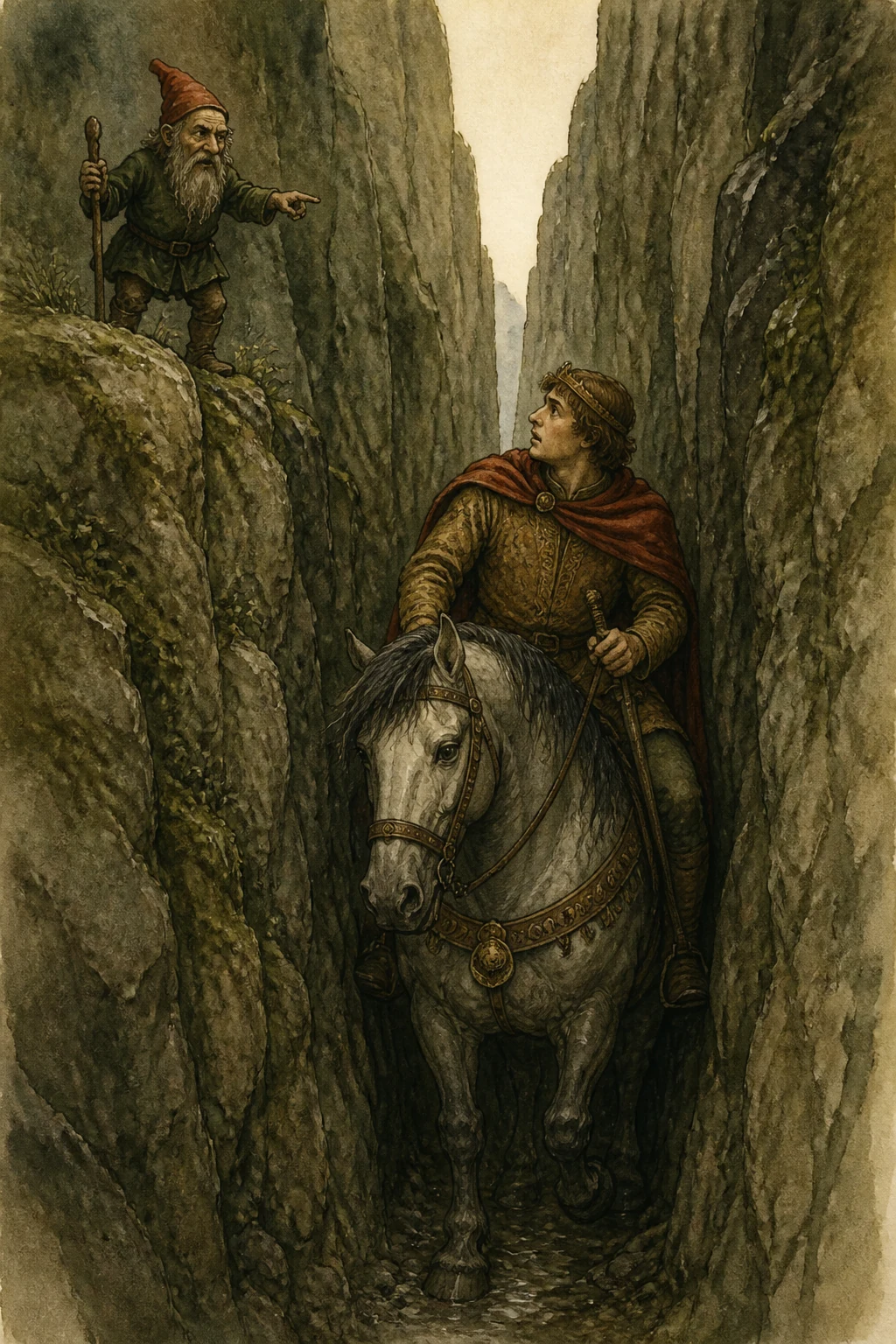
On the third day the youngest stayed at home, and the little man came again and asked for a piece of bread. When Hans had given it to him, he let it fall once more and asked him to be so kind as to give him the piece again. But Hans said to the little man, "What! Can't you pick it up yourself? If you won't take even that much trouble over your daily bread, you don't deserve to eat it!" The little man grew angry and said he must do it; but Hans was quick to seize the dear little fellow and give him a thorough thrashing. Then the little man cried out loudly, "Stop, stop, and let me go! I'll tell you where the princesses are."
When Hans heard this, he stopped beating him, and the little man told him that he was an earth-dwarf, and that there were more than a thousand of his kind. Hans need only come with him, and he would show him where the princesses were. Then he showed him a deep well in which there was no longer any water. The little man said he knew very well that Hans's companions meant him no good, and that if he wished to rescue the king's children, he would have to do it alone. The other two brothers were eager enough to have the princesses back, but they were unwilling to face any hardship or danger for their sake. To rescue the daughters, Hans must take a large basket, sit down in it with a hunting sword and a bell, and have himself lowered into the well. At the bottom were three rooms; in each sat a princess, stroking the heads of a many-headed dragon. He must cut off those heads. When the earth-dwarf had told him all this, he vanished. That evening the other two returned and asked Hans how he had fared. "Oh, well enough," he said. He had seen no one, except at noon, when a little man had come and asked for a piece of bread. When Hans gave it to him, the little man had dropped it and told him to pick it up again. And when Hans refused, the fellow had begun to threaten him; but Hans had taken that amiss and thrashed the little man, who had then told him where the king's children were. At this the other two young huntsmen were so angry that they turned yellow and green. The next morning they went together to the well and drew lots to see who should sit in the basket first. The lot fell to the eldest, so he had to climb in and take the bell with him. "When I ring," he said, "you must haul me up again quickly." He had scarcely been lowered at all when the bell rang, and the other two brothers hauled him back up. Then the second climbed in, and did just the same. Now it was the youngest's turn, and he let himself be lowered all the way to the bottom. When he had climbed out of the basket, he took his hunting sword, went to the first door, and listened. He heard the dragon snoring loudly. Slowly he opened the door, and there sat a princess with nine dragon's heads resting in her lap, stroking them. He raised his hunting sword and struck, and all nine heads were off. The princess sprang up, threw her arms around his neck, and kissed him with all her heart. Then she took a piece of ancient gold jewellery that she wore upon her breast and hung it around the young huntsman's neck. Next he went to the second princess, who had to stroke a dragon with seven heads, and rescued her too. Then he rescued the youngest, who had to stroke a dragon with four heads. The three sisters embraced and kissed one another in their joy, and could not stop. Then the youngest brother rang the bell so loudly that those above heard it. He put the princesses into the basket one after another and had all three drawn up. But when his own turn came, he remembered the earth-dwarf's words, that his companions meant him no good. So he took a large stone lying on the ground and put it in the basket. When the basket had been hauled about halfway up, the treacherous brothers above cut the rope, and the basket with its load of stone plunged to the bottom. Now they thought he was dead. They hurried away with the three princesses and made them promise to tell their father that the two elder brothers had rescued them. Thus they came to the king, and each demanded a princess for his wife.
Meanwhile, the youngest huntsman wandered sorrowfully through the three chambers, thinking that now he would surely have to die. Then he saw a flute hanging on the wall and said, "Why are you hanging there? No one can be merry here!" He looked at the dragon's heads too, and said, "You can't help me either!" And he paced up and down until the ground beneath his feet was worn quite smooth. All at once a different thought came to him. He took the flute from the wall and played a little tune, and suddenly, with every note he blew, an earth-dwarf appeared. He went on playing until the whole room was full of earth-dwarfs. They all asked what he wished. He said he wanted to return to the daylight above. Then each one took hold of a hair on his head, and together they flew up with him to the surface. Once above ground, he went straight to the king's palace, where the wedding to one of the princesses was just about to take place, and entered the room where the king sat with his three daughters. When the children saw him, they fainted. The king grew very angry and had him thrown into prison at once, for he thought he had done the children some harm. But when the princesses came to their senses, they begged their father to set him free again. The king asked why, but the children said they were not allowed to tell. Their father, however, told them to tell it to the stove. Then he went out, listened at the door, and heard everything. He had the two brothers hanged on the gallows, and gave the youngest his youngest daughter. And then I put on a pair of glass shoes, and struck them against a stone; they went "clink," and broke in two.