Prevod
A full year’s delay kept us there, and much I saw myself in that long time, and much I heard, including, among many other things, a tale told me in secret by one of the four attendants appointed to those rites. For while Circe was alone with my leader, the girl showed me a statue made of snowy marble, a young man bearing a woodpecker on his head, set in a sacred shrine and adorned with many wreaths.
When I asked who he was, why he was honored in a shrine, and why he bore that bird, eager to learn, “Listen, Macareus,” she said, “and learn from this as well how great my mistress’s power is. Attend to what I tell you! Picus, a son of Saturn, was king in the Ausonian lands, devoted to horses useful in war. His looks were as you see them here: you may judge his true beauty for yourself from this sculpted likeness.
His spirit matched his beauty; he was not yet old enough to have seen four of the five-yearly contests at Greek Elis. He had drawn the eyes of the dryads born in Latium’s mountains; the deities of the springs pursued him, the naiads borne by Albula, by the waters of Numicius and Anio, by Almo with its briefest course, by rushing Nar and Farfarus with its deep shade, and those who haunt the woodland pool of Scythian Diana and the neighboring lakes. Yet, spurning them all, he loved one nymph alone, whom Venilia is said to have borne to Ionian Janus on the Palatine hill.
As soon as she reached marriageable age, she was given to Picus of Laurentum, preferred above all others. Rare was her beauty, but rarer still her gift of song, which earned her the name Canens. With her voice she could move woods and rocks, soothe wild beasts, hold back long rivers, and halt the wandering birds in flight. While she was singing in her womanly voice, Picus had left his home for the fields of Laurentum to spear the native boars. He rode a spirited horse, carrying two hunting spears in his left hand, his scarlet cloak fastened with yellow gold.
The daughter of the Sun had come to those same woods; to gather fresh herbs on the fertile hills, she had left the Circaean fields that bore her name. Hidden among the bushes, she caught sight of the young man and stood spellbound. The herbs she had gathered fell from her hand, and fire seemed to course through the marrow of her bones. As soon as she recovered her senses from that fierce heat, she was ready to confess her desire. But she could not approach him: his galloping horse and the attendants around him prevented her.
“You shall not escape,” she said, “though the wind itself carry you, if I know myself, if the herbs have not lost all their power, and my spells do not fail me.” She spoke and fashioned a phantom boar, a likeness without a body, and commanded it to run before the king’s eyes and seem to plunge into a dense grove, where the trees grew thickest and no horse could pass.
At once, unsuspecting, Picus pursued the shadow of his quarry, swiftly leaped from his horse’s foaming back, and followed his empty hope on foot into the deep woods. She composed her prayers and spoke the words of invocation, worshiping unknown gods with an unknown chant, the spell with which she would obscure the face of the snowy Moon and weave moisture-laden clouds before her father’s head.
Now too, as she sang her spell, the heavens thickened, the earth breathed out mist, and his companions wandered along darkened paths, leaving their king unguarded. Seizing her time and place, she said, “By those eyes of yours that have captivated mine, by this beauty, fairest of men, which makes a goddess kneel before you, take pity on my burning love. Accept the all-seeing Sun as your father-in-law, and do not cruelly scorn Circe, the Titan’s daughter!”
She finished. But he proudly turned from her and her entreaties. “Whoever you are,” he said, “I am not yours. Another holds my heart, and may she hold it, I pray, for many years! No alien love shall make me violate our marriage bond while fate preserves Canens, Janus’s daughter, for me!” After the Titan’s daughter had vainly renewed her pleas again and again, “You shall not go unpunished,” she said, “nor return to Canens.
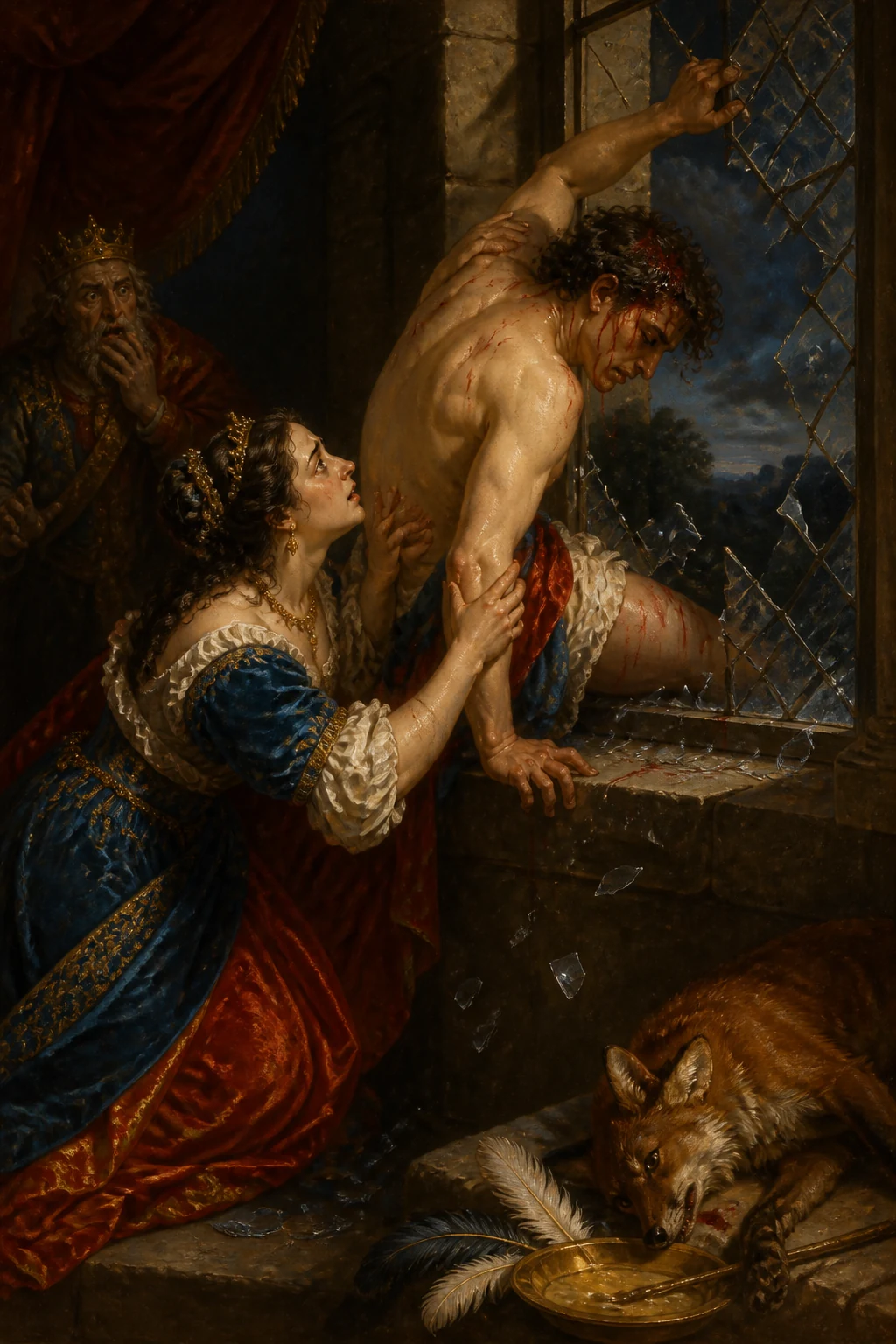
You shall learn what a woman can do when wounded, when in love.” So spoke Circe, a woman both wounded and in love. Then twice she turned to the west and twice to the east, touched the young man three times with her wand, and spoke three spells. He fled, but wondered to find himself moving more swiftly than before. He saw feathers on his body, and, outraged to find himself suddenly a strange new bird in the woods of Latium, he stabbed the rugged oaks with his hard beak and angrily wounded their long branches.
His feathers took on the purple color of his cloak; the gold that had been a clasp, fastening his garment, became plumage, and a band of yellow gold encircled his neck. Nothing of the old Picus remained except his name. Meanwhile his companions, after calling repeatedly through the fields for Picus in vain and finding him nowhere, came upon Circe—for she had now thinned the air and let the winds and sun disperse the mists.
They pressed her with well-founded accusations, demanded their king, and threatened violence, preparing to attack her with their deadly weapons. She scattered harmful venom and poisonous juices, summoned Night and the gods of Night from Erebus and Chaos, and called on Hecate with long, howling cries. The woods leaped from their places—marvelous to tell— the earth groaned, the neighboring trees grew pale, and the grass grew wet with scattered drops of blood.
The stones seemed to give out hoarse bellowing; dogs seemed to bark, the ground to swarm with black snakes, and insubstantial spirits to flit through the air. Stunned by these marvels, the men trembled. As they stood in terrified wonder, she touched their faces with her poisoned wand. At its touch the shapes of various monstrous beasts came over the young men; not one retained his own form.
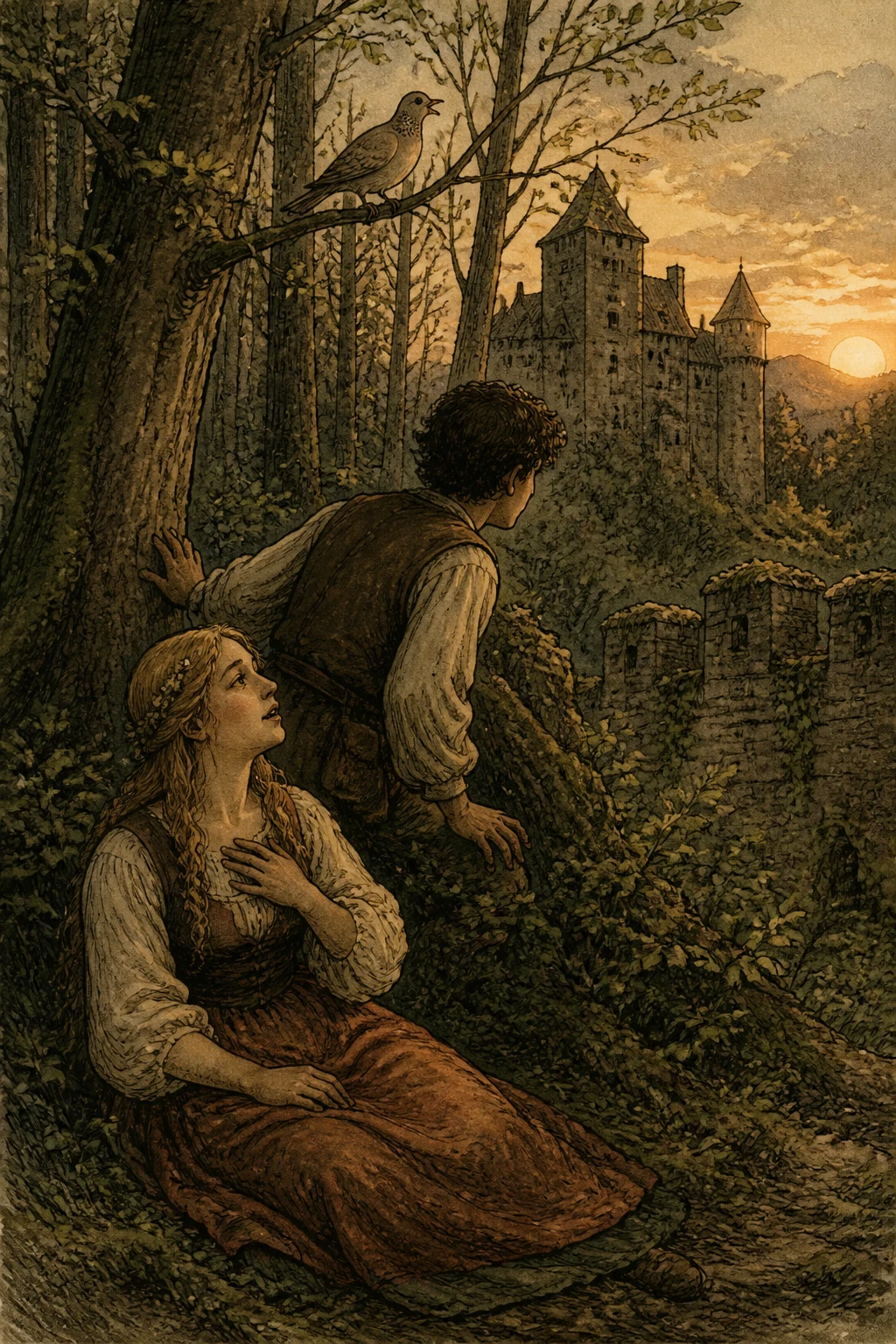
The setting sun had bathed the shores of Tartessus in light, and Canens had watched and longed for her husband in vain. Servants and people ran through every wood, carrying torches to meet him on his way. For the nymph, weeping and tearing her hair and beating her breast were not enough—though she did all these. She rushed out and wandered wildly through the fields of Latium.
Six nights and as many returning dawns saw her without sleep or food, roaming over hills and through valleys wherever chance led her. Last of all, the Tiber saw her, worn out with grief and wandering, laying herself down upon its long bank. There, through her tears, she poured out sorrowful words in a faint voice, her grief itself shaping the melody, as a swan, at the point of death, sings its own funeral song.
Her tender marrow melted in the extremity of sorrow; she wasted away and slowly vanished into the insubstantial air. Yet the place preserved her memory: the ancient Camenae fittingly named it Canens after the nymph.” Many such stories were told me during that long year, and many such things I saw. Idle and slow from disuse, we were ordered to take to the sea again, to set sail once more.
The Titan’s daughter had told us of uncertain paths, a vast journey, and the dangers of the savage sea that still lay ahead. I was afraid, I confess, and, reaching this shore, I stayed.”