O besedilu
Kača
- Vir
- Pentameron
- Avtor
- Giambattista Basile
- Jezik branja
- English
- Jezik izvirnika
- Neapolitan
- Čas branja
- 17 min branja
- Obseg
- 14 strani
- Naslov izvirnika
- Jornata II V LO SERPE
O izvirniku
Pentameron
Baročna, divja starejša plast evropske pravljice, polna obratov in pretiravanj. Bralni jezik je English, izvirnik pa prihaja iz vira Pentameron v jeziku Neapolitan.
Besedilo
Kača
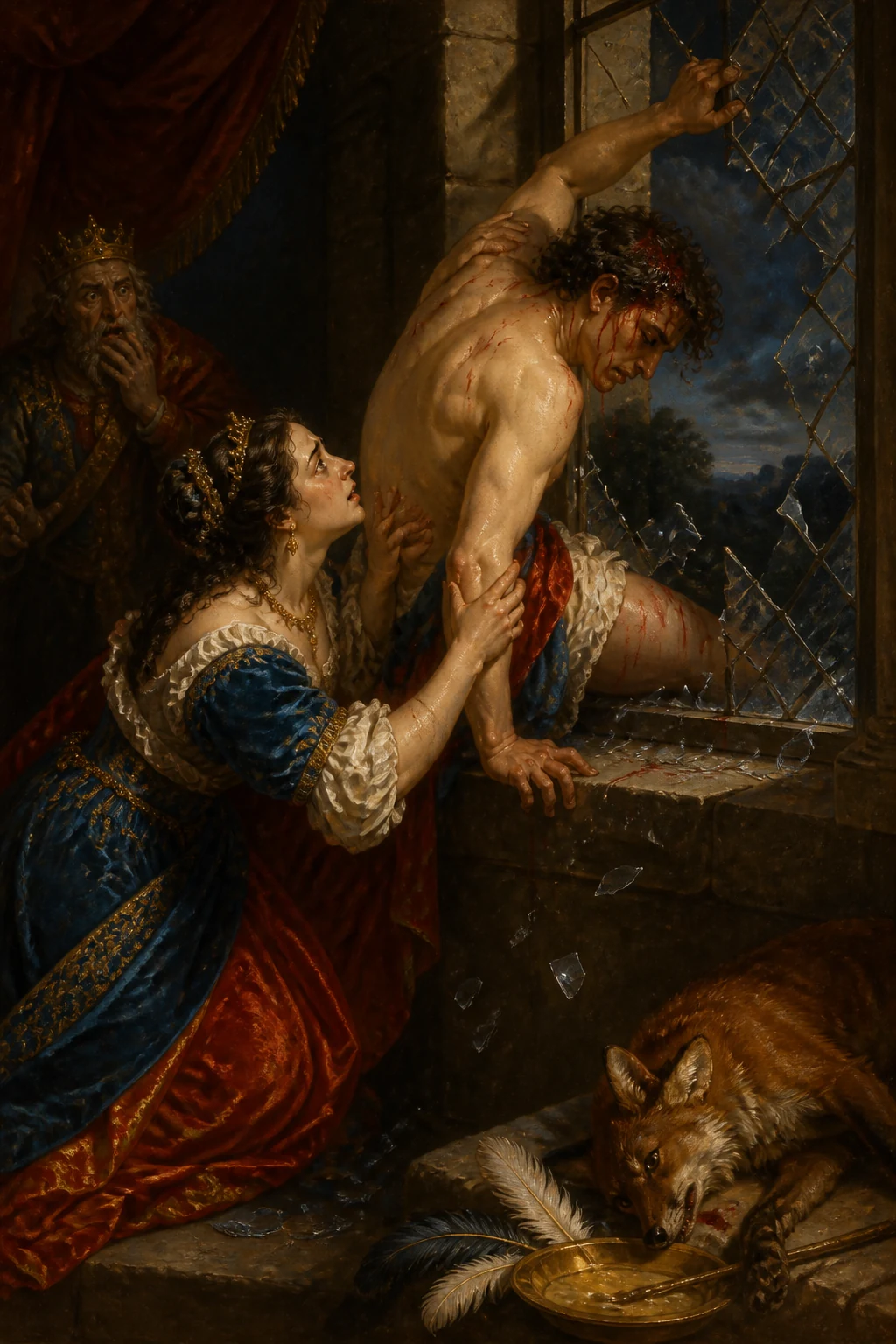
_The King of Starza-longa marries his daughter to a Serpent and, discovering that he is a handsome young man, burns his skin. Trying to break through a window to escape, the young man wounds his head. When no remedy can be found, the King’s daughter leaves her father’s house and learns from a Fox the secret of curing her beloved. She cunningly kills the Fox and, anointing the wounded young man, who is a prince, with her fat and that of various birds, wins him as her husband._ _Everyone felt boundless pity for the poor Cat, to see her so ill rewarded, though someone remarked that she might console herself with what she had gained and gathered, since she was not alone in her plight. Nowadays ingratitude has become as common a household complaint as the French disease or a hernia. Others have toiled and struggled, squandered their property, and ruined their lives in the service of this ungrateful breed; and just when they thought they held golden cages in their hands, they find themselves destined for a pauper’s grave at the hospital. Meanwhile, seeing Popa ready to speak, they fell silent, and she began._ Whoever pries too curiously into other people’s affairs always brings the axe down on his own foot, as the King of Starza-longa can testify: by poking his nose into the business, he tangled his daughter’s thread and ruined his poor son-in-law, who, having come to make a great stir, ended with his own head smashed.
Now it is told that once there was a countrywoman who longed for a child more than a litigant longs for a favorable judgment, a sick man for cool water, or an innkeeper for the passing coach. But however diligently her husband dug away, she never saw the fruitfulness she desired. One day the poor man went to the mountain to gather a bundle of firewood, and when he untied it at home, he found a pretty little serpent among the branches. Seeing it, Sapatella—for that was the countrywoman’s name—heaved a great sigh and said, “Why, even serpents have their little serpents, while I was born unlucky into this world, with a ruptured husband who, gardener though he is, cannot manage a single graft!” At these words the Serpent replied, “Since you cannot have children, take me instead. You will have made a good bargain, and I shall love you more dearly than a mother.” When Sapatella heard a serpent speak, she nearly gave up the ghost;
but taking courage, she said, “If for no other reason than this affection of yours, I am happy to take you as though you had come from my own womb.” So she gave him a hole in the house for a cradle and fed him on whatever she had, with the greatest tenderness in the world. He grew day by day, and when he was fairly big, he said to Cola-Matteo, the countryman whom he regarded as his father, “Daddy, I want to marry.” “Certainly,” said Cola-Matteo. “We shall find another serpent like you and set up this little partnership.” “What is this?” replied the little Serpent. “Must we all be lumped together with vipers and grass snakes? You certainly are a simpleton, making one bundle of every kind of herb! I want the King’s daughter. So go this very instant and ask the King for his daughter, and tell him that a serpent wants her.” Cola-Matteo, who was an innocent soul and understood little of such twists and turns, went straight to the King and delivered his message. “An ambassador should suffer no harm,” he said, “or else I shall earn as many blows as there are grains of sand. Now you must know that a serpent wants your daughter for his wife, so I have come to you as a gardener to see whether we might graft a serpent onto a little dove.” The King, who could tell at a glance that he was a blockhead, said, merely to get him off his back, “Go and tell this Serpent that if he turns all the fruit in my park to gold, I shall give him my daughter.” Then, bursting into laughter, he dismissed him.
But when Cola-Matteo brought the answer to the Serpent, he said, “Go tomorrow morning and gather all the fruit stones you can find in the city, and sow them in the park. You will see pearls strung upon rushes!” Cola-Matteo, who was used to being driven and knew neither how to argue nor how to object, waited until the Sun, with his golden broom, swept the rubbish of shadows from the fields watered by dawn. Then he slipped a basket over his arm and went from square to square, gathering every stone he could find from peaches, apricots, plums, and cherries, and all the seeds and pips lying in the streets. Going to the park, he sowed them as the Serpent had told him, and instantly they sprouted, sending up trunks, leaves, flowers, and fruit, all of gleaming gold. At the sight, the King went into an ecstasy of wonder and swelled with delight. But when the Serpent sent Cola-Matteo to claim the King’s promise, the King said, “Not so fast! If he wants my daughter, there is something else I require: he must make all the walls and the ground of the park into precious stones.” When the farmer reported this to the Serpent, he replied, “Go tomorrow morning and gather all the broken crockery you find on the ground, and scatter it over the paths and walls of the park. We shall catch this limping fellow yet!” So Cola-Matteo, when Night, outlawed for aiding thieves, began gathering her bundles of twilight from the sky, tucked a hamper beneath his arm and went about collecting shards of pitchers, pieces of flowerpots and lids, bottoms of cooking pots and pans, rims of washbasins, handles of water jugs, and lips of chamber pots. He rounded up every broken lamp, shattered vessel, cracked jar, and scrap of earthenware he could find in the street. When he had done as the Serpent instructed, the park appeared heaped with emeralds and chalcedonies and plastered with rubies and carbuncles, whose brilliance imprisoned sight within the storehouses of the eyes and planted wonder in the territories of the heart. At this spectacle the King stood stock-still, not knowing what had come over him. But when the Serpent sent word once more that he should keep his promise, the King replied, “All that has been done is nothing unless he turns this entire palace into gold.” Cola-Matteo reported this further whim of the King’s to the Serpent, who said:
“Go and gather a bundle of different herbs, and rub them over the foundations of the palace. We shall see if we can satisfy this royal fancy.” Cola-Matteo immediately gathered a great bundle of mallow, wild turnip greens, sorrel, purslane, rocket, and chervil, and when he had rubbed them around the foot of the palace, he saw the whole building instantly shine like a gilded pine nut, enough to purge poverty from a hundred households left constipated by fortune. The countryman returned in the Serpent’s name to press his suit for a wife, and the King, seeing every escape cut off, summoned his daughter and said, “My Grannonia, to make a fool of a suitor who wanted you, I demanded terms that I thought impossible to fulfill. But now I find myself caught and bound, I scarcely know how. If you are a good daughter, I beg you to let me keep my word and accept what Heaven wills and I am obliged to do.” “Do as you please, my lord and father,” Grannonia answered, “for I shall not stray one jot from your wishes.” Hearing this, the King told Cola-Matteo to bring the Serpent, who, on receiving the summons, came to court in a chariot of solid gold drawn by four golden elephants. Wherever he passed, people fled in terror at the sight of so huge and fearsome a serpent parading through the city. When he reached the palace, all the courtiers trembled like reeds and made themselves scarce; not even the kitchen scullions remained. The King and Queen hid themselves in a room out of sheer fright. Grannonia alone stood firm. Though her father and mother cried, “Run! Be off, Grannonia! Save your skin!” she would not budge an inch, saying, “Why should I run away from the husband you have given me?” The Serpent entered the room, caught Grannonia round the waist with his tail, and gave her a shower of kisses. At this the King writhed as though full of worms, and if you had pricked him, not a drop of blood would have come out. Then the Serpent carried her into another room and had the door shut. Shaking his skin off onto the floor, he became a most handsome young man, with a head of golden curls and eyes that could bewitch you. Embracing his bride, he gathered the first fruits of her love.
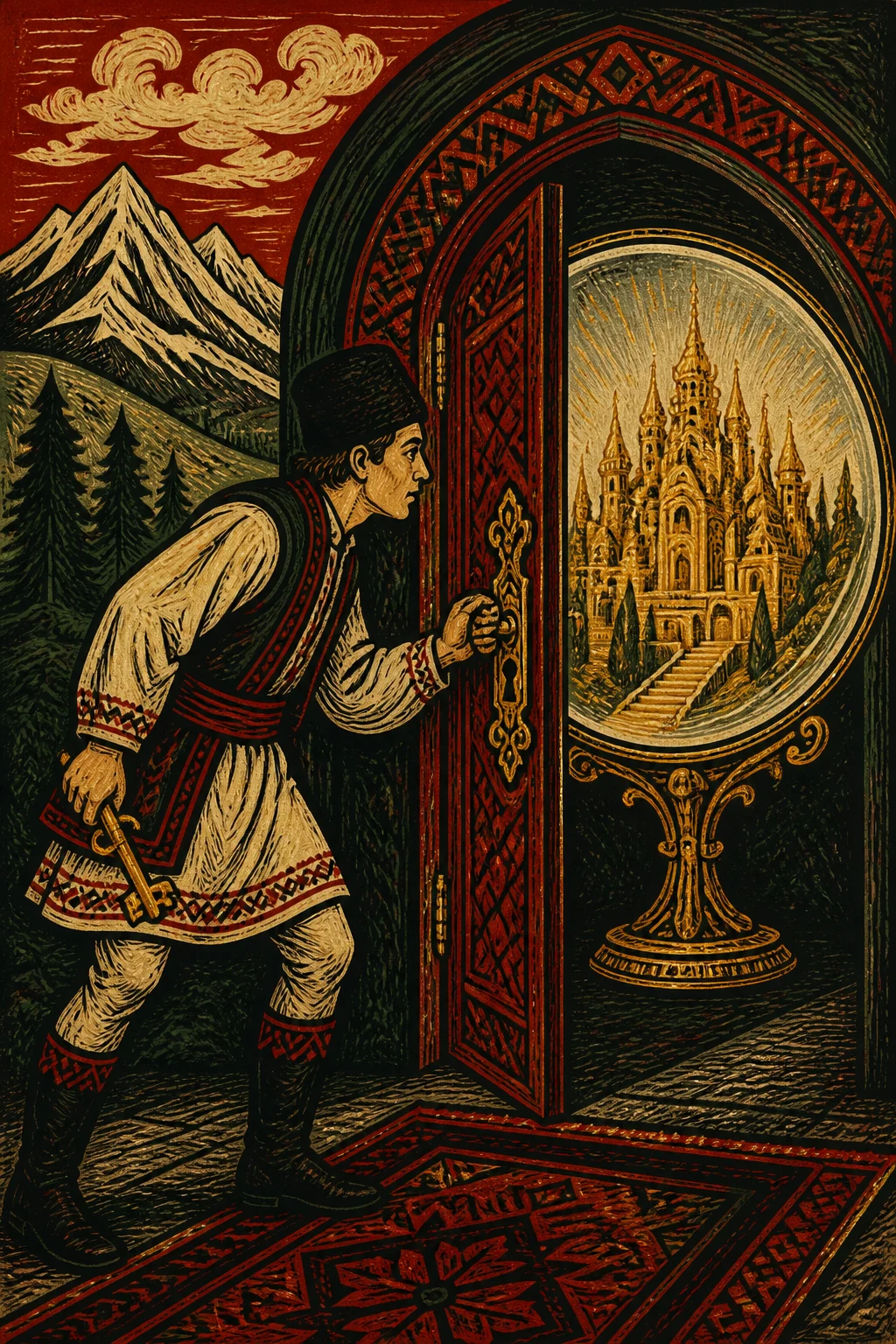
The King, who had seen the Serpent shut himself away with his daughter and close the door, said to his wife, “May Heaven grant peace to our good daughter’s soul, for she is certainly gone by now, and that accursed Serpent must have swallowed her like the yolk of an egg.” Putting his eye to the keyhole, he tried to see what had become of her. But when he beheld the extraordinary beauty of the young man and the serpent’s skin lying on the floor, he kicked open the door, and they rushed inside, seized the skin, and threw it into the fire to burn;
at the sight, the young man cried, “Ah, you accursed dogs! You have ruined me!” Turning into a dove, he tried to escape, but found glass in the windows. He battered it with his head until he broke through, yet emerged so badly hurt that not a single part of his skull remained sound. Grannonia, finding herself in the same instant joyful and wretched, happy and unfortunate, rich and beggared, clawed at her face and reproached her father and mother for this clouding of her happiness, this poisoning of her sweetness, this wrecking of her good fortune. They excused themselves, saying that they had meant no harm. But she went on lamenting until Night came out to light the catafalque of Heaven for the Sun’s funeral rites. When she saw everyone asleep, she gathered all the jewels she kept in a cabinet and slipped out through a back door, determined to search until she found the happiness she had lost;
and once outside the city, guided by the moonlight, she met a Fox, who asked whether she would like some company. Grannonia replied, “You would be doing me a kindness, my good gossip, for I do not know this country very well.”
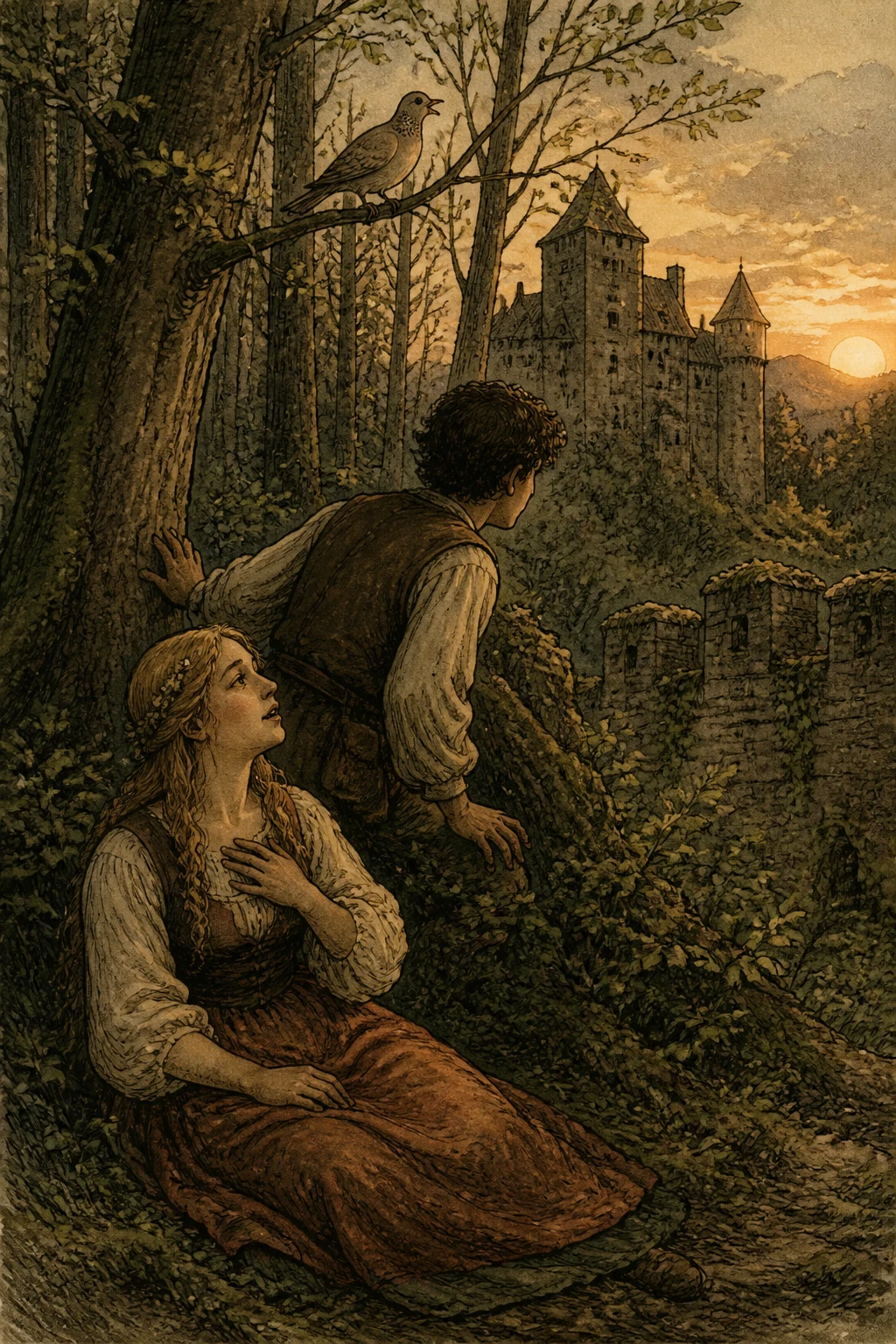
Walking on together, they reached a wood where the trees, playing like little children, made little houses for the shadows to nest in. By now weary from their journey and wishing to rest, they withdrew beneath the sheltering leaves, where a fountain played carnival games with the fresh grass, dousing it with jugfuls of water. Lying down upon a mattress of tender grass, they paid Nature the toll of rest they owed her for the merchandise of life. They did not wake until the Sun gave his customary fiery signal to sailors and couriers that they might continue on their way. Once awake, they lingered a good while to listen to the singing of the various birds, and Grannonia showed great pleasure in their warbling. Seeing this, the Fox said, “You would take twice as much pleasure if you understood what they were saying, as I do.” At these words Grannonia—for curiosity comes as naturally to women as chatter—begged the Fox to tell her what she had heard in the birds’ language. After allowing herself to be begged for a good while, to arouse still greater curiosity about what she had to tell, the Fox said that the birds were discussing a misfortune that had befallen a king’s son. He was as handsome as a fairy prince, but because he had refused to satisfy the unbridled desires of an accursed ogress, she had laid a curse upon him, transforming him into a serpent for seven years. The term was almost over when he fell in love with a king’s daughter. He was with his bride in a room and had left his skin upon the floor, but the bride’s father and mother, prying too closely, had burned it. Fleeing in the form of a dove, he had smashed through a glass window to escape and injured himself so badly that the physicians had given him up for lost. Grannonia, hearing her own affairs discussed, first asked whose son this prince was and whether there was any hope of a remedy for his injuries. The Fox replied that the birds had said his father was the King of Vallone-gruosso, and that there was no other secret for stopping the holes in his head, to keep his soul from slipping out, than to anoint his wounds with the blood of the very birds who had told the story.
At these words Grannonia knelt before the Fox and begged her to do her the kindness of catching those birds so that she could draw their blood, promising that they would share the reward like good companions. “Softly,” said the Fox. “Let us wait until night, and when the birds roost, leave it to your old mother: I shall climb the tree and wring their necks one by one.” So they spent the whole day talking, now of the young man’s beauty, now of the bride’s father’s mistake, now of the misfortune that had followed. Talking and talking, they let the day slip by, until Earth spread out a great black sheet to catch the wax from the torches of Night. When the Fox saw the birds asleep upon the branches, she crept up and, one by one, caught all the golden orioles, goldfinches, wrens, chaffinches, woodhens, woodcocks, owls, hoopoes, thrushes, greenfinches, kestrels, and flycatchers in the trees. Having killed them, they poured their blood into a little flask the Fox carried to refresh herself on the road. Grannonia was so delighted that her feet scarcely touched the ground, but the Fox said, “Ah, my child, this is happiness in a dream! You have achieved nothing unless you also have my blood to make a stew with that of the birds.” With that, she took to her heels. Grannonia, seeing her hopes dashed, resorted to women’s arts—cunning and flattery—and said, “Gossip Fox, you would have good reason to save your skin if I were not so deeply in your debt, and if there were no other foxes in the world. But since you know how much I owe you, and know too that there are plenty of your kind in these fields, you may trust my good faith. Do not be like the cow who kicks over the pail just when she has filled it with milk! You have done so much, only to undo it all and abandon me at the best moment. Stop, trust me, and come with me to this king’s city, and I shall be your slave.” The Fox, who had never believed that a finer essence of foxhood than herself could exist, found herself outfoxed by a woman. For she agreed to walk with Grannonia, and they had not gone fifty paces before Grannonia aimed a blow at her with the stick she carried and struck her on the skull so hard that she instantly stretched out her legs. Slitting her throat at once, Grannonia drew her blood and poured it into the flask. Then she set off at a brisk pace and reached Vallone-gruosso, where she made her way to the royal palace and sent word to the King that she had come to cure the Prince. The King had her brought before him and marveled to see a young girl promise what the finest physicians in his kingdom had been unable to accomplish. Still, since there was no harm in trying, he said he would be very glad to see her make the attempt.
But Grannonia replied, “If I bring about the result you desire, I want you to promise to give him to me as my husband.” The King, who already considered his son dead, answered, “When you give him back to me safe and sound, I shall give him to you sound and free. It is no great thing to give a husband to someone who gives me a son.” So they went to the Prince’s room, and scarcely had she anointed him with the blood when he was as well as though he had never been ill. Seeing the Prince strong and vigorous, Grannonia asked the King to keep his word. Turning to his son, the King said, “My son, you have already looked death in the face, and now I see you alive and can scarcely believe it. But I promised this young woman that, if she cured you, you would become her husband. Since Heaven has granted you this mercy, let me fulfill my promise, for the love you bear me, for gratitude obliges us to pay this debt.” The Prince answered, “My lord, I wish my heart were as free to give you satisfaction as it is full of love for you. But I have pledged my word to another woman, and neither would you consent to my breaking faith, nor would this young woman advise me to wrong the one I love, nor can I change my mind.” Hearing this, Grannonia felt an inward joy beyond all telling, to find herself still alive in the Prince’s memory. Her face flushed crimson, and she said, “If I persuaded this young woman you love to yield her claim to me, would you not bend to my wishes?” “Never,” replied the Prince, “shall I erase the lovely image of my beloved from this breast. Whether she gives me the sweet preserves of her love or doses me with bitter physic, I shall always hold to the same desire and the same resolve. Even if I were in danger of losing my place at the table of life, I would never play such a trick or practice such deceit.” Unable to remain any longer in the shackles of pretense, Grannonia revealed who she was. For the room had been kept dark because of his wounded head, and her altered dress had prevented him from recognizing her. Once he knew her, the Prince embraced her at once with a joy that left everyone astonished, telling his father who she was and what he had suffered and done for her sake. They sent for the King and Queen of Starza-longa, and in good fellowship celebrated the wedding, taking particular delight in the trick played upon the Fox, and concluding, in the end, _That to the joys of love_ _Pain has always lent its savor._
Izvirnik
Jornata II V LO SERPE
Naslednje strani prikazujejo izvirno besedilo za primerjavo.
_Lo Rrè de Starza-longa mmarita la figlia co no Serpe, e scopierto, ch’era no bello giovene, l’ardette la spoglia: isso volenno rompere na vetriata pe ffoire, se rompette la capo; nè ttrovanno remmedio, la figlia de lo Rrè lassa la casa de lo Patre, e ’ntiso da na Vorpe lo secreto da sanare lo ’nnammorato, accide maliziosamente la Vorpe, e co lo ggrasso sujo, e de varie aucielle, ontanno lo giovane feruto, ch’era figlio de lo Prencepe, le deventa marito._ _Fu compatuta fora de muodo la scura Gatta pe bederela cossì male remunerata; si be ’nce fu perzona, che disse, ca se poteva conzolare co l’avanzo, e ppresa, non essenno sola; ca ogge la sgratetudene è fatto male domesteco, comme a lo mmale franzese, e lo crastene; essennoce de l’autre, c’hanno fatto, e sfatto
conzummato la robba, roinata la vita pe servire sta razza de sgrate, e quanno se tenevano ’n mano autro, che gajole d’oro, se destinano na sebetura a l’Ospetale. Fra chisso miezo vedenno apparecchiata Popa pe parlare, facettero selenzio, mentre essa disse._ Sempre se dette l’ascia a lo pede chi cercaje troppo coriuso de sapere li fatte d’autre, comme ne po fare testemmonio lo Rrè de Starza-longa, che pe mmettere lo musso a la chelleta, sgarraje lo ffilato de la figlia, e rroinaje lo nigro jennero, che dove era venuto a sfracassare co la capo, restaje co la capo sfracassata.
Ora dice, ch’era na vota na Foretana, che ddesiderava cchiù d’avere no figlio, che non desidera lo liticante la sentenza ’n favore, lo malato l’acqua fresca, e lo tavernaro la passata de lo procaccio; ma pe quanto lo marito zappava a ghiornata, maje arrevava a bedere la ferteletate, che desederava: ma essenno juto no juorno lo poverommo a ffare na fascina a la montagna, e sciarvogliannola a la casa, ’nce trovaje no bello serpetiello dinto a le ffrasche, la quale cosa vedenno Sapatella (che cossì se chiammava la foretana) jettato no gran sospiro, disse: ecco ca pe fi a li sierpe fanno li serpunchiole, e io nasciette sbentorata a sto munno, co no guallaruso de marito, che con tutto, che sia Ortolano, non è da tanto de fare no ’nzierto: a le
cquale parole respose lo Serpe: pocca non potite avere figlie, e tu pigliate a mme, ca farraje no buono appiello, e te vorraggio bene cchiù de mamma. Sapatella, che ’ntese parlare a no Serpe, appe a spiretare; ma fatto armo, le disse quanno maje ped’autro, pe ss’amorevolezza toja io mme contento d’azzettarete comme fusse sciuto da lo denucchio mio; e cossì consignatole no pertuso de la casa pe cconnola, le deva a mmagnare de chello, che aveva co la cchiù granne affezzione de lo munno, e crescenno de juorno ’n ghiuorno, comme fu fatto granneciello, disse a Ccola-Matteo lo Foretano, che teneva pe messere; o tata, io mme voglio ’nzorare. De grazia, disse Cola-Matteo, trovarrimmo n’autra Serpe comm’a ttene, e farrimmo sta lega de poteca. Che serve, respose
lo Serpetiello, sarrimmo fatte tutte uno co le vipere, e li scorzune, bè se pare ca si n’Antuono, e ffaje d’ogne erva fascio. Io voglio la figlia de lo Rrè, e perzò vavattenne a sta medesema pedata, e ccerca a lo Rrè la figlia, e dì ca la vole no Serpe. Cola-Matteo, che ghieva a la bona, nne se ntenneva troppo de sti votta varrile, jette semprecemente a lo Rrè, e le facette la mmasciata, decenno, Mmasciatore non porta pena, si no mazze quanto l’arena. Ora sacce, ca no serpe vole figliata pe mmogliere, perzò vengo comme Ortolano a bederete si potesse fare no ’nzierto de no Serpe co na palommella. Lo Rrè, che ccanoscette a lo naso ch’era no vozzacchione, pe llevaresello da cuollo, disse: Và dì a sto Serpe, che si mme farrà li frutte de sto parco tutto d’oro,
io le darraggio figliema; fattose na gran risata, le dette lecienzia. Ma dato Cola-Matteo la resposta a lo Serpe, isso le disse: Va craje mmatino, e aduna tutte l’ossa de frutte, che truove pe la Cetate, e nne semmena lo Parco, ca vederraje perne ’nfilate a li junco. Cola-Matteo, ch’era fatto a la storza, ne ssapeva reprecare nè contradire, comme lo Sole co le ghienestre d’oro scopaje le mmonnezze de l’ombre de li campe adacquate da l’arba; nfilatose na sporta a lo vraccio, jette de chiazza ’n chiazza adonanno tutte l’ossa, che trovaje de perzeca, de gresommola, d’alberge, de visciole, e de quante nnevinole, e l’arille trovate pe le strate; e ghiuto a lo Parco, le ssemmenaje, comme aveva ditto lo Serpe, che ’nnitto ’nfatto sguigliaro, e ffecero li troncune
de le chiante, le ffrunne, li sciure, e li frutte tutte d’oro lampante, che lo Rrè vedenno tale cosa, jette n’estrece de stopore, e ppampaniaje de prejezza. Ma essenno mannato Cola-Matteo da lo Serpe a cercare a lo Rrè la promessa, adaso li cuorpe, disse lo Rrè, ca voglio n’autra cosa, si vole figliema, ed è, che faccia tutte le mmura, e lo suolo de lo Parco de prete preziose; e rreferuta sta cosa da lo parzonaro a lo Serpe, isso le respose, và craje mmatino, e adonanno tutte le graste, che truove pe la terra, jettale pe le strate, e pe le mmura de lo Parco, ca volimmo arrevare sto zuoppo. E Ccola-Matteo comme la notte ped’avere fatto spalla a li mariuole ave l’ausilio, e bà raccoglienno le ssarcinole de li crepuscole da lo cielo, pigliatose no cuofano
sotta tetilleco, commenzaje a ghire adunanno graste d’arciule, piezze de tieste, e de coperchiole, funne de pignate, e de tiane, urle de scafareje, maneche de lancelle, lavre de cantaro, arresediannone quante locernelle rotte, graste spezzate, fesine sesete, e quante frantumme de roagne trovaje pe la via, fattone chello che aveva ditto lo Serpe, se vedde lo parco ammontonato de smiraude, e caucedonie ’ntonacato de rubine, e carvunchie, che lo lostrore sequestrava la vista dinto li magazene de l’uocchie, e chiantava la maraviglia dinto a li territorie de li core; a lo quale spettacolo restaje lo Rrè tutto de no piezzo, e non sapeva, che l’era socciesso: ma fattole dire n’autra vota lo Serpe, che l’attennesse la parola; lo Rrè respose, quanto s’è fatto è
zubba, si non me fa reventare sto palazzo tutto d’oro; e Ccola-Matteo, referuto st’autro capriccio de lo Rrè a lo Serpe, lo Serpe le disse: và, e piglia no fascio d’erve deverze, e ugnene le ppedamente de lo Palazzo, ca vedarrimmo de contentare sta regnola. Cola-Matteo a lo stisso punto se fece na grossa mappata de foglia molle, de rapestelle, d’airelle, de porchiacchie, d’arucole, e de cerefuoglie, e fattone n’onzione a lo pede de lo palazzo lo vedde subbeto tutto stralucere comme a ppinolo ’nnaurato da fare vacuare la povertà a cciento case stetecute da la fortuna. E ttornato lo Foretano a nnomme de lo Serpe a fare stanzia pe la mogliere, lo Rrè vedennose stagliate li passe, chiammaje la figlia, e disse: Grannonia mia, io pe delleggiare no
marito, che te voleva, aggio cercato patte, che mme pareva ’mpossibele, che se potessero comprire, ma vedennome arrevato, e obrecato, non saccio comme, te prego, si si figlia benedetta, che mme facce mantenere la fede, e che te contiente de chello, che bole lo cielo, ed io so ccostritto de fare. Fa chello, che te piace, Tata Gnore mio, respose Grannonia, ca no sciarraggio na jota da lo volere tujo; ’ntiso chesto lo Rrè, disse a Ccola-Matteo, che facesse venire lo Serpe, lo quale sentuto la chiammata, ’ncoppa a no carro tutto d’oro, tirato da quatto alifante d’oro, se ne venne a la Corte. Ma dovonca passava, sfrattavano atterrute le gente, vedenno no serpe accossì gruosso, e spaventuso fare lo spassiggio pe la Cetate. Ed arrivato ’mpalazzo, tremmaro comme
a ghiunco, ed ammarciarono tutte li Cortesciane, che non ce restaro manco li guattare. E lo Rrè, e la Regina se ’ncaforchiaro pe lo jajo dinto a na cammara, sulo Grannonia stette sauda sauda. E benchè lo Patre, e la Mamma gridasse: fuje, sbigna, Grannonia, sarvate, Rienzo, essa non se voze scazzecare mollica, decenno: ca che boglio foire da lo marito, che m’avite dato: ma trasuto lo Serpe a la cammara, afferraje pe mmiezo co la coda a Grannonia, e le dette na vranca de vase, che lo Rrè ne fece na quatra de vierme, e si lo ’nzagnave, non ne sceva sango. E portatasella dinto n’autra cammara, fece serrare la porta, e scotolanno lo cuojero nterra, deventaje no bellissemo Giovane, ch’aveva na capo tutta ricce d’oro, e coll’uocchie te affattorava, lo
quale abbracciata la Zita, couze li primme frutte de l’ammore sujo. Lo Rrè, che bedde ’ncaforchiare lo Serpe co la Figlia, e cchiudere la porta, disse a la mogliere: lo Cielo faccia pace a chella bona arma de figliama, ca è ghiuta senz’autro: e chillo ’marditto Serpe nne l’averrà scesa comme a veluocciolo d’uovo; e mmettenno l’uocchie pe lo pertuso de la chiavatura, voze vedere, che cosa nn’era fatto: ma visto la stremata grazia de chillo Giovane, e la spoglia de Serpe, ch’aveva lassato ’nterra, dato no cauce a la porta, trasettero dinto, e ppigliato chella pella la jettaro a lo ffuoco, facennola abrosciare; la quale cosa, vedenno chillo Giovane, gridaje: Ah cane arrenegate, mme l’avite fatta; e ttrasformatose a na palomma, e ttrovato pe ffoire
le bitriate a le ffenestre, tanto ’nce tozzaje co la capo, pe fi che le rroppe, ma ne scette conciato de manera, che no le restaje parte de la catarozzola sana. Grannonia; che se vedde a no punto contenta, e nnegra; felice, e sbentorata; ricca, e pezzente, sciccannose la faccie, se lamentaje co lo patre, e co la mamma de sta ’ntrevolata de gusto, de sta ’ntossecata de docezza, e de sta sgarrata de sciorte, li quale se scusattero, che non penzaro de fare male. Ma essa gualiannose ficchè scette la notte ad allommare lo catafarco de lo Cielo pe le pompe funerale de lo Sole, comme vedde corcate tutte, pigliatose tutte le gioje, che tteneva a no scrittorio, se ne scette pe na porta fauza, co penziero de cercare tanto, fichè trovasse lo bene, che aveva perduto;
e sciuta fore de la Cetate, guidata da lo raggio de la Luna, trovaje na Vorpe, la quale disse se voleva compagnia; e Grannonia le respose: mme ne faje piacere, commare mia, ca non so troppo pratteca de lo pajese. E cossì cammenanno, arrivaro a no vosco, dove l’arvole joquanno comm’a ppeccerille, facevano casarelle pe ’nce accovare l’ombre. Ed essenno oramaje stracque da lo cammino, volennose arreposare, se retiraro a lo ccopierto de le ffrunne, dove na fontana joquava a carnevale co l’erva fresca, scarrecannole adduosso l’acqua a llancelle; e ccorcatose ’ncoppa no matarazzo d’erva tennerella; pagaro lo dazio de repuoso, che devevano a la natura, pe la mercanzia de la vita; ne se scetaro maje, fichè lo Sole non dette signo co lo soleto fuoco a mmarinare,
ed a corriere, che potevano secotare lo cammino lloro: e scetate che fforo, se fermaro ancora no buono piezzo a ssentire lo cantare de varie aucielle, mostranno Grannonia no gusto granne de sentire lo bernoliare, che facevano; la quale cosa visto la Vorpe, le disse autro tanto piacere sentarisse ’ntennenno chello, che ddiceno, comme lo ’ntengo io. A ste pparole Grannonia, perchè le ffemmene hanno cossì pe nnatura la curiositate, comme le cchiacchiare, pregaje la Vorpe a ddirele chello che aveva sentuto a lo lenguaggio dell’aucielle: ed essa dapò fattose pregare no buono piezzo, pe guadagnare maggiore curejosetà a chello, che doveva contare, disse che chille aucielle trascorrevano fra loro de na desgrazia soccessa a lo figlio de lo Rrè, lo quale
essenno bello comme a no Fato, pe non avere voluto dare sfazione a le sfrenate voglie de n’Orca ’mmardetta, l’era stata data na mmardezzione, che fosse trasformato ’n Serpe pe ssette anne, e che già era vicino a ffornire lo tiempo quanno ’nnammoratose de na figlia de Rrè se ne steva co la Zita dinto na cammara, ed aveva lassato lo cuojero ’nterra, ma lo Patre, e la Mamma de la zita troppo coriuse, l’aveano abbrusciato la spoglia, lo quale fojenno ’nforma de na palomma, a lo rrompere na vitriata pe scire da na fenestra, s’era sfravecato de manera, ch’era desperato da miedece. Grannonia, che ssentette parlare de ll’aglie suoje, demmannaje la primma cosa, di chi era figlio sto Prencepe, e si nc’era speranza de remmedio a lo mmale sujo; e la Vorpe
respose, ca chille aucielle avevano ditto ch’era lo patre sujo lo Rrè de Vallone-gruosso; e che non c’era autro secreto pe appilare le ppertosa de la capo soja, azzò non se nne scesse l’arma, che ontare le fferite co lo sango de l’aucielle stisse, ch’avevano contato sto fatto. Grannonia a sse pparole se ’ngenocchiaje nnante la Vorpa, pregannola a ffarele st’utele de pigliarele chill’aucielle, pe ccacciarene lo sango, che averriano spartuto da buon compagne lo guadagno. Chiano, disse la Vorpe: aspettammo la notte, e ccomme l’aucielle s’ammasonano, lassa fare a mmammata, ca saglio ’ncoppa a l’arvolo, e nne le scervecchio uno ped’uno. Cossì passato tutto lo juorno, mo parlanno de la bellezza de lo Giovane, mo de l’arrore de lo Patre de la Zita, mo de la desgrazia
soccessa, trascorrenno trascorrenno passaje lo juorno, e la terra spase no gran cartone nigro pe rraccogliere la cera de le ’ntorcie de la notte. La Vorpe comme vedde appapagnate l’aucielle ’ncoppa a li ramme, se nne sagliette guatto guatto e ad uno ad uno nne piuzaje quanta golane, cardille, reille, froncille, galline, arcere, coccovaje, paposce, marvizze, lecore, cestarelle, e pappamosche erano ’ncoppa all’arvole; ed accisole, mesero lo sango dinto a no fiaschetiello, che portava la Vorpe pe rrefrescarese pe la via. Grannonia pe lo priejo, non toccava pede ’nterra: ma la Vorpe le disse, oh che allegrezza ’nsuonno, figlia mia, tu non aje fatto niente, si non aje ancora lo sango mio pe fare crapiata co chillo de l’aucielle; e ditto
chesto se mese a foire. Grannonia, che bedde derropate le speranze soje, recorse a l’arte de le femmene, ch’è l’astuzia, e la losenga, decennole: Commare Vorpe, avarrisse ragione de sarvarete la pella quanno io non te fosse tanto obrecata, e quanno non se trovassero autre burpe a lo munno; perzò mentre saje quanto devo, e ssaje ancora ca non mancano pare toje pe sse campagne, te puoje assecurare de la fede mia, e non fare comme la vacca, co dare de pede a la tina, mo che l’aje chiena de latte; aje fatto e sfatto, e mmo te pierde a lo mmeglio; fermate; crideme, ed accompagname a la Cetate de sto Rrè, ca m’accatte pe schiava. La Vorpe che non se credeva maje, che se trovasse quinta essenzia Vorpina, se trovaje vorpinata da na femmena; perchè
accordatose a camminare co Grannonia, non appero date cinquanta passe, ch’essa le ’nzertaje na mazzata co lo vastone, che portava, e le dette a la chiricoccola de manera, che subeto stese li piede, e scannatela subeto nne pigliaje lo sango, refonnennolo a lo fiaschitiello; e commenzato a ttoccare de pede, arrivaje a Vallone-gruosso, dove abbiatose verzo lo Palazzo Riale, fece ’ntennere a lo Rrè, ch’era venuta pe ssanare lo Prencepe. Lo Rrè fattola venire a la presenzia soja, se maravigliaje de vedere na figliola promettere chello, che n’aveano potuto fare li meglio miedece de lo Regno sujo; puro perchè lo tentare non noce, disse ch’era de gusto granne vederene la sperienzia.
Ma Grannonia leprecaje, s’io ve faccio vedere l’effetto, che desiderate, voglio, che me promettite de daremillo pe marito. Lo Rrè, che teneva lo figlio pe mmuorto, le respose, quanno tu mme lo darraje libero e ssano, io te lo darraggio sano, e libero, che n’è gran cosa dare no marito, a chi mme dace no figlio: e cossì jute a la cammara de lo Prencepe, non cossì priesto l’appe ontato co chillo sango, che se trovaje comme n’avesse avuto maje male; e Grannonia comme vedette lo Prencepe forte, e gagliardo disse a lo Rrè, che l’attennesse la parola, e lo Rrè votatose a lo figlio, disse. Figlio mio, già te si bisto muorto, ed io te vedo vivo, e mmanco lo creo. Però avenno mprommiso a sta giovane, si te sanava, che tu le fusse marito, già che lo cielo
t’ha fatto la grazia, famme comprire sta ’mprommessa pe quanto ammore mme puorte; pocca è nnecessità de gratetudene pagare sto debeto. A ste pparole respose lo Prencepe: Segnore mio, vorria avere tanta libertate a le boglie meje, pe dareve sfazione, quanto ammore ve porto; ma trovannome ’mpegnato de parola ad autra femmena, nè vuje consenterrite, che io rompa la fede; nè sta giovane mme consigliarrà, che io faccia sto tuorto a chi voglio bene, nè io pozzo mutare pensiero: Grannonia sentuto chesto, appe no gusto ’ntrinseco, che non se porria dicere, vedennose viva dinto a la mammoria de lo Prencepe, fatto na tenta de carmosino a la facce, disse quanno io facesse contentare sta giovane amata da vuje, che mme cedesse sta partita, non te chiegarrisse a le
boglie meje? Non sarrà maje, respose lo Prencepe, ch’io scache la bella mmagene de l’amanza mia da chisto pietto, o che mme faccia conserva de l’ammore sujo, o che mme dia cassia tratta, sempre sarraggio de na stessa voglia, de no stisso pensiero, e mme porria vedere ’n pericolo de perdere lo luoco a la tavola de la vita, che io non farraggio maje ne sto cavalletto, ne sto trucco. Grannonia non potenno cchiù stare dinto le ppastore de lo fegnemiento, se le scoperze chella, ch’era; pocca la cammara serrata tutta, pe le fferite de la capo, e lo bederela stravestuta, non ce l’aveva fatta canoscere, e lo Prencepe recanosciutala, subeto l’abbracciaje co no giubelo de stordire, decenno a lo Patre la perzona, che era, e chello che aveva patuto, e fatto
ped’essa; mannato a chiammare lo Rrè, e la Regina de Starza-Longa de bona commegna fecero lo matremonio pigliannose sopra tutto grannissemo sfizio de lo corrivo de la Vorpe, concrudenno a l’utemo de l’utemo, _Ch’a li guste d’ammore_ _Fu sempre connemiento lo dolore._
Nadaljuj z branjem