Prevod
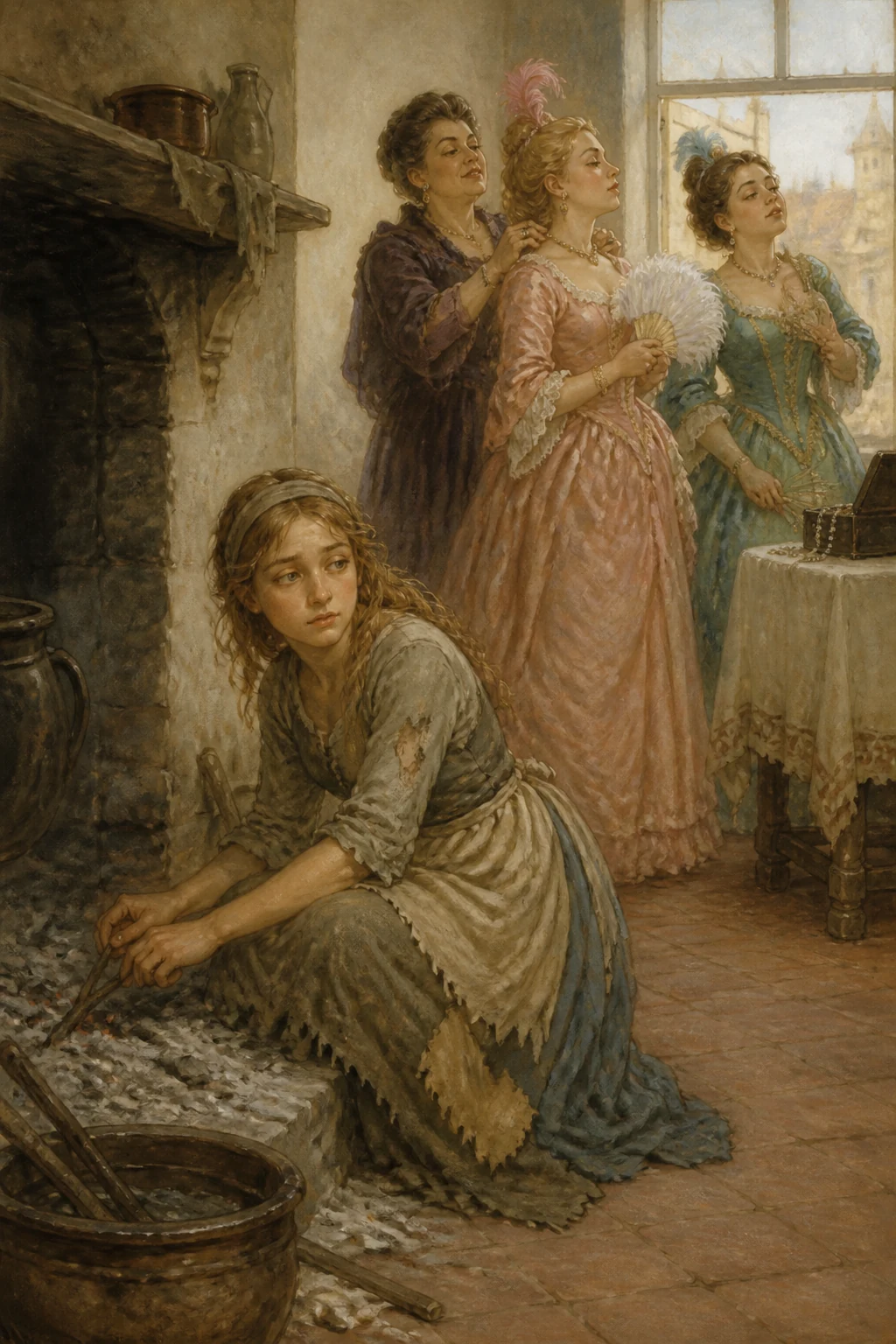
Once upon a time there was a gentleman who married for his second wife the proudest, haughtiest woman anyone had ever seen. She had two daughters of the same disposition, who resembled her in every way. The husband, for his part, had a young daughter of quite extraordinary sweetness and goodness: she took after her mother, who had been the best woman in the world. Scarcely was the wedding over when the stepmother began to show her ill temper. She could not bear the good qualities of this young child, which made her own daughters seem all the more hateful. She gave her the meanest work in the house: it was she who washed the dishes and cleaned the stairs, who scrubbed Madam’s room and those of her young ladies. She slept at the very top of the house, in an attic, on a wretched straw mattress, while her sisters had rooms with parquet floors, beds in the latest fashion, and mirrors in which they could see themselves from head to foot. The poor girl bore it all patiently and dared not complain to her father, who would have scolded her, for his wife ruled him completely. When she had finished her work, she would go to the chimney corner and sit among the ashes, which was why everyone in the house generally called her Cinderbottom. The younger sister, who was not quite so rude as the elder, called her Cinderella. Yet Cinderella, in her wretched clothes, was still a hundred times more beautiful than her sisters, magnificently dressed though they were.
It happened that the King’s son gave a ball and invited all the people of rank. Our two young ladies were invited too, for they cut quite a figure in the country. How delighted they were, and how busy choosing the gowns and headdresses that would suit them best! This meant fresh trouble for Cinderella, for it was she who ironed her sisters’ linen and pleated their cuffs. Nothing was talked of but what they would wear.
“For my part,” said the elder, “I shall wear my red velvet gown with my English trimming.” “I,” said the younger, “shall wear only my everyday skirt; but to make up for it, I shall put on my mantle with the gold flowers, and my diamond clasp, which is certainly nothing to be ashamed of.” They sent for the best hairdresser to arrange their caps in double rows, and had beauty patches bought from the finest maker. They called Cinderella to ask her opinion, for she had excellent taste. Cinderella gave them the best advice in the world, and even offered to dress their hair, which they graciously allowed her to do. As she worked, they said to her, “Cinderella, would you like to go to the ball?” “Alas, young ladies, you are making fun of me. It is no place for someone like me.” “You are right. People would laugh to see a Cinderbottom at the ball.”
Anyone but Cinderella would have dressed their hair crookedly; but she was good-hearted, and she did it to perfection. They went almost two days without eating, so carried away were they with delight. More than a dozen laces were broken in the effort to pull their waists ever smaller, and they were forever standing before their mirrors. At last the happy day arrived. They set off, and Cinderella watched them for as long as she could. When they were out of sight, she began to cry. Her godmother, seeing her in tears, asked what was the matter. “I should so like… I should so like…” She was crying so hard that she could not finish. Her godmother, who was a fairy, said, “You would like to go to the ball, would you not?”
“Oh, yes,” said Cinderella with a sigh. “Well, will you be a good girl?” said her godmother. “Then I shall see that you go.” She took her into her room and said, “Go into the garden and bring me a pumpkin.”
Cinderella went at once to pick the finest she could find and brought it to her godmother, quite unable to imagine how this pumpkin could help her go to the ball. Her godmother hollowed it out, leaving only the rind, then struck it with her wand, and the pumpkin was instantly changed into a splendid coach, gilded all over.
Next she looked in the mousetrap, where she found six mice, all alive. She told Cinderella to lift the trapdoor a little, and as each mouse came out, she tapped it with her wand. The mouse was instantly changed into a fine horse, making a handsome team of six horses, all a beautiful dappled mouse-grey.
As she was wondering what she could use for a coachman, Cinderella said, “I shall go and see whether there is a rat in the rat trap. We can make a coachman of him.” “Quite right,” said her godmother. “Go and look.”
Cinderella brought her the rat trap, which held three large rats. The fairy chose one of the three for his magnificent whiskers, and when she touched him, he became a stout coachman with one of the finest moustaches anyone had ever seen.
Then she said, “Go into the garden. You will find six lizards behind the watering can. Bring them to me.” No sooner had Cinderella brought them than her godmother changed them into six footmen, who immediately climbed up behind the coach in their richly braided liveries and held on as though they had never done anything else in their lives.
The fairy then said to Cinderella, “Well, there is everything you need to go to the ball. Are you not pleased?” “Yes, but must I go like this, in these dreadful clothes?” Her godmother merely touched her with her wand, and at once her clothes were changed into a gown of gold and silver cloth, all embroidered with precious stones. Then she gave her a pair of glass slippers, the prettiest in the world.
When she was dressed in all this finery, she stepped into the coach; but above all else her godmother charged her not to stay past midnight, warning her that if she remained at the ball a moment longer, her coach would turn back into a pumpkin, her horses into mice, her footmen into lizards, and her old clothes would return to their former state.
She promised her godmother that she would be sure to leave the ball before midnight, and set off beside herself with joy. The King’s son, who had been told that a great princess whom no one knew had just arrived, hurried to receive her. He gave her his hand as she stepped down from the coach and led her into the hall where the guests were gathered. A deep silence fell; the dancing stopped and the violins ceased playing, so intent was everyone on gazing at the great beauty of this unknown lady. Nothing could be heard but a murmur: “Oh, how beautiful she is!” Even the King, old as he was, could not help looking at her and whispering to the Queen that it was a long time since he had seen anyone so beautiful and charming. All the ladies studied her hair and her gown, meaning to have the same by the very next day, provided they could find fabrics fine enough and craftsmen skilful enough.
The King’s son seated her in the place of honour, then took her out to dance. She danced so gracefully that she was admired more than ever. A splendid supper was served, but the young Prince ate nothing, so absorbed was he in looking at her. She went and sat beside her sisters and showed them a thousand kindnesses, sharing with them the oranges and lemons the Prince had given her. This astonished them greatly, for they did not recognize her.
While they were talking, Cinderella heard the clock strike a quarter to twelve. At once she made a deep curtsy to the company and left as quickly as she could.
As soon as she arrived home, she went to find her godmother, and after thanking her, said that she very much wished to go to the ball again the next evening, because the King’s son had invited her. While she was busy telling her godmother everything that had happened at the ball, the two sisters knocked at the door. Cinderella went to let them in. “How late you are coming home!” she said, yawning, rubbing her eyes, and stretching as though she had only just woken up. Yet she had not felt the least desire to sleep since they had parted.
“If you had been at the ball,” one of her sisters told her, “you would not have been bored. The most beautiful princess came, the most beautiful anyone could ever see. She was wonderfully gracious to us, and gave us oranges and lemons.” Cinderella could scarcely contain her joy. She asked them the princess’s name, but they replied that no one knew her, that the King’s son was greatly troubled by this, and that he would give anything in the world to know who she was. Cinderella smiled and said, “Then she really was very beautiful? Good heavens, how fortunate you are! Could I not see her too? Oh, Miss Javote, lend me that yellow gown you wear every day.” “Indeed!” said Miss Javotte. “What a fine idea! Lend my gown to a grubby Cinderbottom like you? I should have to be quite mad.”
Cinderella had fully expected this refusal, and was glad of it, for she would have been greatly embarrassed if her sister had agreed to lend her the gown.
The next evening the two sisters went to the ball, and Cinderella went too, dressed even more splendidly than the first time. The King’s son stayed constantly at her side and never ceased whispering sweet things to her. The young lady was enjoying herself so much that she forgot her godmother’s warning, and heard the first stroke of midnight when she thought it was not yet eleven. She rose and fled as lightly as a doe. The Prince followed, but could not catch her. She dropped one of her glass slippers, which the Prince picked up with the greatest care. Cinderella reached home quite out of breath, without coach or footmen, and in her wretched old clothes. Nothing remained of all her splendour but one little slipper, the fellow of the one she had dropped. The guards at the palace gates were asked whether they had seen a princess leave. They said they had seen no one go out except a very poorly dressed girl, who looked more like a peasant than a young lady.
When the two sisters returned from the ball, Cinderella asked whether they had enjoyed themselves again, and whether the beautiful lady had been there. They said that she had, but that she had fled when midnight struck, and in such haste that she had dropped one of her little glass slippers, the prettiest in the world. The King’s son had picked it up and had done nothing but gaze at it for the rest of the ball; surely he was deeply in love with the beautiful person to whom the little slipper belonged. They spoke the truth, for a few days later the King’s son had it proclaimed to the sound of trumpets that he would marry the girl whose foot fitted the slipper exactly. They began by trying it on the princesses, then the duchesses, and all the court, but in vain. It was brought to the two sisters, who did everything they could to squeeze their feet into it, but could not manage it. Cinderella, who was watching them and had recognized her slipper, said with a laugh, “Let me see whether it will fit me.” Her sisters began to laugh and mock her. But the gentleman conducting the fitting looked closely at Cinderella, and finding her very beautiful, said that it was only fair, and that he had orders to try it on every girl. He seated Cinderella and brought the slipper to her little foot. It slipped on without the least difficulty and fitted as though it had been moulded in wax. Great was the astonishment of the two sisters, but greater still when Cinderella drew the other little slipper from her pocket and put it on her other foot. Just then her godmother arrived, and with a touch of her wand made Cinderella’s clothes more magnificent than any she had worn before.
Then her two sisters recognized her as the beautiful lady they had seen at the ball. They threw themselves at her feet to beg forgiveness for all the ill treatment they had made her suffer. Cinderella raised them up and, embracing them, said that she forgave them with all her heart and begged them always to love her dearly. She was taken to the young Prince, dressed in all her finery. He found her more beautiful than ever, and a few days later he married her. Cinderella, who was as good as she was beautiful, gave her two sisters lodgings in the palace, and married them that very day to two great lords of the court.
MORAL Beauty in a woman is a treasure rare; We never tire of gazing on its face. Yet what we call a gracious air Is priceless, and surpasses beauty’s grace.
This was the gift her godmother bestowed On Cinderella, teaching her so well, And guiding her, that she became a queen: (Such is the moral of the tale we tell.)
Fair ladies, more than well-dressed hair, This gift will win a heart and hold it true. A gracious manner is the fairies’ real gift: Without it, nothing; with it, all is yours to do.
ANOTHER MORAL It is undoubtedly a great advantage To have intelligence and courage, Noble birth and good sound sense, And other talents of that kind Which Heaven is pleased to grant us;
But have them as you may, They will not help you on your way Unless, to make their value known, You have a godfather or godmother of your own.
Izvirnik
CENDRILLON
LA PETITE
PENTOUFLE DE VERRE
CONTE
Il estoit une fois un gentil-homme qui épousa en secondes une femme, la plus hautaine & la plus fiere qu’on eut jamais veuë. Elle avoit deux filles de son humeur, & qui luy ressembloient en toutes choses. Le Mari avoit, de son costé, une jeune fille, mais d’une douceur et d’une bonté sans exemple : elle tenoit cela de sa Mere, qui estoit la meilleure personne du monde. Les nopces ne furent pas plûtost faites que la Belle-mere fit éclater sa mauvaise humeur : elle ne put souffrir les bonnes qualitez de cette jeune enfant, qui rendoient ses filles encore plus haïssables. Elle la chargea des plus viles occupations de la Maison : c’estoit elle qui nettoyoit la vaisselle et les montées, qui frottoit la chambre de Madame & celles de Mesdemoiselles ses filles ; elle couchoit tout au haut de la maison, dans un grenier, sur une méchante paillasse, pendant que ses sœurs estoient dans des chambres parquetées, où elles avoient des lits des plus à la mode, & des miroirs où elles se voyoient depuis les pieds jusqu’à la teste ; la pauvre fille souffroit tout avec patience et n’osoit s’en plaindre à son pere qui l’auroit grondée, parce que sa femme le gouvernoit entierement. Lorsqu’elle avoit fait son ouvrage, elle s’alloit mettre au coin de la cheminée & s’asseoir dans les cendres, ce qui faisoit qu’on l’appeloit communément dans le logis Cucendron ; la cadette, qui n’estoit pas si malhonneste que son aisnée, l’appeloit Cendrillon. Cependant Cendrillon, avec ses méchans habits, ne laissoit pas d’estre cent fois plus belle que ses sœurs, quoy que vestuës tres-magnifiquement.
Il arriva que le fils du Roi donna un bal & qu’il en pria toutes les personnes de qualité : nos deux Damoiselles en furent aussi priées, car elles faisoient grande figure dans le pays. Les voilà bien aises & bien occupées à choisir les habits & les coëffures qui leur seïeroient le mieux ; nouvelle peine pour Cendrillon, car c’estoit elle qui repassoit le linge de ses sœurs & qui godronoit leurs manchettes : on ne parloit que de la maniere dont on s’habilleroit.
Moy, dit l’aînée, je mettray mon habit de velours rouge & ma garniture d’Angleterre.
Moy, dit la cadette, je n’auray que ma juppe ordinaire ; mais, en récompense, je mettray mon manteau à fleurs d’or, & ma barriere de diamants, qui n’est pas des plus indifferentes. On envoya querir la bonne coëffeuse pour dresser les cornettes à deux rangs, & on fit achetter des mouches de la bonne Faiseuse : elles appellerent Cendrillon pour luy demander son avis, car elle avoit le goût bon. Cendrillon les conseilla le mieux du monde, & s’offrit mesme à les coëffer ; ce qu’elles voulurent bien. En les coëffant, elles luy disoient, Cendrillon, serois-tu bien aise d’aller au Bal : Helas ! Mesdamoiselles, vous vous mocquez de moy, ce n’est pas là ce qu’il me faut : tu as raison ; on riroit bien si on voyoit un Cucendron aller au bal.
Une autre que Cendrillon les auroit coëffées de travers ; mais elle estoit bonne, & elle les coëffa parfaitement bien. Elles furent prés de deux jours sans manger, tant elles estoient transportées de joye : on rompit plus de douze lacets à force de les serrer pour leur rendre la taille plus menuë, & elles estoient toûjours devant leur miroir. Enfin l’heureux jour arriva ; on partit, & Cendrillon les suivit des yeux le plus longtemps qu’elle put ; lorsqu’elle ne les vit plus, elle se mit à pleurer. Sa Maraine, qui la vit toute en pleurs, luy demanda ce qu’elle avoit : Je voudrois bien… Je voudrois bien… elle pleuroit si fort qu’elle ne put achever : sa Maraine, qui estoit Fée, luy dit, tu voudrois bien aller au Bal, n’est-ce pas :
Helas ! ouy, dit Cendrillon en soûpirant : Hé bien ! seras-tu bonne fille ? dit sa Maraine ; je t’y feray aller ?
Elle la mena dans sa chambre, et luy dit, va dans le jardin & apporte moy une citroüille :
Cendrillon alla aussi tost cueillir la plus belle qu’elle put trouver, & la porta à sa Maraine, ne pouvant deviner comment cette citroüille la pouroit faire aller au bal : sa Maraine la creusa, & n’ayant laissé que l’écorce, la frappa de sa baguette, & la citroüille fut aussi-tost changée en un beau carosse tout doré.
Ensuite, elle alla regarder dans sa sourissiere, où elle trouva six souris toutes en vie ; elle dit à Cendrillon de lever un peu la trappe de la sourissiere, & à chaque souris qui sortoit, elle luy donnoit un coup de sa baguette, & la souris estoit aussi-tost changée en un beau cheval ; ce qui fit un bel attelage de six chevaux d’un beau gris de souris pommelé :
Comme elle estoit en peine de quoy elle ferait un Cocher, je vais voir, dit Cendrillon, s’il n’y a point quelque rat dans la ratiere ; nous en ferons un Cocher : Tu as raison, dit sa Maraine, va voir :
Cendrillon lui apporta la ratiere, où il y avoit trois gros rats. La fée en prit un d’entre les trois, à cause de sa maîtresse barbe, & l’ayant touché, il fut changé en un gros Cocher qui avoit une des plus belles moustaches qu’on ait jamais veuës.
Ensuite elle luy dit, va dans le jardin, tu y trouveras six lezards derriere l’arrosoir, apporte les moy, elle ne les eut pas plûtost apportez, que la Maraine les changea en six Laquais, qui monterent aussi-tost derriere le carosse avec leurs habits chamarez, & qui s’y tenoient attachez, comme s’ils n’eussent fait autre chose de toute leur vie.
La Fée dit alors à Cendrillon :
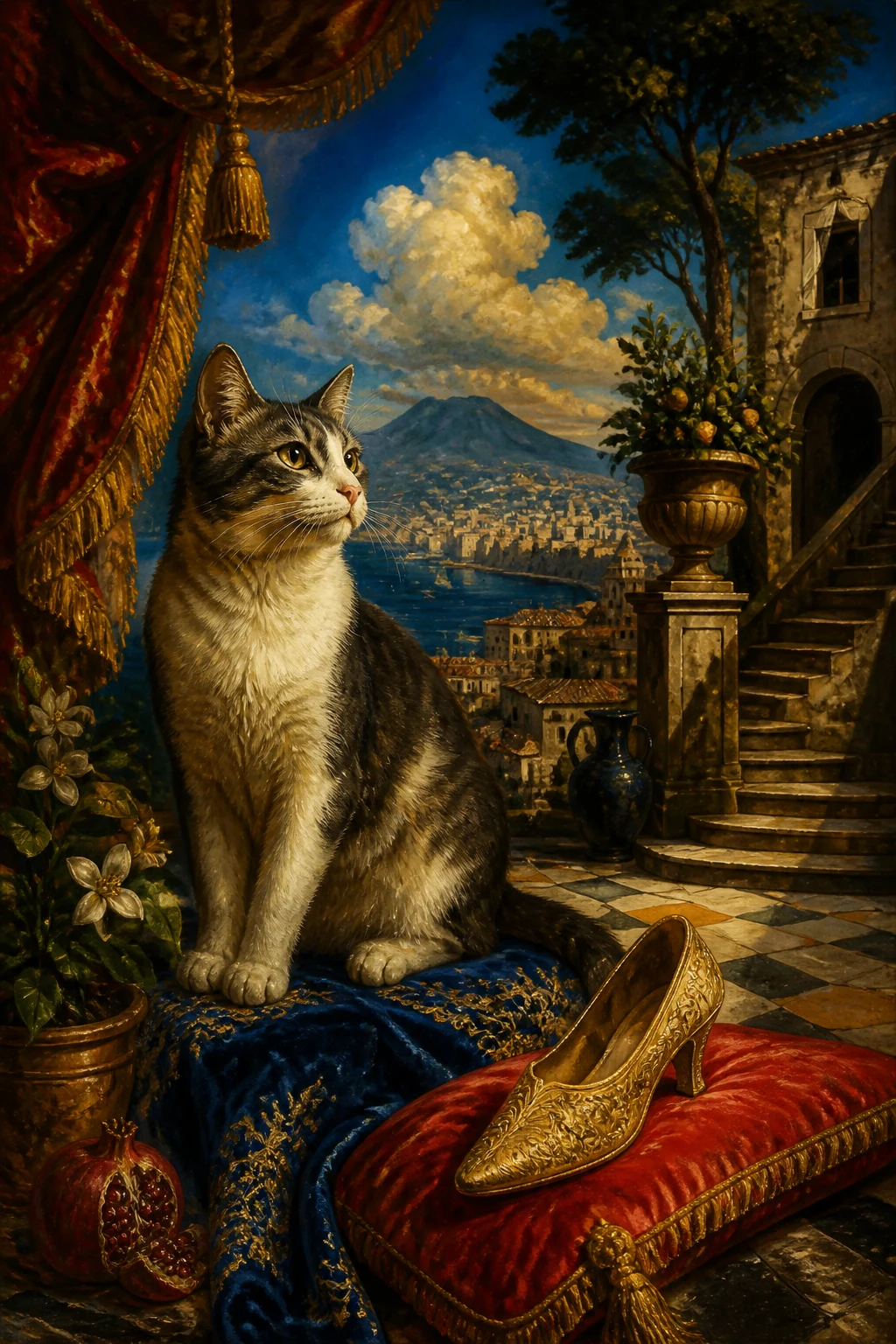
Hé bien ? voilà de quoy aller au bal, n’es-tu pas bien aise ? Ouy, mais est-ce que j’irai comme cela, avec mes vilains habits : Sa maraine ne fit que la toucher avec sa baguette, & en même tems ses habits furent changez en des habits de drap d’or & d’argent, tout chamarrez de pierreries : elle luy donna ensuite une paire de pentoufles de verre, les plus jolies du monde.
Quand elle fut ainsi parée, elle monta en carosse ; mais sa Maraine luy recommanda, sur toutes choses, de ne pas passer minuit, l’avertissant que, si elle demeuroit au bal un moment davantage, son carosse redeviendroit citroüille, ses chevaux des sourils, ses laquais des lezards, et que ses vieux habits reprendroient leur première forme.
Elle promit à sa Maraine qu’elle ne manqueroit pas de sortir du bal avant minuit : Elle part, ne se sentant pas de joye.
Le Fils du Roi, qu’on alla avertir qu’il venoit d’arriver une grande Princesse qu’on ne connoissoit point, courut la recevoir ; il luy donna la main à la descente du carosse, & la mena dans la salle où estoit la compagnie : il se fit alors un grand silence ; on cessa de danser, & les violons ne joüerent plus, tant on estoit attentif à contempler les grandes beautez de cet inconnuë : on n’entendoit qu’un bruit confus, ha, qu’elle est belle ! Le Roi même tout vieux qu’il estoit, ne laissoit pas de la regarder, & de dire tout bas à la Reine, qu’il y avoit long-temps qu’il n’avoit vû une si belle & si aimable personne. Toutes les Dames estoient attentives à considerer sa coëffure & ses habits, pour en avoir dés le lendemain de semblables, pourveu qu’il se trouvast des étoffes assez belles & des ouvriers assez habiles.
Le Fils du Roi la mit à la place la plus honorable, & ensuite la prit pour la mener danser : elle dança avec tant de grace, qu’on l’admira encore davantage. On apporta une fort belle collation, dont le jeune Prince ne mangea point, tant il estoit occupé à la considerer. Elle alla s’asseoir auprés de ses sœurs, & leur fit mille honnestetez : elle leur fit part des oranges & des citrons que le Prince luy avoit donnez ; ce qui les estonna fort, car elles ne la connoissoient point.
Lorsqu’elles causoient ainsi, Cendrillon entendit sonner onze heures trois quarts ; elle fit aussi-tost une grande reverence à la compagnie, & s’en alla le plus viste qu’elle pût.
Dés qu’elle fut arrivée, elle alla trouver sa Maraine, & aprés l’avoir remerciée, elle luy dit qu’elle souhaiteroit bien aller encore le lendemain au Bal, parce que le Fils du Roi l’en avoit priée. Comme elle estoit occupée à raconter à sa Maraine tout ce qui s’étoit passé au bal, les deux sœurs heurterent à la porte ; Cendrillon leur alla ouvrir : Que vous estes longtemps à revenir, leur dit-elle, en bâillant, en se frottant les yeux, & en s’étendant comme si elle n’eust fait que de se réveiller : elle n’avoit cependant pas eu envie de dormir depuis qu’elles s’estoient quittées :
Si tu estois venuë au Bal, luy dit une de ses sœurs, tu ne t’y serais pas ennuyée ; il y est venu la plus belle Princesse, la plus belle qu’on puisse jamais voir ; elle nous a fait mille civilitez ; elle nous a donné des oranges & des citrons. Cendrillon ne se sentoit pas de joye : elle leur demanda le nom de cette Princesse ; mais elles luy répondirent qu’on ne la connoissoit pas, que le Fils du Roi en estoit fort en peine, & qu’il donneroit toutes choses au monde pour sçavoir qui elle estoit. Cendrillon sourit & leur dit, elle estoit donc bien belle ? Mon Dieu ! que vous estes heureuses, ne pourrois-je point la voir ? Helas ! Mademoiselle Javote, prestez-moi vostre habit jaune que vous mettez tous les jours : vraiment, dit mademoiselle Javotte, je suis de cet avis, prestez vostre habit à un vilain Cucendron comme cela, il faudroit que je fusse bien folle.
Cendrillon s’attendoit bien à ce refus, & elle en fut bien aise, car elle auroit esté grandement embarrassée si sa sœur eut bien voulu luy prester son habit.
Le lendemain, les deux sœurs furent au bal, & Cendrillon aussi, mais encore plus parée que la premiere fois. Le Fils du Roi fut toûjours auprés d’elle, & ne cessa de lui conter des douceurs ; la jeune Demoiselle ne s’ennuyoit point & oublia ce que sa Maraine luy avoit recommandé ; de sorte qu’elle entendit sonner le premier coup de minuit, lorsqu’elle ne croyoit pas qui fut encore onze heures : elle se leva & s’enfüit aussi legerement qu’auroit fait une biche : le Prince la suivit, mais il ne put l’attraper ; elle laissa tomber une de ses pantoufles de verre, que le Prince ramassa biensoigneusement. Cendrillon arriva chez elle, bien ésoufflée, sans carosse, sans laquais, & avec ses méchans habits, rien ne luy estant resté de toute sa magnificence, qu’une de ses petites pantoufles, la pareille de celle qu’elle avoit laissé tomber. On demanda aux Gardes de la porte du Palais s’ils n’avoient point veu sortir une Princesse ; ils dirent qu’ils n’avoient veu sortir personne, qu’une jeune fille fort mal vestuë, & qui avoit plus l’air d’une Paysanne que d’une Demoiselle.
Quand les deux sœurs revinrent du Bal, Cendrillon leur demanda si elles s’estoient encore bien diverties, & si la belle Dame y avoit esté ; elles luy dirent que oüy, mais qu’elle s’étoit enfuye lorsque minuit avoit sonné, & si promptement qu’elle avoit laissé tomber une de ses petites pantoufles de verre, la plus jolie du monde ; que le fils du Roy l’avoit ramassée, & qu’il n’avoit fait que la regarder pendant tout le reste du Bal, & qu’assurément il estoit fort amoureux de la belle personne à qui appartenoit la petite pentoufle. Elles dirent vray, car peu de jours aprés, le fils du Roy fit publier à son de trompe, qu’il épouseroit celle dont le pied seroit bien juste à la pentoufle. On commença à l’essayer aux Princesses, ensuite aux Duchesses, & à toute la Cour, mais inutilement : on la porta chez les deux sœurs, qui firent tout leur possible pour faire entrer leur pied dans la pentoufle, mais elles ne purent en venir à bout. Cendrillon, qui les regardoit, & qui reconnut sa pentoufle, dit en riant, que je voye si elle ne me serait pas bonne : ses sœurs se mirent à rire et à se moquer d’elle. Le Gentilhomme qui faisoit l’assay de la pentoufle, ayant regardé attentivement Cendrillon, & la trouvant fort belle, dit que cela estoit juste, & qu’il avoit ordre de l’essayer à toutes les filles : il fit asseoir Cendrillon, & approchant la pentoufle de son petit pied, il vit qu’elle y entroit sanspeine, et qu’elle y estoit juste comme de cire. L’étonnement des deux sœurs fut grand, mais plus grand encore quand Cendrillon tira de sa poche l’autre petite pentoufle, qu’elle mit à son pied. Là-dessus arriva la Maraine, qui, ayant donné un coup de sa baguette sur les habits de Cendrillon, les fit devenir encore plus magnifiques que tous les autres.
Alors ses deux sœurs la reconnurent pour la belle personne qu’elles avoient veuë au Bal. Elles se jetterent à ses pieds pour luy demander pardon de tous les mauvais traittemens, qu’elles luy avoient fait souffrir. Cendrillon les releva et leur dit, en les embrassant, qu’elle leur pardonnoit de bon cœur, & qu’elle les prioit de l’aimer bien toûjours. On la mena chez le jeune Prince, parée comme elle estoit : il la trouva encore plus belle que jamais, & peu de jours aprés il l’épousa. Cendrillon, qui estoit aussi bonne que belle, fit loger ses deux sœurs au Palais, et les maria dés le jour même à deux grands Seigneurs de la Cour.
MORALITE
La beauté, pour le sexe, est un rare tresor ;
De l’admirer jamais on ne se lasse ;
Mais ce qu’on nomme bonne grace
Est sans prix, & vaut mieux encor.
C’est ce qu’à Cendrillon fit avoir sa Maraine,
En la dressant, en l’instruisant,
Tant & si bien qu’elle en fit une Reine :
(Car ainsi sur ce conte on va moralisant.)
Belles, ce don vaut mieux que d’estre bien coëffées,
Pour engager un cœur, pour en venir à bout,
La bonne grace est le vrai don des Fées ;
Sans elle on ne peut rien, avec elle on peut tout.
AUTRE MORALITÉ
C’est sans doute un grand avantage
D’avoir de l’esprit, du courage,
De la naissance, du bon sens,
Et d’autres semblables talens
Qu’on reçoit du Ciel en partage ;
Mais vous aurez beau les avoir,
Pour vostre avancement ce seront choses vaines
Si vous n’avez, pour les faire valoir,
Ou des parrains, ou des Maraines.