O besedilu
Mačka Pepelka
- Vir
- Pentameron
- Avtor
- Giambattista Basile
- Jezik branja
- English
- Jezik izvirnika
- Neapolitan
- Čas branja
- 13 min branja
- Obseg
- 11 strani
- Naslov izvirnika
- Jornata I VI LA GATTA CENNERENTOLA
O izvirniku
Pentameron
Baročna, divja starejša plast evropske pravljice, polna obratov in pretiravanj. Bralni jezik je English, izvirnik pa prihaja iz vira Pentameron v jeziku Neapolitan.
Besedilo
Mačka Pepelka
_Zezolla is persuaded by her governess to murder her stepmother, and, believing she will be cherished if she helps the governess marry her father, finds herself banished to the kitchen; but through the power of the Fairies, after various adventures, she wins a King for her husband._ _The listeners sat like statues as they heard the tale of the Flea, and pronounced King Catammaro an ass for having put his own flesh and blood and the succession to his kingdom in such peril over a thing of no account. When all the others had stopped their mouths, Antonella opened hers as follows._ Envy, sailing the sea of malice, has always used a swollen bladder instead of swimming bladders to keep afloat; and where she hopes to see another drowned, she finds herself beneath the water or dashed against a rock, as I mean to tell you of certain envious girls. You must know, then, that once upon a time there was a widowed Prince who had a daughter so dear to him that he saw the world only through her eyes. He kept an excellent governess for her, who taught her chain stitch, lacework, drawn-thread work, and openwork embroidery, and showed her more affection than words can tell. But the father had lately married again, taking a hot-tempered, wicked woman, a she-devil from hell; and this accursed creature began to take a dislike to her stepdaughter, giving her sour looks, twisted faces, and scowling eyes enough to frighten her out of her wits;
so that the poor little thing was always complaining to her governess of the ill treatment she received from her stepmother, saying, “Oh God, why couldn’t you be my dear little mother, you who pet and pamper me so?” And she went on singing this tune so often that she set a wasp buzzing in the governess’s ear, until, blinded by the devil Mazzamauriello, the woman said to her one day:
“If you will do as this mad head of mine advises, I shall be your mother, and you shall be as dear to me as the pupils of these eyes.” She was about to go on when Zezolla—for that was the girl’s name—said:
“Forgive me for taking the words out of your mouth. I know you love me, so enough said: teach me the trick, for I am quite new to it. You write, and I shall sign.” “Well, then,” the governess replied, “listen closely, open your ears, and you shall have bread as white as flowers. As soon as your father goes out, tell your stepmother you want one of the old dresses in the big chest in the little back room, to save the one you are wearing. Since she would like to see you all in rags and tatters, she will open the chest and say, ‘Hold up the lid.’ While you are holding it and she is rummaging inside, let it fall with a bang, and it will break her neck. Once that is done, you know your father would coin false money to please you; so when he is fondling you, beg him to take me for his wife. Lucky girl, you shall be mistress of my life!” When Zezolla heard this, every hour seemed a thousand years. She carried out the governess’s advice to the letter, and after the mourning for her stepmother’s misfortune was over, she began sounding out her father about marrying the governess. At first the Prince took it as a joke, but the girl kept pushing sideways until she struck the mark;
and at last he yielded to Zezolla’s pleas and married Carmosina, for that was the governess’s name, celebrating the wedding with a great feast. Now, while the bridal couple were making merry, Zezolla leaned out from a balcony of her house, and a little dove flew onto a wall and said to her, “Whenever you long for anything, send to ask for it from the Dove of the Fairies on the island of Sardinia, and you shall have it at once.” For five or six days the new stepmother smothered Zezolla with affection, seating her in the best place at table, giving her the choicest morsels, and dressing her in the finest clothes. But scarcely any time had passed before she cast aside and utterly forgot the service she had received—alas for the soul that has a wicked mistress!—and began exalting six daughters of her own, whom until then she had kept secret. She worked upon her husband so well that, as his stepdaughters won his favor, his own daughter slipped out of his heart;
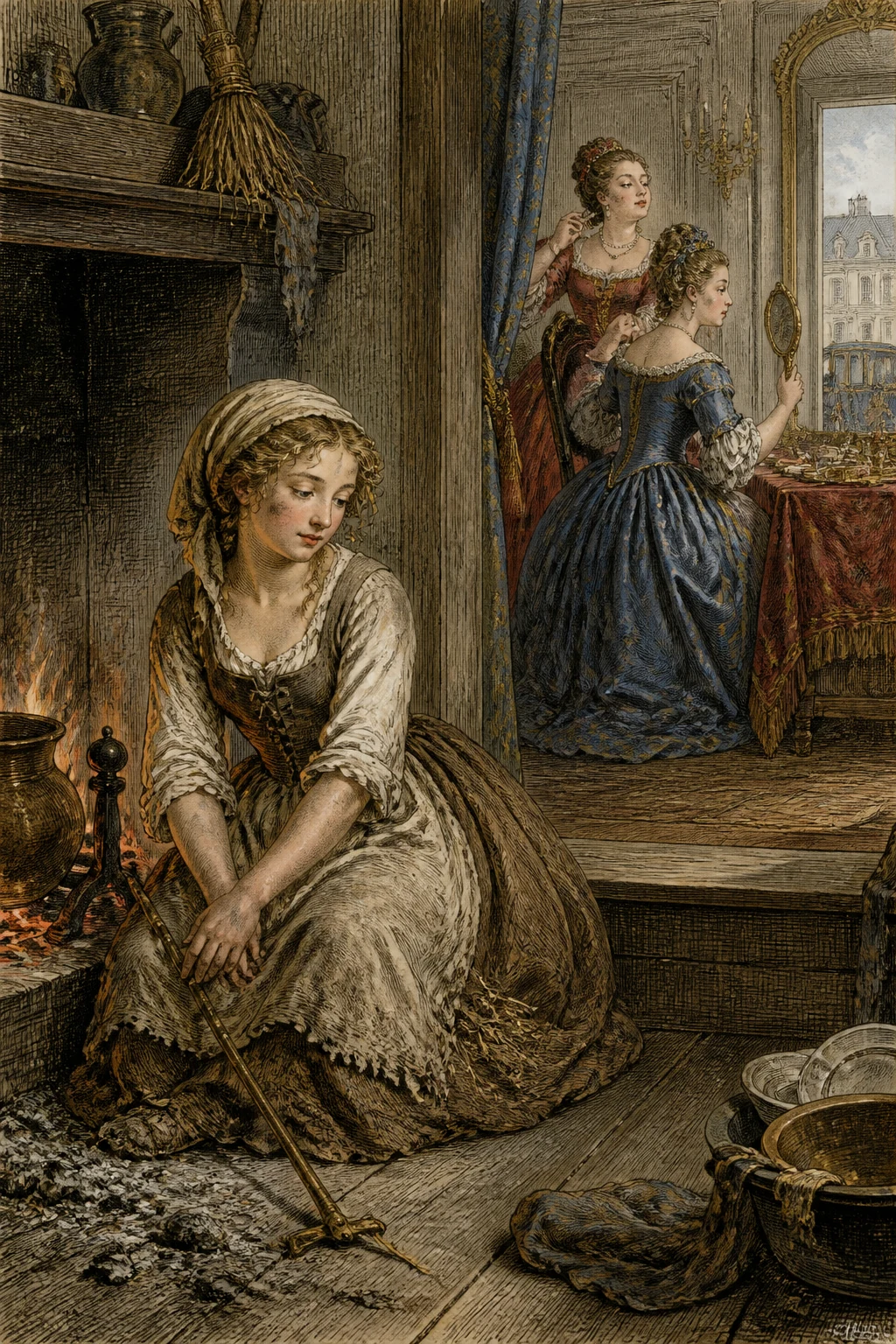
until, losing ground today and falling further tomorrow, she was at last reduced from the bedchamber to the kitchen, from the canopy of state to the hearth, from silken and golden finery to dishcloths, from scepters to roasting spits.
Nor did she change her station alone, but her name as well: for instead of Zezolla she was called the Cinderella Cat. It happened that the Prince had to go to Sardinia on business concerning his estate, and he asked his six stepdaughters, Mperia, Calamita, Sciorella, Diamante, Colommina, and Pascarella, one by one, what they would like him to bring them on his return:
one asked for splendid dresses, another for ornaments for her hair, another for cosmetics for her face, another for little games to pass the time, and each for something different. Last of all, almost in mockery, he said to his daughter, “And what would you like?” “Nothing,” she replied, “except that you commend me to the Dove of the Fairies and ask them to send me something. And if you forget, may you be unable to go either forward or back. Remember what I tell you: your soul is in your own keeping.” The Prince went to Sardinia, attended to his affairs, and bought everything his stepdaughters had asked for; but Zezolla slipped his mind. Yet when he boarded a vessel and set sail, there was no getting the ship away from the harbor: it seemed as though a remora were holding it fast.
The captain, nearly in despair, lay down to sleep from sheer exhaustion and dreamed of a Fairy who said to him, “Do you know why you cannot get your ship out of the harbor? Because the Prince traveling with you has broken his promise to his daughter, remembering everyone except his own flesh and blood.” The captain awoke and told the Prince his dream. Ashamed of his neglect, the Prince went to the Grotto of the Fairies, commended his daughter to them, and asked them to send her something. And out of the cavern came a beautiful young woman, as splendid as a banner, who said that she thanked his daughter for remembering her so kindly and that the girl should be happy for her sake. With these words she gave him a date palm, a hoe, a little golden pail, and a silken towel, saying that the one was for planting and the others for tending the plant. The Prince, marveling at this gift, took his leave of the Fairy and set off for his own country. After giving all his stepdaughters what they had wished for, he at last gave his daughter the Fairy’s present. Beside herself with joy, she planted the date palm in a beautiful pot, hoed its soil, watered it, and wiped it with the silken towel morning and evening;
until, in four days, it had grown as tall as a woman, and a Fairy stepped out of it, saying, “What do you wish?” Zezolla answered that she wished to go out of the house now and then without her sisters knowing. The Fairy replied, “Whenever you please, come to the pot and say:
_My golden date palm dear,_ _With the little golden hoe I have hoed you,_ _With the little golden pail I have watered you,_ _With the silken towel I have dried you_;
_Strip yourself and dress me._ And when you wish to undress, change the last line and say, ‘Strip me and dress yourself.’” Now, when a feast day came and the governess’s daughters went out all flaunting and flouncing, plastered with paint, all ribbons, bells, and frills, all flowers, scents, finery, and roses, Zezolla ran straight to the pot. She spoke the words the Fairy had drummed into her, and was dressed like a Queen and mounted on a palfrey, with twelve pages as neat and handsome as pictures. She went where her sisters were going, and their mouths watered at the beauty of this painted dove. As luck would have it, the King came to that very place, and when he saw Zezolla’s overwhelming beauty he was instantly bewitched. He told a trusted servant to find out whatever he could about this lovely creature: who she was and where she lived. The servant followed close upon her heels. But she noticed the ambush and threw down a handful of gold coins, which she had asked the date palm to give her for that very purpose. Dazzled by the shining money, the fellow forgot to follow the palfrey and busied himself filling his fists with cash. She slipped swiftly home and undressed as the Fairy had taught her, before those harpies of sisters arrived and, to torment her, told her of all the beautiful things they had seen. Meanwhile the servant returned to the King and told him about the coins. The King flew into a furious rage and said he had sold his master’s pleasure for a few filthy coppers, and that at the next feast he must find out at all costs who that beautiful young woman was and where that lovely bird nested. The next feast day came, and the sisters went out in all their finery, leaving despised Zezolla by the hearth. She ran straight to the date palm and spoke the usual words, and out came a troop of maidens: one with a mirror, another with a little bottle of gourd water, another with curling irons, another with a patch of rouge, another with a comb, another with pins, another with dresses, and others with necklaces and chains. Having made her as beautiful as the sun, they placed her in a coach drawn by six horses, attended by footmen and pages in livery. When she reached the same place she had visited at the previous feast, she added wonder to her sisters’ hearts and fire to the King’s breast. But when she left and the servant followed, she threw down a handful of pearls and jewels to keep him from catching her. The worthy fellow stayed behind to peck them up, for such things were not to be wasted; and she had time to make her way home and undress as usual. The servant returned to the King with a face a mile long, and the King said, “By the souls of my dead, if you do not find this woman, I shall give you a thrashing and as many kicks in the arse as you have hairs in that beard!” The next feast day came, and when her sisters had gone out she returned to the date palm. Repeating the enchanted song, she was magnificently dressed and placed in a golden coach with so many servants around her that she looked like a whore caught out walking and surrounded by constables. She went to make her sisters’ mouths water and then departed; but the King’s servant stitched himself to the coach with a double thread. Seeing him always at her heels, she cried, “Drive on, coachman!” The coach set off at such a furious pace, and raced along so wildly, that one of her slippers fell off—a lovelier thing you could never hope to see. Unable to catch the flying coach, the servant picked the slipper up from the ground and carried it to the King, telling him all that had happened. The King took it in his hand and said, “If the foundation is so lovely, what must the house be like? O beautiful candlestick that held the candle which consumes me! O trivet of the lovely cauldron in which my life boils! O lovely corks fastened to the fishing line of love, with which she has caught this soul! Here I embrace you and clasp you close; and if I cannot reach the plant, I worship its roots;
if I cannot have the capitals, I kiss the bases. Once you were the fetters of a white foot; now you are the traps of a blackened heart. Through you, she who tyrannizes over my life stood a span and a half taller; through you, my life grows just as much in sweetness as I gaze upon you and possess you.” So saying, he summoned the clerk and commanded the trumpeter, and toot-toot! had a proclamation made that all the women in the land should come to a public feast and banquet he had taken it into his head to give. The appointed day arrived. Oh, my dears, what a slaughtering and what a bustle there was! Where did all those wheat pies and cheese breads come from? Where all the tarts and meatballs? Where the macaroni and ravioli? There was enough to feed a whole army. All the women came, noble and common, rich and poor, old and young, beautiful and ugly; and when the King had combed his guests well with a hearty meal, he tried the slipper on each of the women in turn, to see whose foot it fitted to a hair, so perfectly that its shape would reveal the woman he sought. But finding no foot it fitted properly, he was driven almost to despair. Still, he called for silence and said, “Come back tomorrow and do penance with me again. But if you love me, leave no woman at home, whoever she may be.” The Prince said, “I have a daughter, but she is always tending the hearth, being such a wretched, worthless creature that she is not fit to sit where you dine.” The King replied, “Let her be first on the list, for that would please me.” And so they departed. The next day they all returned, and Zezolla came with Carmosina’s daughters. As soon as the King saw her, he had an inkling that she was the woman he desired;
but he gave no sign. When they had finished plying their jaws, they came to the trial of the slipper. Yet scarcely had it approached Zezolla’s foot when it sprang of its own accord onto the foot of that darling of Love, as iron flies to a magnet. Seeing this, the King ran to press her in his arms, seated her beneath the canopy of state, and set the crown upon her head, commanding everyone to bow and make obeisance to her as their Queen. When her sisters saw this, they were ready to burst with spite; and, unable to stomach the sight of such a blow to their hearts, they slipped quietly away to their mother’s house, confessing, in spite of themselves, _That he is a fool who strives against the stars._
Izvirnik
Jornata I VI LA GATTA CENNERENTOLA
Naslednje strani prikazujejo izvirno besedilo za primerjavo.
_Zezolla ’nvezzata da la Majestra ad accidere la Matreja, e ccredenno, co ffarele avere lo Patre pe mmarito, d’essere tenuta cara, è pposta a la cucina; ma pe bertute de le Ffate, dapò varie fortune, se guadagna no Rrè pe mmarito._ _Parzero statole l’Ascotante a ssentire lo cunto de lo Polece, e ffacettero na dechiaratoria d’asenetate a lo Rrè Catammaro, che mmese a ttanto riseco lo ’nteresse de lo sango, e la soccessione de lo stato pe na cosa de vrenna; ed essenno tutte appilate, Antonella spilaje de la manera, che ssecota._ Sempre la ’nvidia ne lo maro de la malegnetate appe ’ncagno de vessiche la guallara, e ddove crede de vedere autro annegato a mmaro, essa se trova o sott’acqua, o tozzata a no scuoglio, comme de cierte ffigliole
’nvediose me va ’mpenziero de ve contare; saperrite donca, che Era na vota no Prencepe vidolo, lo quale aveva na figliola accossì ccara, che non vedeva pe d’autr’uocchie, a la quale teneva na Majestra prencepale, che le ’mmezzava le ccatenelle, lo punto nn’aiero, le sfilatielle, e l’afreco perciato, mostrannole tant’affezzione, che non s’abbasta a ddicere. Ma essennose ’nzorato de frisco lo patre, e ppigliata na focoliata, marvasa, e mmiciata de lo Diantane, commenzaje sta mmardetta femmena ad avere ’nsauvorria la ffigliastra, facennole cere brosche, facce storte, uocchie gronnuse, de farela sorrejere; tanto che la scura peccerella se gualiava sempre co la Majestra de li male trattamiente, che le faceva la Matreja, decennole; oh Dio, e non
potisse essere tu la mammarella mia, che mme faje tanta vruoccole, e ccassesie? e ttanto secotaje a ffare sta cantelena, che puostole no vespone a l’aurecchie, cecata da Mazzamauriello, le disse na vota: se tu vuoje fare a mmodo de sta capo pazza, io te sarraggio mamma, e ttu mme sarraje cara comm’a le bisole de st’uocchie. Voleva secotiare a ddicere, quanno Zezolla (che cossì la figliola aveva nomme) disse; perdoname se te spezzo parola ’mmocca, io saccio ca me vuoje bene, perzò zitto, e zuffece, e ’nmezzame l’arte, ca vengo da fore, tu scrive, e io firmo. Ora susso, le leprecaje la Majestra, siente buono, apre l’aurecchie, e te venerà lo ppane janco comm’a li sciure. Comme esce patreto, dì a Matrejata, ca vuoje no vestito de chille viecchie,
che stanno dinto lo cascione granne de lo retretto, pe sparagnare chisto, che puorte ’ncuollo; essa che te vò vedere tutta pezze, e pperuoglie, aprerà lo cascione, e ddirrà: tiene lo copierchio, e tu tenendolo, mentre jarrà scervecanno pe ddinto, lassalo cadere de botta, ca se romparà lo cuollo; fatto chesto, tu saje ca patreto farria moneta fauza pe ccontentarete, e tu quanno te fa carizze, pregalo a pigliareme pe mmogliere, ca viata te, tu sarraje la patrona de la vita mia: ’Ntiso chesto Zezolla, le parze ogn’ora mill’anne, e fatto compritamente lo conziglio de la Majestra, dapò, che se fece lo llutto pe la desgrazia de la Matreja, commenzaje a toccare li taste a lo patre, che se ’nzorasse co la Majestra. Da principio lo Prencepe la pigliaje a
burla, ma la figliola tanto tiraje de chiatto, fi che couze de ponta; che all’utemo se chiegaje a le pparole de Zezolla, e ppigliatase Carmosina, ch’era la Majestra pe mmogliere, fece na festa granne. Ora mentre stavano li Zite ’ntresca, affacciatase Zezolla a no gaifo de la casa soja, volata na palommella sopra no muro, le disse: Quanno te vene golio de quarcosa, mannal’addemmannare a la Palomma de le Fate all’Isola de Sardegna, ca l’averraje subeto. La nova Matreja pe ccinco, o seje juorne affumaje de carizze a Zezolla, sedennola a lo meglio luoco de la tavola, dannole lo meglio muorzo; mettennole li meglio vestite; ma passato a mmala pena no poco de tiempo, mannato a mmonte, e scordato affatto de lo servizio recevuto (o trista l’arma c’ha mala
patrona) commenzaje a mmettere ’mperecuoccuolo seje figlie soje, che fi a ttanno aveva tenuto secrete, e ttanto fece co lo marito, che rreceputo ’ngrazia le figliastre, le cadette da core la figlia propria; tanto che scapeta oje, manca craje, venne a ttermene, che se redusse da la cammera a la cocina, e da lo Vardacchino a lo focolare, da li sfuorge de seta, e d’oro, a le mmappine, da li scettre a li spite.
Ne sulo cagnaje stato, ma nomme perzì, che da Zezolla, fu cchiammata Gatta cennerentola. Soccesse, ch’avenno lo Prencepe da ire ’nSardegna pe ccose necessarie a lo stato sujo, dommannaje una ped’una a Mperia, Calamita, Sciorella, Diamante, Colommina, Pascarella, ch’erano le sseje figliastre, che cosa volesseno, che le portasse a lo retuorno: e chi le cercaje vestite da sforgiare, chi galantarie pe la capo, chi cuonce pe la faccie, chi jocarielle pe ppassare lo tiempo, e chi na cosa, e chi n’autra, ped’utemo quase pe ddellieggio disse a la figlia, e tu che borrisse? ed essa nient’autro, se non che mme raccommanne a la Palomma de le Ffate, decennole, che mme manneno quarcosa, e si te lo scuorde, non puozze ire ne nnanze, ne arreto: tiene a mmente
chello che te dico, arma toja, maneca toja. Jette lo Prencepe fece li fatte suoje ’nSardegna, accattaje quanto l’avevano cercato le ffigliastre, e Zezolla le scie de mente. Ma ’mmarcatose ’ncoppa a no vasciello, e ffacenno vela, non fu possibile maje, che la Nave se arrassasse da lo puorto, e pareva che fosse ’mpedecata da la Remmora: Lo Patrone de lo Vasciello, ch’era quase desperato, se pose pe stracquo a ddormire, e vedde ’nsuonno na Fata, che le disse: Saje perchè non potite scazzellare la nave da lo puorto? perchè lo Prencepe, che vene co buje, ha mancato de promessa a la figlia, allecordannose de tutte, fora che de lo sango proprio. Se sceta lo Patrone, conta lo suonno a lo Prencepe, lo quale confuso de lo mancamiento, ch’aveva fatto, jeze
a la Grotta de le Ffate, e arracommannatole la figlia, disse, che le mannassero quarcosa: ed ecco scette fora da la spelonca na bella giovane, che bedive no confalone: la quale le disse, ca rengraziava la figlia de la bona memoria, e che se gaudesse pe l’ammore sujo, cossì decenno le dette no Dattolo, na zappa, no secchietiello d’oro, e na tovaglia de seta; decenno che l’uno era pe pastenare, e ll’autra pe ccortevare la chianta. Lo Prencepe maravigliato de sto presiento, se lecenziaje da la Fata a la vota de lo pajese sujo, e dato a tutte le figliastre quanto avevano desiderato; deze finalmente a la figlia lo duono, che le faceva la Fata: la quale co na prejezza, che non capeva dinto la pella, pastenaje lo dattolo a na bella testa, lo zappolejava,
adacquava, e co la tovaglia de seta matino, e ssera l’asciuttava; tanto, che ’n quattro juorne cresciuto quanto a la statura de na femmena, ne scette fora na Fata, decennole; che desiddere? a la quale respose Zezolla; che desiderava quarche bota de scire fora de casa, ne boleva, che le ssore lo ssapessero; leprecaje la Fata, ogne vota, che t’è gusto, viene a la testa, e dì; _Dattolo mio ’nnaurato_ _Co la zappetella d’oro t’aggio zappato_, _Co lo secchietiello d’oro t’aggio adacquato_, _Co la tovaglia de seta t’aggio asciuttato_; _Spoglia a te, e bieste a me._ E quanno vorraje spogliarete, cagna l’utemo vierzo, decenno spoglia
a mme, e bieste a tte. Ora mo essendo venuta la festa, e sciute le ffiglie de la Maestra tutte spampanate, strellecate, ’mpallaccate, tutte zagarelle, campanelle, e scarpelle, tutte sciure, addure, cose, e rrose: Zezolla corze subeto a la testa, e dditto le pparole ’nfrocecatele da la Fata, fu posta ’nnordene comme na Regina, e posta sopra n’Acchinea, co ddudece pagge linte, e ppinte; jette a dove jevano le ssore che ffecero la spotazzella pe le bellezze de sta penta palomma. Ma comme voze la sciorta, dette a chillo luoco stisso lo Rrè, lo quale visto la spotestata bellezza de Zezolla, nne restaje subeto affattorato, e disse a no servetore cchiù ’ntrinseco, che se fosse ’nformato, comme potesse ’nformarese de sta bellezza cosa, e chi fosse,
e dove stava. Lo servetore a la medesema pedata le jeze retomano. Ma essa addonatose dell’agguaito, jettaje na mano de scute riccie, che s’aveva fatto dare da lo Dattolo pe cchesto effetto. Chillo allummato li sbruonzole, se scordaje de secotare l’Acchinea, pe ’nchirese le branche de fellusse: ed essa se ficcaje de relanzo a la casa, dove spogliata che fo, comme le ’nvezzaje la Fata, arrivate le scirpie de le ssore, le quale pe ddarele cottura, dissero tante cose belle, che avevano visto. Tornaje fra sto miezo lo servetore a lo Rrè, e disse lo fatto de li scute, lo quale ’nsorfatose co na zirria granne, le disse, che pe quatto frisole cacate aveva vennuto lo gusto sujo, e che nnogne cunto avesse l’autra festa procurato de sapere chi fosse chella bella
Giovene, e dove s’ammasonasse sto bello Auciello. Venne l’autra festa, e sciute le ssore tutte aparate, e galante, lassaro desprezzata Zezolla a lo focolaro; la quale subeto corze a lo Dattolo, e dditto le pparole solete; ecco scettero na mano de dammecelle, chi co lo schiecco, chi co la carrafella d’acqua de cocozze, chi co lo fierro de li ricce, chi co la pezza de russo, chi co lo pettene, chi co le spingole, chi co li vestite, chi co la cannacca, e collane; e ffattala bella comme a no Sole, la mesero a na carrozza a seje cavalle, accompagnata da staffiere, e da pagge de livrera; e ghionta a lo medesemo luoco dove era stata l’autra festa, agghionze maraviglia a lo core de le ssore, e ffuoco a lo pietto de lo Rrè: ma repartutase, e ghiutole dereto lo
servetore, pe non farese arrevare, juttaie na vranca de perne, e de gioje, dove remmase chill’ommo da bene a ppizzoliarennelle, ca non era cosa da perdere; Essa ebbe tiempo de remmorchiarese a la casa, e de spogliarese conforme a lo ssoleto. Tornaje lo servetore luongo luongo a lo Rrè, lo quale disse, pe l’arma de li muorte mieje, ca si tu non truove chesta, te faccio na ’ntosa, e te darraggio tanta cauce ’nculo, quanto aje pile a sta varva. Venne l’autra festa, e sciute le ssore, essa tornaje a lo dattolo, e continuanno la canzona fatata, fu bestuta soperbamente, e pposta dinto na carrozza d’oro co ttante serviture attuorno, che pareva pottana pigliata a lo passiggio ’ntorniata de tammare; e ghiuta a fare cannavola a le Ssore, se
partette; e lo servetore de lo Rrè, se cosette a ffilo duppio co la carrozza. Essa vedendo, che sempre l’era a le ccoste, disse tocca cocchiero, ed ecco se mese la carrozza a ccorrere de tanta furia, e ffu cossì granne la corzeta, che le cascaje no chianiello, che non se poteva vedere la cchiù ppentata cosa. Lo servetore, che non potte jognere la carrozza, che bolava, auzaje lo chianiello da terra, e lo portaje a lo Rrè decennole; quanto l’era socceduto, lo quale pigliatolo ’nmano disse: Se lo pedamiento è ccosì bello, che sarrà la casa? o bello canneliero dove è stata la cannela, che mme strude? o Trepete de la bella caudara, dove volle la vita; o belle suvare attaccate a la lenza d’ammore, co la quale ha pescato chest’arma: ecco v’abbraccio, e
ve stregno, e si non pozzo arrevare a la chianta, adoro le rradeche; si non pozzo avere li capetielle, vaso le base. Già fustevo cippe de no janco pede, mò site tagliole de no nigro core: pe buje era auta no parmo, e mmiezo de cchiù, chi tirannea sta vita, e pe buje cresce auto tanto de docezza sta vita, mentre ve guardo, e ve possedo. Cossì ddicenno, chiamma lo scrivano, commanna lo trommetta, e tù tù, fa jettare no Banno, che tutte le femmene de la terra vengano a na festa vannuta, e a no banchetto, che s’ha puosto ’nchiocca de fare. E benuto lo juorno destenato. Oh bene mio, che mmazzacatorio, e che bazzarra, che se facette. Da dove vennero tante pastiere, e ccasatielle; dove li sottellate, e le pporpette; addò li maccarune, e graviuole? tanto,
che ’nce poteva magnare n’asserzeto formato. Venute le ffemmene tutte e nnobele, e ’gnobele, e rricche, e pezziente, e becchie, e ffigliole, e belle, e brutte, e buono pettenato lo Rrè fatto lo profitto, provaje lo chianiello ad una ped’una a tutte le commetate, pe bedere a chi jesse a capillo, ed assestato tanto, che potesse conoscere da la forma de lo chianiello chello, che ghieva cercanno; ma non trovanno pede, che ’nce jesse a ssiesto, s’appe a ddesperare. Tuttavota fatto stare zitto ogn’uno disse; tornate craje a ffare penetenzia co mmico: ma se mme volite bene, non lassate nesciuna femmena a la casa, e ssia chi si voglia: Disse lo Prencepe, aggio na figlia, ma guarda sempre lo focolaro ped’essere desgraziata, e da poco, che non è meretevole
de sedere dove magnate vuje. Disse lo Rrè chesta sia ’ncapo de lista, ca l’aggio a ccaro. Cossì partettero, e lo juorno appriesso tutte, e ’nsiemme co le ffiglie de Carmosina venne Zezolla, la quale subeto, che fu bista da lo Rrè, l’ebbe na ’nfanzia de chella, che desiderava; tutta vota semmolaje. Ma fornuto de sbattere, se venne a la prova de lo chianiello: ma non tanto priesto s’accostaje a lo pede de Zezolla, che se lanzaje da se stisso a lo pede de chella cuccopinto d’Ammore, comme lo fierro corre a la calamita, la quale cosa vista lo Rrè, corze a ffarele soppressa co le braccia, e ffattola sedere sotto lo bardacchino, le mese la corona ’ntesta che le facessero ’ncrinate, e lleverenzie comme a Rregina loro. Le ssore, vedendo chesto, chiene
de crepantiglia, non avenno stommaco de vedere sto schiuoppo de lo core lloro, se la sfilaro guatte guatte verso la casa de la mamma, confessanno a despietto lloro _Ca pazzo è chi contrasta co le stelle._
Nadaljuj z branjem