Prevod
Once upon a time there were a woodcutter and his wife who had seven children, all boys. The eldest was only ten, and the youngest was just seven. You may wonder how the woodcutter had so many children in so short a time, but his wife was quick about her business and never had fewer than two at once.
They were very poor, and their seven children were a great burden to them, for none was yet able to earn his living. What troubled them still more was that the youngest was very delicate and scarcely spoke a word: they mistook for stupidity what was really a sign of a fine mind. He was very small, and when he came into the world he was hardly bigger than a thumb, which was why they called him Little Thumb.
This poor child was the household scapegoat, and everything was always his fault. Yet he was the cleverest and shrewdest of all his brothers, and if he spoke little, he listened a great deal.
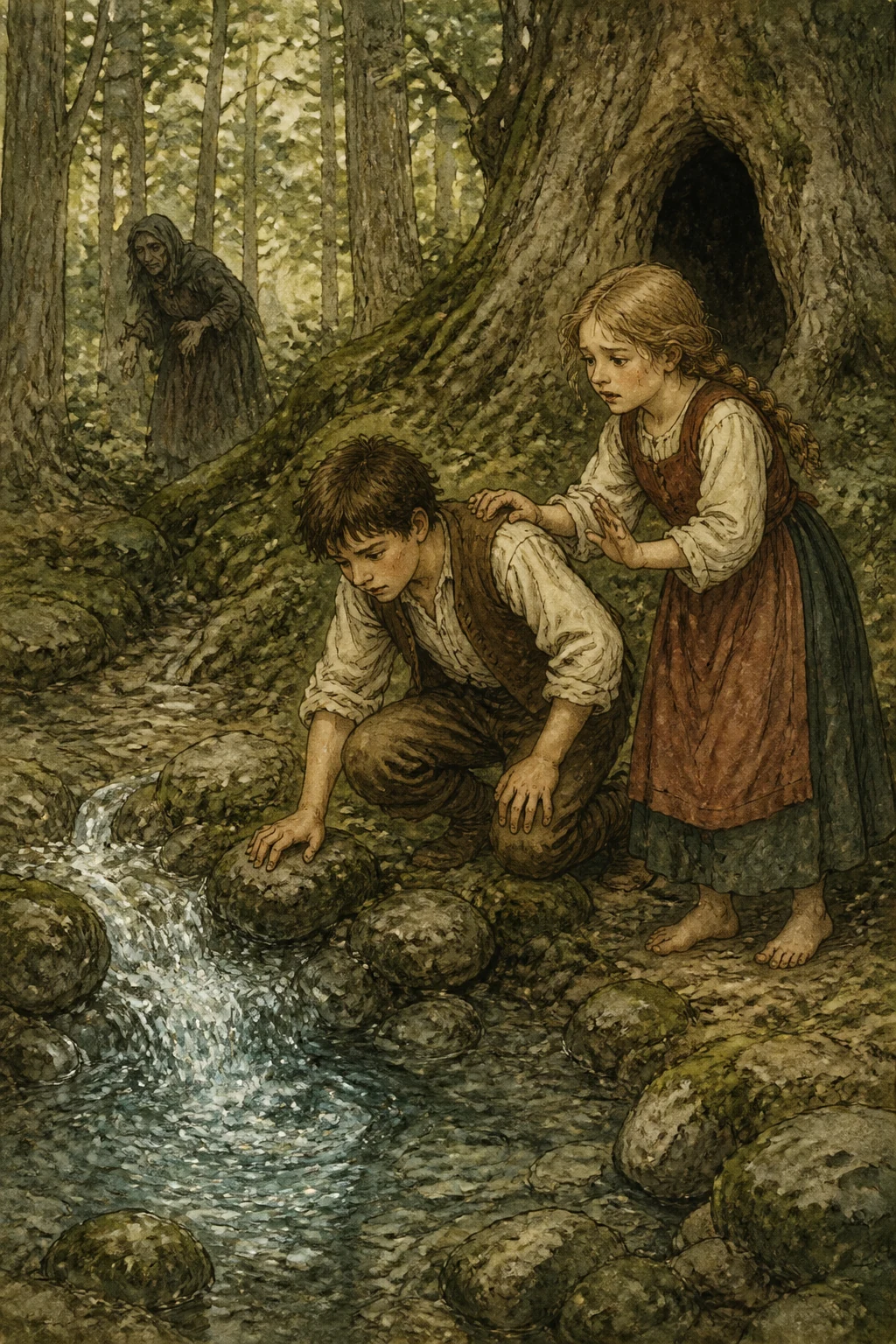
There came a very hard year, and the famine was so severe that these poor people resolved to rid themselves of their children. One evening, when the children were in bed and the woodcutter was sitting by the fire with his wife, he said to her, his heart heavy with grief, “You can see that we can no longer feed our children. I cannot bear to watch them starve before my eyes, and I have made up my mind to take them into the woods tomorrow and leave them there. It will be easy enough: while they are busy gathering sticks into bundles, we need only slip away without their seeing us.” “Ah!” cried his wife. “Could you really take your own children out and abandon them?” Her husband reminded her of their terrible poverty, but to no avail: she could not consent. She was poor, but she was their mother. At last, however, when she considered how painful it would be to see them starve, she agreed, and went to bed in tears. Little Thumb heard everything they said, for when he heard from his bed that they were discussing serious matters, he had got up quietly and slipped beneath his father’s stool to listen unseen. He went back to bed and lay awake for the rest of the night, thinking about what he must do. He rose early in the morning and went down to a stream, where he filled his pockets with little white pebbles, then returned home. They set out, and Little Thumb told his brothers nothing of what he knew. They went into a forest so thick that ten paces apart they could not see one another. The woodcutter began to cut wood, and his children to gather twigs into bundles. Seeing them busy at their work, the father and mother gradually drew away, then suddenly fled down a little winding path. When the children found themselves alone, they began to shout and weep as loudly as they could. Little Thumb let them cry, knowing very well how he would get home, for as they walked he had dropped the little white pebbles from his pockets along the path. “Do not be afraid, brothers,” he told them. “Father and Mother have left us here, but I shall take you safely home. Just follow me.” They followed him, and he led them back to their house by the very path they had taken into the forest. At first they dared not go in, but all pressed close to the door to listen to what their father and mother were saying.
Just as the woodcutter and his wife arrived home, the lord of the village sent them ten crowns he had owed them for a long time, which they had given up all hope of receiving. This put new life into them, for the poor people were starving. The woodcutter sent his wife straight to the butcher’s. Since it was so long since she had eaten, she bought three times as much meat as two people needed for supper. When they had eaten their fill, the woodcutter’s wife said, “Alas, where are our poor children now? What a feast they would make of what we have left! But then, Guillaume, it was you who wanted to abandon them. I told you we should regret it. What are they doing now in that forest? Alas, dear God, perhaps the wolves have eaten them already! How heartless you were to abandon your children like that!” At last the woodcutter lost patience, for she repeated more than twenty times that they would regret it and that she had told him so. He threatened to beat her if she would not be quiet. It was not that the woodcutter was not perhaps even more distressed than his wife, but she was giving him a headache; and he was like many other people, who are very fond of women who speak well, but find those who always knew better a great nuisance. His wife was in tears. “Alas, where are my children now, my poor children?” Once she said it so loudly that the children at the door heard her and all cried out together, “Here we are! Here we are!” She ran to open the door and said, embracing them, “How glad I am to see you again, my dear children! You must be so tired and so hungry! And you, Pierrot, how muddy you are! Come here and let me wash your face.” This Pierrot was her eldest son, whom she loved more than all the others because his hair was a little red, and hers was a little red too. They sat down at the table and ate with an appetite that delighted their father and mother, telling them how frightened they had been in the forest and almost always talking all at once. The good people were overjoyed to have their children with them again, and their happiness lasted as long as the ten crowns. But when the money was spent, they fell back into their former misery and resolved to abandon the children once more, taking them much farther away than before to make certain of succeeding.
They could not discuss this so secretly that Little Thumb did not overhear them, and he intended to get out of trouble just as he had before. But although he rose early to gather little pebbles, he could not manage it, for he found the door of the house locked and double-locked. He did not know what to do, until the woodcutter’s wife gave each of them a piece of bread for breakfast, and it occurred to him that he could use his bread instead of pebbles, scattering crumbs along the paths they took. So he tucked it into his pocket. Their father and mother led them into the thickest, darkest part of the forest, and as soon as they were there, slipped down a side path and left them. Little Thumb was not greatly troubled, for he believed he could easily find his way back by means of the bread he had scattered wherever he went. But he was astonished when he could not find a single crumb: the birds had come and eaten them all. Now they were in great distress, for the farther they walked, the more they lost their way and the deeper they went into the forest. Night fell, and a great wind rose, filling them with dreadful fears. They thought they heard nothing on every side but the howling of wolves coming to eat them. They scarcely dared speak to one another or turn their heads. A heavy rain began, soaking them to the bone; they slipped at every step and fell in the mud, getting up filthy all over and not knowing what to do with their hands. Little Thumb climbed to the top of a tree to see whether he could make anything out. Looking all around, he saw a little glimmer, like candlelight, far away beyond the forest. He climbed down, but once he was on the ground he could see nothing, which dismayed him. Nevertheless, after walking for some time with his brothers in the direction where he had seen the light, he caught sight of it again as they came out of the woods. At last they reached the house where the candle was burning, though not without many frights, for they often lost sight of it whenever they went down into a hollow. They knocked at the door, and a good woman came to open it. She asked them what they wanted. Little Thumb told her they were poor children who had lost their way in the forest, and begged her, out of charity, to give them shelter for the night. Seeing what pretty children they all were, the woman began to weep. “Alas, my poor children,” she said, “what a place you have come to! Do you know that this is the house of an ogre who eats little children?” “Alas, madam,” replied Little Thumb, trembling from head to foot like his brothers, “what are we to do? The wolves in the forest are certain to eat us tonight if you will not take us in. If we must be eaten, we would rather it were your husband who ate us. Perhaps he will take pity on us, if you would be so kind as to ask him.” The ogre’s wife thought she could hide them from her husband until the following morning, so she let them in and took them to warm themselves by a good fire, where a whole sheep was roasting on a spit for the ogre’s supper. Just as they began to warm themselves, they heard three or four heavy blows on the door: the ogre had come home. His wife at once hid them under the bed and went to open the door. The ogre immediately asked whether supper was ready and the wine had been drawn, then sat down at the table. The sheep was still quite bloody, but he thought it all the better for that. He sniffed to the right and left, saying he smelled fresh flesh. “It must be the calf I have just dressed that you smell,” his wife told him. “I smell fresh flesh, I tell you again,” the ogre replied, giving his wife a sidelong glare, “and there is something going on here that I do not understand.” With these words he rose from the table and went straight to the bed. “Aha!” he said. “So this is how you mean to deceive me, you wretched woman! I do not know what keeps me from eating you too. It is lucky for you that you are such a tough old creature. Here is some game that will come in very handy for entertaining three ogre friends of mine who are coming to visit in the next few days.” He dragged the children out from under the bed one by one. The poor children fell to their knees and begged for mercy, but they were dealing with the cruellest of all ogres, who, far from taking pity on them, was already devouring them with his eyes, and told his wife what tasty morsels they would be once she had made a good sauce for them. He went to fetch a great knife and, as he approached the poor children, sharpened it on a long stone he held in his left hand. He had already seized one of them when his wife said, “What are you thinking of, at this hour? Will you not have time enough tomorrow morning?” “Be quiet,” replied the ogre. “They will be all the more tender.” “But you still have so much meat,” his wife went on. “There is a calf, two sheep, and half a pig.” “You are right,” said the ogre. “Give them a good supper so they do not grow thin, and put them to bed.” The good woman was overjoyed and brought them a fine supper, but they were too terrified to eat. As for the ogre, he went back to his drinking, delighted to have such a feast for his friends. He drank a dozen more cups than usual, which went to his head a little and obliged him to go to bed.
The ogre had seven daughters who were still only children. These little ogresses all had lovely complexions, because they ate fresh flesh like their father; but they had small, round grey eyes, hooked noses, and very large mouths with long, sharp teeth set far apart. They were not yet very wicked, but they showed great promise, for they already bit little children to suck their blood. They had been put to bed early and lay all seven in one great bed, each with a golden crown on her head. In the same room there was another bed of the same size, and it was here that the ogre’s wife put the seven little boys to sleep, after which she went to bed beside her husband. Little Thumb had noticed the golden crowns on the heads of the ogre’s daughters, and feared that the ogre might regret not having cut their throats that very evening. Towards the middle of the night he got up, took his brothers’ caps and his own, and very gently placed them on the heads of the ogre’s seven daughters, first removing their golden crowns, which he put on his brothers’ heads and his own, so that the ogre would mistake them for his daughters, and his daughters for the boys whose throats he meant to cut. Everything happened as he had expected. The ogre woke around midnight and regretted having put off until morning what he could have done the night before. He leapt out of bed and took up his great knife. “Let us see how our little rascals are getting on,” he said. “We may as well finish the business now.” He groped his way upstairs to his daughters’ room and approached the bed where the little boys lay, all asleep except Little Thumb, who was very frightened when he felt the ogre’s hand feeling his head, as it had felt the heads of all his brothers. Feeling the golden crowns, the ogre said, “Well, that would have been a fine piece of work! I can see I drank too much last night.” He then went to his daughters’ bed, where he felt the boys’ little caps. “Ah, here are our young scamps!” he said. “Let us get to work.” With these words, he cut the throats of all seven daughters without a moment’s hesitation. Very pleased with what he had done, he went back to bed beside his wife. As soon as Little Thumb heard the ogre snoring, he woke his brothers and told them to dress quickly and follow him. They crept down into the garden and climbed over the walls. They ran for almost the whole night, trembling all the while and not knowing where they were going. When the ogre woke, he said to his wife, “Go upstairs and dress those little rascals from last night.” The ogress was much surprised by her husband’s kindness, having no suspicion of the way he meant her to dress them, and, believing he was telling her to put their clothes on, went upstairs. There she was horrified to find her seven daughters with their throats cut, lying in their own blood. Her first act was to faint, for that is the first remedy almost every woman finds on such occasions. Fearing that his wife was taking too long over the task he had given her, the ogre went upstairs to help. He was no less astonished than she had been at the dreadful sight. “Ah, what have I done?” he cried. “The wretches shall pay for this, and at once!” He immediately threw a potful of water in his wife’s face, and when he had revived her, said, “Quick, give me my seven-league boots, so I can catch them!” He set off across the countryside and, after running a great distance in every direction, at last came upon the road along which the poor children were walking, now only a hundred paces from their father’s house. They saw the ogre striding from mountain to mountain and crossing rivers as easily as the smallest brook. Little Thumb spotted a hollow rock nearby, made his six brothers hide inside, and squeezed in after them, keeping his eye on the ogre all the while. The ogre was very weary from the long journey he had made to no purpose, for seven-league boots are very tiring to their wearer. He wanted to rest, and by chance sat down on the very rock where the little boys were hiding. Being utterly exhausted, he fell asleep after resting a little, and began to snore so frightfully that the poor children were no less terrified than when he had held his great knife ready to cut their throats. Little Thumb was less afraid, and told his brothers to hurry home while the ogre was sound asleep and not to worry about him. They took his advice and made their way quickly home. Little Thumb crept up to the ogre, gently pulled off his boots, and put them on at once. The boots were very large and very wide, but as they were enchanted, they could grow larger or smaller to fit the legs of whoever wore them, so they fitted his feet and legs as neatly as if they had been made for him. He went straight to the ogre’s house, where he found the ogre’s wife weeping beside her murdered daughters. “Your husband is in great danger,” Little Thumb told her. “He has been captured by a band of robbers who have sworn to kill him unless he gives them all his gold and silver. Just as they were holding a dagger to his throat, he caught sight of me and begged me to come and tell you what had happened, and to ask you to give me everything he owns, holding nothing back, for otherwise they will kill him without mercy. Since the matter is so urgent, he insisted that I take his seven-league boots, which you see here, both to make haste and so that you would not think me an impostor.” Greatly frightened, the good woman immediately gave him everything she had, for although the ogre ate little children, he was nevertheless a very good husband. Laden with all the ogre’s riches, Little Thumb returned to his father’s house, where he was welcomed with great joy.
There are many people who dispute this last part of the story and maintain that Little Thumb never robbed the ogre at all. It is true, they say, that he had no scruples about taking his seven-league boots, because the ogre used them only to chase little children. These people claim to have it on good authority, and even to have eaten and drunk in the woodcutter’s house. They declare that once Little Thumb had put on the ogre’s boots, he went to court, where he knew there was great anxiety about an army two hundred leagues away and the outcome of a battle that had been fought. He went, they say, to see the king and told him that, if he wished, he would bring him news of the army before the day was out. The king promised him a large sum of money if he succeeded. Little Thumb brought back news that very evening, and as this first journey made him known, he could earn as much as he pleased. The king paid him handsomely to carry orders to the army, and countless ladies gave him whatever he asked for news of their lovers; indeed, this was his greatest source of profit. A few wives entrusted him with letters for their husbands, but they paid him so poorly, and it amounted to so little, that he did not deign to include these earnings in his accounts. After working as a courier for some time and amassing a great fortune, he returned to his father’s house, where the joy at seeing him again was beyond imagining. He made his whole family comfortable. He bought newly created offices for his father and brothers, and in this way provided for them all while at the same time winning great favour at court.
MORAL. No one grieves at having many children When all are handsome, tall, and strong, And pleasing to the eye; But if one is weak or scarcely speaks, He is scorned, and mocked, and bullied.
And yet sometimes it is this little child Who will bring happiness to the whole family. THE END.
Izvirnik
LE PETIT
POUCET
CONTE.
Il estoit une fois un Bucheron & une Bucheronne, qui avaient sept enfans tous Garçons ; l’aîné n’avoit que dix ans, & le plus jeune n’en avoit que sept. On s’estonnera que le Bucheron ait eu tant d’enfans en si peu de temps ; mais c’est que sa femme allait viste en besogne, & n’en faisait pas moins que deux à la fois.
Ils estaient fort pauvres, & leurs sept enfans les incommodaient beaucoup, parce qu’aucun d’eux ne pouvait encore gagner sa vie. Ce qui les chagrinait encore, c’est que le plus jeune estait fort delicat, & ne disait mot, prenant pour bestise ce qui estait une marque de la bonté de son esprit : il estoit fort petit, & quand il vint au monde, il n’estait gueres plus gros que le pouce, ce qui fit que l’on l’appella le Petit Poucet.
Ce pauvre enfant estoit le souffre-douleurs de la maison, & on lui donnoit toûjours le tort. Cependant il estoit le plus fin, & le plus avisé de tous ses freres, & s’il parloit peu, il écoutoit beaucoup.
Il vint une année très-fâcheuse, & la famine fut si grande que ces pauvres gens resolurent de se deffaire de leurs enfans. Un soir que ces enfans estoient couchez, & que le Bucheron estoit auprés du feu avec sa femme, il luy dit, le cœur serré de douleur ? Tu vois bien que nous ne pouvons plus nourrir nos enfans : je ne sçaurois les voir mourir de faim devant mes yeux, & je suis resolu de les mener perdre demain au bois, ce qui sera bien aisé, car tandis qu’ils s’amuseront à fagoter, nous n’avons qu’à nous enfuir sans qu’ils nous voient. Ah ! s’écria la Bucheronne, pourrois-tu bien toy-même mener perdre tes enfans ? Son mary avoit beau luy representer leur grande pauvreté, elle ne pouvoit y consentir ; elle estoit pauvre, mais elle estoit leur mere. Cependant ayant consideré quelle douleur ce luy seroit de les voir mourir de faim, elle y consentit, & alla se coucher en pleurant. Le petit Poucet oüit tout ce qu’ils dirent, car ayant entendu de dedans son lit qu’ils parloient d’affaires, il s’estoit levé doucement, & s’estoit glissé sous l’escabelle de son pere pour les écouter sans estre vû. Il alla se recoucher & ne dormit point le reste de la nuit, songeant à ce qu’il avoit à faire. Il se leva de bon matin, & alla au bord d’un ruisseau, où il emplit ses poches de petits cailloux blancs, & ensuite revint à la maison. On partit, & le petit Poucet ne découvrit rien de tout ce qu’il sçavoit à ses freres. Ils allerent dans une forest fort épaisse, où à dix pas de distance on ne se voyoit pas l’un l’autre. Le Bucheron se mit à couper du bois & ses enfans à ramasser des broutilles pour faire des fagots. Le pere & la mere les voyant occupez à travailler, s’éloignerent d’eux insensiblement, & puis s’enfuirent tout à coup par un petit sentier détourné. Lorsque ces enfans se virent seuls, il se mirent à crier & à pleurer de toute leur force. Le petit Pouçet les laissoit crier, sçachant bien par où il reviendroit à la maison ; car en marchant il avoit laissé tomber le long du chemin les petits cailloux blancs qu’il avait dans ses poches. Il leur dit donc, ne craignez point mes freres, mon Pere & ma Mere nous ont laissez icy, mais je vous rameneray bien au logis, suivez-moy seulement : ils le suivirent, & il les mena jusqu’à leur maison, par le même chemin qu’ils estoient venus dans la forest. Ils n’oserent d’abord entrer, mais ils se mirent tous contre la porte pour écouter ce que disaient leur pere & leur mere.
Dans le moment que le Bucheron & la Bucheronne arriverent chez eux, le seigneur du Vilage leur envoya dix écus qu’il leur devoit il y avoit longtems, & dont ils n’esperoient plus rien : Cela leur redonna la vie, car les pauvres gens mouroient de faim. Le Bucheron envoya sur l’heure sa femme à la Boucherie. Comme il y avoit longtemps qu’elle n’avoit mangé, elle acheta trois fois plus de viande qu’il n’en falloit pour le soupé de deux personnes. Lorsqu’ils furent rassasiez, la Bucheronne dit, helas, où sont maintenant ces pauvres enfans, ils feroient bonne chere de ce qui nous reste là. Mais aussi, Guillaume, c’est toy qui les as voulu perdre, j’avois bien dit que nous nous en repentirions, que font-ils maintenant dans cette Forest ? Helas ! mon Dieu les loups les ont peut-être déjà mangez ; tu es bien inhumain d’avoir perdu ainsi tes enfans. Le Bucheron s’impatienta à la fin, car elle redit plus de vingt fois qu’ils s’en repentiroient & qu’elle l’avoit bien dit. Il la menaça de la battre si elle ne se taisoit. Ce n’est pas que le Bucheron ne fust peut-estre encore plus fâché que sa femme ; mais c’est qu’elle luy rompoit la teste, & qu’il estoit de l’humeur de beaucoup d’autres gens, qui ayment fort les femmes qui disent bien, mais qui trouvent très importunes celles qui ont toûjours bien dit. La Bucheronne estoit tout en pleurs ? Helas ! où sont maintenant mes enfans, mes pauvres enfans ? Elle le dit une fois si haut que les enfans qui étoient à la porte l’ayant entendu se mirent à crier tous ensemble, nous voyla, nous voyla. Elle courut viste leur ouvrir la porte, & leur dit en les embrassant, que je suis aise de vous revoir, mes chers enfans, vous estes bien las, & vous avez bien faim ; & toy, Pierrot, comme te voyla crotté, viens que je te débarboüille. Ce Pierrot estoit son fils aîné, qu’elle aimoit plus que tous les autres, parce qu’il estoit un peu rousseau, & qu’elle estoit un peu rousse. Ils se mirent à Table, & mangerent d’un apetit qui faisoit plaisir au Pere & à la Mere, à qui ils racontoient la peur qu’ils avoient euë dans la Forest, en parlant presque toûjours tous ensemble : Ces bonnes gens étoient ravis de revoir leurs enfans avec eux, & cette joie dura tant que les dix écus durerent ; mais lors que l’argent fut dépensé ils retomberent dans leur premier chagrin ; & résolurent de les perdre encore, & pour ne pas manquer leur coup, de les mener bien plus loin que la premiere fois.
Ils ne purent parler de cela si secrettement qu’ils ne fussent entendus par le petit Poucet, qui fit son compte de sortir d’affaire comme il avoit déjà fait ; mais quoyqu’il se fut levé de bon matin pour aller ramasser des petits cailloux, il ne put en venir à bout, car il trouva la porte de la maison fermée à double tour. Il ne sçavoit que faire lors que la Bucheronne leur ayant donné à chacun un morceau de pain pour leur déjeuné, il songea qu’il pourroit se servir de son pain au lieu de cailloux, en le jettant par miettes le long des chemins où ils passeroient : il le serra donc dans sa poche. Le Pere & la Mere les menerent dans l’endroit de la Forest le plus épais & le plus obscur, & dés qu’ils y furent ils gagnerent un faux-fuyant & les laisserent là. Le Petit Poucet ne s’en chagrina pas beaucoup, parce qu’il croyoit retrouver aisément son chemin par le moyen de son pain qu’il avoit semé partout où il avoit passé ; mais il fut bien surpris lorsqu’il ne put en retrouver une seule miette, les Oiseaux étoient venus qui avoient tout mangé. Les voylà donc bien affligés, car, plus ils marchoient plus ils s’égaroient, & s’enfonçoient dans la Forest. La nuit vint, & il s’éleva un grand vent qui leur faisoit des peurs épouventables. Ils croyoient n’entendre de tous côtés que des heurlemens de loups qui venoient à eux pour les manger. Ils n’osoient presque se parler ny tourner la teste. Il survint une grosse pluye qui les perça jusqu’aux os ; ils glissoient à chaque pas & tomboient dans la boüe, d’où ils se relevoient tout crottés, ne sçachant que faire de leurs mains. Le petit Pouçet grimpa au haut d’un arbre pour voir s’il ne découvrirait rien ; ayant tourné la teste de tous costés, il vit une petite lueur comme d’une chandelle, mais qui estoit bien loin par delà la Forest. Il descendit de l’arbre, & lorsqu’il fut à terre, il ne vit plus rien ; cela le desola. Cependant, ayant marché quelque temps, avec ses freres du costé qu’il avoit veu la lumiere, il la revit en sortant du Bois. Ils arriverent enfin à la maison où estoit cette chandelle, non sans bien des frayeurs, car souvent ils la perdoient de veuë, ce qui leur arrivoit toutes les fois qu’ils descendoient dans quelques fonds. Ils heurterent à la porte, & une bonne femme vint leur ouvrir. Elle leur demanda ce qu’ils vouloient. Le petit Pouçet luy dit, qu’ils étoient de pauvres enfans qui s’estoient perdus dans la Forest, & qui demandoient à coucher par charité. Cette femme les voyant tous si jolis se mit à pleurer, & leur dit, helas ! mes pauvres enfans, où estes-vous venus ? sçavez-vous bien que c’est icy la maison d’un Ogre qui mange les petits enfans. Helas ! Madame, luy répondit le petit Pouçet, qui trembloit de toute sa force, aussi bien que ses freres, que ferons-nous ? Il est bien seur que les Loups de la Forest ne manqueront pas de nous manger cette nuit, si vous ne voulez pas nous retirer chez vous. Et cela étant nous aimons mieux que ce soit Monsieur qui nous mange. Peut-estre qu’il aura pitié de nous, si vous voulez bien l’en prier. La femme de l’Ogre qui crut qu’elle pourroit les cacher à son mary jusqu’au lendemain matin, les laissa entrer & les mena se chauffer auprés d’un bon feu, car il y avoit un Mouton tout entier à la broche pour le soupé de l’Ogre. Comme ils commençoient à se chauffer ils entendirent heurter trois ou quatre grands coups à la porte, c’estoit l’Ogre qui revenoit. Aussi tost sa femme les fit cacher sous le lit & alla ouvrir la porte. L’Ogre demanda d’abord si le soupé estoit prest & si on avoit tiré du vin, & aussi-tost se mit à table. Le Mouton estoit encore tout sanglant, mais il ne luy en sembla que meilleur. Il fleuroit à droite & à gauche, disant qu’il sentoit la chair fraiche. Il faut luy dit sa femme, que ce soit ce veau que je viens d’habiller que vous sentez. Je sens la chair fraîche, te dis-je encore une fois, reprit l’Ogre en regardant sa femme de travers, & il y a icy quelque chose que je n’entens pas ; en disant ces mots, il se leva de Table, & alla droit au lit. Ah, dit-il voilà, donc comme tu veux me tromper maudite femme, je ne sçais à quoi il tient que je ne te mange aussi, bien t’en prend d’estre une vieille beste. Voila du Gibier qui me vient bien à propos pour traiter trois Ogres de mes amis, qui doivent me venir voir ces jours-icy. Il les tira de dessous le lit, l’un aprés l’autre. Ces pauvres enfans se mirent à genoux en luy demandant pardon, mais ils avoient affaire au plus cruël de tous les Ogres, qui bien loin d’avoir de la pitié, les dévoroit déjà des yeux, & disoit à sa femme que ce seroient là de friands morceaux lorsqu’elle leur auroit fait une bonne sausse. Il alla prendre un grand Couteau, & en approchant de ces pauvres enfans, il l’aiguisoit sur une longue pierre qu’il tenoit à sa main gauche. Il en avoit déjà empoigné un, lorsque sa femme luy dit, que voulez-vous faire à l’heure qu’il est, n’aurés-vous pas assez de temps demain matin ? Tais-toy, reprit l’Ogre, ils en seront plus mortifiés. Mais vous avez encore là tant de viande, reprit sa femme : voilà un Veau, deux & la moitié d’un cochon. Tu as raison, dit l’Ogre, donne-leur bien à souper affin qu’ils ne maigrissent pas, & va les mener coucher. La bonne femme fut ravie de joye, & leur porta bien à souper ; mais ils ne purent manger tant ils estoient saisis de peur. Pour l’Ogre, il se remit à boire ravis d’avoir de quoy si bien regaler ses Amis. Il but une douzaine de coups de plus qu’à l’ordinaire, ce qui luy donna un peu dans la teste, & l’obligea de s’aller coucher.
L’Ogre avoit sept filles qui n’étoient encore que des enfans. Ces petites Ogresses avoient toutes le teint fort beau, parce qu’elles mangeoient de la chair fraîche comme leur pere ; mais elles avoient de petits yeux gris & tout ronds, le nez crochu & une fort grande bouche avec de longues dents fort aiguës & fort éloignées l’une de l’autre. Elles n’estoient pas encore fort méchantes ; mais elles promettoient beaucoup, car elles mordoient déjà les petits enfans pour en succer le sang. On les avoit fait coucher de bonne heure, & elles estoient toutes sept dans un grand lit, ayant chacune une Couronne d’or sur la teste. Il y avoit dans la même chambre un autre lit de la même grandeur ce fut dans ce lit que la femme de l’Ogre mit coucher les sept petits garçons, aprés quoi elle s’alla coucher auprés de son mary. Le petit Pouçet qui avoit remarqué que les filles de l’Ogre avoient des Couronnes d’or sur la teste, & qui craignoit qu’il ne prit à l’Ogre quelques remords de ne les avoir pas égorgés dés le soir même, se leva vers le milieu de la nuit, & prenant les bonnets de ses freres & le sien, il alla tout doucement les mettre sur la teste des sept filles de l’Ogre, aprés leur avoir osté leurs Couronnes d’or, qu’il mit sur la teste de ses freres & sur la sienne, affin que l’Ogre les prit pour ses filles, & ses filles pour les garçons qu’il vouloit égorger. La chose réüssit comme il l’avoit pensé : car l’Ogre s’étant éveillé sur le minuit, eut regret d’avoir differé au lendemain ce qu’il pouvoit executer la veille, il se jetta donc brusquement hors du lit, & prenant son grand Couteau, allons voir, dit il, comment se portent nos petits drolles, n’en faisons pas à deux fois ; il monta donc à tâtons à la Chambre de ses filles & s’approcha du lit où étoient les petits garçons, qui dormoient tous excepté le petit Pouçet, qui eut bien peur lorsqu’il sentit la main de l’Ogre qui luy tastoit la teste, comme il avoit tasté celle de tous ses freres. L’Ogre, qui sentit les Couronnes d’or ; vrayment, dit-il, j’allois faire là un bel ouvrage, je voy bien que je bus trop hier au soir. Il alla ensuite au lit de ses filles, où ayant senti les petits bonnets des garçons. Ah, les voilà, dit-il, nos gaillards ? Travaillons hardiment ; en disant ces mots, il coupa sans balancer la gorge à ses sept filles. Fort content de cette expedition, il alla se recoucher auprés de sa femme. Aussi-tost que le petit Poucet entendit ronfler l’Ogre, il reveilla ses freres, & leur dit de s’habiller promptement & de le suivre. Ils descendirent doucement dans le Jardin, & sauterent par-dessus les murailles. Ils coururent presque toute la nuit, toûjours en tremblant & sans sçavoir où ils alloient. L’Ogre s’estant éveillé dit à sa femme, vaten la haut habiller ces petits droles d’hier au soir ; L’Ogresse fut fort estonnée de la bonté de son mary, ne se doutant point de la maniere qu’il entendoit qu’elle les habillast, & croyant qu’il lui ordonnoit de les aller vestir, elle monta en haut, où elle fut bien surprise lorsqu’elle aperçut ses sept filles égorgées & nageant dans leur sang. Elle commença par s’évanoüir (car c’est le premier expedient que trouvent presque toutes les femmes en pareilles rencontres.) L’Ogre craignant que sa femme ne fût trop longtemps à faire la besongne dont il l’avoit chargée, monta en haut pour luy aider. Il ne fut pas moins estonné que sa femme lorsqu’il vit cet affreux spectacle. Ah, qu’ay-je fait là s’écria-t-il, ils me le payeront les malheureux, & tout à l’heure. Il jetta aussitost une potée d’eau dans le nez de sa femme, & l’ayant fait revenir, donne-moy viste mes bottes de sept lieuës, luy dit-il, afin que j’aille les attraper. Il se mit en campagne, & aprés avoir couru bien loin de tous costés, enfin il entra dans le chemin où marchoient ces pauvres enfans qui n’étoient plus qu’à cent pas du logis de leur pere. Ils virent l’Ogre qui alloit de montagne en montagne, & qui traversoit des rivieres aussi aisément qu’il auroit fait le moindre ruisseau. Le petit Poucet qui vit un rocher creux proche le lieu où ils estoient, y fit cacher ses six freres, & s’y fourra aussi, regardant toûjours ce que l’Ogre deviendroit. L’Ogre qui se trouvoit fort las du long chemin qu’il avoit fait inutilement, (car les bottes de sept lieuës fatiguent fort leur homme), voulut se reposer, & par hasard il alla s’asseoir sur la roche où les petits garçons s’estoient cachés. Comme il n’en pouvoit plus de fatigue il s’endormit aprés s’estre reposé quelque temps, & vint à ronfler si effroyablement que les pauvres enfans n’eurent pas moins de peur que quand il tenoit son grand Couteau pour leur couper la gorge. Le petit Poucet en eut moins de peur, & dit à ses freres de s’enfuir promptement à la maison pendant que l’Ogre dormoit bien fort, & qu’ils ne se missent point en peine de luy. Ils crurent son conseil, & gagnerent viste la maison. Le petit Poucet s’estant approché de l’Ogre, lui tira doucement ses bottes, & les mit aussitost ; les bottes estoient fort grandes & fort larges ; mais comme elles estoient Fées, elles avoient le don de s’agrandir & de s’apetisser selon la jambe de celuy qui les chaussoit, de sorte qu’elles se trouverent aussi justes à ses pieds & à ses jambes que si elles avoient esté faites pour lui. Il alla droit à la maison de l’Ogre où il trouva sa femme qui pleuroit auprés de ses filles égorgées. Vostre mary, lui dit le petit Poucet, est en grand danger, car il a esté pris par une troupe de voleurs qui ont juré de le tuër s’il ne leur donne tout son or & tout son argent. Dans le moment qu’ils luy tenoient le poignard sur la gorge, il m’a aperceu & m’a prié de vous venir avertir de l’estat où il est, & de vous dire de me donner tout ce qu’il a vaillant sans en rien retenir, parce qu’autrement ils le tuëront sans misericorde : Comme la chose presse beaucoup, il a voulu que je prisse ses bottes de sept lieuës que voilà pour faire diligence, & aussi afin que vous ne croyiez pas que je sois un affronteur. La bonne femme fort effrayée lui donna aussitost tout ce qu’elle avoit : car cet Ogre ne laissoit pas d’estre fort bon mari, quoiqu’il mangeast les petits enfans. Le petit Poucet estant donc chargé de toutes les richesses de l’Ogre s’en revint au logis de son pere, où il fut receu avec bien de la joye.
Il y a bien des gens qui ne demeurent pas d’accord de cette derniere circonstance, & qui prétendent que le petit Poucet n’a jamais fait ce vol à l’Ogre ; qu’à la verité, il n’avoit pas fait conscience de luy prendre ses bottes de sept lieuës, parce qu’il ne s’en servoit que pour courir aprés les petits enfans. Ces gens-là asseurent le sçavoir de bonne part, & même pour avoir bû & mangé dans la maison du bûcheron. Ils assurent que lorsque le petit Poucet eut chaussé les bottes de l’Ogre, il s’en alla à la Cour, où il sçavoit qu’on estoit fort en peine d’une Armée, qui estoit à deux cents lieües de là, & du succés d’une bataille qu’on avoit donnée. Il alla, disent-ils, trouver le Roi, & luy dit que, s’il le souhaitoit, il luy rapporteroit des nouvelles de l’Armée avant la fin du jour. Le Roi lui promit une grosse somme d’argent s’il en venoit à bout. Le petit Pouçet rapporta des nouvelles dés le soir même ; & cette premiere course l’ayant fait connoître, il gagnoit tout ce qu’il vouloit : car le roi le payoit parfaitement bien pour porter ses ordres à l’Armée, & une infinité de Dames luy donnoient tout ce qu’il vouloit pour avoir des nouvelles de leurs Amans, & ce fut là son plus grand gain. Il se trouvoit quelques femmes qui le chargeoient de Lettres pour leurs maris, mais elles le payoient si mal, & cela alloit à si peu de chose, qu’il ne daignoit mettre en ligne de conte, ce qu’il gagnoit de ce côté-là. Aprés avoir fait pendant quelque temps le métier de courier, & y avoir amassé beaucoup de bien, il revint chez son pere, où il n’est pas possible d’imaginer la joye qu’on eut de le revoir. Il mit toute sa famille à son aise. Il achepta des Offices de nouvelle création pour son pere & pour ses freres, & par là il les établit tous, & fit parfaitement bien sa Cour en même temps.
MORALITÉ.
On ne s’afflige point d’avoir beaucoup d’enfans
Quand ils sont tous beaux, bien-faits & bien grands
Et d’un extérieur qui brille ;
Mais si l’un d’eux est foible ou ne dit mot,
On le méprise, on le l’aille, on le pille.
Quelquefois, cependant, c’est ce petit marmot
Qui fera le bonheur de toute la famille.
FIN.