Prevod
There are people whose rigid minds, beneath brows that never lose their frown, will tolerate, approve, and esteem nothing but the pompous and sublime. For my part, I dare maintain that even the finest mind may at certain moments delight in puppet shows without a blush, and that there are times and places when gravity and seriousness are worth less than a little pleasant nonsense.
Why should we marvel that the soundest reason, often weary of keeping watch too long, should take pleasure in a little sleep, ingeniously lulled by tales of ogres and fairies?
Without fear, then, of being condemned for misusing my leisure, I shall satisfy your rightful wish and tell you at length the story of Donkeyskin.
Once upon a time there was a king, the greatest on earth, gracious in peace and terrible in war, with none, in short, to equal him but himself. His neighbors feared him, his dominions were at peace, and everywhere, beneath the shade of his victorious palms, virtue and the fine arts flourished.
His beloved wife, his faithful companion, was so charming and beautiful, so gentle and accommodating in spirit, that with her he was happier still as a husband than as a king.
From their tender, chaste marriage, so full of sweetness and delight, a daughter had been born whose many virtues easily consoled them for having no other children.
In his vast and wealthy palace, all was magnificence; everywhere there swarmed a lively abundance of courtiers and servants. His stables held horses great and small, of every kind, covered in handsome caparisons stiff with gold and embroidery;
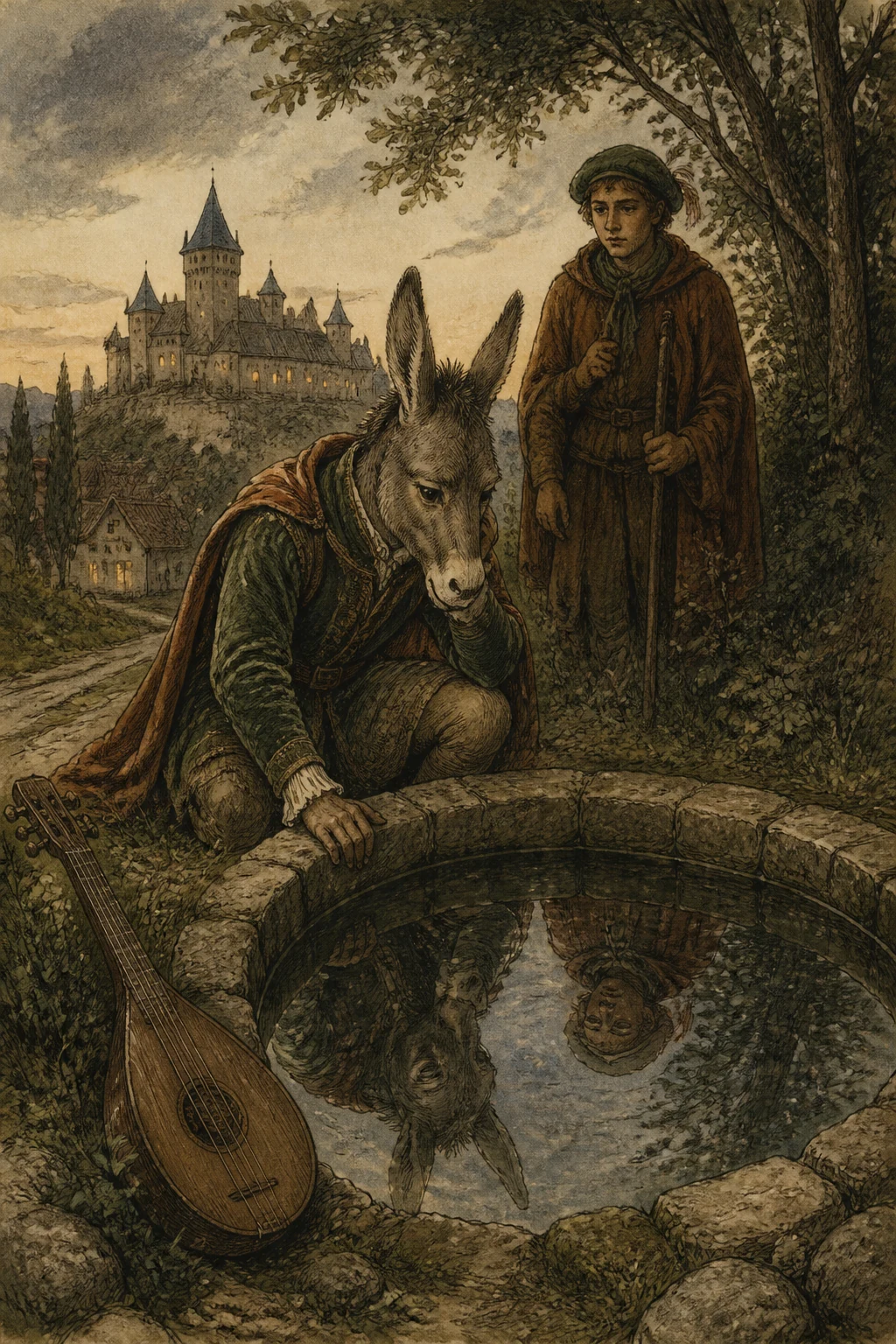
But what astonished everyone on entering was that, in the most conspicuous place, a splendid donkey displayed his two great ears. Such an injustice surprises you;
But when you learn his matchless virtues, you will not think the honor too great. Nature had made him so fine and clean that he never produced any dung, but rather handsome gold sun-crowns and louis of the highest value, which were gathered from his golden straw each morning when he woke.
Now Heaven, which sometimes tires of making men content, and always mingles some misfortune with its gifts, as rain with fine weather, allowed a cruel illness suddenly to strike down the queen in the flower of her days;
Help was sought everywhere; but neither the physicians, for all their study of Greek, nor the fashionable quacks could, with all their efforts combined, check the fire that her ever-mounting fever kindled.
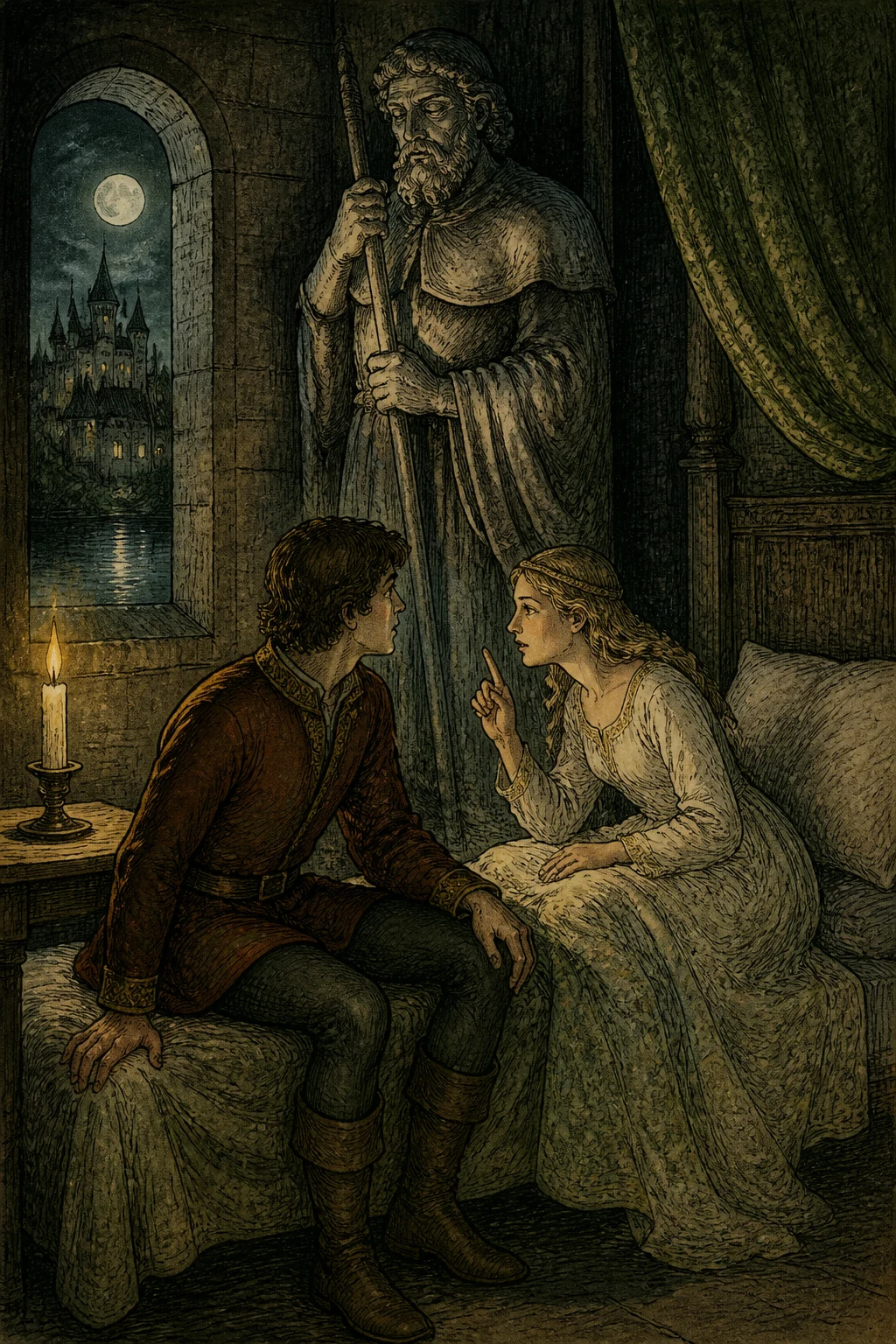
When her last hour came, she said to the king, her husband, “Allow me, before I die, to ask one thing of you: should you ever feel the wish to marry again when I am gone…”
“Ah!” said the king, “such worries are needless. I shall never think of it as long as I live; set your mind at rest.” “I readily believe you,” replied the queen, “if I may take your ardent love as witness;
“But to make myself more certain, I wish to have your oath, softened, however, by this condition: if you meet a woman more beautiful, more shapely, and wiser than I, you may freely pledge yourself to her and marry her…”
Her confidence in her charms made her regard such a promise as a cleverly obtained oath never to marry again. So the king, his eyes bathed in tears, swore everything the queen desired.
The queen died in his arms; and never did a husband make such an uproar. Hearing him sob night and day, people judged that his mourning would not last long, and that he wept for his departed love like a man in haste to have the business over.
They were not mistaken. After a few months he wished to choose another wife. But this was no easy matter: he had to keep his oath, and the new bride must have more beauty and charm than the one they had just laid in the tomb.
Neither the court, so fertile in beauties, nor the country, nor the town, nor the neighboring kingdoms, which were searched in turn, could furnish such a woman;
Only the princess was more beautiful, and possessed certain tender charms her late mother had lacked. The king noticed this himself; and, burning with an overwhelming love, foolishly took it into his head that for this very reason he ought to marry her;
He even found a casuist who judged the case worth considering. But the young princess, distressed to hear of such a love, lamented and wept night and day.
Her soul full of a thousand sorrows, she went to find her godmother, far away in a secluded grotto richly adorned with mother-of-pearl and coral. This was a marvelous fairy, whose skill had never been equaled.
There is no need to tell you what a fairy was in those blessed times, for I am sure your nurse will have told you in your earliest years.
“I know,” she said on seeing the princess, “what brings you here; I know the deep sorrow in your heart. But with me you need worry no longer:
“Nothing can harm you, provided you let my counsel guide you. Your father, it is true, wishes to marry you; to entertain his mad proposal would be a very grave wrong;
“But you can refuse him without contradicting him. Tell him, then, that to satisfy your wishes, before your heart yields to his love, he must give you a dress the color of the sky.
“For all his power and all his wealth, though Heaven favors his every wish, he will never be able to fulfill that promise.” At once the young princess went trembling to tell her enamored father, who immediately informed his foremost tailors that unless they made him, without keeping him waiting too long, a dress the color of the sky, they could be certain he would have them all hanged.
The second day had not yet dawned when the desired dress was brought. The loveliest blue of the heavens, even when girdled by a beautiful golden cloud, is no more azure.
Filled with joy and grief, the princess did not know what to say or how to escape her pledge. “Princess, ask for another,” her godmother whispered, “more brilliant and less common, the color of the moon;
“That he will not give you.” Scarcely had the princess made her request when the king said to his embroiderer, “Let the orb of night possess no greater splendor, and have it brought to me in four days without fail.”
The sumptuous garment was finished on the appointed day, just as the king had ordered. In the heavens where night has spread her veils, the moon is less magnificent in her silver robe, even when, midway through her swift course, her brightest light makes the stars grow pale.
Admiring this wondrous gown, the princess had almost made up her mind to consent; but, prompted by her godmother, she said to the enamored king:
“I cannot be content until I have a dress more brilliant still, and the color of the sun.” The king, who loved her with a love beyond compare, at once summoned a wealthy jeweler and commanded him to make it of a splendid fabric of gold and diamonds, saying that if he failed to satisfy him fully, he would have him tortured to death.
The king was spared that trouble; for before the week was out, the ingenious craftsman had the precious work delivered, so beautiful, so vivid, so radiant that the golden-haired lover of Clymene, as he journeys beneath the vault of heaven in his golden chariot, dazzles the eyes with no brighter splendor.
The princess, utterly bewildered by these gifts, no longer knew what answer to give her father and her king. Her godmother immediately took her by the hand;
“You must not,” she whispered in her ear, “stop when you are doing so well. Are all these gifts he gives you such a great wonder, so long as he has that donkey you know of, which never ceases filling his purse with gold?
“Ask him for the skin of that rare animal. Since it is the source of all his wealth, you will not obtain it—or my reasoning is at fault.” This fairy was very learned, yet she did not know that violent love, provided it is gratified, counts silver and gold as nothing.
The skin was gallantly promised as soon as the princess asked for it. When it was brought to her, it filled her with terror and made her bitterly lament her fate.
Her godmother arrived and reminded her that those who do right should never fear; that she must let the king believe she was quite prepared to enter into marriage with him;
But at that very moment, alone and well disguised, she must depart for some distant kingdom, to escape an evil so near and so certain.
“Here,” she continued, “is a large chest in which we shall put all your dresses, your mirror, your dressing things, your diamonds, and your rubies. I also give you my wand. While you hold it in your hand, the chest will follow wherever you go, always hidden beneath the earth;
“And whenever you wish to open it, scarcely will my wand have touched the ground before it appears before your eyes. To make you unrecognizable, the donkey’s hide is an admirable disguise:
“Hide yourself well inside that skin. It is so dreadful that no one will ever believe it conceals anything beautiful.” The princess, thus disguised, had scarcely left the wise fairy’s dwelling in the cool of the morning when the king, who was preparing to celebrate his happy marriage, learned in horror of his misfortune.
There was not a house, a road, or an avenue that was not swiftly searched; but all the bustle was in vain: no one could guess what had become of her.
A dark and dismal sorrow spread everywhere. No more wedding, no more feast, no more tarts, no more sugared almonds: the ladies of the court were so disheartened that most of them ate no dinner;
But the parish priest was saddest of all, for it made him breakfast very late, and, worse still, he received no offering. Meanwhile the princess pursued her journey, her face covered in filthy grime;
She held out her hand to every passerby and tried to find a place in service; but even the least fastidious and most wretched, seeing her so hideous and so covered in dirt, would neither listen to her nor take such a filthy creature into their homes.
So she went far, far away, and farther still. At last she came to a farm where the farmer’s wife needed a scullery maid whose talents extended to washing dishcloths properly and cleaning out the pigs’ trough.
She was put in a corner at the back of the kitchen, where the servants, insolent vermin, did nothing but tug at her, contradict her, and mock her:
They were forever devising tricks to play on her, tormenting her at every turn; she was the constant butt of all their jibes and clever remarks.
On Sundays she had a little more rest; for, having finished her small chores early in the morning, she went into her room, shut the door, washed off the grime, and opened her chest. She neatly laid out her dressing things and arranged her little pots before her great mirror. Happy and content, she put on now the moon-colored dress, now the one ablaze with the fire of the sun, now the beautiful blue gown whose color all the azure of the heavens could not equal. Her only sorrow was that the floor was too small to let their long trains spread out.
She loved to see herself young, rosy, and fair, a hundred times fairer than anyone else. This sweet pleasure sustained her and carried her through to the following Sunday.
I forgot to mention, in passing, that this great farm housed the menagerie of a magnificent and powerful king; and that there, Barbary hens, rails, guinea fowl, cormorants, musk ducks, little bustards, and a thousand other birds of various kinds, almost all different from one another, vied in filling ten entire courtyards.
The king’s son often came to this charming place on his return from hunting, to rest and enjoy iced drinks with the lords of his court.
Not even handsome Cephalus could compare with him. His bearing was royal, his look martial, enough to make the proudest battalions tremble. Donkeyskin saw him from afar with tenderness, and knew by that bold feeling that beneath her grime and rags she still kept the heart of a princess.
“How noble he looks, even in his careless dress! How charming he is,” she said, “and how happy the beauty to whom his heart is pledged!
“If he honored me with the simplest dress, I should feel more richly adorned than in all the gowns I own.” One day the young prince, wandering at random from farmyard to farmyard, passed down a dark passage where Donkeyskin had her humble lodging.
By chance he put his eye to the keyhole. As it was a holiday, she had put on her rich adornments and her splendid garments, which, woven of fine gold and great diamonds, equaled the sun’s purest light.
The prince gazed at her to his heart’s content, scarcely able to draw breath at the sight, so great was his delight. Whatever her clothes might be, the beauty of her face, her graceful figure, her luminous fairness, her delicate features, and her youthful freshness moved him a hundred times more;
But a certain air of grandeur, and still more a wise and modest reserve, sure testimony to the beauty of her soul, took possession of his whole heart.
Three times, in the heat of the passion that swept him away, he wished to break down the door; but, believing he beheld a goddess, three times his arm was checked by reverence.
He withdrew pensively to the palace, and there sighed night and day. He no longer wished to go to balls, although it was carnival time. He hated hunting; he hated the theater;
He had no appetite, and everything turned his stomach; at the root of his illness was a sad and deadly languor. He asked who that marvelous nymph was who lived in a farmyard, at the end of a dreadful passage where one could not see a thing even in broad daylight.
“That,” he was told, “is Donkeyskin, neither a nymph nor a beauty. We call her Donkeyskin because of the hide she wears over her shoulders. She is the surest cure for love: in short, the ugliest beast one could see this side of a wolf.”
They might say what they pleased; he could not believe them. The features love had drawn, ever present in his memory, would never be erased. Meanwhile the queen, his mother, who had no other child, wept and despaired:
In vain she urged him to tell her what ailed him. He moaned, he wept, he sighed; he said nothing except that he wished Donkeyskin to bake him a cake with her own hands;
And his mother could not understand what her son meant. “Heavens, madam!” they told her. “This Donkeyskin is a black mole, uglier and more slovenly than the filthiest kitchen boy.”
“No matter,” said the queen, “he must be satisfied, and that alone must concern us.” So dearly did this mother love him that he would have had gold, had he wished to eat it.
So Donkeyskin took her flour, which she had had specially sifted to make her dough finer, her salt, her butter, and her fresh eggs;
And, to make her cake properly, shut herself alone in her little room. First she scrubbed her hands, her arms, and her face, and put on a silver bodice, which she quickly laced, so that she might be suitably dressed for the task she began at once.
They say that, working a little too hastily, she accidentally let one of her costly rings fall from her finger into the dough. But those thought to know the finer points of this story maintain that she put it there on purpose;
And for my part, I would frankly be inclined to believe it, being quite sure that when the prince came to her door and watched her through the keyhole, she had noticed him.
In such matters a woman is so alert, and her eye so quick, that one cannot look at her for a moment without her knowing she has been seen. I am equally certain, and would swear to it, that she had no doubt her young lover would welcome the ring.
Never was so delicious a morsel kneaded, and the prince found the cake so good that in his greedy hunger he very nearly swallowed the ring as well.
When he saw its marvelous emerald, and the narrow circle of its band, which showed the shape of the finger, his heart was filled with unbelievable joy:
He put it beneath his pillow at once; and as his illness continued to worsen, the doctors, wise with experience, seeing him grow thinner day by day, all concluded, through their great learning, that he was sick with love.
Since marriage, whatever ill may be said of it, is an excellent remedy for this disease, it was decided that he should marry. For a while he let himself be urged;
Then he said, “I am willing, provided I am given as my bride the person whom this ring will fit.” The queen and king were greatly astonished by this strange request;
But he was so ill that they dared not refuse. And so the search began for the woman whom the ring, without regard to birth, was to raise to so exalted a rank.
There was not one who did not prepare to come and present her finger, nor one willing to yield her claim. Word having spread that, to aspire to the prince, one must have a very slender finger, every quack, to gain a welcome, declared he knew the secret of making it small.
One, following her strange fancy, scraped hers like a turnip; another thought to make hers smaller by squeezing it; a third used a certain liquid to strip off the skin and reduce its size.
In short, there was no trick a lady would not try to make her finger fit the ring. The trial began with the young princesses, the marchionesses, and the duchesses;
But their fingers, though delicate, were too large and would not go in. The countesses and baronesses, and all the noble ladies, likewise presented their hands in turn, and presented them in vain.
Next came the working girls, whose pretty, slender fingers—for some of them are very shapely—seemed at times about to fit the ring;
But the ring, always too small or too round, rejected them all with almost equal disdain. At last they had to come to the maids, the cooks, the ragged drudges, the turkey girls—in short, all the common fry, whose red and blackened paws hoped for good fortune no less than the delicate hands.
Many a girl came forward whose thick, stubby finger would have passed through the prince’s ring no more easily than a cable through a needle.
At last they thought it was all over; for indeed, none remained but poor Donkeyskin at the back of the kitchen. “But how could we believe,” they said, “that Heaven means her to reign?”
The prince said, “And why not? Have her brought here.” Everyone began to laugh, crying aloud, “What can they mean by bringing that filthy monkey in here?”
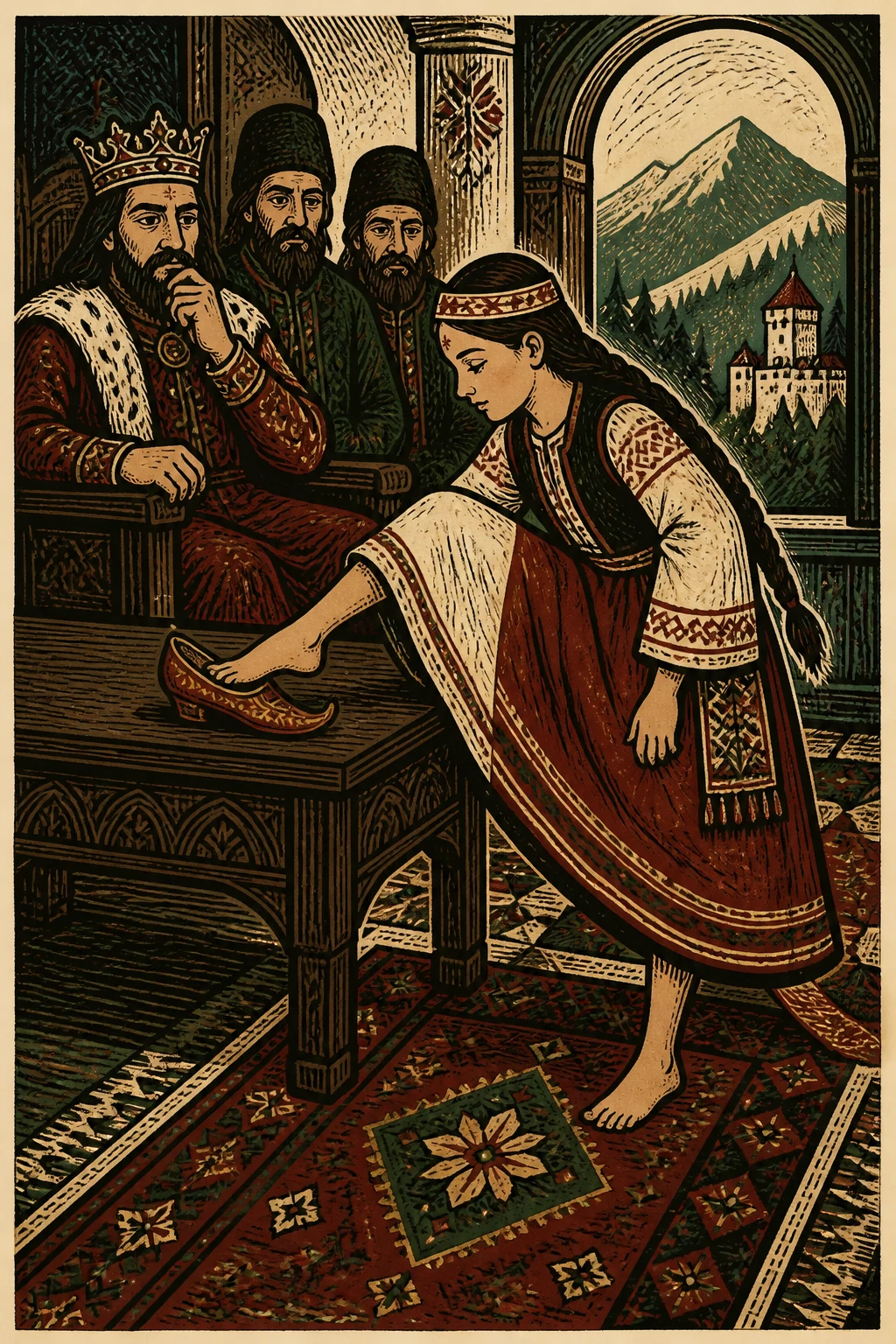
But when she drew from beneath her black hide a little hand that seemed made of ivory tinged with a touch of crimson, and the fateful ring encircled her slender finger with a perfect fit, the court was seized with astonishment beyond all imagining.
In their sudden excitement they were leading her to the king, but she asked that, before appearing before her lord and master, she might be allowed time to put on another dress.
To tell the truth, everyone was getting ready to laugh at this dress; but when she entered the royal apartments and passed through the halls in those magnificent garments, whose sumptuous beauty had never been equaled;
When her lovely golden hair, entwined with diamonds whose vivid light turned every lock into a sunbeam, and her great blue eyes, gentle and long-lidded, full of proud majesty, which never looked without delighting and wounding;
And finally her waist, so slender and fine that two hands could have encircled it, revealed their charms and heavenly graces, all the beauty of the court ladies and all the splendor of their ornaments faded away.
Amid the joy and clamor of the whole assembly, the good king was beside himself to see how many charms his daughter-in-law possessed; the queen was utterly enchanted;
And the prince, her dear lover, his soul filled with a hundred delights, sank beneath the weight of his rapture. Everyone at once set about preparing for the wedding;
The monarch invited all the neighboring kings, who, glittering in their various fineries, left their dominions to attend the great day. Some were seen arriving from the lands of the dawn, mounted on great elephants;
Others came from the Moorish coast, blacker and uglier still, frightening the little children. In short, they arrived from every corner of the world, and the court overflowed with them.
But no prince, no potentate appeared there in such splendor as the bride’s father, who, once in love with her, had with time purified the fires that had consumed his soul:
He had banished every criminal desire; and the little that remained in his soul of that hateful flame only made his fatherly love more ardent.
As soon as he saw her, “Blessed be Heaven, which allows me to see you again, my dear child!” he said; and, weeping with joy, ran to embrace her tenderly.
Everyone wished to share in his happiness; and the bridegroom was delighted to learn that he was becoming the son-in-law of so powerful a king. At that moment the godmother arrived, told the whole story, and by her account completed Donkeyskin’s triumph.
It is easy to see that the purpose of this tale is to teach a child that it is better to face the harshest suffering than to fail in one’s duty;
That virtue may meet with misfortune, but is always crowned at last; that against a mad love and its impetuous passions, the strongest reason is but a feeble barrier; and that there are no treasures so rich that a lover will not squander them;
That clear water and brown bread are food enough for any young creature, provided she has beautiful clothes; that beneath the heavens there is no female who does not imagine herself beautiful, and who does not often imagine, too, that had she taken part in the famous dispute among the three beauties, she would have won the golden apple.
The tale of Donkeyskin is hard to believe; but as long as there are children in the world, mothers, and grandmothers, its memory will endure.