Prevod
There are people whose rigid minds, beneath brows that never lose their frown, will tolerate, approve, and esteem nothing but the pompous and sublime. For my part, I dare maintain that even the finest mind may at certain moments delight in puppet shows without a blush, and that there are times and places when gravity and seriousness are worth less than a little pleasant nonsense.
Why should we marvel that the soundest reason, often weary of keeping watch too long, should take pleasure in a little sleep, ingeniously lulled by tales of ogres and fairies?
Without fear, then, of being condemned for misusing my leisure, I shall satisfy your rightful wish and tell you at length the story of Donkeyskin.
Once upon a time there was a king, the greatest on earth, gracious in peace and terrible in war, with none, in short, to equal him but himself. His neighbors feared him, his dominions were at peace, and everywhere, beneath the shade of his victorious palms, virtue and the fine arts flourished.
His beloved wife, his faithful companion, was so charming and beautiful, so gentle and accommodating in spirit, that with her he was happier still as a husband than as a king.
From their tender, chaste marriage, so full of sweetness and delight, a daughter had been born whose many virtues easily consoled them for having no other children.
In his vast and wealthy palace, all was magnificence; everywhere there swarmed a lively abundance of courtiers and servants. His stables held horses great and small, of every kind, covered in handsome caparisons stiff with gold and embroidery;
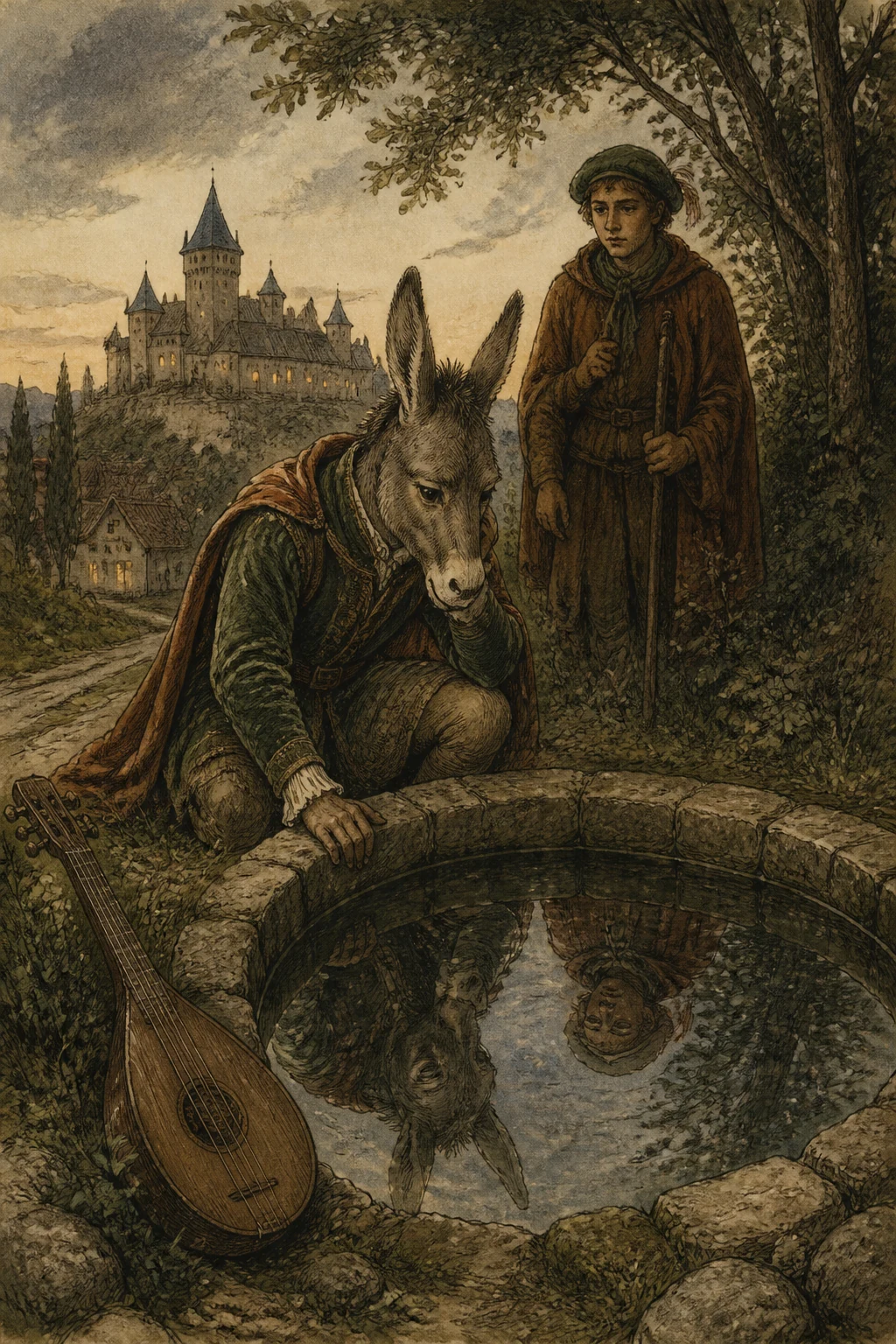
But what astonished everyone on entering was that, in the most conspicuous place, a splendid donkey displayed his two great ears. Such an injustice surprises you;
But when you learn his matchless virtues, you will not think the honor too great. Nature had made him so fine and clean that he never produced any dung, but rather handsome gold sun-crowns and louis of the highest value, which were gathered from his golden straw each morning when he woke.
Now Heaven, which sometimes tires of making men content, and always mingles some misfortune with its gifts, as rain with fine weather, allowed a cruel illness suddenly to strike down the queen in the flower of her days;
Help was sought everywhere; but neither the physicians, for all their study of Greek, nor the fashionable quacks could, with all their efforts combined, check the fire that her ever-mounting fever kindled.
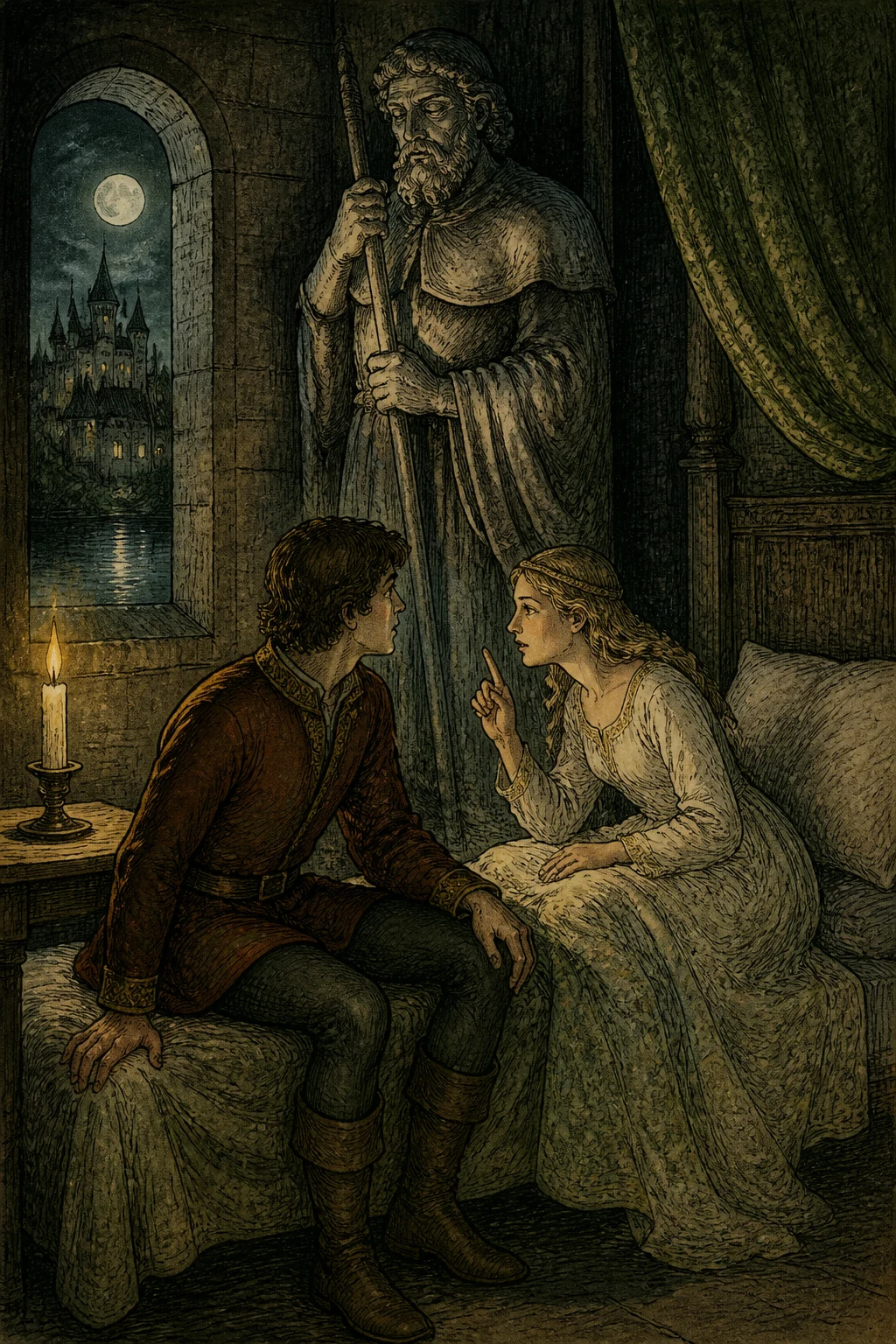
When her last hour came, she said to the king, her husband, “Allow me, before I die, to ask one thing of you: should you ever feel the wish to marry again when I am gone…”
“Ah!” said the king, “such worries are needless. I shall never think of it as long as I live; set your mind at rest.” “I readily believe you,” replied the queen, “if I may take your ardent love as witness;
“But to make myself more certain, I wish to have your oath, softened, however, by this condition: if you meet a woman more beautiful, more shapely, and wiser than I, you may freely pledge yourself to her and marry her…”
Her confidence in her charms made her regard such a promise as a cleverly obtained oath never to marry again. So the king, his eyes bathed in tears, swore everything the queen desired.
The queen died in his arms; and never did a husband make such an uproar. Hearing him sob night and day, people judged that his mourning would not last long, and that he wept for his departed love like a man in haste to have the business over.
They were not mistaken. After a few months he wished to choose another wife. But this was no easy matter: he had to keep his oath, and the new bride must have more beauty and charm than the one they had just laid in the tomb.
Neither the court, so fertile in beauties, nor the country, nor the town, nor the neighboring kingdoms, which were searched in turn, could furnish such a woman;
Only the princess was more beautiful, and possessed certain tender charms her late mother had lacked. The king noticed this himself; and, burning with an overwhelming love, foolishly took it into his head that for this very reason he ought to marry her;
He even found a casuist who judged the case worth considering. But the young princess, distressed to hear of such a love, lamented and wept night and day.
Her soul full of a thousand sorrows, she went to find her godmother, far away in a secluded grotto richly adorned with mother-of-pearl and coral. This was a marvelous fairy, whose skill had never been equaled.
There is no need to tell you what a fairy was in those blessed times, for I am sure your nurse will have told you in your earliest years.
“I know,” she said on seeing the princess, “what brings you here; I know the deep sorrow in your heart. But with me you need worry no longer:
“Nothing can harm you, provided you let my counsel guide you. Your father, it is true, wishes to marry you; to entertain his mad proposal would be a very grave wrong;
“But you can refuse him without contradicting him. Tell him, then, that to satisfy your wishes, before your heart yields to his love, he must give you a dress the color of the sky.
“For all his power and all his wealth, though Heaven favors his every wish, he will never be able to fulfill that promise.” At once the young princess went trembling to tell her enamored father, who immediately informed his foremost tailors that unless they made him, without keeping him waiting too long, a dress the color of the sky, they could be certain he would have them all hanged.
The second day had not yet dawned when the desired dress was brought. The loveliest blue of the heavens, even when girdled by a beautiful golden cloud, is no more azure.
Filled with joy and grief, the princess did not know what to say or how to escape her pledge. “Princess, ask for another,” her godmother whispered, “more brilliant and less common, the color of the moon;
“That he will not give you.” Scarcely had the princess made her request when the king said to his embroiderer, “Let the orb of night possess no greater splendor, and have it brought to me in four days without fail.”
The sumptuous garment was finished on the appointed day, just as the king had ordered. In the heavens where night has spread her veils, the moon is less magnificent in her silver robe, even when, midway through her swift course, her brightest light makes the stars grow pale.
Admiring this wondrous gown, the princess had almost made up her mind to consent; but, prompted by her godmother, she said to the enamored king:
“I cannot be content until I have a dress more brilliant still, and the color of the sun.” The king, who loved her with a love beyond compare, at once summoned a wealthy jeweler and commanded him to make it of a splendid fabric of gold and diamonds, saying that if he failed to satisfy him fully, he would have him tortured to death.
The king was spared that trouble; for before the week was out, the ingenious craftsman had the precious work delivered, so beautiful, so vivid, so radiant that the golden-haired lover of Clymene, as he journeys beneath the vault of heaven in his golden chariot, dazzles the eyes with no brighter splendor.
The princess, utterly bewildered by these gifts, no longer knew what answer to give her father and her king. Her godmother immediately took her by the hand;
“You must not,” she whispered in her ear, “stop when you are doing so well. Are all these gifts he gives you such a great wonder, so long as he has that donkey you know of, which never ceases filling his purse with gold?
“Ask him for the skin of that rare animal. Since it is the source of all his wealth, you will not obtain it—or my reasoning is at fault.” This fairy was very learned, yet she did not know that violent love, provided it is gratified, counts silver and gold as nothing.
The skin was gallantly promised as soon as the princess asked for it. When it was brought to her, it filled her with terror and made her bitterly lament her fate.
Her godmother arrived and reminded her that those who do right should never fear; that she must let the king believe she was quite prepared to enter into marriage with him;
But at that very moment, alone and well disguised, she must depart for some distant kingdom, to escape an evil so near and so certain.
“Here,” she continued, “is a large chest in which we shall put all your dresses, your mirror, your dressing things, your diamonds, and your rubies. I also give you my wand. While you hold it in your hand, the chest will follow wherever you go, always hidden beneath the earth;
“And whenever you wish to open it, scarcely will my wand have touched the ground before it appears before your eyes. To make you unrecognizable, the donkey’s hide is an admirable disguise:
“Hide yourself well inside that skin. It is so dreadful that no one will ever believe it conceals anything beautiful.” The princess, thus disguised, had scarcely left the wise fairy’s dwelling in the cool of the morning when the king, who was preparing to celebrate his happy marriage, learned in horror of his misfortune.
There was not a house, a road, or an avenue that was not swiftly searched; but all the bustle was in vain: no one could guess what had become of her.
A dark and dismal sorrow spread everywhere. No more wedding, no more feast, no more tarts, no more sugared almonds: the ladies of the court were so disheartened that most of them ate no dinner;
But the parish priest was saddest of all, for it made him breakfast very late, and, worse still, he received no offering. Meanwhile the princess pursued her journey, her face covered in filthy grime;
She held out her hand to every passerby and tried to find a place in service; but even the least fastidious and most wretched, seeing her so hideous and so covered in dirt, would neither listen to her nor take such a filthy creature into their homes.
So she went far, far away, and farther still. At last she came to a farm where the farmer’s wife needed a scullery maid whose talents extended to washing dishcloths properly and cleaning out the pigs’ trough.
She was put in a corner at the back of the kitchen, where the servants, insolent vermin, did nothing but tug at her, contradict her, and mock her:
They were forever devising tricks to play on her, tormenting her at every turn; she was the constant butt of all their jibes and clever remarks.
On Sundays she had a little more rest; for, having finished her small chores early in the morning, she went into her room, shut the door, washed off the grime, and opened her chest. She neatly laid out her dressing things and arranged her little pots before her great mirror. Happy and content, she put on now the moon-colored dress, now the one ablaze with the fire of the sun, now the beautiful blue gown whose color all the azure of the heavens could not equal. Her only sorrow was that the floor was too small to let their long trains spread out.
She loved to see herself young, rosy, and fair, a hundred times fairer than anyone else. This sweet pleasure sustained her and carried her through to the following Sunday.
I forgot to mention, in passing, that this great farm housed the menagerie of a magnificent and powerful king; and that there, Barbary hens, rails, guinea fowl, cormorants, musk ducks, little bustards, and a thousand other birds of various kinds, almost all different from one another, vied in filling ten entire courtyards.
The king’s son often came to this charming place on his return from hunting, to rest and enjoy iced drinks with the lords of his court.
Not even handsome Cephalus could compare with him. His bearing was royal, his look martial, enough to make the proudest battalions tremble. Donkeyskin saw him from afar with tenderness, and knew by that bold feeling that beneath her grime and rags she still kept the heart of a princess.
“How noble he looks, even in his careless dress! How charming he is,” she said, “and how happy the beauty to whom his heart is pledged!
“If he honored me with the simplest dress, I should feel more richly adorned than in all the gowns I own.” One day the young prince, wandering at random from farmyard to farmyard, passed down a dark passage where Donkeyskin had her humble lodging.
By chance he put his eye to the keyhole. As it was a holiday, she had put on her rich adornments and her splendid garments, which, woven of fine gold and great diamonds, equaled the sun’s purest light.
The prince gazed at her to his heart’s content, scarcely able to draw breath at the sight, so great was his delight. Whatever her clothes might be, the beauty of her face, her graceful figure, her luminous fairness, her delicate features, and her youthful freshness moved him a hundred times more;
But a certain air of grandeur, and still more a wise and modest reserve, sure testimony to the beauty of her soul, took possession of his whole heart.
Three times, in the heat of the passion that swept him away, he wished to break down the door; but, believing he beheld a goddess, three times his arm was checked by reverence.
He withdrew pensively to the palace, and there sighed night and day. He no longer wished to go to balls, although it was carnival time. He hated hunting; he hated the theater;
He had no appetite, and everything turned his stomach; at the root of his illness was a sad and deadly languor. He asked who that marvelous nymph was who lived in a farmyard, at the end of a dreadful passage where one could not see a thing even in broad daylight.
“That,” he was told, “is Donkeyskin, neither a nymph nor a beauty. We call her Donkeyskin because of the hide she wears over her shoulders. She is the surest cure for love: in short, the ugliest beast one could see this side of a wolf.”
They might say what they pleased; he could not believe them. The features love had drawn, ever present in his memory, would never be erased. Meanwhile the queen, his mother, who had no other child, wept and despaired:
In vain she urged him to tell her what ailed him. He moaned, he wept, he sighed; he said nothing except that he wished Donkeyskin to bake him a cake with her own hands;
And his mother could not understand what her son meant. “Heavens, madam!” they told her. “This Donkeyskin is a black mole, uglier and more slovenly than the filthiest kitchen boy.”
“No matter,” said the queen, “he must be satisfied, and that alone must concern us.” So dearly did this mother love him that he would have had gold, had he wished to eat it.
So Donkeyskin took her flour, which she had had specially sifted to make her dough finer, her salt, her butter, and her fresh eggs;
And, to make her cake properly, shut herself alone in her little room. First she scrubbed her hands, her arms, and her face, and put on a silver bodice, which she quickly laced, so that she might be suitably dressed for the task she began at once.
They say that, working a little too hastily, she accidentally let one of her costly rings fall from her finger into the dough. But those thought to know the finer points of this story maintain that she put it there on purpose;
And for my part, I would frankly be inclined to believe it, being quite sure that when the prince came to her door and watched her through the keyhole, she had noticed him.
In such matters a woman is so alert, and her eye so quick, that one cannot look at her for a moment without her knowing she has been seen. I am equally certain, and would swear to it, that she had no doubt her young lover would welcome the ring.
Never was so delicious a morsel kneaded, and the prince found the cake so good that in his greedy hunger he very nearly swallowed the ring as well.
When he saw its marvelous emerald, and the narrow circle of its band, which showed the shape of the finger, his heart was filled with unbelievable joy:
He put it beneath his pillow at once; and as his illness continued to worsen, the doctors, wise with experience, seeing him grow thinner day by day, all concluded, through their great learning, that he was sick with love.
Since marriage, whatever ill may be said of it, is an excellent remedy for this disease, it was decided that he should marry. For a while he let himself be urged;
Then he said, “I am willing, provided I am given as my bride the person whom this ring will fit.” The queen and king were greatly astonished by this strange request;
But he was so ill that they dared not refuse. And so the search began for the woman whom the ring, without regard to birth, was to raise to so exalted a rank.
There was not one who did not prepare to come and present her finger, nor one willing to yield her claim. Word having spread that, to aspire to the prince, one must have a very slender finger, every quack, to gain a welcome, declared he knew the secret of making it small.
One, following her strange fancy, scraped hers like a turnip; another thought to make hers smaller by squeezing it; a third used a certain liquid to strip off the skin and reduce its size.
In short, there was no trick a lady would not try to make her finger fit the ring. The trial began with the young princesses, the marchionesses, and the duchesses;
But their fingers, though delicate, were too large and would not go in. The countesses and baronesses, and all the noble ladies, likewise presented their hands in turn, and presented them in vain.
Next came the working girls, whose pretty, slender fingers—for some of them are very shapely—seemed at times about to fit the ring;
But the ring, always too small or too round, rejected them all with almost equal disdain. At last they had to come to the maids, the cooks, the ragged drudges, the turkey girls—in short, all the common fry, whose red and blackened paws hoped for good fortune no less than the delicate hands.
Many a girl came forward whose thick, stubby finger would have passed through the prince’s ring no more easily than a cable through a needle.
At last they thought it was all over; for indeed, none remained but poor Donkeyskin at the back of the kitchen. “But how could we believe,” they said, “that Heaven means her to reign?”
The prince said, “And why not? Have her brought here.” Everyone began to laugh, crying aloud, “What can they mean by bringing that filthy monkey in here?”
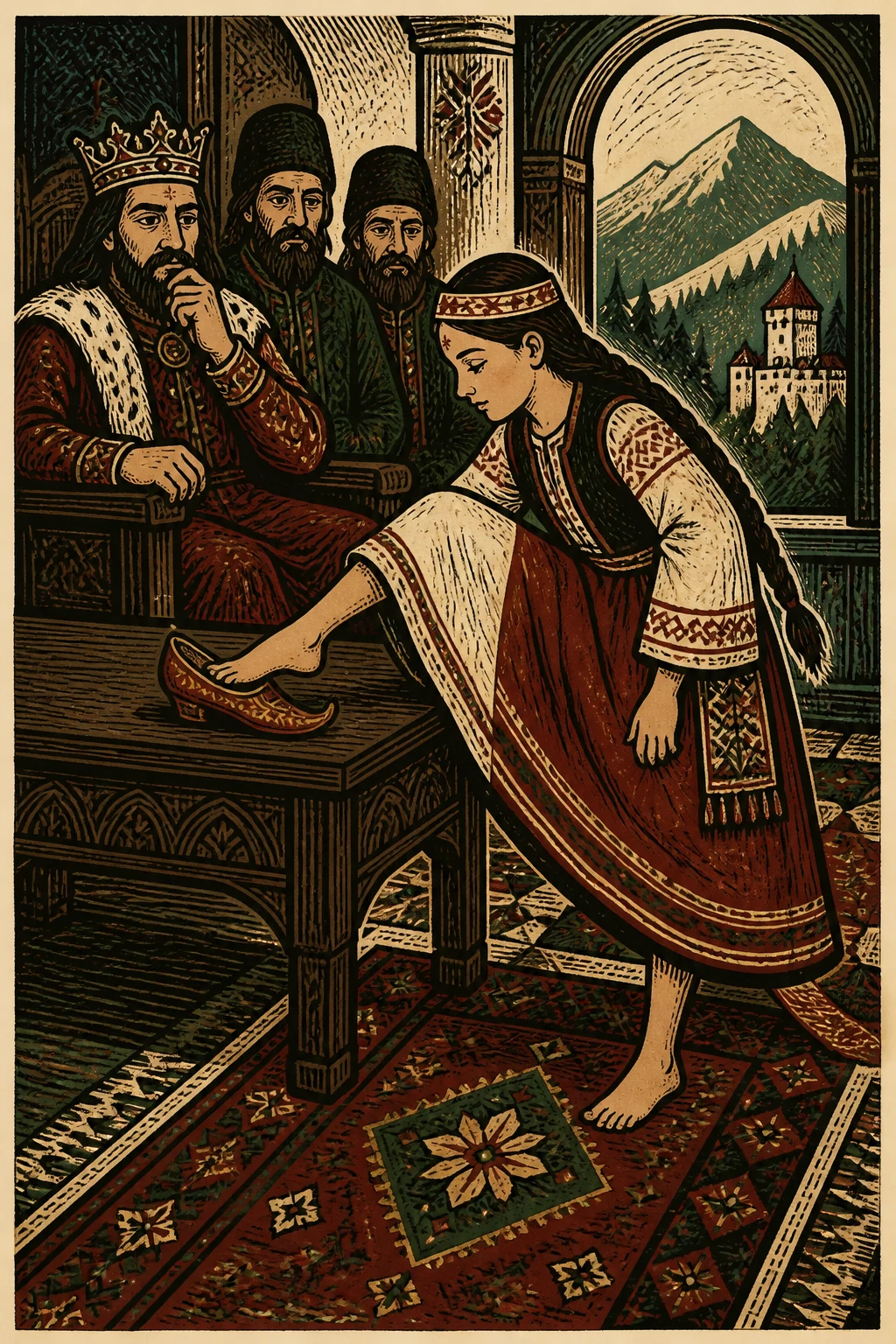
But when she drew from beneath her black hide a little hand that seemed made of ivory tinged with a touch of crimson, and the fateful ring encircled her slender finger with a perfect fit, the court was seized with astonishment beyond all imagining.
In their sudden excitement they were leading her to the king, but she asked that, before appearing before her lord and master, she might be allowed time to put on another dress.
To tell the truth, everyone was getting ready to laugh at this dress; but when she entered the royal apartments and passed through the halls in those magnificent garments, whose sumptuous beauty had never been equaled;
When her lovely golden hair, entwined with diamonds whose vivid light turned every lock into a sunbeam, and her great blue eyes, gentle and long-lidded, full of proud majesty, which never looked without delighting and wounding;
And finally her waist, so slender and fine that two hands could have encircled it, revealed their charms and heavenly graces, all the beauty of the court ladies and all the splendor of their ornaments faded away.
Amid the joy and clamor of the whole assembly, the good king was beside himself to see how many charms his daughter-in-law possessed; the queen was utterly enchanted;
And the prince, her dear lover, his soul filled with a hundred delights, sank beneath the weight of his rapture. Everyone at once set about preparing for the wedding;
The monarch invited all the neighboring kings, who, glittering in their various fineries, left their dominions to attend the great day. Some were seen arriving from the lands of the dawn, mounted on great elephants;
Others came from the Moorish coast, blacker and uglier still, frightening the little children. In short, they arrived from every corner of the world, and the court overflowed with them.
But no prince, no potentate appeared there in such splendor as the bride’s father, who, once in love with her, had with time purified the fires that had consumed his soul:
He had banished every criminal desire; and the little that remained in his soul of that hateful flame only made his fatherly love more ardent.
As soon as he saw her, “Blessed be Heaven, which allows me to see you again, my dear child!” he said; and, weeping with joy, ran to embrace her tenderly.
Everyone wished to share in his happiness; and the bridegroom was delighted to learn that he was becoming the son-in-law of so powerful a king. At that moment the godmother arrived, told the whole story, and by her account completed Donkeyskin’s triumph.
It is easy to see that the purpose of this tale is to teach a child that it is better to face the harshest suffering than to fail in one’s duty;
That virtue may meet with misfortune, but is always crowned at last; that against a mad love and its impetuous passions, the strongest reason is but a feeble barrier; and that there are no treasures so rich that a lover will not squander them;
That clear water and brown bread are food enough for any young creature, provided she has beautiful clothes; that beneath the heavens there is no female who does not imagine herself beautiful, and who does not often imagine, too, that had she taken part in the famous dispute among the three beauties, she would have won the golden apple.
The tale of Donkeyskin is hard to believe; but as long as there are children in the world, mothers, and grandmothers, its memory will endure.
Izvirnik
CONTES EN VERS. PEAU-D’ÂNE. Il est des gens, de qui l’esprit guindé, Sous un front jamais déridé, Ne souffre, n’approuve et n’estime Que le pompeux et le sublime. Pour moi, j’ose poser en fait, Qu’en de certains momens l’esprit le plus parfait Peut aimer, sans rougir, jusqu’aux marionnettes, Et qu’il est des tems et des lieux Où le grave et le sérieux Ne valent pas d’agréables sornettes.
Pourquoi faut-il s’émerveiller Que la raison la mieux sensée, Lasse souvent de trop veiller, Par des contes d’ogre et de fée, Ingénieusement bercée, Prenne plaisir à sommeiller ? Sans craindre donc qu’on me condamne De mal employer mon loisir, Je vais, pour contenter votre juste désir, Vous raconter au long l’histoire de Peau-d’Âne. Il était une fois un roi, Le plus grand qui fût sur la terre,
Aimable en paix, terrible en guerre, Seul enfin comparable à soi. Ses voisins le craignaient, ses états étaient calmes, Et l’on voyait de toutes parts Fleurir à l’ombre de ses palmes Et les vertus et les beaux-arts. Son aimable moitié, sa compagne fidèle, Était si charmante et si belle, Avait l’esprit si commode et si doux, Qu’il était encore avec elle Moins heureux roi qu’heureux époux.
De leur tendre et chaste hyménée, Plein de douceur et d’agrément, Avec tant de vertus une fille était née, Qu’ils se consolaient aisément De n’avoir pas de plus ample lignée. Dans son vaste et riche palais Ce n’était que magnificence ; Partout y fourmillait une vive abondance De courtisans et de valets. Il avait dans son écurie Grands et petits chevaux de toutes les façons, Couverts de beaux caparaçons
Roides d’or et de broderie ; Mais ce qui surprenait tout le monde en entrant, C’est qu’au lieu le plus apparent, Un maître âne étalait ses deux grandes oreilles. Cette injustice vous surprend ; Mais lorsque vous saurez ses vertus nonpareilles, Vous ne trouverez pas que l’honneur fût trop grand. Tel et si net le forma la nature, Qu’il ne faisait jamais d’ordure, Mais bien beaux écus au soleil, Et louis de valeur première, Qu’on allait recueillir sur la blonde litière,
Tous les matins à son réveil. Or, le ciel qui parfois se lasse De rendre les hommes contens, Qui toujours à ses biens mêle quelque disgrâce Ainsi que la pluie au beau tems, Permit qu’une âpre maladie Tout-à-coup de la reine attaquât les beaux jours ; Partout on cherche du secours ; Mais ni la faculté, qui le grec étudie, Ni les charlatans ayant cours, Ne purent tous ensemble arrêter l’incendie Que la fièvre allumait en s’augmentant toujours.
Arrivée à sa dernière heure, Elle dit au roi son époux : Trouvez bon qu’avant que je meure J’exige une chose de vous ; C’est que s’il vous prenait envie De vous remarier quand je n’y serai plus… Ah ! dit le roi, ces soins sont superflus, Je n’y songerai de ma vie, Soyez en repos là-dessus. Je le crois bien, reprit la reine, Si j’en prends à témoin votre amour véhément ; Mais, pour m’en rendre plus certaine,
Je veux avoir votre serment, Adouci toutefois par ce tempérament, Que si vous rencontrez une femme plus belle, Mieux faite et plus sage que moi, Vous pourrez franchement lui donner votre foi, Et vous marier avec elle… Sa confiance en ses attraits Lui faisait regarder une telle promesse, Comme un serment surpris avec adresse, De ne se marier jamais. Le prince jura donc, les yeux baignés de larmes, Tout ce que la reine voulut.
La reine entre ses bras mourut ; Et jamais un mari ne fit tant de vacarmes. À l’ouïr sanglotter et les nuits et les jours, On jugea que son deuil ne lui durerait guère, Et qu’il pleurait ses défuntes amours Comme un homme pressé qui veut sortir d’affaire. On ne se trompa point. Au bout de quelques mois Il voulut procéder à faire un nouveau choix : Mais ce n’était pas chose aisée ; Il fallait garder son serment, Et que la nouvelle épousée Eût plus d’attraits et d’agrément
Que celle qu’on venait de mettre au monument. Ni la cour, en beautés fertile, Ni la campagne, ni la ville, Ni les royaumes d’alentour, Dont on alla faire le tour, N’en purent fournir une telle ; L’infante seule était plus belle, Et possédait certains tendres appas Que la défunte n’avait pas. Le roi le remarqua lui-même ; Et, brûlant d’un amour extrême, Alla follement s’aviser
Que par cette raison il devait l’épouser ; Il trouva même un casuiste Qui jugea que le cas se pouvait proposer. Mais la jeune princesse, triste D’ouïr parler d’un tel amour, Se lamentait et pleurait nuit et jour. De mille chagrins l’ame pleine, Elle alla trouver sa marraine, Loin dans une grotte à l’écart, De nacre et de corail richement étoffée ; C’était une admirable fée, Qui n’eut jamais de pareille en son art.
Il n’est pas besoin qu’on vous die Ce qu’était une fée en ces bienheureux tems, Car je suis sûr que votre mie Vous l’aura dit dès vos plus jeunes ans. Je sais, dit-elle, en voyant la princesse, Ce qui vous fait venir ici, Je sais de votre cœur la profonde tristesse ; Mais avec moi n’ayez plus de souci : Il n’est rien qui vous puisse nuire, Pourvu qu’à mes conseils vous vous laissiez conduire.
Votre père, il est vrai, voudrait vous épouser : Écouter sa folle demande Serait une faute bien grande ; Mais, sans le contredire, on le peut refuser. Ainsi, dites-lui qu’il vous donne, Pour rendre vos désirs contens, Avant qu’à son amour votre cœur s’abandonne, Une robe qui soit de la couleur du tems. Malgré tout son pouvoir et toute sa richesse, Quoique le ciel en tout favorise ses vœux, Il ne pourra jamais accomplir sa promesse.
Aussitôt la jeune princesse L’alla dire en tremblant à son père amoureux, Qui dans le moment fit entendre Aux tailleurs les plus importans, Que s’ils ne lui faisaient, sans le trop faire attendre, Une robe qui fût de la couleur du tems, Ils pouvaient s’assurer qu’il les ferait tous pendre. Le second jour ne luisait pas encor, Qu’on apporta la robe désirée ; Le plus beau bleu de l’empirée N’est pas, lorsqu’il est ceint d’un beau nuage d’or, D’une couleur plus azurée.
De joie et de douleur l’infante pénétrée, Ne sait que dire, ni comment Se dérober à son engagement. Princesse, demandez-en une, Lui dit sa marraine tout bas, Qui, plus brillante et moins commune, Soit de la couleur de la lune ; Il ne vous la donnera pas. À peine la princesse en eut fait la demande, Que le roi dit à son brodeur : Que l’astre de la nuit n’ait pas plus de splendeur, Et que dans quatre jours, sans faute, on me la rende.
Le riche habillement fut fait au jour marqué, Tel que le roi s’en était expliqué. Dans les cieux où la nuit a déployé ses voiles, La lune est moins pompeuse en sa robe d’argent, Lors même qu’au milieu de son cours diligent Sa plus vive clarté fait pâlir les étoiles. La princesse, admirant ce merveilleux habit, Était à consentir presque délibérée ; Mais, par sa marraine inspirée, Au prince amoureux elle dit : Je ne saurais être contente Que je n’aie une robe encore plus brillante,
Et de la couleur du soleil. Le prince, qui l’aimait d’un amour sans pareil, Fit venir aussitôt un riche lapidaire, Et lui commanda de la faire D’un superbe tissu d’or et de diamans, Disant que s’il manquait à le bien satisfaire, Il le ferait mourir au milieu des tourmens. Le prince fut exempt de s’en donner la peine ; Car l’ouvrier industrieux, Avant la fin de la semaine, Fit apporter l’ouvrage précieux, Si beau, si vif, si radieux,
Que le blond amant de Climène, Lorsque sous la voûte des cieux, Dans son char d’or il se promène, D’un plus brillant éclat n’éblouit pas les yeux. L’infante, que ces dons achèvent de confondre, À son père, à son roi ne sait plus que répondre. Sa marraine aussitôt la prenant par la main ; Il ne faut pas, lui dit-elle à l’oreille, Demeurer en si beau chemin. Est-ce une si grande merveille Que tous ces dons que vous en recevez, Tant qu’il aura l’âne que vous savez,
Qui d’écus d’or sans cesse emplit sa bourse ? Demandez-lui la peau de ce rare animal ; Comme il est toute sa ressource, Vous ne l’obtiendrez pas, ou je raisonne mal. Cette fée était bien savante, Et cependant elle ignorait encor Que l’amour violent, pourvu qu’on le contente, Compte pour rien l’argent et l’or. La peau fut galamment aussitôt accordée Que l’infante l’eut demandée ; Cette peau, quand on l’apporta, Terriblement l’épouvanta,
Et la fit de son sort amèrement se plaindre. Sa marraine survint, et lui représenta Que quand on fait le bien on ne doit jamais craindre ; Qu’il faut laisser penser au roi Qu’elle est tout-à-fait disposée À subir avec lui la conjugale loi ; Mais qu’au même moment, seule et bien déguisée, Il faut qu’elle s’en aille en quelqu’état lointain, Pour éviter un mal si proche et si certain.
Voici, poursuivit-elle, une grande cassette Où nous mettrons tous vos habits, Votre miroir, votre toilette, Vos diamans et vos rubis. Je vous donne encor ma baguette, En la tenant en votre main, La cassette suivra votre même chemin, Toujours sous la terre cachée ; Et lorsque vous voudrez l’ouvrir, À peine mon bâton la terre aura touchée, Qu’aussitôt à vos yeux elle viendra s’offrir.
Pour vous rendre méconnaissable, La dépouille de l’âne est un masque admirable : Cachez-vous bien dans cette peau ; On ne croira jamais, tant elle est effroyable, Qu’elle renferme rien de beau. La princesse, ainsi travestie, De chez la sage fée à peine fut sortie Pendant la fraîcheur du matin, Que le prince, qui pour la fête De son heureux hymen s’apprête, Apprend, tout effrayé, son funeste destin.
Il n’est point de maison, de chemin, d’avenue, Qu’on ne parcoure promptement ; Mais on s’agite vainement, On ne peut deviner ce qu’elle est devenue. Partout se répandit un triste et noir chagrin ; Plus de noces, plus de festin, Plus de tartes, plus de dragées : Les dames de la cour, toutes découragées, N’en dînèrent point la plupart ; Mais du curé, surtout, la tristesse fut grande, Car il en déjeûna fort tard, Et, qui pis est, n’eut point d’offrande.
L’infante cependant poursuivait son chemin, Le visage couvert d’une vilaine crasse ; À tout passant elle tendait la main, Et tâchait, pour servir, de trouver une place ; Mais les moins délicats et les plus malheureux, La voyant si maussade et si pleine d’ordure, Ne voulaient écouter ni retirer chez eux Une si sale créature. Elle alla donc bien loin, bien loin, encor plus loin.
Enfin elle arriva dans une métairie, Où la fermière avait besoin D’une souillon dont l’industrie Allât jusqu’à savoir bien laver des torchons Et nettoyer l’auge aux cochons. On la mit dans un coin au fond de la cuisine, Où les valets, insolente vermine, Ne faisaient que la tirailler, La contredire et la railler : Ils ne savaient quelle pièce lui faire, La harcelant à tout propos ; Elle était la butte ordinaire
De tous leurs quolibets et de tous leurs bons mots. Elle avait le dimanche un peu plus de repos ; Car, ayant du matin fait sa petite affaire, Elle entrait dans sa chambre, et tenant son huis clos, Elle se décrassait, puis ouvrait sa cassette, Mettait proprement sa toilette, Rangeait dessus ses petits pots Devant son grand miroir : contente et satisfaite, De la lune tantôt la robe elle mettait, Tantôt celle où le feu du soleil éclatait, Tantôt la belle robe bleue Que tout l’azur des cieux ne saurait égaler,
Avec ce chagrin seul que leur traînante queue Sur le plancher trop court ne pouvait s’étaler. Elle aimait à se voir jeune, vermeille et blanche, El plus blanche cent fois que nulle autre n’était. Ce doux plaisir la substantait, Et la menait jusqu’à l’autre dimanche. J’oubliais de dire en passant, Qu’en cette grande métairie, D’un roi magnifique et puissant Se faisait la ménagerie ; Que là, poules de Barbarie, Râles, pintades, cormorans,
Oiseaux musqués, canepetières, Et mille autres oiseaux de diverses manières, Entre eux presque tous différens, Remplissaient à l’envi dix cours toutes entières. Le fils du roi, dans ce charmant séjour Venait souvent, au retour de la chasse, Se reposer, boire à la glace Avec les seigneurs de sa cour. Tel ne fut point le beau Céphale ; Son air était royal, sa mine martiale, Propre à faire trembler les plus fiers bataillons.
Peau-d’Âne de fort loin le vit avec tendresse, Et reconnut, par cette hardiesse, Que sous sa crasse et ses haillons, Elle gardait le cœur d’une princesse. Qu’il a l’air grand, quoiqu’il l’ait négligé ! Qu’il est aimable, disait-elle, Et que bienheureuse est la belle À qui son cœur est engagé ! D’une robe de rien s’il m’avait honorée, Je m’en trouverais plus parée Que de toutes celles que j’ai.
Un jour le jeune prince errant à l’aventure, De basse-cour en basse-cour, Passa dans une allée obscure, Où de Peau-d’Âne était l’humble séjour. Par hasard il mit l’œil au trou de la serrure. Comme il était fête ce jour, Elle avait pris une riche parure, Et ses superbes vêtemens, Qui, tissus de fin or et de gros diamans, Égalaient du soleil la clarté la plus pure.
Le prince, au gré de son désir, La contemple et ne peut qu’à peine, En la voyant, reprendre haleine, Tant il est comblé de plaisir. Quels que soient ses habits, la beauté du visage, Son beau tour, sa vive blancheur, Ses traits fins, sa jeune fraîcheur, Le touchent cent fois davantage ; Mais un certain air de grandeur, Plus encore une sage et modeste pudeur, Des beautés de son ame assuré témoignage, S’emparèrent de tout son cœur.
Trois fois, dans la chaleur du feu qui le transporte, Il voulut enfoncer la porte ; Mais croyant voir une divinité, Trois fois par le respect son bras fut arrêté. Dans le palais, pensif, il se retire ; Et là, nuit et jour il soupire : Il ne veut plus aller au bal, Quoiqu’on soit dans le carnaval. Il hait la chasse, il hait la comédie ; Il n’a plus d’appétit, tout lui fait mal au cœur ; Et le fond de sa maladie Est une triste et mortelle langueur.
Il s’enquit quelle était cette nymphe admirable Qui demeurait dans une basse-cour, Au fond d’une allée effroyable, Où l’on ne voit goutte en plein jour. C’est, lui dit-on, Peau-d’Âne, en rien nymphe ni belle, Et que Peau-d’Âne l’on appelle, À cause de la peau qu’elle met sur son cou. De l’amour c’est le vrai remède, La bête en un mot la plus laide Qu’on puisse voir après le loup.
On a beau dire, il ne saurait le croire ; Les traits que l’amour a tracés, Toujours présens à sa mémoire, N’en seront jamais effacés. Cependant la reine sa mère, Qui n’a que lui d’enfant, pleure et se désespère : De déclarer son mal elle le presse en vain ; Il gémit, il pleure, il soupire : Il ne dit rien, si ce n’est qu’il désire Que Peau-d’Âne lui fasse un gâteau de sa main ; Et la mère ne sait ce que son fils veut dire.
Ô ciel ! madame, lui dit-on. Cette Peau-d’Âne est une noire taupe, Plus vilaine encor et plus gaupe Que le plus sale marmiton. N’importe, dit la reine, il faut le satisfaire, Et c’est à cela seul que nous devons songer : Il aurait eu de l’or, tant l’aimait cette mère, S’il en avait voulu manger. Peau-d’Âne donc prend sa farine (Qu’elle avait fait bluter exprès, Pour rendre sa pâte plus fine), Son sel, son beurre et ses œufs frais ;
Et pour bien faire sa galette, S’enferme seule en sa chambrette. D’abord elle se décrassa Les mains, les bras et le visage, Et prit un corps d’argent, que vite elle laça, Pour dignement faire l’ouvrage Qu’aussitôt elle commença. On dit qu’en travaillant un peu trop à la hâte, De son doigt par hasard il tomba dans la pâte Un de ses anneaux de grand prix ; Mais ceux qu’on tient savoir le fin de cette histoire, Assurent que par elle exprès il y fut mis ;
Et, pour moi, franchement je l’oserais bien croire, Fort sûr que, quand le prince à sa porte aborda, Et par le trou la regarda, Elle s’en était aperçue. Sur ce point la femme est si drue, Et son œil va si promptement, Qu’on ne peut la voir un moment Qu’elle ne sache qu’on l’a vue. Je suis bien sûr encor, et j’en ferais serment, Qu’elle ne douta point que de son jeune amant La bague ne fût bien reçue.
On ne pétrit jamais un si friand morceau, Et le prince trouva la galette si bonne, Qu’il ne s’en fallut rien que d’une faim gloutonne Il n’avalât aussi l’anneau. Quand il en vit l’émeraude admirable, Qu’il vit du jonc le cercle étroit, Qui marquait la forme du doigt, Son cœur en fut touché d’une joie incroyable : Sous son chevet il le mit à l’instant ; Et son mal toujours augmentant, Les médecins, sages d’expérience, En le voyant maigrir de jour en jour,
Jugèrent tous, par leur grande science, Qu’il était malade d’amour. Comme l’hymen, quelque mal qu’on en die, Est un remède exquis pour cette maladie, On conclut à le marier. Il s’en fit quelque tems prier ; Puis dit : Je le veux bien, pourvu que l’on me donne En mariage la personne Pour qui cet anneau sera bon. À cette bizarre demande, De la reine et du roi la surprise fut grande ; Mais il était si mal qu’on n’osa dire non.
Voilà donc qu’on se met en quête De celle que l’anneau, sans nul égard du sang, Doit placer dans un si haut rang. Il n’en est point qui ne s’apprête À venir présenter son doigt, Ni qui veuille céder son droit. Le bruit ayant couru que, pour prétendre au prince, Il faut avoir le doigt bien mince, Tout charlatan, pour être bien venu, Dit qu’il a le secret de le rendre menu.
L’une, en suivant son bizarre caprice, Comme une rave le ratisse ; Une autre, en le pressant, croit qu’elle l’apetisse ; Et l’autre, avec de certaine eau, Pour le rendre moins gros, en fait tomber la peau. Il n’est enfin point de manœuvre Qu’une dame ne mette en œuvre Pour faire que son doigt cadre bien à l’anneau. L’essai fut commencé par les jeunes princesses, Les marquises et les duchesses ; Mais leurs doigts, quoique délicats, Étaient trop gros, et n’entraient pas.
Les comtesses et les baronnes, Et toutes les nobles personnes, Comme elles tour-à-tour présentèrent leur main, Et la présentèrent en vain. Ensuite vinrent les grisettes, Dont les jolis et menus doigts, Car il en est de très-bien faites, Semblèrent à l’anneau s’ajuster quelquefois ; Mais la bague, toujours trop petite ou trop ronde, D’un dédain presqu’égal rebutait tout le monde.
Il fallut en venir enfin Aux servantes, aux cuisinières, Aux tortillons, aux dindonnières, En un mot, à tout le fretin, Dont les rouges et noires pattes, Non moins que les mains délicates, Espéraient un heureux destin. Il s’y présenta mainte fille Dont le doigt gros et ramassé, Dans la bague du prince eût aussi peu passé Qu’un cable au travers d’une aiguille.
On crut enfin que c’était fait ; Car il ne restait, en effet, Que la pauvre Peau-d’Âne au fond de la cuisine. Mais, comment croire, disait-on, Qu’à régner le ciel la destine ? Le prince dit : Et pourquoi non ? Qu’on la fasse venir. Chacun se prit à rire, Criant tout haut : Que veut-on dire, De faire entrer ici cette sale guenon ? Mais, lorsqu’elle tira de dessous sa peau noire Une petite main qui semblait de l’ivoire Qu’un peu de pourpre a coloré,
Et que de la bague fatale, D’une justesse sans égale, Son petit doigt fut entouré, La cour fut dans une surprise Qui ne peut pas être comprise. On la menait au roi dans ce transport subit, Mais elle demanda qu’avant que de paraître Devant son seigneur et son maître, On lui donnât le tems de prendre un autre habit. De cet habit, pour la vérité dire, De tous côtés on s’apprêtait à rire ; Mais lorsqu’elle arriva dans les appartemens,
Et qu’elle eut traversé les salles Avec ces pompeux vêtemens, Dont les riches beautés n’eurent jamais d’égales ; Que ses aimables cheveux blonds, Mêlés de diamans, dont la vive lumière En faisaient autant de rayons ; Que ses yeux bleus, grands, doux et longs, Qui, pleins d’une majesté fière, Ne regardent jamais sans plaire et sans blesser ; Et que sa taille enfin si menue et si fine, Qu’avecque les deux mains on eût pu l’embrasser, Montrèrent leurs appas et leurs grâces divines,
Des dames de la cour et de leurs ornemens Tombèrent tous les agrémens. Dans la joie et le bruit de toute l’assemblée, Le bon roi ne se sentait pas De voir sa bru posséder tant d’appas : La reine en était affolée ; Et le prince, son cher amant, De cent plaisirs l’ame comblée, Succombait sous le poids de son ravissement. Pour l’hymen aussitôt chacun prit ses mesures ; Le monarque en pria tous les rois d’alentour, Qui, tout brillans de diverses parures,
Quittèrent leurs états pour être à ce grand jour. On en vit arriver des climats de l’Aurore, Montés sur de grands éléphans ; Il en vint du rivage maure, Qui, plus noirs et plus laids encore, Faisaient peur aux petits enfans : Enfin, de tous les coins du monde Il en débarque, et la cour en abonde. Mais nul prince, nul potentat N’y parut avec tant d’éclat Que le père de l’épousée, Qui, d’elle autrefois amoureux,
Avait, avec le tems, purifié les feux Dont son ame était embrasée : Il en avait banni tout désir criminel ; Et de cette odieuse flamme, Le peu qui restait dans son ame N’en rendait que plus vif son amour paternel. Dès qu’il la vit : Que béni soit le ciel Qui veut bien que je te revoie, Ma chère enfant, dit-il ; et, tout pleurant de joie, Courut tendrement l’embrasser.
Chacun à son bonheur voulut s’intéresser ; Et le futur époux était ravi d’apprendre Que d’un roi si puissant il devenait le gendre. Dans ce moment la marraine arriva, Qui raconta toute l’histoire, Et par son récit acheva De combler Peau-d’Âne de gloire. Il n’est pas malaisé de voir Que le but de ce conte est qu’un enfant apprenne Qu’il vaut mieux s’exposer à la plus rude peine Que de manquer à son devoir ; Que la vertu peut être infortunée,
Mais qu’elle est toujours couronnée ; Que contre un fol amour et ses fougueux transports, La raison la plus forte est une faible digue, Et qu’il n’est point de si riches trésors Dont un amant ne soit prodigue ; Que de l’eau claire et du pain bis Suffisent pour la nourriture De toute jeune créature, Pourvu qu’elle ait de beaux habits ; Que sous le ciel il n’est point de femelle Qui ne s’imagine être belle, Et qui souvent ne s’imagine encor
Que, si des trois beautés la fameuse querelle S’était démêlée avec elle, Elle aurait eu la pomme d’or. Le conte de Peau-d’Âne est difficile à croire ; Mais tant que dans le monde on aura des enfans, Des mères et des mères-grand’s, On en gardera la mémoire.