O besedilu
Faeton vozi sončni voz
- Vir
- Ovidove preobrazbe
- Avtor
- Ovid
- Jezik branja
- English
- Jezik izvirnika
- Latin
- Čas branja
- 13 min branja
- Obseg
- 10 strani
- Naslov izvirnika
- Phaethon Drives the Sun Chariot
O izvirniku
Ovidove preobrazbe
Pesniški tok antičnih preobrazb, kjer bogovi, ljudje in narava stalno menjavajo obliko. Bralni jezik je English, izvirnik pa prihaja iz vira Ovidove preobrazbe v jeziku Latin.
Besedilo
Faeton vozi sončni voz
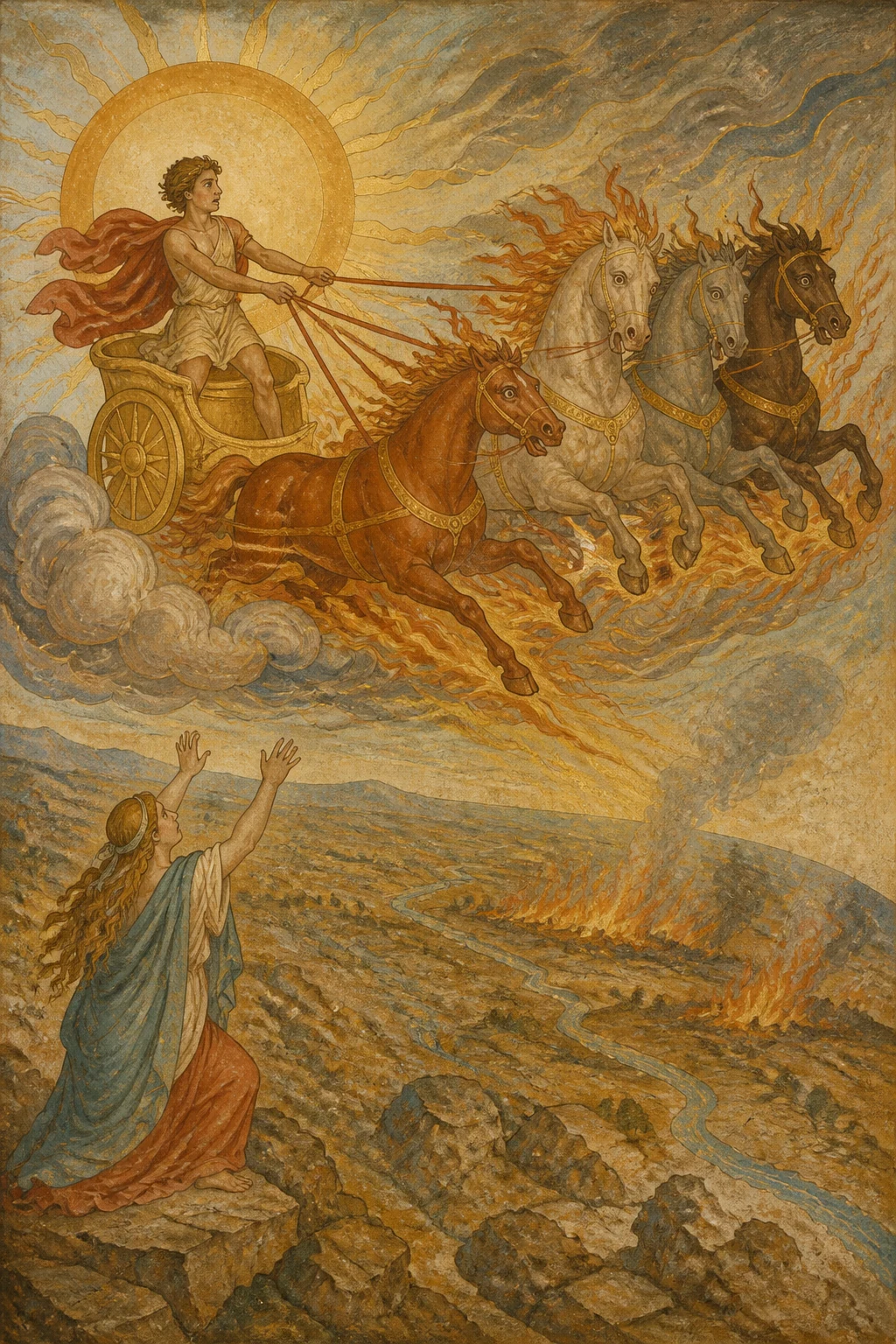
He steps into the light chariot with his youthful body, stands upright, and rejoices to touch the reins placed in his hands, thanking his reluctant father. Meanwhile Pyrois, Eous, and Aethon, the swift horses of the Sun, and Phlegon, the fourth, fill the air with fiery neighing and strike the barriers with their hooves. When Tethys, knowing nothing of her grandson’s fate, had drawn back the barriers and opened the boundless sky, they seized their course, and, moving their feet through the air, tore through the clouds before them; lifted on wings, they outstripped the east winds rising from the same quarter.
But the weight was light, not one the horses of the Sun could recognize: the yoke lacked its accustomed burden. As curved ships rock without their proper ballast and pitch unsteadily at sea through being too light, so the chariot, missing its usual load, leaps into the air, is tossed high, and seems as though it were empty. As soon as the team of four sensed this, they bolted, leaving the beaten track and abandoning their former order.
Phaethon himself is terrified: he neither knows how to turn the reins entrusted to him nor where the road lies; and even if he knew, he could not command them. Then for the first time the chilly Bears grew hot beneath the rays and vainly tried to plunge into the sea forbidden them; the Serpent, too, that lies nearest the icy pole, once sluggish with cold and feared by no one, grew warm, and the heat kindled an unfamiliar fury.
You too, Boötes, they say, fled in alarm, slow though you were and held back by your wagon. But when, from the summit of the heavens, unhappy Phaethon looked down at the earth lying far, far below, he turned pale, his knees shook with sudden terror, and darkness rose before his eyes amid that blaze of light. Now he wished he had never touched his father’s horses; now he regretted learning his descent and winning his request, now longed to be called Merops’ son. He is swept along like a ship driven by the headlong north wind, whose helmsman, overcome, has let go the helm and abandoned her to the gods and his prayers.
What can he do? Much of heaven lies behind him, and more before his eyes! He measures both in his mind, and now looks ahead toward the west, which fate will not let him reach, now back toward the east. Bewildered, not knowing what to do, he neither lets the reins go nor has strength to hold them, nor knows the horses’ names. In terror he also sees strange wonders scattered throughout the varied heavens, and the shapes of monstrous beasts.
There is a place where the Scorpion bends its claws into twin arcs, and with its tail and limbs curved out on either side stretches its body across the space of two signs. When the boy saw it, drenched in the sweat of black venom, threatening to wound him with its curving sting, his mind gave way, and in icy terror he dropped the reins. When the slack reins touched the horses’ backs, they swerved from their course, and with no one to check them raced through the air of an unknown region. Wherever impulse drove, there they rushed unchecked, striking the stars fixed high in heaven and dragging the chariot through trackless space.
Now they climb to the heights, now plunge down slopes and headlong paths, sweeping nearer the earth. The Moon marvels to see her brother’s horses running below her own, and the scorched clouds smoke. The highest places on earth are the first caught by the flames; the ground splits, opens in cracks, and dries as its moisture is drained. The pastures turn ashen, trees burn with all their leaves, and the dry corn feeds the fire that destroys it.
These are small griefs: great cities perish with their walls, and the fires reduce whole nations, people and all, to ashes. Forests burn with the mountains; Athos burns, and Cilician Taurus, Tmolus, Oeta, and Ida, dry now, once rich in springs; Helicon, haunt of the maidens, and Haemus, not yet Oeagrius’ mountain. Aetna burns fiercely, its fires doubled, and twin-peaked Parnassus, Eryx, Cynthus, Othrys, and Rhodope, destined at last to lose its snow; Mimas, Dindyma, Mycale, and Cithaeron, born for sacred rites.
Scythia gains no help from its cold: Caucasus burns, Ossa with Pindus, and Olympus, greater than either, the lofty Alps and cloud-bearing Apennines. Then indeed Phaethon sees the world ablaze on every side, and cannot bear the mighty heat. He draws into his mouth air boiling as though from a deep furnace, and feels his chariot glowing white-hot. He can no longer endure the ashes and flying sparks; hot smoke wraps him round on every side.
Shrouded in pitch-black darkness, he knows neither where he is nor where he goes, swept along at the horses’ will. It was then, they believe, that the peoples of Ethiopia turned black, their blood drawn to the surface of their bodies. Then Libya became a desert, its moisture stolen by the heat; then the nymphs, with streaming hair, wept for their springs and lakes. Boeotia searches for Dirce, Argos for Amymone, Ephyre for Pirene’s waters.
Nor do rivers whose lot has given them widely separated banks remain safe: Tanais smoked in the middle of its stream, and old Peneus, and Teuthranian Caicus, swift Ismenos and Erymanthus of Phegia, Xanthus, destined to burn again, and golden Lycormas, and Maeander, playing in its winding waters; Mygdonian Melas and Eurotas of Taenarus. Babylonian Euphrates burned, and Orontes burned, swift Thermodon, Ganges, Phasis, and Hister.
Alpheus boils, the banks of Spercheus burn, and the gold Tagus carries in its stream melts in the flames. The river birds whose songs delighted the Maeonian banks grew hot in the very midst of Cayster. The Nile fled in terror to the ends of the earth and hid its head, which is still hidden: its seven mouths lie empty and dusty, seven valleys without a river. The same fate dries Ismarian Hebrus and Strymon, and the western rivers, Rhine, Rhone, and Po, and Tiber, to whom dominion over the world was promised.
Everywhere the ground bursts apart, and light pierces through the cracks into Tartarus, terrifying its king and his consort. The sea shrinks, and where there was ocean a moment before lies a plain of dry sand. Mountains once covered by the deep emerge, adding to the scattered Cyclades. The fish seek the depths, and the arching dolphins no longer dare their customary leaps above the waves into the air.
The lifeless bodies of seals float belly-up on the sea’s surface. Even Nereus himself, they say, with Doris and their daughters, hid in their warmed caves. Three times Neptune ventured to thrust his arms and grim face above the waters; three times he could not bear the blazing air. Yet nurturing Earth, surrounded as she was by ocean, amid the sea’s waters and the springs that everywhere had shrunk and hidden themselves in their dark mother’s womb, parched, lifted her oppressed face as high as her neck, set her hand against her brow, and, shaking all things with a mighty tremor, sank a little, lower than her accustomed place, and spoke in a dry voice:
“If this is your will, and I have deserved it, why do your thunderbolts linger, greatest of gods? If I must perish by fire, let it be yours, and lighten my ruin by being its author. I can scarcely open my throat to speak these very words”— the heat had choked her voice—“Look at my scorched hair, the ashes heaped upon my eyes, upon my face! Is this the return you make me, this the reward for my fruitfulness and service, that I endure the wounds of the hooked plough and harrows, and am worked throughout the year; that I supply leaves for cattle, wholesome food—the crops— for humankind, and incense even for you?
But grant that I deserve destruction: what have the waters done, what has your brother done? Why do the seas allotted him shrink away, withdrawing farther from the sky? If neither your brother’s claims nor mine can move you, at least have pity on your own heaven. Look around: both poles are smoking. If the fire destroys them, your palaces will fall. Look, Atlas himself is struggling, scarcely sustaining the white-hot heavens on his shoulders.
If the seas, the earth, and heaven’s royal dwelling perish, we shall dissolve into ancient chaos. Rescue from the flames whatever still remains, and take thought for the universe.” So Earth spoke: she could no longer endure the heat or say anything more. She drew her face back into herself, into caverns nearer the shades below. Then the almighty father, calling the gods to witness, and the very god who had lent the chariot, that unless he helped all things would meet a dreadful end, climbed to the highest citadel, from which he would spread clouds over the wide earth, and roll the thunder and hurl his flashing bolts.
But now he had no clouds to spread over the earth, no rain to send down from heaven. He thundered, and, balancing a bolt beside his ear, hurled it from his right hand at the charioteer, casting him out of life and chariot alike, quenching fire with savage fire. The horses panic, leap in opposite directions, tear their necks from the yoke, and leave the broken reins behind.
Here lie the reins, there the axle wrenched from the pole; elsewhere the spokes of shattered wheels, and far and wide the wreckage of the mangled chariot. But Phaethon, flames ravaging his ruddy hair, tumbles headlong, trailing a long streak through the air, as sometimes a star in a clear sky, though it has not fallen, may seem to fall. Far from his homeland, in another quarter of the world, mighty Eridanus receives him and bathes his smoking face.
The western Naiads bury his body, still smoking from the three-forked flame, and mark the stone with these verses: HERE LIES PHAETHON, DRIVER OF HIS FATHER’S CHARIOT: THOUGH HE COULD NOT MASTER IT, HE FELL IN A GREAT ATTEMPT. For his father, pitiful in anguished grief, had veiled and hidden his face; and, if we may believe it, they say one day passed without the sun. The fires supplied the light: even that disaster had some use.
But Clymene, after saying all that could be said in such great sorrow, grieving, distraught, her bosom torn, searched the whole world. Seeking first his lifeless limbs, then his bones, she found them—yet buried on a foreign shore!— and threw herself upon the grave. Reading his name on the marble, she drenched it with tears and warmed it against her bare breast. No less do the Heliades mourn, offering tears, useless gifts to the dead, and beating their breasts with their hands.
Night and day they call Phaethon, who cannot hear their sorrowful laments, and lie prostrate on his tomb. Four times the Moon had joined her horns to fill her circle, and still they mourned as usual, for repetition had made it their custom. Phaethusa, the eldest of the sisters, wishing to sink to the ground, complained that her feet had stiffened. Fair Lampetie, trying to reach her, was held fast by a sudden root.
A third, preparing to tear her hair with her hands, plucked leaves instead. One grieves that her legs are enclosed in a trunk, another that her arms are turning into long branches. While they marvel, bark embraces their loins and gradually encircles belly, breast, shoulders, and hands, until only their mouths remain, calling to their mother. What can their mother do but run here and there, wherever anguish drives her, and kiss them while she can?
That is not enough: she tries to tear their bodies from the trunks and breaks the tender branches with her hands; but from them drops of blood flow as though from a wound. “Spare me, Mother, I beg you!” cries whichever one is hurt. “Spare me, I beg you! It is our flesh you tear within the tree. And now farewell”—the bark closed over her final words. From there their tears flow, and, dripping from the new branches, harden in the sun as amber, which the shining river receives and sends for Latin brides to wear.
Cycnus, son of Sthenelus, witnessed this marvel. Though joined to you, Phaethon, by your mother’s blood, he was closer still in spirit. He had left his kingdom— for he had ruled the Ligurian peoples and their great cities— and filled the green banks and the river Eridanus with lamentation, and the forest enlarged by your sisters, when his voice grew thin, white feathers hid his hair, and his neck stretched far from his breast. A web bound his reddening toes, wings clothed his sides, and a blunt beak took over his mouth.
Cycnus became a bird unknown before, trusting neither the sky nor Jupiter, mindful of the fire unjustly hurled by him. He seeks pools and open lakes, and, hating fire, chooses rivers for his home, the opposite of flame. Meanwhile Phaethon’s father, unkempt and stripped of his own radiance, as he is when eclipsed, hates the light, himself, and the day. He gives his heart to mourning, adds anger to his grief, and refuses the world his service. “Enough,” he says, “since time began, my lot has been unceasing toil. I am weary of the labours I have performed without end, without honour.
Let someone else drive the chariot that carries the light! If no one will, and all the gods admit they cannot, let Jupiter himself drive it, so that, while he tries our reins, he may at least lay aside the bolts that rob fathers of their sons. Then, having tested the strength of the fire-footed horses, he will know that one who failed to guide them did not deserve death.”
As the Sun speaks, all the gods gather round him and beg with pleading voices that he not plunge the world into darkness. Jupiter, too, excuses the bolt he hurled, and, like a king, adds threats to his entreaties. Phoebus gathers his maddened horses, still trembling with terror, and in his grief rages at them with goad and whip: in his rage he reproaches them with his son’s death and lays the blame on them.
Izvirnik
Phaethon Drives the Sun Chariot
Naslednje strani prikazujejo izvirno besedilo za primerjavo.
Source ID: ovid_metamorphoses_story_011 Citation: Ovid, Metamorphoses 2.150-2.400 Original language: Latin Source: PerseusDL canonical-latinLit Source URL: https://github.com/PerseusDL/canonical-latinLit/blob/master/data/phi0959/phi006/phi0959.phi006.perseus-lat2.xml Segmentation certainty: medium 150: Occupat ille levem iuvenali corpore currum, 151: statque super manibusque datas contingere habenas 152: gaudet et invito grates agit inde parenti.
153: Interea volucres Pyrois et Eous et Aethon, 154: Solis equi, quartusque Phlegon, hinnitibus auras 155: flammiferis implent pedibusque repagula pulsant. 156: Quae postquam Tethys, fatorum ignara nepotis 157: reppulit, et facta est inmensi copia caeli, 158: corripuere viam pedibusque per aera motis 159: obstantes scindunt nebulas pennisque levati 160: praetereunt ortos isdem de partibus Euros.
161: Sed leve pondus erat, nec quod cognoscere possent 162: Solis equi, solitaque iugum gravitate carebat; 163: utque labant curvae iusto sine pondere naves 164: perque mare instabiles nimia levitate feruntur, 165: sic onere adsueto vacuus dat in aera saltus 166: succutiturque alte similisque est currus inani. 167: Quod simulac sensere, ruunt tritumque relinquunt 168: quadriiugi spatium, nec quo prius ordine currunt.
169: Ipse pavet nec qua commissas flectat habenas, 170: nec scit, qua sit iter; nec, si sciat, imperet illis. 171: Tum primum radiis gelidi caluere triones 172: et vetito frustra temptarunt aequore tingi, 173: quaeque polo posita est glaciali proxima serpens, 174: frigore pigra prius nec formidabilis ulli, 175: incaluit sumpsitque novas fervoribus iras. 176: Te quoque turbatum memorant fugisse, Boote, 177: quamvis tardus eras et te tua plaustra tenebant.
178: Ut vero summo despexit ab aethere terras 179: infelix Phaethon penitus penitusque iacentes, 180: palluit et subito genua intremuere timore, 181: suntque oculis tenebrae per tantum lumen obortae. 182: Et iam mallet equos numquam tetigisse paternos, 183: iam cognosse genus piget et valuisse rogando, 184: iam Meropis dici cupiens ita fertur, ut acta 185: praecipiti pinus borea, cui victa remisit 186: frena suus rector, quam dis votisque reliquit.
187: Quid faciat? multum caeli post terga relictum, 188: ante oculos plus est! animo metitur utrumque, 189: et modo quos illi fatum contingere non est, 190: prospicit occasus, interdum respicit ortus: 191: quidque agat ignarus stupet et nec frena remittit 192: nec retinere valet nec nomina novit equorum. 193: Sparsa quoque in vario passim miracula caelo 194: vastarumque videt trepidus simulacra ferarum.
195: Est locus, in geminos ubi bracchia concavat arcus 196: scorpius et cauda flexisque utrimque lacertis 197: porrigit in spatium signorum membra duorum. 198: Hunc puer ut nigri madidum sudore veneni 199: vulnera curvata minitantem cuspide vidit, 200: mentis inops gelida formidine lora remisit. 201: Quae postquam summum tetigere iacentia tergum, 202: exspatiantur equi, nulloque inhibente per auras 203: ignotae regionis eunt, quaque impetus egit, 204: hac sine lege ruunt altoque sub aethere fixis 205: incursant stellis rapiuntque per avia currum.
206: Et modo summa petunt, modo per declive viasque 207: praecipites spatio terrae propiore feruntur. 208: Inferiusque suis fraternos currere Luna 209: admiratur equos, ambustaque nubila fumant; 210: corripitur flammis ut quaeque altissima, tellus 211: fissaque agit rimas et sucis aret ademptis. 212: Pabula canescunt, cum frondibus uritur arbor, 213: materiamque suo praebet seges arida damno.
214: Parva queror: magnae pereunt cum moenibus urbes, 215: cumque suis totas populis incendia gentes 216: in cinerem vertunt. Silvae cum montibus ardent, 217: ardet Athos Taurusque Cilix et Tmolus et Oete 218: et tum sicca, prius creberrima fontibus, Ide, 219: virgineusque Helicon et nondum Oeagrius Haemus; 220: ardet in inmensum geminatis ignibus Aetna 221: Parnasusque biceps et Eryx et Cynthus et Othrys, 222: et tandem nivibus Rhodope caritura, Mimasque 223: Dindymaque et Mycale natusque ad sacra Cithaeron.
224: Nec prosunt Scythiae sua frigora: Caucasus ardet 225: Ossaque cum Pindo maiorque ambobus Olympus 226: aeriaeque Alpes et nubifer Appenninus. 227: Tum vero Phaethon cunctis e partibus orbem 228: adspicit accensum nec tantos sustinet aestus, 229: ferventesque auras velut e fornace profunda 230: ore trahit currusque suos candescere sentit; 231: et neque iam cineres eiectatamque favillam 232: ferre potest calidoque involvitur undique fumo, 233: quoque eat, aut ubi sit, picea caligine tectus 234: nescit et arbitrio volucrum raptatur equorum.
235: Sanguine tum credunt in corpora summa vocato 236: Aethiopum populos nigrum traxisse colorem. 237: Tum facta est Libye raptis umoribus aestu 238: arida, tum nymphae passis fontesque lacusque 239: deflevere comis: quaerit Boeotia Dircen, 240: Argos Amymonen, Ephyre Pirenidas undas. 241: Nec sortita loco distantes flumina ripas 242: tuta manent: mediis Tanais fumavit in undis 243: Peneusque senex Teuthranteusque Caicus 244: et celer Ismenos cum Phegiaco Erymantho 245: arsurusque iterum Xanthus flavusque Lycormas, 246: quique recurvatis ludit Maeandrus in undis.
247: Mygdoniusque Melas et Taenarius Eurotas. 248: Arsit et Euphrates Babylonius, arsit Orontes 249: Thermodonque citus Gangesque et Phasis et Hister. 250: Aestuat Alpheus, ripae Spercheides ardent, 251: quodque suo Tagus amne vehit, fluit ignibus aurum, 252: et quae Maeonias celebrabant carmine ripas 253: flumineae volucres, medio caluere Caystro. 254: Nilus in extremum fugit perterritus orbem 255: occuluitque caput, quod adhuc latet: ostia septem 256: pulverulenta vacant, septem sine flumine valles.
257: Fors eadem Ismarios Hebrum cum Strymone siccat 258: Hesperiosque amnes Rhenum Rhodanumque Padumque, 259: cuique fuit rerum promissa potentia, Thybrin. 260: Dissilit omne solum, penetratque in Tartara rimis 261: lumen et infernum terret cum coniuge regem. 262: Et mare contrahitur, siccaeque est campus harenae 263: quod modo pontus erat: quosque altum texerat aequor, 264: exsistunt montes et sparsas Cycladas augent.
265: Ima petunt pisces, nec se super aequora curvi 266: tollere consuetas audent delphines in auras; 267: corpora phocarum summo resupina profundo 268: exanimata natant. Ipsum quoque Nerea fama est 269: Doridaque et natas tepidis latuisse sub antris. 270: Ter Neptunus aquis cum torvo bracchia vultu 271: exserere ausus erat, ter non tulit aeris ignes. 272: Alma tamen Tellus, ut erat circumdata ponto, 273: inter aquas pelagi contractosque undique fontes, 274: qui se condiderant in opacae viscera matris, 275: sustulit oppressos collo tenus arida vultus 276: opposuitque manum fronti magnoque tremore
277: omnia concutiens paulum subsedit et infra 278: quam solet esse fuit, siccaque ita voce locuta est: 279: “Si placet hoc, meruique, quid o tua fulmina cessant, 280: summe deum? liceat periturae viribus ignis 281: igne perire tuo clademque auctore levare. 282: Vix equidem fauces haec ipsa in verba resolvo” 283: (presserat ora vapor): “tostos en adspice crines 284: inque oculis tantum, tantum super ora favillae.
285: Hosne mihi fructus, hunc fertilitatis honorem 286: officiique refers, quod adunci vulnera aratri 287: rastrorumque fero totoque exerceor anno, 288: quod pecori frondes, alimentaque mitia, fruges, 289: humano generi, vobis quoque tura ministro? 290: Sed tamen exitium fac me meruisse: quid undae, 291: quid meruit frater? cur illi tradita sorte 292: aequora decrescunt et ab aethere longius absunt?
293: Quodsi nec fratris nec te mea gratia tangit, 294: at caeli miserere tui. Circumspice utrumque, 295: fumat uterque polus. Quos si vitiaverit ignis, 296: atria vestra ruent. Atlas en ipse laborat 297: vixque suis umeris candentem sustinet axem. 298: Si freta, si terrae pereunt, si regia caeli, 299: in chaos antiquum confundimur. Eripe flammis, 300: siquid adhuc superest, et rerum consule summae.”
301: Dixerat haec Tellus: neque enim tolerare vaporem 302: ulterius potuit nec dicere plura: suumque 303: rettulit os in se propioraque manibus antra. 304: At pater omnipotens, superos testatus et ipsum, 305: qui dederat currus, nisi opem ferat, omnia fato 306: interitura gravi, summam petit arduus arcem, 307: unde solet nubes latis inducere terris, 308: unde movet tonitrus vibrataque fulmina iactat.
309: Sed neque quas posset terris inducere nubes 310: tunc habuit, nec quos caelo demitteret imbres. 311: Intonat et dextra libratum fulmen ab aure 312: misit in aurigam pariterque animaque rotisque 313: expulit et saevis compescuit ignibus ignes. 314: Consternantur equi et saltu in contraria facto 315: colla iugo eripiunt abruptaque lora relinquunt. 316: Illic frena iacent, illic temone revulsus 317: axis, in hac radii fractarum parte rotarum, 318: sparsaque sunt late laceri vestigia currus.
319: At Phaethon rutilos flamma populante capillos, 320: volvitur in praeceps longoque per aera tractu 321: fertur, ut interdum de caelo stella sereno 322: etsi non cecidit, potuit cecidisse videri. 323: Quem procul a patria diverso maximus orbe 324: excipit Eridanus fumantiaque abluit ora. 325: Naïdes Hesperiae trifida fumantia flamma 326: corpora dant tumulo, signant quoque carmine saxum: 327: HIC SITUS EST PHAETHON, CURRUS AURIGA PATERNI: 328: QUEM SI NON TENUIT, MAGNIS TAMEN EXCIDIT AUSIS.
329: Nam pater obductos, luctu miserabilis aegro 330: condiderat vultus: et, si modo credimus, unum 331: isse diem sine sole ferunt: incendia lumen 332: praebebant aliquisque malo fuit usus in illo. 333: At Clymene postquam dixit quaecumque fuerunt 334: in tantis dicenda malis, lugubris et amens 335: et laniata sinus totum percensuit orbem, 336: exanimesque artus primo, mox ossa requirens 337: repperit (ossa tamen peregrina condita ripa!), 338: incubuitque loco nomenque in marmore lectum 339: perfudit lacrimis et aperto pectore fovit.
340: Nec minus Heliades lugent et inania morti 341: munera dant lacrimas, et caesae pectora palmis 342: non auditurum miseras Phaethonta querellas 343: nocte dieque vocant adsternunturque sepulcro. 344: Luna quater iunctis implerat cornibus orbem: 345: illae more suo (nam morem fecerat usus) 346: plangorem dederant. E quis Phaethusa, sororum 347: maxima, cum vellet terra procumbere, questa est 348: deriguisse pedes. Ad quam conata venire 349: candida Lampetie subita radice retenta est.
350: Tertia cum crinem manibus laniare pararet, 351: avellit frondes; haec stipite crura teneri, 352: illa dolet fieri longos sua bracchia ramos. 353: Dumque ea mirantur, complectitur inguina cortex, 354: perque gradus uterum pectusque umerosque manusque 355: ambit et exstabant tantum ora vocantia matrem. 356: Quid faciat mater, nisi, quo trahat impetus illam, 357: huc eat atque illuc, et, dum licet, oscula iungat?
358: Non satis est; truncis avellere corpora temptat, 359: et teneros manibus ramos abrumpit; at inde 360: sanguineae manant, tamquam de vulnere, guttae. 361: “Parce, precor, mater”, quaecumque est saucia, clamat, 362: “parce, precor: nostrum laceratur in arbore corpus. 363: iamque vale” —cortex in verba novissima venit. 364: Inde fluunt lacrimae, stillataque sole rigescunt 365: de ramis electra novis, quae lucidus amnis 366: excipit et nuribus mittit gestanda Latinis.
367: Adfuit huic monstro proles Stheneleia Cycnus, 368: qui tibi materno quamvis a sanguine iunctus, 369: mente tamen, Phaethon, propior fuit. Ille relicto 370: (nam Ligurum populos et magnas rexerat urbes) 371: imperio ripas virides amnemque querellis 372: Eridanum implerat silvamque sororibus auctam, 373: cum vox est tenuata viro, canaeque capillos 374: dissimulant plumae, collumque a pectore longe 375: porrigitur, digitosque ligat iunctura rubentes, 376: penna latus velat, tenet os sine acumine rostrum.
377: Fit nova Cycnus avis, nec se caeloque Iovique 378: credit, ut iniuste missi memor ignis ab illo: 379: stagna petit patulosque lacus, ignemque perosus 380: quae colat elegit contraria flumina flammis. 381: Squalidus interea genitor Phaethontis et expers 382: ipse sui decoris, qualis, cum deficit orbem, 383: esse solet, lucemque odit seque ipse diemque, 384: datque animum in luctus; et luctibus adicit iram 385: officiumque negat mundo. “Satis” inquit “ab aevi 386: sors mea principiis fuit inrequieta, pigetque 387: actorum sine fine mihi, sine honore, laborum.
388: Quilibet alter agat portantes lumina currus! 389: Si nemo est omnesque dei non posse fatentur, 390: ipse agat ut saltem, dum nostras temptat habenas, 391: orbatura patres aliquando fulmina ponat. 392: Tum sciet, ignipedum vires expertus equorum, 393: non meruisse necem, qui non bene rexerit illos.” 394: Talia dicentem circumstant omnia Solem 395: numina, neve velit tenebras inducere rebus, 396: supplice voce rogant: missos quoque Iuppiter ignes 397: excusat precibusque minas regaliter addit.
398: Conligit amentes et adhuc terrore paventes 399: Phoebus equos stimuloque dolens et verbere saevit: 400: saevit enim, natumque obiectat et imputat illis.
Nadaljuj z branjem