Prevod
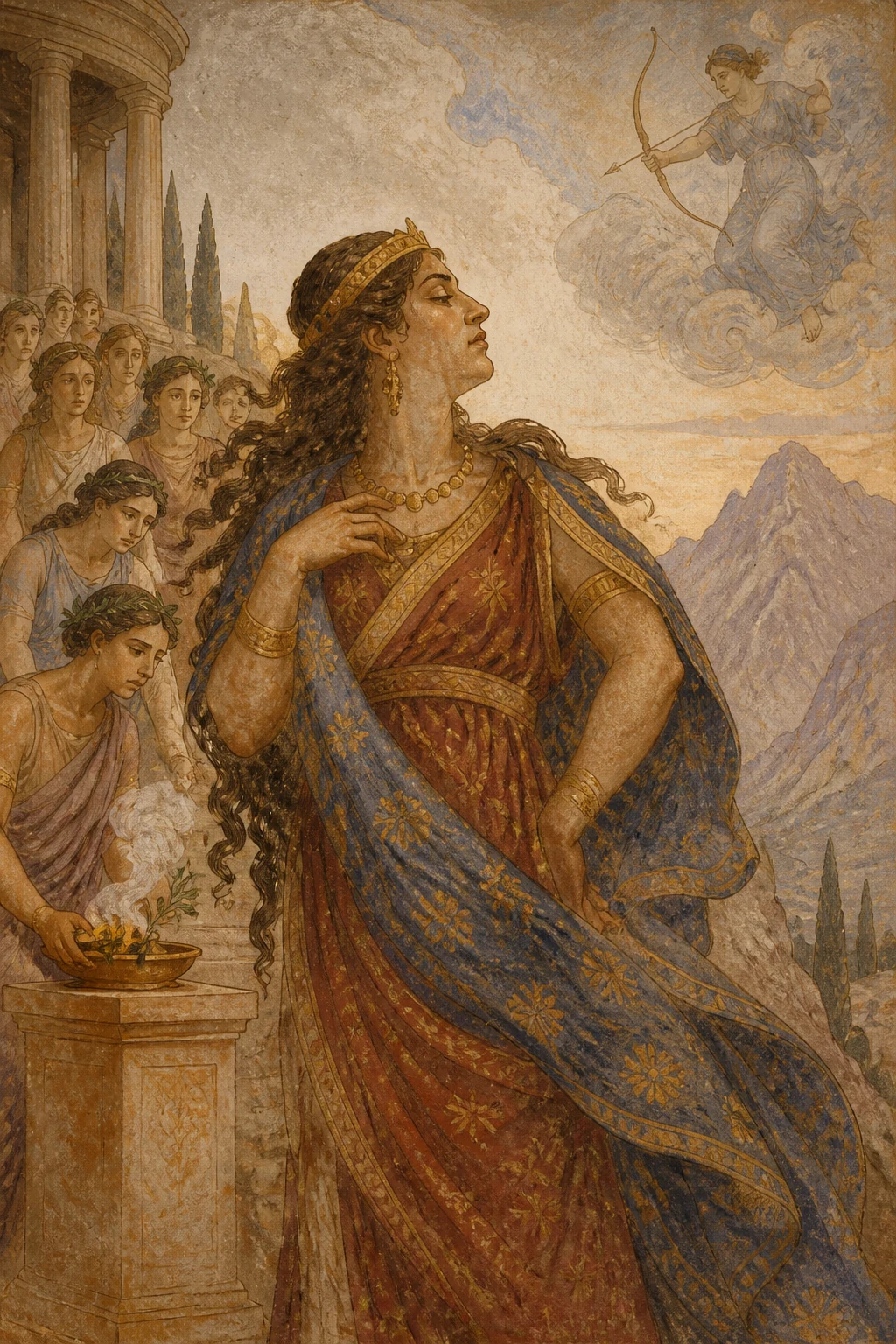
Tritonia had listened to these words and approved the Aonian sisters’ song and their righteous anger. Then she said to herself, “Praise is not enough; let us win praise ourselves, and not allow our divine power to be scorned unpunished.” She turned her thoughts to the fate of Maeonian Arachne, who, she had heard, would not yield to her in renown for working wool. Neither her birthplace nor her family had made the girl renowned, but her skill. Her father, Idmon of Colophon, dyed thirsty wool with purple from Phocaean shellfish.
Her mother was dead; she too had been of humble birth, her husband’s equal. Yet through her diligence the girl had won a memorable name throughout the towns of Lydia, though born in a modest home and living in little Hypaepa. To gaze upon her wondrous work, the nymphs would often leave the vineyards of their own Mount Tmolus; the nymphs of Pactolus would leave their waters.
Nor was it only a pleasure to see the finished cloth, but to watch its making too: such grace attended her skill. Whether she was winding the rough wool into its first balls, or working it with her fingers, drawing out the fleece again and again in long, soft wisps like clouds, whether she twirled the rounded spindle with a deft thumb or painted with her needle, you would have known that Pallas taught her.
Yet she denied it, and, offended at the thought of such a teacher, said, “Let her compete with me: if beaten, I will refuse no penalty.” Pallas took the shape of an old woman, adding false gray hair at her temples and feeble limbs that she supported with a staff. Then she began: “Old age does not bring only things we should shun: experience comes with advancing years.
Do not scorn my advice. Seek the greatest fame among mortals for your work in wool, but yield to the goddess, rash girl, and humbly beg forgiveness for your words: she will forgive you if you ask.” Arachne glared at her and dropped the threads she had begun. Scarcely restraining her hand, her anger plain upon her face, she answered Pallas in disguise with these words: “You come here witless, worn out by a long old age.
It does you harm to have lived too long. Let your daughter-in-law, if you have one, or your daughter, listen to such talk. I have sense enough of my own. And do not think your warnings have done any good: my mind is unchanged. Why does she not come herself? Why does she avoid this contest?” Then the goddess said, “She has come,” and shed her old woman’s shape, revealing herself as Pallas. The nymphs and the women of Mygdonia bowed before her divinity; only the girl was unafraid.
Yet she blushed: a sudden flush against her will colored her face, then vanished again, as the sky grows crimson when dawn first stirs, and soon afterward brightens at the rising sun. She held to her purpose, and in her foolish longing for victory rushed to her doom. For Jupiter’s daughter did not refuse, nor warn her further, nor postpone the contest any longer. Without delay, the two took their places opposite each other and stretched fine warp threads on their separate looms.
The web was fastened to the crossbeam; a reed divided the warp. Pointed shuttles carried the weft between the threads; their fingers guided it, and, once drawn through the warp, the notched teeth of the comb beat it firmly into place. Both worked swiftly, their clothes bound high beneath their breasts, their practiced arms moving, their eagerness disguising the toil.
There they wove purple wool steeped in Tyrian dye, and delicate shades with scarcely a difference between them, like the rainbow that sunlight striking through rain often paints across the sky in a vast curve: though a thousand different colors shine within it, their very blending deceives the watching eye; neighboring colors seem the same, yet the furthest are distinct.
There, too, pliant gold was woven among the threads, and ancient stories were drawn out upon the cloth. Pallas pictured the rock of Mars on the Cecropian citadel, and the ancient dispute over the naming of the land. Twelve heavenly gods, with Jupiter in their midst, sat on lofty thrones in solemn majesty. Each god was known by his own features; Jupiter’s image was kingly.
She showed the sea god standing, striking the rugged rock with his long trident, and from the wound in its midst a surge of seawater leaping out, his pledge of claim to the city. To herself she gave a shield and a sharp-pointed spear, a helmet for her head, and the aegis to protect her breast. She showed the earth, struck by her spear point, bringing forth a gray-green olive tree laden with fruit, and the gods marveling: Victory crowned the scene.
But so that her rival for glory might learn from examples what reward to expect for such outrageous daring, she added four contests in the four corners, each clear in its colors, each rendered in tiny figures. One corner held Thracian Rhodope and Haemus, now icy mountains, but once mortal beings, who had claimed for themselves the names of the highest gods. Another showed the wretched fate of the Pygmy mother: defeated in a contest, she was commanded by Juno to become a crane and wage war upon her own people.
She also pictured Antigone, who once had dared to vie with mighty Jupiter’s consort, and whom queenly Juno changed into a bird. Neither Ilion nor her father Laomedon could save her from taking wing as a snow-white stork, applauding herself with her clattering beak. The one remaining corner held the childless Cinyras; embracing the temple steps, the bodies of his daughters, he seemed to lie upon the stone and weep.
She bordered the outer edges with peaceful olive branches: that was the limit, and with her own tree she finished her work. The Maeonian girl portrayed Europa, deceived by the shape of a bull: you would have thought the bull real, the sea real. The girl herself seemed to be looking back at the shore she had left, calling to her companions, fearing the touch of the leaping water, and drawing back her timid feet.
She also showed Asterie held by a struggling eagle, and Leda lying beneath a swan’s wings. She added how Jupiter, concealed in a satyr’s shape, had filled Nycteus’s lovely daughter with twin children; how he had been Amphitryon when he won you, woman of Tiryns; how, as gold, he deceived Danae, as fire, Asopus’s daughter, as a shepherd, Mnemosyne, and as a speckled serpent, Deo’s daughter.
You too, Neptune, she pictured, changed into a fierce bull for an Aeolian maiden. In Enipeus’s likeness you fathered the Aloadae; as a ram you deceived Bisaltes’ daughter. The golden-haired, most gentle mother of grain knew you as a horse; the snake-haired mother of the winged horse knew you as a bird, and Melantho as a dolphin. To all these figures she gave their proper likeness, and to their settings too. There was Phoebus in a countryman’s guise, and how he wore now a hawk’s feathers, now a lion’s skin; how, as a shepherd, he deceived Isse, Macareus’s daughter; how Liber deceived Erigone with the semblance of grapes; how Saturn, as a horse, begot Chiron of the twofold form.
The outermost part of the weaving, enclosed by a narrow border, held flowers interwoven with entwining ivy. Neither Pallas nor Envy itself could find fault with that work. The golden-haired warrior goddess grieved at its success and tore apart the pictured cloth, that record of the gods’ crimes. And with the shuttle of wood from Mount Cytorus that she held, she struck Idmon’s daughter Arachne three or four times on the forehead.
The unhappy girl could not bear it, and in her pride fastened a noose around her throat. Pitying her as she hung, Pallas raised her and said, “Live, then, but hang, wicked girl! And, lest you feel secure about the future, let this same sentence of punishment be pronounced upon your line and your remotest descendants.” Then, as she left, she sprinkled her with the juice of Hecate’s herb.
At once, touched by the baleful potion, her hair fell away, and with it her nose and ears; her head shrank tiny, and her whole body became small. Slender fingers clung to her sides in place of legs; the rest was belly. Yet from it she still lets out a thread, and, as a spider, practices her ancient art of weaving.