Prevod
Once upon a time, long, long ago, there were two brothers, one rich and the other poor. When Christmas Eve came, the poor brother had not a scrap of meat or bread in the house, so he went to his brother and begged him, in God’s name, for a little something for Christmas. It was hardly the first time his brother had had to give him something, and he was none too pleased to see him now, either. “If you’ll do what I ask, you shall have a whole ham,” he said. The poor man promised at once and thanked him. “There you are, then. Now go straight to Hell!” said the rich man, tossing him the ham. “Well, I must keep my promise,” said the other. He took the ham and set off;
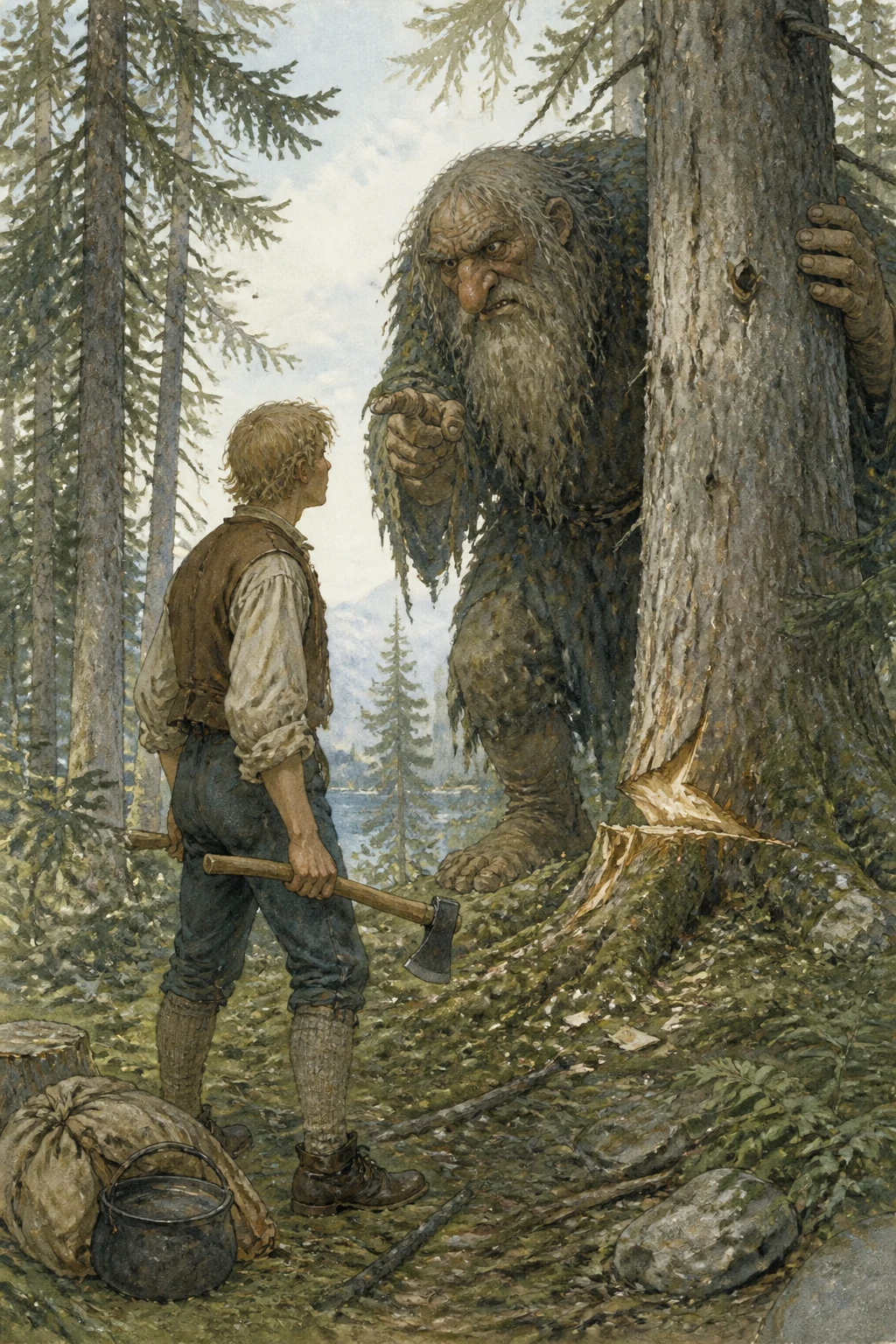
he walked and walked all day, and at dusk he came to a place where a bright light shone. This must be it, thought the man with the ham. Outside in the woodshed stood an old man with a long white beard, chopping firewood for Christmas. “Good evening!” said the man with the ham. “Good evening to you! Where are you going so late?” said the old man. “I’m bound for Hell, if I’m on the right road,” answered the poor man. “Yes, you’ve come the right way. This is the place,” said the old man. “When you go inside, they’ll all want to buy your ham, for pork is a rare treat in Hell. But don’t sell it unless they give you the hand-mill standing behind the door in exchange.
“When you come out again, I’ll teach you how to stop the mill. It’s useful for all manner of things.” The man with the ham thanked him for his good advice and knocked at the Devil’s door.
Once he was inside, everything happened just as the old man had said: all the devils, great and small, swarmed round him like ants round a worm, each outbidding the next for the ham.
“Well, my wife and I were to have had it for our Christmas Eve supper, but since you’re so set on it, I suppose I must let you have it,” said the man. “But if I sell it, I want that hand-mill standing behind the door over there.” The Devil was loath to part with it, and bargained and haggled with the man, but he stood firm, and at last the Devil had to hand it over. When the man came out into the yard, he asked the old woodcutter how to stop the mill. Once he had learned, he thanked him and set off home as fast as he could; even so, he did not reach home until the clock struck twelve on Christmas night.
“Where in the world have you been?” said his wife. “Here I’ve sat hour after hour, longing and waiting, without so much as two sticks to lay crosswise beneath the Christmas porridge pot.” “Oh, I couldn’t get here any sooner. I had all sorts of things to see to, and a long way to go besides.
“But now, just you watch,” said the man. He set the mill on the table and told it to grind first candles, then a tablecloth, then food and ale and everything good for a Christmas Eve feast; and whatever he commanded, the mill ground out. His wife crossed herself again and again and wanted to know where he had got the mill, but he would not tell her. “Never mind where I got it. You can see it’s a good mill, and its millstream never freezes,” said the man. Then he ground out food and drink and all good things for the whole Christmas season, and on the third day of Christmas he invited his friends over, for he meant to give a feast.
When the rich brother saw all there was in the house where the feast was held, he was beside himself with anger, for he begrudged his brother every good thing. “On Christmas Eve he was so hard up that he came begging me for a little something in God’s name, and now he gives a feast as though he were a count or a king,” he said to the others. “But where in blazing Hell did you get all your riches?” he asked his brother. “Behind the door,” said the owner of the mill, for he had no wish to give him an account of it. But later that evening, when he had had a little too much to drink, he could no longer keep it to himself and brought out the mill. “There you see what has brought me all my riches,” he said, and he made the mill grind out one thing after another. When his brother saw this, he was determined to have the mill, and at long last the man agreed to let him have it, but he must pay three hundred dollars, and the man was to keep it until haymaking time; for, he thought, if I have it that long, I can grind enough food to last for years. You may be sure the mill did not stand idle all that time, and when haymaking came, his brother got it; but the other had taken good care not to teach him how to stop it.
It was in the evening that the rich man brought the mill home, and next morning he told his wife to go out and spread the hay behind the mowers. He would prepare the midday meal himself that day, he said.
When it was nearly mealtime, he set the mill on the kitchen table. “Grind herrings and gruel, and be quick and good about it!” said the man, and the mill began grinding herrings and gruel, filling all the dishes and troughs first, then spilling out over the whole kitchen floor.
The man fiddled and fumbled, trying to stop the mill, but however he turned and tinkered with it, the mill kept grinding, and before long the gruel rose so high that he was in danger of drowning. Then he flung open the door to the living room, but it was not long before the mill had filled that room too, and he only just managed to find the door latch beneath the flood of gruel.
Once he got the door open, he did not linger indoors. Out he dashed, with herrings and gruel pouring after him, flooding the yard and fields.
Meanwhile his wife, who was out spreading hay, thought the meal was taking far too long. “Even if my husband doesn’t call us home, we’d better go all the same. He can’t be much of a hand at making gruel. I suppose I’ll have to help him,” she said to the haymakers. So they began straggling home, but when they had come some way up the hills, they met herrings and gruel and bread rushing and tumbling over one another, with the man himself running ahead of the flood. “God grant you had a hundred bellies apiece, but take care you don’t drown in your dinner!” he shouted, racing past them as though the Evil One were at his heels, and down towards his brother’s house. He begged him, for God’s sake, to take the mill back, and that very instant;
“If it grinds for another hour, the whole district will perish in herrings and gruel,” he said. But his brother would not take it back until he paid him another three hundred dollars, and so he had to pay. Now the poor man had both the money and the mill, and before long he built himself a house far finer than the one his brother lived in. With the mill he ground out so much gold that he covered the house entirely in gold plates, and it stood so close to the shore that it shone and glittered far out across the sea. Everyone who sailed past had to put in and visit the rich man in the golden house, and they all wanted to see the marvellous mill, for word of it had spread far and wide, and there was no one who had not heard tell of it.
At last a sea captain came who also wanted to see the mill. He asked whether it could grind salt. “Oh yes, it can grind salt!” said its owner, and when the captain heard that, he was determined to have the mill, whatever it might cost; for if he had it, he thought, he would no longer have to sail far away across dangerous seas for a cargo of salt.
At first the man would not part with it, but the captain begged and pleaded, and in the end he sold it for many, many thousands of dollars. Once the captain had the mill on his back, he did not linger, for he was afraid the man might change his mind. As for asking how to stop it, he had no time for that at all. He hurried down to his ship as fast as he could, and when he was some way out to sea, he brought out the mill. “Grind salt, and be quick and good about it!” said the captain. And the mill began grinding salt till it flew in all directions. When the captain had filled the ship, he wanted to stop the mill, but whatever he did, however he tinkered with it, the mill ground on just as fast, and the heap of salt grew higher and higher, until at last the ship sank. There the mill stands on the bottom of the sea, grinding to this very day, and that is why the sea is salt.